navigation
|<[p.1] sig.–2r>
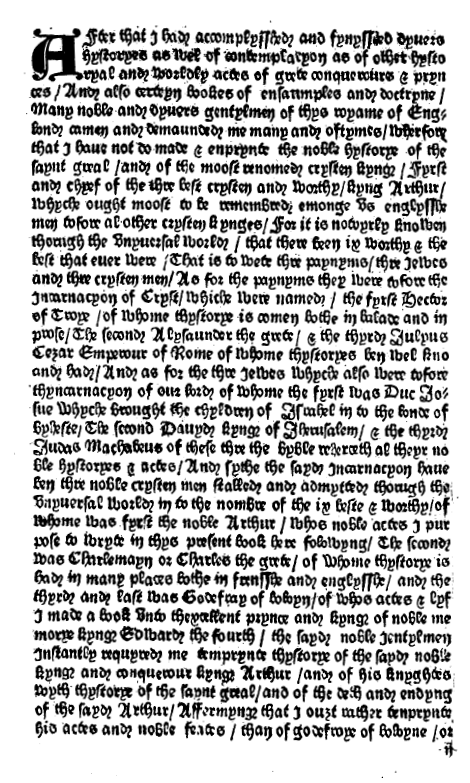
 Fter that I had accomplyſſhed and fynyſſhed dyuers hyſtoryes as wel of contemplacyon as of other hyſtoryal and wordly actes of grete conquerours & prynces / And alſo certeyn bookes of enſaumples and doctryne / Many noble and dyuers gentylmen of thys royame of Englond camen and demaunded me many and oftymes / wherfore that I haue not do made & enprynte the noble hyſtorye of the ſaynt greal / and of the mooſt renomed cryſten kyng / Fyrſt and chyef of the thre beſt cryſten and worthy / kyng Arthur / whyche ought mooſt to be remembred emonge vs englyſſhe men tofore al other cryſten kynges / For it is notoyrly knowen thorugh the vnyuerſal world / that there been ix worthy & the beſt that euer were / That is to wete thre paynyms / thre Iewes and thre cryſten men / As for the paynyms they were tofore the Incarnacyon of Cryſt / whiche were named / the fyrſt Hector of Troye / of whome thyſtorye is comen bothe in balade and in proſe / The ſecond Alyſaunder the grete / & the thyrd Iulyus Ceჳar Emperour of Rome of whome thyſtoryes ben wel kno and had / And as for the thre Iewes whyche alſo were tofore thyncarnacyon of our lord of whome the fyrſt was Duc Ioſue whyche brought the chyldren of Iſrahel in to the londe of byheſte / The ſecond Dauyd kyng of Iheruſalem / & the thyrd Iudas Machabeus of theſe thre the byble reherceth al theyr noble hyſtoryes & actes / And ſythe the ſayd Incarnacyon haue ben thre noble cryſten men ſtalled and admytted thorugh the vnyuerſal world in to the nombre of the ix beſte & worthy / of whome was fyrſt the noble Arthur / whos noble actes I purpoſe to wryte in thys preſent book here folowyng / The ſecond was Charlemayn or Charles the grete / of whome thyſtorye is had in many places bothe in frenſſhe and englyſſhe / and the thyrd and laſt was Godefray of boloyn / of whos actes & lyf I made a book vnto thexcellent prynce and kyng of noble memorye kyng Edward the fourth / the ſayd noble Ientylmen Inſtantly requyred me temprynte thyſtorye of the ſayd noble kyng and conquerour kyng Arthur / and of his knyghtes wyth thyſtorye of the ſaynt greal / and of the deth and endyng of the ſayd Arthur / Affermyng that I ouჳt rather tenprynte his actes and noble feates / than of godefroye of boloyne / or
|<[p.2] sig.–2v> ony of the other eyght / conſyderyng that he was a man borne wythin this royame and kyng and Emperour of the ſame / And that there ben in frenſſhe dyuers and many noble volumes of his actes / and alſo of his knyghtes / To whome I anſwerd / that dyuers men holde oppynyon / that there was no ſuche Arthur / and that alle ſuche bookes as been maad of hym / ben fayned and fables / by cauſe that ſomme cronycles make of hym no mencyon ne remembre hym noo thynge ne of his knyghtes / wherto they anſwerd / and one if ſpecyal ſayd / that in hym that ſhold ſay or thynke / that there was neuer ſuche a kynge callyd Arthur / myght wel be aretted grete folye and blyndeneſſe / For he ſayd that there were many euydences of the contrarye / Fyrſt ye may ſee his ſepulture in the monaſterye of Glaſtyngburye / And alſo in polycronycon in the v book the ſyxte chappytre / and in the ſeuenth book the xxiij chappytre / where his body was buryed and after founden and tranſlated in to the ſayd monaſterye / ye ſhal ſe alſo in thyſtorye of bochas in his book de caſu principum / parte of his noble actes / and alſo of his falle / Alſo galfrydus in his brutyſſhe book recounteth his lyf / and in dyuers places of Englond / many remembraunces ben yet of hym and ſhall remayne perpetuelly / and alſo of his knyghtes / Fyrſt in the abbey of weſtmeſtre at ſaynt Edwardes ſhryne remayneth the prynte of his ſeal in reed Waxe cloſed in beryll / In whych is wryton Patricius Arthurus / Britannie / Gallie / Germanie / dacie / Imperator / Item in the caſtel of douer ye may ſee Gauwayns ſkulle / & Cradoks mantle. At wyncheſter the rounde table / in other places Launcelottes ſwerde and many other thynges / Thenne al theſe thynges conſydered there can no man reſonably gaynſaye but there was a kyng of thys lande named Arthur / For in al places cryſten and hethen he is reputed and taken for one of the ix worthy / And the fyrſt of the thre Cryſten men / And alſo he is more ſpoken of beyonde the ſee moo boookes made of his noble actes than there be in englond as wel in duche ytalyen ſpaynyſſhe and grekyſſhe as in frenſſhe / And yet of record remayne in wytneſſe of hym in wales in the toune of Camelot the grete ſtones & meruayllous werkys of yron lyeng vnder the grounde & ryal vautes
|<[p.3] sig.–3r> which dyuers now lyuyng hath ſeen / wherfor it is a meruayl why he is nomore renomed in his owne contreye / ſauf onelye it accordeth to the worde of god / whyche ſayth that no man is accept for a prophete in his owne contreye / Thenne al theſe thynges forſayd aledged I coude not wel denye / but that there was ſuche a noble kyng named arthur / and reputed one of the ix Worthy / & fyrſt & chyef of the criſten men / & many noble volumes be made of hym & of his noble knyჳtes in frenſſhe which I haue ſeen & redde beyonde the ſee / which been not had in our maternal tongue / but in walſſhe ben many & alſo in frenſſhe / & ſomme in englyſſhe but no wher nygh alle / wherfore ſuche as haue late ben drawen oute bryefly in to englyſſhe / I haue after the ſymple connynge that god hath ſente to me / vnder the fauour and correctyon of al noble lordes and gentylmen enpryſed to enprynte a book of the noble hyſtoryes of the ſayd kynge Arthur / and of certeyn of his knyghtes after a copye vnto me delyuerd / whyche copye Syr Thomas Malorye dyd take oute of certeyn bookes of frenſſhe and reduced it in to Englyſſhe / And I accordyng to my copye haue doon ſette it in enprynte / to the entente that noble men may ſee and lerne the noble actes of chyualrye / the Ientyl and vertuous dedes that ſomme knyghtes vſed in tho dayes / by whyche they came to honour / and how they that were vycious were punyſſhed and ofte put to ſhame and rebuke / humbly byſechyng al noble lordes and ladyes wyth al other eſtates of what eſtate or degree they been of / that ſhal ſee and rede in this ſayd book and werke / that they take the good and honeſt actes in their remembraunce / and to folowe the ſame / Wherin they ſhalle fynde many Ioyous and playſaunt hyſtoryes / and noble & renomed actes of humanyte / gentylneſſe and chyualryes / For herein may be ſeen noble chyualrye / Curtoſye / Humanyte / frendlyneſſe / hardyneſſe / loue / frendſhyp / Cowardyſe / Murdre / hate / vertue / and ſynne / Doo after the good and leue the euyl / and it ſhal brynge you to good fame and renommee / And for to paſſe the tyme thys boook ſhal be pleſaunte to rede in / but for to gyue fayth and byleue that al is trewe that is conteyned herin / ye be at your lyberte / but al is wryton for our doctryne / and for to beware that we falle not to
|<[p.4] sig.–3v> vyce ne ſynne / but texerſyſe and folowe vertu / by whyche we may come and atteyne to good fame and renomme in thys lyf / and after thys ſhorte and tranſytorye lyf to come vnto euerlaſtyng blyſſe in heuen / the whyche he graunte vs that reygneth in heuen the bleſſyd Trynyte Amen /
Fter that I had accomplyſſhed and fynyſſhed dyuers hyſtoryes as wel of contemplacyon as of other hyſtoryal and wordly actes of grete conquerours & prynces / And alſo certeyn bookes of enſaumples and doctryne / Many noble and dyuers gentylmen of thys royame of Englond camen and demaunded me many and oftymes / wherfore that I haue not do made & enprynte the noble hyſtorye of the ſaynt greal / and of the mooſt renomed cryſten kyng / Fyrſt and chyef of the thre beſt cryſten and worthy / kyng Arthur / whyche ought mooſt to be remembred emonge vs englyſſhe men tofore al other cryſten kynges / For it is notoyrly knowen thorugh the vnyuerſal world / that there been ix worthy & the beſt that euer were / That is to wete thre paynyms / thre Iewes and thre cryſten men / As for the paynyms they were tofore the Incarnacyon of Cryſt / whiche were named / the fyrſt Hector of Troye / of whome thyſtorye is comen bothe in balade and in proſe / The ſecond Alyſaunder the grete / & the thyrd Iulyus Ceჳar Emperour of Rome of whome thyſtoryes ben wel kno and had / And as for the thre Iewes whyche alſo were tofore thyncarnacyon of our lord of whome the fyrſt was Duc Ioſue whyche brought the chyldren of Iſrahel in to the londe of byheſte / The ſecond Dauyd kyng of Iheruſalem / & the thyrd Iudas Machabeus of theſe thre the byble reherceth al theyr noble hyſtoryes & actes / And ſythe the ſayd Incarnacyon haue ben thre noble cryſten men ſtalled and admytted thorugh the vnyuerſal world in to the nombre of the ix beſte & worthy / of whome was fyrſt the noble Arthur / whos noble actes I purpoſe to wryte in thys preſent book here folowyng / The ſecond was Charlemayn or Charles the grete / of whome thyſtorye is had in many places bothe in frenſſhe and englyſſhe / and the thyrd and laſt was Godefray of boloyn / of whos actes & lyf I made a book vnto thexcellent prynce and kyng of noble memorye kyng Edward the fourth / the ſayd noble Ientylmen Inſtantly requyred me temprynte thyſtorye of the ſayd noble kyng and conquerour kyng Arthur / and of his knyghtes wyth thyſtorye of the ſaynt greal / and of the deth and endyng of the ſayd Arthur / Affermyng that I ouჳt rather tenprynte his actes and noble feates / than of godefroye of boloyne / or
|<[p.2] sig.–2v> ony of the other eyght / conſyderyng that he was a man borne wythin this royame and kyng and Emperour of the ſame / And that there ben in frenſſhe dyuers and many noble volumes of his actes / and alſo of his knyghtes / To whome I anſwerd / that dyuers men holde oppynyon / that there was no ſuche Arthur / and that alle ſuche bookes as been maad of hym / ben fayned and fables / by cauſe that ſomme cronycles make of hym no mencyon ne remembre hym noo thynge ne of his knyghtes / wherto they anſwerd / and one if ſpecyal ſayd / that in hym that ſhold ſay or thynke / that there was neuer ſuche a kynge callyd Arthur / myght wel be aretted grete folye and blyndeneſſe / For he ſayd that there were many euydences of the contrarye / Fyrſt ye may ſee his ſepulture in the monaſterye of Glaſtyngburye / And alſo in polycronycon in the v book the ſyxte chappytre / and in the ſeuenth book the xxiij chappytre / where his body was buryed and after founden and tranſlated in to the ſayd monaſterye / ye ſhal ſe alſo in thyſtorye of bochas in his book de caſu principum / parte of his noble actes / and alſo of his falle / Alſo galfrydus in his brutyſſhe book recounteth his lyf / and in dyuers places of Englond / many remembraunces ben yet of hym and ſhall remayne perpetuelly / and alſo of his knyghtes / Fyrſt in the abbey of weſtmeſtre at ſaynt Edwardes ſhryne remayneth the prynte of his ſeal in reed Waxe cloſed in beryll / In whych is wryton Patricius Arthurus / Britannie / Gallie / Germanie / dacie / Imperator / Item in the caſtel of douer ye may ſee Gauwayns ſkulle / & Cradoks mantle. At wyncheſter the rounde table / in other places Launcelottes ſwerde and many other thynges / Thenne al theſe thynges conſydered there can no man reſonably gaynſaye but there was a kyng of thys lande named Arthur / For in al places cryſten and hethen he is reputed and taken for one of the ix worthy / And the fyrſt of the thre Cryſten men / And alſo he is more ſpoken of beyonde the ſee moo boookes made of his noble actes than there be in englond as wel in duche ytalyen ſpaynyſſhe and grekyſſhe as in frenſſhe / And yet of record remayne in wytneſſe of hym in wales in the toune of Camelot the grete ſtones & meruayllous werkys of yron lyeng vnder the grounde & ryal vautes
|<[p.3] sig.–3r> which dyuers now lyuyng hath ſeen / wherfor it is a meruayl why he is nomore renomed in his owne contreye / ſauf onelye it accordeth to the worde of god / whyche ſayth that no man is accept for a prophete in his owne contreye / Thenne al theſe thynges forſayd aledged I coude not wel denye / but that there was ſuche a noble kyng named arthur / and reputed one of the ix Worthy / & fyrſt & chyef of the criſten men / & many noble volumes be made of hym & of his noble knyჳtes in frenſſhe which I haue ſeen & redde beyonde the ſee / which been not had in our maternal tongue / but in walſſhe ben many & alſo in frenſſhe / & ſomme in englyſſhe but no wher nygh alle / wherfore ſuche as haue late ben drawen oute bryefly in to englyſſhe / I haue after the ſymple connynge that god hath ſente to me / vnder the fauour and correctyon of al noble lordes and gentylmen enpryſed to enprynte a book of the noble hyſtoryes of the ſayd kynge Arthur / and of certeyn of his knyghtes after a copye vnto me delyuerd / whyche copye Syr Thomas Malorye dyd take oute of certeyn bookes of frenſſhe and reduced it in to Englyſſhe / And I accordyng to my copye haue doon ſette it in enprynte / to the entente that noble men may ſee and lerne the noble actes of chyualrye / the Ientyl and vertuous dedes that ſomme knyghtes vſed in tho dayes / by whyche they came to honour / and how they that were vycious were punyſſhed and ofte put to ſhame and rebuke / humbly byſechyng al noble lordes and ladyes wyth al other eſtates of what eſtate or degree they been of / that ſhal ſee and rede in this ſayd book and werke / that they take the good and honeſt actes in their remembraunce / and to folowe the ſame / Wherin they ſhalle fynde many Ioyous and playſaunt hyſtoryes / and noble & renomed actes of humanyte / gentylneſſe and chyualryes / For herein may be ſeen noble chyualrye / Curtoſye / Humanyte / frendlyneſſe / hardyneſſe / loue / frendſhyp / Cowardyſe / Murdre / hate / vertue / and ſynne / Doo after the good and leue the euyl / and it ſhal brynge you to good fame and renommee / And for to paſſe the tyme thys boook ſhal be pleſaunte to rede in / but for to gyue fayth and byleue that al is trewe that is conteyned herin / ye be at your lyberte / but al is wryton for our doctryne / and for to beware that we falle not to
|<[p.4] sig.–3v> vyce ne ſynne / but texerſyſe and folowe vertu / by whyche we may come and atteyne to good fame and renomme in thys lyf / and after thys ſhorte and tranſytorye lyf to come vnto euerlaſtyng blyſſe in heuen / the whyche he graunte vs that reygneth in heuen the bleſſyd Trynyte Amen /
 Henne to procede forth in thys ſayd book / whyche I dyrecte vnto alle noble prynces / lordes and ladyes / gentylmen or gentylwymmen that deſyre to rede or here redde of the noble and Ioyous hyſtorye of the grete conquerour and excellent kyng. Kyng Arthur / ſomtyme kyng of thys noble royalme / thenne callyd / brytaygne / I wyllyam Caxton ſymple perſone preſent thys book folowyng / Whyche I haue enpryſed tenprynte / And treateth of the noble actes / feates of armes of chyualrye / proweſſe / hardyneſſe / humanyte loue / curtoſye / and veray gentylneſſe / wyth many wonderful hyſtoryes and adventures / And for to vnderſtonde bryefly the contente of thys volume / I haue deuyded it in to xxj bookes / and euery book chapytred as here after ſhal by goddes grace folowe / The fyrſt book ſhal treate how Vtherpendragon gate the noble conquerour kyng Arthur and conteyneth xxviij chappytres / The ſecond book treateth of Balyn the noble knyght and conteyneth xix chapytres / The thyrd book treateth of the maryage of kyng Arthur to quene queneuer wyth other maters and conteyneth fyftene chappytres / The fourth book how Merlyn was aſſotted / and of warre maad to kyng Arthur / and conteyneth xxix chappytres / The fyfthe book treateth of the conqueſte of Lucius themperour and conteyneth xij chappytres / The ſyxthe book treateth of Syr Launcelot and ſyr Lyonel and meruayllous adventures and conteyneth xviij chapytres / The ſeuenth book treateth of a noble knyght called ſyr Gareth and named by ſyr kaye Beaumayns and conteyneth xxxvj chapytres / The eyght book treateth of the byrthe of Syr Tryſtram the noble knyght and of hys actes / and conteyneth xlj chapytres / The ix book treateth of a knyght named by Syr kaye le cote male taylle and alſo of Syr Tryſtram and conteyneth xliiij
|<[p.5] sig.–4r> chapytres / The x book treateth of ſyr Tryſtram & other meruayllous adventures and conteyneth lxxxviij chappytres / The xj book treateth of ſyr Launcelot and ſyr Galahad and conteyneth xiiij chappytres / The xij book treateth of ſyr Launcelot and his madneſſe and conteyneth xiiij chappytres / The xiij book treateth how galahad came fyrſt to kyng Arthurs courte and the queſt how the ſangreall was begonne and conteyneth xx Chapytres / The xiiij boook treateth of the queſte of the ſangreal & conteyneth x chapytres / The xv book treateth of ſyr launcelot & conteyneth vj chapytres / The xvj book treateth of Syr Bors & ſyr Lyonel his brother and conteyneth xvij chapytres / The xvij book treateth of the ſangreal and conteyneth xxiij chapytres / The xviij book treateth of Syr Launcelot and the quene and conteyneth xxv chapytres / The xix book treateth of quene Gueneuer and Launcelot and conteyneth xiij chapytres / The xx book treateth of the pyetous deth of Arthur and conteyneth xxij chapytres / The xxj book treateth of his laſt departyng / and how ſyr Launcelot came to reuenge his dethe and conteyneth xiij chapytres / The ſomme is xxj bookes whyche conteyne the ſoome of v hondred & vij chapytres / as more playnly ſhal folowe herafter /
|<[p.6] sig.–4v>
Henne to procede forth in thys ſayd book / whyche I dyrecte vnto alle noble prynces / lordes and ladyes / gentylmen or gentylwymmen that deſyre to rede or here redde of the noble and Ioyous hyſtorye of the grete conquerour and excellent kyng. Kyng Arthur / ſomtyme kyng of thys noble royalme / thenne callyd / brytaygne / I wyllyam Caxton ſymple perſone preſent thys book folowyng / Whyche I haue enpryſed tenprynte / And treateth of the noble actes / feates of armes of chyualrye / proweſſe / hardyneſſe / humanyte loue / curtoſye / and veray gentylneſſe / wyth many wonderful hyſtoryes and adventures / And for to vnderſtonde bryefly the contente of thys volume / I haue deuyded it in to xxj bookes / and euery book chapytred as here after ſhal by goddes grace folowe / The fyrſt book ſhal treate how Vtherpendragon gate the noble conquerour kyng Arthur and conteyneth xxviij chappytres / The ſecond book treateth of Balyn the noble knyght and conteyneth xix chapytres / The thyrd book treateth of the maryage of kyng Arthur to quene queneuer wyth other maters and conteyneth fyftene chappytres / The fourth book how Merlyn was aſſotted / and of warre maad to kyng Arthur / and conteyneth xxix chappytres / The fyfthe book treateth of the conqueſte of Lucius themperour and conteyneth xij chappytres / The ſyxthe book treateth of Syr Launcelot and ſyr Lyonel and meruayllous adventures and conteyneth xviij chapytres / The ſeuenth book treateth of a noble knyght called ſyr Gareth and named by ſyr kaye Beaumayns and conteyneth xxxvj chapytres / The eyght book treateth of the byrthe of Syr Tryſtram the noble knyght and of hys actes / and conteyneth xlj chapytres / The ix book treateth of a knyght named by Syr kaye le cote male taylle and alſo of Syr Tryſtram and conteyneth xliiij
|<[p.5] sig.–4r> chapytres / The x book treateth of ſyr Tryſtram & other meruayllous adventures and conteyneth lxxxviij chappytres / The xj book treateth of ſyr Launcelot and ſyr Galahad and conteyneth xiiij chappytres / The xij book treateth of ſyr Launcelot and his madneſſe and conteyneth xiiij chappytres / The xiij book treateth how galahad came fyrſt to kyng Arthurs courte and the queſt how the ſangreall was begonne and conteyneth xx Chapytres / The xiiij boook treateth of the queſte of the ſangreal & conteyneth x chapytres / The xv book treateth of ſyr launcelot & conteyneth vj chapytres / The xvj book treateth of Syr Bors & ſyr Lyonel his brother and conteyneth xvij chapytres / The xvij book treateth of the ſangreal and conteyneth xxiij chapytres / The xviij book treateth of Syr Launcelot and the quene and conteyneth xxv chapytres / The xix book treateth of quene Gueneuer and Launcelot and conteyneth xiij chapytres / The xx book treateth of the pyetous deth of Arthur and conteyneth xxij chapytres / The xxj book treateth of his laſt departyng / and how ſyr Launcelot came to reuenge his dethe and conteyneth xiij chapytres / The ſomme is xxj bookes whyche conteyne the ſoome of v hondred & vij chapytres / as more playnly ſhal folowe herafter /
|<[p.6] sig.–4v>
¶ The table or rubryſſhe of the contente of chapytres ſhortly of the fyrſt book of kyng Arthur /
Fyrſt how vtherpendragon ſente for the duke of cornewayl & Igrayne his wyf & of their departyng ſodeynly ageyn → ca primo
How Vtherpendragon made warre on the duke of cornewayl and how by the moyane of Merlyn he laye by the ducheſſe & gate Arthur → Capitulo ij
Of the byrthe of kyng arthur and of his nouryture / & of the deth of kyng vtherpendragon / and how Arthur was choſen kyng and of wondres and meruaylles of a ſwerde taken out of a ſtone by the ſayd Arthur → capitulo iij iiij & v
How kyng arthur pulled oute the ſwerde dyuers tymes → vj
How kyng arthur was crowned & how he made offycers → vij
How kyng Arthur helde in wales at a pentecoſt a grete feeſt and what kynges and lordes came to his feſte → viij
Of the fyrſt warre that kyng Arthur had and how he wanne the felde → Capitulo ix
How Merlyn counceylled kyng arthur to ſende for kyng ban & kyng bors & of theyr counceyl taken for the warre → x
Of a grete tornoye made by kynge arthur & the ij kynges ban and bors and how they wente ouer the ſee → Capitulo xj
How xj kynges gadred a grete hooſt ayenſt kyng Arthur → xij
Of a dreme of the kyng wyth the hondred knyghtes → xiij
How the xj kynges wyth theyr hooſt fought ayenſt arthur & his hooſt and many grete feates of the warre → capitulo xiiij
Yet of the ſame batayll → Capitulo xv
Yet more of the ſaid batayl & how it was ended by merlyn → xvij
How Kyng Arthur kyng ban & kyng bors reſcowed Kyng Leodegraunce and other Incydentes → xviij
How Kyng arthur rode to Garlyon and of his dreme / & how he ſawe the queſtyng beeſt → capitulo xix
How kyng Pellynore took arthurs hors & folowed the queſtyng beeſt and how Merlyn mette wyth Arthur → xx
How vlfyus apeched quene Igrayne Arthurs moder of treaſon / and how a knyght came and deſyred to haue the deth of hys mayſter reuengyd capitulo → xxj
How gryflet was made knyght & Iuſted with a knyჳt → xxij |<[p.7] sig.–5r>
How xij knyghtes came from Rome & axed truage for thys londe of arthur / and how arthur faught wyth a Knyght → xxiij
How Merlyn ſaued Arthurs lyf & threwe an enchauntement vpon Kyng Pellynore and made hym to ſlepe → xxiiij
How Arthur by the meane of Merlyn gate Excalybur hys ſwerde of the lady of the lake → Capitulo xxv
How tydynges cam to arthur that kyng ryons had ouercome xj kynges & how he deſyred arthus berde to purfyl his mantel → Capitulo xxvij ¶ How al the chyldren were ſente ſore / that were borne on may day. & how Mordred was ſaued → xxviij
¶ The ſecond book
Of a damoyſel whyche came gyrde wyth a ſwerde for to fynde a man of ſuche vertue to drawe it oute of the ſcabard → ca primo
How balen arayed lyke a poure Knyght pulled out the ſwerde whyche afterward was cauſe of his deth → capitulo ij
How the lady of the lake demaunded the Knyჳtes heed that had wonne the ſwerde / or the maydens hede → iij
How merlyn tolde thaduenture of this damoyſel → capitulo iiij
How balyn was purſyewed by ſyr Launceor Knyght of Irelonde / and how he Iuſted and ſlewe hym → v
How a damoyſel whiche was loue to Launceor ſlewe hyr ſelf for loue / and how balyn mette wyth his brother balan → vj
How a dwarfe repreuyd Balyn for the deth of Launceor / & how Kyng Marke of Cornewayl founde them and maad a tombe ouer them → capitulo vij
How Merlyn prophecyed that two the beſt Knyghtes of the world ſhold fyght there / whyche were Syr Launcelot and ſyr Tryſtram → Capitulo viij
How balyn and his broder by the counceyl of Merlyn toke Kyng ryons and brought hym to Kyng Arthur → ix
How Kyng arthur had a bataylle ayenſt Nero and Kyng loth of orkeney / and how Kyng loth was deceyued by merlyn and how xij Kynges were ſlayne → capitulo x
Of the entyerement of xij Kynges / & of the prophecye of merlyn / how balyn ſhold gyue the dolorous ſtroke → xj
How a ſorouful knyჳt cam tofore arthur & how balyn fet hym & how that Knyght was ſlayn by a knyght Inuyſyble → xij
How balyn & the damoyſel mette wyth a Knyght whych was |<[p.8] sig.–5v> in lyke wyſe ſlayn / & how the damoyſel bledde for the cuſtom of a caſtel → Capitulo xiij
Ho balyn mette wyth that knyght named garlon at a feeſt & there he ſlewe hym to haue his blood / to hele therwith the ſone of his hooſt → Capitulo xiiij
How Balyn fought wyth kyng Pelham / & how his ſwerde brake / and how he gate a ſpere wherewyth he ſmote the dolorous ſtroke → capitulo xv
How balyn was delyuerd by Merlyn / and ſauyd a knyght that wold haue ſlayn hym ſelf for loue → capitulo xvj
How that knyght ſlewe his loue & a knyght lyeng by hyr / & after how he ſlewe hym ſelf wyth his owne ſwerde / & how balyn rode toward a caſtel where he loſt his lyf → Capitulo xvij
How balyn mette wyth his brother balen & how eche of theym ſlewe other vnknowen tyl they were wounded to deth → xviij
How merlyn buryed hem bothe in one tōbe / & of balyns ſwerd → capitulo xix
¶ Hrre folowen the chapytres of the thyrd book
How kyng arthur took a wyf and wedded gueneuer doughter to leodegran kyng of the londe of Camelerd wyth whome he had the rounde table → Capitulo primo
How the knyghtes of the rounde table were ordeyned & theyr ſyeges bleſſyd by the byſſhop of caunterburye → capitulo ij
How a poure man rydyng vpon a lene mare / and deſyred of kyng Arthur to make his ſone knyght → Capitulo iij
How ſyr Tor was knowen for ſone of kyng Pellynore / and how Gawayn was made knyght → capitulo iiij
How atte feſte of the Weddyng of kyng arthur to gueneuer a Whyte herte came in to the halle & thyrty couple houndes / & how a brachet pynched the herte whiche was taken awaye → v
How ſyr Gawayn rode for to fetche ageyn the herte / & how ij brethern fought eche ageynſt other for the herte → Capitulo vj
How the herte was chaced in to a caſtel and there ſlayn / and how Gauwayn ſlewe a lady → Capitulo vij
How iiij knyჳtes faught ayenſt ſir gawayn & gaheryſe & how they were ouercom & her lyues ſaued atte requeſt of iiij ladyes → capitulo viij
¶ How ſyr Tor rode after the knyght wyth the brachet & of his aduenture by the waye → capitulo ix
How ſyr Tor fonde the brachet wyth a lady / & how a knyght |<[p.9] sig.–6r> aſſaylled hym for the ſayd brachet → capitulo x
How ſyr Tor ouercame the knyght / and how he loſth ys heed at the requeſte of a lady → capitulo xj
How kyng pellenore rode after the lady and the knyght that ladde her awaye / & how a lady deſyred helpe of hym and how he faught wyth ij knyghtes for that lady of whome he ſlewe that one at the fyrſt ſtroke → capitulo xij
How kyng Pellynore gate the lady & brought hyr to Camelot to the courte of kyng arthur → capitulo xiij
How on the waye he herde two knyghtes as he laye by nyght in a valeye & of other aduentures → capitulo xiiij
How whan he was comen to Camelot he was ſworne vpon a book to telle the trouthe of his queſte → capitulo xv
¶ Here folowen the chapytres of the fourth book
How merlyn was aſſotted & dooted on one of the ladyes of the lake / and how he was ſhytte in a roche vnder a ſtone and there deyed → capitulo primo
How v kynges came in to this londe to warre ayenſt kyng Arthur / & what counceyl arthur had ayenſt them → capitulo ij
How kyng arthur had adoo with them & ouerthrewe them & ſlewe the v kynges & made the remenaunte to flee → iij
How the batayl was fynyſſhed or he came / & how the kyng founded an abbay where the batayl was → capitulo iiij
How ſyr Tor was made knyght of the rounde table and how badgemagus was dyſpleaſed → capitulo v
How kyng Arthur / kyng Vryens & Syr Accolon of gaule chaced an hert & of theyr meruayllous aduenture → vj
How Arthur took vpon hym to fyght to be delyuerd oute of pryſon / & alſo for to delyuer twenty knyghtes that were in pryſon → Capitulo vij
How accollon fonde hym ſelf by a welle / & he toke vpon hym to doo bataylle ayenſt Arthur → capitulo viij
Of the bataylle bytwene kyng Arthur & Accolon → ix
How kyng arthurs ſwerde that he faught wyth brake / & how he recouerd of accolon his owne ſwerde excalibur and ouercame his enemye → Capitulo x
How accolon confeſſyd the treaſon of Morgan le fay Kyng arthurs ſyſter & how ſhe wold haue doon ſlee hym → ca xj |<[p.10] sig.–6v>
How Arthur accorded the two brethern / and delyuerd the xx knyghtes / & how ſyr Accolons deyed → capitulo xij
How Morgan wold haue ſlayn ſyr vryens hyr huſbond / & how ſyr Ewayn hir ſone ſaued hym → Capitulo xiij
How quene Morgan le fay made grete ſorowe for the deth of accolon / & how ſhe ſtale awaye the ſcawbard fro arthur → xiiij
How Morgan le fay ſaued a knyght that ſhold haue be drowned / & how kyng Arthur retorned home ageyn → capitulo xv
How the damoyſel of the lake ſaued Kynge Arthur from a mantel which ſhold haue brente hym → capitulo xvj
How ſyr Gawayn & ſyr Ewayn mette with xij fayr damoyſelles / & how they compleyned on ſyr Marhaus → ca xvij
How ſyr Marhaws Iuſted with ſyr Gawayn & ſyr Ewayn and ouerthrewe them bothe → capitulo xviij and xix
How ſyr Marhaus ſyr Gawayn & ſyr Ewayn mette the damoyſelles & eche of them toke one → capitulo xx
How a knyght & a dwarf ſtroof for a lady → capitulo xxj
How kyng Pelleas ſuffred hym ſelf to be taken pryſoner by cauſe he wolde haue a ſyght of his lady / & how ſyr Gawayn promyſed hym for to gete to hym the loue of his lady → xxij
How ſyr Gawayn came to the lady Ettard and laye by hyr & how ſyr Pelleas fonde them ſlepyng → capitulo xxiij
How ſyr Pelleas loued nomore ettard by the moyan of the damoyſel of the lake whome he loued euer after → ca xxiiij
How ſyr marhaus rode with the damoyſel and how he came to the duke of the ſouth marchis → Capitulo xxv
How ſyr Marhaus faught wyth the duke and his vj ſones and made them to yelde them → capitulo xxvj
How ſyr Ewayn rode wyth the damoyſel of lx yere of age / & how he gate the prys at tornoyeng →capitulo xxvij
How ſyr Ewayn fauჳt with ij knyჳtes & ouercam hem →xxviij
How at the yeres ende alle thre knyghtes wyth theyr thre damoyſelles metten at the fontayne → capitulo xxix
¶ Of the fyfthe book the chapytres folowen
How xij aged Ambaſſyatours of rome came to kyng Arthur to demaunde truage for brytayne → capitulo primo
How the kynges and lordes promyſed to kyng Arthur ayde and helpe ageynſt the Romayns → capitulo ij |<[p.11] sig.–7r>
How kyng Arthur helde a parlement at yorke & how he ordeyned how the royame ſhold be gouerned in his abſcence → iij
How kyng Arthur beyng ſhypped & lyeng in his caban had a meruayllous dreme / & of thexpoſycion therof → capitulo iiij
How a man of the contreye tolde to hym of a meruayllous geaunte / & how he faught & conquerd hym → Capitulo v
How kyng Arthur ſente ſyr gawayn & other to lucius / & how they were aſſaylled & eſcaped wyth worſhyp → Capitulo vj
How Lucius ſente certeyn eſpyes in a buſſhement for to haue taken hys knyghtes beyng pryſonners / and how they were letted → capitulo vij
How a ſenatour tolde to Lucius of their dyſcomfyture / & alſo of the grete batayl betwene Arthur & Lucius → capitulo viij
How Arthur after he had achyeued the batayl ayenſt the Romayns entred in to almayn & ſo in to ytalye → Capitulo ix
Of a bataylle doon by Gauwayn ayenſt a ſaraſyn / whiche after was yelden & became cryſten → Capitulo x
How the Saraſyns came oute of a wode for to reſcowe theyr beeſtys / and of a grete bataylle → Capitulo xj
How ſyr Gauwayn retorned to kyng Arthur wyth his pryſoners / And how the kyng wanne a Cyte / and how he was crowned emperour → capitulo xij
¶ Here folowen the chappytres of the vj book
How ſyr Launcelot and ſyr Lyonel departed fro the courte for to ſeek auentures / and how ſyr Lyonel lefte hym ſlepyng and was taken → Capitulo primo
How ſyr Ector folowed for to ſeek ſyr Launcelot / & how he was taken by ſyr Turquyne → Capitulo ij
How iiij quenes fonde Launcelot ſlepyng / & how by enchauntement he was taken & ledde in to a caſtel → capitulo iij
How ſyr Lancelot was deliuerd by the meane of a damoſel → iiij
How a knyght founde ſyr Launcelot lyeng in his lemmans bedde / & how ſyr Launcelot faught with the knyght → ca v
How ſir Launcelot was receyued of kyng bagdemagus doughter / & he made his complaynte to hir fader → Capitulo vj
How ſyr Launcelot byhaued hym in a tournement / & how he mette wyth ſyr Turquyn ledyng ſyr Gaheris → capitulo vij
How ſyr Launcelot & ſy Turquyn faught to gyders → ca viij |<[p.12] sig.–7v>
How ſyr Turquyn was ſlayn / & how ſyr Launcelot bad ſyr gaheris delyuer al the pryſoners → capitulo ix
How ſyr Launcelot rode with the damoyſel & ſlewe a knyght that diſtreſſid al ladyes / & alſo a vylayn þt kept a bridge → x
How ſyr launcelot ſlewe ij geauntes & made a caſtel free → xj
How ſyr Launcelot rode dyſguyſed in Syr kayes harnoys / & how he ſmote doun a knyght → Capitulo xij
How ſyr Launcelot Iuſted ayenſt four knyჳtes of the rounde table and ouerthrewe theym → capitulo xiij
How ſyr Launcelot folowed a brachet in to a caſtel where he fonde a dede knyght & how he after was requyred of a damoyſel to hele hir brother → capitulo xiiij
How ſir Launcelot cam in to the chapel peryllous & gate there of a dede corps a pyece of the cloth & a ſwerde → capitulo xv
How ſyr Launcelot at the requeſt of a lady recouerd a fawcon by whiche he was deceyued → capitulo xvj
How ſyr Launcelot ouertoke a knyght which chaſed hys wyf to haue ſleyn hyr / & how he ſayd to hym → capitulo xvij
How ſyr Launcelot came to kyng arthurs court / & how there were recounted al his noble feates & actes → capitulo xviij
¶ Here folowen the chappytres of the ſeuenth boook
How beaumayns came to kyng arthurs courte & demaunded thre petycyons of kyng Arthur → Capitulo primo
How ſyr Launcelot & ſyr Gauwayn were wroth by cauſe ſyr kaye mocqued beaumayns / & of a damoyſel whyche deſyred a knyght to fyght for a lady → Capitulo ij
How beawmayns deſyred the batayl / & how it was graunted to hym / & how he deſyred to be made knyჳt of ſir Launcelot → iij
How beaumayns departed & how he gate of ſyr Kaye a ſpere and a ſhelde / and how he Iuſted and faughte wyth Syr Launcelot → Capitulo iiij
How beaumayns tolde to ſyr Launcelot his name and how he was dubbed knyght of Syr Launcelot / and after ouertooke the damoyſel → Capitulo v
How beaumayns fought & ſlewe ij knyghtes at a paſſage → vj
How beaumayns faught with the knyght of the blacke laundes / & faught with hym tyl he fyl doun & deyed → capitulo vij
How the brother of the knyght that was ſlayn mette wyth |<[p.13] sig.–8r> beaumayns / & fauჳt with beaumayns tyl he wos yelden → viij
How the damoyſel euer rebuked beaumayns / & wold not ſuffre hym to ſyt at hir table / but callyd hym kychyn boye → ix
How the iij brother callyd the rede knyght Iuſted & faughte ayenſt beaumayns / & how beaumayns ouercame hym → ca x
How ſyr beaumayns ſuffred grete rebukes of the damoyſel / & he ſuffred it pacyently → capitulo xj
How beaumayns faughte wyth Syr Perſaunt of ynde / and made hym to be yelden → capitulo xij
Of the godelye comynycacyon bytwene ſyr Perſaunt & beaumayns / & how he tolde hym that his name was ſyr gareth → xiij
How the lady that was byſyeged had worde fro hyr ſyſter how ſhe had brought a knyght to fyght for hyr / and what bataylles he had achyeued → Capitulo xiiij
How the damoyſel & beaumayns came to the ſyege / & came to a Sykamor tree / & there beaumayns blewe an horne / & thenne the knyჳt of the rede laundes cam to fyght wyth hym → ca xv
How the two knyghtes mette to gyders and of their talkyng and how they began theyr batayl → Capitulo xvj
How after longe fyghtyng beaumayns ouercame the knyght & wold haue ſlayn hym / but atte requeſt of the lordes he ſaued his lyf & made hym to yelde hym to the lady → capo. xvij
How the knyჳt yelded hym / & how beaumayns made hym to goo vnto kyng arthurs court & to crye ſir lancelot mercy → xviij
How Beaumayns came to the lady. & whan he came to the caſtel / the yates were cloſed ageynſt hym / & of the wordes that the lady ſayd to hym → Capitulo xix
How ſyr beaumayns rode after to reſcowe his dwarfe / and came in to the caſtel where he was → capitulo xx
How ſyr gareth otherwyſe callyd beaumayns cam to þe preſence of his lady & how they toke acqueyntance / & of their loue → xxj
How at nyght cam an armed knyght & faught with ſir gareth & he ſore hurt in the thyghe ſmote of the knyghtes heed → ca xxij
How the ſayd knyght came ageyn the next nyght & was beheded ageyn / & how at the feſte of pentecoſt al the knyჳtes that ſyr gareth had ouercome cam & yelded hem to kyng arthur → xxiij
How kyng Arthur pardoned them / and demaunded of them where ſyr Gareth was → Capitulo xxiiij |<[p.14] sig.–8v>
How the quene of Orkeney came to this feſte of pentecoſte / & ſir gawayn & his brethern cam to aſke hir bleſſyng → xxv xxvj
How kyng Arthur ſente for the lady Lyonas / & how ſhe lete crye a tournoye at hir caſtel / where as came many knyghtes → Capitulo xxvij
How kyng Arthur wente to the tornoyment with his knyghtes / and how the lady receyued hym worſhypfully / & how the knyghtes encountred → Capitulo xxviij
How the knyghtes bare them in the batayl → capitulo xxix
Yet of the ſayd tornoyment → capitulo xxx
How ſyr Gareth was eſpyed by the herowdes / and how he eſcaped oute of the felde → capitulo xxxj
How ſyr Gareth came to a caſtel where he was wel lodged & he Iuſted with a knyght & ſlewe hym → Capitulo xxxij
How ſyr Gareth fought wyth a knyght that helde within his caſtel xxx ladyes & how he ſlewe hym → capitulo xxxiij
How ſyr gawayn & ſyr Gareth fought eche ayenſt other / and how they knewe eche other by the damoyſel Lynet → ca xxxiiij
How ſyr Gareth knowleched that they loued eche other to kyng Arthur / & of thappoyntement of their weddyng → xxxv
Of the grete ryalte & what offycers were made at the feſte of the weddyng & of the Iuſtes at the feeſt → Capitulo xxxvj
¶ Here folowen the chappytres of the eyght book
How ſyr Tryſtram de Lyones was borne and how his moder deyed at his byrthe / wherfore ſhe named hym Triſtram → primo
How the ſtepmoder of ſyr Tryſtram had ordeyned poyſon for to haue poyſened Syr Tryſtram → Capitulo ij
How Syr Tryſtram was ſente in to Fraunce and had one to gouerne hym named Gouernayle / and how he lernyd to harpe / hawke and hunte → capitulo iij
How ſyr Marhaus came out of Irelonde for to aſke trewage of Cornewayle or ellys he wold fyght therefor → capitulo iiij
How Tryſtram enterpryſed the bataylle to fyght for the trewage of Cornwayl / & how he was made knyght → Capitulo v
How Syr Tryſtram arryued in to the Ilond for to furnyſſhe the bataylle wyth ſyr Marhaus → Capitulo vj
hoow ſyr Triſtram faught ayenſt Syr Marhaus & achyeued his batayl / & how ſyr Marhaus fledde to his ſhyppe → ca vij |<[p.15] sig.vr>
How Syr Marhaus after that he was arryued in Irelonde dyed of the ſtroke that ſyr Tryſtram had gyuen to hym / and how Tryſtram was hurte → capitulo viij
How ſyr Tryſtram was put to the kepyng of la bele yſoude fyrſt for to be helyd of hys wounde → Capitulo ix
How ſyr Tryſtram wanne the degree at a tornoyment in Irelonde / & there made palomydes to bere no harnoys in a yere → x
How the quene eſpyed that ſyr Triſtram had ſlayn hir broder ſyr Marhaus by his ſwerde & in what Ieopardye he was → xj
How Syr Tryſtram departed fro the kyng & la bele Iſoude out of Irelonde for to come in to cornewayl → capitulo xij
How ſyr Tryſtram and Kyng Marke hurted eche other for the loue of a knyghtes wyf → capitulo xiij
How ſyr Tryſtram laye wyth the lady. and how her huſbond faught wyth ſyr Tryſtram → Capitulo xiiij
How ſyr bleoberis demaunded the fayreſt lady in kyng marks court whom he toke awaye & how he was fouჳten with → xv
How ſyr Tryſtram faught wyth two knyghtes of the rounde table → capitulo xvj
How Syr triſtcum* faught with ſyr bleoberis for a lady / and how the lady was put to choyſe to whome ſhe wold goo → xvij
How the lady forſoke ſyr triſtram & abode with Syr bleoberis and how ſhe deſyred to goo to hyr huſbond → ca xviij
How kyng mark ſent ſyr tryſtram for la bele Iſoude toward Irelond & how by fortune he arryued in to englond → xix
How kyng Anguyſſhe of Irelonde was ſomoned to come to Kyng Arthurs courte for treaſon → Capitulo xx
How ſyr Tryſtram reſcowed a chylde fro a knyght / and how gouernayle tolde hym of Kyng Anguyſſhe → ca xxj
How ſyr tryſtram faught for ſyr anguyſſhe & ouercame hys aduerſarye & how his aduerſarye wold neuer yelde hym → xxij
How ſyr blamor deſyred tryſtram to ſlee hym / & how ſyr triſtram ſpared hym & how they took appoyntement → xxiij
How ſyr triſtram demaunded la bele Iſoude for kynge mark & how ſyr tryſtram & Iſoude dronken the loue drynke → xxiiij
How ſyr Triſtram & Iſoude were in pryſon / & how he faughte for hir beaute / & ſmote of another ladyes hede → capitulo xxv
How ſyr Tryſtram faught wyth ſyr breunor / and atte laſte |<[p.16] sig.vv> ſmote of his hede → Capitulo xxvj
How ſyr galahad faught wyth ſyr Triſtram / & how ſyr triſtram yelded hym & promyſed to felauſhyp with lancelot → xxvij
How ſyr Launcelot mette with ſyr Carados beryng awaye ſir gawayn / & of the reſcows of ſyr Gawayn → Capitulo xxviij
Of the weddyng of Kyng Marke to la bele Iſoude / and of brangwayn hyr mayde and of Palamydes → xxix
How Palamydes demaunded quene Iſoude / & how lambegus rode after to reſcowe hyr / and of theſcape of Iſoude → xxx
How ſyr Tryſtram rode after Palamydes and how he fonde hym and faught wyth hym / and by the moyne of Iſoude the batayl ſeced → Capitulo xxxj
How ſyr Tryſtram brought quene Iſoude home / and of the debate of kyng Marke and Syr Tryſtram → capitulo xxxij
How ſyr Lamerok Iuſted wyth xxx knyghtes / & ſyr Triſtram atte requeſte of kyng mark ſmote his hors doun → xxxiij
How ſyr Lamerok ſente an horne to kyng Marke in deſpyte of ſyr Tryſtram / And how ſyr Tryſtram was dryuen in to a chapel → capitulo xxxiiij
How Syr triſtram was holpen by his men / & of quene Iſoude which was put in laჳaroote / & how triſtrā was hurt → xxxv
How ſyr Tryſtram ſerued in warre the kyng howel of brytayn and ſlewe hys aduerſarye in the felde → xxxvj
How ſyr Suppynabyles tolde ſyr Tryſtram how he was deffamed in the courte of kyng Arthur / & of ſyr lamerok → xxxvij
How ſyr Tryſtram and his wyf arryued in wales and how he mette there wyth ſyr Lamerok → Capitulo xxxviij
How ſyr Tryſtram faught wyth Syr Nabon / and ouercame hym / and made ſyr Lamerok lord of the yle → xxxix
How ſyr Lamerok departed fro ſyr Tryſtram / & how he mette wyth ſyr frolle and after wyth ſyr Launcelot → capitulo xl
How ſyr Lamerok ſlewe ſyr frolle / and of the curtoyſe fyghtyng wyth ſyr belleaunce hys brother → Capitulo xlj
¶ here folowen the chapytres of the ix book
How a yonge man came in to the courte of kyng arthur / and how ſyr Kaye called hym in ſcorne la cote male tayle → primo
How a damoyſel came in to the courte & deſyred a knyght to take on hym an enqueſt which la cote male tayle empriſed → ij |<[p.17] sig.v1r>
How le cote male tayle ouerthrewe ſyr Dagonet the Kynges fole / and of the rebuke that he had of the damoyſel → ca iij
How le cote male tayle fought ayenſt an hondred knyghtes / & how he eſſcaped by the meane of a lady → Capitulo iiij
How ſyr Launcelot cam to the courte and herde of la cote male tayle / and how he folowed after hym / and how la cote male tayle was pryſoner → Capitulo v
How ſyr Launcelot faught wyth vj knyghtes / & after wyth ſyr bryan / and how he delyuerd the pryſonners → vj
How ſyr Launcelot mette wyth the damoyſel named maledyſaunt / and named hyr the damoyſel bien penſaunt → vij
How le cote male tayle was taken pryſoner / & after reſcowed by ſyr launcelot / & how ſyr launcelot ouercam iiij brethern → viij
How Syr Launcelot maad le cote mayle lord of the caſtel of Pendragon & after was made knyght of the rounde table → ix
How la bele Iſoude ſente letters to ſyr Tryſtram by hir mayde brangwayn and of dyuers auentures of ſyr Tryſtram → x
How ſyr Triſtram mette with ſyr lamerok de gales / and how they faught & after accorded neuer to fyght to gyders → xj
How ſyr palomydes folowed the queſtyng beeſt & ſmote doun ſyr Tryſtram and ſyr Lamerock wyth one ſpere → Capitulo xij
How ſyr lamerok mette wyth ſyr Melleagaunce / & faught to gydre for the beaulte of dame Gueneuer → capitulo xiiij
How Syr Kaye mette wyth Syr Tryſtram / and after of the ſhame ſpoken of the knyghtes of Cornewayl / and how they Iuſted → capitulo xv
How Kyng Arthur was brought in to the foreſt peryllous / & how ſyr Tryſtram ſaued his lyf → capitulo xvj
How ſyr Tryſtram came to la bele Iſoude / & how kehydyous began to loue bele Iſoude & of a letter that triſtram fonde → xvij
How ſyr Triſtram departed fro tyntagyl & how he ſorowed & was ſo longe in a foreſt tyl he was out of his mynde → xviij
How ſyr Tryſtram ſowſed dagonet in a welle / & how Palamydes ſente a damoyſel to ſeche Tryſtram / and how palamydes mette wyth Kyng Mark → capitulo xix
How it was noyſed how ſyr Tryſtram was dede and how la bele Iſoude wolde haue ſlayn hyr ſelf → capitulo xx
How kyng Mark fonde ſyr Tryſtram naked and made hym |<[p.18] sig.v1v> to be borne home to tyntagyl and how he was there knowen by a brachet → capitulo xxj
How Kyng Marke by thauys of his counceyl bannyſſhed ſyr Tryſtram oute of Cornewayl the terme of x yere → xxij
How a damoyſel ſouჳght helpe to helpe ſir laūcelot ayenſt xxx knyghtes / & how ſyr tryſtram faught with them → ca xxiij
How ſyr Tryſtram & ſyr Launcelot came to a lodgynge where they muſt Iuſte wyth two knyghtes → capitulo xxiiij
How ſyr Tryſtram Iuſted wyth ſyr Kaye and ſyr Sagramor le deſyrous / and how ſyr Gawayn torned Syr Tryſtram fro Morgan le fay → Capitulo xxv
How ſyr Tryſtram and ſyr Gauwayn rode to haue foughten ayenſt the xxx knyghtes / but they durſt not come oute → xxvj
How damoyſel brangwayn fonde tryſtram ſlepyng by a welle & how ſhe delyuerd letters to hym fro bele Iſoude → ca xxvij
How ſyr Tryſtram had a falle of ſyr Palomydes / and how Launcelot ouerthrewe two knyghtes → capitulo xxviij
How ſyr Launcelot Iuſted with Palomydes and ouerthrewe hym / & after he was aſſaylled with xij knyghtes → xxix
How ſyr Tryſtram byhaued hym the fyrſt day of the tournement / and there he had the prys → Capitulo xxx
How ſyr Tryſtram retourned ayenſt kyng arthurs partye by cauſe he ſawe ſyr Palomydes on that partye → capitulo xxxj
How Syr Tryſtram fonde Palomydes by a welle / & broughte hym wyth hym to his lodgyng → Capitulo xxxij
How ſyr Tryſtram ſmote doun ſyr Palomydes / and how he Iuſted wyth kyng Arthur and other feates → xxxiij
How ſyr Launcelot hurte ſyr Tryſtram / and how after ſyr Tryſtram ſmote doun ſyr Palomydes → capitulo xxxiiij
How the prys of the thyrd day was gyuen to Syr Launcelot and ſyr Launcelot gaf it to ſyr Tryſtram → ca xxxv
How Palomydes came to the caſtel where ſyr Tryſtram was And of the queſte that ſyr Launcelot & x knyghtes made for ſyr Tryſtram → Capitulo xxxvj
How ſyr Tryſtram / ſyr Palomydes / and Syr dynadan were taken and put in pryſon → Capitulo xxxvij
How Kyng marke was ſory for the good renommee of ſyr Triſtram / ſomme of arthurs knyghtes Iuſted wyth knyghtes |<[p.19] sig.v2r> of Cornewayl → Capitulo xxxviij
Of the treaſon of kyng Marke / and how ſyr Gaheris ſmote hym doun / and Andred / his coſyn → capitulo xxxix
How after that ſyr Tryſtram / ſyr Palomydes / and ſyr Dynadan had be longe in pryſon / they were delyuerd → ca xl
How ſyr Dynadan reſcowed a lady fro ſyr breuſe ſauns pyte & how ſyr Tryſtram receyued a ſhelde of Morgan le fay → xlj
How ſyr Tryſtram took wyth hym the ſhelde / and alfo how he ſlewe the paramour of Morgan le fay → capitulo xlij
How Morgan le fay buryed hyr paramour / and how ſyr triſtram preyſed ſyr Launcelot and hys kynne → ca xliij
How ſyr Tryſtram at a tornoyment bare the ſhelde that Morgan le fay delyuerd to hym → capitulo xliiij
¶ Here folowen the chapytres of the tenth book
How ſyr Tryſtram Iuſted and ſmote doun Kyng Arthur / bycauſe he tolde hym not the cauſe why he bare that ſhelde → ca j
How ſyr Tryſtram ſaued ſyr Palomydes lyf / & how they promyſed to fyght to gyder wythin fourtenyght → capitulo ij
How ſyr Tryſtram ſought a ſtronge knyght that had ſmyton hym doun & many other knyghtes of the rounde table → iij
How ſyr Tryſtram ſmote doun ſyr Sagramor le deſyrous / & ſyr Dodynas le ſauage → capitulo iiij
How ſyr Tryſtram mette at the perron wyth ſyr Launcelot / & how they faught to gyder vnknowen → Capitulo v
How ſyr Launcelot brought ſyr Tryſtram to the courte / and of the Ioye that the kyng and other made for the comyng of ſyr Tryſtram → Capitulo vj
How for deſpyte of ſyr Tryſtram kyng Mark came wyth ij knyghtes in to englond and how he ſlewe one of the knyghtes → Capitulo vij
How the kyng came to a fontayne where he fonde ſyr Lamerock complaynyng for the loue of Kyng lots wyf → viij
How kyng marke / ſyr Lamerok / and ſyr dynadan came to a caſtel / and how Kyng Marke was knowen there → capitulo ix
How ſyr Berluſes mette wyth Kyng marke / and how Syr dynadan toke his partye → ca x
¶ How kyng marke mocked ſyr dynadan / & how they mette wyth vj knyჳtes of the rounde table → xj ¶ How the vj knyჳtes ſente ſir dagonet to Iuſte with |<[p.20] sig.v2v> kyng marke & how Kyng marke refuſed hym → ca xij
How ſyr Palomydes by aduenture mette kyng Marke fleyng & how he ouerthrewe dagonet / and other knyghtes → xiij
How kyng marke & ſyr Dynadan herde ſyr palomydes makyng grete ſorowe & mornyng for la bele Iſoude → xiiij
How the kyng had ſlayn amant wrongfully tofore kyng arthur / & ſyr launcelot fette kyng marke to kyng arthur → xv
How ſyr dynadan tolde ſyr palamydes of the batayl betwene Syr Launcelot and ſyr Tryſtram → Capitulo xvj
How ſyr Lamerok Iuſted wyth dyuers knyghtes of the caſtel / wherin was Morgan le fay → capitulo xvij
How ſyr Palamydes wold haue Iuſted for ſyr Lamerock wyth the knyghtes of the caſtel → Capitulo xviij
How ſyr Lamerock Iuſted wyth ſyr Palomydes and hurte hym greuouſly → capitulo xix
How it was tolde ſyr Launcelot that Dagonet chaced kyng marke / & how a knyght ouerthrewe hym & vj knyghtes → xx
How Kyng Arthur lete do crye a Iuſtes / & how ſyr Lamorak came in and ouerthrewe ſyr Gawayn & many other → xxj
How Kyng Arthur made Kyng marke to be accorded with ſyr Tryſtram & how they departed toward Cornewayll → xxij
How ſyr Percyuale was made knyght of kyng arthur / and how a dombe mayde ſpack & brouჳt hym to the roūde table → xxiij
How ſyr Lamerock laye wyth king lots wyf / and how ſyr Gaheris ſlewe hir whiche was his owne moder → ca xxiiij
How ſyr agrauayn & ſyr Mordred mette wyth a knyght fleyng / and how they bothe were ouerthrowen and of Syr Dynadan → Capitulo xxv
How Kyng Arthur / the quene & Launcelot receyued letters oute of Cornewayle / & of the anſuer ageyn → ca xxvj
How Syr Launcelot was wrothe wyth the letter that he receyued from kyng Marke / and of Dynadan whiche made a laye of kyng Marke → capitulo xxvij
How Syr Tryſtram was hurte / and of a warre maad to Kynge Marke / And of Syr Tryſſtram how he promyſed to reſcowe hym → Capitulo xxviij
How ſyr Tryſtram ouercame the batayl / & how Elyas deſyred a man to fyght body for body → capitulo xxix |<[p.21] sig.v3r>
How ſyr Elyas & ſyr Tryſtram faught to gyder for the truage / & how ſyr tryſtram ſlewe Elyas in the felde → xxx
How at a grete feſte that kyng Marke made / an harper came and ſange the lay that dynadan had made → capitulo xxxj
How kyng Marke ſlewe by treaſon his brother bowdyn for good ſeruyce that he had done to hym → Capitulo xxxij
How anglydes boudyns wyf eſcaped with hir yonge ſone aliſaunder le orphelyn & came to the caſtel of arondel → xxxiij
How anglydes gaf the blody doblet to alyſaunder hir ſone the ſame day that he was made knyჳt & the charge withal → xxxiiij
How it was tolde to kyng marke of Alyſaunder. and how he wold haue ſlayn ſyr Sadok for ſauyng of his lyf → xxxv
How ſyr Alyſaunder wanne the pryce at a tournoyment and of Morgan le fay / And how he faught wyth Syr Maulgryn and ſlewe hym → capitulo xxxvj
How quene Morgan le fay had alyſaunder in hyr caſtel / and how ſhe heelyd his woundes → capitulo xxxvij
How Alyſaunder was delyuerd fro the quene Morgan le fay by the moyane of a damoyſel → capitulo xxxviij
How alyſaunder mette wyth alys la beale pylgrym / and how he Iuſted wyth two knyghtes / And after of hym and of Syr Mordred → capitulo xxxix
How ſir galahalt dyd do crye a Iuſtes in ſurluſe / & quene gueneuers knyჳtes ſhold Iuſte ayenſt all that wold come → xL
How ſyr Lancelot fought in the tournoyment / & how ſyr palomydes dyd armes there for a damoyſell → Ca xlj
How ſyr Galahault & ſyr Palomydes faught to gyder / and of ſyr dynadan and ſyr Galahault → Capitulo xlij
How ſyr archade appeled ſyr Palamydes of treaſon & how ſyr palamydes ſlewe hym → Capitulo xliij
Of the thyrd day & how ſyr Palomydes Iuſted wyth ſyr Lamerok and other thynges → capitulo xliiij
Of the iiij day & of many grete feates of armes → ca xlv
Of the v day & how ſyr Lamerok byhaued hym → ca xlvj
How palamydes fought wyth Corſabryn for a lady / & how Palamydes ſlewe corſabryn → xlvij
Of the vj day & what was thenne doon → ca xlviij
Of the vij batayll / and how Syr Launcelot beyng deſguyſed |<[p.22] sig.v3v> lyke a mayde ſmote doun ſyr dynadan → capitulo xlix
How by treſon ſyr Triſtram was brought to a tournoyment for to haue be ſlayn / and how he was put in pryſon → L
How Kyng Marke lete do counterfete letters from the pope & how ſyr percyual delyuerd ſyr Triſtram oute of pryſon → lj
How ſyr Tryſtram & la bele Iſoude came in to englond / & how ſyr Launcelot brought them to Ioyous garde → capitulo lij
How by the counceyl of bele yſoude Tryſtram rode armed and how he mette wyth ſyr Palomydes → capitulo liij
Of ſyr Palomydes and how he mette wyth ſyr bleoberys & wyth ſyr Ector and of ſyr Percyuale → Capitulo liiij
How ſyr Tryſtram mette wyth ſyr dynadan & of their deuyſes & what he ſayd to ſyr Gauwayns brethern → lv
How ſyr Tryſtram ſmote doun ſyr agrauayn & ſyr gaheris & how ſyr Dynadan was ſente fore by la bele Iſoude → lvj
How ſyr Dynadan mette wyth ſyr Tryſtram / & wyth Iuſtyng wyth ſyr Palamydes ſyr Dynadan knewe hym → lvij
How they approched the caſtel Lonaჳep and of other deuyſes of the deth of ſyr Lamerok → Capitulo lviij
How they came to humberbanke / & how they fonde a ſhyppe there wherin laye the body of Kyng Hermaunce → lix
How ſyr Tryſtram wyth his felawſhyp came and were with an hooſt whyche after faught wyth Syr Tryſtram and other maters → capitulo lx
How Palamydes wente for to fyght wyth two brethern for the deth of kyng Hermaunce → Capitulo lxj
The copye of the letter wryton for to reuenge the kynges deth and how ſyr palamydes faught for to haue the bataylle → lxij
Of the preparacyon of ſyr Palamydes & the ij brethern that ſhold fyght wyth hym → Capitulo lxiij
Of the batayl betwene ſyr Palamydes & the two brethern and how the two brethern were ſlayn → capitulo lxiiij
How ſyr Tryſtram and ſyr Palamydes mette Breuce ſauns pyte and how Syr Triſtram and la beale yſoude wente vnto Lonaჳep → Capitulo lxv
How ſyr Palamydes Iuſted wyth ſyr Galyhodyn / & after wyth ſyr Gawayn & ſmote them doun → lxvj
How ſyr Tryſtram & his felauſhyp cam vnto the tournement |<[p.23] sig.v4r> of loneჳep and of dyuers Iuſtes and maters → capitulo lxvij
How ſyr Tryſtram and hys felauſhyp Iuſted & of the noble feates that they dyd in that tournoyeng → lxviij
How ſyr Tryſtram was vnhorſed & ſmyten doun by ſyr launcelot / & after that ſyr Triſtram ſmote doun kyng arthur → lxix
How ſyr Tryſtram chaunged his harnoys & it was al reed and how he demenyd hym and how Syr Palamydes ſlewe Launcelottes hors → Capitulo lxx
How ſyr Launcelot ſayd to ſyr Palamydes / & how the prys of that day was gyuen to ſyr Palamydes → lxxj
How ſyr dynadan prouoked ſyr Tryſtram to do wel → lxxij
How kyng Arthur & ſyr Launcelot came to ſee la bele yſoude & how Palamydes ſmote doun kyng arthur → Capitulo lxxiij
How the ſecond day Palamydes forſoke ſyr Tryſtram / and wente to the contrarye partye ayenſt hym → capitulo lxxiiij
How ſyr Tryſtram departed out of the felde & awaked Sir Dynadan and chaunged his araye in to blacke → ca lxxv
How ſyr Palamydes chaunged his ſhelde & armour for to hurte ſir triſtram / & how ſyr Launcelot dyd to ſir triſtram → lxxvj
How ſyr Tryſtram departed wyth la bele Iſoude / & how Palomydes folowed and excuſed hym → capitulo lxxvij
How kyng arthur and ſyr Launcelot came in to theyr pauelyons as they ſatte at ſouper / and of Palomydes → lxxviij
How ſyr Tryſtram and ſyr Palamydes dyd the nexte day and how kyng Arthur was vnhorſed → capitulo lxxix
How ſyr Tryſtram torned to kynge Arthurs ſyde / and how Syr Palomydes wolde not → capitulo lxxx
How ſyr bleoberis & ſyr Ector reported to quene Gueneuer of the beaute of la bele Iſoude → capitulo lxxxj
How Palomydes complayned by a welle / & how Epynogris came and fonde hym / and of theyr bothe ſorowes → lxxxij
How ſyr palomydes brouჳt to ſyr epynogris his lady / & how ſir palomydes & ſyr ſafer were aſſayled → ca lxxxiij & lxxxiiij
How ſyr Tryſtram made hym redy to reſcowe Syr Palomydes but ſyr Launcelot reſcowed hym or he came → capitulo lxxxv
How ſyr Tryſtram and ſyr Launcelot wyth palomydes came to Ioyous garde / of Palomydes and ſyr Tryſtram → ca lxxxvj
How there was a day ſette bytwene ſyr Tryſtram and Syr |<[p.24] sig.v4v> palomydes for to fyght / & how ſir tryſtram was hurte → lxxxvij
How ſyr palomydes kepte his day for to haue foughten / but ſyr Tryſtram myght not come / & other thynges → ca lxxxviij
¶ Here folowen the chapytres of the xi book
How Syr Launcelot rode on his aduenture / & how he helpe a dolorous lady fro hyr payne / and how that he faught wyth a dragon → capitulo primo
How ſyr Launcelot came to Pelles / and of the ſangreal / and how he begate galahad on Elayn kyng pelles douჳter → ij
How Syr Launcelot was dyſpleaſyd whan he knewe that he had layen by Elayn / & how ſhe was delyuerd of galahad → iij
How ſyr bors came to dame Elayn & ſawe galahad / & how he was fedde wyth the ſangreal → capitulo iiij
How ſyr bors made ſyr pedyuer to yelde hym / & of meruayllous aduentures that he had & how he achyeued them → ca v
How ſyr bors departed / & how ſyr Launcelot was rebuked of the quene Gueneuer / and of his excuſe → capitulo vj
How dame Elayn galahads moder came in grete eſtate to camelot / and how Launcelot byhaued hym there → Capitulo vij
How dame bryſen by enchauntement brought ſyr Launcelotte to Elayns bedde / & how quene gueneuer rebuked hym → viij
How dame Elayn was commaunded by quene Gueneuer to voyde the courte / & how ſyr Launcelot becam madde → ix
What ſorowe quene gueneuer made for Syr Launcelot / & how he was ſought by knyghtes of his kynne → Capitulo x
How a ſeruaunte of ſyr Aglouals was ſlayn / & what vengeaunce ſyr aglouale & ſyr percyuale dyd therfore → xj
How ſyr percyuale departed ſecretelye fro his brother / & how he loſed a knyght bounden with a chayne & other thynges → xij
How ſyr Percyuale mette wyth ſir Ector / & how they faught longe and eche had almooſt ſlayne other → capitulo xiij
How by myracle they were bothe made hole by the comyng of the holy veſſel of Sangreal → Capitulo xiiij
¶ Here folowen the chapytres of the xij book
How ſyr Launcelot in hys madnes took a ſwerde & faughte with a knyght and after lepte in to a bedde → capitulo primo
How ſyr Launcelot was caryed in an hors lytter / & after ſyr Launcelot reſcowed ſyr blyaunte his hooſt → Capitulo ij |<[p.25] sig.v5r>
How ſyr Launcelot faught ayenſte a bore & ſlewe hym / & how he was hurte / & brought to an hermytage → capitulo iij
How ſyr Launcelot was knowen by dame Elayn / and was borne in to a chambre & after helyd by the ſangreal → iiij
How ſyr Launcelot after that he was hole & had his mynde he was aſhamed / and how that Elayn deſyred a caſtel for hym → capitulo v
How ſyr Launcelot came in to the Ioyous yle / & there he named hym ſelf le chyualer malfet → capitulo vj
Of a grete tournoyeng in the Ioyous yle / and how ſyr Percyuale and Syr Ector came thyder and ſyr Percyuale fought wyth hym → capitulo vij
How eche of them knewe other / & of their curtoyſye / & how his brother Ector came to hym / and of theyr → Ioye viij
How ſyr bors & ſyr Lyonel came to kyng brandegore / & how ſyr bors toke his ſone helyne le blank & of ſir launcelot → ix
How ſyr Launcelot wyth ſyr Percyuale & ſyr ector came to the courte / and of the grete Ioye of hym → capitulo x
How la bele yſoude counceylled ſyr Tryſtram to goo vnto the courte to the grete feſte of Pentecoſte → capitulo xj
How ſyr Tryſtram departed vnarmed and mette with ſyr Palomydes / and how they ſmote eche other / and how Palomydes forbare hym → capitulo xij
How Syr Tryſtram gate hym harnoys of a Knyght whyche was hurte & how he ouerthrewe ſyr Palomydes → xiij
How ſyr Tryſtram and ſyr Palamydes fought longe to gyders / and after accorded / and ſyr Tryſtram maad hym to be cryſtened → Capitulo xiiij
¶ here folowen the chapytres of the xiij book
How at the vygyle of the feſte of Pentecoſte entred in to the halle before Kyng Arthur a damoyſel / and deſyred ſyr launcelot for to come and dubbe a knyght / and how he wente wyth hyr → capitulo primo
How the letters were founde wryton in the ſyege peryllous & of the meruayllous aduenture of the ſwerde in a ſtone → ij
How ſyr Gawayn aſſayed to drawe oute the ſwerde / & how |<[p.26] sig.v5v> an olde man brought in galahad → capitulo iij
How the olde man broght Galahad to the ſyege peryllous & ſette hym therin / & how al the knyghtes meruaylled → iiij
How Kyng Arthur ſhewed the ſtone houyng on the water to Galahad and how he drewe oute the ſwerde → v
How kyng Arthur had al the knyghtes to gyder for to Iuſte in the medowe beſyde wyncheſter or they departed → vj
How the quene deſyred to ſee Galahad / & after al the knyghtes were replenyſſhed wyth the holy ſangreal / & how all they auowed the enqueſte of the ſame → capitulo vij
How grete ſorowe was made of the kyng and ladyes for the departyng of the knyghtes / & how they departed → viij
How Galahad gate hym a ſhelde / and how they ſpedde that preſumed to take doun the ſayd ſhelde → capitulo ix
How Galahad departed with the ſhelde / and how Kyng enelake had receyued thys ſhelde of Ioſeph of armathye → x
How Ioſeph made a croſſe on the whyte ſhelde with his blode & how galahad was by a monke brought to a tombe → xj
Of the meruayle that ſyr Galahad ſawe & herde in the tombe and how he made melyas knyght → Capitulo xij
Of thaduenture that Melyas had / & how Galahad reuenged hym / and how melyas was caryed in to an abbey → xiij
How Galahad departed / & how he was commaunded to goo to the caſtel of maydens to deſtroye the wycked cuſtome → xiiij
How ſyr Galahad faught wyth the knyghtes of the caſtel & deſtroyed the wycked cuſtome → capitulo xv
How ſyr Gawayn came to thabbey for to folowe Galahad / & how he was ſhryuen to an heremyte → capitulo xvj
How ſyr Galahad mette with ſyr Launcelot & with ſyr Percyuale / and ſmote hem doun and departed fro them → xvij
How ſyr Launcelot halfe ſlepyng and halfe wakyng ſawe a ſeek man borne in a lytter / and how he was heled by the ſangreal → capitulo xviij
How a voys ſpake to ſyr Launcelot / & how he fonde his hors & his helme borne awaye / & after wente a fote → xix
How ſyr Launcelot was ſhryuen & what ſorowe he made / & of good enſaumples whyche were ſhewed to hym → ca xx
¶ here folowen the chapytres of the xiiij book |<[p.27] sig.v6r>
How ſyr Percyuale came to a recluſe and aſked hyr counceyl / & how ſhe tolde hym that ſhe was hys aunte → ca primo
How Merlyn lykened the rounde table to the world / and how the knyghtes that ſhold achyeue the ſangreal ſhold be knowen → Capitulo ij
How ſyr Percyuale came in to a monaſterye where he fonde Kyng Enelake whyche was an olde man → capitulo iij
How ſyr Percyuale ſawe many men of armes beryng a dede knyght and how he fauggt ageynſt them → capitulo iiij
How a yeman deſyred hym to gete ageyn an hors / and how Syr Percyualles hakenay was ſlayn / and how he gate an hors → capitulo v
Of the grete daunger that ſyr Percyual was in by hys hors and how he ſawe a ſerpent and a Lyon fyght → vj
Of the aduyſyon that ſyr percyual ſawe / and how hys aduyſyon was expowned / and of hys Lyon → Capitulo vij
How ſyr Percyuale ſawe a ſhyppe comyng to hym warde / & how the lady of the ſhyppe tolde hym of hir diſherytaunce → viij
How ſyr Percyual promyſed hir helpe & how he requyred hir of loue / and how he was ſaued fro the fende → ca ix
How Syr Percyual for penaunce roof hym ſelf thorugh the thyghe / and how ſhe was knowen for the deuyl → x
¶ here folowth the xv book whyche is of ſyr Launcelot
How Syr Launcelot came in to a chapel where he fonde deed in a whyte ſherte a man of relygyon / of on hondred wynter olde → capitulo primo
Of a dede man how men wold haue hewen / and it wolde not be / & how ſyr Launcelot toke the hayr of the dede man → ij
Of an aduyſyon that ſyr Launcelot had / and how he tolde it to an heremyte / and deſyred counceyll of hym → capitulo iij
How the heremyte expowned to ſyr Launcelot his advyſyon & tolde hym that ſyr Galahad was hys ſone → capitulo iiij
How ſyr Launcelot Iuſted wyth many knyghtes / & he was taken → Capitulo v
How ſyr Launcelot tolde hys aduyſyon to a woman / & how ſhe expowned it to hym → capitulo vj |<[p.28] sig.v6v>
¶ here folowen the chapytres of the xvj book
How ſyr Gawayn was nyghe wery of the queſte of ſangreal and of his meruayllous dreme → capitulo primo
Of the advyſyon of ſyr Ector / and how he Iuſted wyth ſyr Ewayn le auoultres hys ſworne brother → ca ij
How ſyr Gawayn & ſyr Ector cam to an hermytage to be confeſſyd & how they tolde to the hermyte theyr aduyſyons → iij
How the heremyte expowned theyr aduyſyon → Capitulo iiij
Of the good counceyl that the heremyte gaf to them → v
How Syr Bors mette wyth an heremyte / and how he was confeſſyd to hym and of his penaunce enioyned to hym → vj
How ſyr bors was lodged wyth a lady and how he took on hym for to fyght ageynſt a champyon for hyr lande → vij
Of a vyſyon whyche Syr bors had that nyght / and how he faught and ouercame hys aduerſarye → capitulo viij
How the lady was reſtored to hyr londes by the bataylle of ſyr Boors / and of his departyng / and how he mette ſyr Lyonel taken and beten wyth thornes / and alſo a mayde which ſhold haue ben deuoured → Capitulo ix
How ſyr boors lefte to reſcowe his brother. & reſcowed the damoyſel / & how it was tolde hym that lyonel was dede → x
How ſyr boors tolde his dreme to a preeſt / whiche he had dremed & of the counceyl that the preeſt gaf to hym → xj
How the deuyl in a womans lykenes wold haue had Syr bors to haue layen by hir / & how by goddes grace he eſcaped → xij
Of the holy comynycacyon of an abbot to Syr boors / and how the abbot counceylled hym → capitulo xiij
How ſyr boors mette wyth his brother ſyr Lyonel / and how ſyr Lyonel wolde haue ſlayn ſyr boors → capitulo xiiij
How ſyr Colgreuaunce fought ayenſt ſyr Lyonel for to ſaue ſyr boors / and how the heremyte was ſlayn → ca xv
How ſyr Lyonel ſlewe Syr Colgreuaunce / and how after he wold haue ſlayn ſyr boors → capitulo xvj
How there came a voys whyche charged ſyr bors to touche not hym and of a cloude that came bytwene them → capitulo xvij
¶ here folowen the chapytres of the xvij book |<[p.29] sig.v7r>
How ſyr Galahad faught at a turnement / and how he was knowen of ſyr gawayn & of ſyr ector de marris → capitulo j
How ſyr Galahad rode with a damoyſel / & came to the ſhyp where as ſyr boors and ſyr Percyuale were in → capitulo ij
How ſyr Galahad entryd in to the ſhyp / & of a fayr bedde therin wyth other meruayllous thynges / & of a ſwerde → iij
Of the meruaylles of the ſwerde & of the ſcaubard → iiij
How Kyng Pelles was ſmyton thorugh bothe thyes by cauſe he drewe the ſwerde / & other meruayllous hyſtoryes → v
How Salomon toke dauyds ſwerde by the counceyl of hys wyf / and of other maters meruayllous → Capitulo vj
A wonderful tale of kyng Salamon & his wyf →vij
How Galahad and hys felowes came to a caſtel / and how they were foughten wyth al / & how they ſlewe theyr aduerſaryes and other maters → capitulo viij
How the iij knyghtes wyth Percyuales ſyſter came in to the waſte foreſt / & of an herte & iiij Lyons and other thynges → ix
How they were deſyred of a ſtraūge cuſtom / which they wolde not obeye / wherfore they faught & ſlewe many knyghtes → x
How Percyuales ſyſter bledde a dyſſhe ful of blood for to hele a lady wherfore ſhe dyed / and how that the body was put in a ſhyppe → Capitulo xj
How Galahad and percyuale fonde in a caſtel many tombes of maydens that had bledde to dethe → capitulo xij
How Syr Launcelot entred in to the ſhyppe where ſyr Percyuales ſyſter laye deed / and how he mette wyth Syr Galahad hys ſone → capitulo xiij
How a knyght brought to ſyr Galahad an hors / & bad hym come from his fader ſyr Launcelot → capitulo xiiij
How Launcelot was tofore the dore of the chambre / wherin the holy ſangreal was → capitulo xv
How ſyr Launcelot had layen xiiij dayes & as many nyghtes as a dede man & other dyuers maters → capitulo xvj
How ſyr Launcelot retorned toward logres and of other aduentures whyche he ſawe in the waye → capitulo xvij
How Galahad came to Kyng Mordrayns / and of other maters and aduentures → Capitulo xviij
How ſyr Percyuale and ſyr boors mette wyth ſyr Galahad |<[p.30] sig.v7v> & how they came to the caſtel of carbonek & other maters → xix
How Galahad & his felowes were fedde of the holy ſangreal & how our lord apperyd to them and other thynges → xx
How Galahad enoynted wyth the blood of the ſpere the maymed kyng and of other aduentures → capitulo xxj
How they were fedde wyth the ſangreal whyle they were in pryſon / & how Galahad was made kyng → capitulo xxij
Of the ſorowe that Percyuale and boors made whan galahad was dede & of Percyuale how he dyed & other maters → xxiij
¶ here folowen the chapytres of the xviij book
Of the Ioye of Kyng Arthur and the quene had of thachyeuement of the ſangreal / and how Launcelot fyl to hys olde loue ageyn → capitulo primo
How the quene comaunded ſyr Launcelot to auoyde the court and of the ſorowe that Launcelot made → capitulo ij
How at a dyner that the quene made there was a knyght enpoyſoned whyche ſyr Mador layed on the quene → iij
How ſyr Mador appeched the quene of treaſon / & there was no knyght wold fyght for hyr at the fyrſt tyme → iiij
How the quene requyred ſyr Boors to fyght for hyr / & how he graunted vpon condycyon / and how he warned ſyr Launcelot therof → capitulo v
How at the day ſyr boors made hym redy for to fyght for the quene / & whan he ſhold fyჳt how another dyſcharged hym → vj
How ſyr Launcelot fought ayenſt ſyr mador for the quene / & how he ouercame ſyr Mador & dyſcharged the quene → vij
How the trouthe was knowen by the mayden of the lake / and of dyuers other maters → Capitulo viij
How ſyr Launcelot rode to aſtolat / & receyued a ſleue to bere vpon his helme at the requeſte of a mayde → capitulo ix
How the tornoye began at Wyncheſter and what Knyghtes were at the Iuſtes and other thynges → capitulo x
How ſir Launcelot and ſyr Lauayn entred in the felde ayenſt them of kyng Arthurs court / & how launcelot was hurte → xj
How ſyr Launcelot & ſyr Lauayn departed oute of the felde and in what Ieopardye Launcelot was → capitulo xij |<[p.31] sig.–r>
How Launcelot was brought to an hermyte for to be helyd of his wounde and of other maters → capitulo xiij
How ſyr Gawayn was lodged wyth the lord of aſtolat / & there had knowlege that hit was Syr Launcelot that bare the rede ſleue → Capitulo xiiij
Of the ſorowe that ſyr boors had for the hurte of Launcelot and of the angre that the quene had by cauſe Launcelot bare the ſleue → capitulo xv
How Syr boors ſought launcelot & fonde hym in the hermytage / & of the lamentacion bytwene them → Capitulo xvj
How ſyr Launcelot armed hym to aſſaye yf he myght bere armes & how his woundes breſt oute ageyn → capitulo xvij
How ſyr boors retorned & tolde tydynges of ſyr Launcelot / & of the tournoye and to whome the prys was gyuen → xviij
Of the grete lamentacyn of the fayr made of aſtolat whan Launcelot ſhold departe & how ſhe dyed for his loue → xix
How the corps of the mayde of aſtolat arryued tofore kyng arthur and of the buryeng / and how ſyr Launcelot offryd the maſſe peny → capitulo xx
Of grete Iuſtes doon alle a cryſtemaſſe / and of a grete Iuſtes and tournoye ordeyned by Kyng Arthur / and of Syr Launcelot → Capitulo xxj
How Launcelot after that he was hurt of a gentylwoman came to an hermyte and of other maters → capitulo xxij
How ſyr Launcelot byhaued hym at the Iuſtes / and other men alſo → capitulo xxiij
How Kyng arthur meruaylled moche of the Iuſtyng in the felde and how he rode & fonde ſyr Launcelot → capitulo xxiiij
How trewe loue is lykened to ſommer → Capitulo xxv
¶ here folowen the chapytres of the xix book
How quene gueneuer rode on mayeng with certeyn knyghtes of the rounde table and clad al in grene → capitulo primo
How ſyr Mellyagraunce toke the quene & al hyr knyghtes whyche were ſore hurte in fyghtyng → capitulo ij
How ſyr Launcelot had word how the quene was taken / & how ſyr mellyagraunce layed a buſſhement for launcelot → iij |<[p.32] sig.–v>
How ſyr Launcelots hors was ſlayn / & how ſyr Launcelot rode in a carte for to reſcowe the quene → Capitulo iiij
How ſyr Mellyagraunce requyred foryeuenes of the quene / & how ſhe appeaſed ſyr Launcelot and other maters → v
How ſyr Launcelot came in the nyght to the quene and laye wyth hyr / and how ſyr Melyagraunce appeched the quene of treſon → capitulo vj
How ſyr Launcelot anſwerd for the quene / and waged bataylle ayenſt ſyr melyagraunce / and how ſyr Launcelot was taken in a trappe → Capitulo vij
How ſyr Launcelot was delyuerd out of pryſon by a lady & toke a whyt courſer and came for to kepe hys day → viij
How ſyr Launcelot cam the ſame tyme that ſyr mellyagraūce abode hym in the felde and dreſſyd hym to bataylle → ix
How ſyr Vrre came in to arthurs courte for to be heled of his woundes / & how kyng arthur wold begyn to handle hym → x
How Kyng arthur handled ſyr Vrre / and after hym many other knyghtes of the rounde table → capitulo xj
How ſyr Launcelot was comanded by arthur to handle hys woundes & anone he was al hool / & how they thanked god → xij
How there was a party made of an hondred knyghtes ayenſt an hondred knyghtes / and of other maters → capitulo xiij
¶ here foloweth the book of the pyteous hyſtorye whyche is of the morte or deth of kyng Arthur / and the chapytres of the twenty book
How ſyr Agrauayn & ſyr mordred were beſy vpon ſyr Gawayn for to dyſcloſe the loue bytwene Syr Launcelot & quene Gueneuer → Capitulo primo
How ſyr Agrauayn dyſcloſed theyr loue to kyng Arthur / & how Kyng Arthur gaf them lycence to take hym → ij
How ſyr Launcelot was eſpyed in the quenes chambre / and how Syr Agrauayn and Syr Mordred came wyth twelue knyghtes to ſlee hym → Capitulo iij
How ſyr Launcelot ſlewe ſyr colgreuance & armed hym in his harnoys & after ſlewe ſyr agrauayn & xij of his felawes → iiij
How Syr Launcelot came to ſyr bors & tolde hym how he had |<[p.33] sig.r> ſpedde & in what aduenture he had ben / & how he eſcaped → v
Of the counceyl and aduys whiche was taken by ſyr Launcelot and by hys frendes for to ſaue the quene → Capitulo vj
How ſyr mordred rode haſtely to the Kyng / to telle hym of thaffray & deth of ſyr agrauayn & the other knyghtes → vij
How ſyr Launcelot and hys kynneſmen reſcowed the quene from the fyre and how he ſlewe many knyghtes → viij
Of the ſorowe & lamentacyon for the dethe of his neuewes & other good knyghtes / & alſo for the quene hys wyf → ix
How Kyng Arthur at the requeſte of ſyr Gawayn concluded to make warre ayenſt ſyr Launcelot / and layed ſyege to his caſtel called Ioyous garde → capitulo x
Of the comynycacyon bytwene kyng Arthur & ſyr Launcelot and how Kyng Arthur repreuyd hym → capitulo xj
How the coſyns & kynneſmen of ſyr Launcelot excyted hym to goo oute to batayl / and how they made them redy → xij
How ſyr Gawayn Iuſted and ſmote doun ſyr Lyonel / and how ſyr Launcelot horſed kyng Arthur → ca xiij
How the Pope ſent doun his bulles to make pees / & how ſyr Launcelot brought the quene to kyng Arthur → xiiij
Of the delyueraunce of the quene to the kyng by ſir launcelot & what langage ſyr Gawayn had to ſyr Launcelot → xv
Of the comynycacyon bytwene ſyr Gawayn and ſyr Launcelot wyth moche other langage → capitulo xvj
How ſyr Launcelot departed fro the kyng & fro Ioyous garde ouer ſee warde and what knyghtes wente wyth hym → xvij
How ſyr Launcelot paſſed ouer the ſee / & how he made grete lordes of the knyghtes that wente wyth hym → capitulo xviij
How kyng arthur & ſyr Gawayn made a grete hooſt redy to go ouer ſee to make warre on ſyr Launcelot → capitulo xix
What meſſage ſyr Gawayn ſente to ſyr Launcelot / & kynge Arthur layed ſyege to benwyck and other maters → xx
How ſyr launcelot & ſyr Gawayn dyd batayl togyder / and how ſyr Gawayn was ouerthrowen and hurte → capitulo xxj
Of the ſorowe that kyng arthur made for the warre / & of an other batayl where alſo ſyr Gawayn had the werſe → xxij
¶ here folowen the chapytres of the xxj book |<[p.34] sig.–2v>
How Syr Mordred preſumed & toke on hym to be kyng of englond / & wold haue maryed the quene his faders wyf → ca j
How after that kyng arthur had tydynges / he retorned and came to douer where ſyr Mordred mette hym to lette his landyng / and of the deth of Syr Gawayn → Capitulo ij
How after ſyr Gawayns ghooſt apperyd to kynge arthur & warned hym that he ſhold not fyght that day → capitulo iij
How by myſaduenture of an adder the batayl began / where Mordred was ſlayn and arthur hurte to the deth → iiij
How Kyng arthur comanded to caſte his ſwerd excalybur in to the water / & how he was delyuerd to ladyes in a barge → v
How ſyr bedwere fonde hym on the morne deed in an hermytage / and how he abode there wyth the hermyte → capitulo vj
Of thoppynyon of ſomme men of the deth of kynge arthur / & how quene Gueneuer made hir a nonne in almeſburye → vij
How whan ſyr Launcelot herde of the deth of kyng arthur & of ſyr Gawayn and other maters came in to englond → viij
How ſyr Launcelot departed to ſeche the quene Gueneuer and how he fonde hir at almeſburye → capitulo ix
How Syr Launcelot came to thermytage where tharchebyſſhop of caunterburye was / & how he toke thabyte on hym → x
How ſyr Launcelot wente wyth his ſeuen felowes to ameſburye / & fonde there quene Gueneuer deed / whom they brought to glaſtynburye → capitulo xj
How ſyr Launcelot began to ſekene / & after dyed / whos body was borne to Ioyous garde for to be buryed → capitulo xij
How ſyr Ector fonde ſyr launcelot hys brother dede / and how Conſtantyn reygned next after Arthur / and of the ende of thys book → capitulo xiij
¶ Explicit the table |<[p.35] sig.a1r>
¶ Capitulum primum
 It befel in the dayes of Vther pendragon when he was kynge of all Englond / and ſo regned that there was a myჳty duke in Cornewaill that helde warre ageynſt hym long tyme / And the duke was called the duke of Tyntagil / and ſo by meanes kynge Vther ſend for this duk / chargyng hym to brynge his wyf with hym / for ſhe was called a fair lady / and a paſſynge wyſe / and her name was called Igrayne / So whan the duke and his wyf were comyn vnto the kynge by the meanes of grete lordes they were accorded bothe / the kynge lyked and loued this lady wel / and he made them grete chere out of meſure / and deſyred to haue lyen by her / But ſhe was a paſſyng good woman / and wold not aſſente vnto the kynge / And thenne ſhe told the duke her huſband and ſaid I suppoſe that we were ſente for that I ſhold be diſhonoured Wherfor huſband I counceille yow that we departe from hens ſodenly that we maye ryde all nyghte vnto oure owne caſtell / and in lyke wyſe as ſhe ſaide ſo they departed / that neyther the kynge nor none of his counceill were ware of their departyng Alſo ſoone as kyng Vther knewe of theire departyng ſoo ſodenly / he was wonderly wrothe / Thenne he called to hym his pryuy counceille / and told them of the ſodeyne departyng of the duke and his wyf / ¶ Thenne they auyſed the kynge to ſend for the duke and his wyf by a grete charge / And yf he wille not come at your ſomōs / thenne may ye do your beſt / thenne haue ye cauſe to make myghty werre vpon hym / Soo that was done and the meſſagers hadde their anſuers / And that was thys ſhortly / that neyther he nor his wyf wold not come at hym / Thenne was the kyng wonderly wroth / And thenne the kyng ſente hym playne word ageyne / and badde hym be redy and ſtuffe hym and garnyſſhe hym / for within xl dayes he wold fetche hym oute of the byggeſt caſtell that he hath ¶ Whanne the duke hadde thys warnynge / anone he wente and furnyſſhed and garnyſſhed two ſtronge Caſtels of his of the whiche the one hyght Tyntagil / & the other caſtel hyჳt
|<[p.36] sig.a1v>
Terrabyl / So his wyf Dame Igrayne he putte in the caſtell of Tyntagil / And hym ſelf he putte in the caſtel of Terrabyl the whiche had many yſſues and poſternes oute / Thenne in alle haſte came Vther with a grete hooſt / and leyd a ſyege aboute the caſtel of Terrabil / And ther he pyght many pauelyons / and there was grete warre made on bothe partyes / and moche peple ſlayne / Thenne for pure angre and for grete loue of fayr Irayne the kyng Vther felle ſeke / So came to the kynge Vther Syre Vlfius a noble knyght / and aſked the kynge why he was ſeke / I ſhall telle the ſaid the kynge / I am ſeke for angre and for loue of fayre Igrayne that I may not be hool / wel my lord ſaid Syre Vlfius / I ſhal ſeke Merlyn / and he ſhalle do yow remedy that youre herte ſhalbe pleaſyd / So Vlfius departed / and by aduenture he mette Merlyn in a beggars aray / and ther Merlyn aſked Vlfius whome he ſoughte / and he ſaid he had lytyl ado to telle hym / Well ſaide Merlyn / I knowe whome thou ſekeſt / for thou ſekeſt Merlyn / therfore ſeke no ferther / for I am he / and yf kynge Vther wille wel rewarde me / and be ſworne vnto me to fulfille my deſyre that ſhall be his honour & profite more thā myn for I ſhalle cauſe hym to haue alle his deſyre / Alle this wyll I vndertake ſaid Vlfius that ther ſhalle be nothyng reſonable / but thow ſhalt haue thy deſyre / well ſaid Merlyn / he ſhall haue his entente and deſyre / And therfore ſaide Merlyn / ryde on your wey / for I wille not be long behynde
It befel in the dayes of Vther pendragon when he was kynge of all Englond / and ſo regned that there was a myჳty duke in Cornewaill that helde warre ageynſt hym long tyme / And the duke was called the duke of Tyntagil / and ſo by meanes kynge Vther ſend for this duk / chargyng hym to brynge his wyf with hym / for ſhe was called a fair lady / and a paſſynge wyſe / and her name was called Igrayne / So whan the duke and his wyf were comyn vnto the kynge by the meanes of grete lordes they were accorded bothe / the kynge lyked and loued this lady wel / and he made them grete chere out of meſure / and deſyred to haue lyen by her / But ſhe was a paſſyng good woman / and wold not aſſente vnto the kynge / And thenne ſhe told the duke her huſband and ſaid I suppoſe that we were ſente for that I ſhold be diſhonoured Wherfor huſband I counceille yow that we departe from hens ſodenly that we maye ryde all nyghte vnto oure owne caſtell / and in lyke wyſe as ſhe ſaide ſo they departed / that neyther the kynge nor none of his counceill were ware of their departyng Alſo ſoone as kyng Vther knewe of theire departyng ſoo ſodenly / he was wonderly wrothe / Thenne he called to hym his pryuy counceille / and told them of the ſodeyne departyng of the duke and his wyf / ¶ Thenne they auyſed the kynge to ſend for the duke and his wyf by a grete charge / And yf he wille not come at your ſomōs / thenne may ye do your beſt / thenne haue ye cauſe to make myghty werre vpon hym / Soo that was done and the meſſagers hadde their anſuers / And that was thys ſhortly / that neyther he nor his wyf wold not come at hym / Thenne was the kyng wonderly wroth / And thenne the kyng ſente hym playne word ageyne / and badde hym be redy and ſtuffe hym and garnyſſhe hym / for within xl dayes he wold fetche hym oute of the byggeſt caſtell that he hath ¶ Whanne the duke hadde thys warnynge / anone he wente and furnyſſhed and garnyſſhed two ſtronge Caſtels of his of the whiche the one hyght Tyntagil / & the other caſtel hyჳt
|<[p.36] sig.a1v>
Terrabyl / So his wyf Dame Igrayne he putte in the caſtell of Tyntagil / And hym ſelf he putte in the caſtel of Terrabyl the whiche had many yſſues and poſternes oute / Thenne in alle haſte came Vther with a grete hooſt / and leyd a ſyege aboute the caſtel of Terrabil / And ther he pyght many pauelyons / and there was grete warre made on bothe partyes / and moche peple ſlayne / Thenne for pure angre and for grete loue of fayr Irayne the kyng Vther felle ſeke / So came to the kynge Vther Syre Vlfius a noble knyght / and aſked the kynge why he was ſeke / I ſhall telle the ſaid the kynge / I am ſeke for angre and for loue of fayre Igrayne that I may not be hool / wel my lord ſaid Syre Vlfius / I ſhal ſeke Merlyn / and he ſhalle do yow remedy that youre herte ſhalbe pleaſyd / So Vlfius departed / and by aduenture he mette Merlyn in a beggars aray / and ther Merlyn aſked Vlfius whome he ſoughte / and he ſaid he had lytyl ado to telle hym / Well ſaide Merlyn / I knowe whome thou ſekeſt / for thou ſekeſt Merlyn / therfore ſeke no ferther / for I am he / and yf kynge Vther wille wel rewarde me / and be ſworne vnto me to fulfille my deſyre that ſhall be his honour & profite more thā myn for I ſhalle cauſe hym to haue alle his deſyre / Alle this wyll I vndertake ſaid Vlfius that ther ſhalle be nothyng reſonable / but thow ſhalt haue thy deſyre / well ſaid Merlyn / he ſhall haue his entente and deſyre / And therfore ſaide Merlyn / ryde on your wey / for I wille not be long behynde
Capitulum Secundum
Henne Vlfius was glad and rode on more than a paas tyll that he came to kynge Vtherpendragon / and told hym he had met with Merlyn / where is he ſaid the kyng ſir ſaid Vlfius he wille not dwelle long / ther with al Vlfius was ware where Merlyn ſtood at the porche of the pauelions dore / And thenne Merlyn was bounde to come to the kynge Whan kyng Vther ſawe hym he ſaid he was welcome / ſyr ſaid Merlyn I knowe al your hert euery dele / ſo ye will be ſworn vnto me as ye be a true kynge enoynted to fulfille my deſyre ye ſhal haue your deſyre / thenne the kyng was ſworne vpon the iiij euuāgeliſtes / Syre ſaid Merlyn this is my deſyre / the firſt nyჳt þt ye ſhal lye by Igrayne ye ſhal gete a child on her & |<[p.37] sig.a2r> whan that is borne that it ſhall be delyuerd to me for to nouriſſhe there as I wille haue it / for it ſhal be your worſhip / & the childis auaille as mykel as the child is worth / I wylle wel ſaid the kynge as thow wilt haue it / Now make you redy ſaid Merlyn this nyght ye ſhalle lye with Igrayne in the caſtel of Tyntigayll / & ye ſhalle be lyke the duke her huſband Vlfyus ſhal be lyke Syre Braſtias / a knyghte of the dukes And I will be lyke a knyghte that hyghte Syr Iordanus a knyghte of the dukes / But wayte ye make not many queſtions with her nor her men / but ſaye ye are diſeaſed and ſoo hye yow to bedde / and ryſe not on the morne tyll I come to yow / for the caſtel of Tyntygaill is but x myle hens / ſoo this was done as they deuyſed / But the duke of Tyntigail aſpyed hou the kyng rode fro the ſyege of tarabil / & therfor that nyghte he yſſued oute of the caſtel at a poſterne for to haue diſtreſſid the kynges hooſte / And ſo thorowe his owne yſſue the duke hym ſelf was ſlayne or euer the kynge cam at the caſtel of Tyntigail / ſo after the deth of the duke kyng Vther lay with Igrayne more than thre houres after his deth / and begat on her that nygჳ arthur / & on day cam Merlyn cā to the kyng / & bad hym make hym redy / & ſo he kiſt the lady Igrayne and departed in all haſt / But whan the lady herd telle of the duke her huſbād and by all record he was dede or euer kynge Vther came to her thenne ſhe merueilled who that myghte be that laye with her in lykenes of her lord / ſo ſhe mourned pryuely and held hir pees / Thenne alle the barons by one aſſent prayd the Kynge of accord betwixe the lady Igrayne and hym / the kynge gaf hem leue / for fayne wold he haue ben accorded with her / Soo the kyng put alle the truſt in Vlfyus to entrete bitwene them ſo by the entrete at the laſt the kyng & ſhe met to gyder / Now wille we doo well ſaid Vlfyus / our kyng is a luſty knyghte and wyueles / & my lady Igrayne is a paſſynge fair lady / it were grete ioye vnto vs all and hit myghte pleaſe the kynge to make her his quene / vnto that they all well accordyd and meued it to the kynge / And anone lyke a luſty knyghte / he aſſentid therto with good wille / and ſo in alle haſte they were maryed in a mornynge with grete myrthe and Ioye / And Kynge Lott of Lowthean and of Orkenay thenne
|<[p.38] sig.a2v> wedded Margawſe that was Gaweyns moder / And kynge Nentres of the land of Garlot wedded Elayne / Al this was done at the requeſt of kynge Vther / And the thyrd ſyſter morgan leſey was put to ſcole in a nonnery / And ther ſhe lerned ſo moche that ſhe was a grete Clerke of Nygromancye / And after ſhe was wedded to kynge Vryens of the lond of Gore that was Syre Ewayns le blaunche maynys fader /
Capitulum tercium
Hēne quene Igrayne waxid dayly gretter & gretter / ſo it befel after within half a yere as kyng Vther lay by his quene he aſked hir by the feith ſhe ouჳt to hym whos was the child within her body / thēne ſhe ſore abaſſhed to yeue anſuer / Deſmaye you not ſaid the kyng but telle me the trouthe / and I ſhall loue you the better by the feythe of my body Syre ſaide ſhe I ſhalle telle you the trouthe / the ſame nyghte þt my lord was dede the houre of his deth as his knyჳtes record ther came in to my caſtel of Tyntigaill a man lyke my lord in ſpeche and in countenaunce / and two knyghtes with hym in lykenes of his two knyghtes barcias and Iordans / & ſoo I went vnto bed with hym as I ouჳt to do with my lord / & the ſame nyght as I ſhal anſwer vnto god this child was begoten vpon me / that is trouthe ſaide the kynge as ye ſay / for it was I my ſelf that cam in the lykeneſſe / & therfor deſmay you not for I am fader to the child / & ther he told her alle the cauſe / how it was by Merlyns counceil / thenne the quene made grete ioye whan ſhe knewe who was the fader of her child / Sone come merlyn vnto the kyng / & ſaid ſyr ye muſt puruey yow / for the nouriſſhyng of your child / as thou wolt ſaid the kyng be it / wel ſaid Merlyn I knowe a lord of yours in this land that is a paſſyng true man & a feithful / & he ſhal haue the nouryſſhyng of your child / & his name is ſir Ector / & he is a lord of fair lyuelode in many partyes in Englond & walys / & this lord ſir ector lete hym be ſent for / for to come & ſpeke with you / & deſyre hym your ſelf as he loueth you that he will put his owne child to nouriſſhynge to another woman / and that his wyf nouriſſhe yours / And whan the child is borne lete it be delyuerd to me at yōder pryuy poſterne vncryſtned / So like
|<[p.39] sig.a3r> as Merlyn deuyſed it was done / And whan ſyre Ector was come / he made fyaūce to the kyng for to nouriſſhe the child lyke as the Kynge deſyred / and there the kyng graunted ſyr ector grete rewardys / Thenne when the lady was delyuerd the kynge commaunded ij knyghtes & ij ladyes to take the child bound in a cloth of gold / & that ye delyuer hym to what poure man ye mete at the poſterne yate of the caſtel / So the child was delyuerd vnto Merlyn / and ſo he bare it forth vnto Syre Ector / and made an holy man to cryſten hym / and named hym Arthur / and ſo ſir Ectors wyf nouryſſhed hym with her owne pappe / Thenne within two yeres kyng Vther felle ſeke of a grete maladye / And in the meane whyle hys enemyes Vſurpped vpon hym / and dyd a grete bataylle vpon his men / and ſlewe many of his peple / Sir ſaid Merlyn ye may not lye ſo as ye doo / for ye muſt to the feld though ye ryde on an hors lyttar / for ye ſhall neuer haue the better of your enemyes / but yf your perſone be there / and thenne ſhall ye haue the vyctory So it was done as Merlyn had deuyſed / and they caryed the kynge forth in an hors lyttar with a grete hooſte towarde his enemyes / And at ſaynt Albons ther mette with the kynge a grete hooſt of the north / And that day Syre Vlfyus and ſir Bracias dyd grete dedes of armes / and kyng Vthers men ouercome the northeryn bataylle and ſlewe many peple & putt the remenaunt to flight / And thenne the kyng retorned vnto london and made grete ioye of his vyctory / And thēne he fyll paſſynge ſore ſeke / ſo that thre dayes & thre nyghtes he was ſpecheles / wherfore alle the barons made grete ſorow and aſked Merlyn what counceill were beſt / There nys none other remedye ſaid Merlyn but god wil haue his wille / But loke ye al Barons be bifore kynge Vther to morne / and god and I ſhalle make hym to ſpeke / So on the morne alle the Barons with merlyn came to fore the kyng / thēne Merlyn ſaid aloud vnto kyng Vther / Syre ſhall your ſone Arthur be kyng after your dayes of this realme with all the appertenaunce / thenne Vtherpendragon torned hym and ſaid in herynge of them alle I gyue hym gods bliſſing & myne / & byd hym pray for my ſoule / & righteuouſly & worſhipfully that he clayme þe croune vpon forfeture of my bleſſyng / & therwith he yelde vp the ghoſt & |<[p.40] sig.a3v> thenne was he enterid as longed to a kyng / wherfor the quene fayre Igrayne made grete ſorowe and alle the Barons / Thenne ſtood the reame in grete ieopardy long whyle / for euery lord that was myghty of men maade hym ſtronge / and many wende to haue ben kyng / Thenne Merlyn wente to the archebiſſhop of Caunterbury / and counceilled hym for to ſende for alle the lordes of the reame / and alle the gentilmen of armes that they ſhold to london come by Criſtmas vpon payne of curſynge / And for this cauſe þt Ihū that was borne on that nyghte that he wold of his grete mercy ſhewe ſome myracle / as he was come to be kynge of mankynde for to ſhewe ſomme myracle who ſhold be rightwys kynge of this reame / So the Archebiſſhop by the aduys of Merlyn ſend for alle the lordes and gentilmen of armes that they ſhold come by cryſtmaſſe euen vnto london / And many of hem made hem clene of her lyf that her prayer myghte be the more acceptable vnto god / Soo in the gretteſt chirch of london whether it were Powlis or not the Frenſſhe booke maketh no mencyon / alle the eſtates were longe or day in the chirche for to praye / And whan matyns & the firſt maſſe was done / there was ſene in the chircheyard ayēſt the hyghe aulter a grete ſtone four ſquare lyke vnto a marbel ſtone / And in myddes therof was lyke an Anuylde of ſtele a foot on hyghe / & theryn ſtack a fayre ſwerd naked by the poynt / and letters there were wryten in gold aboute the ſwerd that ſaiden thus / who ſo pulleth oute this ſwerd of this ſtone and anuyld / is rightwys kynge borne of all Enlond / Thenne the peple merueilled & told it to the Archebiſſhop I commande ſaid tharchebiſſhop that ye kepe yow within your chirche / and pray vnto god ſtill that no man touche the ſwerd tyll the hyghe maſſe be all done / So whan all maſſes were done all the lordes wente to beholde the ſtone and the ſwerd / And whan they ſawe the ſcripture / ſom aſſayed ſuche as wold haue ben kyng / But none myght ſtere the ſwerd nor meue hit He is not here ſaid the Archebiſſhop that ſhall encheue the ſwerd but doubte not god will make hym knowen / But this is my counceill ſaid the archebiſſhop / that we lete puruey x knyჳtes men of good fame / & they to kepe this ſwerd / ſo it was ordeyned / & thēne ther was made a crye / þt euery mā ſhold aſſay þt
|<[p.41] sig.a4r> wold for to wynne the ſwerd / And vpon newe yeerſday the barons lete maake a Iuſtes and a tournement / that alle knyჳtes ſhat wold Iuſte or tourneye / there myჳt playe / & all this was ordeyned for to kepe the lordes to gyders & the comyns / for the Archebiſſhop truſted / that god wold make hym knowe that ſhold wynne the ſwerd / So vpon newe yereſday whan the ſeruyce was done / the barons rode vnto the feld / ſome to Iuſte / & ſom to torney / & ſo it happed that ſyre Ector that had grete lyuelode aboute london rode vnto the Iuſtes / & with hym rode ſyr kaynus his ſone & yong Arthur that was hys nouriſſhed broder / & ſyr kay was made knyჳt at al halowmas afore So as they rode to ye Iuſtes ward / ſir kay loſt his ſwerd for he had lefte it at his faders lodgyng / & ſo he prayd yong Arthur for to ryde for his ſwerd / I wyll wel ſaid Arthur / & rode faſt after ye ſwerd / & whan he cam home / the lady & al were out to ſee the Iouſtyng / thenne was Arthur wroth & ſaide to hym ſelf / I will ryde to the chircheyard / & take the ſwerd with me that ſtycketh in the ſtone / for my broder ſir kay ſhal not be without a ſwerd this day / ſo whan he cam to the chircheyard ſir Arthur aliჳt & tayed his hors to the ſtyle / & ſo he wente to the tent / & found no knyჳtes there / for they were atte Iuſtyng & ſo he handled the ſwerd by the handels / and liჳtly & fierſly pulled it out of the ſtone / & took his hors & rode his way vntyll he came to his broder ſir kay / & delyuerd hym the ſwerd / & as ſone as ſir kay ſaw the ſwerd he wiſt wel it was the ſwerd of the ſtone / & ſo he rode to his fader ſyr Ector / & ſaid / ſire / loo here is the ſwerd of the ſtone / wherfor I muſt be kyng of thys land / when ſyre Ector beheld the ſwerd / he retorned ageyne & cam to the chirche / & there they aliჳte al thre / & wente in to the chirche / And anon he made ſir kay ſwere vpon a book / how he came to that ſwerd / Syr ſaid ſir kay by my broder Arthur for he brought it to me / how gate ye this ſwerd ſaid ſir Ector to Arthur / ſir I will telle you when I cam home for my broders ſwerd / I fond no body at home to delyuer me his ſwerd And ſo I thought my broder ſyr kay ſhold not be ſwerdles & ſo I cam hyder egerly & pulled it out of the ſtone withoute ony payn / found ye ony knyჳtes about this ſwerd ſeid ſir ector Nay ſaid Arthur / Now ſaid ſir Ector to Arthur I vnderſtāde
|<[p.42] sig.a4v> ye muſt be kynge of this land / wherfore I / ſayd Arthur and for what cauſe / Sire ſaide Ector / for god wille haue hit ſoo for ther ſhold neuer man haue drawen oute this ſwerde / but he that ſhal be rightwys kyng of this land / Now lete me ſee whether ye can putte the ſwerd ther as it was / and pulle hit oute ageyne / that is no mayſtry ſaid Arthur / and ſoo he put it in the ſtone / wherwith alle Sir Ector aſſayed to pulle oute the ſwerd and faylled.
¶Capitulum ſextum
 Ow aſſay ſaid Syre Ector vnto Syre kay / And anon he pulled at the ſwerd with alle his myghte / but it wold not be / Now ſhal ye aſſay ſaid Syre Ector to Arthur I wyll wel ſaid Arthur and pulled it out eaſily / And therwith alle Syre Ector knelyd doune to the erthe and Syre Kay / Allas ſaid Arthur myne own dere fader and broder why knele ye to me / Nay nay my lord Arthur / it is not ſo I was neuer your fader nor of your blood / but I wote wel ye are of an hygher blood than I wende ye were / And thenne Syre Ector told hym all how he was bitaken hym for to nouriſſhe hym And by whoos commandement / and by Merlyns delyueraūce ¶ Thenne Arthur made grete doole whan he vnderſtood that Syre Ector was not his fader / Sir ſaid Ector vnto Arthur woll ye by my good & gracious lord when ye are kyng / els were I to blame ſaid arthur for ye are the man in the world that I am moſt be holdyng to / & my good lady and moder your wyf that as wel as her owne hath foſtred me and kepte / And yf euer hit be goddes will that I be kynge as ye ſay / ye ſhall deſyre of me what I may doo / and I ſhalle not faille yow / god forbede I ſhold faille yow / Sir ſaid Sire Ector / I will aſke no more of yow / but that ye wille make my ſone your foſter broder Syre Kay Senceall of alle your landes / That ſhalle be done ſaid Arthur / and more by the feith of my body that neuer man ſhalle haue that office but he whyle he and I lyue / There with all they wente vnto the Archebiſſhop / and told hym how the ſwerd was encheued / and by whome / and on twelfth day alle the barons cam thyder / and to aſſay to take the ſwerd who that wold aſſay / But there afore hem alle ther myghte none take it out but Arthur / wherfor ther were many lordes wroth
|<[p.43] sig.a5r> And ſaide it was grete ſhame vnto them all and the reame to be ouer gouernyd with a boye of no hyghe blood borne / And ſo they fell oute at that tyme that it was put of tyll Candelmas / And thenne alle the barons ſhold mete there ageyne / but alwey the x knyghtes were ordeyned to watche the ſwerd day & nyჳt / & ſo they ſette a pauelione ouer the ſtone & þe ſwerd & fyue alwayes watched / Soo at Candalmaſſe many moo grete lordes came thyder for to haue wonne the ſwerde / but there myghte none preuaille / And right as Arthur dyd at Criſtmaſſe / he dyd at Candelmaſſe and pulled oute the ſwerde eaſely wherof the Barons were ſore agreued and put it of in delay till the hyghe feſte of Eeſter / And as Arthur ſped afore / ſo dyd he at Eeſter / yet there were ſome of the grete lordes had indignacion that Arthur ſhold be kynge / and put it of in a delay tyll the feeſt of Pentecoſte / Thenne the Archebiſſhop of Caunterbury by Merlyns prouydence lete purueye thenne of the beſt knyghtes that they myghte gete / And ſuche knyghtes as Vtherpendragon loued beſt and mooſt truſted in his dayes / And ſuche knyghtes were put aboute Arthur as ſyr Bawdewyn of Bretayn / ſyre kaynes / ſyre Vlfyus / ſyre barſias / All theſe with many other were alweyes about Arthur day and nyghte till the feſte of Pentecoſt
Ow aſſay ſaid Syre Ector vnto Syre kay / And anon he pulled at the ſwerd with alle his myghte / but it wold not be / Now ſhal ye aſſay ſaid Syre Ector to Arthur I wyll wel ſaid Arthur and pulled it out eaſily / And therwith alle Syre Ector knelyd doune to the erthe and Syre Kay / Allas ſaid Arthur myne own dere fader and broder why knele ye to me / Nay nay my lord Arthur / it is not ſo I was neuer your fader nor of your blood / but I wote wel ye are of an hygher blood than I wende ye were / And thenne Syre Ector told hym all how he was bitaken hym for to nouriſſhe hym And by whoos commandement / and by Merlyns delyueraūce ¶ Thenne Arthur made grete doole whan he vnderſtood that Syre Ector was not his fader / Sir ſaid Ector vnto Arthur woll ye by my good & gracious lord when ye are kyng / els were I to blame ſaid arthur for ye are the man in the world that I am moſt be holdyng to / & my good lady and moder your wyf that as wel as her owne hath foſtred me and kepte / And yf euer hit be goddes will that I be kynge as ye ſay / ye ſhall deſyre of me what I may doo / and I ſhalle not faille yow / god forbede I ſhold faille yow / Sir ſaid Sire Ector / I will aſke no more of yow / but that ye wille make my ſone your foſter broder Syre Kay Senceall of alle your landes / That ſhalle be done ſaid Arthur / and more by the feith of my body that neuer man ſhalle haue that office but he whyle he and I lyue / There with all they wente vnto the Archebiſſhop / and told hym how the ſwerd was encheued / and by whome / and on twelfth day alle the barons cam thyder / and to aſſay to take the ſwerd who that wold aſſay / But there afore hem alle ther myghte none take it out but Arthur / wherfor ther were many lordes wroth
|<[p.43] sig.a5r> And ſaide it was grete ſhame vnto them all and the reame to be ouer gouernyd with a boye of no hyghe blood borne / And ſo they fell oute at that tyme that it was put of tyll Candelmas / And thenne alle the barons ſhold mete there ageyne / but alwey the x knyghtes were ordeyned to watche the ſwerd day & nyჳt / & ſo they ſette a pauelione ouer the ſtone & þe ſwerd & fyue alwayes watched / Soo at Candalmaſſe many moo grete lordes came thyder for to haue wonne the ſwerde / but there myghte none preuaille / And right as Arthur dyd at Criſtmaſſe / he dyd at Candelmaſſe and pulled oute the ſwerde eaſely wherof the Barons were ſore agreued and put it of in delay till the hyghe feſte of Eeſter / And as Arthur ſped afore / ſo dyd he at Eeſter / yet there were ſome of the grete lordes had indignacion that Arthur ſhold be kynge / and put it of in a delay tyll the feeſt of Pentecoſte / Thenne the Archebiſſhop of Caunterbury by Merlyns prouydence lete purueye thenne of the beſt knyghtes that they myghte gete / And ſuche knyghtes as Vtherpendragon loued beſt and mooſt truſted in his dayes / And ſuche knyghtes were put aboute Arthur as ſyr Bawdewyn of Bretayn / ſyre kaynes / ſyre Vlfyus / ſyre barſias / All theſe with many other were alweyes about Arthur day and nyghte till the feſte of Pentecoſt
¶ Capitulum ſeptimum
Nd at the feſte of pentecoſt alle maner of men aſſayed to pulle at the ſwerde that wold aſſay / but none myghte preuaille but Arthur / and pulled it oute afore all the lordes and comyns that were there / wherfore alle the comyns cryed at ones we wille haue Arthur vnto our kyng we wille put hym nomore in delay / for we alle ſee that it is goddes wille that he ſhalle be our kynge / And who that holdeth ageynſt it we wille ſlee hym / And therwith all they knelyd at ones both ryche and poure / and cryed Arthur mercy by cauſe they had delayed hym ſoo longe / and Arthur foryaf hem / and took the ſwerd bitwene both his handes / and offred it vpon the aulter where the Archebiſſhop was / and ſo was he made knyghte of the beſt man that was there / And ſo anon
|<[p.44] sig.a5v> was the coronacyon made / And ther was he ſworne vnto his lordes & the comyns for to be a true kyng to ſtand with true Iuſtyce fro thens forth the dayes of this lyf / Alſo thēne he made alle lordes that helde of the croune to come in / and to do ſeruyce as they oughte to doo / And many complayntes were made vnto ſir Arthur of grete wronges that were done ſyn the dethe of kyng Vther / of many londes that were bereued lordes knyghtes / ladyes & gentilmen / wherfor kynge Arthur maade the londes to be yeuen ageyne to them that oughte hem ¶ Whanne this was done that the kyng had ſtabliſſhed alle the countreyes aboute london / thenne he lete make Syr kay ſencial of Englond / and ſir Baudewyn of Bretayne was made Conſtable / and ſir Vlfyus was made chamberlayn / And ſire Braſtias was maade wardeyn to wayte vpon the northe fro Trent forwardes for it was þt tyme þe moſt party the kynges enemyes / But within fewe yeres after Arthur wan alle the north ſcotland / and alle that were vnder their obeiſſaunce / Alſo walys a parte of it helde ayenſt Arthur / but he ouercam hem al as he dyd the remenaunt thurgh the noble proweſſe of hym ſelf and his knyghtes of the round table
¶ Capitulum octauum
Henne the kyng remeued in to walys / and lete crye a grete feſte that is ſhold be holdyn at Pentecoſt after the incoronacion of hym at the Cyte of Carlyon / vnto the feſt come kyng Lott of Lowthean / and of Orkeney / with fyue C knyჳtes with hym / Alſo ther come to the feſte kynge Vryens of gore with four C knyჳtes with hym ¶ Alſo ther come to that feeſte kyng Nayntres of garloth with ſeuen C knyghtes with hym / Alſo ther came to the feeſt the kynge of Scotland with ſixe honderd knyghtes with hym / and he was but a yong man / Alſo ther came to the feſte a kyng that was called the kyng with the honderd knyghtes / but he and his men were paſſyng wel biſene at al poyntes Alſo ther cam the kyng of Cardos with fyue honderd knyghtes / And kyng Arthur was glad of their comynge / for he wende that al the kynges & knyghtes had come for grete loue / and to haue done hym worſhip at his feſte / wherfor the kyng made grete ioye / and ſente the kynges and knyghtes grete preſentes / But
|<[p.45] sig.a6r> the kynges wold none receyue / but rebuked the meſſagers ſhamefully / and ſaid they had no ioye to receyue no yeftes of a berdles boye that was come of lowe blood / and ſente hym word / they wold none of his yeftes / But that they were come to gyue hym yeftes with hard ſwerdys betwixt the neck and the ſholders / And therfore they came thyder / ſo they told to the meſſagers playnly / for it was grete ſhame to all them to ſee ſuche a boye to haue a rule of ſoo noble a reaume as this land was / With this anſuer the meſſagers departed & told to kyng Arthur this anſuer / wherfor by the aduys of his barons he took hym to a ſtrong towre with / v / C good men with hym / And all the kynges afore ſaid in a maner leyd a ſyege tofore hym / but kyng Arthur was well vytailled / And within xv dayes ther came Merlyn amonge hem in to the Cyte of Carlyon / thenne all the kynges were paſſyng gladde of Merlyn / and aſked hym for what cauſe is that boye Arthur made your kynge / Syres ſaid Merlyn / I ſhalle telle yow the cauſe for he is kynge Vtherpendragons ſone borne in wedlok goten on Igrayne the dukes wyf of Tyntigail / thenne is he a baſtard they ſaid al / nay ſaid Merlyn / After the deth of the duke more than thre houres was Arthur begoten / And xiij dayes after kyng Vther wedded Igrayne / And therfor I preue hym he is no baſtard / And who ſaith nay / he ſhal be kyng and ouercome alle his enemyes / And or he deye / he ſhalle be long kynge of all Englond / and haue vnder his obeyſſaunce Walys / yrland and Scotland / and moo reames than I will now reherce / Some of the kynges had merueyl of Merlyns wordes and demed well that it ſhold be as he ſaid / And ſom of hem lough hym to ſcorne / as kyng Lot / and mo other called hym a wytche / But thenne were they accorded with Merlyn that kynge Arthur ſhold come oute and ſpeke with the kynges / and to come ſauf and to goo ſauf / ſuche ſuraunce ther was made / So Merlyn went vnto kynge Arthur / and told hym how he had done / and badde hym fere not but come oute boldly and ſpeke with hem / and ſpare hem not / but anſuere them as their kynge and chyuetayn / for ye ſhal ouercome hem all whether they wille or nylle /
¶ Capitulum ix |<[p.46] sig.a6v>
Henne kynge Arthur came oute of his tour / and had vnder his gowne a Ieſſeraunte of double maylle / and ther wente with hym the Archebiſſhop of Caunterbury / and ſyr Baudewyn of Bretayne and ſyr kay / and ſyre Braſtias / theſe were the men of mooſt worſhip that were with hym / And whan they were mette / there was no mekenes but ſtoute wordes on bothe ſydes / but alweyes kynge Arthur anſuerd them and ſaid / he wold make them to bowe and he lyued wherfore they departed with wrath / and kynge Arthur badde kepe hem wel / and they bad the kynge kepe hym wel / Soo the kynge retorned hym to the toure ageyne and armed hym and alle his knyჳtes / what will ye do ſaid Merlyn to the kynges ye were better for to ſtynte / for ye ſhalle not here preuaille though ye were x ſo many / be we wel auyſed to be aferd of a dreme reder ſaid kyng Lot / with that Merlyn vanyſſhed aweye / and came to Kynge Arthur / and bad hym ſet on hem fierſly / & in the mene whyle there were thre honderd good men of the beſt that were with the kynges / that wente ſtreyghte vnto kynge Arthur / and that comforted hym gretely / Syr ſaid Merlyn to Arthur / fyghte not with the ſwerde ye had by myracle / til that ye ſee ye go vnto the wers / thenne drawe it out and do your beſt / So forth with alle kynge Arthur ſette vpon hem in their lodgyng / And ſyre Bawdewyn ſyre Kay and ſyr Braſtias ſlewe on the right hand & on the lyfte hand that it was merueylle / and alweyes Kynge Arthur on horſback leyd on with a ſwerd and dyd merueillous dedes of armes that many of the kynges had grete ioye of his dedes and hardyneſſe / Thenne Kynge Lot brake out on the bak ſyde / and the kyng with the honderd knyghtes and kyng Carados / and ſette on Arthur fierſly behynde hym / with that Syre Arthur torned with his knyghtes / and ſmote behynd and before / and euer ſir Arthur was in the formeſt prees tyl his hors was ſlayne vndernethe hym / And therwith kynge lot ſmote doune kyng Arthur / With that his four knyghtes receyued hym and ſet hym an horſback / thēne he drewe his ſwerd Excalibur / but it was ſo bryght in his enemyes eyen / that it gaf light lyke xxx torchys / And therwith he put hem on bak / and ſlewe moche peple And thenne the comyns of Carlyon aroos with clubbis and
|<[p.47] sig.a7r> ſtauys and ſlewe many knyghtes / but alle the kynges helde them to gyders with her knyghtes that were lefte on lyue / and ſo fled and departed / And Merlyn come vnto Arthur / and counceilled hym to folowe hem no further.
Ca / x
 O after the feſte and iourneye kynge Arthur drewe hym vnto london / and ſoo by the counceil of Merlyn the kyng lete calle his barons to coūceil / for Merlyn had told the kynge that the ſixe kynges that made warre vpon hym wold in al haſte be awroke on hym & on his landys wherfor the kyng aſked counceil at hem al / they coude no counceil gyue but ſaid they were bygge ynough / ye ſaye wel ſaid Arthur / I thanke you for your good courage / but wil ye al that loveth me ſpeke with Merlyn ye knowe wel that he hath done moche for me / and he knoweth many thynges / & whan he is afore you / I wold that ye prayd hym hertely of his beſt auyſe / Alle the barons ſayd they wold pray hym and deſyre hym / Soo Merlyn was ſente for & fair deſyred of al the barons to gyue them beſt counceil / I ſhall ſay you ſaid Merlyn I warne yow al / your enemyes are paſſyng ſtrong for yow / and they are good men of armes as ben on lyue / & by thys tyme they haue goten to them four kynges mo / and a myghty duke / and onleſſe that our kyng haue more chyualry with hym than he may make within þe boundys of his own reame and he fyghte with hem in batail / he ſhal be ouercome & ſlayn what were beſt to doo in this cauſe ſaid al the barons / I ſhal telle you ſaid Merlyn myne aduys / there ar two bretheren beyond the ſee / & they be kynges bothe and merueillous good men of her handes / And that one hyghte Kynge Ban of Benwic And that other hyght Kyng Bors of gaule that is Fraunce And on theſe two Kynges warrith a myghty man of men the Kynge Claudas / and ſtryueth with hem for a caſtel / and grete werre is betwixt them / But this Claudas is ſo myghty of goodes wherof he geteth good Knyჳtes that he putteth theſe two kynges mooſt parte do the werſe / wherfor this is my counceil that our kyng and ſouerayne lord ſende vnto the kynges Ban and Bors by two truſty knyghtes with letters wel deuyſed / that and they wil come and ſee kynge Arthur and his courte / & ſo helpe hym in his warrys that he wil be ſworne
|<[p.48] sig.a7v> vnto them to helpe them in their warrys ageynſt kynge Claudas / Now what ſaye ye vnto this counceill ſaid Merlyn / thys is wel counceilled ſaid the kynge & alle the Barons / right ſo in alle haſte ther were ordeyned to goo two knyghtes on the meſſage vnto the two kynges / Soo were there made letters in the pleſaunt wyſe accordyng vnto kyng Arthurs deſyre / Vlfyus and Braſtias were made the meſſagers / & ſo rode forth wel horſed and wel armed / and as they gyſe was that tyme & ſo paſſed the ſee & rode toward the cyte of Benwyck / and there byſydes were viij knyghtes that aſpyed them / And at a ſtrayt paſſage they mette with Vlfyus & Braſtias / & wold haue taken hem pryſoners / ſo they prayd hem that they myght paſſe / for they were meſſagers vnto kyng Ban & Bors ſent from kynge Arthur / therfor ſaid the viij knyghtes ye ſhalle dye or be pryſoners / for we ben knyghtes of kyng Claudas And therwith two of them dreſſid theire ſperys / and Vlfyus and Braſtias dreſſid theire ſperes and ranne to gyder with grete raundon / And Claudas knyghtes brack their ſperes / and ther to hylde and bare the two knyghtes out of her ſadels to the erthe / and ſo lefte hem lyeng and rode her wayes / And the other ſixe knyghtes rode afore to a paſſage to mete wyth hem ageyne / and ſo Vlfyus & Braſtias ſmote other two doun And ſo paſt on her wayes / And at the fourth paſſage there mette two for two / and bothe were leid vnto the erthe / ſo ther was none of the viij knyghtes but he was ſore hurte or bryſed And whan they come to Benwick it fortuned ther were both kynges Ban and Bors / And whan it was told the kynges that there were come meſſagers / there were ſente vnto them ij knyghtes of worſhip / the one hyghte Lyonſes lord of the country of payarne and Sir phariaunce a worſhipful knyght Anone they aſked from whens they came / and they ſaid from kynge Arthur kyng of Englond / ſo they took them in theyre armes and made grete ioye eche of other / But anon as the ij kynges wiſt they were meſſagers of Arthurs / ther was made no taryenge / but forthwith they ſpak with the knyghtes / & welcomed hem in the feythfulleſt wyſe / & ſaid / they were moſt welcome vnto them before alle the kynges lyuynge / and ther with they kyſt the letters & delyuerd hem / And whan Ban
|<[p.49] sig.a8r> and Bors vnderſtood the letters / thenne were they more wel come than they were before / And after the haſt of the letters / they gaf hem this anſuer that they wold fulfille the deſyre of kynge Arthurs wrytyng & Vlfyus & Braſtias tary there as longe as they wold / they ſhold haue ſuche chere as myghte be made them in tho marchys / Thenne Vlfyus & Braſtias told the kyng of the aduēture at their paſſages of the eyghte knyჳtes / Ha A ſaid Ban and Bors they were my good frendes I wold I had wyſt of hem they ſhold not haue eſcaped ſo So Vlfius & Braſtias had good chere and grete yeftes as moche as they myghte bere awey / and hadde their anſuere by mouthe and by wrytynge that tho two Kynges wold come vnto Arthur in all the haſt that they myჳte / So the two Knytes rode on a fore / and paſſed the ſee / and come to their lord and told hym how they had ſpedde / wherof Kynge Arthur was paſſyng gladde / At what tyme suppoſe ye / the ij Kynges wol be here / Syr ſaid they afore all halowmaſſe / Thenne the kynge lete puruey for a grete feeſte / and lete crye a grete Iuſtes / And by all halowmaſſe the two kynges were come ouer the ſee with thre honderd knyჳtes wel arayed both for the pees and for the werre / And kyng Arthur mette with hem x myle oute of london / and ther was grete ioye as coude be thouჳt or made / And on al halowmaſſe / at the grete feeſte ſate in the halle the thre kynges / and ſyre kay ſencial ſerued in the halle And Syr lucas the bottelere that was duke Corneus ſone / & ſir gryflet that was the ſone of Cardol / theſe iij knyჳtes had the rule of alle the ſeruyſe that ſerued the kynges / And anon as they had waſſhen & ryſen / al knyჳtes that wold Iuſte made hem redy / by than they were redy on horſbak there were vij C knyghtes / And Arthur Ban and Bors with the Archebiſſhop of Caunterbury / and ſyre Ector kays fader they were in a place couerd with clothe of gold lyke an halle with ladyes and gentilwymmen for to behold who dyd beſt and theron to giue Iugement
O after the feſte and iourneye kynge Arthur drewe hym vnto london / and ſoo by the counceil of Merlyn the kyng lete calle his barons to coūceil / for Merlyn had told the kynge that the ſixe kynges that made warre vpon hym wold in al haſte be awroke on hym & on his landys wherfor the kyng aſked counceil at hem al / they coude no counceil gyue but ſaid they were bygge ynough / ye ſaye wel ſaid Arthur / I thanke you for your good courage / but wil ye al that loveth me ſpeke with Merlyn ye knowe wel that he hath done moche for me / and he knoweth many thynges / & whan he is afore you / I wold that ye prayd hym hertely of his beſt auyſe / Alle the barons ſayd they wold pray hym and deſyre hym / Soo Merlyn was ſente for & fair deſyred of al the barons to gyue them beſt counceil / I ſhall ſay you ſaid Merlyn I warne yow al / your enemyes are paſſyng ſtrong for yow / and they are good men of armes as ben on lyue / & by thys tyme they haue goten to them four kynges mo / and a myghty duke / and onleſſe that our kyng haue more chyualry with hym than he may make within þe boundys of his own reame and he fyghte with hem in batail / he ſhal be ouercome & ſlayn what were beſt to doo in this cauſe ſaid al the barons / I ſhal telle you ſaid Merlyn myne aduys / there ar two bretheren beyond the ſee / & they be kynges bothe and merueillous good men of her handes / And that one hyghte Kynge Ban of Benwic And that other hyght Kyng Bors of gaule that is Fraunce And on theſe two Kynges warrith a myghty man of men the Kynge Claudas / and ſtryueth with hem for a caſtel / and grete werre is betwixt them / But this Claudas is ſo myghty of goodes wherof he geteth good Knyჳtes that he putteth theſe two kynges mooſt parte do the werſe / wherfor this is my counceil that our kyng and ſouerayne lord ſende vnto the kynges Ban and Bors by two truſty knyghtes with letters wel deuyſed / that and they wil come and ſee kynge Arthur and his courte / & ſo helpe hym in his warrys that he wil be ſworne
|<[p.48] sig.a7v> vnto them to helpe them in their warrys ageynſt kynge Claudas / Now what ſaye ye vnto this counceill ſaid Merlyn / thys is wel counceilled ſaid the kynge & alle the Barons / right ſo in alle haſte ther were ordeyned to goo two knyghtes on the meſſage vnto the two kynges / Soo were there made letters in the pleſaunt wyſe accordyng vnto kyng Arthurs deſyre / Vlfyus and Braſtias were made the meſſagers / & ſo rode forth wel horſed and wel armed / and as they gyſe was that tyme & ſo paſſed the ſee & rode toward the cyte of Benwyck / and there byſydes were viij knyghtes that aſpyed them / And at a ſtrayt paſſage they mette with Vlfyus & Braſtias / & wold haue taken hem pryſoners / ſo they prayd hem that they myght paſſe / for they were meſſagers vnto kyng Ban & Bors ſent from kynge Arthur / therfor ſaid the viij knyghtes ye ſhalle dye or be pryſoners / for we ben knyghtes of kyng Claudas And therwith two of them dreſſid theire ſperys / and Vlfyus and Braſtias dreſſid theire ſperes and ranne to gyder with grete raundon / And Claudas knyghtes brack their ſperes / and ther to hylde and bare the two knyghtes out of her ſadels to the erthe / and ſo lefte hem lyeng and rode her wayes / And the other ſixe knyghtes rode afore to a paſſage to mete wyth hem ageyne / and ſo Vlfyus & Braſtias ſmote other two doun And ſo paſt on her wayes / And at the fourth paſſage there mette two for two / and bothe were leid vnto the erthe / ſo ther was none of the viij knyghtes but he was ſore hurte or bryſed And whan they come to Benwick it fortuned ther were both kynges Ban and Bors / And whan it was told the kynges that there were come meſſagers / there were ſente vnto them ij knyghtes of worſhip / the one hyghte Lyonſes lord of the country of payarne and Sir phariaunce a worſhipful knyght Anone they aſked from whens they came / and they ſaid from kynge Arthur kyng of Englond / ſo they took them in theyre armes and made grete ioye eche of other / But anon as the ij kynges wiſt they were meſſagers of Arthurs / ther was made no taryenge / but forthwith they ſpak with the knyghtes / & welcomed hem in the feythfulleſt wyſe / & ſaid / they were moſt welcome vnto them before alle the kynges lyuynge / and ther with they kyſt the letters & delyuerd hem / And whan Ban
|<[p.49] sig.a8r> and Bors vnderſtood the letters / thenne were they more wel come than they were before / And after the haſt of the letters / they gaf hem this anſuer that they wold fulfille the deſyre of kynge Arthurs wrytyng & Vlfyus & Braſtias tary there as longe as they wold / they ſhold haue ſuche chere as myghte be made them in tho marchys / Thenne Vlfyus & Braſtias told the kyng of the aduēture at their paſſages of the eyghte knyჳtes / Ha A ſaid Ban and Bors they were my good frendes I wold I had wyſt of hem they ſhold not haue eſcaped ſo So Vlfius & Braſtias had good chere and grete yeftes as moche as they myghte bere awey / and hadde their anſuere by mouthe and by wrytynge that tho two Kynges wold come vnto Arthur in all the haſt that they myჳte / So the two Knytes rode on a fore / and paſſed the ſee / and come to their lord and told hym how they had ſpedde / wherof Kynge Arthur was paſſyng gladde / At what tyme suppoſe ye / the ij Kynges wol be here / Syr ſaid they afore all halowmaſſe / Thenne the kynge lete puruey for a grete feeſte / and lete crye a grete Iuſtes / And by all halowmaſſe the two kynges were come ouer the ſee with thre honderd knyჳtes wel arayed both for the pees and for the werre / And kyng Arthur mette with hem x myle oute of london / and ther was grete ioye as coude be thouჳt or made / And on al halowmaſſe / at the grete feeſte ſate in the halle the thre kynges / and ſyre kay ſencial ſerued in the halle And Syr lucas the bottelere that was duke Corneus ſone / & ſir gryflet that was the ſone of Cardol / theſe iij knyჳtes had the rule of alle the ſeruyſe that ſerued the kynges / And anon as they had waſſhen & ryſen / al knyჳtes that wold Iuſte made hem redy / by than they were redy on horſbak there were vij C knyghtes / And Arthur Ban and Bors with the Archebiſſhop of Caunterbury / and ſyre Ector kays fader they were in a place couerd with clothe of gold lyke an halle with ladyes and gentilwymmen for to behold who dyd beſt and theron to giue Iugement
¶ Capitulum xj
nd kynge Arthur and the two Kynges lete departe the vij C knyghtes in two partyes And there were iij C knyghtes of the reame of Benwick and of gaule torned on the other ſyde than they dreſſid her ſheldes / and
|<[p.50] sig.a8v> beganne to couche her ſperes many good knyghtes / So Gryflet was the firſt that mette with a knyghte one ladynas and they mett ſo egerly that al men hadde wonder / And they ſoo faughte that her ſheldes felle to pyeces / and hors and man felle to the erthe / And bothe the frenſſhe knyghte and the Englyſſhe knyghte lay ſo longe that alle men wend they had ben dede / Whan lucas the botteler ſawe Gryflet ſoo lye / he horſed hym ageyne anon / and they two dyd merueillous dedes of armes with many bachelers / Alſo ſyre kay came oute of an enbuſſhement with fyue knyghtes with hym / and they ſixe ſmote other ſixe doune / But ſyr kay dyd that day merueillous dedes of armes / that ther was none dyd ſo wel as he that day Thenne ther come ladynas & Graſtian two knyghtes of fraunce / and dyd paſſynge wel that all men preyſed them / Thenne come there Syre placidas a good knyghte and mette with ſyr kay and ſmote hym doune hors and man / wherfore Syre gryflet was wrothe and mette with Syre placidas ſoo harde that hors and man felle to the erthe / But whan the / v / knyghtes wyſt that ſyr kay had a falle they were wrothe out of wyt / And therwith eche of them / v / bare doune a knyghte / Whanne kyng Arthur and the two kynges ſawe hem begyn waxe wrothe on bothe partyes / they lepte on ſmale hakeneis / and lete crye that all men ſhold departe vnto their lodgynge And ſo they wente home and vnarmed them and ſo to euenſonge and ſouper / And after the thre kynges wente in to a gardyn / and gaf the pryce vnto ſyre kay and to lucas the bottelere / and vnto Syre Gryflet / And thenne they wente vnto counceil / and with hem gwenbaus the brother vnto ſyr Ban & Bors a wyſe Clerk / and thyder went Vlfyus and Braſtias and Merlyn / And after they had ben in counceill / they wente vn to bedde / And on the morne they herde maſſe and to dyner / and ſo to their counceille and made many argumentis what were beſt to doo / At the laſt they were concluded / that Merlyn ſhold goo with a token of kyng Ban and that was a rynge vnto his men and kynge Bors and Gracian & placidas ſholde goo ageyne and kepe theire caſtels and her countreyes / as for kynge Ban of Benwick and kynge Bors of Gaules had ordeyned hem / and ſo paſſed the ſee and came to
|<[p.51] sig.b1r> Benwyck / And whan the peple ſawe kyng Bans rynge & gracian and placidas they were glad / and aſked how the kynges ferd / and made grete ioye of their welfare and cordyng / and accordynge vnto the ſouerayne lordes deſyre / the men of warre made hem redy in al haſt poſſyble / ſoo that they were xv M on hors and foot / and they had grete plente of vytaylle with hem by Merlyns prouyſyon / But gracian and placidas were lefte to furnyſſhe and garnyſſhe the caſtels for drede of kynge Claudas / ryght ſo Merlyn paſſed the ſee wel vytailled bothe by water and by land / And whan he came to the ſee / he ſente home the foote men ageyne and took no mo with hym / but x M men on horſbak the mooſt parte men of armes and ſo ſhypped and paſſed the ſee in to Englond / and londed at Douer / and thorow the wytte of Merlyn he had the hooſt Northward the pryuyeſt wey that coude be thoughte vnto the foreiſt of Bedegrayne / and there in a valey he lodged hem ſecretely / ¶ Thenne rode Merlyn vnto Arthur and the two kynges & told hem how he had ſped / wherof they had grete merueylle / that man on erthe myghte ſpede ſo ſoone / and goo and come So Merlyn told them x M were in the foreſt of Bedegrayne wel armed at al poyntes / thenne was there no more to ſaye / but to horſbak wente all the hooſt as Arthur had afore purueyed / So with xx M he paſſed by nyghte and day / but ther was made ſuche an ordenaūnce afore by Merlyn that ther ſhold no man of werre ryde nor go in no countrey on this ſyde trent water / but yf he had a token from kynge Arthur / where thorow the kynges enemyes durſte not ryde as they dyd to fore to aſpye
¶ Capitulum xij
Nd ſoo within a lytel ſpace the thre kynges came vnto the Caſtel of Bedegrayne / and fond there a paſſynge fayr felauſhip and wel be ſene / wherof they had grete ioye / and vytaille they wanted none / This was the cauſe of the northeren hooſt that they were rered for the deſpyte and rebuke the ſyx kynges had at Carlyon / And tho vj kynges by her meanes gate vnto hem fyue other kynges / And thus they beganne to gadre theyr peple ¶ And how they ſware that for wele nor woo they ſhold not leue other /
|<[p.52] sig.b1v> tyl they had deſtroyed Arthur / and thenne they made an oth The fyrſt that beganne the othe was the duke of Candebenet / that he wold brynge with hym v M men of armes the which were redy on horſbak / Thenne ſware kynge Brandegoris of ſtranggore that he wold brynge v M men of armes on horſbak / Thenne ſware kynge Claryuaus of Northumberland he wold brynge thre thouſand men of armes / thenne ſware the kyng of the C knyghtes that was a paſſynge good man and a yonge that he wold brynge four thouſand men of armes on horſbak / thenne ther ſwore kynge Lott a paſſyng good knyჳt and ſyre Gawayns fader that he wold brynge v M men of armes on horſbak / Alſo ther ſwore kynge Vryence that was ſyr Vwayns fader of the lond of gore and he wold brynge vj M men of armes on horſbak / Alſo ther ſwore kyng Idres of Cornewallle that he wold brynge v M men of armes on horſbak / Alſo ther ſwore kynge cardelmans to brynge v M mē on horſbak / Alſo ther ſwore kyng Agwyſaunce of Irelond to brynge v M men of armes on horſbak / Alſo ther ſwore kyng Nentres to brynge v M men of armes on horſbak / Alſo there ſwore kynge Carados to brynge v M of armes on horſbak / Soo her hool hooſt was of clene men of armes on horſbak fyfty thouſand and a foot x thouſand of good mennes bodyes / thenne were they ſoone redy and mounted vpon hors and ſente forth their fore rydars / for theſe xj kynges in her wayes leyd a ſyege unto the caſtel of Bedegrayne / and ſo they departed and drewe toward Arthur and lefte fewe to abyde at the ſyege for the caſtel of Bedegrayne was holden of kynge Arthur / and the men that were theryn were Arthurs
¶ Capitulum xiij
Oo by Merlyns aduys ther were ſente fore rydars to ſkumme the Countreye / & they mette with the fore rydars of the north / and made hem to telle whiche wey the hooſte cam / and thenne they told it to Arthur / and by kyng Ban and Bors counceill they lete brenne and deſtroye alle the contrey afore them there they ſhold ryde / ¶ The kynge with the honderd knyghtes mette a wonder dreme two nyghtes a fore the bataille / that ther blewe a grete wynde & blewe doun her caſtels and her townes / and after that cam a water and bare hit
|<[p.53] sig.b2r> all awey / Alle that herd of the ſweuen ſaid / it was a token of grete batayll / Thenne by counceill of Merlyn whan they wiſt whiche wey the xj kynges wold ryde and lodge that nyghte At mydnyght they ſette vpon them as they were in theyr pauelyons / But the ſcoute watche by her hooſt cryed lordes att armes for here be your enemyes at your hand
¶ Capitulum xiiij
Henne kynge Arthur and kynge Ban and Kynge Bors with her good and truſty knyghtes ſet on hem ſo fyerſly that he made them ouer throwe her pauelions on her hedys / but the xj kynges by manly proweſſe of armes tooke a fayre champayne / but there was ſlayne that morowe tyde x M good mennys bodyes / And ſo they had afore hem a ſtrong paſſaye yet were they fyfty M of hardy men / Thenne it drewe toward day / now ſhalle ye doo by myne aduys ſaid Merlyn vnto the thre kynges I wold that kynge Ban and kynge Bors with her felauſhip of x M men were put in a wood here beſyde in an enbuſſhement and kepe them preuy / and that they be leid or the lyght of the daye come / and that they ſtere not tyll ye and your knyghtes haue foughte with hem longe And whanne hit is daye lyght dreſſe your bataille euen afore them and the paſſage that they may ſee alle your hooſte / For thenne wyl they be the more hardy when they ſee yow but aboute xx M / and cauſe hem to be the gladder to ſuffre yow and youre hooſt to come ouer the paſſage / All the thre kynges and the hoole barons ſayde that Merlyn ſaid paſſyngly wel / and it was done anone as Merlyn had deuyſed / Soo on the morn whan eyther hooſt ſawe other / the hooſt of the north was well comforted / Thenne to Vlfyus and Braſtias were delyuerd thre thowſand men of armes / and they ſette on them fyerſly in the paſſage / and ſlewe on the ryght hand and on the lyft hand that it was wonder to telle ¶ Whanne that the enleuen kynges ſawe that there was ſo fewe a felauſhip dyd ſuche dedes of armes they were aſhamed and ſette on hem agayne fyerſly / and ther was ſyr Vlfyus hors ſlayne vnder hym / but he dyd merueyllouſly well on foote / ¶ But the Duke Euſtace of Cambenet
|<[p.54] sig.b2v> and Kynge Claryaunce of Northumberland / were alweye greuous on Vlfyus / thenne Braſtias ſawe his felawe ferd ſo with al / he ſmote the duke with a ſpere that hors & man fell doune / that ſawe kyng Claryaunce and retorned vnto Braſtias / and eyther ſmote other ſoo that hors & man wente to the erthe / and ſo they lay long aſtonyed / & their hors knees braſt to the hard bone / Thenne cam Syr kay the ſencyal with ſyxe felawes with hym / and dyd paſſyng wel / with that cam the xj kynges / and ther was Gryflet put to the erthe hors & man and lucas the bottelere hors and man by kynge Brandegorys and kyng Idres & kyng Agwyſaunce / thēne waxed the medle paſſynge hard on bothe partyes / whan ſyre kay ſawe Gryflet on foote / he rode on kyng Nentres & ſmote hym doun and lad his hors vnto ſyr gryflet & horſed hym ageyne / Alſo ſyr kay with the ſame ſpere ſmote doun kyng Lott / & hurt hym paſſyng ſore / that ſawe the kyng with the C knyჳtes and ran vnto ſyr kay and ſmote hym doune and toke his hors / & gaf hym kyng Lott wherof he ſaid gramercy / whan ſyr Gryflet ſawe ſyr kay & lucas the bottelere on foote / he tooke a ſharp ſpere grete and ſquare / and rode to pynel a good man of armes / and ſmote hors and man doune / And thenne he tooke his hors / and gaf hym vnto ſyr kay / Thenne kynge Lot ſaw kyng Nentres on foote / he ranne vnto Melot de la roche / & ſmote hym doune hors and man & gaf kyng Nentres the hors & horſed hym ageyne / Alſo the kyng of the C knyჳtes ſawe kynge Idres on foot thenne he ran vnto Gwymyart de bloy and ſmote hym doune hors and man & gaf kynge Idres the hors & horſed hym ageyne / & kyng Lot ſmote doun Claryaunce de la foreiſt ſaueage & gaf the hors vnto duke Euſtace / And ſo whanne they had horſed the kynges ageyne they drewe hem al xj kynges to gyder and ſaid they wold be reuenged of the dommage that they had taken that day / The meane whyle cam in ſyr Ector with an egyr countenaunce / and found Vlfyus and Braſtias on foote in grete perylle of deth that were fowle defoyled vnder horſfeet / Thenne Arthur as a lyon ranne vnto kynge Cradelment of North walys / and ſmote hym thorowe the lyfte ſyde that the hors and the kynge fylle doune / And thenne he tooke the hors by the rayne / and ladde hym
|<[p.55] sig.b3r> vnto Vlfyus & ſaid haue this hors myn old frend / for grete nede haſt thow of hors / gramercy ſaid Vlfyus / thenne ſyre Arthur dyd ſo merueillouſly in armes that all men had wondyr / Whan the kynge with the C knyghtes ſawe kyng Cradelment on foote / he ranne vnto ſyre Ector that was wel horſed ſyr kayes fader / and ſmote hors and man doune / and gaf the hors vnto the kynge / and horſed hym ageyne / and when kyng Arthur ſawe the kyng ryde on ſyr Ectors hors he was wroth and with his ſwerd he ſmote the kynge on the helme / that a quarter of the helme and ſhelde fyll doune / and ſo the ſwerd carf doune vnto the hors neck / and ſo the kyng & the hors fyll doune to the ground / Thenne ſyr kay cam vnto ſyr Morganore ſencial with the kyng of the C knyghtes & ſmote hym doun hors and man / and lad the hors vnto his fader ſyre Ector / thenne ſyr Ector ranne vnto a knyght hyghte lardans / & ſmote hors & man doune / & lad the hors vto ſyr Braſtias that grete nede had of a hors and was gretely defoyled / whan Braſtias beheld lucas the botteler that lay lyke a dede man vnder the horſe feet / and euer ſyr Gryflet dyd merueillouſly for to reſcowe hym / and there were alweyes xiiij knyghtes on ſyr lucas / & thenne Braſtias ſmote one of hem on the helme / that it wente to the teeth / & he rode to another and ſmote hym that the arme flewe in to the feld / Thēne he wente to the third and ſmote hym on the ſholder that ſholder and arme flewe in the feld / And whan Gryflet ſawe reſcowes / he ſmote a knyght on the tempils that hede & helme wente to the erthe / and gryflet took the hors of that knyght & lad hym vnto ſyr lucas / & bad hym mounte vpon the hors & reuenge his hurtes / For Braſtias had ſlayne a knyghte to fore & horſed gryflet /
¶ Capitulum xv
Henne lucas ſawe kyng Agwyſaunce that late hadde ſlayne Morys de la roche / and lucas ran to hym with a ſhort ſpere that was grete / that he gaf hym ſuche a falle that the hors felle doun to the erthe / Alſo lucas found there on fote bloyas de la flaundres and ſyr Gwynas ij hardy knyჳtes & in that woodenes that lucas was in / he ſlewe ij bachelers & horſed hem ageyn / thēne waxid the batail poſſyng hard on both partyes / but arthur was glad þt his knyჳtes were horſed ayene
|<[p.56] sig.b3v> & thēne they foughte to gyders that the noyſe and ſowne rang by the water & the wood / wherfor kyng Ban and kyng bors made them redy and dreſſyd theyr ſheldes and harneys / and they were ſo couragyous that many Knyghtes ſhoke & beuerd for egrenes / All this whyle lucas and Gwynas & bryaunte & Bellyas of Flaundrys helde ſtrong medle ayenſt vj kynges / that was Kynge Lott / kynge Nentres / kyng Brandegorys / Kyng Idres / kyng Vryens & kyng Agwyſaunce / Soo with the helpe of ſyre kay & of ſyr gryflet / they helde theſe vj kynges hard that vnnethe they had ony power to defend them But whan ſyr Arthur ſawe the batail wold not be endyd by no maner / he ferd wood as a lyon / & ſtered his hors here & there on the right hand & on the lyft hand. that he ſtynte not tyl he had ſlayne xx knyჳtes / Alſo he wounded kyng Lot ſore on the ſholder and made hym to leue that ground / for ſyre kay & gryflet dyd with kyng Arthur there grete dedes of armes / Thenne Vlfyus and Braſtias & ſir Ector encountred ageynſt the duke Euſtace & kyng Cradelment & kyng Cradelmāt and kynge Claryaunce of Northumberland & kyng Carados & ageynſt the kyng with the C knyჳtes / So theſe knyჳtes encountred with theſe kynges that they made them to auoyde the grounde / thēne Kyng Lott made grete dool for his dommagis & his felawes / & ſaid vnto the x kynges but yf ye wil do as I deuyſe we ſhalle be ſlayn & deſtroyed / lete me haue the kynge with the C Knyჳtes & kyng Agwyſaunce & kyng Idres and the duke of Canbenec / & we v Kynges wol haue xv M men of armes with vs & we wille go on parte / wyle ye vj Kynges holde medle with xij M / & we ſee that ye haue fouჳten with hem long thēne will we come on fyerſly / & ellys ſhall we neuer matche hem ſaid kynge Lot but by this meane So they departed as they here deuyſed / & vj kynges made her party ſtrong ageynſt Arthur and made grete warre longe / In the meane whyle brake the enbuſſhement of Kynge Ban and kynge bors and Lyonſes and Pharyaunce had the aduant garde / and they two knyghtes mette with kyng Idres and his felauſhip / and there began a grete medele of brekyng of ſperes and ſmytynge of ſwerdys with ſleynge of men and horſes / And kynge Idres was nere at diſcomforture
|<[p.57] sig.b4r> That ſawe Agwyſaunce the kynge and put lyonſes and pharyaunce in poynte of dethe / for the duke of Canbenek came on with all with a grete felauſhip / ſoo theſe two knyghtes were in grete daunger of their lyues that they were fayn to retorne but alweyes they reſcowed hem ſelf and their felauſhip merueillouſly / Whan kynge Bors ſawe tho knyghtes put on bak it greued hym ſore / thēne he cam on ſo faſt that his felauſhip ſemed as blak as Inde / whan kyng Lot had aſpyed kynge bors / he knewe hym wel / thenne he ſaid O Iheſu defende vs fō deth & horryble maymes / for I ſee wel we ben in grete perylle of dethe / for I ſee yonder a kynge one of the moſt worſhipfulleſt men & one of the beſt knyჳtes of the world ben enclyned vnto his felauſhip / what is he ſaid the kynge with the C knyჳtes / it is ſaid kyng Lot kyng bors of gaule / I merueile how they come in to this countreye without wetynge of vs all It was by Merlyns auyſe ſaid the knyghte / As for hym ſayd kynge Carados / I wylle encountre with kynge bors / and ye wil reſcowe me whan myſter is / go on ſaid they al / we wil do all that we may / thenne kyng Carados & his hooſt rode on a ſofte pace tyl that they come as nyghe kynge Bors as bowe draughte / thenne eyther bataill lete their hors renne as faſt as they myghte / And Bleoberys that was godſon vnto kynge Bors he bare his chyef ſtandard / that was a paſſynge good knyghte / Now ſhall we ſee ſaid kyng Bors hou theſe northeren bretons can bere the armes / & kyng Bors encountred with a knyght / and ſmote hym thorow out with a ſpere that he fel dede vnto the erthe / and after drewe his ſwerd & dyd merueillous dedes of armes that all partyes had grete wōder therof / & his knyჳtes failled not but dyd their part / & kyng Carados was ſmyten to the erthe / With that came the kyng with the C knyჳtes & reſcued kyng Carados myჳtely by force of armes / for he was a paſſyng good knyght of a kynge / & but a yong man
¶ Capitulum xvj
 Y than come in to the feld kynge Ban as fyers as a lyon with bandys of grene / & therupon gold / Ha a ſaid kyng Lot we muſt be diſcomfyte / for yonder I ſee the moſte valyaunt knyght of the world / and the man of the moſt renoume / for ſuche ij bretheren as is kyng Ban & kyng bors ar
|<[p.58] sig.b4v> not lyuynge / wherfore we muſt nedes voyde or deye / And but yf we auoyde manly and wyſely / ther is but dethe / whanne kynge Ban came in to the bataill / he cam in ſo fierſly / that the ſtrokes redounded ageyne fro the woode and the water / wherfor kynge Lott wepte for pyte and doole that he ſawe ſo many good knyჳtes take theyr ende / But thorowe the grete force of kyng Ban they made both the Northeren bataylles that were departed / hurtled to gyders for grete drede / and the thre kynges & their knyghtes ſlewe on euer that it was pyte on to behold that multitude of the people that fledde / But kynge Lott and Kynge of the honderd knyჳtes & kynge Morganore gadred the peple to gyders paſſyng knyghtly / and dyd grete proweſſe of armes / and helde the bataill all that daye lyke hard / ¶ Whanne the kynge of the honderd knyghtes beheld the grete damage that kynge Ban dyd / he threſt vnto hym wyth his hors and ſmote hym in hyhe vpon the helme a grete ſtroke and ſtonyed hym ſore / Thenne kynge Ban was wroth with hym / and folowed on hym fyerſly / the other ſawe that / and caſt vp his ſheld & ſpored his hors forward / But the ſtroke of kynge Ban felle doune and carfe a cantel of the ſheld / and the ſwerd ſlode doune by the hauberk behynde his back / & cut thorow the trappere of ſtele / and the hors euen in two pyeces that the ſwerd felte the erthe / Thenne the kynge of the C knyghtes voyded the hors lyghtly and with his ſwerd he broched the hors of kyng Ban thorow and thorow / with that kynge Ban voyded lyghtly from the deede hors / and thenne kynge Ban ſmote at the other ſo egrely / and ſmote hym on the helme that he felle to the erth / Alſo in that yre he feld kyng Morganore and there was grete ſlaughter of good knyghtes and moche peple / by than come in to the prees kynge Arthur / and fond Kynge Ban ſtondynge among dede men and dede hors fyghtynge on foote as a wood lyon / that ther came none nyghe hym as fer as he myght reche with his ſwerd / but he caughte a greuous buffet wherof Kynge Arthur had grete pyte / And Arthur was ſo blody that by his ſhelde ther myght no man knowe hym / for all was blood and braynes on his ſwerd / And as Arthur loked by hym he ſawe a knyght that was paſſyngly wel horſed / and therwith ſyre Arthur ranne |<[p.59] sig.b5r> to hym / and ſmote hym on the helme that his ſwerd wente vnto his teeth / and the knyght ſanke doune to the erthe dede / & anon Arthur tooke the hors by the rayne and ladde hym vnto kynge Ban & ſaid fair broder / haue this hors / for ye haue grete myſter thereof & me repenteth ſore of your grete dammage Hit ſhall be ſoone reuengid ſaid Kynge Ban / for I truſte in god myn eure is not ſuche but ſome of them may ſore repente thys / I wol wel ſaid Arthur / for I ſee your dedes full actual Neuertheles I myghte not come at yow at that tyme / But whanne Kynge Ban was mounted on horſbak / thenne there beganne newe bataill the whyche was ſore and hard / and paſſyng grete ſlaughter / And ſo thurgh grete force Kynge Arthur / Kynge Ban and Kynge Bors made her kynghtes a litel to with drawe them / But alwey the xj Kynges with her chyualrye neuer torned bak / and ſo withdrewe hem to a lytil woode / and ſo ouer a lytyl ryuer / & there they reſted hem / for on the nyghte they myghte haue no reſt on the feld / And thēne the xj kynges and knyghtes put hem on a hepe all to gyders as men adrad and out of alle comforte / but ther was no man myghte paſſe them / they helde hem ſo hard to gyders bothe behynde and before that kynge Arthur had merueille of their dedes of armes and was paſſynge wrothe / A ſyr Arthur ſaid kynge Ban and kynge Bors blame hem noughte / For they doo as good men ouჳt to doo / For by my feith ſaid kyng Ban / they are the beſt fyghtyng men and knyghtes of mooſt proweſſe that euer I ſawe or herd ſpeke of / And tho xj kynges are men of grete worſhip / And yf they were longyng vn to yow / there were no kynge vnder the heuen hadde ſuche xj knyghtes and of ſuche worſhip / I may not loue hem ſaid Arthur / they wold deſtroye me / that wote we wel ſaid kynge Ban and Kynge Bors / for they are your mortal enemyes / and that hath ben preued afore hand / And this day they haue done theire parte / and that is grete pyte of theire wilfulnes Thenne alle the xj kynges drewe hem to gyder / And thenne ſaid kynge Lott / lordes ye muſt other wayes than ye do / or els the grete loſſe is behynde / ye may ſee what peple we haue loſt / and what good men we leſe / by cauſe we waytte alweyes on theſe foote men / and euer in ſauynge of one of the foote men
|<[p.60] sig.b5v> we leſe x horſmen for hym / therfore this is myne aduys / lete vs put our foote men from vs / for it is nere nyghte / For the noble Arthur wille not tary on the foote men / for they maye ſaue hym ſelf / the woode is nerehand / And whan we horſmen be to gyders / loke eueryche of yow kynges lete make ſuche ordinaunce that none breke vpon payne of dethe / And who that ſeeth ony man dreſſe hym to flee / lightly that he be ſlayne / for it is better that we ſlee a coward than thorow a coward alle we to be ſlayne / How ſaye ye ſaid kynge Lott / anſuere me all ye kynges / it is wel ſaid quod kynge Nentres / ſo ſaid the kynge of the honderd knyghtes / the ſame ſaide the kynge Carados and kyng Vryence / ſo dyd kynge Idres and kyng brandegorys / and ſo dyd kyng Cradulmas and the duke of Cādebenet / the ſame ſaid kyng Claryaunce & kyng Agwyſaunce and ſware they wold neuer faille other neyther for lyf nor for dethe / And who ſo that fledde but did as they dyd ſhold be ſlayne / Thenne they amended their harneys and ryghted theire ſheldes and tooke newe ſperys and ſette hem on theire thyes and ſtode ſtille as hit had ben a plompe of wood /
Y than come in to the feld kynge Ban as fyers as a lyon with bandys of grene / & therupon gold / Ha a ſaid kyng Lot we muſt be diſcomfyte / for yonder I ſee the moſte valyaunt knyght of the world / and the man of the moſt renoume / for ſuche ij bretheren as is kyng Ban & kyng bors ar
|<[p.58] sig.b4v> not lyuynge / wherfore we muſt nedes voyde or deye / And but yf we auoyde manly and wyſely / ther is but dethe / whanne kynge Ban came in to the bataill / he cam in ſo fierſly / that the ſtrokes redounded ageyne fro the woode and the water / wherfor kynge Lott wepte for pyte and doole that he ſawe ſo many good knyჳtes take theyr ende / But thorowe the grete force of kyng Ban they made both the Northeren bataylles that were departed / hurtled to gyders for grete drede / and the thre kynges & their knyghtes ſlewe on euer that it was pyte on to behold that multitude of the people that fledde / But kynge Lott and Kynge of the honderd knyჳtes & kynge Morganore gadred the peple to gyders paſſyng knyghtly / and dyd grete proweſſe of armes / and helde the bataill all that daye lyke hard / ¶ Whanne the kynge of the honderd knyghtes beheld the grete damage that kynge Ban dyd / he threſt vnto hym wyth his hors and ſmote hym in hyhe vpon the helme a grete ſtroke and ſtonyed hym ſore / Thenne kynge Ban was wroth with hym / and folowed on hym fyerſly / the other ſawe that / and caſt vp his ſheld & ſpored his hors forward / But the ſtroke of kynge Ban felle doune and carfe a cantel of the ſheld / and the ſwerd ſlode doune by the hauberk behynde his back / & cut thorow the trappere of ſtele / and the hors euen in two pyeces that the ſwerd felte the erthe / Thenne the kynge of the C knyghtes voyded the hors lyghtly and with his ſwerd he broched the hors of kyng Ban thorow and thorow / with that kynge Ban voyded lyghtly from the deede hors / and thenne kynge Ban ſmote at the other ſo egrely / and ſmote hym on the helme that he felle to the erth / Alſo in that yre he feld kyng Morganore and there was grete ſlaughter of good knyghtes and moche peple / by than come in to the prees kynge Arthur / and fond Kynge Ban ſtondynge among dede men and dede hors fyghtynge on foote as a wood lyon / that ther came none nyghe hym as fer as he myght reche with his ſwerd / but he caughte a greuous buffet wherof Kynge Arthur had grete pyte / And Arthur was ſo blody that by his ſhelde ther myght no man knowe hym / for all was blood and braynes on his ſwerd / And as Arthur loked by hym he ſawe a knyght that was paſſyngly wel horſed / and therwith ſyre Arthur ranne |<[p.59] sig.b5r> to hym / and ſmote hym on the helme that his ſwerd wente vnto his teeth / and the knyght ſanke doune to the erthe dede / & anon Arthur tooke the hors by the rayne and ladde hym vnto kynge Ban & ſaid fair broder / haue this hors / for ye haue grete myſter thereof & me repenteth ſore of your grete dammage Hit ſhall be ſoone reuengid ſaid Kynge Ban / for I truſte in god myn eure is not ſuche but ſome of them may ſore repente thys / I wol wel ſaid Arthur / for I ſee your dedes full actual Neuertheles I myghte not come at yow at that tyme / But whanne Kynge Ban was mounted on horſbak / thenne there beganne newe bataill the whyche was ſore and hard / and paſſyng grete ſlaughter / And ſo thurgh grete force Kynge Arthur / Kynge Ban and Kynge Bors made her kynghtes a litel to with drawe them / But alwey the xj Kynges with her chyualrye neuer torned bak / and ſo withdrewe hem to a lytil woode / and ſo ouer a lytyl ryuer / & there they reſted hem / for on the nyghte they myghte haue no reſt on the feld / And thēne the xj kynges and knyghtes put hem on a hepe all to gyders as men adrad and out of alle comforte / but ther was no man myghte paſſe them / they helde hem ſo hard to gyders bothe behynde and before that kynge Arthur had merueille of their dedes of armes and was paſſynge wrothe / A ſyr Arthur ſaid kynge Ban and kynge Bors blame hem noughte / For they doo as good men ouჳt to doo / For by my feith ſaid kyng Ban / they are the beſt fyghtyng men and knyghtes of mooſt proweſſe that euer I ſawe or herd ſpeke of / And tho xj kynges are men of grete worſhip / And yf they were longyng vn to yow / there were no kynge vnder the heuen hadde ſuche xj knyghtes and of ſuche worſhip / I may not loue hem ſaid Arthur / they wold deſtroye me / that wote we wel ſaid kynge Ban and Kynge Bors / for they are your mortal enemyes / and that hath ben preued afore hand / And this day they haue done theire parte / and that is grete pyte of theire wilfulnes Thenne alle the xj kynges drewe hem to gyder / And thenne ſaid kynge Lott / lordes ye muſt other wayes than ye do / or els the grete loſſe is behynde / ye may ſee what peple we haue loſt / and what good men we leſe / by cauſe we waytte alweyes on theſe foote men / and euer in ſauynge of one of the foote men
|<[p.60] sig.b5v> we leſe x horſmen for hym / therfore this is myne aduys / lete vs put our foote men from vs / for it is nere nyghte / For the noble Arthur wille not tary on the foote men / for they maye ſaue hym ſelf / the woode is nerehand / And whan we horſmen be to gyders / loke eueryche of yow kynges lete make ſuche ordinaunce that none breke vpon payne of dethe / And who that ſeeth ony man dreſſe hym to flee / lightly that he be ſlayne / for it is better that we ſlee a coward than thorow a coward alle we to be ſlayne / How ſaye ye ſaid kynge Lott / anſuere me all ye kynges / it is wel ſaid quod kynge Nentres / ſo ſaid the kynge of the honderd knyghtes / the ſame ſaide the kynge Carados and kyng Vryence / ſo dyd kynge Idres and kyng brandegorys / and ſo dyd kyng Cradulmas and the duke of Cādebenet / the ſame ſaid kyng Claryaunce & kyng Agwyſaunce and ſware they wold neuer faille other neyther for lyf nor for dethe / And who ſo that fledde but did as they dyd ſhold be ſlayne / Thenne they amended their harneys and ryghted theire ſheldes and tooke newe ſperys and ſette hem on theire thyes and ſtode ſtille as hit had ben a plompe of wood /
¶ Capitulum xvij
 Hanne Syre Arthur and kynge ban and bors byhelde the mand all her knyghtes they preyſed hem moche for their noble chere of chyualrye for the hardyeſt fyghters that euer they herd or ſawe / with that there dreſſyd hem a xl noble knyghtes and ſaide vnto the thre kynges / they wold breke their bataille / theſe were her names Lyonſes / pharyaunce Vlfyus / braſtias / Ector / kaynes / lucas the bottelere / Gryflett la fyſe de dieu / mariet de la roche / Gwynas de bloy / briāt de la foreyſt ſaueage / bellaus / Moryans of the caſtel maydyns / flānedreus of the caſtel of ladyes / Annecians that was kynge bors godſone a noble knyght / ladynas de la rouſe / Emerauſe Caulas / Gracyens le caſteleyn / one bloyſe de la caaſe / and ſyre Colgreueaunce de gorre / all theſe knyჳtes rode on afore with ſperys on their thyes / and ſpored their horſes myghtely as the horſes myჳte renne / And the xj kynges with parte of her knyჳtes ruſſched with their horſes as faſt as they myჳte with their ſperes / & ther they dyd on onboth* partyes merueillous dedes of armes / ſoo came in the thycke of the prees Arthur ban &
|<[p.61] sig.b6r> bors & ſlewe doune right on both handes that her horſes went in bloood vp to the fytlokys / But euer the xj Kynges and their hooſte was euer in the vyſage of Arthur / wherfore Ban and Bors had grete merueille conſyderyng the grete ſlauჳter that there was / but at the laſt they were dryuen abak ouer a lytil ryuer / with that came Merlyn on a grete black hors / and ſaid vnto arthur thow haſt neuer done / haſt thou not done ynough / of thre ſcore thouſand this day haſt thow lefte on lyue but xv M / and it is tyme to ſaye ho for god is wrothe with the that thow wolt neuer haue done / for yonder xj kynges at this tyme will not be ouerthrowen / but and thow tary on them ony lenger / thy fortune wille torne and they ſhall encreace / And therfor withdrawe yow vnto your lodgyng and reſte you as ſoone as ye may and rewarde your good knyჳtes with gold and with ſyluer / for they haue wel deſerued hit / there may no rycheſſe be to dere for them / for of ſo fewe men as ye haue ther were neuer men dyd more of proweſſe than they haue done to day / for ye haue matched this day with the beſte fyghters of the world / that is trouthe ſaid kyng Ban and bors / Alſo ſaid Merlyn / withdrawe yow where ye lyſt / For this thre yere I dar vndertake they ſhalle not dere yow / And by than ye ſhalle here newe tydynges / And thenne Merlyn ſaid vnto arthur / theſe xj kynges haue more on hand than they are ware of / for the Saraſyns are londed in their countreyes mo than xl M that brenne and ſlee / and haue leid ſyege att the caſtel Wandeſborow and make grete deſtruction / therfore drede yow not this thre yere / ¶ Alſo ſyre al the goodes that ben goten at this bataill lete it be ſerched / And whanne ye haue it in your handys lete it be gyuen frely vnto theſe two kynges Ban and Bors that they may rewarde theyr knyght with all / And that ſhalle cauſe ſtraungers to be of better wyll to do yow ſeruyſe at nede / Alſo ye be able to reward youre owne knyghtes of your owne goodes whan ſomeuer it lyketh you It is wel qd Arthur And as thow haſt deuyſed ſo ſhal it be done / whanne it was delyuerd to Ban & Bors they gaf the goodes as frely to their knyჳtes as frely as it was yeuen to them / Thenne Merlyn took his leue of Arthur and of the ij kynges for to go and ſee his mayſter Bleyſe that dwelde
|<[p.62] sig.b6v> in Northumberland / and ſo he departed and cam to his maiſter that was paſſyng glad of his comynge / & there he tolde / how Arthur and the two kynges had ſped at the grete batayll / and how it was ended / and told the names of euery kyng and knyght of worſhip that was there / And ſoo Bleyſe wrote the bataill word by word as Merlyn told hym how it began / & by whome / and in lyke wyſe how it was endyd / And who had the werre / All the batails that were done in arthurs dayes / merlyn dyd his maiſter Bleyſe do wryte / Alſo he did do wryte all the batails that euery worthy knyght dyd of arthurs Courte / After this Merlyn departed from his mayſter and came to kynge Arthur that was in the caſtel of Bedegrayne / that was one of the caſtels that ſtondyn in the foreſt of Sherewood / And Merlyn was ſo diſguyſed that kynge Arthur knewe hym not for he was al be furred in black ſhepe ſkynnes and a grete payre of bootes / and a bowe and arowes in a ruſſet gowne / and broughte wild gyſe in his hād and it was on the morne after candelmas day / but kyng Arthur knewe hym not / Syre ſaid Merlyn vnto the kynge / Wil ye gyue me a yefte / wherfor ſaid kyng Arthur ſhold I gyue the a yefte chorle / Sir ſaid Merlyn ye were better to gyue me a yefte that is not in your hand than to leſe grete rycheſſe / for here in the ſame place there the grete bataill was is grete treſour hyd in the erthe / who told the ſo chorle ſaid Arthur / Merlyn told me ſo ſaid he / thenne Vlſyus and Braſtias knew hym wel ynough and ſmyled / Syre ſaid theſe two knyghtes It is Merlyn that ſo ſpeketh vnto yow / thenne kyng arthur was gretely abaſſhed and had merueyll of Merlyn / & ſo had kynge Ban and kynge Bors / and ſoo they had grete dyſport at hym / Soo in the meane whyle there cam a damoyſel that was an erlys doughter his name was Sanam / and her name was Lyonors a paſſynge fair damoyſel / and ſo ſhe cam thyder for to dohomage* as other lordes dyd after the grete bataill / And kyng Arthur ſette his loue gretely vpon her and ſo dyd ſhe vpon hym / and the kyng had adoo with her / and gat on her a child / his name was Borre that was after a good knyghte and of the table round / thenne ther cam word that the kyng Ryence of Northen walys maade grete werre on
|<[p.63] sig.b7r> kynge Lodegreance of camylyard / for the whiche thyng arthur was wroth for he loued hym wel and hated kyng Ryence / for he was alwey ageynſt hym / So by ordenaunce of the thre kynges that were ſente home vnto Benwyck / alle they wold departe for drede of kynge Claudas and pharyaunce and Antemes and Graſians and lyonſes / payarne with the leders of tho that ſhold kepe the kynges landys
Hanne Syre Arthur and kynge ban and bors byhelde the mand all her knyghtes they preyſed hem moche for their noble chere of chyualrye for the hardyeſt fyghters that euer they herd or ſawe / with that there dreſſyd hem a xl noble knyghtes and ſaide vnto the thre kynges / they wold breke their bataille / theſe were her names Lyonſes / pharyaunce Vlfyus / braſtias / Ector / kaynes / lucas the bottelere / Gryflett la fyſe de dieu / mariet de la roche / Gwynas de bloy / briāt de la foreyſt ſaueage / bellaus / Moryans of the caſtel maydyns / flānedreus of the caſtel of ladyes / Annecians that was kynge bors godſone a noble knyght / ladynas de la rouſe / Emerauſe Caulas / Gracyens le caſteleyn / one bloyſe de la caaſe / and ſyre Colgreueaunce de gorre / all theſe knyჳtes rode on afore with ſperys on their thyes / and ſpored their horſes myghtely as the horſes myჳte renne / And the xj kynges with parte of her knyჳtes ruſſched with their horſes as faſt as they myჳte with their ſperes / & ther they dyd on onboth* partyes merueillous dedes of armes / ſoo came in the thycke of the prees Arthur ban &
|<[p.61] sig.b6r> bors & ſlewe doune right on both handes that her horſes went in bloood vp to the fytlokys / But euer the xj Kynges and their hooſte was euer in the vyſage of Arthur / wherfore Ban and Bors had grete merueille conſyderyng the grete ſlauჳter that there was / but at the laſt they were dryuen abak ouer a lytil ryuer / with that came Merlyn on a grete black hors / and ſaid vnto arthur thow haſt neuer done / haſt thou not done ynough / of thre ſcore thouſand this day haſt thow lefte on lyue but xv M / and it is tyme to ſaye ho for god is wrothe with the that thow wolt neuer haue done / for yonder xj kynges at this tyme will not be ouerthrowen / but and thow tary on them ony lenger / thy fortune wille torne and they ſhall encreace / And therfor withdrawe yow vnto your lodgyng and reſte you as ſoone as ye may and rewarde your good knyჳtes with gold and with ſyluer / for they haue wel deſerued hit / there may no rycheſſe be to dere for them / for of ſo fewe men as ye haue ther were neuer men dyd more of proweſſe than they haue done to day / for ye haue matched this day with the beſte fyghters of the world / that is trouthe ſaid kyng Ban and bors / Alſo ſaid Merlyn / withdrawe yow where ye lyſt / For this thre yere I dar vndertake they ſhalle not dere yow / And by than ye ſhalle here newe tydynges / And thenne Merlyn ſaid vnto arthur / theſe xj kynges haue more on hand than they are ware of / for the Saraſyns are londed in their countreyes mo than xl M that brenne and ſlee / and haue leid ſyege att the caſtel Wandeſborow and make grete deſtruction / therfore drede yow not this thre yere / ¶ Alſo ſyre al the goodes that ben goten at this bataill lete it be ſerched / And whanne ye haue it in your handys lete it be gyuen frely vnto theſe two kynges Ban and Bors that they may rewarde theyr knyght with all / And that ſhalle cauſe ſtraungers to be of better wyll to do yow ſeruyſe at nede / Alſo ye be able to reward youre owne knyghtes of your owne goodes whan ſomeuer it lyketh you It is wel qd Arthur And as thow haſt deuyſed ſo ſhal it be done / whanne it was delyuerd to Ban & Bors they gaf the goodes as frely to their knyჳtes as frely as it was yeuen to them / Thenne Merlyn took his leue of Arthur and of the ij kynges for to go and ſee his mayſter Bleyſe that dwelde
|<[p.62] sig.b6v> in Northumberland / and ſo he departed and cam to his maiſter that was paſſyng glad of his comynge / & there he tolde / how Arthur and the two kynges had ſped at the grete batayll / and how it was ended / and told the names of euery kyng and knyght of worſhip that was there / And ſoo Bleyſe wrote the bataill word by word as Merlyn told hym how it began / & by whome / and in lyke wyſe how it was endyd / And who had the werre / All the batails that were done in arthurs dayes / merlyn dyd his maiſter Bleyſe do wryte / Alſo he did do wryte all the batails that euery worthy knyght dyd of arthurs Courte / After this Merlyn departed from his mayſter and came to kynge Arthur that was in the caſtel of Bedegrayne / that was one of the caſtels that ſtondyn in the foreſt of Sherewood / And Merlyn was ſo diſguyſed that kynge Arthur knewe hym not for he was al be furred in black ſhepe ſkynnes and a grete payre of bootes / and a bowe and arowes in a ruſſet gowne / and broughte wild gyſe in his hād and it was on the morne after candelmas day / but kyng Arthur knewe hym not / Syre ſaid Merlyn vnto the kynge / Wil ye gyue me a yefte / wherfor ſaid kyng Arthur ſhold I gyue the a yefte chorle / Sir ſaid Merlyn ye were better to gyue me a yefte that is not in your hand than to leſe grete rycheſſe / for here in the ſame place there the grete bataill was is grete treſour hyd in the erthe / who told the ſo chorle ſaid Arthur / Merlyn told me ſo ſaid he / thenne Vlſyus and Braſtias knew hym wel ynough and ſmyled / Syre ſaid theſe two knyghtes It is Merlyn that ſo ſpeketh vnto yow / thenne kyng arthur was gretely abaſſhed and had merueyll of Merlyn / & ſo had kynge Ban and kynge Bors / and ſoo they had grete dyſport at hym / Soo in the meane whyle there cam a damoyſel that was an erlys doughter his name was Sanam / and her name was Lyonors a paſſynge fair damoyſel / and ſo ſhe cam thyder for to dohomage* as other lordes dyd after the grete bataill / And kyng Arthur ſette his loue gretely vpon her and ſo dyd ſhe vpon hym / and the kyng had adoo with her / and gat on her a child / his name was Borre that was after a good knyghte and of the table round / thenne ther cam word that the kyng Ryence of Northen walys maade grete werre on
|<[p.63] sig.b7r> kynge Lodegreance of camylyard / for the whiche thyng arthur was wroth for he loued hym wel and hated kyng Ryence / for he was alwey ageynſt hym / So by ordenaunce of the thre kynges that were ſente home vnto Benwyck / alle they wold departe for drede of kynge Claudas and pharyaunce and Antemes and Graſians and lyonſes / payarne with the leders of tho that ſhold kepe the kynges landys
¶ Capitulum xviij
Nd thenne kynge Arthur and kynge Ban & kyng Bors departed with her felauſhip a xx M and came within vj dayes in to the countrey of Cmyliarde and there reſcowed kynge Lodegreaunce and ſlewe ther moche people of kynge Ryence vnto the nombre of x M men and put hym to flyghte / And thenne had theſe thre kynges grete chere of kyng Lodegreaunce / that thanked them of their grete goodneſſe that they wold reuenge hym of his enemyes / and there hadde Arthur the fyrſt ſyght of gweneuer the kynges doughter of Camylyard / and euer after he loued her / After they were weddyd as it telleth in the booke / Soo breuely to make an ende / they took theyr leue to goo in to theyre owne Countreyes for kynge Claudas dyd grete deſtruction on their landes / Thenne ſaid Arthur I wille goo with yow / Nay ſaid the kynges ye ſhalle not at this tyme / for ye haue moche to doo yet in theſe landes / therfore we wille departe / and with the grete goodes that we haue goten in theſe landes by youre yeftes we ſhalle wage good knyghtes & withſtande the kynge Claudas malyce / for by the grace of god and we haue nede we wille ſende to yow for youre ſocour / And yf ye haue nede ſende for vs / and we wille not tary by the feythe of our bodyes / Hit ſhalle not ſaide Merlyn nede that theſe two kynges come ageyne in the wey of werre / But I knowe wel kynge Arthur maye not be longe from yow / for within a yere or two ye ſhalle haue grete nede / And thenne ſhalle he reuenge yow on youre enemyes as ye haue done on his / For theſe xj kynges ſhal deye all in a day by the grete myghte and proweſſe of armes of ij valyaunt knyghtes as it telleth after / her names ben Balyn le Saueage and Balan his broder that ben merueillous good knyghtes as ben ony lyuyng / ¶ Now torne we to the xj
|<[p.64] sig.b7v> kynges that retorned vnto a cyte that hyghte Sorhaute / the whiche cyte was within kynge Vryens / and ther they refreſſhed hem as wel as they myght / and made leches ſerche theyr woundys and ſorowed gretely for the dethe of her peple / with that ther came a meſſager and told how ther was comen in to their landes people that were laules as wel as ſaraſyns a xl M / and haue brent & ſlayne al the peple that they may come by withoute mercy / and haue leyd ſyege on the caſtel of wādiſborow / Allas ſayd the xj kynges here is ſorow vpon ſorou And yf we had not warryd ageynſt Arthur as we haue done / he wold ſoone reuenge vs / as for kyng Lodegryaunce he loueth Arthur better than vs / And as for kyng Ryence / he hath ynough to doo with Lodegreans / for he hath leyd ſyege vnto hym / Soo they conſentyd to gyder to kepe alle the marches of Cornewayle / of walys and of the northe / ſoo fyrſt they putte kynge Idres in the Cyte of Nauntys in Brytayne with iiij thowſand men of armes / to watche bothe the water and the land / Alſo they put in the cyte of Wyndeſan kynge Nauntres of garlott with four thouſand knyghtes to watche both on water and on lond / Alſo they had of other men of werre moo than eyght thouſand for to fortyfye alle the fortreſſes in the marches of Cornewaylle / Alſo they put moo knyჳtes in alle the marches of walys and ſcotland with many good men of armes / and ſoo they kepte hem to gyders the ſpace of thre yere And euer alyed hem with myghty kynges and dukes and lordes / And to them felle kynge Ryence of North walys / the whiche was a myghty man of men & Nero that was a myghty man of men / And all this whyle they furnyſſhed hem and garnyſſhed hem of good men of armes and vytaille and of alle maner of abylement that pretendith to the werre to auenge hem for the bataille of Bedegrayne / as it telleth in the book of auentures folowynge
Capitulum xix
Hēne after the departyng of kyng Ban and of kyng Bors kynge Arthur rode vnto Carlyon / And thyder cam to hym kyng Lots wyf of Orkeney in maner of a meſſage / but ſhe was ſente thyder to aſpye the Courte of kynge Arthur / and ſhe cam rychely biſene with her four ſones / gawayn
|<[p.65] sig.b8r> Gaherys / Agrauaynes / and Gareth with many other knyghtes and ladyes / for ſhe was a poſſynge fayr lady / wherfore the kynge caſt grete loue vnto her / and deſyred to lye by her / ſo they were agreed / and he begate vpon her Mordred / and ſhe was his ſyſter on the moder ſyde Igrayne / So ther ſhe reſted her a moneth and at the laſt departed / Thenne the kyng dremed a merueillous dreme wherof he was ſore adrad / But al this tyme kyng Arthur knewe not that kyng Lots wyf was his ſyſter / Thus was the dreme of Arthur / hym thought ther was come in to this land Gryffons and Serpentes / And hym thoughte they brente and ſlough alle the peple in the lād And thenne hym thoughte / he faughte with hem / and they dyd hym paſſynge grete harme / and wounded hym ful ſore / but at the laſt he ſlewe hem / Whanne the kynge awaked / he was paſſynge heuy of his dreme / and ſo to put it oute of thoughtes / he made hym redy with many knyghtes to ryde on huntynge / As ſoone as he was in the foreſt / the kynge ſawe a grete hert afore hym / this herte wille I chace ſaid kynge Arthur / And ſo he ſpored the hors / and rode after longe / And ſo by fyne force ofte he was lyke to haue ſmyten the herte / where as the kynge had chaced the herte ſoo long that his hors had loſte hys brethe and fylle doune dede / Thenne a yoman fette the kynge another hors / So the kyng ſawe the herte enbuſſhed and his hors dede / he ſette hym doune by a fontayne and there he fell in grete thoughtes / And as he ſatte ſo hym thoughte he herd a noyſe of houndes to the ſomme of xxx / And with that the kynge ſawe comyng toward hym the ſtraungeſt beſt that euer he ſawe or herd of / ſo the beſt wente to the welle and drank / and the noyſe was in the beſtes bely lyke vnto the queſtyng of xxx coupyl houndes / but alle the whyle the beeſt dranke there was no noyſe in the beſtes bely / and therwith the beſt departed with a grete noyſe / wheros the kyng had grete merueyll / And ſo he was in a grete thoughte / and therwith he fell on ſlepe / Ryght ſo ther came a knyght a foote vnto Arthur / and ſayd knyght full of thought and ſlepy / telle me yf thow ſaweſt a ſtraunge beſt paſſe this waye / Suche one ſawe I ſaid kynge Arthur / that is paſt two myle / what wold ye with the beſt ſaid arthur Syre I haue folowed that beſt long tyme / and kyld myne
|<[p.66] sig.b8v> hors / ſo wold god I had another to folowe my queſt / ryჳte ſo came one with the kynges hors / and whan the knyght ſawe the hors / he prayd the kyng to yeue hym the hors / for I haue folowed this queſt this xij moneth / and other I ſhal encheue hym or blede of the beſt blood of my body / Pellinore that tyme kynge folowed the queſtynge beſt / and after his deth ſir Palamydes folowed hit
¶ Capitulum xx
Yr knyghte ſaid the kynge leue that queſt / and ſuffre me to haue hit / and I wyll folowe it another xij moneth / A foole ſaid the knyghte vnto Arthur / it is in veyne thy deſyre / for it ſhalle neuer ben encheued but by me / or my next kyn / there with he ſterte vnto the kynges hors and mounted in to the ſadel / and ſaid gramercy this hors is myn owne / wel ſaid the kynge thow mayſt take myn hors by force but and I myჳte preue the whether thow were better on horſbak or I / wel ſaid the knyght ſeke me here whan thow wolt and here nygh this wel thow ſhalt fynde me / and ſoo paſſyd on his weye / thenne the kyng ſat in a ſtudy and bad his men fetche his hors as faſte as euer they myghte / Ryght ſoo came by hym Merlyn lyke a child of xiiij yere of age and ſalewed the kyng / and aſked hym why he was ſo penſyf / I may wel be penſyf ſayd the kynge / for I haue ſene the merueylleſt ſyჳt that euer I ſawe / that knowe I wel ſaid Merlyn as wel as thy ſelf and of all thy thoughtes / but thow art but a foole to take thought / for it wylle not amend the / Alſo I knowe what thow arte / and who was thy fader / and of whome thow were begoten / kynge Vtherpendragon was thy fader / and begat the on Igrayne / that is fals ſaid kyng Arthur / how ſholdeſt thou knowe it / for thow arte not ſo old of yeres to knowe my fader / yes ſayd Merlyn I knowe it better than ye or ony man lyuynge / I wille not bileue the ſaid Arthur and was wroth with the child / Soo departed Merlyn and came ageyne in the lykenes of an old man of iiij ſcore yere of age / wherof the kynge was ryght glad / for he ſemed to be ryghte wyſe Thenne ſaide the old man why are ye ſo ſad / I maye wel be heuy ſaid Arthur for many thynges / Alſo here was a chyld and told me many thynges that me ſemeth / he ſhold not knowe / for he was not of age to knowe my fader / yes ſaid the old
|<[p.67] sig.c1r> man / the child told yow trouthe / and more wold he haue tolde yow and ye wolde haue ſuffred hym / But ye haue done a thynge late that god is diſpleaſyd with yow / for ye haue layne by your ſyſter / and on her ye haue goten a chyld / that ſhalle deſtroye yow and all the knyghtes of your realme What are ye ſaid Arthur that telle me theſe tydynges / I am Merlyn / and I was he in the childes lykenes / A ſayd kyng Arthur ye are a merueillous man / but I merueylle moche / of thy wordes that I mote dye in bataille / Merueylle not ſaid Merlyn / for it is gods wyll youre body to be punyſſhed for your fowle dedes / but I may wel be ſory ſaid Merlyn / for I ſhalle dye a ſhameful deth / to be put in the erthe quyck / and ye ſhall dye a worſhipful deth / And as they talked this / cam one with the kynges hors / and ſo the kyng mounted on his hors and Merlyn on another and ſo rode vnto Carlyon / & anone the kynge aſked Ector and Vlfyus how he was bigoten / & they told hym Vtherpendragon was his fader & quene Igrayn his moder / thenne he ſayd to Merlyn I wylle that my moder be ſente for that I may ſpeke with her / And yf ſhe ſaye ſo her ſelf / thēne wylle I byleue hit / In all haſt the quene was ſente for / and ſhe cam & broughte with her Morgan le fay her doughter that was as fayre a lady as ony myghte be / & the kynge welcomed Igrayne in the beſt maner /
¶ Capitulum xxj
 Yght ſoo cam Vlfyus & ſaide openly that the kynge and all myჳt here that were feſted that day / ye are the falſeſt lady of the world and the moſt traitreſſe vnto the kynges perſon / Beware ſaide Arthur what thow ſaiſt / thow ſpekeſt a grete word / I am wel ware ſaid Vlfyus what I ſpeke / & here is my gloue to preue hit vpon ony man that will ſeye the contrary / that this quene Igrayne is cauſar af your grete domage / & of your grete werre For and ſhe wold haue vtterd it in the lyf of kyng Vtherpēdragon of the byrthe of yow / and how ye were begoten ye had neuer had the mortal werrys that ye haue had for the mooſt party of your barons of your realme knewe neuer whos ſone ye were / nor of whome ye were begoten / & ſhe that bare yow of her body ſhold haue made it knowen openly in excuſyng of her worſhip & yours / & in lyke wyſe to alle the reame / wherfor I
|<[p.68] sig.c1v> preue her fals to god and to yow and to al your realme and who wyll ſaye the contrary I wyll preue it on his body Thenne ſpak Igrayne and ſayd I am a woman and I may not fyghte / but rather than I ſhold be diſhonoured / ther wold ſome good man take my quarel / / More ſhe ſayd / Merlyn knoweth wel and ye ſyr Vlfyus how kynge Vther cam to me in the Caſtel of Tyntagaill in the lykenes of my lord that was dede thre houres to fore / and therby gat a child that nyght vpon me / And after the xiij day kynge Vther wedded me / and by his commaundement whan the child was borne it was delyuerd vnto Merlyn and nouryſſhed by hym / and ſo I ſawe the child neuer after / nor wote not what is his name / for I knewe hym neuer yet / And there Vlfyus ſaide to the quene Merlyn is more to blame than ye / wel I wote ſaid the quene I bare a child by my lord kyng Vther / but I wote not where he is become / thenne Merlyn toke the kynge by the hand ſayeng / this is your moder / and therwith ſyr Ector bare wytnes how he nouryſſhed hym by Vthers commaundement / And therwith kynge Arthur toke his moder quene Igrayne in his armes and kyſt her / and eyther wepte vpon other / And thenne the kyng lete make a feeſt that laſted eyght dayes / Thenne on a day ther come in the courte a ſquyer on hors back ledynge a knyght before hym wounded to the dethe / and told hym how ther was a knyght in the foreſt had rered vp a pauelione by a well and hath ſlayne my mayſter a good knyght / his name was mylis / wherfor I byſeche yow that my mayſter maye be buryed / and that ſomme knyჳt maye reuenge my mayſters deth / thenne the noyſe was grete of that knyghtes dethe in the Court / and euery man ſaid his aduys / thenne came Gryflett that was but a ſquyer / and he was but yonge of the age of the kyng Arthur / ſoo he beſoughte the kyng for alle his ſeruyſe that he had done hym to gyue the ordre of knyghthode
Yght ſoo cam Vlfyus & ſaide openly that the kynge and all myჳt here that were feſted that day / ye are the falſeſt lady of the world and the moſt traitreſſe vnto the kynges perſon / Beware ſaide Arthur what thow ſaiſt / thow ſpekeſt a grete word / I am wel ware ſaid Vlfyus what I ſpeke / & here is my gloue to preue hit vpon ony man that will ſeye the contrary / that this quene Igrayne is cauſar af your grete domage / & of your grete werre For and ſhe wold haue vtterd it in the lyf of kyng Vtherpēdragon of the byrthe of yow / and how ye were begoten ye had neuer had the mortal werrys that ye haue had for the mooſt party of your barons of your realme knewe neuer whos ſone ye were / nor of whome ye were begoten / & ſhe that bare yow of her body ſhold haue made it knowen openly in excuſyng of her worſhip & yours / & in lyke wyſe to alle the reame / wherfor I
|<[p.68] sig.c1v> preue her fals to god and to yow and to al your realme and who wyll ſaye the contrary I wyll preue it on his body Thenne ſpak Igrayne and ſayd I am a woman and I may not fyghte / but rather than I ſhold be diſhonoured / ther wold ſome good man take my quarel / / More ſhe ſayd / Merlyn knoweth wel and ye ſyr Vlfyus how kynge Vther cam to me in the Caſtel of Tyntagaill in the lykenes of my lord that was dede thre houres to fore / and therby gat a child that nyght vpon me / And after the xiij day kynge Vther wedded me / and by his commaundement whan the child was borne it was delyuerd vnto Merlyn and nouryſſhed by hym / and ſo I ſawe the child neuer after / nor wote not what is his name / for I knewe hym neuer yet / And there Vlfyus ſaide to the quene Merlyn is more to blame than ye / wel I wote ſaid the quene I bare a child by my lord kyng Vther / but I wote not where he is become / thenne Merlyn toke the kynge by the hand ſayeng / this is your moder / and therwith ſyr Ector bare wytnes how he nouryſſhed hym by Vthers commaundement / And therwith kynge Arthur toke his moder quene Igrayne in his armes and kyſt her / and eyther wepte vpon other / And thenne the kyng lete make a feeſt that laſted eyght dayes / Thenne on a day ther come in the courte a ſquyer on hors back ledynge a knyght before hym wounded to the dethe / and told hym how ther was a knyght in the foreſt had rered vp a pauelione by a well and hath ſlayne my mayſter a good knyght / his name was mylis / wherfor I byſeche yow that my mayſter maye be buryed / and that ſomme knyჳt maye reuenge my mayſters deth / thenne the noyſe was grete of that knyghtes dethe in the Court / and euery man ſaid his aduys / thenne came Gryflett that was but a ſquyer / and he was but yonge of the age of the kyng Arthur / ſoo he beſoughte the kyng for alle his ſeruyſe that he had done hym to gyue the ordre of knyghthode
¶ Capitulum xxij
Hou arte full yong and tendyr of age ſayd Arthur for to take ſo hyghe an ordre on the / Sir ſaid gryflet I byſeche yow make me knyჳt / Syr ſaid Merlyn it were grete pyte to leſe Gryflet / for he wille be a paſſynge good man / whanne he is of age / abydynge with yow the terme
|<[p.69] sig.c2r> of his lyf / And yf he auenture his body with yonder knyght at the fontayne it is in grete peryll yf euer he come ageyne / for he is one of the beſt knyghtes of the world / and the ſtrēgyſt man of armes / wel ſaid Arthur / ſo at the deſyre of gryflet the kynge made hym knyght / Now ſaid Arthur vnto ſyre Gryflet / Sythen I haue made yow knyghte thow muſt yeue me a gyfte / what ye will ſaid Gryflet / thou ſhalt promyſe me by the feythe of thy body whan thou haſt Iuſted with the knyght at the fontayne / whether it falle ye be on foote or on horſbak / that ryght ſo ye ſhal come ageyne vnto me withoute makynge ony more debate / I wyll promyſe yow ſaid Gryflet as yow deſyre / Thenne toke Gryflet his hors in grete haſte / & dreſſyd his ſheld and toke a ſpere in his hand / and ſo he rode a grete wallop tyll he cam to the fontayne / and ther by he ſawe a ryche pauelion / and ther by vnder a clothe ſtode a fayr hors wel ſadeled and brydeled / and on a tree a ſhelde of dyuerſe colours and a grete ſpere / Thenne Gryflet ſmote on the ſheld with the bott of his ſpere that the ſhylde felle doune to the ground / with that the knyght cam oute of the pauelione / & ſayd fair knyght why ſmote ye doune my ſheld / for I wil Iuſte with yow ſaid gryflet / it is better ye doo not ſayd the knyghte for ye are but yong and late made knyght / and your myghte is nothyng to myn / as for that ſaide Gryflet I wylle Iuſte with yow / that is me loth ſaid the knyght / but ſythen I muſte nedes I wille dreſſe me therto / of whens be ye ſayd the knyჳte ſyre I am of Arthurs courte / So the two knyghtes ranne to gyder that gryflets ſpere al to ſheuered / and ther with all he ſmote Gryflet thorowe the ſhelde & the lyfte ſyde / and brake the ſpere that the troncheon ſtack in his body / that hors and knyghte fylle doune
¶ Capitulum xxiij
Han the knyght ſawe hym lye ſoo on the ground / he alyght and was paſſynge heuy / for he wende he had ſlayne hym / and thenne he vnlaced his helme and gate hym wynde / and ſo with the troncheon he ſet hym on his hors and gate him wynde / and ſo bytoke hym to god / and ſeid he had a myghty hert and yf he myght lyue he wold preue a paſſynge good knyჳt / & ſo ſyr Gryflet rode to the court where grete doole
|<[p.70] sig.c2v> was made for hym / But thorowe good leches he was heled / and ſaued / Ryght ſo cam in to the Courte xij knyჳtes & were aged men / and they cam from themperour of Rome / & they aſked of Arthur truage for this realme / other els themperour wold deſtroye hym & his land / wel ſaid kyng Arthur ye are meſſagers / therfor ye may ſay what ye wil other els ye ſhold dye therfore / But this is myn anſuer I owe themperour noo truage nor none will I hold hym / but on a fayr felde I ſhall yeue hym my truage that ſhal be with a ſharp ſpere / or els with a ſharp ſwerd / & that ſhall not be long by my faders ſoule Vtherpendragon / & therwith the meſſagers departed paſſyngly wroth / & kyng arthur as wroth / for in euyl tyme cam they thenne / for the kyng was paſſyngly wroth for the hurte of ſir Gryflet / & ſoo he commaunded a pryuy man of his chambre / that or hit be day his beſt hors and armour with all that longeth vnto his perſone be withoute the cyte or to morowe daye Ryght ſo or to morow day he met with his man and his hors and ſo mounted vp and dreſſid his ſheld / & toke his ſpere and bad his chamberlayne tary there tyll he came ageyne / And ſo Arthur roode a ſofte paas tyll it was day / & thenne was he ware of thre chorles chacynge Merlyn / and wold haue ſlayne hym / thenne the kyng rode vnto them / and bad them flee chorles / thenne were they aferd whan they ſawe a knyght and fled / O Merlyn ſaid Arthur / here haddeſt thou be ſlayne for all thy craftes had I not byn / Nay ſaid Merlyn not ſoo for I coude ſaue my ſelf and I wold / and thou arte more nere thy deth than I am for thow goſt to the deth ward & god be not thy frend / So as they wente thus talkyng / they came to the fontayne / and the ryche pauelione there by hit / thenne kyng Arthur was ware where ſat a knyght armed in a chayer / Syr knyght ſaid Arthur / for what cauſe abydeſt thow here that ther maye no knyght ryde this wey but yf he Iuſte wyth the ſaid the kynge / I rede the leue that cuſtome ſaid Arthur This cuſtomme ſaide the knyght haue I vſed and wille vſe magre who ſaith nay / & who is greued with my cuſtome / lete hym amende hit that wol / I wil amende it ſaid Arthur / I ſhal defende the ſaid the knyჳt / anon he toke his hors & dreſſid his ſhylde & toke a ſpere & they met ſo hard either in others ſheldes
|<[p.71] sig.c3r> that al to ſheuered their ſperys / ther with anone Arthur pulled oute his ſwerd / nay not ſo ſaid the knyght / it is fayrer ſayd the knyჳt that we tweyne renne more to gyders with ſharp ſperys / I wille wel ſaid Arthur and I had ony mo ſperys I haue ynow ſaid the knyჳt / ſo ther cam a ſquyer and brouჳt in good ſperys / and Arthur choſe one & he another / ſo they ſpored their horſes & cam to gyders with al the myghtes / that eyther brak her ſperes to her handes / thenne Arthur ſette hand on his ſwerd / nay ſeid the knyght / ye ſhal do better / ye are a paſſynge good Iuſter as euer I mette with al / & ones for the loue of the hyghe ordre of knyჳthode lete vs Iuſte ones ageyn / I aſſente me ſaid Arthur / anone there were brought two grete ſperys / and euery knyght gat a ſpere / and therwith they ranne to gyders that Arthurs ſpere al to ſheuered / But the other knyghte hyt hym ſo hard in myddes of the ſhelde / that horſe & man felle to the erthe / and ther with Arthur was egre & pulled oute his ſwerd / and ſaid I will aſſay the ſyr knyghte on foote / for I haue loſt the honour on horſbak / I will be on horſbak ſaid the knyght / thenne was Arthur wrothe and dreſſid his ſheld toward hym with his ſwerd drawen / whan the knyght ſawe that / he a lyghte / for hym thought no worſhip to haue a knyght at ſuche auaille he to be on horſbak and he on foot and ſo he alyght & dreſſid his ſheld vnto Arthur & ther begā a ſtrong bataille with many grete ſtrokes / & ſoo hewe with her ſwerdes that the cantels flewe in the feldes / and moche blood they bledde bothe / that al the place there as they faught was ouer bledde with blood / and thus they fought long and reſted hem / and thenne they wente to the batayl ageyne / and ſo hurtled to gyders lyke two rammes that eyther felle to the erthe So at the laſt they ſmote to gyders that both her ſwerdys met euen to gyders / But the ſwerd of the knyght ſmote kyng arthurs ſwerd in two pyeces / wherfor he was heuy / thenne ſaid the knyghte vnto Arthur / thow arte in my daunger whether my lyſt to ſaue the or ſlee the / and but thou yelde the as ouercome and recreaunt / thow ſhalt deye / as for deth ſaid kyng arthur welcome be it whan it cometh / But to yelde me vnto the as recreaunt I had leuer dye than to be ſoo ſhamed / And ther with al the kynge lepte vnto Pellinore & tooke hym by
|<[p.72] sig.c3v> the myddel and threwe hym doune and raced of his helme / Whan the knyght felt that / he was adrad / for he was paſſynge bygge man of myghte / and anone he broughte Arthur vnder hym / and reaced of his helme and wold haue ſmyten of his hede /
¶ Capitulum xxiiij
Her with all came Merlyn and ſayd knyghte / hold thy hand / For and thow ſlee that knyghte thou putteſt this reame in the gretteſt dammage that euer was reame / For this knyght is a man of more worſhip than thou woteſt of / Why / who is he ſaid the knyghte / it is kyng Arthur Thenne wold he haue ſlayn hym for drede of his wrathe / and heue vp his ſwerd / and therwith Merlyn caſt an enchauntement to the knyghte that he felle to the erthe in a grete ſlepe / Thenne Merlyn tooke vp kyng Arthur and rode forth on the knyჳtes hors / Allas ſaid Arthur what haſt thou done merlyn haſt thow ſlayne this good knyghte by thy craftes / there lyueth not ſoo worſhipful a knyghte as he was / I had leuer than the ſtynte of my land a yere that he were on lyue / care ye not ſayd Merlyn / for he is holer than ye / for he is but on ſlepe and will awake within thre houres / I told you ſaid Merlyn what a knyghte he was / Here had ye be ſlayn had I not ben Alſo ther lyueth not a bygger knyght than he is one / and he ſhal here after do yow ryght good ſeruyſe & his name is Pellinore / and he ſhal haue two ſones that ſhal be paſſyng good men ſauf one / they ſhalle haue no felawe or proweſſe and of good lyuynge / and her names ſhal be Perſyual of walys / & Lamerak of walis / & he ſhal telle yow the name of your own ſone bygoten of your ſyſter that ſhal be the deſtruction of alle this royame
¶ Capitulum xxv
Yghte ſo the kyng and he departed & wente vn tyl an ermyte that was a good man and a grete leche / Soo the heremyte ſerched all his woundys & gaf hym good ſalues ſo the kyng was there thre dayes & thenne were his woundes wel amendyd that he myght ryde and goo / & ſo departed / & as they rode Arthur ſaid I haue no ſwerd / no force ſaid Merlyn here by is a ſwerd that ſhalle be yours and I may / Soo they rode tyl they came to a lake the whiche was a fayr water / and brood / And in the myddes of the lake Arthur was ware of
|<[p.73] sig.c4r> an arme clothed in whyte ſamyte / that held a fayr ſwerd in that hand / loo ſaid Merlyn yonder is that ſwerd that I ſpak of / with that they ſawe a damoiſel goyng vpon the lake / what damoyſel is that ſaid Arthur / that is the lady of the lake ſaid Merlyn / And within that lake is a roche / and theryn is as fayr a place as ony on erthe and rychely beſene / and this damoyſell wylle come to yow anone / and thenne ſpeke ye fayre to her that ſhe will gyue yow that ſwerd / Anone with all came the damoyſel vnto Arthur / and ſalewed hym / and he her ageyne / Damoyſel ſaid Arthur / what ſwerd is that / that yonder the arme holdeth aboue the water / I wold it were myne / for I haue no ſwerd / Syr Arthur kynge ſaid the damoyſell / that ſwerd is myn / And yf ye will gyue me a yefte whan I aſke it yow / ye ſhal haue it by my feyth ſaid Arthur / I will yeue yow what yefte ye will aſke / wel ſaid the damoiſel go ye into yonder barge / & rowe your ſelf to the ſwerd / and take it / and ſcaubart with yow / & I will aſke my yefte whan I ſee my tyme / So ſyr Arthur & merlyn alyght & tayed their horſes to two trees / & ſo they went in to the ſhip / & whanne they came to the ſwerd that the hand held / ſyre Arthur toke it vp by the handels / & toke it with hym / & the arme & the hād went vnder the water / & ſo come vnto the lond & rode forth / & thēne ſyr Arthur ſawe a ryche pauelion / what ſygnyfyeth yōder pauelion / þt is þe knyჳtes pauelion ſeid merlyn þt ye fouჳt with laſt / ſyr Pellinore / but he is out / he is not there / he hath adoo with a knyght of yours that hyght Egglame & they haue fouჳten to gyder / but al the laſt Egglame / fledde and els he had ben dede / & he hath chaced hym euen to Carlyon / and we ſhal mete with hym anon in the hygh wey / that is wel ſayd / ſaid Arthur / now haue I a ſwerd / now wille I wage bataill with hym & be auenged on hym / ſir ye ſhal not ſo ſaid Merlyn / for the knyght is wery of fyghtyng & chacyng ſo that ye ſhal haue no worſhip to haue a do with hym / Alſo he will not be lyჳtly matched of one knyჳt lyuyng / & therfor it is my counceil / lete hym paſſe / for he ſhal do you good ſeruyſe in ſhorte tyme & his ſones after his dayes / Alſo ye ſhal ſee that day in ſhort ſpace ye ſhal be riჳt glad to yeue him your ſiſter to wedde Whan I ſee hym I wil doo as ye aduyſe ſayd Arthur
|<[p.74] sig.c4v> Thenne ſyre Arthur loked on the ſwerd / and lyked it paſſynge wel / whether lyketh yow better ſayd Merlyn the ſuerd or the ſcaubard / Me lyketh better the ſwerd ſayd Arthur / ye are more vnwyſe ſayd Merlyn / for the ſcaubard is worth x of the ſwerdys / for whyles ye haue the ſcaubard vpon yow ye ſhalle neuer leſe no blood / be ye neuer ſo ſore wounded therfor kepe wel the ſcaubard alweyes with yow / ſo they rode vnto Carlyon / and by the way they met with ſyr Pellinore / but Merlyn had done ſuche a crafte / that pellinore ſawe not Arthur / and he paſt by withoute ony wordes / I merueylle ſayd Arthur that the knyght wold not ſpeke / ſyr ſaid Merlyn / he ſawe yow not / for and he had ſene yow ye had not lyghtly departed / Soo they come vnto Carlyon / wherof his knyghtes were paſſynge glad / And whanne they herd of his auentures / they merueilled that he wold ieoparde his perſone ſoo al one / But alle men of worſhip ſaid it was mery to be vnder ſuche a chyuetayne that wolde put his perſone in auenture as other poure knyghtes dyd /
¶ Capitulum xxvij
His meane whyle came a meſſager from kynge Ryons of Northwalys / And kynge he was of all Ireland and of many Iles / And this was his meſſage gretynge wel kynge Arthur in this manere wyſe ſayenge / that kynge Ryons had diſcomfyte and ouercome xj kynges / and eueryche of hem did hym homage / and that was this / they gaf hym their berdys clene flayne of / as moche as ther was / wher for the meſſager came for kyng Arthurs berd / For kyng Ryons had purfyled a mantel with kynges berdes / and there lacked one place of the mantel / wherfor he ſente for his berd or els he wold entre in to his landes / and brenne and ſlee / & neuer leue tyl he haue the hede and the berd / wel ſayd Arthur thow haſt ſaid thy meſſage / the whiche is the moſt vylaynous and lewdeſt meſſage that euer man herd ſente vnto a kynge / Alſo thow mayſt ſee / my berd is ful yong yet to make a purfyl of hit / But telle thow thy kynge this / I owe hym none homage / ne none of myn elders / but or it be longe to / he ſhall do me homage on bothe his kneys / or els he ſhall leſe his hede by the feith of my body / for this is the moſt ſhamefulleſt meſſage
|<[p.75] sig.c5r> that euer I herd ſpeke of / I haue aſpyed / thy kyng met neuer yet with worſhipful man / but telle hym / I wyll haue his hede withoute he doo me homage / thenne the meſſager departed ¶ Now is there ony here ſaid Arthur that knoweth kyng Ryons thenne anſuerd a knyght that hyght Naram / Syre I knowe the kynge wel / he is a paſſyng good man of his body / as fewe ben lyuynge / and a paſſyng prowde man / and ſir doubte ye not / he wille make warre on yow with a myghty puyſſaunce / wel ſaid Arthur I ſhall ordeyne for hym in ſhort tyme
¶ Capitulum xxviij
Hēne kyng arthur lete ſende for al the childrē born on may day begotē of lordes & born of ladyes / for Merlyn told kynge Arthur that he that ſhold deſtroye hym / ſhold be borne in may day / wherfor he ſent for hem all vpon payn of deth and ſo ther were founde many lordes ſones / and all were ſente vnto the kynge / and ſoo was Mordred ſente by kyng Lotts wyf / and all were put in a ſhip to the ſee / and ſome were iiij wekes old and ſome laſſe / And ſo by fortune the ſhyp drofe vnto a caſtel and was al to ryuen and deſtroyed the moſt part ſauf that Mordred was caſt vp and a good man fonde hym / and nouryſſhed hym tyl he was xiiij yere olde / & thenne he brought hym to the Court / as it reherceth afterward toward the ende of the deth of Arthur / So many lordes and barons of this reame were diſpleaſyd / for her children were ſo loſt / and many put the wyte on Merlyn more than on Arthur / ſo what for drede and for loue they helde their pees / But whanne the meſſager came to kynge Ryons / thenne was he woode oute of meſure and purueyed hym for a grete hooſt as it rehercyth after in the book of Balyn le ſaueage that foloweth next after / how by aduenture Balyn gat the ſwerd.
¶ Explicit liber primus
¶Incipit liber ſecundus
Fter the dethe of Vtherpendragon regned Arthur his ſone / the whiche had grete werre in his dayes for to gete al Englond in to his hand / For there were many kynges within the realme of Englond and in walys / Scotland and Cornewaille / Soo it befelle on a tyme / whanne kyng Arthur
|<[p.76] sig.c5v> was at London ther came a knyght and tolde the kynge tydynges how that the kynge Ryons of Northwalys had rered a grete nombre of peple / and were entryd in to the land and brente and ſlewe the kynges true liege peple / yf this be true ſaid Arthur / it were grete ſhame vnto myn eſtate / but that he were myghtely withſtand / it is trouthe ſayd the kynghte / for I ſawe the hooſt my ſelf / wel ſaide the kynge / lete make a crye / that all the lordes knyghtes and gentylmen of armes ſhold drawe vnto a caſtel called Camelot in tho dayes / and ther the kynge wold lete make a counceil general and a grete Iuſtes So whan the kynge was come thyder with all his baronage and lodged as they ſemed beſt / ther was come a damoiſel the whiche was ſente on meſſage from the grete lady lylle of auelyon / And whan ſhe came bifore kynge Arthur / ſhe told from whome ſhe came / and how ſhe was ſent on meſſage vnto hym for theſe cauſes Thenne ſhe lete her mantel falle that was rychely furred / And thenne was ſhe gyrd with a noble ſwerd wherof the kynge had merueill / and ſaid Damoyſel for what cauſe are ye gyrd with that ſwerd / it biſemeth yow not / Now ſhall I telle yow ſaid the damoyſel / This ſwerd that I am gyrd with al doth me grete ſorowe and comberaunce / for I may not be delyuerd of this ſwerd / but by a knyghte / but he muſt be a paſſyng good man of his handes and of his dedes and withoute vylonye or trecherye and withoute treaſon / And yf I maye fynde ſuche a knyghte that hath all theſe vertues / he may drawe oute this ſwerd oute of the ſhethe / for I haue ben at kyng Ryons / it was told me ther were paſſyng good knyghtes / and he and alle his knyghtes haue aſſayed it and none can ſpede / This is a grete merueill ſaid Arthur / yf this be ſothe / I wille my ſelf aſſaye to drawe oute the ſwerd / not preſumynge vpon my ſelf that I am the beſt knyghte / but that I will begynne to drawe at your ſwerd in gyuyng example to alle the Barons that they ſhall aſſay euerychone after other whan I haue aſſayed it / Thenne Arthur toke the ſwerd by the ſhethe and by the gyrdel and pulled at it egrely / but the ſwerd wold not oute / ¶ Sire ſeid the damoyſell ye nede not to pulle half ſo hard / for he that ſhall pulle it out ſhal do it with lytel myghte / ye ſay wel ſaid Arthur / Now aſſaye
|<[p.77] sig.c6r> ye al my barons / but beware ye be not defoyled with ſhame trechery ne gyle / thenne it wille not auaylle ſayd the damoyſell / for he muſt be a clene knyght withoute vylony and of a gentil ſtrene of fader ſyde and moder ſyde / Mooſt of all the barons of the round table that were there at that tyme aſſayed alle by rewe / but ther myght non ſpede / wherfor the damoyſel made grete ſorow oute of meſure and ſayd Allas I wende in this Courte had ben the beſt knyghtes withoute trechery or treſon / By my feythe ſayth Arthur here are good knyghtes as I deme as ony ben in the world / but theyr grace is not to helpe yow / wherfor I am diſpleaſyd
¶ Capitulum ij
Henne felle hit ſoo that tyme / ther was a poure knyght with kynge Arthur / that had byn pryſoner with hym half a yere & more for ſleynge of a knyghte / the whiche was coſyn vnto kynge Arthur / the name of this knyght was called Balen / and by good meanes of the barons he was delyuerd oute of pryſon / for he was a good man named of his body / and he was borne in northumberland / and ſoo he wente pryuely in to the Courte / and ſawe this aduenture / werof hit reyſed his herte / and wolde aſſaye it as other knyghtes dyd / but for he was poure and pourely arayed he put hym not ferre in prees / But in his herte he was fully aſſured to doo as wel yf his grace happed hym as ony knyght that there was / And as the damoyſel toke her leue of Arthur and of alle the barons ſo departyng / this knyght Balen called vnto her and ſayd Damoyſel I praye yow of your curtoſy / ſuffre me as wel to aſſay as theſe lordes though that I be ſo pourely clothed / in my herte me ſemeth I am fully aſſured as ſomme of theſe other / And me ſemeth in my herte to ſpede ryght wel / The damoyſel beheld the poure knyght / and ſawe he was a lykely man / but for his poure arrayment ſhe thoughte he ſhold be of no worſhip withoute vylonye or trechery / And thēne ſhe ſayd vnto the knyght / ſir it nedeth not to put me to more payn or labour / for it ſemeth not yow to ſpede there as other haue failled / A fayr Damoyſel ſaid Balen worthynes and good tatches and good dedes are not only in arrayment / but manhood and worſhip is hyd within mans perſone and many a worſhipful knyghte is not knowen
|<[p.78] sig.c6v> vnto alle people / and therfore worſhip and hardyneſſe is not in arayment / By god ſayd the damoyſel ye ſay ſothe / therfor ye ſhal aſſaye to do what ye may / Thenne Balen took the ſwerd by the gyrdel and ſhethe / and drewe it out eaſyly / and when he loked on the ſwerd hit pleaſyd hym moche / thenne had the kynge and alle the barons grete merueille that Balen hadde done that auenture / many knyghtes had grete deſpyte af Balen / Certes ſaid the damoyſel / this is a paſſynge good knyght and the beſt that euer I found and mooſt of worſhip withoute treſon / trechery or vylony / and many merueylles ſhalle he do / Now gentyl and curtois knyght yeue me the ſwerd ayene nay ſaid Balen / for this ſwerd wylle I kepe but it be taken from me with force / wel ſaide the damoyſel ye are not wyſe to kepe the ſwerd from me / for ye ſhalle ſlee with the ſwerd the beſt frende that ye haue and the man that ye moſte loue in the world / and the ſwerd ſhalle be your deſtruction / I ſhal take the aduenture ſayd Balen that god wille ordeyne me / but the ſwerd ye ſhalle not haue at this tyme by the feythe of my body / ye ſhalle repente hit within ſhort tyme ſayd the damoyſel / For I wold haue the ſwerd more for your auaylle than for myne / for I am paſſyng heuy for your ſake / For ye wil not byleue that ſwerd ſhal be youre deſtruction / and that is grete pyte / with that the damoyſel departed makynge grete ſorowe / Anone after Balen ſente for his hors and armour / and ſoo wold departe fro the Courte and toke his leue of kynge Arthur / nay ſayd the kynge I suppoſe ye wyll not departe ſo liჳtely fro this felauſhip / I suppoſe ye are diſpleaſed that I haue ſhewed yow vnkyndenes / Blame me the laſſe / for I was mys ſenformed* ageynſt yow / but I wende ye had not ben ſuche a knyght as ye are of worſhip and proweſſe / and yf ye wyll abyde in this courte among my felauſhip / I ſhalle ſo auaunce yow as ye ſhalle be pleaſed / god thanke your hyhenes ſaid Balen / your bounte and hyhenes may no man preyſe half to the valewe / but at this tyme I muſt nedes departe / byſechyng yow alwey of your good grace / Truly ſaid the kynge I am ryght wrothe for your departyng / I pray yow faire knyghte / that ye tary not long / and ye ſhal be ryght welcome to me / & to my barons / and I ſhalle amende all myſſe that I haue
|<[p.79] sig.c7r> done ageynſt yow / god thanke your grete lordſhip ſaid Balen / and therwith made hym redy to departe / Thenne the mooſt party of the knyghtes of the round table ſayd that Balen did not this auenture al only by myghte but by wytchecraft
¶ Capitulum Tercium
He meane whyle that this knyght was makyng hym redy to departe / there came in to the Court a lady that hyght the lady of the lake / And ſhe came on horſback rychely byſene / and ſalewed kynge Arthur / and there aſked hym a yefte that he promyſed her whan ſhe gaf hym the ſwerd / that is ſothe ſaid Arthur / a gyfte I promyſed yow / but I haue forgoten the name of my ſwerd that ye gaue me / The name of it ſaid the lady is Excalibur that is as moche ſay as cut ſtele / ye ſaye wel ſaid the kynge / Aſke what ye wil and ye ſhall haue it / and hit lye in my power to yeue hit / wel ſayd the lady / I aſke the heede of the knyghte that hath wonne the ſwerd / or els the damoyſels heede that broughte hit / I take no force though I haue bothe their hedes / for he ſlewe my broder a good knyჳte and a true / and that gentilwoman was cauſar of my faders deth / Truly ſaid kynge Arthur I maye not graunte neyther of her hedes with my worſhip / therfor aſke what ye wille els / and I ſhall fulfille your deſyre / I wil aſke none other thyng ſaid the lady / whan Balyn was redy to departe he ſawe the lady of the lake that by her menes had ſlayne Balyns moder and he had ſoughte her thre yeres / and whan it was told hym that ſhe aſked his hede of kynge Arthur he went to her ſtreyte and ſaid euyl be you foūde / ye wold haue my hede / and therfore ye ſhall leſe yours / and with hys ſwerd lyghtly he ſmote of hir hede before kynge Arthur / allas for ſhame ſayd Arthur why haue ye done ſo / ye haue ſhamed me and al my Courte / for this was a lady that I was be holden to / and hyther ſhe came vnder my ſauf conduyte / I ſhalle neuer foryeue you that treſpas / Sir ſaid Balen me forthynketh of your diſpleaſyr / for this ſame lady was the vntrueſt lady lyuynge / and by enchauntement and ſorſſery ſhe hath ben the deſtroyer of many good knyghtes / and ſhe was cauſer that my moder was brente thorow her falſhede and trechery / what cauſe ſoo euer ye had ſaid Arthur ye ſhold haue
|<[p.80] sig.c7v> forborne her in my preſence / therfor thynke not the contrary ye ſhalle repente it / for ſuche another deſpyte had I neuer in my Courte / therfor withdrawe yow oute of my Courte in al haſt that ye may / Thenne Balen toke vp the heed of the lady and bare it with hym to his hoſtry / and there he met with his ſquyer that was ſory he had diſpleaſyd kyng Arthur / and ſo they rode forth oute of the town / Now ſaid Balen we muſt departe / take thow this hede and bere it to my frendys / and telle hem how I haue ſped / and telle my frendys in Northumberland that my moſt foo is deed / Alſo telle hem how I am oute of pryſon / and what auenture befelle me at the getyng of this ſwerd Allas ſaid the ſquyar ye are gretely to blame for to diſpleaſe kyng Arthur / as for that ſaid Balen I wylle hyhe me in al the haſt that I may to mete with kynge Ryons and deſtroye hym eyther els or dye therfor / and yf it may happe me to wynne hym / thenne wille kynge Arthur be my good and gracious lord / where ſhall I mete with yow ſaide the ſquyer / in kynge Arthurs Court ſaid Balen / ſo his ſquyer and he departed at that tyme / thenne kynge Arthur and alle the Court made grete doole and had ſhame of the deth of the lady of the lake thenne the kyng buryed her rychely
¶ Capitulum iiij
T that tyme ther was a knyghte / the whiche was the kynges ſone of Irelond and his name was Launceor / the whiche was an orgulous knyჳt / and counted hym ſelf one of the beſt of the Courte / and he had grete deſpyte at Balen for the encheuynge of the ſwerd that ony ſhold be acounted more hardy or more of proweſſe / and he aſked kynge Arthur yf he wold gyue hym leue to ryde after Balen and to reuenge the deſpyte that he had done / Doo your beſt ſaid Arthur I am right wroth ſaid Balen I wold he were quyte of the deſpyte that he hath done to me and to my Courte / Thenne this Launceor wente to his hoſtry to make hym redy / In the meane whyle cam Merlyn vnto the Court of kyng Arthur and there was told hym the aduenture of the ſwerd and the deth of the lady of the lake / Now ſhall I ſaye yow ſaid Merlyn / this ſame damoyſel that here ſtandeth that broughte the ſwerde vnto your Court / I ſhalle telle yow the cauſe of her comynge / ſhe was the falſeſt damoyſel that lyueth / ſay not ſo ſaid they / She
|<[p.81] sig.c8r> hath a broder a paſſynge good knyght of proweſſe and a ful true man / and this damoyſel loued another knyght that helde her to peramour / and this good knyght her broder mett with the knyght that held her to peramour and ſlewe hym by force of his handes / whan this fals damoyſel vnderſtood thys / ſhe wente to the lady lyle of Auelione / and beſought her of help / to be auengyd on her owne broder
¶ Capitulum quintum
Nd ſo this lady lyle of Auelion toke her this ſwerd that ſhe broughte with her / and told there ſhold noo man pulle it oute of the ſhethe but yf he be one of the beſt knyghtes of this reame / and he ſhold be hard and ful of proweſſe / and with that ſwerd he ſhold ſlee her broder / this was the cauſe that the damoyſel came in to this Courte / I knowe it as wel as ye / wolde god ſhe had nat comen in to thys Courte / but ſhe came neuer in felauſhip of worſhip to do good but alweyes grete harme / and that knyght that hath encheued the ſuerd ſhal be deſtroyed by that ſuerd / for the whiche wil be grete dommage / for ther lyueth not a knyჳt of more proweſſe than he is / and he ſhalle do vnto yow my lord Arthur grete honour and kyndeneſſe / and it is grete pyte ſhall not endure but a whyle / for of his ſtrengthe and hardyneſſe I knowe not his matche lyuynge / Soo the knyght of Irelonde armed hym at al poyntes / and dreſſid his ſhelde on his ſholder and mounted vpon horſback and toke his ſpere in his hand and rode after a grete paas as moche as his hors myght goo / and within a lytel ſpace on a montayne he had a ſyghte of Balyn / and with a lowde voys he cryed abyde knyght / for ye ſhal abyde whether ye will or nyll / and the ſheld that is to fore you ſhalle not helpe / whan Balyn herd the noyſe / he tourned his hors fyerſly / and ſaide faire knyghte what wille ye with me / wille ye Iuſte with me / ye ſaid the Iryſſhe knyghte / therfor come I after yow / parauenture ſaid Balyn it had ben better to haue hold yow at home / for many a man weneth to putte his enemy to a rebuke / and ofte it falleth to hym ſelf / of what courte be ye ſente fro ſaid Balyn / I am come fro the Courte of kynge Arthur ſayd the knyghte of Irlond / that come hyder for to reuenge the deſpyte ye dyd this day to kyng arthur
|<[p.82] sig.c8v> and to his courte / wel ſaid Balyn / I ſee wel I muſt haue adoo with yow that me forthynketh for to greue kyng arthur or ony of his courte / and your quarel is ful ſymple ſaid Balyn vnto me / for the lady that is dede / dyd me grete dommage or els wold I haue ben lothe as ony knyghte that lyueth for to ſlee a lady / Make yow redy ſayd the knyght launceor / and dreſſe yow vnto me / for that one ſhalle abyde in the feld thenne they toke their ſperes / and cam to gyders as moche as their horſes myght dryue / and the Iryſſhe knyght ſmote Balyn on the ſheld that alle wente ſheuers of his ſpere / & Balyn hyt hym thorugh the ſheld / and the hauberk peryſſhed / & ſo percyd thurgh his body and the hors croppe / and anon torned his hors fyerſly and drewe oute his ſwerd and wyſte not that he had ſlayn hym / and thenne he ſawe hym lye as a dede corps.
¶ Capitulum vj
Henne he loked by hym and was ware of a damoyſel that came ryde ful faſt as the hors myghte ryde on a fayr palfroy / and whan ſhe aſpyed that launceor was ſlayne / ſhe made ſorowe oute of meſure and ſayd O Balyn two bodyes thou haſt ſlayne and one herte and two hertes in one body / and two ſoules thow haſt loſt / And therwith ſhe toke the ſwerd from her loue that lay ded and fylle to the ground in a ſwowne / And whan ſhe aroos ſhe made grete dole out of meſure / the whiche ſorowe greued Balyn paſſyngly ſore / and he wente vnto her for to haue taken the ſwerd oute of her hād but ſhe helde it ſo faſt / he myghte not take it oute of her hand onles he ſhold haue hurte her / and ſodenly ſhe ſette the pomell to the ground / and rofe her ſelf thorow the body / whan balyn aſpyed her dedes he was paſſynge heuy in his herte and aſhamed that ſo fair a damoyſell had deſtroyed her ſelf for the loue of his deth / Allas ſaid Balyn me repenteth ſore the deth of this knyght for the loue of this damoyſel / for ther was moche true loue betwixe them bothe / and for ſorowe myght not lenger behold hym but torned his hors and loked toward a grete foreſt and ther he was ware by the armes of his broder Balan / and whan they were mette they putte of her helmes and kyſſed to gyders and wepte for ioye and pyte / Thenne Balan ſayd / I
|<[p.83] sig.d1r> lytel wende to haue met with yow at this ſodayne auenture / I am ryght glad of your delyueraunce and of youre dolorous pryſonement / for a mā told me in the caſtel of four ſtones that ye were delyuerd / & that man had ſene you in the court of kynge Arthur / & therfor I cam hyder in to this countrey / for here I suppoſed to fynde you / anon the knyჳt balyn told his broder of his aduenture of the ſwerd & of the deth of the lady of the lake / & how kyng arthur was diſpleaſyd with hym wherfor he ſente this knyჳt after me that lyeth here dede / & the dethe of this damoyſel greueth me ſore / ſo doth it me ſaid Balan / but ye muſt take the aduenture that god will ordeyne yow / Truly ſaid Balyn I am ryght heuy that my lord Arthur is diſpleaſyd with me / for he is the mooſt worſhipful knyght that regneth now on erthe / & his loue will I gete or els I wil put my lyf in auenture / for the kyng Ryons lyeth at a ſyege atte caſtel Tarabil & thyder will we drawe in all haſt to preue our worſhip & proweſſe vpon hym / I wil wel ſaid Balan that we do & we wil helpe eche other as bretheren ouჳt to do /
¶ Ca vij
Ow go we hens ſaid balyn & wel be we met / the mene whyle as they talked ther cam a dwarf from the cyte of camelot on horſbak as moche as he myght & foūd the dede bodyes / wherfor he made grete dole & pulled out his here for ſorou & ſaide which of you knyჳtes haue done this dede / where by aſkeſt thou it ſaid balan / for I wold wete it ſaid the dwarfe / it was I ſaid balyn that ſlewe this knyght in my defendaūt for hyder he cam to chaace me & other I muſt ſlee hym or he me / & this damoyſel ſlewe her ſelf for his loue whiche repenteth me / & for her ſake I ſhal owe al wymmen the better loue / Allas ſaid the dwarf thow haſt done grete dommage vnto thy ſelf / for this knyght that is here dede was one of the moſt valyaunts men that lyued / and truſt wel balyn the kynne of this knyght wille chace yow thorowe the world tyl they haue ſlayne yow / As for that ſayd Balyn I fere not gretely / but I am ryght heuy that I haue diſpleaſyd my lord kyng arthur for the deth of this knyght / Soo as they talked to gyders there came a kynge of Cornewaille rydynge / the whiche hyghte kynge Mark / ¶ And whanne he ſawe theſe two bodyes dede and vnderſtood hou they were dede by the ij knyghtes
|<[p.84] sig.d1v> aboue ſaide / thenne maade the kynge grete ſorowe for the true loue that was betwix them / & ſaid I wil not departe tyl I haue on this erthe made a tombe / and there he pyght his pauelions and ſoughte thurgh alle the countrey to fynde a tombe / and in a chirche they found one was fair and ryche / & thenne the kynge lete put hem bothe in the erthe & put the tombe vpon hem / and wrote the names of them bothe on the tombe / How here lyeth launceor the kynges ſone of Irlond that at his owne requeſt was ſlayne by the handes of balyn / & how his lady colombe and peramoure ſlewe her ſelf with her loues ſwerd for dole and ſorowe
¶ Capitulum viij
He mene whyle as this was a doyng / in cam merlyn to kyng mark ſeyng alle his doynge ſaid / Here ſhalle be in this ſame place the gretteſt bataille betwixt two knyghtes that was or euer ſhall be / and the trueſt louers / and yet none of hem ſhalle ſlee other / and there Merlyn wrote her names vpon the tombe with letters of gold that ſhold fyghte in that place / whos names were Launcelot de lake / and Tryſtram / thow art a merueillous man ſaide kynge Marke vnto Merlyn that ſpekeſt of ſuche merueilles / thou art a boyſtous man and an vnlykely to telle of ſuche dedes / what is thy name ſaid kynge Marke / at this tyme ſaid Merlyn I will not telle / but at that tyme whan ſyr Tryſtram is taken with his ſouerayne lady / thenne ye ſhalle here and knowe my name / & at that tyme ye ſhal here tydynges that ſhal not pleaſe yow / Thenne ſaid merlyn to balyn thou haſt done thy ſelf grete hurt by cauſe that thow ſaueſt not this lady that ſlewe her ſelf that myght haue ſaued her & thow woldeſt / by the feyth of my body ſayd balyn I myght not ſaue her for ſhe ſlewe her ſelf ſodenly Me repenteth ſaide Merlyn by cauſe of the dethe of that lady thou ſhalt ſtryke a ſtroke moſt dolorous that euer man ſtroke excepte the ſtroke of oure lorde / for thou ſhalt hurte the trueſt knyჳt & the man of moſt worſhip that now lyueth / & thorow that ſtroke iij kyngdoms ſhal be in grete pouerte myſere & wretchidnes xij yere / & the knyჳt ſhal not be hool of that woūd many yeres / thenne merlyn toke his leue of balyn & balen ſaid yf I wiſt it were ſoth that ye ſay I ſhold do ſuche peryllous dede as that I wold ſlee my ſelf to make the a lyar / therwith merlyn
|<[p.85] sig.d2r> vanyſſhed awey ſodenly / and thenne balyn and his broder toke her leue of kynge Mark / fyrſt ſaid the kynge telle me your name / ſyr ſaid Balen ye may ſee he bereth two ſwerdes ther by ye may calle hym the knyght with the two ſwerdes & ſoo departed kyng marke vnto camelot to kynge Arthur & balyn toke the wey toward kyng Ryons / and as they rode to gyder they mett with Merlyn deſguyſed / but they knewe hym not / whyder ryde yow ſaid Merlyn / we haue lytel to do ſaide the ij knyჳtes to telle the / but what is thy name ſaid Balen at this tyme ſaid Merlyn I will not telle it the / it is euyl ſene ſaid the knyghtes that thou art a true man that thou wolt not telle thy name / as for that ſayd Merlyn / be hit / as it be may I can telle yow wherfor ye ryde this wey for to mete kyng Ryons but it will not auaille you without ye haue my counceill A ſaid Balyn ye are Merlyn we wyl be rulyd by your coūceill / come on ſaid Merlyn ye ſhal haue grete worſhip & loke that ye do knyჳtely for ye ſhal haue grete nede / as for that ſaid Balen drede yow not we will do what we may /
¶ Capitulum ix
Henne Merlyn lodged them in a wode amonge leuys beſyde the hyhe way & toke of the brydels of their horſes & put hem to gras & leid hem doun to reſte hem tylle it was nyhe mydnyჳt / Thenne Merlyn badde hem ryſe / & make hem redy / for the the kynge was nygh them that was ſtolen awey from his hooſt with a iij ſcore horſes of his beſt knyჳtes & xx of hem rode to fore to warne the lady de Vance that the kyng was comyng / for that nyჳt kyng Ryons ſhold haue layn with her / whiche is the kyng ſaid Balyn / abyde ſaid Merlyn here in a ſtreyte wey ye ſhal mete with hym & therwith he ſhewed Balyn & his broder where he rode / anon balyn & his broder mette with the kyng & ſmote hym doune & wounded hym fyerſly & leid hym to the ground / & there they ſlewe on the ryght hand & the lyfte hand & ſlewe moo than xl of his men / & the remenaunt fled / thenne went they ageyne to kyng Ryons & wold haue ſlayn hym had he not yelded hym vnto her grace Thenne ſaid he thus knyghtes ful of proweſſe ſlee me not / for by my lyf ye may wynne / & by my dethe ye ſhalle wynne noo thynge / Thenne ſayd theſe two knyghtes ye ſay ſothe & trouth
|<[p.86] sig.d2v> and ſo leyd hym on on hors lyttar / with that Merlyn was vanyſſhed and came to kyng Arthur afore hand & told hym how his moſt enemy was taken and diſcomfyted / by whome ſaid kynge Arthur / by two knyghtes ſaid Merlyn that wold pleaſe your lordſhip / and to morowe ye ſhalle knowe what knyghtes they are / Anone after cam the knyght with the two ſwerdes and balan his broder / and brought with hem kynge Ryons of Northwalys and there delyuerd hym to the porters and charged hem with hym / & ſoo they two retorned ageyne in the daunyng of the day / kynge Arthur cam thenne to kyng Ryons and ſaid Syr kynge ye are welcome / by what auenture come ye hyder / ſyr ſaid kyng Ryons I cam hyther by an hard auenture / who wanne yow ſaid kyng Arthur / ſyre ſaid the kyng the knyght with the two ſwerdes & his broder whiche are two merueillous knyghtes of proweſſe / I knowe hem not ſayd arthur but moche I am beholden to them / A ſaid merlyn I ſhal telle yow it is balen that encheued the ſwerd & his broder balan a good knyght / ther lyueth not a better of proweſſe & of worthyneſſe / and it ſhal be the gretteſt dole of hym that euer I knewe of knyght / for he ſhalle not long endure / Allas ſaide kynge Arthur that is grete pyte for I am moche beholdyng vnto hym / & I haue yll deſerued it vnto hym for his kyndenes / nay ſaid Merlyn he ſhal do moche more for yow / and that ſhal ye knowe in haſt / but ſyr are ye purueyed ſaid Merlyn for to morne the hooſte of Nero kynge Ryons broder wille ſette on yow or none with a grete hooſt and therfor make yow redy for I wyl departe from yow
¶ Capitulum x
Henne kyng Arthur made redy his hooſt in x batails and Nero was redy in the felde afore the caſtel Tarabil with a grete hooſt / & he had x batails with many mo peple than Arthur had / Thenne Nero had the vaward with the mooſt party of his peple / & merlyn cam to kyng lot of the yle of Orkeney / and helde hym with a tale of prophecye til Nero and his peple were deſtroyed / & ther ſyr kay the ſencyal dyd paſſyngly wel that the dayes of his lyf the worſhip went neuer frō hym & ſir heruys de reuel did merueillous dedes with
|<[p.87] sig.d3r> with kynge Arthur / and kynge Arthur ſlewe that daye xx knyghtes & maymed xl / At that tyme cam in the knyჳte with the two ſwerdys and his broder Balan / But they two did ſo merueillouſly that the kynge and alle the knyghtes merueilled of them / and alle they that behelde them ſaid they were ſente from heuen as aungels or deuyls from helle / & kynge Arthur ſaid hym ſelf they were the beſt knyghtes that euer he ſawe / for they gaf ſuche ſtrokes that all men had wōder of hem In the meane whyle came one to kynge Lott and told hym / whyle he taryed there nero was deſtroyed and ſlayne with al his peple / Allas ſayd kynge Lot I am aſhamed / for by my defaute ther is many a worſhipful man ſlayne / for and we had ben to gyders there hadde ben none hooſte vnder the heuen that had ben abel for to haue matched with vs / This fayter with his prophecye hath mocked me / Al that dyd Merlyn for he knewe wel that and kyng Lot had ben with his body there at the fyrſt bataille / kynge Arthur had be ſlayne / and alle his peple deſtroyed / & wel Merlyn knewe the one of the kynges ſhold be dede that day / & loth was Merlyn that ony of them both ſholde be ſlayne / But of the tweyne / he had leuer kyng Lotte had be ſlayne than kynge Arthur / Now what is beſt to doo ſayd kyng Lot of Orkeney whether is me better to treate with kynge Arthur or to fyghte / for the gretter party of oure peple are ſlayne / and deſtroyed / Syr ſaid a knyght ſet on arthur for they are wery and forfoughten and we be freſſhe / As for me ſayd kyng Lot I wolde euery knyght wolde do his parte as I wold do myn / And thenne they auaunced baners and ſmoten to gyders and al to ſheuered their ſperes / and arthurs knyghtes with the helpe of the knyght with two ſwerdes & his broder balan put kyng lot & his hooſt to the werre / But alweyes kyng Lot helde hym in the formeſt frunte & dyd merueillous dedes of armes / for alle his hooſte was borne vp by his handes for he abode al knyghtes / allas he myght not endure the whiche was grete pyte that ſo worthy a knyyt as he was one ſhold be ouermatched that of late tyme afore hadde ben a knyght of kyng Arthurs & wedded the ſiſter of kyng arthur & for kyng Arthur lay by kyng lots wyf the whiche was arthurs ſyſter & gat on her Mordred / therfor kyng lot held ayenſt
|<[p.88] sig.d3v> Arthur / So ther was a knyght that was called the knyghte with the ſtraunge beeſte / and at that tyme his ryght name was called Pellinore / the whiche was a good man of proweſſe / and he ſmote a myghty ſtroke att kynge Lot as he fought with all his enemyes / and he fayled of his ſtroke / and ſmote the hors neck that he fylle to the grounde with kyng lot And therwith anon Pellinore ſmote hym a grete ſtroke thorow the helme & hede vnto the browes & thenne alle the hooſte of Orkeney fled for the deth of kynge Lott / and there were ſlayn many moders ſones / But kynge Pellinore bare the wytte of the deth of kynge Lot / wherfore ſyr Gawayne reuenged the deth of his fader the x yere after he was made knyght and ſlewe kynge Pellinore with his owne handes / Alſo there were ſlayne at that bataille xij kynges on the ſyde of kyng Lot with Nero / and alle were buryed in the chirche of ſaynt Steuyns in Camelot / and the remenaunt of knyghtes and of other were buryed in a grete roche
¶ Capitulum xj
O at the enterement cam kynge Lots wyf Morgauſe with her foure ſones Gawayne / Agrauayne / Gaherys and Gareth / Alſo ther came thyder kyng Vryens ſyr Ewayns fader and Morgan le fay his wyf that was kyng Arthurs ſyſter / Alle theſe cam to the enterement / but of alle theſe xij kynges kyng Arthur lete make the tombe of kynge Lot paſſyng rychely / and made his tombe by his owne / and thenne Arthur lete make xij ymages of laton and couper / & ouer gylt hit with gold in the ſygne of xij kynges / & echon of hem helde a tapyr of wax that brent day and nyჳt / & kyng Arthur was made in ſygne of a fygure ſtandynge aboue hem with a ſwerd drawen in his hand / and alle the xij fygures had countenaunce lyke vnto men that were ouercome / All this made Merlyn by his ſubtyl crafte and ther he told the kyng whā I am dede / theſe tapers ſhalle brenne no lenger / and ſoone after the aduentures of the Sangrayll ſhalle come among yow and be encheued / Alſo he told Arthur how Balyn the worſhipful knyght ſhal gyue the dolourous ſtroke / wherof ſhalle falle grete vengeaunce / O where is Balen & Balan & Pellinore ſaide kynge Arthur / as for Pellinore ſayd Merlyn / he wyl mete with yow ſoone / ¶ And as for Balyn
|<[p.89] sig.d4r> he wille not be longe from yow / but the other broder wil departe ye ſhalle ſee hym no more / By my feyth ſaid Arthur they are two merueyllous knyghtes / and namely Balyn paſſeth of proweſſe of ony knyghte that euer I found / for moche be holden I am vnto hym / wold god he wold abyde with me / Syr ſayd Merlyn loke ye kepe wel the ſcaubard of Excalibur / for ye ſhalle leſe no blood whyle ye haue the ſcauberd vpon yow though ye haue as many woundes vpon yow as ye may haue / Soo after for grete truſt Arthur betoke the ſcauberd to Morgan le fay his ſyſter / and ſhe loued another knyght better than her huſband kynge Vryens or kynge Arthur And ſhe wold haue had Arthur her broder ſlayne / And ther for ſhe lete make another ſcauberd lyke it by enchauntement and gaf the ſcauberd Excalibur to her loue / and the knyghtes name was called Accolon that after had nere ſlayne kyng arthur / After this Merlyn told vnto kynge Arthur of the prophecye / that there ſhold be a grete batail beſyde Salyſbury and Mordred his owne ſone ſholde be ageynſte hym / Alſo he tolde hym that Baſdemegus was his coſyn and germayn vnto kynge Vryence
¶ Capitulum xij
Ythin a daye or two kynge Arthur was ſomewhat ſeke / and he lete pytche his pauelione in a medowe / & there he leyd hym doune on a paylet to ſlepe / but he myght haue no reſt / Ryght ſo he herd a grete noyſe of an hors and therwith the kynge loked oute at the porche of the pauelione / and ſawe a knyght comynge euen by hym makyng grete dole Abyde fair ſyr ſaid Arthur / & telle me wherfor thow makeſt this ſorowe / ye maye lytel amend me ſaid the knyghte and ſoo paſſed forthe to the caſtel of Melyot / Anone after ther cam balen / and whan he ſawe kynge Arthur / he alyght of his hors / and cam to the kynge on foote / and ſalewed hym / by my hede ſaide Arthur ye be welcome / Sire ryght now cam rydynge this way a knyght makynge grete moorne / for what cauſe I can not telle / wherfor I wold deſyre of yow of your curtoſye and of your gentylneſſe to fetche ageyne that knyght / eyther by force or els by his good wil / I wil do more for your lordſhip than that ſaid balyn / and ſo he rode more than a paas and found the knyght with a damoyſel in a foreſt & ſaid ſir knyჳt
|<[p.90] sig.d4v> ye muſt come with me vnto kynge Arthur for to telle hym of your ſorow / that wille I not / ſayd the knyghte / for hit wylle ſcathe me gretely / and now do yow none auaylle / ſyr ſayd Balyn I pray yow make yow redy for ye muſt goo with me / or els I muſt fyghte with yow and brynge yow by force / and that were me loth to doo / wylle ye be my waraunt ſaid the knyght and I goo with yow / ye ſaide Balyn or els I wylle deye therfore / And ſo he made hym redy to go with Balyn / and lefte the damoyſel ſtylle / And as they were euen afore kynge Arthurs pauelione / there came one inuyſybel and ſmote thys knyghte that wente with Balyn thorow oute the body wyth a ſpere / Allas ſayd the knyght I am ſlayne vnder youre cōduyt with a knyght called Garlon / therfor take my hors that is better than yours and ryde to the damoyſel and folowe the queſt that I was in / as ſhe wylle lede yow and reuenge my deth whan ye may / That ſhalle I doo ſayd Balyn / and that I make vowe vnto knyghthode / and ſo he departed from thys knyghte with grete ſorowe / Soo kyng Arthur lete berye thys knyght rychely / and made a menſyon on his tombe / how there was ſlayne Herlews le berbeus / and by whome the trechery was done the knyght garlon / But euer the damoyſel bare the truncheon of the ſpere with her that ſyr Harlews was ſlayn with al
¶ Capitulum xiij
O Balyn and the damoyſel rode in to a foreſt / & ther met with a knyght that had ben on huntynge / and that knyght aſked Balyn for what cauſe he made ſo grete ſorowe / me lyſt not to telle yow ſaide Balyn / Now ſaide the knyghte and I were armed as ye be I wolde fyghte wyth yow / that ſhold lytel nede ſayd Balyn / I am not aferd to telle yow / and told hym alle the cauſe how it was A ſayd the knyght is this al / Here I enſure yow by the feithe of my body neuer to departe from yow whyle my lyf laſteth / & ſoo they wente to the hoſtry and armed hem / and ſo rode forth with balyn / And as they came by an heremytage euen by a Chyrche yerd / ther cam the knyghte garlon invyſybel and ſmote thys knyghte Peryn de mountebeliard thurgh the body with a ſpere / Allas ſaide the knyghte I am ſlayne by this traytoure
|<[p.91] sig.d5r> knyghte that rydeth Inuyſyble / Allas ſaid balyn it is not the fyrſt deſpyte he hath done me / and there the heremyte and Balyn beryed the knyght vnder a ryche ſtone and a tombe royal And on the morne they fond letters of gold wryten / how ſyr Gaweyn ſhalle reuenge his faders deth kynge Lot / on the kynge Pellinore / Anone after this balyn and the damoyſel rode tyl they came to a caſtel and there balyn alyghte / and he and the damoyſel wende to goo in to the caſtel / and anone as balyn came within the caſtels yate the portecolys fylle doune at his bak / and there felle many men about the damoyſel / and wold haue ſlayne her / whan balyn ſawe that / he was ſore agreued / for he myghte not helpe the damoyſel / thanne he wente vp in to the toure and lepte ouer wallys in to the dyche / and hurte hym not / and anone he pulled oute his ſuerd and wold haue fouჳten with hem / and they all ſayd nay they wold not fyghte with hym / for they dyd no thyng but thold cuſtome of the caſtel / and told hym how her lady was ſeke / & had layne many yeres / and ſhe myghte not be hole but yf ſhe had a dyſſhe of ſyluer ful of blood of a clene mayde & a kynges doughter / and therfore the cuſtome of this caſtel is / there ſhalle no damoyſel paſſe this way but ſhe ſhal blede of her blood in a ſyluer dyſſhe ful / wel ſaid Balyn ſhe ſhal blede as moche as ſhe may blede / but I wille not leſe the lyf of her whyles my lyf laſteth / & ſoo balyn made her to blede by her good will / but her blood halpe not the lady / and ſo he & ſhe reſted there al nyght / & had there ryght good chere / and on the morn they paſſed on their wayes / And as it telleth after in the ſangraylle that ſyre Percyualis ſyſter halpe that lady with her blood wherof ſhe was dede
¶ Capitulum xiiij
Henne they rode thre or foure dayes and neuer mette with aduenture / and by happe they were lodged with a gentyll man that was a ryche man and well at eaſe / And as they ſat at her ſouper balyn herd ouer complayne greuouſly by hym in a chayer / what is this noyſe ſaid balen / forſothe ſaid his hooſt I wylle telle yow / I was but late att a Iuſtynge / and there I Iuſted with a knyghte that is broder vnto kynge Pellam / and twyes ſmote I hym doune / & thenne
|<[p.92] sig.d5v> he promyſed to quyte me on my beſt frynde / and ſo he wounded my ſone that can not be hole tyll I haue of that knyghtes blood / and he rydeth alwey Inuyſyble / but I knowe not his name / A ſayd Balyn / I knowe that knyght / his name is Garlon / he hath ſlayne two knyghtes of myn in the ſame maner / therfor I had leuer mete with that knyght than alle the gold in this realme / for the deſpyte he hath done me / wel ſaid his ooſte I ſhalle telle yow kynge Pellam of lyſtyneyſe hath made do crye in all this countrey a grete feeſt that ſhal be within theſe xx dayes / & no knyght may come ther but yf he brynge his wyf wyth hym / or his peramour / & that kynჳte youre enemy and myn ye ſhalle ſee that daye / Thenne I behote yow ſayd Balyn parte of his blood to hele youre ſone with alle / we wille be forward to morne ſayd his ooſt / So on the morne they rode all thre toward Pellam / and they had xv dayes Iourney or they cam thyder / and that ſame day began the greete feeſte / and ſoo they alyght and ſtabled theyr horſes / and went in to the Caſtel / but balyns ooſt myght not be lete in by cauſe he had no lady / thenne Balyn was wel receyued & brought vnto a chamber and vnarmed hym / and there were brought hym robes to his pleaſyr / and wold haue had Balen leue his ſwerd behynde hym / Nay ſayd Balen that doo I not for it is the cuſtomme of my Countrey a knyghte alweyes to kepe his wepen with hym and that cuſtomme wylle I kepe / or els I wyll departe as I cam / thenne they gaf hym leue to were his ſwerd / and ſo he wente vnto the caſtel / and was ſette amonge knyghtes of worſhip and his lady afore hym / Soone balyn aſked a knyght / is ther not a knyghte in this court whos name is Garlon / yonder he goth ſayd a knyght / he with the blak face / he is the merueylleſt knyჳt that is now lyuyng for he deſtroyeth many good knyghtes / for he goth Inuyſyble A wel ſaid Balen is that he / thenne balyn auyſed hym long yf I ſlee hym here I ſhall not ſcape / And yf I leue hym now perauentur I ſhalle neuer mete with hym ageyne at ſuche a ſteuen / and moche harme he wille doo and he lyue / Ther with this Garlon aſpyed that this Balen behelde hym / and thenne he came and ſmote Balyn on the face with the bak of his hand / and ſayd knyჳt why beholdeſt thow me ſo for ſhame
|<[p.93] sig.d6r> therfor ete thy mete and doo that thow cam for / Thow ſayſt ſothe ſaid Balyn / this is not the fyrſt deſpyte that thow haſt done me / and therfor I will doo that I cam for and roſe vp fyerſly and claue his hede to the ſholders / gyue me the truncheon ſayd Balyn to his lady where with he ſlewe your knyghte / anone ſhe gaf it hym / for alwey ſhe bare the troncheon with her And therwith Balyn ſmote hym thurgh the body / and ſayd openly with that truncheon thow haſt ſlayn a good knyghte / and now it ſtycketh in thy body / And thenne Balyn called vnto hym his hooſt / ſayenge / now may ye fetche blood ynough to hele your ſone with all /
Capitulum xv
None all the knyghtes aroos from the tabyl for to ſet on Balyn / and kynge Pellam hym ſelf aroos vp fyerſly / & ſayd knyჳt haſt thow ſlayn my broder / thow ſhalt dye therfor or thou departe / wel ſaid balen do it your ſelf yis ſayde kyng pellā / ther ſhall no mā haue ado with the / but my ſelf for the loue of my broder / Thenne kyng Pellam cauჳt in his hand a grym wepen and ſmote egrely at balyn / but balyn put his ſwerd betwixe his hede and the ſtroke / and therwith his ſwerd breſt in ſonder / And whan balyn was wepenles he ranne in to a chamber for to ſeke ſomme wepen / and ſoo fro chamber to chamber / and no wepen he coude fynde / and alweyes kynge Pellam after hym / And at the laſt he entryd in to a chambyr that was merueillouſly wel dyჳte and rychely / and a bedde arayed with clothe of gold the rycheſt that myghte be thought / and one lyenge theryn / and therby ſtode a table of clene gold with four pelours of ſyluer / that bare vp the table / and vpon the table ſtood a merueillous ſpere ſtraungely wrought / And whan balyn ſawe that ſpere / he gat it in his hand and torned hym to kyng Pellam / and ſmote hym paſſyngly ſore with that ſpere that kynge Pellam felle doune in a ſwoune / and therwith the caſtel roofe and wallys brake and fylle to the erthe / and balyn felle doune ſo that he myghte not ſtere foote nor hand / And ſo the mooſt parte of the caſtel that was falle doune thorugh that dolorous ſtroke laye vpon Pellam and balyn thre dayes
¶ Capitulum xvj |<[p.94] sig.d6v>
Henne Merlyn cam thyder and toke vp Balyn and gat hym a good hors for his was dede / and bad hym ryde oute of that countrey / I wold haue my damoyſel ſayd balyn / Loo ſayd Merlyn where ſhe lyeth dede & kynge Pellam lay ſo many yeres ſore wounded / and myght neuer be hole tyl Galahad / the haute prynce heled hym in the queſt of the Sangraille / for in that place was part of the blood of our lord Iheſu cryſt that Ioſeph of Armathe broughte in to this lond / and ther hym ſelf lay in that ryche bed / And that was the ſame ſpere that Longeus ſmote oure lorde to the herte / and kynge Pellam was nyghe of Ioſeph kynne / and that was the mooſt worſhipful man that lyued in tho dayes / and grete pyte it was of his hurte / for thorow that ſtroke torned to grete dole tray and tene / Thenne departed Balyn from Merlyn and ſayd in this world we mete neuer nomore / Soo he rode forth thorowe the fayr countreyes and Cytees & fond the peple dede ſlayne on euery ſyde / and alle that were on lyue cryed O balyn thow haſt cauſed grete dommage in theſe cōtrayes for the dolorous ſtroke thow gaueſt vnto kynge Pellā thre countreyes are deſtroyed / and doubte not but the vengeaunce wil falle on the at the laſt / whanne Balyn was paſt tho contrayes he was paſſyng fayne / ſo he rode eyჳt dayes or he met with auenture / And at the laſt he came in to a fayr foreſt in a valey and was ware of a Toure / And there beſyde he ſawe a grete hors of werre tayed to a treee / and ther beſyde ſatte a fayr knyght on the ground and made grete mornynge and he was a lykely man and a wel made / Balyn ſayd God ſaue yow why be ye ſo heuy / telle me and I wylle amende it and I may to my power / Syr knyghte ſaid he ageyne thow doeſt me grete gryef / for I was in mery thoughtes and now thou putteſt me to more payne / Balyn wente a lytel from hym / & loked on his hors / thenne herd Balyn hym ſaye thus / a fair lady why haue ye broken my promyſe / for thow promyſeſt me to mete me here by none / and I maye curſe the that euer ye gaf me this ſwerd / for with this ſwerd I ſlee my ſelf / and pulled it oute / and therwith Balyn ſterte vnto hym & took hym by the hand / lete goo my hand ſayd the knyght or els I ſhal ſlee the / that ſhal not nede ſaid balyn / for I ſhal promyſe
|<[p.95] sig.d7r> yow my helpe to gete yow your lady / and ye wille telle me where ſhe is / what is your name ſayd the knyght / myn name is Balyn le ſaueage / A ſyr I knowe yow wel ynough ye are the knyght with the two ſwerdys and the man of mooſt proweſſe of your handes lyuyng / what is your name ſayd balen / my name is garnyſſhe of the mount a poure mans ſone / But by my proweſſe and hardyneſſe a duke hath maade me knyght / and gaf me landes / his name is duke Hermel / and his doughter is ſhe that I loue and ſhe me as I demed / hou fer is ſhe hens ſayd Balyn / but xj myle ſaid the knyghte Now ryde we hens ſayde theſe two knyghtes / ſo they rode more than a paas tyll that they cam to a fayr caſtel wel wallyd and dyched / I wylle in to the caſtel ſayd Balen / and loke yf ſhe be ther / Soo he wente in and ſerched fro chamber to chābir / and fond her bedde but ſhe was not there / Thenne Balen loked in to a fayr litil gardyn / and vnder a laurel tre he ſawe her lye vpon a quylt of grene ſamyte and a knyght in her armes faſt halſynge eyther other and vnder their hedes graſſe & herbes / whan Balen ſawe her lye ſo with the fowleſt knyghte that euer he ſawe and ſhe a fair lady / thenne Balyn wente thurgh alle the chambers ageyne and told the knyghte how he fond her as ſhe had ſlepte faſt / and ſo brought hym in the place there ſhe lay faſt ſlepynge
¶ Capitulum xvij
Nd whan Garnyſſh beheld hir ſo lyeng for pure ſorou his mouth and noſe braſt oute on bledynge and with his ſwerd he ſmote of bothe their hedes / and thenne he maade ſorowe oute of meſure and ſayd O Balyn / Moche ſorow haſt thow brought vnto me / for haddeſt thow not ſhewed me that ſyght I ſhold haue paſſed my ſorow / forſoth ſaid balyn I did it to this entent that it ſholde better thy courage / and that ye myght ſee and knowe her falſhede / and to cauſe yow to leue loue of ſuche a lady / god knoweth I dyd none other but as I wold ye dyd to me / Allas ſaid garnyſſhe now is my ſorou doubel that I may not endure / Now haue I ſlayne that I mooſt loued in al my lyf / and therwith ſodenly he roofe hym ſelf on his own ſwerd vnto the hyltys / when balen ſawe that
|<[p.96] sig.d7v> he dreſſid hym thens ward / leſt folke wold ſay he had ſlayne them / and ſo he rode forth / and within thre dayes he cam by a croſſe / & theron were letters of gold wryten that ſaid / it is not for no knyght alone to ryde toward this Caſtel / thenne ſawe he an old hore gentylman comyng toward hym that ſayd Balyn le Saueage thow paſſyſt thy bandes to come this waye / therfor torne ageyne and it will auaille the / and he vanyſſhed awey anone / and ſoo he herd an horne blowe as it had ben the dethe of a beſt / That blaſt ſaid Balyn is blowen for me / For I am the pryſe and yet am I not dede / anone with al he ſawe an hondred ladyes and many knyghtes that welcommed hym with fayr ſemblaunt and made hym paſſyng good chere / vnto his ſyght and ledde hym in to the caſtel / and ther was daunſynge and mynſtralſye and alle maner of Ioye / Thenne the chyef lady of the caſtel ſaid / knyghte with the two ſuerdys ye muſt haue adoo and Iuſte with a knyght hereby that kepeth an Iland / for ther may no man paſſe this way but he muſt Iuſte or he paſſe / that is an vnhappy cuſtomme ſaid Balyn that a knyght may not paſſe this wey / but yf he Iuſte / ye ſhalle not haue adoo but with one knyghte ſayd the lady / Wel ſayd Balyn ſyn I ſhalle therto I am redy but traueillynge men are ofte wery and their horſes to / but though my hors be wery / my hert is not wery / I wold be fayne ther my deth ſhold be / Syr ſaid a knyght to Balyn / me thynketh your ſheld is not good / I wille lene yew a byggar / therof I pray yow / and ſo he tooke the ſheld that was vnknowen and lefte his owne and ſo rode vnto the Iland / and put hym and his hors in a grete boote / and whan he came on the other ſyde / he met with a damoyſel / and ſhe ſaid / O knyght balyn why haue ye lefte your owne ſheld / allas ye haue put your ſelf in grete daunger / for by your ſheld ye ſhold haue ben knowen / it is grete pyte of yow as euer was of knyght / for of thy proweſſe & hardynes thou haſt no felawe lyuynge / Me repenteth ſaid balyn that euer I cam within this Countrey / but I maye not torne now ageyne for ſhame and what auenture ſhalle falle to me be it lyf or dethe I wille take the aduenture that ſhalle come to me & / thenne he loked on his armour / & vnderſtood he was wel armed / and therwith bleſſid hym and mounted
|<[p.97] sig.d8r> vpon his hors
¶ Capitulum xviij
Henne afore hym he ſawe come rydynge oute of a caſtel a knyght and his hors trapped all reed and hym ſelf in the ſame colour / whan this knyghte in the reed beheld Balyn hym thought it ſhold bee his broder Balen by cauſe of his two ſwerdys / but by cauſe he knewe not his ſheld he demed it was not he / And ſo they auentryd theyr ſperes & came merueillouſly faſt to gyders / and they ſmote other in the ſheldes / but theire ſperes and theire cours were ſoo bygge that it bare doune hors & man that they lay bothe in a ſwoun But balyn was bryſed ſore with the falle of his hors / for he was wery of trauaille / And Balan was the fyrſt that roſe on foote and drewe his ſwerd and wente toward Balyn / and he aroos and wente ageynſt hym / But balan ſmote balyn fyrſte / and he put vp his ſhelde and ſmote hym thorow the ſhelde and tamyd his helme / thenne Balyn ſmote hym ageyne with that vnhappy ſwerd and wel nyghe had fellyd his broder Balan / and ſo they fought ther to gyders tyl theyr brethes faylled / thenne Balyn loked vp to the caſtel and ſawe the Towres ſtand ful of ladyes / Soo they went vnto bataille ageyne and wounded eueryche other dolefully / and thenne they brethed oftymes / and ſo wente vnto bataille that alle the place there as they fought was blood reed / And att that tyme ther was none of them bothe but they hadde eyther ſmyten other ſeuen grete woundes ſo that the leſt of them myჳt haue ben the dethe of the myghtyeſt gyaunt in this world / Thenne they wente to batail ageyn ſo merueillouſly that doubte it was to here of that bataille for the grete blood ſhedynge And their hawberkes vnnailled that naked they were on euery ſyde / Atte laſt balan the yonger broder withdrewe hym a lytel & leid hym doune / Thenne ſaid balyn le Saueage what knyghte arte thow / for or now I found neuer no knyჳt that matched me / my name is ſaid he balan broder vnto the good knyght balyn / Allas ſayd balyn that euer I ſhold ſee this day / and therwith he felle backward in a ſwoune / Thenne balan yede on al four feet and handes and put of the helme of his broder and myght not knowe hym by the vyſage / it was ſo ful hewen and bledde / but whan he awoke he ſayd O balan
|<[p.98] sig.d8v> my broder thow haſt ſlayne me and I the / wherfore alle the wyde world ſhalle ſpeke of vs bothe / ¶ Allas ſayd Balan that euer I ſawe this day that thorow myſhap I myght not knowe yow / for I aſpyed wel your two ſwerdys / but by cauſe ye had another ſhild I demed ye had ben another knyჳt Allas ſaide Balyn all that maade an vnhappy knyght in the caſtel / for he cauſed me to leue myn owne ſhelde to our bothes deſtruction / and yf I myჳt lyue I wold deſtroye that caſtel for ylle cuſtomes / that were wel done ſaid Balan / For I had neuer grace to departe fro hem ſyn that I cam hyther / for here it happed me to ſlee a knyght that kepte this Iland / & ſyn myght I neuer departe / and nomore ſhold ye broder & ye myght haue ſlayne me as ye haue and eſcaped your ſelf with the lyf / Ryght ſo cam the lady of the Toure with iiij knyghtes and vj ladyes and vj yomen vnto them and there ſhe herd how they made her mone eyther to other and ſayd we came bothe oute of one tombe that is to ſay one moders bely / And ſo ſhalle we lye bothe in one pytte / So Balan prayd the lady of her gentylneſſe for his true ſeruyſe / that ſhe wold burye them bothe in that ſame place there the bataille was done / and ſhe graunted hem with wepynge it ſhold be done rychely in the beſt maner / Now wille ye ſende for a preeſt that we may receyue our ſacrament and receyue the bleſſid body of our lord Iheſu cryſt / ye ſaid the lady it ſhalle be done / and ſo ſhe ſente for a preeſt and gaf hem her ryghtes / Now ſayd balen whan we are buryed in one tombe and the menſyon made ouer vs / how ij bretheren ſlewe eche other / there wille neuer good knyght nor good man ſee our tombe but they wille pray for our ſoules / & ſo alle the ladyes and gentylwymen wepte for pyte / Thenne anone Balan dyed but Balyn dyed not tyl the mydnyghte after / and ſo were they buryed bothe / and the lady lete make a menſyon of Balan how he was ther ſlayne by his broders handes / but ſhe knewe not balyns name /
¶ Capitulum xix
 N the morne cam Merlyn and lete wryte balyns name on the tombe with letters of gold / that here lyeth balyn le Saueage that was the knyჳt with the two ſwerdes
|<[p.99] sig.e1r> and he that ſmote the dolorous ſtroke / Alſo Merlyn lete make there a bedde / that ther ſhold neuer man lye therin / but he wente oute of his wytte / yet Launcelot de lake fordyd that bed thorow his nobleſſe / and anone after Balyn was dede / merlyn toke his ſwerd / and toke of the pomel and ſet on an other pomel / ſo merlyn bad a knyght that ſtode afore hym handeld that ſwerd / and he aſſayed / and he myght not handle hit Thenne Merlyn lough / why laugh ye ſaid the knyghte / this is the cauſe ſaid Merlyn / ther ſhalle neuer man handle this ſuerd but the beſt knyght of the world / and that ſhalle be ſyr Launcelot or els Galahad his ſone / and Launcelot with this ſuerd ſhalle ſlee the man that in the world he loued beſt that ſhalle be ſyr Gawayne / Alle this he lete wryte in the pomel of the ſwerd / Thenne Merlyn lete make a brydge of yron & of ſtele in to that Iland / and it was but half a foote brode / & there ſhalle neuer man paſſe that brydge nor haue hardynes to goo ouer / but yf he were a paſſyng good man and a good knyght withoute trechery or vylonye / Alſo the ſcaubard of Balyns ſwerd Merlyn lefte it on this ſyde of the Iland that galahad ſhold fynde it / Alſo merlyn lete make by his ſubtylyte that Balyns ſwerd was put in a marbel ſtone ſtandyng vp ryght as grete as a mylle ſtone / and the ſtone houed al weyes aboue the water and dyd many yeres / and ſo by aduenture it ſwam doun the ſtreme to the Cyte of Camelot that is in englyſſhe wyncheſtre / & that ſame day galahad the haute prynce came with kyng Arthur / and ſoo galahad broughte wyth hym the ſcaubard and encheued the ſwerde / that was there in the marbel ſtone / houynge vpon the water / And on whytſonday he encheued the ſwerd as it is reherced in the book of Sāc grayll / Soone after this was done Merlyn came to kyng Arthur and told hym of the dolorous ſtroke that Balyn gaf to kyng Pellam / and how Balyn and Balan foughte to gyders the merueillous batail that euer was herd of / and how they were buryed bothe in one Tombe / Allas ſaid kyng Arthur / this is the gretteſt pyte that ouer I herd telle of two knyჳtes / for in the world I knowe not ſuche two knyghtes / ¶ Sequitur iij liber|<[p.100] sig.e1v>
N the morne cam Merlyn and lete wryte balyns name on the tombe with letters of gold / that here lyeth balyn le Saueage that was the knyჳt with the two ſwerdes
|<[p.99] sig.e1r> and he that ſmote the dolorous ſtroke / Alſo Merlyn lete make there a bedde / that ther ſhold neuer man lye therin / but he wente oute of his wytte / yet Launcelot de lake fordyd that bed thorow his nobleſſe / and anone after Balyn was dede / merlyn toke his ſwerd / and toke of the pomel and ſet on an other pomel / ſo merlyn bad a knyght that ſtode afore hym handeld that ſwerd / and he aſſayed / and he myght not handle hit Thenne Merlyn lough / why laugh ye ſaid the knyghte / this is the cauſe ſaid Merlyn / ther ſhalle neuer man handle this ſuerd but the beſt knyght of the world / and that ſhalle be ſyr Launcelot or els Galahad his ſone / and Launcelot with this ſuerd ſhalle ſlee the man that in the world he loued beſt that ſhalle be ſyr Gawayne / Alle this he lete wryte in the pomel of the ſwerd / Thenne Merlyn lete make a brydge of yron & of ſtele in to that Iland / and it was but half a foote brode / & there ſhalle neuer man paſſe that brydge nor haue hardynes to goo ouer / but yf he were a paſſyng good man and a good knyght withoute trechery or vylonye / Alſo the ſcaubard of Balyns ſwerd Merlyn lefte it on this ſyde of the Iland that galahad ſhold fynde it / Alſo merlyn lete make by his ſubtylyte that Balyns ſwerd was put in a marbel ſtone ſtandyng vp ryght as grete as a mylle ſtone / and the ſtone houed al weyes aboue the water and dyd many yeres / and ſo by aduenture it ſwam doun the ſtreme to the Cyte of Camelot that is in englyſſhe wyncheſtre / & that ſame day galahad the haute prynce came with kyng Arthur / and ſoo galahad broughte wyth hym the ſcaubard and encheued the ſwerde / that was there in the marbel ſtone / houynge vpon the water / And on whytſonday he encheued the ſwerd as it is reherced in the book of Sāc grayll / Soone after this was done Merlyn came to kyng Arthur and told hym of the dolorous ſtroke that Balyn gaf to kyng Pellam / and how Balyn and Balan foughte to gyders the merueillous batail that euer was herd of / and how they were buryed bothe in one Tombe / Allas ſaid kyng Arthur / this is the gretteſt pyte that ouer I herd telle of two knyჳtes / for in the world I knowe not ſuche two knyghtes / ¶ Sequitur iij liber|<[p.100] sig.e1v>
¶ Capitulum primum
N the begynnynge of Arthur after he was choſen kyng by aduenture and by grace for the moſt party of the barons knewe not that he was Vther pendragons ſone / But as Merlyn made it openly knowen / But yet many kynges & lordes helde grete werre ayenſt hym for that cauſe / But wel Arthur ouercame hem alle / for the mooſte party the dayes of his lyf he was ruled moche by the counceil of Merlyn / Soo it fell on a tyme kyng Arthur ſayd vnto Merlyn / my barons wille lete me haue no reſt but nedes I muſte take a wyf / and I wylle none take / but by thy counceill and by thyne aduys / it is wel done ſaid Merlyn / that ye take a wyf / for a man of your bounte and nobleſſe ſhold not be without a wyf / Now is ther ony that ye loue more than another / ye ſaid kyng Arthur / I loue gweneuer the kynges doughter Lodegrean of the land of Camelerd / the whiche holdeth in his hows the table round that ye told he had of my fader Vther / And this damoyſel is the mooſt valyaunt and fayreſt lady that I knowe lyuynge or yet that euer I coude fynde / Syre ſayd Merlyn as of her beaute and fayrenes ſhe is one of the fayreſt on lyue / But and ye loued her not ſo wel as ye doo / I ſhold fynde yow a damoyſel of beaute and of goodeneſſe that ſhold lyke yow & pleſe yow and your herte were not ſette / But there as a mans herte is ſet / he wylle be lothe to retorne / that is trouth ſaid kyng Arthur / but Merlyn warned the kynge couertly that gweneuer was not holſome for hym to take to wyf / for he warned hym that launcelot ſhold loue her and ſhe hym ageyne / and ſo he torned his tale to the auentures of Sancgreal / Thenne merlyn deſyred of the kynge for to haue men with hym that ſhold enquere of gweneuer / and ſo the kyng graunted hym / & Merlyn wente forth vnto kyng Lodegrean of Camyllerd / & told hym of the deſyre of the kyng that he wold haue vnto his wyf Gweneuer his doughter / that is to me ſayd kyng Lodegreans the beſt tydynges that euer I herd that ſo worthy a kyng of proweſſe and nobleſſe wille wedde my doughter / And os for my landes I wylle gyue hym wyſt I it myght pleaſe hym /
|<[p.101] sig.e2r> but he hath londes ynowe / hym nedeth none / but I ſhalle ſende hym a gyfte ſhalle pleaſe hym moche more / for I ſhalle gyue hym the table round / the whiche Vtherpendragon gaue me / & whan it is ful complete / ther is an C knyghtes & fyfty / And as for on C good knyghtes I haue my ſelf / but I fawte / l / for ſo many haue ben ſlayne in my dayes / and ſo Ladegreans delyuerd his doughter Gweneuer vnto Merlyn / and the table round with the C knyghtes / and ſo they rode freſſhly with grete royalte / what by water and what by land / tyl that they came nyghe vnto london
¶ Capitulum Secundum
Hanne kyng Arthur herd of the comyng of gweneuer and the C knyghtes with the table round / thenne kynge Arthur maade grete Ioye for her comyng / and that ryche preſente / and ſaid openly this fair lady is paſſyng welcome vnto me / for I haue loued her longe / And therfore ther is nothyng ſo lyef to me / And theſe knyghtes with the round table pleaſen me more than ryght grete rycheſſe / And in alle haſt the kynge lete ordeyne for the maryage and the Coronacyon in the mooſt honorable wyſe that coude be deuyſed Now Merlyn ſaid kyng Arthur / goo thow and aſpye me in al this land l knyghtes whiche ben of moſt proweſſe & worſhip / within ſhort tyme merlyn had founde ſuche knyჳtes that ſhold fulfylle xx & xiij knyghtes but no mo he coude fynde Thenne the Biſſhop of Caunterbury was fette and he bleſſid the ſyeges with grete Royalte and deuoycyon / and there ſette the viij and xx knyghtes in her ſyeges / and whan this was done / Merlyn ſaid fayr ſyrs ye muſt al aryſe and come to kyng Arthur for to doo hym homage / he will haue the better wil to mayntene yow / and ſo they aroſe and dyd their homage / & when they were gone / merlyn fond in euery ſyeges letters of gold that told the knyghtes names that had ſytten therin / But two ſyeges were voyde / And ſo anone cam yong gawayn & aſked the kyng a yefte Aſke ſaid the kyng / & I ſhal graunte it yow / ſyr I aſke that ye will make me knyჳt / that ſame day ye ſhall wedde faire Gweneuer / I will do it with a good wil ſaid kyng arthur & do vnto yow all the worſhip that I may / for I muſt by reſon ye ar myn neuew my ſuſters ſone /
¶ Ca iij |<[p.102] sig.e2v>
 Orth with alle ther cam a poure man in to the Courte and broughte with hym a fayre yonge man of xviij yere of age rydynge vpon a lene mare / and the poure man aſked all men that he met / where ſhall I fynde kyng arthur / yonder he is ſayd the knyghtes / wylt thow ony thynge with hym / ye ſayd the poure man / therfor I cam hyder / anone as he came before the kyng he ſalewed hym and ſayd O kyng Arthur the floure of all knyghtes and kynges I byſeche Iheſu ſaue the / Syr it was told me that at this tyme of your maryage ye wolde yeue any man the yefte that he wold aſke / oute excepte that were vnreſonable / that is trouth ſaid the kynge ſuche cryes I lete make / and that will I holde ſo it apayre not my realme nor myne eſtate / ye ſay wel and graciouſly ſaid the poure man / Syre I aſke no thyng els but that ye wil make my ſone here a knyghte / it is a grete thynge thow aſkeſt of me ſaid the kyng / what is thy name ſaid the kyng to the poure man / ſyr my name is Aryes the Cowherd / whether cometh this of the or of thy ſone ſaid the kyng / Nay ſyre ſaid Aryes / this deſyre cometh of my ſone and not of me / For I ſhal telle yow I haue xiij ſones / & alle they will falle to what laboure I put them & wille be ryght glad to doo labour / but this child wylle not laboure for me for ony thyng that my wyf or I may doo / but alweyes he wille be ſhotynge or caſtynge dartes / and glad for to ſee batailles and to behold knyghtes / And alweyes day and nyghte he deſyreth of me to be made a knyჳt what is thy name ſayd the kynge vnto the yonge man / Syre my name is Tor / the kyng beheld hym faſt / and ſawe he was paſſyngly wel vyſaged and paſſyngly wel made of his yeres Wel ſaid kyng Arthur vnto Aryes the Cowherd fetche al thy ſones afore me that I may ſee them / and ſo the poure man did and al were ſhapen moche lyke the poure man / But Tor was not lyke none of hem al in ſhap ne in contenaunce / for he was moche more than ony of hem / Now ſaid kyng Arthur vnto the Cowherd / where is the ſwerd he ſhalle be made knyght with al / it is here ſayd Tor / take it oute of the ſhethe ſayd the kynge / and requyre me to make yow a knyght Thenne Tor alyght of his mare and pulled oute his ſwerd knelynge and requyrynge the kynge / that he wold maake
|<[p.103] sig.e3r> hym knyght / & that he myghte be a knyght of the table round As for a knyჳt I will make yow / & therwith ſmote hym in the neck with the ſwerd ſayeng be ye a good knyჳt / & ſo I pray to god ſo ye may be / & yf ye be of proweſſe and of worthyneſſe ye ſhalle be a knyght of the table round / Now Merlyn ſayd Arthur ſay wether this Tor ſhall be a good knyghte / or no / ye ſyre he ought to be a good knyght / for he is comen of as good a man as ony is on lyue / and of kynges blood how ſo ſyr ſayd the kynge / I ſhalle telle yow ſayd Merlyn / This poure man Aryes the cowherd is not his fader / he is no thyng ſyb to hym / for kynge Pellinore is his fader / I suppoſe nay ſaid the Cowherd / fetche thy wyf afore me ſaid merlyn / and ſhe ſhalle not ſay nay / anon the wyf was fet which was a fair houſwyf / and there ſhe anſuerd Merlyn ful womanly / and there ſhe told the kynge and Merlyn that whan ſhe was a maide & went to mylke kyen / ther met with her a ſterne knyght / & half by force he had my maidenhede / & at that tyme he bigat my ſone Tor / & he toke awey from me my greyhound that I had that tyme with me / & ſaide that he wold kepe the greyhound for my loue / A ſaid the Cowherd I wende not thys / but I may bileue it wel / for he had neuer no tatches of me / ſir ſaid Tor vnto Merlyn diſhonoure not my moder / ſyr ſaid merlyn it is more for your worſhip than hurte / for your fader is a good man & a kyng / & he may ryght wel auaunce you and your moder / for ye were begoten or euer ſhe was wedded / that is trouth ſaid the wyf / hit is the laſſe gryef vnto me ſayd the Cowherd
Orth with alle ther cam a poure man in to the Courte and broughte with hym a fayre yonge man of xviij yere of age rydynge vpon a lene mare / and the poure man aſked all men that he met / where ſhall I fynde kyng arthur / yonder he is ſayd the knyghtes / wylt thow ony thynge with hym / ye ſayd the poure man / therfor I cam hyder / anone as he came before the kyng he ſalewed hym and ſayd O kyng Arthur the floure of all knyghtes and kynges I byſeche Iheſu ſaue the / Syr it was told me that at this tyme of your maryage ye wolde yeue any man the yefte that he wold aſke / oute excepte that were vnreſonable / that is trouth ſaid the kynge ſuche cryes I lete make / and that will I holde ſo it apayre not my realme nor myne eſtate / ye ſay wel and graciouſly ſaid the poure man / Syre I aſke no thyng els but that ye wil make my ſone here a knyghte / it is a grete thynge thow aſkeſt of me ſaid the kyng / what is thy name ſaid the kyng to the poure man / ſyr my name is Aryes the Cowherd / whether cometh this of the or of thy ſone ſaid the kyng / Nay ſyre ſaid Aryes / this deſyre cometh of my ſone and not of me / For I ſhal telle yow I haue xiij ſones / & alle they will falle to what laboure I put them & wille be ryght glad to doo labour / but this child wylle not laboure for me for ony thyng that my wyf or I may doo / but alweyes he wille be ſhotynge or caſtynge dartes / and glad for to ſee batailles and to behold knyghtes / And alweyes day and nyghte he deſyreth of me to be made a knyჳt what is thy name ſayd the kynge vnto the yonge man / Syre my name is Tor / the kyng beheld hym faſt / and ſawe he was paſſyngly wel vyſaged and paſſyngly wel made of his yeres Wel ſaid kyng Arthur vnto Aryes the Cowherd fetche al thy ſones afore me that I may ſee them / and ſo the poure man did and al were ſhapen moche lyke the poure man / But Tor was not lyke none of hem al in ſhap ne in contenaunce / for he was moche more than ony of hem / Now ſaid kyng Arthur vnto the Cowherd / where is the ſwerd he ſhalle be made knyght with al / it is here ſayd Tor / take it oute of the ſhethe ſayd the kynge / and requyre me to make yow a knyght Thenne Tor alyght of his mare and pulled oute his ſwerd knelynge and requyrynge the kynge / that he wold maake
|<[p.103] sig.e3r> hym knyght / & that he myghte be a knyght of the table round As for a knyჳt I will make yow / & therwith ſmote hym in the neck with the ſwerd ſayeng be ye a good knyჳt / & ſo I pray to god ſo ye may be / & yf ye be of proweſſe and of worthyneſſe ye ſhalle be a knyght of the table round / Now Merlyn ſayd Arthur ſay wether this Tor ſhall be a good knyghte / or no / ye ſyre he ought to be a good knyght / for he is comen of as good a man as ony is on lyue / and of kynges blood how ſo ſyr ſayd the kynge / I ſhalle telle yow ſayd Merlyn / This poure man Aryes the cowherd is not his fader / he is no thyng ſyb to hym / for kynge Pellinore is his fader / I suppoſe nay ſaid the Cowherd / fetche thy wyf afore me ſaid merlyn / and ſhe ſhalle not ſay nay / anon the wyf was fet which was a fair houſwyf / and there ſhe anſuerd Merlyn ful womanly / and there ſhe told the kynge and Merlyn that whan ſhe was a maide & went to mylke kyen / ther met with her a ſterne knyght / & half by force he had my maidenhede / & at that tyme he bigat my ſone Tor / & he toke awey from me my greyhound that I had that tyme with me / & ſaide that he wold kepe the greyhound for my loue / A ſaid the Cowherd I wende not thys / but I may bileue it wel / for he had neuer no tatches of me / ſir ſaid Tor vnto Merlyn diſhonoure not my moder / ſyr ſaid merlyn it is more for your worſhip than hurte / for your fader is a good man & a kyng / & he may ryght wel auaunce you and your moder / for ye were begoten or euer ſhe was wedded / that is trouth ſaid the wyf / hit is the laſſe gryef vnto me ſayd the Cowherd
¶ Capitulum Quartum
O on the morne kyng Pellinore cam to the Court of kynge Arthur / whiche had grete ioye of hym and told hym of Tor / how he was his ſone / and how he hadde made hym knyght at the requeſt of the Cowherd / Whan Pellinore beheld Tor / he pleaſyd hym moche / ſo the kyng made gawayne knyght / but Tor was the fyrſt he made at the feeſt / What is the cauſe ſaid kyng Arthur that there ben two places voyde in the ſyeges / Syre ſaid Merlyn / ther ſhalle no man ſyt in tho places / but they ſhall be of mooſt worſhip / But in the ſege perillous there ſhall no man ſytte therin but one / and yf ther be ony ſo hardy to doo it he ſhall be deſtroyed / & he that
|<[p.104] sig.e3v> ſhalle ſytte there ſhalle haue no felawe / And therwith Merlyn tooke kynge Pellinore by the hand / and in the one hand next the two ſeges and the ſege peryllous he ſaid in open audyence this is your place and beſt ye are worthy to ſytte there in of ony that is here / there at ſat ſyr gawayne in grete enuy & told Gaherys his broder / yonder knyghte is put to grete worſhip / the whiche greueth me ſore / for he ſlewe our fader kynge Lot / therfor I wille ſlee hym ſaid Gauayne with a ſwerd / that was ſente me that is paſſyng trenchaunt / ye ſhall not ſoo ſaid Gaherys at this tyme / For at this tyme I am but a ſquyer / and whan I am made knyght / I wol be auenged on hym and therfor broder it is beſt ye ſuffre tyl another tyme that we may haue hym oute of the Courte / for & we dyd ſo / we ſhold trouble this hyhe feeſt / I wyl wel ſaid gauayn as ye wylle /
¶ Capitulum quintum
Henne was the hyghe feeſte made redy / and the kynge was wedded att Camelott vnto Dame Gweneuer in the chirche of ſaynt ſteuyns with grete ſolempnyte / And as euery man was ſet after his degree / Merlyn wente to alle the knyghtes of the round table / and bad hem ſytte ſtyll that none of hem remeue / for ye ſhalle ſee a ſtraunge and a merueillous aduenture / Ryght ſo as they ſat ther came rennyng in a whyte hert in to the halle and a whyte brachet next hym and xxx couple of black rennyng houndes cam after with a greete crye / and the hert went aboute the table round as he went by other boordes / the whyte brachet boot hym by the buttok & pulled oute a pees / where thurgh the herte lepte a grete lepe / and ouerthrewe a knyght that ſat at the boord ſyde / and therwith the knyჳt aroos & toke vp the brachet / & ſo went forth oute of the halle & toke his hors & rode his wey with the brachet / right ſo anone cam in a lady on a whyte palfrey & cryed aloude for the kyng Arthur / Syre ſuffre me not to haue this deſpyte for the brachet was myn that the knyght lad aweye / I maye not doo therwith ſaid the kynge ¶ With this there came a knyght rydynge al armed on a grete hors / and tooke the lady awey with hym with force / and euer ſhe cryed and made grete dole / whanne ſhe was gone the kynge was glad for ſhe
|<[p.105] sig.e4r> made ſuche a noyſe / Nay ſaid merlyn / ye may not leue this adventures ſo lyghtely / For theſe aduentures muſt be brought agayne or els it wold be diſworſhip to yow and to your feeſt I wyll ſaid the kynge that al be done by your aduys / Thenne ſaide merlyn lete calle ſyr gauayne / for he muſt brynge ageyne the whyte herte / Alſo ſyr ye muſt lete calle Syre Tor / for he muſt brynge ageyne the brachet / and the knyght or els ſlee hym / Alſo lete calle kynge Pellinore for he muſt brynge ageyne the lady and the knyght or els ſlee hym / and theſe thre knyghtes ſhalle doo merueillous auentures or they come ageyn Thenne were they called al thre as it reherceth afore / and eueryche of hem toke his charge / and armed them ſurely / But ſir gauayne had the fyrſt requeſt / and therfore we wille begynne at hym /
¶ Capitulum vj
Yre gauayne roode more than a paas and gaheryſe his broder that roode with hym in ſtede of a ſquyer to doo hym ſeruyſe / Soo as they rode they ſawe two knyჳtes fyghte on horſbak paſſyng ſore / ſo ſyr gauayn & his broder rode betwixe them / and aſked them for what cauſe they foughte ſo / the one knyght anſuerd and ſayd / we fyghte for a ſymple mater / for we two be two bretheren born & begoten of one man & of one woman / allas ſaid ſir gauayn why do ye ſo / ſyr ſaid the eldar / ther cam a whyte hert this way this day & many hoūdes chaced hym / & a whyte brachet was alwey next hym / and we vnderſtood it was auenture made for the hyhe feeſt of kynge Arthur / and therfore I wold haue gone after to haue wonne me worſhip / and here my yonger broder ſaid he wolde go after the herte / for he was better knyght than I / And for this cauſe we felle at debate / & ſo we thouჳt to preue whiche of vs bothe was better knyჳt / This is a ſymple cauſe ſaid ſir gauayn / vncouth men ye ſhold debate with al & no broder with broder / therfor but yf ye wil do by my coūceil I wil haue ado with yow / that is ye ſhal yelde you vnto me / & that ye go vnto kyng Arthur and yelde yow vnto his grace / ſir knyჳt ſaid the ij bretheren we are forfoughten & moche blood haue we loſte thorow our wilfulneſſe / And therfore we wolde be loth to haue adoo with yow / thenne do as I will haue yow ſaid ſir gauayne /
|<[p.106] sig.e4v> we wille agree to fulfylle your wylle / But by whom ſhalle we ſaye that we be thyder ſente / ye maye ſay / by the knyჳt that foloweth the queſt of the herte that was whyte / Now what is your name ſayd gauayne / Sorlouſe of the foreſt ſaid the eldar & my name is ſayde the yonger Bryan of the foreſt and ſoo they departed and wente to the kynges Court / and Syr gauayne on his queſt / and as gauyne folowed the herte by the crye of the houndes euen afore hym ther was a grete Ryuer / and the hert ſwamme ouer / and as ſyr gauayne wold folowe after / ther ſtode a knyght ouer the other ſyde and ſayd / Syre knyghte come not ouer after this herte / but yf thou wilt Iuſte with me / I wille not faille as for that ſaid ſir gauayn to folowe the queſt that I am in / and ſoo maade his hors to ſwymme ouer the water / and anone they gat theire ſperes / and ranne to gyder ful hard / but ſyre gauayne ſmote hym of his hors / and thenne he torned his hors & bad hym yelde hym / Nay ſayd the knyght not ſo though thow haue the better of me on horſbak / I pray the valyaunt knyght alyghte a foote and matche we to gyders with ſwerdes / what is youre name ſaid ſir gauayne / Alardyn of the Ilys ſaid the other / thenne eyther dreſſid her ſheldes and ſmote to gyders / but ſir gauayne ſmote hym ſo hard thorow the helme that it went to the braynes and the knyght felle doune dede / A ſaid Gaheryſe that was a myghty ſtroke of a yonge knyght /
¶ Capitulum Septimum
Henne Gauayne and Gaheryſe rode more than a paas after the whyte herte / and lete ſlyppe at the herte thre couple of greyhoundes / and ſo they chace the herte in to a caſtel / and in the chyef place of the caſtel they ſlewe the hert / ſyr gauayne and gaheryſe folowed after / Ryght ſoo there came a knyght oute of a chamber with a ſwerd drawe in his hand and ſlewe two of the greyhoundes euen in the ſyghte of ſyre gauayne / and the remenaunte he chaced hem with his ſwerd oute of the caſtel / And whan he cam ageyne he ſayd / O my whyte herte / me repenteth that thow art dede / for my ſouerayne lady gaf the to me / and euyll haue I kepte the / and thy deth
|<[p.107] sig.e5r> ſhalle be dere bought and I lyue / and anone he wente in to his chamber and armed hym / and came oute fyerſly / & there mette he with ſyr gauayne / why haue ye ſlayne my houndes ſaid ſyr gauayn / for they dyd but their kynde / and leuer I had ye had wroken your angre vpon me than vpon a dom beſt thow ſaiſt trouth ſaid the knyght I haue auengyd me on thy houndes and ſo I wille on the or thow goo / Thenne ſyr Gauayne alyght afoote and dreſſid his ſhelde and ſtroke to gyders myghtely / and clafe their ſheldes and ſtoned their helmes and brak their hawberkes that the blood ranne doune to their feet / Atte laſt ſyr gauayne ſmote the knyght ſo hard that he felle to the erthe / and thenne he cryed mercy / and yelded hym and beſought hym as he was a knyghte and gentylman / to ſaue his lyf / thow ſhalt dye ſaid ſir gauayne for ſleyng of my houndes / I wille make amendys ſaid the knyght vnto my power / Syr gauayne wold no mercy haue but vnlacyd his helme to haue ſtryken of his hede / Ryght ſoo came his lady oute of a chamber and felle ouer hym / and ſoo he ſmote of her hede by myſauenture / Allas ſaide Gaheryſe that is fowle and ſhamefully done / that ſhame ſhal neuer from yow / Alſo ye ſhold gyue mercy vnto them that aſke mercy / for a knyჳt without mercy is withoute worſhip / Syr gauayne was ſo ſtonyed of the deth of this fair lady / that he wiſte not what he dyd / and ſaid vnto the knyght aryſe I wille gyue the mercy / nay nay ſaid the knyght / I take no force of mercy now / for thou haſt ſlayne my loue and my lady that I loued beſt of alle erthely thynge / Me ſore repentith it ſaid ſyr gauayn / for I thoughte to ſtryke vnto the / But now thow ſhalt goo vnto kyng Arthur and telle hym of thyne aduentures and how thow arte ouercome by the knyghte that wente in the queſte of the whyte herte / I take no force ſaid the knyჳt whether I lyue or I dye but ſo for drede of deth he ſwore to goo vnto kynge Arthur / & he made hym to bere one greyhound before hym on his hors and another behynde hym / what is your name ſaid ſir gauayn or we departe / my name is ſaid the knyght Ablamor of the mariſe / ſoo he departed toward Camelot
¶ Capitulum Octauum |<[p.108] sig.e5v>
Nd ſyr gauayne went in to the caſtel and made hym redy to lye there al nyght / and wold haue vnarmed hym / what wylle ye doo ſayd gaheryſe / wylle ye vnarme yow in this Countrey / ye may thynke ye haue many enemyes here / they had not ſooner ſayd that word but ther cā four knyghtes wel armed and aſſayled ſyr gauayne hard and ſaid vnto hym thou newe made knyght thow haſt ſhamed thy knyghthode / for a knyght withoute mercy is diſhonoured Alſo thow haſt ſlayne a fayr lady to thy grete ſhame to the worldes ende / and doubte thow not thow ſhalt haue grete nede of mercy or thow departe from vs / And therwith one of hem ſmote ſyr gauayne a grete ſtroke that nygh he felle to the erthe / and gaheryſe ſmote hym ageyne ſore / and ſoo they were on the one ſyde and on the other / that ſyr gauayne and gaheryſe were in ieopardy of their lyues / and one with a bowe an archer ſmote ſyr gauayne thurჳ the arme that it greued hym wonderly ſore / And as they ſhold haue ben ſlayne / there cam four fair ladyes / and beſought the knyghtes of grace for ſyre gauayne / and goodely atte requeſt of the ladyes they gaf ſyr gauayne and gaherſye their lyues / & made hem to yelde them as pryſoners / thenne gauayne and gaheryſe made grete dole / Allas ſayd ſyre gauayne myn arme greueth me ſore / I am lyke to be maymed and ſo made his complaynt pytouſly / erly on the morow ther cam to ſyr gauayne one of the four ladyes / that had herd alle his complaynte and ſaid ſyr knyჳte what chere / not good ſaid he it is your owne defaulte ſayd the lady / for ye haue doone a paſſynge fowle dede in the ſleynge of the lady / the whiche will be grete vylany vnto yow / But be ye not of kynge Arthurs kyn ſaide the lady / yes truly ſayd ſyr gauayne / what is your name ſaide the lady / ye muſt telle it me or ye paſſe / my name is gauayne the kyng Lott of Orkeney ſone / and my moder is kynge Arthurs ſyſter / A thenne are ye neuewe vnto kyng Arthur ſayd the lady / and I ſhalle ſo ſpeke for yow that ye ſhall haue conduyte to go to kynge Arthur for his loue / and ſoo ſhe departed / and told the foure knyghtes how theire pryſoner was kynge Arthurs neuewe / and his name is ſyr gauayne kyng Lots ſone of Orkeney / and they gaf hym the hertes hede by cauſe it was in
|<[p.109] sig.e6r>
his queſt / ¶ Thenne anone they delyuerd ſyr Gauayne vnder this promyſe that he ſhold bere the dede lady with hym in this maner / The hede of her was hanged aboute his neck and the hole body of hyr lay before hym on his hors mane / Ryght ſoo rode he forth vnto Camelot / And anone as he was come merlyn deſyred of kyng Arthur þt Syre Gauayne ſhold be ſworne to telle of alle his auentures / and how he ſlewe the lady / and how he wold gyue no mercy vnto the knyght / where thurgh the lady was ſlayne / Thenne the kynge and the quene were gretely diſpleaſyd with ſyr gauayn for the ſleynge of the lady / And ther by ordenaunce of the quene ther was ſet a queſt of ladyes on ſyr gauayn / and they Iuged hym for euer whyle he lyued to be with all ladyes & to fyჳte for her quarels / & that euer he ſhold be curteys / & neuer to refuſe mercy to hym / that aſketh mercy / Thus was gauayne ſworne vpon the four euuangelyſtes that he ſhold neuer be ageynſt lady ne gentilwoman / but yf he fought for a lady / and his aduerſary fouჳt for another / And thus endeth the auenture of ſyr gauayn that he dyd at the maryage of kyng Arthur Amen
¶ Capitulum ix
Han Syre Tor was redy he mounted vpon his horſbak / and rode after the knyght with the brachet / ſo as he rode he mette with a dwarf ſodenly / that ſmote hys hors on the hede with a ſtaf / that he wente backward his ſpere lengthe / why doſt thou ſo ſaid ſyre Tor / for thou ſhalt not paſſe this way / but yf thow Iuſte with yonder knyghtes of the pauelions / Thenne was Tor ware where two pauelions were / & grete ſperys ſtood oute / and two ſheldes henge on trees by the pauelions / I may not tary ſaid ſyr Tor / for I am in a queſt that I muſt nedes folowe / thou ſhalt not paſſe ſaid the dwarf and therwith alle he blewe his horne / thenne ther cam one armed on horſbak / and dreſſyd his ſhelde / and cam faſt toward Tor / and he dreſſid hym ageynſt hym / and ſo ranne to gyders that Tor bare hym from his hors / and anone the knyght yeld hym to his mercy / But ſyr I haue a felawe in yonder pauelione that wille haue adoo with yow anone / he ſhall be welcome ſaid ſyr Tor / Thenne was he ware of another knyght comyng with grete raundon / and eche of them dreſſid to other / that
|<[p.110] sig.e6v> merueille it was to ſee / but the knyght ſmote ſyre Tor a grete ſtroke in myddes of the ſhelde that his ſpere all to ſheuered And ſyr Tor ſmote hym thurgh the ſheld by lowe of the ſheld and it wente thorow the cooſt of the knyჳt / but the ſtroke ſlewe hym not / And therwith ſyr Tor alyght & ſmote hym on the helme a grete ſtroke / and therwith the knyght yelded hym and beſought hym of mercy / I wille wel ſaid ſyr Tor / But thou and thy felawe muſt goo vnto kynge Arthur / and yelde yow pryſoners vn to hym / by whome ſhall we ſay are we thyder ſente / ye ſhall ſay by the knyght that wente in the queſt of the knyght that wente with the brachet / Now what be your ij names ſaid ſyr Tor / my name is ſayd the one Sire Felot of Langduk / & my name is ſaid the other Sir Petypaſe of wynchylſe / Now go ye forth ſaide ſyre Tor and god ſpede yow & me / Thenne cam the dwarf and ſaide vnto ſyr Tor / I praye yow gyue me a yefte / I wylle wel ſaid ſyr Tor / aſke / I aſke no more ſaide the dwarf / but that ye wille ſuffre me to doo yow ſeruyſe / for I will ſerue no more recreaunt knyghtes / Take an hors ſaid ſyr Tor and ryde on with me / I wote ye ryde after the knyght with the whyte brachet / and I ſhalle brynge yow there he is ſaid the dwerf / And ſoo they rode thorow oute a foreſt / and at the laſt they were ware of two pauelions euen by a pryory with two ſheldes / And the one ſhylde was enewed with whyte / and the other ſhelde was reed
¶ Capitulum x
Her with ſyr Tor alyghte and toke the dwarf his glayue / and ſoo he cam to the whyte pauelione / and ſawe thre damoyſels lye in it / and one paylet ſlepyng / & ſo he wente to the other pauelione / and found a lady lyeng ſlepyng ther in / But ther was the whyte brachet that bayed at her faſt / and therwith the lady yede oute of the pauelione & all her damoyſels / But anone as ſyr Tor aſpyed the whyte brachet / he took her by force and took her to the dwerf / what / wille ye ſo ſayd the lady take my brachet from me / ye ſayd ſyr Tor / this brachet haue I ſought from kynge Arthurs Courte hyder / well ſaid the lady / knyght ye ſhalle not go fer with her / but that ye ſhalle be mette and greued / I ſhall abyde what auenture that
|<[p.111] sig.e7r> cometh by the grace of god / and ſo mounted vpon his hors / and paſſed on his way towarde Camelot / but it was ſo nere nyght he myჳt not paſſe but lytel ferther / knowe ye ony lodgyng ſaid Tor I knowe none ſaid the dwarf / but here beſydes is an hermytage / and there ye muſte take lodgynge as ye fynde / And within a whyle they cam to the heremytage & took lodgyng / and was there gras otys and breed for their horſes ſoone it was ſped / and full hard was their ſouper but there they reſted hem al nyght tyl on the morne / and herd a maſſe deuoutely / and tooke their leue of the heremyte / and ſyre Tor prayed the heremyte to pray for hym / he ſayd he wold and betooke hym to god / And ſoo mounted vpon horſbak and rode towardes Camelot a long whyle / with that they herd a knyჳte calle lowde that came after hem / and he ſayd knyghte abyde / & yelde my brachet that thow took from my lady / Syr Tor retorned ageyne / and behelde hym how he was a ſemely knyghte and wel horſed and wel armed at al poyntes / thenne Syre Tor dreſſyd his ſhelde and took his ſpere in his handes and the other cam fyerſly vpon hym / and ſmote bothe hors & man to the erthe / anone they aroos lyghtely and drewe her ſwerdes as egrely as lyons and put their ſheldes afore them and ſmote thorow the ſheldes that the cantels felle of bothe partyes / Alſo they tamyd their helmes that the hote blood ranne oute / and the thyck maylles of their hawberkes they carfe and rofe in ſonder that the hote blood ranne to the erthe / and both they had many woundes and were paſſyng wery / But ſyr Tor aſpyed that the other knyght faynted / and thenne he ſewed faſt vpon hym and doubled his ſtrokes and garte hym go to the erthe on the one ſyde / thenne Syre Tor bad hym yelde hym / that wille I not ſaid Abilleus whyle my lyf laſteth and the ſoule is within my body onles that thou wilt yeue me the brachet / that wylle I not doo ſayd ſyre Tor / for it was my queſt to brynge ageyne thy brachet / the or bothe /
¶ Capitulum xj
Yth that cam a damoyſel rydynge on a palfrey as faſt as ſhe myჳt dryue and cryed with a lowde voys vnto Syre Tor / what wille ye with me ſayd ſyr Tor / I byſeche the
|<[p.112] sig.e7v> ſaid the damoyſel for kynge Arthurs loue / gyue me a yefte / I requyre the gentyl knyght as thow arte a gentilman / Now ſaid Tor Aſke a yefte and I wille gyue it yow / gramercy ſaid the damoyſel / Now I aſke the hede of the fals knyght Abelleus / for he is the mooſte outragyous knyght that lyueth & the gretteſt murtherer / I am loth ſeid ſyr Tor of that gyfte I haue gyuen yow / lete hym make amendys in that he hath treſpaced vnto yow / now ſaid the damoyſel he may not / for he ſlewe myn owne broder afore myn owne eyen that was a better knyght than he / and he hadde had grace / and I kneled half an houre afore hym in the myre for to ſaue my broders lyf that had done hym no dammage but fought with hym by auenture of armes / and ſo for al that I coude do / he ſtroke of his hede wherfore I requyre the as thow arte a true knyght to gyue me my yefte or els I ſhal ſhame the in al the Court of kyng Arthur / for he is the falſeſt knyght lyuynge and a grete deſtroyer of good knyghtes / Thenne whan Abelleus herd this / he was more aferd / and yelded hym and aſked mercy / I maye not now ſaide ſyr Tor / but yf I ſhold be founde fals of my promeſſe / for whyle I wold haue taken you to mercy / ye wold none aſke but yf ye had the brachet ageyn that was my queſt And therwith he tooke of his helme / and he aroos and fled / and ſyr Tor after hym and ſmote of his hede quyte / ¶ Now ſyr ſaid the damoyſel / it is nere nyght / I pray yow come & lodge with me here at my place / it is here faſt by / I will wel ſaid ſyr Tor / for his hors and he had ferd euyll ſyn they departed from Camelot / and ſoo he rode with her and had paſſyng good chere with her / and ſhe hadde a paſſyng fair old knyght to her huſband that made hym paſſynge good chere and wel eaſyd bothe his hors and he / and on the morne he herd his maſſe and brake his faſt and tooke his leue of the knyghte and of the lady that beſought hym to telle hym his name / Truly he ſaid my name is ſyr Tor that was late made knyght / and this was the fyrſt queſte of armes that euer I dyd to brynge ageyn that this knyght Abelleus toke awey fro kyng arthurs courte / O fayr knyght ſaid the lady and her huſband / and ye come here in oure marches / come and ſee oure poure lodgynge / and it ſhalle be alweyes at your commaundement / Soo ſyre
|<[p.113] sig.e8r> Tor departed and came to Camelot on the thyrdde day by noone / and the kyng & the quene & alle the Courte was paſſyng fayne of his comyng and made grete ioye that he was come ageyne / for he wente from the Court with lytel ſocour / but as kyng Pellinore his fader gaf hym an old courſer / and kyng Arthur gaf hym armour and a ſwerd / and els had he none other ſocour / but rode ſo forthe hym ſelf alone / And thenne the kyng and the quene by merlyns aduys made hym to ſwere to telle of his auentures / and ſoo he told and made pryeues of his dedes as it is afore reherced / wherfor the kyng and the quene made hym grete ioye / nay nay ſaide Merlyn theſe ben but Iapes to that he ſhalle doo / for he ſhalle preue a noble knyght of proweſſe as good as ony is lyuyng and gentyl and curteis & of good tatches and paſſyng true of his promeſſe / and neuer ſhalle outrage where thorow Merlyns wordes kynge Arthur gaf hym an erldome of londes that felle vnto hym / and here endeth the queſt of Syr Tor kynge Pellenors ſone
¶ Capitulum xij
Henne kynge Pellinore armed hym and mounted vpon his hors and rode more than a paas after the lady that the knyჳt ladde awey / And as he rode in a foreſt he ſawe in a valey a damoyſel ſitte by a welle and a wounded knyght in her armes / and Pellenore ſalewed her / And whan ſhe was ware of hym ſhe cryed ouer lowde / helpe me knyghte for cryſtes ſake kynge Pellinore & he wold not tarye he was ſo eger in his queſt / and euer ſhe cryed an C tymes after help Whanne ſhe ſawe he wold not abyde / ſhe prayd vnto god to ſende hym as moche nede of help as ſhe had / and that he myჳt fele it or he dyed / Soo as the book telleth the knyght there dyed that there was wounded / wherfor the lady for pure ſorowe ſlewe her ſelf with his ſwerd / As kynge Pellinore rode in that valey he met with a poure man a labourer / Saweſt thow not ſaide Pellinore a knyghte rydynge and ledynge aweye a lady / ye ſaid the man / I ſawe that knyght and the lady that made grete dole / And yonder bynethe in a valey ther ſhal ye ſee two pauelions and one of the knyჳtes of the pauelions
|<[p.114] sig.e8v> chalengyd that lady of that knyght and ſayd ſhe was his coſyn nere / wherfor he ſhold lede her no ferther / And ſoo they wage bataill in that quarel / the one ſaide he wold haue her by force / and the other ſaid he wold haue the rule of her by cauſe he was her kynneſman and wold led her to her kyn / for this quarel he lefte them fyghtynge / And yf ye wille ryde a paas ye ſhalle fynde them fyghtyng / and the lady was beleft with the two ſquyers in the pauelions / god thanke the ſayd kynge Pellenore / Thenne he rode a wallop tyll he had a ſyght of the two pauelions and the two knyghtes fyghtyng / anon he rode vnto the pauelions / and ſawe the lady that was his queſt / and ſayd fayre lady ye muſt goo with me vnto the court of kynge Arthur / Syr knyght ſaid the two ſquyers that were with her yonder are two knyghtes that fyghte for thys lady / goo thyder and departe them / and be agreed with hem / & thenne may ye haue her at your pleaſyr / ye ſay wel ſayd kyng Pellenore / And anone he rode betwixt them and departed hem and aſked hem the cauſes why that they fought / Sir knyght ſaid the one / I ſhalle telle yow / this lady is my kynneſwoman nygh myn auntes doughter / And whan I herd her complayne that ſhe was with hym maulgre her hede / I waged bataille to fyghte with hym / Syre knyght ſayd the other whoos name was Hontჳlake of wentland / and this lady I gat by my proweſſe of armes this day at Arthurs courte / that is vntruly ſaid / ſaid kynge Pellenore / for ye cam in ſodenly ther as we were at the hyghe feeſt and tooke awey this lady or ony man myght make hym redy and therfore hit was my queſt to brynge her ageyne and yow bothe / or els the one of vs to abyde in the felde / therfor the lady ſhalle goo with me / or I wille dye for it / for I haue promyſed hit kynge Arthur / And therfor fyghte ye no more / for none of yow ſhalle haue no parte of her at this tyme / And yf ye lyſt to fyჳte for her / fyჳte with me / and I wille defende her / wel ſaid the knyghtes make you redy / and we ſhalle aſſaile yow with al our power / And as kynge Pellenore wold haue put his hors for them ſyr Hontჳlake roofe his hors thorow with a ſwerd and ſaid / Now art thow on foote as wel as we are / whan kynge Pellinore aſpyed that his hors was ſlayne / lyჳtely he lepte from his horſ/
|<[p.115] sig.f1r> and pulled oute is ſwerd / and put his ſheld afore hym / and ſayde knyghte kepe wel thy heede / for thow ſhalt haue a buffet for the ſleyng of my hors / So kyng Pellenore gaf hym ſuche a ſtroke vpon the helme that he clafe the hede doune to the chynne that he fylle to the erthe dede
¶ Capitulum xiij
Nd thenne he torned hym to the other knyჳte that was ſore wounded / but whan he ſawe the others buffet / he wold not fyghte / but kneled doune and ſayd take my coſyn the lady with yow at youre requeſt / and I requyre yow as ye be a true knyghte / put her to no ſhame nor vylony / What ſayd kynge Pellenore wylle ye not fyghte for her / no ſyr ſayd the knyghte I wylle not fyghte with ſuche a knyჳte of proweſſe as ye be / wel ſaid Pellenore / ye ſay wel / I promyſe yow ſhe ſhall haue no vylony by me as I am true knyght / but now me lacketh an hors ſaid Pellinore / but I wylle haue hontჳlakes hors / ye ſhalle not nede ſayd the knyght / for I ſhalle gyue yow ſuche an hors as ſhalle pleaſe yow / ſo that ye wille lodge with me / for it is nere nyghte / I wille wel ſayd kynge Pellenore abyde with yow al nyghte / and there he hadde with hym ryght good chere / and faryd of the beſt with paſſynge good wyne and had mery reſt that nyghte / And on the morne he herd a maſſe and dyned / And thenne was broughte hym a fayre bay courſer / and kynge Pellenors ſadel ſette upon hym / Now what ſhalle I calle yow ſaid the knyჳt in as moche as ye haue my coſyn at your deſyre of your queſt Syr I ſhalle telle yow my name is kyng Pellenore of the Ilys and knyghte of the table round / Now I am glad ſaid the knyght that ſuche a noble man ſhalle haue the rule of my coſyn / Now what is your name ſaid Pellenore / I pray yow telle me / Syr my name is ſyr Meliot of Logurs / and this lady my coſyn hyght Nymue / and the knyghte that was in the other pauelione is my ſworne broder a paſſynge good knyჳte and his name is Bryan of the Ilys / and he is ful loth to do wronge and ful lothe to fyghte with ony man / but yf he be ſore ſouჳt on / ſo that for ſhame he may not leue it / It is merueil
|<[p.116] sig.f1v> ſaid Pellinore that he wille not haue adoo with me / ſyr he wil not haue adoo with no man but yf it be at his requeſt / Brynge hym to the Courte ſaid Pellenore one of theſe dayes / Syr we wylle come to gyders / and ye ſhalle be welcome ſaid Pellinore to the Courte of kynge Arthur / and gretely allowed for your comynge and ſo he departed with the lady / & brouჳt her to Camelot / Soo as they rode in a valey it was ful of ſtones / and there the ladyes hors ſtumbled and threwe her doun that her arme was ſore bryſed and nere ſhe ſwouned for payne / Allas ſyr ſayd the lady myn arme is oute of lythe wher thorow I muſt nedes reſte me / ye ſhal wel ſaid kyng Pellinore / and ſo he alyჳt vnder a fayr tree where was fayr graſſe and he put his hors therto / and ſo leyd hym vnder the tree / and ſlepte tyl it was nyghe nyght / And whan he awoke / he wold haue ryden / Sir ſaid the lady it is ſo derke that ye may as wel ryde backward as forward / ſoo they abode ſtyll & made there their lodgyng / Thenne ſyr Pellenore put of his armour thenne a lytel afore mydnyჳt they herd the trottynge of an hors be ye ſtyll ſaid kyng Pellenore / for we ſhalle here of ſomme auenture
¶ Capitulum xiiij
Nd ther with he armed hym / ſo ryght euen afore hym ther met two knyghtes / the one cam froward Camelot / and the other from the northe / and eyther ſalewed other / what tydynges at Camelot ſayd the one / by my hede ſaide the other ther haue I ben & aſpyed the courte of kynge Arthur And ther is ſuche a felauſhip they may neuer be broken / and wel nyghe al the world holdeth with Arthur / for there is the flour of chyualrye / Now for his cauſe I am rydyng in to the north to telle or chyuetayns of the felauſhip that is withholden with kyng Arthur / as for that ſaid the other knyght I haue brought a remedy with me that is the gretteſt poyſon that euer ye herd ſpeke of & to Camelot wyll I with it / for we haue a frend ryght nyghe kyng Arthur and wel cheryſſhed that ſhal poyſone kynge Arthur / for ſo he hath promyſed oure chyuetayns & receyued grete yeftes for to do it / Beware ſaid the other knyght of Merlyn / for he knoweth all thynges by the deuyls crafte / therfore wille I not lete it ſaid the knyghte / & ſo they departed in ſonder / Anone after Pellenore maade hym
|<[p.117] sig.f2r> redy and his lady rode toward Camelot / And as they cam by the wel there as the wounded knyght was and the lady / there he fond the knyghte and the lady eten with lyons or wylde beeſtes al ſauf the hede / wherfor he made grete ſorowe and wepte paſſynge ſore and ſaid Allas her lyf myghte I haue ſaued / but I was ſo fyers in my queſt therfore I wold not abyde / wherfore make ye ſuche doole ſaid the lady / I wote not ſaid Pellinore / but my herte morneth ſore of the deth of her for ſhe was a paſſyng fayr lady and a yonge / Now wylle ye doo by myne aduys ſaid the lady / take this knyghte and lete hym be buryed in an heremytage / and thenne take the ladyes hede and bere it with yow vnto Arthur / So kyng Pellinore took this dede knyght on his ſholders / and broughte hym to the heremytage and charged the heremyte with the corps / that ſeruyſe ſhold be done for the ſoule / and take his harneys for your payne / it ſhalle be done ſaid the heremyte as I wille anſuer vnto god
¶ Capitulum xv
Nd ther with they departed and cam there as the hede of the lady lay with a fair yelow here that greued kyng Pellinore paſſyngly ſore whan he loked on hit / for moche he caſt his herte on the vyſage / And ſoo by none they came to Camelot / and the kynge and the quene were paſſyng fayn of his comynge to the Courte / And there he was made to ſwere vpon the four euuangelyſtes to telle the trouth of his queſt from the one to the other / A ſyr Pellinore ſayd quene Gweneuer ye were gretely to blame that ye ſaued not this ladyes lyf / Madame ſaid Pellinore ye were gretely to blame and ye wold not ſaue your owne lyf & ye myჳt / but ſauf your pleaſir I was ſo furyous in my queſt that I wold not abyde / & that repenteth me & ſhal the dayes of my lyf / Truly ſaide Merlyn ye ouჳt ſore to repente it / for that lady was your own douჳter begoten on the lady of the rule / & that knyght that was dede was her loue / and ſhold haue wedded her / and he was a ryght good knyght of a yonge man and wold haue preued a good man / & to this court was he comyng & his name was ſir Myles of the laūdys / & a knyჳt cam behynde hym / & ſlewe him with ſpere & his name is Lorayne le ſaueage a fals knyჳt & a coward / & ſhe for grete ſorow & dole ſlewe her ſelf with
|<[p.118] sig.f2v> his ſwerd / and her name was Eleyne / And by cauſe ye wold not abyde and helpe her / ye ſhalle ſee youre beſt frende faylle yow whan ye been the gretteſt diſtreſſe that euer ye were / or ſhalle be / And that penaūce god hath ordeyned yow for that dede / that he that ye ſhalle moſt truſte to of ony man alyue / he ſhalle leue yow ther ye ſhalle be ſlayne / Me forthynketh ſaid kynge Pellinore that this ſhalle me betyde but god may fordoo wel deſteny / Thus whan the queſt was done of the whyte herte / the whiche folowed ſyr gawayne and the queſt of the brachet folowed of ſyr Tor Pellenors ſone / & the queſt of the lady that the knyghte tooke aweye / the whiche kyng Pellinre at that tyme folowed / Thenne the kyng ſtablyſſhed all his knyghtes and gaf them that were of londes not ryche / he gaf them londes / and charged hem neuer to doo outragyouſyte nor mordre / and alweyes to flee treaſon / Alſo by no meane to be cruel / but to gyue mercy vnto hym that aſketh mercy vpon payn of forfeture of their worſhip and lordſhip of kyng Arthur for euermore / and alweyes to doo ladyes / damoyſels / and gentylwymmen ſocour vpon payne of dethe / Alſo that no man take noo batails in a wrongful quarel for noo lawe ne for noo worldes goodes / Vnto this were all the knyghtes ſworne of the table round both old and yong / And euery yere were they ſworne at the hyghe feeſt of Pentecoſt.
¶ Explicit the weddynge of kynge Arthur
¶ Sequitur quartus liber ¶ Capitulū Primū
Oo after theſe queſtys of Syr Gawyne / Syre Tor / and kynge Pellinore / It felle ſo that Merlyn felle in a dottage on the damoiſel that kyng Pellinore broughte to the Courte / and ſhe was one of the damoyſels of the lake that hyჳte Nyneue / But Merlyn wold lete haue her no reſt but alweyes he wold be with her / And euer ſhe maade Merlyn good chere tyl ſhe had lerned of hym al maner thynge that ſhe deſyred and he was aſſoted vpon her that he myghte not be from her / Soo on a tyme he told kynge Arthur that he ſholde not dure longe but for al his craftes he ſhold be put in the erthe quyck and
|<[p.119] sig.f3r> ſo he told the kynge many thynges that ſhold befalle / but alle wayes he warned the kynge to kepe wel his ſwerd and the ſcaubard / for he told hym how the ſwerd and the ſcaubard ſhold be ſtolen by a woman from hym that he moſt truſted / Alſo he told kynge Arthur that he ſhold myſſe hym / yet had ye leuer than al your landes to haue me ageyne / A ſayd the kynge / ſyn ye knowe of your aduenture puruey for hit / and put awey by your craftes that myſauenture / Nay ſaid Merlyn it wylle not be / ſoo he departed from the kynge / And within a whyle the damoyſel of the lake departed / and Merlyn wente with her euermore where ſome euer ſhe wente / And oftymes merlyn wold haue had her pryuely awey by his ſubtyle craftes / thenne ſhe made hym to ſwere that he ſhold neuer do none enchauntement vpon her yf he wold haue his wylle / And ſo he ſware / ſo ſhe and Merlyn wente ouer the ſee vnto the land of Benwyck there as kynge Ban was kynge that had grete warre ageynſt kynge Claudas / and there Merlyn ſpake with kynge Bans wyf a fair lady and a good / and her name was Elayne / and there he ſawe yonge Launcelot / there the quene made grete ſorowe for the mortal werre þt kyng claudas made on her lord and on her landes / Take none heuyneſſe ſaid Merlyn / for this ſame child within this xx yere ſhall reuenge yow on kynge Claudas that all Cryſtendom ſhalle ſpeke of it And this ſame child ſhalle be the mooſt man of worſhip of the world / and his fyrſt name is galahad / that knowe I wel ſaid Merlyn / And ſyn ye haue confermed hym Launcelot / that is trouthe ſaid the quene / his fyrſt name was Galahad / O Merlyn ſaid the quene ſhalle I lyue to ſee my ſone ſuche a man of proweſſe / ye lady on my parel ye ſhal ſee hit / and lyue many wynters after / And ſoo ſone after the lady and Merlyn departed / and by the waye Merlyn ſhewed her many wondres / and cam in to Cornewaille / And alweyes Merlyn lay aboute the lady to haue her maydenhode / and ſhe was euer paſſynge wery of hym / and fayne wold haue ben delyuerd of hym / for ſhe was aferd of hym by cauſe he was a deuyls ſone / and ſhe coude not beſkyfte hym by no meane / ¶ And ſoo on a tyme it happed that Merlyn ſhewed to her in a roche where as was a greete wonder / and wroughte by
|<[p.120] sig.f3v> enchauntement that wente vnder a grete ſtone / So by her ſubtyle wyrchynge ſhe maade Merlyn to goo vnder that ſtone to lete her wete of the merueilles there / but ſhe wroughte ſo ther for hym that he came neuer oute for alle the crafte he coude doo / And ſo ſhe departed and lefte Merlyn /
¶ Capitulum Secundum
Nd as kynge Arthur rode to Camelot / and helde ther a grete feeſt with myrthe and Ioye / ſo ſoone after he retorned vnto Cardoylle / and ther cam vnto Arthur newe tydynges that the kynge of Denmarke and the kynge of Ireland that was his broder and the kynge of the vale and the kynge of Soleyſe / and the kynge of the yle of Longtaynſe al theſe fyue kynges with a grete hooſt were entrid in to the lād of kynge Arthur and brente and ſlewe clene afore hem / both Cytees and caſtels that it was pyte to here / ¶ Allas ſayd Arthur yet had I neuer reſte one monethe ſyn I was crowned kyng of this land / Now ſhalle I neuer reſte tyl I mete with tho kynges in a fayre feld / that I make myn auowe for my true lyege peple ſhalle not be deſtroyed in my defaulte / goo with me who wille and abyde who that wylle / thenne the kynge lete wryte vnto kynge Pellenore and prayd hym in alle haſte to make hym redy with ſuche peple as he myght lyჳtlyeſt rere and hye hym after in al haſt / All the Barons were pryuely wrothe / that the kynge wold departe ſo ſodenly but the kynge by no meane wold abyde / but made wrytynge vnto them that were not there / and bad them hye after hym ſuche as were not at that tyme in the Courte / Thenne the kynge came to quene gweneuer and ſayd lady make yow redy / for ye ſhall goo with me / for I may not longe myſſe yow / ye ſhal cauſe me to be the more hardy / what auenture ſo befalle me / I wille not wete my lady to be in no ieopardy / Sire ſaid ſhe I am at your commaundement / and ſhalle be redy what tyme ſo ye be redy / So on the morne the kynge and the quene departed with ſuche felauſhip as they hadde / and came in to the Northe in to a foreſt beſyde humber and there lodged hem ¶ Whanne the word & tydynge came vnto the fyue kynges
|<[p.121] sig.f4r> aboue ſayd that Arthur was beſyde humber in a foreſte there was a knyght broder vnto one of the fyue kynges that gafe hem this counceille / ye knowe wel that ſyre Arthur hath the floure of Chyualrye of the world with hym as it is preued by the grete bataille he dyd with the xj kynges / And therfor hye vnto hym nyghte and daye tyl that we be nyghe hym / for the lenger he taryeth the bygger he is / and we euer the waiker And he is ſo couragyous of hym ſelf that he is come to the felde with lytel peple / And therfore lete vs ſet vpon hym or day and we ſhalle ſlee doune of his knyghtes ther ſhal none eſcape
¶ Capitulum Tercium
 N to this counceille theſe fyue kynges aſſented / and ſo they paſſed forth with her hooſt thorow Northwalis and came vpon Arthur by nyghte and ſett vpon his hooſt as the kynge and his knyghtes were in their pauelions kynge Arthur was vnarmed / and had leid hym to reſt with hys quene Gweneuer / Sir ſaid ſyr kaynus it is not good we be vnarmed / we ſhalle haue no nede ſaid ſyre Gawayne and Syr Gryflet that laye in a lytel pauelione by the kynge / With that they herd a grete noyſe and many cryed treſon treſon / Allas ſaid kynge Arthur we ben bitrayed / Vnto armes felawes thenne he cryed / ſo they were armed anone at al poyntes / Thenne cam ther a wounded knyghte vnto the kynge & ſaide ſyr ſaue your ſelf and my lady the quene for our hooſte is deſtroyed and moche peple of ours ſlayne / Soo anone the kynge and the quene and the thre knyghtes took her horſes & rode toward humber to paſſe ouer it / and the water was ſo rough that they were aferd to paſſe ouer / Now may ye cheſe ſayd kynge Arthur whether ye wille abyde and take the aduentur on this ſyde / for and ye be taken / they wille ſlee yow / It were me leuer ſayd the quene to dye in the water than to falle in your enemyes handes & there be ſlayne / And as they ſtode ſoo talkyng / ſyr kaynus ſawe the fyue kynges comynge on horſbak by hem ſelf alone with her ſperes in her handes euen toward hem / loo ſaid ſyr kaynus yonder be the fyue kynges / lete vs go to them and matche hem / that were foly ſayd ſire gawayne / for we are but thre and they ben fyue that is trouthe ſaid ſyre Gryflet / No force ſaid ſyr kay I wille vndertake for two of
|<[p.122] sig.f4v> them / and thenne may ye thre vndertake for the other thre / and ther with al ſyr kay lete his hors renne as faſt as he myghte and ſtrake one of them thorow the ſhelde / and the body a fadom that the kynge felle to the erthe ſtark dede / That ſawe ſyr Gawayne and ranne vnto another kyng ſo hard that he ſmote hym thurgh the body / And ther with all kyng Arthur ran to another / and ſmote hym thurgh the body with a ſpere that he fylle to the erthe dede / Thenne ſyr Gryflet ranne vnto the iiij kyng and gaf hym ſuche a falle that his neck brake / Anone ſyr kay ranne vnto the fyfthe kynge and ſmote hym ſo hard on the helme that the ſtroke clafe the helme and the hede to the erthe / that was wel ſtryken ſayd kynge Arthur / and worſhipfully haſt thow hold thy promeſſe / therfor I ſhal honoure the / whyle that I lyue / and ther with all they ſet the quene in a barge in to humber / but alweyes quene gweneuer prayſed ſyr kay for his dedes / and ſayd what lady that ye loue / and ſhe loue yow not ageyne ſhe were gretely to blame / and amonge ladyes ſaid the Quene I ſhalle bere youre noble fame / for ye ſpak a grete word and fulfylled it worſhipfully and therwith the quene departed / Thenne the kyng and the thre knyghtes rode in to the foreſt / for there they suppoſed to here of them that were eſcaped / and there he fond the moſt party of his peple / and told hem all how the fyue kynges were dede / and therfore lete vs hold vs to gyders tyll it be day / and whan their hooſt have aſpyed that their chyuetayns be ſlayn they wille make ſuche dole that they ſhalle not mowe helpe hem ſelf / and ryght ſo as the kynge ſaid / ſo it was / for whan they fonde the fyue kynges dede / they made ſuche dole that they fell fro their horſes / Ther with all cam kyng Arthur but with a fewe peple and ſlewe on the lyfte hand and on the ryght hand that wel nyhe ther eſcaped no man / but alle were ſlayne to the nombre of xxx M / And whan the bataille was all ended the kynge kneled doune and thanked god mekely / and thenne he ſente for the quene and ſoone ſhe was come / and ſhe maade grete Ioye of the ouercomynge of that bataille
N to this counceille theſe fyue kynges aſſented / and ſo they paſſed forth with her hooſt thorow Northwalis and came vpon Arthur by nyghte and ſett vpon his hooſt as the kynge and his knyghtes were in their pauelions kynge Arthur was vnarmed / and had leid hym to reſt with hys quene Gweneuer / Sir ſaid ſyr kaynus it is not good we be vnarmed / we ſhalle haue no nede ſaid ſyre Gawayne and Syr Gryflet that laye in a lytel pauelione by the kynge / With that they herd a grete noyſe and many cryed treſon treſon / Allas ſaid kynge Arthur we ben bitrayed / Vnto armes felawes thenne he cryed / ſo they were armed anone at al poyntes / Thenne cam ther a wounded knyghte vnto the kynge & ſaide ſyr ſaue your ſelf and my lady the quene for our hooſte is deſtroyed and moche peple of ours ſlayne / Soo anone the kynge and the quene and the thre knyghtes took her horſes & rode toward humber to paſſe ouer it / and the water was ſo rough that they were aferd to paſſe ouer / Now may ye cheſe ſayd kynge Arthur whether ye wille abyde and take the aduentur on this ſyde / for and ye be taken / they wille ſlee yow / It were me leuer ſayd the quene to dye in the water than to falle in your enemyes handes & there be ſlayne / And as they ſtode ſoo talkyng / ſyr kaynus ſawe the fyue kynges comynge on horſbak by hem ſelf alone with her ſperes in her handes euen toward hem / loo ſaid ſyr kaynus yonder be the fyue kynges / lete vs go to them and matche hem / that were foly ſayd ſire gawayne / for we are but thre and they ben fyue that is trouthe ſaid ſyre Gryflet / No force ſaid ſyr kay I wille vndertake for two of
|<[p.122] sig.f4v> them / and thenne may ye thre vndertake for the other thre / and ther with al ſyr kay lete his hors renne as faſt as he myghte and ſtrake one of them thorow the ſhelde / and the body a fadom that the kynge felle to the erthe ſtark dede / That ſawe ſyr Gawayne and ranne vnto another kyng ſo hard that he ſmote hym thurgh the body / And ther with all kyng Arthur ran to another / and ſmote hym thurgh the body with a ſpere that he fylle to the erthe dede / Thenne ſyr Gryflet ranne vnto the iiij kyng and gaf hym ſuche a falle that his neck brake / Anone ſyr kay ranne vnto the fyfthe kynge and ſmote hym ſo hard on the helme that the ſtroke clafe the helme and the hede to the erthe / that was wel ſtryken ſayd kynge Arthur / and worſhipfully haſt thow hold thy promeſſe / therfor I ſhal honoure the / whyle that I lyue / and ther with all they ſet the quene in a barge in to humber / but alweyes quene gweneuer prayſed ſyr kay for his dedes / and ſayd what lady that ye loue / and ſhe loue yow not ageyne ſhe were gretely to blame / and amonge ladyes ſaid the Quene I ſhalle bere youre noble fame / for ye ſpak a grete word and fulfylled it worſhipfully and therwith the quene departed / Thenne the kyng and the thre knyghtes rode in to the foreſt / for there they suppoſed to here of them that were eſcaped / and there he fond the moſt party of his peple / and told hem all how the fyue kynges were dede / and therfore lete vs hold vs to gyders tyll it be day / and whan their hooſt have aſpyed that their chyuetayns be ſlayn they wille make ſuche dole that they ſhalle not mowe helpe hem ſelf / and ryght ſo as the kynge ſaid / ſo it was / for whan they fonde the fyue kynges dede / they made ſuche dole that they fell fro their horſes / Ther with all cam kyng Arthur but with a fewe peple and ſlewe on the lyfte hand and on the ryght hand that wel nyhe ther eſcaped no man / but alle were ſlayne to the nombre of xxx M / And whan the bataille was all ended the kynge kneled doune and thanked god mekely / and thenne he ſente for the quene and ſoone ſhe was come / and ſhe maade grete Ioye of the ouercomynge of that bataille
¶ Capitulum iiij |<[p.123] sig.f5r>
Here with alle came one to kynge Arthur / and told hym that kyng Pellinore was within thre myle with a grete hooſt / and he ſaid / go vnto hym and lete hym vnderſtande how we haue ſpedde / Soo within a whyle kynge Pellinore cam with a grete hooſt / and ſalewed the peple and the kyng / and ther was grete ioye made on euery ſyde / Thenne the kyng lete ſerche how moche people of his party ther was ſlayne / And ther were founde but lytel paſt two honderd men ſlayne and viij knyჳtes of the table round in their pauelions Thenne the kynge lete rere and deuyſe in the ſame place there as the batail was done a faire abbeye and endowed it wyth grete lyuelode and lete it calle the Abbey of la beale aduenture / but whanne ſomme of them cam in to their Countreyes ther of the fyue kynges were kynges and told hem how they were ſlayne / ther was made grete dole / And alle kynge Arthurs enemyes as the kynge of Northwales and the kynges of the North wyſte of the bataille they were paſſynge heuy / and ſoo the kynge retorned vnto Camelot in haſt / And whan he was come to Camelot / he called kynge Pellinore vnto hym & ſayd ye vnderſtand wel that we haue loſte viij knyghtes of the beſt of the table round / and by your aduys we wille cheſe viij ageyne of the beſt we may fynde in this Courte / Syr ſaid Pellinore / I ſhal counceille yow after my conceyte the beſt / there are in your Courte ful noble knyghtes bothe of old & yonge And therfor by myn aduys ye ſhal cheſe half of the old and half of the yonge / whiche be the old ſaid kyng Arthur / Syre ſaid kynge Pellinore me ſemeth that kynge Vryence that hath wedded your ſyſter Morgan le fay and the kynge of the lake and ſyr Heruyſe de reuel a noble knyght / and ſyr galagars the iiij / this is wel deuyſed ſaid kyng Arthur and right ſoo ſhal it be / Now whiche are the four yong knyჳtes ſaid Arthur Syre ſaide Pellinore the fyrſt is ſyr Gawayne your neuewe that is as good a knyght of his tyme / as ony is in this lād And the ſecond as me ſemeth beſt is ſyre Gryflet le fyſe the dene that is a good knyght and ful deſyrous in armes / and who may ſee hym lyue he ſhal preue a good knyghte / And the thyrd as me ſemeth is wel to be one of the knyghtes of the round table ſyr kay the ſeneſcha* for many tymes he hath done
|<[p.124] sig.f5v> ful worſhipfully / And now at your laſt bataille he dyd full honourably for to vndertake to ſlee two kynges / By my hede ſaid Arthur he is beſt worthy to be a knyght of the rounde table of ony that ye haue reherced / and he had done no more proweſſe in his lyf dayes
¶ Capitulum Quintum
Ow ſaid kynge Pellenore I ſhalle putte to yow two knyghtes / and ye ſhalle cheſe whiche is mooſt worthy / that is Syr Bagdemagus and ſyr Tor my ſone / But by cauſe Syre Tor is my ſone I may not prayſe hym / but els and he were not my ſone / I durſt ſaye that of his age ther is not in this land a better knyghte than he is nor of better condycions and lothe to doo ony wronge / and loth to take ony wronge / By my hede ſaid Arthur he is a paſſyng good knyght / as ony ye ſpak of this day that wote I wel ſaid the kyng / for I haue ſene hym preued but he ſeyth lytyll and he doth moche more / for I knowe none in al this courte & he were as wel borne on his moder ſyde as he is on your ſyde that is lyke hym of proweſſe and of myghte / And therfor I wille haue hym at this tyme and leue ſyr Bagdemagus tyll another tyme / Soo whan they were ſo choſen by the aſſente of alle the barons / Soo were there founden in her ſyeges euery knyghtes names that here are reherced / and ſo were they ſet in their ſyeges / wherof ſyr Bagdemagus was wonderly wrothe that ſyr Tor was auaunced afore hym / and therfore ſodenly he departed from the Courte and toke his ſquyer with hym / & rode longe in a foreſt tyll they came to a croſſe and there alyჳt and ſayd his prayers deuoutely / The meane whyle his ſquyer founde wryten vpon the croſſe that Bagdemagus ſhold neuer retorne vnto the Courte ageyne / tyll he had wonne a knyჳtes body of the round table body for body / lo ſyr ſaid his ſquyer / here I fynde wrytyng of yow / therfor I rede yow retorne ageyne to the Courte / that ſhalle I neuer ſaid Bagdemagus by men ſpeke of me grete worſhip / and that I be worthy to be a knyghte of the round table / and ſoo he rode forthe / And ther by the way he founde a braūche of an holy herbe that was the ſygne of the Sancgraill / and no knyght founde ſuche tokens but he were a good lyuer / So as ſir Bagdemagus rode
|<[p.125] sig.f6r>
to ſee many aduentures / it happed hym to come to the roche / ther as the lady of the lake had put Merlyn vnder the ſtone / and there he herde hym make grete dole / wherof ſyre Bagdemagus wold haue holpen hym and wente vnto the grete ſtone / and he was ſo heuy that an C men myght not lyfte hyt vp / whan Merlyn wyſte he was there he bad leue his labour / for al was in vayne / for he myght neuer be holpen but by her that put hym ther / and ſo Bagdemagus departed and dyd many auentures and preued after a full good knyght / and came ageyne to the Courte and was made knyght of the round table / So on the morne ther felle newe tydynges and other auentures
¶ Capitulum Sextum
Henne it befelle that Arthur and many of his knyghtes rode on huntynge in to a grete foreſt / and it happed kyng Arthur / kynge Vryens and ſyr Accolon of gaulle folowed a grete herte for they thre were wel horſed / and ſoo they chaced ſo faſt that within a whyle they thre were thenne x myle from her felauſhip / And at the laſt they chaced ſo ſore that they ſlewe theyr horſes vndernethe them / thenne were they al thre on foote / and euer they ſawe the herte afore them paſſynge wery and enbuſſhed / What wille we doo ſaid kyng arthur we are hard beſtad / lete vs goo on foote ſaid kyng Vryens tyl we may mete with ſome lodgynge / Thenne were they ware of the herte that lay on a grete water banke / and a brachet bytynge on his throte and mo other houndes cam after / Thenne kynge Arthur blewe the pryſe and dyghte the herte / Thenne the kynge loked aboute the world / and ſawe afore hym in a grete water a lytel ſhip al apparailled with ſylke doune to the water / and the ſhyp cam ryghte vnto hem and lāded on the ſandes / Thenne Arthur wente to the banke & loked in / and ſawe none erthely creature therin / Sirs ſaid the kyng come thens / and lete vs ſee what is in this ſhip / Soo they wente in al thre and founde hit rychely behanged with clothe of ſylke / By thenne it was derke nyghte / and there ſodenly were aboute them an C torches ſette vpon alle the ſydes of the ſhyp bordes and it gaf grete lyghte / And ther with all there
|<[p.126] sig.f6v> cam out twelue fayr damoyſels and ſalewed kynge Arthur on her knees and called hym by his name / and ſayd he was ryght welcome / and ſuche chere as they had he ſhold haue of the beſt / the kynge thanked hem fayre / There with all they lad the kyng and his two felawes in to a faire chambre / and ther was a clothe leyd rychely byſene of al that longed vnto a tabel / and there were they ſerued of al wynes and metes that they coude thynke / of that the kynge had grete merueille / for he ferd neuer better in his lyf as for one ſouper / And ſo when they had ſouped at her leyſer / kyng Arthur was ledde vnto a chamber / a rycher beſene chamber ſawe he neuer none / and ſoo was kynge Vryens ſerued / and ledde in to ſuche another chābyr / and ſyr Accolon was ledde in to the thyrd chamber paſſynge rychely and wel byſene / and ſo were they layde in theire beddes eaſyly / And anone they felle on ſlepe / and ſlepte merueillouſly ſore all the nyght / And on the morowe kynge Vryens was in Camelott abed in his wyues armes Morgan le fay / And whan he awoke / he had grete merueylle / how he cam there / for on the euen afore he was two dayes Iourney frō Camelot / And whan kyng Arthur awoke he found hym ſelf in a derke pryſon herynge aboute hym many complayntes of woful knyghtes
¶ Capitulum Septimum
Hat are ye that ſoo complayne ſaid kynge Arthur / we ben here xx knyghtes pryſoners ſayd they / & ſome of vs haue layne here ſeuen yere and ſomme more and ſomme laſſe / for what cauſe ſayd Arthur / we ſhalle telle yow ſaid the knyghtes / this lord of this caſtel his name is ſyr Damas / & he is the falſeſt knyght that lyueth / and ful of treaſon / and a very coward as ony lyueth / and he hath a yonger broder a good knyghte of proweſſe / his name is ſyr Ontჳlake / and this traytour Damas the elder broder wylle gyue hym noo parte of his lyuelode / But as ſyre Ontჳlake kepeth thorow proweſſe of his handes / and ſo he kepeth from hym a ful fair maner and a ryche and therin ſyre Ontჳlake dwelleth worſhipfully / and is wel biloued of al peple / & this ſyre Damas our maiſter is as euyll beloued for he is without mercy / and
|<[p.127] sig.f7r> he is acoward / and grete werre hath ben betwyxe them bothe / but Ontჳlake hath euer the better / and euer he profereth ſyre Damas to fyghte for the lyuelode body for body / but he wylle not doo / other els to fynde a knyghte to fyghte for hym / Vnto that ſyr Damas hath graunted to fynde a knyghte / but he is ſo euyll byloued and hated / that there nys neuer a knyghte wylle fyghte for hym / And whan Damas ſawe this that ther was neuer a knyght / wold fyghte for hym / he hath daily layn a wayte with many knyghtes with hym / and taken alle the knyghtes in this countrey to ſee and aſpye her auentures / he hath taken hem by force and broughte hem to his pryſon / and ſo he tooke vs ſeueratly as we rode on oure auentures / & many good knyჳtes haue dyed in this pryſon for hongre to the nombre of xviij knyghtes / And yf ony of vs alle that here is or hath ben wold haue foughten with his broder Ontჳlake / he wold haue delyuerd vs / but for by cauſe this Damas is ſo fals and ſo ful of treaſon we wold neuer fyghte for hym to dye for it / And we be ſoo lene for hongre that vnnethe we may ſtande on oure feete / god delyuer yow for his mercy ſayd Arthur / Anone there with alle ther cam a damoyſel vnto Arthur / and aſked hym what chere / I can not ſay ſayd he / ſir ſayd ſhe and ye wylle fyghte for my lord ye ſhall be delyuerd oute of pryſon / and els ye eſcape neuer the lyf / Now ſayd Arthur that is hard / yet had I leuer to fyghte with a knyght than to dye in pryſon / With this ſaid Arthur I may be delyuerd and alle theſe pryſoners I wylle doo the batail / yes ſaid the damoyſel / I am redy ſayd Arthur and I had hors and armour / ye ſhalle lacke none ſaid the damoyſel / Me ſemeth damoyſel I ſhold haue ſene yow in the Courte of Arthur / Nay ſaid the damoyſel I cam neuer there / I am the lordes doughter of this caſtel / yet was ſhe fals for ſhe was one of the damoyſels of Morgan le fay / Anone ſhe wente vnto ſyr Damas and told hym how he wold doo bataille for hym / and ſo he ſente for Arthur / And whan he cam he was wel coloured and wel made of his lymmes / that al knyჳtes that ſawe hym ſaid it were pyte that ſuche a knyghte ſhold dye in pryſon / ſoo ſyr Damas and he were agreed that he ſhold fyghte for hym vpon this couenaūt that all other knyghtes ſhold be delyuerd
|<[p.128] sig.f7v> And vnto that was ſyr Damas ſworne vnto Arthur / and alſo to doo the bataille to the vttermeſt / And with that all the xx knyghtes were brought oute of the derke pryſon in to the halle and delyuerd / and ſo they all abode to ſee the bataille
¶ Capitulum Octauum
Ow torne we vnto Accolon of Gaulle that whanne he awoke / he found hym ſelf by a depe welle ſyde within half a foote in grete perylle of dethe / And there cam oute of that fontayne a pype of ſyluer / and oute of that pype ranne water all on hyhe in a ſtone of marbel / whan ſyre Accolon ſawe this / he bleſſyd hym and ſayd Iheſu ſaue my lorde kyng Arthur and kynge Vryens / for theſe damoyſels in this ſhip haue bitrayed vs / they were deuyls and noo wymmen / And yf I may eſcape this miſauenture / I ſhalle deſtroye all where I may fynde theſe fals damoyſels that vſen enchaūtementys / ¶ Ryght with that ther cam a dwarf with a grete mouthe & a flat noſe and ſalewed ſyre Accolon and ſaid how he came from Quene Morgan le fay / and ſhe greteth yow wel / and byddeth yow be of ſtrong herte / for ye ſhal fyჳte to morne with a knyghte at the houre of pryme / And therfore ſhe hath ſente yow here Excalibur Arthurs ſwerd and the ſcaubard / and ſhe byddeth yow as ye loue her that ye doo batail to the vttermeſt without ony mercy lyke as ye had promyſed her whā ye ſpake to gyder in pryuete / And what damoyſel that bryngeth her the knyghtes hede whiche ye ſhal fyghte with al / ſhe wille make her a quene / Now I vnderſtand yow wel ſayd Accolon / I ſhalle holde that I haue promyſed her now I haue the ſwerd / whan ſawe ye my lady Quene Morgan le fay Ryghte late ſayd the dwarf / thenne Accolon tooke hym in his armes / and ſaid recommaunde me vnto lady Quene / and telle her all ſhal be done that I haue promyſed her / and els I wille dye for hit / Now I suppoſe ſaid Accolon ſhe hath made alle theſe craftes and enchauntement for this bataille / ye may wel bileue it ſaid the dwarf / Ryჳt ſo there cam a knyghte and a lady with ſyxe ſquyers / and ſalewed Accolon / and prayd hym for to aryſe and come and reſte hym at his
|<[p.129] sig.f8r> maner / and ſo Accolon mounted vpon a voyde hors / & wente with the knyghte vnto a fayre maner by a pryory / and there he had paſſynge good chere / Thenne ſir Damas ſente vnto his broder ſyr Ontჳelake / and badde make hym redy by to morne at the houre of pryme / and to be in the felde to fyghte wyth a good knyght / for he had founden a good knyght that was redy to doo bataill at all poyntes / whan this word cam vnto ſir Ontჳelake / he was paſſyng heuy / for he was wounded a lytel to fore thorow bothe his thyes with a ſpere / and made grete dole / But as he was wounded he wold haue taken the bataille on hand / Soo it happed at that tyme by the meanes of Morgan le fay Accolon was with ſyr Ontჳelake lodged / and whan he herd of that bataille and how Ontჳelake was woūded / he ſayd that he wold fyghte for hym by cauſe Morgan le fey had ſente hym Excalibur and the ſhethe for to fyჳte with the knyght on the morne / This was the cauſe ſyr Accolon toke the bataille on hand / thenne ſyre Ontჳelake was paſſynge glad / and thāked ſyr Accolon with alle his herte that he wold do ſo moche for hym / & ther with al ſyr Ontჳelake ſente word vnto his broder ſyre Damas / that he had a knyჳte þt for hym ſhold be redy in the felde by the houre of pryme / Soo on the morne ſyr Arthur was armed and wel horſed / and aſked ſyr Damas whan ſhalle we to the felde / ſyr ſaid ſyr Damas ye ſhalle here maſſe / and ſo Arthur herd a maſſe / And whan maſſe was done / there cam a ſquyer on a grete hors & aſked ſyr Damas yf his knyght were redy / for oure knyght is redy in the felde / Thenne ſyre Arthur mounted vpon horſbak / & there were alle the knyghtes and comyns of that countrey / & ſo by alle aduyſes ther were choſen xij good men of the countrey for to wayte vpon the two knyghtes / And ryght as Arthur was on horſbak / ther cam a damoiſel from Morgan le fey and broughte vnto ſyr Arthur a ſwerd lyke vnto Excalibur / and the ſcaubard / and ſayd vnto Arthur Morgan le fey ſendeth here your ſwerd for grete loue / and he thanked her / & wende it had ben ſo / but ſhe was fals / for the ſwerd and the ſcaubard was counterfeet & brutyll and fals
¶ Capitulum ix |<[p.130] sig.f8v>
Nd thenne they dreſſyd hem on bothe partyes of the felde / & lete their horſes renne ſo faſt that eyther ſmote other in the myddes of the ſhelde / with their ſperes hede / that bothe hors and man wente to the erthe / And thenne they ſterte vp bothe / and pulled oute their ſwerdys / the meane whyle that they were thus at the bataille cam the damoyſel of the lake in to the felde / that put Merlyn vnder the ſtone / & ſhe cam thydder for loue of kynge Arthur / for ſhe knewe how Morgan le fay had ſoo ordeyned / that kynge Arthur ſhold haue ben ſlayne that daye / and therfor ſhe cam to ſaue his lyf And ſo they went egrely to the bataille / and gaf many grete ſtrokes / but alweyes Arthurs ſwerd bote not lyke Accolon ſwerd / But for the moſt party euery ſtroke that Accolon gaf he wounded ſore Arthur / that it was merueylle he ſtode / And alweyes his blood fylle from hym faſt / whan Arthur beheld the ground ſo ſore bebledde he was deſmayed / and thenne he demed treaſon that his ſwerd was chaunged / for his ſwerd boote not ſtyl as it was wonte to do / therfor he dredde hym ſore to be dede / for euer hym ſemed that the ſwerd in Accolons hand was Excalibur / for at euery ſtroke that Accolon ſtroke he drewe blood on Arthur / Now knyghte ſaid Accolon vnto Arthur kepe the wel from me / but Arthur anſuerd not ageyne / and gaf hym ſuche a buffet on the helme that he made hym to ſtoupe nygh fallynge doune to the erthe / Thenne ſyr Accolon withdrewe hym a lytel / and cam on with Excalibur on hyghe / and ſmote ſyr Arthur ſuche a buffet that he felle nyhe to the erthe / Thenne were they wroth bothe / and gaf eche other many ſore ſtrokes / but alweyes ſyr Arthur loſt ſo moche blood that it was merueille he ſtode on his feet / but he was ſoo ful of knyghthode that knyghtly he endured the payne / And ſyr Accolon loſt not a dele of blood / therfor he waxt paſſynge lyghte / and ſyr Arthur was paſſynge feble / and wende veryly to haue dyed / but for al that he made countenaunce as though he myghte endure / and helde Accolon as ſhorte as he myght / But Accolon was ſo bolde by cauſe of Excalibur that he waxed paſſynge hardy / But alle men that beheld hym ſayd they ſawe neuer knyghte fyghte ſo wel as Arthur dyd conſyderyng the blood that he bled / Soo was all the peple ſory for
|<[p.131] sig.g1r> hym / but the two bretheren wold not accorde / thene alweyes they ſought to gyders as fyers knyghtes / and ſyre Arthur withdrewe hym a lytel for to reſte hym / and ſyre Accolon called hym to bataille and ſaid it is no tyme for me to ſuffre the to reſte / And therwith he cam fyerſly vpon Arthur / and ſyre Arthur was wrote for the blood that he had loſt / and ſmote Accolon on hyhe vpon the helme ſoo myჳtely that he made hym nyhe to falle to the erthe / And therwith Arthurs ſwerd braſt at the croſſe and felle in the graſſe amonge the blood and the pomel and the ſure handels he helde in his handes / When ſyr arthur ſawe that / he was in grete fere to dye / but alweyes he helde vp his ſhelde and loſt no ground nor bated no chere /
¶ Capitulum x
Hene ſyre Accolon beganne with wordes of treaſon and ſayd knyghte thow arte ouercome / and maxſte not endure and alſo thow arte wepenles / and thow haſt loſte moche of thy blood / and I am ful lothe to ſlee the / therfor yelde the to me as recreaunt / Nay ſaide ſyre Arthur I maye not ſo / for I haue promyſed to doo the bataille to the vttermeſt by the feythe of my body whyle me laſteth the lyf / and therfor I had leuer to dye with honour than to lyue with ſhame / And yf it were poſſyble for me to dye an C tymes I had leuer to dye ſo ofte / than yelde me to the / for though I lacke wepen / I ſhalle lacke no worſhip / And yf thow ſlee me wepenles that ſhalle be thy ſhame / wel ſayd Accolon as for the ſhame I wyl not ſpare / Now kepe the from me for thow arte but a dede mā And therwith Accolon gaf hym ſuche a ſtroke that he felle nyghe to the erthe / and wolde haue had Arthur to haue cryed hym mercy / But ſyre Arthur preſſed vnto Accolon with his ſheld / and gaf hym with the pomel in his hand ſuche a buffet that he went thre ſtrydes abak / whan the damoiſel of the lake beheld arthur / how ful of proweſſe his body was & the fals treſon that was wrouჳt for hym to haue had hym ſlayn ſhe had grete pyte that ſo good a knyჳt & ſuche a mā of worſhip ſhold ſo be deſtroyed / And at the next ſtroke ſyr Accolon ſtroke hym ſuche a ſtroke that by the damoyſels enchauntement the ſwerd Excalibur felle out of Accolons hande to the erthe / And therwith alle Syre Arthur lyghtely lepte to hit / and gate hit
|<[p.132] sig.g1v> in his hand / and forthwith al he knewe that it was his ſuerd Excalibur / & ſayd thow haſt ben from me al to long / & moche dommage haſt thow done me / & ther with he aſpyed the ſcaubard hangynge by his ſyde / and ſodenly he ſterte to hym and pulled the ſcaubard from hym and threwe hit fro hym as fer as he myghte throwe hit / O knyghte ſaide Arthur this daye haſt thow done me grete dommage with this ſwerd / Now are ye come vnto your dethe / for I ſhalle not waraunt yow but ye ſhalle as wel be rewarded with this ſwerde or euer we departe as thow haſt rewarded me / for moche payne haue ye made me to endure / and moche blood haue I loſt / And therwith ſyr Arthur ruſſhed on hym with alle his myghte and pulled hym to the erthe / and thenne ruſſhed of his helme / and gaf hym ſuche a buffet on the hede that the blood cam oute at his eres / his noſe & his mouthe / Now wylle I ſlee the ſaid Arthur / Slee me ye may wel ſaid Accolon and it pleaſe yow / for ye ar the beſt knyghte that euer I fonde / and I ſee wel that god is with yow / But for I promyſed to do this batail ſaid Accolon to the vttermeſt and neuer to be recreaunt whyle I lyued therfore ſhal I neuer yelde me with my mouthe / but god doo with my body what he wyll / ¶ Thenne ſyr Arthur remembrid hym and thoughte he ſhold haue ſene this knyghte / Now telle me ſaid Arthur or I wylle ſlee the / of what coūtrey art thou and of what courte / Syre knyghte ſayd ſyr Accolon I am of the courte of kynge Arthur / & my name is Accolon of gaulle Thenne was Arthur more deſmayed than he was before hand For thenne he remembryd hym of his ſyſter Morgan le fay / and of the enchauntement of the ſhip / O ſyre knyghte ſayd he I pray yow telle me who gaf yow this ſwerd and by whom ye had it /
¶ Capitulum xj
Henne ſyre Accolon bethouჳte hym and ſaid wo worth this ſwerd / for by hit haue I geten my dethe / it may wel be / ſaid the kynge / Now ſyre ſaid Accolon I wil telle yow this ſwerd hath ben in my kepynge the mooſt party of this twelue moneth / And Morgan le fay kynge Vryens wyf ſente it me yeſter daye by a dwerf to this entente that I ſhold ſlee kynge Arthur her broder / For ye ſhall vnderſtand
|<[p.133] sig.g2r>
entente to ſlee kyng Arthur her broder / for ye ſhal vnderſtand kynge Arthur is the man in the world that ſhe mooſt hateth by cauſe he is mooſt of worſhip and of proweſſe of ony of her blood / Alſo ſhe loueth me oute of meſure as paramour / and I her ageyne / And yf ſhe myghte brynge aboute to ſlee Arthur by her craftes / ſhe wold ſlee her huſband kynge Vryens lyghtely / And thenne hadde ſhe me deuyſed to be kyng in this land / and ſoo to regne / and ſhe to be my quene / but that is now done ſaide Accolon / for I am ſure of my dethe wel ſayd ſyre Arthur / I fele by yow ye wold haue ben kynge in this land / It had ben grete dommage to haue deſtroyed your lord ſayd Arthur / it is trouth ſaid Accolon / but now I haue told yow trouthe / wherfore I praye yow telle me of whens ye are and of what courte / O Accolon ſayd kynge Arthur now I lete the wete / that I am kynge Arthur to whome thow haſte done grete dommage / Whanne Accolon herd that / he cryed on lowde fayre ſwete lord haue mercy on me / for I knewe not yow / O ſyr Accolon ſayd kynge Arthur mercy ſhalt thow haue / by cauſe I fele by thy wordes at this tyme / thow knoweſt not my perſone / But I vnderſtand wel by thy wordes that thow haſt agreed to the dethe of my perſone / and therfore thow arte a traytour / but I wyte the the laſſe / for my ſyſter Morgan le fay by her fals craftes made the to agree and conſente to her fals luſtes / but I ſhalle be ſore auengyd vpon her and I lyue that alle Cryſtendome ſhalle ſpeke of it / god knoweth / I haue honoured her and worſhipped her more than alle my kynne / and more haue I truſted her than myn owne wyf and alle my kynne after / ¶ Thenne ſyr Arthur called the kepars of the felde and ſaid Syrs cometh hyder / for here are we two knyghtes that haue foughten vnto a grete dommage vnto us both / and lyke echone of vs to haue ſlayne other / yf it had happed ſoo / And hadde ony of vs knowen other / here had ben no bataille / nor ſtroke ſtryken ¶ Thenne al a lowde cryed Accolon vnto alle the knyghtes and men that were thenne there gadred to gyder / and ſayd to them in this manere / O lordes this noble knyghte that I haue foughten with all / the whiche me ſore repenteth is the mooſte man of proweſſe of manhode and of
|<[p.134] sig.g2v> worſhip in the world / for it is hym ſelf kynge Arthur our al ther liege lord & with myſhap and with myſaūeture have I done this bataill with the kyng and lord that I am holden with all
¶ Capitulum xij
Henne alle the peple felle doune on her knees and cryed kynge Arthur mercy / mercy ſhalle ye haue ſayd Arthur / here maye ye ſee what auentures befallen oftyme of erraunte knyghtes how that I haue foughten with a knyght of myn owne vnto my grete dommage and his bothe / But ſyrs by cauſe I am ſore hurte and he bothe / and I had grete nede of a lytel reſt / ye ſhalle vnderſtande the oppynyon betwixe yow two bretheren as to the ſyre Damas / for whom I haue ben champyon and wonne the feld of this knyghte / yet wylle I Iuge by cauſe ye ſyre Damas are called an orgulous knyghte and full of vylony and not worthe of proweſſe of youre dedes / therfor I wylle that ye gyue vnto your broder alle the hole manoir with the appertenaūce vnder thys forme / that ſir Ontჳelake hold the manoir of yow / and yerely to gyue yow a palfrey to ryde vpon / for that wylle become yow better to ryde on than vpon a courſer / Alſo I charge the ſyre Damas vpon payne of deth / that thow neuer deſtreſſe no knyჳtes erraunte that ryde on their aduenture / And alſo that thow reſtore theſe xx knyghtes that thow haſt longe kepte pryſoners of all their harneis that they be content for / and yf ony of hem come to my court and complayne of the / by my hede thou ſhalt dye therfore / Alſo ſyre Ontჳelake as to yow by cauſe ye are named a good knyghte and ful of proweſſe and true and gentyl in all your dedes this ſhalle be youre charge I wylle gyue yow that in al goodely haſte ye come vnto me and my courte and ye ſhalle be a knyghte of myne / and yf your dedes be there after I ſhall ſo proferre yow by the grace of god that ye ſhalle in ſhorte tyme be in eaſe for to lyue as worſhipfully as your broder ſyre Damas / God thanke your largeneſſe of your goodenes & of your bounte / I ſhall be from hens forward at all tymes at your commaundement / For ſyr ſaid ſyr Ontჳelake as god wold as I was hurte but late with an aduentures knyght thurgh both my thyes that greued me ſore / & els
|<[p.135] sig.g3r> had I done this bataille with yow / god wold ſayd Arthur it had ben ſo / for thenne had not I ben hurte as I am / I ſhalle telle you the cauſe why / for I had not ben hurte as I am hadde not ben myne owne ſwerd / that was ſtolen from me by treaſon / And this bataille was ordeyned afore hand to haue ſlayne me / and ſo it was brouჳte to the purpos by fals treaſon and by fals enchauntement / Allas ſaid ſyr Ontჳelake that is greete pyte that euer ſoo noble a man as ye are of your dedes and proweſſe / that ony man or woman myჳt fynde in their hertes to worche ony treaſon ageynſt yow / I ſhalle reward them ſaid Arthur in ſhort tyme by the grace of god Now telle me ſaid Arthur how fer am I from Camelot / ſyr ye are two dayes iourney ther fro / I wold fayn be at ſome place of worſhip ſaid ſyr Arthur that I myghte reſte me / Syre ſaid ſyr Ontჳelake / here by is a ryche abbey of your elders foūdacyon of Nonnes but thre myle hens / So the kynge took his leue of alle the peple / and mounted vpon horſbak / and ſir Accolon with hym / And whan they were come to the Abbaye / he lete fetche leches and ſerche his woundes and Accolons bothe / but ſyr Accolon dyed within four dayes / for he had bled ſoo moche blood that he myghte not lyue / but kyng Arthur was wel recouerd / Soo whan Accolon was dede / he lete ſende hym on a horſbere with ſyxe knyghtes vnto Camelot / and ſaid / bere hym to my ſyſter Morgan le fay / and ſay that I ſende her hym to a preſente / and telle her I haue my ſwerd Excalibur and the ſcaubard / ſoo they departed with the body
¶ Capitulum xiij
He meane whyle Morgan le fay hadde wend kynge Arthur had been dede / ſoo on a day ſhe aſpyed kynge Vryens lay in his bedde ſlepynge / thenne ſhe called vnto her a mayden of her counceyll / & ſaid go fetche me my lordes ſwerd for I ſawe neuer better tyme to ſlee hym than now / ¶ O Madame ſayd the damoyſel / and ye ſlee my lord ye can neuer eſcape / Care not yow ſaid Morgan le fay / for now I ſee my tyme in the whiche it is beſt to doo hit / And therfor hye the faſt and fetche me the ſuerd / Thenne the damoiſel departed
|<[p.136] sig.g3v> fonde ſyre Vwayne ſlepynge vpon a bedde in another chamber ſoo ſhe wente vnto ſire Vwayne and awaked hym / and badde hym aryſe and wayte on my lady youre moder / for ſhe wille ſlee the kynge your fader ſlepynge in his bedde / for I goo to fetche his ſwerd / wel ſaid ſyr Vwayne go on your waye / and lete me dele / Anone the damoyſel brought Morgan the ſwerd with quakynge handes / and lyghtely took the ſwerd / & pulled it out / and wente boldely vnto the beddes ſyde / and awayted how and where ſhe myght ſle hym beſt / And as ſhe lyfte vp the ſwerd to ſmyte / ſir Vwayne lepte vnto his moder and caughte her by the hand and ſayd A fende what wilt thow do And thow were not my moder with this ſwerd I ſhold ſmyte of thy hede / A ſayd ſyr Vwayn men ſaith that Merlyn was begoten of a deuylle / but I may ſaye an erthely deuylle bare me / O fayre ſone Vwayne haue mercy vpon me / I was tempted with a deuylle / wherfore I crye the mercy / I wylle neuer more doo ſoo and ſaue my worſhip and diſcouer me not / On this couenaunt ſaid ſyr Vwayne I wille forgyue it yow / ſoo ye wille neuer be aboute to doo ſuche dedes / Nay ſone ſaid ſhe / & that I make yow aſſuraunce /
¶ Capitulum xiiij
Henne came tydynges vnto Morgan le fay that Accolon was dede / and his body brought vnto the chirche And how kynge Arthur had his ſwerd ageyne / But whanne Quene Morgan wyſte that Accolon was dede / ſhe was ſoo ſorouful that nere hir herte to braſt / But by cauſe ſhe wold not it were knowen / oute ward ſhe kepte her countece naun* / & maade no ſemblaunt of ſorowe / But wel ſhe wyſte and ſhe abode tyll her broder Arthur cam thyder / there ſhold no gold goo for her lyf ¶ Thenne ſhe wente vnto Quene Gweneuer / and aſked her leue to ryde in to the countreye / ye maye abyde ſayde Quene Gweneuer tyll youre brother the kynge come home / I maye not ſayde Morgan le fay / for I haue ſuche haſty tydynges / that I may not tary / wel ſaide Gueneuer ye maye departe
|<[p.137] sig.g4r> whanne ye wille / Soo erly on the morne or hit was daye ſhe tooke her hors and rode alle that daye and mooſte parte of the nyghte / And on the morn by none ſhe cam to the ſame Abbay of Nonnes / where as lay kyng arthur / & ſhe knowyng he was there ſhe aſked where he was / And they anſuerd how he had leyd hym in his bed to ſlepe / for he had had but lytel reſte theſe thre nyghtes / Wel ſaid ſhe I charge yow that none of yow awake hym tyl I doo / and thenne ſhe alyghte of her hors / & thoughte for to ſtele awey Excalibur his ſwerd / and ſoo ſhe wente ſtreyghte vnto his chamber / And noo man durſte dyſobeye her commaundement / and there ſhe fond Arthur a ſlepe in his bedde and Excalibur in his ryght hand naked / Whan ſhe ſawe that ſhe was paſſynge heuy that ſhe myghte not come by the ſwerd withoute ſhe had awaked hym / and thenne ſhe wyſt wel ſhe had ben dede / Thenne ſhe tooke the ſcaubard and wente her wey on horſbak / whan the kynge awoke and myſſed his ſcaubard / he was wrothe / and he aſked who had ben there / and they ſaid his ſyſter quene Morgan had ben ther and had put the ſcaubard vnder her mantel and was gone / Allas ſayd Arthur falſly ye haue watched me / Syre ſayd they alle we durſte not diſobeye your ſyſters commaundement A ſaid the kynge lete fetche the beſt hors maye be founde / And byd ſyre Ontჳlake arme hym in al haſt / and take another good hors and ryde with me / Soo anone the kynge and Ontჳelake were wel armed / and rode after this lady / and ſoo they cam by a croſſe and found a Cowherd / and they aſked the poure man yf ther cam ony lady rydynge that way / Syre ſaid this poure man / ryght late cam a lady rydynge with a xl horſes / and to yonder foreſt ſhe rode / Thenne they ſpored theire horſes / and folowed faſt / And within a whyle Arthur had a ſyghte of Morgan le fay / thenne he chaced as faſt as he myghte / whanne ſhe aſpyed hym folowynge her / ſhe rode a gretter paas thorowe the foreſt tyl ſhe cam to a playne / And whanne ſhe ſawe ſhe myghte not eſcape ſhe rode vnto a lake ther by / & ſayd what ſoo euer come of me / my broder ſhall not haue this ſcaubard / And thenne ſhe lete throwe the ſcauberd in the depeſt of the water ſoo it ſanke / for it was heuy of gold and precious ſtones ¶ Thenne ſhe rode in to a valeye
|<[p.138] sig.g4v> where many grete ſtones were / And whan ſhe ſawe ſhe muſte be ouertake ſhe ſhope her ſelf hors and man by enchauntement vnto a grete marbyl ſtone / Anone with al cam Syr Arthur / and ſyr Ontჳelake where as the kynge myght knowe his ſyſter and her men / and one knyght from another / A ſayd the kynge here may ye ſee the vengeaunce of god / & now am I ſory that this myſauenture is befalle / & thenne he loked for the ſcaubard / but it wold not be founde / ſo he retorned to the Abbeye there he came fro / So whan Arthur was gone / ſhe torned alle in to the lykeneſſe as ſhe and they were before / and ſayd ſyrs now may we goo where we wylle /
¶ Capitulum xv
Henne ſaid Morgan ſawe ye Arthur my broder / ye ſaid her knyghtes ryght wel / and that ye ſhold haue founde and we myghte haue ſtered from one ſtede / for by his armyueſtal contenaunce he wold haue cauſed vs to have fled I byleue yow ſaid Morgan / Anone after as ſhe rode ſhe met a knyght ledyng another knyჳt on his hors before hym bounde hand and foote blyndefeld to haue drouned hym in a fontayne / whan ſhe ſawe this knyჳt ſo boūde / ſhe aſked hym what wylle ye doo with that knyght / lady ſaid he I wylle drowne hym / for what cauſe ſhe aſked / for I fonde hym with my wyf and ſhe ſhalle haue the ſame dethe anone / that were pyte ſayd Morgan le fay / Now what ſaye ye knyჳt is it trouthe þt he ſaith of yow ſhe ſaid to the knyght that ſhold be drowned / nay truly madame he ſeith not ryght on me / Of whens be ye ſayd Morgan le fay and of what countre / I am of the Courte of kynge Arthur / and my name is Manaſſen coſyn vnto Accolon of gaulle / ye ſay wel ſaid ſhe / and for the loue of hym ye ſhalle be delyuerd / and ye ſhalle haue your aduerſary in the ſame caas ye be in / So Maneſſen was loſed & the other knyght bounde / And anone Maneſſen vnarmed hym and armed hym ſelf in his harneis / and ſoo mounted on horſbak / and the knyght afore hym and ſoo threwe hym in to the fontayne and drowned hym / And thenne he rode vnto Morgan ageyne / & aſked yf ſhe wold ony thyng vnto kynge Arthur / Telle hym that I reſcued the / not for the loue of hym but for the loue of Accolon / and telle hym I fere hym not whyle I can make me
|<[p.139] sig.g5r> and them that ben with me in lykenes of ſtones / And lete hym wete I can doo more whan I ſee my tyme / And ſo ſhe departed in to the countrey of Gorre / and there was ſhe rychely receyued / and maade her caſtels and townes paſſynge ſtronge / for alweyes ſhe drad moche kynge Arthur / Whanne the kynge had wel reſted hym at the Abbey he rode vnto Camelot / and fonde his quene and his barons ryght glad of his comynge / And whan they herd of his ſtraunge auentures as is afore reherced / they alle hadde merueille of the falſhede of Morgan le fay / many knyghtes wyſſhed her brent / thenne cam Maneſſen to courte and told the kyng of his auenture / well ſaid the kynge ſhe is a kynde ſyſter / I ſhalle ſoo be auengid on her and I lyue / that alle Cryſtendome ſhalle ſpeke of hit / So on the morne ther cam a damoiſel from Morgan to the kynge and ſhe brought with her the rycheſt mantel that euer was ſene in that Courte / for it was ſette as ful of precious ſtones as one myght ſtand by another / and there were the rycheſt ſtones that euer the kynge ſawe / And the damoyſel ſaide youre ſyſter ſendeth yow this mantel / and deſyreth that ye ſhold take this gyfte of her / And in what thyng ſhe hath offended you ſhe wille amende it at youre owne pleaſyr / whan the kyng beheld this mantel it pleaſyd hym moche / but he ſaid but lytel
¶ Capitulum xvj
Yth that came the damoyſel of the lake vnto the kyng and ſaid ſyr I muſt ſpeke with yow in pryuyte / ſay on ſaid the kynge what ye wille / Syr ſayd the damoyſel put not on yow this mantel tyl ye haue ſene more / and in no wyſe lete it not come on yow nor on no knyghte of yours tyl ye commaunde the brynger thereof to put it vpon her / wel ſaid kynge Arthur / It ſhalle be done as ye counceille me / And thenne he ſaid vnto the damoyſel that cam fro his ſiſter / damoiſel this mantel that ye haue brought me I wille ſee it vpon yow / ſyr ſhe ſaid / it wille not biſeme me to were a kynges garment / by my hede ſaid Arthur / ye ſhalle were it or it come on my bak or ony mans that here is / and ſo the kyng made it to be putt vpon her / And forth with al ſhe felle doune dede / and neuer more
|<[p.140] sig.g5v> ſpake word after and brente to coles / Thenne was the kyng wonderly wrothe more than he was to fore hand / and ſayd vnto kynge Vryens my ſyſter your wyf is alwey aboute to bytraye me / and wel I wote outher ye or my neuewe youre ſone is of counceille with her to haue me deſtroyed / But as for yow ſaid the kyng to kynge Vryens I deme not gretely that ye be of her counceill / For Accolon confeſſyd to me by his own mouth that ſhe wold haue deſtroyed yow as wel as me ther for I hold yow excuſed / But as for your ſone Syr Vwayn I hold hym ſuſpect / therfore I charge yow put hym oute of my courte / So ſyr Vwayne was diſcharged / And whanne Syr Gawayne wyſt that he made hym redy to go with hym / & ſaid who ſo bannyſſheth my coſyn germayn / ſhal bannyſſhe me Soo they two departed / and rode in to a grete foreſt / and ſoo they came to an Abbay of Monkes / and ther were wel lodged But whanne the kynge wyſt that ſyr Gawayne was departed from the Courte / ther was made grete ſorowe amonge alle the eſtates / Now ſayd Gaherys Gawayns broder we haue loſt two good knyghtes for the loue of one / So on the morne they herd their maſſes in the abbay / and ſo they rode forth tyl that they came to a grete foreſt / thenne was ſyr Gawayne ware in a valey by a turret xij fayre damoyſels / and two knyghtes armed on grete horſes / and the damoyſels wente to and fro by a tree / And thenne was ſyr Gawayne ware how ther henge a whyte ſhelde on that tree / And euer as the damoyſels cam by it / they ſpytte vpon it / and ſome threwe myre vpon the ſheld /
¶ Capitulum xvij
Henne ſyr Gawayne and ſyr Vwayne wente and ſalewed them / and aſked why they dyd that deſpyte to the ſhelde / Syrs ſaiden the damoyſels / we ſhalle telle yow / There is a knyght in this coūtrey that oweth this whyte ſheld and he is a paſſyng good man of his handes / but he hateth al ladyes and gentylwymmen / and therfor we doo alle this deſpyte to the ſhelde / I ſhall ſay yow ſaid ſyr gawayne / hit byſemeth euylle a good knyghte to deſpyſe all ladyes and gentil wymmen / And parauentur though he hate yow he hath ſomme
|<[p.141] sig.g6r> And parauenture he loueth in ſomme other places ladyes and gentylwymmen / and to be loued ageyne / and he be ſuche a mā of proweſſe as ye ſpeke of / Now what is his name / ſyr ſayd they / his name is Marhaus the kynges ſone of Irelond I knowe hym wel ſayd ſyre Vwayne / he is a paſſynge good knyght as ony is on lyue / for I ſawe hym ones preued at a Iuſtes where many knyghtes were gadered / and that tyme ther myghte no man withſtande hym / A ſayd ſyr Gawayne Damoyſels me thynketh ye are to blame / for hit is to suppoſe / he that henge that ſheld ther / he wille not be longe ther fro / & thenne may tho knyghtes matche hym on horſbak / and that is more your worſhip than thus / For I wille abyde no lenger to ſee a knyghtes ſheld diſhonoured / And therwith ſyre Vwayne and Gawayne departed a lytel fro them / And thenne were they ware where ſyre Marhaus cam rydynge on a grete hors ſtreyghte toward them / And whanne the xij damoyſels ſawe ſyr Marhaus they fled in to the turret as they were wylde ſo that ſomme of them felle by the wey / Thenne the one of the knyghtes of the Toure dreſſid his ſhelde and ſaid on hyghe ſyr Marhaus defende the / and ſoo they ranne to gyders that the knyჳt brake his ſpere on Marhaus / & Marhaus ſmote hym ſo hard that he brake his neck and the hors back / That ſawe the other knyght of the turret and dreſſyd hym toward Marhaus / and they mette ſo egrely to gyders that the knyght of the Turret was ſoone ſmyten doune hors and man ſtark dede /
¶ Capitulum xviij
Nd thenne ſyre Marhaus rode vnto his ſhelde / and ſawe how it was defowled / and ſayd of this deſpyte I am a parte auengyd / But for her loue that gaf me this whyte ſhelde I ſhalle were the / and hange myn where thow was and ſoo he hanged it aboute his neck / Thenne he rode ſtreyght vnto ſyr Gawayn and to ſyr Vwayne / and aſked them what they dyd there / They anſuerd hym that they cam from kynge Arthurs courte for to ſee auentures / wel ſayd ſyre Marhaus here am I redy an auentures knyghte that wille fulfylle ony
|<[p.142] sig.g6v>
aduenture that ye wylle deſyre / And ſoo departed fro them / to fetche his raunge / lete hym goo ſeid ſyr Vwayn vnto ſyre Gawayne / for he is a paſſynge good knyghte as ony is lyuynge / I wold not by my wille that ony of vs were matched with hym / Nay ſaid ſir Gawayne not ſo / it were ſhame to vs were he not aſſayed were he neuer ſoo good a knyghte / wel ſaid ſyr Vwayne I wylle aſſaye hym afore yow / for I am more weyker than ye / And yf he ſmyte me doune / thenne may ye reuenge me / ſoo theſe two knyghtes cam to gyders with grete raundon that ſyr Vwayne ſmote ſyr Marhaus that his ſpere braſte in pyeces on the ſhelde / and Syre Marhaus ſmote hym ſo ſore that hors and man he bare to the erthe / and hurte ſyre Vwayne on the lyfte ſyde / Thenne ſyr Marhaus torned his hors and rode toward Gawayne with his ſpere / and when ſyr Gawayne ſawe that / he dreſſid his ſheld / and they auentryd their ſperes / and they cam to gyders with alle the myჳte of their horſes / that eyther knyght ſmote other ſo hard in myddes of theyr ſheldes / but ſyr Gawayns ſpere brak / but ſir marhaus ſpere helde / And therwith ſyre Gawayne and his hors ruſſhed doune to the erthe / And lyghtly ſyre Gawayne roſe on his feet / and pulled out his ſwerd / and dreſſyd hym toward ſyr Marhaus on foote / and ſyr marhaus ſawe that / and pulled oute his ſwerd / and beganne to come to ſyr Gawayne on horſbak / Syre knyght ſaid ſyr gawayn alyჳte on foote or els I wylle ſlee thy hors / gramercy ſayd ſyr Marhaus of youre gentylnes ye teche me curtoſye / for hit is not for one knyჳt to be on foote / and the other on horſbak / & therwith ſyr Marhaus ſette his ſpere ageyne a tree and alyghte and tayed his hors to a tree / and dreſſid his ſhelde / and eyther cam vnto other egerly / and ſmote to gyders with her ſwerdes that her ſheldes flewe in cantels / and they bryſed their helmes and their hauberkes and wounded eyther other / but Syre gawayne fro it paſſed ix of the clok waxed euer ſtronger and ſtronger / for thenne hit cam to the houre of noone & thryes his myghte was encreaced / Alle this aſpyed ſyr Marhaus and had grete wonder how his myghte encreaced / and ſo they wounded other paſſynge ſore / And thenne whan it was paſt noone / and whan it drewe toward euenſonge ſyre gawayns ſtrengthe febled & |<[p.143] sig.g7r> waxt paſſynge faynte that vnnethes he myght dure ony lenger / and ſyr Marhaus was thenne bygger and bygger / ſyre knyght ſaid ſyr Marhaus / I haue wel felt that ye are a paſſynge good knyghte and a merueyllous man of myghte as euer I felt ony / whyle hit laſteth / And oure quarels are not grete / and therfor it were pyte to doo yow hurte / for I fele ye are paſſynge feble / A ſaid ſyr Gawayn gentyl knyghte ye ſay the word that I ſhold ſay / And therwith they took of theire helmes / and eyther kyſſed other / and there they ſwore to gyders eyther to loue other as bretheren / And ſyr Marhaus prayd ſyr gawayn to lodge with hym that nyghte / And ſo they toke theyr horſes / and rode toward ſyr Marhaus hous / And as they rode by the wey / ſyr knyghte ſaid ſyr gawayne I haue merueylle that ſo valyaunt a man as ye be loue no ladyes ne damoyſels / Syre ſayd ſyr marhaus they name me wrongfully tho that gyue me that name / but wel I wote it ben the damoyſeles of the Turret that ſo name me and other ſuche as they be / Now ſhalle I telle yow for what cauſe I hate them / For they be ſorcereſſes and enchaunters many of them / & be a knyჳt neuer ſo good of his body and ful of proweſſe as man may be / they wille make hym a ſtark coward to haue the better of hym / and this is the pryncipal cauſe that I hate them & to al good ladyes and gentyl wymmen I owe my ſeruyſe as a knyght ouჳte to do / As the book reherceth in frenſſhe ther were many knyghtes that ouermatched ſyr gawayne for alle the thryes myghte that he had / Syr Launcelot de lake / ſyr Tryſtrams / ſyr Bors de ganys / ſyr Percyuale / ſyr Pellias & ſyr Marhaus / theſe ſixe knyჳtes had the better of ſir gawayn Thenne within a lytel whyle they cam to ſyr Marhaus place / whiche was in a lytel pryory / and there they alyghte and ladyes and damoyſels vnarmed them / and haſtely loked to theyr hurtes / for they were all thre hurte / and ſo they had all thre good lodgynge with ſyr Marhaus and good chere / for whan he wyſt that they were kynge Arthurs ſyſter ſones / he maade them al the chere that lay in his power / and ſo they ſoiourned there a vij nyghte / and were wel eaſyd of their woundes and at the laſt departed / Now ſaid ſyre Marhaus we wylle not departe ſoo lyჳtely / for I wylle brynge you thorow the foreſt
|<[p.144] sig.g7v> And rode daye by day wel a ſeuen dayes or they fond ony auenture / At the laſt they cam in to a grete foreſt that was named the countreye and foreſte of Arroy and the countrey of ſtraunge auentures / In this countrey ſayd ſyr Marhaus cam neuer knyghte ſyn it was cryſtened / but he fonde ſtraunge auentures / and ſoo they rode / and cam in to a depe valey ful of ſtones / and ther by they ſawe a fayr ſtreme of water / aboue ther by was the hede of the ſtreme a fayr fontayne / & thre damoyſels ſyttynge therby / And thenne they rode to them / and eyther ſalewed other / and the eldeſt had a garland of gold aboute her hede / and ſhe was thre ſcore wynter of age / or more and her here was whyte vnder the garland / The ſecond damoyſel was of thyrtty wynter of age with a ſerkelet of gold aboute her hede / The thyrd damoyſel was but xv yere of age / and a garland of floures aboute her hede / when theſe knyghtes had ſoo beholde them / they aſked hem the cauſe why they ſat at that fontayne / we be here ſayd the damoyſels for thys cauſe / yf we may ſee ony erraunt knyghtes to teche hem vnto ſtraunge auentures / and ye be thre knyghtes that ſeken auentures and we be thre damoyſels / and therfore eche one of yow muſt cheſe one of vs / And whan ye haue done ſoo / we wylle lede yow vnto thre hyhe wayes / and there eche of yow ſhal cheſe a wey and his damoyſel with hym / And this day twelue monethe ye muſt mete here ageyn / and god ſende yow your lyues / and there to ye muſt plyჳte your trouthe / this is wel ſaid ſayd ſyr Marhaus
¶ Capitulum xx
Ow ſhalle eueryche of vs cheſe a damoyſel / I ſhalle telle yow ſayd ſyre Vwayne I am the yongeſt and mooſt weykeſt of yow bothe / therfor I wyl haue the eldeſt damoyſel / for ſhe hath ſene moche and can beſt helpe me whan I haue nede / for I haue mooſt nede of helpe of yow bothe / Now ſaid ſyr Marhaus I wyll haue the damoyſel of thyrtty wynter age for ſhe falleth beſt to me / wel ſayd ſyre gawayne / I thanke yow for ye haue lefte me the yongeſt and the fayreſt / and ſhe is mooſt leueſt to me / Thenne euery damoyſel tooke her
|<[p.145] sig.g8r> knyght by the raynes of his brydel / and broughte him to the thre wayes / and there was their othe made to mete at the fontayne that day twelue moneth and they were lyuynge / and ſoo they kyſt and departed / and eueryche knyghte ſette his lady behynd hym / and ſyr Vwayne took the wey that lay weſt And ſyr Marhaus took the wey that lay ſouthe / and ſyr gawayne took the weye that laye northe / Now wylle we begynne at ſyr gawayne that helde that wey tyll that he cam vnto a fayre manoir where dwellyd an old knyghte & a good houſholder / and there ſyr Gawayn aſked the knyght yf he knewe ony auentures in that countrey / I ſhalle ſhewe yow ſomme to morne ſayd the old knyghte / and that merueyllous / Soo on the morne they rode in to the foreſt of aduentures tyl they cam to a launde / and ther by they fond a croſſe / and as they ſtode and houed / ther cam by them the fayreſt knyght and the ſemelyeſt man that euer they ſawe / makynge the gretteſt dole that euer man made / And thenne he was ware of ſyr gawayn and ſalewed hym and praid god to ſende hym moche worſhip / As to that ſaid ſyr gawayn gramercy / Alſo I praye to god that he ſend yow honour and worſhip / A ſaid the knyghte I may laye that on ſyde / for ſorowe and ſhame cometh to me after worſhip /
¶ Capitulum xxj
Nd ther with he paſſed vnto the one ſyde of the launde / And on the other ſyde ſawe ſyr Gawayne & knyჳtes that houed ſtyll and make hem redy with her ſheldes and ſperes ageynſt that one knyght that cam by ſyr gawayn / Thenne this one knyght auentryd a grete ſpere / and one of the x knyghtes encountred with hym / but this woful knyght ſmote hym ſo hard that he felle ouer his hors taylle / So this ſame dolorous knyჳt ſerued hem al / that at the leſt way he ſmote doune hors and man / and alle he dyd with one ſpere / and ſoo whan they were all x on fote / they wente to that one knyght / and he ſtode ſtone ſtyll / and ſuffred hem to pulle hym doune of his hors / and bound hym hande and foote / and tayed hym vnder the hors bely / and ſo ledde hym with hem / O Iheſu
|<[p.146] sig.g8v> ſayd ſyr gawayne this is a dooleful ſyghte / to ſee the yonder knyghte ſo to be entreted / and it ſemeth by the knyght that he ſuffreth hem to bynde hym ſoo / for he maketh no reſyſtence / Noo ſaid his hooſt that is trouthe / for and he wold they al were to weyke ſoo to doo hym / Syr ſaid the damoyſel vnto ſyr Gawayn / me ſemeth hit were your worſhip to helpe that dolorous knyghte / for me thynketh he is one of the beſt knyghtes that euer I ſawe / I wold doo for hym ſayd ſyre gawayn but hit ſemeth he wylle haue no helpe / thenne ſayd the damoyſel me thynketh ye haue no luſte to helpe hym / Thus as they talked they ſawe a knyჳte on the other ſyde of the launde al armed ſauf the hede / And on the other ſyde ther cam a dwerf on horſbak all armed ſauf the hede with a grete mouthe / and a ſhorte noſe / And whan the dwerf came nyghe he ſaid where is the lady ſhold mete vs here / and ther with all ſhe came forth out of the wood / And thenne they began to ſtryue for the lady / For the knyghte ſayd he wold haue her / & the dwerf ſaid he wold haue her / Wylle we doo wel ſayd the dwerf / yonder is a knyht at the croſſe / lete vs put it bothe vpon hym / and as he demeth ſo ſhalle it be / I wylle wel ſaid the knyght / and ſo they wente all thre vnto ſyre gawayn and told hym wherfor they ſtrofe / wel ſyrs ſaid he wylle ye put the mater in my hand / ye they ſayd both / Now damoyſel ſayd ſyr gawayn ye ſhal ſtande betwixe them both / and whether ye lyſt better to go to / he ſhal haue yow / And whan ſhe was ſette bitwene them both ſhe left the knyghte and wente to the dwerf / and the dwerf took her and wente his waye ſyngynge / and the knyghte wente hys wey with grete mornyng / Thenne cam ther two knyghtes all armed and cryed on hyghe Syre gawayn / knyghte of kynge Arthurs make the redy in al haſt and Iuſte with me / ſoo they ranne to gyders that eyther felle doune / and thenne on foote they drewe their ſwerdes and dyd ful actually / the mene whyle the other knyghte wente to the damoyſel / and aſked her / why ſhe abode with that knyghte / and yf ye wold abyde with me / I wylle be your feythful knyghte and with yow wylle I be ſaid the damoyſel / for with ſyr Gawayn I may not fynde in myn herte to be with hym / For now here was one knyჳt ſcomfyte x knyghtes / And at the laſte he was cowardly led
|<[p.147] sig.h1r> awey / and therfore lete vs two goo whyleſt they fyghte / and ſyre Gawayne fought with that other knyght longe / but at the laſt they accorded both / And thenne the knyght prayd ſyr gawayn to lodge with hym that nyghte / Soo as ſyre Gawayn wente with this knyghte he aſked hym what knyghte is he in this countrey that ſmote doune the ten knyghtes / for whan he had done ſo manfully he ſuffred hem to bynde hym hand and foote / and ſoo ledde hym away / A ſayd the knyghte that is the beſt knyght I trowe in the world / and the mooſt man of proweſſe / and he hath be ſerued ſoo as he was enne* more than x tymes / and his name hyghte ſyr Pelleas / and he loueth a grete lady in this countrey and her name is Ettard / and ſo when he loued her there was cryed in this country a greete Iuſtes thre dayes / And alle the knyghtes of this countrey were there and gentylwymmen / And who that preued hym the beſt knyght ſhold haue a paſſyng good ſwerd and a Serklet of gold and the ſerklet the knyght ſhold gyue hit to the fayreſt lady that was at the Iuſtes / And this knyghte ſyre Pelleas was the beſt knyghte that was there / and there were fyue honderd knyghtes / but there was neuer man that euer ſyre Pelleas met with al / but he ſtroke hym doune or els from his hors / And euery day of thre dayes he ſtrake doune twenty knyghtes / therfore they gaf hym the pryſe / & forthe with all he wente there as the lady Ettard was / and gaf her the ſerklet / & ſaid openly / ſhe was the fayreſt lady that ther was / & that wold he preue vpon ony knyghte that wold ſay nay /
¶ Ca xxij
Nd ſoo he choſe her for his ſouerayne lady / & neuer to loue other but her / but ſhe was ſo proude that ſhe had ſcorne ef hym and ſayd that ſhe wold neuer loue hym thouჳ he wold dye for her / wherfor al ladyes and gentylwymmen hadde ſcorne of her that ſhe was ſo proude / for there were fayrer than ſhe / & ther was none that was ther but & ſir Pelleas wold haue proferd hem loue they wold haue loued hym for his noble proweſſe / & ſo this knyჳt promyſed the lady ettard to folowe her in to this coūtrey / & neuer to leue her tyl ſhe loued hym / & thus he is here the mooſt party nyghe her and lodged by a pryory / and euery weke ſhe ſendeth knyghtes to fyჳte with hym / And whan he hath put hem to the wers than wylle
|<[p.148] sig.h1v> he ſuffre hem wylfully to take hym pryſoner by cauſe he wold haue a ſyghte of this lady / And alweyes ſhe doth hym grete deſpyte / for ſome tyme ſhe maketh her knyghtes to taye hym to his hors taylle and ſome to bynd hym vnder the hors bely Thus in the mooſt ſhamefulleſt wyſe that ſhe can thynke he is broughte to her / And alle ſhe doth hyt for to cauſe hym to leue this countreye and to leue his louynge / But all this can not make hym to leue / for and he wold haue foughte on foote he myghte haue had the better of the ten knyghtes as wel on foote as on horſbak / Allas ſayd ſyr gawayn it is grete pyte of hym / And after this nyghte I wylle ſeke hym to morowe in this foreſt to doo hym alle the helpe I can / So on the morne ſyr gawayne tooke his leue of his hooſt ſyre Carados and rode in to the foreſt / And at the laſt he mette with ſyr Pelleas makyng grete moone oute of meſure / ſo eche of hem ſalewed other / and aſked hym why he made ſuche ſorowe / And as it is aboue reherced / ſyre Pelleas told ſyre Gawayne / but alweyes I ſuffre her knyghtes to fare ſoo with me as ye ſawe yeſterdaye in truſte at the laſt to wynne her loue / for ſhe knoweth wel alle her knyghtes ſhold not lyghtely wynne me / and me lyſte to fyghte with them to the vttermeſt / Wherfore and I loued her not ſo ſore I hadde leuer dye an honderd tymes / and I myght dye ſoo ofte rather than I wold ſuffre that deſpyte / but I truſte ſhe wylle haue pyte vpon me at the laſte / for loue cauſeth many a good knyght to ſuffre to haue his entent / but allas I am vnfortunate / And ther with he maade ſoo grete dole & ſorowe that vnnethe he myghte holde hym on horſback ¶ Now ſayd ſyre gawayne leue your mornynge and I ſhalle promyſe yow by the feythe of my body to doo alle that lyeth in my power to gete yow the loue of your lady / and ther to I wylle plyte yow my trouthe / A ſayd ſyr Pelleas of what Courte are ye telle me I praye yow my good frend / And thenne ſyr gawayne ſayd I am of the courte of kynge Arthur / and his ſuſters ſone / and kynge Lott of Orkeney was my fader / and my name is ſyre Gawayne / And thenne he ſayd my name is Syre Pelleas borne in the Iles / and of many Iles I am lord / and neuer haue I loued lady nor damoyſel tyl now in an vnhappy tyme / and ſyr
|<[p.149] sig.h2r> knyghte ſyn ye are ſoo nyghe coſyn vnto kynge Arthur and a kynges ſone / therfor bytraye me not but helpe me / for I may neuer come by her but by ſomme good knyghte / for ſhe is in a ſtronge caſtel here faſt by within this four myle / and ouer all this countrey ſhe is lady of / And ſo I may neuer come to her preſence / but as I ſuffre her knyghtes to take me / and but yf I dyd ſo that I myghte haue a ſyghte of her I had ben dede long or this tyme / and yet fayre word had I neuer of her / but whā I am brought to fore her ſhe rebuketh me in the fowleſt maner / And thenne they take my hors and harneis and putten me oute of the yates / and ſhe wylle not ſuffre me to ete nor drynke / and alweyes I offre me to be her pryſoner / but that ſhe wylle not ſuffre me / for I wold deſyre no more what paynes ſo euer I had / ſoo that I myჳte haue a ſyghte of her dayly / wel ſayd ſyr gawayne / Al this ſhalle I amende and ye wylle do as I ſhal deuyſe / I wylle haue your hors and your armour / and ſo wylle I ryde vnto her caſtel and telle her that I haue ſlayne yow / and ſoo ſhal I come withynne her to cauſe her to cheryſſhe me / And thenne ſhalle I do my true parte that ye ſhalle not faylle to haue the loue of her
¶ Capitulum xxiij
Nd there with ſyr Gawayne plyghte his trouthe vnto ſyr Pelleas to be true and feythful vnto hym / ſoo eche one plyghte their trouthe to other / and ſoo they chaunged horſes and harneis / and ſire Gawayn departed / and came to the caſtel where as ſtoode the pauelions of this lady withoute the yate / And as ſoone as Ettard had aſpyed ſyr Gawayn ſhe fledde in toward the caſtel / ſyr Gawayn ſpak on hyghe / and badde her abyde / for he was not ſyre Pelleas / I am another knyghte that haue ſlayne ſyr Pelleas / doo of youre helme ſaid the lady Ettard that I maye ſee your vyſage / And ſoo whan ſhe ſawe that it was not ſyr Pelleas / ſhe made hym alyghte / and ledde hym vnto her caſtel / and aſked hym feythfully / whether he had ſlayne ſyr Pelleas / and he ſayd her ye / and told her his name was ſyre gawayn of the courte of kynge Arthur and his ſyſter ſone / Truly ſayd ſhe that is grete pyte for he was a paſſynge good knyghte of his body / but
|<[p.150] sig.h2v> of al men on lyue I hated hym mooſt / for I coude neuer be quyte of hym / And for ye haue ſlayne hym / I ſhalle be your woman and to doo ony thynge that myghte pleaſe yow / Soo ſhe made ſyr Gawayne good chere / Thenne ſyr gawayn ſayd that he loued a lady / and by no meane ſhe wold loue hym / She is to blame ſayd Ettard and ſhe wylle not loue yow / for ye that be ſoo wel borne a man and ſuche a man of proweſſe / there is no lady in the world to good for yow / wylle ye ſayd ſyre Gawayne promyſe me to doo alle that ye maye by the feythe of youre body to gete me the loue of my lady / ye ſyre ſayd ſhe / and that I promyſe yow by the feythe of my body / Now ſayd ſyre Gawayne it is your ſelf that I loue ſo wel / therfore I praye yow hold your promyſe / I maye not cheſe ſayd the lady Ettard / but yf I ſhold be forſworne / and ſoo ſhe graunted hym to fulfylle alle his deſyre / ¶ Soo it was thenne in the moneth of May that ſhe and ſyre Gawayn wente oute of the caſtel and ſouped in a pauelione / and there was made a bedde / and there ſyre gawayne and the lady Ettard wente to bedde to gyders / and in another pauelione ſhe layd her damoyſels / and in the thyrd pauelione ſhe leyd parte of her knyghtes / for thenne ſhe had no drede of ſyr Pelleas / And there ſyre gawayn lay with her in that pauelione two dayes and two nyghtes / And on the thyrd day in the mornyng erly ſyr Pelleas armed hym / for he hadde neuer ſlepte ſyn ſyr Gawayn departed from hym / for ſyr Gawayne had promyſed hym by the feythe of hys body to come to hym vnto his pauelione by that pryory within the ſpace of a daye and a nyghte ¶ Thenne ſyre Pelleas mounted vpon horſbak / and cam to the pauelions that ſtode without the caſtel / and fonde in the fyrſt pauelione thre knyghtes in thre beddes / and thre ſquyers lyggynge at theire feet / thenne wente he to the ſeconde pauelione & fond four gentyl wymmen lyenge in four beddes / & thenne he yede to the thyrd pauelion & fond ſyr gawayn lyggyng in bedde with his lady Ettard & eyther clyppyng other in armes / and whan he ſawe that his herte wel nyghe braſt for ſorou / & ſaid Allas that euer a knyჳt ſhold be founde ſo fals / and thenne he took his hors & myჳt not abyde no lenger for pure ſorowe / And whanne he hadde ryden
|<[p.151] sig.h3r>
nyghe half a myle he torned ageyne and thoughte to ſlee hem bothe / And whanne he ſawe hem bothe ſoo lye ſlepynge faſte / vnnethe he myght holde hym on horſbak for ſorowe / and ſayd then to hym ſelf / though this knyght be neuer ſoo fals I wyl neuer ſlee hym ſlepynge / For I wylle neuer deſtroye the hygh ordre of knyghthode / and therwith he departed ageyne And or he hadde ryden half a myle he retorned ageyne / and thoughte thenne to ſlee hem bothe / makynge the gretteſt ſorou that euer man made / And whanne he came to the pauelions / he tayed his hors vnto a tree / and pulled oute his ſwerd naked in his hand / and wente to them there as they lay / and yet he thought it were ſhame to ſlee them ſlepynge / and layd the naked ſwerd ouerthwart bothe their throtes / and ſoo tooke his hors and rode his awaye ¶ And whanne ſyre Pelleas came to his pauelions he told his knyghtes and his ſquyers how he had ſped / and ſayd thus to them for your true and good ſeruyſe ye haue done me I ſhall gyue you alle my goodes / for I wylle goo vnto my bedde and neuer aryſe vntyl I am dede / And whan that I am dede / I charge yow that ye take the herte oute of my body and bere it her betwyxe two ſyluer dyſſhes / and telle her how I ſawe her lye with the fals knyght Syr Gawayne / Ryght ſoo ſyr Pelleas vnarmed hym ſelfe and wente vnto his bedde makynge merueyllous dole and ſorowe / ¶ Thenne ſyre Gawayne and Ettard awoke of her ſlepe / & fonde the naked ſwerd ouerthwart theire throtes / thenne ſhe knewe wel it was ſyr Pelleas ſwerd / Allas ſayd ſhe to ſir Gawayne ye haue bitrayed me and ſyr Pelleas bothe / for ye told me ye had ſlayne hym / and now I knowe wel it is not ſoo he is on lyue / And yf ſyre Pelleas had ben as vncurteis to yow as ye haue ben to hym ye hadde bene a dede knyghte / but ye haue deceyued me and bytrayd me falſly / that al ladyes and damoyſels may beware by yow and me / And ther with ſyr gawayn made hym redy / and wente in to the foreſt / Soo it happed thenne that the damoyſel of the lake Nymue mette with a knyghte of ſyr Pelleas that wente on his foote in the foreſt makyng grete dole / and ſhe aſked hym the cauſe And ſoo the woful knyghte told her how his mayſter and
|<[p.152] sig.h3v> lorde was bitrayed thurgh a knyghte and a lady / and how he wyll neuer aryſe oute of his bed tyl he be dede / Brynge me to hym ſayd ſhe anone / and I wyl waraunt his lyf he ſhal not dye for loue / and ſhe that hath cauſed hym ſo to loue / ſhe ſhalle be in as euyl plyte as he is or it be long to / for it is no Ioy of ſuche a prowde lady that wylle haue no mercy of ſuche a valyaunt knyght / anone that knyჳte broughte her vnto hym And whan ſhe ſawe hym lye in his bedde / ſhe thoughte ſhe ſawe neuer ſo lykely a knyght / and ther with ſhe threwe an enchauntement vpon hym / and he felle on ſlepe / And ther whyle ſhe rode vnto the lady Ettard / and charged no man to awake hym tyl ſhe came ageyne / Soo within two houres ſhe broughte the lady Ettard thydder / and both ladyes fonde hym on ſlepe / loo ſayd the damoyſel of the lake ye oughte to be aſhamed for to murdre ſuche a knyght / And therwith ſhe threwe ſuche an enchauntement vpon her that ſhe loued hym ſore / that wel nyghe ſhe was oute of her mynde / O lord Iheſu ſaide the lady Ettard / how is it befallen vnto me / that I loue now hym that I haue mooſt hated of ony man alyue / that is the ryght wys Iugement of god ſayd the damoyſel / And thenne anone ſyr Pelleas awaked and loked vpon Ettard / And whan he ſawe her / he knewe her / & thenne he hated her more than ony woman alyue / and ſaid awey traitreſſe come neuer in my ſyჳt And whan ſhe herd hym ſay ſo / ſhe wepte and made grete ſorou oute of meſure
¶ Capitulum xxiiij
Yre knyghht Pelleas ſayd the damoyſel of the lake / take your hors / and come forthe with me oute of this countrey / and ye ſhal loue a lady that ſhal loue yow / I wylle wel ſaid ſyr Pelleas / for this lady Ettard hath done me grete deſpyte and ſhame / and there he told her the begynnynge and endynge / And how he had purpoſed neuer to haue aryſen tyll that he hadde ben dede / And now ſuche grace god hath ſente me / that I hate her as moche as euer I loued her thanked be our lord Iheſus / Thanke me ſayde the damoyſel of the lake
|<[p.153] sig.h4r>
anone ſyre Pellas armed hym and tooke his hors and commaunded his men to brynge after his pauelions and his ſtuffe where the damoyſel of the lake wold aſſigne / ſoo the lady Ettard dyed for ſorowe / and the damoyſel of the lake reioyſed ſyr Pellas and loued to gyders durynge their lyf dayes
¶ Capitulum xxv
Ow torne we vnto ſyr Marhaus that rode with the damoyſel of xxx wynter of age ſouthard / and ſoo they cam in to a depe foreſt / and by fortune they were nyჳted / and rode longe in a depe way / and at the laſt they came vnto the courtelage / and there they aſked herborow / but the mā of the courtelage wold not lodge them for no treatyce that they coude treate / but thus moche the good man ſayd / and ye will take the aduenture of youre lodgyng / I ſhal brynge you there ye ſhalle be lodged / what auenture is that that I ſhal haue / for my lodgynge ſayd ſyr Marhaus / ye ſhalle wete whan ye come there ſayd the good man / ſyr what auenture ſo it be bryng me thyder I pray the ſayd ſyr Marhaus / for I am wery / my damoyſel and my hors / So the good man wente and opened the gate / and within an houre he broughte hym vnto a fayre caſtel / and thenne the poure man called the porter / and anon he was lete in to the caſtel / & ſoo he told the lord how he brouჳt hym a knyght erraunt and a damoyſel that wold be lodged with hym / lete hym in ſaid the lord / it may happen he ſhalle repente that they toke their lodgyng here / So ſyr Marhaus was lete in with torche lyghte / and there was a goodely ſyghte of yonge men that welcomed hym / And thenne his hors was ledde in to the ſtable / and he and the damoyſel were broughte in to the halle / and there ſtode a myghty duke and many goodely men about hym / thenne this lord aſked hym what he hyghte / and fro whens he cam / and with whome he dwelt / ſyre he ſaid I am a knyghte of kynge Arthurs and knyght of the table round / and my name is ſyre Marhaus / and borne I am in Irland / And thenne ſayd the duke to hym / that me ſore repenteth / the cauſe is this / for I loue not thy lord / nor
|<[p.154] sig.h4v> none of thy felawes of the table round / And therfor eaſe thy ſelf this nyghte as wel as thow mayſt / for as to morne I & my ſixe ſonnes ſhal matche with yow / Is ther no remedy but that I muſt haue a doo with yow and your vj ſones at ones ſayd ſyr Marhaus / No ſayd the duke for this cauſe I maade myn auowe / for ſyr gawayne ſlewe my ſeuen ſonnes in a recounter / therfore I made myn auowe / there ſhold neuer knyჳt of kynge Arthurs court lodge with me or come there as I myght haue adoo with hym / but that I wold haue a reuengyng of my ſonnes dethe / what is your name ſaid ſyr Marhaus I requyre yow telle me and it pleaſe yow / wete thow wel I am the duke of ſouth marchys / A ſayd ſir Marhaus I haue herd ſaye that ye haue ben longe tyme a grete ſoo vnto my lord arthur and to this knyghtes / that ſhalle ye fele to morne ſaid the duke / Shalle I haue adoo with yow ſayd ſyr Marhaus / ye ſayd the duke / therof ſhalt thow not cheſe / and therfore take yow to your chambre and ye ſhalle haue all that to yow longeth / So ſyr Marhaus departed and was led to a chamber / and his damoyſel was led vnto her chamber / And on the morn the duke ſente vnto ſyre Marhaus and bad make hym redy / And ſo ſyr Marhaus aroſe and armed hym / and thenne ther was a maſſe ſonge afore hym and brake his faſt / and ſo moūted on horſback in the courte of the caſtel there they ſhold doo the batail / So ther was the duke al redy on horſbak clene armed and his ſyxe ſonnes by hym / and eueryche had a ſpere in his hand / and ſoo they encountred where as the duke and his two ſones brak theyr ſperes vpon hym / but ſir Marhaus helde vp his ſpere and touched none of them /
¶ Capitulum xxvj
Henne cam the foure ſones by couple / and two of them brake their ſperes / and ſoo dyd the other two / And alle this whyle ſyre marhaus touched hem not / Thenne ſir marhaus ranne to the duke / and ſmote hym with his ſpere that hors and man felle to the erthe / And ſo he ſerued his ſones / And thenne ſyr Marhaus alyghte doune and bad the duke |<[p.155] sig.h5r> yelde hym or els he wold ſlee hym / And thenne ſome of his ſones recouerd / and wold haue ſet vpon ſyr Marhaus / thenne ſyr Marhaus ſayd to the duke ſeace thy ſones or els I will doo the vttermeſt to yow all / Thenne the duke ſawe he myghte not eſcape the deth he cryed to his ſones and charged them to yelde them to ſyr Marhaus / And they kneled al doune / and put the pomels of theire ſwerdes to the knyght / and ſoo he receyued them / And thenne they halp vp their fader / and ſoo by their comynal aſſente promyſed to ſyr Marhaus neuer to be foes vnto kynge Arthur / and therupon at whytſontyde after to come he and his ſones and putte them in the kynges grace Thenne ſyr Marhaus departed and within two dayes his damoyſel brought hym where as was a grete tornement that the lady de Vawſe has cryed / And who that dyd beſt ſhold haue a ryche ſerklet of gold worthe a thouſand beſauntes / And there ſyr Marhaus dyd ſo nobly that he was renomed / & had ſomtyme doune fourty knyghtes / and ſoo the ſerklet of gold was rewarded hym / Thenne he departed fro them with grete worſhip / And ſoo within ſeuen nyghtes his damoyſel brought hym to an erles place / his name was the erle Fergus / that after was ſyre Tryſtrams knyghte / and this Erle was but a yonge man / and late come in to his landes / and there was a gyant faſt by hym that hyჳte Taulurd / and he had another broder in Cornewaille that hyghte Taulas that ſyr Tryſtram ſlewe whanne he was oute of hys mynde / So this Erle maade his complaynte vnto ſyre Marhaus that there was a gyaunt by hym that deſtroyed al his londes / & how he durſt nowhere ryde nor goo for hym / Syr ſayd the knyghte whether vſeth he to fyghte on horſbak or on foote / nay ſayd the erle there maye no hors bere hym / Wel ſaid ſyr marhaus thenne wille I fyghte with hym on foote / Soo on the morne ſyr Marhaus prayd the erle that one of his men myghte brynge hym where as the gyaūt was / and ſo he was / for he ſawe hym ſytte vnder a tree of hoolly / and many clubbes of Iron and gyſarms about hym Soo thys knyghte dreſſid hym to the gyant puttyng his ſheld afore hym / and the gyant toke an Iron clubbe in his hande / & at the fyrſte ſtroke he clafe ſyre Marhaus ſhelde in ij pyeces / And there he was in grete peryl / for the gyant was a wyly
|<[p.156] sig.h5v> fyghter / but atte laſt ſyr Marhaus ſmote of his ryght arme aboue the elbowe / thenne the gyant fledde and the knyght after hym / and ſoo he drofe hym in to a water / but the gyant was ſoo hyghe that he myghte not wade after hym / And thenne ſir Marhaus made the erle Fergus man to fetche hym ſtones / & with tho ſtones the knyghte gaf the gyaunt many ſore knockes / tyl at the laſt he made hym falle doune in to the water / & ſo was he there dede / thenne ſyr Marhaus wente vnto the gyants caſtel / and there he delyuerd xxiiij ladyes and twelue knyჳtes oute of the gyants pryſon / and there he had grete rycheſſe withoute nombre / ſoo that the dayes of his lyf he was neuer poure man / thenne he retorned to the erle Fergus / the whiche thanked hym gretely / and wold haue gyuen hym half his lādes but he wold none take / Soo ſyr Marhaus dwellyd with the erle nyghe half a yere / for he was ſore bryſed with the gyaunt / and at the laſte he took his leue / And as he rode by the way / he mette with ſyr gawayne and ſyr Vwayne / and ſo by aduenture he mette with foure knyghtes of Arthurs courte / the fyrſt was ſyr Sagramore deſyrus / ſyr Oჳanna / ſyr Dodynas le ſaueage / and ſyre felot of lyſtynoyſe / and there ſyr Marhaus with one ſpere ſmote doune theſe foure knyghtes / and hurte them ſore / Soo he departed to mete at his day afore ſette
¶ Capitulum xxvij
Ow tourne we vnto ſyr Vwāyne that rode weſtwarde with his damoyſel of thre ſcore wynter of age / and ſhe broughte hym there as was a turnement nyghe the marche of walys / and at that tornement ſyre Vwayne ſmote doune xxx knyghtes / therfore was gyuen hym the pryſe / and that was a gerfaukon / and a whyte ſtede trapped with clothe of gold / Soo thenne ſyr Vwayn dyd many ſtraunge auentures by the meanes of the old damoyſel / and ſo ſhe broughte hym to a lady that was called the lady of the roche / the which was moche curtois / So there were in the countrey two knyჳtes that were bretheren / and they were called two peryllous knyghtes / the one knyghte hyght ſyre Edward of the reed caſtel / & |<[p.157] sig.h6r> the other ſyr Hue of the reed caſtel / And theſe two bretheren had diſheryted the lady of the roche of a Baronry of landes by their extorſion / And as this knyჳt was lodged with this lady ſhe made her compleynt to hym of theſe two knyghtes / Madame ſayd ſyr Vwayne / they are to blame / for they doo ageynſt the hyghe ordre of knyghthode & the othe that they made / And yf hit lyke yow I wille ſpeke with hem by cauſe I am a knyghte of kynge Arthurs / and I wylle entrete them with fayreneſſe / And yf they wylle not I ſhalle doo bataille with them and in the deffenſe of youre ryghte / gramercy ſayd the lady / and there as I maye not acquyte yow / god ſhalle / Soo on the morne the two knyghtes were ſente for / that they ſhold come thyder to ſpeke with the lady of the roche / and wete ye wel they fayled not / for they cam with an C hors / But whan this lady ſawe them in this maner ſoo bygge / ſhe wold not ſuffre ſyr Vwayne to goo oute to them vpon to ſurete ne for no fayr langage / but ſhe made hym ſpeke with them ouer a toure / but fynally theſe two bretheren wold not be entreated and anſuerd that they wold kepe that they had / wel ſaid ſyr Vwayne / thenne wylle I fyghte with one of yow / and preue that ye doo this lady wronge / that wille we not ſaid they For and we doo bataille we two wyl fyghte with one knyჳt at ones / and therfore yf ye wille fyghte ſoo we wille be redy at what houre ye wille aſſigne / And yf ye wynne vs in bataille the lady ſhal haue her landes ageyne / ye ſay wel ſayd ſir Vwayne / therfor make yow redy ſo that ye be here to morne in the defence of the ladyes ryght
¶ Capitulum xxviij
O was there ſykerneſſe made on both partyes that no treaſon ſhold be wrought on neyther partye / ſoo thenne the knyghtes departed and made hem redy / and that nyghte ſyr Vwayn had grete chere / And on the morne he aroſe erly and herd maſſe and brake his faſt / and ſoo he rode vnto the playn withoute the gates where houed the two bretheren abydynge hym / Soo they rode to gyders paſſynge ſore that ſyre Edward and ſyr Hue brake their ſperes vpon ſyr Vwayne
|<[p.158] sig.h6v> And ſyr Vwayne ſmote ſyre Edward that he felle ouer his hors and yet his ſpere braſt not / And thenne he ſpored his hors and came upon ſyr Hue and ouerthrewe hym / but they ſoone recouerd and dreſſid their ſheldes and drewe their ſuerdes and bad ſyre Vwayne alyghte and doo his bataill to the vttermeſt / Thenne ſyr Vwayn deuoyded his hors ſodenly / & put his ſhelde afore hym and drewe his ſwerde / and ſoo they dreſſyd to gyders and eyther gaf other ſuche ſtrokes / & there theſe two bretheren wounded ſyr Vwayne paſſyng greuouſly that the lady of the roche wende he ſhold haue dyed / And thus they fought to gyders fyue houres as men raged oute of reaſon / And at the laſte ſyr Vwayne ſmote ſyre Edward vpon the helme ſuche a ſtroke that his ſwerd kerued vnto his canelbone / and thenne ſyr Hue abated his courage / but ſyr Vwayn preſſed faſt to haue ſlayne hym / That ſawe ſyr Hue he kneled doune and yelde hym to ſyr Vwayne and he of his gentilneſſe receyued his ſwerd and took hym by the hand & went in to the caſtel to gyders / thenne the lady of the roche was paſſyng glad and the other broder made grete ſorowe for his broders dethe / thenne the lady was reſtored of al her landes / and ſyr Hue was commaunded to be at the Courte of kynge Arthur at the next feeſt of penthecoſt / So ſir Vwayn dwelt with the lady nyghe half a yere / for it was longe or he myghte be hole of his grete hurtes / and ſoo whan it drewe nygh the terme day that ſyr gawayn ſyr Marhaus and ſyre Vwayne ſhold mete at the croſſe way / thenne euery knyght drewe hym thyder to holde his promyſe that they had made / & ſyr Marhaus and ſyr Vwayne broughte their damoyſels with them / but ſir Gawayn had loſt his damoyſel as it is afore reherced
Capitulum xxix
Yght ſoo at the twelue monethes ende they mette alle thre knyghtes at the fontayne and their damoiſels but the damoyſel that ſyr gawayn had coude ſaye but lytel worſhip of hym / ſoo they departed from the damoyſels and roode
|<[p.159] sig.h7r> thurgh a grete foreſt / and there they mette with a meſſager that cam fro kynge Arthur that ſoughte them wel nyhe a xij moneth thorou oute al Englond / walys and Scotland / and charged yf euer he myght funde ſyre Gawayn and ſyre Vwayn to brynge hem to the courte ageyne / And thenne were they al gladde / and ſoo prayd they ſyre Marhaus to ryde with hem to the kynges courte / And ſoo within twelue dayes they cam to Camelot / and the kynge was paſſyng glad of their comynge and ſoo was alle the Courte / thenne the kyng made hem to ſwere vpon a book to telle hym alle theire aduentures that had befalle hem that twelue monethe and ſoo they dyd / And there was ſir Marhaus wel knowen / for ther were knyghtes that he had matched afore tyme / and he was named one of the beſt knyghtes lyuyng / Ageyne the feeſt of pentecoſt cam the damoyſel of the lake and broughte with hir ſyr Pelleas / and at that hyhe feeſt there was grete Iuſtynge of knyghtes / and of al knyghtes that were at that Iuſtes / ſyr Pelleas had the pryſe / and ſyr Marhaus was named the next / but ſyr Pelleas was ſoo ſtronge / there myght but fewe knyghtes ſytte hym a buffet with ſpere / And at that next feeſt ſir pelleas and ſyr marhaus were made knyghtes of the table roūd For there were two ſeges voyde / for two knyghtes were ſlayn that twelue moneth / and grete ioye had kynge Arthur of ſire Pelleas and of ſire Marhaus / but Pelleas loued neuer after ſire Gawayne but as he ſpared hym for the loue of kyng arthur / But oftymes at Iuſtes and turnementes ſire Pelleas quyte ſire Gawayn / for ſo it reherceth in the book of Frenſſhe / Soo ſire Tryſtram many dayes after faughte with ſire Marhaus in an yland / and there they dyd a grete bataylle / but at the laſt ſire Tryſtram ſlewe hym / ſoo ſire Tryſtram was woūded that vnnethe he myght recouer and lay at a nonnery halfe a yere / and ſire Pelleas was a worſhipful knyghte / & was one of the four that encheued the ſancgreal / and the damoyſel or the lake made by her meanes that neuer he had adoo with ſire launcelot de lake / for where ſire launcelot was at ony Iuſtes / or ony tornement / ſhe wold not ſuffre hym be there that daye / but yf it were on the ſyde of ſire launcelot /|<[p.160] sig.h7v>
¶ Explicit liber quartus
¶ Incipit liber quintus
Hanne kyng Arthur had after longe werre reſted / and helde a Ryal feeſte and table rounde with his alyes of kynges / prynces / and noble knyghtes all of the round table / there came in to his halle he ſyttynge in his throne Ryal xij aūcyen men / berynge eche of them a braunche of Olyue in token that they cam as Embaſſatours and meſſagers fro the Emperour Lucyus / whiche was called at that tyme / Dictatour or procurour of the publyke wele of Rome / whiche ſayde meſſagers after their entryng & comyng in to the preſence of kynge Arthur dyd to hym theyr obeyſſaūce in makyng to hym reuerence ſaid to hym in this wyſe / The hyghe & myghty Emperour Lucyus ſendeth to the kyng of Bretayne gretyng / cōmaūdyng the to knouleche hym for thy lord / and to ſende hym the truage due of this Royamme vnto thempyre / whiche thy fader and other to fore thy preceſſours haue paid as is of record / And thou as rebelle not knowynge hym as thy ſouerayne withholdeſt and reteyneſt contrary to the ſtatutes and decrees maade by the noble and worthy Iulius Ceჳar conquerour of this royame / and fyrſt Emperour of Rome / and yf thou refuſe his demaunde and commaundement / knowe thou for certayne that he ſhal make ſtronge werre ageynſt the / thy Royames & londes / and ſhall chaſtyſe the and thy ſubgettys / that it ſhal be enſamble perpetuel vnto alle kynges and prynces / for to denye their truage vnto that noble empyre whiche domyneth vpon the vnyuerſal world / Thenne whan they had ſhewed theffecte of their meſſage / the kyng commaunded them to withdrawe them And ſaid he ſhold take auyce of counceylle and gyue to them an anſuere / Thenne ſomme of the yonge knyghtes heryng this their meſſage wold haue ronne on them to haue ſlayne them ſayenge that it was a rebuke to alle the knyghtes there beyng preſent to ſuffre them to ſaye ſo to the kynge / And anone the |<[p.161] sig.h8r> kynge commaunded that none of them vpon payne of dethe to myſſaye them ne doo them ony harme / and commaūded a knyghte to brynge them to their lodgynge / and ſee that they haue alle that is neceſſary and requyſyte for them / with the beſt chere / and that noo deyntee be ſpared / For the Romayns ben grete lordes / and though theyr meſſage pleaſe me not ne my court yet I muſt remembre myn honour / ¶ After this the kyng lete calle alle his lordes and knyghtes of the round table to counceyl vpon this mater / and deſyred them to ſaye theire aduys / thenne ſyr Cador of Cornewaile ſpacke fyrſte and ſayd Syre this meſſage lyketh me wel / for we haue many dayes reſted vs and haue ben ydle / and now I hope ye ſhalle make ſharp warre on the Romayns where I doubte not we ſhal gete honour / I byleue wel ſayd Arthur that this mater pleaſeth the wel / but theſe anſuers may not be anſuerd / for the demaunde greueth me ſore / For truly I wyl neuer paye truage to Rome / wherfore I pray yow to counceylle me / I haue vnderſtande that Bellinus and Brenius kynges of Bretayne haue had tempyre in their handes many dayes / And alſo Conſtantyn the ſone of Heleyne / whiche is an open euydence that we owe noo trybute to Rome / but of ryght we that ben deſcended of them haue ryght to clayme the tytle of thempyre /
¶ Capitulum Secundum
Henne anſuerd kynge Anguyſſhe of Scotland / Syr ye oughte of ryght to be aboue al other kynges / for vnto yow is none lyke ne pareylle in Cryſtendome / of knyჳt hode ne of dygnyte / & I counceylleyou* neuer to obey the Romayns / for whan they regned on vs / they deſtreſſyd oure elders / and putte this land to grete extorcions & taylles / wherfore I make here myn auowe to auenge me on them / and for to ſtrengthe youre quarel I ſhal furnyſſhe xy* M good men of warre and wage them on my coſtes / whiche ſhal awayte on yow with my ſelf whan it ſhal pleaſe yow / and the kyng of lytel Bretayne graunted hym to the ſame xxx M / wherfor kynge Arthur thanked them / And thenne euery man
|<[p.162] sig.h8v> agreed to make warre / and to ayde after their power / that is to wete the lord of weſtwalis promyſed to brynge xxx M men And ſyr Vwayne / ſyre Ider his ſone with their coſyns promyſed to brynge xxx M / thenne ſyre launcelot with alle other promyſed in lyke wyſe euery man a grete multytude / ¶ And whan kynge Arthur vnderſtood theire courages and good wylles / he thanked them hertely / and after lete calle thembaſſatours to here theire anſuere / And in preſence of alle his lordes and knyghtes he ſayd to them in thys wyſe / I wylle that ye retorne vnto your lord and procurour of the comyn wele for the Romayns / and ſaye ye to hym Of his demaunde and commaundement I ſette nothyng / And that I knowe of no truage ne trybute that I owe to hym / ne to none erthely prynce / Cryſten ne hethen / but I pretende to haue and occupye the ſoueraynte of thempyre / wherin I am entytled by the ryght of my predeceſſours ſomtyme kynges of this lond / and ſaye to hym that I am delybered and fully concluded to goo wyth myn armye with ſtrengthe and power vnto Rome by the grace of god to take poſſeſſion in thempyre / and ſubdue them that ben rebelle / wherfore I commaunde hym and alle them of Rome that incontynent they make to me their homage or to knouleche me for their Emperour and gouernour vpon payne that ſhal enſiewe / And thenne he commaunded his treſorer to gyue to them grete and large yeftes / and to paye alle theyr diſpencys / and aſſygned ſyre Cador to conueye them oute of the land / and ſoo they took theire leue and departed / and tooke theyr ſhyppyng at Sandwyche / and paſſed forthe by flaundrys / Almayn / the montayns / and all ytalye vntyl they cam vnto Lucius / And after the reuerence made / they made relacyon of their anſuer lyke as ye to fore haue herd / whan themperour Lucyus had wel vnderſtonde theyre credence / he was ſore meued as he had ben al araged / & ſayd / I had suppoſed that Arthur wold haue obeyed to my commaundement / and haue ſerued yow hym ſelf / as hym wel byſemed or ony other kyng to doo / O ſyre ſayd one of the ſenatours late be ſuche vayn wordes / for we late yow wete that I and my felawes were ful ſore aferd to beholde his countenaunce / I fere me ye haue made a rodde for your ſelf / for he entendeth to be lord of this empyre
|<[p.163] sig.i1r> whiche ſore is to be doubted yf he come / for he is al another mā than ye wene / and holdeth the moſt noble courte of the world alle other kynges ne prynces maye not compare vnto his noble mayntene / On newe yeres daye we ſawe hym in his eſtate whiche was the ryalleſt that euer we ſawe / for he was ſerued at his table with ix kynges / and the nobleſt felauſhip of other prynces lordes and knyghtes that ben in the world / and euery knyghte approued and lyke a lord and holdeth table roūd And in his perſone the mooſt manly man that lyueth / and is lyke to conquere alle the world / for vnto his courage it is to lytel / wherfore I aduyſe yow to kepe wel youre marches and ſtraytes in the montayns / For certaynly he is a lord to be doubted / Wel ſayd Lucius bifore Eeſter I suppoſe to paſſe the moūtayns and ſoo forth in to fraunce / and there byreue hym his londes with Ianeweyes and other myghty warryours of Tuſkane and lombardye / And I ſhall ſende for them all that ben ſubgettys and alyed to thenpyre of Rome to come to myn ayde / and forthwith ſente old wyſe knyghtes vnto theſe countrayes / folowynge / fyrſte to ambage and arrage / to Alyſaundrye / to ynde. to hermonye / where as the ryuer of Eufrates renneth in to Aſye / to Auffryke / and Europe the large / to ertayne and Elamye to Arabye / Egypte and to damaſke / to damyete and Cayer / to Capadoce / to tarce / Turkye / pounce / and pampoylle / to Surrye and gallacye / And alle theſe were ſubgette to Rome and many moo / as Grece / Cypres / Macydone Calabre / Cateland / portyngale with many thouſandes of ſpaynardys / Thus alle theſe kynges / dukes / and admyrals aſſembled aboute Rome with xvj kynges attones with grete multytude of peple / whan themperour vnderſtood their comyng / he made redy his Romayns / and alle the people bytwene hym & Flaundres ¶ Alſo he hadde goten wyth hym fyfty Geaunts whiche had ben engendred of fendys And they were ordeyned to garde his perſone / and to breke the frounte of the bataylle of kynge Arthur / And thus departed fro Rome and came doune the montayns for to deſtroye the londes that Arthur had conquerd and cam vnto Coleyne / and byſeged a Caſtel there by / and wanne it ſoone and ſtuffed hit with two honderd ſaraſyns or Infydeles
|<[p.164] sig.i1v> and after deſtroyed many fayr countrees / whiche Arthur had wonne of kyng Claudas / And thus Lucius cam with alle his hooſt whiche were diſperplyd lx myle in brede / and commaunded them to mete with hym in Burgoyne / for he purpoſed to deſtroye the Royame of lytyl Bretayne /
Capitulo tercio
Ow leue we of Lucius the emperour and ſpeke we of kynge Arthur / that commaunded alle them of his retenue to be redy atte vtas of hyllary for to holde a parlement at yorke / And at that parlement was concluded to areſte alle the nauye of the lond and to be redy within xv dayes at ſandwyche / and there he ſhewed to his armye how he purpoſed to conquere thempyre whiche he ought to haue of ryght / And there he ordeyned two gouernours of his Royame that is to ſay Syre Bawdewyn of Bretayne for the counceille to the beſt and ſyr Conſtantyn ſone to ſyre Cador of Cornewaylle / whiche after the dethe of Arthur was kyng of this Royamme / And in the preſence of alle his lordes he reſyned the rule of the royame and Gweneuer his quene to them / wherfore ſyre launcelot was wrothe / for he left ſyre Tryſtram with kynge marke for the loue of beal Iſoulde / Thenne the quene Gweneuer made grete ſorowe for the departynge of her lord and other / and ſwouned in ſuche wyſe that the ladyes bare her in to her chambre Thus the kyng with his grete armye departed leuyng the quene and Royamme in the gouernaunce of ſyre Bawduyn and Conſtantyn / And whan he was on his hors / he ſayd with an hyhe voys yf I dye in this iourney I wyl that ſyre Conſtantyn be myn heyer and kyng crowned of this royame as next of my blood / And after departed and entred in to the ſee atte Sandwyche with alle his armye with a greete multitude of ſhyppes / galeyes / Cogges / and dromoundes / ſayllynge on the ſee /
|<[p.165] sig.i2r>
¶ Capitulum iiij
Nd as the kyng laye in his caban in ſhyp / he fyll in a ſlomerynge and dremed a merueyllous dreme / hym ſemed that a dredeful dragon dyd drowne moche of his peple / and he cam fleynge oute of the weſt / and his hede was enameled with aſure / and his ſholders ſhone as gold / his bely lyke maylles of a merueyllous hewe / his taylle ful of tatters / his feet ful of fyne ſable / & his clawes lyke fyne gold And an hydous flamme of fyre flewe oute of his mouthe / lyke as the londe and water had flammed all of fyre / After hym ſemed there came oute of thoryent / a grymly bore al blak in a clowde / and his pawes as bygge as a poſt / he was rugged lokynge roughly / he was the fouleſt beeſt that euer man ſawe / he rored and romed ſoo hydrouſly that it were merueill to here / Thenne the dredeful dragon auaunced hym and cam in the wynde lyke a fawcon gyuynge grete ſtrokes on the bore / and the bore hytte hym ageyne with his gryſly tuſkes / that his breſt was al blody / and that the hote blood made alle the ſee reed of his blood / Thenne the dragon flewe awey al on a heyჳte / and come doune with ſuche a ſwough and ſmote the bore on the rydge whiche was x foote large fro the hede to the taylle / and ſmote the bore all to powdre bothe fleſſhe and bonys / that it flutteryd al abrode on the ſee / And therwith the kynge awoke anone / and was ſore abaſſhed of this dreme / And ſente anone for a wyſe philoſopher / commaundynge to telle hym the ſygnyfycacion of his dreme / Syre ſayd the philoſopher / the dragon that thow dremedeſt of / betokeneth thyn owne perſone that ſaylleſt here / & the colours of his wynges ben thy Royames that thow haſte wonne / And his taylle whiche is al to tatterd ſygnefyeth the noble knyghtes of the round table ¶ And the bore than the dragon ſlough comyng fro the clowdes / betokeneth ſome tyraunt that tormenteth the peple / or elſe thow arte lyke to fyghte with ſomme Geaunt thy ſelf / beynge horryble and abhomynable whoos pere ye ſawe neuer in your dayes / wherfore
|<[p.166] sig.i2v> of this dredeful dreme doubte the no thynge / but as a Conqueror come forth thy ſelf / Thenne after this ſoone they had ſyghte of londe and ſaylled tyl they arryued atte Barflete in Flaundres / and whanne they were there he fond many of his grete lordes redy / as they had ben commaunded to awayte vpon hym
¶ Capitulum v
Henne came to hym an huſbond man of the countrey / and told hym how there was in the countre of Conſtantyn beſyde Bretayne a grete gyaunt whiche hadde ſlayne murthered and deuoured moche peple of the countreye and had ben ſuſteyned ſeuen yere with the children of the comyns of that land / in ſoo moche that alle the children ben alle ſlayne and deſtroyed / and now late he hath taken the ducheſſe of Bretayne as ſhe rode by with her meyne / and hath ledde her to his lodgynge whiche is in a montayne for to rauyſſhe and lye by her to her lyues ende / and many people folowed her moo than v C / but alle they myghte not reſcowe her / but they lefte he ſhrykyng and cryenge lamentably / wherfore I suppoſe than he hath ſlayn her in fulfyllynge his fowle luſt of lechery / She was wyf vnto thy Coſyn ſyre Howel / whome we calle ful nyhe of thy blood / Now as thow a ryghtful kynge haue pyte on this lady / and reuenge vs al as thow arte a noble conquerour / ¶ Alas ſayd kynge Arthur / this is a grete meſchyef / I had leuer than the beſt Royame that I haue / that I hadde ben a forlonge way to fore hym for to haue reſcowed that lady / ¶ Now felawe ſayd kynge Arthur canſt thou brynge me there as thys gyaunt haunteth / ye ſyre ſayd the good man / loo yonder where as thow ſeeſt tho two grete fyres / there ſhalt thou fynde hym / and more treſour than I suppoſe is in al Fraunce / whanne the kynge hadde vnderſtanden this pyteous caas / he retorned in to his tente / ¶ Thenne he callyd to hym ſyre kaye and ſyre Bedewere / & commaunded them ſecretely to make redy hors and harneis for hym ſelf and them tweyne / For after euenſonge he wold ryde on pylgremage with them two only vnto ſaynt Mychels
|<[p.167] sig.i3r> mounte / And thenne anone he maad hym redy / and armed hym at alle poyntes / and tooke his hors and his ſheld / And ſoo they thre departed thens and rode forthe as faſte as euer they myჳt tyl that they cam to the forlond of that mount And there they alyghted / and the kynge commaunded them to tarye there / for he wold hym ſelf goo vp in to that mounte And ſoo he aſcended up in to that hylle tyl he came to a grete fyre / and there he fonde a careful wydowe wryngynge her handes and makyng grete ſorowe ſyttynge by a graue newe made / And thenne kynge Arthur ſalewed her / and demaunded of her wherfore ſhe made ſuche lamentacion / to whome ſhe anſuerd and ſayd Syre knyghte ſpeke ſofte / for yonder is a deuyll yf he here the ſpeke / he wylle come and deſtroye the / I hold the vnhappy what doſt thow here in this mountayne / For yf ye were ſuche fyfty as ye be / ye were not able to make reſyſtence ageynſt this deuyl / here lyeth a ducheſſe deede the whiche was the fayreſt of alle the world wyf to ſyre Howel / duc of Bretayne / he hath murthred her in forcynge her / and has ſlytte her vnto the nauyl / ¶ Dame ſayd the kynge / I came fro the noble Conqueroure kynge Arthur for the treate with that tyraunt for his lyege peple / Fy on ſuche treatys ſayd ſhe / he ſetteth not by the kynge ne by no man els / But and yf thou haue broughte Arthurs wyf dame Gweneuer / he ſhalle be gladder than thow haddeſt gyuen to hym half fraunce / Beware approche hym not to nygh / for he hath vaynquyſſhed xv kynges / and hath maade hym a cote ful of precious ſtones enbrowdred with theyre berdes / whiche they ſente hym to haue his loue for ſauacion of theyr peple at this laſte Cryſtemaſſe / And yf thow wylt / ſpeke with hym at yonder grete fyre at ſouper / wel ſayd Arthur I wyll accomplyſſhe my meſſage for al your ferdful wordes / and wente forth by the creaſt of that hylle / and ſawe where he ſatte atte ſouper gnawynge on a lymme of a man / bekynge his brode lymmes by the fyre and brecheles / and thre fayr damoyſels tornynge thre broches wheron were broched twelue yonge children late borne lyke yonge byrdes ¶ Whanne kynge Arthur beheld that pyteous ſyჳte / he had grete compaſſion on them ſo that his hert
|<[p.168] sig.i3v> bledde for ſorowe / and hayled hym ſayeng in this wyſe he that alle the world weldeth gyue the ſhorte lyf & ſhameful dethe / And the deuyl haue thy ſoule / why haſt thow murthred theſe yonge Innocent children / and murthred this ducheſſe / Therfore aryſe and dreſſe the thow gloton / For this day ſhall thou dye of my hand / Thenne the gloton anone ſtarte vp and tooke a grete clubbe in his hand / and ſmote at the kynge that his coronal fylle to the erthe / and the kynge hytte hym ageyn that he carf his bely and cutte of his genytours / that his guttes & his entraylles fylle doune to the ground / thenne the gyaunt threwe awey his clubbe / and caught the kynge in his armes that he cruſſhyd his rybbes / Thenne the thre maydens knelyd doune and callyd to Cryſt for helpe and comforte of Arthur And thenne Arthur weltred and wrong / that he was other whyle vnder and another tyme aboue / And ſo weltryng and walowynge they rolled doune the hylle / tyl they came to the ſee marke / and euer as they ſoo weltred / Arthur ſmote hym with his daggar / and it fortuned they came to the place / where as the two knyghtes were and kepte Arthurs hors / thenne when they ſawe the kynge faſt in the gyaunts armes / they came and loſed hym / And thenne the kynge commaunded ſyr kaye to ſmyte of the gyaunts hede / and to ſette it vpon a truncheon of a ſpere / and bere it to ſyre howel / and telle hym that his enemy was ſlayne / and after late this hede be bounden to a barbycan that alle the peple may ſee and behold hit / and go ye two up to the montayn / and fetche me my ſheld / my ſuerd and the clubbe of yron / And as for the treſour take ye it / for ye ſhalle fynde there good oute of nombre / So I haue the kertyl and the clubbe I deſyre no more / This was the fyerſt gyaunt that euer I mette with / ſauf one in the mount of Arabe / whiche I ouercame / but this was gretter and fyerſer / Thenne the knyghtes fette the clubbe and the kyrtyl / and ſome of the treſour they took to them ſelf / and retorned ageyne to the hoſt And anone this was knowen thurgh alle the countrey / wher for the peple came and thanked the kynge / And he ſayd ageyne yeue the thanke to god / and departe the goodes among yow / And after that kynge Arthur ſayd and commaunded his Coſyn howel that he ſhold ordeyne for a chirche to be bylded
|<[p.169] sig.i4r> on the ſame hylle in the worſhip of ſaynte Mychel / ¶ And on the morne the kynge remeuyd with his grete bataylle / and came in to Champayne and in a valeye / and there they pyght their tentys / and the kynge beynge ſet at his dyner / ther cam in two meſſagers / of whome that one was Marchal of fraūce and ſayd to the kyng that themperour was entryd in to fraunce / and had deſtroyed a grete parte and was in Burgoyn and had deſtroyed and made grete ſlaughter of peple & brente townes and borowes / wherfor yf thou come not haſtely / they muſt yelde vp their bodyes and goodes /
¶ Capitulum ſextum
Henne the kynge dyd doo calle ſyre Gawayne / ſyre Borce / ſyr Lyonel and ſyre Bedewere / and commaunded them to goo ſtrayte to ſyre Lucius / and ſaye ye to hym that haſtely he remeue oute of my land / And yf he wil not / bydde hym make hym redy to bataylle and not diſtreſſe the poure peple / Thenne anone theſe noble knyghtes dreſſyd them to horſbak / And whanne they came to the grene wood / they ſawe many pauelions ſette in a medowe of ſylke of dyuerſe colours beſyde a ryuer / And themperours pauelione was in the myddle with an egle diſplayed aboue / To the whiche tente our knyghtes rode toward / and ordeyned ſyr Gawayn and ſyre Bors to doo the meſſage / And lefte in a buſſhement ſyre Lyonel / and ſyre Bedwere / And thenne ſyre Gawayn and ſyr Borce dyd their meſſage / and commaunded Lucius in Arthurs name to auoyde his lond / or ſhortly to adreſſe hym to bataylle / To whome Lucius anſuerde and ſayd ye ſhalle retorne to your lord and ſaye ye to hym that I ſhall ſubdue hym and alle his londes / Thenne ſyre Gawayn was wrothe and ſayde I hadde leuer than alle Fraunce fyghte ageynſt the / and ſoo hadde I ſaide ſyr Borce leuer than alle Bretayne or burgoyne ¶ Thenne a knyght named ſyre Gaynus nyghe coſyn to the Emperour ſayde / loo how theſe Bretons ben ful of pryde and booſt / and they bragge as though they bare up alle the worlde / Thenne ſyre Gawayne was ſore greued
|<[p.170] sig.i4v> with theſe wordes / and pulled oute his ſwerd and ſmote of his hede / And therwith torned theyr horſes and rode ouer waters and thurgh woodes tyl they came to theyre buſſhement / where as ſyr Lyonel and ſyr Bedeuer were houyng / The romayns folowed faſt after on horſbak and on foote ouer a chāpayn vnto a wood / thenne ſyre Boors torned his hors / and ſawe a knyghte come faſt on / whome he ſmote thurgh the body with a ſpere that he fylle dede doune to the erthe / thenne cam Callyburne one of the ſtrengeſt of pauye and ſmote doun many of Arthurs knyghtes / And whan ſyr Bors ſawe hym do ſoo moche harme he adreſſyd toward hym & ſmote hym thurჳ the breſt that he fylle doune dede to the erthe / Thenne ſyr Feldenak thought to reuenge the dethe of gaynus vpon ſyre Gawayn / but ſyre gawayn was ware therof and ſmote hym on the hede / whiche ſtroke ſtynted not tyl it came to his breſte / And thenne he retorned and came to his felawes in the buſſhement / And there was a recountre / for the buſſhement brake on the Romayns / and ſlewe and hewe doune the Romayns and forced the Romayns to flee and retorne / whome the noble knyghtes chaced vnto theyr tentes / Thenne the Romayns gadred more peple / and alſo foote men cam on / and ther was a newe bataille and ſoo moche peple that ſyr Bors and ſyr Berel were taken / but whan ſyre gawayn ſawe that / he tooke with hym ſyre Idrus the good knyght and ſayd he wold neuer ſee kynge Arthur but yf he reſcued them / and pulled out galatyn his good ſwerd / and folowed them that ledde tho ij knyghtes awaye / and he ſmote hym that lad ſyre Bors / and took ſyr Bors fro hym and delyuerd hym to his felawes / And ſyre Idrus in lyke wyſe reſcowed ſyre Berel / thenne beganne the bataill to be grete that oure knyჳtes were in grete Ieopardy / wherfore ſyre Gawayn ſente to kyng Arthur for ſocour and that he hye hym for I am ſore wounded / and that oure pryſoners may paye good oute of nombre / And the meſſager came to the kyng and told hym his meſſage / And anon the kynge dyd doo aſſemble his armye / but anone or he departed the pryſoners were comen / and ſyre gawayn and his felawes gate the felde and put the Romayns to flyght / and after retorned and came with their felauſhip in ſuche wyſe / that
|<[p.171] sig.i5r> no man of worſhip was loſte of them / ſauf that ſyr Gawayn was ſore hurte / Thenne the kynge dyd do ranſake his woundes and comforted hym / And thus was the begynnyng of the fyrſt iourney of the brytons and Romayns / and ther were ſlayne of the Romayns moo than ten thouſand / and grete ioye and myrthe was made that nyghte in the hooſt of kynge Arthur / And on the morne he ſente alle the pryſoners in to parys vnder the garde of ſyre launcelot with many knyghtes & of ſyr Cador
¶ Capitulum vij
Ow torne we to the Emperour of Rome whiche aſpyed that theſe pryſoners ſhold be ſente to Parys / and anone he ſente to leye in a buſſhement certayne knyghtes and prynces with ſyxty thouſand men for to reſcowe his knyghtes and lordes that were pryſoners / And ſo on the morne as Launcelot and ſyre Cador chyuetayns and gouernours of all them that conueyed the pryſoners as they ſholde paſſe thurgh a wode ſyr Laūcelot ſente certayne knyghtes teſpye yf ony were in the woodes to lette them / And whanne the ſaid knyghtes cam in to the wood / anone they aſpyed and ſawe the grete enbuſſhement / and retorned and told ſyr Laūcelot that ther lay in a wayte for them thre ſcore thouſand Romayns / And thenne ſyr Launcelot with ſuche knyghtes as he hadde and men of warre to the nombre of x M put them in araye and met wyth them and foughte with them manly / and ſlewe and dretenchid many of the Romayns / and ſlewe many knyghtes & admyrals of the party of the Romayns and ſaraſyns / ther was ſlayne the kynge of lylye and thre grete lordes Aladuke / herawde and heryngdale / but ſyr Launcelot fought ſoo nobly that no man myght endure a ſtroke of his hande / but where he came he ſhewed his proweſſe and myght / for he ſlewe doune ryght on euery ſyde / And the Romayns and ſaraſyns fledde from hym as the ſheep fro the wulf or fro the lyon / and putt them alle that abode alyue to flyght / And ſo longe they fouჳte that tydynges came to kynge Arthur / And anone he graythed hym and came to the bataille / and ſawe his knyghtes how they had
|<[p.172] sig.i5v> vaynquyſſhed the bataylle / he enbraced them knyght by knyჳte in his armes and ſaid ye be worthy to welde all your honour and worſhip / there was neuer kynge ſauf my ſelf that had ſo noble knyghtes / Syre ſayd Cador there was none of vs failled other / but of the proweſſe and manhode of ſyre Launcelot were more than wonder to telle / and alſo of his coſyns whiche dyd that daye many noble feates of werre / And alſo ſyre Cador tolde who of his knyghtes were ſlayne / as ſyr beriel & other ſyr Morys and ſyr Maurel two good knyghtes / thenne the kynge wepte and dryed his eyen with a keuerchyef / & ſayd your courage had nere hand deſtroyed yow / For though ye had retorned ageyne / ye had loſt no worſhip / For I calle hit foly / knyghtes to abyde whan they be ouermatched / Nay ſayd Launcelot and the other / For ones ſhamed maye neuer be recouerd
¶ Capitulum viij
Ow leue we kynge Arthur and his noble knyghtes whiche had wonne the felde / and had brought theyre pryſoners to parys / and ſpeke we of a ſenatour whiche eſcaped fro the bataille / and came to Lucius themperour & ſayd to hym / Syre emperour I aduyſe the for to withdrawe the / what doſt thow here / thow ſhalt wynne noo thynge in theſe marches but grete ſtrokes oute of al meſure / For this day one of Arthurs knyghtes was worth in the batayll an honderd of ours Fy on the ſayd Lucius thow ſpekeſt cowardly / for thy wordes greue me more than alle the loſſe that I had this day / and anone he ſende forth a kynge whiche hyghte ſyr leomye with a grete armye / and badde hym hye hym faſt to fore / and he wold folowe haſtely after / kynge Arthur was warned pryuely / & ſente his peple to Seſſoyne / and toke vp the townes & caſtels fro the Romayns / Thenne the kyng commaunded ſyr Cador to take the rereward / & to take with hym certayne knyghtes of the round table / and ſyre Launcelot / ſyre Bors / ſyr kay / ſyre Marrok with ſyre Marhaus ſhalle awayte on our perſone / Thus the kynge Arthur diſperplyd his hooſt in dyuerſe partyes / to thende that his enemyes ſhold not eſcape / whanne the
|<[p.173] sig.i6r> Emperour was entryd in to the vale of Seſſoyne / he myghte ſee where kynge Arthur was enbatailled and his baner dyſplayed / and he was byſette round aboute with his enemyes / that nedes he muſt fyghte or yelde hym / for he myght not flee / But ſayd openly vnto the Romayns / ſyrs I admoneſte you that this day ye fyghte and acquyte yow as men / and remembre how Rome domyneth and is chyef and hede ouer alle the erthe and vnyuerſal world / and ſuffre not theſe bretons thys day to abyde ageynſte vs / & ther with he dyd commaunde hys trōpettes to blowe the blody ſownes in ſuche wyſe that the ground trembled and dyndled / Thenne the batails approuched and ſhoue and ſhowted on bothe ſydes and grete ſtrokes were ſmyten on bothe ſydes / many men ouerthrowen / hurte / & ſlayn and grete valyaunces / proweſſes and appertyces of werre were that day ſhewed / whiche were ouer long to recounte the noble feates of euery man / For they ſhold conteyne an hole volume / But in eſpecyal kynge Arthur rode in the bataille exhortynge his knyghtes to doo wel / and hym ſelf dyd as nobly with his handes as was poſſyble a man to doo / he drewe oute Excalibur his ſwerd / and awayted euer where as the romayns were thyckeſt and mooſt greued his peple / and anone he adreſſyd hym on that parte and hewe and ſlewe doune ryჳt and reſcued his peple / and he ſlewe a grete gyaunt named galapas / whiche was a man of an huge quantyte and heyghte he ſhorted hym and ſmote of bothe his legges by the knees / ſayenge Now arte thow better of a ſyſe to dele with / than thou were / and after ſmote of his hede / there ſyre gawayn foughte nobly and ſlewe thre admyrales in that bataill / And ſo dyd alle the knyghtes of the round table / Thus the bataill bitwene kynge Arthur and Lucius themperour endured longe / Lucius had on his ſyde many ſaraſyns / whiche were ſlayn / and thus the bataille was grete / and oftſydes that one party was at a fordele and anone at an afterdele / whiche endured ſo longe tyl at the laſt kyng Arthur aſpyed / where Lucius themperour fought / and dyd wonder with his owne handes / And anon he rode to hym / And eyther ſmote other fyerſly / and atte laſt Lucyus ſmote Arthur thwart the vyſage / and gaf hym a large wound / And whanne kyng Arthur felte hym ſelf hurte / anon
|<[p.174] sig.i6v> he ſmote hym ageyne with Excalibur that it clefte his hede fro the ſomette of his hede / and ſtynted not tyl it cam to his breſte And thenne themperour fylle doune dede / and there ended his lyf / And whan it was knowen that themperour was ſlayne anone alle the Romayns with all their hooſt put them to flyght / and kynge Arthur with alle his knyghtes folowed the chaas / and ſlewe doune ryght alle them that they myghte atteyne / And thus was the vyctory gyuen to kynge Arthur & the tryumphe / and there were ſlayne on the party of Lucius moo than an hondred thouſand / And after kyng Arthur dyd doo ranſake the dede bodyes / and dyd doo burye them that were ſlayne of his retenue euery man accordynge to theſtate & degree that he was of / And them that were hurte he lete the ſurgyens doo ſerche their hurtes and woundes / and commaunded to ſpare no ſalues ne medecynes tyl they were hole / Thenne the kyng rode ſtrayte to the place where themperour lucius lay dede / and with hym he fond ſlayne the Sowdan of Surrey / the kynge of Egypte and of Ethyope / whiche were two noble kynges with xvij other kynges of dyuerſe regyons / and alſo ſyxty ſenatours of Rome al noble men / whome the kynge dyd do bawme and gomme with many good gommes aromatyk / and after dyd do cere them in ſyxty fold of cered clothe of Sendale / and leyd them in cheſtys of leed / by cauſe they ſhold not chauffe ne ſauoure / and vpon alle theſe bodyes their ſheldes with theire armes and baners were ſette / to thende they ſhold be knowen of what country they were / and after he fonde thre Senatours whiche were on lyue to whome he ſayd / for to ſaue your lyues I wylle that ye take theſe dede bodyes / and carye them with yow vnto grete Rome / and preſente them to the poteſtate on my behalue ſhewynge hym my letters / and telle them that I in my perſone ſhal haſtely be atte Rome / And I suppoſe the Romayns ſhalle beware how they ſhal demaunde ony trybute of me / And I commaunde yow to ſaye whan ye ſhal come to Rome to the poteſtate and all the counceylle and Senate / that I ſende to them theſe dede bodyes for the trybute that they haue demaunded / And yf they be not content with theſe / I ſhal paye more at my comynge / for other trybute owe I none / ne none other wylle I paye / And me
|<[p.175] sig.i7r> thynketh this ſuffyſeth for Bretayne / Irlond and al Almayne with germanye / And ferthermore I charge yow to ſaye to them / that I commaunde them vpon payne of theyre hedes neuer to demaunde trybute ne taxe of me ne of my londes Thenne with this charge and commaundement the thre Senatours afore ſayd departed with alle the ſayd dede bodyes leynge the body of Lucius in a carre couerd with tharmes of the Empyre al alone / And after alwey two bodyes of kynges in a charyot / and thenne the bodyes of Senatours after them and ſoo wente toward Rome / and ſhewed theyr legacyon & meſſage to the poteſtate and Senate / recountyng the bataylle done in Fraunce / and how the feld was loſt and moche people & Innumerable ſlayne / wherfore they aduyſed them in no wyſe to meue no more warre ageynſte that noble conqueroure Arthur / For his myght and proweſſe is moſt to be doubted ſeen the noble kynges and grete multytude of knyghtes of the round table / to whome none erthely prynce may compare /
¶ Capitulo nono
Ow torne we vnto kynge Arthur and his noble knyghtes whiche after the grete bataylle acheued ageynſte the Romayns / entryd in to Lorayne braban and Flaundres and ſythen retorned in to hault Almayn / and ſo ouer the mōtayns in to lombardye / and after in to Tuſkane / wherin was a Cyte / whiche in no wyſe wold yelde them ſelf ne obeye / wherfore kynge Arthur biſeged it / and lay longe aboute hit / and gaf many aſſaultes to the Cyte / And they within deffended them valyauntly / Thenne on a tyme the kynge called ſyr florence a knyght / and ſayd to hym they lacked vytaylle / and not ferre from hens ben grete foreſtes and woodes / wherin ben many of myn enemyes with moche beſtyayl / I wyl that thou make the redy and goo thyder in foreyeng / and take with the ſyr Gawayn my neuew / Syre wyſſhard / ſyre Clegys / Syre Cleremond and the Captayn of Cardef with other / & brynge with yow alle the beeſtes that ye there can gete / And anone theſe knyghtes made them redy / and rode ouer holtys & hyllys thurgh foreſtes and woodes / tyl they cam in to a fayr medow
|<[p.176] sig.i7v> ful of fayre floures and graſſe / And there they reſted them & theyr horſes alle that nyghte / And in the ſpryngynge of the day in the next morne / ſyre Gawayn took his hors and ſtale away from his felauſhip to ſeke ſome aduentures / And anon he was ware of a man armed walkynge his hors eaſyly by a wodes ſyde / and his ſheld laced to his ſholdre ſyttynge on a ſtronge courſer withoute ony man ſauyng to a page berynge a myghty ſpere. The knyght bare in his ſheld thre gryffons of gold in ſable charbuncle the chyef of ſyluer / whan ſyre Gawayn aſpyed this gay knyght / he fewtryd his ſpere and rode ſtrayt to hym / and demaūded of hym from whens that he was that other anſuerd and ſayd he was of Tuſcane / and demaunded of ſyre gawayn / what profryſt thow proude knyghte the ſo boldly / here geteſt thou no praye / thou mayſt proue whā thou wylt / for thou ſhalt be my pryſoner or thou departe / ¶ Thenne ſayd gawayn / thou auaunteſt the gretely and ſpekeſt proude wordes / I coūceylle the for alle thy booſt that thou make the redy / and take thy gere to the / to fore gretter grame falle to the
¶ Capitulum x
Henne they took theyr ſperes and ranne eche at other with alle the myghte they had / and ſmote eche other thurgh their ſheldes in to theyr ſholders / wherfore anone they pulled oute their ſwerdes / and ſmote grete ſtrokes that the fyre ſprange oute of their helmes / Thenne ſyre gawayne was al abaſhed and with galatyn his good ſwerd he ſmote thurgh ſhelde and thycke hauberke made of thyck maylles and al to ruſſhed and brake the precious ſtones / and made hym a large wounde / that men myghte ſee bothe lyuer and long / Thenne groned that knyght / and adreſſyd hym to ſyr Gawayn / & with an awke ſtroke gaf hym a grete wound and kytte a vayne / whiche greued gawayn ſore / and he bledde ſore / ¶ Thenne the knyghte ſayd to ſyre Gawayn / bynde thy wounde or thy blee chaunge / for thou bybledeſt al thy hors and thy fayre armes / For alle the Barbours of Bretayne ſhal not conne ſtaunche thy blood / For who ſomeuer is hurte with this blade he ſhalle
|<[p.177] sig.i8r> neuer be ſtaunched of bledynge / Thenne anſuerd gawayn hit greueth me but lytyl / thy grete wordes ſhalle not feare me ne laſſe my courage / but thow ſhalt ſuffre tene and ſorow or we departe / but telle me in haſt who maye ſtaunche my bledynge / That may I doo ſayd the knyght yf I wylle / And ſo wyll I yf thou wylt ſocoure an ayde me that I maye be cryſtned and byleue on god / And therof I requyre the of thy manhode / and it ſhalle be grete meryte for they ſoule I graunte ſaid Gawayne ſo god helpe me taccomplyſſhe alle thy deſyre / But fyrſt telle me what thou ſoughteſt here thus allone / and of what londe and legeaunce thou arte of / Syre he ſayd my name is Pryamus / and a grete prynce is my fader / and he hath ben rebelle vnto Rome and ouer ryden many of theyr londes / My fader is lyneally deſcended of Alyſaunder and of hector by ryght lygne / And duke Ioſue and Machabeus were of oure lygnage / I am ryght enherytour of Alyſaunder and auffryke and alle the oute yles / yet wyl I byleue on thy lord that thow byleueſt on / And for thy laboure I ſhalle yeue the treſour ynough / I was ſoo elate and hauteyn in my hert that I thought no man my pere ne to me ſemblable / I was ſente in to this werre with ſeuen ſcore knyghtes / and now I haue encountred with the whiche haſt gyuen to me of fyghtyng my fylle / wherfore ſyr knyghte I pray the to telle me what thow arte / I am no knyght ſayd gawayn / I haue ben brought vp in the garderobe with the noble kynge Arthur many yeres for to take hede to his armour and his other araye / and to poynte his paltockes that longen to hym ſelf / At yole laſt he made me yoman and gaf to me hors and harneys and an honderd pound in money / And yf fortune be my frend / I doubte not / but to be wel auaunced and holpen by my lyege lord / A ſayd Pryamus / yf his knauys be ſo kene and fyers / his knyჳtes ben paſſynge good / Now for the kynges loue of heuen whether thou be a knaue or a knyghte telle thou me thy name / By god ſayd ſyre Gawayn / Now wyl I ſaye the ſothe / my name is ſyre gawayn and knowen I am in his courte and in his chambre / and one of the knyghtes of the round table / he dubbed me a duke with owne hand / Therfore grutche not yf this grace is to me fortuned / hit is the goodneſſe of god
|<[p.178] sig.i8v> that lente to me my ſtrengthe / Now am I better pleaſyd ſayd Pryamus than thou haddeſt gyuen to me al the prouynce and parys the ryche / I had leuer to haue ben torn with wylde horſes / than ony varlet had wonne ſuche loos / or ony page or pryker ſhold haue had prys on me / But now ſyre knyghte I warne the / that here by is a duke of Lorayne with his armye and the nobleſt men of Dolphyne and lordes of lombardye / with the garneſon of godard / and ſaraſyns of Southland ynombred lx M of good men of armes / wherfor but yf we hye vs hens / it wylle harme vs bothe / for we ben ſore hurte / neuer lyke to recouer / but take hede to my page that he no horne blowe / For yf he doo ther ben houynge faſt by an C knyჳtes awaytynge on my perſone / and yf they take the / ther ſhall no raunſon of gold ne ſyluer acquyte the / Thenne ſyre gawayne rode ouer a water for to ſaue hym / And the knyghte folowed hym / and ſoo rode forthe tyl they came to his felawes / whiche were in the medowe / where they had ben al the nyghte Anone as ſyre wychard was ware of ſyre gawayn and ſawe that he was hurte / he ranne to hym ſoroufully wepynge / and demaunded of hym who had ſoo hurte hym / and gawayn told how he had foughten with that man / and eche of them hadde hurte other / and how he had ſalues to hele them / but I can telle yow other tydynges / that ſoone we ſhal haue adoo with many enemyes / Thenne ſyre pryamus and ſyre gawayn alyghted / and lete theire horſes graſe in the medowe and vnarmed them / And thenne the blood ranne freſſhly fro theyre woundes / And pryamus toke fro his page a vyolle ful of the four waters that came oute of paradys / and with certayne baume enoynted theyr woundes / and weſſhe them with that water / & within an houre after / they were both as hole as euer they were / And thenne with a trompet were they alle aſſembled to counceylle / And there pryamus told vnto them / what lordes and knyghtes had ſworne to reſcowe hym / and that without faill they ſhold be aſſailled with many thouſandes / wherfor he counceilled them to withdrawe them / Thenne ſyre gawayn ſayd it were grete ſhame to them to auoyde withoute ony ſtrokes / Wherfore I aduyſe to take oure armes and to make vs redy to mete with theſe ſaraſyns and myſbyleuyng men / and wyth
|<[p.179] sig.k1r> the helpe of god we ſhal ouerthrowe them and haue a fayre day on them / And ſyre Florens ſhall abyde ſtyll in thys felde to kepe the ſtale as a noble knyghte / and we ſhal not forſake yonder felawes / Now ſayd Pyramus ſeaſſe your wordes / for I warne yow ye ſhal fynde in yonder woodes many peryllous knyghtes / they wylle put forthe beeſtes to calle yow on / they be out of nombre / and ye are not paſt vij C whiche ben ouer fewe to fyght with ſoo many / Neuertheles ſayd ſyr gawayn we ſhal ones encountre them / and ſee what they can do and the beſte ſhalle haue the vyctory
¶ Capitulo xj
Henne ſyre Florence callyd to hym ſyre florydas with an honderd knyghtes and droofe forth the herde of beſtes / Thenne folowed hym vij honderd men of armes / and ſyr Feraunt of ſpayne on a fayr ſtede came ſpryngynge oute of the woodes / and came to ſyre Florence and axyd hym why he fledde / Thenne ſyre Florence took his ſpere / and rode ageynſte hym / and ſmote hym in the forhede and brake his necke bone / Thenne all thother were meued / and thought to auenge the dethe of ſyr Feraunt / and ſmote in emonge them / and there was grete fyghte and many ſlayne and leyd doune to grounde / and ſyr Florence with his C knyghtes alwey kepte the ſtale and foughte manly / ¶ Thenne whan Pryamus the good knyght perceyued the grede fyght / he wente to ſyre Gawayn / and badde hym that he ſhold goo and ſocoure his felauſhip / whiche were ſore byſtad with their enemyes / Syr greue yow not ſayd ſyre Gawayn / For theyr gree ſhall be theirs I ſhall not ones meue my hors to them ward / but yf I ſee mo than ther ben / For they ben ſtronge ynough to matche them / & with that he ſawe an erle called ſyre Ethelwold and the duk of duchemen cam lepyng out of a wood with many thouſādes & pryamus knyჳtes / & cam ſtrayte vn to the bataylle / thenne ſir gawayn comforted his knyghtes / and bad them not to be abaſſhed / for al ſhal be ours / thenne they began to wallope & mette with their enemyes / there were men ſlayn & ouerthrowen on euery
|<[p.180] sig.k1v> ſyde / Thenne threſtyd in amonge them the knyghtes of the table round / and ſmote doune to the erthe alle them that wythſtode them / in ſoo moche that they made them to recuyelle & flee / By god ſayd ſyre Gawayn this gladeth my herte / for now ben they laſſe in nombre by xx M / Thenne entryd in to the bataylle Iubaunce a geaunt / and fought and ſlewe doune ryght and diſtreſſyd many of our knyghtes / emonge whome was ſlayne ſyre Gherard a knyght of walys / Thenne oure knyghtes toke herte to them / and ſlewe many ſaraſyns / And thenne came in ſyr Priamus with his penon / and rode with the knyghtes of the round table / and fought ſo manfully that many of their enemyes loſt theyr lyues / And ther ſyr Pryamus ſlewe the Marquys of Moyſes land / and ſyre gawayn with his felawes ſo quytte hem that they had the feld / but in that ſtoure was ſyr Cheſtelayne a chyld and ward of ſyre Gawayne ſlayne / wherfore was moche ſorou made / and his deth wes ſoone auengyd / Thus was the bataille ended and many lordes of lombardye and ſaraſyns left dede in the feld / ¶ Thenne ſyre florence and ſyre Gawayne herberowed ſurely theyr peple / and token grete plente of beſtyal of gold & ſyluer and grete treſour and rycheſſe and retorned vnto kyng Arthur whiche lay ſtyl at the ſyege / And whanne they came to the kynge / they preſented theyr pryſoners and recounted theyre aduentures / and how they had vaynquyſſhed theyre enemyes
¶ Capitulum xij
Ow thanked be god ſayd the noble kynge Arthur / But what maner man is he that ſtandeth by hym ſelf hym ſemed no pryſoner / Syre ſayd Gawayne this is a good man of armes / he hath matched me / but he is yolden vnto god and to me for to bycome Cryſten had not he haue be we ſhold neuer haue rotorned / wherfor I pray yow that he may be baptyſed / for ther lyueth not a nobler man ne better knyght of his handes / thenne the kyng lete hym anon be cryſtned / and dyd doo calle hym his fyrſte name Pryamus / and made hym a duke and knyghte of the table round ¶ And thenne anon the kynge lete do crye aſſaulte to the cyte / and there was rerynge of laddres brekyng of wallys and the dyche fylled /
|<[p.181] sig.k2r> that men with lytel payne myჳt entre in to the cyte / thenne cam out a ducheſſe / & Claryſyn the counteſſe with many ladyes & damoyſels / and knelyng bifore kynge Arthur requyred hym for the loue of god to receyue the cyte / & not to take it by aſſaulte for thenne ſhold many gyltles be ſlayne / thenne the kyng aualyd his vyſer with a meke & noble coūtenaūce / & ſaid madame ther ſhal none of my ſubgettys myſdoo you ne your maydens / ne to none that to yow longen / but the duke ſhal abyde my Iugement / thenne anone the kyng commaunded to leue the aſſault / & anon the dukes oldeſt ſone brought out the keyes / & knelyng delyuerd them to the kyng / & byſouჳt hym of grace / & the kyng ſeaſed the toun by aſſent of his lordes / & toke the duc & ſent hym to douer there for to abyde pryſoner terme of his lyf & aſſigned certayn rentes for the dower of the ducheſſe & for her children / Thenne he made lordes to rule tho londes & lawes as a lord ought to do in his owne countrey / & after he took his iourney toward Rome / & ſent ſir Florys & ſyr florydas to fore with v C men of armes / & they cam to the cyte of vrbyne & leid there a buſſhement there as them ſemed moſt beſt for them / & rode to fore the toune / where anon yſſued oute moche peple & ſkarmuſſhed with the fore rydars / thenne brake out the buſſhement & wan the brydge & after the toun / & ſet vpon the wallis the kynges baner / thenne cam the kynge vpon an hille & ſawe the Cyte & his baner on the wallys / by whiche he knewe that the Cyte was wonne / & anone he ſente & commaunded that none of his lyege men ſhold defoule ne lygge by no lady / wyf / ne maide / & whan he cam in to the cyte / he paſſid to the caſtel / and comforted them that were in ſorou / & ordeyned ther a captayn a knyჳt of his own coūtrey / & whan they of Melane herd that thylk cyte was wōne / they ſent to kyng Arthur grete ſōmes of money / & beſouჳt hym as their lord to haue pyte of them / promyſyng to be his ſubgettys for euer / & yelde to hym homage & fealte for the lādes of pleſaūce & pauye / peterſaynt & the port of tremble / & to gyue hym yerly a melyon of gold al his lyf tyme / thenne he rydeth in to Tuſkane & wynneth tounes & caſtels & waſted al in his way that to hym wil not obeye / & ſo to ſpolute & viterbe & fro thens he rode in to the vale of vycecoūte emong the vynes And fro thens he ſente to the ſenatours to wete / whether they
|<[p.182] sig.k2v> wold knowe hym for theyr lord / But ſoone after on a ſaterday came vnto kynge Arthur alle the ſenatours that were left on lyue / and the nobleſt Cardynals that thenne dwellyd in Rome / And prayd hym of pees / and profered hym ful large And byſought hym as gouernour to gyue lycence for vj wekes for to aſſemble alle the Romayns / And thenne to crowne hym Emperour with creme as it bylongeth to ſo hyhe aſtate / I aſſente ſayd the kynge lyke as ye haue deuyſed / and at cryſtemas there to be crowned / and to holde my round table with my knyghtes as me lyketh / And thenne the ſenatours maade redy for his Intronyſacyon / And at the day appoynted as the Romaunce telleth he came in to Rome / and was crouned emperour by the popes hand with all the ryalte that coude be made / And ſudgerned there a tyme / and eſtablyſſhed all his londes from Rome in to Fraunce / and gaf londes and royammes vnto his ſeruauntes and knyghtes to eueryche after his deſert in ſuche wyſe that none complayned ryche ne poure / & he gafe to ſyre Pryamus the duchye of Lorayne / and he thanked hym and ſayd he wold ſerue hym the dayes of his lyf / and after made dukes and erles / and made euery man ryche / Thenne after this alle his knyghtes and lordes aſſembled them afore hym / and ſayd bleſſyd be god your warre is fynyſſhed and your conqueſt acheued / in ſoo moche that we knowe none ſoo grete ne myghty that dar make warre ageynſt yow / wherfore we byſeche you to retorne homeward / and gyue vs lycence to goo home to our wyues / fro whome we haue ben longe / and to reſte vs / for your Iourney is fynyſſhed with honour & woſhip* / Thenne ſayd the kyng / ye ſaye trouthe / and for to tempte god it is no wyſedome / And therfore make you redy and retorne we in to Englond / Thenne there was truſſyng of harneis and bagage and grete caryage / And after lycence gyuen he retorned and commaunded that noo man in payne of dethe ſhold not robbe ne take vytaylle / ne other thynge by the way but that he ſhold paye therfore / And thus he came ouer the ſee and londed at ſandwyche / ageynſte whome Quene Gweneuer his wyf came and mette hym / and he was nobly receyued of alle his comyns in euery cyte and burgh / and grete yeftes preſented to hym at his home comyng to welcome hym with /|<[p.183] sig.k3r>
¶ Thus endeth the fyfthe booke of the conqueſte that kynge Arthur hadde ageynſte Lucius the Emperoure of Rome / and here foloweth the ſyxth book whiche is of ſyr Launcelot du lake
¶ Capitulum primum
Oone after that kyng Arthur was come / fro rome in to Englond / thenne alle the knyghtes of the table round reſorted vnto the kyng / & made many Iuſtes & turnementes / & ſome there were that were but knyჳtes whiche encreaced ſo in armes and worſhip that they paſſed alle their felawes in proweſſe and noble dedes / and that was wel preued on many But in eſpecyal it was preued on ſyre launcelot du lake / for in al turnementys and Iuſtes and dedes of armes both for lyf and deth he paſſed al other knyჳtes / and at no tyme he was neuer ouercome / but yf it were by treſon or enchauntement / ſo ſyr Launcelot encreaced ſoo merueyllouſly in worſhip / and in honour / therfor is he the fyrſt knyჳt that the frenſſhe book maketh mencyon of after kynge Arthur came fro rome / wherfore quene gweneuer had hym in grete fauour aboue al other knyghtes. and in certayne he loued the quene ageyne aboue al other ladyes damoyſels of his lyf / And for her he dyd many dedes of armes and ſaued her from the fyer thorou his noble chyualry / Thus ſyre launcelot reſted hym longe with play & game / And thenne he thought hym ſelf to preue hym ſelf in ſtraunge auentures / thenne he badde his neuewe ſyre Lyonel for to make hym redy / for we two wylle ſeke aduentures / So they mounted on their horſes armed at al ryghtes / and rode in to a depe foreſt & ſoo in to a depe playne / ¶ And thenne the weder was hote about noone / and ſyre launcelot had grete luſt to ſlepe / Thenne ſyr lyonel aſpyed a grete Appyl tree that ſtode by an hedge / & ſaid broder yonder is a fayre ſhadowe / there maye we reſte vs on oure horſes / hit is wel ſaide faire broder ſaid ſyr launcelot / for this viij yere I was not ſo ſlepy as I am now / and ſo they there alyghted & tayed their horſes vnto ſondry trees / and ſo ſyr launcelot layd hym doune vnder an appyl tree / and his helme he layd vnder his hede / And Syre
|<[p.184] sig.k3v> lyonel waked whyle he ſlepte / Soo ſyre launcelot was a ſlepe paſſynge faſt / And in the mene whyle there came thre knyghtes rydynge as faſte fleynge as euer they myghte ryde And there folowed hem thre but one knyghte / And whanne ſyr lyonel ſawe hym / hym thought he ſawe neuer ſoo grete a knyghte nor ſoo wel farynge a man neyther ſoo wel apparailled vnto al ryghtes / Soo within a whyle this ſtrong knyჳt had ouertaken one of theſe knyghtes / and there he ſmote hym to the cold erth that he lay ſtyll / And than he rode vnto the ſecond knyght / and ſmote hym ſoo that man and hors felle doune / And thenne ſtreyghte to the thyrdde knyghte he rode and ſmote hym behynde his hors ars a ſpere length / And thenne he alyghte doune arayned his hors on the brydel & bonde alle the thre knyghtes faſt with the raynes of their owne brydels / Whan ſyr lyonel ſawe hym doo thus / he thought to aſſay hym / & made hym redy & ſtylly / and pryuely he took his hors & thoughte not for to awake ſyr launcelot / And whan he was mounted vpon his hors / he ouertoke this ſtrong knyght / & bad hym torne / and the other ſmote ſyr lyonel ſo hard that hors & man he bare to the erthe / & ſo he alyght doun & bound hym faſt and threwe hym ouerthwart his owne hors / and ſoo he ſerued hem al foure / & rode with hem awey to his owne caſtel / And whan he came there he garte vnarme them & bete hem with thornys al naked / & after put hem in a depe pryſon where were many mo knyghtes that made grete doloure
¶ Capitulum ſecundum /
Han ſyre Ector de marys wyſt that ſyre laūcelot was paſt out of the court to ſeke aduentures he was wroth with hym ſelf / & made hym redy to ſeke ſyre laūcelot / & as he had ryden long in a grete foreſt he mette with a man was lyke a foſter / Fayre felaw ſaid ſyre Ector knoweſt thou in thys countrey ony aduentures that ben here nyghe hand / Syr ſayd the foſter / this countrey knowe I wel. and here by within thys myle / is a ſtronge manoir and wel dyked / & by that manoir on the lyfte hand there is a faire fourde for horſes to drynke of / and ouer that fourde there groweth a fayr tree / and theron hangen many fayre ſheldes that welded ſomtyme good knyghtes / & atte hoole of the tree hangeth a bacyn of coper & latoen /
|<[p.185] sig.k4r> and ſtryke vpon that bacyn with the but of thy ſpere thryes / And ſoone after thou ſhalt here newe tydynges / And ellys haſt thou the fayreſt grace that many a yere had euer knyght that paſſed thorou this foreſt / gramercy ſayd ſyre Ector / and departed / and came to the tree and ſawe many fayre ſheldes And amonge them he ſawe his broders ſheld ſyr Lyonel and many moo that he knewe that were his felawes of the round table / the whiche greued his herte / and promyſed to reuenge his broder / Thenne anone ſyr Ector bete on the bacyn as he were wood / and thenne he gaf his hors drynke at the fourde / & ther came a knyghte behynd hym / and bad hym come oute of the water and make hym redy / and ſyre Ector anone torned hym ſhortly and in fewter caſt his ſpere and ſmote the other knyghte a grete buffet that his hors torned twyes aboute / This was wel done ſaid the ſtrong knyჳt / & knyჳtly thou haſt ſtryken me / And therwith he ruſſhed his hors on ſyre Ector / and cleyჳte hym vnder his ryght arme & bare hym clene out of the ſadel / and rode with hym awey in to his owne halle / & threwe hym doune in myddes of the floore / the name of thys knyghte was ſyre Turquyne / than he ſaid vnto ſyre Ector for thou haſt done this day more vnto me than ony knyghte dyd theſe xij yeres / Now wille I graunte the thy lyf ſo thou wilt be ſworn to be my pryſoner all thy lyf dayes / Nay ſaid ſir Ector / that wylle I neuer promyſe the / but that I will do myne auauntage / That me repenteth ſayd ſyre Turquyne / and thenne he garte to vnarme hym and bete hym with thornys all naked / and ſythen putte hym doune in a depe dungeon where he knewe many of his felawes / But whan ſyre Ector ſawe ſyr lyonel thenne made he grete ſorowe / Allas broder ſayd ſir Ector / where is my broder ſyre Launcelot / Fayre broder I lefte hym on ſlepe whan that I from hym yode vnder an appel tree and what is become of hym I can not telle yow / Allas ſaid the knyghtes / but ſyre launcelot helpe vs we may neuer be delyuerd / for we knowe now noo knyght that is able to matche oure mayſter Turquyn
¶ Capitulum tercium |<[p.186] sig.k4v>
Ow leue we theſe knyghtes pryſoners and ſpeke we of ſyre Launcelott du lake that lyeth vnder the Appyl Tree ſlepynge / euen aboute the noone there come by hym foure quenes of grete eſtate / And for the hete ſhold not nyhe hem there rode foure knyghtes aboute hem / and bare a clothe of grene ſylke on foure ſperes betwixe them and the ſonne / And the quenes rode on foure whyte mules ¶ Thus as they rode they herde by them a grete hors grymly neye / thenne were they ware of a ſlepynge knyghte that laye alle armed vnder an appyl tree / anone as theſe quenes loked on his face / they knewe it was ſyre launcelot / Thenne they byganne for to ſtryue for that knyghte / euerychone ſayd they wold haue hym to her loue / ¶ We ſhalle not ſtryue ſayd Morgan le fay that was kynge Arthurs ſyſter / I ſhalle putte an enchauntement vpon hym / that he ſhalle not awake in ſyxe owres / And thenne I wylle lede hym awey vnto my caſtel / And whanne he is ſurely within my hold / I ſhalle take the enchauntement from hym / And thenne lete hym cheſe whyche of vs he wylle haue vnto peramour / ¶ Soo thys enchauntement was caſte vpon ſyre Launcelot / And thenne they leyd hym vpon his ſhelde / and bare hym ſoo an horſback betwixt two knyghtes / and brought hym vnto the caſtel charyot / and there they leyd hym in a chambyr cold / and att nyghte they ſente vnto hym a fayre damoyſel with his ſouper redy dyght By that the enchauntement was paſt / And whan ſhe came ſhe ſalewed hym / and aſked hym what chere / I can not ſaye fayre damoyſel ſaid ſyre Launcelot / for I wote not how I cam in to this caſtel / but it be by an enchauntement / Syre ſayd ſhe ye muſt make good chere / And yf ye be ſuche a knyჳte as it is ſayd ye ben / I ſhalle telle you more to morne by pryme of the daye / Gramercy fayre damoyſel ſayd ſyre Launcelot of youre good wyl I requyre yow / And ſoo ſhe departed / And there he laye alle that nyght withoute comforte of ony body ¶ And on the morne erly came theſe foure quenes paſſyngly wel byſene / Alle they byddyng hym good morne / and he them ageyne / ¶ Syre knyghte the foure quenes ſayd thow muſt vnderſtande thou arte our pryſoner / and we here knowe the wel that thou arte ſyre Launcelot du laake / kynge Bans
|<[p.187] sig.k5r> ſone / And by cauſe we vnderſtande your worthynes that thou arte the nobleſt knyght lyuyng / And as we knowe wel ther can no lady haue thy loue but one / and that is quene Gweneuer / and now thow ſhalt loſe her for euer and ſhe the / and therfore the behoueth now to cheſe one of vs four / I am the quene Morgan le fay quene of the land of Gorre / and here is the quene of Northgalys and the quene of Eeſtland / and the quene of the oute yles /¶ Now cheſe one of vs whiche thou wylt haue to thy peramour / for thou mayſt not cheſe or els in thys pryſon to dye / This is an hard caaas ſayd ſyre Launcelot that eyther I muſte dye or els cheſe one of yow / yet had I leuer to dye in this pryſon with worſhip than to haue one of you to my peramour maugre my hede / And therfore ye be anſuerd I wylle none of yow for ye be fals enchauntreſſes / And as for my lady dame Gweneuer / were I at my lyberte as I was / I wold preue hit on you or on yours / that ſhe is the trueſt lady vnto her lord lyuyng / Wel ſayd the quenes / is this your anſuer that ye wylle reffuſe vs / ye on my lyf ſayd ſyr laūcelot / reffuſed ye ben of me / Soo they departed and lefte hym there alone that made grete ſorowe
¶ Capitulum quartum
Yght ſo at the noone came the damoyſel vnto hym with his dyner / and aſked hym what chere / truly fayre damoyſel ſayd ſyre Launcelot in my lyf dayes neuer ſo ylle / ſir ſhe ſayd that me repenteſt / but and ye wylle be reulyd by me / I ſhal help you out of this diſtreſſe / and ye ſhal haue no ſhame nor vylony ſoo that ye hold me a promyſe / fayre damoyſel I wil graunte yow / and ſore I am of theſe quenes ſorcereſſes aferd / for they haue deſtroyed many a good knyght / ſyre ſayd ſhe that is ſothe and for the renome and bounte that they here of you / they wold haue your loue / and ſir they ſayne / your name is ſyre Launcelot du laake the floure of knyghtes / & they be paſſynge wrothe with yow that ye haue reffuſed hem / But ſyre and ye wold promyſe me to helpe my fader on tewſdaye next comynge / that hath made a turnement betwixe hym and
|<[p.188] sig.k5v> the kynge of Northgalys / for the laſt teweſdaye paſt my fader loſt the felde thorugh thre knyghtes of Arthurs courte / And ye wyll be there on teweſday next comyng / and helpe my fader to morne or pryme by the grace of god I ſhalle delyuer yow clene / Fayre mayden ſayd ſyr launcelot telle me what is your faders name / and thenne ſhal I gyue you an anſuer / Syre knyghte ſhe ſayd / my fader is kyng Bagdemagus that was foule rebuked at the laſt turnement / I knowe your fader wel ſaid ſyre launcelot for a noble kyng and a good knyghte / And by the feythe of my body ye ſhalle haue my body redy to doo your fader and you ſeruyſe at that day / Syre ſhe ſayd gramercy / and to morne awayte ye be redy by tymes and I ſhal be ſhe that ſhal delyuer you / and take you your armoure and your hors ſhelde and ſpere / And here by within this x myle is an Abbey of whyte monkes / there I praye you that ye me abyde / and thyder ſhal I brynge my fader vnto you / alle thys ſhal be done ſaide ſyre Launcelot as I am true knyghte / and ſoo ſhe departed and came on the morne erly / and found hym redy / thenne ſhe brought hym oute of twelue lockes & brouჳt hym vnto his armour / & whan he was clene armed / ſhe brought hym vntyl his owne hors / and lyghtely he ſadeled hym and toke a grete ſpere in his hand / and ſoo rode forth / and ſayd fayre damoyſel I ſhal not faile you by the grace of god / And ſoo he rode in to a grete foreſt all that day / and neuer coude fynde no hyghe waye / and ſoo the nyght felle on hym / and thenne was he ware in a ſlade of a pauelione of reed ſendel / By my feythe ſayd ſyre launcelot in that pauelione wil I lodge alle this nyghte / and ſoo there he alyghte doune and tayed his hors to the pauelione / and there he vnarmed hym / and there he fond a bedde / and layd hym theryn / and felle on ſlepe ſadly
¶ Capitulum v
Henne within an houre there came the knyghte to whome the pauelione ought / And he wende that his lemā had layne in that bedde / and ſoo he laid hym doune beſyde ſyr Launcelot / and toke hym in his armes and beganne to kyſſe
|<[p.189] sig.k6r> hym / And whanne ſyre launcelot felte a rough berd kyſſyng hym / he ſtarte oute of the bedde lyghtely / and the other knyჳt after hym / and eyther of hem gate their ſwerdes in theire handes / and oute at the pauelione dore wente the knyghte of the pauelione / and ſyre launcelot folowed hym / and ther by a lytyl ſlake ſyr launcelot wounded hym ſore nyghe vnto the deth And thenne he yelded hym vnto ſyre launcelot / and ſo he graūted hym ſo that he wold telle hym why he came in to the bedde Syre ſayd the knyght the pauelione is myn owne / and there thys nyght I had aſſygned my lady to haue ſlepte with me And now I am lykely to dye of this wounde / that me repenteth ſayd Launcelot of youre hurte / but I was adrad of treſon / for I was late begyled / and therfore come on your way in to your pauelione and take your reſt / And as I suppoſe I ſhalle ſtaunche your blood / and ſoo they wente bothe in to the pauelione / And anone ſyre launcelot ſtaunched his blood / There with al came the knyghtes lady / that was a paſſynge fayre lady / And whanne ſhe aſpyed that her lord Belleus was ſore wounded ſhe cryed oute on ſyre launcelot / and made grete dole oute of meſure / Pees my lady and my loue ſaid Belleus / for this knyght is a goood man and a knyght aduenturous / and there he told her all the cauſe how he was woūded / And whan that I yolde me vnto hym / he lefte me goodely and hath ſtaunched my blood / Syre ſayd the lady I requyre the telle me what knyght ye be / and what is youre name / Fayr lady he ſayd / my name is ſyre launcelot du lake / ſoo me thought euer by your ſpeche ſayd the lady / for I haue ſene yow ofte or this / and I knowe you better than ye wene / ¶ But now and ye wold promyſe me of your curtoſy for the harmes that ye haue done to me and to my lord Belleus that whanne he cometh vnto Arthurs courte for to cauſe hym to be made knyghte of the roūd table / for he is a paſſyng good man of armes and a myghty lord of landes of many oute yles / ¶ Fayre lady ſaid ſyr launcelot lete hym come vnto the courte the next hyhe feeſt / and loke that ye come with hym / and I ſhal doo my power / and ye preue you doughty of your handes that ye ſhalle haue your deſyre ¶ So thus within a whyle as they thus talked the nyghte paſſed / and the daye ſhone / and
|<[p.190] sig.k6v> thenne ſyre launcelot armed hym / and took his hors / and they taught hym to the Abbaye and thyder he rode within the ſpace of two owrys
¶ Capitulum Sextum /
Nd ſoone as ſyre launcelott came withyn the Abbeye yarde / the doughter of kynge Bagdemagus herd a grete hors goo on the pauyment / And ſhe thenne aroos and yede vnto a wyndowe / and there ſhe ſawe ſyr launcelot / and anone ſhe made men faſt to take his hors from hym / & lete lede hym in to a ſtabyl / and hym ſelf was ledde in to a fayre chamber / and vnarmed hym / and the lady ſente hym a longe goune / & anone ſhe came her ſelf / And thenne ſhe made launcelot paſſyng good chere / and ſhe ſayd he was the knyჳt in the world was mooſt welcome to her / Thenne in al haſte ſhe ſente for her fader Bagdemagus that was within xij myle of that Abbay and afore euen he came with a fayre felauſhip of knyghtes wyth hym / And whanne the kynge was alyghte of his hors he yode ſtreyte vnto ſyr launcelots chamber / and there he fond hys doughter / and thenne the kyng enbraced ſyr Launcelot in hys armes / and eyther made other good chere / Anone ſyre launcelot made his complaynt vnto the kynge how he was bytrayed And how his broder ſyre lyonel was departed from hym / he nyſt not where / and how his doughter had delyuerd hym out of pryſon / therfor whyle I lyue I ſhal doo her ſeruyſe and al her kynred / Thenne am I ſure of youre helpe ſayd the kynge on teweſday next comynge / ye ſyr ſayd ſyr launcelot / I ſhalle not faylle yow / for ſoo I haue promyſed my lady your doughter / But ſyre what knyghtes be they of my lord Arthurs that were with the kynge of Northgalys / and the kyng ſayd it was ſyre madore de laporte / and ſyr Mordred and ſyr gahalaytyne that al fur fared my knyghtes / for ageynſt hem thre I nor my knyghtes myghte bere no ſtrenghte / Syre ſayde ſyre launcelot as I here ſay that the turnement ſhal be here within this thre myle of this abbay / ye ſhal ſende vnto me thre knyghtes of yours ſuche as ye truſt and loke that the thre knyghtes haue al whyte ſheldes & I alſo & no paynture on the ſheldes / & and we four will come out of a lytel wood in myddes of both
|<[p.191] sig.k7r> partyes / and we ſhalle falle in the frounte of oure enemyes & greue hem that we may / And thus ſhal I not be knowen what knyght I am / Soo they took their reſt that nyght / and thys was on the ſonday / and ſoo the kyng departed / and ſente vnto ſyre launcelot thre knyghtes with the four whyte ſheldes And on the teweſday they lodged hem in a lytyl leued wood beſyde there the turnement ſhold be / And there were ſcaffoldis and holes that lordes and ladyes myghte beholde and to gyue the pryſe / Thenne came in to the feld the kyng of Northgalys with eyght ſcore helmes / And thenne the thre knyghtes of Arthur ſtode by them ſelf / ¶ Thenne cam in to the feld kyng Bagdemagus with four ſcore of helmys / And thenne they fewtryd their ſperys / and cam to gyders with a grete daſſhe / & there were ſlayn of knyghtes at the firſt recountre xij of kyng Bagdemagus parte / and ſyx of the kyng of Northgalys party / and kyng Bagdemagus party was ferre ſette a back /
¶ Capitulum ſeptimum
Yth that came ſyr Launcelot du lake and he threſte in with his ſpere in the thyckeſt of the prees / and there he ſmote doune with one ſpere fyue knyghtes / and of foure of hem he brake their backes / And in that throng he ſmote doune the kynge of Northgalys / and brake his thye in that falle / Alle thys doyng of ſyre Launcelot ſawe the thre knyghtes of Arthurs / Yonder is a ſhrewde geſt ſayd ſyre Madore de la port therfore haue here ones at hym / ſoo they encountred / and ſyre Launcelot bare hym doune hors and man / ſoo that his ſholder wente oute of lyth / Now befalleth it to me to Iuſte ſayd Mordred / for ſyr Mador hath afore falle / Syre Launcelot was ware of hym / and gate a grete ſpere in his hand / and mette hym and ſyr Mordred brake a ſpere vpon hym / and ſyre launcelot gaf hym ſuche a buffet that the arſſon of his ſadel brake / & ſoo he flewe ouer his hors taylle that his helme butte in to the erthe a foote and more that nyhe his neck was broken / & there he lay longe in a ſwoune / ¶ Thenne came in ſyr Gahalantyne with a grete ſpere / and Launcelot ageynſt hym with al theyre ſtrength that they myჳt dryue that both her ſperes to braſt euen
|<[p.192] sig.k7v> to their handes / and thenne they flang out with their ſwerdes and gaf many a grym ſtroke / Thenne was ſyr launcelot wroth oute of meſure / and thenne he ſmote ſyr galahantyne on the helme that his noſe braſte oute on blood and eerys and mouthe bothe / and ther with his hede henge lowe / And therwith his hors ranne awey with hym / and he felle doune to the erthe / Anone there with al ſyre launcelot gate a greete ſpere in hys hand / And or euer that grete ſpere brake / he bare doune to the erthe xvj knyghtes ſome hors and man / and ſome the man & not the hors / & there was none but that he hyt ſurely he bare none armes that day / And thenne he gate another grete ſpere & ſmote doune twelue knyghtes / and the mooſt party of hem neuer throfe after / And thenne the knyჳtes of the kyng of northgalys wold Iuſte nomore / And there the gree was was gyuen to kynge Bagdemagus / So eyther party departed vnto his owne place / and ſyr launcelot rode forth with kynge Bagdemagus vnto his caſtel / and there he had paſſynge good chere both with the kyng and with his doughter / and they profred hym grete yeftes / And on the morne he took his leue / and told the kynge that he wold goo and ſeke his broder ſyre Lyonel that wente from hym whan that he ſlepte / ſo he toke his hors / and betaught hem alle to god / And there he ſayd vnto the kynges doughter yf ye haue nede ony tyme of my ſeruyſe I praye you lete me have knouleche / and I ſhal not faylle you as I am true knyght / and ſo ſyr launcelot departed / and by aduenture he came in to the ſame foreſt / there he was take ſlepyng / And in the myddes of an hyhe way he mette a damoyſel rydyng on a whyte palfroy / and there eyther ſalewed other / Fayre damoyſel ſaid ſyre launcelot knowe ye in this countray ony aduentures / ſyre knyghte ſayd that damoyſel / here are aduentures nere hand / and thou durſt preue hem / why ſhold I not preue aduentures ſaid ſyre launcelot for that cauſe come I hyder / Wel ſayd ſhe thou ſemeſt wel to be a good knyght / And yf thou dare mete with a good knyght / I ſhal brynge the where is the beſt knyght / and the myghtyeſt that euer thou fond / ſo thou wylt telle me what is thy name / and what knyght thou arte / damoyſel as for to telle the my name I take no grete force / Truly my name is ſyre laūcelot du lake / ſyre thou byſemyſt
|<[p.193] sig.k8r> wel / here ben aduentures by that fallen for the / for here by duelleth a knyght that wylle not be ouermatched for no man I knowe but ye ouermatche hym / & his name is ſyre Turquyne And as I vnderſtand he hath in his pryſon of Arthurs courte good knyghtes thre ſcore and foure / that he hath wonne with his owne handes / But whan ye haue done that Iourney ye ſhal promyſe me as ye are a true knyght for to go with me and to helpe me / and other damoyſels that are diſtreſſid dayly with a fals knyghte / All your entente damoyſel and deſyre I wylle fulfylle / ſoo ye wyl brynge me vnto this knyghte Now fayre knyght come on your waye / and ſoo ſhe broughte hym vnto the fourde and the tre where henge the bacyn / So ſir launcelot lete his hors drynke / and ſythen he bete on the bacyn with the butte of his ſpere ſo hard with al his myჳt tyl the bottom felle oute / and longe he dyd ſoo but he ſawe noo thynge Thenne he rode endlong the gates of that manoyre nyghe half an houre / And thenne was he ware of a grete knyჳt that drofe an hors afore hym / and ouerthwarte the hors there lay an armed knyght bounden / And euer as they came nere and nere / ſyre launcelot thouჳt he ſhold knowe hym / Thenne ſir launcelot was ware that hit was ſyre gaherys Gawayns broder a knyghte of the table round / Now fayre damoyſel ſayd ſir launcelot / I ſee yonder cometh a knyght faſt bounden that is a felawe of myne / and broder he is vnto ſyr gawayne / And att the fyrſt begynnyng I promyſe yow by the leue of god to reſcowe that knyght / But yf his mayſter ſytte better in the ſadel I ſhal delyuer alle the pryſoners that he hath oute of daunger / for I am ſure he hath two bretheren of myne pryſoners with hym / By that tyme that eyther had ſene other / they grypped theyr ſperes vnto them / Now fayre knyghte ſayd ſyr launcelot / put that wounded knyghte of the hors / and lete hym reſte a whyle / and lete vs two preue oure ſtrengthes / For as it is enformed me thou doeſt and haſt done grete deſpyte and ſhame vnto knyghtes of the round table / and therfor now defende the / And thow be of the table round ſayd Turquyne I defye the and alle thy felauſhip / that is ouermoche ſayd / ſayd ſyre launcelot
|<[p.194] sig.k8v>
¶ Capitulum viij
Nd thenne they put theyr ſperes in the reſtys / & cam to gyders with her horſes as faſt as they myght renne / And eyther ſmote other in myddes of theyre ſheldes that bothe theyre horſe backes braſte vnder them / and the knyghtes were bothe aſtonyed / and as ſoone as they myghte auoyde theyre horſes / they took theire ſheldes afore them / and drewe oute her ſwerdes / and came to gyder egerly / and eyther gaf other many ſtronge ſtrokes / for there myght neyder ſheldes nor harneis hold theyr ſtrokes / And ſoo within a whyle they hadde bothe grymly woundes / and bledde paſſynge greuouſly / Thus they ferd two houres or mo traſyng and raſyng eyther other where they myght hytte ony bare place / Thenne at the laſt they were bretheles bothe / and ſtode lenyng on theyre ſwerdes / Now felawe ſayd ſyr Turquyne hold thy hand a whyle / and telle me what I ſhal aſke the / Say on thenne Turquyne ſayd thou arte the byggeſt man that euer I mette with al / and the beſte brethed / and lyke on knyჳt that I hate aboue al other knyghtes / ſo be hit that thou be not he I wyl lyghtly accorde with the / & for thy loue I wil delyuer al the pryſoners that I haue that is thre ſcore and foure / ſoo thou wylt telle me thy name / And thou and I we wyl be felawes to gyders and neuer to fayle the whyle that I lyue / it is wel ſayd / ſayd ſyr launcelot / but ſythen hit is ſoo that I may haue thy frendſhip what knyght is he that thou ſoo hateſt aboue al other / Feythfully ſayd ſyr Turquyne his name is ſyre launcelot du lake / for he ſlewe my broder ſyr Caradus at the dolorous toure that was one of the beſt knyghtes on lyue / And therfore hym I excepte of al knyghtes / for may I ones mete with hym / the one of vs ſhal make an ende of other I make myn auowe / And for ſir launcelots ſake I haue ſlayne an C good knyghtes / and as many I haue maymed al vtterly that they myght neuer after helpe them ſelf / and many haue dyed in pryſon / and yet haue I thre ſcore and foure / and al ſhal be delyuerd ſo thou wilt telle me thy name / ſo be it that thou be not ſyre launcelot / ¶ Now ſee I wel ſayd ſyre launcelot that ſuche a man I myghte be I myght haue peas / and ſuche a man I myghte be /
|<[p.195] sig.l1r> that ther ſhold be warre mortal betwyxte vs / and now ſyre knyghte at thy requeſt I wyl that thou wete and knowe that I am Launcelot du lake kynge Bans ſone of Benwyck / & very knyghte of the table round / And now I defye the and doe thy beſt / A ſayd Turquyne / launcelot / thou arte vnto me mooſt welcome that euer was knyghte / for we ſhalle neuer departe tyl the one of vs be dede / Thenne they hurtled to gyders as two wilde bulles roſſhynge and laſſhyng with their ſheldes and ſwerdes that ſomtyme they felle bothe ouer theyr noſes / Thus they foughte ſtylle two houres and more / and neuer wolde haue reſte / and ſyre Turquyn gaf ſyre laūcelot many woundes / that alle the ground there as they foughte was al beſpeckled with blood
¶ Capitulum ix
Henne at the laſt ſyr Turquyn waxed faynte / and gaf ſomwhat a bak / and bare his ſhelde lowe for weryneſſe / That aſpyed ſyre Launcelot / and lepte upon hym fyerſly and gate hym by the Bauowre of his helmet / and plucked hym doune on his knees / And anone he racyd of his helme / and ſmote his neck in ſondyr / And whanne ſyre laūcelot had done this / he yode vnto the damoyſel and ſayd / damoyſel I am redy to goo with yow where ye wylle haue me / but I haue no hors / Fayre ſyre ſayd ſhe / take this wounded knyghtes hors and ſende hym in to this manoyr and commaunde hym to delyuer alle the pryſoners / Soo ſyr launcelot wente vnto Gaheryes and praid hym not to be agreued for to leue hym his hors Nay fayr lord ſaid Gaheryes I wyll that ye take my hors atte your owne commaundement / for ye houe bothe ſaued me and my hors / & this day I ſaye ye are the beſt knyghte in the worlde For ye haue ſlayne this daye in my ſyghte the myჳteſt man & the beſt knyghte excepte yow that euer I ſawe / & fore ſyre ſaid Gaheryes I pray you telle me your name / Syre my name is ſyr launcelot du lake that ouჳte to helpe you of ryghte for kyng arthurs ſake / & in eſpecial for my lord ſir gawayns ſake your owne dere broder / & whan that ye come within yonder manayr / I am ſure ye ſhal fynde ther many knyჳtes of the round table / for I haue ſene many of their ſheldes that I knowe
|<[p.196] sig.l1v> on yonder tree / there is kayes ſhelde / & ſir braundeles ſheld / and ſyr Marhaus ſheld and ſyre Galyndes ſhelde and ſyre Bryan de lyſtnoyſe ſheld and ſyr Alydukes ſheld with many mo that I am not now auyſed of / and alſo my two bretheren ſheldes ſyre Ector de marys and ſyr Lyonel / wherfore I pray yow grete them al from me / and ſay that I bydde them take ſuche ſtuffe there as they fynd / and that in ony wyſe my bretheren goo vnto the courte and abyde me there tyl that I come / for by the feeſt of pentecoſt I caſt me to be there / for as at this tyme I muſt ryde with this damoyſel for to ſaue my promyſe / and ſoo he departed from Gaheryſe / & Gaheryſe yede in to the manore / and ther he fond a yoman porter kepyng ther many keyes / Anone with al ſyre gaheryſe threwe the porter vnto the ground / and toke the keyes from hym / and haſtely he opened the pryſon dore / and there he lete oute all the pryſoners / and euery man loſed other of their boundes / And whan they ſawe ſyre Gaheryſe / alle they thanked hym / for they wend that he was wounded / Not ſoo ſayd Gaheryſe / hit wos launcelot that ſlewe hym worſhipfully with his owne handes / I ſawe it with myn owne eyen / and he greteth you al wel / and prayeth you to haſte you to the courte / And as vnto ſyr Lyonel and Ector de marys he prayeth yow to abyde hym at the court That ſhalle we not doo ſays his bretheren / we wyll fynde hym and we may lyue / So ſhal I ſayd ſyr kay fynde hym or I come at the courte as I am true knyghte / Thenne alle tho knyghtes ſought the hous there as the armour was / and thenne they armed hem / and euery knyght fonde his owne hors / & al thet euer longed vnto hym / And whan this was done ther cam a foſter with foure horſes lade with fatte veneſon / A none ſyr kay ſayd / here is good mete for vs for one meale / for we had not many a day no good repaſt / And ſo that veneſon was roſted baken and ſoden / and ſo after ſouper ſomme abode there al that nyghte / But ſyre Lyonel and Ector de marys and ſyre kay rode after ſyre launcelot to fynde hym yf they myghte
¶ Capitulum Decimum |<[p.197] sig.l2r>
Ow torne we vnto ſyre laucelot that rode with the damoyſel in a fayre hyghe waye / ſyr ſayd the damoyſel / here by this way haunteth a knyght that deſtreſſyd al ladyes and gentylwymmen / And at the leeſt he robbeth them or lyeth by them / what ſaid ſir launcelot is he a theef & a knyght & a rauyſſher of wymmen / he doth ſhame vnto the ordre of knyghthode / and contrary vnto his othe / hit is pyte that he lyueth / But fayr damoyſel ye ſhal ryde on afore your ſelf / and I wylle kepe my ſelf in couerte / And yf that he trouble yow or diſtreſſe yow / I ſhalle be your reſcowe and lerne hym to be ruled as a knyghte / Soo the mayde rode on by the way a ſoft ambelynge paas / And within a whyle cam oute that knyght on horſbak oute of the woode / and his page with hym / & there he put the damoyſel from her hors / and thenne ſhe cryed / With that came launcelot as faſt as he myghte tyl he came to that knyght / ſayenge / O thou fals knyght and traytour vnto knyghthode / who dyd lerne the to dyſtreſſe ladyes and gentylwymmen / whanne the knyghte ſawe ſyre launcelot thus rebukynge hym / he anſuerd not / but drewe his ſwerd and rode vnto ſyre launcelot / and ſyre laūcelot threwe his ſpere fro hym / and drewe oute his ſwerd / and ſtrake hym ſuche a buffet on the helmet that he clafe his hede and neck vnto the throte Now haſt thou thy payement that long thou haſt deſerued / that is trouthe ſayd the damoyſel / For lyke as ſyr Turquyne watched to deſtroye knyghtes / ſoo dyde this knyght attende to deſtroye and dyſtreſſe ladyes damoyſels and gentylwymmen / & his name was ſyre Perys de foreyſt ſaueage / Now damoyſel ſayde ſyre launcelot wylle ye ony more ſeruyſe of me / Nay ſyre ſhe ſayd at this tyme / but almyghty Iheſu perſerue you where ſomeuer ye ryde or goo / for the curteyſt knyghte thou arte and mekeſt vnto all ladyes and gentylwymmen that now lyueth / But one thyng ſyre knyghte me thynketh ye lacke / ye that are a knyghte wyueles that ye wyl not loue ſome mayden or gentylwoman / for I coude neuer here ſay that euer ye loued ony of no maner degree and that is grete pyte / but hit is noyſed that ye loue quene Gueneuer / and that ſhe hath ordeyned by enchauntement that ye ſhal neuer loue none other / but her / ne none other damoyſel ne lady ſhall reioyſe you / wherfor
|<[p.198] sig.l2v> many in this land of hyghe eſtate and lowe make grete ſorowe / ¶ Fayre damoyſel ſayd ſyr launcelot I maye not warne peple to ſpeke of me what it pleaſeth hem / But for to be a wedded man / I thynke hit not / for thenne I muſt couche with her / and leue armes and turnementys / batayls / and aduentures / And as for to ſay for to take my pleſaunce with peramours that wylle I refuſe in pryncypal for drede of god / For knyghtes that ben auenturous or lecherous ſhal not be happy ne fortunate vnto the werrys / for outher they ſhalle be ouercome with a ſymplyer knyghte than they be hem ſelf / Outher els they ſhal by vnhap and her curſydnes ſlee better men than they ben hem ſelf / And ſoo who that vſeth peramours ſhalle be vnhappy / and all thyng is vnhappy that is aboute hem / And ſoo ſyre Launcelot and ſhe departed / And thenne he rode in a depe foreſt two dayes and more / and had ſtrayte lodgynge / Soo on the thyrdde day he rode ouer a longe brydge / and there ſtarte vpon hym ſodenly a paſſynge foule chorle / and he ſmote his hors on the noſe that he torned aboute / & aſked hym why he rode ouer that brydge withoute his lycence / why ſhold I not ryde this way ſayd ſyr launcelot / I may not ryde beſyde / thou ſhall not cheſe ſayd the chorle and laſſhyd at hym with a grete clubbe ſhod with yron / Thenne ſyre laūcelot drewe his ſuerd and put the ſtroke abak / and clafe his hede vnto the pappys / At the ende of the brydge was a fayre village / & al the people men and wymmen cryed on ſyre launcelot / and ſayd A wers dede dydeſt thou neuer for thy ſelf / for thou haſt ſlayn the chyef porter of oure caſtel / ſyr laūcelot lete them ſay what they wold And ſtreyghte he wente in to the caſtel / And whanne he cam in to the caſtel he alyghte / and teyed his hors to a rynge on the walle / And there he ſawe a fayre grene courte / and thyder he dreſſyd hym / For there hym thought was a fayre place to fyghte in / Soo he loked aboute / and ſawe moche peple in dores and wyndowes that ſayd fayr knyghte thou arte vnhappy
¶Capitulum xj |<[p.199] sig.l3r>
Capitulum xij
None with al cam there vpon hym two grete gyaunts wel armed al ſauf the hedes with two horryble clubbes in theyr handes / Syre Launcelot put his ſheld afore hym and put the ſtroke aweye of the one gyaunt / and with his ſwerd he clafe his hede a ſondre / Whan his felaw ſawe that / he ran awey as he were wood / for fere of the horryble ſtrokes / & laūcelot after hym with al his myჳt & ſmote hym on the ſholder / and clafe hym to the nauel / Thenne ſyre launcelot went in to the halle / and there came afore hym thre ſcore ladyes and damoyſels / and all kneled vnto hym / and thanked god & hym of their delyueraunce. For ſyre ſayd they / the mooſte party of vs haue ben here this ſeuen yere their pryſoners / and we haue worched al maner of ſylke werkes for oure mete / and we are al grete gentylwymmen borne / and bleſſyd be the tyme knyჳte that euer thou be borne / For thou haſt done the mooſt worſhip that euer dyd knyght in this world / that wyl we bere recorde and we al pray you to telle vs your name / that we maye telle our frendes who delyuerd vs oute of pryſon / Fayre damoyſel he ſayd / my name is ſyre launcelot du lake / A ſyre ſayde they al / wel mayſt thou be he / for els ſaue your ſelf / as we demed / there myghte neuer knyght haue the better of theſe two gyaunts / for many fayre knyghtes haue aſſayed hit / and here haue ended / and many tymes haue we wyſſhed after yow / and theſe two gyaunts dredde neuer knyghte but you / Now maye ye ſaye ſayd ſyr launcelot vnto youre frendes how & who hath delyuerd you / and grete them al from me / and yf that I come in ony of your marches / ſhewe me ſuche chere as ye haue cauſe and what treſour that there in this caſtel is I gyue it you for a reward for your greuaunce / And the lorde that is owner of this caſtel I wold he receyued it as is ryght / Fayre ſyre ſaide they / the name of this caſtel is Tyntygayl / & a duke oughte it ſomtyme that had wedded fair Igrayn / & after wedded her Vtherpendragon / & gate on her Arthur / wel ſaide ſir launcelot I vnderſtande to whome this caſtel longeth / and ſoo he departed from them / and bytaughte hem vnto god ¶ And thenne he mounted vpon his hors & rode in to many ſtraunge & wyld
|<[p.200] sig.l3v> countreyes and thorou many waters and valeyes and euyl was he lodged / And at the laſte by fortune hym happend ageynſt a nyghte to come to a fayr courtelage / & therin he fond an old gentylwoman that lodged hym with good wyl / and there he had good chere for hym and his hors / And whan tyme was his ooſt brought hym in to a fayre garet ouer the gate to his bedde / There ſyre Launcelot vnarmed hym & ſette hys harneys by hym / and wente to bed / and anone he felle on ſlepe / So ſoone after ther cam one on horſback / & knocked at the gate in grete haſte / and whan ſyr launcelot herd this / he aroſe vp and loked oute at the wyndowe / & ſawe by the mone lyghte thre knyghtes cam rydyng after that one man / and al thre laſſhed on hym at ones with ſwerdes / & that one knyჳt tourned on hem knyჳtly ageyne / and deffended hym / Truly ſaide ſyre launcelot yonder one knyჳte ſhal I helpe / for it were ſhame for me to ſee thre knyჳtes on one / And yf he be ſlayne I am partener of his deth / & ther with he took his harneis / and went out at a wyndowe by a ſhete doune to the four knyჳtes / & thenne ſyr launcelot ſayd on hyghe / torne you knyghtes vnto me and leue your fyghtyng with that knyght / And thenne they alle thre lefte ſyr kay / and torned vnto ſyr launcelot / and there beganne grete bataylle / for they alyghte al thre / and ſtrake many grete ſtrokes at ſyr launcelot / and aſſayled hym on euery ſyde / Thenne ſyre kay dreſſid hym for to haue holpen ſyre Launcelot / nay ſyre ſayd he I wylle none of your helpe / therfor as ye wylle haue my helpe / lete me alone with them / Syre kay for the pleaſyre of the knyghte ſuffred hym for to doo hys wylle / and ſoo ſtode on ſyde / And thenne anon within vj ſtrokes / ſyre launcelot had ſtryken hem to the erthe ¶ And thenne they al thre cryed ſyre knyghte we yelde vs vnto you as man of myght makeles / As to that ſaid ſyr laūcelot I will not take your yeldyng vnto me / But ſo that ye wylle yelde you vnto ſyr kay the Seneſchal on that couenaunt I wyl ſaue your lyues and els not / ¶ Fayre knyghte ſayd they that were lothe to doo / For as for ſyr kay / we chaced hym hyder / and had ouercome hym had not ye ben / therfor to yelde vs vnto hym it were no reſon / wel as to that ſaid laūcelot / auyſe you wel / for ye may cheſe whether ye wyll
|<[p.201] sig.l4r> dye or lyue / for and ye be yolden it ſhal be vnto ſyr kay / ¶ Fayre knyght thenne they ſayd in ſauynge of oure lyues we wylle doo as thou commaundys vs / Thenne ſhal ye ſayd ſyre launcelot on whytſonday nexte comyng go vnto the courte of kynge Arthur / and there ſhal ye yelde you vnto quene Gueneuer / and put you al thre in her grace and mercy / and ſaye that ſir kay ſente you thyder to be her pryſoners / Syre they ſaid it ſhalle be done by the feythe of oure bodyes / and we ben lyuynge / and there they ſwore euery knyghte vpon his ſwerd / And ſo ſir launcelot ſuffred hem ſoo to departe / And thenne ſir launcelot knocked at the yate with the pomel of his ſwerd / and with that came his ooſt / and in they entred ſir kay and he Syre ſayd his hooſt I wende ye had ben in youre bedde / ſo I was / ſayd ſire launcelot / But I aroſe and lepte oute atte my wyndowe for to helpe an old felawe of myne / And ſo whanne they came nyghe the lyghte / ſir kay knewe wel / that it was ſir launcelot / and ther with he kneled doune and thanked hym of al his kyndeneſſe that he had holpen hym twyes from the deth Syre he ſayd I haue no thynge done but that me ought for to doo / and ye are welcome / and here ſhal ye repoſe yow and take your reſt / Soo whan ſir kay was vnarmed / he aſked after mete / ſoo there was mete fette hym / and he ete ſtrongly / And whan he hadde ſouped they went to theyr beddes and were lodged to gyders in one bedde / On the morne ſir launcelot aroſe erly / and lefte ſyre kay ſlepynge / and ſir launcelot toke ſire kayes armour and his ſhelde and armed hym / and ſo he wente to the ſtable / and toke his hors and toke his leue of his ooſt / and ſoo he departed / Thenne ſoone after aroſe ſyr kay and myſſed ſir launcelot / And thenne he aſpyed that he had his armoure and his hors / Now by my feythe I knowe wel that he wylle greue ſome of the courte of kynge Arthur. For on hym knyghtes wylle be bolde / and deme that it is I / and that wyll begyle them / And by cauſe of his armoure and ſhelde I am ſure I ſhal ryde in pees / And thenne ſoone after departed ſir kay & thanked his hooſt
¶ Capitulum xij |<[p.202] sig.l4v>
Ow torne we vnto ſyre launcelot that had ryden long in a grete foreſt / and at the laſt he came in to a lowe countray ful of fayre Ryuers and medowes / And afore hym he ſawe a longe brydge / and thre pauelions ſtode ther on of ſylke and ſendel of dyuers hewe / And withoute the pauelions henge thre whyte ſheldes on truncheons of ſperys / & grete longe ſperys ſtode vpryght by the pauelions / and at euery pauelions dore ſtode thre freſſhe ſquyers / and ſoo ſyre launcelot paſſed by them and ſpake no worde / whan he was paſte the thre knyghtes ſayden hym that hit was the proud kay / he weneth no knyght ſoo good as he / and the contrary is oftyme preued / By my feythe ſayd one of the knyghtes / his name was ſyre gaunter / I wylle ryde after hym / & aſſaye hym / for alle his pryde / and ye may beholde how that I ſpede / Soo this knyght ſyre Gaunter armed hym / and henge his ſhelde vpon his ſholder / and mounted vpon a grete hors / and gate his ſpere in his hand / and wallopt after ſyre launcelot / and whanne he came nyghe hym / he cryed Abyde thou proude knyght ſyr kay / for thou ſhalt not paſſe quyte / Soo ſyr launcelot torned hym / and eyther feutryd their ſperes / and came to gyders with alle theyr myghtes / and ſyre Gaunters ſpere brake but ſyre launcelot ſmote hym doune hors and man / and whan ſyr gaunter was at the erthe / his bretheren ſayd echone to other yonder knyght is not ſyre kay / for he is bygger than he / I dare laye my heed ſayd ſyre Gylmere yonder knyghte hath ſlayne ſyr kay and hath taken his hors and his harneis / whether it be ſoo or no ſayd ſyr Raynold the thyrd broder / lete vs now goo mounte vpon oure horſes and reſcowe our broder ſir Gaunter vpon payne of dethe / we alle ſhal haue werke ynouჳ to matche that knyght / for euer me ſemeth by his perſone it is ſyre Launcelot / or ſyr Tryſtram / or ſyr Pelleas the good knyght / Thenne anon they toke theyr horſes and ouertook ſyr launcelot / and ſyre gylmere put forth his ſpere / and ranne to ſir launcelot / and ſyre launcelot ſmote hym doune that he lay in a ſwoune / Syre knyght ſayd ſyr Raynold thou arte a ſtrong man / and as I suppoſe thou haſt ſlayne my two bretheren / for the whiche raſyth my herte ſore ageynſt the / And yf I myght with my worſhip I wold not haue a doo with yow but
|<[p.203] sig.l5r> nedes I muſt take parte as they doo / And therfor knyghte he ſayd / kepe thy ſelf / And ſoo they hurtled to gyders with alle theyr myghtes / and al to ſheuered bothe theyre ſperes / And thenne they drewe her ſwerdes and laſſhyd to gyder egerly / Anone there with aroos ſyre Gaūter / and came vnto his broder ſyre gylmere / and bad hym aryſe and helpe we oure broder ſyr Raynold that yonder merueyllouſly matched yonder good knyght / There with alle they lepte on theyr horſes & hurtled vnto ſyre launcelot / ¶ And whanne he ſawe them come / he ſmote a ſore ſtroke vnto ſyr Raynold that he felle of his hors to the ground / And thenne he ſtroke to the other two bretheren / and at two ſtrokes he ſtrake them doune to the erthe / With that ſir Raynold beganne to ſtarte vp with his heede al blody / and came ſtreyte vnto ſyre launcelot / Now late be ſayd ſir launcelot / I was not ferre from the whan thou were maade knyght ſir Raynold / and alſo I knowe thou arte a good knyght / and lothe I were to ſlee the / Gramercy ſayd ſyr raynold as for your goodnes / And I dare ſaye as for me and my bretheren we wyl not be lothe to yelde vs vnto you / with that we knewe your name / for wel we knowe ye are not ſire kay / As for that be it as it be maye / for ye ſhal yelde yow vnto dame gweneuer / and loke that ye be with her on whytſonday and yelde you vnto her as pryſoners / and ſaye that ſyre kay ſente yow vnto her / thenne they ſwore hit ſhold be done / and ſo paſſed forthe ſire launcelot / and echone of the bretheren halpe other as wel as they myght
¶ Capitulum xiij
Oo ſir launcelot rode in to a depe foreſt / and ther by in a ſlade / he ſawe four knyghtes houyng vnder an oke / and they were of Arthurs courte / one was ſir Sagramour le deſyrus and Ector de marys / and ſir Gawayn and ſir Vwayne / Anone as theſe four knyghtes had aſpyed ſir Launcelot they wend by his armes it hadde ben ſir kay / Now by my feythe ſayd ſir Sagramour / I wylle preue ſir kayes myghte / & gate his ſpere in his hand / and came toward ſir launcelot Ther with ſir launcelot was ware and knewe hym wel / and
|<[p.204] sig.l5v>
feutryd his ſpere ageynſt hym / and ſmote ſyre Sagramore ſo ſore that hors and man felle bothe to the erthe / Lo my felaus ſayd he yonder ye may ſee what a buffet he hath / that knyჳt is moche bygger than euer was ſyre kay / Now ſhal ye ſee what I may doo to hym / Soo ſyr Ector gate his ſpere in his hand and wallopte toward ſyre Laūcelot / and ſyre Launcelot ſmote hym thorou the ſhelde & ſholder that man and hors went to the erthe / and euer his ſpere held / By my feythe ſayd ſir Vwayne yonder is a ſtrong knyghte / and I am ſure he hath ſlayne ſyr kay / And I ſee by his grete ſtrengthe it wyll be hard to matche hym / And there with al ſyre Vwayne gate his ſpere in his hand and rode toward ſyre Launcelot / and ſyr launcelot knewe hym wel / and ſoo he mette hym on the playne / & gafe hym ſuche a buffette that he was aſtonyed / that longe he wyſt not where he was / Now ſee I wel ſayd ſyre gawayne I muſt encoūtre with that knyჳt / Thenne he dreſſid he his ſheld and gate a good ſpere in his hand / and ſyre launcelot knewe hym wel / and thenne they lete renne theyr horſes with all theyr myghtes / and eyther knyght ſmote other in myddes of the ſhelde / But ſyre gawayns ſpere to braſt / and ſyre launcelot charged ſo ſore vpon hym that his hors reuerſed vp ſo doune And moche ſorowe had ſyre gawayn to auoyde his hors / and ſo ſyre launcelot paſſed on a paas and ſmyled and ſaid god gyue hym ioye that this ſpere made / for there came neuer a better in my hand / Thenne the four knyghtes wente echone to other and comforted eche other / what ſaye ye by this geſt ſayd ſyre Gawayne / that one ſpere hath feld vs al foure / we commaunde hym vnto the deuyl they ſayd al / for he is a man of grete myght / ye may wel ſaye it / ſayd ſyre gawayne / that he is a man of myght / for I dare lay my hede it is ſyre Launcelot I knowe it by his rydyng / Lete hym goo ſayd ſyre Gawayn for whan we come to the courte than ſhal we wete / and thenne had they moche ſorowe to gete theyr horſes ageyne
¶ Capitulum xiiij
Ow leue we there & ſpeke of ſyr Launcelot that rode a grete whyle in a depe foreſt where he ſaw a black brachet
|<[p.205] sig.l6r> ſekyng in maner as it had ben in the feaute of an hurt dere / And ther with he rode after the brachet and he ſawe lye on the ground a large feaute of blood / And thenne ſyre launcelot rode after / And euer the Brachet loked behynd her / and ſoo ſhe wente thorou a grete mareyſe / and euer ſyre launcelot folowed / And thenne was he ware of an old manoyr / and thyder ranne the brachet / and ſoo ouer the brydge / Soo ſyre launcelot rode ouer that brydge that was old and feble / and whan he cam in myddes of a grete halle ther he ſawe lye a dede knyght that was a ſemely man / and that brachet lycked his woundes / and there with al came oute a lady wepyng & wryngyng her handes / And thenne ſhe ſayd / O knyghte to moche ſorowe haſt thou broughte me / Why ſaye ye ſoo ſayd ſyre launcelot / I dyd neuer this knyghte no harme / for hyther by feaute of blood this Brachet broughte me / And therfor fayre lady be not diſpleaſed with me / for I am ful ſore agreued of your greuaunce / Truly ſyre ſhe ſayd I trowe hit be not ye that hath ſlayne my huſband / for he that dyd that dede is ſore wounded / & he is neuer lyckly to recouer / that ſhal I enſure hym / What was your huſbandes name ſayd ſyre laūcelot / Syre ſayd ſhe / his name was called ſyre Gylbert the baſtard one of the beſt knyghtes of the world / and he that hath ſlayne hym I knowe not his name / Now god ſende you better comforte ſayd ſyre launcelot / and ſoo he departed and wente in to the foreſt ageyne / and there he met with a damoyſel / the whiche knewe hym wel / and ſhe ſayd on loude wel be ye fond my lord And now I requyre the on thy knyghthode helpe my brother that is ſore wounded / and neuer ſtynteth bledyng / for this day he fought with ſyre gylbert the baſtard & ſlewe hym in playn bataylle / and there was my broder ſore wounded / and there is a lady a ſorcereſſe that duelleth in a caſtel here beſyde / and this day ſhe told me / my broders woundes ſhold neuer be hole tyl I coud fynde a knyght that wold go in to the chappel peryllous / & ther he ſhold fynde a ſwerd and a blody clothe that the wounded knyght was lapped in / and a pyece of that clothe & ſwerd ſhold hele my broders woundes ſo that his woundes were ſerched with the ſwerde and the clothe / This is a merueyllous thynge ſayd ſyre launcelot / but what is your broders name /
|<[p.206] sig.l6v> Syre ſhe ſayd / his name was ſyre Melyot de logurs / that me repenteth ſaid ſyre launcelott / for he is a felawe of the table round / and to his helpe I wylle doo my power / Thenne ſyre ſayd ſhe / folowe euen this hyhe waye / and it wyl brynge you vnto the chappel peryllous / And here I ſhalle abyde tyl god ſend you here ageyne / and but you ſpede I knowe no knyჳte lyuynge that may encheue that aduenture
¶ Capitulum xv
Yyght ſoo ſyr Launcelot departed / And whan he cam vnto the chappel peryllous / he alyghte doune / and teyed his hors vnto a lytyl gate / and as ſoone as he was with in the chirche yard / he ſawe on the frount of the chappel many fayre ryche ſheldes torned vp ſo doune / and many of the ſheldes ſyre launcelot had ſene knyghtes bere byfore hand / wyth that he ſawe by hym there ſtande a xxx greete knyghtes more by a yarde than ony man that euer he had ſene / and all tho greued and gnaſted at ſyre launcelot / And whan he ſawe theyr countenaunce he dred hym ſore / and ſoo putte his ſhelde afore hym / and toke his ſwerd redy in his hand redy vnto bataylle / and they were al armed in black harneis redy with her ſheldes and her ſwerdes drawen / And whan ſyr Launcelot wold haue gone throu oute them / they ſcateryd on euery ſyde of hym / and gaf hym the way / and ther with he waxed al bold / and entred in to the chappel / and thenne he ſawe no lyght / but a dymme lamp brennynge / and thenne was he ware of a corps hylled with a clothe of ſylke / Thenne ſyre Launcelot ſtouped doune / and cutte a pyece awey of that clothe / and thenne it ferd vnder hym as the erthe had quaked a lytel / there with al he feryd / And thenne he ſawe a fayre ſwerd lye by the dede knyghte / and that he gate in his hand and hyed hym oute of the chapel / Anone as euer he was in the chappel yarde / alle the knyghtes ſpak to hym with a grymly voys / and ſayd knyghte ſyr launcelot leye that ſwerd from the or ellys thou ſhalt dye / whether that I lyue or dye ſayd ſyr launcelot with noo grete word gete ye hit ageyne / therfor fyghte for it and ye lyſt / Thenne ryght ſoo he paſſed thorou out them / and
|<[p.207] sig.l7r> by yonde the chappel yarde ther mette hym a fayre damoyſel & ſayd ſyr launcelot leue that ſwerd behynde the / or thou wil dye for it / I leue it not ſayd ſyr launcelot for no treatys / No ſayd ſhe and thou dydeſt loue that ſwerd / quene gweneuer ſhold thou neuer ſee / thenne were I a foole and I wold leue this ſwerd ſayd launcelot / Now gentyl knyghte ſayde the damoyſel / I requyre the to kyſſe me but ones / Nay ſayd ſyr launcelot that god me forbede / wel ſyr ſayd ſhe / and thou haddeſt kyſſed me / thy lyf dayes had ben done / but now allas ſhe ſaid I haue loſte al my labour / for I ordeyned this chappel for thy ſake / and for ſyre gawayne / And ones I had ſyr Gawayne within me / and at that tyme he foughte with that knyghte that lyeth there dede in yonder chappel ſyre Gylbert the baſtard. and at that tyme he ſmote the lyfte hand of of ſir Gylbert the baſtard / And ſyre Launcelot now I telle the / I haue loued the this ſeuen yere / but there may no woman haue thy loue but quene Gweneuer / But ſythen I maye not reioyce the to haue thy body on lyue I had kepte no more ioye in this world / but to haue thy body dede / Thenne wold I haue baumed hit and ſerued hit / and ſoo haue kepte it my lyfe dayes / and dayly I ſhold haue clypped the / and kyſſed the in deſpyte of Quene Gweneuer / ye ſaye wel ſayd ſyr launcelot Iheſu preſerue me from your ſubtyle craftes / And ther with al he took his hors and ſoo departed from her / And as the book ſayth whan ſyr launcelot was departed ſhe took ſuche ſorou that ſhe dyed within a fourten nyghte / and her name was Hellawes the ſorcereſſe lady of the caſtel Nygramous / Anone ſyre launcelot mette with the damoyſel ſyre Melyotis ſyſter / And whan ſhe ſawe hym ſhe clapped her handes / and wepte for ioye And thenne they rode vnto a caſtel there by where lay ſyr Melyot / And anone as ſyre launcelot ſawe hym / he knewe hym / but he was paſſynge pale as the erthe for bledyng / whan ſyre Melyot ſawe ſyre launcelot he kneled vpon his knees and cryed on hyghe / O lord ſyr launcelot helpe me / Anone ſyre launcelot lepte vnto hym and touched his woundes with ſyr Gylbertes ſwerde / And thenne he wyped his woundes with a part of the blody clothe that ſir gylbert was wrapped in / and anon an holer man in his lyf was he neuer / And thenne ther was
|<[p.208] sig.l7v> grete ioye bytwene hem / and they made ſyr launcelot all the chere that they myghte / and ſoo on the morne ſyre launcelot toke his leue / and badde ſyre Melyot hye hym to the courte of my lord Arthur / for it draweth nyhe to the feeſt of pentecoſte / and there by the grace of god ye ſhal fynde me / and therwith they departed /
¶ Capitulum xvj
Nd ſoo ſyre Launcelot rode thorou many ſtraunge countreyes ouer marys and valeyes tyl by fortune he came to a fayre caſtel / and as he paſte beyonde the caſtel / hym thought he herde two bellys rynge. And thenne was he ware of a Faucon came fleynge ouer his hede toward an hyghe elme / and longe lunys aboute her feet / and ſhe flewe vnto the elme to take her perche / the lunys ouer caſt aboute a bough / And whanne ſhe wold haue taken her flyghte / ſhe henge by the legges faſt / and ſyre launcelot ſawe how he henge / and byheld the fayre faucon perygot / & he was ſory for her / The meane whyle came a lady oute of the caſtel and cryed on hyghe O launcelot launcelot as thou arte floure of alle knyghtes helpe me to gete my hauke / for and my hauke be loſt / my lord wyl deſtroye me / for I kepte the hauke and ſhe ſlypped from me / and yf my lord my huſband wete hit / he is ſoo haſty that he wyll ſlee me / What is your lordes name ſayd ſir Launcelot / ſir ſhe ſaid his name is ſire Phelot a knygthe that longeth vnto the the kynge of Northgalys / wel fayre lady ſyn that ye knowe my name and requyre me of knyghthode to helpe yow I wylle doo what I may to gete your hauke / and yet god knoweth I am an ylle clymber and the tree is paſſynge hyghe / and fewe bowes to helpe me with alle / And ther with ſir launcelot alyჳte and teyed his hors to the ſame tree / and prayd the lady to vnarme hym / And ſoo whan he was vnarmed / he put of alle his clothes vnto his ſherte and breche / and with myghte & force he clamme vp to the faucon / and teyed the lunys to a grete rotten boyſhe / and threwe the hauke doune and it with alle / Anone the lady gate the hauke in her hand / and there with al came oute ſyre phelot oute of the greuys ſodenly / that was her
|<[p.209] sig.l8r> huſband al armed / and with his naked ſwerd in his hand and ſayd O knyghte launcelot now haue I fond the as I wold and ſtode at the bole of the tree to ſlee hym / A lady ſayd ſyre Launcelot why haue ye bytrayed me / She hath done ſayd ſyre Phelot but as I commaunded her / and therfor ther nys none other boote but thyne houre is come that thou muſte dye / That were ſhame vnto the ſayd ſyre launcelot thou an armed knyghte to ſlee a naked man by treaſon / thou geteſt none other grace ſayd ſyre phelot and therefor helpe thy ſelf and thou canſt / Truly ſayde ſyre launcelot that ſhal be thy ſhame / but ſyn thou wylt doo none other / take myn harneys with the and hange my ſwerde vpon a bough that I maye gete hit / & thenne doo thy beſt to ſlee me and thou canſt / Nay nay ſaid ſir Phelot / for I knowe the better than thou weneſt / therfor thow geteſt no wepen and I may kepe you ther fro / Allas ſaid ſir launcelot that euer a knyghte ſhold dye wepenles / And ther with he wayted aboue hym and vnder hym / and ouer his hede he ſawe a rownſepyk a bygge bough leueles / and ther with he brake it of by the body / And thenne he came lower & awayted how his owne hors ſtode / and ſodenly he lepte on the ferther ſyde of the hors froward the knyghte / And thenne ſir phelot laſſhed at hym egerly wenynge to haue ſlayne hym / But ſyr Launcelot putte aweye the ſtroke with the rounſepyk / and ther with he ſmote hym on the one ſyde of the hede that he felle doune in a ſwoune to the ground / Soo thenne ſyre launcelot took his ſwerd oute of his hand and ſtroke his neck fro the body / Thenne cryed the lady / Allas why haſt thou ſlayne my huſband / I am not cauſer ſayd ſyre launcelot / for with falſhede ye wold haue had ſlayne me with treſon / and now it is fallen on you bothe / And thenne ſhe ſouned as though ſhe wold dye / And ther with al ſyre launcelot gate al his armour as wel as he myght / and put hit vpon hym for drede of more reſorte / for he dredde that the knyჳtes caſtel was ſoo nygh And ſoo as ſoone as he myght he took his hors and departed and thanked god that he had eſcaped that aduenture
¶ Capitulum xvij |<[p.210] sig.l8v>
Oo ſyre launcelot rode many wylde wayes thorou out mareys and many wylde wayes / And as he rode in a valey he ſawe a knyght chacynge a lady with a naked ſwerd to haue ſlayn her / And by fortune as this knyჳte ſhold haue ſlayne thys lady ſhe cryed on ſyr Launcelot and prayd hym to reſcowe her / Whan ſyre launcelot ſawe that meſchyef / he took his hors and rode bytwene them / ſayeng knyჳte fy for ſhame / why wolt thou ſlee this lady / thou doſt ſhame vnto the and alle knyghtes / what haſte thou to doo betwyx me & my wyf / ſayd the knyght / I wylle ſlee her maugre thy hede / that ſhalle ye not ſayd ſyr launcelot / for rather we two wylle haue adoo to gyders / Syre Launcelot ſayd the knyght thow doeſt not thy part / for this lady hath bytrayed me / hit is not ſo ſayd the lady / truly he ſayth wronge on me / And for by cauſe I loue and cheryſſhe my coſyn germayne / he is Ialous betwixe hym and me / And as I ſhalle anſuer to god there was neuer ſynne betwyxe vs / But ſir ſayd the lady as thou arte called the worſhipfulleſt knyghte of the world I requyre the of true knyჳthode kepe me and ſaue me / For what ſomeuer ye ſaye he wyl ſlee me / for he is withoute mercy / haue ye no doubte ſayd launcelot it ſhal not lye in his power / Syr ſayd the knyghte in you ſyghte I wyl be ruled as ye wylle haue me / And ſoo ſir launcelot rode on the one ſyde and ſhe on the other / he had not ryden but a whyle / but the knyghte badde ſir Launcelot torne hym and loke behynde hym / and ſayde ſyre yonder come men of armes after vs rydynge / And ſoo ſir launcelot torned hym and thoughte no treaſon / and there wyth was the knyghte and the lady on one ſyde / & ſodenly he ſwapped of his ladyes hede / And whan ſyr Launcelot hadde aſpyed hym what he had done / he ſayd and called hym traytour thou haſt ſhamed me for euer / and ſodenly ſir launcelot alyჳte of his hors and pulled oute his ſwerd to ſlee hym / and there with al he felle flat to the erthe / and grypped ſir launcelot by the thyes and cryed mercy / Fy on the ſayd ſir launcelot thow ſhameful knyght thou mayſt haue no mercy / and therfor aryſe and fyghte with me / nay ſayde the knyghte I wyl neuer aryſe tyl ye graunte me mercy / Now wyl I profer the fayr ſaid launcelot I wyl vnarme me vnto my ſherte / and I wylle
|<[p.211] sig.m1r> haue nothyng vpon me / but my ſherte and my ſwerd and my hand / And yf thou canſt ſlee me / quyte be thou for euer / nay ſir ſaid Pedyuere that wille I neuer / wel ſaid ſir Launcelott take this lady and the hede / and bere it vpon the / and here ſhalt thou ſwere vpon my ſwerd to bere it alweyes vpon thy back and neuer to reſte tyl thou come to quene Gueneuer / Syre ſayd he that wylle I doo by the feithe of my body / Now ſaid launcelot telle me what is your name / ſir my name is Pedyuere / In a ſhameful houre were thou borne ſaid launcelot / Soo Pedyuere departed with the dede lady and the hede / and fond the quene with kynge Arthur at wyncheſtre / and there he told alle the trouthe / Syre knyჳt ſaid the quene this is an horryble dede and a ſhameful / and a grete rebuke vnto ſire launcelott But not withſtondynge his worſhip is not knowen in many dyuerſe countreyes / but this ſhalle I gyue you in penaunce make ye as good ſkyfte as ye can ye ſhal bere this lady with you on horſbak vnto the pope of Rome / and of hym receyue your penaunce for your foule dedes / and ye ſhalle neuer reſte one nyghte there as ye doo another / and ye goo to ony bedde the dede body ſhal lye with you / this othe there he made and ſoo departed / And as it telleth in the frenſſhe book / whan he cam to Rome / the pope badde hym goo ageyne vnto quene Gueneuer and in Rome was his lady beryed by the popes commaundement / And after this ſir Pedyuere felle to grete goodneſſe / & was an holy man and an heremyte
¶ Capitulum xviij
Ow torne we vnto ſir launcelot du lake that came home two dayes afore the feeſt of Pentecoſt / and the kyng and alle the courte were paſſynge fayne of his comynge / And whanne ſire Gawayne / ſir Vwayne / ſire Sagramore / ſir Ector de marys ſawe ſire Launcelot in Kayes armour / thenne they wiſt wel it was he that ſmote hem doune al with one ſpere / Thenne there was laughyng and ſmylyng amonge them / and euer now and now came alle the Knyghtes home that ſir Turquyn hadde pryſoners and they alle honoured and worſhipped ſyre launcelot / ¶ Whanne ſire Gaheryes herd them
|<[p.212] sig.m1v> ſpeke / he ſaid / I ſawe alle the bataille from the begynnyng to the endynge / and there he told kyng Arthur alle how it was and how ſyre Turquyn was the ſtrongeſt knyghte that euer he ſawe excepte ſyre launcelot / there were many knyghtes bare hym record nyghe thre ſcore / Thenne ſire kay told the kynge / how ſyr launcelot had reſcowed hym whan he ſhold haue ben ſlayne / and how he made the knyghtes yelde hem to me / and not to hym / And there they were al thre / and bare record / and by Iheſu ſaid ſyr kay by cauſe ſyr launcelot took my harneis and lefte me his / I rode in good pees / and no man wold haue adoo with me / ¶ Anone there with alle ther came the thre knyghtes that fought with ſyre launcelot at the longe brydge And there they yelded hem vnto ſyr kay / and ſir kay forſoke hem and ſaid he foughte neuer with hem / but I ſhall eaſe your herte ſaid ſir kay / yonder is ſyr launcelot the ouercam you whan they wyſt that / they were glad / And thenne ſyr Melyot de logrys came home / and told the kynge how ſyr launcelot had ſaued hym fro the dethe / and all his dedes were knowen how foure quenes ſorcereſſes had hym in pryſon / and how he was delyuerd by kynge Bagdemagus doughter / Alſo there were told alle grete dedes of armes that ſyr launcelot dyd betwixe the two kynges / that is for to ſaye the kynge of northgalys and kynge Bagdemagus Alle the trouthe ſyr Gahalantyne dyd telle / and ſyre Mador de la porte and ſyre Mordred / for they were at that ſame turnement / ¶ Thenne cam in the lady that knewe ſyr launcelot whan that he wounded ſyr Bellyus at the pauelione / And there atte requeſt of ſyr laūcelot ſyr Bellyus was made knyghte of the round table / And ſoo at that tyme ſir launcelot had the gretteſt name of ony knyghte of the world / and moſt he was honoured of hyhe and lowe
¶ Explicit the noble tale of ſyr Launcelot du lake whiche is the vj book
¶ Here foloweth the tale of ſyr Gareth of Orkeney that was called Beaumayns by ſyr kay and is the ſeuenth book|<[p.213] sig.m2r>
¶ Capitulum primum
Han Arthur held his round table mooſt plenour / it fortuned that he commaunded that the hyhe feeſt of Pentecoſt ſhold be holden at a cyte and a Caſtel the whiche in tho dayes was called kynke kenadonne vpon the ſondes that marched nyghe walys / ¶ Soo euer the kyng hadde a cuſtom that at the feeſt of Pentecoſt in eſpecyal afore other feeſtes in the yere he wold not goo that daye to mete vntyl he had herd or ſene of a grete merueylle / And for that cuſtome alle maner of ſtraunge aduentures came before Arthur as at that feeſt before alle other feeſtes / And ſoo ſire Gawayne a lytyl to fore none of the daye of Pentecoſt aſpyed att a wyndowe thre men vpon horſbak and a dwarf on foote / and ſoo the thre men alighte and the dwarf kepte their horſes / and one of the thre men was hyher than the other tweyne by a foote and a half Thenne ſir Gawayne wente vnto the kynge and ſayd / ſire go to your mete / for here at the hande comen ſtraunge aduentures So Arthur wente vnto his mete with many other kynges / And there were all the knyghtes of the round table only tho that were pryſoners or ſlayn at a recountre / thenne at the hyhe feeſt euermore they ſhold be fulfilled the hole nombre of an C and fyfty / for thenne was the round table fully compliſſhed Ryght ſoo cam in to the halle two men wel biſene and rychely / and vpon their ſholders there lened the goodlyeſt yong man & the faireſt that euer they al ſawe / & he was large and long and brode in the ſholders & wel vyſaged / and the fayreſt and the largeſt handed that euer man ſawe / but he ferd as though he myght not goo nor bere hym ſelf / but yf he lened vpon their ſholders / Anon as Arthur ſawe hym there was made pees & rome / & ryght ſo they yede with hym vnto the hyghe deyſe without ſayeng of ony wordes / thenne this moche yong man pulled hym a bak and eaſily ſtretched vp ſtreyghte / ſayeng kynge Arthur god you bliſſe and al your fair felauſhip / and in eſpecial the felauſhip of the table rounde / And for thys cauſe I am come hyder to praye you and requyre you to gyue me thre yeftes / and they ſhalle not be vnreſonably aſked / but that ye may worſhipfully and honorably graunte hem me / and to you
|<[p.214] sig.m2v> no grete hurte nor loſſe / And the fyrſt done and gyfte I wil aſke now / and the other two yeftes I wylle aſke this daye twelue moneth / where ſomeuer ye hold your hyghe feeſt / Now aſke ſayd Arthur / and ye ſhalle haue your aſkyng ¶ Now ſyre this is my petycyon for thys feeſt / that ye wylle gyue me mete and drynke ſuffycyauntly for this twelue moneth / and at that day I wylle aſke myn other two yeftes ¶ My fayr ſone ſayd Arthur aſke better I counceille the for this is but a ſymple aſkynge / for my herte geueth me to the gretely that thou arte come of men of worſhyp / and gretely my conſayte fayleth me / but thou ſhalt preue a man of ryghte grete worſhip / Syre he ſayd / ther of be as it be may I haue aſked that I wylle aſke / wel ſayd the kynge ye ſhal have mete & drynke ynouჳ / I neuer deffended þt none / nother my frende ne my foo / But what is thy name I wold wete / I can not telle you ſayd he / that is merueylle ſayd the kynge / that thou knoweſt not thy name / and thou arte the goodlyeſt yong man one that euer I ſawe / Thenne the kyng betook hym to ſir kay the ſteward / and charged hym that he ſhold gyue hym of al maner of metes and drynkes of the beſt / and alſo that he hadde al maner of fyndynge as though he were a lordes ſone / that ſhal lytel nede ſayd ſyr kay to doo ſuche coſt vpon hym For I dare undertake he is a vylayne borne / and neuer will make man / for and he had come of gentylmen he wold haue axed of you hors and armour / but ſuche as he is ſo he aſketh And ſythen he hath no name / I ſhall yeue hym a name that ſhal be Beaumayns that is fayre handes / and in to the kechen I ſhalle brynge hym / and there he ſhal haue fatte broweys euery day þt he ſhall be as fatte by the twelue monethes ende as a porke hog / ryght ſoo the two men departed and belefte hym to ſyr kay / that ſcorned hym and mocked hym
¶ Ca ij
Here at was ſir Gawayn wroth / & in eſpecyal ſir launcelot bad ſir kay leue his mockyng / for I dare laye my hede he ſhall preue a man of grete worſhip / lete be / ſaid ſir kay / it may not be by no reaſon / for as he is / ſo he hath aſked / Beware ſaid ſyre Launcelot / ſo ye gafe the good knyჳt Brewnor ſyre Dynadamys broder a name / and ye called hym la cote male tayle / and that tourned you to anger after- |<[p.215] sig.m3r> ward / As for that ſayd ſyr kay this ſhall neuer preue none ſuche / For ſyr Brewnor deſyred euer worſhip and thys deſyreth breed & drynke / & brothe vpon payne of my lyf he was foſtred vp in ſome abbay / and how ſomeuer it was they fayled mete and drynke / and ſoo hyther he is come for his ſuſtenaunce ¶ And ſoo ſyre kay badde gete hym a place and ſytte doune to mete / ſoo Beaumayns wente to the halle dore / and ſette hym doune amonge boyes and laddys / & there he ete ſadly / And thenne ſyre launcelot after mete badde hym come to his chamber / And there he ſhold haue mete and drynke ynough / And ſoo dyd ſyre Gawayne / but he reffuſed hem al / he wold doo none other / but as ſyr kay commaunded hym for no profer / But as touchynge ſyre Gawayn he hadde reſon to profer hym lodgyng mete and drynke / for that profer came of his blood / for he was nere kynne to hym than he wyſt But that as ſyre launcelot dyd was of his grete gentylnes and curtoſye ¶ Soo thus he was putte in to the kechyn and laye nyghtly as the boyes of the kechen dyd / And ſoo he endured alle that twelue moneth / and neuer diſpleaſyd man nor chylde / but alweyes he was meke & mylde / But euer whanne that he ſawe ony Iuſtynge of knyghtes / that wold he ſee and he myght / And euer ſyre launcelot wold gyue hym gold to ſpende and clothes / and ſoo dyd ſyre Gawayne / and where there were ony mayſtryes done / there atte wold he be / and there myghte none caſt barre nor ſtone to hym by two yerdys / Thenne wold ſyre kay ſaye how lyketh yow my boye of the kechyn / ſoo it paſt on tyl the feeſt of Whytſontyde / And at that tyme the kynge helde hit att Carlyon in the mooſt royalleſt wyſe that myghte be / lyke as he dyd yerly / But the Kynge wold no mete ete vpon the whyyſonday vntyl he herd ſome aduentures / Thenne cam ther a ſquyer to the Kyng / and ſaid / ſyre ye maye goo to your mete / for here cometh a damoyſel with ſomme ſtraunge aduentures / thenne was the Kynge gladde and ſette hym doune / ¶ Ryghte ſoo ther came a damoyſel in to the halle and ſalewed the Kynge and prayd hym of ſocour / for whome ſayd the Kynge what is the aduenture / ¶ Syre ſhe ſayd I haue a lady of grete worſhip and renomme / and ſhe is byſeged with a tyraunte ſo that ſhe may
|<[p.216] sig.m3v> not oute of her caſtel / And by cauſe here are callyd the nobleſt knyghtes of the world / I come to you to praye you of ſocour / What heteth your lady and where dwelleth ſhe / & who is he / & what is his name that hath byſeged her / ſyre kyng ſhe ſaide / as for my ladyes name that ſhall not ye knowe for me as at this tyme / but I lete you wete ſhe is a lady of grete worſhip and of grete landes / And as for the tyraunt that byſyegeth her and deſtroyeth her landes he is called the rede knyght of the reed laundes / I knowe hym not ſayd the kynge / Syre ſaid ſyre Gawayne / I knowe hym wel for he is one of the perillouſt knyghtes of the world / men ſaye that he hath ſeuen mennys ſtrengthe / and from hym I eſcaped ones ful hard / with my lyf / Fayre damoyſel ſayd the kynge there ben knyჳtes here wolde doo her power for to reſcowe your lady / but by cauſe ye wylle not telle her name nor where ſhe dwelleth / therfor none of my knyghtes that here be now ſhal goo with yow by my wylle / thenne muſt I ſpeke further ſayd the damoyſel
¶ Capitulum iij
Yth theſe wordes came before the kynge Beaumayns whyle the damoyſel was ther / & thus he ſaid ſyr Kyng god thanke you I haue ben this xij monethe in your kechyn and haue hadde my ful ſuſtenaūce and now I will aſke my two yeftes that ben behynde / Aſke vpon my peryl ſaid the kynge / Syre this ſhal be my two gyftes / fyrſt that ye wil graunte me to haue this aduenture of the damoyſel / for hit belongeth vnto me / thou ſhalt haue hit ſayd the kyng I graunte it the / thenne ſyr this is the other yeft / that ye ſhal bydde Launcelot du lake to make me knyჳt for of hym I wil be made knyght and els of none / And whanne I am paſte I praye yow lete hym ryde after me and make me Knyght / whan I requyre hym / Al this ſhal be done ſayd the Kynge / Fy on the ſayde the damoyſel / ſhalle I haue none but one that is your kechyn page / thenne was ſhe wrothe and toke her hors and departed / And with that there cam one to Beaumayns and told hym his hors and armour was come for hym / and there was the dwarf come with all thyng that hym neded in the rycheſt maner / ther at al the court had moche merueill from whens cam al þt
|<[p.217] sig.m4r> gere / Soo whanne he was armed ther was none but fewe ſoo goodely a man as he was / and ryght ſoo as he came in to the halle and took his leue of kyng Arthur & ſir Gawayn & ſyr launcelot / and prayed that he wolde hyhe after hym / and ſoo departed and rode after the damoyſel
¶ Capitulum iiij
Vt there wente many after to behold how wel he was horſed and trapped in clothe of gold / but he had neyther ſhelde nor ſpere / Thenne ſyr kay ſayd al open in the halle I wylle ryde after my boye in the kechyn to wete / whether he wylle knowe me for his better / Said ſyr launcelot and ſir gawayn yet abyde at home / So ſyr kay made hym redy and took his hors and his ſpere and rode after hym / And ryghte as Beaumayns ouertook the damoyſel / ryghte ſoo cam ſyre kay & ſayd Beumayns what ſyre knowe ye not me / Thenne he torned his hors / and knewe hit was ſir kay / that had done hym alle the deſpyte as ye haue herde afore / ye ſayd beaumayns I knowe yow for an vngentyl knyghte of the courte / and therfore beware of me / There with ſyre kay putte his ſpere in the reyſte / and ranne ſtreyghte vpon hym / and beaumayns cam as faſt vpon hym with his ſwerd in his hand / and ſoo he putte awey his ſpere with his ſwerd and with a foyne threſted hym thorou the ſyde / that ſyr kay felle doune as he had ben dede / & he alyght doune and took ſir kayes ſhelde and his ſpere / and ſtarte vpon his owne hors and rode his waye / Al that ſawe ſyr launcelot and ſoo dyd the damoyſel / And thenne he badde his dwarf ſtarte vpon ſir kayes hors / and ſoo he dyd / by that ſyre Launcelot was come / thenne he profered ſir laūcelot to Iuſte / and eyther made hem redy / and they came to gyder ſoo fyerſly that eyther bare doune other to the erthe / and ſore were they bryſed / Thenne ſir launcelot aroſe and halpe hym fro his hors And thenne beaumayns threwe his ſheld from hym / and profered to fyghte with ſir launcelot on foote / and ſoo they raſſhed to gyders lyke borys tracynge / raſynge and foynynge to the
|<[p.218] sig.m4v> mountenaunce of an houre / and ſyre launcelot felte hym ſoo bygge that he merueylled of his ſtrengthe / for he fought more lyker a gyaunt than a knyght / and that his fyghtynge was durable and paſſynge perillous / For ſyr launcelot had ſo moche adoo with hym that he dred hym ſelf to be ſhamed / and ſayd Beaumayns fyghte not ſo ſore / youre quarel and myn is not ſoo grete but we may leue of / Truly that is trouthe ſayd Beaumayns / but it doth me good to fele your myght / and yet my lord I ſhewed not the vtteraunce
¶ Capitulum quintum
N goddes name ſayd ſyr launcelot / for I promyſe you by the feythe of my body I had as moche to doo as I myght to ſaue my ſelf fro you vnſhamed / and therfore haue ye no doubte of none erthely knyghte / Hope ye ſo that I maye ony whyle ſtand a proued knyght ſayd Beaumayns / ye ſayd Launcelot / doo as ye haue done / and I ſhal be your waraunt / Thenne I praye you ſayd Beaumayns yeue me the ordre of knyghthode / thenne muſt ye telle me your name ſeyd launcelot / and of what kynne ye be borne / Syr ſoo that ye wylle not diſcouer me I ſhal ſayd Beaumayns / nay ſayd ſyre laūcelot / and that I promyſe yow by the feithe of my body / vn tyl hit be openly knowen / Thenne ſyr he ſayd my name is Gareth and broder vnto ſyr Gawayn of fader and moder / A ſyr ſaid Launcelot I am more gladder of you than I was / For euer me thouჳte ye ſhold be of a grete blood / and that ye cam not to the courte neyther for mete ne for drynke / And thenne ſire Launcelot gaf hym thordre of knyჳthode / and thenne ſire Gareth prayd hym for to departe and lete hym goo / Soo ſyre launcelot departed from hym and came to ſyre kay and maade hym to be born home vpon his ſhelde / and ſo he was helyd hard with the lyf / and al men ſcorned ſyr kay / and in eſpecyal ſir Gawayne and ſyre launcelot ſayd it was not his parte to rebuke no yong man / for ful lytel knewe he of what byrth he is comen / and for what cauſe he came to this courte / and ſoo we leue ſyr kay and torne we vnto Beaumayns / whanne he had ouertaken the damoyſel / anone ſhe ſayd what doſt thow here / thou ſtynkeſt al of the kechyn / thy clothes ben bawdy of
|<[p.219] sig.m5r> the greece and talowe that thou gayneſt in kyng Arthurs kechyn / weneſt thou ſayd ſhe that I alowe the for yonder knyჳt that thou kylleſt / Nay truly / for thou ſleweſt hym vnhappely and cowardly / therfor torne ageyn bawdy kechyn page / I knowe the wel / for ſyre kay named the Beaumayns / what arte thou but a luſke and a torner of broches and a ladyl weſſher Damoyſel ſayd Beaumayns ſaye to me what ye wylle / I wylle not goo from you what ſomeuer ye ſay / for I haue vntertake to kynge Arthur for to acheue your aduenture / and ſo ſhal I fynyſſhe it to the ende / eyther I ſhal dye therfore / Fy on the kechyn knaue wolt thou fynyſſhe myn aduenture / thou ſhalt anone be met with al / that thou woldeſt not for alle the brothe that euer thou ſoupeſt ones loke hym in the face / I ſhal aſſaye ſayd Beaumayns / Soo thus as they rode in the woode / ther came a man fleynge al that euer he myghte / whether wolt thou ſayd Beaumayns / O lord he ſaid / helpe me / for here by in a ſlade are ſyxe theues that haue taken my lord and bounde hym / ſoo I am aferd leſt they wyl ſlee hym / Brynge me thyder ſaid Beaumayns / and ſoo they rode to gyders vntyl they came there as was the knyghte bounden / and thenne he rode vnto hem / and ſtrake one vnto the dethe / and thenne an other / and at the thyrd ſtroke he ſlewe the thyrdde theef / and thenne the other thre fledde / And he rode after hem / and he ouertook hem / and thenne tho thre theues tourned ageyne and aſſayled Beaumayns hard / but at the laſt he ſlewe them / & retorned and vnbounde the knyghte / And the knyght thanked hym / and prayd hym to ryde with hym to his caſtel there a lytel beſyde / and he ſhold worſhipfully rewarde hym for his good dedes / Syr ſayd Beaumayns I wille no reward haue / I was this day made knyghte of noble ſyr launcelot / & therfor I wylle no reward haue / but god rewarde me / And alſo I muſt folowe this damoyſel / And whan he came nyghe her ſhe bad hym ryde fro her / for thou ſmellyſt al of the kechyn / Weneſt thou that I haue Ioye of the / for al this dede that thou haſt done nys but myſhappen the / But thou ſhalt ſee a ſyghte ſhal make the torne ageyne and that lyghtly / Thenne the ſame knyght whiche was reſcowed of the theues rode after that damoyſel and prayed her to lodge with hym alle that nyghte And by cauſe it was nere nyght / the damoyſel rode with hym
|<[p.220] sig.m5v> to his caſtel / and there they had grete chere / and at ſouper the knyght ſat ſyr Beumayns afore the damoiſel / Fy fy ſaid ſhe ſyr knyghte ye are vncurtoys to ſette a kechyn page afore me hym byſemeth better to ſtycke a ſwyne than to ſytte afore a damoyſel of hyhe parage / thenne the knyght was aſhamed atte her wordes / and took hym vp / and ſette hym at aſyde bord / and ſette hym ſelf afore hym / and ſoo al that nyght they had good chere and mery reſte /
¶ Capitulum ſextum
Nd on the morn the damoiſel & he took their leue & thanked the knyght / and ſoo departed / and rode on her way / vntyl they came to a grete foreſt / And there was a grete ryuer and but one paſſage / and ther were redy two knyghtes on the ferther ſyde to lette them the paſſage / what ſaiſt thou ſayd the damoyſel / wylt thou matche yonder knyghtes or torne ageyne / Nay ſayd ſyr Beaumayns I wyl not torne ageyn and they were ſyxe mo / And ther with al he raſſhyd in to the water / and in myddes of the water eyther brake their ſperes vpon other to their handes / and thenne they drewe their ſwerdes / and ſmote egerly at other / And at the laſt ſyr Beaumayns ſmote the other vpon the helme that his hede ſtonyed / and there with alle he felle doune in the water / and there was he drowned / And thenne he ſporyd his hors vpon the londe / where the other knyghte felle vpon hym / and brake his ſpere / and ſoo they drewe theyr ſwerdes / and foughte longe to gyders At the laſte ſyre Beaumayns clafe his helme and his heede doune to the ſholders / and ſoo he rode vnto the damoyſel & bad her ryde forth on her way / Allas ſhe ſayd that euer a kechen page ſhold haue that fortune to deſtroye ſuche two douჳty knyghtes / thou weneſt thou haſt done doughtely that is not ſoo / For the fyrſte knyghte his hors ſtumbled / and there he was drouned in the water / and neuer it was by thy force / nor by thy myght / And the laſt knyghte by myſhap thou camyſt behynde hym and myſhappely thou ſlowe hym / Damoyſel ſayd Beaumayns ye maye ſaye what ye wyl / but with whom ſomeuer I haue a doo with al I truſte to god to ſerue hym or he
|<[p.221] sig.m6r> departe / And therfor I recke not what ye ſay ſoo that I may wynne youre lady / Fy fy foule kechen knaue thou ſhalt ſee knyghtes that ſhal abate thy booſt / Fayre damoyſel gyue me goodly langage / and thenne my care is paſt / for what knyghtes ſomeuer they be / I care not ne I doubte hem not / Alſo ſayd ſhe I ſaye it for thyne auayle / yet mayſt thou torne ageyne with thy worſhip / for and thou folowe me / thou arte but ſlayne / for I ſee alle that euer thou doſt is but by myſauenture / and not by proweſſe of thy handes / wel damoyſel ye may ſay what ye wylle / but where ſomeuer ye goo I wylle folowe you Soo this Beaumayns rode with that lady tyl euenſong tyme and euer ſhe chyde hym and wold not reſte / And they cam to a black launde / and there was a black hauthorne / & theron henge a blak baner / and on the other ſyde there henge a black ſhelde / and by hit ſtode a black ſpere grete and longe / and a grete black hors couerd with ſylke / and a black ſtone faſt by
¶ Capitulum ſeptimum
Her ſat a knyghte al armed in black harneis / and his name was þe knyჳt of the blak laūde / thenne þe damoyſel whanne ſhe ſawe that knyghte ſhe badde hym flee doun that valey for his hors was not ſadeled / Gramercy ſayd Beaumayns / for alweyes ye wold haue me a coward / with that the black knyghte / whanne ſhe came nyghe hym ſpak / & ſayd damoyſel haue ye broughte this knyghte of kynge Arthur to be your champyon / Nay fayr knyghte ſayd ſhe / this is but a kechyn knaue that was fedde in kynge Arthurs kechyn for almeſſe / Why cometh he ſayd the knyghte in ſuche aray / hit is ſhame that he bereth you company / ſyr I can not be delyuerd of hym ſayd ſhe / for with me he rydeth maugre myn hede / god wold that ye ſhold put hym from me / outher to ſlee hym and ye may / for he is an vnhappy knaue / and vnhappely he hath done this day / thorou myſhappe I ſawe hym ſlee two knyghtes at the paſſage of the water / and other dedes he dyde beforne ryght merueyllous and thorou vnhappynes / that merueylled me ſayd the black knyghte that ony man that is of worſhyp wylle haue adoo with hym / they knowe hym not ſayd the damoyſel / And for by cauſe he rydeth with me / they wene that he
|<[p.222] sig.m6v> be ſome man of worſhip borne / that may be / ſayd the blak knyghte / how be it as ye ſay that he be no man of worſhyp he is a ful lykely perſone / and ful lyke to be a ſtronge man / but thus moche ſhal I graunte you ſayd the black knyghte / I ſhal putte hym doune vpon one foote / and his hors and hys harneys he ſhal leue with me / for it were ſhame to me to doo hym ony more harme / Whanne ſyre Beaumayns herd hym ſaye thus / he ſayd ſyre knyghte thou art ful large of my hors and my harneys / I lete the wete it coſte the noughte / & whether hit lyketh the or not this launde wylle I paſſe maulgre thyn hede / And hors ne harneys geteſt thou none of my / but yf thou wynne hem with thy handes / and therfor lete ſee what thou canſt doo / Sayſt thou that ſayd the black knyghte / now yelde thy lady fro the / for it beſemeth neuer a kechyn page to ryde with ſuche a lady / Thou lyeſt ſayd Beaumayns I am a gentyl man borne and of more hyghe lygnage than thou / & that wyl I preue on thy body / Thenne in grete wrathe they departed with theyr horſes / and came to gyders as hit had ben the thonder / and the black knyghtes ſpere brake / and Beaumayns threſte hym thorou bothe his ſydes / and there with his ſpere brak / and the truncheon lefte ſtylle in his ſyde / But neuertheles the black knyght drewe his ſuerd / and ſmote many eger ſtrokes and of grete myghte / and hurte Beaumayns ful ſore / But at the laſte the black knyghte within an houre and an half he felle doune of his hors in ſwoune / and there he dyed / And thenne Beaumayns ſawe hym ſoo wel horſed and armed / thenne he alyghte doune and armed hym in his armour / and ſoo took his hors and rode after the damoyſel / Whanne ſhe ſawe hym come nyghe / ſhe ſayd awey kechyn knaue oute of the wynde / for the ſmelle of thy baudy clothes greueth me / Allas ſhe ſayd that euer ſuche a knaue ſhold by myſhap ſlee ſoo good a knyghte as thou haſt done / but alle thys is thyn vnhappynes / But here by is one ſhal paye the alle thy payement / and therfore yet I counceylle the / flee / it may happen me ſayd Beaumayns to be beten or ſlayne / but I warne you fayre damoyſel I wyll not flee awey / nor leue your company for al that ye can ſay / for euer ye ſay that they wil kylle me or bete me / but how ſomeuer hit happeneth I eſcape / and
|<[p.223] sig.m7r> they lye on the groūd / And therfore it were as good for you to hold you ſtyll thus al day rebukynge me / for aweye wille I not tyl I ſee the vttermeſt of this Iourneye / or els I wylle be ſlayne / outher truly beten / therfore ryde on your waye / For folowe you I wille what ſomeuer happen
¶ Capitulum octauum
Hus as they rode to gyders they ſawe a knyght come dryuend by them al in grene bothe his hors & his harneis / And whanne he came nyghe the damoyſel he aſked her / is that my broder the black Knyჳte that ye haue brought with yow / Nay nay ſhe ſayd this vnhappy kechen knaue hath ſlayne your broder thorou vnhappyneſſe / Allas ſayd the grene knyghte that is grete pyte that ſoo noble a knyghte as he was ſhold ſoo vnhappely be ſlayne / and namely of a knaues hand as ye ſay that he is / a traytour ſayd the grene knyghte thou ſhalt dye for ſleynge of my broder / he was a ful noble knyghte and his name was ſyr Pereard / I defye the ſaid Beaumayns / for I lete the wete I ſlewe hym knyghtely and not ſhamefully / There with al the grene knyghte rode vnto an horne that was grene / and hit henge vpon a thorne / and there he blewe thre dedely motys / and there came two damoyſels and armed hym lyghtely / And thenne he took a grete hors / and a grene ſhelde and a grene ſpere / And thenne they ranne to gyders with al their myghtes and brake their ſperes vnto their handes / And thenne they drewe their ſwerdes / and gaf many ſadde ſtrokes / and either of them wounded other ful yll And at the laſt at an ouerthwart Beaumayns with his hors ſtrake the grene knyghtes hors vpon the ſyde that he felle to the erthe / And thenne the grene knyghte auoyded his hors lightly / and dreſſid hym vpon foote / That ſawe Beaumayns And there with al he alighte and they raſſhed to gyders lyke two myghty kempys a longe whyle / and ſore they bledde bothe / with that cam the damoyſel / and ſaid my lord the grene knyghte / why for ſhame ſtande ye ſoo longe fyghtyng with the kechyn knaue / Allas it is ſhame that euer ye were made knyghte to ſee ſuche a ladde to matche ſuche a knyghte / as the
|<[p.224] sig.m7v> wede ouer grewe the corne / There with the grene knyght was aſhamed / and there with al he gaf a grete ſtroke of myghte & clafe his ſhelde thorou / Whan Beaumayns ſawe his ſhelde clouen a ſonder / he was a lytel aſhamed of that ſtroke and of her langage / And thenne he gaf hym ſuche a buffet vpon the helme that he felle on his knees / And ſoo ſodenly Beaumayns pulled hym vpon the ground grouelynge / And thenne the grene knyghte cryed hym mercy / and yelded hym vnto ſyre Beaumayns / and prayd hym to ſlee hym not / Al is in vayn ſaid Beaumayns for thou ſhalt dye but yf this damoyſel that came with me praye me to ſaue thy lyf / and ther with al he vnlaced his helme lyke as he wold ſlee hym / Fy vpon the falſe kechen page / I wyll neuer pray the to ſaue his lyf / for I will neuer be ſoo moche in thy daunger / Thenne ſhalle he deye ſayde Beaumayns / Not ſoo hardy thou bawdy knaue ſayd the damoyſel / that thou ſlee hym / Allas ſayd the grene knyghte ſuffre me not to dye for a fayre word may ſaue me / Fayr knyჳt ſaid the grene knyghte ſaue my lyf / & I wyl foryeue the / the dethe of my broder / and for euer to become thy man / and xxx knyghtes that hold of me for euer ſhal doo you ſeruyſe / In the deuyls name ſayd the damoyſel that ſuche a bawdy kechen knaue ſhold haue the and thyrtty knyghtes ſeruyſe / Syr knyght ſaid Beaumayns alle this auaylleth the not / but yf my damoyſel ſpeke with me for thy lyf / And therwith al he made a ſemblaunt to ſlee hym / lete be ſayd the damoyſel thou baudy knaue / ſlee hym not / for and thou do / thou ſhalt repente it Damoyſel ſaid Beaumayns your charge is to me a pleaſyr and at your commaundement his lyf ſhal be ſaued / & els not Thenne he ſaid ſir Knyghte with the grene armes I releace the quyte at this damoyſels requeſt / for I wylle not make her wrothe / I wille fulfylle al that ſhe chargeth me / And thenne the grene knyghte kneled doune / and dyd hym homage with his ſwerd / thenne ſaid the damoiſel me repenteth grene knyghte of your dommage / and of youre broders dethe the black knyghte / for of your helpe I had grete myſter / For I drede me ſore to paſſe this foreſt / Nay drede you not ſayd the grene knyghte / for ye ſhal lodge with me this nyghte / and to morne I ſhalle helpe you thorou this foreſt / Soo they tooke theyre
|<[p.225] sig.m8r> horſes and rode to his manoyr whiche was faſt there beſyde
¶ Capitulum ix
Nd euer ſhe rebuked Beaumayns and wold not ſuffre hym to ſytte at her table / but as the grene knyghte took hym and ſat hym at a ſyde table / Merueylle me thynketh ſaid the grene knyght to the damoyſel why ye rebuke this noble knyghte as ye doo / for I warne you damoyſel he is a full noble knyght / and I knowe no knyght is abel to matche hym therfor ye doo grete wrong to rebuke hym / for he ſhall do yow ryght good ſeruyſe / for what ſomeuer he maketh hym ſelf / ye ſhalle preue at the ende that he is come of a noble blood and of kynges lygnage / Fy fy ſaid the damoiſel it is ſhame for you to ſaye of hym ſuche worſhip / Truly ſaid the grene knyჳt it were ſhame for me to ſey of hym ony diſworſhip / for he hath preued hym ſelf a better knyght than I am / yet haue I mett with many knyghtes in my dayes / and neuer or this tyme haue I fond no knyght his matche / and ſo that nyghte they yede vnto reſt / and al that nyght the grene knyght commaunded thyrtty knyghtes pryuely to watche Beaumayns for to kepe hym from al treaſon / And ſoo on the morne they al aroſe and herd their maſſe and brake theyr faſt / and thenne they tooke their horſes / and rode on theire waye / and the grene knyghte conueyed hem thorou the foreſt / and there the grene Knyghte ſaid my lord Beaumayns I & theſe thyrtty knyghtes ſhall be alweye at your ſomons both erly and late at your callyng and whether that euer ye wille ſende vs / it is wel ſaid / ſayd Beaumayns / whanne that I calle vpon you / ye muſt yelde you vnto kynge Arthur and all your knyghtes / yf that ye ſo commaunde vs / We ſhal ben redy at all tymes ſaid the grene knyght / Fy fy vpon the in the deuyls name ſaide the damoyſel that ony good knyghtes ſhold be obedyent vnto a kechyn knaue / Soo thenne departed the grene Knyghte and the damoyſel / And thenne ſhe ſaid vnto Beaumayns why foloweſt thou me thou kechyn boye / caſte away thy ſhelde and thy ſpere / and flee aweye / yet I counceille the by tymes or thou ſhalt ſay ryght ſoone Allas for were thou as wyჳte as euer was wade
|<[p.226] sig.m8v> or Laūcelot / Tryſtram / or the good knyghte ſyr lamaryk thou ſhalt not paſſe a paas here that is called the paas perillous / Damoyſel ſaid Beaumayns who is aferd lete hym flee / for it were ſhame to torne ageyne ſythen I haue ryden ſoo longe with yow / wel ſaid the damoyſel ye ſhal ſone whether ye wyll or not
¶ Capitulum x
Oo within a whyle they ſawe a toure as whyte as ony ſnowe wel matchecold al aboute / and doubel dyked / And ouer the toure gate there henge a fyfty ſheldes of dyuerſe colours / and vnder that toure there was a fayr medow And therin were many knyghtes and ſquyers to behold ſcaffoldes and pauelions / for there vpon the morn ſhold be a grete turnement / and the lord of the toure was in his caſtel and loked out at a wyndowe / and ſawe a damoyſel / a dwarf and a knyჳt armed at al poyntes / So god me helpe ſaid the lord with þt knyჳt wyll I Iuſte / for I ſee that he is a kniჳt arraūt & ſoo he armed hym and horſed hym haſtely / And whanne he was on horſbak with his ſhelde and his ſpere / it was al rede bothe his hors and his harneis / and alle that to hym longeth / And whanne that he came nyghe hym he wende it hadde ben his broder the black knyghte / And thenne he cryed a loude broder what doo ye in theſe marches / nay nay ſayd the damoyſel / it is not he / this is but a kechyn knaue that was brought vp for almeſſe in kynge Arthurs courte / Neuertheles ſayd the reed knyghte I wylle ſpeke with hym or he departe / A ſayd the damoyſel this knaue hath kylled thy broder / and ſyre kay named hym Beaumayns / and this hors and this harneis was thy broders the black knyghte / Alſo I ſawe thy broder the grene knyghte ouercome of his handes / Now maye ye be reuenged vpon hym / for I may neuer be quyte of hym ¶ With this eyther knyghtes departed in ſondre / and they cam to gyder with alle their myght / and eyther of their horſes fell to the erthe / and they auoyded their horſes / and put their ſheldes afore them and drewe their ſwerdes / and either gaf other ſadde ſtrokes / now here / now there / raſyng / tracyng / foynynge and hurlynge lyke two bores the ſpace of two houres / And thenne ſhe cryed on hyhe to the rede knyghte / Allas thou noble
|<[p.227] sig.n1r> reed knyghte / thynke what worſhip hath folowed the / lete neuer a kechyn knaue endure the ſoo longe as he doth / Thenne the reed knyght waxed wrothe and doubled his ſtrokes and hurte Beaumayns wonderly ſore that the blood ranne doune to the ground that it was wonder to ſee that ſtronge bataille / Yet at the laſt ſyre Beaumayns ſtrake hym to the erthe / and as he wold haue ſlayne the reed knyghte he cryed mercy ſayeng Noble knyghte ſlee me not / and I ſhall yelde me to the with fyfty knyghtes with me that be at my commaundement And I forgyue the al the deſpyte that thou haſt done to me / and the dethe of my broder the black knyghte / All this auailleth not ſaid Beaumayns / but yf my damoyſel praye me to ſaue thy lyf / And therwith he maade ſemblaunt to ſtryke of his hede / Lete be thou Beaumayns ſlee hym not / for he is a noble knyghte / and not ſoo hardy vpon thyne hede but thou ſaue hym / Thenne Beaumayns badde the reed knyghte ſtand vp and thanke the damoyſel now of thy lyf / ¶ Thenne the reed knyght praid hym to ſee his caſtel / and to be there al nyghte Soo the damoyſel thenne graunted hym / and there they had mery chere / But alweyes the damoyſel ſpak many foule wordes vnto Beaumayns wherof the reed knyght had grete merueylle / and alle that nyghte the reed knyghte maade thre ſcore knyghtes to watche Beaumayns that he ſhold haue no ſhame nor vylony / And vpon the morne they herd maſſe and dyned / and the reed knyghte came before Beaumayns with his thre ſcore knyghtes / and there he profered hym his homage and feaute at al tymes he and his knyghtes to doo hym ſeruyſe / I thanke you ſaid Beaumayns / but this ye ſhalle graunte me / whanne I calle vpon you to come afore my lord kynge Arthur and yelde you vnto hym to be his knyghtes / Syr ſaid the reed knyghte I wille be redy and my felauſhip at your ſomons / So ſyr Beaumayns departed and the damoyſel and euer ſhe rode chydynge hym in the fowleſt manere /
|<[p.228] sig.n1v>
¶ Capitulum xj
 Amoyſel ſaid Beaumayns ye are vncurteis ſo to rebuke me / as ye doo / for me ſemeth I haue done you good ſeruyſe / and euer ye threate me I ſhal be betyn with knyghtes that we mete / but euer for al your booſt they lye in the duſt or in the myre / and therfor I pray you rebuke me no more / And whan ye ſee me beten or yolden as recreaūt thenne may ye bydde me goo from you ſhamefully / but fyrſte I lete you wete I wylle not departe from you / for I were werſe than a foole and I wold departe from you all the whyle that I wynne worſhip / wel ſaid ſhe / ryght ſoone ther ſhall mete a knyght ſhal paye the alle thy wages / for he is the moſt man of worſhip of the world excepte kyng Arthur / I will wel ſaid Beaumayns / the more he is of worſhip / the more ſhalle be my worſhip to haue adoo with hym / Thenne anone they were ware / where was afore them a Cyte ryche and fayre And betwixe them and the Cyte a myle and a half there was a fayre medowe that ſemed newe mowen / and therin were many pauelions fayre to beholde / Lo ſaid the damoyſel yonder is a lord that oweth yonder cyte / and his cuſtome is whan the weder is fayr to lye in this medowe to Iuſte and torneye / And euer there ben aboute hym fyue honderd knyghtes & gentilmen of armes / and there ben alle maner of games that ony gentylman can deuyſe / That goodly lord ſaide Beaumayns wold I fayne ſee / thou ſhalt ſee hym tyme ynough ſaide the damoyſel / and ſoo as ſhe rode nere ſhe aſpyed the pauelione / where he was / Loo ſayd ſhe ſeeſt thou yonder pauelione that is al of the coloure of Inde and al maner of thynge that there is aboute men and wymmen / and horſes trapped / ſheldes and ſperes were all of the colour of Inde and his name is ſir perſant of Inde the mooſt lordlyeſt knyghte that euer thou lokeſt on / Hit may wel be ſaid Beaumayns / but be he neuer ſo ſtoute a knyghte in this felde / I ſhalle abyde tyl that I ſee hym vnder his ſhelde / A foole ſaid ſhe thou were better flee by tymes / why ſayd Beaumayns and he be ſuche a knyghte as ye make hym he wylle not ſette vpon me with alle his men / or with his / v / C knyghtes / For and ther come no more but one
|<[p.229] sig.n2r> at ones / I ſhall hym not fayle whyleſt my lyf laſteth / Fy fy ſaid the damoyſel that euer ſuche a ſtynkynge knaue ſhold blowe ſuche a booſt / Damoyſel he ſaid ye ar to blame ſoo to rebuke me / For I had leuer do fyue batails / than ſo to be rebuked / lete hym come and thenne lete hym doo his werſt / Syre ſhe ſaid I merueylle what thou arte and of what kyn thou arte come / boldly thou ſpekeſt / and boldly thou haſt done / that haue I ſene / therfore I praye the ſaue thy ſelf and thou mayſt / for thy hors and thou haue had grete traueylle / And I drede we dwelle ouer longe from the ſege / For hit is but hens ſeuen myle / and alle perillous paſſages we ar paſt ſaue al only this paſſage / and there I drede me ſore leſt ye ſhalle ketche ſome hurte / therfore I wold haue ye were hens that ye were not bryſed nor hurte with this ſtronge knyghte / But I lete you wete this ſyr Perſant of ynde is no thyng of myჳte nor ſtrength vnto the knyghte that leid the ſyege aboute my lady / As for that ſaid ſyre Beaumayns be it as it be may / For ſythen I am come ſoo nyghe this knyght I wille preue his myghte or I departe from hym / and els I ſhalle be ſhamed / and I now withdrawe me from hym / And therfore damoyſel haue ye no doubte by the grace of god I ſhall ſo dele with this knyghte that within two houres after none I ſhalle delyuer hym And thenne ſhal we come to the ſyege by day lyghte / O Iheſu merueille haue I ſaid the damoyſel what maner a man ye be / for hit may neuer ben otherwyſe but that ye be comen of a noble blood / for ſoo foule ne ſhamefully dyd neuer woman rule a knyghte as I haue done you / and euer curtoiſly ye haue ſuffred me / and that cam neuer but of a gentyl blood / ¶ Damoyſel ſayd Beaumayns a knyght may lytel do that may not ſuffre a damoiſel / for what ſomeuer ye ſaid vnto me / I took none hede to your wordes / for the more ye ſayd the more ye angryd me / and my wrathe I wrekyd vpon them that I had adoo with al / And therfor alle the myſſayenge that ye myſſayed me / fordered me in my bataill & cauſed me to thynke to ſhewe & preue my ſelf at the ende what I was / for peraventur thouჳ I had mete in kyng Arthurs kechyn / yet I myჳt haue had mete ynouჳ in other places / but alle that I dyd it for to preue & aſſaye my frendes / and that ſhalle be knowen
|<[p.230] sig.n2v> another day / and whether that I be a gentylman borne or none / I lete you wete fayre damoyſel I haue done you gentilmans ſeruyſe / and parauentur better ſeruyſe yet wille I do or I departe from you / Allas ſhe ſaid fayre Beaumayns forgyue me alle that I haue myſſaid or done ageynſt the / wyth alle my herte ſaid he I forgyue it yow / for ye dyde no thyng but as ye ſhold doo / for al your euyl wordes pleaſyd me / & damoyſel ſaide Beaumayns ſyn hit lyketh you to ſaye thus fayre vnto me / wete ye wel it gladeth my herte gretely / and now me ſemeth ther is no knyght lyuynge but I am able ynough for hym
Amoyſel ſaid Beaumayns ye are vncurteis ſo to rebuke me / as ye doo / for me ſemeth I haue done you good ſeruyſe / and euer ye threate me I ſhal be betyn with knyghtes that we mete / but euer for al your booſt they lye in the duſt or in the myre / and therfor I pray you rebuke me no more / And whan ye ſee me beten or yolden as recreaūt thenne may ye bydde me goo from you ſhamefully / but fyrſte I lete you wete I wylle not departe from you / for I were werſe than a foole and I wold departe from you all the whyle that I wynne worſhip / wel ſaid ſhe / ryght ſoone ther ſhall mete a knyght ſhal paye the alle thy wages / for he is the moſt man of worſhip of the world excepte kyng Arthur / I will wel ſaid Beaumayns / the more he is of worſhip / the more ſhalle be my worſhip to haue adoo with hym / Thenne anone they were ware / where was afore them a Cyte ryche and fayre And betwixe them and the Cyte a myle and a half there was a fayre medowe that ſemed newe mowen / and therin were many pauelions fayre to beholde / Lo ſaid the damoyſel yonder is a lord that oweth yonder cyte / and his cuſtome is whan the weder is fayr to lye in this medowe to Iuſte and torneye / And euer there ben aboute hym fyue honderd knyghtes & gentilmen of armes / and there ben alle maner of games that ony gentylman can deuyſe / That goodly lord ſaide Beaumayns wold I fayne ſee / thou ſhalt ſee hym tyme ynough ſaide the damoyſel / and ſoo as ſhe rode nere ſhe aſpyed the pauelione / where he was / Loo ſayd ſhe ſeeſt thou yonder pauelione that is al of the coloure of Inde and al maner of thynge that there is aboute men and wymmen / and horſes trapped / ſheldes and ſperes were all of the colour of Inde and his name is ſir perſant of Inde the mooſt lordlyeſt knyghte that euer thou lokeſt on / Hit may wel be ſaid Beaumayns / but be he neuer ſo ſtoute a knyghte in this felde / I ſhalle abyde tyl that I ſee hym vnder his ſhelde / A foole ſaid ſhe thou were better flee by tymes / why ſayd Beaumayns and he be ſuche a knyghte as ye make hym he wylle not ſette vpon me with alle his men / or with his / v / C knyghtes / For and ther come no more but one
|<[p.229] sig.n2r> at ones / I ſhall hym not fayle whyleſt my lyf laſteth / Fy fy ſaid the damoyſel that euer ſuche a ſtynkynge knaue ſhold blowe ſuche a booſt / Damoyſel he ſaid ye ar to blame ſoo to rebuke me / For I had leuer do fyue batails / than ſo to be rebuked / lete hym come and thenne lete hym doo his werſt / Syre ſhe ſaid I merueylle what thou arte and of what kyn thou arte come / boldly thou ſpekeſt / and boldly thou haſt done / that haue I ſene / therfore I praye the ſaue thy ſelf and thou mayſt / for thy hors and thou haue had grete traueylle / And I drede we dwelle ouer longe from the ſege / For hit is but hens ſeuen myle / and alle perillous paſſages we ar paſt ſaue al only this paſſage / and there I drede me ſore leſt ye ſhalle ketche ſome hurte / therfore I wold haue ye were hens that ye were not bryſed nor hurte with this ſtronge knyghte / But I lete you wete this ſyr Perſant of ynde is no thyng of myჳte nor ſtrength vnto the knyghte that leid the ſyege aboute my lady / As for that ſaid ſyre Beaumayns be it as it be may / For ſythen I am come ſoo nyghe this knyght I wille preue his myghte or I departe from hym / and els I ſhalle be ſhamed / and I now withdrawe me from hym / And therfore damoyſel haue ye no doubte by the grace of god I ſhall ſo dele with this knyghte that within two houres after none I ſhalle delyuer hym And thenne ſhal we come to the ſyege by day lyghte / O Iheſu merueille haue I ſaid the damoyſel what maner a man ye be / for hit may neuer ben otherwyſe but that ye be comen of a noble blood / for ſoo foule ne ſhamefully dyd neuer woman rule a knyghte as I haue done you / and euer curtoiſly ye haue ſuffred me / and that cam neuer but of a gentyl blood / ¶ Damoyſel ſayd Beaumayns a knyght may lytel do that may not ſuffre a damoiſel / for what ſomeuer ye ſaid vnto me / I took none hede to your wordes / for the more ye ſayd the more ye angryd me / and my wrathe I wrekyd vpon them that I had adoo with al / And therfor alle the myſſayenge that ye myſſayed me / fordered me in my bataill & cauſed me to thynke to ſhewe & preue my ſelf at the ende what I was / for peraventur thouჳ I had mete in kyng Arthurs kechyn / yet I myჳt haue had mete ynouჳ in other places / but alle that I dyd it for to preue & aſſaye my frendes / and that ſhalle be knowen
|<[p.230] sig.n2v> another day / and whether that I be a gentylman borne or none / I lete you wete fayre damoyſel I haue done you gentilmans ſeruyſe / and parauentur better ſeruyſe yet wille I do or I departe from you / Allas ſhe ſaid fayre Beaumayns forgyue me alle that I haue myſſaid or done ageynſt the / wyth alle my herte ſaid he I forgyue it yow / for ye dyde no thyng but as ye ſhold doo / for al your euyl wordes pleaſyd me / & damoyſel ſaide Beaumayns ſyn hit lyketh you to ſaye thus fayre vnto me / wete ye wel it gladeth my herte gretely / and now me ſemeth ther is no knyght lyuynge but I am able ynough for hym
¶ Capitulum Duodecimum
Yth this ſir Perſant of ynde had aſpyed them as they houed in the felde / and knyჳtly he ſente to them whether he came in werre or in pees / ſay to thy lord ſaid beaumayns I take no force / but whether as hym lyſt hym ſelf / Soo the meſſager went ageyne vnto ſyr Perſaunt / and told hym alle this anſuer / wel thenne will I haue adoo with hym to the vtteraunce / and ſoo he purueyed hym and rode ageynſt hym / And Beaumayns ſawe hym and made hym redy / & ther they mette with all that euer theyr horſes myght renne / and braſte their ſperes eyther in thre pyeces / & their horſes raſſed ſo to gyders that bothe their horſes felle dede to the erthe & lyჳtly they auoyded their horſes / and put their ſheldes afore them / & drewe their ſwerdes / and gaf many grete ſtrokes that ſomtyme they hurtled to gyder that they felle grouelyng on the ground Thus they fought two houres and more that their ſheldes & theyr hauberkes were al forhewen / & in many ſtedys they were wounded / So at the laſt ſyr Beaumayns ſmote hym thorou the coſt of the body / & thenne he retrayed hym here & there & knyghtly mayntened his batail long tyme / And at the laſt though hym lothe were Beaumayns ſmote ſir Perſant aboue vpon the helme that he felle grouelyng to the erthe / & thenne he lepte vpon hym ouerthwart and vnlaced his helme to haue ſlayne hym / Thenne ſyr Perſant yelded hym & aſked hym mercy / with that cam þe damoiſel & praid to ſaue his lyf / I wil wel / for it were pyte this noble knyჳt ſhold dye / gramercy ſayd Perſaunt gentyl knyჳt & damoyſel / For certeynly now I
|<[p.231] sig.n3r> wote wel it was ye that ſlewe my broder the black knyghte / at the black thorne / he was a ful noble knyჳte / his name was ſyr Perard / Alſo I am ſure that ye are he that wanne myn other brother the grene knyght / his name was ſyre Pertolepe Alſo ye wanne my broder the reed knyght ſyr Perrymones / And now ſyn ye haue wonne theſe / this ſhal I do for to pleaſe you ye ſhal haue homage & feaute of me / & an C knyghtes to be alweyes at your commaundement to go & ryde where ye wil commaunde vs / & ſo they wente vnto ſir Perſauntes pauelione & dranke the wyne / & ete ſpyeces / & afterward ſire Perſaunte made hym to reſte vpon a bedde vntyl ſouper tyme / and after ſouper to bedde ageyne / whan Beaumayns was abedde ſyr Perſaunt had a lady a faire douჳter of xviij yere of age and there he called her vnto hym / & charged her & commaunded her vpon his bleſſynge to go vnto the knyghtes bedde / and lye doun by his ſyde / & make hym no ſtraunge chere / but good chere / and take hym in thyne armes & kyſſe hym / & loke that this be done I charge you as ye wil haue my loue & my good wil So ſyr Perſants doughter dyd as her fader bad her / and ſoo ſhe wente vnto ſyr Beaumayns bed / & pryuely ſhe diſpoylled her / & leid her doune by hym / & thenne he awoke & ſawe her & aſked her what ſhe was / ſyre ſhe ſaid I am ſir Perſants douჳter that by the commaundement of my fader am come hyder / Be ye a mayde or a wyf ſaid he / ſir ſhe ſaid I am a clene maiden / God defende ſayd he that I ſhold defoyle you to doo ſyre Perſaunt ſuche a ſhame / therfore fayre damoyſel aryſe oute of this bedde or els I wille / Syre ſhe ſaid I cam not to you by myn owne wille but as I was commaunded / Allas ſaid ſyr Beaumayns I were a ſhameful knyghte and I wolde do your fader ony diſworſhip / and ſo he kyſt her and ſoo ſhe departed and came vnto ſyr Perſant her fader / & told hym alle how ſhe had ſpedde / Truly ſaide ſyre Perſaunt what ſomeuer he be / he is comen of a noble blood / and ſoo we leue hem there tyl on the morne|<[p.232] sig.n3v>
¶ Capitulum xiij
Nd ſoo on the morne the damoyſel & ſir Beaumayns herd maſſe & brake their faſt / and ſoo took their leue Fair damoyſel ſaid Perſant whether ward ar ye way ledyng this knyghte / ſyr ſhe ſaid this knyghte is goyng to the ſege / that beſyegeth my ſyſter in the caſtel Dangerus / A a ſayd perſaunt that is the knyghte of the reed launde / the whiche is the mooſt peryllous knyghte that I knowe now lyuyng / and a man that is withouten mercy / and men ſayen that he hath ſeuen mens ſtrength / god ſaue you ſaid he to Beaumayns from þt knyghte / for he doth grete wrong to that lady / and that is grete pyte / for ſhe is one of the faireſt ladyes of the world / & me ſemeth that your damoyſel is her ſuſter / is not your name Lynet ſaid he / ye ſir ſaid ſhe / and my lady my ſuſters name is dame Lyoneſſe / Now ſhal I telle you ſaid ſyr Perſaunt / thys reed knyghte of the reed laund hath layne long at the ſyege wel nyghe this two yeres / and many tymes he myghte haue had her and he had wold / but he prolongeth the tyme to thys entent / for to haue ſir laūcelot du lake to doo bataill with hym or ſir Tryſtram or ſyr Lamerak de galys / or ſyre Gawayne / & this is his taryenge ſoo longe at the ſyege / Now my lord ſyre Perſaunt of ynde ſaide the damoyſel Lynet I requyre you that ye wille make this gentilman knyghte or euer he fyghte with the reed knyghte / I will with all my herte ſaid ſyr Perſaunt and it pleaſe hym to take the ordre of knyghthode of ſo ſymple a man as I am / Sire ſaid Beaumayns I thanke you for your good wil / for I am better ſped / for certaynly the noble knyght ſir Launcelot made me knyght / A ſaid ſir Perſant of a more renomed knyghte myghte ye not be made knyghte / For of alle knyghtes he maye be called chyef of knyghthode / & ſo all the world ſaith that betwixe thre knyghtes is departed clerly knyghthode / that is laūcelot du lake / ſyr Tryſtram de lyones and ſir Lamerak de galis / theſe bere now the renommee / there ben many other knyghtes as ſir Palamydes the ſaraſyn and ſir Saſere his broder / Alſo ſir Bleoberys and ſire Blamore de ganys his broder / Alſo ſyr Bors de Ganys & ſyr Ector de marys & ſir Percyuale de galis / theſe & many mo ben noble kniჳtes / but ther be none þt paſſe þe iij aboue ſaid / therfor god
|<[p.233] sig.n4r> ſpede you wel ſaid ſyr Perſant / for and ye may matche the rede knyghte ye ſhalle be called the fourth of the world / ſir ſaid Beaumayns I wold fayne be of good fame / and of knyghthode / And I lete you wete I am of good men / for I dare ſay my fader was a noble man / and ſoo that ye wil kepe hit in cloſe / and this damoyſel / I wyl telle you of what kyn I am We wille not diſcouer you ſaid they both tyl ye commaunde vs by the feythe we owe vnto god / ¶ Truly thenne ſaide he / my name is Gareth of Orkeney and kynge Lot was my fader / & my moder is kynge Arthurs ſyſter / her name is Dame Morgawſe / and ſir Gawayne is my broder / and ſir Agrauayne & ſir Gaheryes / and I am the yongeſt of hem alle / And yet wote not kyng Arthur nor ſir Gawayn what I am
¶ Capitulum xiiij
Oo the book ſaith / that the lady that was biſeged had word of her ſyſters comynge by the dwerf and a knyghte with her / and how he had paſſed al the perillous paſſages / what manere a man is he ſaid the lady / he is a noble knyght truly madame ſaid the dwerf and but a yong man / but he is as lykely a man as euer ye ſawe ony / what is he ſayd the damoyſel / and of what kynne is he comen / and of whome was he made knyghte / Madame ſaid the dwerf he is the kynges ſone of Orkeney / but his name I wille not telle you as at this tyme / but wete ye wel of ſyre launcelot was he maade knyght / for of none other wolde he be maade knyghte / and ſire kay named hym Beaumayns / how eſcaped he ſaid the lady from the bretheren of Perſaunt / ¶ Madame he ſaid as a noble knyghte ſhold / Fyrſte he ſlewe two bretheren att a paſſage of a water / A ſaide ſhe they were good knyghtes but they were murtherers / the one hyght Gherard de breuſſe / & the other knyght hyght ſir Arnolde le Brewſe / thenne madame he recountred with the black knyght / and ſlewe hym in playne batail & ſo he toke his hors & his armour & fouჳt with the grene knyght & wanne hym in playn bataill / & in lyke wyſe he ſerued the reed knyჳt / and aftir in the ſame wyſe he ſerued the blewe knyჳt & wan hym in playn batail / thenne ſaid the lady he hath ouercome ſir Perſaūt of Inde / one of the nobleſt knyჳtes of the world / & þe dwerf ſaid he hath wōne al the iiij bretheren & ſlayn
|<[p.234] sig.n4v> the blak knyght / and yet he dyd more tofore he ouerthrewe ſir kay and lefte hym nyghe dede vpon the ground / Alſo he dyd a grete batayll with ſyre launcelot / and there they departed on euen handes / And thenne ſyre launcelot made hym knyghte / Dwerf ſayd the lady I am gladde of theſe tydynges / therfor go thou in an hermytage of myn here by / and there ſhalt thow bere with the of my wyn in two flagans of ſiluer / they ar of two galons / and alſo two caſt of brede with fatte veneſon bake and deynte foules / and a cop of gold here I delyuer the / that is ryche and precyous and bere all this to myn hermytage / and put it in the hermytes handes / And ſythen go thow vnto my ſyſter and grete her wel / and commaūde me vnto that gentyl knyghte / and praye hym to ete and to drynke and make hym ſtronge / and ſay ye hym I thanke hym of his curtoſye and goodenes that he wold take vpon hym ſuche labour for me that neuer dyd hym bounte nor curtoſye / ¶ Alſo pray hym that he be of good herte & courage / for he ſhalle mete with a ful noble knyghte / but he is neyther of bounte / curtoſye / nor gentylnes / for he attendyth vnto nothynge but to murther / & that is the cauſe I can not prayſe hym nor loue hym / So this dwerf departed / and came to ſyre Perſant where he fond the damoyſel lynet and ſyr Beaumayns / and there he tolde hem alle as ye haue herd / and thenne they took theyr leue / but ſyr Perſant took an ambelyng hacney and conueyed hem on theyr wayes / And thenne belefte hem to god / and ſoo within a lytil whyle they came to that heremytage / and there they dranke the wyne / and ete the veneſon and the foules baken / And ſo whan they had repaſted hem wel / the dwerf retorned ageyn with his veſſel vn to the caſtel ageyne / and there mette with hym the reed knyght of the reed laundes / and aſked hym from whens that he came / and where he had ben / Syr ſayd the dwerf I haue ben with my ladyes ſyſter of this caſtel and ſhe hath ben at kynge Arthurs courte / and broughte a knyghte with her / thenne I accompte her trauaille but loſte / For though ſhe had broughte with her ſyre launcelot / ſir Tryſtram / ſyr Lamerak or ſyr gawayne / I wold thynke my ſelfe good ynough for them all / it may well be ſaid the dwerf / but this knyghte hath paſſed alle the peryllous paſſages & ſlayn
|<[p.235] sig.n5r> the black knyghte and other two mo / and wonne the grene knyght / the reed knyghte and the blewe knyghte / thenne is he one of theſe four that I haue afore reherced / He is none of tho ſaid the dwerf / but he is a kynges ſone / what is his name ſayd the reed knyght of the reed laund / that wille I not telle you ſeyd the dwerf / but ſire kay upon ſcorne named hym Beaumayns / I care not ſaid the knyght what knyghte ſoo euer he be / for I ſhal ſoone delyuer hym / And yf I euer matche hym he ſhalle haue a ſhameful dethe as many other haue had that were pyte ſayd the dwerf / And it is merueill that ye make ſuche ſhameful warre vpon noble knyghtes
¶ Capitulum xv
Oo leue we the knyghte and the dwerf / and ſpeke we of Beaumayns that al nyჳt lay in the hermytage / & vpon the morne he and the damoyſel lynet herd their maſſe / and brake their faſt / And thenne they toke theyr horſes / and rode thorou oute a fair foreſt / and thenne they came to a playne and ſawe where were many pauelions and tentys / and a fayr caſtel / and there was moche ſmoke and grete noyſe / and whanne they came nere the ſege / ſyr Beaumayns aſpyed vpon grete trees as he rode / how there henge ful goodly armed knyghtes by the neck and theire ſheldes aboute theire neckys with their ſwerdes / and gylt ſpores vpon their heles / and ſoo there henge nyghe a fourty knyghtes ſhamefully with ful ryche armes / Thenne ſir Beaumayns abated his countenaunce & ſayd what meneth this / Fayre ſyre ſaid the damoyſel abate not your chere for all this ſyghte / for ye muſt courage your ſelf or els ye ben al ſhente / for all theſe knyghtes came hyder to this ſege to reſcowe my ſyſter Dame lyones / and whanne the reede knyghte of the reed laund hadde ouercome hem / he putte them to this ſhameful dethe withoute mercy and pyte / And in the ſame wyſe he wyll ſerue you / but yf ye quyte you the better Now Iheſu deffende me ſaid Beaumayns from ſuche a vylaynous dethe and ſhenſhip of armes / For rather than I ſholde ſo be faren with all / I wolde rather be ſlayn manly in playn
|<[p.236] sig.n5v> bataille / Soo were ye better ſaid the damoyſel / for truſt not in hym is no curtoſye but alle goth to the deth or ſhameful murther / and that is pyte / for he is a ful lykely man / wel made of body / and a ful noble knyghte of proweſſe and a lorde of grete laundes and poſſeſſions / Truly ſaid Beaumayns / he may wel be a good knyghte / but he vſeth ſhameful cuſtoms and it is merueylle that he endureth ſo longe that none of the noble knyghtes of my lord Arthurs haue not delt with hym And thenne they rode to the dykes and ſawe them double dyked with ful warly wallis / and there were lodged many grete lordes nyghe the wallys / and there was grete noyſe of mynſtralſy / and the ſee betyd vpon the one ſyde of the walles where were many ſhippes and maryners noyſe with hale & how And alſo there was faſt by a Sykamore tree / and ther henge an horne the gretteſt that euer they ſawe of an Olyfantes bone / and this knyght os the reed laund had hanged it vp ther that yf ther came ony arraunt knyghte / he muſte blowe that horne / and thenne wylle he make hym redy & come to hym to doo bataille / But ſyr I pray you ſaid the damoyſel Lynet blowe ye not the horne tyl it be hyghe none / for now it is aboute pryme / & now encreaced his myghte / that as men ſay he hath ſeuen mens ſtrengthe / A fy for ſhame fair damoiſel ſay ye neuer ſoo more to mo / For and he were as good a knyghte as euer was I ſhalle neuer fayle hym in his mooſt myghte / for outher I wille wynne worſhip worſhipfully or dye knyghtely in the felde / and ther with he ſpored his hors ſtreyghte to the Sykamore tree / and blewe ſoo the horne egerly that alle the ſege and the caſtel range therof / And thenne there lepte oute knyghtes oute of their tentys and pauelions / and they within the caſtel loked ouer the wallis and oute att wyndowes / Thenne the reed knyghte of the reed laūdes armed hym haſtely / and two barons ſette on his ſpores vpon his heles / and alle was blood reed his armour ſpere and ſhelde / And an Erle bucled his helme vpon his hede / and thenne they broughte hym a rede ſpere and a rede ſtede / and ſoo he rode into a lytyl vale vnder the caſtel / that al that were in the caſtel and at the ſege myghte behold the bataill
|<[p.237] sig.n6r>
¶ Capitulum xvj
Yre ſayd the damoyſel Lynet vnto ſyr Beaumayns loke ye be gladde and lyght / for yonder is your dedely enemy / and at yonder wyndowe is my lady ſyſter dame Lyones / where ſayd Beaumayns / yonder ſaid the damoyſel & poynted with her fynger / that is trouthe ſayd Beaumayns / She beſemeth a ferre the fayreſt lady that euer I loked vpon and truly he ſaid I aſke no better quarel than now for to do bataylle / for truly ſhe ſhalle be my lady / and for her I wylle fyghte / And euer he loked vp to the wyndowe with gladde countenaunce / And the lady Lyones made curtoſy to hym doune to the erthe with holdynge vp bothe their handes / Wyth that the reed knyghte of the reed laundes callid to ſyr Beaumayns / leue ſyr knyghte thy lokynge / and behold me I coūceille the / for I warne the wel ſhe is my lady / and for her I haue done many ſtronge batails / Yf thou haue ſo done ſaid Beaumayns / me ſemeth it was but waſte labour / for ſhe loueth none of thy felauſhip / and thou to loue that loueth not the / is but grete foly / For and I vnderſtode that ſhe were not glad of my comynge / I wold be auyſed or I dyd bataille for her / But I vnderſtande by the ſyegyng of this caſtel ſhe may forbere thy felauſhip / And therfor wete thou wel thou rede knyghte of the reed laundes / I loue her / and wille reſcowe her or els to dye / Saiſt thou that ſaid the reed knyghte / me ſemeth / thou oughte of reſon to beware by yonder knyghtes that thow ſaweſt hange vpon yonder trees / Fy for ſhame ſaid Beaumayns that euer thou ſholdeſt ſaye or do ſo euyl for in that thou ſhameſt thy ſelf and knyghthode / and thou mayſt be ſure ther wylle no lady loue the that knoweth thy wycked cuſtommes And now thou weneſt that the ſyghte of theſe hanged knyghtes ſhold fere me / Nay truly not ſo / that ſhameful ſyght cauſeth me to haue courage and hardynes ageynſte the more than I wold haue had ageynſt the / and thou were a wel ruled knyght / make the redy ſaid the reed knyghte of the reed laūdes / and talke no lenger with me / Thenne ſyre Beamayns badde the damoyſel goo from hym / and thenne they putte their ſperes in their reyſtes and came to gyders with alle their myჳt
|<[p.238] sig.n6v> that they had bothe / and eyther ſmote other in myddes of their ſheldes that the paytrellys / ſurſenglys and crowpers braſte / and felle to the erthe bothe / and the reynys of their brydels in their handes / and ſoo they laye a grete whyle ſore ſtonyed that al that were in the caſtel and in the ſege wende their neckes had ben broken / and thenne many a ſtraunger and other ſayd the ſtraunge knyჳt was a bygge man / and a noble Iuſter / for or now we ſawe neuer noo knyghte matche the reed knyghte of the reed laundes / thus they ſayd bothe within the caſtel and withoute / thenne lyghtly they auoyded theyr horſes and put their ſheldes afore them / and drewe their ſwerdes and ranne to gyders lyke two fyers lyons / and eyther gafe other ſuche buffets vpon their helmes that they relyd bacward bothe two ſtrydys / and thenne they recouerd bothe and hewe grete pyeces of theire harneis and theire ſheldes / that a grete parte felle in to the feldes
¶ Capitulum xvij
Nd thenne thus they foughte tyl it was paſt none / and neuer wold ſtynte tyl att the laſte they lacked wynde bothe / and thenne they ſtode wagyng and ſcateryng pontyng / blowynge and bledynge that al that behelde them for the mooſt party wepte for pyte / Soo whan they had reſtyd them a whyle / they yede to bataille ageyne / tracyng racyng foynyng as two bores / And at ſome tyme they toke their renne as hit had ben two rammys & hurtled to gyders that ſomtyme they felle grouelyng to the erthe / And at ſomtyme they were ſo amaſed that eyther took others ſwerd in ſtede of his owne / Thus they endured tyl euenſong tyme / that there was none that beheld them myghte knowe whether was lyke to wynne the bataill / and their armour was ſo fer hewen that men myჳt ſee their naked ſydes / and in other places / they were naked / but euer the naked places they dyd defende / and the rede knyghte was a wyly knyght of werre / and his wyly fyhtyng taughte ſyr Beaumayns to be wyſe / but he aboughte hit fulle ſore or he dyd aſpye his fyghtynge / And thus by aſſente of them bothe they graunted eyther other to reſt / and ſo they ſette
|<[p.239] sig.n7r> hem doune vpon two molle hylles there beſydes the fyghtynge place / and eyther of hem vnlaced his helme / and toke the cold wynde / for either of their pages was faſt by them to come whā they called to vnlace their harneis and to ſette hem on ageyn at their commaundement / And thenne whan ſyr Beaumayns helme was of / he loked vp to the wyndowe / and there he ſawe the faire lady Dame Lyones / and ſhe made hym ſuche countenaunce that his herte waxed lyghte and Ioly / and ther with he bad the reed knyghte of the reed laundes make hym redy and lete vs doo the bataille to the vtteraunce / I will wel ſaid the knyghte / and thenne they laced vp their helmes / and their pages auoyded / & they ſtepte to gyders & foughte freſſhely / but the reed knyghte of the reed laundes awayted hym / & at an ouerthwart ſmote hym within the hand / that his ſwerd felle oute of his hand / and yet he gaf hym another buffet vpon the helme that he felle grouelynge to the erthe / & the reed knyghte felle ouer hym / for to holde hym doune / Thenne cryed the maiden Lynet on hyghe / O ſyr Beaumayns where is thy courage become / Allas my lady ſyſter beholdeth the and ſhe ſobbeth and wepeth / that maketh myn herte heuy / when ſyr Beaumayns herd her ſaye ſoo / he abrayed vp with a grete myght and gate hym vpon his feet / and lyghtely he lepte to his ſwerd and gryped hit in his hand and doubled hys paas vnto the reed knyghte and there they foughte a newe bataille to gyder / But ſir Beaumayns thenne doubled his ſtrokes / and ſmote ſoo thyck that he ſmote the ſwerd oute of his hand / and thenne he ſmote hym vpon the helme that he felle to the erthe / and ſir Beaumayns felle vpon hym / and vnlaced his helme to haue ſlayne hym / and thenne he yelded hym and aſked mercy / and ſaid with a lowde vois O noble knyghte I yelde me to thy mercy / Thenne ſyr Beaumayns bethoughte hym vpon the knyghtes that he had made to be hanged ſhamefully / and thenne he ſaid I may not with my worſhip ſaue thy lyf / for the ſhameful dethes that thou haſt cauſed many ful good knyghtes to dye / Syre ſaide the reed knyghte of the reed laundes hold your hand and ye ſhalle knowe the cauſes why I put hem to ſo ſhameful a dethe / ſaye on ſaid ſir Beaumayns / Syre I loued ones a lady a faire damoiſel / and ſhe
|<[p.240] sig.n7v> had her broder ſlayne / and ſhe ſaid hit was ſyr launcelot du lake / or els ſyr gawayn / and ſhe praide me as that I loued her hertely that I wold make her a promyſe by the feith of my knyghthode for to laboure dayly in armes vnto I mette wyth one of them / and alle that I myghte ouercome I ſhold putte them vnto a vylaynous dethe / and this is the cauſe that I haue putte alle theſe knyghtes to dethe / and ſoo I enſured her to do alle the vylony vnto kynge Arthurs knyghtes / and that I ſhold take vengeaūce vpon alle theſe knyghtes and ſyr now I wille the telle that euery daye my ſtrengthe encreaceth tylle none / and al this tyme haue I ſeuen mens ſtrengthe
¶ Capitulum xviij
Henne came ther many Erles and Barons and noble knyghtes and praid that knyghte to ſaue his lyf and take hym to your pryſoner / And all they felle vpon their knees and prayd hym of mercy / and that he wolde ſaue his lyf / and ſyr they all ſayd it were fairer of hym to take homage and feaute / and lete hym holde his landes of you than for to ſlee hym / by his deth ye ſhal haue none auauntage and his myſdedes that ben done maye not ben vndone / And therfor he ſhal make amendys to al partyes & we al wil become your men and doo you homage and feaute / Fayre lordes ſaid Beaumayns / wete you wel I am ful lothe to ſlee this knyჳt neuertheles he hath done paſſyng ylle and ſhamefully / But in ſoo moche al that he dyd was at a ladyes requeſt I blame hym the leſſe / and ſo for your ſake I wil releace hym that he ſhal haue his lyf vpon this couenaunt / that he goo within the caſtel / and yelde hym there to the lady / And yf ſhe wil forgyue and quyte hym / I wil wel / with this he make her amendys of al the treſpas he hath done ageynſt her and her landes / ¶ And alſo whanne that is done that ye goo vnto the courte of kyng Arthur / and there that ye aſke ſyr Launcelot mercy / & ſyr Gawayn for the euyl wil ye haue had ageynſt them / ſire ſaid the reed knyght of the reed laundes / al this wil I do as ye commaunde / and ſyker aſſuraunce and borowes ye ſhal haue / And ſoo thenne whan the aſſuraunce was made / he made
|<[p.241] sig.n8r> his homage and feaute / and alle tho erles and barons wyth hym / And thenne the mayden Lynet came to ſyre Beaumayns / and vnarmed hym and ſerched his woundes / and ſtynted his blood / and in lyke wyſe ſhe dyd to the rede knyghte of the reed laundes / and there they ſoiourned ten dayes in their tentes / and the reed knyghte made his lordes and ſeruauntes to doo alle the pleaſyre that they myghte vnto ſyre Beaumayns / And ſoo within a whyle the reed knyghte of the reed laundes yede vnto the caſtel / and putte hym in her grace And ſoo ſhe receyued hym vpon ſuffyſaunt ſeurte / ſo alle her hurtes were wel reſtored of al that ſhe coude complayne / and thenne he departed vnto the Courte of kyne Arthur / and there openly the reed knyghte of the reed laundes putte hym in the mercy of ſyre Launcelot and ſyr Gawayne / and there he told openly how he was ouercome and by whome / and alſo he told alle the batails from the begynnynge vnto the endynge / Iheſu mercy ſayd kynge Arthur and ſire Gawayne we merueylle moche of what blood he is come / for he is a noble knyghte / Haue ye no merueille ſaide ſire Launcelot / for ye ſhal ryght wel wete that he is comen of a ful noble blood / and as for his myghte and hardynes ther ben but fewe now lyuynge that is ſo myghty as he is / and ſo noble of proweſſe It ſemeth by yow ſaid kynge Arthur that ye knowe his name / and fro whens he is come / and of what blood he is / I suppoſe I doo ſo ſaid Launcelot / or els I wold not haue yeuen hym thordre of knyჳthode / but he gaf me ſuche charge at that tyme that I ſhold neuer diſcouer hym vntyl he requyred me or els it be knowen openly by ſome other
¶ Capitulum xix
Ow torne we vnto ſyr Beaumayns that deſyred of Lynet that he myght ſee her ſyſter his lady / Syre ſhe ſaid I wold fayne ye ſawe her / Thenne ſyr Beaumayns al armed hym and toke his hors and his ſpere and rode ſtreyჳt vnto the caſtel / And whanne he cam to the gate he fond there many men armed and pulled vp the drawe brydge / & drewe
|<[p.242] sig.n8v> the porte clooſe / ¶ Thenne merueilled he why they wold not ſuffre hym to entre / And thenne he loked vp to the wyndow And there he ſawe the fair Lyones that ſaid on hyghe go thy way / ſyr Beaumayns / for as yet thou ſhalt not haue holy my loue vnto the tyme that thou be callyd one of the nombre of the worthy knyghtes / And therfor goo laboure in worſhip this twelue monethe / and thenne thou ſhalt here newe tydynges / Allas faire lady ſaid Beaumayns I haue not deſerued that ye ſhold ſhewe me this ſtraungenes / and I had wend that I ſhold haue ryght good chere with you and vnto my power I haue deſerued thanke / and wel I am ſure I haue boughte your loue with parte of the beſt blood within my body Fayre curteis knyghte ſaid Dame Lyones / be not diſpleaſyd nor ouer haſty / for wete you wel / your grete trauaill nor good loue ſhal not be loſt / for I conſydre your grete trauail & labour / your bounte and your goodenes as me oughte to doo / And therfore goo on your wey / and loke that ye be of good comforte for all ſhal be for your worſhip / and for the beſt / & perde a twelue moneth wille ſoone be done / and truſt me fair knyghte I ſhal be true to you and neuer te bitraye you / but to my dethe I ſhalle loue you / and none other / And ther with alle ſhe torned her from the wyndowe / and ſyr Beaumayns rode awey ward from the caſtel makyng grete dole / and ſoo he rode here and there & wyſte not ne where he rode tyl hit was derke nyghte / And thenne it happend hym to come to a poure mans hous and there he was herborowed all that nyghte / But ſyr Beaumayns hadde no reſt but walowed and wrythed for the loue of the lady of the caſtel / And ſoo vpon the morowe he took his hors and rode vn tyl vnderne / and thenne he came to a brode water / and there by was a grete lodge / and there he alyghte to ſlepe and leid his hede vpon the ſhelde / and bitoke his hors to the dwarf / and commaunded hym to watche al nyghte / Now torne we to the lady of the ſame caſtel / that thoughte moche vpon Beaumayns / and thenne ſhe called vnto her ſyr Gryngamore her broder / and praid hym in al maner as he loued her hertely that he wold ryde after ſyr Beaumayns / and euer haue ye wayte vpon hym tyl ye may fynde hym ſlepynge / for I am ſure in his heuynes he wil alyჳt doun
|<[p.243] sig.o1r> in ſome place / and leye hym doune to ſlepe / And therfor haue ye your wayte vpon hym / and in the preuyeſt manere ye can take his dwerf / and go ye your waye with hym as faſte as euer ye maye or ſyr Beaumayns awake / For my ſyſter Lynet telleth me that he can telle of what kynreed he is come / and what is his ryghte name / And the meane whyle I and my ſyſter wille ryde vnto youre caſtel to awayte whanne ye brynge with you the dwerf / And thenne whan ye haue broughte hym vnto youre Caſtel / I wylle haue hym in examynacion my ſelf / vnto the tyme that I knowe what is his ryghte name / and of what kynred he is come / ſhalle I neuer be mery at my herte ¶ Syſter ſaid ſyre Gryngamore alle thys ſhalle be done after your entente / And ſoo he rode alle the other daye and the nyghte tylle that he fond ſyre Beaumayns lyenge by a water and his hede vpon his ſhelde for to ſlepe / ¶ And thenne whanne he ſawe ſyre Beaumayns faſt on ſlepe / he cam ſtylly ſtalkyng behynde the dwerf and plucked hym faſt vnder his arme / and ſoo he rode aweye with hym as faſte as euer he myght vnto his owne caſtel And this ſyre Gryngamors armes were alle black and that to hym longeth / But euer as he rode with the dwerf toward his caſtel / he cryed vnto his lord / and prayd hym for helpe / And there with awoke ſyre Beaumayns / and vp he lepte lyghtly / & ſawe where the Gryngamor rode his waye with the dwerf / and ſoo ſyr Gryngamor rode oute of his ſyghte /
¶ Capitulum xx
Henne ſyre Beaumayns putte on his helme anone / and buckeled his ſhelde / and tooke his hors / and rode after hym alle that euer he myghte ryde thorou marys and feldes and grete dales / that many tymes his hors and he plonged ouer the hede in depe myres / for he knewe not the wey / but took the gayneſt waye in that woodenes that many tymes he was lyke to peryſſhe / And at the laſte hym happend to come to a fayre grene waye And there he mette with a poure man of the countreye whom he ſalewed & aſked hym /
|<[p.244] sig.o1v> whether he mette not with a knyghte vpon a black hors & all black harneis a lytel dwerf ſyttynge behynde hym with heuy chere / Syre ſaide this poure man here by me came ſyre Gryngamor the knyght with ſuche a dwerf mornyng as ye ſaye / & therfore I rede you not folowe hym / For he is one of the peryllouſt knyghtes of the world / and his caſtel is here nyhe hand but two myle / therfor we aduyſe you ryde not after ſyr Gryngamor but yf ye owe hym good wille / Soo leue we ſyre Beaumayns rydynge toward the caſtel and ſpeke we of ſir Gryngamor and the dwerf / Anone as the dwerf was come to the caſtel / dame Lyones and dame Lynet her ſyſter aſked the dwerf where was his maiſter borne / and of what lygnage he was come / And but yf thou telle me ſaid dame Lyones thou ſhalt neuer eſcape this caſtel / but euer here to be pryſoner As for that ſaid the dwerf I fere not gretely to telle his name and of what kynne he is come / Wete ye wel he is a kynges ſone / and his moder is ſyſter to kyng Arthur / and he is broder to the good knyghte of ſyre Gawayne / and his name is ſyre Gareth of Orkeney / and now I haue told you his ryght name / I praye you fayre lady lete me goo to my lord ageyne / for he wille neuer oute of this countrey vntyl that he haue me ageyne / And yf he be angry / he wil doo moche harme or that he be ſtynte / and worche you wrake in this countray As for that thretyng ſayd ſyr Gryngamore be it as it be may We wille goo to dyner / and ſoo they waſſhed and wente to mete / and made hem mery and wel at eaſe / by cauſe the lady Lyones of the caſtel was there / they made grete Ioye ¶ Truly Madame ſayd Lynet vnto her ſyſter wel maye he be a kynges ſone / for he hath many good tatches on hym / for he is curteis and mylde and the mooſt ſufferynge man that euer I mette with al / For I dar ſaye ther was neuer gentylwoman reulyd man in ſoo foule a manere / as I haue rebuked hym / And at all tymes he gafe me goodely and meke anſuers ageyne ¶ And as they ſate thus talkynge / ther came ſire Gareth in at the gate with an angry countenaunce and his ſwerd drawen in his hand / and cryed aloude that alle the caſtel myჳt here hit ſayeng thou traitour ſyre
|<[p.245] sig.o2r> Gryngamor delyuer me my dwerf ageyn / or by the feith that I owe to the ordre of knyghthode I ſhal doo the al the harme that I can / Thenne ſyr Gryngamor loked oute at a wyndow and ſaid ſyr gareth of Orkeney leue thy boſtyng wordes / for thou geteſt not thy dwerf ageyne / Thou coward knyghte ſayd ſyr Gareth brynge hym with the / and come and doo bataylle with me / and wynne hym and take hym / So wille I do ſaid ſyr Gryngamor and me lyſt / but for al thy grete wordes thou geteſt hym not / A fayr broder ſaid dame Lyones I wold he had his dwerf ageyne / for I wold he were not wroth / for now he hath told me al my deſyre I kepe nomore of the dwerf And alſo broder he hath done moche for me / and delyuerd me from the reed knyghte of the reed laundes / and therfor broder I owe hym my ſeruyſe afore al knyghtes lyuynge / And wete ye wel that I loue hym before al other / and ful fayne I wold ſpeke with hym / But in no wyſe I wold that he wiſt what I were / but that I were another ſtraunge lady / Wel ſaid ſyr Gryngamor ſythen I knowe now your wille / I wylle obeye now vnto hym / And ryght ther with al he wente doun vnto ſyr Gareth / and ſaid ſyr I crye you mercy / and al that I haue myſdone I wille amend hit at your wille / And therfore I pray you that ye wold alyghte / and take ſuche chere as I can make you in this caſtel / Shal I haue my dwerfe ſaide ſyre Gareth / ye ſyr / and alle the pleaſaunce that I can make you / for as ſoone as your dwerf told me what ye were and of what blood ye ar come / and what noble dedes ye haue done in theſe marches / thenne I repentyd of my dedes / And thenne ſyre Gareth alyghte / and ther came his dwerf & took his hors / O my felawe ſaid ſyr gareth / I haue had many aduentures for thy ſake / And ſoo ſyre Gryngamor tooke hym by the hand / and ledde hym in to the halle where his own wyf was
¶ Capitulum xxj |<[p.246] sig.o2v>
Nd thenne came forth Dame Lyones arayed lyke a prynceſſe / and there ſhe made hym paſſyng good chere and he her ageyne / and they had goodely langage & louely countenaunce to gyder / And ſyre Gareth thought many tymes Iheſu wold that the lady of the caſtel perillous were ſo fayre as ſhe was / there were al maner of games & playes of dauncyng and ſyngynge / And euer the more ſyre Gareth bihelde that lady / the more he loued her / and ſo he brenned in loue that he was paſt hym ſelf in his reaſon / and forth toward nyghte they yede vnto ſouper / and ſyre Gareth myghte not ete for his loue was ſoo hote / that he wiſt not where he was Alle theſe lokes aſpyed ſyr Gryngamor / and thenne at after ſouper he callid his ſyſter Dame Lyones vnto a chamber / and ſayd / fair ſyſter I haue wel aſpyed your coūtenaūce betwixe you and this knyght / And I wil ſyſter that ye wete he is a ful nobel knyჳt / & yf ye can make hym to abyde here I wil do hym all the pleaſyr þt I can / for & ye were better than ye ar ye were wel bywaryd vpon hym / Fayre broder ſaid Dame lyones I vnderſtande wel that the knyghte is good & come he is of a noble hous / Notwithſtandyng I wille aſſaye hym better how be it I am mooſt beholdyng to hym of ony erthely mā for he hath had grete labour for my loue / and paſſid many a daungerous paſſage / Ryght ſoo ſyr Gryngamor wente vnto ſyr Gareth and ſaid ſyre make ye good chere / for ye ſhal haue none other cauſe / for this lady my ſyſter is yours at al tymes her worſhip ſaued / for wete ye wel ſhe loueth you as wel as ye doo her and better / yf better may be / And I wiſt that ſaid ſyr Gareth / ther lyued not a gladder man than I wold be Vpon my worſhip ſaid ſyr Gryngamor truſt vnto my promyſe And as long as it lyketh you ye ſhal ſoiourne with me and this lady ſhal be with vs dayly and nyghtly to make yow alle the chere that ſhe can / I wille wel ſaid ſyre Gareth / For I haue promyſed to be nyghe this countrey this twelue moneth / And wel I am ſure kynge Arthur and other noble knyghtes wille fynde me where that I am within this twelfe moneth / For I ſhal be ſoughte and founden yf that I be on lyue ¶ And thenne the noble knyghte ſyre Gareth wente vnto the dame Lyones whiche he thenne moche loued / & kyſt her
|<[p.247] sig.o3r> many tymes / and eyther made grete Ioye of other / And there ſhe promyſed hym her loue certaynly to loue hym and none other the dayes of hyr lyf / Thenne this lady dame Lyones by the aſſente of her broder told ſyr Gareth alle the trouth what ſhe was / And how ſhe was the ſame lady that he dyd batail for / and how ſhe was lady of the caſtel peryllous / and there ſhe told hym how ſhe cauſed her broder to take awey his dwerf
¶ Capitulum xxij
Or this cauſe to knowe the certaynte what was your name / and of what kynne ye were come / And thenne ſhe lete fetche tofore hym Lynet the damoyſel that had ryden with hym many wylſome wayes / Thenne was ſyre Gareth more gladder than he was to fore / And thenne they trouthplyte eche other to loue / and neuer to faylle whyles their lyfe laſteth / And ſoo they brente bothe in loue that they were accorded to abate their luſtes ſecretely / And there Dame Lyones counceylled ſyr Gareth to ſlepe in none other place but in the halle / And there ſhe promyſed hym to come to his bedde a lytel afore mydnyght / This counceil was not ſoo pryuely kepte but it was vnderſtande / for they were but yonge bothe and tendyr of age / and had not vſed none ſuche craftes to forne / Wherfor the damoyſel Lynet was a lytel diſpleaſyd / and ſhe thoughte her ſyſter Dame Lyones was a lytel ouer haſty / that ſhe myghte not abyde the tyme of her maryage / And for ſauyng their worſhip / ſhe thoughte to abate their hote luſtes / ¶ And ſo ſhe lete ordeyne by her ſubtyl craftes that they had not their ententes neyther with other as in her delytes / vntyl they were maryed / And ſoo it paſt on / At after ſouper was made clene auoydaunce / that euery lord and lady ſhold goo vnto his reſt / But ſyr Gareth ſaid playnly he wold goo noo ferther than the halle / for in ſuche places he ſaid was conuenyent for an arraunt knyჳt to take his reſt in / and ſo there were ordeyned grete couches / & theron fether beddes / & there leyde hym doune to ſlepe / & within a whyle cam dame Lyones wrapped in a mantel furred with Ermyne & leid her doun beſydes ſyr gareth / And there with alle he beganne to kyſſe her / And thenne he loked afore hym and there he apperceuyued and ſawe come an armed knyght with many lyghtes aboute hym / and
|<[p.248] sig.o3v> ſawe come an armed knyჳt with many lyghtes about hym / &* this knyghte had a longe Gyſarme in his hand / and maade grym countenaunce to ſmyte hym / Whanne ſyre Gareth ſawe hym come in that wyſe / he lepte oute of his bedde and gate in his hand his ſwerd and lepte ſtrayte toward that knyght / And whanne the knyght ſawe ſyr Gareth come ſo fyerſly vpon hym / he ſmote hym with a foyne thorou the thycke of the thyჳ that the wound was a ſhaftmon brode and had cutte atwo many vaynes and ſenewes / And there with al ſyr Gareth ſmote hym vpon the helme ſuche a buffet that he felle grouelyng / and thenne he lepte ouer hym and vnlaced his helme and ſmote of his hede fro the body / And thenne he bledde ſo faſt that he myghte not ſtande / but ſoo he leid hym doun vpon his bedde / and there he ſwouned and laye as he had ben dede Thenne dame Lyones cryed alowde / that her broder ſyr Gryngamor herd / and came doune / And whan he ſawe ſyr Gareth ſoo ſhamefully wounded / he was ſore diſpleaſyd and ſayd I am ſhamed that this noble knyghte is thus honoured / Syr ſayd ſyr Gryngamore hou may this be / that ye be here / and thys noble knyghte wounded / Broder ſhe ſaid I can not telle yow For it was not done by me nor by myn aſſente / For he is my lord and I am his / and he muſt be myn huſband / therfore my broder I wille that ye wete I ſhame me not to be with hym / nor to doo hym alle the pleaſyr that I can / Syſter ſaid ſyre Gryngamore / and I will that ye wete it and ſyr Gareth both that it was neuer done by me nor by my aſſente that this vnhappy dede was done / And there they ſtaunched his bledynge as wel as they myght / and grete ſorou made ſir Gryngamor and Dame Lyones / And forthe with al came Dame Lynet and toke vp the hede in the ſyghte of hem alle / and enoynted it with an oyntement there as it was ſmyten of / and in the ſame wyſe ſhe dyd to the other parte there as the hede ſtak / And thenne ſhe ſette it to gyders / and it ſtak as faſt as euer it did And the knyghte aroſe lyghtely vp / and the damoyſel Lynet put hym in her chambre / Alle this ſawe ſir Gryngamor and dame Lyones / and ſoo dyd ſir Gareth / and wel he eſpyed that it was the damoyſel Lynet that rode with hym thorou the peryllous paſſages / A wel damoyſel ſaid ſyre Gareth I wende wold* not haue done as ye haue done / My lord Gareth ſaid Lynet / alle that I haue done I will auowe / and alle that I haue done ſhal be for youre honoure and worſhip / and to vs alle / And ſoo within a whyle ſyr Gareth was nyghe hole / & waxid lyghte and Iocounde / and ſange / daunced and gamed / and he and dame Lyones were ſoo hote in brennynge loue that they made their couenaunte at the tenth nyghte after that ſhe ſhold come to his bedde / And by cauſe he was woūded afore / he laid his armour / and his ſwerd nyghe his beddes ſyde
¶ Capitulum xxiij
Yght as ſhe promyſed ſhe came / and ſhe was not ſoo ſoone in his bedde / but ſhe aſpyed an armed knyghte comyng toward the bedde / there with alle ſhe warned ſyr Gareth / and lyghtly thorou the good helpe of Dame Lyones he was armed / and they hurtled to gyders with grete Ire & malyce al aboute the halle / and there was grete lyght as it had ben the nombre of xx torches bothe before and behynd / ſoo that ſyr Gareth ſtrayned hym / ſoo that his old wounde braſte ageyne on bledyng / but he was hote and couragyous and toke no kepe / but with his grete force he ſtroke doune that knyghte / and voyded his helme / and ſtrake of his hede / Thenne he hewe the hede in an honderd pyeces / And whan he had done ſo he took vp alle tho pyeces and threwe hem oute at a wyndow in to the dyches of the caſtel / and by this done / he was ſo faynt that vnnethes he myght ſtande for bledyng / And by thenne he was al moſt vnarmed / he felle in a dedely ſwoune in the flore / And thenne dame Lyones cryed ſoo that ſyr Gryngamor herd / And whan he cam and fond ſyr Gareth in that plyte he made grete ſorou / & there he awaked ſir Gareth / and gaf hym a drynke that releued hym wonderly wel / but the ſorou that Dame Lyones made there maye no tonge telle / for ſhe ſoo faryd with her ſelf as ſhe wold haue dyed / ¶ Ryghte ſoo cam this damoyſel Lynet before hem al / and ſhe had fette alle the goblets of the hede that ſyr Gareth had throwen out at a wyndowe / and there ſhe enoynted hem as ſhe had done to fore / & ſet them to gyder ageyn / wel damoiſel Lynet ſaid ſyre Gareth /
|<[p.250] sig.o4v> I haue not deſerued alle this deſpyte that ye doo vnto me / ſir knyghte ſhe ſaid / I haue no thynge do / but I will auowe / And al that I haue done ſhalle be to your worſhip and to vs al / And thenne was ſyre Gareth ſtaūched of his bledyng But the leches ſaid / that ther was no man that bare the lyf / ſholde hele hym thorou oute of his wounde / but yf they heled hym that cauſed that ſtroke by enchauntement / So leue we ſyr Gareth there with ſyr Gryngamore and his ſyſters / and torne we vnto kynge Arthur that at the nexte feeſt of Pentecoſt helde his feeſt / and there cam the grene knyჳt with fyfty knyghtes / and yelded hem all vnto kynge Arthur / And ſo there came the reed knyghte his broder / and yelded hym to kyng Arthur and thre ſcore knyghtes with hym / Alſo there came the blewe knyghte broder to them with an honderd knyghtes / & yelded hem vnto kynge Arthur / and the grene knyghtes name was Partolype / and the reed knyghtes name was Perymones / and the blewe knyghtes name was ſyr Perſant of Inde / theſe thre bretheren told kynge Arthur how they were ouercome by a knyghte that a damoyſel had with her / and called hym Beaumayns / Iheſu ſayd the kynge I merueylle what knyghte he is / and of what lygnage he is come / He was with me a twelue monethe / and pourely and ſhamefully he was foſtred / and ſyre kay in ſcorne named hym Beaumayns / Soo ryghte as the kyng ſtode ſoo talkyng with theſe thre bretheren / there came ſyr Launcelot du lake and told the kynge that there was come a goodly lord with vj C knghtes with hym / thenne the kynge wente oute of Carlyon / for there was the feeſt / and there came to hym this lord / and ſalewed the kynge in a goodly manere / What wylle ye ſayd kyng Arthur / and what is youre erand / Syr he ſaid my name is the reed knyghte of the reed laundes / but my name is ſyr Ironſyde / and ſyre wete ye wel / here I am ſente to yow / of a knyght that is called Beaumayns / for he wanne me in playne bataille hande for hand / and ſoo dyd neuer no knyght but he that euer had the better of me this xxx wynter / the whiche commaunded to yelde me to yow at youre wylle / ye are welcom ſaid the kyng / for ye haue ben long a grete foo to me and my Courte / and now I truſte to god I ſhalle
|<[p.251] sig.o4r> ſoo entreate you that ye ſhal be my frend / Syre / bothe I and theſe fyue honderd knyghtes ſhal alweyes be at your ſomons to doo you ſeruyſe as maye lye in oure powers / Iheſu mercy ſaid kyng Arthur I am moche beholdynge vnto that knyght / that hath put ſoo his body in deuoyre to worſhippe me & my Courte / And as to the Ironſyde that art called the reed knyghte of the reed laundes thou arte called a peryllous knyჳt And yf thou wylt holde of me I ſhal worſhippe the and make the knyghte of the table round / but thenne thou muſt be no more a murtherer / Syre as to that I haue promyſed vnto ſyre Beaumayns neuer more to vſe ſuche cuſtommes / for all the ſhameful cuſtomes that I vſed I dyd at the requeſt of a lady that I loued / and therfor I muſt goo vnto ſyr Launcelot and vnto ſyre Gawayne / and aſke them foryeuenes of the euyll wylle I had vnto them / for alle that I put to deth was al only for the loue of ſyr Launcelot and of ſyr Gawayne / They ben here now ſaid the kynge afore the / now maye ye ſaye to them what ye wylle / And thenne he kneled doune vnto ſyre Launcelot and to ſyre Gawayne and prayd them of foryeuenes of his enemytee that euer he had ageynſte them /
¶ Capitulum xxiiij
Henne goodely they ſaid al at ones / god foryeue you and we do / and praye you that ye will telle vs where we may fynde ſyr Beaumayns / Fayre lordes ſaid ſyr Ironſyde I can not telle you / for it is ful hard to fynde hym / for ſuche yong knyghtes as he is one / whanne they be in their aduentures ben neuer abydynge in no place / ¶ But to ſaye the worſhip that the reed knyghte of the reed laundes and ſyr perſaunt and his broder ſaid of Beaumayns / it was merueil to here / Wel my fayre lordes ſaid kynge Arthur / wete yow wel / I ſhalle do you honour for the loue of ſyr Beaumayns / and as ſoone as euer I mete with hym I ſhalle make you al vpon one day knyghtes of the table round / And as to the ſyre Perſaunt of Inde thou haſt ben euer called a ful noble knyghte / and ſoo haue euer ben thy thre bretheren called / But I merueil ſaid the kyng that I here not of the black knyჳt your
|<[p.252] sig.o5v> broder / he was a ful noble knyghte / Syr ſayd Pertolype the grene knyჳt ſyr Beaumayns ſlewe hym in a recoūtre with his ſpere / his name was ſyr Perard / that was grete pyte ſayd the kynge and ſoo ſaid many knyghtes / For theſe four bretheren were ful wel knowen in the courte of kynge Arthur for noble knyghtes / for long tyme they had holden werre ageynſt the knyghtes of the round table / Thenne ſayd Pertolepe the grene knyghte to the kynge atte a paſſage of the water of mortayſe there encountred ſyr Beaumayns with two bretheren that euer for the mooſt party kepte that paſſage / and they were two dedely knyghtes / and there he ſlewe the eldeſt broder in the water / and ſmote hym vpon the heede ſuche a buffet that he felle doune in the water / and there he was drouned / & his name was ſir Garard le brewſe / and after he ſlewe the other broder vpon the lond / his name was ſyr Arnold le brewſe /
¶ Capitulum xxvj
Oo thenne the kyng and they wente to mete / and were ſerued in the beſt manere / And as they ſatte at the mete / ther came in the quene of Orkeney with ladyes & knyჳtes a grete nombre / And thenne ſyr Gawayn / ſyr Agrauayn and Gaherys aroſe / and wente to her / and ſalewed her vpon their knees / and aſked her blyſſyng / For in xv yere they had not ſene her / Thenne ſhe ſpak on hyghe to her broder kynge Arthur / where haue ye done my yong ſone ſyr Gareth / he was here amongſt you a twelue moneth / & ye made a kechyn knaue of hym / the whiche is ſhame to you all / Allas where haue ye done my dere ſone that was my Ioye and blyſſe / O dere moder ſaid ſyr Gawayn I knewe hym not / Nor I ſaid the kynge that now me repenteth / but thanked be god he is preued a worſhipful knyghte as ony is now lyuyng of his yeres / & I ſhal neuer be glad tyl I may fynde hym / A broder ſayd the quene vnto kyng Arthur and vnto ſyr Gawayne and to alle her ſones / ye dyd your ſelf grete ſhame whan ye amongſt you kepte my ſone in the kechyn and fedde hym lyke a poure hog / Fayr ſiſter ſaid kyng Arthur ye ſhall ryghte wel wete / I knewe hym not / nor nomore dyd ſyre Gawayn / nor his
|<[p.253] sig.o5r>
bretheren / but ſythen it is ſoo ſaid the kyng that he is thus gone from vs alle / we muſt ſhape a remedy to fynde hym / Alſo ſyſter me ſemeth ye myght haue done me to wete of his comynge / And thenne and I had not done wel to hym / ye myჳt haue blamed me / For whan he cam to this courte he came lenyng vpon two mens ſholders as though he myght not haue gone / And thenne he aſked me thre yeftes / and one he aſked the ſame day / that was that I wold gyue hym mete ynough that twelue moneth / and the other two yeftes he aſked that day a twelue moneth / and that was that he myghte haue thaduenture of the damoyſel Lynet / and the thyrd was that ſyre Launcelot ſhold make hym knyght whan he deſyred hym / And ſoo I graunted hym alle his deſyre / and many in this Courte merueilled that he deſyred his ſuſtenaunce for a twelf monethe / And there by we demed many of vs that he was not come of a noble hous / Syre ſaid the Quene of Orkeney vnto kynge Arthur her broder / wete ye wel that I ſente hym vnto you ryghte wel armed and horſed and worſhipfully byſene his body / and gold and ſyluer plente to ſpend / it may be ſaid the kynge / but therof ſawe we none / ſauf that ſame daye as he departed from vs / knyghtes told me that ther came a dwerf hyder ſodenly and broughte hym armour and a good hors ful wel and rychely byſene / and there at we al had merueille / fro whens that rycheſſe came / that we demed al that he was come of men or worſhip / Broder ſaid the Quene alle that ye ſaye I byleue / for euer ſythen he was growen / he was merueillouſly wytted / and euer he was feythful & true of his promeſſe / But I merueille ſaid ſhe that ſyre kay dyd mocke hym and ſcorne hym / and gaf hym that name Beaumayns / yet ſyr kay ſaid the quene named hym more ryghteuouſly than he wende / For I dare ſaye and he be on lyue / he is as fair an handed man and wel diſpoſed as ony is lyuynge / Syre ſaid Arthurle te this langage be ſtylle / and by the grace of god he ſhal be founde / and he be within theſe ſeuen royames / and lete alle this paſſe and be mery / for he is proued to be a man of worſhip / and that is my Ioye
¶ Capitulum xxvij |<[p.254] sig.o6v>
Henne ſaid ſyr Gawayne and his bretheren vnto arthur / ſyre and ye wyl gyue vs leue we wille go and ſeke oure brother / Nay ſaid ſyr Launcelot that ſhalle ye not nede / and ſo ſaid ſyr Bawdewyn of Bretayne / for as by oure aduys the kynge ſhal ſende vnto dame Lyones a meſſager / and praye her that ſhe wille come to the courte in alle the haſt that ſhe may / and doubte ye not ſhe wille come / And thenne ſhe may gyue you beſt coūceille where ye ſhal fynde hym This is wel ſaid of you ſaid the kyng / Soo thenne goodely letters were made / and the meſſager ſente forth that nyghte & day he wente tyl he cam vnto the caſtel perillous / And thenne the lady dame Lyones was ſente fore there as ſhe was wyth ſyr Gryngamor her broder and ſyre Gareth / and whan ſhe vnderſtode this meſſage / ſhe badde hym ryde on his way vnto kynge Arthur / and ſhe wold come after in al goodely haſt ¶ Thenne whan ſhe came to ſyr Gryngamor and to ſir Gareth ſhe told hem al how kyng Arthur had ſente for her / that is by cauſe of me ſaid ſyr Gareth / Now auyſe me ſaid dame Lyones what ſhalle I ſaye and in what manere I ſhal rule me / My lady and my loue ſaid ſir Gareth I pray you in no wyſe be ye aknowen where I am / but wel I wote my moder is there and alle my bretheren / and they wille take vpon hem to ſeke me / I wote wel that they doo / But this madame I wold ye ſayd and aduyſed the kynge whan he queſtyoned with you of me / Thenne maye ye ſay / this is your aduys that and hit lyke his good grace / ye wille doo make a crye ayenſt the feeſt of thaſſumpcion of our lady that what knyghte there preueth hym beſt he ſhal welde you and all your land / And yf ſoo be that he be a wedded man that his wyf ſhall the degre and a coronal of gold beſette with ſtones of vertue to the valewe of a thouſand pound and a whyte Iarfaucon / Soo dame Lyones departed / and came to kynge Arthur where ſhe was nobly receyued / and there ſhe was ſore queſtyoned of the kyng and of the quene of Orkeney / And ſhe anſuerde where ſyr Gareth was ſhe coude not telle / But thus moche ſhe ſaid vnto Arthur / ſyre I wille lete crye a turnement that ſhal be done before my caſtel at the Aſſumpcion of oure lady / and the crye ſhal be this that you my lorde Arthur ſhalt be there / & |<[p.255] sig.o6r> your knyghtes / and I will puruey that my knyghtes ſhalle be ageynſt yours / And thenne I am ſure ye ſhall here of ſyr Gareth / this is wel aduyſed ſaid kynge Arthur / and ſoo ſhe departed / And the kynge and ſhe maade grete prouyſyon to that turnement / Whan dame Lyones was come to the yle of Auylyon that was the ſame yle ther as her broder ſyr Gryngamor dwelte / thenne ſhe told hem al how ſhe had done / and what promyſe ſhe had made to kynge Arthur / Allas ſaid ſyr Gareth / I haue been ſoo wounded with vnhappynes ſythen I cam in to this caſtel that I ſhal not be abyl to doo at that turnement lyke a knyghte / for I was neuer thorouly hole ſyn I was hurte / Be ye of good chere ſaid the damoyſel Lynet / for I vndertake within theſe xv dayes to make you hole and as luſty as euer ye were / And thenne ſhe leid an oynement & a ſalue to hym as it pleaſyd to her that he was neuer ſo freſſh nor ſoo luſty / Thenne ſaid the damoyſel Lynet / ſend you vnto ſyr Perſaunt of ynde / and aſſomone hym and his knyghtes to be here with you as they haue promyſed / Alſo that ye ſend vnto ſyr Ironſyde that is the reed knyghte of the reed laundes / and charge hym that he be redy with you with his hole ſomme of knyghtes / and thenne ſhalle ye be abyl to matche with kynge Arthur and his knyghtes / Soo this was done & alle knyghtes were ſente for vnto the caſtel peryllous / & thenne the reed knyght anſuerd and ſaid vnto dame Lyones and to ſyre Gareth / Madame & my lord ſyr Gareth ye ſhal vnderſtande that I haue ben at the court of kynge Arthur and ſire Perſaunt of Inde and his bretheren / and there we haue done oure homage as ye commaunded vs / Alſo ſyr Ironſyde ſayd I haue taken vpon me with ſyre Perſaunt of Inde and his bretheren to hold party ageynſt my lord ſir Launcelot and the knyghtes of that courte / And this haue I done for the loue of my lady Dame Lyones and you my lord ſir Gareth / ye haue wel done ſaid ſyr Gareth / But wete you wel ye ſhal be ful ſore matched with the mooſt noble knyghtes of the world / therfor we muſt purueye vs of goode knyghtes where we may gete them / That is wel ſaid / ſaid ſir Perſaunt and worſhipfully And ſoo the crye was made in England / walis and ſcotland Ireland / Cornewaille / & in alle the oute Iles and in bretayn
|<[p.256] sig.o7v> and in many countreyes that at the feeſt of our lady the aſſumpcion next comyng men ſhold come to the caſtel peryllous beſyde the yle of Auylyon / And there al the knyghtes that ther came ſhold haue the choyſe whether them lyſt to be on the one party with the knyghtes of the caſtel or on the other party with kynge Arthur / And two monethes was to the daye that the turnement ſhold be / & ſo ther cam many good knyჳtes that were at her large and helde hem for the mooſt party ageynſt kynge Arthur and his knyghtes of the round table / cam in the ſyde of them of the caſtel / For ſyr Epynogrus was the fyrſt / and he was the kynges ſone of Northumberland / & ſyr Palamydes the ſaraſyn was another / and ſyr Safere his broder / and ſyre Segwarydes his broder / but they were cryſtned / and ſyre Malegryne another / and ſyr Bryan des les Ilelys a noble knyghte / and ſyr Grummore gummurſum a good knyghte of Scotland / and ſyr Carados of the dolorous toure a noble knyghte and ſyr Turquyn his broder / and ſyr Arnold and ſyre Gauter two bretheren good knyghtes of Cornewaile / there cam ſyr Tryſtram de lyones / and with hym ſyr Dynadas the ſeneſchal / and ſir Saduk / but this ſyr Triſtram was not at that tyme knyght of the table round / but he was one of the beſt knyghtes of the world / And ſoo all theſe noble knyghtes accompanyed hem with the lady of the caſtel and with the reed knyghte of the reed laundes / but as for ſir Gareth he wold not take vpon hym more but as other meane knyghtes
¶ Capitulum xxviij
Nd thenne ther cam with kynge Arthur ſir Gawayn Agrauayne / Gaherys his bretheren / And thenne his neuewes ſyr Vwayn le blaunche maynys / and ſyr Aglouale ſyr Tor / ſir Percyuale de galys / and ſyre Lamorrak de galis Thenne came ſir Launcelot du lake with his bretheren neuews and coſyns as ſir Lyonel / ſir Ector de marys / ſyr bors de ganys and ſir Galyhodyn / ſyre Galihud and many moo of ſyre Launcelots blood and ſyre Dynadan / ſir la coote male tayle / his broder a good knyghte / and ſir Sagramore a good knyჳt
|<[p.257] sig.o7r> And al the moſt party of the round table / Alſo ther cam with kynge Arthur theſe knyghtes the kynge of Ireland / kynge Agwyſaunce / and the kyng of Scotland kyng Carados and kynge Vryens of the londe of gore and kyng Bagdemagus and his ſone ſyr Melyaganus and ſyr Galahault the noble prynce / Alle theſe kynges prynces and Erles Barons and other noble knyghtes / as ſyre Braundyles / ſyre Vwayne les auowtres / and ſyre kay / ſyr Bedeuere / ſyr Melyot de logrys ſyr Petypaſe of wynkelſee / ſyr Godelake / alle theſe came with kynge Arthur and moo that can not ben reherced / ¶ Now leue we of theſe kynges and knyghtes / and lete vs ſpeke of the grete araye that was made within the caſtel and aboute the caſtel for bothe partyes / the lady Dame Lyones ordeyned grete aray vpon her party for her noble knyghtes for al maner of lodgyng and vytaille that cam by land & by water that ther lacked no thynge for her party nor for the other but there was plente to be had for gold and ſyluer for kynge Arthur and his knyghtes / And thenne ther cam the herbegeours from kynge Arthur for to herberowe hym & his kynges / dukes Erles Barons and knyghtes / And thenne ſyr Gareth prayd dame Lyones and the reed knyghte of the reed laundes / and ſyr Perſant and his broder / and ſyre Gryngamor that in no wyſe ther ſhold none of them telle not his name and make no more of hym than of the leeſt knyghte that there was / for he ſaid I wille not be knowen of neyther more ne leſſe / neyther at the begynnynge neyther at the endynge ¶ Thenne Dame Lyones ſaid vnto ſyr Gareth / ſyre I wylle lene you a rynge / but I wold pray you as ye loue me hertely lete me haue it ageyne whanne the turnement is done / ¶ For that rynge encreaceth my beaute moche more than it is of hym ſelf / And the vertu of my rynge is that / that is grene it will torne to reed / and that is reed it wil torne is lykenes to grene / And that is blewe it wil torne in lykenes of whyte / and that is whyte it wil torne in lykenes to blewe / and ſo it wil doo of al manere of colours / Alſo who that bereth my rynge / ſhalle leſe no blood / and for grete loue I will gyue you thys rynge / Gramercy ſaid ſyr Gareth myn own lady / for this rynge is paſſynge mete for me / for it wille torne al manere of
|<[p.258] sig.o8v> lykenes that I am in / and that ſhalle cauſe me that I ſhall not be knowen / Thenne ſyr Gryngamor gaf ſyr Gareth a bay courſer that was a paſſyng good hors / Alſo he gafe hym good armoure and ſure and a noble ſwerd that ſomtyme ſyre Gryngamors fader wanne vpon an hethen Tyraunt / And ſoo thus euery knyghte made hym redy to that turnement & kyng Arthur was comen two dayes to fore thaſſumpcion of our lady / And there was al maner of Royalte of al mynſtralſye / that myghte be founde / Alſo there cam quene Gweneuer and the quene of Orkeney ſyr Gareths moder / And vpon the aſſumpcion day whanne maſſe and matyns were done there were herowdes with trompettes commaunded to blowe to the feld And ſoo there came oute ſyr Epynogrus the kynges ſone of Northumberland from the caſtel / and there encountred with hym ſyre Sagramor le deſyrus / and eyther of hem brake their ſperes to their handes / And thenne came in ſyre Palamydes oute of the Caſtel / and there encountred with hym Gawayne and eyther of hem ſmote other ſo hard that bothe the good knyghtes and their horſes felle to the erthe / And thenne knyghtes of eyther party reſcowed their knyghtes / And thenne cam in ſyr Safere and ſyre Segwarydes bretheren to ſyre Palamydes / and there encountred ſyr Agrauayne with ſyr Safere and ſyr Gaherys encountred with ſyre Segwarydes / So ſyr Safere ſmote doune Agrauayne ſyr Gawayns broder / and ſir Segwarydes ſyr Saferys broder And ſyr Malgryne a knyჳt of the Caſtel encountred with ſyr Vwayne le blaunche maynys / And there ſyre Vwayne gaf ſyr Malgryn a falle / that he had almoſt broke his neck
¶ Capitulum xxix
Henne ſyr Bryan de les yles and Grummore grummorſſum knyghtes of the Caſtel with ſyre Aglouale and ſyre Tor ſmote doun ſyr Gromere Gromorſon to the erth Thenne cam in ſyr Carados of the dolorous toure / & ſyr Turquyne knyghtes of the Caſtel / and there encoūtred with hem ſyr Percyuale de galys & ſyr Launcelot de galys / that were two bretheren / And there encountred ſyr Percyuale with ſyre
|<[p.259] sig.p1r> Caradus / and eyther brake their ſperes vnto their handes / & thenne ſyr Turquyn with ſyre Lamerak / and eyther of hem ſmote doune others hors and alle to the erthe / and eyther partyes reſcowed other / and horſed them ageyn / And ſyr Arnold and ſyr Gautere knyghtes of the caſtel encountred with ſyre Braundyles and ſyr kay / and theſe four knyghtes encountred myghtely / and brake their ſperes to their handes / Thenne came in ſyr Tryſtram / ſyre Saduk / and ſyre Dynas knyghtes of the caſtel / and there encountred ſyr Tryſtram wyth ſyre Bedyuere / and there ſyr Bedyuere was ſmyten to the erthe bothe hors and man / And ſyr Saduk encountred with ſir Petypaſe / and there ſyr Saduk was ouerthrowen / And there Vwayne les auoutres ſmote doune ſyr Dynas the ſeneſchal / Thenne came in ſyr Perſaunt of Inde a knyght of the caſtel And there encountred with hym ſyr Launcelot du lake / and there he ſmote ſyr Perſaunts hors and man to the erthe / thenne came ſyr Pertylope from the caſtel / and there encountred with hym ſyr Lyonel / and there ſyr Pertylope the grene knyght ſmote doune ſyr Lyonel broder to ſyr Laūcelot / All this was marked by noble heroudes / who bare hym beſt / and theire names / And thenne came in to the feld ſyre Perymones the grene knyght ſyr Perſaunts broder that was a knyght of the Caſtel / and he encountred with ſyr Ector de marys / and eyther ſmote other ſo hard / that bothe their horſes and they felle to the erthe / And thenne came in the reed knyght of the reed laundes and ſyr Gareth from the caſtel / and there encountred with hem ſyr Bors de ganys and ſyr Bleoberys / and there the reed knyghte and ſyr Bors ſmote other ſo hard that her ſperes braſt and their horſes felle grouelynge to the erthe Thenne ſyr Blamor brake his ſpere vpon ſyr Gareth / but of that ſtroke ſyr Blamor felle to the erthe / whan ſyr Galyhoudyn ſawe that / he bad ſir gareth kepe hym / & ſire gareth ſmote hym to the erthe / thenne ſire Galyhud gate a ſpere to auenge his broder / & in the ſame wyſe ſir gareth ſerued hym / & ſir Dynadan & his broder la cote male tayle / & ſir Sagramor deſirus & ſir Dodynas le ſaueage / All theſe he bare doun with one ſpere / Whan kyng Aguyſaūce of Irland ſawe ſyr Gareth fare ſo he merueiled what he myჳt be þt one tyme ſemed grene & another
|<[p.260] sig.p1v> tyme at his ageyne comyng he ſemed blewe / And thus at euery cours that he rode to and fro he chaunged his colour ſo that ther myghte neyther kynge nor knyghte haue redy congnyſſaunce of hym / Thenne ſyr Anguyſſaunce the kyng of Irland encountred with ſyr Gareth / and there ſyr Gareth ſmote hym from his hors ſadyl and all / And thenne came kyng Caradus of Scotland and ſyr Gareth ſmote hym doun hors and man / And in the ſame wyſe he ſerued kyng Vryens of the land of Gore / And thenne came in ſyr Bawdemagus / and ſyr Gareth ſmote hym doune hors and man to the erthe And Bawdemagus ſone Melyganus brake a ſpere vpon ſir Gareth myghtely and knyghtely / And thenne ſyr Galahaut the noble prynce cryed on hyghe knyghte with the many colours wel haſt thou Iuſted / Now make the redy that I maye Iuſte with the / Syre Gareth herd hym / and he gat a grete ſpere / and ſoo they encountred to gyder / and there the prynce brake his ſpere / But ſyr Gareth ſmote hym vpon the lyfte ſyde of the helme / that he relyd here and there / and he had falle doune had not his men recouerd hym / Soo god me help ſayd kynge Arthur that ſame knyght with the many colours is a good knyghte / wherfor the kynge called vnto hym ſyr Launcelot and praid hym to encountre with that knyghte / Syr ſaid Launcelot I may wel fynde in my herte for to forbere hym as at this tyme / for he hath hadde trauail ynough this day / & whan a good knyghte doth ſoo wel vpon ſomme day / it is no good knyghtes parte to lette hym of his worſhip / And namely whan he ſeeth a Knyght hath done ſoo grete labour / for peraduenture ſaid ſyr Launcelot his quarel is here this day / & perauentur he is beſt byloued with this lady of al that ben here / for I ſee wel / he payneth hym & enforceth hym to do grete dedes / & therfor ſaid ſyr launcelot as for me this day he ſhall haue the honour / though it lay in my power to put hym fro it / I wold not
¶ Capitulum xxx
Henne whanne this was done / there was drawynge of ſwerdes / And thenne there began a ſore turnement
|<[p.261] sig.p2r> And there dyd ſyr Lamerak merueyllous dedes of armes / & betwixe ſyr Lamerak and ſyre Ironſyde that was the reed knyghte of the reed laūdes there was ſtrong batail / & betwix ſyre Palamides & Bleoberys there was a ſtrong batail / & ſir Gawayne and ſyr Tryſtram mette / and there ſyr Gawayne had the werſe / for he pulled ſyre Gawayne from his hors / And there he was long vpon foote and defouled / Thenne cam in ſyr Launcelot and he ſmote ſyr Turquyne / and he hym / & thenne came ſyr Caradus his broder / and bothe at ones they aſſayled hym / & he as the mooſt nobleſt knyght of the world worſhipfully foughte with hem bothe / that al men wondred of the nobleſſe of ſyr launcelot / And thenne came in ſyr Gareth and knewe that it was ſir launcelot that fought with tho two peryllous knyghtes / And thenne ſyr Gareth came with his good hors and hurtled hem in ſonder / & no ſtroke wold he ſmyte to ſyr Launcelot / that aſpyed ſir launcelot & demed it ſhold be the good knyghte ſyre Gareth / & thenne ſyr Gareth rode here and there / & ſmote on the ryght hand & on the lyfte hand that alle the folke myghte wel aſpye where that he rode / and by fortune he mette with his broder ſyr Gawayn / and there he put ſyr Gawayne to the werſe / for he put of his helme / and ſo he ſerued fyue or ſyxe knyghtes of the rounde table that alle men ſaid / he put hym in the moſt payne / and beſt he dyd his deuoyr / For whan ſyr Tryſtram beheld hym how he fyrſt Iuſted and after foughte ſo wel with a ſwerd / Thenne he rode vnto ſyr Ironſyde and to ſyre Perſaunt of ynde and aſked hem by their feythe / what maner a knyghte is yonder knyght that ſemeth in ſoo many dyuerſe colours / Truly me ſemeth ſayd Tryſtram that he putteth hym ſelf in grete payne for he neuer ceaſeth / Wote ye not what he is ſayd ſyr Ironſyde / No ſaid ſyr Tryſtram / thenne ſhal ye knowe that this is he that loueth the lady of the caſtel and ſhe hym ageyne / and this is he that wanne me whan I byſeged the lady of this caſtel / and this he that wanne ſyr Perſaunt of ynde / and his thre bretheren / what is his name ſayd ſyr Tryſtram and of what blood is he come / he was called in the courte of kyng Arthur Beaumayns / but his ryჳt name is ſir Gareth of Orkeney broder to ſir Gawayn / by my hede ſaid ſir Triſtram he is a good kniჳt
|<[p.262] sig.p2v> knyght and a bygge man of armes / & yf he be yong he ſhalle preue a ful noble knyghte / he is but a child they all ſaide & of ſyr Launcelot he was made knyჳt / therfor is he mykel the better ſaid Tryſtram / And thenne ſyr tryſtram / ſyr Ironſyde / ſyr Perſaunt and his broder rode to gyders for to helpe ſir gareth / & thenne there were gyuen many ſtrong ſtrokes / And thenne ſyr Gareth rode oute on the one ſyde to amende his helme / & thenne ſaid his dwerf take me your ryng that ye leſe it not whyle that ye drynke / And ſo whan he had dronken he gat on his helme / & egerly took his hors & rode in to the felde & lefte his rynge with his dwerf / and the dwerf was gladde the ryng was from hym / for thenne he wiſt wel he ſhold be knowen And thenne whan ſyr Gareth was in the felde all folkes ſawe hym wel / & playnly that he was in yelowe colours / & there he raſſyd of helmes & pulled doun knyჳtes that kynge Arthur had merueylle what knyჳt he was / for the kyng ſawe by his here that it was the ſame knyght
¶ Capitulum xxxj
Vt by fore he was in ſo many colours and now he is but in one colour that is yelowe / Now goo ſaid kyng Arthur vnto dyuerſe heroudes and ryde aboute hym & aſpye what maner knyghte he is / for I haue ſperyd of many knyghtes this day that ben vpon his party / and all ſaye they knowe hym not / And ſo an heroude rode nyhe Gareth as he coude / and there he ſawe wryten aboute his helme in golde / This helme is ſyr gareth of Orkeney / Thenne the heroude cryed as he were wood / & many heroudes with hym / This is ſyre gareth of Orkeney in the yelowe armes that by all kynges and knyghtes of Arthurs beheld hym & awayted / & thenne they preſſyd al to beholde hym / & euer the heroudes cryed this is ſyre gareth of Orkeney kyng Lots ſone / and whan ſyr gareth aſpyed that he was diſcoueryd / thenne he doubled his ſtrokes / & ſmote doune ſyr Sagramore & his broder ſir gawayn / O broder ſaide ſir gawayn I wende ye wolde not haue ſtryken me / ſo whan he herd hym ſay ſo he thrang here & there / & ſo with grete payne he gat out of the prees / and there he mette with his dwerf / O boye ſaid ſyr gareth thou haſt begyled me foule this day that thou kepte my rynge / Gyue it me anone ageyn that
|<[p.263] sig.p3r> I may hyde my body with al / and ſoo he tooke it hym / And thenne they all wiſt not where he was become / and ſyr Gawayn had in maner aſpyed where ſyr Gareth rode / and thenne he rode after with alle his myghte / that aſpyed ſyr Gareth and rode lyghtely in to the foreſt that ſyr Gawayn wiſt not where he was become / And whan ſyr Gareth wyſt that ſyr Gawayn was paſt / he aſked the dwerf of beſt counceil / Syr ſaid the dwerf / me ſemeth it were beſt now that ye are eſcaped fro ſpyeng that ye ſend my lady dame lyones her rynge / It is wel aduyſed ſaid ſyr Gareth / now haue it here and bere it to her / And ſaye that I recommaunde me vnto her good grace / and ſaye her I will come whan I maye / and I pray her to be true and feythful to me as I wil be to her / Syr ſaid the dwerf it ſhal be done as ye commaunde / and ſoo he rode his waye and dyd his eraund vnto the lady / Thenne ſhe ſaid where is my knyghte ſyr Gareth / Madame ſaid the dwerf he bad me ſaye / that he wold not be long from you / ¶ And ſoo lyghtely the dwerf cam ageyne vnto ſyr Gareth that wold ful fayne haue had a lodgyng / for he had nede to be repoſed / And thenne felle there a thonder and a rayne as heuen and erthe ſhold goo to gyder / And ſyr Gareth was not a lytyl wery / for of al that day he had but lytel reſt neyther his hors nor he / So this ſyr Gareth rode ſoo longe in that foreſt vntyl the nyghte came And euer it lyghtned and thondred as it had ben woode At the laſt by fortune he came to a Caſtel / and there he herd the waytes vpon the wallys
¶ Capitulum xxxij /
Henne ſyr Gareth rode vnto the barbycan of the caſtel / and praid the porter fayr to lete hym in to the caſtel / The porter anſuerd vngoodely ageyne / and ſaide thow geteſt no lodgyng here / Fayr ſyr ſay not ſoo for I am a knyჳte of kynge Arthurs / & pray the lord or the lady of this caſtel to gyue me herberow for the loue of kynge Arthur / Thenne the porter wente vnto the ducheſſe / and told her how ther was a knyghte of kyng Arthurs wold haue herberowe / lete hym in ſaid the ducheſſe / for I wille ſee that knyghte / And for kyng Arthurs ſake he ſhalle not be herberoules / ¶ Thenne ſhe yode vp in to a toure ouer the gate with greete torche lyght / whan ſir Gareth ſawe that torche lyghte he cryed
|<[p.264] sig.p3v> on hyhe whether thou be lord or lady gyaunt or champyon I take no force ſo that I may haue herberowe this nyghte / & yf hit ſo be that I muſt nedes fyghte / ſpare me not to morne when I haue reſtyd me for bothe I and myn hors ben wery / Syr knyghte ſaid the lady thou ſpekeſt knyghtly and boldly / but wete thou wel the lord of this caſtel loueth not kyng Arthur / nor none of his court / for my lord hath euer ben ageynſt hym and therfor thou were better not to come within this caſtel / For and thou come in this nyghte / thou muſt come in vnder ſuche fourme that where ſomeuer thou mete my lord by ſtyჳ or by ſtrete / thou muſt yelde the to hym as pryſoner / Madame ſaid ſyre Gareth what is your lord and what is his name / ſyr my lordes name is the duke de la rouſe / wel madame ſaid ſyr Gareth I ſhal promyſe yow in what place I mete your lord I ſhalle yelde me vnto hym and to his good grace with that I vnderſtande he wille do me no harme / And yf I vnderſtand that he wille I wil releace my ſelf and I can with my ſpere and my ſwerd / ye ſay wel ſaid the ducheſſe / and thenne ſhe lete the drawe brydge doune / and ſoo he rode in to the halle / and there he alyghte / and his hors was ledde in to a ſtable / & in the halle he vnarmed hym / & ſaide madame I will not oute of this holle this nyghte / And whan it is daye lyght / lete ſee / who wil haue adoo with me / he ſhal fynde me redy / Thenne was he ſette vnto ſouper / and had many good dyſſhes / thenne ſyr Gareth lyſt wel to ete / and knyghtely he ete his mete / and egerly / there was many a fair lady by hym / & ſome ſaid they neuer ſawe a goodlyer man nor ſo wel of etynge / thenne they made hym paſſyng good chere / & ſhortly whan he had ſouped his bedde was made there ſo he reſted hym al nyghte / And on the morne he herd maſſe & brake his faſt & toke his leue at the ducheſſe / & at them al / & thanked her goodely of her lodgyng & of his good chere / & thenne ſhe aſked gym his name / Madame he ſaide truly my name is Gareth of Orkeney / & ſome men calle me Beaumayns / thenne knewe ſhe wel it was the ſame knyჳt that fouჳt for dame lyones / ſo ſir gareth departed & rode vp in to a montayne / & ther mette hym a knyghte / his name was ſyr Bendelayne and ſayd to ſyr Gareth thou ſhalt not paſſe this way / for outher thou ſhalt Iuſte with me or
|<[p.265] sig.p4r> els be my pryſoner / Thenme wille I Iuſte ſaid ſyr Gareth / And ſoo they lete their horſes renne / and there ſyr Gareth ſmote hym thorou oute the body / and ſyr Bendalyne rode forth to his caſtel there beſyde and there dyed / So ſyr gareth wold haue reſted hym / and he cam rydynge to Bendalaynis caſtel / Thenne his knyghtes and ſeruauntes aſpyed that it was he that had ſlayne their lord / Thenne they armed xx good men and cam out and aſſailled ſyr gareth / and ſoo he had no ſpere but his ſwerd / and put his ſhelde afore hym / and there they brake their ſperes vpon hym / and they aſſailled hem paſſyngly ſore / But euer ſyr gareth deffended hym as a knyght
¶ Capitulum xxxiij
Oo whan they ſawe that they myghte not ouercome hym / they rode from hym / and took their counceylle to ſlee his hors / and ſoo they cam in vpon ſyr gareth / and with ſperes they ſlewe his hors / and thenne they aſſailled hym hard But whan he was on foote / there was none that he raughte but he gaf him ſuche a buffet that he dyd neuer recouer / So he ſlewe hem by one and one tyl they were but foure / and there they fledde / and ſire gareth took a good hors that was one of theirs and rode his waye / Thenne he rode a grete paas til that he came to a caſtel and there he herd moche mornynge of ladyes and gentylwymmen / ſo ther cam by hym a page / what noyſe is this ſaid ſyr gareth that I here within this caſtel / Syre knyghte ſaid the page here ben within this caſtel thyrtty ladyes and alle they be wydowes / For here is a knyght that wayteth dayly vpon this caſtel / and his name is the broun knyght withoute pyte / and he is the peryllouſt knyght that now lyueth / And therfor ſir ſaid the page I rede you flee / Nay ſaid ſir gareth I wille not flee though thou be aferd of hym / And thenne the page ſawe where came the broune knyghte / loo ſaid the page yonder he cometh / lete me dele with hym ſaid ſyre gareth / And whan eyther of other had a ſyghte they lete theyr horſes renne / and the broune knyghte brake his ſpere and ſir gareth ſmote hym thorou oute the body that he ouerthrewe hym to the ground ſtark dede / So ſir gareth rode in to the caſtel & praid the ladyes þt he myჳt repoſe hym / allas ſaid the ladyes ye may not be lodged here / make hym good chere ſaid the page
|<[p.266] sig.p4v> for this knyghte hath ſlayne your enemy / thenne they al made hym good chere as laye in their power / But wete ye wel they maade hym good chere for they myghte none otherwyſe doo for they were but poure / And ſo on the morne he wente to maſſe / and there he ſawe the thyrtty ladyes knele / and lay grouelyng vpon dyuerſe tombes makynge grete dole and ſorowe / Thenne ſyr Gareth wyſt wel that in the tombes lay theire lordes / Fayre ladyes ſaid ſyr Gareth ye muſt at the next feeſte of Pentecoſt be at the court of kynge Arthur / and ſaye that I ſyr Gareth ſente you thyder / we ſhal doo this ſaid the ladyes Soo he departed / and by fortune he came to a mountayne / & there he found a goodely knyght that badde hym abyde ſyr knyghte and Iuſte with me / what are ye ſaid ſyr Gareth / My name is ſaid he the duke de la rowſe / A ſyr ye ar the ſame knyghte that I lodged ones in your Caſtel / And there I made promyſe vnto your lady that I ſhold yelde me vnto yow A ſaid the duke arte thou that proud knyghte that profereſt to fyghte with my knyghtes / therfore make the redy for I wil haue adoo with you / Soo they lete their horſes renne / and ther ſyr Gareth ſmote the duke doune from his hors / But the duke lyghtly auoyded his hors / and dreſſid his ſhelde and drewe his ſwerd / and bad ſyr Gareth alyghte and fyghte with hym / Soo he dyd alyghte / and they dyd grete batail to gyders more than an houre / and eyther hurte other ful ſore / Att the laſt ſir Gareth gat the duke to the erthe / and wold haue ſlayn hym / and thenne he yelded hym to hym / Thenne muſt ye goo ſaid ſir Gareth vnto ſyr Arthur my lord at the next feeſt and ſaye that I ſir Gareth of Orkeney ſente you vnto hym / hit ſhal be done ſaid the duke / and I wil doo to yow homage and feaute with an C knyჳtes with me / and alle the dayes of my lyf to doo you ſeruyſe where ye wille commaunde me /
¶ Capitulum xxxiiij
Oo the duke departed / and ſir Gareth ſtode there alone and there he ſawe an armed knyght comyng toward hym / Thenne ſyre Gareth toke the dukes ſhelde / and
|<[p.267] sig.p5r> mounted vpon horſbak / and ſoo withoute bydyng they ranne to gyder as it had ben the thonder / And there that knyჳt hurt ſyr Gareth vnder the ſyde with his ſpere / And thenne they alyghte / and drewe their ſwerdes / and gafe grete ſtrokes that the blood trayled to the ground / And ſoo they foughte two houres / At the laſt there came the damoyſel Lynet that ſomme men calle the damoyſel ſaueage / and ſhe came rydynge vpon an ambelynge meule / and there ſhe cryed al on hyghe / ſyr Gawayne ſyr Gawayne leue thy fyghtynge with thy broder ſyre Gareth / And whan he herd her ſaye ſoo he threwe aweye hys ſhelde and his ſwerd / and ranne to ſyre Gareth / and tooke hym in his armes / and ſythen kneled doune and aſked hym mercy / What are ye ſaid ſyr Gareth that ryght now were ſoo ſtronge and ſoo myghty / and now ſo ſodenly yelde you to me O Gareth I am your broder ſyr Gawayn that for youre ſake haue had grete ſorou and labour / Thenne ſyr Gareth vnlaced his helme / and knelyd doune to hym / and aſked hym mercy / thenne they roſe both and enbraced eyther other in their armes and wepte a grete whyle or they myghte ſpeke / and eyther of hem gaf other the pryce of the bataille / And there were many kynde wordes bitwene hem / Allas my faire broder ſaid ſir gawayn perde I owe of ryghte to worſhippe you / and ye were not my broder / for ye haue worſhipped kyng Arthur and all his courte / for ye haue ſente me mo worſhipful knyghtes this twelue moneth than ſyxe the beſt of the round table haue done excepte ſir Launcelot / Thenne cam the damoyſel ſaueage that was the lady Lynet that rode with ſir gareth ſoo longe / and there ſhe dyd ſtaunche ſir gareths woundes / and ſir gawayns Now what wille ye doo ſaid the damoyſel ſaueage / me ſemeth that it were wel do þt Arthur had wetyng of you both for your horſes are ſoo bryſed that they may not bere / Now faire damoyſel ſaid ſyr Gawayne / I praye you ryde vnto my lord myn vnkel kynge Arthur / and telle hym what aduenture is to me betyd here / and I suppoſe he wille not tary long / Thenne ſhe tooke her meule and lyghtly ſhe came to kynge Arthur / that was but two myle thens / And whan ſhe had told hym tydynges the kynge bad gete hym a palfroy / ¶ And whan he was vpon his bak he badde the lordes and ladyes come after who
|<[p.268] sig.p5v> that wold / and there was ſadelyng and brydelyng of quenes horſes and prynces horſes / & wel was hym that ſooneſt myght be redy / Soo whan the kynge came there as they were he ſawe ſyr Gawayn and ſyr Gareth ſytte vpon a lytel hylle ſyde / & thenne the kynge auoyded his hors / And whanne he cam nyghe ſyre Gareth / he wold haue ſpoken but he myghte not / and therwith he ſanke doune in a ſwoune for gladneſſe / and ſoo they ſtarte vnto theyr vnkyl / and requyred hym of his good grace to be of good comforte / Wete ye wel the kyng made grete ioye and many a pyteous complaynte he made to ſyr Gareth / And euer he wepte as he had ben a chyld / With that cam his moder the quene of Orkeney dame Morgauſe / And whan ſhe ſawe ſyr Gareth redely in the vyſage ſhe myghte not wepe but ſodenly felle doun in a ſwoune / and lay there a grete whyle lyke as ſhe had ben dede / And thenne ſyr Gareth recomforted his moder in ſuche wyſe that ſhe recouerd and made good chere / Thenne the kynge commaunded that al maner of knyghtes that were vnder his obeiſſaunce ſhold make their lodgyng ryght there for the loue of his neuewes / And ſoo it was done and al manere of purueaunce purueyd that ther lacked nothyng that myghte be goten of tame nor wylde for gold or ſyluer / And thenne by the meanes of the damoyſel Saueage ſyr Gawayne and ſyr Gareth were heled of their woundes / and there they ſoiourned eyght dayes / Thenne ſaid kyng Arthur vnto the damoyſel ſaueage I merueylle that your ſyſter Dame Lyones cometh not here to me / and in eſpecyal that ſhe cometh not to vyſyte her knyghte my neuewe ſyre Gareth that hath had ſoo moche trauaille for her loue / My lord ſaid the damoyſel Lynet ye muſt of your good grace hold her excuſed / For ſhe knoweth not that my lord ſyr Gareth is here / Go thenne for her ſaid kynge Arthur that we may be apoynted what is beſt to done accordyng to the pleſyr of my neuewe / Syr ſaid the damoyſel that ſhal be done / and ſoo ſhe rode vnto her ſyſter / And as lyghtely as ſhe myght made her redy & ſhe cam on the morne with her broder ſyr Gryngamor / and with her xl knyჳtes / And ſo whan ſhe was come ſhe had alle the chere that myghte be done bothe of the kynge and of many other kynges and quenes
|<[p.269] sig.p6r>
¶ Capitulum xxxv
Nd amonge alle theſe ladyes ſhe was named the fayreſt and pyereles / Thenne whanne ſyr Gawayn ſawe her / there was many a goodely loke and goodely wordes that alle men of worſhip had ioye to beholde them / Thenne cam kynge Arthur and many other kynges and dame Gweneuer & the quene of Orkeney / And there the kyng aſked his neuew ſyre Gareth whether he wold haue that lady as peramour or to haue her to his wyf / My lord wete yow wel that I loue her aboue al ladyes lyuynge / Now fayre lady ſaid kyng Arthur what ſay ye / Mooſt noble kynge ſaid dame Lyones wete yow wel that my lord ſyr Gareth is to me more leuer to haue and welde as my huſband than ony kyng or prynce that is cryſtened / and yf I maye not haue hym I promyſe yow I wylle neuer haue none / For my lord Arthur ſayd dame Lyones wete ye wel he is my fyrſt loue and he ſhal be the laſte / And yf ye wil ſuffre hym to haue his wyl and free choyſe I dare ſaye he wylle haue me / That is trouthe ſaid ſyr Gareth / And I haue not you and weld not you as my wyf / there ſhal neuer lady ne gentylwoman reioyce me / What neuewe ſaid the kynge is the wynde in that dore / for wete ye wel I wold not for the ſtynte of my croune to be cauſar to withdrawe your hertes / And wete ye wel ye con not loue ſo wel but I ſhal rather encreaſe hit than dyſtreſſe hit / And alſo ye ſhal haue my loue and my lordſhip in the vttermeſt wyſe that may lye in my power / And in the ſame wyſe ſaid ſir Gareths moder / thenne there was made a prouyſyon for the day of maryge / and by the kynges aduyſe it was prouyded that it ſhold be at Mychelmas folowyng at kynkenadon by the ſee ſyde / for ther is plentyful countrey / And ſoo it was cryed in al the places thurgh the royamme / And thenne ſyr Gareth ſent his ſomones to alle theſe knyghtes and ladyes that he had wonnen in batail to fore that they ſhold be at his day of maryage at kynkenadon by the ſandys / And thenne dame Lyones and the damoyſel Lynet with ſyr Gryngamor rode to theire caſtel / and a goodely and a ryche rynge ſhe gaf to ſyr Gareth / and he gaf her another / And kyng Arthur gaf her a ryche bee of
|<[p.270] sig.p6v> gold / and ſoo ſhe departed / and kyng Arthur and his felauſhip rode toward Kynkenadon / and ſyr Gareth broughte his lady on the way / & ſo cam to the kyng ageyne and rode with hym / Lord the grete chere that ſyr launcelot made of ſir Gareth and he of hym / for there was neuer no knyght that ſyr gareth loued ſo wel as he dyd ſyr Launcelot / and euer for the moſt party he wold be in ſyr launcelots company / for after ſyr Gareth had aſpyed ſir Gawayns condycions he withdrewe hym ſelf fro his broder ſyr Gawayns felauſhip / for he was vengeable / and where he hated he wold be auengyd with murther and that hated ſyr gareth
¶ Capitulum xxxvj
Oo hit drewe faſte to Mychelmas / and thyder came dame Lyones the lady of the caſtel peryllous and her ſyſter dame Lynet with ſyre gryngamor her broder with hem / For he had the conduyte of theſe ladyes / And there they were lodged at the deuyſe of kyng Arthur / And vpon mychelmas day the Biſſhop of Caunterbury made the weddyng betwixe ſyr gareth and the lady Lyones with grete ſolempnyte / and kyng Arthur made gaherys to wedde the damoyſel ſaueage / that was dame Lynet / and kyng Arthur made ſyr Agrauayne to wedde dame Lyones nees a fayr lady / her name was dame Laurel / And ſo whan this ſolemnacion was done / thenne came in the grene knyghte ſyr Pertylope with thyrtty knyghtes / and there he dyd homage and feaute to ſyr gareth and theſe knyghtes to hold of hym fro euermore / Alſo ſir Pertilope ſaid I pray you that at this feeſt I maye be your chamberlayne / with a good wil ſaid ſyr gareth / ſyth it lyketh you to take ſoo ſymple on offyce / Thenne come in the reed knyghte with thre ſcore knyghtes with hym / and dyde to ſyr Gareth homage and feaute / and alle tho knyghtes to hold of hym for euermore / And thenne this ſyr Perymonyes praide ſir gareth to graunte hym to be his chyef botteler at that hyghe feeſt I wil wel ſaide ſir gareth that ye haue this offyce and it were better / Thenne came in ſyr Perſant of Inde with an C knyghtes with hym / and there he dyd homage and feaute / and
|<[p.271] sig.p7r> al his knyghtes ſhold doo hym ſeruyſe / and hold their londes of hym for euer / and there he prayd ſyr Gareth to make hym his Sewar chyef at the feeſt / I wil wel ſaid ſyr Gareth that ye haue it & it were better / Thenne cam the dukde la rowſe with an C knyghtes with hym / and there he dyd homage and feaute to ſyr Gareth / and ſoo to hold theire londes of hym for euer / And he requyred ſyr Gareth that he myght ſerue hym of the wyn that day at that feeſt / I wil wel ſayd ſyr Gareth and it were better / Thenne came in the reed knyჳte of the reed laundes that was ſyr Ironſyde / and he broughte with hym thre honderd knyghtes / and there he dyd homage & feaute / and al theſe knyghtes to hold their landes of hym for euer / And thenne he aſked ſyr Gareth to be his keruer / I will wel ſaid ſyr Gareth and it pleaſe you / Thenne came in to the courte thyrtty ladyes / and alle they ſemed wydowes / and tho thyrtty ladyes broughte with hem many fayre gentylwymmen / And alle they kneled doune at ones vnto kyng arthur and vnto ſyr Gareth / and there al tho ladyes told the kyng how ſyr Gareth delyuerd hem from the dolorous toure / and ſlewe the broune knyght withoute pyte / And therfore we and oure heyres for euermore wille doo homage vnto ſyr Gareth of Orkeney / So thenne the kynges and quenes / prynces & erlys Barons and many bold knyghtes wente vnto mete / & well maye ye wete there were al manere of mete plentyuouſly / alle manere rules and games with al manere of mynſtralſy that was vſed in tho dayes / ¶ Alſo there was grete iuſtes thre dayes / But the kynge wold not ſuffre ſyre Gareth to Iuſte by cauſe of his newe bryde / for as the freſſhe book ſayth that dame Lyones deſyred of the kynge that none that were wedded ſhold Iuſte at that feeſt / Soo the fyrſt day there Iuſted ſir lamerak de galys / for he ouerthrewe thyrtty knyghtes / & did paſſyng merueillouſly dedes of armes / and thenne kyng Arthur made ſyr Perſuant and his two bretheren knyghtes of the round table to their lyues ende / and gaf hem grete londes / Alſo the ſecond daye there Iuſted Tryſtram beſt / and he ouerthrew fourty knyghtes / and dyd there merueillous dedes of armes And there kynge Arthur made Ironſyde that was the reed knyghte of the reed laundes a knyghte of the table round to
|<[p.272] sig.p7v> his lyues ende / and gaf hym grete landes / The thyrd day there Iuſted ſyr launcelot du lake / and he ouerthrewe fyfty knyghtes and dyd many merueyllous dedes of armes that all men wondred on hym / And there kynge Arthur made the duke de la rouſe a knyghte of the round table to his lyues ende / and gaf hym grete landes to ſpende / But whan this Iuſtes were done / ſyr Lamerak and ſyr Tryſtram departed ſodenly / & wold not be knowm / for the whiche kyng Arthur and all the court were ſore diſpleaſyd / And ſoo they helde the courte fourty dayes with grete ſolempnyte / And this ſyr Gareth was a noble knyghte and a wel rulyd and fayr langaged
¶ Thus endeth this tale of ſyr Gareth of Orkeney that wedded dame Lyones of the caſtel peryllous / And alſo ſyr Gaherys wedded her ſyſter dame Lynet / that was called the damoyſel ſaueage / And ſyr Agrauayne wedded dame Laurel a fary lady and grete and myghty landes with grete rycheſſe gaf with them kyng Arthur that ryally they myght lyue tyl their lyues ende
Here foloweth the viij book the which is the firſt book of ſir Triſtram de Lyones / & who was his fader & his moder / & hou he was borne and foſteyrd / And how he was made knyghte|<[p.273] sig.p8r>
¶ Capitulum primum
it was a kyng that hyghte Melyodas / and he was lord and kynge of the countre of Lyonas And this Melyodas was a lykely knyght as ony was that tyme lyuynge / And by fortune he wedded kynge Markys ſyſter of Cornewaille / And ſhe was called Elyჳabeth that was callyd bothe good and fair And at that tyme kynge Arthur regned / and he was hole kynge of Englond / walys and Scotland & of many other royammes how be it there were many kynges that were lordes of many countreyes / but alle they held their landes of kyng Arthur / for in walys were two kynges / and in the north were many kynges / And in Cornewail and in the weſt were two kynges / ¶ Alſo in Irland were two or thre kynges and al were vnder the obeiſſaunce of kyng Arthur / So was the kynge of Fraunce and the kyng of Bretayn and all the lordſhippes vnto Rome / So whan this kyng Melyodas hadde ben with his wyf / within a whyle ſhe waxid grete with child and ſhe was a ful meke lady / and wel ſhe loued her lord / & he her ageyne / ſoo there was grete ioye betwixe them / Thenne ther was a lady in that countrey that had loued kynge Melyodas longe / And by no meane ſhe neuer coude gete his loue therfore ſhe lete ordeyne vpon a day as kynge Melyodas rode on huntynge / for he was a grete chacer / and there by an enchauntement ſhe made hym chace an herte by hym ſelf alone / til that he came to an old Caſtel / and there anone he was taken pryſoner by the lady that hym loued / Whanne Elyჳabeth kyng Melyodas myſt her lord / and ſhe was nyghe oute of her wytte and alſo as grete with child as ſhe was ſhe took a gentylwoman with her / and ranne in to the foreſt to ſeke her lord / And whanne ſhe was ferre in the foreſt ſhe myghte no ferther for ſhe byganne to trauaille faſt of her child / And ſhe had many grymly throwes / her gentylwoman halp her alle that ſhe myghte / And ſoo by myracle of oure lady of heuen ſhe was delyuerd with grete paynes / But ſhe had taken ſuche cold for the defaute of helpe that depe draughtes of deth toke her / that nedes ſhe muſt dye and departe oute of this world / ther was
|<[p.274] sig.p8v> none other boote / And whanne this quene Elyჳabeth ſawe that ther was none other bote / thenne ſhe made grete dole / and ſaid vnto her gentylwoman / whan ye ſee my lord kyng Melyodas recommaunde me vnto hym / and telle hym what paynes I endure here for gis* loue / and how I muſt dye here for his ſake for defaute of good helpe / and lete hym wete that I am ful ſory to departe out of this world fro hym / therfor pray hym to be frende to my ſoule / Now lete me ſee my lytel child / for whome I haue had alle this ſorowe / And whanne ſhe ſawe hym ſhe ſaid thus / A my lytel ſone thou haſt murthered thy moder / and therfore I suppoſe thou that arte a murtherer ſoo yong / thou arte ful lykely to be a manly man in thyn age / And by cauſe I ſhal dye of the byrthe of the / I charge the gentylwoman / that thou pray my lord kynge Melyodas that whan he is cryſtned lete calle hym Tryſtram that is as moch to ſaye / as a ſorouful byrthe / And ther with this quene gafe vp the ghooſt and dyed / Thenne the gentylwoman leyd her vnder an vmbre of a grete tree / and thenne ſhe lapped the chyld as wel as ſhe myght for cold / Ryghte ſoo ther came the Barons folowynge after the quene / ¶ And whan they ſawe that ſhe was dede / and vnderſtood none other but the kynge was deſtroyed /
¶ Capitulum ſecundum
Henne certayne of them wold haue ſlayne the child / by cauſe they wold haue ben lordes of the countrey of Lyonas / But thenne thorou the faire ſpeche of the gentylwoman / and by the meanes that ſhe made / the mooſt party of the Barons wold not aſſente ther to / And thenne they lete cary home the dede quene / and moche dole was made for her / Thenne this meane whyle Merlyn delyuerd kynge Melyodas out of pryſon on the morne after his quene was dede / And ſo when the kynge was come home / the mooſt party of the barons made grete ioye / But the ſorou that the kyng made for his quene that myghte no tong telle Soo thenne the kynge lete entere her rychely and after he lete cryſtene his child as his wyf commaunded afore her
|<[p.275] sig.q1r> deth / And thenne he lete calle hym Tryſtram the ſorouful borne child / ¶ Thenne the kynge Melyodas endured ſeuen yeres without a wyf / And alle this tyme Tryſtram was nouryſſhed wel / ¶ Thenne hit befelle that kynge Melyodas wedded kynge Howles doughter of Bretayne / and anone ſhe hadde children of kynge Melyodas / thenne was ſhe heuy and wrothe / that her children ſhold not reioyce the Countrey of Lyones / wherfor this quene ordeyned for to poyſone yong Triſtram / So ſhe lete poyſon be put in a pyece of ſyluer in the chamber where as Tryſtram and her children were to gyders / Vnto that entente that whanne Tryſtram were thurſty he ſhold drynke that drynke / And ſo hit felle vpon a daye the quenes ſone as he was in that chamber / aſpyed the pyece with poyſon / and he wende hit hadde ben good drynke / and by cauſe the child was thurſty he tooke the pyece with poyſon and dranke frely / and there with al ſodenly the child braſt & was dede / whanne the quene Melyodas wyſt of the dethe of her ſone wete ye wel that ſhe was heuy / But yet the kyng vnderſtode no thynge of her treaſon / ¶ Not withſtandynge the quene wold not leue this / but efte ſhe lete ordeyne more poyſon / and putte hit in a pyece / And by fortune kyng Melyodas her huſband fond the pyece with wyn where was the poyſon / and he that was moche thurſty took the pyece for to drynke ther oute And as he wold haue dronken therof / the Quene aſpyed hym / and thenne ſhe ranne vnto hym / and pulled the pyece from hym ſodenly ¶ The kyng merueilled why ſhe dyd ſoo / and remembyrd hym how her ſone was ſodenly ſlayne with poyſon / And thenne he took her by the hand and ſayd / thou fals traitreſſe thou ſhalte telle me what manere of drynke this is / or els I ſhalle ſlee the / And ther with he pulled oute his ſwerd / and ſware a grete othe that he ſhold ſlee her / but yf ſhe told hym trouthe / A mercy my lord ſayd ſhe / and I ſhalle telle you alle / And thenne ſhe told hym why ſhe wold haue ſlayne Tryſtram / by cauſe her chyldren ſhold reioyced his land / wel ſaid the kyng Melyodas / and therfor ſhal ye haue the lawe / And ſoo ſhe was dampned by the aſſente of the Barons to be brent / and thenne was ther made a grete fyre / & ryght as ſhe was at the fyre to take he execucion / yong
|<[p.276] sig.q1v> Tryſtram knelyd afore kynge Melyodas / and beſought hym to gyue hym a bone / I wylle wel ſaid the kynge ageyne / ¶ Thenne ſaide yonge Tryſtram gyue me the lyf of thy quene my ſtepmoder / That is vnryghtfully aſked ſaid kyng Melyodas / for thou oughte of ryght to hate her / for ſhe wold haue ſlayne the with that poyſon and ſhe myghte haue hadde her wille / And for thy ſake mooſt is my cauſe that ſhe ſholde dye Syr ſaide Tryſtram as for that I byſeche you of your mercy that ye wille forgyue hit her / And as for my parte god forgyue it her and I doo / and ſoo moche it lyked your hyhenes to graunte me my bone / for goddes loue I requyre you hold your promyſe / Sythen hit is ſoo ſaid the kynge I wille that ye haue her lyf / thenne ſaid the kynge I gyue her to you / and go ye to the fyre and take her / and doo with her what ye wylle / Soo ſyre Tryſtram wente to the fyre / and by the commaundement of the kyng delyuerd her from the dethe / But after that kynge Melyodas wold neuer haue adoo with her as at bedde and borde / But by the good meanes of yong Tryſtram he made the kynge and her accorded / But thenne the kynge wold not ſuffre yonge Tryſtram to abyde no lenger in his courte
¶ Capitulum iij
Nd thenne he lete ordeyne a gentylman that was wel lerned and taughte / his name was gouernayle / and thenne he ſente yonge Tryſtram with Gouernayle in to Fraunce to lerne the langage / and nurture / and dedes of armes / And there was Tryſtram more than ſeuen yeres / ¶ And thenne whanne he wel couthe ſpeke the langage and hadde lerned alle that he myght lerne in that countreyes / thenne he came home to his fader kynge Melyodas ageyne / and ſo Tryſtram lerned to be an harper paſſynge alle other that there was none ſuche called in no countrey / and ſoo in harpynge & on Inſtrumentys of muſyke he applyed hym in his yongthe for to lerne / And after as he growed in myght and ſtrengthe he laboured euer in huntynge and in haukynge ſoo that neuer
|<[p.277] sig.q2r> gentylman more that euer we herd rede of / ¶ And as the book ſayth / he beganne good meſures of blowyng of beeſtes of venery and beeſtes of chace / and alle manere of vermayns / and alle theſe termes we haue yet of haukyng and huntyng And therfore the book of venery / of haukynge and huntynge is called the book of ſyr Tryſtram / Wherfor as me ſemeth alle gentylmen that beren old armes oughte of ryght to honoure ſyre Tryſtram for the goodly termes that gentilmen haue and vſe / and ſhalle to the daye of dome / that there by in a maner alle men of worſhip maye diſſeuer a gentylman fro a yoman / and from a yoman a vylayne / For he that gentyl is wylle drawe hym vnto gentil tatches / and to folowe the cuſtommes of noble gentylmen ¶ Thus ſyr Tryſtram endured in Cornewaile vntyl he was bygge / and ſtronge / of the age of xviij yeres / And thenne the kynge Melyodas had grete ioye of ſyr Tryſtram / and ſoo had the quene his wyfe / For euer after in her lyf by cauſe ſyre Tryſtram ſaued her from the fyre ſhe dyd neuer hate hym more after / but loued hym euer after / and gaf Tryſtram many grete yeftes for euery eſtate loued hym / where that he wente
¶ Capitulum quartum
Henne it befelle that kynge Anguyſſhe of Irland / ſente vnto kynge Marke of Cornewaile for his truage that Cornewaile had payed many wynters / And alle that tyme kynge Marke was behynde of the truage for ſeuen yeres / And kyng Marke and his Barons gaf vnto the meſſager of Irland theſe wordes and anſuere that they wold none paye / and bad the meſſagyer goo vnto his Kynge Anguyſſhe / and telle hym we wille paye hym no truage / but telle youre lord / and he wille alweyes haue truage of vs of Cornewaile / bydde hym ſende a truſty knyghte of his land / that wille fyghte for his ryght / and we ſhalle fynde another for to defende oure ryght / With this anſuer the meſſagers departed in to Irland / ¶ And whanne kynge Anguyſh vnderſtood the anſuere of the meſſagers / he was wonderly wroth
|<[p.278] sig.q2v> And thenne he callyd vnto hym ſyr Marhaus the good knyght that was nobly preued / and a knyghte of the table round / And this Marhaus was broder vnto the quene of Irland / ¶ Thenne the kynge ſayd thus / Fayre broder ſir Marhaus I praye yow goo in to Cornewaile for my ſake and do bataille for our truage that of ryght we oughte to haue / and what ſomeuer ye ſpende ye ſhalle haue ſuffyciently more than ye ſhal nede / Syre ſaide Marhaus wete ye wel that I ſhalle not be lothe to doo bataille in the ryght of you and your land with the beſt knyght of the table rounde / for I knowe them for the mooſt party what ben theire dedes / and for to auaunce my dedes and to encreace my worſhip I wylle ryght gladly goo vnto this iourneye for our ryghte ¶ Soo in alle haſte there was made purueaunce for ſyr marhaus / and he hadde al thynge that to hym neded / and ſoo he departed out of Irland / and arryued vp in Cornewaile euen faſt by the caſtel of Tyntagil / And whan kynge Marke vnderſtood that he was there arryued to fyghte for Irland / ¶ Thenne made kynge marke grete ſorou whan he vnderſtood that the good and noble knyghte ſire Marhaus was come / For they knewe no knyght that durſte haue adoo with hym / For at that tyme ſyre Marhaus was called one of the famoſeſt and renoumed knyghtes of the world ¶ And thus ſyre Marhaus abode in the ſee / and euery daye he ſente vnto kynge Marke for to paye the truage that was behynde of ſeuenyere / outher els to fynde a knyght to fyghte with hym for the truage / This maner of meſſage ſyre Marhaus ſente dayly vnto kynge Marke / ¶ Thenne they of Cornewayle lete make cryes in euery place that what knyght wold fyghte for to ſaue the truage of Cornewaile he ſholde be rewarded ſoo that he ſholde fare the better terme of hys lyf / ¶ Thenne ſome of the Barons ſayde to kynge Marke / and counceiled hym to ſende to the courte of Kynge Arthur for to ſeke ſyre Launcelot du lake that was that tyme named for the merueillouſt Knyght of alle the worlde / ¶ Thenne there were ſomme other Barons that counceylled the Kynge not to doo ſoo & ſaid that it was laboure in vayn /
|<[p.279] sig.q3r> by cauſe ſyr Marhaus was a knyght of the round table / therfor ony of hem will be loth to haue adoo with other / but yf hit were ony knyght at his owne requeſt wold fyghte dyſguyſed and vnknowen / Soo the kynge and alle his barons aſſented that it was no bote to ſeke ony knyght of the round table / ¶ This meane whyle came the langage and the noyſe vnto kynge Meliodas hou that ſire Marhaus abode bataille faſte by Tyntagil / And how kyng Marke couthe fynde no maner knyghte to fyghte for hym / Whan yong Tryſtram herd of thys / he was wrothe and ſore aſhamed that ther durſt no knyghte in Cornewaile haue adoo with ſyr Marhaus of Irland /
¶ Capitulum quintum
Here with al Tryſtram wente vnto his fader Kynge Meliodas and aſked hym counceil what was beſt to doo for to recouer Cornewaile from truage / For as me ſemeth ſaid ſir Triſtram it were ſhame that ſyr Marhaus the quenes broder of Irland ſhold goo aweye onles that he were foughten with alle ¶ As for that ſaid kyng Meliodas wete you wel ſone Triſtram that ſyre Marhaus is called one of the beſt knyghtes of the world and knyghte of the table round / And therfore I knowe no knyghte in this countre that is able to matche with hym / ¶ Allas ſaide ſyre Triſtram that I am not made knyght / And yf ſir Marhaus ſhold thus departe in to Irland / god lete me neuer haue worſhip and I were made knyght I ſhold matche hym / And ſyr ſaid Tryſtram I pray you gyue me leue to ryde to kynge Mark / and ſoo ye be not diſpleaſyd / of kynge Marke wille I be made Knyght / I wille wel ſaide kyng Meliodas that ye be ruled as your courage wille rule you ¶ Thenne ſir Tryſtram thanked his fader moche / And thenne he made hym redy to ryde in to Cornewaile / ¶ In the meane whyle there came a meſſager with letters of loue fro kynge Faramon of Fraunces doughter vnto ſyre Tryſtram that were ful pyteous letters & in them were wryten many complayntes of loue / but ſyre Triſtram had no Ioye of her letters nor
|<[p.280] sig.q3v> regard vnto her / Alſo ſhe ſente hym a lytel brachet that was paſſynge fayre / But whan the kynges doughter vnderſtood that ſyre Tryſtram wold not loue her / as the book ſayth / ſhe dyed for ſorou / ¶ And thenne the ſame ſquyer that broughte the letter and the brachet came ageyne vnto ſyr Tryſtram / as after ye ſhalle here in the tale ¶ Soo this yonge ſyre Tryſtram rode vnto his eme kynge Marke of Cornewayle / ¶ And whanne he came there / he herd ſay that ther wold no knyghte fyghte with ſyre Marhaus / Thenne yede ſir Triſtram vnto his eme and ſayd / ſyre yf ye wylle gyue me thordre of knyghthode / I wille doo bataille with ſyr Marhaus / What are ye ſaid the kynge and from whens be ye comen / Sir ſaid Tryſtram I come fro kynge Melyodas that wedded your ſyſter and a gentylman wete ye wel I am ¶ Kynge Marke behelde ſir Tryſtram and ſawe that he was but a yonge man of age / but he was paſſyngly wel maade and bygge / ¶ Faire ſyre ſaid the kynge what is youre name and where were ye borne / Syre ſayd he ageyne / my name is Tryſtram / and in the countreye of Lyones was I borne / Ye ſaye wel ſaid the kynge / and yf ye wille doo this batayll I ſhalle make yow knyghte / Therfore I come to you ſayd ſyre Tryſtram and for none other cauſe ¶ But thenne kynge Marke made hym knyghte / And there with al anone as he had made hym knyght he ſente a meſſager vnto ſyre Marhaus with letters that ſaid / that he hadde fonde a yonge knyghte redy for to take the bataile to the vttermeſt / hit may wel be ſaid ſyre Marhaus / ¶ But telle kynge Marke I wille not fyghte with no knyghte but he be of blood royal / that is to ſaye outher kynges ſone outher quenes ſone borne of a prynce or prynceſſe / ¶ Whanne Kynge Marke vnderſtood that / he ſente for ſyre Tryſtram de lyones and tolde hym what was the anſuer of ſyr Marhaus / ¶ Thenne ſayd ſyre Tryſtram ſythen that he ſeyth ſoo / lete hym wete that I am comen of fader ſyde and moder ſyde of as noble blood as he is / ¶ For ſyre now ſhalle ye knowe that I am kynge Melyodas ſone borne of youre own ſyſter dame Elyჳabeth that dyed in the foreſt in the byrthe of me / O Iheſu ſaid kynge Mark ye are welcome faire neuewe
|<[p.281] sig.q4r> to me / ¶ Thenne in alle the haſte the kynge lete horſe ſyr Triſtram and arme hym in the beſt maner that myghte be had or goten for gold or ſyluer / ¶ And thenne kynge Marke ſente vnto ſir Marhaus / and dyd hym to wete that a better born mā than he was hym ſelf ſhold fyghte with hym / and his name is ſir Tryſtram de lyonas goten of kynge Melyodas / and borne of kynge Markes ſyſter / Thenne was ſir Marhaus glad and blythe that he ſhold fyghte with ſuche a gentylman / and ſoo by the aſſente of kynge Mark and of ſyr Marhaus they lete ordeyne that they ſhold fyghte within an Iland nyghe ſyr Marhaus ſhyppes / and ſoo was ſyr Tryſtram putte in to a veſſel both his hors and he and all that to hym longed bothe for his body and for his hors / Syre Tryſtram lacked no thynge / And whan kynge Marke and his Barons of Cornewaile beheld how yonge ſyr Tryſtram departed with ſuche a caryage to fyghte for the ryghte of Cornewaile / there was neyther man ne woman of worſhip but they wepte to ſee and vnderſtande ſoo yonge a knyght to Ieoparde hym ſelf for their ryghte /
¶ Capitulum ſextum
Oo to ſhorten this tale whan ſyr Tryſtram was arryued within the Iland / he loked to the ferther ſyde / & there he ſawe at an anker ſyxe ſhippes nyghe to the land / and vnder the ſhadowe of the ſhippes vpon the land / there houed the noble knyghte ſyr Marhaus of Irland / Thenne ſyr Tryſtram commaunded his ſeruaunt gouernail to brynge his hors to the land and dreſſe his harneis at al manere of ryghtes / And thenne whan he had ſoo done / he mounted vpon his hors And whan he was in his ſadel wel apparailled / & his ſhelde dreſſid vpon his ſholder / Tryſtram aſked Gouernayle where is this knyghte that I ſhal haue adoo with alle / Syre ſayd Gouernaile / ſee ye hym not / I wende ye had ſene hym yonder he houeth vnder the vmbre of his ſhippes on horſbak with his ſpere in his hand and his ſheld vpon his ſholder / That is trouthe ſayd the noble knyghte ſyre Tryſtram now I ſee hym wel ynouჳ Thenne he commaunded his ſeruaunt Gouernayle
|<[p.282] sig.q4v> to goo to his veſſaile ageyne / and commaunde me vnto myne eme kynge Marke / and praye hym / yf that I be ſlayn in this bataille for to entere my body as hym ſemed beſt / & as for me lete hym wete I will neuer yelde me for cowardyſe / and yf I be ſlayne and flee not / thenne they haue loſt no truage for me And yf ſoo be that I flee or yelde me as recreaūt / bydde myn eme neuer berye me in Cryſten beryels / And vpon thy lyf ſaid ſyr Tryſtram to Gouernayle / come thou not nyghe this Iland tyl that thou ſee me ouercomen or ſlayne / or els that I wynne yonder knyght / ſoo eyther departed from other ſore wepynge
¶ Capitulum ſeptimum
Nd thenne ſyr Marhaus auyſed ſyr Tryſtram and ſaid thus / yonge knyght ſyr Tryſtram what doſt thou here / me ſore repenteth of thy courage / for wete thou wel I haue ben aſſayed / and the beſt knyghtes of this land haue ben aſſayed of my hand / And alſo I haue matched with the beſt knyghtes of the world / and therfor by my counceille retorne ageyne vnto thy veſſaile / And faire knyght and wel preued knyght ſaid ſyre Tryſtram thou ſhalt wel wete I maye not forſake the in this quarel / for I am for thy ſake made knyght And thou ſhalt wel wete that I am a kynges ſone born and goten vpon a quene / and ſuche promyſe I haue made att my neuews requeſt and myn owne ſekyng that I ſhalle fyghte with the vnto the vttermeſt / and delyuer Cornewaile from the old truage / And alſo wete thou wel ſyr Marhaus / that this is the gretteſt cauſe that thou courageſt me to haue adoo with the / For thou art called one of the mooſt renoumed knyghtes of the world / and by cauſe of that noyſe and ſame / that thou haſt / thou gyueſt me courage to haue adoo with the / for neuer yet was I preued with good knyghte / And ſythen I toke the ordre of knyghthode this day / I am wel pleaſyd that I maye haue adoo with ſo good a knyght as thou arte / And now wete thou wel ſyr Marhaus that I caſte me to gete worſhip on thy body / And yf that I be not preued / I truſt to god that I ſhal be worſhipfully preued vpon thy body / and to delyuer the countrey of Cornewaile for euer fro al
|<[p.283] sig.q5r> maner of truage from Irland for euer / Whanne ſyr Marhaus had herde hym ſaye what he wold / he ſaide thenne thus ageyn Fair Knyght ſythen it is ſoo that thou caſteſt to wynne worſhip of me / I lete the wete / worſhip may thou none leſe by me yf thou mayſt ſtande me thre ſtrokes / for I lete the wete / for my noble dedes preued and ſene / Kyng Arthur made me knyghte of the table round / Thenne they beganne to feutre theyre ſperes / and they mette ſoo fyerſly to gyders / that they ſmote eyther other doune / bothe hors and all / But ſir Marhaus ſmote ſyr Tryſtram a grete wounde in the ſyde with his ſpere / & thenne they auoyded their horſes / and pulled oute their ſwerdes / and threwe their ſheldes afore them / And thenne they laſſhed to gyders as men that were wyld and couragyous / And whan they hadde ſtryken ſoo to gyder longe / thenne they lefte her ſtrokes / and foyned at their brethes and vyfours / & when they ſawe that that myght not preuaile them / thenne they hurtled to gyders lyke rammes to bere eyther other doun / thus they fought ſtylle more than half a day / and eyder were wounded paſſyng ſore / that the blood ranne doune freſſhly fro them vpon the ground / By thenne ſyr Tryſtram waxed more freſſher / than ſyr Marhaus and better wynded and bygger / and with a myghty ſtroke he ſmote ſyr Marhaus vpon the helme ſuche a buffet that hit went thorou his helme / and thorou the coyfe of ſtele and thorou the brayn pan / and the ſwerd ſtak ſoo faſt in the helme and in his brayn pan that ſir Tryſtram pulled thryes at his ſwerd or euer he myght pulle it out from his hede / & there Marhaus felle doun on his knees the edge of Triſtrams ſwerd left in his brayne pan / And ſodenly ſyr Marhaus roſe grouelynge / and threwe his ſwerd and his ſhelde from hym / and ſoo ranne to his ſhippes and fledde his waye / and ſir triſtram hadde euer his ſhelde and his ſwerd / And whan ſir Triſtram ſawe ſir Marhaus withdrawe hym / he ſaid A ſir knyght of the roūd table why withdraweſt thou the / thou doſt thy ſelfe and thy kyn grete ſhame / for I am but a yong Knyghte / or now I was neuer preued / and rather than I ſhold withdrawe me from the / I had rather be hewen in C pyeces / Syr marhaus anſuerd no worde but yede his way ſore gronynge / Well ſir knyght ſaid ſir Triſtram I promyſe the thy ſuerd and thy
|<[p.284] sig.q5v> ſheld ſhal be myn / and thy ſheld ſhalle I were in al places where I ryde on myn aduentures and in the ſyghte of kyng Arthur and alle the round table
¶ Capitulum viij
Non ſir Marhaus and his felauſhip departed in to Irland / And as ſoone as he came to the kynge his broder / he lete ſerche his woundes / ¶ And whan his hede was ſerched / a pyece of ſyre Tryſtrams ſwerd was founden therin / and myghte neuer be had oute of his hede for no ſurgeons / and ſoo he dyed of ſyr Tryſtrams ſwerd / and that pyece of the ſwerd the quene his ſyſter kepte hit for euer wyth her / for ſhe thoughte to be reuengyd and ſhe myghte / ¶ Now torne we ageyne vnto ſyr Tryſtram that was ſore wounded / and ful ſore bled that he myჳt not within a lytel whyle when he had take cold vnnethe ſtere hym of his lymmes / and thenne he ſette hym doune ſoftely vpon a lytel hylle / and bledde faſt / Thenne anone came Gouernaile his man with his veſſel And the kynge and his barons came with proceſſion ageynſt hym / And whan he was come vnto the land / Kynge Marke toke hym in his armes / and the kynge and ſir Dynas the ſeneſcal ladde ſyr Triſtram in to the caſtel of Tyntygail / And thenne was he ſerched in the beſt maner / and leid in his bedde / And whan kynge Marke ſawe his woundes / he wepte hertely and ſoo dyd alle his lordes / So god me help ſaid kyng Mark I wolde not for alle my landes that my neuewe dyed / Soo ſyr Tryſtram laye there a moneth and more / and euer he was lyke to deye of that ſtroke that ſir Marhaus ſmote hym fyrſt with the ſpere / For as the Frenſſhe book ſaith / the ſperes hede was enuenymed that ſyr Tryſtram myghte not be hole / Thenne was kynge Mark and alle his barons paſſynge heuy / For they demed none other / but that ſyr Tryſtram ſhold not recouer / Thenne the kynge lete ſende after alle manere of leches & ſurgens bothe vnto men and wymmen / and there was none / that wold behote hym the lyf / Thenne came there a lady that was a ryght wyſe lady / & ſhe ſaid playnly vnto kyng mark and to ſir Tryſtram and to alle his barons that he ſhold neuer
|<[p.285] sig.q6r> be hole / but yf ſire Tryſtram wente in the ſame countrey that the venym came fro / and in that countrey ſhold he be holpen or els neuer / Thus ſaid the lady vnto the Kynge / whan kynge Marke vnderſtood that / he lete purueye for ſyr Tryſtram a faire veſſel / wel vytailled / and therin was put ſyr Tryſtram and gouernail with hym / and ſir Triſtram toke his harp with hym / and ſoo he was putte in to the ſee to ſayle in to Irland / and ſoo by good fortune he arryued vp in Irland euen faſt by a caſtel where the Kynge and the quene was / and at his arryuayl he ſat and harped in his bedde a mery lay ſuche one herd they neuer none in Irland afore that tyme / ¶ And whan it was told the Kyng and the quene of ſuche a Knyght that was ſuche an harper / anone the Kyng ſente for hym / and lete ſerche his woundes / and thenne aſked hym his name / then he anſuerd I am of the countrey of Lyonas / & my name is Tramtryſt that thus was wounded in a bataille as I fought for a ladyes ryght / So god me help ſaid kyng Anguyſſhe ye ſhal haue al the helpe in this land that ye may haue here / But I lete you wete in Cornewaile I had a grete loſſe / as euer hadde kynge / for there I loſt the beſt knyghte of the world / his name was Marhaus a ful noble knyghte and Knyght of the table round / and there he told ſyr Tryſtrā wherefore ſyr Marhaus was ſlayne / Syr Tryſtram made ſemblaunt as he had ben ſory / and better knewe he how hit was than the kynge
¶ Capitulum ix
Henne the kynge for grete fauoure maade Tramtryſt to be put in his doughters ward and kepyng by cauſe ſhe was a noble ſurgeon / And whan ſhe had ſerched hym / ſhe fond in the bottome of his wound that therin was poyſon / And ſoo ſhe heled hym within a whyle / and therfore Tramtriſt caſt grete loue to la beale Iſoud / for ſhe was at that tyme the faireſt mayde and lady of the worlde / And there Tramtryſt lerned her to harpe / and ſhe beganne to haue grete fantaſye vnto hym / And at that tyme ſir Palamydes the ſaraſyn was in that countrey and wel cheryſſhed with the kynge and the
|<[p.286] sig.q6v> quene / And euery day ſyr Palamydes drewe vnto la beale Iſoud / and profered her many yeftes / for he loued her paſſyngly wel / Al that Aſpyed Tramtryſt / and ful wel knewe he ſyr Palamydes for a noble knyght and a myghty man / And wete ye wel ſyr Tramtryſt had grete deſpyte at ſyr palomydes / for la beale Iſoud told Tramtryſt that Palamydes was in wylle to be cryſtened for her ſake / Thus was ther grete enuy betwixe Tramtryſt and ſyr Palamydes / Thenne hit befelle that kynge Anguyſſhe lete crye a grete Iuſtes and a grete turnement for a lady that was called the lady of the laundes / and ſhe was nyghe coſyn vnto the kynge / And what man wanne her / thre dayes after he ſhold wedde her and haue alle her landes / This crye was made in England / walys Scotland and alſo in Fraunce and in Bretayne / It befelle vpon a day la beale Iſoud came vnto ſyr Tramtryſt and told hym of this turnement / he anſuerd and ſayd fayr lady I am but a feble knyghte / and but late I had ben dede / had not your good ladyſhip ben / Now fayre lady what wold ye I ſhold doo in this matere / wel ye wote my lady that I maye not Iuſte / A Tramtryſt ſaid la beale Iſoud why wille ye not haue ado at that turnement / wel I wote ſyr Palamydes ſhall be there / and to doo what he maye / And therfore Tramtryſt I pray you for to be there / for els ſyr Palamydes is lyke to wynne the degree / Madame ſaid Tramtriſt as for that / it may be ſoo / for he is a proued knyght / and I am but a yong knyght and late made / and the fyrſt batail that I dyd it myſhapped me to be ſoore wounded as ye ſee / But and I wyſt ye wold be my better lady / at that turnement I will be ſo that ye wille kepe my counceille and lete no creature haue knouleche that I ſhalle Iuſte but your ſelf / and ſuche as ye wil to kepe your counceil / my poure perſone ſhall I Ieoparde there for your ſake that parauentur ſir Palamydes ſhal knowe whan that I come / Therto ſaid la beale Iſoud do your beſt & as I can ſaid la beale Iſoud I ſhal purueye hors and armour for you at my deuyſe / as ye will ſoo be hit ſaid ſyr Trātriſt I wille be at your cōmaundement / So at the day of Iuſtes / ther cam ſir Palamydes with a black ſheld / & he ouerthrew many knyghtes that alle the peple had merueylle of hym /
|<[p.287] sig.q7r> For he putte to the werſe ſyr Gawayne / Gaherys / Agrauayn Bagdemagus / kay / Dodyus le ſaueage / Sagramor le deſyrus / Gumret le petyte / and Gryſlet le fyſe de dieu / Alle theſe the fyrſte daye ſyr Palamydes ſtrake doune to the erthe / And thenne alle maner of knyghtes were adred of ſir Palamydes and many called hym the knyght with the black ſhelde / Soo that day ſyre Palamydes had grete worſhyp / ¶ Thenne cam kynge Anguyſſhe vnto Tramtryſt / and aſked hym why he wold not Iuſte / Syr he ſaid I was but late hurte / and as yet I dare not auenture me / ¶ Thenne came there the ſame ſquyer that was ſente from the kynges doughter of Fraunce / vnto ſyr Tryſtram / And whanne he had aſpyed ſyre Triſtrā he felle flat to his feete / Alle that aſpyed la Bele Iſoud / what curtoſye the ſquyer made vnto ſyr Tryſtram / And therwith al ſodenly ſyr Tryſtram ranne vnto his ſquyer whos name was Heles le renoumes / and praid hym hertely in noo wyſe to telle his name / Syr ſaid Heles I wille not diſcouer your name / but yf ye commaunde me
¶ Capitulum x
Henne ſyr Tryſtram aſked hym what de dyd in thoſe countreyes / ſyr he ſayd / I came hyder with ſyr Gawayn for to be made knyght / And yf it pleaſe you of your handes that I may be made knyghte / Awaite vpon me as to morn ſecretely / and in the feld I ſhal make you a knyght / Thenne had la beale Iſoud grete ſuſpecyon vnto Tramtryſt that he was ſomme man of worſhip proued / and ther with ſhe comforted her ſelf / and caſt more loue vnto hym than ſhe had done tofore ¶ And ſoo on the morne ſyr Palamydes maade hym redy to come in to the feld as he dyd the fyrſt day / And there he ſmote doune the kynge with the C knyghtes and the kynge of Scottes / ¶ Thenne had la beale Iſoud ordeyned and wel arayed ſyr Tryſtram in whyte hors and harneis / And ryght ſoo ſhe lete putte hym oute at a preuy poſterne / & ſoo he came in to the feld as it had ben a bryght angel / And anone ſyr Palamydes aſpyed hym / and ther with he feutrid a ſpere vnto ſyr Tramtriſt / and he ageyne vnto hym / And
|<[p.288] sig.q7v> there ſyr Tryſtram ſmote doune ſyr Palamydes vnto the erth And thenne there was a grete noyſe of people / ſome ſayd / ſyre Palamydes hadde a falle / ſome ſaid the knyght with the blak ſhelde had a falle / And wete you wel la beale Iſoud was paſſynge gladde / And thenne ſire Gawayne and his felawes ix had merueille what knyghte it myght be that had ſmyten doune ſyr Palamydes / Thenne wold there none Iuſte with Tramtryſt / but alle that there were forſoke hym / mooſt & leſt / Thenne ſyr Tryſtram made Heles a knyght / and cauſed hym to put hym ſelf forthe / and dyd ryght wel that day / So after ſyr Heles held hym with ſyr Tryſtram / And whan ſyre Palamydes had receyued this falle / wete ye wel that he was ſore aſhamed / And as pryuely as he myght / he withdrewe hym oute of the feld / Alle that aſpyed ſyre Tryſtram / and lyghtly he rode after ſyre Palamydes and ouertoke hym / and badde hym torne / for better he wold aſſaye hym / or euer he departed / Thenne ſyr Palamydes torned hym and eyther laſſhed at other with their ſwerdes / But at the fyrſte ſtroke ſyre Tryſtram ſmote doune Palamydes / and gaf hym ſuche a ſtroke vpon the hede that he felle to the erthe / Soo thenne Triſtram badde yelde hym / and doo his commaundement or els he wold ſlee hym / whan ſyre Palamydes beheld his countenaunce / he dredde his buffets ſoo / that he graunted al his aſkynges / Wel ſaid / ſaid ſir Triſtram / this ſhalle be your charge / Fyrſt vpon payne of your lyf that ye forſake my lady la beale Iſoud / and in no maner wyſe that ye drawe not to her / Alſo this twelue moneth and a day / that ye bere none armour nor none harneis of werre / ¶ Now promyſe me this or here ſhalt thou dye / Allas ſaide Palamydes for euer I am aſhamed / ¶ Thenne he ſware as ſyr Tryſtram hadde commaunded hym / Thenne for deſpyte and anger / ſyre Palamydes cutte of his harneis / and threwe them aweye / And ſoo ſyr Tryſtram torned ageyne to the Caſtel where was la beale Iſoud / and by the weye he mette with a damoyſel that aſked after ſyre launcelot that wanne the dolorous gard worſhipfully / & this damoyſel aſked ſire Triſtram what he was / For it was tolde her that it was he that ſmote doune ſyr Palamydes / by whom the x knyghtes of kynge Arthurs were ſmyten doune /
|<[p.289] sig.q8r> Thenne the damoyſel prayd ſyr Tryſtram to telle her what he was / And whether that he were ſyr Launcelot du lake / for ſhe demyd that there was no knyght in the world myghte do ſuche dedes of armes / but yf it were Launcelot / Fayre damoyſel ſayd ſyr Tryſtram wete ye wel that I am not ſyr launcelot for I was neuer of ſuche proweſſe / but in god is al that he maye make me as good a knyght as the good knyght ſir laūcelot / Now gentyl knyght ſaid ſhe / put vp thy vyſure / & whan ſhe beheld his vyſage / ſhe thouჳt ſhe ſawe neuer a better mās vyſage / nor a better farynge knyght / And thenne whan the damoyſel knewe certaynly that he was not ſyre launcelot / thenne ſhe took her leue and departed from hym / And thenne ſyre Tryſtram rode pryuely vnto the poſterne where kepte hym la beale Iſoud / and there ſhe made hym good chere and thanked god of his good ſpede / Soo anone within a whyle the kynge and the quene vnderſtood that hit was Tramtryſt that ſmote doune ſyre Palamydes / thenne was he moche made of more than he was before
¶ Capitulum xj
Hus was ſir Tramtryſt longe there wel cheryſſhed / with the kynge and the quene / and namely with la beale Iſoud / So vpon a daye / the quene and la beale Iſoud made a bayne for ſyre Tramtryſt / And whan he was in his bayne / the quene and Iſoud her doughter romed vp & doune in the chamber / and there whyles Gouernail and Heles attendyd vpon Tramtryſt / & the quene beheld his ſwerd there as it laye vpon his bedde / And thenne by vnhap the quene drewe oute his ſwerd / and beheld it a longe whyle / and bothe they thoughte it a paſſynge fayre ſwerd / but within a foote and an half of the poynte there was a grete pyece there of oute broken of the edge / And whan the quene aſpyed that gap in the ſwerd / ſhe remembryd her of a pyece of a ſwerd / that was foūde in the brayne pan of ſyre Marhaus the good knyght that was her broder / Allas thenne ſaid ſhe vnto her doughter la beale Iſoud / this is the ſame traytour knyghte that ſlewe my broder thyn eme / Whanne Iſoud herd her ſaye
|<[p.290] sig.q8v> ſoo / ſhe was paſſynge ſore abaſſhed / for paſſyng wel ſhe loued Tramtryſt / and ful wel ſhe knewe the cruelnes of her moder the quene / Anon there with alle the quene went vnto her owne chamber / and ſoughte her cofre / and there ſhe toke oute the pyece of the ſwerd that was pulled out of ſyr Marhaus hede after that he was dede / And thenne ſhe ranne with that pyece of yron to the ſwerd that laye vpon the bedde / And whanne ſhe putte that pyece of ſtele and yron vnto the ſwerd / hit was as mete as it myghte be / whan it was newe broken / And thenne the quene gryped that ſwerd in her hand fyerſly / & with alle her myghte ſhe ranne ſtreyghte vpon Tramtryſt where he ſat in his bayne / And there ſhe hadde ryued hym thorou hadde not ſyr Heles goten her in his armes / and pulled the ſuerd from her / and els ſhe hadde threſt him thorou / Thenne whanne ſhe was lettyd of her euyl wylle / ſhe ranne to the kynge Anguyſſh her huſband and ſayde on her knees / O my lord here haue ye in your hous that traitour knyght that ſlewe my broder and your ſeruaunt that noble knyght ſyr Marhaus / Who is that ſaid kynge Anguyſſhe and where is he / Syr ſhe ſaid hit is ſyr Tramtryſt the ſame knyght that my doughter helyd Allas ſaid the kynge therfore am I ryght heuy / for he is a ful noble knyght as euer I ſawe in felde / ¶ But I charge you ſaid the kyng to the quene that ye haue not ado with that knyght / but lete me dele with hym / Thenne the kynge went in to the chambre vnto ſyr Tramtryſt / and thenne was he gone vnto his chambre / and the kynge fond hym al redy armed to mounte vpon his hors / Whanne the kynge ſawe hym al redy armed to goo vnto horſbak / the kynge ſaid nay Tramtryſt hit wille not auaile to compare the ageynſt me / But thus moche I ſhalle doo for my worſhip and for thy loue in ſoo moch as thou arte within my courte / hit were no worſhip for me to ſlee the / Therfore vpon this condycyon I wille gyue the leue for to departe from this courte in ſaufte / ſo thou wilt telle me who was thy fader / and what is thy name / and yf thou ſlewe ſyr Marhaus my broder
¶ Capitulum xij |<[p.291] sig.r1r>
Yr ſaid Tryſtram now I ſhalle telle you alle the trouthe / my faders name is ſir Melyodas kynge of Lyonas / & my moder hyჳt Elyჳabeth that was ſiſter vnto kynge Marke of Cornewaile / & my moder dyed of me in the foreſte / And by cauſe therof ſhe commaunded or ſhe dyed that whan I were cryſtened / they ſhold cryſtene me Tryſtram / & by cauſe I wold not be knowen in this countrey I turned my name and lete me calle Tramtryſt / & for the truage of Cornewayle I fought for myn emes ſake / & for the ryght of Cornewaile that ye had poſſeded many yeres / And wete ye well ſaid Tryſtram vnto the kynge I dyd the bataille for the loue of myn vnkel kynge Marke / and for the loue of the countreye of Cornewaile / and for to encreace myn honoure / For that ſame day that I fought with ſir Marhaus I was made knyჳt And neuer or than dyd I no bataile with no knyght / & fro me he went alyue & lefte his ſheld & his ſuerd behynde / ſo god me helpe ſaid the kyng I may not ſay but ye dyd as a knyght ſhold / & it was your part to doo for your quarel / & to encreace your worſhip as a knyght ſhold / how be it I may not mayntene you in this countrey with my worſhip onles that I ſhold diſpleaſe my barons & my wyf / & her kyn / Syr ſaid Tryſtram I thanke you of your good lordſhip that I haue had with you here / and the grete goodenes my lady your doughter hath ſhewed me / & therfor ſaid ſir Triſtram it may ſo happen that ye ſhalle wynne more by my lyf than by my dethe / for in the partyes of Englond it may happen I may doo you ſeruyſe at ſome ſeaſon that ye ſhal be glad that euer ye ſhewed me your good lordſhip / ¶ With more I promyſe you as I am true knyჳt that in all places I ſhal be my lady your douჳters ſeruaunt / & knyჳt in ryght & in wrong / & I ſhal neuer fayle her to doo as moche as a knyght maye doo ¶ Alſo I byſeche your good grace that I may take my leue at my lady your doughter and at alle the Barons and knyghtes / I wille wel ſaid the kynge / ¶ Thenne ſire Triſtram wente vnto la beale Iſoud / and tooke his leue of her / And thenne he tolde her all what he was and how he had chaunged his name by cauſe he wold not be knowen / & hou a lady told hym he þt ſhold neuer be hole tyl he cam in to this coūtrey where
|<[p.292] sig.r1v> the poyſon was made / where thorou I was nere my dethe had not your ladyſhip ben / O gentyl knyght ſaid la beale Iſoud ful wo am I of thy departynge / for I ſawe neuer man that I oughte ſoo good wille to / and there with all ſhe wepte hertely / Madame ſaid ſire Tryſtram ye ſhalle vnderſtande that my name is ſir Tryſtram de lyones goten of kyng Melyodas and borne of his quene / And I promyſe you feythfully that I ſhal be alle the dayes of my lyf your knyghte / Gramercy ſaid La beale Iſoud / and I promyſe you there ageynſte that I ſhalle not be maryed this ſeuen yeres but by your aſſent / and to whome that ye wille ſhalle be maryed to / hym wylle I haue / and he wille haue me yf ye wil conſente / And thenne ſyre Tryſtram gaf her a rynge and ſhe gaf hym another / and ther with he departed fro her / leuynge her / makynge grete dole and lamentacion / and he ſtreyghte wente vnto the Courte amonge alle the Barons / and there he took his leue at mooſt and leeſt / and openly he ſaid amonge them all / Faire lordes now it is ſoo that I muſte departe / Yf there be ony man here that I haue offended vnto / or that ony man be with me greued / lete complayne hym here afore me or that euer I depart and I ſhal amende it vnto my power / And yf there be ony that wil profer me wronge or ſay of me wrong / or ſhame behynde my bak / ſaye hit now or neuer / and here is my body to make it good body ageynſt body / And alle they ſtood ſtylle / ther was not one that wold ſaye one word / yet were there ſome knyghtes that were of the quenes blood and of ſire Marhaus blood / but they wold not medle with hym /
¶ Capitulum xiij
Oo ſir Triſtram departed and toke the ſee / & with good wynde he aryued vp at Tyntagyl in Cornewaile / & whan kyng Mark was hole in his proſperite ther cam tydynges that ſir Triſtram was arryued and hole of his woundes / therof was kynge marke paſſyng glad / & ſoo were alle the barons / & whan he ſawe his tyme he rode vnto his fader kyng melyodas / & there he had al the chere that the kyng & the quene coude make hym / And thenne largely Kyng Melyodas and his quene departed of their landes and goodes to ſire Tryſtram / ¶ Thenne by the lycence of Kyng
|<[p.293] sig.r2r> Melyodas his fader he retorned ageyne vnto the court of kynge Mark / and there he lyued in grete ioye long tyme / vntyl at the laſte there befelle a Ialouſye and an vnkyndenes betwyxe kynge Marke and ſir Triſtram / for they loued bothe one lady / And ſhe was an erles wyf that hyght ſyre Segwarydes / And this lady loued ſyre Tryſtram paſſyngly wel / And he loued her ageyne for ſhe was a paſſynge fayr lady / And that aſpyed ſir Triſtram wel / ¶ Thenne kynge Mark vnderſtood that and was Ialous / for kyng Marke loued her paſſyngly wel / Soo it felle vpon a day / this lady ſent a dwerf vnto ſir Triſtram and badde hym as he loued her / that he wold be with her the nyჳt nexte folowynge / Alſo ſhe charged you that ye come not to her but yf ye be wel armed / for her lord was called a good knyghte ¶ Syre Tryſtram anſwerd to the dwerf / recommaunde me vnto my lady / and telle her I wille not fayle but I wille be with her the terme that ſhe hath ſette me / and with this anſuer the dwerf departed / And kynge Marke aſpyed that the dwerfe was with ſyre Tryſtram vpon meſſage from Segwarydes wyf / thenne kyng Marke ſent for the dwerfe / And whanne he was comen / he maade the dwerf by force to telle hym alle why and wherfore that he came on meſſage from ſire Triſtram ¶ Now ſaid kynge Marke goo where thou wolt / and vpon payne of dethe that thou ſaye no word that thou ſpakeſt with me / ſoo the dwerf departed from the kynge / ¶ And that ſame nyghte that the ſteuen was ſette betwixt Segwarydes wyfe & ſyr Tryſtram kynge Marke armed hym / and made hym redy and took two knyghtes of his counceylle with hym / and ſoo he rode afore for to abyde by the waye / for to awayte vpon ſir Tryſtram / ¶ And as ſire Tryſtram came rydynge vpon hys waye with his ſpere in his hand / kynge Marke came hurtlynge vpon hym with his two knyghtes ſodenly / And alle thre ſmote hym with theyre ſperes / and kynge Marke hurte ſyre Tryſtram on the breſt ryght ſore / And thenne ſyre Triſtram feutryd his ſpere / and ſmote his vnkel kynge Marke ſoo ſore that he raſſhyd hym to the erthe / and bryſed hym that he laye ſtylle in a ſwoune / and longe hit was or euer
|<[p.294] sig.r2v> he myghte welde hym ſelf / And thenne he ranne to the one knyght / and efte to the other / and ſmote hem to the cold erthe / that they laye ſtylle / And ther with alle ſir Triſtram rode forthe ſore wounded to the lady / and fonde her abydynge hym at a poſterne
¶ Capitulum xiiij
Nd there ſhe welcomed hym fayre / and eyther halſed other in armes / and ſoo ſhe lete putte vp his hors in the beſt wyſe / and thenne ſhe vnarmed hym / And ſoo they ſouped lyghtely and wente to bedde with grete ioye and pleſaunce / and ſoo in his ragyng he took no kepe of his grene wound that kynge Marke had gyuen hym / And ſoo ſyr Triſtram bebled both the ouer ſhete and the nether & pelowes / and hede ſhete / and within a whyle ther came one afore that warned her that her lord was nere hand within a bowe draughte Soo ſhe made ſir Tryſtram to aryſe / and ſoo he armed hym / and tooke his hors and ſo departed / By thenne was come ſegwarydes her lord / and whan he fond her bedde troubled & broken and wente nere and beheld it by candel lyghte / thenne he ſawe that there had layne a wounded knyght / A fals traitreſſe thenne he ſaid / why haſt thou bitrayed me / and there with alle he ſwange oute a ſwerd and ſaid / but yf thou telle me who hath ben here / here thou ſhalt dye / A my lord mercy ſayd the lady / and helde vp her handes / ſayeng / ſlee me not / and I ſhall telle you alle who hath ben here / Telle anone ſaid ſegwarydes to me alle the trouthe / Anone for drede ſhe ſaide here was ſir Tryſtram with me / and by the way as he came to me ward / he was ſore wounded / A fals traitreſſe ſaid ſegwarides where is he become / ſir ſhe ſaid he is armed and departed on hors bak not yet hens half a myle / ye ſaye wel ſaid ſegwarydes thenne he armed hym lyghtly / and gate his hors and rode after ſyre Triſtram that rode ſtreyght waye vnto Tyntagyl / And within a whyle he ouertoke ſire Triſtram / And thenne he badde hym torne fals traitour knyghte / and ſyr Triſtram anon torned hym ageynſt hym / And there with al ſegwarides ſmote ſyr Tryſtram with a ſpere that it alle to braſte / ¶ And
|<[p.295] sig.r3r> thenne he ſwange oute his ſwerd / and ſmote faſt at ſyr Triſtram / Syre knyght ſaid ſyre Tryſtram I counceyle you that ye ſmyte no more how be it for the wronges that I haue done you / I wille forbere you as longe as I maye / ¶ Nay ſayd Segwarides that ſhalle not be / for outher thou ſhalt dye or I / Thenne ſyre Triſtram drewe out his ſwerd and hurtled his hors vnto hym fyerſly / and thorou the waſte of the body he ſmote ſyre Segwarides that he felle to the erthe in a ſwoune / And ſoo ſire Triſtram departed and lefte hym there And ſoo he rode vnto Tyntagil and tooke his lodgynge ſecretely for he wold not be knowen that he was hurte ¶ Alſo ſir Segwarides men rode after theyr maiſter / whome they fond lyenge in the feld ſore wounded / and brouჳt hym home on his ſhelde / and there he lay longe or that he were hole / but at the laſte he recouerd ¶ Alſo kynge Marke wold not be aknowen of that ſir Triſtram and he hadde mette that nyght / And as for ſyre Tryſtram he knewe not that kynge Marke had mette with hym / And ſoo the kynges aſtaūce came to ſir Triſtram to comforte hym as he laye ſeke in his bedde / But as longe as kynge Marke lyued / he loued neuer ſire Tryſtram after that / though there was fayre ſpeche / loue was there none / And thus it paſt many wekes and dayes / & alle was forgyuen and forgotten / For ſire Segwarydes durſte not haue ado with ſir Triſtram by cauſe of his noble proweſſe And alſo by cauſe he was neuewe vnto kynge Marke / therfore he lete it ouer ſlyp / for he that hath a pryuy hurte is loth to haue a ſhame outward
¶ Capitulum xv /
Henne hit befelle vpon a daye that the good knyghte Bleoberys de ganys broder to Blamore de ganys / & nyghe coſyn vnto the good knyght ſir launcelot du lake / This Bleoberys came vnto the courte of kynge Marke / & there he aſked of kynge Marke a bone to gyue hym what yeft that he wold aſke in his courte ¶ Whanne the kyng herd hym aſke ſoo / he merueilled of hys
|<[p.296] sig.r3v> aſkynge / but by cauſe he was knyghte of the round table / & of a grete renomme / kynge Marke graunted hym his hole aſkynge / thenne ſaide ſire Bleoberys I wille haue the fayreſt lady in your Courte that me lyſt to cheſe / I maye not ſay nay ſayd kynge marke / Now cheſe at youre aduenture And ſoo ſir Bleoberys dyd cheſe ſyr ſegwarydes wyf / and toke her by the hand and ſoo wente his waye with her / and ſoo he tooke his hors and gart ſette her behynde his ſquyer and rode vpon his way / When ſir ſegwarydes herd telle that his lady was gone with a knyght of kynge Arthurs courte / ¶ Thenne he armed hym and rode after that knyght for to reſcowe his lady / ſoo whan Bleoberys was gone with this lady / kyng Mark and all the courte was wroth that ſhe was awey / thenne were there certayne ladyes that knewe that there was grete loue bitwene ſir Triſtram and her / and alſo that lady loued ſir Triſtram aboue alle other knyghtes / Thenne there was one lady that rebuked ſir Triſtram in the horrybleſt wyſe / and called hym coward knyghte / that he wold for ſhame of his knyghthode ſee a lady ſoo ſhamefully be taken aweye / fro his vnkels courte / But ſhe ment that eyther of hem hadde loued other with entiere hert / But ſire Triſtram anſuerd her thus / Faire lady it is not my parte to haue adoo in ſuche maters whyle her lord and huſband is preſent here / And yf hit hadde ben that her lord hadde not ben here in this courte / thenne for the worſhip of this courte perauentur / I wold haue ben her champyon / And yf ſo be / ſir ſegwarides ſpede not wel / it may happen that I wille ſpeke with that good knyght / or euer he paſſe from this countrey / Thenne within a whyle came one of ſir ſegwarydes ſquyers / and told in the court that ſir ſegwarides was beten ſore and wounded to the poynte of dethe / as he wold haue reſcowed his lady / ſir Bleoberis ouerthrewe hym and ſore hath wounded hym / Thenne was kynge marke heuy therof / and alle the courte / When ſire Triſtram herd of this / he was aſhamed and ſore greued / And thenne was he ſoone armed and on horſbak / & gouernaile his ſeruaunt bare his ſhelde and ſpere / And ſoo as ſire Triſtram rode faſt / he mette with ſir Andret his coſyn that by the commaundement of kynge Marke was ſente brynge forth & euer it laye in his power / ij /
|<[p.297] sig.r4r> knyghtes of Arthurs Courte that rode by the countrey to ſeke their aduentures / Whan ſyr Tryſtram ſawe ſir Andret / he aſked hym what tydynges / Soo god me helpe ſaid ſyre Andret / ther was neuer worſe with me / for here by the commaundement of kynge Mark I was ſente to fetche two knyghtes of kynge Arthurs courte / and that one bete me / and wounded me / and ſette nought by my meſſage / Faire coſyn ſaid ſir triſtram ryde on your way / and yf I may mete them / it may happen I ſhal reuenge you / So ſyr Andret rode in to Cornewaile And ſyr Triſtram rode after the two knyghtes the whiche one hyght Sagramor le deſyrus / & the other hyght Dodynas le ſaueage /
¶ Capitulum xvj /
Henne within a whyle ſyr Tryſtram ſawe hem afore hym two lykely knyghtes / Sir ſaid Gouernaile vnto his maiſter / ſir I wold counceile you nought to haue ado with hem / for they ben two preued knyghtes of Arthurs Courte / As for that ſaid ſyr Tryſtram haue ye no doute / but I wille haue adoo with hem to encreace my worſhip / for it is many daye ſythen I dyd ony dedes of armes / doo as ye lyſte ſaid Gouernaile / and there with alle anone ſyr Tryſtram aſked them / from whens they came / and wheder they wold / and what they dyd in tho marches / Syre Sagramore loked vpon ſyre Triſtram / and hadde ſcorne of his wordes / & aſked hym ageyne / Fair knyghte be ye a knyght of Cornewaile / where by aſke ye hit ſaid ſir Triſtram / For it is ſeldom ſene ſaid ſir Sagramore that ye Cornyſſhe knyghtes ben valyaunte men of armes / For within theſe two houres there mette vs one of you cornyſſhe knyghtes / and grete wordes he ſpak / and anon with lytel myght he was leyd to the erthe / And as I trowe ſayd ſir Sagramore ye ſhal haue the ſame handſel that he hadde Faire lordes ſaid ſire Triſtram it may ſoo happen that I maye better withſtande than he dyd / and whether ye will or nyl / I wil haue ado with you / by cauſe he was my coſyn that ye bete And therfore here do your beſt / & wete ye wel but yf ye quyte you the better here vpon this ground / one knyჳt of cornewaile ſhal bete you both / Whan ſire Dodynas le ſaueage herd hym ſaye ſoo he gatte a ſpere in his hand and ſaid / ſire knyghte
|<[p.298] sig.r4v> thy ſelf / And thenne they departed and came to gyders as it had ben thonder / And ſyr Dodynas ſpere braſt in ſonder / but ſyr Tryſtram ſmote hym with a more myght / that he ſmote hym clene ouer the hors croupe that nyghe he hadde broken his neck / Whanne ſyre Sagramour ſawe his felawe haue ſuche a falle / he merueylled what knyჳt he myght be / And he dreſſeth his ſpere with alle his myght / and ſyr Tryſtram ageynſt hym and they came to gyders as the thonder / and ther ſir Triſtram ſmote ſyr Sagramore a ſtronge buffet that he bare his hors & hym to the erthe / and in the fallyng he brake his thygh / whan this was done / ſyr Tryſtram aſked hem / Fayre knyghtes will ye ony more / Be there no bygger knyჳtes in the courte of kynge Arthur / it is to you ſhame to ſay of vs knyჳtes of Cornewayle diſhonoure / for it may happen a Cornyſſhe knyght may matche you / that is trouthe ſaid ſyr Sagramore / that haue we wel preued / but I requyre the ſayd ſyre Sagramore telle vs youre ryght name by the feythe and trouthe that ye owe to the hyghe ordre of knyghthode / ye charge me with a grete thynge ſaid ſyr Tryſtram / and ſythen ye lyſt to wete hit / ye ſhal knowe and vnderſtande that my name is ſyr Tryſtram de lyonas kynge Melyodas ſone / and neuewe vnto kynge Marke Thenne were they two knyghtes fayne / that they had mette with Tryſtram / and ſoo they praid hym to abyde in their felauſhip / Nay ſaid ſire Triſtram / for I muſt haue ado with one of your felawes / his name is ſyr Bleoberys de ganys / god ſpede you wel ſaid ſyr Sagramore and Dodynas / Syre Tryſtram departed and rode on ward on his waye / And thenne was he ware before hym in a valeye where rode ſyr Bleoberys with ſir Segwarydes lady that rode behynde his ſquyer vpon a palfroy
¶ Capitulum xvij
Henne ſyr Tryſtram rode more than a paas vntyl that he had ouertake hym / Thenne ſpak ſyr Tryſtram abyde he ſaid knyght of Arthurs courte / brynge ageyne that lady or delyuer her to me / I wille doo neyther ſaid Bleoberys / for I drede no Cornyſſhe knyght ſoo ſore that me lyſte
|<[p.299] sig.r5r> to delyuer her / why ſaid ſyr Triſtram may not a Cornyſſhe knyght doo as wel as another knyght / this ſame daye two knyghtes of your Courte within this thre myle mette with me / And or euer we departed / they fonde a Cornyſſh knyght good ynough for them bothe / what were their names ſaid Bleoberis / they told me ſaid ſyr Tryſtram that the one of them hyghte ſyr Sagramore le deſyrus / and the other hyghte Dodynas le ſaueage / A ſaid ſyr Bleoberys haue ye met with them Soo god me helpe they were two good knyghtes and men of grete worſhip / And yf ye haue bete them bothe / ye muſt nedes be a good knyght / but yf it ſoo be / ye haue bete them bothe / yet ſhalle ye not fere me / but ye ſhalle bete me / or euer ye haue thys lady / Thenne defende you ſaid ſyr Triſtram / ſoo they departed and came to gyder lyke thonder / and eyder bare other doune hors and alle to the erthe / Thenne they auoyded their horſes / and laſſhed to gyder egerly with ſwerdes and myghtely / now tracyng and trauerſynge on the ryght hand and on the lyfte hand more than two houres / And ſomtyme they raſſhed to gyder with ſuche a myght that they laye bothe grouelynge on the ground / Thenne ſir Bleoberis de ganys ſtarte abak / and ſaid thus / Now gentyl good knyght a whyle hold your handes / & lete vs ſpeke to gyders / Saye what ye wille ſaid Tryſtram / & I wille anſuere you / Sire ſaide Bleoberys I wold wete of whens ye be / and whom ye be come / and what is your name / Soo god me help ſaid ſyr Tryſtram I fere not to telle you my name / Wete ye wel I am kynge Melyodas ſone / and my moder is kyng Markes ſiſter / and my name is ſir Triſtram de Lyonas and kynge Marke is myn vnkel / Truly ſaid Bleoberys I am ryght gladde of you / for ye are he that ſlewe marhaus the knyght hand for hand in an Iland for the truage of Cornewaile / Alſo ye ouercame ſir Palamydes the good knyght at a turnement in an Iland / where ye bete ſir Gawayne & his nyne felawes / Soo god me helpe ſaid ſir Tryſtram wete ye wel that I am the ſame knyჳt / Now I haue told you my name / telle me yours with good will / Wete ye wel that my name is ſir Bleoberys de ganys / and my broder hyghte ſire Blamore de ganys / that is called a good knyght and we be ſyſter children vnto my lord ſir Laūcelot du lake that we calle
|<[p.300] sig.r5v> one of the beſt knyghtes of the world / That is trouthe ſaid ſir Triſtram / ſir Launcelot is called pierles of curtoſy and of knyghthode / and for his ſake ſaid ſir Tryſtram I will not with my good wille fyghte no more with you for the grete loue I haue to ſir Launcelot du lake / In good feith ſaid Bleoberys / as for me / I will be lothe to fyghte with you / But ſythen ye folowe me here to haue this lady / I ſhal profer you kyndenys curtoſy and gentilnes right here vpon this ground / This lady ſhalle be betwixe vs bothe / and to whome that ſhe wille go / lete hym haue her in pees / I wille wel ſaid Triſtrā For as I deme ſhe wille leue you / and come to me / ye ſhalle preue hit anone ſaid Bleoberys
¶ Capitulum xviij
Oo whan ſhe was ſette betwixe them bothe / ſhe ſayd theſe wordes vnto ſir Triſtram / wete ye wel ſyr Triſtram de lyones that but late thou was the man in the world that I mooſt loued and truſted / And I wende thou haddeſt loued me ageyne aboue alle ladyes / But whan thou ſaweſt this knyght lede me awey thou madeſt no chere to reſcowe me / but ſuffred my lord Segwarydes ryde after me / but vn tyl that tyme I wend thou haddeſt loued me / And therfore now I wille leue the / and neuer loue the more / & there with alle ſhe went vnto ſir Bleoberys / Whan ſyr Triſtram ſawe her doo ſoo / he was wonderly wrothe with that lady & aſhamed to come to the courte / ſir Triſtram ſaid ſir Bleoberys ye are in the defaute / for I here by theſe ladyes wordes / ſhe before this day truſted you aboue alle erthly knyghtes / and as ſhe ſaith ye haue deceyued her / therfore wete ye wel / ther may noo man hold that wille aweye / and rather than ye ſhold be hertely diſpleaſyd with me / I wold ye had her / and ſhe wold abyde with you / Nay ſaid the lady / ſo god me help I wil neuer goo with hym / For he that I loued moſt / I wende he had loued me / And therfore ſire Tryſtram ſhe ſaid ryde as thou cam / for though thou haddeſt ouercome this knyჳt as ye was lykely / with the neuer wold I haue gone / And I ſhall pray this knyghte ſoo faire of his knyghthode that or euer he paſſe
|<[p.301] sig.r6r> this countrey / that he wille lede me to the Abbeye / there my lord ſyr Segwarydes lyeth Soo god me helpe ſaid Bleoberis I lete yow wete good knyght ſire Tryſtram by cauſe kynge Marke gaf me the choyſe of a yefte in this courte / and ſo this lady lyked me beſt / Not withſtandynge ſhe is wedded and hath a lord / and I haue fulfylled my queſt / ſhe ſhall be ſent vnto her huſband ageyne / And in eſpecyal mooſt for youre ſake ſir Tryſtram / And yf ſhe wold goo with you / I wold ye had her / I thanke you ſaid ſyr Tryſtram / but for her loue I ſhal beware what manere a lady I ſhalle loue or truſte / For had her lord ſyr Segwarydes ben away from the courte I ſhold haue ben the fyrſt that ſhold haue folowed yow / but ſythen ye haue refuſed me / as I am true knyght I ſhalle her knowe paſſyngly wel that I ſhal loue or truſt / and ſoo they took theyr leue one fro thother and departed / And ſoo ſir triſtram rode vnto Tyntagyl / and ſyr Bleoberys rode vnto the abbay where ſyr ſegwarydes lay ſore wounded / and there he delyuerd his lady / and departed as a noble knyght / & whan ſir ſegwarydes ſawe his lady / he was gretely comforted / and thenne ſhe told hym that ſir Tryſtram had done grete bataill with ſyre Bleoberys / and cauſed hym to brynge her ageyne / Theſe wordes pleaſyd ſir ſegwarydes ryght wel that ſir triſtram wold doo ſoo moche / and ſoo that lady told alle the bataill vnto kynge Marke betwixe ſyr Tryſtram and ſir Bleoberys
¶ Capitulum xix
Henne whanne this was done / kynge Mark caſt alweyes in his hert how he myght deſtroye ſyr Triſtram And thenne he ymagyned in hym ſelf to ſende ſir triſtram in to Irland for la beale Iſoud / For ſir Tryſtram had ſoo preyſed her beaute and her goodnes that kynge Mark ſaid he wold wedde her / where vpon he praid ſyr Triſtram to take his wey in to Irland for hym on meſſage / And all this was done to the entente to ſlee ſyr Triſtram / Not withſtandynge ſyr Tryſtram wold not reffuſe the meſſage for no daūger nor peryl that myght falle for the pleaſyr of his vnkel / but
|<[p.302] sig.r6v> to goo he made hym redy in the moſt goodlyeſt wyſe that myght be deuyſed / For ſir Triſtram tooke with hym the mooſte goodlyeſt knyghtes that he myght fynde in the courte / & they were arayed after the gyſe that was thenne vſed in the goodlyeſt maner / So ſir Triſtram departed and toke the ſee with alle his felauſhip / And anone as he was in the brode ſee / a tempeſt toke hym and his felauſhip and drofe them bak in to the coſte of Englond / And there they arryued faſt by Camelot / and ful fayne they were to take the land / ¶ And whan they were landed ſir Triſtram ſette vp his pauelione vpon the land of Camelot / and there he lete hange his ſhelde vpon the pauelione / And that ſame day came two knyghtes of kynge Arthurs / that one was ſir Ector de marys and ſir Morganor And they touched the ſhelde / and badde hym come oute of the pauelione for to Iuſt and he wold Iuſt / ye ſhalle be anſuerd ſaid ſir Triſtram and ye wille tarye a lytel whyle / Soo he made hym redy / and fyrſte he ſmote doune ſir Ector de marys / and after he ſmote doune ſir Morganor alle with one ſpere / and ſore bryſed them / And whan they laye vpon the erthe / they aſked ſir Triſtram what he was / and of what countrey he was knyghte / Faire lordes ſaid ſir Triſtram wete ye wel that I am of Cornewaile / Allas ſaid ſire Ector now am I aſhamed / that euer ony Cornyſſhe knyghte ſhold ouercome me / And thenne for deſpyte ſyre Ector put of his armour fro hym / and wente on foot and wold not ryde
¶ Capitulum xx
Henne it felle that ſire Bleoberys and ſire Blamore de ganys that were bretheren they hadde aſſomoned the kyng Anguyſſhe or Irland for to come to Arthurs Court vpon payne of forfeture of kyng Arthurs good grace And yf the kynge of Irland came not in at the day aſſigned and ſette / the kynge ſhold leſe his landes / So by hit happend that at the day aſſigned kyng Arthur neither ſire Launcelot myght not be there for to gyue the Iugement / for kynge Arthur was with ſir launcelot at the caſtel ioyous gard / And ſo
|<[p.303] sig.r7r> kynge Arthur aſſigned kyng Carados and the kyng of ſcottes to be there that day as Iuges / So whan the kynges were at Camelot / kynge Anguyſſhe of Irland was come to knowe is accuſars / Thenne was there Blamore de ganys and appeled the kynge of Irland of treaſon / that he hadde ſlayne a coſyn of his in his courte in Irland by treaſon / The kyng was ſore abaſſhed of his accuſacion / for why / he was come att the ſomons of kynge Arthur / And or that he came at Camelot / he wiſt not wherfore has was ſente after / And whanne the kyng herd ſir Blamor ſaye his wille / he vnderſtood wel there was none other remedy but to anſuere hym knyghtly / for the cuſtome was ſuche in tho dayes / that and ony man were appealed of ony treaſon or murther / he ſhold fyghte body for body / or els to fynde another knyght for hym / And alle maner of Murtherers in tho dayes were callid treaſon / So whan kyng Anguyſſhe vnderſtood his accuſynge / he was paſſynge heuy / for he knewe ſir Blamor de ganys that he was a noble knyght / and of noble knyghtes comen / Thenne the kynge of Irland was ſymply purueyed of his anſuere / therfore the Iuges gaf hym reſpyte by the thyrdde daye to gyue his anſuere / Soo the kynge departed vnto his lodgynge / the mean whyle ther came a lady by ſir Tryſtrams pauelione makyng grete dole / what eyleth you ſaid ſir Triſtram that ye make ſuche dole / A fayre knyght ſaid the lady I am aſhamed onles that ſom good knyght helpe me / for a grete lady of worſhip ſente by me a fayre child and a ryche vnto ſir launcelot du lake / and here by there mette with me a knyghte and threwe me doune fro my palfray and took aweye the child from me / wel my lady ſaid ſyr Triſtram / and for my lord ſyr Launcelots ſake I ſhalle gete you that child ageyne / or els I ſhalle be beten for hit / And ſoo ſire Triſtram tooke his hors / and aſked the lady whiche wey the knyght rode / And thenne ſhe tolde hym And he rode after hym / and within a whyle he ouertoke that knyght / And thenne ſyr Triſtram badde hym come and gyue ageyne the child
¶ Capitulum xxj |<[p.304] sig.r7v>
he knyghte torned his hors / and he made hym redy to fyghte / And thenne ſir Tryſtram ſmote hym with a ſwerd ſuche a buffet / that he tombled to the erthe / And thenne he yelded hym vnto ſir Triſtram / thenne come thy waye ſayd ſire Tryſtram and brynge the child to the lady ageyne / Soo he took his hors wekely and rode with ſir Tryſtram / and thenne by the way ſyr Tryſtram aſked hym his name / Thenne he ſaid my name is Breunis ſaunte pyte / Soo whanne he hadde delyuerd that child to the lady / he ſaid / ſir as in this the child is wel remedyed / Thenne ſir Tryſtram lete hym goo ageyne that ſore reyentyd* hym after / for he was a grete foo vnto many good knyghtes of kynge arthurs courte / ¶ Thenne whan ſir Triſtram was in his pauelione / Gouernaile his man cam / and told hym how that kynge anguyſſhe of Irland was come thyder / and he was putte in grete diſtreſſe / and there gouernaile told ſir Tryſtram / how kynge anguyſſhe was ſomoned and appealed of murther / Soo god me help ſaid ſir Triſtram theſe ben the beſt tydynges that euer came to me this vii yere / for now ſhalle the kynge of Irland haue nede of my helpe for I dare ſaye there is no knyght in this countrey that is not of arthurs courte dare doo bataille with ſyre Blamore de ganys / and for to wynne the loue of the kyng of Irland I wil take the batail vpon me / and therfor gouernaile brynge me I charge the to the kyng / Thenne Gouernaile wente vnto kynge anguyſſhe of Irland and ſalewed hym fayre / the kynge welcomed hym / and aſked hym what he wolde / Syr ſaide Gouernaile / here is a knyghte nere hande that deſyreth to ſpeke with you / he badde me ſaye he wolde doo you ſeruyſe / what Knyght is he ſaide the Kynge / ſyr he ſaid hit is ſir Triſtram du lyonas that for your good grace ye ſhewed hym in your landes wyll rewarde you in theſe countreyes / Come on felawe ſaid the kynge with me anone / and ſhewe me vnto ſir Tryſtram / ſoo the Kyng took a lytel hackney and but fewe felauſhip with him vntyl he came vnto ſir Triſtrams pauelione / and whanne ſyre Tryſtram ſawe the Kynge / he ranne vnto hym and wold haue holden his ſtyrope / But the kynge lepte from his hors lyghtly / and eyther halſed other in armes / my gracious Lord ſayde ſire Tryſtram gramercy of your grete goodneſſes ſhewed
|<[p.305] sig.r8r> vnto me in your marches and landes / And at that tyme I promyſed you to doo my ſeruyſe / and euer it laye in my power / & gentyl knyght ſaid the kynge vnto ſir Triſtram / now haue I grete nede of you / neuer had I ſoo grete nede of no knyghtes helpe / How ſoo my good lord ſaid ſire Tryſtram / I ſhalle telle you ſaid the kynge I am aſſomoned and appeled fro my countrey for the deth of a knyght that was kyn vnto the good knyght ſir Launcelot / wherfor ſir Blamor de ganys broder to ſir Bleoberys hath appeled me to fyghte with hym / outher to fynde a knyght in my ſtede / And wel I wote ſaid the kyng theſe that are come of kynge Bans blood as ſir Launcelot & theſe other are paſſynge good knyghtes and hard men for to wynne in bataille as ony that I knowe now lyuynge / Syre ſaid ſir Tryſtram / for the good lordſhip ye ſhewed me in Irland and for my lady youre doughters ſake / La Beale Iſoud I wille take the bataille for you vpon this condycyon / that ye ſhalle graūte me two thynges / that one is that ye ſhal ſwere to me that ye are in the ryght that ye were neuer conſentynge to the knyჳtes dethe / Syr thenne ſaid ſir Triſtram when that I haue done this bataille yf god yeue me grace that I ſpede that ye ſhalle gyue me a reward what thynge reſonable that I wille aſke of you / Soo god me help ſaid the kyng ye ſhal haue what ſomeuer ye will aſke / It is wel ſaid / ſaid ſir Tryſtram
¶ Capitulum xxij
Ow make your anſuer that youre Champyon is redy For I ſhalle dye in your quarel rather than to be racreaunt / I haue no doubte of you ſaid the kynge / that and ye ſhold haue adoo with ſir Launcelot du lake / Syr ſaid ſir Triſtram as for ſire Launcelot he is called the nobleſt knyghte of the worlde / And wete ye wel that the knyghtes of his blood are noble men and drede ſhame / And as for Bleoberys broder to ſyr Blamor I haue done bataille with hym / therfore vpon my hede / it is no ſhame to call hym a good knyght / It is noyſed ſaid the kynge / that Blamor is the hardyer knyghte / ſire as for that lete hym be / he ſhal neuer be refuſed / & as he were
|<[p.306] sig.r8v> the beſt knyght that now bereth ſhelde or ſpere / Soo kyng Anguyſſhe departed vnto kynge Carados / and the kynges that were that tyme as Iuges / and told hem that he hadde fonde his champyon redy / Thenne by the commaundementes of the kynges ſir Blamor de ganys and ſire Triſtram were ſente for to here the charge / And whan they were come beforne the Iuges / there were many kynges and knyghtes biheld ſire Triſtram / and moche ſpeche they had of hym by cauſe he ſlewe ſir Marhaus the good knyght / and by cauſe he foriuſted ſir Palamydes the good knyght / ¶ So when they had taken theire charge / they withdrewe hem to make hem redy to doo bataile / Thenne ſaid ſir Bleoberys to his broder ſir Blamore / fayr dere broder remembre of what kyn we be come of / and what a man is ſir launcelot du lake / neyther ferther nor nere but brother children / and ther was neuer none of oure kyn that euer was ſhamed in bataille / and rather ſuffre deth broder than to be ſhamed / Broder ſaid Blamore haue you no doute of me / for I ſhal neuer ſhame none of my blood / hou be it I am ſure that yonder knyghte is called a paſſynge good knyght as of his tyme one of the world / yet ſhal I neuer yelde me nor ſay the lothe word / wel may he happen to ſmyte me doun with his grete myჳt of chyualry / but rather ſhalle he ſlee me than I ſhal yelde me as recreaunt / God ſpede you wel ſaid Bleoberys for ye ſhal fynde hym the myghtyeſt knyght that euer ye hadde ado with all / for I knowe hym for I haue had ado with hym God me ſpede ſaid Blamor de ganys / and therwith he tooke his hors at the one ende of the lyſtes / and ſire Tryſtram atte other ende of the lyſtes / and ſoo they feutryd theyre ſperes / & came to gyders as it had ben thonder / and there ſir Triſtram thorou grete myght ſmote doune ſir Blamore and his hors to the erthe / Thenne anone ſir Blamor auoyded his hors and pulled oute his ſwerd / and threwe his ſhelde afore hym / and badde ſir Tryſtram alyghte / for though an hors hath failed me I truſte to god the erthe wil not faile me / And thenne ſyre Tryſtram alyght and dreſſid hym vnto batail / and there they laſſhed to gyder ſtrongly as racyng and tracyng / foynynge and daſſhyng many ſad ſtrokes that the kynges and knyghtes had grete wonder that they myghte ſtande / for euer they
|<[p.307] sig.s1r> fought lyke wood men ſo that there were neuer knyghtes ſene fyghte more fyerſly than they dyd / for ſire Blamore was ſo haſty he wold haue no reſt that alle men wondred that they had brethe to ſtande on their feet / and alle the place was blody that they fought in / And at the laſte ſyre Triſtram ſmote ſir Blamor ſuche a buffet vpon the helme that he there felle doune vpon his ſyde / and ſir Tryſtram ſtode and beheld hym /
¶ Capitulum xxiij
Henne whan ſir Blamor myghte ſpeke / he ſaid thus Syre Triſtram de Lyones I requyre the as thou art a noble knyghte and the beſt knyghte that euer I fond that thou wilt ſlee me oute / for I wold not lyue to be made lord of alle the erth / for I haue leuer dye with worſhip than lyue with ſhame / and nedes ſir Triſtram thou muſt ſlee me / or els thou ſhalt neuer wynne the feld / for I wille neuer ſaye the lothe word / And therfore yf thou dare ſlee me / ſlee me / I requyre the / Whanne ſir Triſtram herd hym ſaye ſoo knyghtely / he wyſte not what to doo with hym / he remembryng hym of bothe partyes of what blood he was comen / and for ſir Launcelots ſake he wold be lothe to ſlee hym / and in the other party in no wyſe he myghte not cheſe / but that he muſt make hym to ſaye the lothe word or els to ſlee hym / Thenne ſyre Triſtram ſtarte abak and went to the kynges that were Iuges / and ther he kneled doun to fore hem and beſoughte hem for their worſhippes and for kynge Arthurs and ſir Laūcelots ſake that they wold take this mater in theyr handes / For my fayre lordes ſaid ſir triſtram hit were ſhame and pyte / that this noble knyght that yonder lyeth ſhold be ſlayne / for ye here wel / ſhamed wille he not be / and I pray to god that he neuer be ſlayne nor ſhamed for me / And as for the kyng for whome I fyghte fore I ſhalle requyre hym as I am his true champyon and true knyght in this felde that he wille haue mercy vpon this knyghte / So god me helpe ſaid kynge Anguyſſhe I wil for your ſake ſyre triſtram be ruled as ye wylle haue me / For I knowe you for my true knyghte / ¶ And therfore I
|<[p.308] sig.s1v> wylle hertely pray the kynges that ben here as Iuges to take hit in theire handes / And the kynges that were Iuges called ſyr Bleoberys to them / and aſked hym his aduyſe ¶ My lordes ſaid Bleoberys / though my broder be beten and hath the wers thorou myghte of armes I dare ſaye though ſyre Tryſtram hath beten his body / he hath not beten his herte / and I thanke god he is not ſhamed this daye / And rather than he ſhold be ſhamed / I requyre you ſayd Bleoberys lete ſir Triſtram ſlee hym oute / It ſhalle not be ſoo ſaid the kynges / for his parte aduerſary bothe the kynge and the champyon haue pyte of ſyre Blamors knyghthode / My lordes ſaid Bleoberys I wille ryght wel as ye wille / ¶ Thenne the kynges called the kynge of Irland and fond hym goodely and tretabyl / And thenne by alle their aduyſes ſyre Triſtram and ſyre Bleoberys toke vp ſire Blamore / and the two bretheren were accorded with kynge Anguyſſhe / and kyſſed and made frendys for euer / And thenne ſire Blamor and ſire Tryſtram kyſſed to gyders / and there they made their othes that they wold neuer none of them two bretheren fyghte with ſyre Tryſtram / and ſyre Tryſtram made the ſame oth And for that gentyl bataille alle the blood of ſyre Launcelot loued ſire Tryſtram for euer / ¶ Thenne kynge Anguyſſhe and ſyre Triſtram toke theire leue ande ſailed in to Irland with grete nobleſſe and ioye / ¶ Soo whanne they were in Irland / the kynge lete make it knowen thoroute alle the land how and in what manere ſyre Tryſtram had done for hym ¶ Thenne the Quene and alle that there were made the mooſt of hym that they myghte / But the Ioye that la beale Iſoud made of ſyr Triſtram there myghte no tonge telle / for of alle men erthely ſhe loued hym mooſt
¶ Capitulum xxiiij
Henne vpon a daye kynge Anguyſſhe aſked ſyr Triſtram why he aſked not his bone / For what ſomeuer he had promyſed hym / he ſhold haue hit withoute fayle
|<[p.309] sig.s2r> Syre ſayd ſire Tryſtram now is hit tyme this is alle that I wylle deſyre that ye wylle gyue me la beale Iſoud youre doughter not for my ſelf but for myn vnkel kynge Marke that ſhalle haue her to wyf / for ſoo haue I promyſed hym / Allas ſaid the kynge I had leuer than alle the land that I haue / ye wold wedde her youre ſelf / Syre and I dyd than I were ſhamed for euer in this world / and fals of my promyſe / Therfore ſaid ſire Tryſtram I praye you hold your promyſe that ye promyſed me / for this is my deſyre that ye wylle gyue me la Beale Iſoud to goo with me in to Cornewaile for to be wedded to kynge Marke myn vnkel / ¶ As for that ſayd kynge Anguyſſhe ye ſhalle haue her with you to doo with her what it pleaſe you / that is for to ſaye yf that ye lyſt to wedde her your ſelf that is me leueſt / And yf ye wille gyue her vnto kynge Marke youre vnkel that is in youre choyſe / ¶ Soo to make ſhort concluſion la beale Iſoud was made redy to goo with ſyre Tryſtram and dame Bragwayne wente with her for her chyef gentylwoman with many other / thenne the quene Iſouds moder gaf to her and dame Bragwayne her doughters gentilwoman and vnto Gouernaile a drynke and charged them that what day kynge Marke ſhold wedde that ſame daye they ſhold gyue hym that drynke / ſoo that kynge Marke ſhold drynke to la beale Iſoud / and thenne ſaid the Quene I vndertake eyther ſhalle loue other the dayes of their lyf / Soo this drynke was yeuen vnto dame Bragwayne and vnto Gouernaile / And thenne anone ſyre Tryſtram tooke the ſee / and la Beale Iſoud / and whan they were in theire caban hit happed ſoo that they were thurſty / and they ſawe a lytyl flacked of gold ſtande by them / and hit ſemed by the coloure and the taſte that it was noble wyn / Thenne ſire Tryſtram toke the flacket in his hand / and ſayd Madame Iſoud here is the beſt drynke that euer ye drank that dame Bragwayne youre mayden and Gouernayle my ſeruaunt haue kepte for them ſelf / Thenne they lough and made good chere and eyther dranke to other frely / and they thoughte neuer drynke that euer they dranke to other was ſoo ſwete nor ſoo good / But by that theyr drynke was in their
|<[p.310] sig.s2v> bodyes / they loued eyther other ſo wel that neuer theyr loue departed for wele neyther for wo / And thus it happed the loue fyrſte betwixe ſire Triſtram and la beale Iſoud / the whiche loue neuer departed the dayes of their lyf / ſoo thenne they ſayled tyl by fortune they came nyghe a caſtel that hyght Pluere And there by arryued for to repoſe them wenyng to them to haue hadde good herborouჳ / but anon as ſir Tryſtram was within the caſtel / they were taken pryſoners / for the cuſtomme of the caſtel was ſuche who that rode by that caſtel and brought ony lady he muſt nedes fyghte with the lord that hyghte Breunor And yf it were ſoo that Breunor wanne the feld / thenne ſhold the knyght ſtraunger and his lady be putte to dethe what that euer they were / and yf hit were ſo that the ſtraunge knyghte wanne the feld of ſir Breunor / thenne ſhold he dye and his lady bothe / this cuſtome was vſed many wynters / for hit was called the caſtel pluere that is to ſaye the wepynge caſtel
¶ Capitulum xxv
Hus as ſire Tryſtram and la beale Iſoud were in pryſon / hit happed a knyght and a lady came vnto them / where they were to chere them / I haue merueille ſaid Triſtram vnto the knyჳt and the lady what is the cauſe the lord of this Caſtel holdeth vs in pryſon / hit was neuer the cuſtome of no place of worſhip that euer I came in / whan a knyghte and a lady aſked herborugh / and they to receyue hem / & after to deſtroye them that ben his geſtes / Syr ſaid the knyჳt this is the old cuſtome of this caſtel that whan a knyght cometh here / he muſt nedes fyghte with our lord / and he that is weyker muſte leſe his hede / And whan that is done yf his lady that he bryngeth / be fouler than out lordes wyf / ſhe muſt leſe her heede / And yf ſhe be fayrer preued than is oure lady / thenne ſhal the lady of this caſtel leſe her heede / Soo god me help ſaid ſire Triſtram this is a fowle cuſtome and a ſhameful / But one auūntage haue I ſaid ſir Tryſtram I haue a lady is fayre ynouჳ fayrer ſawe I neuer in alle my lyfe dayes / And I doubte
|<[p.311] sig.s3r> not for lack of beaute ſhe ſhalle not leſe her heed / and rather than I ſhold leſe my heede I wille fyghte for hit on a fayre felde / ¶ Wherfore Syre knyght I pray you telle your lord that I wille be redy as to morne with my lady and my ſelfe to doo batail yf hit be ſo I maye haue my hors and myne armour / Syre ſaid that knyght I vndertake that youre deſyre ſhalle be ſpedde ryght wel / And thenne he ſayd take youre reſt and loke that ye be vp by tymes and make you redy and your lady / for ye ſhall wante no thynge that you behoueth / and ther with he departed and on the morne by tymes that ſame knyghte came to ſire Tryſtram and fetched hym oute and his lady & brouჳte hym hors and armour that was his owne / and badde hym make hym redy to the feld / for alle the eſtates and comyns of that lordſhip were there redy to behold that bataille and Iugement / ¶ Thenne came ſyre Breunor the lord of that Caſtel wyth his lady in his hand muffeld / and aſked ſyre Tryſtram where was his lady / for and thy lady be fayrer than myn wyth thy ſwerd ſmyte of my ladyes hede / and yf my lady be fayrer than myn / with my ſwerd I muſte ſtryke of her heed / And yf I maye wynne the / yet ſhalle thy lady be myne / and thou ſhalt leſe thy hede / ¶ Syre ſaid Tryſtram this is a fowle cuſtome and horryble / and rather than my lady ſhold leſe her heed / yet had I leuer leſe my hede / ¶ Nay nay ſaid ſire Breunor the ladyes ſhalle be fyrſt ſhewed to gyder / and the one ſhalle haue her Iugement / Nay I wille not ſoo ſaid ſire Triſtram / For here is none that wille gyue ryghteuous Iugement / But I doubte not ſaid ſir Triſtram my lady is fayrer than thyne / And that wille I preue and make good with my hand / And who ſomeuer he be that wille ſaye the contrary I wille preue hit on his hede And there with ſire Triſtram ſhewed la beale Iſoud / and torned her thryes aboute with his naked ſwerd in his hand And whanne ſyre Breunor ſawe that he dyd the ſame wyſe torne his lady / But whanne ſyre Breunor beheld la beale Iſoud / hym thoughte he ſawe neuer a fayrer lady / and thenne he dradde his ladyes hede ſhold be of / and ſoo al the peple
|<[p.312] sig.s3v> that were there preſent gaf Iugement that la beale Iſoud was the fayrer lady and the better made / how now ſaid ſir Triſtrā me ſemeth it were pyte that my lady ſhold loſe her heed / but by cauſe thou and ſhe of long tyme haue vſed this wycked cuſtome / and by you bothe haue many good knyghtes and ladyes ben deſtroyed / for that cauſe it were no loſſe to deſtroye you bothe / Soo god me help ſaid ſir Breunor for to ſaye the ſothe / thy lady is fayrer than myn / and that me ſore repenteth And ſoo I here the peple pryuely ſaye / for alle wymmen I ſawe none ſoo fayre / and therfor and thou wilt ſlee my lady I doute not but I ſhal ſlee the and haue thy lady / ¶ Thou ſhalt wynne her ſaid ſir Tryſtram as dere as euer knyჳt wan lady / And by cauſe of thyn owne Iugement as thou woldeſt haue done to my lady yf that ſhe had ben fouler / and by cauſe of the evyl cuſtome gyue me thy lady ſaid Tryſtram / & there with alle ſir Triſtram ſtrode vnto hym and toke his lady from hym / and with an auke ſtroke he ſmote of her hede clene / wel knyght ſaid ſir Breunor now haſt thou done me a deſpyte /
¶ Capitulum xxvj
Ow take thyn hors ſythen I am lady les I wil wyn thy lady and I may / thenne they took their horſes / & came to gyders as hit had ben the thonder / and ſire Tryſtram ſmote ſir Breumor clene from his hors / and lyჳtely he roſe vp And as ſir Tryſtram came ageyne by hym / he threſt his hors thorou oute both the ſholders that his hors hurled here and there / and felle dede to the ground / And euer ſir Breunor ranne after to haue ſlayne ſire Triſtram / but ſire Triſtram was lyght and nymel and voyded his hors lightely / And or euer ſir Tryſtram myght dreſſe his ſheld and his ſwerd / the other gaf hym thre or foure ſadde ſtrokes ¶ Thenne they raſſhed to gyders like two bores tracyng and trauercyng myჳtely and wyſely as two noble knyghtes / For this ſire Breunor was a proued knyghte and hadde ben or than the dethe of many good knyghtes / that it was pyte that he had ſo long endured / Thus they fouჳt hurlyng here & there nyჳ two houres & |<[p.313] sig.s4r>
eyder were wounded ſore / thenne at the laſt ſir Breunor raſſhed vpon ſir Tryſtram and tooke hym in his armes / for he truſted moche to his ſtrengthe / Thenne was ſir Tryſtram called the ſtrengeſt and the hyeſt knyght of the world / For he was called byggar than ſir laūcelot / but ſir Launcelot was better brethed / Soo anone ſire Tryſtram thruſt ſyr Breunor doune grouelynge / and thenne he vnlaced his helme / and ſtrake of his hede / And thenne al they that longed to the caſtel cam to hym and dyd hym homage and feaute prayenge hym / that he wold abyde there ſtylle a litel whyle to fordo that foule cuſtom Syr Tryſtram graunted ther to / the meane whyle one of the knyghtes of the caſtel rode vnto ſire Galahad the haut prynce the whiche was ſir Breunors ſone / whiche was a noble knyჳt and told hym what myſauenture his fader hadde and his moder
¶ Capitulum xxvij
Henne came ſir Galahad and the kyng with the honderd knyghtes with hym / and this ſyr Galahad profered to fyghte with ſir Tryſtram hand for hand / and ſoo they made them redy to go vnto bataile on horſbak with grete courage / Thenne ſir Galahad and ſir Tryſtram mette to gyders ſoo hard that eyder bare other doune hors and alle to the erthe / And thenne they auoyded their horſes as noble knyghtes and dreſſid theire ſheldes and drewe their ſwerdes with Ire & rancour / and they laſſhed to gyder many ſadde ſtrokes / and one whyle ſtrykynge another whyle foynynge / tracynge and trauerſynge as noble knyghtes / thus they fought long nere half a day and eyder were ſore wounded / At the laſt ſire Tryſtram waxed lyghte and bygge / and doubled his ſtrokes and drofe ſyr Galahad abak on the one ſyde and on the other / ſo that he was lyke to haue ben ſlayne / With that came the kynge with the honderd knyghtes and all that felauſhip went fyerſly vpon ſir Triſtram / whan ſir Tryſtram ſawe them comyng vpon hym / thenne he wiſt wel he myghte not endure / ¶ Thenne as a wyſe knyght of werre he ſaid to ſir Galahaud the haut prynce ſyre ye ſhewe to me no knyghthode for to ſuffre alle youre men to haue adoo with me al at ones / ¶ And as me ſemeth ye be a
|<[p.314] sig.s4v> noble knyghte of your handes / hit is grete ſhame to you / So god me helpe ſaid ſire Galahad there is none other waye but thou muſt yelde the to me / outher els to dye ſaid ſir Galahad to ſir Tryſtram I wille rather yelde me to you than dye / for that is more for the myght of your men than of your handes / And ther with alle ſir Tryſtram tooke his owne ſuerd by the poynte / and put the pomel in the hand of ſir Galahad / there with alle came the kynge with the honderd knyghtes / and hard beganne to aſſaylle ſir Tryſtram / lete be ſaid ſir Galahad be ye not ſoo hardy to touche hym / for I haue gyuen this knyght his lyf / that is youre ſhame ſaid the kynge with the C knyghtes / hath he not ſlayne your fader and your moder / As for that ſaid ſyre Galahad I may not wyte hym gretely for my fader had hym in pryſon / and enforced hym to doo bataill with hym / and my fader had ſuche a cuſtomme that was a ſhameful cuſtome that what knyght came there to aſke herborouh his lady muſt nedes deye but yf ſhe were fayrer than my moder / And yf my fader ouercame that knyght he muſt nedes deye / This was a ſhameful cuſtomme and vſage / a knyghte for his herberowe aſkynge to haue ſuche herborage /
¶ And for this cuſtomme I wold neuer drawe aboute hym / So god me helpe ſaid the kynge this was a ſhameful cuſtomme / Truly ſaid ſyre Galahad ſoo ſemed me / and me ſemed it had ben grete pyte that this knyght ſhold haue ben ſlayne / for I dare ſaye he is the nobleſt man that bereth lyf / but yf it were ſir laūcelot du lake / Now fayre knyght ſaid ſir Galahad I requyre the telle me thy name / and of whens thou arte / and whyder thou wolt / Syr he ſaid my name is ſir Tryſtram du lyones & from kynge Marke of Cornewaile I was ſente on meſſage vnto kynge Anguyſſhe of Irland for to fetche his doughter to be his wyf / & here ſhe is redy to go with me into Cornewaile / and her name is la beale Iſoud / and / ſir Tryſtram ſaid ſir Galahad the haut prynce / wel be ye fonde in theſe marches / & ſoo ye wille promyſe me to goo vnto ſyr Launcelot du lake / and accompanye with hym / ye ſhalle goo where ye wylle / and your fayre lady with you / And I ſhalle promyſe you neuer in al my dayes ſhal ſuche cuſtommes be vſed in this caſtel as haue ben vſed / Syr ſaid ſyre Tryſtram now I lete you wete
|<[p.315] sig.s5r> ſoo god me helpe I wende ye had ben ſyr launcelot du lake / whan I ſawe you fyrſte / and therfore I dredde you the more And ſire I promyſe you ſaid ſir Triſtram as ſoone as I may I wille ſee ſir launcelot / and enfelauſhippe me with hym / for of alle the knyghtes of the world I mooſt deſyre his felauſhip
¶ Capitulum xxviij
Nd thenne ſir Triſtram took his leue whan he ſawe his tyme and tooke the ſee / And the meane whyle word came vnto ſir Launcelot and to ſir Tryſtram that ſire Carados the myghty kynge that was made lyke a gyaunt / that fought with ſir Gawayn and gaf hym ſuche ſtrokes that he ſwouned in his ſadel / and after that he took hym by the coller /and pulled hym oute of his ſadel / and faſt bounde hym to the ſadel bowe / and ſo rode his wey with hym toward his caſtell / And as he rode by fortune ſir Launcelot mette with ſire Carados and anone he knewe ſire Gawayne / that lay bounde after hym / A ſaid ſir Launcelot vnto ſire Gawayne how ſtande it with you / Neuer ſo hard ſaid ſir gawayn onles that ye helpe me / for ſo god me help without ye reſcowe me I knowe no knyght that may but outher you or ſyr Tryſtram / where for ſir Launcelot was heuy of ſir Gawayns wordes / And thenne ſir Launcelot bad ſir Carados leye doune that knyghte / & fyghte with me / thou arte but a foole ſaide ſire Carados / for I wylle ſerue you in the ſame wyſe / as for that ſaid ſir Launcelot ſpare me not / for I warne the I wille not ſpare the / And thenne he bond ſir Gawayne hand and foot / and ſo threwe hym to the ground / And thenne he gate his ſpere of his ſquyer / and departed from ſyr launcelot to fetche his cours / and ſoo eyther met with other / and brake their ſperes to their handes / & thenne they pulled out ſwerdes / and hurtled to gyders on horſbak more than an houre / And at the laſte ſire launcelot ſmote ſir Carados ſuche a buffet vpon the helme that it perched his brayne pan / So thenne ſir Launcelot toke ſir Carados by the coller and pulled hym vnder his hors feet / And thenne he alyჳte and pulled of his helme / and ſtrake of his hede / And thenne
|<[p.316] sig.s5v> ſir Launcelot vnbounde ſir Gawayne / ſoo this ſame tale was told to ſir Galahad and to ſir Tryſtram / here maye ye here the noblenes that foloweth ſir launcelot / Allas ſaid ſyr Tryſtram and I had not this meſſage in hand with this fayre lady / truly I wold neuer ſtynte or I had fonde ſyre Launcelot / Thenne ſire Tryſtram and la beale Iſoud wente to the ſee & came in to Cornewaile / and there alle the barons mette hem /
¶ Capitulum xxix
Nd anone they were rychely wedded with grete nobley / But euer as the frenſſhe book ſayth ſir Tryſtram and la beale Iſoud loued euer to gyders / ¶ Thenne was there grete Iuſtes and grete torneyenge / and many lordes and ladyes were at that feeſt / and ſir Tryſtram was moſt preyſed of alle other / thus dured the feeſt longe / and after the feeſt was done / within a lytel whyle after by the aſſent of two ladyes that were with quene Iſoud / they ordeyned for hate and enuy for to deſtroye dame Bragwayne / that was mayden and lady vnto la beale Iſoud / and ſhe was ſente in to the foreſt for to fetche herbes / & there ſhe was mette & bounde feete and hand to a tree / and ſoo ſhe was bounden thre dayes / And by fortune ſir Palamydes fond dame Bragwayne / and there he delyuerd her from the dethe / and brought her to a nonnery there beſyde for to be recouerd / whanne Iſoud the quene myſt her mayden / wete ye wel ſhe was ryght heuy as euer was ony quene / for of alle erthely wymmen ſhe loued her beſt / the cauſe was for ſhe came with her oute of her countreye / And ſoo vpon a day quene Iſoud walked in to the foreſt to putte aweye her thoughtes / and ther ſhe wente her ſelf vnto a welle / and made grete mone / and ſodenly there came Palamydes to her / and had herd alle her complaynte / and ſayd Madame Iſoud and ye wille graunte me my bone / I ſhalle brynge to you dame Bragwayne ſauf and ſound / And the quene was ſo glad of his profer / that ſodenly vnauyſed ſhe graūted alle his aſkynge / wel madame ſaid Palamydes I truſt to your promyſe / And yf ye wille abyde here half an houre / I ſhal brynge her to you / I ſhall abyde you ſaid la beale Iſoud
|<[p.317] sig.s6r> And ſir Palamydes rode forth his way to that nonnery / and lyghtly he came ageyne with dame Bragwayne / but by her good wille ſhe wold not haue comen ageyne / by cauſe for loue of the quene ſhe ſtood in auenture of her lyf / Notwithſtandyng half ageynſt her wille ſhe wente with ſir Palamydes vnto the quene / And whan the quene ſawe her / ſhe was paſſyng glad Now madame ſaid Palamydes remembre vpon your promyſe / for I haue fulfilled my promyſe / Sir Palamydes ſaid the quene I wote not what is your deſyre / But I wille that ye wete how be it I promyſed you largely I thought none euyl nor I warne you none ylle wille I doo / Madame ſaid ſir palamydes / as at this tyme ye ſhalle not knowe my deſyre / but bifore my lord your huſband there ſhalle ye knowe that I wil haue my deſyre that ye haue promyſed me / And therwith the quene departed and rode home to the kynge / and ſir palamydes rode after her / And whan ſyr Palamydes came before the kynge / he ſaid ſir kyng I requyre you as ye be a ryghteuous kynge that ye wille Iuge me the ryght / Telle me your cauſe ſaid the kynge and ye ſhalle haue ryght /
¶ Capitulum xxx
Yre ſaid Palamydes I promyſed your Quene Iſoud to brynge ageyne dame Bragwayne that ſhe had loſt vpon this couenaunt that ſhe ſhold graunte me a bone that I wold aſke / and without grutchynge outher auyſement ſhe graunted me / what ſaye ye my lady ſaid the kynge / hit is as he ſaith ſoo god me help ſaid the quene / to ſaye the ſothe / I promyſed hym his aſkynge for loue and ioye that I had to ſee her / Wel madame ſaid the kynge / and yf ye were haſty to graunte hym what bone he wold aſke / I wylle wel that ye performe your promyſe / Thenne ſaid Palamydes I will that ye wete that I wille haue your quene to lede her and gouerne her where as me lyſt / There with the kynge ſtood ſtyll and bethought hym of ſir Tryſtram / and demed that he wold reſcowe her / And thenne haſtely the kynge anſuerd take her with the aduentures that ſhal falle of hit / for as I suppoſe thou wylt
|<[p.318] sig.s6v> not enioye her noo whyle / As for that ſaid Palamydes I dare ryght wel abyde the aduenture / and ſoo to make ſhort tale / ſir Palamydes toke her by the hand / and ſaid Madame grutche not to goo with me / for I deſyre no thynge but your own promyſe / As for that ſaid the quene I fere not gretely to go with the / hou be it thou haſt me at auauntage vpon my promyſe / For I doute not I ſhalle be worſhipfully reſcowed from the / As for that ſaid ſir Palamydes be it as it be maye / So quene Iſoud was ſette behynde Palamydes / and rode his way / anon the kynge ſente after ſyr Tryſtram / but in no wyſe he coude be foūde / for he was in the foreſt an huntyng / for that was alweyes his cuſtome / but yf he vſed armes / to chaſe and to hunte in the foreſtes / Allas ſaid the kynge now I am ſhamed for euer that by myn owne aſſente my lady and my quene ſhalle be deuoured / Thenne came forth a knyght his name was lambegus / and he was a knyght of ſyr Tryſtram / My lord ſayd this knyght ſythe ye haue truſte in my lord ſire Triſtram / wete ye wel for his ſake I wille ryde after your quene and reſcowe her / or els I ſhal be beten / Gramercy ſaide the kynge / & I lyue ſir Lambegus I ſhal deſerue hit / And thenne ſir Lambegus armed hym / and rode after as faſt as he myghte / And thenne within a whyle he ouertoke ſir Palamydes / And thenne ſir Palamydes lefte the quene / what arte thou ſaide Palamydes / arte thou Tryſtram / nay he ſaide I am his ſeruaunte / and my name is Lambegus / that me repenteth ſaide Palamydes / I hadde leuer thou haddeſt ben ſire Tryſtram / I bileue you wel ſaid Lambegus / but when thou meteſt with ſir Tryſtram thou ſhalt haue thy handes ful / And thenne they hurtled to gyders and alle to braſte their ſperes / and thenne they pulled oute their ſwerdes / and hewed on helmes and hauberkes / At the laſte ſire Palamydes gaf ſir Lambegus ſuche a wound that he felle doun lyke a dede knyghte to the erthe / Thenne he loked after la beale Iſoud / and thenne ſhe was gone he nyſt where / wete ye wel ſir Palamydes was neuer ſoo heuy / So the quene ranne in to the foreſt / and there ſhe fond a wel / and theryn ſhe hadde thoughte to haue drouned her ſelf / And as good fortune wold ther came a knyght to her that hadde a Caſtel therby his name was ſire Adtherp / And when he fonde the quene
|<[p.319] sig.s7r> in that meſchyef / he reſcowed her / and broughte her to his caſtel / And whanne he wyſt what ſhe was he armed hym / and took his hors and ſaid / he wold be auengyd vpon palamydes and ſoo he rode on tyll he mette with hym / and there ſir Palamydes wounded hym ſore / and by force he made hym to telle hym the cauſe why he dyd bataille with hym / and how he had ladde the quene vnto his caſtel / Now brynge me there ſaid palamydes or thou ſhalt dye of my handes / Sir ſaid ſir Adtherp I am ſoo wounded I may not folowe / but ryde you this way and hit ſhalle brynge you in to my caſtel / and there within is the quene / Thenne ſire Palamydes rode ſtyll tyl he came to the Caſtel / And at a wyndowe La Beale Iſoud ſawe ſir Palamydes / thenne ſhe made the yates to be ſhette ſtrongly / And whan he ſawe he myght not come within the caſtel / he putte of his brydel and his ſadel / and putte his hors to paſture / and ſette hym ſelf doune atte gate lyke a man that was oute of his wytte that retchyd not of hym ſelf /
¶ Capitulum xxxj
Ow torne we vnto ſir Triſtram that whanne he was come home / and wyſte la Beale Iſoud was gone with ſyr Palamydes wete ye wel he was wrothe oute of meſure / Allas ſaid ſir Tryſtram I am this day ſhamed / Thenne he cryed to Gouernaile his man / haſte the that I were armed and on horſbak / for wel I wote Lambegus hath no myghte nor ſtrengthe to withſtande ſir Palamydes / Allas that I haue not ben in his ſtede / Soo anone as he was armed and horſed ſir Triſtram and Gouernaile rode after in to the foreſt / and within a whyle he fond his knyght Lambegus al mooſt woūded to the dethe / and ſyre Tryſtram bare hym to a foſter / and charged hym to kepe hym wel / And thenne he rode forth and there he fond ſyr Adtherp ſore wounded / and he told hym hou the quene wold haue drouned her ſelf had not he ben / And how for her ſake & loue he had taken vpon hym to doo bataille with ſir Palamydes / where is my lady ſaid ſire Tryſtram / Syr ſaid the knyght ſhe is ſure ynough within my Caſtel / & |<[p.320] sig.s7v> ſhe can hold her within hit / Gramercy ſaid ſyre Tryſtram of thy grete goodenes / and ſoo he rode tyl he came nyghe to that Caſtel / and thenne ſyr Tryſtram ſawe where ſyr Palamydes ſat at the gate ſlepynge / and his hors paſtured faſt afore hym Now goo thou Gouernaile ſaid ſire Triſtram / and byd hym awake / and make hym redy / So Gouernayle rode vnto hym / and ſaid ſir Palamydes aryſe and take to the thyn harneis but he was in ſuche a ſtudy he herd not what Gouernayle ſaid So Gouernaile came ageyne and told ſyre Tryſtram he ſlepte or els he was madde / Goo thou ageyne ſaid ſire Triſtram / and bydde hym aryſe / and telle hym that I am here his mortal foo / So Gouernaile rode ageyne and putte vpon hym the but of his ſpere / and ſaid ſir Palamydes make the redy / for wete ye wel ſyr Triſtram houeth yonder and ſendeth the word he is thy mortal foo / And there with all ſire Palamydes aroſe ſtylly withoute wordes and gate his hors / and ſadeled hym / and brydeled hym / and lyghtely he lepte vpon / and gat his ſpere in his hand / and eyder feutryd their ſperes and hurtled faſte to gyders / and there Triſtram ſmote doune ſire Palamydes ouer his hors tayle / Thenne lightely ſire Palamydes putte his ſheld afore hym and drewe his ſwerd / And there beganne ſtronge bataill on bothe partyes / for both they fought for the loue of one lady / and euer ſhe laye on the walles and behelde them / hou they foughte oute of meſure / and eyther were woūded poſſyng ſore / but Palamydes was moche ſorer woūded / thus they fought tracynge and trauercyng more than two houres that wel nygh for dole and ſorowe la beale Iſoud ſwouned / ¶ Allas ſhe ſaid that one I loued and yet doo / and the other I loue not / yet it were grete pyte that I ſhold ſee ſir palamydes ſlayne / for wel I knowe by that tyme the ende be done ſir Palamydes is but a dede knyჳt / by cauſe he is not cryſtened I wold be lothe that he ſhold dye a ſaraſyn / And there with alle ſhe came doune and biſought ſire Tryſtram to fyghte no more / A madame ſaide he what meane you / wille ye haue me ſhamed / wel ye knowe I wille be ruled by you / I wylle not your diſhonour ſaide la beale Iſoud but I wold that ye wold for my ſake ſpare this vnhappy ſaraſyn Palamydes / Madame ſaid ſyre Tryſtram I wille leue fyghtynge at this
|<[p.321] sig.s8r> tyme for your ſake / ¶ Thenne ſhe ſaid to ſire Palamydes this ſhalle be your charge that thou ſhalt goo oute of this countrey whyle I am therin / I wille obeye your commaundement ſaid ſire Palamydes / the whiche is ſore ageynſt my wylle ¶ Thenne take thy waye ſaid la beale Iſoud vnto the Courte of kynge Arthur / and there recommaūde me vnto quene Gueneuer / and telle her that I ſend her word / that ther be withyn this land but four louers / that is ſire Launcelot du lake and Quene Gueneuer and ſire Tryſtram de lyonas and quene Iſoud
¶ Capitulum xxxij
Nd ſoo ſyre Palamydes departed with grete heuynes And ſir Triſtram took the quene and brouჳte her ageyne to kynge Marke / And thenne was there made grete Ioye of her home comynge / who was cheryſſhed but ſir Tryſtram / Thenne ſir Tryſtram lete fetche ſyr Lambegus his knyჳte fro the foſters hous and hit was longe or he was hole / but at the laſt he was wel recouerd / thus they lyued with Ioye and play a long whyle / But euer ſir Andred that was nygh coſyn to ſyr Tryſtram lay in a watche to wayte betwix ſir Tryſtram and la beale Iſoud for to take hem and ſklaundre hem / Soo vpon a day ſyr Triſtram talked with la beale Iſoud in a wyndowe / and that aſpyed ſir Andred and told it to the kynge / Thenne kynge Marke took a ſwerd in his hand and came to ſir Triſtram and called hym fals traitour / and wold haue ſtryken hym / But ſir Tryſtram was nyghe hym and ranne vnder his ſwerd and tooke his oute of his hande / And thenne the kynge cryed where are my knyghtes and my men / I charge you ſlee this traitour / But at that tyme there was not one wold meue for his wordes / Whanne ſyre Tryſtram ſawe that there was not one wold be ageynſt hym / he ſhoke the ſwerd to the kynge and made countenaunce as though he wold haue ſtryken hym / And thenne kynge Marke fledde / and ſire triſtram folowed hym and ſmote vpon hym fyue or ſixe ſtrokes flatlynge on the neck that he made hym to falle vpon the noſe / & thenne ſir Triſtram yede his waye and armed hym and tooke
|<[p.322] sig.s8v> his hors and his men / and ſoo he rode in to that foreſt / And there vpon a daye ſyr Tryſtram mette with two bretheren that were knyghtes with kynge Marke / and there he ſtrake of the hede of the one / & wounded the other to the dethe / and he maade hym to bere his broders hede in his helme vnto the kynge / and thyrtty moo there he wounded / And whan that knyght came before the kynge of ſaye his meſſage / he there dyed afore the kynge and the quene / Thenne kynge Marke called his counceill vnto hym / and aſked aduyſe of his barons what was beſt to doo with ſire Tryſtram / Syr ſaid the barons in eſpecyal Syre Dynas the Seneſchal / ſyr / we wille yeue you counceyll for to ſende for ſir Triſtram / for we wille that ye wete / many men wille holde with ſyre Tryſtram / and he were hard beſtad And ſyr ſaid ſire Dynas ye ſhalle vnderſtande that ſir Triſtram is called pyerles and makeles of ony Cryſten knyghte / and of his myghte and hardynes we knewe none ſoo good a knyght / but yf hit be ſire Launcelot du lake / And yf ye departe from your Courte and goo to kynge Arthurs courte / wete ye wel he wille gete hym ſuche frendes there that he wylle not ſette by your malyce / And therfore ſyre I counceyle yow to take hym to youre grace / I wylle wel ſaid the kynge that he be ſente for / that we maye be frendes / Thenne the Barons ſente for ſyr Triſtram vnder a ſauf conduyte / And ſoo whan ſyre Triſtram came to the kynge / he was welcome / and no reherſail was made / and there was game and playe / and thenne the kynge and the quene wente on huntynge and ſir Triſtram
¶ Capitulum xxxiij
He kynge and the quene made their pauelions & theire tentes in that foreſt beſyde a Ryuer / and ther was dayly huntynge and Iuſtynge / for there were euer xxx knyghtes redy to Iuſte vnto alle them that came in at that tyme / And there by fortune came ſire Lamerak de galys and ſir Dryaunt / and there ſyre Dryaunt Iuſted ryght wel / but at the laſte he had a falle / Thenne ſire Lamerak profered to Iuſte / And whan he began he ferd ſo with the thyrtty knyჳtes
|<[p.323] sig.t1r> that there was not one of hem but that he gaf hym a falle / and ſomme of them were ſore hurte / I merueyle ſaid kyng Mark what knyght he is that doth ſuche dedes of armes / Sir ſaid ſire Triſtram / I knowe hym wel for a noble knyght / as fewe now ben lyuynge / and his name is ſir Lamorak de Galys / it were grete ſhame ſaide the kynge that he ſhold goo thus aweye onles that ſomme of you mette with hym better / Syre ſaid ſyre Triſtram me ſemeth it were no worſhip for a noble man to haue adoo with hym / And for by cauſe at this tyme he hath done ouer moche for ony meane knyght lyuynge / therfore as me ſemeth hit were grete ſhame and vylony to tempte hym ony more at this tyme / in ſoo moche as he and his hors are wery bothe For the dedes of armes that he hath done this daye and they be wel conſydered / it were ynough for ſir Launcelot du lake / ¶ As for that ſaid kynge Marke I requyre you as ye loue me and my lady the Quene La beale Iſoud take youre armes and Iuſte with ſire Lamorak de Galys / ¶ Syre ſaid ſir Triſtram ye byd me doo a thynge that is ageynſt knyghthode / And wel I can deme that I ſhal gyue hym a falle / For hit is no mayſtry / for my hors and I ben freſſhe bothe / and ſo is not his hors and he / and wete ye wel / that he wil take hit for grete vnkyndenes / For euer one good is lothe to take another at diſauauntage / But by cauſe I wil not diſpleaſe yow / as ye requyre me / ſoo wille I doo and obeye your commaundement And ſoo ſire Triſtram armed hym and took his hors / & putt hym forth / and there ſire Lamerak mette hym myghtely / and what with the myght of his owne ſpere / and of ſire Triſtram ſpere ſyr Lamoraks hors felle to the erthe / and he ſyttynge in the ſadel / Thenne anone as lyghtly as he myghte he auoyded the ſadel and his hors / and put his ſhelde afore hym and drewe his ſwerd / And thenne he badde ſir Triſtram alyghte thou knyght and thou darſt / Nay ſaid ſire Triſtram I wil no more haue adoo with the / for I haue done to the ouer moche vnto my diſhonour and to thy worſhip / ¶ As for that ſaid ſir Lamorak I can the no thanke / ſyn thou haſt foriuſted me on horſbak I requyre the and I biſeche the / and thou be ſir Triſtram / fyghte with me on foote / ¶ I wylle not ſoo
|<[p.324] sig.t1v> ſaid ore Triſtram / And wete ye wel my name is ſire Triſtrā de lyones / and wel I knowe ye be ſire Lamorak de Galys / And this that I haue done to you was ageynſt my wylle / but I was requyred therto / but to ſaye that I wille doo atte youre requeſt / as at thys tyme I will haue no more ado with you / for me ſhameth of that I haue done / ¶ As for the ſhame ſaid ſire Lamorak on thy party or on myne / beare thou hit & thou wilt / For though a marys ſone hath fayled me / now a Quenes ſone ſhalle not fayle the / And therfore and thou be ſuche a knyghte as men calle the / I requyre the / alyghte / and fyghte with me / Syre Lamorak ſaid ſire Triſtram I vnderſtande youre herte is grete / and cauſe why ye haue / to ſaye the ſothe / for hit wold greue me and ony knyght ſhold kepe hym freſſhe / and thenne to ſtryke doune a wery knyghte / for that knyghte nor hors was neuer fourmed that alwey myght ſtāde or endure / And therfore ſaid ſire Triſtram I wille not haue adoo with you / for me forthynketh of that I haue done / as for that ſaid ſire Lamorak I ſhal quyte you and euer I ſee my tyme /
¶ Capitulum xxxiiij
Oo he departed from hym with ſire Dryaun / and by the weye they mette with a knyჳt that was ſente from Morgan le fay vnto kynge Arthur / and this knyght hadde a fayre horne harneſt with gold / and the horne had ſuche a vertue that there myght no lady ne gentilwoman drynke of that horne / but yf ſhe were true to her huſband / And yf ſhe were fals ſhe ſhold ſpylle alle the drynke / And yf ſhe were true to her lord ſhe myght drynke peaſyble / and by cauſe of the quene Gueneuer and in deſpyte of ſire Launcelot this horne was ſente vnto kynge Arthur / and by force ſire Lamorak made that knyghte to telle alle the cauſe why he bare that horne / ¶ Now ſhalte thou bere this horn ſayd Lamorak vnto kyng Marke or els cheſe thou to dye for it / For I telle the playnly in deſpyte and repreef of ſire Triſtrams thou ſhalte bere that horne vnto kynge Marke his vnkel / and ſay thou to hym that
|<[p.325] sig.t2r> I ſent hit hym for to aſſay his lady / ¶ And yf ſhe be true to hym he ſhal preue her / Soo the knyghte wente his waye vnto kynge Marke and broughte hym that ryche horne / and ſayd that ſir Lamorak ſente hit hym / and there to he told hym the vertue of that horne ¶ Thenne the kynge maade Quene Iſoud to drynke therof / and an honderd ladyes / and there were but four ladyes of alle tho that dranke clene / ¶ Allas ſaide kynge Marke this is a grete deſpyte / and ſware a grete othe / that ſhe ſhold be brente and the other ladyes / ¶ Thenne the Barons gadred them to gyder and ſaid playnly they wold not haue tho ladyes brente for an horne maade by ſorcery that came from as fals a ſorcereſſe and wytche as tho was lyuynge / For that horne dyd neuer good but cauſed ſtryf and debate / and alweyes in her dayes ſhe had ben an enemy to alle true louers / Soo there were many knyghtes made their auowe / and euer they met with Morgan le fay that they wold ſhewe her ſhort curtoſye / ¶ Alfo ſir Triſtram was paſſynge wrothe that ſire Lamorak ſente that horne vnto kynge Marke for wel he knewe that hit was done in the deſpyte of hym / And therfor he thoughte to quyte ſire Lamorak / ¶ Thenne ſyre Triſtram vſed dayly and nyghtely to go to quene Iſoud whanne he myght / and euer ſyre Andred his coſyn watched hym nyght and daye for to take hym with la Beale Iſoud / And ſoo vpon a nyght ſyre Andred aſpyed the houre and the tyme whan ſir Tryſtram wente to his lady / ¶ Thenne ſyre Andred gate vnto hym twelue knyghtes / and at mydnyghte he ſette vpon ſire Triſtram ſecretely and ſodenly / and there ſire Triſtram was take naked a bedde with la beale Iſoud / and thenne was he boūd hande and foot / and ſoo was he kepte vntyl daye / ¶ And thenne by the aſſent of kynge Marke and of ſyr Andred and of ſomme of the Barons ſyre Triſtram was ledde vnto a chappel that ſtode vpon the ſee rockes there for to take his Iugement / and ſoo he was ledde bounden with fourty knyghtes / And whan ſire Triſtram ſawe that there was none other boote / but nedes that he muſt dye / thenne ſaid he fayr lordes remembre what I haue done for the Countreye of Cornewaile / and in what Ieopardy I haue ben in for the wele of you alle / For whan I fouჳt for the truage of cornewaile with
|<[p.326] sig.t2v> ſir Marhaus the good knyght / I was promyſed for to be better rewarded / whanne ye alle reffuſed to take the betaille / therfore as ye be good gentyl knyghtes / ſee me not thus ſhamefully to dye / for it is ſhame to alle knyghthode thus to ſee me dye / For I dare ſaye ſaid ſire Triſtram that I neuer met with no knyght but I was as good as he / or better / Fy vpon the ſaid ſir Andred fals traitour that thou arte with thyn auaūcynge / for alle thy booſt thou ſhalt dye this daye / O Andred Andred ſaid ſir Triſtram thou ſholdeſt be my kynneſman / and now thou art to me ful vnfrendely / but and there were no mo but thou and I / thou woldeſt not putte me to deth / No ſaid ſir Andred / and ther with he drewe his ſwerd / and wold haue ſlayne hym / Whanne ſir Triſtram ſawe hym make ſuche countenaunce / he loked vpon bothe his handes that were faſt bounden vnto two knyghtes / and ſodenly he pulled them bothe to hym / and vnwraſt his handes / and thenne he lepte vnto his coſyn ſyr Andred and wrothe his ſwerd oute of his handes / thenne he ſmote ſir Andred that he fylle to the erthe / and ſoo ſir Triſtram foughte tyl that he hadde kylled x knyghtes / So thenne ſir Triſtram gate the chappell and kepte hit myghtely / thenne the crye was grete / and the peple drewe faſte vnto ſire Andred moo than an honderd / whanne ſir Triſtram ſawe the peple drawe vnto hym he remembryd he was naked / & ſperd faſt the chappel dore and brake the barrys of a wyndowe / and ſoo he lepte oute and fylle vpon the crackys in the ſee / And ſo at that tyme ſir Andred nor none of his felawes myghte gete to hym at that tyme /
¶ Capitulum xxxv
Oo whanne they were departed / Gouernaile and ſire Lambegus and ſire Sentraille de luſhon that were ſir Triſtrams men ſoughte their maiſter / whanne they herd he was eſcaped / thenne they were paſſynge gladde / and on the rockes they fond hym / and with tuels they pulled hym vp / And thenne ſire Triſtram aſked hem where was la beale Iſoud / for he wende ſhe had ben had aweye of Andreds peple / Syr ſaid Gouernaile ſhe is put in a laჳar cote ¶ Allas
|<[p.327] sig.t3r> ſaid ſyre Tryſtram this is a ful vngoodely place for ſuche a fayre lady / And yf I maye ſhe ſhalle not be longe there / And ſoo he took his men and wente there as was la Beale Iſoud / and fette her aweye and broughte her in to a foreſt to a fayre manoyre / and ſire Triſtram there abode with her / Soo the good knyghte badde his men goo from hym / For att this tyme I maye not helpe you / ſoo they departed alle ſauf Gouernaile / And ſoo vpon a daye ſir Triſtram yede in to the foreſt for to diſporte hym / and thenne hit happend / that there he felle on ſlepe / And there came a man that ſire Triſtram afore hand had ſlayne his broder / And whan this man hadde foūd hym he ſhotte hym thorou the ſholder with an arow / and ſir Triſtram lepte vp and kylled that man / And in the meane tyme it was told kynge Marke / how ſir Triſtram and la beale Iſoud were in that ſame manoir / and as ſoone as euer he myght thyder he came with many knyჳtes to ſlee ſir Triſtram And whanne he came there / he fond hym gone / and there he took la beale Iſoud home with hym / and kepte her ſtrayte that by no meane neuer ſhe myght wete nor ſende vnto Tryſtram nor he vnto her / And thenne whanne ſyre Triſtram came toward the old manoir / he fond the trak of many horſes / and ther by he wiſte his lady was gone / And thenne ſir Triſtram took grete ſorou / and endured with grete payne long tyme / for the arowe that he was hurte with al was enuenymed / Thenne by the meane of la Beale Iſoud ſhe told a lady that was coſyn vnto dame Bragwayne / and ſhe came to ſir Triſtram and told hym that he myght not be hole by no meanes / For thy lady la beale Iſoud maye not helpe the / therfor ſhe byddeth you haſte in to Bretayne to kynge Howel / and there ye ſhal fynde his douჳter Iſoud le blaunche maynys / and ſhe ſhal helpe the / Thenne ſir triſtram and gouernaile gat them ſhyppyng / and ſoo ſailed in to Bretayne / And whan kynge Howel wiſt that it was ſir triſtram / he was ful gladde of hym / Syre he ſaid I am comen in to this countrey to haue help of your doughter / For hit is tolde me / that there is none other may hele me but ſhe / and ſoo within a whyle ſhe heled hym /
|<[p.328] sig.t3v>
¶ Capitulum xxxvj
Here was an Erle that hyghte Gryp / And this Erle maade grete werre vpon the kynge / and putte the kynge to the werſe / and byſeged hym / And on a tyme ſyre kehydyus that was ſone to kynge Howel / as he yſſued oute / he was ſore wounded nyghe to the dethe / ¶ Thenne Gouernaile wente to the kynge and ſaid / ſyre I counceyle you to deſyre my lord ſyre Triſtram as in your nede to helpe you / I wille doo by your counceylle ſaid the kynge / and ſoo he yede vnto ſyr Tryſtram and praid hym in his warris to helpe hym / for my ſone kehydyus may not goo in to the felde ¶ Sire ſaid ſir Triſtram I wille goo to the feld and doo what I maye / Thenne ſir Triſtram yſſued out of the towne with ſuche felauſhip as he myght make / and dyd ſuche dedes that alle Bretayne ſpake of hym / And thenne at the laſt by grete myghte and force he ſlewe the Erle Gryp with his owne handes / and moo than an honderd knyghtes he ſlewe that daye / And thenne ſire Triſtram was receyued worſhipfully with proceſſion ¶ Thenne kynge Howel enbraced hym in his armes / and ſaid ſire Triſtram alle my kyngdome I wille reſygne to the / God defende ſaid ſir Triſtram / For I am beholden vnto you for youre doughters ſake to doo for you / ¶ Thenne by the grete meanes of kynge Howel & kehydyus his ſone by grete profers there grewe grete loue betwixe Iſoud and ſire Tryſtram / for that lady was bothe good and fayre / and a woman of noble blood & fame ¶ And for by cauſe ſir Triſtram had ſuche chere and Rycheſſe and alle other pleſaunce that he hadde / all mooſt he hadde forſaken la beale Iſoud / And ſoo vpon a tyme ſir Tryſtram agreed to wedde Iſoud la blaunche maynys / And at the laſte they were wedded / and ſolempnly held theyr maryage / And ſoo whanne they were abedde bothe / ſire Triſtram remembryd hym of his old lady la beale Iſoud / And thenne he toke ſuche a thought ſodenly that he was alle deſmayed / and other chere maade he none but with clyppynge and kyſſynge as for other fleſſhly luſtes ſire Tryſtram neuer thoughte nor hadde adoo with her / ſuche mencyon maketh the frenſſhe booke
|<[p.329] sig.t4r> Alſo it maketh mencyon that the lady wende there had ben no pleaſyr but kyſſynge and clyppynge / ¶ And in the meane tyme there was a knyght in Bretayne his name was Suppynabyles / and he came ouer the ſee in to Englond / And thenne he came in to the court of kynge Arthur / and he met with ſir Launcelot du lake / and told hym of the maryage of ſyre Triſtram / Thenne ſaid ſire Launcelot / Fy vpon hym vntrue knyghte to his lady that ſoo noble a knyghte as ſir Tryſtram is ſhold be foūde to his fyrſt lady fals / la beale Iſound / quene of Cornewaile / But ſaye ye hym this / ſaid ſire Launcelot that of alle knyghtes in the world I loued hym mooſt / and had mooſt ioye of hym / and alle was for his noble dedes / and lete hym wete the loue bitwene hym and me is done for euer / And that I gyue hym warnyng from this daye forth as his mortal enemy
¶ Capitulum xxxvij
Henne departed ſyr Suppynabyles vnto Bretayne ageyne / and there he fond ſir Triſtram / and told hym / that he had ben in kynge Arthurs courte / Thenne ſaid ſir Triſtram herd ye ony thynge of me / Soo god me help ſaide ſyre Suppynabyles / there I herd ſire Launcelot ſpeke of you grete ſhame / and that ye be a fals knyght to your lady / and he bad me doo you to wete that he wille be your mortal enemy in euery place where he may mete you / That me repenteth ſaid Triſtram / for of alle knyghtes I loued to be in his felauſhip / Soo ſyre Triſtram made grete mone and was aſhamed that noble knyghtes ſhold deſſame hym for the ſake of his lady / And in this meane whyle la beale Iſoud maade a letter vnto Quene Gueneuer complaynyng her of the vntrouthe of Sir Triſtram and how he hadde wedded the kynges doughter of Bretayne / Quene Gueneuer ſente her another letter / and badde her be of good chere / for ſhe ſhold haue Ioye after ſorou / for ſire triſtram was ſo noble a knyჳt called / that by craftes of ſorcery ladyes wolde make ſuche noble men to wedde them / but in the ende Quene Gueneuer ſaid hit ſhal be thus / that he ſhalle hate her / and loue you better than euer he dyd to fore ¶ So leue
|<[p.330] sig.t4v> we ſire Tryſtram in Bretayne and ſpeke we of ſire Lamerak de galys / that as he ſayled his ſhyp felle on a rok and peryſſhed all / ſaue ſire Lamerak and his ſquyer / and there he ſwam myghtely / and fyſſhers of the yle of ſeruage toke hym vp and his ſquyer was drouned / and the ſhip men had grete laboure to ſaue ſire Lamoraks lyf / for alle the comfort that coude doo / and the lord of that yle hyght ſyre Nabon le noyre a grete myghty gyaunt / And this ſir Nabon hated alle the knyghtes of kynge Arthurs / and in no wyſe he wold doo hem fauoure / And theſe fyſſhers told ſir Lamorak alle the gyſe of ſyre Nabon / how there came neuer knyghte of kynge Arthurs but he deſtroyed hym / And atte laſt bataille that he dyd was ſlayne ſyr Nanowne le petyte / the which he put to a ſhameful dethe in deſpyte of kynge Arthur / for he was drawen lymme meale / That forthynketh me ſaid ſir Lamerak for that knyghtes dethe / for he was my coſyn / And yf I were at myn eaſe as wel as euer I was I wold reuenge his dethe / Pees ſayd the fyſſhers and make here no wordes / for or euer ye departe from hens ſyre Nabon muſt knowe that ye haue ben here / or els we ſhold dye for your ſake / So that I be hole ſaid Lamorak of my diſeaſe / that I haue taken in the ſee / I wille that ye telle hym that I am a knyჳt of kynge Arthurs / for I was neuer aferd to reneye my lord /
¶ Capitulum xxxviij
Ow tourne we vnto ſire Tryſtram that vpon a daye he took a lytel Barget and his wyf Iſound la blaūche maynys with ſire kay hedyus her broder to playe hem in the coſſtes / And whan they were from the land / there was a wynde drofe hem in to the coſte of walys vpon this yle of ſeruage / where as was ſyre Lamorak and there the Barget all to roſe and there dame Iſoud was hurte / and as wel as they myჳte they gate in to the foreſt / and there by a welle he ſawe Segwarydes and a damoyſel / And thenne eyther ſalewed other / ſyre ſayde Segwarydes I knowe you for ſire Triſtram de Lyones the man in the world that I haue mooſt cauſe to hate by cauſe
|<[p.331] sig.t5r> ye departed the loue bitwene me and my wys / but as for that ſayd Segwarydes I wil neuer hate a noble knyჳt for a lyჳt lady / And therfore I pray you be my frende and I wille be yours vnto my power / for wete ye wel / ye are hard beſtad in this valey / and we ſhalle haue ynough to doo eyther of vs to ſocoure other / And thenne ſir Segwarydes brought ſir Tryſtram to a lady there by that was borne in Cornewaile / and ſhe told hym alle the peryls of that valey / and how ther cam neuer knyght there but he were taken pryſoner or ſlayne / wete you wel fair lady ſaid ſir Tryſtram that I ſlewe ſire Marhaus and delyuerd Cornewaile from the truage of Irland / And I am he that delyuerd the kynge of Irlande from ſire Blamor de ganys / and I am he that bete ſire Palamydes / and wete ye wel I am ſire Tryſtram de lyones that by the grace of god ſhalle delyuer this woful yle of ſeruage / So ſir Triſtram was wel eaſed / thenne one told hym there was a knyghte of kyng Arthur þt had wrackyd on the rockes / what is his name ſaid ſir Triſtram / we wote not ſaid the fyſſhers but he kepeth it no counceil but that he is a knyghte of Kynge Arthurs / and by the myghty lord of this yle he ſetteth nought by / I praye you ſaid ſir Tdeſtram* and ye maye brynge hym hyder that I maye ſee hym / And yf he be ony of the Knyghtes of Arthurs I ſhalle knowe hym / Thenne the lady prayed the fyſſhers to brynge hym to her place / Soo on the morowe they brouჳt hym thyder in a fyſſhers rayment / And as ſoone as ſire Triſtram ſawe hym he ſmyled vpon hym and knewe hym wel / but he knewe not ſir Triſtram / Fair ſir ſaide ſire Triſtram me ſemeth by your chere ye haue ben diſeaſed but late / and alſo me thynketh I ſhold knowe you here to fore / I wille wel ſaid ſir Lamorak that ye haue ſene me and mette with me / Fair ſir ſaide ſir triſtram telle me your name / vpon a couenaunt I wil telle you ſaid ſir Lamorak / that is / that ye wil telle me whether ye be lord of this Iland or noo that is called Nabon le noyre / For ſothe ſaid ſir triſtram I am not he nor I hold not of hym I am his foo as wel as ye be / and ſoo ſhal I be foūde or I departe out of this yle / Wel ſaid ſir Lamorak ſyn ye haue ſaide ſoo largely vnto me / My name is ſire Lamorak de galis ſone vnto kynge pellinore / forſothe I trowe wel ſaid ſir triſtram /
|<[p.332] sig.t5v> for and ye ſaid other / I knowe the contrary / What are ye ſaid ſyre Lamorak that knoweth me / I am ſir Tryſtram de lyones / A ſyre remembre ye not of the falle ye dyd yeue me ones / and after ye refuſed me to fyghte on foot / that was not for fere I had of you ſaid ſire Triſtram / but me ſhamed att that tyme to haue more a doo with you / for me ſemed ye hadde ynough / but ſire Lamorack for my kyndenes many ladyes ye putte to a repreef / whan ye ſente the horne from Morgan le fay to kynge Marke where as ye dyd this in deſpyte of me / Well ſaid he / and it were to doo ageyne / ſoo wold I doo / for I had leuer ſtryf and debate felle in kyng Marks courte rather than Arthurs courte / for the honour of bothe courtes be not y lyke As to that ſaid ſir Triſtram I knowe wel / ¶ But that that was done it was for deſpyte of me / but alle youre malyce I thanke god hurte not gretely / Therfor ſaid ſir Triſtram ye ſhal leue alle your malyce / and ſoo wille I and lete vs aſſay hou we may wynne worſhip bitwene you and me vpon this gyaunt ſir Nabon le noyre / that is lord of this Iland to deſtroye hym / Sir ſaid ſir Lamorak now I vnderſtande your knyghthode / it maye not be fals that alle men ſaye / for of your bounte nobles and worſhip of alle knyghtes ye are pyerles / And for your curtoſy and gentilnes I ſhewed you vngentilneſſe / & that now me repenteth
¶ Capitulum xxxix
N the meane tyme there cam word that ſir Nabon had made a crye that alle the peple of that yle ſhold be at his caſtel the fyfthe day after / ¶ And the ſame daye the ſone of Nabon ſhold be made knyghte / and alle the knyghtes of that valey and there about ſhold be there to Iuſte and all tho of the Royamme of Logrys ſhold be there to Iuſte with them of Northwalys / and thyder came fyue honderd knyghtes / and they of the countrey brought thyder ſyre Lamorak and ſir Triſtram and ſyre kehydyus and ſire Segwarides / for they durſt none other wyſe doo / and thenne ſir Nabon lent ſire Lamorak hors and armour at ſire Lamoraks deſyre / and ſire Lamorak Iuſted and dyd ſuche dedes of armes that Nabon and all the
|<[p.333] sig.t6r> peple ſaid there was neuer knyჳt that euer they ſawe do ſuche dedes of armes / for as the Frenſſhe book ſaith he foriuſted alle that were there for the mooſt party of fyue honderd knyghtes that none abode hym in his ſadel Thenne ſir Nabon profered to playe with hym his playe / for I ſawe neuer no knyghte doo ſoo muche vpon a daye / I wille wel ſaid ſire Lamorak playe as I may but I am wery and ſore bryſed / and there eyther gate a ſpere / but Nabon wold not encountre with ſire Lamorak / but ſmote his hors in the forhede and ſoo ſlewe hym / and thenne ſire Lamorak yede on foote and torned his ſhelde and drewe his ſwerd / and there beganne ſtronge bataill on foote / But ſir Lamorak was ſo ſore bryſed and ſhorte brethed that he tracyd and trauercyd ſomwhat abak / Fair felawe ſaid ſyre Nabon hold thy hand and I ſhalle ſhewe the more curtoſye / than euer I ſhewed knyght by cauſe I haue ſene this daye thy noble knyghthode / And therfore ſtand thou by and I wil wete whether ony of thy felawes wille haue adoo with me / Thenne whan ſir Triſtram herd that / he ſtepte forth and and ſaid Nabon lende me hors and ſure armour and I wille haue adoo with the Wel felawe ſaid ſir Nabon goo thou to yonder pauelione and arme the of the beſt thou fyndeſt there / and I ſhalle playe a merueillous playe with the / Thenne ſaid ſire Triſtram loke ye playe wel or els peraduentur I ſhalle lerne you a newe play that is wel ſaid felawe ſaid ſir Nabon / So whan ſir Triſtram was armed as hym lyked beſt and wel ſhelded and ſwerded / he dreſſid to hym on foote / For wel he knewe ſyr Nabon wold not abyde a ſtroke with a ſpere / therfore he wold ſlee alle knyghtes horſes / Now fair felawe ſaid ſir Nabon lete vs playe / Soo thenne they foughte longe on foote tracynge and trauercynge ſmytynge and foynynge longe withoute ony reſt / Atte laſt ſir Nabon praid hym to telle hym his name / Syre Nabon I telle the my name is ſir Triſtram de lyones a knyჳt of Cornewail vnder kynge Marke / thou art welcome ſaid ſir nabon / for of alle knyghtes I haue mooſt deſyred to fyghte with the or with ſir Launcelot / Soo thenne they wente egerly to gyders and ſire triſtram ſlewe ſire nabon / and ſoo forth with he lepte to his ſone / and ſtrake of his hede / and thenne al the countrey ſayde / they wold holde of ſire Triſtram / nay ſaide ſire Triſtram
|<[p.334] sig.t6v> I wille not ſoo / here is a worſhipfull knyght ſir Lamorak de galys that for me he ſhalle be lord of this countreye / for he hath done here grete dedes of armes / nay ſaid ſir Lamorak I wil not be lord of this countrey / for I haue not deſerued it as wel as ye / therfore gyue ye hit where ye wille for I will none haue / Wel ſaide ſire Triſtram ſyn ye nor I wille not haue hit / lete vs yeue hit to hym that hath not ſo wel deſerued hit / Doo as ye lyſt ſaid Segwarydes / for the yefte is yours for I wil none haue and I had deſerued hit / Soo was it yeuen to ſegwarydes wherof he thanked hem / and ſoo was he lord / & worſhipfully he dyd gouerne hit / And thenne ſir Segwarydes delyuerd alle pryſoners and ſette good gouernaunce in that valey / and ſoo he torned in to Cornewaile / and told kynge Mark and la beale Iſoud how ſir Triſtram had auaunced hym to the yle of ſeruage / and there he proclamed in al Cornewaile of alle the aduentures of theſe two knyghtes / ſo was hit openly knowen / But ful wo was la Beale Iſoud when ſhe herde telle that ſire Triſtram was wedded to Iſoud la blaunche maynys
¶ Capitulum xl
Oo torne we vnto ſir Lamorak that rode toward Arthurs courte / and ſire Triſtrams wyf and Kehydyus took a veſſel and ſailed in to Bretayne vnto kynge Howel where he was welcome / And whan he herd of theſe aduentures they merueilled of his noble dedes / Now torne we vnto ſir Lamorak that whan he was departed from ſire Triſtram / he rode oute of the foreſt tyll he came to an hermytage / whan the heremyte ſawe hym / he aſked hym from whens he came / ſir ſaid ſir Lamorak I come fro this valey / ſir ſaid the hermyte therof I merueille / For this xx wynter I ſawe neuer no knyght paſſe this countrey / but he was other ſlayne or vylaynouſly wounded or paſſe as a poure pryſoner / Tho ylle cuſtoms ſaid ſir lamorak are fordone / for ſir Triſtram ſlewe your lord ſir Nabon and his ſone / thenne was the heremyte gladde and all his bretheren / for he ſaid ther was neuer ſuche a tyraunt among cryſten men / And therfor ſaid the hermyte this valey and fraūceis
|<[p.335] sig.t7r> we wille holde of ſire Triſtram / Soo on the morowe ſir Lamorak departed / And as he rode he ſawe four knyghtes fyghte ageynſt one / and that one knyght defended hym wel but atte laſt the four knyghtes had hym doune / And thenne ſir Lamorak wente betwixe them / and aſked them why they wold ſlee that one knyght / and ſaid hit was ſhame four ageynſt one / Thou ſhalt wel wete ſaid the four knyghtes that he is fals / that is youre tale ſaid ſir Lamorak / And whanne I here hym alſo ſpeke / I wille ſay as ye ſaye / ¶ Thenne ſaid Lamorak / a knyght can ye not excuſe you / but that ye are a fals knyghte / Syr ſaid he yet can I excuſe me both with my word & with my handes / that I wille make good vpon one of the beſt of them my body to his body / ¶ Thenne ſpake they al attones / we wil not Ieopardy our bodyes as for the / But wete thou wel they ſaide and kynge Arthur were here hym ſelf it ſhold not lye in his power to ſaue his lyf / That is to moche ſaid / ſaid ſire Lamorak / but many ſpeke behynde a man more than they wylle ſaye to his face / And by cauſe of your wordes ye ſhalle vnderſtande that I am one of the ſympleſt of kynge Arthurs courte / in the worſhip of my lord now doo your beſt / and in deſpyte of you I ſhalle reſcowe hym / And thenne they laſſhed alle at ones to ſir Lamorak / but anone at two ſtrokes ſyre Lamorak had ſlayne two of them / and thenne the other two fledde ¶ Soo thenne ſire Lamorak torned ageyne to that knyghte / & aſked hym his name / ſyre he ſayde my name is ſire Frolle of the oute Iles / thenne he rode with ſire Lamorak and bare hym company / And as they rode by the waye / they ſawe a ſemely knyght rydynge ageynſt them / and all in whyte / A ſaid Frol yonder knyght Iuſted late with me and ſmote me doune / therfore I wil Iuſte with hym / ye ſhal not doo ſoo ſaid ſire Lamorak by my counceil / and ye will telle me your quarel whether ye Iuſted at his requeſt / or he at yours / Nay ſaid ſir Frol / I Iuſted with hym at my requeſt / Syr ſaid Lamorak / thenne wil I coūceile you dele no more with hym / for me ſemeth by his countenaunce he ſhold be a noble knyght / and no Iaper / for me thynketh / he ſhold be of the table round / therfor I wil not ſpare ſaid ſir Frol / and thenne he cryed and ſaid / ſir knyჳt make
|<[p.336] sig.t7v> the redy to Iuſt / That nedeth not ſaid the whyte knyghte / For I haue no luſte to Iuſte with the / but yet they feutryd theyr ſperes / and the whyte knyghte ouerthrewe ſire Frol / and thenne he rode his waye a ſofte paas / Thenne ſir Lamorak rode after hym / and praid hym to telle hym his name / for me ſemeth ye ſhold be of the felauſhip of the round table / Vpon a couenaunt ſaid he I wille telle you my name / ſoo that ye wylle not diſcouer my name / and alſo that ye wille telle me yours / Thenne ſaid he my name is ſir Lamorak de galys / And my name is ſir Launcelot du lake / thenne they putte vp their ſuerdes / and kyſſed hertely to gyders / and eyder made grete Ioye of other / Syr ſaid ſir Lamorak and hit pleaſe you I wyll do you ſeruyſe / God defende ſaid Launcelot that ony of ſoo noble a blood as ye be ſhold doo me ſeruyſe / Thenne he ſaide more I am in a queſt that I muſt doo my ſelf alone / Now god ſpede you ſaid ſir Lamorak / and ſo they departed / Thenne ſir Lamorak came to ſir Frol and horſed hym ageyne / what knyght is that ſaid ſir Frol / ſir he ſaid it is not for you to knowe nor it is no poynte of my charge / ye are the more vncurteis ſaide ſire Frol / and therfore I wille departe fro yow / ye may doo as ye lyſt ſaid ſir Lamorak / and yet by my company ye haue ſaued the fayreſt floure of your garland / ſoo they departed
¶ Capitulum xlj
Henne within two or thre dayes ſyr Lamorak fond a knyghte at a welle ſlepynge / and his lady ſate with hym and waked / Ryght ſo came ſir Gawayne and toke the knyghtes lady / and ſette her vp behynde his ſquyer / Soo ſyre Lamorak rode after ſyre Gawayne / and ſaid ſire Gawayne / torne ageyne / And thenne ſaid ſir Gawayne what wylle ye do with me / for I am neuewe vnto kyng Arthur / ſyre ſaid he for that cauſe I wil ſpare you / els that lady ſhold abyde wyth me / or els ye ſhold Iuſte with me / Thenne ſire Gawayne torned hym and ranne to hym that ought the lady with his ſpere / but the knyght with pure myght ſmote doune ſyre Gawayne / and took his lady with hym / Alle this ſir Lamorak ſaw and ſaid to hym ſelf / but I reuenge my felawe / he will ſay of
|<[p.337] sig.t8r> me diſhonour in kynge Arthurs courte / Thenne ſire Lamorak retorned and profered that knyght to Iuſte / Syr ſaid he I am redy / and there they came to gyders with alle their myght / and there ſir Lamorak ſmote the knyght thorou both ſydes / that he fylle to the erthe dede / thenne that lady rode to that knyghtes broder that hyght Belliaūce le orgulus / that duelled faſt ther by / and thenne ſhe told hym how his broder was ſlayne / Allas ſaid he I wille be reuengyd / and ſoo he horſed hym / & armed hym / and within a whyle he ouertook ſyre Lamorak / and badde hym torne and leue that lady / for thou and I muſt playe a newe playe / for thou haſt ſlayne my broder ſyre Froll that was a better knyghte than euer were thou / It myghte wel be ſaid ſir Lamorak / but this day in the felde I was foūd the better / Soo they rode to gyder / and vnhorſed other / & torned their ſheldes / and drewe their ſwerdes / and foughte myghtely as noble knyghtes preued by the ſpace of two houres / So thenne ſir Bellyaunce prayed hym to telle hym his name / Syr ſaid he my name is ſire Lamorak de galys / A ſaid ſyr Bellyaunce / thou arte the man in the world that I mooſt hate / for I ſlewe my ſones for thy ſake / where I ſaued thy lyf / and now thou haſt ſlayne my broder ſyr Frol / Allas how ſhold I be accorded with the / therfore defende the / for thou ſhalt dye ther is none other remedy / ¶ Allas ſaid ſir Lamorak ful wel me ought to knowe you / for ye are the man that mooſt haue done for me / And there with alle ſire Lamorak knelyd doune / and biſought hym of grace / Aryſe ſaid ſir Bellyaunce / or els there as thou kneleſt I ſhalle ſlee the / That ſhal not nede ſaide ſire Lamorak / for I wyl yelde me vnto you / not for fere of yow / nor for your ſtrengthe / but your goodenes maketh me ful loth to haue adoo with you / wherfore I requyre you for goddes ſake / and for the honour of knyghthode forgyue me al that I haue offended vnto you / Allas ſaid Belleaunce leue thy knelynge or els I ſhal ſlee the withoute mercy / Thenne they yede ageyne vnto batail / and either wounded other that al the ground was blody there as they foughte / And at the laſte Belleaunce withdrewe hym abak and ſette hym doune ſoftely vpon a lytil hylle / for he was ſo faynte for bledyng that he myght not ſtande / Thenne ſir lamorak threwe his ſhelde vpon his
|<[p.338] sig.t8v> bak / and aſked hym what chere / wel ſaid ſyr Belliaunce / A ſyr yet ſhalle I ſhewe you faueour in your male eaſe / A knyght ſyr Belliaunce ſaid ſyr Lamorak thou arte a foole / for and I had had the at ſuche auauntage as thou haſt done me I ſhold ſlee the / but thy gentylnes is ſo good and ſo large / that I muſt nedes forgyue the myn euylle wille / And thenne ſire Lamorak knelyd adoune / and vnlaced fyrſt his vmberere / and thenne his owne / and thenne eyther kyſſed other with wepynge teres / Thenne ſire Lamerak ledde ſir Belliaūce to an Abbay faſt by / and there ſire Lamorak wold not departe from Bellyaunce tyl he was hole / And thenne they ſware to gyders that none of hem ſhold neuer fyghte ageynſt other / So ſyre Lamorak departed and wente to the courte of kynge Arthur /
¶ here leue we of ſire Lamorak and of ſir Triſtram
¶ And here begynneth the hiſtorye of La cote male tayle
¶ Capitulum primum
T the Courte of kynge Arthur there cam a yonge man and bygly made / and he was rychely byſene / and he deſyred to be made knyghte of the kyng but his ouer garment ſat ouerthwartly / how be hit / hit was ryche clothe of gold / ¶ What is your name ſaid kynge Arthur / Syre ſaide he / my name is Breunor le noyre / and within ſhorte ſpace ye ſhalle knowe that I am of good kyn / It maye wel be ſaid ſir kay the Seneſchal / but in mockage ye ſhalle be called la cote male tayle / that is as moche to ſaye the euyl ſhapen cote / Hit is a grete thynge that thou aſkeſt ſaid the kyng / And for what cauſe wereſt thou that ryche cote / telle me / for I can wel thynke for ſomme cauſe hit is / Syre he anſuerd I had a fader a noble knyght / And as he rode on huntynge vpon a daye hit happed hym to leye hym doune ſlepe / And there came a knyght that had ben longe his enemy / And whan he ſawe he was faſt on ſlepe / he alle to hewe hym / And this ſame cote had my fader
|<[p.339] sig.v1r> on the ſame tyme / and that maketh this cote to ſytte ſoo evyll vpon me / for the ſtrokes ben on hit as I fond hit / and neuer ſhalle be amendyd for me / Thus to haue my faders dethe in remembraunce I were this cote tyl I be reuengyd / and by cauſe ye are callyd the mooſt nobleſt kynge of the world I come to you that ye ſhold make me knyght / Sir ſaid ſir Lamorak and ſir Gaherys / hit were wel done to make hym knyght / for hym beſemeth wel of perſone / and of countenaunce / that he ſhall preue a good man and a good knyght / and a myghty for ſire and ye be remembryd euen ſuche one was ſire launcelot du lake / whanne he came fyrſte in to this Courte / and full fewe of vs knewe from whens he came / and now is he preued the man of mooſt worſhip in the world / and all your courte and alle your Round table is by ſire launcelot worſhipped and amended more than by ony knyghte now lyuynge / that is trouthe ſaide the kynge / and to morou att your requeſt I ſhalle make hym knyght ¶ So on the morou there was an herte founden / and thyder rode kynge Arthur with a company of his knyghtes to ſlee the herte / And this yonge man that ſire kay named la cote male tayle was there lefte behynd with Quene Gueneuer / and by ſodeyne aduenture ther was an horryble lyon kepte in a ſtronge Toure of ſtone and it happend that he at that tyme brake loos / and came hurlynge afore the Quene & her knyghtes ¶ And whanne the Quene ſawe the lyon / ſhe cryed and fledde / and praide her knyghtes to reſcowe her / And there was none of hem alle but twelue that abode / and alle the other fledde / ¶ Thenne ſaide La cote male tayle Now I ſee wel that alle coward knyghtes ben not dede / and there with alle he drewe his ſwerd / and dreſſid hym afore the lyon / and that lyon gaped wyde and came vpon hym raumppynge to haue ſlayne hym / And he thenne ſmote hym in the mydde of the hede ſuche a myghty ſtroke / that it clafe his hede in ſonder / and daſſhed to the erthe / ¶ Thenne was hit tolde the Quene how the yonge man that ſire kay named by ſcorne La cote male tayle hadde ſlayne the lyon / With that the kyng came home / ¶ And whanne the Quene tolde hym of that aduenture / he was wel pleaſed / and ſaid / vpon payne of myn hede he ſhalle preue a noble man and a feythful Knyghte
|<[p.340] sig.v1v> and true of his promyſe / thenne the kynge forth with al made hym knyght / Now ſire ſaid this yonge knyght I requyre you and alle the knyghtes of youre courte / that ye calle me by none other name but la cote male tayle / in ſoo moche that ſyr kay hath ſoo named me / ſoo wille I be called / I aſſente me wel therto ſaid the kynge
¶ Capitulum ſecundum
Henne that ſame daye there came a damoyſel in to the courte / and ſhe brought with her a grete black ſhelde / with a whyte hand in the myddes holdynge a ſwerd Other pyctour was there none in that ſhelde / whan kyng Arthur ſawe her / he aſked her from whens ſhe came / and what ſhe wold / Syr ſhe ſaid I haue ryden longe and many a day with this ſheld many wayes / and for this cauſe I am come to your courte / There was a good knyght that ought this ſheld / & this knyght had vndertake a grete dede of armes to enchieue hit / and ſoo it myſfortuned hym / another ſtronge knyght met with hym by ſodeyne aduenture / and there they fought longe / & eyther wounded other paſſynge ſore / and they were ſoo wery / that they lefte that bataille euen hand / Soo this knyghte that ought this ſhelde ſawe none other way but he muſt dye / & thenne he commaunded me to bere this ſhelde to the Courte of kynge Arthur / he requyrynge and prayenge ſomme good knyჳt to take this ſhelde / and that he wold fulfylle the queſt that he was in / Now what ſaye ye to this queſt ſaid kynge Arthur / Is there ony of you here that wille take vpon hym to welde this ſhelde / ¶ Thenne was there not one that wold ſpeke one word / thenne ſir kay took the ſhelde in his handes / Sire knyჳt ſaid the damoyſel what is your name / Wete ye wel ſaid he my name is ſir kay the ſeneſchal that wyde where is knowen / Syre ſaid that damoyſel laye doune that ſhelde / for wete ye wel it falleth not for you / for he muſt be a better knyჳt than ye / that ſhalle welde this ſhelde / damoyſel ſayd ſyr kay wete ye wel I toke this ſheld in my handes by youre leue / for to behold it
|<[p.341] sig.v2r> not to that entent / but goo where ſomeuer thou wilt / for I will not go with you / Thenne the damoyſel ſtode ſtylle a grete whyle / and byheld many of tho knyghtes / Thenne ſpak the knyght La cote male tayle / fayre damoyſel I wille take the ſhelde and that aduenture vpon me / ſoo I wyſt I ſhold knowe / wheder ward my iourney myght be / for by cauſe I was thys daye made knyght I wold take this aduenture vpon me / What is your name fayre yonge man ſaid the damoyſel / My name is ſaid he la cote male tayle / wel mayſt thou be called ſo ſaid the damoyſel / the knyჳt with the euylle ſhapen cote / but & thou be ſoo hardy to take vpon the to bere that ſhelde and to folowe me / wete thou wel / thy ſkyn ſhalle be as wel hewen as thy cote / As for that ſaid la cote male tayle whan I am ſoo hewen I wille aſke you no ſalue to hele me with alle / And forth with all ther came in to the Court two ſquyers & brouჳt hym grete horſes and his armour and his ſperes / and anone he was armed and tooke his leue / ¶ I wold not by my will ſaid the kynge that ye took vpon you that hard aduenture / ſir ſaid he / this aduenture is myn / and the fyrſt that euer I took vpon me / and that wille I folowe what ſomeuer come of me ¶ Thenne that damoyſel departed / and la cote male tayle faſt folowed after / And within a whyle he ouertook the damoyſell and anone ſhe myſſaid hym in the fowleſt maner
¶ Capitulum Tercium /
Henne ſire kay ordeyned ſir dagonet / kynge Arthurs foole to folowe after la cote male taile / and there ſir kay ordeyned that ſir Dagonet was horſed and armed and bad hym folowe la cote male taile / and profer hym to Iuſte and ſoo he dyd / and whan he ſawe la cote male tayle he cryed and badde hym make hym redy to Iuſte / Soo ſir la cote male tayle ſmote ſir Dagonet ouer his hors croupe / Thenne the damoyſel mocked la cote male tayle / and ſaid fy for ſhame / now art thou ſhamed in Arthurs courte / whan they ſende a foole to haue adoo with the / and ſpecially at thy fyrſt Iuſtes / thus ſhe rode longe and chyde / ¶ And within a whyle there
|<[p.342] sig.v2v> came ſir Bleoberys the good knyght / and there he Iuſted with la cote male tayle / and there ſyre Bleoberys ſmote hym ſo ſore that hors and alle felle to the erth / Thenne la cote male tayle aroſe vp lyghtely and dreſſid his ſheld / and drewe his ſuerd and wold haue done bataill to the vtteraūce / for he was wode wrothe / Not ſoo ſaid Bleoberys de ganys / as at this tyme I wille not fyghte vpon foote / Thenne the damoyſel Maledyſaūt rebuked hym in the fouleſt maner / and badde hym torne ayene coward / A damoyſel he ſaid I pray you of mercy to myſſay me no more / my gryef is ynough though ye gyue me no more / I calle my ſelf neuer the wers knyght / whan a marys ſone fayleth me / and alſo I compte me neuer the wers knyght for a falle of ſir Bleoberys / Soo thus he rode with her two dayes / and by fortune there came ſir Palomydes and encountred with hym / and he in the ſame wyſe ſerued hym as dyd Bleoberys to fore hand / ¶ What doſt thou here in my felauſhip ſaide the damoyſel maledyſaunt / thou canſt not ſytte no knyghte / nor withſtande hym one buffet / but yf hit were ſir dagonet / A fair damoyſel I am not the wers to take a falle of ſire Palamydes / and yet grete diſworſhip haue I none / for neyder Bleoberys nor yet palamydes wold not fyghte with me on foote / As for that ſaid the damoyſel wete thou wel they haue deſdayne and ſcorne to lyghte of their horſes to fyghte with ſuche a lewde knyght as thou arte / Soo in the meane whyle ther cam ſir Mordred / ſir Gawayns broder / and ſoo he felle in the felauſhip with the damoyſel maledyſaunt / And thenne they came afore the caſtel Orgulous / and there was ſuche a cuſtomme that there myght no knyght come by that caſtel / but outher he muſt Iuſte or be pryſoner / or at the leſt to leſe his hors and his harneis / and there came oute two knyghtes ageynſt them / and ſir Mordred Iuſted with the formeſt / and that knyght of the caſtel ſmote ſire Mordred doune of his hors / and thenne la cote male tayle Iuſted with that other / and eyther of hem ſmote other doune hors and alle to the erthe / And whanne they auoyded their horſes / thenne eyther of hem took others horſes / ¶ And thenne la cote male tayle rode vnto that knyght that ſmote doune ſire Mordred and Iuſted with hym / And there ſyre La cote male tayle hurte & wounded hym paſſynge ſore
|<[p.343] sig.v3r> and putte hym from his hors as he had ben dede / So he torned vnto hym that mette hym afore / and he took the flyght toward the caſtel / and ſire la cote male tayle rode after hym in to the Caſtel Orgulous / and there la cote male tayle ſlewe hym
¶ Capitulum iiij
Nd anone there came an honderd knyჳtes about hym and aſſaylled hym / and whan he ſawe his hors ſhold be ſlayne / he alyghte and voyded his hors / & putte the brydel vnder his feete / and ſo put hym out of the gate / And whan he had ſoo done / he hurled in amonge hem / and dreſſid his bak vnto a ladyes chamber walle / thynkynge hym ſelf that he had leuer dye there with worſhip / than to abyde the rebukes of the damoiſel Maledyſaunt / And in the meane tyme as he ſtood & fouჳt that lady whos was the chamber wente out ſlyly at her poſterne / and without the gates ſhe fond la cote male tayles hors and lyghtly ſhe gate hym by the brydel / and teyed hym to the poſterne / And thenne ſhe wente vnto her chambre ſlyly ageyn for to behold hou that one knyght fought ageynſt an honderd knyghtes / And whan ſhe had behold hym longe / ſhe wente to a wyndowe behynde his bak / and ſaid thou knyght thou fyghteſt wonderly wel / but for alle that at the laſt thou muſt nedes dye / But and thou canſt thorou thy myჳty proweſſe wynne vnto yonder poſterne / for there I haue faſtned thy hors to abyde the / but wete thou wel thou muſt thynke on thy worſhip / & thynke not to dye / for thou maiſte not wynne vnto that poſterne without thou doo nobly and myghtly / Whan la cote male tayle herd her ſaye ſo / he gryped his ſwerd in his handes and put his ſheld fayre afore hym / & thorou the thyckeſt prees he thrulled thorou them / And whan he came to the poſterne he fond there redy four knyghtes / and at two the fyrſt ſtrokes he ſlewe two of the knyghtes / & the other fledde / & ſoo he wanne his hors and rode from them / and alle as it was it was reherced in kynge Arthurs courte / hou he ſlewe twelue knyghtes within the caſtel Orgulous / and ſo he rode on his waye / And in the meane whyle the damoyſel ſaid to ſir Mordred I wene my foolyſſhe knyჳt be outher ſlayn or taken pryſoner / thenne were they ware where he came rydyng / And whan he was come
|<[p.344] sig.v3v> to them / he told alle how he hadde ſpedde / and eſcaped in deſpyte of them alle / and ſomme of the beſt of hem wille telle no tales / Thou lyeſt falſly ſaide the damoyſel / that dare I make good / but as a foole and a daſtard to alle knyghthode / they haue lete the paſſe / that may ye preue ſaid La cote male tayle / With that ſhe ſente a currour of hers that rode alweye with her for to knowe the trouthe of this dede / and ſoo he rode thydder lyghtly / and aſked how and in what maner that la cote male tayle was eſcaped oute of the caſtel / ¶ Thenne alle the knyghtes curſyd hym and ſaid that he was a fende and noo man / For he hath ſlayne here twelue of oure beſt knyghtes / & we wende vnto this daye that hit ben to moche for ſir laūcelot du lake or for ſire Triſtram de lyones / And in deſpyte of vs alle he is departed from vs and maulgre oure hedes / ¶ With this anſuer the currour departed and came to Maledyſaunt his lady / and told her alle how ſyr la cote male tayle had ſpedde at the caſtel Orgulous / Thenne ſhe ſmote doun her heed / and ſayd lytel / By my hede ſaid ſir Mordred to the damoyſel ye are gretely to blame ſo to rebuke hym / for I warne you playnly he is a good knyghte / and I doubte not / but he ſhalle preue a noble knyghte / but as yet he may not yet ſytt ſure on horſbak / for he that ſhalle be a good horſman / hit muſt come of vſage and excercyſe / But whan he cometh to the ſtrokes of his ſwerd / he is thenne noble and myghty / and that ſawe ſire Bleoberys and ſir Palamydes / for wete ye wel they are wyly men of armes / and anon they knowe when they ſee a yonge knyghte by his rydyng / how they ar ſure to yeue hym a falle from his hors or a grete buffet / But for the mooſt party they wille not lyghte on foote with yonge knyghtes / For they are wyght and ſtrongly armed / For in lyke wyſe ſir launcelot du lake whan he was fyrſte made knyghte / he was often putte to the werſe vpon horſbak / but euer vpon foote he recouerd his renomme / and ſlewe and defoyled many knyghtes of the round table / And therfor the rebukes that ſir Launcelot dyd vnto many knyghtes cauſeth them that be men of proweſſe to beware / for often I haue ſene the old preued knyghtes rebuked and ſlayne by them that were but yonge begynners / Thus they rode ſure talkynge by the way to gyders / |<[p.345] sig.v4r> ¶ here leue we of a whyle of this tale and ſpeke we of ſire Launcelot du lake
¶ Capitulum Quintum
Hat whan he was come to the courte of kynge Arthur thenne herd he telle of the yonge knyghte la cote male tayle how he ſlewe the lyon / & how he tooke vpon hym the aduenture of the black ſhelde / the whiche was named atte that tyme the hardyeſt aduenture of the world / Soo god me ſaue ſaid ſir Laūcelot vnto many of his felawes / it was ſhame to alle the noble knyghtes to ſuffre ſuche a yonge knyghte to take ſuche aduenture vpon hym for his deſtructyon / for I wille that ye wete ſaid ſire launcelot / that that damoyſel maledyſaunt hath born that ſhelde many a day for to ſeche the moſt proued knyghtes / and that was ſhe that Breunys ſaunce pyte took that ſheld from her / and after Triſtram de lyones reſcowed that ſhelde from hym / and gaf it to the damoyſell ageyne A lytil afore that tyme that ſir Triſtram fought with my neuewe ſire Blamore de Ganys for a quarel that was betwixe the kynge of Irland and hym / Thenne many knyghtes were ſory that ſir La cote male tayle was gone forth to that aduenture / Truly ſaid ſir launcelot I caſt me to ryde after hym / and within ſeuen dayes ſir launcelot ouertook la cote male tayle / And thenne he ſalewed hym / and the damoyſel maledyſaunt / And whan ſir Mordred ſawe ſir laūcelot / thenne he lefte their felauſhip / and ſoo ſir launcelot rode with hem al a day / and euer that damoyſel rebuked la cote male taile / and thenne ſire launcelot anſuerd for hym / thenne ſhe lefte of / and rebuked ſir launcelot / Soo this meane tyme ſyre Triſtram ſente by a damoyſel a letter vnto ſire launcelot excuſynge hym of the weddynge of Iſoud le blaunche maynys / and ſaid in the letter as he was a true knyჳt / he hadde neuer adoo fleſſhly with Iſoud la blaunche maynys / and paſſynge curtoiſly & gentyly ſir triſtram wrote vnto ſire launcelot / euer byſechyng hym to be his good frende / & vnto la beale Iſoud of Cornewaile / and that ſire
|<[p.346] sig.v4v> Launcelot wold excuſe hym yf that euer he ſawe her / ¶ And within ſhorte tyme by the grace of god ſaid ſir Triſtram that he wold ſpeke with la Beale Iſoud and with hym ryghte haſtely / Thenne ſire Launcelot departed from the damoyſel / & from ſyr la cote male taile for to ouerſee that letter / and to wryte another letter vnto ſyre Triſtram de lyones / and in the meane whyle la cote male tayle roode with the damoyſel vntyl they came to a caſtel that hyght Pendragon / and there were ſyxe knyghtes ſtode afore hym / and one of hem profered to Iuſte with la cote male tayle / And there la cote male tayle ſmote hym ouer his hors croupe / ¶ And thenne the fyue knyghtes ſette vpon hym all at ones with their ſperes / & there they ſmote la cote male tayle doune hors and man / And thenne they alyght ſodenly / and ſette their handes vpon hym all attones / and toke hym pryſoner / and ſoo ledde hym vnto the caſtel / & kepte hym as pryſoner / And on the morne ſir Launcelot aroſe and delyuerd the damoyſel with letters vnto ſir Triſtram / & thenne he took his way after la cote male tayle / & by the waye vpon a brydge there was a knyghte profered ſire Launcelot to Iuſte / and ſire Launcelot ſmote hym doune / and thenne they foughte vpon foote a noble batail to gyders and a myghty / & at the laſte ſire Launcelot ſmote hym doune grouelynge vpon his handes and his knees / And thenne that knyghte yelded hym / and ſire launcelot receyued hym fayre / Syr ſaid the knyght I requyre the telle me your name / for moche my herte yeueth vnto you / Nay ſaid ſire Launcelot as at this tyme I wil not telle you my name / onles thenne that ye telle me your name / Certaynly ſaid the knyght my name is ſir Nerouens that was made knyght of my lord ſir Launcelot du lake / A Nerouens de lyle ſaid ſire Launcelot I am ryght gladde that ye ar proued a good knyghte / for now wete ye wel my name is ſir Launcelot du lake / Allas ſaid ſire Nerouens de lyle what haue I done / and there with al flatlyng he ſelle to his feet / and would haue kyſt them / but ſir Launcelot wold not lete hym / & thenne eyther made grete ioye of other / And thenne ſire Nerouens told ſir Launcelot that he ſhold not goo by the caſtel of Pendragon / for there is a lord a myghty knyght / and many knyghtes with hym / and this nyght I herd ſay that they toke
|<[p.347] sig.v5r> a knyght pryſoner yeſterday that rode with a damoyſel / & they ſaye he is a knyghte of the round table
¶ Capitulum vj
Said ſir Launcelot that knyght is my felawe / & hym ſhalle I reſcowe or els I ſhalle leſe my lyf therfore And there with alle he rode faſt tyl he came before the Caſtel of Pendragon / and anone there with alle there cam vj knyghtes / and alle made hem redy to ſette vpon ſire Launcelot at ones / thenne ſire Laūcelot feutryd his ſpere / and ſmote the formeſt that he brake his bak in fonder / and thre of them hytte and thre fayled / And thenne ſire launcelot paſt thorou them / and lyghtly he torned in ageyne / and ſmote another knyghte / thorugh the breſt and thorou oute the bak more than an ell / & ther with alle his ſpere brak / Soo thenne alle the remenaunt of the four knyghtes drewe their ſwerdes and laſſhed at ſyre Launcelot / And at euery ſtroke ſire launcelot beſtowed ſo his ſtrokes that at four ſtrokes ſondry they auoyded theyr ſadels paſſynge ſore wounded / and forthe with alle rode hurlynge in to that caſtel / And anon the lord of the caſtel that was that tyme cleped ſir Bryan de les yles the which was a noble mā and grete enemy vnto kyng arthur / within a whyle he was armed and vpon horſbak / And thenne they feutryd their ſperes and hurled to gyders ſoo ſtrongly that bothe theire horſes raſſhed to the erthe / And thenne they auoyded their ſadels / & dreſſid their ſheldes and drewe theire ſwerdes and flange to gyders as wood men / and there were many ſtrokes yeuen in a whyle / at the laſt ſir launcelot gaf to ſir Bryan ſuche a buffet that he kneled vpon his knees / and thenne ſir launcelot raſſhed vpon hym / and with grete force he pulled of his helme / and whanne ſire Bryan ſawe that he ſhold be ſlayne he yelded hym and put hym in his mercy and in his grace / Thenne ſire launcelot made hym to delyuer alle his pryſoners that he had within his caſtel / and therin ſir laūcelot fonde of arthurs knyghtes thyrtty / and / xl / ladyes / and ſoo he delyuerd hem / and thenne he rode his waye / and anon as la cote male tayle was delyuerd he gat his hors and his harneis / and his damoyſel
|<[p.348] sig.v5v> Maledyſaunt / the meane whyle ſyre Neroueus that ſir Launcelot had foughten with alle afore at the brydge / he ſente a damoyſel after ſir Launcelot to wete hou he ſpedde at the Caſtell of Pendragon / And thenne they within the caſtel merueylled what knyght he was whan ſir Bryan and his knyghtes delyuerd alle tho pryſoners / haue ye no merueille ſaid the damoyſel / for the beſt knyghte in this world was here / and dyd this iourney / and wete ye wel ſhe ſaid it was ſire launcelott Thenne was ſir Bryan ful gladde and ſoo was his lady / & alle his knyghtes / that ſuche a man ſhold wynne them / And whan the damoyſel and la cote male tayle vnderſtood that it was ſyr Launcelot du lake that had ryden with them in felauſhip / ¶ And that ſhe remembryd her hou ſhe had rebuked hym and callyd hym coward / thenne was ſhe paſſynge heuy
¶ Capitulum ſeptimum
Oo thenne they took their horſes and rode forth a pas aſter ſire Launcelot / And within two myle they ouertook hym / and ſalewed hym / and thanked hym / and the damoyſel cryed ſir Launcelot mercy of her euyll dede / and ſayenge / for now I knowe the floure of alle knyghthode is departed euen bitwene ſire Triſtram and you / For god knoweth ſaid the damoyſel that I haue ſoughte you my lord ſir Launcelot and ſir Triſtram longe / and now I thanke god I haue mette with you / and ones at Camelot I mette with ſir Triſtram / and there he reſcowed this blak ſhelde with the whyte hand holdynge a naked ſwerd / that ſir Bruyns ſaunce pyte had taken from me / Now fayre damoyſel ſaid ſir Launcelot who told you my name / Syre ſaid ſhe / there came a damoyſell from a knyghte that ye fought with all at the brydge / and ſhe told me your name was ſir Launcelot du lake / blame haue ſhe thenne ſaid ſire Launcelot / but her lord ſire Neroueus hath told her / But damoyſel ſaid ſire Launcelot vpon this couenaunt I wille ryde with you / ſo that ye wille not rebuke this knyght ſir La cote male tayle nomore / for he is a good knyght and I doubte not he ſhalle preue a noble knyght / and for his
|<[p.349] sig.v6r> ſake and pyte that he ſholde not be deſtroyed / I folowed hym to ſocoure hym in this grete nede / A / Iheſu thanke you ſaid the damoyſel / for now I wil ſay vnto you and to hym both / I rebuked hym neuer for no hate that I hated hym / but for grete loue that I had to hym / For euer I supooſed that he had ben to yonge and to tendyr to take vpon hym theſe aduentures / And therfore by my wille I wold haue dryuen hym aweye for Ialouſy that I had of his lyf / for it maye be no yong knyghtes dede that ſhal enchyeue this aduenture to the ende / Perdieu ſaid ſire Launucelot his is wel ſaid / and where ye are called the damoyſel Maledyſaunt I wille calle you the damoyſel Bien penſaunt / and ſoo they rode forthe a grete whyle vnto they came to the Bordoure of the countrey of Surluſe / and there they fond a fayr vyllage with a ſtronge brydge lyke a fortreſſe / And whanne ſir launcelot and they were at the bridge / there ſtarte forth afore them of gentilmen and yomen many that ſaide / Faire lordes ye maye not paſſe this brydge and this fortreſſe by cauſe of that black ſhelde that I ſee one of you bere / And therfore there ſhalle not paſſe but one of you at ones / therfore cheſe you whiche of you ſhalle entre withynne this brydge fyrſte / Thenne ſir Launcelot profered hym ſelf fyrſt to entre within this brydge / Syr ſaid La cote male tayle I biſeche you lete me entre within this fortreſſe / and yf I may ſpede wel / I wille ſende for you / and yf it happend that I be ſlayn there it goth / And yf ſoo be that I am a pryſoner taken / thenne maye ye reſcowe me / I am lothe ſaid ſir launcelot to lete you paſſe this paſſage / Syre ſaid la cote male tayle I praye you lete me putte my body in this aduenture / Now goo youre waye ſaid ſire Laūcelot / and Iheſu be your ſpede / So he entrid and anone there mette with hym two bretheren / the one hyჳte ſyr Playne de force and the other hyght ſir Playne he amours And anone they mette with ſir la cote male tayle / and fyrſte la cote male tayle ſmote doune Playne de force / and after he ſmote doune playne de amours / and thenne they dreſſid them to their ſheldes and ſwerdes / and badde la cote male tayle alyghte / and ſoo he dyd / and there was daſſhyng and foynyng with ſwerdes / and ſoo they began to aſſaile ful hard la cote male tayle / and many grete woundes they gaf hym vpon his
|<[p.350] sig.v6v> heed and vpon his breſt and vpon his ſholders / And as he myght euer amonge he gaf ſadde ſtrokes ageyne / And thenne the two bretheren traced and trauercyd for to be of bothe handes of ſire la cote male tayle / but he by fyne force & knyghtly proweſſe gate hem afore hym / And thenne whan he felte hym ſelf ſoo wounded / thenne he doubled his ſtrokes / & gaf them ſoo many woundes that he feld them to the erthe / & wold haue ſlayne them had they not yelded them / And ryჳt ſoo ſire la cote male tayle tooke the beſt hors that there was of them thre / and ſoo rode forth his waye to the other fortreſſe & brydge and there he mette with the thyrd broder whoos name was ſire Plenorius / a ful noble knyghte / and there they Iuſted to gyder / and eyther ſmote other doune hors and man to the erthe / And thenne they auoyded their horſes / and dreſſid their ſheldes / and drewe their ſwerdes / and gaf many ſad ſtrokes / and one whyle the one knyght was afore on the brydge / and an other whyle the other / And thus they foughte two houres and more / and neuer reſted / And euer ſire Launcelot and the damoyſel beheld them / ¶ Allas ſaid the damoyſel my knyghte fyghteth paſſynge ſore and ouer longe / ¶ Now may ye ſee ſaid ſir Launcelot that he is a noble knyghte for to conſydre his fyrſte bataile / and his greuous woundes / And euen forth with all ſo wounded as he is / it is merueile that he may endure this longe batail with that good knyghte /
¶ Capitulum Octauum
His meane whyle ſyre la cote male tayle ſanke ryghte doun vpon the erthe / what forwounded and what forbled he myghte not ſtande / Thenne the other knyghte hadde pyte of hym / and ſayd fayr yonge knyghte deſmaye you not / for had ye ben freſſhe whan ye mette with me / as I was / I wote wel that I ſhold not haue endured ſo longe as ye haue done / and therfore / for youre noble dedes of armes / I ſhall ſhewe to you kyndenes and gentylneſſe in alle that I maye / And forth with al this noble knyght ſir Plenorius took hym vp in his armes / and ledde hym in to his toure / And thenne
|<[p.351] sig.v7r> he commaunded hym the wyn / and made to ſarche hym and to ſtoppe his bledynge woundes / ¶ Syre ſaid la cote male tayle withdrawe you from me / and hyhe you to yonder brydge ageyne / for there wille mete with you another maner knyght than euer was I / why ſaid Plenorius / is there another maner knyght behynde of your felauſhip / ye ſaid la cote male tayle / ther is a moche better knyght than I am / what is his name ſayd Plenorius / ye ſhalle not knowe for me / ſaid la cote male tayle Wel ſaid the knyght / he ſhalle be encountred with alle / what ſomeuer he be / Thenne ſir Plenorius herd a knyght calle / that ſayd ſyr Plenorius where art thou / outher thou muſt delyuer me the pryſoner that thou haſt led vnto thy toure / or els come and doo bataile with me / Thenne Plenorius gat his hors / and came with a ſpere in his hand walloppynge toward ſyr launcelot / and thenne they beganne to feutre their ſperes / and came to gyders as thonder / and ſmote eyther other ſo myghtely that their horſes felle doune vnder them / And thenne they auoyded their horſes / and pulled out their ſwerdes / & lyke two bulles they laſſhed to gyders with grete ſtrokes and foynes / but euer ſyr launcelot recouerd ground vpon hym / and ſire Plenorius traced to haue gone aboute hym / But ſire launcelot wold not ſuffer that / but bare hym backer and backer / tyll he came nyyhe his toure gate / And thenne ſaid ſire launcelot I knowe the wel for a good knyght / but wete thou wel / thy lyf and dethe is in my hand / and therfore yelde the to me / and thy pryſoner The other anſuerd no word / but ſtrake myჳtely vpon ſir laūcelots helme that the fyre ſprange out of his eyen / thenne ſyre Launcelot doubled his ſtrokes ſoo thyck / and ſmote at hym ſo myghtely that he made hym knele vpon his knees / And there with ſir launcelot lepte vpon hym / and pulled hym grouelyng doune / Thenne ſir Plenorius yelded hym / and his toure / and alle his pryſoners at his wille / thenne ſir launcelot receyued hym and took his trouthe / and thenne he rode to the other brydge / and there ſir launcelot Iuſted with other thre of his bretheren / the one hyght Pillounes / and the other hyght Pellogris and the thyrdde ſir Pellandris / and fyrſt vpon horſbak ſir launcelot ſmote hem doune / and afterward he bete them on foote / and made them to yelde them vnto hym / and thenne he retorned
|<[p.352] sig.v7v> vnto ſir Plenorius / and there he fond in his pryſon kyng Carados of ſcotland and many other knyghtes / and alle they were delyuerd / And thenne ſire la cote male tayle came to ſire launcelot / and thenne ſir launcelot wold haue yeuen hym alle theſe fortreſſes and theſe brydges / Nay ſaid la cote male tayle I wille not haue ſire Plenorius lyuelode / with that he wylle graunte you my lord ſire launcelot to come vnto kynge Arthurs courte and to be his knyght and alle his bretheren I will pray you my lord to lete hym haue his lyuelode / I wille wel ſaid ſire launcelot / with this that he wille come to the Courte of kynge Arthur and bicome his man / and his bretheren fyue / And as for you ſir Plenorius I wille vndertake ſaid ſir Launcelot at the next feeſt ſoo there be a place voyded that ye ſhalle be knyght of the round table / Syr ſaid Plenorius atte next feeſt of Pentecoſt I wille be at Arthurs courte / and at that tyme I wille be guyded and ruled as kynge Arthur & ye wille haue me / Thenne ſir Launcelot and ſire la cote male tayle repoſed hem there vnto the tyme ſire la cote male tayle was hole of his woundes / and there they hadde mery chere and good reſt and many good gamys / and there were many fayre ladyes /
¶ Capitulum Nonum /
Nd in the meane whyle came ſir kay the ſeneſchal and ſire Brandyles / and anone they felauſhypped wyth them / And thenne within ten dayes thenne departed tho knyghtes of Arthurs Courte from theſe fortreſſes / And as ſir laūcelot came by the caſtel of Pendragon / there he putte ſir Bryan de les yles from his landes / for cauſe he wold neuer be withhold with kynge Arthur / and alle that caſtel of Pendragon / and alle the landes therof he gaf to ſire la cote male tayle / & thenne ſir launcelot ſente for Neroueus that he made ones knyghte / and he made hym to haue alle the rule of that caſtel / & of that countrey vnder la cote mayle tayle / and ſoo they rode to Arthurs courte al holy to gyders / And at Pentecoſt next folowynge there was ſire Plenorius and ſir la cote male tayle called otherwyſe by ryght ſyr Breunes le noyre bothe maade
|<[p.353] sig.v8r> knyghtes of the table round / and grete londes kynge Arthur gaf them / and there Breune le noyre wedded that damoyſell Maledyſaunt / And after ſhe was called Beau viuante / but euer after for the more party he was called la cote male tayle and he preued a paſſynge noble knyghte and myghty / & many worſhipful dedes he dyd after in his lyf / and ſire Plenorius proued a noble knyght and ful of proweſſe / and alle the dayes of their lyf for the mooſt party they awayted vpon ſir laūcelot / and ſire Plenorius bretheren were euer knyghtes of kynge Arthur / and alſo as the frenſſhe book maketh mencyon / ſyr la cote male tayle auengyd his faders dethe /
¶ Capitulum x
Ow leue we here ſire la cote male tayle / and torne we vnto ſir Triſtram de lyones that was in Bretayne / whanne la beale Iſoud vnderſtode that he was wedded / ſhe ſent to hym by her mayden Bragwayne as pyteous letters as coude be thoughte and made / and her concluſion was / that / and hit pleaſyd ſyr Triſtram / that he wold come to her courte / and brynge with hym Iſoud la blaunche maynys / and they ſhold be kepte as wel as ſhe her ſelf / Thenne ſir Triſtram called vnto hym ſir kehydius / and aſked hym whether he wold go with hym in to Cornewaile ſecretely / He anſuerd hym that he was redy at al tymes / And thenne he lete ordeyne pryuely / a lytel veſſel / and therin they wente ſyr Triſtram / kehydius / Dame Bragwayne and Gouernaile ſir Triſtrams ſquyer / So when they were in the ſee / a contraryous wynde blewe hem on the coſtes of Northwalys nygh the caſtel peryllous / Thenne ſayd ſir Triſtram here ſhalle ye abyde me theſe ten dayes / and Gouernaile my ſquyer with you / And yf ſo be I come not ageyne / by that daye / take the next way in to Cornewaile / for in thys foreſt are many ſtraunge aduentures / as I haue herd ſaye / & ſomme of hem I caſte me to preue or I departe / And whanne I maye / I ſhalle hyhe me after you / Thenne ſir Triſtram and kehydius took their horſes and departed from their felauſhip / And ſoo they rode within that foreſt a myle and more / And
|<[p.354] sig.v8v> at the laſt ſir Triſtram ſawe afore hym a lykely knyჳt armed ſyttynge by a welle / and a ſtronge myghty hors paſſyng nyghe hym teyed to an Oke and a man houynge and rydynge by hym ledynge an hors lade with ſperes / And this knyghte that ſatte atte welle / ſemed by his countenaunce to be paſſyng heuy / Thenne ſire Triſtram rode nere hym / and ſaid fayr knyჳt why ſytte ye ſoo droupyng / ye ſeme to be a knyght erraunt by your armes and harneis / and therfor dreſſe you to Iuſte with one of vs or with bothe / There with all that knyght made noo wordes / but took his ſhelde and bokeled hit aboute his neck / and lyghtely he took his hors and lepte vpon hym / And thenne he took a grete ſpere of his ſquyer / and departed his waye a furlonge / Sire kehydius aſked leue of ſir Triſtram to Iuſte fyrſt / doo your beſt ſaid ſire Triſtram / ſoo they mette to gyders and there ſir kehydius had a falle / and was ſore wounded / on hyghe aboue the pappys / ¶ Thenne ſir Triſtram ſaid / knyჳt that is wel Iuſted / Now make you redy vnto me / I am redy ſaid the knyght / And thenne that knyght took a gretter ſpere in his hand / and encountred with ſir Triſtram / and there by grete force that knyght ſmote doune ſir Triſtram from his hors and had a grete falle / Thenne ſir Triſtram was ſore aſhamed / and lyghtly he auoyded his hors / and put his ſheld afore his ſholder and drewe his ſwerd / And thenne ſire Tryſtram requyred that knyghte of his knyghthode to alyghte vpon foote and fyghte with hym / I wille wel ſaid the knyght and ſoo he alyghte vpon foote / and auoyded his hors / and caſt his ſhelde vpon his ſholder / and drewe his ſwerd / and there they fought a longe bataile to gyder ful nyghe two houres / ¶ Thenne ſir Triſtram ſaid fayr knyght hold thyn hand / & telle me of whens thou arte / and what is thy name / ¶ As for that ſaid the knyght / I wille be auyſed / but and thou wolt telle me thy name / peraduenture I wille telle the myn /
¶ Capitulum xj
Ow fayr knyght he ſaid / my name is ſire Triſtram de lyones / Syre ſaide the other knyght / and my name is ſir lamorak de galys / A ſir lamorak ſaid ſir Triſtram / well
|<[p.355] sig.x1r> be we mette / and bethynke the now of the deſpyte thou dydeſt me of the ſendyng of the horne vnto kynge Markes courte to the entente to haue ſlayne or diſhonoured my lady the Quene la Beale Iſoud / and therfore wete thou wel ſaid ſir Triſtram the one of vs ſhalle dye or we departe / Sire ſaid ſir Lamorak remembre that we were to gyders in the yle of ſeruage / and at that tyme ye promyſed me grete frendſhip / thenne ſire Triſtram wold make no lenger delayes but laſſhed at ſir Lamorak / & thus they foughte longe / tyl eyder were wery of other / Thenne ſir Triſtram ſeid to ſir Lamorak in alle my lyf mette I neuer with ſuche a knyght that was ſoo bygge and well brethed as ye be / therfore ſaid ſyre Triſtram hit were pyte / that ony of vs both ſhold here be meſchyeued Syr ſaid ſire Lamorak for youre renomme and name I wille that ye haue the worſhip of this bataille / and therfor I will yelde me vnto you / And ther with he took the poynte of his ſwerd to yelde hym / Nay ſaid ſir triſtram ye ſhalle not doo ſoo / for wel I knowe your profers and more of your gentylneſſe than for my fere or drede ye haue of me / And there with alle ſir Triſtram profered hym his ſwerde and ſaid ſire Lamorak as an ouercomen knyghte I yelde me vnto you / as to a mā of the moſt noble proweſſe / that euer I mette with alle / Nay ſaid ſir Lamorak I wille doo you gentylneſſe / I requyre yow lete vs be ſworne to gyders that neuer none of vs ſhalle after this day haue adoo with other / and there with alle ſyre Triſtram and ſire Lamorak ſware that neuer none of hem ſhold fyghte ageynſt other nor for wele / nor for woo
¶ Capitulum xij
Nd this meane whyle there came ſire Palomydes the good knyght folowynge the queſtynge beeſt that hadde in ſhap a hede lyke a ſerpentes hede / and a body lyke a lybard / buttocks lyke a lyon / and foted lyke an herte / and in his body there was ſuche a noyſe as hit had ben the noyſe of thyrtty coupel of hoūdes queſtyng / and ſuche a noyſe that beeſt made where ſomeuer he wente / & this beeſt euermore ſyr palomydes folowed / for hit was called his queſt / & ryჳt ſo as he folowed this beeſt / it came by ſyr Triſtram / and ſoone after cam
|<[p.356] sig.x1v> Palamydes / and to breue this matere / he ſmote doune ſir triſtram and ſir Lamorak bothe with one ſpere / and ſoo he departed after the beſte Glatyſaunt / that was called the queſtynge beeſt / wherfore theſe two knyghtes were paſſynge wrothe / that ſir Palomydes wold not fyghte on foote with hem / ¶ Here men may vnderſtande / that ben of worſhip that he was neuer fourmed that alle tymes myght ſtande / but ſomtyme he was putte to the werſe by male fortune / And at ſoome tyme the wers knyghte putte the better knyghte to a rebuke / Thenne ſire Triſtram the ſire Lamorak gate ſire kehydius vpon a ſheld betwixe them bothe / and ledde hym to a foſters lodge / & there they gaf hym in charge to kepe hym well / and with hym they abode thre dayes / Thenne the two knyghtes toke their horſes / and at the croſſe they departed / And thenne ſaid ſir Triſtram to fire Lamorak I requyre you yf ye happe to mete wyth ſir Palamydes / ſay hym that he ſhal fynde me atte ſame welle there I mette hym / and there I ſire Triſtram ſhalle preue whether he be better knyght than I / and ſoo eyther departed from other a ſondry way / and ſire triſtram rode nyghe there as was ſire kehydius / and ſire Lamorak rode vn tyl he came to a chapel / and there he putte his hors vnto paſture / and anone there came ſir Melyagaunce that was kynge Bagdemagus ſone / & he there putte his hors to paſture / and was not ware of ſir lamorak / and thenne this knyght ſire Melliagaunce maade his mone of the loue that he hadde to quene Gueneuer / and there he made a woful complaynte / All this herd ſire Lamorak / and on the morne ſir lamorak took his hors and rode vnto the foreſt / and there he mette with two knyghtes houynge vnder the wood ſhawe / Faire knyghtes ſaid fire Lamorak what doo ye houynge here and watchynge / And yf ye be knyghtes arraunt that wille Iuſte / loo I am redy / Nay ſir knyght they ſaid / not ſoo / we abyde not here for to Iuſte with you / but we lye here in a wayte of a Knyghte that ſlewe our broder / ¶ What knyght was that ſaid ſir Lamorak that ye wold fayne mete with all / Syre they ſaid / hit is ſire launcelot that ſlewe oure broder / And yf euer we maye mete with hym / he ſhal not eſcape but we ſhalle ſlee hym / ¶ Ye take vpon you a
|<[p.357] sig.x2r> grete charge ſaide ſir Lamorak / for ſire launcelot is a noble proued knyჳt / As for that we doute not / for there nys none of vs but we are good ynough for hym I will not bileue that ſaid ſir Lamorak / For I herd neuer yet of no knyght the dayes of my lyf but ſir launcelot was to bygge for hym
¶ Capitulum xiij /
Yyght ſoo as they ſtode talkynge thus / ſyre Lamorak was ware hou ſyr launcelot came rydynge ſtreyghte toward them / thenne ſire Lamorak ſalewed hym / and he hym ageyne / And thenne ſire lamorak aſked ſir launcelot / yf there were ony thynge that he myght doo for hym in theſe marches / Nay ſaid ſire launcelot not at this tyme / I thanke you / thenne eyther departed from other / and ſir Lamorak rode ageyn ther as he lefte the two knyghtes / and thenne he fond them hydde in the leued woode / Fy on you ſaid ſir Lamorak fals cowardes / pyte and ſhame it is / that ony of you ſhold take the hyhe ordre of knyghthode / Soo ſir Lamorak departed fro them / and within a whyle he mette with ſire Melyagaunce / And thenne ſyre Lamorak aſked hym / why he loued Quene Gueneuer as he dyd / for I was not fer from you whanne ye made your complaynte by the cappel / Dyd ye ſoo ſaid ſir Melyagaūce / thenne wille I abyde by hit / I loue quene gueneuer what wille ye with hit / I wille preue and make good / that ſhe is the fayreſt lady and mooſt of beaute in the world / ¶ As to that ſaid ſire Lamorak I ſay nay therto / for quene Morgauſe of Orkeney moder to ſire Gawayne and his moder is the fayreſt quene and lady that bereth the lyf / That is not ſo ſayd ſyre Melyagaunce / and that wille I preue with my handes vpon thy body / wille ye ſoo ſaid ſire Lamorak / and in a better quarel kepe I not to fyghte / Thenne they departed eyther from other in grete wrathe / And thenne they came rydyng to gyder as hit had ben thonder / and eyther ſmote other ſo ſore that their horſes felle bakward to the erthe / And thenne they auoyded their horſes and dreſſid their ſheldes / and drewe their ſwerdes And thenne they hurtled to gyders as wylde bores / and thus
|<[p.358] sig.x2v> they fought a grete whyle / For Melyagaunce was a good man and of grete myght / but ſire Lamorak was hard bygge for hym / and putte hym alweyes a bak / but eyther had wounded other ſore / ¶ And as they ſtode thus fyghtynge / by fortune came ſire Launcelot and ſire Bleoberys rydynge / And thenne ſire launcelot rode betwixe them / and aſked them / For what cauſe they fought ſoo to gyders / and ye are bothe knyghtes of kynge Arthur /
¶ Capitulum xiiij
Yr ſaid Melyagaunce I ſhalle telle you for what cauſe we doo this bataille / I prayſed my lady Quene Gueneuer / and ſaid ſhe was the fayreſt lady of the world / and ſire Lamorak ſaid nay therto / For he ſaid quene Morgauſe of Orkeney was fayrer than ſhe and more of beaute / A ſyre Lamorak why ſaiſt thou ſoo / hit is not thy parte to diſprayſe thy prynceſſe that thou arte vnder theire obeyſſaunce dn we alle / and there with he alyghte on foote / and ſayd for this quarel make the redy / For I wille preue vpon the / that Quene Gueneuer is the fayreſt lady and mooſt of bounte in the world ¶ Syre ſaid ſire Lamorak I am loth to haue adoo with you in this quarell / For euery man thynketh his owne lady fayreſt / and though I prayſe the lady / that I loue mooſt / ye ſhold not be wrothe / For though my lady quene Gueneuer be fayreſt in your eye / wete ye wel Quene Morgauſe of Orkeney is fayreſt in myn eye / and ſoo euery knyght thynketh his owne lady fayreſt / and wete ye wel ſyr ye are the man in the world excepte ſire Triſtram / that I am mooſt lotheſt to haue adoo with alle / But and ye wille nedes fyghte with me I ſhal endure you as long as I may / ¶ Thenne ſpake ſire Bleoberys / and ſaid / my lord ſire Laūcelot / I wyſte you neuer ſoo myſauyſed as ye are now / For ſyre Lamorak ſaith you but reaſon and knyghtely / ¶ For I warne you I haue a lady / and me thynketh that ſhe is the fayreſt lady of the world / were this a grete reaſon that ye ſhold be wrothe with me for ſuche langage / And wel ye wote / that ſyr Lamorak is as noble a knyght as I knowe / and he
|<[p.359] sig.x3r> hath oughte you and vs euer good wille / and therfore I praye you be good frendes / ¶ Thenne ſire Launcelot ſayd vnto ſir lamerak / I pray you foryeue me myn euylle wylle / And yf I was myſauyſed I wille amende hit / Syre ſayde ſir Lamorak the amendys is ſoone made betwixe you and me And ſoo ſir Launcelot and ſire Bleoberys departed / and ſyr Melyagaunce and ſir Lamorak took their horſes / and eyther departed from other / And within a whyle came kynge Arthur and mette with ſir Lamorak and Iuſted with hym / and there he ſmote doune ſire Lamorack / and wounded hym ſore with a ſpere / and ſoo he rode from hym / wherfore ſir Lamorak was wrothe that he wold not fyghte with hym on foote / hou be it that ſire Lamorak knewe not kynge Arthur
¶ Capitulum xv
Ow leue we of this tale / and ſpeke we of ſire Triſtram / that as he rode he mette with ſir kay the ſeneſchal and there ſire kay aſked ſir Triſtram of what coūtrey he was / he anſuerd that he was of the countrey of Cornewail Hit maye wel be ſaid ſir kay / for yet herd I neuer that euer good knyghte came oute of Cornewaile / that is euyl ſpoken ſaid ſir Triſtram / but and it pleaſe you to telle me your name I requyre you / Syre wete ye wel ſaid ſire kay that my name is ſire kay the ſeneſchal / Is that your name ſaid ſir Triſtram / now wete ye well that ye are named the ſhamefulleſt knyghte of youre tonge that now is lyuynge / how be it ye are called a good knyght / but ye are called vnfortunate / and paſſyng ouerthwarte of your tonge / And thus they rode to gyders tyl they came to a brydge / And there was a knyghte wold not lete hem paſſe / tyl one of hem Iuſted with hym / and ſo that knyჳt Iuſted with ſir kay / and there that knyght gaf ſir kay a falle / his name was ſire Tor ſyre Lamoraks half broder / and thenne they two rode to theyre lodgynge / And there they fonde ſire Brandyles / and ſir Tor came thyder anone after / ¶ And as they ſatte atte ſouper theſe foure knygtes / thre of
|<[p.360] sig.x3v> them ſpak alle ſhame by Cornyſſhe knyghtes / ¶ Syr Triſtram herd alle that they ſaide / and he ſayd but lytell / but he thoughte the more / but at that tyme he diſcouerd not his name / Vpon the morne ſir Triſtram took his hors / and abode them vpon their way / And there ſyre Brandyles proferd to Iuſte with ſir Triſtram / and ſir Triſtram ſmote hym doune hors and alle to the erthe / Thenne ſire Tor le fyſe de vayſhoure encountred with ſyre Triſtram / and there ſire Triſtram ſmote hym doune / and thenne he rode his waye / and ſir kay folowed hym / but he wold not of his felauſhip / Thenne ſire Brandyles came to ſir kay / and ſaid I wold wete fayne what is that knyghtes name / Come on with me ſaid ſir kay / and we ſhall praye hym to telle vs his name / Soo they rode to gyders / tylle they came nyghe hym / and thenne they were ware where he ſat by a welle / and had putte of his helme to drynke at the welle And whanne he ſawe them come / he laced on his helme lyghtly / and took his hors / and proferd hem to Iuſte / Nay ſaid ſyre Brandyles we Iuſted late ynough with you / we come not in that entent / But for this we come to requyre you of knyghthode to telle vs your name / My fayre knyghtes ſythen that is your deſyre / and to pleaſe you ye ſhal wete that my name is ſir Triſtram de lyones neuewe vnto kynge Mark of Cornewayle / In good tyme ſaide ſire Brandyles / and wel be ye fonden / and wete ye wel that we be ryght gladde that we haue fonde you / and we be of a felauſhip that wold be ryჳt glad of your company / For ye are the knyghte in the world that the noble felauſhip of the round table mooſte deſyreth to haue the company of / God thanke them ſaid ſir Triſtram of theyre grete goodenes / but as yet I feale wel that I am vnabyl to be of their felauſhip / For I was neuer yet of ſuche dedes of worthynes to be in the company of ſuche a felauſhip / A ſayde ſire kay and ye be ſyre Tryſtram de lyones ye are the man called now mooſt of proweſſe excepte ſir launcelot du lake / For he bereth not the lyf cryſten ne hethen that can fynde ſuche another knyght to ſpeke of his proweſſe and of his handes and his trouthe with alle / For yet coude there neuer creature ſaye of hym diſhonour and make hit good / ¶ Thus they talked a grete whyle / and thenne they departed eyther from
|<[p.361] sig.x4r> other ſuche weyes as hem ſemed beſt /
¶ Capitulum xvj /
Ow ſhall ye here what was the cauſe that kynge Arthur cam in to the foreſt perillous / that was in Northwalys by the meanes of a lady / her name was Annowre / and this lady came to kynge Arthur at Cardyf / and ſhe by fayre promyſe and fayre biheſtes maade kynge Arthur to ryde with her in to that foreſt perillous / and ſhe was a grete ſorcereſſe / and many dayes ſhe hadde loued kynge arthur / and by cauſe ſhe wold haue hym to lye by her / ſhe came in to that Countrey / Soo whanne the kynge was gone with her / many of his knyghtes folowed after kynge arthur / whan they myſt hym / as ſir launcelot Braundyles and many other / and when ſhe had brought hym to her toure / ſhe deſyred hym to lye by her and thenne the kynge remembryd hym of his lady / and wold not lye by her for no crafte that ſhe coude doo / Thenne euery daye ſhe wolde make hym ryde in to that foreſt with his owne knyghtes to the entent to haue had kynge arthur ſlayne / For whan this lady annoure ſawe that ſhe myჳt not haue hym at her wille / thenne ſhe laboured by fals meanes to haue deſtroyed kynge arthur and ſlayne / Thenne the lady of the lake that was alwey frendely to kynge arthur / ſhe vnderſtoode by her ſubtyl craftes that kynge arthur was lyke to be deſtroyed And therfore this lady of the lake that hyght Nyneue cam in to that foreſt to ſeke after ſire Launcelot du lake / or ſire Triſtram for to helpe kynge arthur / for as that ſame day this lady of the lake knewe wel that kynge arthur ſhold be ſlayne / onles that he hadde helpe of one of theſe two knyჳtes / and thus ſhe rode vp and doune tyl ſhe mette with ſire Triſtram / and anone as ſhe ſawe hym / ſhe knewe hym / O my lord ſir Triſtram ſhe ſaid well be ye mette / and bleſſid be the tyme that I haue mette with you / for this ſame day / and within theſe two houres ſhalle be done the fouleſt dede that euer was done in this land O fair damoyſel ſaid ſir Triſtram maye I amende hit / Come on with me ſhe ſaid and that in alle tha haſte ye maye / for ye ſhal ſee the moſt worſhipfulleſt knyჳt of the world hard beſtad
|<[p.362] sig.x4v> ¶ Thenne ſaid ſire Triſtram I am redy to helpe ſuche a noble man / he is neither better ne wers ſaid the lady of the lake but the noble kynge Arthur hym ſelf / God defende ſaid ſir Tryſtram that euer he ſhold be in ſuche diſtreſſe / Thenne they rode to gyders a grete pas vntyl they came to a lytel turret a caſtel / & vndernethe that caſtel they ſawe a knyghte ſtandynge vpon foote fyghtynge with two knyghtes / And ſoo ſir Triſtram biheld them / and at the laſte the two knyghtes ſmote doune the one knyghte / and that one of hem vnlaced his helme to haue ſlayne hym / And the lady Annoure gat kyng Arthurs ſuerd in her hand to haue ſtryken of his hede / And there with alle came ſire Triſtram with alle his myghte / cryenge / Traytreſſe / Traitreſſe leue that / And anone there ſire Triſtram ſmote the one of the knyghtes thorou the body that he felle dede / and thenne he raſſhed to the other / and ſmote his bak in ſonder / and in the meane whyle the lady of the lake cryed to kyng Arthur lete not that fals lady eſcape / Thenne kynge Arthur ouertoke her / and with the ſame ſwerd he ſmote of her heed / and the lady of the lake took vp her heed and henge it vp by the heyre of her ſadel bowe / And thenne ſir Triſtram horſed kyng Arthur / and rode forth with hym / but he charged the lady of the lake not to diſcouer his name as at that tyme / Whan the kynge was horſed / he thanked hertely ſire Triſtram / and deſyred to wete his name / but he wold not telle hym / but that he was a poure knyght auenturous / and ſoo he bare kynge Arthur felauſhip tyl he met with ſomme of his knyghtes / And within a whyle he mette with ſir Ector de marys / and he knewe not kynge Arthur nor ſir Triſtram / and he deſyred to Iuſte with one of hem / Thenne ſire Triſtram rode vnto ſir Ector / and ſmote hym from his hors / And whanne he hadde done ſoo / he cam ageyne to the kynge / and ſaid my lord yonder is one of your knghtes / he may bere you felauſhip / and another day that dede that I haue done for you I truſte to god ye ſhalle vnderſtande that I wold do you ſeruyſe / Allas ſaid kyng Arthur lete me wete what ye are / Not at this tyme ſaid ſir Triſtram / Soo he departed and lefte kynge Arthur and ſir Ector to gyders
|<[p.363] sig.x5r>
¶ Capitulum xvij
Nd thenne at a day ſette ſire Triſtram and ſire Lamorak mette at the welle / and thenne they took kehydius at the foſters hous / and ſoo they rode with hym to the ſhip / where they lefte dame Brangwayne and Gouernayle and ſoo they ſayled in to Cornewaile all holy to gyders / and by aſſent and enformacyon of dame Brangwayn whan thye were landed they rode vnto ſire Dynas the ſeneſchal / a truſty frende of ſir Triſtrams / and ſo dame Brangwayne and ſyre Dynas rode to the courte of kynge Marke / and told the quene la Beale Iſoud that ſir triſtram was nyghe her in that countrey / thenne for very pure Ioye la beale Iſoud ſwouned / & whan ſhe myghte ſpeke / ſhe ſaid gentyl knyჳt Seneſchall help that I myght ſpeke with hym / outher my herte wille braſt / ¶ Thenne ſir Dynas and dame Brangwayne broughte ſyre triſtram and kehydius pryuely vnto the courte vnto a chambre where as la beale Iſoud hadde aſſygned hit / and to telle the ioyes that were betwixe la beale Iſoud and ſire triſtram / there is no tonge can telle it / nor herte thynke hit / nor pen wryte hit / And as the Frenſſhe book maketh mencyon at the fyrſt tyme that euer ſir kehydius ſawe la beale Iſoud / he was ſoo enamoured vpon her / that for very pure loue he myghte neuer withdrawe hit / And at the laſt as ye ſhall here or the book be ended / ſire Kehydius dyed for loue of la beale Iſoud / and thenne pryuely he wrote vnto her lettres and ballades of the mooſt goodlyeſt that were vſed in tho dayes / ¶ And whanne La beale Iſoud vnderſtood his letters ſhe hadde pyte of his cōplaynt / and vnauyſed ſhe wrote another letter to comforte hym with alle / And ſire triſtram was alle this whyle in a turret at the commaundement of la beale Iſoud / and whan ſhe myght / ſhe came vnto ſire triſtram / So on a day kynge Mark played at the cheſſe vnder a chamber wyndowe / and at that tyme ſire triſtram and ſire Kehydius were within the chamber ouer Kyng Marke / and as it myſhapped ſir triſtram fonde the letter that Kehydius ſent vnto la beale Iſoud / alſo he had fūnd the letter that ſhe wrote vnto Kehydius / & at that ſame tyme la Beale Iſoud was in the ſame chamber / Thenne ſir triſtram
|<[p.364] sig.x5v> came vnto la Beale Iſoud and ſaid / Madame here is a letter that was ſente vnto you / and here is the letter that ye ſent vnto hym that ſente you that letter / Allas madame the good loue that I haue loued you / and many landes and rycheſſe haue I forſaken for your loue / and now ye are a traytreſſe to me the whiche dothe me grete payne / but as for the ſir kehydius I broughte the oute of Bretayne in to this Coūtrey / and thy fader kynge Howel I wanne his landes / how be it I wedded thy ſyſter Iſoud le blaunche maynys for the goodenes ſhe dyd vnto me / And yet as I am true knyghte ſhe is a clene mayden for me / but wete thou wel ſyr Kehydius for this falſhede and treaſon thou haſt done me / I wille reuenge hit vpon the / And there with alle ſir Triſtram drewe oute his ſwerd / and ſaid ſire kehydius kepe the / and thenne la Beale Iſoud ſwouned to the erthe / And whanne ſir kehydius ſawe ſir triſtram come vpon hym / he ſawe none other bote / but lepte oute at a bay wyndowe euen ouer the hede where ſat kynge Marke playenge at the cheſſes / And whanne the kynge ſawe one come hurlynge ouer his hede / he ſayd / Felawe what arte thou / and what is the cauſe thou lepeſt oute at that wyndowe / ¶ My lord the kynge ſaid Kehydius / hit fortuned me that I was a ſlepe in the wyndowe aboue your hede / and as I ſlepte I ſlommeryd / and ſoo I felle doune / And thus ſir kehydius excuſed hym
¶ Capitulum xviij
Henne ſir Triſtram dredde ſore leſt he were diſcouerd vnto the kynge that he was there / wherfore he drewe hym to the ſtrengthe of the Toure / and armed hym in ſuche armour as he had to fyghte with hem that wold withſtande hym / And ſoo whanne ſire Triſtram ſawe / there was no reſyſtence ageynſt hym / he ſente Gouernaile for his hors and his ſpere / and knyghtely he rode forth oute of the caſtel openly that was called the caſtel of Tyntagil / And euen atte gate he mette with Gyngalyn ſyr Gawayns ſone / And anone ſir Gyngalyn putte his ſpere in his reyſte / and ranne vpon ſire Tryſtram and brake his ſpere / and ſire Triſtram at that
|<[p.365] sig.x6r> tyme had but a ſwerd / and gaf hym ſuche a buffet vpon the helme that he fylle doune from his ſadel / and his ſwerd ſlode adoune / and carf a ſonder his hors neck / And ſoo ſire triſtram rode his waye in to the foreſt / and alle this doynge ſawe kyng Mark / And thenne he ſente a ſquyer vnto the hurte knyghte and commaunded hym to come to hym / and ſoo he dyd / And whanne kynge Marke wyſt that it was ſir Gyngalyn / he welcomed hym / and gaf hym an hors / and aſked hym what knyght hit was that had encoūtred with hym / Syr ſaid ſir gyngalyn / I wote not what knyჳt he was / but wel I wote that he ſygheth and maketh grete dole / Thenne ſir Triſtram within a whyle mette with a knyght of his owne that hyghte ſir Fergus / And whan he had mette with hym he made grete ſorowe in ſo moche that he felle doune of his hors in a ſwoune / and in ſuche ſorowe he was in thre dayes and thre nyghtes / Thenne at the laſte ſir Triſtram ſent vnto the courte by ſir Fergus for to ſpere what tydynges / And ſo as he rode by the way he met with a damoyſel that came from ſir Palamydes to knowe and ſeke how ſir Triſtram dyd / Thenne ſir Fergus told her / how he was al moſt out of his mynde / ¶ Allas ſaid the damoyſel where ſhalle I fynde hym / In ſuche a place ſaid ſire Fergus ¶ Thenne ſir Fergus fond Quene Iſoud ſeke in her bedde / makynge the gretteſt dole that euer ony erthely woman made And whan the damoyſel fonde ſire Triſtram / ſhe made grete dole by cauſe ſhe myჳt not amende hym / for the more ſhe made of hym / the more was his payne / And at the laſt ſir Triſtram toke his hors and rode aweye from her / And thenne was it thre dayes or that ſhe coude fynde hym / And thenne ſhe broughte hym mete and drynke / but he wold none / and thenne another tyme ſir Triſtram eſcaped awey from the damoyſel / and it happed hym to ryde by the ſame caſtel where ſire Palamydes and ſir Triſtram dyd bataille whan la beale Iſoud departed them / And there by fortune the damoyſel mette with ſire Triſtram ageyne makynge the gretteſt dole that euer erthely creature made / and ſhe yede to the lady of that caſtel / and tolde her of the myſauenture of ſire Triſtram / allas ſaid the lady of that caſtel where is my lord ſir triſtram / Ryght here by your caſtel ſaid the damoyſel / In good tyme ſaide the lady / is he ſoo nyghe me / he
|<[p.366] sig.x6v> ſhalle haue mete and drynke of the beſt / and an harp I haue of his / where vpon he taught me / For of goodely harpynge he bereth the pryce in the world / So this lady and damoiſel brought hym mete and drynke / but he ete lytel therof / Thenne vpon a nyght he putte his hors from hym / And thenne he vnlaced his armour / and thenne ſir Triſtram wold go in to the wilderneſſe and braſt doune the trees and bowes / and other-whyle whan he fond the harp that the lady ſente hym / thenne wold he harpe and playe therupon / and wepe to gyders / and ſomtyme whan ſire Triſtram was in the woode that the lady wyſt not where he was / thenne wold ſhe ſytte her doune and playe vpon that harp / Thenne wold ſire Triſtram come to that harp / and herken ther to / and ſomtyme he wold harpe hym ſelf Thus he there endured a quarter of a yere / thenne at the laſt he ranne his way / and ſhe wiſte not where he was become / And thenne was he naked and waxed lene / and poure of fleſſhe / and ſoo he felle in the felauſhip of herd men and ſheepherdes / and dayly they wold gyue hym ſomme of their mete / & drynke / And whan he dyd ony ſhrewd dede / they wold bete hym with roddes / and ſoo they clypped hym with ſheres and made hym lyke a foole
¶ Capitulum xix
Nd vpon a day Dagonet kynge Arthurs foole came in to Cornewaile with two ſquyers with hym / and as they rode thorugh that foreſt / they came to a fayre welle / where ſir Triſtram was wonte to be / and the whether was hote / and they alyghte to drynke of that welle / and in the meane whyle their horſes brake lous / ¶ Ryght ſoo ſire Triſtram came vnto them / and fyrſt he ſouſyd ſire Dagonet in that welle / & after his ſquyers / and there at lough the ſheepherdes / and forth with al he ranne after their horſes and broughte hem ageyne / one by one / and ryghte ſoo wete as they were / he made hem lepe vp / and ryde their wayes / ¶ Thus ſire Triſtram endured there an halfe yere naked / and wold neuer come in town / ne vyllage / The meane whyle the damoyſel that ſyre Palomydes ſente to ſeke ſir Triſtram ſhe yede vnto ſir Palomydes / and told
|<[p.367] sig.x7r> hym alle the meſchyef that ſir Triſtram endured / Allas ſayd ſir Palomydes hit is grete pyte that euer ſoo noble a Knyght ſhold be ſoo meſcheued for the loue af a lady / But neuertheles I wille goo and ſeke hym / and comforte hym and I may ¶ Thenne a lytel before that tyme la Beale Iſoud had commaunded ſir Kehydius oute of the Countrey of Cornewaile / Soo ſir Kehydius departed with a dolorous herte / and by aduenture he mette with ſir Palomydes / and they enfelauſhypped to gyder / and eyther complayned to other of theire hote loue that they loued la beale Iſoud / Now lete vs ſaid ſir Palomydes ſeke ſire triſtram that loued her as wel as we / and lete vs preue whether we maye recouer hym / Soo they rode in to that foreſt / and thre dayes and thre nyghtes they wold neuer take their lodgynge but euer ſoughte ſir triſtram / And vpon a tyme by aduenture they mette with Kynge Mark that was ryden from hys men al alone / whanne they ſawe hym / ſyre palomydes knewe hym / but ſir Kehydius knewe hym not / A fals kynge ſaid ſir Palomydes / it is pyte thou haſt thy lyf / For thou arte a deſtroyer of alle worſhipful Knyghtes / and by thy meſchyef and thy vengeaunce thou haſt deſtroyed the mooſte noble Knyght ſire triſtram de lyones / And therfor defende the ſaid ſir Palomydes / for thou ſhalt dye this day / that were ſhame ſaid Kyng Mark / for ye two are armed and I am vnarmed / As for that ſaid ſir Palomydes I ſhalle fynde a remedy therfore / here is a Knyჳt with me / and thou ſhalt haue his harneis / Nay ſaid kyng Mark I wille not haue adoo with yow for cauſe haue ye none to me / For alle the myſeaſe that ſir triſtram hath / was for a letter that he fond / for as to me I dyd to hym no diſpleaſyre / and god knoweth I am ful ſory for his diſeaſe and malady / Soo when the kyng had thus excuſed hym / they were frendes / and kyng Mark wold haue had them vnto tyntagil / but ſyr Palomydes wolde not but torned vnto the Realme of Logrys / and ſir kehydius ſaide that he wolde goo in to Bretayn / ¶ Now torne we vnto ſir Dagonet ayene that whanne he and his ſquyers were vpon horſbak / he demyd that the ſheepherdes had ſente that ſoole to araye hem ſo / by cauſe that they laughed at hem / and ſoo they rode vnto the kepers of beeſtes and alle to bete them / Syr triſtram ſawe them bete
|<[p.368] sig.x7v> that were wonte to gyue hym mete and drynke / thenne he ran thyder / and gat ſir Dagonet by the hede / and gaf hym ſuche a falle to the erthe / that he bryſed hym ſore ſo that he lay ſtylle / And thenne he wraſt his ſwerd oute of his hand / And therwith he ranne to one of his ſquyers / and ſmote of his hede / & the other fled / And ſoo ſir Triſtram took his waye with that ſwerd in his hand rennynge as he hadde ben wylde woode / ¶ Thenne ſir Dagonet rode to kyng Mark and told hym hou he had ſpedde in that foreſt / And therfore ſaid ſir Dagonet / Beware kynge Mark that thou come not aboute that welle / in the foreſt / For there is a foole naked / and that foole and I foole mette to gyders / and he hadde almoſt ſlayn me / ¶ A ſaid kynge Mark / that is ſir Matto le breune / that felle oute of his wytte by cauſe he loſt his lady / For whan ſir Gaherys ſmote doune ſir Matto and wanne his lady of hym / Neuer ſyns was he in his mynde / and that was pyte / for he was a good knyght /
¶ Capitulum xx
Henne ſir Andred that was coſyn vnto ſir Triſtram / made a lady that was his peramour to ſay and to noyſe hit that ſhe was with ſire Triſtram or euer he dyed / And this tale ſhe broughte vnto kynge markes courte that ſhe buryed hym by a welle / and that or he dyed / he beſoughte kynge Marke to make his coſyn ſir Andred kynge of the countre of Lyonas / of the whiche ſir Tryſtram was lord of / Alle this dyd ſir Andred by cauſe he wold haue had ſire triſtrams lādes / ¶ And whanne kynge Mark herd telle / that ſir triſtram was dede / he wepte / and made grete dole / But whanne quene Iſoud herd of theſe tydynges / ſhe maade ſuche ſorowe / that ſhe was nyghe oute of her mynde / And ſoo vpon a daye ſhe thought to ſlee her ſelf / and neuer to lyue after ſir triſtrams deth And ſoo vpon a day la beale Iſoud gat a ſwerd pryuely / and bare hit in to her gardyn / and there ſhe pyghte the ſwerd thorugh a plumme tree vp to the hyltes / ſoo that hit ſtak faſt and hit ſtode breſt hyhe / And as ſhe wold haue ronne vpon the ſwerd and to haue ſlayne her ſelf / ¶ Alle this aſpyed kyng
|<[p.369] sig.x8r> Marke / how ſhe kneled doune and ſaide / ſwete lord Iheſu haue mercy vpon me / for I maye not lyue after the dethe of ſyr Triſtram de lyones / for he was my fyrſt loue / and he ſhalle be the laſt / and with theſe wordes came Kyng mark and took her in his armes / and thenne he took vp the ſwerd / and bare her away with hym in to a Toure / and there he made her to be kept and watched her ſurely / and after that ſhe lay longe ſeke nyჳ at the poynte of dethe / This meane whyle ranne ſir Triſtram naked in the foreſt with the ſwerd in his hand / and ſoo he cam to an hermytage / and there he leid hym doun and ſlepte / and in the meane whyle the heremyte ſtale aweye his ſwerd / and leid mete doune by hym / Thus was he kepte there a ten dayes And at the laſt he departed and came to the herd men ageyne / And there was a gyaunt in that countre that hyght Tawleas And for fere of ſir Triſtram more than ſeuen yere he durſt neuer moche goo at large / but for the mooſt party he kepte hym in a ſure caſtel of his owne / and ſoo this Tauleas herd telle / that ſir Triſtram was dede by the noyſe of the courte of kynge Marke / Thenne this Tauleas wente dayly at large / And ſoo he happed vpon a daye he came to the herd men wandryng and langerynge / And there he ſette hym doun to reſte among them The meane whyle ther cam a knyght of Cornewaile that ledde a lady with hym / and his name was ſir Dynaunt / & whanne the gyaunt ſawe hym / he wente from the herd men and hydde hym vnder a tree / and ſoo the knyght came to that welle / and there he alyghte to repoſe hym / And as ſoone as he was from his hors / this gyaunt Tauleas came betwixe this knyght and his hors / and toke the hors and lepte vpon hym / So forth with he rode vnto ſir Dynaunt / and took hym by the coller / & pulled hym afore hym vpon his hors / and there wolde haue ſtryken of his hede / Thenne the herd men ſaid vnto ſire Triſtram / helpe yonder knyght / helpe ye hym ſeid ſir triſtram / we dare not ſaid the herd men / Thenne ſir triſtram was ware of the ſwerd of the knyght there as hit lay / and ſoo thyder he ranne / and took vp the ſwerd and ſtroke of ſir tauleas hede and ſo he yede his way to the herd men
¶ Capitulum xxj |<[p.370] sig.x8v>
Henne the knyght took vp the gyaunts hede / and bare hit with hym vnto kynge Marke / and told hym / what aduenture betyd hym in the foreſt / and how a naked man reſcowed hym / from the grymly gyaunt Tauleas where hadde ye this aduenture ſaid kynge Marke / forſothe ſaid ſyr Dynaunt at the fayre fontayne in your foreſte / where many aduenturous knyჳtes mete / and there is the madde man wel ſaid kyng Mark I wille ſee that wild man / So within a day or two kynge Marke commaunded his knyghtes / & his hunters that they ſhold be redy on the morne for to hunte / and ſoo vpon the morne he wente vnto that foreſt / And whanne the kynge came to that welle / he fonde there lyenge by that welle a fayr naked man / and a ſwerd by hym / Thenne kyng Mark blewe and ſtraked / and there with his knyghtes came to hym / and thenne the kynge commaunded his knyghtes to take that naked man with fayrenes / and brynge hym to my caſtel / Soo they did ſaufly & fayre and caſt mantels vpon ſir Triſtram and ſoo ledde hym vnto Tyntagyll / and there they bathed hym and waſſhed hym and gaf hym hote suppynges til they had brought hym wel to his remembraunce / but alle this whyle there was no creature that knewe ſir Triſtram nor what man he was / Soo hit felle vpon a daye that the quene la beale Iſoud herd of ſuche a man / that ranne naked in the foreſte / and how the kynge had brought hym home to the Courte / Thenne la Beale Iſoud called vnto her dame Brangwayne and ſaid come on with me / For we wille goo ſee this man / that my lord brought from the foreſt the laſt daye / So they paſſed forthe / and ſpered where was the ſeke man / And thenne a ſquyer told the quene that he was in the gardyn / takynge his reſt / and repoſe hym ageynſt the ſonne / Soo whan the quene loked vpon ſir Triſtram ſhe was not remembryd of hym / but euer ſhe ſeid vnto dame Brangwayne / me ſemeth I ſhold haue ſene hym here to fore in many places / but as ſoone as ſir Triſtram ſawe her / he knewe her wel ynough / And thenne he torned awey his vyſage / and wepte / Thenne the quene hadde alweyes a lytel brachet with her that ſir Triſtram gaf her the fyrſt tyme that euer ſhe came in to Cornewaile / & neuer wold that brachet departe from her / but yf ſyre Triſtram was nyghe
|<[p.371] sig.y1r> there as was la Beale Iſoud / and this brachet was ſente from the kynges doughter of Fraunce vnto ſyre Triſtram for grete loue / and anone as this lytel brachet felte a ſaueour of ſyr Triſtram ſhe lepte vpon hym and lycked his learys and his erys / and thenne he whyned and queſted and ſhe ſmelled at his feet and at his handes / and on all partyes of his body that ſhe myghte come to / A my lady ſayd dame Brangwayn vnto la beale Iſoud / Allas allas ſaid ſhe I ſee it is myn own lord ſyr Triſtram / And therupon Iſoud felle doune in a ſwoune and ſoo laye a grete whyle / And whan ſhe myght ſpeke ſhe ſaid / my lord ſir Triſtram bleſſid be god ye haue your lyf / and now I am ſure ye ſhalle be diſcouerd by this lytel brachet / for ſhe wille neuer leue you / And alſo I am ſure as ſoone as my lord kynge Mark doo knowe you / he wil bannyſſh you oute of the countrey of Cornewaile / or els he will deſtroye you / For goddes ſake myn owne lord / graunte kynge Marke his wille / and thenne drawe you vnto the Courte of kyng arthur / for there are ye byloued / and euer whan I maye I ſhalle ſende vnto you / And whan ye lyſt ye may come to me / and at alle tymes erly and late I wille be at your commaundement / to lyue as poure a lyf as euer dyd quene or lady / O madame ſaid ſir Triſtram goo from me / for mykel anger and daunger haue I eſcaped for your loue
¶ Capitulum xxij
Henne the quene departed / but the brachet wold not from hym / and there with alle came kynge Marke and the brachet ſat vpon hym / and bayed at them all / There with al ſyr Andred ſpak and ſaid ſyr this is ſir Triſtram I ſee by the brachet / Nay ſaid the kyng I can not suppoſe that / Thenne the kyng aſked hym vpon his feith what he was / and what was was his name / ¶ So god me help ſaid he / my name is ſir Triſtram de lyones / now do by me what ye lyſt / A ſaide kyng Mark me repenteth of your recouer / & thenne he lete calle his barons to Iuge ſir Triſtram to the dethe / thenne many of his barons wold not aſſente therto / and in eſpecyal ſyr Dynas the ſeneſchal / & ſir Fergus / And ſo by thaduyſe of them al ſir Triſtram was banyſſhed out of the coūtrey for x yere / & therupon he took his oth vpon a book before the kyng & his barons /
|<[p.372] sig.y1v>
And ſoo he was made to departe oute of the Countrey of Cornewaile / and there were many barons brought hym vnto hys ſhyp / of the whiche ſomme were his frendes / & ſomme his foes / And in the meane whyle there came a knyghte of kynge Arthurs / his name was Dynadan / and his comyng was for to ſeke after ſir Triſtram / thenne they ſhewed hym where he was armed at alle poyntes goynge to the ſhyp / Now fayre knyჳte ſaid ſir Dynadan or ye paſſe this courte that ye will Iuſte with me / I requyre the / with a good wille ſaid ſir Triſtram / & theſe lordes wille gyue me leue / Thenne the Barons graunted therto / and ſoo they ranne to gyders / and there ſire Triſtram gaf ſire Dynadan a falle / And thenne he praid ſir Triſtram to gyue hym leue to goo in his felauſhip / ye ſhalle be ryght welcome ſaid thenne ſire Triſtram / and ſoo they took theyr horſes and rode to their ſhyppes to gyders / and whanne ſire Triſtram was in the ſee / he ſaid / Grete wel kyng Marke and all myn enemyes / and ſaye hem I wille come ageyne whan I maye / And wel am I rewarded for the fyghtynge with ſire Marhaus / and delyuerd all this countrey from ſeruage / and wel am I rewarded for the fetchyng and coſtes of Quene Iſoud oute of Irland / and the daunger that I was in fyrſt & laſt and by the way comynge home what daunger I had to brynge ageyne Quene Iſoud from the caſtel Pluere / and well I am rewarded whanne I foughte with ſir Bleoberys for ſyre Segwarydes wyf / and well am I rewarded whan I fouჳt with ſyre Blamore de ganys for kynge Anguyſſhe / fader vnto la Beale Iſoud / and well am I rewarded whan I ſmote doune the good knyghte ſyre Lamorak de galys at Kyng Markes requeſt / And wel am I rewarded whan I fought with the kynge with the honderd knyghtes / and the kynge of Northgalys / and bothe theſe wold haue put his land in ſeruage / and by me they were put to a rebuke / and wel I am rewarded for the ſleynge of Tauleas the myghty gyaunte and many other dedes haue I done for hym / and now haue I my waryſon / And telle Kynge Mark that many noble knyghtes of the table roūd haue ſpared the barons of this countrey for my ſake / Alſo am I not wel rewarded whan I fought with the good knyght ſir Palomydes and reſcowed quene Iſoud
|<[p.373] sig.y2r>
from hym / And at that tyme kynge Marke ſaid afore all his barons I ſhold haue ben better rewarded / nad forth with alle he took the ſee /
¶ Capitulum xxiij
Nd at the next landynge faſte by the ſee / there mette with ſir Triſtram & with ſir Dynadan ſir Ector de marys and ſir Bors de ganys / and there ſir Ector Iuſted with ſyr Dynadan / and he ſmote hym and his hors doun And thenne ſir Triſtram wold haue Iuſted with ſyre Bors and ſir Bors ſaid that he wolde not Iuſte with no Cornyſſhe knyghtes / for they are not called men of worſhip / and all this was done vpon a brydge / and with this came ſire Bleoberys and ſyr Dryaunt / and ſir Bleoberys profered to Iuſte with ſyr Triſtram / and there ſir Triſtram ſmote doune ſyr Bleoberys / Thenne ſaid ſire Bors de ganys / I wiſt neuer Cornyſſh knyghte of ſoo grete valoure nor ſoo valyaunt as that knyჳt that bereth the trappours enbroudred with crounes / And thenne ſir Triſtram and ſyr Dynadan departed fro them in to a foreſt / and there mette them a damoyſel that came for the loue of ſire launcelot to ſeke after ſomme noble knyghtes of kyng Arthurs courte for to reſcowe ſir launcelot / and ſoo ſir launcelott was ordeyned / for by the treaſon of quene Morgan le fay to haue ſlayne ſir launcelot / and for that cauſe ſhe ordeyned thyrtty knyghtes to lye in a wayte for ſir launcelot / and this damoyſel knewe this treaſon / And for this cauſe the damoyſel came for to ſeke noble knyghtes to helpe ſyr Launcelot / For that nyght or day after ſyr launcelot ſhold come where theſe xxx knyghtes were / And ſoo this damoyſel mette with ſyre Bors and ſire Ector and with ſir Dryaunt / and there ſhe told hem alle four of the treaſon of Morgan le fay / and thenne they promyſed her that they wold be nyghe where ſire launcelot ſhold mete with the xxx knyჳtes / & yf ſoo be they ſet vpon hym / we wil do reſcowes as we can / ſo the damoyſel departed / and by aduenture the damoiſel met with ſir triſtram & with ſir Dynadan / & there the damoyſel told hem al the treaſon that was ordeyned for ſir launcelot / Fair damoyſel ſaid ſir triſtram bryng me to that ſame place where they ſhold mete with ſir launcelot Thenne ſaid ſir Dynadan what will ye do / hit is not for vs to fyghte with thyrtty knyghtes / and wete you wel I wylle
|<[p.374] sig.y2v> not thereof / as to matche one knyght two or thre is ynough and they be men / But for to matche xv knyghtes that wille I neuer vndertake / fy for ſhame ſaid ſire Triſtram / doo but youre parte / Nay ſaid ſir Dynadan I will not therof / but yf ye wil lene me your ſheld / for ye bere a ſheld of Cornewaile / and for the cowardyſe that is named to the knyჳtes of Cornewaile by your ſheldes ye be euer forborne / Nay ſaid ſyr Triſtram I will not departe from my ſheld for her ſake that gaf it me / But one thyng ſaid ſir Triſtram I promyſe the ſyr Dynadan / but yf thou wilt promyſe me to abyde with me / here I ſhalle ſlee the For I deſyre no more of the / but anſuer one knyghte / And yf thy herte wille not ſerue the / ſtande by and loke vpon me and them / Syre ſaid ſyre Dynadan I promyſe you to loke vpon & to doo what I may to ſaue my ſelf / but I wold I had not mette with you / Soo thenne anone theſe thyrtty knyghtes cam faſt by theſe four knyghtes / and they were ware of them / and eyther of other / And ſoo theſe thyrtty knyghtes lete for thys cauſe that they wold not wrathe them yf caas be that they had adoo with ſyr launcelot / and the four knyghtes lete them paſſe to this entent that they wold ſee and beholde what they wold doo with ſyr launcelot / and ſoo the thyrtty knyghtes paſte on / and came by ſir Triſtram and by ſir Dynadan / and thenne ſir Triſtram cryed on hyghe / loo here is a knyght ageynſte you for the loue of ſire launcelot / and there he ſlewe two with one ſperd and ten with his ſwerd / And thenne came in ſyre Dynadan and he dyd paſſynge wel / and ſoo of the thyrtty knyghtes there wente but ten awey / and they fledde / Al this bataille ſawe ſir Bors de ganys and his thre felawes / and thenne they ſawe wel hit was the ſame knyghte that Iuſted with hem at the brydge / thenne they took their horſes and rode vnto ſyr Triſtram and prayſed hym and thanked hym of his good dedes / and they alle deſyred ſyre Triſtram to goo wyth hem to their lodgynge / and he ſaid nay / he wold not go to no lodgynge / Thenne they alle four knyghtes praid hym to telle hem his name / Faire lordes ſaid ſyr Triſtram / as at this tyme I wille not telle you my name /
¶ Capitulum xxiiij /
Henne ſir Triſtram & ſir Dynadan rode forth theire weye tyl they came to the ſheepherdes & to the herde men / & |<[p.375] sig.y3r> there they aſked hem yf they knewe ony lodgynge or herberough there nyghe hand / ¶ Forſothe ſyrs ſayde the herdemen / here by is good lodgynge in a caſtel / But there is ſuche a cuſtomme that there ſhalle no knyghte be herberowed but yf he Iuſte with two knyghtes / and yf he be but one knyghte / he muſt Iuſte with two / And as ye be therin ſoone ſhalle ye be matched / There is ſhrewde herberowe ſaid ſyre Dynadan / lodge where ye will / for I wille not lodge there / Fy for ſhame ſayd ſir Triſtram are ye not a knyghte of the table round / wherfore ye may not with your worſhip refuſe your lodgynge / Not ſoo ſaid the herd men / for and ye be beten / and haue the wers ye ſhalle not be lodged there / and yf ye bete them ye ſhalle be wel herberowed A ſaid ſyr Dynadan they are two ſure knyghtes / Thenne ſire Dynadan wold not lodge there in no manere / but as ſire Triſtram requyred hym of his knyghthode / and ſo they rode thyder / and to make ſhorte tale ſyr Triſtram and ſir Dynadan ſmote hem doune bothe / and ſoo they entred in to the caſtel and had good chere / as they coude thynke or deuyſe / And whanne they were vnarmed and thought to be mery and in good reſt / there came in at the yates ſyre Palomydes and ſyre Gaherys requyrynge to haue the cuſtomme of the caſtel / what aray is this ſaid ſire Dynadan / I wold haue my reſt / that may not be ſaid ſir Triſtram / Now muſt we nedes defende the cuſtomme of this caſtel / in ſoo moche as we haue the better of the lordes of this caſtel / and therfore ſaide ſire Triſtram / nedes muſte ye make you redy / In the deuyls name ſaid ſir Dynadan came I in to your company / and ſo they made them redy And ſir Gaherys encountred with ſire Triſtram / and ſyr Gaherys had a falle / and ſir Palamydes encountred with ſir Dynadan / and ſir Dynadan had a falle / thenne was hit fall for falle / Soo thenne muſte they fyghte on foote / that wold not ſyr Dynadan / for he was ſo ſore bryſed of the falle that ſyre Palomydes gaf hym / Thenne ſir Triſtram vnlaced ſyre Dynadans helme / and praid hym to helpe hym / I wille not ſayde ſyr Dynadan for I am ſore wounded of the thyrtty knyghtes that we hadde but late agoo to doo with alle ¶ But ye fare ſaid ſire Dynadan vnto ſyr Triſtram as a madde man and as a man þt is oute of his mynde þt wold caſt hym ſelf awey
|<[p.376] sig.y3v> and I may curſe the tyme that euer I ſawe you / For in al the world are not two ſuche knyghtes that ben ſo wode as is ſire launcelot and ye ſyr Triſtram / for ones I felle in the felauſhip of ſyr launcelot as I haue done now with you and he ſet me a werke that a quarter of a yere I kepte my bedde / Iheſu defende me ſaid ſyr Dynadan from ſuche two knyghtes / and ſpecially from your felauſhip / Thenne ſaid ſyre Triſtram I will fyghte with hem both / Thenne ſyr Triſtram badde hem come forth both / for I wille fyghte with you / thenne ſyr Palomydes and ſyr Gaherys dreſſid them / and ſmote at hem bothe / thenne Dynadan ſmote at ſyr Gaherys a ſtroke or two / and torned from hym / nay ſaid ſir Palomydes / it is to moche ſhame for vs two knyghtes to fyghte with one / And thenne he dyd byd ſyr Gaherys ſtande a ſyde with that knyght that hath no lyſte to fyghte / Thenne they rode to gyders and fought longe / and atte laſt ſyr Triſtram doubled his ſtrokes / and drofe ſyre Palomydes a bak / more than thre ſtrydes / And thenne by one aſſente ſyre Gaherys and ſyr Dynadan wente betwixe them / and departed them in ſonder / And thenne by aſſent of ſyr Triſtram they wold haue lodged to gyders / But ſyre Dynadan wold not lodge in that caſtel / And thenne he curſed the tyme that euer he came in their feauſhip / and ſoo he took his hors / and his harneis / and departed / thenne ſir Triſtram prayd the lordes of that caſtel to lene hym a man to brynge hym to a lodgynge / and ſoo they dyd / and ouertoke ſir Dynadan / and rode to their lodgynge two myle thens with a good man in a pryory / and there they were wel at eaſe / And that ſame nyght ſir Bors and ſire Bleoberys and ſir Ector and ſyre Dryaunt / abode ſtylle in the ſame place there as ſire Triſtram fouჳt with the thyrtty knyghtes / and there they mette with ſyr Launcelot the ſame knyght / and had made promyſe to lodge with ſyr Colgreuaunce the ſame nyght /
¶ Capitulum xxv
Vt anone as the noble Knyghte ſyre launcelot herd of the ſhelde of Cornewayle thenne wyſt he wel that hyt
|<[p.377] sig.y4r> was ſire Triſtram that fought with his enemyes / And thenne ſyre Launcelot prayſed ſyre Triſtram / and called hym the man of mooſt worſhip in the world / ¶ Soo there was a knyght in that pryory that hyght Pellinore / and he deſyred to wete the name of ſire Triſtram / but in no wyſe he coude not / and ſo ſyr Triſtram departed and lefte ſir Dynadan in the pryory / for he was ſoo wery and ſoo ſore bryſed that he myghte not ryde / Thenne this knyght ſyre Pellinore ſaid to ſire Dynadan / ſythen that ye wille not telle me that knyghtes name I will ryde after hym / and make hym to telle me his name / or he ſhall dye therfore / Beware ſir knyght ſaid ſir Dynadan / for and ye folowe hym / ye ſhalle repente hit / Soo that knyghte ſire Pellinore rode after ſire Triſtram and requyred hym of Iuſtes / thenne ſir Triſtram ſmote hym doune and wounded hym thoruჳ the ſholder / and ſoo he paſt on his way / And on the next day folowyng ſyr Triſtram mette with purſyuaūts / and they told hym that there was made a grete crye of turnement bitwene kynge Carados of ſcotland and the kynge of Northwalys / & eyther ſhold Iuſte ageyne other at the caſtel of maydens / and theſe purſyuaūtes ſought alle the coūtrey after the good knyჳtes / and in eſpecyal kynge Carados lete make ſekynge for ſir launcelot du lake / and the kyng of Northgalys lete ſeke after ſir Triſtram de lyonas / ¶ And at that tyme ſyr Triſtram thought to be at that Iuſtes / and ſoo by aduenture they mette with ſire kay the ſeneſchal and ſyr Sagramor le deſyrus / and ſyr kay requyred ſir Triſtram to Iuſte / and ſire Triſtram in a maner refuſed hym / by cauſe he wold not be hurte nor bryſed ageynſte the grete Iuſtes that ſhold be bifore the caſtel of maydens / and therfore he thought to repoſe hym and to reſte hym / And alway ſir kay cryed ſir knyჳt of Cornewaile Iuſt with me / or els yelde the to me as recreaunte / whan ſir Triſtram herd hym ſaye ſoo / he torned to hym / and thenne ſire kay refuſed hym and torned his bak / Thenne ſyr Triſtram ſaid as I fynde the / I ſhalle take the / Thenne ſire Kay torned with euylle wylle / and ſyre Triſtram ſmote ſyr kay doune / and ſoo he rode forthe / ¶ Thenne ſyre Sagramore le deſyrus rode after ſyre Triſtram / and maade hym to Iuſte with hym / and there ſyre Triſtram ſmote doune ſyre Sagramor le deſyrus from his hors
|<[p.378] sig.y4v> and rode his way / and the ſame day he mette with a damoyſel that told hym that he ſhold wynne grete worſhip of a knyჳt aduenturous that dyd moche harme in alle that countrey / ¶ Whanne ſir Triſtram herd her ſay ſoo / he was gladde to goo with her to wynne worſhip / So ſire Triſtram rode with that damoyſel a vj myle / and thenne mette hym ſyre Gawayne / and there with alle ſyre Gawayne knewe the damoyſel / that ſhe was a damoyſel of Quene Morgan le fay / Thenne ſir Gawayne vnderſtode that ſhe ladde that knyght to ſomme meſchyef / Faire knyght ſaid ſire Gawayne whyder ryde you now wyth that damoyſel / Syr ſaid ſire Triſtram I wote not whyder I ſhalle ryde / but as the damoyſel wylle lede me / Syr ſaide ſyre Gawayne ye ſhalle not ryde with her / for ſhe and her lady did neuer good but ylle / And thenne ſir Gawayne pulled oute his ſwerd / and ſaid / damoyſel / but yf thou telle me anon / for what what cauſe thou ledeſt this knyჳt with the thou ſhalt dye for hit ryght anone / I knowe alle your ladyes treaſon / & yours / Mercy ſyre Gawayne ſhe ſaid / and yf ye wille ſaue my lyf / I wille telle you / Saye on ſaid ſir Gawayne / and thow ſhalte haue thy lyf / Syre ſhe ſaid Quene Morgan le fay my lady hath ordeyned a xxx ladyes to ſeke & to aſpye after ſir laūcelot or ſir triſtram / & by þe trainys of theſe ladyes who þt may fyrſt mete ony of theſe two knyghtes they ſhold torne hem vnto Morgan le fays caſtel / ſayenge that they ſhold doo dedes of worſhip / & yf ony of tho two knyჳtes cam there / there be xxx knyghtes lyenge and watchyng in a toure to wayte vpon ſir launcelot or vpon ſyre triſtram / Fy for ſhame ſaid ſire Gawayne that euer ſuche fals treaſon ſhold be wrought or vſed in a quene and a kynges ſyſter / and a kynge and quenes doughter
¶ Capitulum xxvj
Yr ſaid ſire Gawayne wille ye ſtande with me / and we wille ſee the malyce of theſe thyrtty knyghtes / ſyr ſaid ſir triſtram goo ye to hem / and hit pleaſe you / and ye ſhal ſee I wille not fayle you / for hit is not long a go ſyn I and a felawe mette with thyrtty knyჳtes of that quenes felauſhip
|<[p.379] sig.y5r> And god ſpede vs ſoo that we may wynne worſhip / So thenne ſir Gawayne and ſire triſtram rode toward the caſtel where Morgan le fay was / and euer ſir Gawayne demed wel that he was ſire triſtram de lyones by cauſe he herd that two knyghtes had ſlayne and beten thyrtty knyghtes / And whanne they came afore the caſtel ſir Gawayn ſpak on hyghe / and ſaid Quene Morgan le fay ſende oute youre knyghtes / that ye haue leyd in a watche for ſir laūcelot & for ſir triſtram / Now ſaid ſir Gawayne I knowe your fals treaſon / and thorou all places where that I ryde men ſhall knowe of your fals treaſon / And now lete ſee ſir Gawayn / whether ye dare come out of your caſtel ye thyrtty knyghtes / thenne the quene ſpak and al the thyrtty knyghtes attones / and ſaid / ſir Gawayne ful wel weteſt thou what thou doſt and ſaiſt / For by god we knowe the paſſynge wel / But alle that thou ſpekeſt / and doſt / thow ſaiſt hit vpon pryde of that good Knyghte that is there with the / For there be ſomme of vs that knowen full wel the handes of that knyght ouer alle wel / And wete thou wel ſir gawayne / hit is more for his ſake than for thyn that we wylle not come oute of this caſtel / For wete ye wel ſir Gawayne the Knyght that bereth the armes of Cornewaile / we knowe hym / and what he is / thenne ſir Gawayne and ſir triſtram departed and rode on their wayes a day or two to gyders / and there by aduenture they met with ſyr Kay and ſyr Sagramor le deſyrus / And thenne they were glad of ſyr gawayne / and he of them / but they wiſte not what he was with the ſhelde of Cornewaile / but by demynge / And thus they rode to gyders a daye or two / And thenne they were ware of ſyr Breuſe ſaūce pyte chacynge a lady for to haue ſlayne her / for he had ſlayn her peramour afore / Hold you all ſtylle ſaid ſyr Gawayne & ſhewe none of you forthe / and ye ſhalle ſee me reward yonder fals Knyght / for and he aſpye you he is ſo wel horſed that he wille eſcape awey / And thenne ſyre Gawayne rode betwix ſyr Breuſe and the lady / and ſaid fals knyghte leue her / and haue adoo with me / whan ſyr Breuſe ſawe no moo but ſyre gayne he feutryd his ſpere / and ſyr Gawayne ageynſt hym / and there ſyr Breuſe ouerthrewe ſyr Gawayne / and thenne he rode ouer hym / & ouerthwart hym twenty tymes to haue deſtroyed
|<[p.380] sig.y5v> hym / and whan ſire Triſtram ſawe hym doo ſoo vylaynous a dede / he hurled oute ageynſte hym / And whan ſyr Breuſe ſawe hym with the ſhelde of Cornewaile / he knewe hym well / that it was ſyre Triſtram / and thenne he fledde / and ſir Triſtram folowed after hym / and ſyr Breuſe ſaunce pyte was ſo horſed that he wente his waye quyte / and ſir Triſtram folowed hym longe / for he wold fayne haue ben auengyd vpon hym / And ſoo whanne he hadde longe chaced hym / he ſawe a fayre welle / and thyder he rode to repoſe hym / and teyed his hors til a tree /
¶ Capitulum xxvij
Nd thenne he pulled of his helme and waſſhed his vyſage / and his handes / and ſoo he felle on ſlepe / ¶ In the meane whyle came a damoyſel that had ſought ſir triſtram many wayes and dayes within this land / And whanne ſhe came to the welle ſhe loked vpon hym / & had forgeten hym as in remembraunce of ſire Triſtram / but by hys hors ſhe knewe hym / that hyghte paſſe Brewel / that had ben ſire Triſtrams hors many yeres / For whanne he was mad in the foreſt / ſyr Fergus kepte hym / Soo this lady dame Brangwayne abode ſtylle tyl he was awake / Soo whanne ſhe ſawe hym wake / ſhe ſalewed hym / and he her ageyn / for eyther knewe other of old acqueyntaunce / thenne ſhe told hym how ſhe had ſought hym longe and brode / and there ſhe told hym hou ſhe hadde letters from quene la beale Iſoud / Thenne anon ſire Triſtram redde them / and wete ye well / he was gladde / for theryn was many a pyteous complaynte / Thenne ſir Triſtram ſaid / lady Brangwayne ye ſhalle ryde with me tyl that turnement be done at the caſtel of maydens / And thenne ſhalle ye bere letters and tydynges with you / And thenne ſire triſtram took his hors and ſought lodgynge / and there he mette wyth a good auncyent knyght and prayd hym to lodge with hym Ryჳt ſo came Gouernaile vnto ſir Triſtram / that was glad of that lady / Soo this old knyghtes name was ſir Pellownus / and he told of the grete turnement that ſhold be att the Caſtel of maydens / And there ſir launcelot and xxxij knyჳtes
|<[p.381] sig.y6r> of his blood had ordeyned ſheldes of Cornewaile / and ryჳte ſoo there came one vnto ſyr Pellounes / and told hym that ſir Perſydes de bloyſe was come home / thenne that knyght helde vp his handes and thanked god of his comynge home / and there ſir Pellounes told ſyr Triſtram that in two yeres he had not ſene his ſone ſyr Perſydes / Syr ſaid ſir Triſtram I knowe your ſone wel ynough for a good knyght / ſoo on a tyme ſyr Triſtram and ſyr Perſydes came to their lodgynge both at ones / and ſoo they vnarmed hem / and putte vpon hem their clothynge / And thenne theſe two knyghtes eche welcomed other / And whanne ſyr Perſydes vnderſtode that ſir Triſtram was of Cornewaile / he ſaid he was ones in Cornewaile / and there I Iuſted afore kynge Marke / And ſoo it happed me at that tyme / to ouerthrowe ten knyghtes / and thenne came to me ſyre Triſtram de lyones and ouerthrewe me / and took my lady awey from me / and that ſhalle I neuer forgete / but I ſhalle remembre me and euer I ſee my tyme / A ſaid ſir tryſtram now I vnderſtande that ye hate ſyr Triſtram / what deme ye / wene ye that ſir Triſtram is not able to withſtande your malyce / yes ſaid ſir Perſydes I knowe wel that ſir Triſtram is a noble knyght and a moche better knyght than I / yet ſhalle I not owe hym my good wille / ¶ Ryght as they ſtode thus talkynge at a bay wyndowe of that caſtel / they ſawe many knyghtes rydynge to and fro toward the turnement / And thenne was ſire Triſtram ware of a lykely knyght rydyng vpon a grete black hors / and a black couerd ſhelde / what knyჳte is that ſaid ſire Triſtram with the black hors & the blak ſheld he ſemes a good knyჳt / I knowe hym wel ſaid ſir Perſydes he is one of the beſt knyghtes of the world / thenne is it ſyre Launcelot ſaid ſir Triſtram / nay ſaid ſyre Perſydes / hit is ſyr Palomydes / that is yet vncryſtened /
¶ Capitulum xxviij
Henne they ſawe moche people of the countrey ſalewe ſire Palomydes / And within a whyle after / ther cam a ſquyer of the caſtel / that told ſyre Pellounes that was lord of that caſtel / that a knyght with a blak ſheld had
|<[p.382] sig.y6v> ſmyten doune thyrten knyჳtes / Fayr broder ſaid ſir Triſtram vnto ſyr Perſydes / lete vs caſte vpon vs clokes / and lete vs goo ſee the play / Not ſoo ſaid ſir Perſydes / we wille not goo lyke knaues thyder / but we wille ryde lyke men and good knyghtes to withſtande oure enemyes / Soo they armed them and took their horſes and grete ſperes / and thyder they went there as many knyჳtes aſſayed hem ſelf before the turnement And anone ſir Palomydes ſawe ſir Perſydes / and thenne he ſente a ſquyer vnto hym and ſaid / goo thou to the yonder knyght with the grene ſheld and therin a lyon of gooldis / and ſay hym I requyre hym to Iuſte with me / and telle hym that my name is ſire Palomydes / whanne ſir Perſydes vnderſtood that requeſt of ſyre Palomydes / he made hym redy / and there anone they mette to gyders / but ſyre Perſydes had a falle Thenne ſyre Triſtram dreſſid hym to be reuengyd vpon ſir palomydes / and that ſawe ſyre Palomydes that was redy / and ſoo was not ſire Triſtram and took hym at auauntage / and ſmote hym ouer his hors tayle whanne he had no ſpere in his reyſte / Thenne ſtarte vp ſyre Triſtram and took his hors lyჳtely / and was wrothe oute of meſure / and ſore aſhamed of that falle / Thenne ſire Triſtram ſente vnto ſyr Palomydes by Gouernaile and prayd hym to Iuſte with hym at his requeſt Nay ſaid ſire Palomydes as att this tyme I wille not Iuſte with that knyght / for I knowe hym better than he weneth / And yf he be wrothe / he may ryghte it to morne att the caſtel of maydens / where he maye ſee me and many other knyghtes with that came ſyr Dynadan / and whanne he ſawe ſire Triſtrā wrothe / he lyſt not to Iape / lo ſayd ſir Dynadan / here may a mā preue / Be a man neuer ſoo good yet maye he haue a falle / & he was neuer ſoo wyſe but he myght be ouerſene / and he rydeth wel that neuer fylle / Soo ſyre Triſtram was paſſynge wrothe and ſayd to ſyre Perſydes and to ſyre Dynadan I wille reuenge me / Ryghte ſoo as they ſtood talkyng there / there came by ſir Triſtram a lykely knyght rydyng paſſynge ſoberly and heuyly with a blak ſhelde / what knyght is that ſaid ſir Triſtram vnto ſyr Perſydes / I knowe hym well ſaid ſir Perſydes / for his name is ſire Bryaunt of Northwalys / ſoo he paſte on amonge other knyghtes of Northwalys / And there came
|<[p.383] sig.y7r> in ſyre launcelot du lake with a ſheld of the armes of Cornewaile / and he ſente a ſquyer vnto ſyr Bryaunt / and requyred hym to Iuſte with hym / wel ſaid ſyr Bryaunt / ſythen I am requyred to Iuſte / I wille doo what I may / and there ſyre launcelot ſmote doune ſyr Bryaunt from his hors a grete falle / And thenne ſyr Triſtram merueiled what knyght he was that bare the ſheld of Cornewaile / what ſo euer he be ſaid ſyr Dynadan I warante you he is of Kynge Bannys blood / the whiche ben knyghtes of the mooſt noble proweſſe / in the world for to accompte ſoo many for ſoo many / Thenne there came two knyჳtes of Northgales / that one hyghte Hewe de la montayne / and the other ſyr Madok de la montayne / & they chalengyd fire launcelot foote hote / Syr Launcelot not refuſyng hem but made hym redy / with one ſpere he ſmote hem doune bothe ouer their hors croupes / and ſoo ſir launcelot rode his way / By the good lord ſaid ſire Triſtram he is a good knyght that bereth the ſhelde of Cornewaile / and me ſemeth he rydeth in the beſt maner that euer I ſawe knyghte ryde / Thenne the kynge of Northgalys rode vnto ſyre Palomydes / and praid hym hertely for his ſake to Iuſte with that knyght that hath done vs of Northgalys deſpyte / Syr ſaid ſir Palomydes I am ful lothe to haue adoo with that knyght / and cauſe why is / for as to morne the grete turnement ſhalle be / And therfor I wille kepe my ſelf freſſhe by my wille / Nay ſaid the kyng of Northgalys I pray you requyre hym of Iuſtes / ſyre ſayd ſyr palomydes I wille Iuſte at your requeſt / and requyre that knyght to Iuſte with me / and often I haue ſene a man haue a falle at his owne requeſt
¶ Capitulum xxix
Henne ſir palomydes ſente vnto ſir launcelot a ſquyer and requyred hym of Iuſtes / Fair felawe ſeid ſir launcelot / telle me thy lordes name / Syre ſaid the ſquyer my lordes name is ſyr Palomydes the good knyght / In good houre ſaid ſir launcelot / for there is no knyght that I ſawe thys ſeuen yeres that I had leuer adoo with all than with hym /
|<[p.384] sig.y7v> And ſo eyther knyghtes made hem redy with two grete ſperes Nay ſaid ſyr Dynadan ye ſhalle ſee that ſir Palomydes will quyte hym ryght wel / hit may be ſoo ſaid ſir Triſtram / but I vndertake that knyght with the ſheld of Cornewayle ſhal gyue hym a falle / I bileue hit not ſaid ſir Dynadan / Ryght ſo they ſpored their horſes / and feutryd their ſperes / and eyther hytte other / and ſyr palomydes brake a ſpere vpon ſire launcelot / and he ſat and meued not / but ſir Launcelot ſmote hym ſo lyghtly that he made his hors to auoyde the ſadel / and the ſtroke brake his ſhelde and the hauberke / and had he not fallen / he had be ſlayne / how now ſaid ſir Triſtram / I wiſte wel by the maner of their rydyng bothe that ſire Palomydes ſhold haue a falle / Ryght ſo ſir launcelot rode his way and rode to a well to drynke and to repoſe hym / and they of Northgalys aſpyed hym whyther he rode / and thenne there folowed hym twelue knyghtes for to haue meſchyeued hym / for this cauſe that vpon the morne at the turnement of the caſtel of maydens that he ſhold not wynne the vyctory / Soo they came vpon ſir launcelot ſodenly and vnnethe he myght putte vpon hym his helme / and take his hors but they were in handes with hym / & thenne ſir launcelot gat his ſpere and rode thorou them / and there he ſlewe a knyght and brake his ſpere in his body / Thenne he drewe his ſwerd and ſmote vpon the ryght hand and vpon the lyfte hand ſoo that within a fewe ſtrokes he had ſlayne other thre knyghtes / and the remenaunt that abode he wounded hem ſore alle that dyd abyde / Thus ſyr launcelot eſcaped from his enemyes of Northwalys / and thenne ſir launcelot rode his way tyl a frende & lodged hym tyl on the morne / for he wold not the fyrſte daye haue adoo in the turnement by cauſe of his grete labour / And on the fyrſt day the was with kyng Arthur there as he was ſet on hyhe vpon a ſchaffold to diſcerne who was beſt worthy of his dedes / So ſir Launcelot was with kyng Arthur / and Iuſted not the fyrſt daye /
¶ Capitulum xxx
Ow torne we vnto ſir Triſtram de lyones that commaunded Gouernaile his ſeruaunt to ordeyne hym a blak ſheld with none other remembraunce therin /
|<[p.385] sig.y8r> And ſoo ſyre Perſydes and ſyr Triſtram departed from their hooſte ſyr Pellounes / and they rode erly toward the turnement / and thenne they drewe hem to kynge Carados ſyde of Scotland / and anone knyჳtes beganne the felde what of kynge Northgalys party / and what of kynge Carados party / & there began grete party / Thenne there was hurlyng and raſſhynge / Ryght ſoo came in ſyr Perſydes and ſire Triſtram / and ſoo they dyd fare that they put the kyng of Northgalys abak Thenne came in ſyre Bleoberys de ganys and ſyre Gaherys with them of Northaglys / and thenne was ſir Perſydes ſmyten doune / and alle mooſt ſlayne / For moo than xl horſmen wente ouer hym / For ſyr Bleoberys dyd grete dedes of armes and ſyre Gaherys fayled hym not / whanne ſire Triſtram byheld them / and ſawe hem doo ſuche dedes of armes / he merueyled what they were / Alſo ſir Triſtram thought ſhame that ſir Perſydes was ſoo done to / and thenne he gat a grete ſpere in his hand / and thenne he rode to ſire Gaherys and ſmote hym doune from his hors / And thenne was ſire Bleoberys wroth and gate a ſpere and rode ageynſt ſir Triſtram in grete yre / & there ſyre Triſtram mette with hym / and ſmote ſir Bleoberys from his hors / Soo thenne the kynge with the honderd knyghtes was wrothe / and he horſed ſire Bleoberys and ſir gaherys ageyne / and there beganne a grete medle / and euer ſir triſtram held them paſſynge ſhorte / and euer ſir Bleoberys was paſſynge beſy vpon ſyre Triſtram / and there came ſire Dynadan ageynſt ſyre Triſtram / and ſire Triſtram gaf hym ſuche a buffet that he ſwouned in his ſadel / Thenne anone ſir Dynadan cam to ſire Triſtram / and ſaid ſyr I knowe the better than thow weneſt / But here I promyſe the my trouthe I wille neuer come ayenſt the more / for I promyſe the that ſwerd of thyn ſhal neuer come on myn helme / with that came ſir Bleoberys / and ſyr Triſtram gaf hym ſuche a buffet that doune he leyd his hede / and thenne he raught hym ſo ſore by the helme / that he pulled hym vnder his hors feet / And thenne kyng Arthur blewe to lodgynge / Thenne ſyre Triſtram departed to his pauelione / and ſire Dynadan rode with hym / and ſire Perſydes & kyng Arthur thenne and the kynges vpon bothe partyes merueylled what knyght that was with the blak ſhelde / Many ſaid their
|<[p.386] sig.y8v> aduyſe / and ſome knewe hym for ſyre Triſtram / and helde their pees and wold nought ſay / Soo that fyrſte day kyng Arthur and alle the kynges and lordes that were Iuges gaf ſir Triſtram the pryce / hou be hit they knewe hym not but named hym the knyght with the black ſheld
¶ Capitulum xxxj
Henne vpon the morne ſire Palomydes retorned from the kynge of Northgalys / and rode to kyng Arthurs ſyde where was kynge Carados and the kynge of Irland / & ſyr launcelots kynne and ſir Gawayns kynne / Soo ſire palomydes ſente the damoyſel vnto ſire Triſtram that he ſente to ſeke hym whanne he was oute of his mynde in the foreſt / and thys damoyſel aſked ſire Triſtram / what he was / and what was his name / As for that ſaid ſir Triſtram telle ſir Palomydes ye ſhalle not wete as at this tyme vnto the tyme I haue broken two ſperes vpon hym / But lete hym wete thus moche ſaid ſir Triſtram / that I am the ſame knyghte that he ſmote doune in ouer euenyng at the turnement & telle hym playnly / on what party that ſyre Palomydes be / I wille be of the contrary parte Syre ſaid the damoyſel ye ſhalle vnderſtande that ſir Palomydes wille be on kyng Arthurs ſyde / where the mooſt noble knyghtes of the world ben / In the name of god ſaid ſir Triſtram / thenne wille I be with the kynge of Northgalys by cauſe ſyr Palomydes wille be on kynge Arthurs ſyde / and els I wold not but for his ſake / ¶ Soo whanne kynge Arthur was come they blewe vnto the felde / and thenne there began a grete party / and ſoo kynge Carados Iuſted with the kynge of the honderd knyghtes / and there kynge Carados hadde a falle / thenne was there hurlynge and raſſhynge / and ryght ſo cam in knyghtes of kynge Arthurs / and they bare on bak the kynge of Northgalys knyghtes / Thenne ſir Triſtram came in and beganne ſo roughly and ſoo bygly that there was none myght withſtande hym / and thus ſire Triſtram dured longe / ¶ And at the laſt ſyr Tryſtram felle amonge the felauſhip of kynge Ban / and there felle vpon hym ſyr Bors de ganys / and ſyr Ector de marys / and ſire Blamor de ganys / & many
|<[p.387] sig.ჳ1r> other knyghtes / And thenne ſir Triſtram ſmote on the ryght hand and on the lyfte hand that alle lordes and ladyes ſpak of his noble dedes / But at the laſt ſyre Triſtram ſhold haue had the werſe / had not the kynge with the honderd knyghtes ben / And thenne he came with his felauſhip and reſcowed ſir Triſtram / and brought hym awey from tho knyghtes that bare the ſheldes of Cornewaile / and thenne ſir Triſtram ſawe another felauſhip by them ſelf / and there were a xl Knyghtes to gyder / and ſir Kay the Seneſchal was there gouernour / Thenne ſire Triſtram rode in amongeſt them / and there he ſmote doune ſyr Kay from his hors / and there he ſared among tho Knyghtes lyke a grey hound among conyes / Thenne ſyre launcelot fond a Knyght that was ſore wounded vpon the hede / Sir ſaid ſir launcelot who wounded you ſo ſore / Sire he ſaid a Knyght that bereth a black ſhelde / and I maye curſe the tyme that euer I mette with hym for he is a deuyl and no man Soo ſire launcelot departed fro hym / & thought to mete with ſir Triſtram / and ſoo he rode with his ſwerd drawen in his hand to ſeke ſir Triſtram / and thenne he aſpyed hym how he hurled here and there / and at euery ſtroke ſyr Triſtram wel nygh ſmote doune a knyght / O mercy Iheſu ſaid the kynge ſyth the tyme I bare armes ſawe I neuer no knyght do ſo merueillous dedes of armes / And yf I ſhold ſette vpon this knyght ſaid ſir Launcelot to hym ſelf I dyd ſhame to my ſelf / & there with al ſir launcelot put vp his ſwerd / And thenne the Kyng with the C Knyჳtes / and an honderd more of Northwalys ſet vpon the twenty of ſir launcelots kyn / and they xx Knyჳtes held them euer to gyder / as wylde ſwyne and none wold faile other / & ſo whan ſir Triſtram beheld the nobleſſe of theſe xx Knyghtes / he merueiled of their good dedes / for he ſawe by their fare and by theil reule that they had leuer deye than auoyde the felde / ¶ Now Iheſu ſaide ſyre Triſtram wel maye he be valyaunte and ful of proweſſe that hath ſuche a ſorte of noble Knyghtes vnto his kynne / and ful lyke is he to be a noble man that is their leder and gouernour / he mente hit by ſir Launcelot du Lake / ¶ Soo whanne ſyre Triſtram had beholden them long / he thouჳt ſhame to ſee / ij / C knyჳtes batteryng
|<[p.388] sig.ჳ1v> vpon twenty knyghtes / ¶ Thenne ſire Triſtram rode vnto the kynge with the honderd knyghtes / and ſaid ſyre leue youre fyghtynge with tho twenty knyghtes / for ye wynne no worſhip of them / ye be ſoo many / and they ſoo fewe / And wete ye well they wille not oute of the felde I ſee by their chere and countenaunce / and worſhip gete ye none and ye ſlee them / therfore leue your fyghtynge with them / for I to encreace my worſhip / I wyll ryde to the twenty knyghtes and helpe them with all my myghte and power / ¶ Nay ſaid the kynge with the honderd knyghtes / ye ſhall not do ſo / Now I ſee youre courage and curtoſy / I wille withdrawe my knyჳtes for your pleaſyr / for euermore a good knyght wylle fauoure another / and lyke wille drawe to lyke /
¶ Capitulum xxxij
Henne the kyng with the honderd knyghtes withdrewe his knyghtes / And al this whyle and long tofore ſyr launcelot had watched vpon ſyr Triſtram with a very purpos to haue felauſhipped with hym / And thenne ſodenly ſyr Triſtram / ſyr Dynadan / and Gouernaile his man rode their waye in to the foreſt that no man perceyued where they wente / Soo thenne kynge Arthur blewe vnto lodgynge / and gaf the kynge of Northgalys the pryce by cauſe ſyr Triſtram was vpon his ſyde / Thenne ſyr launcelot rod here and there ſo wood as lyon that fauted his fylle by cauſe he had loſte ſyre Triſtram / and ſoo he retorned vnto kynge Arthur / and thenne in alle the felde was a noyſe that with the wynde hit myght be herd two myle thens / how the lordes and ladyes cryed the knyght with the blak ſhelde hath wonne the felde ¶ Allas ſaid kynge Arthur where is that knyght become / hit is ſhame to alle tho in the felde ſo to lete hym eſcape awey from you / but with gentylnes and curtoſy ye myght haue brought hym vnto me to the caſtel of maydens ¶ Thenne the noble kynge Arthur wente vnto his knyghtes and comforted them in the beſt wyſe that he coude / and ſayd / my fayre felawes be not dyſmayed / how be hit ye haue loſte
|<[p.389] sig.ჳ2r> the felde this daye and many were hurte and ſore wounded / and many were hole / ¶ My felawes ſaid kynge Arthur loke that ye be of good chere / for to morne I wille be in the feld with you and reuenge you of youre enemyes ¶ Soo that nyght Kynge Arthur and his knyghtes repoſed them ſelf / ¶ The damoyſel that came from la Beale Iſoud vnto ſyr Triſtram alle the whyle the turnement was adoynge ſhe was with Quene Gueneuer / and euer the Quene aſked her for what cauſe ſhe came in to that Countrey ¶ Madame ſhe anſuerd I come for none other cauſe but from my lady la Beale Iſoud to wete of your welfare / For in no wyſe ſhe wold telle the Quene that ſhe came for ſyr Triſtrams ſake / Soo this lady dame Brangwayne took her leue of Quene Gueneuer / and ſhe rode after ſyr Triſtram / And as ſhe rode thurgh the foreſt ſhe herd a grete crye / thenne ſhe commaunded her ſquyer to goo in to that foreſt to wete what was that noyſe / and ſoo he came to a welle and there he fond a Knyght bounden tyl a tree cryeng as he had ben wode and his hors and his harneis ſtandynge by hym / And whan he aſpyed the ſquyer / ther with he abraide / and brake hym ſelf loos and took his ſwerd in his hand / and ranne to haue ſlayne that ſquyer / Thenne he took his hors and fledde all that euer he myght vnto dame Brangwayne / and told her of his aduenture / Thenne ſhe rode vnto ſyr Triſtrams pauelione / and told ſire Triſtram what aduenture ſhe had fonde in the foreſt / Allas ſaid ſyr Triſtram vpon my heede there is ſomme good Knyghte at meſchyef / Thenne ſire Triſtram tooke his hors and his ſwerd / and rode thyder / there he herd how the Knyght complayned vnto hym ſelf and ſayd / I woful knyght ſyre palomydes what myſauenture befalleth me / that thus am defoiled with falſhede and treaſon thorou ſyre Bors and ſyre Ector / Allas he ſayde why lyue I ſoo longe / And thenne he gat his ſwerd in his handes / and maade many ſtraunge ſygnes and tokens / and ſoo thorou his ragynge he threwe his ſwerd in to that fontayne ¶ Thenne ſir Palomydes wayled and wrange his handes / And at the laſte for pure ſorow he ranne in to that Fontayne ouer his bely / and ſoughte after
|<[p.390] sig.ჳ2v> his ſwerd / Thenne ſir Triſtram ſawe that and ranne vpon ſyr Palomydes / and helde hym in his armes faſt / what arte thou ſaid Palomydes that holdeth me ſoo / I am a man of this foreſt that wold the none harme / Allas ſaid ſire Palomydes I maye neuer wynne worſhip where ſyr Triſtram is / For euer where he is / and I be there thenne gete I no worſhip / And yf he be awey / for the mooſt party I haue the gree / onles that ſir Launcelot be there or ſyr Lamorak / Thenne ſire Palomydes ſaid ones in Irland ſyr Triſtram putte me to the werſe / and another tyme in Cornewaile and in other places in this land What wold ye do ſaid ſyre Triſtram & ye had ſir Triſtram / I wold fyghte with hym ſaid ſir Palomydes and eaſe my hert vpon hym / and yet to ſaye the ſothe ſyre Triſtram is the gentelyſt knyght in this world lyuynge / what wil ye doo ſayd ſir Triſtram wille ye goo with me to youre lodgynge / Nay ſayde he I wille goo to the kynge with the honderd knyghtes / for he reſcowed me from ſire Bors de ganys / and ſir Ector / & els had I ben ſlayne traitourly / Syre Triſtram ſaid hym ſuche kynde wordes that ſyre Palomydes wente with hym to his lodgynge / Thenne Gouernaile wente to fore / and charged dame Brangwayn to goo oute of the way to her lodgynge / and byd ye ſyre Perſydes that ye make hym no quarels / And ſo they rode to gyders tyl they came to ſire Triſtrams pauelione / and there ſyre Palomydes had alle the chere that myght be had all that nyghte / But in no wyſe ſire Palomydes myჳt not knowe what was ſyr Triſtram / and ſoo after ſouper they yede to reſte And ſyr Triſtram for grete trauaile ſlepte tylle it was daye / And ſyr Palomydes myghte not ſlepe for anguyſſhe / and in the daunynge of the daye he tooke his hors pryuely / and rode his waye vnto ſyr Gaherys and vnto ſyr Sagramour le deſyrus / where they were in their pauelions / for they thre were felawes at the begynnynge of the turnement / And thenne vpon the morne the kynge blewe vnto the turnement vpon the thyrdde daye /
¶ Capitulum xxxiij / |<[p.391] sig.ჳ3r>
Oo the kynge of Northgalys and the kynge with the honderd knyghtes they two encountred with kyng carados and with the kynge of Irland / and there the kynge with the honderd knyghtes ſmote doune kynge Carados / and the kynge of Northgalys ſmote doune the kynge of Irland / With that came in ſyr Palomydes / and whan he cam he made grete werke / for by his endented ſhelde he was well knowen / Soo came in kynge Arthur / and dyd grete dedes of armes to gyders / and putte the kynge of Northgalys and the kynge with the honderd knyghtes to the werſe / With this came in ſyr Triſtram with his black ſhelde / And anone he Iuſted with ſyre palomydes / and there by fyne force ſyr Triſtram ſmote ſyre palomydes ouer his hors croupe / Thenne kynge Arthur cryed Knyght with the black ſhelde make the redy to me / and in the ſame wyſe ſir Triſtram ſmote kynge Arthur / And thenne by force of kyng Arthurs knyghtes the kynge and ſir palomydes were horſed ageyne / Thenne kyng Arthur with a grete egre herte he gate a ſpere in his hand / and therupon the one ſyde he ſmote ſyr Triſtram ouer his hors / Thenne foote hote ſyr Palomydes cam vpon ſir Triſtram as he was vpon foot to haue ouer ryden hym / Thenne ſir Triſtram was ware of hym / & there he ſtouped a ſyde / and with grete yre he gate hym by the arme / and pulled hym doune from his hors / Thenne ſyre palomydes lyghtely aroſe / and thenne they daſſhed to gyder myghtely with their ſwerdes / and many kynges / Quenes and lordes ſtode and beheld them / And at the laſte ſyre Triſtram ſmote ſyre palomydes vpon the helme thre myჳty ſtrokes / and at euery ſtroke that he gaf hym he ſaid this for ſyre Triſtrams ſake / With that ſyre Palomydes felle to the erthe grouelynge / Thenne came the kynge with the honderd knyghtes / & broughte ſyre Triſtram an hors / and ſoo was he horſed ageyn By thenne was ſyr Palomydes horſed / and with grete yre he Iuſted vpon ſyr Triſtram with his ſpere as hit was in the reyſte and gaf hym a grete daſſhe with his ſwerd / ¶ Thenne ſir Triſtram auoyded his ſpere / and gate hym by the neck with his bothe handes / and pulled hym clene oute of his ſadel / and ſoo he bare hym afore hym the lengthe of ten ſperes / & thenne in the preſence of hem al he lete hym falle at his
|<[p.392] sig.ჳ3v> aduenture / Thenne ſire Triſtram was ware of kynge Arthur / with a naked ſuerd in his hand / and with his ſpere ſir Triſtram ranne vpon kynge Arthur / and thenne kynge Arthur boldely abode hym and with his ſwerd he ſmote atwo his ſpere / and there with alle ſyre Triſtram ſtonyed / and ſoo kynge Arthur gaf hym thre or four grete ſtrokes or he myჳt gete out his ſwerd / and at the laſt ſir Triſtram drewe his ſwerd and aſſailed other paſſynge hard / with that the grete prees departed / thenne ſir Triſtram rode here and there and dyd his grete payne that xj of the good knyghtes of the blood of kynge Ban that was of ſire launcelots kyn / that daye ſyre Triſtram ſmote doune / that alle the eſtates merueilled of his grete dedes and alle cryed vpon the knyght with the black ſheld
¶ Capitulum xxxiiij
Henne this crye was ſoo large / that ſir launcelot herd it / And thenne he gate a grete ſpere in his hand / and came towardes the crye / Thenne ſir launcelot cryed / the knyght with blak ſhelde make the redy to Iuſte with me / Whanne ſire Triſtram herd hym ſay ſo he gate his ſpere in his hand / and eyther abeyſhed doun their hedes / and came to gyder as thonder / and ſire Triſtrams ſpere brake in pyeces / and ſyr launcelot by male fortune ſtroke ſir Triſtram on the ſyde a depe wound nyghe to the dethe / But yet ſyr Triſtram auoyded not his ſadel / and ſoo the ſpere brak / there with all ſir triſtram that was wounded gate oute his ſwerd / and he raſſhed to ſir launcelot / and gaf hym thre grete ſtrokes vpon the helme that the fyre ſprange there oute / and ſir launcelot abeyſhed his hede lowely toward his ſadel bowe / And there with alle ſir triſtram departed from the felde / for he felte hym ſoo woūded that he wende he ſhold haue dyed / and ſir Dynadan aſpyed hym and folowed hym in to the foreſt / Thenne ſir launcelot abode & dyd many merueyllous dedes / Soo whan fire Triſtram was departed by the foreſts ſyde / he alyght & vnlaced his harneis and freſſhed his woūd / thenne wende ſir Dynodan that he ſhold
|<[p.393] sig.ჳ4r> haue dyed / Nay nay ſaide ſire Triſtram / Dynadan / neuer drede the / for I am herte hole / & of this wounde I ſhal ſoone be hole by the mercy of god / ¶ By that ſir Dynadan was ware where came palomydes rydynge ſtreyghte vpon them / And thenne ſyre Triſtram was ware that ſyre Palomydes came to haue deſtroyed hym / and ſo ſyre Dynadan gaf hym warnyng and ſaide ſire Triſtram my lord ye are ſoo ſore wounded that ye may not haue adoo with hym / therfore I wille ryde ageynſt hym and doo to hym what I maye / And yf I be ſlayne ye maye praye for my ſoule and in the meane whyle ye maye withdrawe you and goo in to the caſtel / or in the foreſte that he ſhalle not mete with you / ¶ Syre Triſtram ſmyled and ſaid I thanke you ſyre Dynadan of your good wylle / but ye ſhalle wete that I am able to handle hym / And thenne anone haſtely he armed hym and took his hors / and a grete ſpere in his hand and ſaid to ſyre Dynadan Adieu / & rode toward ſyre Palamydes a ſofte paas ¶ Thenne whanne ſire Palomydes ſawe that / he made countenaunce to amende his hors / but he dyd hit for this cauſe / For he abode ſire Gaherys that came after hym / ¶ And whanne he was come he rode toward ſyre Triſtram / ¶ Thenne ſyre Triſtram ſente vnto ſyr palomydes and requyred hym to Iuſte with hym / And yf he ſmote doune ſir Palomydes / he wold doo no more to hym / And yf it ſo happend that ſire Palomydes ſmote doune ſyr Triſtram he badde hym do his vtteraunce / So they were accorded / thenne they mette to gyders / and ſyre Triſtram ſmote doune ſir palomydes / that he had a greuous falle / ſoo that he laye ſtylle as he hadde ben dede / And thenne ſire Tryſtram ranne vpon ſyr Gaherys / and he wold not haue Iuſted But whether he wolde or not ſyre Triſtram ſmote hym ouer his hors croupe that he laye ſtylle as though he had ben dede / And thenne ſyr Triſtram rode his waye and lefte ſyre Perſydes ſquyer within the pauelions / and ſyre Triſtram and ſyre Dynadan rode to an old knyghtes place to lodge them / And that olde knyght had fyue ſones at the turnement / for whome he prayed god hertely for their comyng home / ¶ And ſo as the frenſſhe book faith they cam home al / v / wel beten / And whan ſyr Triſtram departed in to the foreſt ſyr laūcelot held alwey
|<[p.394] sig.ჳ4v> the ſtoure lyke hard as a man araged that took no heede to hym ſelf / and wete ye wel there was many a noble knyghte ageynſt hym / And whanne kyng Arthur ſawe ſir Launcelot doo ſoo merueyllous dedes of armes / he thenne armed hym / & took his hors and his armour / and rode in to the felde to helpe ſyr launcelot / and ſo many knyghtes came in with kyng Arthur / and to make ſhort tale in concluſion the kyng of Northgalys / and the kynge of the honderd knyghtes were putte to the wers / and by cauſe ſyre launcelot abode and was the laſt in the feld / the pryce was yeuen hym / But ſir Laūcelot wold neyther for kyng / Quene ne knyghte haue the pryce / but where the crye was cryed thorugh the felde / ſyr launcelot ſir launcelot hath wonne the felde this day / ſyre Launcelot lete make an other crye contrary ſyr Triſtram hath wonne the feld / for he baganne fyrſt and laſt he hath endured / and ſoo hath he done the fyrſt day / the ſecond and the thyrd day /
¶ Capitulum xxxv
Henne alle the eſtates and degrees hyhe and lowe ſayd of ſyr launcelot grete worſhip / for the honour that he dyd vnto ſyr Triſtram / and for that honour doyng to ſir Triſtram he was at that more preyſed and renoumed than and he had ouerthrowen v C knyghtes / and all the peple holy for this gentylnes / fyrſt the eſtates bothe hyhe and lowe / and after the comynalte cryed at ones ſyre Launcelot hath wonne the felde who ſoo euer ſaye nay / Thenne was ſyre Launcelot wroth and aſhamed / and ſoo there with alle he rode to kynge Arthur / Allas ſaid the kynge we are alle dyſmayed that ſyr Triſtram is thus departed from vs / By god ſaid kynge Arthur he is one of the nobleſt knyჳtes that euer I ſawe hold ſpere or ſwerd in hand / and the mooſt curteyſt knyght in his fyghtyng / for ful hard I ſawe hym ſayd kyng Arthur whanne he ſmote ſyr Palomydes vpon the helme thryes / that he abaſſhed his helme with his ſtrokes / and alſo he ſaid / here is a ſtroke for ſyr Triſtram / and thus thryes he ſayd / Thenne kynge Arthur / ſyr launcelot / and ſire Dodynas le ſaueage took their horſes to ſeke ſir Triſtram / and by the menes
|<[p.395] sig.ჳ5r> of ſyr Perſydes / he had told kyng Arthur where ſyr Triſtram was in his pauelione / but whanne they came there / ſyr Triſtram and ſir Dynadan were gone / thenne kynge Arthur and ſyr launcelot were heuy / and retorned ageyne to the caſtel of maydens makyng grete dole for the hurte of ſyre Tryſtram / & his ſodeyne departynge / Soo god me helpe ſaid kyng Arthur I am more heuy that I can not mete with hym / thenne for al the hurtes that alle my knyghtes haue had at the turnement Ryght ſoo came ſir Gaherys and told kyng Arthur how ſyr Triſtram had ſmyten doune ſyr Palomydes / and it was atte ſyr Palomydes owne requeſt / Allas ſaid Kyng Arthur that was grete diſhonoure to ſyre Palomydes in as moche as ſyre Triſtram was ſore wounded / and now may we alle kynges and knyჳtes and men of worſhip ſaye that ſyre Triſtram may be called a noble knyght and one of the beſt Knyghtes that euer I ſawe the dayes of my lyf / For I wille that ye al kynges and Knyghtes knowe ſaid Kynge Arthur that I neuer ſawe Knyghte doo ſo merueyllouſly as he hath done theſe thre dayes / for he was the firſt that began and that lengeſt held on ſauf laſt day / And though he was hurte it was a manly aduenture of two noble Knyghtes / and whan two noble men encountre nedes muſt the one haue the werſe lyke as god wil ſuffre at that tyme / ¶ As for me ſaid ſir launcelot for alle the landes that euer my fader lefte me I wold not haue hurte ſir Triſtram and I had knowen hym at that tyme / that I hurt hym was for I ſawe not his ſheld / For and I had ſene his black ſheld / I wold not haue medled with hym for many cauſes / for late he dyd as moche for me as euer dyd Knyght and that is wel knowen that he had adoo with thyrtty Knyჳtes / and no helpe ſaue ſyr Dynadan / And one thynge ſhalle I promyſe ſaid ſyr launcelot / ſyr Palomydes ſhalle repente it as in his vnkyndely delynge for to folowe that noble knyght that I by myſhap hurted thus / Syr launcelot ſayd alle the worſhip that myght be ſaid by ſir Triſtram / Thenne kyng Arthur made a grete feeſt to alle that wold come / And thus we lete paſſe Kynge Arthur / and a lytyl we wille torne vnto ſir Palomydes that after he had a falle of ſire Triſtram / he was nyghe hand araged oute of his wyt for deſpyte of ſir Triſtram
|<[p.396] sig.ჳ5v> And ſoo he folowed hym by aduenture / And as he came by a ryuer in his woodenes / he wold haue made his hors to haue lepte ouer / and the hors fayled footynge / and felle in the Ryuer / wherfore ſyre palomydes was adrad left he ſhold haue ben drouned / and thenne he auoyded his hors / and ſwamme to the land / and lete his hors goo doune by aduenture /
¶ Capitulum xxxvj /
Nd whanne he came to the land he took of his harneis / and ſatte rorynge and cryenge as a man oute of his mynde / Ryght ſo came a damoyſel euen by ſyr Palomydes that was ſente fro ſyr Gawayne and his broder vnto ſir mordred that lay ſeke in the ſame place with that old knyჳt where ſyr Triſtram was / For as the Frenſſhe book ſaith ſyr Perſydes hurte ſoo ſyr Mordred a ten dayes afore / and had not ben for the loue of ſir Gawayne and his broder / ſyr Perſydes had ſlayne ſir Mordred / and ſoo this damoyſel came by ſir palomydes / and ſhe and he had langage to gyder / the whiche pleaſyd neyther of them / and ſoo the damoyſel rode her wayes tyl ſhe came to the old knyghtes place / & there ſhe told that old knyght how ſhe mette with woodeſt knyght by aduenture that euer ſhe mette with all / what bare he in his ſheld ſaid ſir Triſtram / hit was endented with whyte and black ſaide the damoyſel / A ſaid ſir Triſtram that was ſir palomydes / the good knyght / For wel I knowe hym ſaid ſir Triſtram for one of the beſt knyghtes lyuynge in this realme / Thenne that old knyght took a lytel hackney and rode for ſyre palomydes / and brought hym vnto his owne manoyr / and ful wel knewe ſire Triſtram ſyr Palomydes / but he ſaid but lytel / for at that tyme ſyr Triſtram was walkyng vpon his feet / and wel amended of his hurtes / and alweyes whan ſire Palomydes ſawe ſyr Triſtram / he wold behold hym ful merueillouſly / And euer hym ſemed that he hadde ſene hym / Thenne wold he ſaye vnto ſyre Dynadan and euer I may mete with ſyre Triſtram he ſhal not eſcape myn handes / I merueile ſaid ſir Dynadan þt
|<[p.397] sig.ჳ6r> ye booſte behynde ſyr Triſtram / for it is but late that he was in youre handes / and ye in his handes / why wold ye not holde hym whanne ye hadde hym / for I ſawe my ſelf twyes or thryes that ye gat but lytel worſhip of ſir Triſtram / thenne was ſyr Palomydes aſhamed / Soo leue we them a lytyl whyle in the old caſtel / with the old knyght ſir Darras / ¶ Now ſhall we ſpeke of Kynge Arthur / that ſaid to ſir Launcelot had not ye ben / we had not loſt ſyre Triſtram for he was here dayly vnto the tyme ye mette with hym / and in an euylle tyme ſayd Arthur ye encountred with hym / My lord Arthur ſaid Launcelot ye putte vpon me that I ſhold ben cauſe of his departycyon / god knoweth hit was ageynſte my wille / But whan men ben hote in dedes of armes ofte they hurte their frendes as wel as their foes / And my lord ſaid ſir launcelot ye ſhal vnderſtande that ſir Triſtram is a man that I am loth to offende for he hath done for me more than euer I dyd for hym as yet / But thenne ſir Launcelot made brynge forth a book and thenne ſir launcelot ſaid / here we are ten Knyghtes that wil ſwere vpon a book neuer to reſte one nyght where we reſt another this twelue moneth vn tyl that we fynde ſyr Triſtram / And as for me ſaid ſyre Launcelot I promyſe you vpon this book that and I may mete with hym / outher with fayrenes or foulneſſe I ſhalle brynge hym to this courte / or els I ſhalle dye therfore / And the names of theſe ten knyghtes that hadde vndertake this queſt were theſe folowynge / Fyrſt was ſir Launcelot / ſyr Ector de Marys / ſyr Bors de ganys and Bleoberis and ſyre Blamor de ganys / and Lucan the botteler / ſyr Vwayne / ſyr Galyhud / Lyonel and Gaylodyn / Soo theſe x noble knyghtes departed from the courte of kynge Arthur / and ſoo they rode vpon their queſt to gyders vntyl they came to a croſſe where departed four wayes / and there departed the felauſhip in four to ſeke ſyr Triſtram / And as ſyr launcelot rode by aduenture he mette with dame Brangwayn that was ſent in to that countrey to ſeke ſir Triſtram / and ſhe fled as faſte as her palfrey myght goo / Soo ſire Launcelot mette with her and aſked her why ſhe fledde / ¶ A fayre knyghte ſaid dame Brangwayne I flee for drede of my lyf / for here foloweth me ſyr Breuſe ſaunce pyte to ſlee me / Hold you nyghe me ſayd
|<[p.398] sig.ჳ6v> ſir launcelot / Thenne whanne ſire Launcelot ſawe ſir Breuſe ſaunce pyte / ſyre launcelot cryed vnto hym / and ſaid / fals knyght deſtroyer of ladyes and damoyſels / now thy laſt dayes be come / Whanne ſire Breuſe ſaunce pyte ſawe ſire launcelots ſhelde he knewe hit wel / for at that tyme he bare not the armes of Cornewaile / but he bare his owne ſhelde / And thenne ſyre Breuſe fled / and ſyr Triſtram folowed after hym / But ſir Breuſe was ſoo wel horſed that whan hym lyſt to flee he myght wel flee / and alſo abyde whan hym lyft / And thenne ſire launcelot retorned vnto dame Brangwayne and ſhe thanked hym of his grete labour /
¶ Capitulum xxxvij
Ow wille we ſpeke of ſir Lucan the buttelere that by fortune he came rydyng to the ſame place there as was ſyr Triſtram / and in he came in none other entente / but to aſke herberowe / thenne the porter aſked what was his name / Telle your lord that my name is ſyr Lucan the botteler a knyghte of the round table / Soo the porter wente vnto ſyre Darras lord of the place / and told hym who was there to aſke herborouჳ / Nay nay ſeid ſyr Daname that was neuewe to ſyr Darras / ſaye hym that he ſhalle not be lodged here / But lete hym wete that I ſyr Daname wyll mete with hym anon and bydde hym make hym redy / So ſire Daname came forth on horſbak / and there they mette to gyders with ſperes / and ſir Lucan ſmote doune ſyr Daname ouer his hors croupe / and thenne he fledde in to that place / and ſir Lucan rode after hym / & aſked after hym many tymes / Thenne ſyr dynadan ſaid to ſire Triſtram hit is ſhame to ſee the lordes coſyn of this place defoiled / Abyde ſaid ſir Triſtram and I ſhalle redreſſe it / and in the meane whyle ſyr Dynadan was on horſbak and he Iuſtid with Lucan þe botteler / & ther ſir lucan ſmote doune dynadā thurჳ the thyck of the thyghe / and ſoo he rode his way / and ſire triſtram was wrothe that ſir Dynadan was hurte / & folowed after and thought to auenge hym / and within a whyle he ouertook ſir lucan / and badde hym torne / and ſoo they mette to gyders ſoo that ſire Triſtram hurt ſir Lucan paſſynge ſore / and
|<[p.399] sig.ჳ7r> gaf hym a falle / With that came ſire Vwayne a gentyl knyჳt And whanne he ſawe fire Lucan ſoo hurte / he called ſyre triſtram to Iuſte with hym / Faire knyght ſaid ſire Triſtram telle me your name I requyre you / Syre knyghte wete ye wel my name is ſyre Vwayne le fyſe de roy Vreyne / A ſaide ſire Triſtram by my wille I wold not haue adoo with you at no tyme / ye ſhalle not ſoo ſaid ſir Vwayne but ye ſhalle haue adoo with me / And thenne ſire Triſtram ſawe none other boote but rode ageynſt hym and ouerthrewe ſyr Vwayn and hurte hym in the ſyde / and ſoo he departed vnto his lodgynge ageyne / And whanne ſire Dynadan vnderſtood that ſyr Triſtram had hurte ſir Lucan / he wold haue ryden after ſyr Lucan for to haue ſlayne hym / but ſir Triſtram wold not ſuffre hym / ¶ Thenne ſyr Vwayne lete ordeyne an hors lytter / and brought ſir Lucan to the abbey of Ganys / and the caſtel there by hyght the caſtel of Ganys / of the whiche ſyr Bleoberys was lord / And at that Caſtel ſire launcelot promyſed alle his felawes to mete in the queſt of ſyr Triſtram / Soo whan ſir triſtram was come to his lodgyng ther cam a damoiſel þt told ſir Darras that thre of his ſones were ſlayne at that turnement and two greuouſly woūded that they were neuer lyke to helpe them ſelf / And alle this was done by a noble knyghte that bare the black ſhelde / and that was he that bare the pryce / ¶ Thenne came there one and told ſyr Darras that the ſame knyght was within hym that bare the black ſheld / Thenne ſir Darras yede vnto ſir Triſtrams chamber / and there he fond his ſheld ſhewed it to the damoyſel / A ſyr ſaid the damoyſel that ſame is he / that ſlewe your thre ſones / Thenne withoute ony taryenge ſir Darras putte ſyre Triſtram and ſyre Palomydes and ſyr Dynadan within a ſtrong pryſon / and there ſir Triſtram was lyke to haue dyed of grete ſekeneſſe / and euery day ſyr Palomydes wold repreue ſir Triſtram of old hate betwixe them / And euer ſir Triſtram ſpak fayre and ſaid lytel / But whan ſir Palomydes ſawe the fallynge of ſekeneſſe of ſir Triſtram thenne was he heuy for hym / and comforted hym in alle the beſt wyſe he coude / And as the Frenſſhe booke ſaith there came fourty knyghtes to ſire Darras / that were of his owne kyn / and they wold haue ſlayne ſire Triſtram and |<[p.400] sig.ჳ7v> his two felawes / but ſire Darras wold not ſuffre that but kepte them in pryſon / and mete and drynke they had / So ſire Triſtram endured there grete payne / for ſekeneſſe had vndertake hym / and that is the gretteſt payne a pryſoner maye haue For alle the whyle a pryſoner may haue his helthe of body / he maye endure vnder the mercy of god and in hope of good delyueraunce / But whanne ſekenes toucheth a pryſoners body / thenne may a pryſoner ſay al welthe is hym berafte / and thenne he hath cauſe to wayle and to wepe / Ryჳt ſo dyd ſyre Triſtram whanne ſekenes had vndertake hym / for thenne he tooke ſuche ſorou that he had almoſt ſlayne hym ſelf
¶ Capitulum xxxviij
Ow wille we ſpeke and leue ſir Triſtram / ſyre Palomydes / & ſyr Dynadan in pryſon / and ſpeke we of other knyghtes that ſoughte after ſyre Triſtram many dyuerſe partyes of this land / and ſome yede in to Cornewaile / and by aduenture ſyr Gaheryſe neuewe vnto kyng Arthur came vnto Kynge Mark / and there he was wel receyued / and ſatte atte kynge Marks owne table & ete of his owne meſſe / ¶ Thenne kynge Mark aſked ſir Gaheryſe what tydynges there were in the royalme of Logrys / Syre ſaid ſyr Gaheryſe the Kyng regneth as a noble knyght / and now but late there was a grete Iuſtes and turnement as euer I ſawe ony in the realme of Logrys / and the mooſt noble knyghtes were at that Iuſtes / But there was one knyght that dyd merueyllouſly thre dayes / and he bare a black ſhelde / and of alle knyghtes that euer I ſawe he preued the beſt knyჳt / thrnne ſaid Kyng mark that was ſyre launcelot or ſyre palomydes the paynym / Not ſoo ſaid ſyr Gaherys / for bothe ſyre launcelot and ſire Palomydes were on the contrary party ageynſt the Knyght with the blak ſhelde / thenne was it ſir Triſtram ſaid the kyng / ye ſaid ſir Gaheryſe And there with all the Kyng ſmote doun his hede / & in his herte he feryd ſore that ſyre Triſtram ſhold gete hym ſuche worſhip in the Royame of Logrys / where thorou that he hym ſelf ſhold not be able to withſtande hym / Thus ſyre Gaheryſe
|<[p.401] sig.ჳ8r> had grete chere with kynge Marke / and with quene la Beale Iſoud the whiche was gladde of ſyr Gaheryſe wordes / For wel ſhe wiſt by his dedes and maners / that it was ſyr Triſtram / And thenne the kynge made a feeſt Royal / and to that feeſt came ſir Vwayne le fyſe de roy Vreyne / and ſomme callid hym Vwayne le blaunche maynys / And this ſyr Vwayn chalengyd alle the knyghtes of Cornewaile / Thenne was the kyng woode wroth that he had no knyghtes to anſuer hym / Thenne ſire Andred neuewe vnto kynge Mark lepte vp and ſaid I wille encountre with ſyr Vwayne / Thenne he yede and armed hym and horſed hym in the beſt maner / And there ſyre Vwayne mette with ſyre Andred and ſmote hym doune that he ſwouned on the erthe / Thenne was kynge Marke ſory and wrothe oute of meſure that he had no knyghte to reuenge his neuewe ſir Andred / Soo the kynge called vnto hym ſyr Dynas the ſeneſchal / and praid hym for his ſake to take vpon hym to Iuſte with ſir Vwayne / Syr ſaid ſyr Dynas I am ful lothe to haue adoo with ony knyght of the round table / yet ſaid the kyng for my loue take vpon the to Iuſte / Soo ſyr Dynas made hym redy / and anone they encountred to gyders with grete ſperes / but ſire Dynas was ouerthrowen hors and man a grete falle / who was wrothe but kynge Marke / Allas he ſaid haue I no knyght that wille encountre with yonder knyghte Syr ſaid ſir Gaheryſe for your ſake I wille Iuſte / So ſir Gaherys made hym redy / and whanne he was armed he rode in to the felde / And whanne ſir Vwayne ſawe ſyr Gaheryſes ſheld he rode to hym and ſaid / ſir ye doo not youre parte / For ſire the fyrſt tyme ye were made Knyght of the round table ye ſware that ye ſhold not haue a do with your felauſhip wetyngly And par dy ſir Gaheryſe ye knewe me wel ynouჳ by my ſhelde & ſo do I knowe you by your ſheld / and thouჳ ye wold breke your othe / I wold not breke myn / for there is not one here nor ye that ſhall thynke I am aferd of yow / but I durſt ryght wel haue adoo with you / and yet we be ſiſter ſones / Thenne was ſir Gaheryſe aſhamed / and ſoo there with alle euery knyght wente their way / and ſir Vwayne rode in to the countrey / Thenne kyng mark armed hym and tooke his hors and his ſpere with a ſquyer with hym / And thenne he rode afore ſir
|<[p.402] sig.ჳ8v> Vwayne / and ſodenly at a gap he ranne vpon hym as he that was not ware of hym / and there he ſmote hym al moſt thurgh the body / and there lefte hym / So within a whyle there cam ſir Kay / and fonde ſir Vwayne / and aſked hym how he was hurte / I wote not ſaid ſir Vwayne why nor wherfore / but by treaſon I am ſure I gat this hurte / for here came a knyghte ſodenly vpon me or that I was ware / and ſodenly hurte me / ¶ Thenne there was come ſyre Andred to ſeke kynge Marke ¶ Thou traytour knyght ſaid ſir kay / and I wiſte it were thou that thus traitourly haſt hurte this noble knyghte / thow ſholdeſt neuer paſſe my handes / Syre ſaide ſir Andred I dyd neuer hurte hym / and that I wylle reporte me to hym ſelf / Fy on you fals knyghtes ſaid ſyr kay / for ye of Cornewaile ar nought worthe / Soo ſyr kay made cary ſyr Vwayne to the abbay of the black Croſſe / and there he was helyd / And thenne ſyr Gaherys took his leue of kynge Mark / But or he departed he ſayd / ſyre kynge ye dyd a foule ſhame vnto you & your Courte whan ye bannyſſhed ſir Triſtram out of this coūtrey / for ye neded not to haue doubted no knyght and he had ben here / and ſoo he departed
¶ Capitulum xxxix
Henne there came ſyre kay the Seneſchal vnto kynge Marke / and there he hadde good chere ſhewyng outeward / Now fayre lordes ſaid he wille ye preue ony aduenture in the foreſt of Morris in the whiche I knowe wel is as hard an aduenture as I knowe ony / Syr ſaid ſir kay / I wille preue hit / And ſir Gaheryſe ſaid he wold be auyſed For kynge Mark was euer ful of treaſon / and there with al ſyr Gaheryſe departed and rode his waye / And by the ſame waye that ſyre Kay ſhold ryde / he leyd hym doune to reſte chargynge his ſquyer to wayte vpon ſir kay / and warne me whanne he cometh / Soo within a whyle ſir kay came rydynge that way / and thenne ſir Gaheryſe tooke his hors and met hym and ſayd ſire kay ye are not wyſe to ryde at the requeſt of kynge Mark for he deleth alle with treaſon / Thenne ſaid ſire kay I requyre you lete vs preue this aduenture / I ſhal not fayle
|<[p.403] sig.&1r> you ſaid ſir Gaherys / and ſoo they rode that tyme tyl a lake / that was that tyme called the peryllous lake / And there they abode vnder the ſhawe of the wood / ¶ The meane whyle kyng Marke within the caſtel of Tyntagyl auoyded alle his barōs & alle other ſauf ſuche as were pryuy with hym / were auoyded oute of his chamber / And thenne he lete calle his neuewe ſir Andred / and badde arme hym and horſe hym lyghtely / & by that tyme it was mydnyght / And ſoo kynge Marke was armed in blak hors and alle / and ſoo att a pryuy poſterne they two yſſued oute with their varlets with them / and rode tylle they came to that lake / Thenne ſir Kay aſpyed them fyrſt and gat his ſpere / and profered to Iuſte / And kynge Mark rode ageynſt hym / and ſmote eche other ful hard / for the mone ſhone as the bryght day / And there at that Iuſtes ſir Kayes hors fylle doune / for his hors was not ſo bygge as the kynges hors and ſir kayes hors bryſed hym ful ſore / Thenne ſire Gaherys was wrothe that ſir kay had a falle / Thenne he cryed knyght ſytte thou faſt in thy ſadel / for I wille reuenge my felawe / Thenne kynge Marke was aferd of ſyr Gaherys / and ſo with euyl wylle kynge Marke rode ageynſt hym / and ſir Gaherys gaf hym ſuche a ſtroke that he felle doun / So thenne forth with all ſyr Gaheryſe ranne vnto ſyr Andred and ſmote hym from his hors quyte that his helme ſmote in the erthe / and nyhe had broken his neck / And there with al ſyr Gaherys alyghte and gate vp ſir Kay / And thenne they yode bothe on foote to them / and badde them yelde them / and telle theire names other they ſhold dye / Thenne with grete payne ſire Andred ſpak fyrſt & ſaid hit is kynge Marke of Cornewaile / therfore be ye ware what ye do / and I am ſir Andred his coſyn / Fy on you bothe ſaid ſir Gaheryſe for a fals traitour / and fals treaſon haſt thou wrouჳt / and he both vnder the fayned chere that ye made vs / it were pyte ſaid ſir Gaherys that thou ſholdeſt lyue ony lenger / Saue my lyf ſaid kynge Marke and I wil make amendys & conſyder that I am a kynge anoynted / it were the more ſhame ſaid ſir Gaherys to ſaue thy lyf / thou arte a kynge enoynted with creme / and therfore thou ſholdeſt holde with alle men of worſhip / And therfor thou arte worthy to dye / With that he laſſhed at kyng Mark without ſayeng ony more & |<[p.404] sig.&1v> couerd hym with his ſheld and defended hym as he myghte / and thenne ſir kay laſſhed at ſir Andred / and there with all kynge Marke yelded hym vnto ſyr Gaherys / And thenne he kneled adoune / and made his othe vpon the croſſe of the ſuerd that neuer whyle he lyued he wold be ageynſt arraunt knyghtes / And alſo he ſware to be good Frende vnto ſir Triſtram / yf euer he came in to Cornewaile / By thenne ſir Andred was on the erthe / and ſir Kay wold haue ſlayne hym / lete be ſaid ſir Gaherys / ſlee hym not I pray you / It were pyte ſaid ſyre kay that he ſhold lyue ony lenger / for this is nygh coſyn vnto ſyr Triſtram / and euer he hath ben a traytour vnto hym / & by hym he was exyled oute of Cornewaile / and therfor I will ſlee hym ſayd ſir Kay / ye ſhalle not ſaid Gaherys ſythen I haue gyuen the kynge his lyf / I pray you yeue hym his lyf / and there with alle ſir Kay lete hym goo / And ſoo ſir Kay and ſyre Gaherys rode their way vnto Dynas the Seneſchal for by cauſe they herd ſay that he loued wel ſir Triſtram / Soo they repoſed them there / and ſoone after they rode vnto the royamme of Logrys / And ſoo within a lytel whyle they mette with ſire Launcelot that alweyes had dame Bragwayn with hym / to that entente / he wende to haue mette the ſooner with ſir Triſtram / and ſyr launcelot aſked what tydynges in Cornewaile / and whether they herd of ſir Triſtram or not / Syr Kay and ſir Gaherys anſuerd and ſaid that they herd not of hym Thenne they told ſir launcelot word by word of theire aduenture / Thenne ſyr launcelot ſmyled and ſaid / hard hit is to take oute of the fleſſhe that is bred in the bone / and ſoo maade hem mery to gyders
¶ Capitulum xl
Ow leue we of this tale / and ſpeke we of ſyr dynas that had within the caſtel a peramour / and ſhe loued another knyghte better than hym / And ſo whanne ſyr Dynas wente oute on huntynge / ſhe ſlypped doune by a tuell / And took with her two brachets / and ſoo ſhe yede to the knyght that ſhe loued / and he her ageyne / ¶ And whanne ſir
|<[p.405] sig.&2r> Dynas come home / and myſt his peramour and his brachets thenne was he the more wrother for his Brachets than for the lady / Soo thenne he rode after the knyght that had his peramour and badde hym torne and Iuſte / So ſyr Dynas ſmote hym doune that with the falle he brake his legge and his arme / And thenne his lady and peramour cryed ſire Dynas mercy / and ſaid ſhe wold loue hym better than euer ſhe dyd / Nay ſaid ſir Dynas I ſhalle neuer truſte them that ones bytrayed me / and therfor as ye haue begonne ſo ende / for I wyll neuer medle with you / And ſo ſir Dynas departed and tooke his brachets with hym / and ſoo rode to his caſtel / Now wil we torne vnto ſir launcelot that was ryght heuy that he coude neuer here no tydynges of ſir Triſtram / for al this whyle he was in pryſon with ſir Darras / Palomydes / & Dynadan / Thenne dame Brangwayne took her leue to goo in to Cornewaile and ſyr launcelot / ſyr kay / & ſyr Gaherys rode to ſeke ſir Triſtram in the countrey of Surleuſe / Now ſpeketh this tale of ſir triſtram and of his two felawes / for euery daye ſyre Palomydes brauled and ſayd langage ageynſt ſyr Triſtram I merueyle ſaid ſir Dynadan of the ſyr Palomydes / and thou haddeſt ſyre Triſtram here / thou woldeſt do hym no harme / For and a wolf and a ſhepe were to gyders in a pryſon / the wolf wold ſuffre the ſheep to be in pees / and wete thou wel ſaid ſire Dynadan this ſame is ſire Triſtram at a word / and now maiſt thou doo thy beſt with hym / & lete ſee now yf ye can ſkyfte it with your handes / thenne was ſire Palomydes abaſſhed and ſaid lytyl / ſyr Palomydes thenne ſaid ſyr Triſtram / I haue herd moche of your maugre ageynſt me / but I wille not medle with you as at this tyme by my wille / by cauſe I drede the lord of this place that hath vs in gouernaunce / for and I dredde hym not more than I doo the / ſoone hit ſhold be ſkyfte / ſoo they peaced them ſelf / Ryght ſoo came in a damoyſel and ſaid knyghtes be of good chere for ye are ſure of your lyues / and that I herd ſay my lord ſyre Darras / Thenne were they gladde alle thre / For dayly they wende they ſhold haue dyed / ¶ Thenne ſoone after this ſyr Triſtram fylle ſeke that he wende to haue dyed / thenne ſyr Dynadan wepte / and ſoo dyd ſire Palomydes vnder them bothe makyng grete ſorou / ¶ Soo a damoyſel
|<[p.406] sig.&2v> came in to them and fonde them mornynge / Thenne ſhe wente vnto ſire Darras / and told hym how that myghty knyghte that bare the black ſhelde was lykely to dye / That ſhalle not be ſayd ſir Darras / for god defende whanne Knyghtes come to me for ſocour that I ſhold ſuffre hem to dye within my pryſon / Therfor ſaid ſir Darras to the damoyſel / fetche that knyჳt and his felawes afore me / And thenne anone ſir Darras ſawe ſir Triſtram brought afore hym / he ſaid ſire Knyghte me repenteth of thy ſekeneſſe / for thou arte called a ful noble knyght / and ſoo hit ſemeth by the / And wete ye wel it ſhall neuer be ſaid that ſyr Darras ſhalle deſtroye ſuche a noble knyght as thou arte in pryſon / how be hit / that thou haſt ſlayn / iij of my ſones / where by I was gretely agreued / But now ſhalt thou goo and thy felawes / and youre harneis & horſes haue ben fayre and clene kepte / and ye ſhall goo where hit lyketh you vpon this couenaunt / that thou Knyght wilt promyſe me to be good frende to my ſones two that ben now on lyue / and alſo that thou telle me thy name / Syr ſaid he as for me my name is ſir Triſtram de Lyones / and in Cornewaile was I born and neuewe I am vnto Kynge Marke / And as for the deth of your ſones I myght not doo with alle / For and they had ben the next kyn þt I haue / I myჳt haue done none other wyſe / And yf I had ſlayne hem by treaſon or trechery I hadde ben worthy to haue dyed / Alle this I conſyder ſaid ſyr Darras / that alle that ye dyd was by force of knyghthode / and that was the cauſe I wold not putte you to deth / But ſythe ye be ſyr Triſtram the good knyght I pray you hertely to be my good frend and to my ſones / Syr ſaid ſire Triſtram I promyſe yow by the feithe of my body euer whyle I lyue I wille do yow ſeruyſe / for ye haue done to vs but as a naturel Knyghte ought to doo / Thenne ſir Triſtram repoſed hym there tyl that he was amended of his ſekeneſſe / And whanne he was bygge and ſtronge / they took their leue / and euery knyght took their horſes and ſoo departed and rode to gyders tyl they came to a croſſe way / Now felawes ſaid ſyr Triſtram here wylle we departe in ſondry wayes / and by cauſe ſire Dynadan hadde the fyrſt aduenture of hym I wille begynne
|<[p.407] sig.&3r>
¶ Capitulum xlj
Oo as ſir Dynadan rode by a welle / he fond a lady makyng grete dole / what eyleth you ſaid ſir Dynadan Syre knyght ſaid the lady I am the wofulleſt lady of the world / for within theſe fyue dayes / here came a knyght called ſir Breuſe ſaunce pyte / and he ſlewe myn owne broder / And euer ſyns he hath kepte me at his owne will / and of al men in the world I hate hym mooſt / And therfor I requyre you of knyghthode to auenge me / for he wille not tary but be here anone / Lete hym come ſaid ſire Dynadan / And by cauſe of honour of alle wymmen I wylle doo my parte / With this cam ſyr Breuſe / And whan he ſawe a Knyght with his lady / he was wood wrothe / And thenne he ſaid ſir Knyght kepe the from me / ſoo they hurled to gyder as thonder / and eyther ſmote other paſſynge ſore / But ſyre Dynadan putte hym thurgh the ſholder a greuous wounde / and or euer ſir Dynadan myght torne hym ſyr Breuſe was gone and fledde / Thenne the lady prayd hym to brynge her to a Caſtel there beſyde but four myle thens / and ſoo ſir Dynadan brought her there / & ſhe was welcome / for the lord of that caſtel was her vnkel / and ſoo ſyre Dynadan rode his way vpon his aduenture / Now torne we this tale vnto ſyre Triſtram that by aduenture he cam to a caſtel to aſke lodgynge / wherin was quene Morgan le fay / & ſoo whan ſire Triſtram was lete into that caſtel / he had good chere alle that nyght / And vpon the morne whan he wold haue departed / the Quene ſaid / wete ye wel ye ſhall not departe lyghtely / for ye are here as a pryſoner / Iheſu defende ſaid ſyr Triſtram / for I was but late a pryſoner / Fayr knyght ſayd the quene ye ſhalle abyde with me tyl that I wete what ye ar and from whens ye come / And euer the Quene wold ſet ſyr Triſtram on her owne ſyde / and her peramour on the other ſyde / And euer Quene Morgan wold beholde ſyr Triſtram / & ther at the knyght was Ialous / and was in wille ſodenly to haue ronne vpon ſyr Triſtram with a ſwerd / but he lefte it for ſhame / thenne the quene ſaid to ſir Triſtram telle me thy name & |<[p.408] sig.&3v> I ſhalle ſuffre you to departe whan ye will / vpon that couenaunt I telle you my name is ſyr Triſtram de lyones / A ſayd Morgan le fay / and I had wyſt that thou ſholdeſt not haue departed ſoo ſoone as thou ſhalt / But ſythen I haue maade a promyſe / I wille holde hyt / with that thou wilt promyſe me to bere vpon the a ſhelde that I ſhall delyuer the / vnto the caſtel of the hard roche where kynge Arthur had cryed a grete turnement / and there I pray you that ye wille be / and to doo for me as moche dedes of armes as ye maye doo / For att the Caſtel of maydens ſyr Triſtram ye dyd merueillous dedes of armes as euer I herd knyght doo / Madame ſaid ſyr Triſtram lete me ſee the ſhelde that I ſhalle bere / Thenne the ſhelde was brought forth / and the feld was guldyſſh with a kynge and a quene therin paynted / and a knyght ſtandynge aboue them vpon the kynges hede / and the other vpon the quenes / Madame ſaid ſir Triſtram this is a fayre ſhelde and a myჳty But what ſygnefyeth this kynge and this quene / and that knyght ſtandynge vp bothe their hedes / I ſhalle telle you ſaid Morgan le fay hit ſygnefyeth kynge Arthur and quene gueneuer and a knyght that holdeth them both in bondage and in ſeruage / who is that knyght ſaid ſyre Triſtram / that ſhalle ye not wete as at this tyme / ſaid the quene / but as the Frenſſhe book ſaith Quene Morgan le fay loued ſir launcelot beſt / and euer ſhe deſyred hym / and he wold neuer loue her / nor doo no thyng at her requeſt / and therfor ſhe held many Knyghtes to gyder / for to haue taken hym by ſtrengthe / And by cauſe ſhe demed that ſyr Launcelot loued Quene Gueneuer peramour / and ſhe hym ageyne / therfore Quene Morgan le fay ordeyned that ſheld to put ſir launcelot to a rebuke to that entent that kyng Arthur myght vnderſtande the loue bitwene them / Thenne ſir Triſtram took that ſheld and promyſed her to bere hit atte turnement at the caſtel of the hard roche / But ſir Triſtram knewe not that that ſheld was ordeyned ageynſt ſyr launcelot / but afterward he knewe hit
¶ Capitulum xlij |<[p.409] sig.&4r>
Oo thenne ſire Triſtram took his leue of the Quene / and took the ſheld with hym / Thenne came the knyჳte that helde Quene Morgan le fay / his name was ſyre Hymeſon / and he made hym redy to folowe ſyre Triſtram / fayr frende ſaid Morgan le fay ryde not after that knyght / for ye ſhalle not wynne no worſhip of hym / Fy on hym coward ſaide ſire Hemyſon / for I wyſt neuer good knyghte come oute of Cornewaile / but yf hit were ſyr Triſtram de Lyones / what & that be he ſaid ſhe / Nay nay ſaid he / he is with la beale Iſoud and this is but a daffyſſh knyght / Allas my fair frende ye ſhalle fynde hym the beſt knyght that euer ye mette with alle / For I knowe hym better than ye doo / for your ſake ſaid ſir Hemyſon I ſhalle ſlee hym / A fayr frende ſaid the Quene me repenteth that ye wylle folowe that knyght / for I fere me ſore of youre ageyne comynge / with this / this knyghte rodd his waye woode wrothe / and he rode after ſyr Triſtram as faſt as he hadde ben chaced with knyghtes / Whanne ſir Triſtram herd a knyghte come after hym ſoo faſt / he retorned aboute / and ſawe a knyჳt comynge ageynſt hym / And whanne he came nyghe to ſir Triſtram / he cryed on hyghe ſyr knyght kepe the from me / Thenne they raſſhed to gyders as hit had ben thonder / and ſir Hemyſon bryſed his ſpere vpon ſyr Triſtram / but his harneis was ſoo good that he myght not hurte hym / And ſyre Tryſtram ſmote hym harder and bare hym thorou the body / and fylle ouer his hors croupe / Thenne ſire Triſtram torned to haue done more with his ſwerd / but he ſawe ſoo moche blood go from hym that hym ſemed he was lykely to deye / And ſo he departed from hym / and came to a fayre manoyre to an old knyჳt and there ſyre Triſtram lodged
¶ Now leue to ſpeke of ſir Triſtram / and ſpeke we of the knyght that was wounded to the dethe / thenne his varlet alyght and took of his helme / and thenne he aſked his lord whether there were only lyf in hym / there is in me lyf ſaide the knyghte but hit is but lytyl / and therfore lepe thou vp behynde me / whan thou haſt holpen me vp / and holde me faſt that I falle not / and brynge me to Quene Morgan le fay / for depe drauჳtes of dethe drawen to my herte that I may not lyue / for I wold fayne ſpeke with her or I dyed / For els my ſoule wyll
|<[p.410] sig.&4v> be in grete perylle and I dye / for with grete payne his varlet brought hym to the Caſtel / and there ſyr Hemyſon fylle doun dede / whanne Morgan le fay ſawe hym dede / ſhe made grete ſorou oute of reaſon / And thenne ſhe lete deſpoylle hym vnto his ſhyrte / and ſoo ſhe lete hym putte in to a tombe / And aboute the tombe ſhe lete wryte / Here lyeth ſyr Hemyſon ſlayne by the handes of ſire Triſtram de lyones / ¶ Now torne we vnto ſyre Triſtram that aſked the knyght his hooſt yf he ſawe late ony knyghtes aduenturous / Sir he ſaid the laſt nyght here lodged with me Ector de marys and a damoyſel with hym / and that damoyſel told me that he was one of the beſt knyghtes of the world / that is not ſoo ſaid ſir Triſtram / for I knowe four better knyghtes of his owne blood / and the fyrſt is ſyr launcelot du lake / calle hym the beſt knyght / and ſir Bors de ganys Syr Bleoberys / ſyr Blamor de ganys and ſyr Gaheris / nay ſaid his hooſt / ſir Gawayne is a better knyght than he / that is not ſoo ſaid ſyr Triſtram / for I haue mette with hem bothe / & I felte ſyr Gaherys for the better knyght and ſir Lamorak I calle hym as good as ony of them / excepte ſir launcelot / Why name ye not ſir Triſtram ſaid his hooſt / for I accompte hym as good as ony of them / I knowe not ſire Triſtram ſaid triſtram / thus they talked and bourded as longe as them lyſte / and thenne wente to reſte / And on the morne ſir Triſtram departed and took his leue of his hooſt / and rode toward the roche deure / and anone aduenture had ſire Triſtram but that / & ſoo he reſted not tyl he came to the caſtel where he ſawe fyue C tentys
¶ Capitulum xliiij
Henne the kynge of Scottes and the kyng of Irland helde ageynſt kynge Arthurs knyghtes / and there beganne a grete medle / So came in ſyr Triſtram and dyd merueillous dedes of armes / for there he ſmote doune many knyჳtes / And euer he was afore kynge Arthur with that ſhelde / And whanne kynge Arthur ſawe that ſhelde / he meruyylled gretely in what entente hit was made / but Quene Gueneuer demed as it was wherfor ſhe was heuy / Thenne was ther a
|<[p.411] sig.&5r> damoyſel of Quene Morgan in a chamber by kynge Arthur / And whan ſhe herd kynge Arthur ſpeke of that ſhelde / thenne ſhe ſpak openly vnto kynge Arthur / ſyre kynge wete ye well this ſheld was ordeyned for you to warne you of your ſhame and diſhonour / and that longeth to you and your Quene / And thenne anone that damoyſel pyked her awey pryuely / that no man wyſt where ſhe was become / Thenne was kynge Arthur ſadde and wrothe and aſked from whens came that damoyſel / there was not one that knewe her / nor wyſte where ſhe was become / Thenne Quene Gueneuer called to her ſir Ector de marys / and there ſhe made her complaynte to hym / and ſaid I wote wel this ſheld was made by Morgan le fay / in deſpyte of me and ſir Launcelot / wherfore I drede me ſore leſt I ſhold be deſtroyed / And euer the kynge bihelde ſyre Triſtram that dyd ſoo merueillous dedes of armes that he wōdred ſore what knyght he myght be / and wel he wyſt hit was not ſyr launcelot / And hit was told hym that ſyr Triſtram was in petyte Bretayne with Iſoud la blaunche maynys / for he demyd and he had ben in the realme of Logrys / ſyr launcelot or ſomme of his felawes that were in the queſt of ſyr Triſtram that they ſhold haue fond hym or that tyme / So kyng Arthur had merueylle what knyght he myghte be / And euer ſyr Arthurs eye was on that ſhelde / Alle that aſpyed the Quene / and that made her ſore aferd / Thenne euer ſyr Triſtram ſmote doune knyghtes wonderly to beholde what vpon the ryght hand and vpon the lyfte hand that vnnethe no knyჳt myght withſtande hym / And the kyng of Scottes and the kyng of Irland beganne to withdrawe hem / Whanne Arthur aſpyed that / he thought that that Knyght with the ſtraunge ſheld ſhold not eſcape hym / Thenne he called vnto hym ſyre Vwayn la blaunche maynys / and bad hym arme hym and make hym redy / Soo anone kynge Arthur and ſir Vwayne dreſſid them bifore ſir Triſtram and requyred hym to telle hem where he had that ſhelde / Syr he ſaid I had it of Quene Morgan le fay ſiſter vnto kynge Arthur ¶ Soo here endeth this hiſtory of this book / for it is the firſte book of ſire Triſtram de Iyones / and the ſecond book of ſir triſtram foloweth
|<[p.407] sig.&5r>
¶ here begynneth the ſecond book of ſire Triſtram / how ſyre Triſtram ſmote doune kyng Arthur & ſir Vwayne / by cauſe he wold not telle hem wherfor that ſhelde was made / But to ſay the ſothe ſire Triſtram coude not telle the cauſe / for he knewe it not
¶ The tenth book
¶ Capitulum primum
Nd yf ſo be ye can deſcryue what ye bere / ye ar worthy to bere the armes / As for that ſaid ſyr Triſtram I wille anſuere you / this ſheld was yeuen me / not deſyred / of quene Morgan le fay And as for me I can not deſcryue theſe armes for it is no poynt of my charge / and yet I truſte to god to bere hem with worſhip / Truly ſayd kynge Arthur ye oughte not to bere none armes / but yf ye wiſt what ye bare / But I pray you telle me youre name / to what entente ſaid ſyre Triſtram / for I wold wete ſaid Arthur / Syre ye ſhalle not wete as at this tyme / thenne ſhalle ye and I doo bataille to gyders ſayd Kyng Arthur / why ſaid ſyre Triſtram wylle ye doo bataille with me but yf I telle you my name / and that lytyl nedeth you and ye were a man of worſhyp / for ye haue ſene me thys day haue had grete traueylle / And therfore ye are a vylaynous knyght to aſke bataille of me conſyderynge my grete traueylle / how be hit I wyl not fayle you / and haue ye no doubte that I feare not you / though ye thynke ye haue me atte a grete auauntage / yet ſhalle I ryght wel endure you / And there with all kynge Arthur dreſſid his ſhelde and his ſpere and ſyre Triſtram ageynſt hym / and they came ſoo egerly to gyders / And there kynge Arthur brake his ſpere all to pyeces vpon ſyr Triſtrams ſhelde / But ſir Triſtram hitte Arthur ageyne that hors and man felle to the erthe / And there was kynge Arthur wounded on the lyfte ſyde a grete wounde and a peryllous / Thenne whanne ſir Vwayne ſawe his lord Arthur lye on the ground ſore wounded he was paſſynge heuy / And thenne he dreſſid his ſhelde and his ſpere / and cryed
|<[p.413] sig.&6r> alowde vnto ſyr Triſtram and ſaid knyght defende the / So they came to gyder as thonder / and ſyr Vwayne bryſed his ſpere / alle to pyeces vpon ſyre Triſtrams ſhelde / and ſyre Triſtram ſmote hym harder and ſorer with ſuche a myჳt that he bare hym clene oute of his ſadel to the erthe / with that ſyr Triſtram torned aboute and ſaid Fair knyghtes / I had no nede to Iuſte with you / for I haue had ynough to doo this daye / Thenne aroſe Arthur / and wente to ſyr Vwayn and ſaid to ſire Triſtram we haue as we haue deſerued / For thurgh our orgulyte we demaunded bataille of you / and yet we knewe not youre name / Neuertheles by ſeynt croſſe ſaid ſyre Vwayne he is a ſtronge knyght at myn aduyſe as ony is now lyuyng / Thenne ſir Triſtram departed / and in euery place he aſked & demaunded after ſir Launcelot / but in no place he coude not here of hym whether he were dede or on lyue / wherfor ſir triſtram made grete dole and ſorowe / Soo ſyr Triſtram rode by a foreſt and thenne was he ware of a fayre toure by a mareyſe on that one ſyde / and on that other ſyde a fayr medowe / And there he ſawe ten knyghtes fyghtynge to gyder / And euer the nere he came / he ſawe how ther was but one knyght dyd bataille ageynſt nyne knyghtes / and that one dyd ſoo merueyllouſly that ſyre Triſtram had grete wonder that euer one knyჳt myght doo ſoo grete dedes of armes / and thenne within a lytell whyle he had ſlayne half their horfes / and vnhorſed them / and their horſes ranne in the feldes and foreſte / Thenne ſyre Triſtram had ſoo grete pyte of that one knyght that endured ſoo grete payne / and euer he thought hit ſhold be ſyr palomydes by his ſhelde / and ſoo he rode vnto the knyghtes and cryed vnto them / and bad them ſeace of their bataille / for they did them ſelf grete ſhame ſoo many knyghtes to fyghte with one / Thenne anſuerd the maiſter of tho knyghtes / his name was called Breuſe ſaunce pyte that was atte that tyme the mooſte meſchyeuouſt knyght lyuynge / and ſaid thus / ſyr knyჳt what haue ye ado with vs to medle / And therfor and ye be wyſe / departe on your way as ye cam / for this knyghte ſhalle not eſcape vs / that were pyte ſaid ſyr Triſtram that ſoo good a knyght as he is ſhold be ſlayne ſoo cowardly / And therfore I warne you I will ſocoure hym with all my puyſſaunce
|<[p.414] sig.&6v>
¶ Capitulum ſecundū
O ſyre Triſtram alyghte of his hors by cauſe they were on foote that they ſhold not ſlee his hors / And thenne dreſſid his ſheld with his ſwerd in his hand / and he ſmote on the ryght hand and on the lyfte hand paſſyng ſore that wel nygh at euery ſtroke he ſtrake doun a knyght / And when they aſpyed his ſtrokes / they fled all with Breuſe ſaūce pyte vnto the toure / & ſir Triſtram folowed faſt after with his ſuerd in his hand / but they eſcaped in to the toure / and ſhytte ſire Triſtram withoute the gate / ¶ And whanne ſire Triſtram ſawe this / he retorned abak vnto ſyr Palomydes / and fond hym ſyttyng vnder a tree ſore wounded / A faire knyght ſaide ſyre Triſtram wel be ye fonde / Gramercy ſaid ſir palomydes of your grete goodenes / for ye haue reſcowed me of my lyf and ſaued me from my dethe / what is your name ſaid ſir Triſtram / he ſaid my name is ſyr Palomydes / O Iheſu ſaid ſyr Triſtrā thou haſt a fayre grace of me this daye / that I ſhold reſcowe the / and thou arte the man in the world that I mooſte hate / but now make the redy / for I will doo bataille with the / what is your name ſayd palomydes / my name is ſir Triſtram your mortal enemy / hit may be ſoo ſaid ſir palomydes / But ye haue done ouer moche for me this day that I ſhold fyghte with you / for in as moche as ye haue ſaued my lyf / hit wille be no worſhip for you to haue adoo with me / for ye are freſſh and I am wounded ſore / And therfor and ye wille nedes haue ado with me / Aſſigne me a day and thenne I ſhal mete with you withoute fayle / ye ſaye wel ſaid ſir Triſtram / Now I aſſigne you to mete me in the medowe by the ryuer of Camelot / where Merlyon ſette the peron / ſoo they were agreed / Thenne ſir Triſtram aſked ſyr Palomydes why the ten knyghtes dyd bataill with hym / for this cauſe ſaid ſir palomydes / as I rode vp myn aduentures in a foreſt here beſyde / I aſpyed where laye a dede Knyght / and a lady wepynge beſyde hym / And whanne I ſawe her makynge ſuche dole / I aſked her who ſlewe her lorde ¶ Syre ſhe ſaid the falſeſt knyght of the world now lyuyng and he is the mooſt vylayne that euer man herd ſpeke of /
|<[p.415] sig.&7r> and his name is ſir Breuſe ſaunce pyte / thenne for pyte I made the damoyſel to lepe on her palfroy / and I promyſed her to be her waraunt / and to helpe her to entyere her lord / And ſoo ſodenly as I came rydynge by this toure / there came oute ſyr Breuſe ſaunce pyte / and ſodenly he ſtrake me from my hors / And thenne or I myghte recouer my hors / this ſir Breuſe ſlewe the damoyſel / and ſoo I took my hors ageyne / and I was ſore aſhamed / and ſo beganne the medle betwixe vs / and this is is the cauſe wherfore we dyd this bataille / Well ſaid ſir triſtram now I vnderſtande the maner of your bataiylle / but in ony wyſe haue remembraunce of your promyſe that ye haue made with me to doo bataille with me this day fourtenyght / I ſhal not fayle you ſaid ſir Palomydes / wel ſaid ſir Triſtram as at this tyme I wille not fayle you tyl that ye be oute of the daūger of your enemyes / So they mounted vpon theyr horſes / & rode to gyders vnto that foreſte / and there they fond a fayre welle / with clere water burbelynge / fayr ſir ſaid ſir Triſtram to drynke of that water haue I courage / and thenne they alyght of their horſes / And thenne were they ware by them where ſtood a grete hors teyed to a tree / and euer he neyhed And thenne were they ware of a fayr knyght armed vnder a tree lackyng no pyece of harneis ſaue his helme lay vnder his heede / By the good lord ſaid ſir Triſtram yonder lyeth a wel farynge knyght / what is beſt to doo / Awake hym ſaid ſir palomydes / ſo ſir Triſtram awaked hym with the but of his ſpere / And ſoo the knyght aroſe vp haſtely and putte his helme vpon his hede / and gat a grete ſpere in his hand / and without ony moo wordes he hurled vnto ſir Triſtram / and ſmote hym clene from his ſadel to the erthe / and hurte hym on the lyfte ſyde that ſir Triſtram lay in grete perylle / Thenne he wallopped ferther / and ſette his cours / and came hurlynge vpon ſir palomydes / and there he ſtrake hym a parte thorou the body that he fylle from his hors to the erthe / ¶ And thenne this ſtraunge knyght lefte them there / and took his way thurgh the foreſte / With this ſir Palomydes and ſire Triſtram were on foote and gat their horſes ageyn / and eyther aſked counceylle of other / what was beſt to done / By my hede ſaid ſir Triſtram I wyll folowe this ſtrong knyght that thus hath ſhamed vs / ¶ Well
|<[p.416] sig.&7v> ſaid ſir Palomydes / & I wylle repoſe me here by with a frend of myn / Beware ſaid ſire Triſtram vnto Palomydes that ye fayle not that day ye haue ſet with me to do bataill / for as I deme ye wille not hold your day / for I am moche bygger than ye / As for that ſaid ſir Palomydes / be hit as hit be maye for I feare you not / For and I be not ſeke nor pryſoner I wil not fayle you /But I haue cauſe to haue moche more doubte of you that ye wille not mete with me / for ye ryde after yonder ſtrong knyght / And yf ye mete with hym / hit is an hard aduenture and euer ye eſcape his handes / Ryght ſoo ſir Triſtram and ſir Palomydes departed / and eyther took their wayes dyuerſe
¶ Capitulum iij
Nd ſo ſyre Triſtram rode longe after this ſtronge knyght / And at the laſte he ſawe where lay a lady ouerthwarte a dede knyght / Faire lady ſaid ſir Triſtram who hath ſlayne your lord / Syr ſhe ſaid here came a knyght rydyng as my lord and I reſted vs here / and aſked hym of whens he was / and my lord ſaid of Arthurs courte / therfore ſaid the ſtronge knyght I wille Iuſte with the / for I hate alle theſe that ben of Arthurs Courte / And my lord that lyeth here dede amounted vpon his hors / and the ſtronge knyght and my lord encountred to gyder / and there he ſmote my lord thorugh oute with his ſpere / and thus he hath broughte me in grete woo and dammage / That me repenteth ſaid ſire Triſtram of your grete anger / and hit pleaſe you / telle me your huſbandes name / ſyr ſaid ſhe his name was Galardoun that wold haue preued a good knyghte / Soo departed ſir Triſtram from that dolorous lady and hadde moche euylle lodgyng / Thenne on the thyrdde day ſyr Triſtram mette with ſyr Gawayne and with ſir Bleoberys in a foreſt at a lodge and eyther were ſore wounded / Thenne ſyre Triſtram aſked ſyr Gawayne and ſyr Bleoberys yf they met with ſuche a Knyghte with ſuche a cognoyſſaunce with a keuerd ſhelde / Faire ſyr ſaid theſe knyghtes ſuche a knyght met with vs to oure grete dommage / & fyrſt he ſmote doune my felawe ſyre Bleoberys & ſore woūded
|<[p.417] sig.&8r> hym / by cauſe he badde me I ſhold not haue ado with hym For why he was ouer ſtronge for me / That ſtrong knyght toke his wordes at ſcorne and ſaid he ſaid it for mockery / And thenne they rode to gyders / and ſoo he hurte my felawe / And whan he had done ſo / I myght not for ſhame / but I muſt Iuſte with hym / And at the fyrſt courſe he ſmote me doune / and my hors to the erthe / And there he had al mooſt ſlayne me / and from vs he took his hors / and departed / and in an euyll tyme we mette with hym / Faire knyghtes ſaid ſir Triſtram ſoo he mette with me / and with another knyght that hyght Palomydes / and he ſmote vs bothe doune with one ſpere / and hurt vs ryght ſore / By my feythe ſaid ſir Gawayne by my counceil ye ſhalle lete hym paſſe / and ſeke hym no ferther / for at the nexte feeſt of the round table vpon payne of my hede ye ſhalle fynde hym there / By my feythe ſaid ſir Triſtram I ſhall neuer reſte tyl that I fynde hym / And thenne ſir Gawayne aſked hym his name / thenne he ſaid my name is ſir Triſtram / and ſo eyther told other their names / and thenne departed ſyr Triſtram / and rode his way / And by fortune in a medowe ſire Triſtram mette with ſir Kay the ſeneſchal and ſir Dynadan / What tydynges with you ſaid ſir Triſtram with you Knyghtes / Not good ſaid theſe knyghtes / why ſoo ſaid ſir Triſtram I praye you telle me / for I ryde to ſeke a knyght / what cognoyſſaunce bereth he ſaid ſir Kay / He bereth ſaid ſir Triſtram a couerd ſheld cloſe with clothe / By my hede ſaid ſir Kay that is the ſame Knyght that mette with vs / for this nyght we were lodged within a wydowes hous / and there was that knyght lodged / And whanne he wyſt we were of Arthurs court / he ſpak grete vylonye by the kynge / and ſpecially by the Quene Gueneuer / ¶ And thenne on the morne was waged bataille with hym for the cauſe / And at the fyrſt recoūtre ſaid ſir kay he ſmote me doune from my hors / and hurte me paſſynge fore / And whanne my felawe ſyr Dynadan ſawe me ſmyten doune and hurte / he wold not reuenge me / but fledde from me / And thus is he departed / And thenne ſir Triſtram aſked them theyr names / and ſoo eyther told other their names / And ſoo ſyre Triſtram departed from ſyr kay / and from ſir Dynodan / and ſo he paſt thurgh a grete foreſt in to a playne tyl he was ware
|<[p.418] sig.&8v> of a pryory / and there he repoſed hym with a good man fyxe dayes
¶ Capitulum quartum
Nd thenne he ſente his man that hyght Gouernaile / & commaunded hym to goo to a Cyte there by to fetche hym newe harneis / for hit was long tyme afore that / that ſyre Triſtram had ben refreſſhed / his harneis was bryſed & broken And whanne Gouernaile his ſeruaunt was come with his apparail / he toke his leue at the wydowe / and mounted vpon his hors / and rode his way erly on the morne / And by ſodeyn aduenture ſyr Triſtram mette with ſir Sagramore le deſyrus / & with ſyre Dodynas le ſaueage / And theſe two knyghtes mette with ſyre Triſtram and queſtyoned with hym / and aſked hym yf he wold Iuſte with hem / Faire knyghtes ſaid ſir Triſtram with a good wylle I wold Iuſte with you / But I haue promyſed at a day ſette nere hand to do bataille with a ſtrong knyght / And therfore I am lothe to haue adoo with you / for and hit myſfortuned me here to be hurte I ſhold not be able to doo my bataille / whiche I promyſed / As for that ſaid Sagramor maulgre your hede ye ſhalle Iuſte with vs / or ye paſſe from vs / well ſaid ſyr Triſtram / yf ye enforce me therto I muſt doo what I may / And thenne they dreſſid their ſheldes / and came rennynge to gyder with grete yre / But thurgh ſyr Triſtrams grete force he ſtrake ſyr Sagramor from his hors / Thenne he hurled his hors ferther / and ſaid to ſir Dodynas / knyჳte make the redy / and ſoo thorou fyne force ſyre Triſtram ſtrake Dodynas from his hors / And whanne he ſawe hem lye on the erthe / he took his brydel / and rode forth on his way and his man Gouernaile with hym / Anone as ſir Triſtram was paſte ſyr Sagramore and ſir Dodynas gate ageyne their horſes / & mounted vp lyghtely and folowed after ſir Triſtram / And whan ſyre Triſtram ſawe them come ſoo faſt after hym / he retorned with his hors to them / and aſked them what they wold Hit is not longe ago ſythen I ſmote you to the erthe at your owne requeſt / and deſyre / I wold haue ryden by you / but ye wold not ſuffre me / and now me ſemeth ye wold doo more bataille with me / That is trouthe ſaid ſire Sagramore and ſyre
|<[p.419] sig.A1r> Dodynas / for we wille be reuengyd of the deſpyte ye haue done to vs / Faire knyghtes ſaid ſir Triſtram that ſhall lytyl nede you / for all that I dyd to you / ye cauſed hit / wherfore I requyre you of your knygthode leue me as at this tyme / for I am ſure and I doo bataille with you I ſhalle not eſcape with oute grete hurtes / and as I suppoſe ye ſhalle not eſcape alle lotles / And this is the cauſe why I am ſoo loth to haue ado with you / For I muſt fyghte within theſe thre dayes with a good knyght and as valyaunt as ony is now lyuynge / and yf I be hurte I ſhalle not be able to doo bataille with hym / What Knyght is that ſaid ſir Sagramor that ye ſhalle fyghte with alle / Syrs ſaid he it is a good knyght called ſir Palomydes / By my hede ſaid ſir Sagramor and ſire Dodynas ye haue cauſe to drede hym / for ye ſhall fynde hym a paſſyng good knyght / and a valyaunt / And by cauſe ye ſhalle haue ado with hym / we wille forbere you as at this tyme / and els ye ſhold not eſcape vs lyghtely / But fayr knyght ſaid ſir Sagramour telle vs your name / Syr ſaid he my name is ſir Triſtram de lyones / A ſaid Sagramor and ſir Dodynas well be ye fonde / for moche worſhip haue we herd of you / And thenne eyther took leue of other / and departed on their way /
¶ Capitulum v
Henne departed ſire Triſtram and rode ſtreyghte vnto Camelot to the Peron that Merlyn had made to fore where ſire Lancyor that was the Kynges ſone of Irland was ſlayne by the handes of Balyn / and in that ſame place was a fayr lady Columbe ſlayn that was loue vnto ſir Lanceor for after he was dede ſhe took his ſuerd and threſt hit thorou her body / And by the crafte of Merlyn he made to entiere this knyght Lanceor and his lady Columbe vnder one ſtone / And at that tyme Merlyon profecyed / that in that ſame place ſhold fyghte two the beſt knyghtes that euer were in Arthurs dayes / and the beſt louers / ¶ Soo whanne ſyre Triſtram came to the tombe where lancyor and his lady were buryed / he
|<[p.420] sig.A1v> loked aboute hym after ſir Palomydes / Thenne was he ware of a ſemely knyght came rydyng ageynſt hym all in whyte / with a couerd ſhelde / Whanne he came nyghe ſir Triſtram he ſaid on hyghe ye be welcome ſyr Knyght / and wel and truly haue ye hold your promyſe / And thenne they dreſſid their ſheldes and ſperes / and came to gyders with alle their myghtes of their horſes / and they met ſo fyerſly that bothe their horſes and Knyghtes fylle to the erthe / And as faſt as they myჳte auoyded theyre horſes / and putte their ſheldes afore them / and they ſtrake to gyders with bryght ſwerdes as men that were of myght / and eyther woūded other wonderly ſore that the blood ranne out vpon the graſſe / And thus they fought the ſpace of four houres / that neuer one wold ſpeke to other one word / & of their harneis they had hewen of many pecys / O lord Iheſu ſaid Gouernaile I merueyle gretely of the ſtrokes my maiſter hath yeuen to your mayſter / By my hede ſaid ſir Laūcelots ſeruaunt your maiſter hath not yeuen ſo many but your maiſter hath receyued as many or more / O Iheſu ſaide Gouernaile it is to moche for ſir palomydes to ſuffre or ſir Launcelot / And yet pyte it were that eyther of theſe good knyghtes ſhold deſtroye others blood / Soo they ſtode and wepte bothe / and made grete dole / whan they ſawe the bryghte ſwerdes ouer couerd with blood of their bodyes / Thenne at the laſt ſpake ſyr launcelot and ſaid knyght thou fyghteſt wonderly wel / as euer I ſawe knyght / therfor and hit pleaſe you telle me your name / Syr ſaide ſyre Triſtram that is me lothe to telle ony man my name / Truly ſaid ſir launcelot and I were requyred I was neuer loth to telle my name / Hit is wel ſaid ſaid ſir Triſtram thenne I requyre you to telle me your name / fayr knyghte he ſaid my name is ſir launcelot du lake / Allas ſaid ſire Triſtram what haue I done / for ye are the man in the world that I loue beſt / Faire knyght ſaid ſir Launcelot telle me your name Truly ſaid he my name is ſir Triſtram de lyones / O Iheſu ſaid ſir launcelot what aduenture is befalle me / And there with ſyr launcelot kneled doune and yelded hym vp his ſuerd And there with alle ſir Triſtram kneled adoune / and yelded hym vp his ſuerd / And ſoo eyther gaf other the degree / And thenne they bothe forth with all went to the ſtone / and ſet them
|<[p.421] sig.A2r> doune vpon hit / and toke of their helmes to kele them / and eyther kyſt other an honderd tymes / And thenne anone after they took of their helmes and rode to Camelot / and there they mette with ſir Gawayne and with ſir Gaherys that had made promyſe to Arthur neuer to come ageyne to the court tyl they had brought ſyr Triſtram with them
¶ Capitulum ſextum
Etorne ageyne ſaid ſir launcelot for your queſt is done / for I haue mette with ſir Triſtram / loo here is his owne perſone / Thenne was ſyr Gawayne gladde / and ſaid to ſire Triſtram ye are welcome / for now haue ye eaſyd me gretely of my labour / For what cauſe ſaid ſir Gawayne came ye in to this courte / Fair ſir ſaid ſir Triſtram I came in to thys countrey / by cauſe of ſyr Palomydes / for he and I had aſſygned at this day to haue done bataille to gyders at the Peroun And I merueyle I here not of hym / And thus by aduentur my lord ſyre Laūcelot and I mette to gyders / With this came Kynge Arthur / And whan he wyſt that there was ſir Triſtram / thenne he ranne vnto hym and toke hym by the hand / And ſaide ſire Triſtram ye are as welcome as ony Knyghte / that euer came to this Courte / And whanne the Kynge had herd how ſire Launcelot and he had foughten / and eyther had wounded other wonderly ſore / thenne the Kynge maade grete dole / Thenne ſir Triſtram told the Kynge how he came thydder for to haue had adoo with ſire Palomydes / And thenne he told the kynge how he had reſcowed hym from the nyne knyghtes and Breuſe ſaunce pyte / And how he fond a Knyght lyeng by a well / and that Knyght ſmote doune ſir Palomydes and me / but his ſheld was couerd with a clothe / Soo ſir Palomydes lefte me / and I folowed after that Knyghte / and in many places I fonde where he had ſlayne Knyghtes / and foriuſted many / By my hede ſaid ſir Gawayne that ſame Knyghte ſmote me doun and ſire Bleoberys and hurte vs ſore both / he with the couerd ſhelde / A ſayd ſir Kay that Knyght ſmote me adoune & hurte me paſſynge ſore / & fayne wolde I haue knowen hym but I myჳt not / Iheſu mercy ſaid Arthur what
|<[p.422] sig.A2v> knyghte was that with the couerd ſhelde / I knowe not ſaide ſir Triſtram / and ſo ſaid they all / now ſaid kyng Arthur thenne wote I for it is ſir laūcelot / theenne they al loked vpon ſir laūcelot & ſaid ye haue begyled vs with your couerd ſhelde / Hit is not the fyrſt tyme ſaid Arthur he hath done ſoo / My lord ſayd ſir Launcelot truly wete ye wel I was the ſame knyght that bare the couerd ſhelde / And by cauſe I wold not be knowen that I was of your Courte I ſaid no worſhip of your hows That is trouthe ſaid ſir Gawayne / ſir kay / and ſir Bleoberys Thenne kynge Arthur took ſir Triſtram by the hand / & wente to the table round / Thenne came Quene Gueneuer and many ladyes with her / and alle tho ladyes ſayden at one voyce / welcome ſir Triſtram / welcome ſaid the damoyſels / welcome ſayd knyghtes / welcome ſaid Arthur for one of the beſt knyghtes / and the gentylſt of the world / and the man of mooſte worſhip / for of alle maner of huntynge thou bereſt the pryce / and of alle meſures of blowynge thou arte the begynnynge / and of alle the termes of huntyng and haukyng ye are the begynner / of all Inſtrumenteſt of muſyke ye ar the beſt / therfor gentyl knyght ſaid Arthur ye are welcome to this courte / And alſo I pray you ſaid Arthur graunte me a bone / it ſhall be at your commaundement ſaid Triſtram / wel ſaid Arthur I will deſyre of you that ye wille abyde in my courte / Syr ſaide ſyre Triſtram therto is me lothe / for I haue adoo in many countreyes / Not ſoo ſaid Arthur / ye haue promyſed hit me / ye maye not ſay nay / Syr ſaid ſir Triſtram I wille as ye wille / Thenne wente Arthur vnto the ſeges about the round table / and loked in euery ſyege / the whiche were voyde that lacked knyghtes / And thenne the kynge ſawe in the ſiege of Marhaus letters that ſaiden / this is the ſyege of the noble knyght ſir Triſtram / And thenne Arthur made ſir Triſtram knyght of the table round with grete nobley and grete feeſt as myghte be thought / for ſir marhaus was ſlayne by the handes of ſire Triſtram in an yland / and that was wel knowen at that tyme in the courte of Arthur / for this marhaus was a worthy knyght / And for euylle dedes that he dyd vnto the countrey of Cornewaile / ſire Triſtram and he foughte / And they foughte ſoo longe tracynge and trauercynge tylle they fylle bledynge
|<[p.423] sig.A3r> to the erthe / for they were ſo ſore wounded that they myght not ſtande for bledynge / and ſir Triſtram by fortune recouerd and ſyre Marhaus dyed thurgh the ſtroke on the hede / Soo leue we of ſir Triſtram and ſpeke we of Kyng Marke /
¶ Capitulum vij
Henne Kynge Marke had grete deſpyte of the renoume of ſir Triſtram / and Thanne he chaced hym oute of Cornewaile / yet was he neuewe vnto Kynge Marke / but he had grete ſuſpecyon vnto ſire Triſtram by cauſe of his Quene la Beale Iſoud / for hym ſemed that there was to moche loue bitwene them bothe / Soo whan ſir Triſtram departed oute of Cornewaile in to Englond / kynge marke herd of the grete proweſſe that ſir Triſtram dyd there / the whiche greued hym ſore / Soo he ſente on his party men to aſpye what dedes he dyd / And the Quene ſente pryuely on her party ſpyes to knowe what dedes he had done / for grete loue was bitwene them tweyn Soo whan the meſſagers were come home / they told the trouth as they had herd that he paſſed alle other knyghtes / but yf it were ſir launcelot / Thenne kynge Marke was ryght heuy of theſe tydynges / and as glad was la Beale Iſoud / Thenne in grete deſpyte he took with hym two good Knyჳtes / and two ſquyers / and deſguyſed hym ſelf / and took his way to Englond to the entente for to ſlee ſir Triſtram / and one of theſe ij Knyghtes hyght Berſules / and the other Knyჳt was called Amant / Soo as they rode Kynge marke aſked a knyght that he met where he ſhold fynde Kynge Arthur / he ſaid at Camelot / Alſo he aſked that Knyghte after ſire Triſtram whether he herd of hym in the courte of Kynge Arthur / wete you wel ſaid that Knyჳt ye ſhall fynde ſir Triſtram ther for a man of as grete worſhip as is now lyuyng for thurჳ his proweſſe he wā the turnement of the caſtel of maydens / that ſtandeth by the hard roche / And ſythen he hath wonne with his owne handes thyrtty Knyghtes that were men of grete honour / ¶ And the laſte batail that euer he dyde / he foughte with ſyre
|<[p.424] sig.A3v> Launcelot / and that was a merueilous bataille / And not by force ſyr launcelot brought ſir Triſtram to the Courte / and of hym kynge Arthur made paſſynge grete ioye / and ſoo maade hym knyght of the table round / and his ſeate was where the good Knyghtes ſir Marhaus ſeate was / Thenne was Kyng Marke paſſynge ſory whanne he herd of the honour of ſir Triſtram / and ſoo they departed / Thenne ſaid Kyng Marke vnto his two Knyghtes / Now wille I telle you my counceylle ye are the men that I truſt mooſt to on lyue / and I wille that ye wete my comynge hyder is to this entente / for to deſtroye ſir Triſtram by wyles or by treaſon / and hit ſhalle be hard yf euer he eſcape our handes / Allas ſaid ſir Berſules what mene you / for ye be ſette in ſuche a waye / ye are diſpoſed ſhamefully For ſir Triſtram is the Knyჳt of mooſt worſhip that we knowe lyuynge / And therfor I warne you playnly I wyll neuer conſente to doo hym to the dethe / and therfor I wyll yelde my ſeruyſe / and forſake you whan kynge Mark herd hym ſay ſo / Sodenly he drewe his ſwerd and ſaid A traitour / & ſmote ſyr Berſules on the hede that the ſuerd wente to his teeth / Whanne Amant the knyghte ſawe hym doo that vylaynous dede / and his ſquyers / they ſaid hit was foul done / and meſchyeuouſly / wherfore we wille doo the no more ſeruyſe / and wete ye wel / we wil appeche the of treaſon afore Arthur / Thenne was Kynge Marke wonderly wrothe / and wold haue ſlayne Amant / but he and the two ſquyers held them to gyders / and ſette nought by his malyce / whanne Kynge marke ſawe he myght not be reuenged on them / he ſaid thus vnto the Knyght Amant / wete thou wel / and thou apoeche me of treaſon / I ſhalle therof defende me afore Kynge Arthur / but I requyre the that thou telle not my name that I am Kyng mark what ſomeuer come of me / As for that ſaid ſir Amant I wil not diſcouer your name / and ſoo they departed / and Amant and his felawes took the body of Berſules and buryed hit |<[p.425] sig.A4r>
¶ Capitulum Octauum
Henne kynge Mark rode tyl he came to a fontayne / and there he reſted hym / and ſtode in a doubte whether he wold ryde to Arthurs courte or none / or retorne ageyne to his countrey / And as he thus reſted hym by that fontayne / ther came by hym a knyght wel armed on horſbak / and he alyghte and teyed his hors vntyl a tree / and ſette hym doune by the brynke of the fontayne / and there he made grete lāgour and dole / and made the dolefulleſt complaynte of loue / that euer man herd / and al this whyle was he not ware of kynge Marke / And this was a grete parte of his complaynte / he cryed and wepte ſayenge O fayre Quene of Orkeney kynge Lots wyf and moder of ſir Gawayne and to ſire Gaheris and moder to many other / for thy loue I am in grete paynes / Thenne Kynge Marke aroſe and wente nere hym / and ſayd / Fayr knyght ye haue made pyteous complaynte / Truly ſaid the knyght / hit is an honderd parte more reufullyr than my herte can vtter / I requyre you ſaid Kyng Marke telle me your name / Sir ſaid he as for my name I wil not hyde it from no knyght that bereth a ſhelde / and my name is ſire Lamorak de galys / But whan ſire Lamorak herd Kynge Mark ſpeke thenne wiſt he wel by his ſpeche that he was a Cornyſſhe knyght / Syr ſaid ſir Lamorak / I vnderſtande by your tonge ye be of Cornewaile wherin there duelleth the ſhamefulleſt kynge that is now lyuynge / for he is a grete enemy to alle good knyghtes / and that preueth wel / for he hath chaced oute of that Countrey ſyr Triſtram that is the worſhipfulleſt knyght that now is lyuynge / and alle knyghtes ſpeken of hym worſhip / And for Ialouſnes of his quene he hath chaced hym oute of his countrey / Hit is pyte ſaid ſir Lamorak that euer ony ſuche fals knyght coward as kynge Marke is ſhold be matched with ſuche a fayre lady and good as la Beale Iſoud is / for alle the world of hym ſpeketh ſhame / and of her worſhyp that ony Quene maye haue ¶ I haue not adoo in this matere ſaid kynge marke / neyther noughte wille I ſpeke therof wel ſaid ſyre Lamorak ſyre can ye
|<[p.426] sig.A4v> telle me ony tydynges / I can telle you ſaid ſyr Lamorak / that there ſhalle be a grete turnement in haſt beſyde Camelot at the caſtel of Iagent / and the kynge with the C knyჳtes & the kyng of Irland as I suppoſe make that turnement ¶ Thenne there came a knyght that was callid ſire Dynadan / and ſalewed them bothe / And whan he wyſt that kynge Marke was a knyght of Cornewaile / he repreued hym for the loue of kynge Marke a thouſand fold more / than dyd ſir lamorak / thenne he profered to Iuſte with kynge Mark / and he was ful lothe therto / But ſir Dynadan edgyd hym ſoo / that he Iuſted with ſir lamorak / & ſir lamorak ſmote kyng marke ſo ſore that he bare hym on his ſpere ende ouer his hors tayle / And thenne kynge Marke aroſe ageyne / and folowed after ſir lamorak / but ſir Dynadan wold not Iuſte with ſire Lamorak / But he told kynge Marke that ſire Lamorak was ſyre kay the ſeneſchall / that is not ſoo ſaid kynge Mark / for he is moche byggar than ſir kay / and ſoo he folowed and ouertoke hym / and badde hym abyde / what wille ye doo ſaid ſir Lamorak / Syr he ſaid / I will fyghte with a ſwerd / for ye haue ſhamed me with a ſpere / and there with they daſſhed to gyders with ſwerdes / and ſir Lamorak ſuffred hym / and forbare hym And kynge Marke was paſſyng haſty / and ſmote thycke ſtrokes / Syr Lamorak ſawe he wold not ſtynte and waxyd ſomwhat wrothe / and doubled his ſtrokes / for he was one of the nobleſt knyghtes of the world / and he bete hym ſoo on the helme that his hede henge nyჳ vn the ſadel bowe Whan ſir lamorak ſawe hym fare ſoo / he ſaid / ſyr knyght what chere me ſemeth ye haue nyghe your fylle of fyghtynge / hit were pyte to doo yow ony more harme / for ye are but a meane knyght / therfore I gyue you leue to goo where ye lyſt / Gramercy ſaid kyng Mark For ye & I be not matches / Thenne ſir dynadan mocked kyng Marke and ſaid ye are not able to matche a good knyght / as for that ſaid Kyng Mark at the firſt tyme that I Iuſted with this Knyჳt ye refuſed hym / Thynke ye that it is a ſhame to me ſaid ſyr Dynadan / Nay ſyr it is euer worſhip to a Knyჳt to refuſe that thyng that he may not atteyne / therfor your worſhip had ben moche more to haue refuſed hym as I dyd / for I warne you playnly he is able to bete ſuche fyue as ye / and
|<[p.427] sig.A5r> I be / for ye Knyghtes of Cornewaile are no men of worſhip / as other Knyghtes are / And by cauſe ye are no men of worſhip / ye hate alle men of worſhip / for neuer was bredde in your countrey ſuche a Knyght as is ſir Triſtram /
¶ Capitulum ix
Henne they rode forth alle to gyders Kynge Mark / ſir Lamorak & ſir Dynadan tyl that they came to a brydge / And at the ende therof ſtode a fayre Toure / Thenne ſawe they a Knyght on horſbak wel armed braundyſſhyng a ſpere cryenge and proferynge hym ſelf to Iuſte / Now ſaid ſir Dynadan vnto Kyng Mark / yonder ar two bretheren that one hyght Aleyn / and the other hyghte Tryan that will Iuſte with ony that paſſeth this paſſage / Now profer your ſelf ſaid Dynadan to Kynge Mark / for euer ye be leide to the erthe / Thenne Kynge Marke was aſhamed / and there with he feutryd hys ſpere / and hurtlid to ſir Tryan / and eyther brake their ſperes / all to pyeces / and paſſid thurgh anone / Thenne ſyr Trian ſent Kynge Mark another ſpere to Iuſte more / But in no wyſe he wold not Iuſte no more / Thenne they came to the caſtel al thre Knyghtes / and praid the lord of the caſtel of herburgh / ye are ryght welcome ſaid the Knyghtes of the caſtel / for the loue of the lord of this caſtel / the whiche hyght ſir Tor le fyſe aries / & thenne they came in to a fayr courte wel repayred / and they had paſſynge good chere tyl the lieutenaunt of this caſtel that hyght Berluſe / aſpyed Kyng Marke of Cornewaile / Thenne ſaid Berluſe / ſyr Knyght I knowe you better than ye wene / for ye are Kynge Marke that ſlewe my fader afore myne owne eyen / and me hadde ye ſlayne hadde I not eſcaped in to a wood / but wete ye wel for the loue of my lord of this caſtel I will neyther hurte you ne harme you nor none of your felauſhip / But wete ye wel whan ye are paſt this lodgynge / I ſhalle hurte you and I may / for ye ſlewe my fader traitourly / But fyrſt for the loue of my lord ſir Tor / and for the loue of ſir Lamorak the honourable Knyght that here is lodged ye ſhal haue none ylle lodgynge / For hit is pyte that euer ye ſhold be in the company of good Knyghtes / for ye ar the mooſt
|<[p.428] sig.A5v> vylaynous knyght or kynge that is now knowen on lyue / for ye are a deſtroyer of good knyghtes and alle that ye doo is but treaſon /
¶ Capitulum x
Henne was Kynge Marke ſore aſhamed / and ſayd but lytyl ageyne / But whanne ſir Lamorak and ſir Dynadan wyſt that he was kynge Marke / they were ſory of his felauſhip / Soo after ſouper they wente to lodgynge / Soo on the morne they aroſe erly / and kynge Marke and ſir Dynadan rode to gyders / and thre myle fro their lodgynge there met with hem thre knyghtes / and ſir Berluſe was one / and that other his two coſyns / Syr Berluſe ſawe kynge Marke / and thenne he cryed on hyghe traytour kepe the from me / for wete thou wel that I am Berluſe / Syr knyght ſaid ſir Dynadan / I counceylle you to leue of at this tyme / for he is rydynge to Kynge Arthur / And by cauſe I haue promyſed to conduyte hym to my lord kynge Arthur / nedes muſt I take a part with hym / how be hit I loue not his condycyon / and fayne I wold be from hym / Wel dynadan ſaid ſir Berluſe me repenteth that ye wille take party with hym / but now doo your beſt / And thenne he hurtled to Kynge Marke and ſmote hym ſore vpon the ſhelde / that he bare hym clene out of his ſadel to the erthe / That ſawe ſir Dynadan / and he feutryd his ſpere / and ranne to one of Berluſes felawes / and ſmote hym doune of his ſadel / Thenne Dynadan torned his hors / and ſmote the thyrdde knyght in the ſame wyſe to the erthe / for ſire Dynadan was a good knyght on horſbak / and there byganne a grete batail for Berluſe and his felawes helde them to gyders ſtrongly on fote And ſoo thurgh the grete force of ſir Dynadan / kyng Marke had Berluſe to the erthe / and his two felawes fledde / and had not ben ſyre Dynadan kynge Marke wold haue ſlayne hym / And ſoo ſyre Dynadan reſcowed hym of his lyf / for kynge Marke was but a murtherer / And thenne they took their horſes / and departed / and lefte ſir Berluſe there ſore woūded Thenne kynge Mark and ſir Dynadan rode forth a four leges englyſſhe tyl that they came to a brydge where houed a knyght on horſbak armed and redy to Iuſte / ¶ Loo ſayd
|<[p.429] sig.A6r> ſyr Dynadan vnto Kynge Marke / yonder houeth a Knyghte that wille Iuſte / for there ſhalle none paſſe this brydge / but he muſt Iuſte with that Knyght / Hit is wel ſaid kynge marke for this Iuſtes falleth with the / Syr Danadan knewe the knyght wel / that he was a noble Knyght / and fayne he wold haue Iuſted / but he had had leuer Kyng Mark had Iuſted with hym / but by no meane kynge Marke wold not Iuſte / Thenne ſyr Dynadan myght not refuſe hym in no maner / And thenne eyther dreſſid their ſperes and their ſheldes / and ſmote to gyders ſoo that thorou fyne force ſyr Dynadan was ſmyten to the erthe / and lyghtely he aroſe vp / and gat his hors / and requyred that Knyght to doo bataille with ſuerdes / And he anſuerd and ſaid Fair Knyght as at this tyme I may not haue adoo with you nomore / for the cuſtomme of this paſſage is ſuche / Thenne was ſir Dynadan paſſynge wrothe / that he myჳt not be reuenged of that Knyghte / and ſoo he departed / and in no wyſe wold that Knyght telle his name / But euer ſir Dynadan thought he ſhold knowe hym by his ſhelde that it ſhold be ſir Tor
¶ Capitulum xj
Oo as they rode by the way / Kynge Mark thenne beganne to mocke ſir Dynadan and ſaid I wend yow Knyghtes of the table round myჳt not in no wyſe fynde their matches / ye ſay well ſaid ſir Dynadan / as for you on my lyfe I calle you none of the beſt knyghtes / But ſythe ye haue ſuch a deſpyte at me / I requyre you to Iuſte with me / to preue my ſtrengthe / Not ſoo ſaid Kynge Mark / for I wille not haue ado with you in no maner / But I requyre you of one thyng that whanne ye come to Arthurs courte diſcouer not my name / for I am there ſoo hated / It is ſhame to you ſaid ſir Dynadan / that ye gouerne you ſoo ſhamefully / for I ſee by you ye ar ful of cowardyſe and ye are a murtherer / and that is the gretteſt ſhame that a Knyght may haue / for neuer a Knyght beynge a murtherer hath worſhip / nor neuer ſhalle haue / for I ſawe but late thurჳ my force ye wold haue ſlayn ſir Berluſe a better Knyghte than ye / or euer ye ſhal be / & more of proweſſe
|<[p.430] sig.A6v> ¶ Thus they rode forth talkynge tyl they came to a fayre place where ſtood a knyght and prayd them to take their lodgynge with hym / Soo at the requeſt of that knyght / they repoſed them there and made them wel at eaſe / and had grete chere / For al arraunt knyghtes were welcome to hym / and ſpecially alle tho of Arthurs courte / Thenne ſire Dynadan demaunded his hooſt what was the Knyghtes name that kepte the brydge For what cauſe aſke you it ſaid his hooſt / for hit is not long ago ſaid ſyr Dynadan ſythen he gaf me a falle / A fayr knyght ſaid his hooſt / therof haue ye no meruaylle for he is a paſſynge good knyght / and his name is ſir Tor the ſone of aries le vayſhere / A ſaid ſir Dynadan was that ſir Tor / for truly ſoo euer me thought / Ryght as they ſtode thus talkyng to gyders / they ſawe come rydynge to them ouer a playne vj knyghtes of the courte of kynge Arthur wel armed at al poyntes / And there by theire ſheldes ſire Dynadan knewe them wel / The fyrſt was the good knyght ſir Vwayne the ſone of Kynge Vryens / the ſecond was the noble knyght ſir Brandyles / the thyrd was Oჳana le cure hardy / the fourthe was Vwayne les auenturous / The fyfthe was ſyr Agrauayne / The vj ſir Mordred broder to ſir Gawayne / Whanne ſir Dynadan had ſene theſe vj knyghtes / he thought in hym ſelf he wold brynge kynge Marke by ſome wyle to Iuſte with one of them And anone they toke their horſes & ranne after theſe knyghtes wel a thre myle englyſſhe / Thenne was kynge Marke ware / where they ſat al ſyxe aboute a welle / and ete and drank ſuche metes as they had / and their horſes walkyng and ſomme teyed / and their ſheldes henge in dyuerſe places aboute them Loo ſaid ſir Dynadan yonder ar Knyghtes arraunt that wyl Iuſte with vs / God forbede ſaid Kynge Mark / for they be ſyx and we but two / As for that ſaid ſire Dynadan lete vs not ſpare / for I wille aſſaye the formeſt / and there with he maade hym redy / whanne kynge Marke ſawe hym doo ſoo as faſt as ſir Dynadan rode toward them Kynge marke rode froward them with alle his mayneal meyny / Soo whan ſire Dynadan ſawe Kynge Marke was gone / he ſette the ſpere oute of the reeſt / and threwe his ſheld vpon his bak / and came rydynge to the felauſhip of the table round / And anone ſire Vwayne
|<[p.431] sig.A7r> knewe ſir Dynadan / and welcomed hym / and ſoo dyd al his felauſhip /
¶ Capitulum xij /
Nd thenne they aſked hym of his aduentures / & whether he had ſene ſyr Triſtram or ſir launcelot / So god me helpe ſaid ſir Dynadan I ſawe none of them ſythen I departed from Camelot / what Knyght is that ſaid ſir Brandyles that ſoo ſodenly departed from you / and rode ouer yonder felde / Syr ſaid he / hit was a Knyghte of Cornewaile / and the mooſt horryble coward that euer beſtrode hors / what is his name ſaid alle theſe knyghtes / I wote not ſaid ſir Dynadan / Soo whan they had repoſed them / and ſpoken to gyders / they took their horſes / and rode to a caſtel where duellid an old knyght that made alle Knyghtes erraunt good chere / Thenne in the meane whyle that they were talkynge came in to the caſtel ſyr Gryflet le fyſe de dieu / and there was he welcome / and they alle aſked hym whether he had ſene ſire Launcelot or ſyre Triſtram / Syrs he anſuerd I ſawe hym not ſythen he departed from Camelot / Soo as ſir Dynadan walked and beheld the caſtel / there by in a chamber he aſpyed Kynge Marke / and thenne he rebuked hym / and aſked hym why he departed ſoo / Syr ſaid he for I durſt not abyde by cauſe they were ſo many But how eſcaped ye ſaid Kyng Mark / ſyr ſaid ſir Dynadan they were better frendes than I wend they had ben / who is Capytayn of that felauſhip ſaid the Kynge / thenne for to fere hym ſir Dynadan ſayd that it was ſir Launcelot / O Iheſu ſaid the Kyng myghte I knowe ſir Launcelot by his ſhelde / ye ſaid Dynadan / for he bereth a ſhelde of ſyluer and black bendys / Alle this he ſaid to fere the kyng / for ſire launcelot was not in his felauſhip / Now I pray you ſaid kyng Mark that ye wille ryde in my felauſhip / that is me lothe to doo ſaid ſyre Dynadan by cauſe ye forſoke my felauſhip / Ryght ſoo ſir Dynadan went from kyng Mark & wente to his own felauſhip and ſoo they mounted vpon their horſes / & rode on their wayes / and talked of the Cornyſſh knyghte / for Dynadan told them that he was in the caſtel where they were lodged / hit is
|<[p.432] sig.A7v> wel ſaid ſaid ſir Gryflet / for here haue I brought ſir Dagonet kynge Arthurs foole that is the beſt felawe and the meryeſt / in the world / ¶ Wille ye doo wel ſaid ſir Dynadan I haue told the Cornyſſhe Knyght that here is ſir Launcelot / and the Cornyſſhe Knyght aſked me what ſhelde he bare / Truly I told hym that he bereth the ſame ſhelde that ſir Mordred bereth / wyl ye doo wel ſaid ſir Mordred I am hurte and maye not wel bere my ſhelde nor harneis / And therfore put my ſhelde and my harneis vpon ſir Dagonet / and lete hym ſette vpon the Cornyſſhe Knyght / that ſhalle be done ſaid ſir Dagonet by my feythe / Thenne anone was Dagonet armed hym in Mordreds harneis and his ſhelde / & he was ſette on a grete hors & a ſpere in his hand / Now ſaid Dagonet ſhewe me the Knyght / & I trowe I ſhalle bere hym doune / Soo alle theſe Knyghtes rode to a woode ſyde / and abode tyl Kynge Marke came by the way / Thenne they putte forth ſir Dagonet / and he came on al the whyle his hors myght renne ſtreyght vpon Kynge Mark And whanne he came nyghe Kynge Marke / he cryed as he were wood / and ſaid kepe the Knyghte of Cornewaile / for I wille ſlee the / Anone as Kynge Mark beheld his ſhelde / he ſaid to hym ſelf / yonder is ſir launcelot Allas now am I deſtroyed / and there with all he made his hors to renne as faſt as it myghte thorugh thycke and thynne / And euer ſire Dagonet folowed after Kynge Mark cryenge and rateynge hym as a wood man thurgh a grete foreſt / whanne ſir Vwayne and ſire Brandyles ſawe dagonet ſoo chace Kynge Marke / they laughed all as they were wood / And thenne they toke theire horſes / and rode after to ſee how ſir Dagonet ſpedde / for they wold not for no good that ſire Dagonet were ſhente / for Kyng Arthur loued hym paſſynge wel / and made hym Knyght his owne handes / And att euery turnement he beganne to make Kynge Arthur to laughe / Thenne the knyghtes rode here and there cryenge and chacyng after kynge Marke that alle the foreſt range of the noyſe /
¶ Capitulum xiij
Oo kyng Mark rode by fortune by a welle in the way where ſtood a Knyght erraunte on horſbak armed att al poyntes with a grete ſpere in his hand
|<[p.433] sig.A8r> And whanne he ſawe Kynge Marke comynge fleynge / he ſaid Knyght retorne ageyne for ſhame and ſtand with me / & I ſhalle be thy waraunt / A fayr Knyght ſaid Kyng Marke lete me paſſe / for yonder cometh after me the beſt knyght of the world with the blak bended ſhelde / Fy for ſhame ſaid the knyght he is none of the worthy Knyghtes / and yf he were ſyre launcelot or ſir Triſtram I ſhold not doubte to mete the better of them bothe / Whanne Kynge Marke herd hym ſaye that word / he torned his hors and abode by hym / And thenne that ſtronge Knyght bare a ſpere to Dagonet / and ſmote hym ſo ſore that he bare hym ouer his hors tayle / and nyghe he had broken his neck / And anone after hym came ſir Brandyles / and whanne he ſawe Dagonet haue that falle / he was paſſynge wrothe / and cryed Kepe the Knyght / and ſoo they hurtled to gyders wonder ſore / But the Knyght ſmote ſir Brandyles ſo ſore that he wente to the erthe hors and man / Syre Vwayne came after and ſawe alle this / Iheſu ſaid he / yonder is a ſtronge Knyght / And thenne they feutryd theyr ſperes / and this Knyght came ſoo egerly that he ſmote doune ſir Vwayne / Thenne came Oჳana with the hardy hert / and he was ſmyten doune / Now ſaid ſire Gryflet by my counceyl lete vs ſende to yonder arraunt Knyght / and wete whether he be of Arthurs Courte / for as I deme hit is ſir Lamorak de galys / Soo they ſente vnto hym / and prayd the ſtraunge Knyghte to telle his name / and whether he were of Arthurs courte or not / As for my name they ſhalle not wete / but telle hem I am a Knyჳt arraunt as they ar / and lete them wete that I am no Knyghte of Kynge Arthurs Courte / and ſoo the ſquyer rode ageyne vnto them and told them his anſuer of hym / By my hede ſaid ſir Agrauayne he is one of the ſtrongeſt Knyghtes that euer I ſawe / for he hath ouerthrowen thre noble Knyghtes / and nedes we muſt encountre with hym for ſhame / So ſyr Agrauayne feutryd hid ſpere / and that other was redy / & ſmote hym doune ouer his hors to the erthe / And in the ſame wyſe he ſmote ſir Vwayne les auoultres and alſo ſir Gryflet / thenne had he ſerued hem alle / but ſir Dynadan / for he was behynde / and ſir Mordred was vnarmed and Dagonet had his harneis / ¶ Soo whan this was done this ſtronge Knyght rode on his
|<[p.434] sig.A8v> his way a ſofte paas / and kynge Marke rode after hym / prayſynge hym mykel / but he wold anſuer no wordes / but ſyghed wonderly ſore / hangynge doune his hede / takyng no hede to his wordes / Thus they rode wel a thre myle Englyſſhe / and thenne this Knyght called to hym a varlette / and badde hym ryde vntyl younder fayr manoyre / and recommaunde me to the lady of that caſtel and place / and praye her to ſende me refreſſhynge of good metes / and drynkes / And yf ſhe aſke the what I am / Telle her that I am the knyght that foloweth the Glatyſaunt beeſt / that is in Englyſſhe to ſaye the queſtynge beeſte for that beeſt where ſomeuer he yede / he queſted in the bely with ſuche a noyſe / as hit hadde ben a thyrtty couple of houndes ¶ Thenne the varlet wente his way and came to the manoyr and ſalewed the lady / and told her from whens he came / And whan ſhe vnderſtode that he came from the knyghte that folowed the queſtynge beeſte / O ſwete lord Iheſu the ſayd whan ſhalle I ſee that noble Knyghte my dere ſone Palomydes / Allas wille he not abyde with me / and there with ſhe ſwouned and wepte / and made paſſynge grete dole / and thenne alſo ſoone as ſhe myghte ſhe gaf the varlet alle that he axyd / And the varlet retorned vnto ſir Palomydes / for he was a varlet of kynge Marke / And as ſoone as he came / he told the knyghtes name was ſir Palomydes / I am wel pleaſyd ſaid kynge Marke but holde the ſtyll and ſeye no thynge / ¶ Thenne they alyghte and ſette them doune and repoſed them a whyle / Anone with alle kynge Marke felle on ſlepe / whanne ſyre Palomydes ſawe hym ſound a ſlepe / he took his hors and rode his way and ſaid to them I wille not be in the companye of a ſlepynge Knyghte / And ſoo he rode forthe a grete paas
¶ Capitulum xiiij
Ow torne we vnto ſire Dynadan that fonde theſe ſeuen knyghtes paſſynge heuy / And whanne he wyſte how that they ſped / as heuy was he / My lord Vwayne ſaid Dynadan / I dare ley my hede it is ſir Lamorak de galys / I promyſe you alle / I ſhalle fynde hym / and he may be founde in |<[p.435] sig.B1r> this countrey / and ſoo ſyre Dynadan rode after this knyghte / And ſo dyd kyng Marke that ſought hym thurgh the foreſt Soo as Kyng Mark rode after ſir Palomydes / he herd a noyſe of a man / that made grete dole / Thenne kyng Mark rode as nyghe that noyſe as he myght and as he durſt / Thenne was he ware of a knyght that was deſcended of his hors / and hadde putte of his helme / and there he made a pyteous complaynte / and a dolorous of loue ¶ Now leue we that / and talke we of ſire Dynadan that rode to ſeke ſyr Palomydes / And as he came within a foreſte / he mette with a Knyght a chacer of a dere / Syr ſaid ſire Dynadan mette ye with a Knyghte with a ſhelde of ſyluer / and lyons hedes / ye fayr knyghte ſayd the other / with ſuche a knyght mette I with but a whyle agone / and ſtrayte yonder waye he yede / Gramercy ſaid ſir Dynadan / for myght I fynde the trak of his hors I ſhold not fayle to fynde that Knyghte / Ryghte ſo as ſir Dynadan rode in the euen late / he herd a doleful noyſe as it were of a man / ¶ Thenne ſir Dynadan rode toward that noyſe / And whanne he came nyghe that noyſe / he alyghte of his hors / and wente nere hym on foote / Thenne was he ware of a knyght that ſtood vnder a tree and his hors teyed by hym / and the helme of his hede / and euer that knyght made a doleful complaynte as euer made knyghte / And alweyes he made his complaynte of la Beale Iſoud the Quene of Cornewaile / and ſaid A fayr lady why loue I the / for thou art fayreſt of alle other / and yet ſheweſt thou neuer loue to me / nor bounte / Allas yet muſt I loue the / And I may not blame the fayre lady / for myn eyen ben cauſe of this ſorowe / And yet to loue the I am but a foole / for the beſt knyghte of the world loueth the / and ye hym ageyne / that is ſir Triſtram de Lyones And the falſeſt kynge and Knyghte is youre huſband / and the mooſt coward and ful of treaſon is your lord kyng marke ¶ Allas that euer ſo fayre a lady and pyerles of alle other ſhold be matched with the mooſt vylaynous knyght of the world / Alle this langage herd Kynge Marke / what ſir Palomydes ſaid by hym / wherfore he was adradde / whanne he ſawe ſire Dynadan leſt and he aſpyed hym / that he wold telle ſyre Palomydes that he was Kynge Marke / and
|<[p.436] sig.B1v> therefor he withdrewe hym and took his hors and rode to his men where he commaunded hem to abyde / And ſoo he rode as faſt as he myght vnto Camelot / & the ſame day he fonde there Amant the knyght redy that afore Arthur had appeled hym of treaſon / and ſoo lyghtely the Kynge commaunded them to do bataile / And by myſauenture kynge Marke ſmote Amant thorugh the body / And yet was Amant in the ryghtuous quarel And ryghte ſoo he took his hors and departed from the court for drede of ſir Dynadan that he wold telle ſyr Triſtram and ſir Palomydes what he was / ¶ Thenne were ther maydens / that la Beale Iſoud hadde ſente to ſire Triſtram that knewe ſir Amant wel
¶ Capitulum xv
Henne by the lycence of Kynge Arthur / they went to hym and ſpak with hym / for whyle the troncheon of the ſpere ſtake in his body he ſpak / A fayr damoyſels ſaid Amant / ye recommaūde me vnto la Beale Iſoud / and telle her that I am ſlayn for the loue of her and of ſir Triſtram / And there he told the damoyſels how cowardly Kyng Mark had ſlayne hym and ſire Berſyles his felawe / ¶ And for that dede I appeled hym of treaſon / and here am I ſlayne in a ryghtuous quarel / and alle was by cauſe of ſir Berſules & I wold not conſente by treaſon ſlee the noble knyght ſir triſtram / Thenne the two maydens cryed alowde that alle the courte myght here it / and ſaid O ſwete lord Iheſu that knoweſt alle hydde thynges / why ſuffreſt thow ſoo fals a traytour to vaynquyſſhe and ſlee a trewe knyght that fought in a ryghtuous quarel / Thenne anone hit was ſpronge to the Kyng and the quene and to alle the lordes that it was kynge Mark that had ſlayne ſyr Amant / and ſire Berſules afore hand / wherfor they dyd theire bataile / Thenne was Kyng Arthur wroth oute of meſure / and ſo were alle the other knyghtes But whanne ſire Triſtram knewe alle the matere / he maade grete dole and ſorowe oute of meſure / and wepte for ſorou for the loſſe of the noble knyghtes ſyr Berſyles & of ſir Amant
|<[p.437] sig.B2r> ¶ Whanne ſir Launcelot aſpyed ſir Triſtram wepe / he wente haſtely to Kynge Arthur and ſaid ſyre I pray you gyue me leue to retorne ageyne to yonder fals kynge and knyghte / I pray yow ſaid kynge Arthur / fetche hym ageyne / but I wold not that ye ſlewe hym for my worſhip / Thenne ſir launcelot armed hym in alle haſte / and mounted vpon a grete hors / & toke a ſpere in his hand and rode after kynge Marke / And from thens a thre myle englyſſhe / ſir launcelot ouertook hym / and badde hym torne recreaunt kyng and knyght / For whyder thou wilt or not thow ſhalt go with me to kyng Arthurs Courte / Kynge Marke retorned and loked vpon ſir Launcelot / and ſaid Faire ſyr what is your name / wete thou wel ſaid he my name is ſire Launcelot / and therfor defende the / And whanne Kynge Marke wiſte that it was ſire Launcelot / and came ſoo faſt vpon hym with a ſpere / he cryed thenne on lowde I yelde me to the ſir launcelot / honourable Knyghte / But ſire Launcelot wold not here hym / but came faſt vpon hym / kyng Marke ſawe that / and maade no defence but tombled adoune out of his ſadel to the erthe as a ſak / and there he lay ſtylle / and cryed ſire launcelot mercy / Aryſe recreaunt knyghte and Kynge / I wylle not fyghte ſaid Kynge Marke / But whether that ye wille I wil goo with yow / Allas Allas ſaid ſire Launcelot that I maye not gyue the one buffet for the loue of ſire Tdeſtram and of la Beale Iſoud And for the two knyghtes that thou haſt ſlayne traitourly / And ſoo he mounted vpon his hors and brouჳt hym to kyng Arthur / and there Kynge Marke alyghte in that ſame place and threwe his helme from hym vpon the erthe / and his ſuerd and fylle flat to the erthe of kynge Arthurs feet and putte hym in his grace and mercy / ¶ Soo god me help ſaid Arthur ye are welcome in a maner / and in a maner ye ar not welcome / In this maner ye are welcome that ye come hyder maulgre thy hede as I suppoſe / ¶ That is trouthe ſaid kynge Marke / and els I had not ben here / For my lord ſir launcelot brought me hyder thurgh his fyne force / and to hym am I yolden to as recreaunt / ¶ Wel ſaid Arthur ye vnderſtande ye oughte to doo me ſeruyſe / homage and feaute / And neuer
|<[p.438] sig.B2v> wold ye doo me none / but euer ye haue ben ageynſt me / and a deſtroyer of my knyghtes / now / how wille ye acquyte you / Sir ſaid Kynge Marke / Ryght as your lordſhip will requyre me vnto my power / I wille make a large amendys / For he was a fayre ſpeker and fals there vnder / Thenne for grete pleaſyr of ſyr Triſtram to make them tweyne accorded / the kyng withheld kynge Marke / as at that tyme / and made a broken loue day bitwene them /
¶ Capitulum xvj
OW torne we ageyne vnto ſir Palomydes how ſir Dynadan comforted hym in alle that he myghte from his grete ſorow / what Knyghte are ye ſaid ſir Palomydes / ſyre I am a knyght erraunt as ye be that hath ſoughte you longe by your ſheld / Here is my ſheld ſaid ſir Palomydes / Wete ye wel and ye wille oughte / there with I wille defende hit / Nay ſaid ſir Dynadan I wille not haue adoo with yow / but in good maner / And yf ye wil ye ſhal fynde me ſone redy / Syr ſaid ſir Dynadan whyder ward ryde you this way / By my hede ſayd ſir Palomydes I wote not but as fortune ledeth me / Herde ye or ſawe ye ought of ſir Triſtram / So god me help of ſir Triſtram I bothe herd and ſawe / and not / for thenne we loued not Inwardly wel to gyders / yet at my meſchyef ſir Triſtram reſcowed me from my dethe / and yet or he and I departed by bothe our aſſentes we aſſigned a day that we ſhold haue met at the ſtony graue / that merlyon ſette beſyde Camelot / & there to haue done bataille to gyders / how be hit I was letted ſayd ſir Palomydes that I myght not holde my daye / the whiche greueth me ſore / but I haue a large excuſe / For I was pryſoner with a lord and many other moo / and that ſhalle ſyre Triſtram ryght wel vnderſtande / þt I brake hit not of fere of cowardyſe / And thenne ſir Palomydes told ſir Dynodan the ſame day that ſhold haue mette / Soo god me helpe ſayd ſyre Dynadan that ſame day mette ſire Launcelot and ſir Triſtram at the ſame graue of ſtone / ¶ And there was the mooſt myghtyeſt bataille that euer was ſene in this land betwyxe
|<[p.439] sig.B3r> two knyghtes / for they fought more than two houres / And there they bothe bledde moche blood / that alle men merueyled that euer they myght endure hit / ¶ And ſo at the laſte by bothe their aſſentes they were made frendes and ſworne bretheren for euer / and no man can Iuge the better knyght / And now is ſir Triſtram made a Knyghte of the round table / and he ſytteth in the ſege of the noble knyght ſire Marhaus / ¶ By my hede ſaid ſir Palomydes ſyre Triſtram is ferre bygger that ſir Launcelot / and the hardyer Knyghte / ¶ Haue ye aſſayed them bothe ſaide ſyre Dynadan / ¶ I haue ſene ſyre Triſtram fyghte ſaid ſyre Palomydes / but neuer ſire Launcelot / to my wetynge / But at the fontayne where ſire Launcelot lay on ſlepe there with one ſpere he ſmote doune ſire Triſtram / and me ſaid Palomydes / but at that tyme they knewe not eyther other Faire Knyghte ſaid ſir Dynadan as for ſir launcelot and ſir Triſtram lete them be / for the werſt of them wille not be lyghly matched of no knyghtes that I knowe lyuynge / No ſaid ſire Palomydes god defende but and I had a quarel to the better of them bothe / I wold with as good a wylle fyghte with hym as with yow ¶ Syre I requyre you telle me your name and in good feith I ſhalle hold you company / tyl that we come to Camelot / and there ſhall ye haue grete worſhip now at this grete turnement for there ſhalle be the Quene Gueneuer / and la Beale Iſoud of Cornewaile / wete yow wel ſyre Knyght for the loue of la Beale Iſoud I wille be there and els not / but I wille not haue adoo in Kynge Arthurs courte / Sir ſaid Dynadan / I ſhal ryde with yow and doo you ſeruyſe / ſo ye wille telle me youre name / Syre ye ſhalle vnderſtande my name is ſyre palomydes brother to Safere the good and noble Knyghte / And Syre Segwarydes and I we be Saraſyns borne of fader and moder / ¶ Syre ſaid ſire Dynadan I thanke you moche / for the tellyng of your name / For I am gladde of that I knowe your name / & I promyſe you by the feyth of my body ye ſhalle not be hurte by me by my will / but rather be auaunced / And therto wille I helpe yow with all my power I promyſe you / doubte ye not / And certaynly on my lyf ye ſhalle
|<[p.440] sig.B3v> wynne grete worſhip in the Courte of Kynge Arthur / And be ryght welcome / Soo thenne they dreſſid on their helmes / & putte on their ſheldes / & mounted vpon horſes / and toke the brode way toward Camelot / And thenne were they ware of a caſtel / that was fayre and ryche / and alſo paſſyng ſtrong as ony was with in this reame
¶ Capitulum xvij
Yr Palomydes ſaid Dynadan here is a Caſtell that I knowe wel / and therin duelleth Quene Morgan le fay Kynge Arthurs ſyſter / And kynge Arthur gafe her this Caſtel / the whiche he hath repented hym ſythen a thouſand tymes / for ſythen kynge Arthur and ſhe haue ben at debate and ſtryfe / but this caſtel coude he neuer gete nor wynne of her by no maner of engyne / And euer as ſhe myght ſhe made werre on kynge Arthur / And alle daungerous knyghtes ſhe withholdeth with her for to deſtroye alle theſe knyghtes that Kynge Arthur loueth / And there ſhalle noo Knyghte paſſe this way but he muſte Iuſte with one knyght or with two or with thre And yf it happe that Kyng Arthurs knyght be beten / he ſhal leſe his hors and his harneis / and alle that he hath / and hard yf that he eſcape / but that he ſhalle be pryſoner / ¶ Soo god me helpe ſaid Palomydes this is a ſhameful cuſtomme and a vylaynous vſaunce for a Quene to vſe / And namely to make ſuche werre vpon her owne lord / that is called the floure of chyualry that is Cryſten of hethen / and with alle my hert I wold deſtroye that ſhameful cuſtomme / And I wille that alle the world wete ſhe ſhalle haue no ſeruyſe of me / And yf ſhe ſende oute ony knyghtes / as I suppoſe ſhe wil for to Iuſte they ſhalle haue bothe their handes ful / And I ſhalle not fayle you ſaid ſir Dynadan vnto my puyſſaunce vpon my lyf / Soo as they ſtode on horſbak afore the Caſtel / there came a Knyght with a reed ſheld and ij ſquyers after hym / And he came ſtreyght vnto ſyre Palomydes the good Knyghte / and ſayd to hym / Fayre and gentyl Knyჳt
|<[p.441] sig.B4r> erraunt I requyre the for the loue thou oweſt vnto knyghthode that ye will not haue adone here with theſe men of thys Caſtell / for this was ſire Lamorack that thus ſaid / For I came hydder to ſeke this dede / and hit is my requeſt / And therfor I biſeche you knyght lete me dele / and yf I be beten / reuenge me / In the name of god ſaid Palomydes / lete ſee how ye wil ſpede / and we ſhalle behold you / ¶ Thenne anone came forth a knyght of the Caſtel and profered to Iuſte with the knyჳte with the reed ſheld / Anone they encountred to gyders / and he with the reed ſhelde ſmote hym ſoo hard that he bare hym ouer to the erthe / There with anone came another Knyght of the caſtel / and he was ſmyten ſo ſore that he auoyded his fadel / And forth with alle came the thyrd knyghte / and the knyght with the reed ſhelde ſmote hym to the erthe / Thenne came ſir Palomydes and beſought hym that he mygth helpe hym to Iuſte Faire knyght ſaid he vnto hym ſuffre me as at this tyme to haue my wylle / For and they were twenty knyghtes I ſhalle not doute them / And euer there were vpon the wallys of the caſtel many lordes and ladyes that cryed and ſaid wel haue ye Iuſted knyght with the reed ſhelde / ¶ But as ſoone as the Knyght had ſmyten hem doune / his ſquyer toke their horſes / & auoyed their ſadels and brydels of the horſes / and tourned them in to the foreſt / and made knyghtes to be kepte to the ende of the Iuſtes / Ryght ſoo came oute of the caſtel the fourth Knyght / and freſſhly proferd to Iuſte with the knyghte with the reed ſhelde / and he was redy / and he ſmote hym ſoo hard / that hors and man felle to the erthe / & the knyghtes bak brak with the falle and his neck alſo / O Iheſu ſaid ſyr Palomydes that yonder is a paſſyng good knyჳt / and the beſt Iuſtar that euer I ſawe / By my hede ſaid ſir Dynadan he is as good as euer was ſir launcelot or ſir Triſtram what knyghte ſomeuer he be/
¶ Capitulum xviij
Henne forthe with alle came a knyght oute of the caſtel with a ſhelde bended with blak and with whyte / ¶ And anone the knyghte with the reede ſhelde and
|<[p.442] sig.B4v> And he encountred ſoo hard / that he ſmote the Knyght of the Caſtel thorou the bented ſhelde and thurgh the body / and brake the hors bak / Faire Knyghte ſaid ſyr Palomydes ye haue ouer moche on hand / therfor I praye you lete me Iuſte / for ye had nede to be repoſed / Why ſir ſaid the knyght / ſeme ye that I am weyke and feble / and ſir me thynketh ye profer me wrong and to me ſhame whan I doo wel ynough / I telle yow now as I told you erſt / for and they were twenty knyჳtes I ſhal bete them / And yf I be beten or ſlayne thenne may ye reuenge me / And yf ye thynke that I be wery / and ye haue an appetyte to Iuſte with me / I ſhalle fynde you Iuſtynge ynough / Syr ſaid Palomydes I ſaid it not by cauſe I wold Iuſte with you / but me ſemeth that ye haue ouer moche on hand / & therfor and ye were gentyl ſaid the Knyght with the reed ſheld ye ſhold not profer me ſhame / therfor I requyre you to Iuſte with me / and ye ſhalle fynde that I am not wery / Syth ye requyre me ſaid ſir palomydes / take kepe to your ſelf / ¶ Thenne they two Knyჳtes came to gyders as faſt as their horſes myght renne / and the Knyght ſmote ſir Palomydes ſo ſore on the ſhelde that the ſpere wente in to his ſyde a grete wounde and a perillous / And there with alle ſir Palomydes auoyded his ſadel / And that Knyght torned vnto ſir Dynadan / And when he ſawe hym comynge / he cryed a loude and ſaid / ſyr I wyll not haue ado with you / but for that he lete it not / but cam ſtreyghte vpon hym / Soo ſire Dynadan for ſhame put forthe hys ſpere and alle to ſheuerd hit vpon the Knyght / But he ſmote ſyr Dynadan ageyne ſoo hard that he ſmote hym clene from his ſadel / but their horſes he wold not ſuffre his ſquyers to medle with / and by cauſe they were knyghtes erraunt / Thenne he dreſſid hym ageyne to the caſtel and Iuſted with feuen knyჳtes moo / and there was none of hem myght withſtande hym / but bare hym to the erthe / And of theſe twelue Knyghtes he ſlewe in playne Iuſtes four / And the eyght knyghtes he made them to ſwere on the croſſe of a ſuerd / that they ſhold neuer vſe the euylle cuſtommes of the caſtel / And whan he had made them to ſwere that othe / he lete them paſſe / And euer ſtode the lordes and the ladyes on the Caſtel walles cryeng and ſayenge / knyghte with the reed ſhelde ye haue merueyllouſly
|<[p.443] sig.B5r>
wel done as euer we ſawe Knyght doo / And therwith came a knyght oute of the Caſtel vnarmed and ſaid / Knyghte with the reed ſheld ouer moche dammage haſt thou done to vs this day / therfor retorne whyther thou wilt / for here ar no moo wille haue adoo with the / for we repente ſore tha euer thow cameſt here / for by the is fordone the old cuſtomme of this caſtel / And with that word he tourned ageyne in to the Caſtel / and ſhytte the yates / Thenne the Knyght with the reede ſheld torned and called his ſquyers / and ſo paſt forth on his waye and rode a grete paas / And whanne he was paſt ſire Palomydes wente to ſir Dynadan and ſaid I had neuer ſuche a ſhame of one Knyght that euer I met / And therfore I caſte me to ryde after hym / and to be reuenged with my ſwerd / for on horſbak I deme I ſhalle gete no worſhip of hym / Syre Palomydes ſaid Dynadan ye ſhalle not medle with hym by my counceil for ye ſhal gete to worſhip of hym / and for this cauſe / ye haue ſene hym this day haue had ouer moche to done & ouer moche trauailed / By almyჳty Iheſu ſaid Palomydes I ſhall neuer be at eaſe tyl that I haue had adoo with hym / Syr ſaid Dynadan I ſhalle gyue you my beholdynge / wel ſaid Palomydes / thenne ſhall ye ſee how we ſhalle redreſſe our myghtes Soo they took their horſes of their varlets / and rode after the Knyght with the reed ſhelde / & doune in a valey beſyde a fontayne they were ware where he was alyghte to repoſe hym / and had done of his helme / for to drynke at the welle
¶ Capitulum xix
Henne Palomydes rode faſte tyl he came nyghe hym / And thenne he ſaid Knyght remembre ye of the ſhame ye dyd to me ryght now at the Caſtel / therfore dreſſe the / for I will haue adoo with the / Fair knyჳt ſaid he to Palomydes of me ye wynne no worſhip / for ye haue ſene this daye that I haue ben trauailed ſore / As for that ſaid Palomydes I wille not lete / for wete ye wel I wil be reuenged / wel ſaid the knyght I may happen to endure you / And there with all he moūted vpon his hors and took a grete ſpere in his hand redy for
|<[p.444] sig.B5v> to Iuſte / Nay ſaid palomydes I wille not Iuſte / for I am ſure at Iuſtynge I gete no pryce / Fair knyght ſaid that Knyghte It wold biſeme a knyght to Iuſte and fyghte on horſbak ye ſhalle ſee what I wille doo ſaid Palomydes / and therwith he alyghte doune vpon foote / and dreſſid his ſhelde afore hym and pulled oute his ſwerd / Thenne the knyghte with the reed ſheld deſcended doune from his hors / and dreſſid his ſheld afore hym / and ſoo he drewe oute his ſuerd / And thenne they came to gyders a ſofte paas / and wonderly they laſſhed to gyders paſſyng thyck the moūtenaunce of an houre / or euer they brethed / Thenne they tracyd and trauercyd and waxed wonderly wrothe / and eyther behyght other dethe / they hewe ſo faſt with their ſuerdes that they cutte in doune half theire ſwerdes / and mayles that the bare fleſſhe in ſome place ſtode aboue theyr harneis / ¶ And whan ſir Palomydes beheld his felawes ſwerd ouer hylled with his blood / hit greued hym ſore / ſome whyle they fayned / ſome whyle they ſtrake as wyld men / But at the laſt ſir Palomydes waxed faynte by cauſe of his firſt wounde that he had atte caſtel with a ſpere / for that wound greued hym wonderly ſore / Faire knyght ſaid Palomydes me ſemeth we haue aſſayed eyther other paſſyng ſore / and yf hit may pleaſe the / I requyre the of thy knyghthode telle me thy name / Sir ſaid the knyჳt to Palomydes / that is me loth to doo / for thou haſt done me wronge / and no knyghthode to profer me bataille / conſyderynge my grete trauaylle / ¶ But and thou wolt telle me thy name / I wille telle the myn / Syr ſaid he wete thou wel my name is palomydes / A ſyr ye ſhall vnderſtande my name is ſir Lamorak de galys / ſone and heyre vnto the good knyghte and kynge / kynge Pellenore / and ſyr Tor the good knyght is my half broder / Whanne ſire Palomydes herd hym ſaye ſoo he kneled doune and aſked mercy for oultragouſly haue I done to you this daye / conſyderyng the grete dedes of armes I haue ſene you done / ſhamefully and vnknyghtely I haue requyred you to doo bataile / A ſyre Palomydes ſaid ſir Lamorak / ouer moche haue ye done and ſayd to me / And ther with he enbraced hym with his both handes / and ſaid Palomydes the worthy knyght in alle this land is noo better than ye nor more of proweſſe / and me repentyd ſore that
|<[p.445] sig.B6r> we ſhold ſyghte to gyders / So it doth not me ſaid ſir Palomydes / and yet am I ſorer wounded than ye ben / ¶ But as for that I ſhalle ſoone therof be hole / But certaynly I wold not for the fayreſt caſtel in this land / but yf thou and I had met for I ſhalle loue you the dayes of my lyfe afore al other knyghtes excepte my broder ſir Safere / I ſaye the ſame ſaid ſyre Lamorak excepte my broder ſir Tor / Thenne came ſire Dynadan / and he made grete ioye of ſir Lamorak / ¶ Thenne theire ſquyers dreſſid bothe their ſheldes and their harneis / and ſtopped their woundes / And there by at a pryory they reſted them alle nyghte /
¶ Capitulum xx
Ow torne we ageyne / whan ſire Gaynys and ſir brandyles with his felawes came to the Courte of kyng Arthur / they told the kynge / ſyr Launcelot and ſir Triſtram / how ſire Dagonet the foole chaced Kynge Marke thurgh the foreſt / and how the ſtronge knyght ſmote them doune al ſeuen with one ſpere / There was grete laughynge and Iapynge atte Kynge Marke and at ſire Dagonet / But all theſe knyghtes coude not telle what knyჳt it was that reſcowed kyng mark Thenne they aſked kynge Marke yf that he knewe hym / and he anſuerd and ſaid / he named hym ſelf the Kynght that folowed the queſtynge beeſt / and on that name he ſente one of my varlets to a place where was his moder / and when ſhe herd from whens he cam / ſhe made paſſyng grete dole and diſcouerd to my varlet his name and ſaid / O my dere ſone ſire Palomydes why wolt thou not ſee me / and therfor ſyr ſaid kyng mark it is to vnderſtande his name is ſir Palomydes a noble knyght / Thenne were alle theſe ſeuen knyghtes gladde that they knewe his name / ¶ Now torne we ageyne / for on the morne they toke their horſes bothe ſir Lamorak / Palomydes Dynadā with their ſquyers and varlets tyl they ſawe a fayre caſtel / that ſtood on a montayne wel cloſed / and thyder they rode and there they fond a knyght that hyght Galahalt that was lord of that caſtel / and there they had grete chere and were wel eaſed / Syr Dynadan ſaid ſire Lamorak what wil ye doo
|<[p.446] sig.B6v> ſir ſaid Dynadan / I wylle to morowe to the courte of kynge Arthur / ¶ But my hede ſaid ſir Palomydes I wille not ryde theſe thre dayes / for I am ſore hurte / and moche haue I bled And therfor I wille repoſe me here / Truly ſaid ſir Lamorak / and I wille abyde here with you / And whan ye ryde / thenne wille I ryde / onles that ye tary ouer longe / Thenne wyll I take myn hors / therfor I pray you ſyr Dynadan abyde and ryde with vs / Feythfully ſaid Dynadan I wylle not abyde for I haue ſuche a talent to ſee ſir Triſtram that I may not abyde longe from hym / / A Dynadan ſaid ſyre Palomydes now do I vnderſtande / that ye loue my mortal enemy / and therfore how ſhold I truſt yow / wel ſaid Dynadan I loue my lord ſyre Triſtram aboue all other / and hym wille I ſerue and do honoure / So ſhalle I ſaid ſyre Lamorak in al that may lye in my power / Soo on the morne ſir Dynadan rode vnto the court of kynge Arthur / And by the way as he rode he ſawe where ſtoode an erraunt Knyght / and made hym redy for to Iuſte / Not ſoo ſaid Dynadan for I haue no wylle to Iuſte / with me ſhalle ye Iuſte ſaid knyght or that ye paſſe this waye / Whether aſke ye Iuſtes by loue or by hate / the knyght anſuerd wete ye wel / I aſke hit for loue & and not hate / hit maye wel be ſoo ſaid ſyre Dynadan / but ye profer me hard loue / whan ye wylle Iuſte with me a ſharp ſpere / But fayre knyghte ſayd ſyre Dynadan ſythe ye wylle Iuſte with me / mete wyth me in the Courte of Kynge Arthur / and there ſhalle I Iuſte with you / Wel ſaid the Knyght ſythe ye wille not Iuſte with me I pray yow telle me your name / ¶ Syr knyght ſaid he my name is ſyre Dynadan / A ſaid the Knyghte / ful wel knowe I you for a good knyghte and a gentyl / and wete yow wel I loue you hertely / ¶ Thenne ſhalle here be no Iuſtes ſayd Dynadan betwixe vs / Soo they departed / And the ſame day he came to Camelot where lay Kynge Arthur / And there he ſalewed the Kynge and the quene / ſyre Launcelot and ſyre Triſtram / and alle the Courte was gladde of ſir Dynadan / for he was gentyl wyſe and curteys / and a good Knyghte / And in eſpecyal the valyaunt Knyght ſir Triſtram loued ſyre Dynadan paſſyng wel aboue alle other knyghtes ſauf ſir launcelot ¶ Thenne the kynge aſked
|<[p.447] sig.B7r> ſyr Dynadan what aduentures he had ſene / Sire ſaid Dynadan I haue ſene many aduentures / and of ſomme kyng mark knoweth / but not alle / Thenne the Kynge herkened ſyr Dynanadan how he told ſir Palomydes and he were afore the caſtel of Morgan le fay / and how ſyr Lamorak toke the Iuſtes afore them / and how he foriuſted twelue Knyghtes / and of them four he ſlewe / And how after he ſmote doune ſir Palomydes and me bothe / I may not byleue that ſayd the kynge For ſir Palomydes is a paſſyng good knyghte / that is very trouthe ſaid ſir Dynadan / but yet I ſawe hym better preued hand for hand / And thenne he told the kyng alle that batail And how ſir Palomydes was more weyker and more hurte / and more loſt of his blood / And withoute doubte ſayd ſir dynadan had the bataille lenger laſted / palomydes had be ſlayn O Iheſu ſaid Kynge Arthur this is to me a grete merueylle Syr ſaid Triſtram merueylle ye no thynge therof / for at myn aduys / there is not a valyaunter knyghte in the world lyuynge / for I knowe his myght / And now I wille ſaye yow I was neuer ſoo wery of knyghte but yf it were ſir launcelot And there is no knyghte in the world excepte ſyr Launcelot I wold dyd ſoo wel as ſir Lamorak / Soo god me help ſaid the kyng I wold that knyght ſyre Lamorak came to thys Courte / ſyr ſaid Dynadan he wille be here in ſhorte ſpace / and ſyr Palomydes bothe / but I fere that Palomydes may not yet trauayle
¶ Capitulum xxj /
Henne within thre dayes after the kynge lete make a Iuſtyng at a pryory / And there made hem redy many Knyghtes of the round table / For ſyr Gawayne and his bretheren made them redy to Iuſte / But Triſtram / Laūcelot nor Dynadan wold not Iuſte / but ſuffred ſir Gawayne for the loue of kyng Arthur with his bretheren to wynne the gree yf they myght / Thenne on the morne they apparayled them to Iuſte ſyr Gawayne and his four bretheren / and dyd there grete dedes of armes / and ſir Ector de marys dyd merueyllouſly wel / But ſire Gawayne paſſed alle that felauſhip / wherfore
|<[p.448] sig.B7v> kynge Arthur and alle the knyghtes gafe ſire Gawayne the honour at the begynnynge / ¶ Ryght ſoo kynge Arthur was ware of a knyght and two ſquyers / the whiche came oute of a foreſt ſyde with a ſheld couerd with leder / And thenne he came ſlyly and hurtlyd here and there / And anone with one ſpere he had ſmyten doune two knyghtes of the round table Thenne with this hurtlyng he loſt the keuerynge of his ſheld thenne was the kynge and alle other ware that he bare a reed ſhelde / O Iheſu ſaide Kynge Arthur ſee where rydeth a ſtoute Knyghte he with the reed ſhelde / And there was noyſe & cryenge Beware the knyght with the reed ſhelde / Soo within a lytel whyle he had ouerthrowen thre bretheren of ſire Gawayns / Soo god me help ſaid Kynge Arthur me ſemeth yonder is the beſt Iuſter that euer I ſawe / with that he ſawe hym encountre with ſire Gawayne / and he ſmote hym doune with ſoo grete force that he made his hors to auoyde the ſadel / ¶ How now ſaid the Kyng ſire Gawayne hath a falle / wel were me / and I knewe what knyght he were with the reed ſhelde / I knowe hym wel ſaid Dynadan / but as this tyme ye ſhalle not knowe his name / By my hede ſaid ſyr Triſtram he Iuſted better than ſir Palomydes / An yf ye lyſt to knowe his name / wete ye wel his name is ſir Lamorak de galys / As they ſtode thus talkynge / ſire Gawayne and he encountred to gyders ageyne / And there he ſmote ſir Gawayne from his hors / and bryſed hym ſore / And in the ſyghte of Kynge Arthur he ſmote doune twenty knyghtes beſyde ſire Gawayne and his bretheren / And ſoo clerely was the pryce yeuen hym as a knyght pyerles / Thenne ſlyly and merueyllouſly ſyr Lamorak withdrewe hym from alle the felauſhip in to the foreſt ſyde / Al this aſpyed Kynge Arthur / for his eye wente neuer from hym / ¶ Thenne the Kynge ſyr Launcelot ſyr Triſtram and ſyr dynadan took theire hackneis / and rode ſtreyght after the good knyght ſyr Lamorak de galys / And there fond hym / And thus ſaid the kyng / A fayr knyght wel be ye fonde / Whanne he ſawe the kynge / he put of his helme and ſalewed hym / and whanne he ſawe ſir Triſtram / he alyghte doun of his hors and ranne to hym to take hym by the thyes / but ſir Triſtram wold
|<[p.449] sig.B8r> not ſuffre hym / but he alyghte or that he came / and eyder took other in armes / and made grete ioye of other / The kynge was gladde / and alſo was alle the felauſhip of the round table / excepte ſire Gawayne and his bretheren / And whanne they wyſt that he was ſyre Lamorak / they had grete deſpyte at hym and were wonderly wrothe with hym / that he had putte hym to diſhonour that day / Thenne Gawayn called pryuely in coūceille alle his bretheren / and to them ſaid thus / Faire bretheren here may ye ſee whome that we hate / kynge Arthur loueth And whome that we loue he hateth / ¶ And wete ye wel my fayr bretheren / that this ſir Lamorak wille neuer loue vs / by cauſe we ſlewe his fader Kynge Pellenore / for we demed that he ſlewe our fader Kynge of Orkeney / And for the deſpyte of Pellenore ſyr Lamorak dyd vs a ſhame to oure moder / therfore I wille be reuenged / Syr ſaid ſir Gawayns bretheren / lete ſee how ye wylle or maye be reuenged / and ye ſhalle fynde vs redy / Wel ſaid Gawayne hold you ſtylle and we ſhalle aſpye oure tyme /
¶ Capitulum xxij
Ow paſſe we oure matere / and leue we ſire Gawayn and ſpeke of Kynge Arthur that on a day ſayd vnto Kynge Marke / Syr I pray yow gyue me a yefte that I ſhall axe yow / Syr ſaid Kyng Mark I will gyue you what ſomeuer ye deſyre and hit be in my power / Syre gramercy ſaid Arthur / This I wille aſke yow that ye wille be good lord vnto ſir Triſtram / for he is a man of grete honour / and that ye wille take hym with yow in to Cornewaile / & lete hym ſee his frendes / and there cheryſſhe hym for my ſake / Syre ſaid Kynge Marke I promyſe yow by the feythe of my body and by the feythe that I owe to god and to yow I ſhalle worſhippe hym for your ſake in alle that I can or may / Syr ſaid Arthur / and I wylle forgyue yow alle the euylle wylle that euer I oughte yow / and ſo be that ye ſwere vpon a book afore me / with a good wille ſaid Kynge Marke / and ſoo he there ſware vpon a boook afore hym and alle his knyghtes / & ther with kynge Mark and ſire Triſtram toke eyther other by
|<[p.450] sig.B8v> the handes hard knyt to gyders / But for alle this kynge marke thought falſly / as it preued after / for he put ſir Triſtram in pryſon / and cowardly wold haue ſlayne hym / Thenne ſoone after kynge Marke took his leue to ryde in to Cornewayl / and ſir Triſtram made hym redy to ryde with hym / wherof the mooſt party of the round table were wrothe and heuy / & in eſpecial ſir launcelot and ſire Lamorak and ſir Dynadan were wrothe oute of meſure / For wel they wyſt kyng Marke wold ſlee or deſtroye ſir Triſtram / Allas ſaid Dynadan that my lord ſyr Triſtram ſhalle departe / and ſir Triſtram toke ſuche ſorowe that he was amaſyd lyke a foole / ¶ Allas ſaid ſir Launcelot vnto kynge Arthur what haue ye done / for ye ſhall leſe the mooſt man of worſhip that euer cam in to your court It was his owne deſyre ſaid Arthur / and therfore I myghte not doo with alle / for I haue done alle that I can and made them at accord / Accord ſaid ſir launcelot fy vpon that accord For ye ſhalle here that he ſhalle ſlee ſir Triſtram / or put hym in a pryſon / for he is the mooſt coward and the vylaynſt kyng and knyght that is now lyuyng / And there with ſire Launcelot departed / and cam to kynge Mark / and ſaid to hym thus Syr kyng wete thou wel the good knyght ſir Triſtram ſhalle goo with the / Beware I rede the of treaſon / for and thou meſchyeue that knyght by ony maner of falſhede or treſon by the feythe I owe to god and to the ordre of knyghthode I ſhall ſlee the myn owne handes / Syr launcelot ſaid the kyng ouer moche haue ye ſaid to me / and I haue ſworne and ſaid ouer largely afore kyng Arthur in herynge of alle his knyghtes / that I ſhal not ſle nor bitraye hym / It were to me ouer moche ſhame to breke my promyſe / ye ſaye wel ſaid ſir Launcelot but ye are called ſo fals and ful of treaſon that no man man byleue yow ¶ For ſoth it is knowen wel wherfor ye came in to this countrey / and for none other cauſe but to ſlee ſir triſtram / Soo with grete dole Kynge Marke and ſir Triſtram rode to gyders / for hit was by ſir Triſtram wil and his meanes to goo with kyng Marke and all was for the entente to ſee la Beale Iſoud / for without the ſyghte of her ſyr Triſtrā myght not endure |<[p.451] sig.C1r>
¶ Capitulum xxiij
Ow torne we ageyne vnto ſire Lamorak / and ſpeke we of his bretheren / ſyr Tor whiche was kynge Pellenors fyrſt ſone and bygoten of Aryes wyf the couherd for he was a baſtard and ſire Aglouale was his fyrſte ſone begoten in wedlok / ſyre Lamorak / Dornar / Percyuale / theſe were his ſones to in wedlok / ¶ Soo whanne kynge Marke and ſire Triſtram were departed from the Courte / there was made grete dole and ſorowe for the departynge of ſir Triſtram Thenne the kynge and his knyghtes made no manere of Ioyes eyghte dayes after / And atte eyghte dayes ende ther cam to the courte a knyghte with a yonge ſquyer with hym / And whanne this knyghtes was vnarmed / he went to the kynge and requyred hym to make the yonge ſquyer a knyghte / Of what lygnage is he come ſaid Kynge Arthur / Syre ſayd the knyght he is the ſone of kyng Pellenore that dyd you ſomtyme good ſeruyſe / And he is broder vnto ſyr Lamorak de galys the good knyght / wel ſayd the kynge for what cauſe deſyre ye that of me that I ſhold make hym knyghte / wete you wel my lord the Kynge that this yonge ſquyer is broder to me as wel as to ſir Lamorak / and my name is Aglauale Syre Aglouale ſayd Arthur for the loue of ſire Lamorak and for his faders loue he ſhalle be made knyghte to morowe / ¶ Now telle me ſaid Arthur what is his name / Syre ſayd the Knyght his name is Percyuale de Galys / Soo on the morne the kynge made hym knyght in Camelott / But the Kynge and alle the knyghtes thoughte hit wold be longe or that he preued a good knyghte ¶ Thenne at the dyner whanne the Kynge was ſet at the table / and euery knyჳt after he was of proweſſe / the kyng commaunded hym to be ſette amonge meane Knyghtes / and ſoo was ſire Percyuale ſette as the Kyng commaunded / Thenne was there a mayden in the Quenes court that was come of hyhe blood / & ſhe was domme & neuer ſpak word / Ryght ſo ſhe cam ſtreyght in to the halle / & went vnto ſir Percyuale & toke hym by þe hā & ſaid
|<[p.452] sig.C1v> alowde that the kyng and all the knyghtes myght here hit / Aryſe ſyr Percyuale the noble Knyght and goddes knyght and go with me / and ſoo he dyd / And there ſhe broughte hym to the ryght ſyde of the ſege perillous / And ſaid Fair knyghte take here thy ſege / for that ſege apperteyneth to the and to none other / Ryght ſoo ſhe departed and aſked a preſte / And as ſhe was confeſſid and houſeld thenne ſhe dyed / Thenne the kynge and alle the courte made grete ioye of ſyr Percyuale
¶ Capitulum xxiiij
Ow torne we vnto ſir Lamorak that moche was there preyſed / Thenne by the meane of ſir Gawayn and his bretheren / they ſente for her moder there beſydes faſt by Caſtel beſyde Camelot / and alle was to that entente to ſlee ſir Lamorak / The Quene of Orkeney was there but a whyle but ſir Lamorak wyſt of their beynge / and was ful fayne / & for to make an ende of this matere he ſente vnto her / and ther betwixe them was a nyght aſſygned that ſir Lamorak ſhold come to her / Therof was ware ſyre Gaherys / and there he rode afore the ſame nyght and waited vpon ſire Lamorak / and thenne he ſawe where he came all armed / and where ſire Lamorak alyghte / he teyed his hors to a preuy poſterne / and ſo he went in to a palour and vnarmed hym / And thenne he wente vnto the Quenes bedde / and ſhe made of hym paſſynge grete Ioye and he of her ageyne / for eyther loued other paſſynge ſore / ¶ Soo whan the Knyght ſyr Gaherys / ſawe his tyme / he cam to their beddes ſyde alle armed with his ſwerd naked / and ſodenly gat his moder by the here and ſtrake of her hede / whanne ſir Lamorak ſawe the blood daſſhe vpon hym all hote / the whiche he loued paſſynge wel / wete yow wel he was ſore abaſſhed and deſmayed of that dolorous knyght / And there with al ſir Lamorak lepte out of the bedde in his ſherte as a knyght deſmayed ſayenge thus A ſyre Gaherys knyght of the table round foule and euylle haue ye done and to yow grete ſhame Allas why haue ye ſlayn your moder that bare you with more ryght ye ſhold haue ſlayne me / ¶ The offence haſt thou done
|<[p.453] sig.C2r> ſayd Gaherys not withſtandynge a man is borne to offre his ſeruyſe / but yet ſholdeſt thow beware with whome thow medleſt / for thow haſt putte me and my bretheren to a ſhame / and thy fader ſlewe our fader / and thow to lye by our moder is to moche ſhame for vs to ſuffre / And as for thy fader kyng Pellenore my broder ſir Gawayne and I ſlewe hym / ye dyd hym the more wronge ſaid ſire Lamorak / For my fader ſlewe not your fader / it was Balyn le ſaueage / and as yet my faders dethe is not reuenged / leue tho wordes ſaid ſir Gaherys / For and thou ſpeke felonſly I wil ſlee the / But by cauſe thow arte naked I am aſhamed to ſlee the / but wete thou wel / in what place I may gete the / I ſhalle ſlee the / and now my moder is quyte of the / and withdrawe the / and take thyn armour that thow were gone / Syre Lamorak ſawe there was none other bote but faſt armed hym and took his hors and rode his way makynge grete ſorowe / But for the ſhame and doloure he wold not ryde to kynge Arthurs Courte / but rode another waye / But whan hit was knowen that Gaherys had ſlayne his moder / the kynge was paſſynge wrothe and commaunded hym to goo oute of his courte / wete ye wel ſire Gawayn was wrothe that Gaherys had ſlayne his moder / and lete ſire Lamorak eſcape / And for this matere was the kynge paſſynge wrothe and ſoo was ſir Lamorak and many other knyghtes Syr ſaid ſir Launcelot here is a grete meſchyef befallen by felony / and by fore caſt treaſon that your ſyſter is thus ſhamefully ſlayne / And I dare ſaye that it was wrouჳte by treſon And I dare ſaye ye ſhalle leſe that good Knyghte ſir Lamorak the whiche is grete pyte / I wote wel and am ſure and ſir Triſtram wyſte hit / he wold neuer more come within your courte / the whiche ſhold greue yow moche more and alle youre knyghtes / God defende ſaid the noble Kynge Arthur that I ſhold leſe ſire Lamorak or ſir Triſtram / for thenne tweyne of my chyef knyghtes of the table round were gone / Syre ſaide ſyre Laūcelot I am ſure ye ſhalle leſe ſir Lamorak for ſir Gawayne and his bretheren wille ſle hym / by one meane or other / for they amonge them haue concluded and ſworne to ſlee hym and euer they may ſee their tyme / That ſhalle I lette ſayd Arthur|<[p.454] sig.C2v>
¶ Capitulum xxv
Ow leue we of ſire Lamorak / and ſpeke of ſire Gawayns bretheren & ſpecially of ſyr Agrauayne and ſyre Mordred as they rode on theire aduentures they mette with a Knyghte fleynge ſore wounded / and they aſked hym what tydynges / Faire Knyghtes ſaid he here cometh a knyght after me that wylle ſlee me / With that came ſire Dynadan rydynge to them by aduenture / but he wold promyſe them no help But ſir Agrauayne and ſire Mordred promyſed hym to reſcowe hym / There with alle came that knyght ſtreyght vnto them And anone he proferd to Iuſte / That ſawe ſyre Mordred and rode to hym but he ſtrake Mordred ouer his hors tayle ¶ That ſawe ſire Agrauayn and ſtreyghte he rode toward that knyght / And ryghte ſoo as he ſerued Mordred ſoo he ſerued Agrauayne / and ſaid to them / Syrs wete ye wel bothe that I am Breuſe ſaunce pyte that hath done this to yow / And yet he rode ouer Agrauayne fyue or ſyxe tymes / ¶ Whan Dynadan ſawe this / he muſte nedes Iuſte with hym for ſhame / And ſo Dynadan and he encountred to gyders / that with pure ſtrengthe ſir Dynadan ſmote hym ouer his hors tayle / Thenne he took his hors and fledde / for he was on foot one of the valyaunteſt knyghtes in Arthurs dayes / and a grete deſtroyer of alle good knyghtes / Thenne rode ſir Dynadan vnto ſir Mordred and vnto ſir Agrauayne / Syre knyght ſaid they alle wel haue ye done / and wel haue ye reuenged vs / wherfor we praye yow telle vs youre name / Faire ſirs ye ouჳte to knowe my name the whiche is called ſire Dynadan / Whanne they vnderſtood that it was Dynadan / they were more wroth than they were before / for they hated hym oute of meſure by cauſe of ſir Lamorak / For Dynadan had ſuche a cuſtome that he loued alle good Knyghtes that were valyaunt / and he hated al tho that were deſtroyers of good knyghtes / And there were none that hated Dynadan but tho that euer were called murtherers Thenne ſpack the hurt knyght that Breuſe ſaunce pyte hadde chaced / his name was Dalan / and ſaid yf thou be Dynadan / thow ſleweſt my fader / Hit may wel be ſo ſaid Dynadan / but thenne it was in my defence and at his requeſt / By my hede ſaid Dalan thow ſhalt dye therfore / and there with he dreſſid
|<[p.455] sig.C3r> his ſpere and his ſhelde / And to make the ſhorter tale ſyre Dynadan ſmote hym doune of his hors that his neck was nyჳ broken / And in the ſame wyſe he ſmote ſyre Mordred and ſir Agrauayne / And after in the queſt of the Sancgreal cowardly and felloynſly they ſlewe Dynadan / the whiche was grete dammage / for he was a grete bourder and a paſſyng good knyght ¶ And ſoo ſire Dynadan rode to a Caſtel that hyght Beale valet / And there he fonde ſire Palomydes that was not yet hole of the wound that ſyr Lamorak gaf hym / And there Dynadan told Palomydes all the tydynges that he herd and ſawe of ſyre Triſtram / and how he was gone with kynge Marke / and with hym he hath alle his wyll and deſyre / There with ſyre Palomydes waxed wrothe / for he loued la Beale Iſoud / And thenne he wyſte wel that ſyre Triſtram enioyed her
¶ Capitulum xxvj
Ow leue we ſire Palomydes and ſire Dynadan in the caſtel of Beale valet / and torne we ageyne vnto kynge Arthur / There came a Knyght oute of Cornewail his name was Fergus / a felawe of the round table / And ther he told the Kynge and ſir Launcelot good tydynges of ſir Triſtram / and there were brought goodly letters / and how he lefte hym in the caſtel of Tyntagil ¶ Thenne came the damoyſel that broughte goodly letters vnto kynge Arthur and vnto ſire launcelot / and there ſhe hadde paſſynge good chere of the Kynge and of the Quene Gueneuer and of ſire Launcelot / ¶ Thenne they wrote goodly letters ageyne / But ſyre Laūcelot badde euer ſire Triſtram beware of kynge Marke / for euer he called hym in his letters Kynge Foxe / As who ſaith / he fareth alle with wyles and treaſon / wherof ſire Triſtram in his herte thanked ſyre Laūcelot ¶ Thenne the Damoyſel went vnto la Beale Iſoud and bare her letters from the Kynge and from ſyre Launcelot / wherof ſhe was in paſſynge grete Ioye ¶ Faire damoyſel ſaid la Beale Iſoud / how fareth my
|<[p.456] sig.C3v> Lord Arthur and the Quene Gweneuer / and the noble knyჳt ſyr Launcelot / ſhe anſuerd and to make ſhort tale / moche the better that ye and ſire Triſtram ben in Ioye / God rewarde them ſaid la beale Iſoud / for ſir Triſtram ſuffereth grete payne for me and I for hym / So the damoyſel departed and broughte letters to Kynge Marke / And whanne he had redde them / and vnderſtood them / he was wrothe with ſir Triſtram / for he demed he had ſente the damoyſel vnto Kyng Arthur / For Arthur and Launcelot in a maner threted kyng mark / And as Kynge mark redde theſe letters / he demed treſon by ſyr Triſtram / Damoyſel ſaid Kynge marke / wille ye ryde ageyne and bere letters from me vnto Kynge Arthur / ſir ſhe ſaid I wille be at your commaundement to ryde whan ye wille / ye ſaye wel ſaid the Kyng / come ageyne ſaid the Kyng to morne / and fetche your letters / Thenne ſhe departed / & told them how ſhe ſhold ryde ageyne with letters vnto Arthur Thenne we praye you ſaid la beale Iſoud and ſir Triſtram that whanne ye haue receyued your letters / that ye wold come by vs that we may ſee the pryuete of your letters / Al that I may doo madame ye wote wel I muſt doo for ſir Triſtram for I haue ben longe his owne mayden / Soo on the morne the damoyſel went to kynge marke to haue had his letters and to departe / I am not auyſed ſaid kynge marke as at this tyme to ſende my letters / Thenne pryuely and ſecretely he ſent letters vnto kynge Arthur and vnto Quene Queneuer / and vnto ſir launcelot / So the varlet departed / and fond the Kyng and the Quene in walys at Carlyon / And as the kyng and the Quene were at maſſe the varlet came with the letters / And whanne maſſe was done the kynge and the Quene opened the letters pryuely by them ſelf / And the begynnynge of the kynges letters ſpak wonderly ſhort vnto Kynge Arthur / and badde hym entermete with hym ſelf and with his wyf / & of his knyghtes / For he was able ynough to rule and kepe his wyf
¶ Capitulum xxvij |<[p.457] sig.C4r>
WHanne kynge Arthur vnderſtood the letter / he muſyd of many thynges / & thouჳt on his ſyſters wordes quene Morgan le fay that ſhe had ſayd betwixe quene gueneuer and ſir Launcelot / And in this thoughte he ſtudyed a grete whyle / Thenne he bethought hym ageyne how his ſyſter was his owne enemy / and that ſhe hated the Quene and ſir launcelot / and ſoo he putte all that oute of his thoughte ¶ Thenne Kyng Arthur redde the letter ageyne / and the latter clauſe ſaid that Kynge Marke tooke ſire Triſtram for his mortal enemy / wherfor he put Arthur oute of doubte he wold be reuengyd of ſir Triſtram / Thenne was kyng Arthur wroth with kynge Marke / And whanne quene Gueneuer redde her letter and vnderſtood hit / ſhe was wrothe oute of meſure / for the letter ſpak ſhame by her / and by ſir launcelot / And ſoo pryuely ſhe ſente the letter vnto ſir Launcelot / And whanne he wyſte the entent of the letter / he was ſoo wrothe that he leyd hym doune on his bedde to ſlepe / wherof ſir Dynadan was ware / for hit was his maner to be preuy with alle good knyghtes / And as ſire launcelot ſlepte he ſtale the letter oute of his hand and red it word by word / And thenne he made grete ſorow for anger / and ſoo ſir Launcelot awaked / and went to a wyndowe / and redde the letter ageyne / the whiche maade hym angry / Syre ſaid Dynadan wherfore be ye angry / diſcouer your hert to me / For ſothe ye wote wel I owe yow good wylle / how be hit I am a poure knyght and a ſeruytour vnto yow and to alle good knyghtes / For though I be not of worſhip my ſelf I loue alle tho that ben of worſhip / It is trouth ſaid ſir Launcelot / ye are a truſty knyght / and for grete truſt I wille ſhewe yow my counceylle / And whan Dynadan vnderſtood alle / he ſaid this is my counceyl / Sette you ryght nought by theſe thretys / For kynge marke is ſoo vylaynous / that by fayre ſpeche ſhalle neuer man gete of hym / ¶ But ye ſhalle ſee what I ſhalle doo / I wille make a lay for hym / & whan hit is made I ſhalle make an harper to ſynge hit afore hym / Soo anone he wente and made hit / and taughte hit an harper that hyght Elyot / And whanne he coude hit / he taught hit to many harpers ¶ And ſoo by the wylle of ſire Launcelot and of Arthur the harpers went ſtreyghte in to
|<[p.458] sig.C4v>
walys / and in to Cornewaile to ſynge the laye that ſire Dynadan made kynge Marke / the whiche was the werſte lay that euer harper ſange with harp or with ony other Inſtrumentys
¶ Capitulum xxviij
Ow torne we ageyne vnto ſire Triſtram and to Kyng Marke / As ſyr Triſtram was at Iuſtes and att turnement / hit fortuned he was ſore hurte bothe with a ſpere and with a ſwerd / but yet he wanne alweyes the degre And for to repoſe hym / he wente to a good knyght that duelled in Cornewaile in a Caſtel whos name was Syr Dynas le Seneſchall / Thenne by myſfortune there came oute of Seſſoyne a grete nombre of men of armes / and an hydous hooſt / & they entred nyghe the caſtel of Tyntagyl / and her Capytayns name was Elyas a good man of armes / Whan Kyng Mark vnderſtode his enemyes were entred in to his land / he maade grete dole and ſorow / for in no wyſe by his wille kyng Mark wold not ſende for ſir Triſtram for he hated hym dedely / Soo whan his counceill was come / they deuyſed and caſt many peryls of the ſtrengthe of her enemyes / And thenne they concluded all at ones and ſaid thus vnto kynge Marke / Syr wete ye wel ye muſt ſende for ſire Triſtram the good knyghte or els they wylle neuer be ouercome / For by ſire Triſtram they muſt be foughten with alle / or els we rowe ageynſt the ſtreme ¶ Wel ſaid Kynge Marke I wille doo by your counceylle / but yet he was ful lothe ther to / but nede conſtrayned hym to ſende for hym / Thenne was he ſente for in alle haſt that myჳte be that he ſhold come to Kynge Marke / And whanne he vnderſtood that Kynge Marke had ſente for hym / he mounted vpon a ſofte ambuler and rode to Kynge Marke / And when he was come / the Kynge ſaid thus / Faire neuewe ſyr Triſtrā this is alle / Here be come oure enemyes of Seſſoyne / that are here nyghe hand / and withoute taryenge they muſt be mette with ſhortly or els they wylle deſtroye this countrey / Syr ſaid ſir Triſtram wete ye wel alle my power is at your commaundement / And wete ye wel ſyre / theſe eyght dayes I may bere
|<[p.459] sig.C5r> none armes for my woundes ben not yet hole / And by that day I ſhalle doo what I may / ye ſaye wel ſaid kynge Marke / Thenne goo ye ageyne and repoſe yow and make yow freſſhe And I ſhalle go and mete the Seſſoyns with alle my power Soo the Kyng departed vnto Tyntagyl and ſir Triſtram went to repoſe hym / and the Kyng made a grete hooſt and departed them in thre / The fyrſte parte ledde ſyr Dynas the Seneſchall and ſir Andred ledde the ſecond parte / and ſir Arguys ledde the thyrd parte / and he was of the blood of Kyng Mark / and the Seſſoyns had thre grete batails / and many good men of armes / And ſoo Kynge Marke by the aduyſe of his Knyghtes yſſued oute of the Caſtel of Tyntagyl vpon his enemyes And Dynas the good knyghte rode oute afore / and ſlewe ij Knyghtes his owne handes / and thenne beganne the batayls / And there was merueyllous brekyng of ſperes and ſmytyng of ſuerdes / and ſlewe doune many good knyghtes / And euer was ſyr Dynas the Seneſchal the beſt of Kyng Markes party / And thus the bataille endured longe with grete mortalyte But at the laſt Kynge Mark and ſire Dynas were they neuer ſoo lothe they withdrewen hem to the caſtel of Tyntagyll / with grete ſlaughter of peple / And the Seſſoyns folowed on faſt / that ten of them were put within the gates and four ſlayne with the porte coloyſe / Thenne Kyng Marke ſente for ſire Triſtram by a varlet that told hym alle the mortalyte / ¶ Thenne he ſente the varlet ageyne and bad hym telle Kyng Mark that I wille come as ſoone as I am hole / for erſte I maye doo hym noo good / Thenne Kynge Mark hadde his anſuer / There with came Elyas and badde the Kynge yelde vp the caſtel / for ye maye not hold it no whyle / Sir Elyas ſaid the kyng ſo wyll I yelde vp the caſtel yf I be not ſoone reſcoued / Anone Kyng Marke ſente ageyne for reſcowe to ſir triſtram / By thenne ſir Triſtram was hoole / and he hadde goten hym ten good Knyghtes of Arthurs / And with hem he rode vnto Tyntagyl / And whanne he ſawe the grete hooſt of Seſſoyns he merueylled wonder gretely / And thenne ſir Tryſtram rode by the woodes and by the dyches as ſecretely as he myght tyl he came nyghe the gatys / And there dreſſid a Knyghte to hym / when he ſawe that ſir Triſtram wold entre & ſir triſtram
|<[p.460] sig.C5v> ſmote hym doune dede / And ſoo he ſerued thre mo / And eueryche of theſe ten knyghtes ſlewe a man of armes / Soo ſir triſtram entryd in to the caſtel of Tyntagyl / And whan kynge Marke wyſt that ſir Triſtram was come he was glad of his comyng / and ſoo was alle the felauſhyp / and of hym they made grete Ioye
¶ Capitulum xxix
Oo on the morne Elyas the capytayne came / and bad kynge Marke come oute / and doo bataille / for now the good knyghte ſir Triſtram is entryd / It wylle be ſhame to the ſayd Elyas for to kepe thy walles / whan kynge Mark vnderſtood this / he was wrothe and ſayd no word / but went vnto ſir Triſtram and axed hym his counceyl / Sire ſaid ſir Triſtram wylle ye that I gyue hym his anſuer / I wille wel ſayd Kynge Marke / Thenne ſir Triſtram ſaid thus to the meſſagere Bere thy lord word from the kynge and me / that we wyl do batail with hym to morne in the playne felde / what is your name ſaid the meſſager / wete thou wel / my name is ſir Tryſtram de Lyones / There with alle the meſſager departed / and told his lord Elyas alle that he had herd / Syr ſaide ſire Triſtram vnto Kynge Marke I praye yow gyue me leue to haue the rule of the bataill / I pray yow take the rule ſaid kyng mark Thenne ſire Triſtram lete deuyſe the bataille in what manere that it ſhold be / He lete departe his hooſt in ſyxe partyes / and ordeyned ſir Dynas the Seneſchal to haue the fore ward / & other knyghtes to rule the remenaunt / And the ſame nyghte ſyre Triſtram brente alle the Seſſoyns ſhyppes vnto the cold water / Anone as Elyas wyſt that he ſaid hit was of ſir Triſtrams doynge / for he caſteth that we ſhalle neuer eſcape moder ſone of vs / Therfore fayre felawes fyghte frely to morowe / & myſcomforte yow noughte for ony knyჳt though he be the beſt knyght in the world / he maye not haue adoo with vs alle / ¶ Thenne they ordeyned theyr batails in four partyes wonderly wel apparailled and garnyſſhed with men of armes Thus they within yſſued / and they withoute ſette frely vpon them / and there ſir Dynas dyd grete dedes of armes / not for
|<[p.461] sig.C6r> thenne ſir Dynas and his felauſhip were put to the werſe / With that came ſire Triſtram and ſlewe two Knyghtes with one ſpere / thenne he ſlewe on the ryght hand and on the lyfte hand / that men merueylled that euer he myght do ſurche dedes of armes / And thenne he myght ſee ſomtyme the bataille was dryuen a bowe draughte from the caſtel / and ſomtyme it was at the gates of the Caſtel / Thenne came Elyas Capytayne raſſhynge here and there / and hytte kynge Mark ſo ſore vpon the helme that he made hym to auoyde the ſadel / And thenne ſir Dynas gate kynge Mark ageyne to horſbak / There with alle came in ſir Triſtram lyke a lyon / and there her mette with Elyas / and he ſmote hym ſo ſore vpon the helme that he auoyded his ſadel / And thus they fought tyl it was nyghte / and for grete ſlauჳter and for wounded peple eueryche party drewe to their reſte / And whan kynge Marke was come within the caſtel of Tyntagyl / he lacked of his knyghtes an honderd and they withoute lacked two honderd / and they ſerched the wounded men on bothe partyes / And thenne they wente to counceil / and wete yow wel eyther party were lothe to fyghte more / ſoo that eyther myght eſcape with their worſhip ¶ Whan Elyas the capytayn vnderſtode the dethe of his men / he made grete dole / And whan he wyſt that they were lothe to goo to bataille ageyne / he was wrothe oute of meſure / Thenne Elyas ſente word vnto Kyng Mark in grete deſpyte whether he wold fynde a Knyght that wold fyghte for hym / body for body / ¶ And yf that he myght ſlee Kynge Markes knyghte / he to haue the truage of Cornewaile yerely / And yf that this knyght ſlee hym / I fully releece my clayme for euer Thenne the meſſager departed vnto Kynge Marke and told hym how that his lord Elyas had ſente hym word to fynde a Knyght to doo bataille with hym body for body / whanne kyng Marke vnderſtood the meſſagyer he badde hym abyde / and he ſhold haue his anſuer / Thenne called he alle the Baronage to gyder to wete what was the beſt counceyll / They ſayd all at ones to fyghte in a felde we haue no luſt / for had not ben ſyr Triſtrams proweſſe / hit had ben lykely that we neuer ſhold haue eſcaped / And therfor ſir as we deme / hit were wel done to fynde a knyჳt that wold do batail with hym for he knyჳtly
|<[p.462] sig.C6v> profereth
¶ Capitulum xxx
Ot for thenne whan alle this was ſaid / they coude fynde no Knyght that wold doo bataille with hym / Syre kynge ſaid they alle / here is no knyght that dare fyghte wyth Elyas / Allas ſaid kynge Marke thenne am I vtterly aſhamed and vtterly deſtroyed / onles that my neuewe ſire Triſtram wylle take the bataille vpon hym / wete yow wel they ſayd alle he had yeſterday ouer moche on hand / and he is wery for trauaille / and ſore wounded / where is he ſaid Kyng mark Syr ſaid they he is in his bedde to repoſe hym / Allas ſaid kynge Marke / but I haue the ſocoure of my neuewe ſir Triſtram I am vtterly deſtroyed for euer / There with one wente to ſyr Triſtram there he lay and told hym what kynge Marke had ſayd / And there with ſire Triſtram aroos lyghtely / and putt on hym a longe gowne / and came afore the Kynge and al the lordes / And whan he ſawe hem alle ſoo deſmayed / he aſked the Kynge and the lordes what tydynges were with hem / Neuer werſe ſaid the Kynge / And ther with he told hym alle how he had word of Elyas to fynde a knyჳt to fyghte for the truage of Cornewail / and none can I fynde / And as for yow ſaid the kynge and alle the lordes we maye aſke no more of yow for ſhame / For thurgh your hardynes yeſterday ye ſaued alle your lyues / Syre ſaid ſyr Triſtram now I vnderſtande ye wold haue my ſocour / reaſon wold that I ſhold doo al that lyeth in my power to doo / ſauynge my worſhip / and my lyf / how be hit I am ſore bryſed and hurte / And ſythen ſir Elyas profereth ſoo largely / I ſhalle fyghte with hym or els I will be ſlayne in the felde / or els I wille delyuer Cornewaile from the old truage / And therfore lyghtely calle his meſſager and he ſhalle be anſuerd / for as yet my woundes ben grene and they wille be ſorer a ſeuen nyght after than they ben now / And therfor he ſhalle haue his anſuere / that I will doo bataill to morn with hym / Thenne was the meſſager departed brought before kynge Marke / Herke my felawe ſaid ſir Triſtram goo faſt vnto thy lord and bydde hym make true aſſuraunce on his party / for the truage / as the kyng here ſhalle make on his party / and thenne telle thy lord ſir Elyas that I ſir Triſtram kynge Arthurs knyght / and knyghte of the table round /
|<[p.463] sig.C7r> wylle as to morne mete with thy lord on horſbak / to doo batail as longe as my hors maye endure / And after that to doo bataille with hym on foote to the vtteraunce / the meſſager behelde ſyre Triſtram from the top to the too / And there with alle he departed and came to his lord and told hym how he was anſuerd of ſir Triſtram / And there with alle was made hoſtage on bothe partyes / and made hit as ſure as hit myghte be / that whether party had the vyctory / ſoo to ende / And thenne were bothe hoſtes aſſembled on bothe partyes of the felde withoute the caſtel of Tyntagyl / & ther was none but ſir Triſtram & ſir Elyas armed / Soo whan the poyntement was made they departed in ſonder / and they came to gyders with alle the myght that their horſes myghte renne / And eyther knyghte ſmote other ſoo hard that bothe horſes and knyghtes wente to the erthe / Not for thenne they bothe lyghtely aroos and dreſſid their ſheldes on their ſholders with naked ſwerdes in their handes / and they daſſhed to gyders that hit ſemed a flammynge fyre aboute them / Thus they tracyd and trauercyd and hewe on helmes and hawberkes / and cutte awaye many cantels of their ſheldes / and eyther wounded other paſſynge ſore / ſo that the hote blood felle freſſhly vpon the erthe / ¶ And by thenne they had foughten the mountenaunce of an houre / ſir Triſtram waxte faynte and forbledde / and gaf ſore a bak / That ſawe ſire Elyas / and folowed fyerſly vpon hym / and wounded hym in many places / And euer ſire Triſtram tracyd and trauercyd / and wente froward hym here and there / and couerd hym with his ſhelde as he myghte alle weykely / that alle men ſaid he was ouercome / For ſir Elyas hadde gyuen hym twenty ſtrokes ageynſt one / ¶ Thenne was there laughyng of the Seſſoyns party and grete dole on Kynge Markys party / Allas ſaid the Kynge we are aſhamed and deſtroyed all for euer / for as the book ſaith ſyr Triſtram was neuer ſo matched but yf it were ſir launcelot / Thus as they ſtode and beheld bothe partyes / that one party laughynge and the other party wepynge / Syre Triſtram remembryd hym of his lady la beale Iſoud that loked vpon hym / And how he was lykely neuer to come in her preſence / Thenne he pulled vp is ſhelde that erſt henge ful lowe / And thenne he dreſſid vp his ſhelde vnto
|<[p.464] sig.C7v> Elyas / and gaf hym many ſadde ſtrokes twenty ageynſt one and alle to brake his ſhelde and his hauberk / that the hote blod ranne doune to the erthe / Thenne beganne kynge Mark to laughe and alle Cornyſſhe men / and that other party to wepe / And euer ſir Triſtram ſaid to ſir Elyas yelde the / ¶ Thenne whanne ſir Triſtram ſawe hym ſoo ſtakkerynge on the groūd he ſaid ſyr Elyas I am ryght ſory for the / for thou arte a paſſynge good knyghte as euer I mette with alle excepte ſire Launcelot / ther with alle ſir Elyas fylle to the erthe / & there dyed / what ſhalle I doo ſaid ſir Triſtram vnto Kynge marke for this bataille is at an ende / Thenne they of Elyas party departed / and kynge Marke took of hem many pryſoners to redreſſe the harmes and the ſcathes that he had of them / and the remenaunt he ſente in to their countrey to borowe oute their felawes / Thenne was ſire Triſtram ſerched and wel helyd / yet for alle this Kynge Marke wold fayne haue ſlayne ſir Triſtram / ¶ But for alle that euer ſire Triſtram ſawe or herd by kynge Marke yet wold he neuer beware of his treaſon / but euer he wold be there as la Beale Iſoud was
¶ Capitulum xxxj
Ow wille we paſſe of this mater / and ſpeke we of the harpers that ſir Launcelot and ſir Dynadan hadde ſente in to Cornewaile / And at the grete feeſt that kyng marke made for Ioye that the Seſſoyns were putte oute of his Countrey / Thenne came Elyas the harper with the lay that Dynadan had made and ſecretely broughte hit vnto ſir Triſtram and told hym the lay that Dynadan had made by kynge Marke / And whan ſir Triſtram herd hit / he ſaid O lord Iheſu that Dynadan can make wonderly wel and ylle / there as it ſhalle be / ¶ Syr ſaid Elyas dare I ſynge this ſonge afore Kynge Marke / ye on my perylle ſaid ſire Triſtram / for I ſhalle be thy waraunt / Thenne at the mete cam in Elyas the harper / & by cauſe he was a curyous harper men herd hym ſynge the ſame lay that Dynadan had made / the whiche ſpak the mooſt vylony by Kyng Marke of his treaſon / that euer man herd / whan the harper had ſonge his ſonge to the ende / kynge Marke was wonderly wrothe ¶ And ſayd / thow
|<[p.465] sig.C8r> harper how durſt thow be ſoo bold on thy heede to ſynge thys ſonge afore me / Syr ſaid Elyas wete yow wel I am a mynſtrel / and I muſt doo as I am commaūded of theſe lordes that I bere the armes of / And ſyre wete ye wel that ſir Dynadan a knyghte of the table round made this ſonge / and made me to ſynge hit afore yow / Thow ſayeſt wel ſayd kynge Marke And by cauſe thow arte a mynſtral / thow ſhalt go quyte / but I charge the hyhe the faſt oute of my ſyghte / Soo the harper departed and wente to ſir Triſtram and told hym how he had ſped / Thanne ſyre Triſtram lete make letters as goodely as he coude to launcelot and to ſire Dynadan / And ſoo he lete conduyte the harper out of the coūtrey / but to ſay þt Kyng Mark was wonderly wrothe he was / for he demed that the lay that was ſonge afore hym was made by ſir Triſtrams counceylle / wherfore he thoughte to ſlee hym / and alle his wel wyllars / in that countrey
¶ Capitulum xxxij
Ow torne we to another mater that felle bitwene kyng Marke and his broder that was called the good prynce Bodwyne that alle the peple of the countrey loued paſſynge wel / So hit befelle on a tyme that the meſcreaunts Saraſyns londed in the countreye of Cornewaile ſoone after theſe ſeſſoyns were gone / And thenne the good prynce Boudwyne at the landynge he areyſed the countrey pryuely and haſtly / And or hit were day / he lete put wylde fyre in thre of his owne ſhyppes / and ſodenly he pulled vp the ſayle / And with the wynde he made tho ſhyppes to be dryuen among the nauye of the Saraſyns / And to make ſhorte tale tho thre ſhippes ſet on fyre alle the ſhippes that none were ſaued / And atte poynt of the day the good prynce Boudwyn with all his felauſhip ſette on the meſcreauntes with ſhoutes and cryes and ſlewe to the nombre of xl / M / and lefte none on lyue / whan kynge Marke wyſt this he was wonderly wrothe that his broder ſhold wynne ſuche worſhip / And by cauſe this prynce was better byloued than he in all that countrey / And that al ſo Boudwyn loued wel ſir Triſtram / therfore he thoughte to ſlee hym
|<[p.466] sig.C8v> And thus haſtly as a man oute of his wytte he ſente for prynce boudwyn / & Anglides his wyf / & bad them brynge theyre yonge ſone with them that he myght ſee hym / Alle this he dyd to the entente to ſlee the child as wel as his fader / for he was the falſeſt traitour that euer was borne / Allas for his goodenes and for his good dedes this gentyl prynce Boudwyn was ſlayne / Soo whan he came with his wyf Anglydes the Kynge made them fayre ſemblaunt tyl they had dyned / And whanne they had dyned / Kynge Marke ſente for his broder and ſaid thus / Broder how ſpedde yow whan the meſcreaunts aryued by yow / me ſemeth hit had be youre parte to haue ſente me word that I myght haue ben at that Iourneye for it had ben reaſon that I had had the honour and not you Syre ſaid the Prynce Boudwyn it was ſoo that and I had taryed tyl that I had ſente for yow / tho myſcreauntes hadde deſtroyed my countrey / Thou lyeſt fals traytour ſaid Kynge Marke / for thou arte euer aboute for to wynne worſhip from me / and put me to diſhonour / and thow cheryſt that I hate / And there with he ſtroke hym to the hert with a daggar / that he neuer after ſpake word / Thenne the lady Anglydes made grete dole and ſwouned / for ſhe ſawe her lord ſlayne afore her face / Thenne was there no more to doo but prynce Boudwyn was deſpoylled and brought to buryels / But Anglydes pryuely gat her huſbandes dobblet and his ſherte / and that ſhe kepte ſecretely / Thenne was there moche ſorowe and cryenge / and grete dole made ſir Triſtram / ſir Dynas / ſir Fergus / and ſo dyd alle knyghtes that were there / for that prynce was paſſyngly wel byloued / Soo la Beale Iſoud ſente vnto Anglydes the prynce Boudwyns wyf and badde her auoyde lyჳtely or els her yonge ſone Alyſander le Orphelyn ſhold be ſlaye / whanne ſhe herd this / ſhe took her hors and her child / and rode with ſuche poure men as durſt ryde with her /
¶ Capitulum xxxiij
Ot withſtandynge whan Kyng Marke had done this dede / yet he thought to doo more vengeaunce / and with
|<[p.467] sig.D1r> his ſwerd in his hand / he ſought from chamber to chamber to ſeke Anglydes and her yonge ſone / And when ſhe was myſte / he called a good knyghte that hyghte Sadok / and charged hym by payne of dethe to fetche Anglydes ageyne / and her yonge ſone / So ſyre Sadok departed / and rode after Anglydes / And within ten myle he ouertoke her / and badde her torne ageyne and ryde with hym to Kynge Marke / Allas fair knyჳt ſhe ſaid / what ſhalle ye wynne by my ſones deth or by myn / I haue hadde ouer moche harme and to grete a loſſe / Madame ſaid Sadok / of your loſſe is dole and pyte / but madame ſaid Sadok wold ye departe oute of this countrey with your ſone / and kepe hym tyl he be of age / that he may reuenge his faders dethe / thenne wold I ſuffer yow to departe from me / Soo ye promyſe me to reuenge the dethe of prynce Boudwyn / A gentyl knyght Iheſu thanke the / and yf euer my ſone Alyſaunder le Orphelyn lyue to be a knyght / he ſhal haue his faders dobblet and his ſhert with the blody markes / and I ſhalle gyue hym ſuche a charge that he ſhalle remembre hit whyles he lyueth / And there with al Sadok departed from her / and eyther bytoke other to god ¶ And when Sadok came to kyng Marke he told hym feythfully that he had drouned yong Alyſander her ſone / and therof kynge Marke was ful gladde / ¶ Now torne we vnto Anglydes that rode bothe nyghte and day by aduenture oute of Cornewaile / and lytyl and in fewe places ſhe reſted / but euer ſhe drewe ſouthward to the ſee ſyde / tyl by fortune ſhe came to a caſtel that is called Magouns / & now hit is called Arundel in ſouthſex / and the Coneſtable of the caſtel welcomed her and ſaid ſhe was welcome to her owne caſtel / and there was Anglydes worſhipfully receyued / for the Coneſtables wyf was nyghe her coſyn / and the Coneſtables name was Belangere / and that ſame Coneſtable told Anglydes that the ſame Caſtel was hers by ryght enherytaunce / Thus Anglydes endured yeres and wynters tyl Alyſander was bygge and ſtronge / there was none ſoo wyght in all that Countrey / neyther there was none that myghte doo no manere of mayſtry afore hym /|<[p.468] sig.D1v>
¶ Capitulum xxxiiij
Henne vpon a day Bellangere the Coneſtable came to Anglydes and ſayd Madame it were tyme my lord Alyſander were made knyჳt / for he is a paſſyng ſtrong yonge man / Syre ſaid ſhe I wold he were made knyghte / But thenne muſt I yeue hym the mooſt charge that euer ſynful moder gaf to her childe / Doo as ye lyſte ſayd Bellangere / and I ſhalle gyue hym warnynge that he ſhalle be maade knyght / Now hit wyl be wel done that he may be made knyght at oure lady day in lente / Be hit ſoo ſaid Anglydes / and I pray yow make redy therfore / Soo came the Coneſtable to Alyſander and told hym that he ſhold at oure lady in lente be made knyghte / I thanke god ſaid Alyſander theſe are the beſt tydynges that euer came to me / Thenne the Coneſtable ordeyned twenty of the gretteſt gentylmens ſones and the beſt born men of the countrey that ſhold be maade knyghtes that ſame day that Alyſander was made knyght / Soo on the ſame daye that Alyſander and his twenty felawes were made Knyghtes / at the offrynge of the maſſe there came Anglydes vnto her ſone and ſayd thus / ¶ O fayre ſwete ſone I charge the vpon my bleſſynge and of the hyghe ordre of chyualry that thou takeſt here this day / that thow vnderſtande what I ſhalle ſaye / and charge the with alle / There with alle ſhe pulled out a blody dobblet and a blody ſherte that were bebledde with old blood / whanne Alyſaunder ſawe this / he ſtarte abak and waxed paale / and ſayd fayre moder what maye this meane / I ſhall telle the fayre ſone / this was thyne owne faders dobblett and ſherte that he ware vpon hym that ſame daye that he was ſlayne / and there ſhe told hym why wherfore / And hou for his goodenes kynge Marke ſlewe hym with his daggar afore myn owne eyen / And therfor this ſhalle be your charge that I I ſhalle gyue the
¶ Capitulum xxxv
Ow I requyre the / and charge the vpon my bleſſyng
|<[p.469] sig.D2r> and vpon the hyghe ordre of knyჳthode that thow be reuengyd vpon kynge Marke for the dethe of thy fader / and there with all ſhe ſwouned / Thenne Alyſander lepte to his moder / and took her vp in his armes and ſayd Fair moder ye haue gyuen me a grete charge / and here I promyſe yow I ſhalle be auengyd vpon Kynge Marke / whanne that I may / and that I promyſe to god and to yow ¶ Soo this feeſt was endyd / and the coneſtabyl by the aduyſe of anglydes lete purueye that Alyſander was wel horſed and harneyſid / Thenne he Iuſted with his twenty felawes that were made knyghtes with hym / but for to make a ſhorte tale he ouerthrewe alle tho twenty that none myght withſtande hym a buffet / ¶ Thenne one of tho Knyghtes departed vnto Kynge Marke / and told hym alle how Alyſander was maade Knyghte / and alle the charge that his moder gaf hym as ye haue herd afore tyme ¶ Allas fals treaſon ſaid Kynge Marke I wende that yonge traitour had ben dede / Allas whome may I truſte / And there with alle kynge Marke took a ſwerd in his hand / and ſoughte ſire Sadok from chamber to chamber to ſlee hym / ¶ Whanne ſir Sadok ſawe kynge Marke come with his ſuerd in his hand / he ſayd thus / Beware Kynge Marke and come not nyghe me / for wete thow wel that I ſaued Alyſander his lyf / of whiche I neuer repente me / for thow falſly and cowardly ſlewe his fader Boudwyn traytourly for his good dedes / wherfor I pray almyghty Iheſu ſende Alyſander myghte and ſtrengthe to be reuengyd vpon the / and now beware Kynge Marke of yonge Alyſander / for he is made a knyghte / ¶ Alas ſaid Kynge Marke that euer I ſhold here a traytour ſaye ſoo afore me / ¶ And there with foure Knyghtes of kynge Markes drewe theire ſwerdes to ſlee ſyre Sadok / but anone ſir Sadok ſlewe hem alle in Kynge Markes preſence / And thenne ſire Sadok paſt forthe in to his chamber / and toke his hors and his harneis / and rode on his waye a good paas / For there was neyther ſyre Triſtram / neyther ſyre Dynas nor ſyre Fergus that wold ſir Sadok ony euylle wylle / ¶ Thenne was Kynge Marke wrothe / and thoughte to deſtroye ſyre Alyſander and ſyre Sadok that had ſaued hym / for kynge Marke dredde and hated Aliſander mooſt of ony man
|<[p.470] sig.D2v> lyuynge whanne ſir Triſtram vnderſtood that Alyſander was made knyghte / Anone forth with alle he ſente hym a letter prayenge hym and chargynge hym that he wold drawe hym to the Courte of Kynge Arthur / and that he putte hym in the rule and in the handes of ſire Launcelot ¶ Soo this letter was ſente to Alyſander from his coſyn ſyr Triſtram / And at that tyme he thought to doo after his commaundement / Thenne kynge Mark called a knyght that broughte hym the tydynges from Alyſander / and badde hym abyde ſtylle in that countrey / Syre ſayd that knyght ſoo muſte I doo / for in myn owne countrey I dare not come / No force ſaid Kynge Marke / I ſhalle gyue the here double as moche landes as euer thow haddeſt of thyne owne / But within ſhort ſpace ſir Sadok mette with that fals knyght / and ſlewe hym Thenne was Kynge Marke wode wrothe oute of meſure ¶ Thenne he ſente vnto Quene Morgan le ſay / and to the quene of Northgalys prayenge them in his letters that they two ſorcereſſes wold ſette alle the countrey in fyre with ladyes that were enchauntreſſes / And by ſuche that were daungerous knyghtes as Malgryn Breuſe ſaunce pyte / that by no meane Alyſander le Orphelyn ſhold eſcape / but outher he ſhold be taken or ſlayne / This ordenaunce made kyng Marke for to deſtroye Alyſander
¶ Capitulum xxxvj
Ow torne we ageyne vnto ſire Alyſander that at his departynge his moder toke with hym his faders blody ſherte / Soo that he bare with hym alweyes tylle hys dethe daye in tokenynge to thynke on his faders dethe ¶ Soo was Alyſander purpoſed to ryde to london by the coūceille of ſire Triſtram to ſyre Launcelot / And by fortune he wente by the ſee ſyde / and rode wronge / and there he wanne at a turnement the gree / that Kynge Carados made / And there he ſmote doune Kynge Carados and twenty of his knyghtes and alſo ſire Safere a good knyght that was ſire Palomydes broder the good knyght / ¶ Alle this ſawe a damoyſel / and
|<[p.471] sig.D3r> ſawe the beſt knyghte Iuſte that euer he ſawe / And euer as he ſmote doune knyghtes / he made them to ſwere to were none harneis in a twelue monethe and a day / This is wel ſayd / ſaide Morgan le fay / this is the knyght that I wold fayne ſee / And ſoo ſhe took her palfroy and rode a grete whyle / and thenne ſhe reſted her in her pauelione / So there came four knyghtes two were armed and two were vnarmed / and they told Morgan le fay their names / the fyrſt was Elyas de gomeret / the ſecond was Carde Gomeret / tho were armed / that other tweyne were of Camylyard / coſyns vnto Quene Gueneuer / and that one hyჳt Guy / and that other hyght Garaūt tho were vnarmed / There theſe four Knyghtes told Morgan le fay how a yonge knyghte had ſmyten them doune before a Caſtel / For the mayden of that Caſtel ſaid that he was but late made knyghte and yonge / But as we suppoſe but yf hit were ſire Triſtram or ſire Launcelot or ſire Lamorak the good knyჳ there is none that myჳt ſytte hym a buffet with a ſpere / Well ſaid Morgan le fay I ſhalle mete that knyght or it be longe tyme / and he dwelle in that countrey ¶ Soo torne we to the damoyſell of the Caſtel that whanne Alyſander le Orphelyn hadde foriuſted the four Knyghtes ſhe called hym to her and ſaid thus / Syre knyghte wolt thou for my ſake Iuſte and fyghte with a knyghte for my ſake of this countrey that is and hath ben long tyme an euyll neyghbour to me / his name is Malgryne / and he wylle not ſuffer me to be maryed in no maner wyſe for all that I can doo / or ony knyght for my ſake / ¶ Damoyſel ſaid Alyſander and he come whyles I am here I wylle fyghte with hym / and my poure body for your ſake I wille Ieoparde / And there with alle ſhe ſente for hym / for he was at her commaundement / And whan eyther hadde a ſyghte of other / they made hem redy for to Iuſfe / and they cam to gyder egerly / and Malgryn bryſed his ſpere vpon Alyſander / and aliſander ſmote hym ageyne ſo hard that he bare hym quyte from his ſadell to the erthe / But this Malgryne aroos lyghtly and dreſſid his ſheld and drewe his ſuerd / and badde hym alyჳte / ſayeng thouჳ thou haue the better of me on horſbak
|<[p.472] sig.D3v> thow ſhalt fynde that I ſhalle endure lyke a knyght on foot It is wel ſaid ſaid Alyſander / and ſoo lyghtly he auoyded his hors and bitoke hym to his varlet / And thenne they raſſhed to gyders lyke two bores and leyd on their helmes and ſheldes long tyme by the ſpace of thre houres that neuer man coude ſaye whiche was the better Knyghte ¶ And in the meane whyle came Morgan le fay to the damoyſel of the Caſtel / and they beheld the bataylle / But this malgryne was an olde roted Knyghte / and he was called one of the daungerous knyghtes of the world to doo bataille on foot but on horſbak there were many better / And euer this Malgryne awayted to ſlee Alyſander / and ſoo wounded hym wonderly ſore / that it was merueylle that euer he myghte ſtande / for he had bledde ſoo moche blood / for Alyſander fought wyldly and not wyttely / And that other was a felonous knyჳte and awayted hym / and ſmote hym ſore / and ſomtyme they raſſhed to gyders with their ſheldes lyke two bores or rammes and fylle grouelynge bothe to the erthe /
¶ Now knyghte ſayd Malgryn hold thy hand a whyle / & telle me what thow arte / I wylle not ſaid Alyſander / but yf me lyſt / But telle me thy name / and why thow kepeſt thys countrey / or els thow ſhalt dye of my handes / wete thow well ſayd Malgryne that for this maydens loue of this Caſtel I haue ſlayne ten good knyghtes by myſhap / and by outerage and orgulyte of my ſelf I haue ſlayne ten other knyghtes / Soo god me helpe ſayd Alyſander this is the fowleſt confeſſyon that euer I herd knyghte make / nor neuer herd I ſpeke of other men of ſuche a ſhameful confeſſion / wherfore hit were grete pyte & grete ſhame vnto me that I ſhold lete the lyue ony lenger / therfore kepe the as wel as euer thow mayſt / for as I am true knyghte eyther thow ſhalte ſlee me or els ſhal ſlee the / I promyſe the feythfully ¶ Thenne they laſſhed to gyders fyerſly / And at the laſt Alyſander ſmote Malegryne to the erthe / And thenne he racyd of his helme / and ſmote of his hede lyghtely / ¶ And whanne he hadde done and ended this bataille / anone he called to hym his varlet the whiche brought hym his hors And thenne he wenyng to be ſtrong ynouჳ wold haue moūted
|<[p.473] sig.D4r> And ſoo ſhe leyd ſire Alyſander in an hors lyttar and ledde hym in to the Caſtel / for he had no foote ne myჳt to ſtande vpon the erthe / for he had ſyxtene grete woundes / and in eſpecyal one of them was lyke to be his dethe /
¶ Capitulum xxxvij
Hene Quene Morgan le fay ſerched his woundes / and gaf ſuche an oynement vnto hym that he ſhold haue dyed / And on the morne whanne ſhe came to hym he camplayned hym ſore / And thenne ſhe put other oynements vpon hym / And thenne he was out of his payne / Thenne cam the damoyſel of the Caſtel and ſaid vnto Morgan le fay / I pray yow helpe me that this Knyghte myghte wedde me / for he hath wonne me with his handes / ye ſhalle ſee ſaid Morgan le fay what I ſhalle ſaye Thenne Morgan le fay wente vnto Alyſander and bad in ony wyſe that he ſhold refuſe this lady and ſhe deſyre to wedde yow / for ſhe is not for yow / Soo the damoyſel came and deſyred of hym maryage / damoyſel ſayd Orphelyn I thanke yow but as yet I caſte me not to marye in this countrey / Syre ſhe ſaid ſythen ye will not mary me / I pray yow in ſoo moche as ye haue wonne me that ye wyl gyue me to a Knyghte of this countrey that hath ben my frende / & loued me many yeres / with alle my herte ſaid Alyſander I wylle aſſente therto / Thenne was the Knyჳte ſente for / his name was Geryne le groſe / And anone he made them hand faſt / and wedded them / Thenne came Quene Morgan le fay to Alyſander and badde hym aryſe and putte hym in an hors lyttar and gaf hym ſuche a drynke that in thre dayes and thre nyghtes he waked neuer but ſlepte / and ſoo ſhe brought hym to her owne caſtel that at that tyme was called la Beale regard / Thenne Morgan le fay came to Alyſander and aſked hym yf he wold fayne be hole / who wold be ſeke ſaid Alyſander and he myghte be hole / wel ſaid Morgan le fay thenne ſhalle ye promyſe me by youre knygthode that this daye twelue monethe and a daye ye ſhalle not paſſe the compas of thys Caſtel / and withoute doubte ye ſhalle lyghtely be hole / I aſſente ſaid ſire
|<[p.474] sig.D4v> Alyſaunder / And there he made her a promyſe / thenne was he ſoone hole / And whanne Alyſander was hole / thenne he repentyd hym of his othe / for he myghte not be reuenged vpon kynge Marke / Ryght ſoo there came a damoyſel that was coſyn to the Erle of paſe / and ſhe was coſyn to Morgan le fay / and by ryght that caſtel of la Beale regard ſhold haue ben hers by true enherytaunce / Soo this damoyſel entred in to this caſtel / where lay Alyſander / and there ſhe fond hym vpon his bed paſſynge heuy and alle ſad
¶ Capitulum xxxviij
Yre knyghte ſaid the damoyſel / and ye wold be mery I coude telle yow good tydynges / wel were me ſaid Alyſander / and I myghte here of good tydynges / for now I ſtand as a pryſoner by my promyſe / Syr ſhe ſayd wete ye wel that ye be a pryſoner and werſe than ye wene / for my lady my coſyn Quene Morgan le fay kepeth yow here for none other entente but for to doo her pleaſyr with yow whan hit lyked her / O Iheſu defende me ſaid Alyſander from ſuche pleaſyr for I had leuer cutte away my hangers than I wold do her ſuche pleaſyr / As Iheſu helpe me ſaid the damoyſel / and ye wold loue me and be ruled by me I ſhalle make youre delyueraunce with your worſhyp / Telle me ſaid Alyſander / by what meane / and ye ſhalle haue my loue / fayre knyghte ſayd ſhe / this caſtel of ryght ought to be myn / And I haue an vnkel the whiche is a myghty Erle / he is Erle of paſe / and of al folkes he hateth mooſt Morgan le fay / and I ſhalle ſende vnto hym / and praye hym for my ſake to deſtroye this caſtel / for the euylle cuſtommes that ben vſed therin / And thenne wylle he come and ſette wylde fyre on euery parte of the caſtel / and I ſhalle gete yow oute at a pryuy poſterne / and there ſhall ye haue your hors and your harneis / ye ſay wel damoyſel ſayd Alyſander / and thenne ſhe ſayd ye may kepe the rome of thys Caſtel this twelue moneth / and a day / thenne breke ye not your othe / Truly fayr damoyſel ſaid Alyſander ye ſaye ſothe / And thenne he kyſte he and dyd to her pleſaunce as it pleaſed them bothe at tymes and leyſers / Soo anone ſhe ſent vnto
|<[p.475] sig.D5r> her vnkel and badde hym come and deſtroye that caſtel / for as the book ſaith / he wold haue deſtroyed that caſtel afore tyme / had not that damoyſel ben / Whanne the Erle vnderſtood her letters / he ſente her word ageyne that on ſuche a day he wold come and deſtroye that caſtel / Soo whan that day come ſhe ſhewed Alyſander a poſterne where thorou he ſhold flee in to a gardyn / and there he ſhold fynde his armour and his hors / Whanne the day came that was ſette thydder came the erle of paſe with four honderd knyghtes / and ſette on fyre all the partyes of the caſtel / that or they ſeaced they lefte not a ſtone ſtandynge / And alle this whyle that the fyre was in the Caſtell / he abode in the gardyn / And whan the fyre was done / he lete make a crye that he wold kepe that pyece of erthe / there as the caſtel of la beale regard was a twelue monethe and daye / from alle manere knyghtes that wold come / Soo hit happed there was a duke that hyჳte Anſirus / and he was of the kyn of ſir launcelot / And this knyght was a grete pylgrym / for euery thyrdde yere he wold be at Iheruſalem / And by cauſe he vſed alle his lyf to goo in pylgremage men called hym duke Anſerus the pylgrym / And this duke had a douჳter that hyჳt Alys that was a paſſyng fayre woman / And by cauſe of her fader ſhe was called Alys la beale pylgrym / And anone as ſhe herd of this crye / ſhe wente vnto Arthurs courte & ſayd openly in heryng of many knyghtes / that what Knyghte maye ouercome that Knyght that kepeth the pyece of erthe ſhal haue me and alle my landes / whan the Knyghtes of the round table herd her ſaye thus / many were gladde / for ſhe was paſſynge fayre of grete rentes / Ryght ſo ſhe lete crye in caſtels and townes as faſte on her ſyde as Alyſander dyd on his ſyde / Thenne ſhe dreſſid her pauelione ſtreyghte by the pyece of the erthe that Alyſander kepte / So ſhe was not ſo ſoone there / but there came a Knyght of Arthurs courte that hyghte Sagramore le deſyrus / and he proferd to Iuſfe with Alyſander / & they encountred / and Sagramore le deſyrus bryſed his ſpere vpon ſire Alyſander / but ſire Alyſander ſmote hym ſoo harde that he auoyded his fadel / And whanne la Beale Alys ſawe hym Iuſte ſoo wel / ſhe thought hym a paſſynge goodly knyჳt on horſbak / And thenne ſhe lepte oute of her pauelione / & toke
|<[p.476] sig.D5v> ſir Alyſander by the brydel / and thus ſhe ſayd / fayre knyght I requyre the of thy knygthode / ſhewe me thy vyſage / I dar wel ſaid Alyſander ſhewe my vyſage / And thenne he put of his helme / and ſhe ſawe his vyſage / ſhe ſaid / O ſwete Iheſu / the I muſt loue / and neuer other / thenne ſhewe me your vyſage ſaid he /
¶ Capitulum xxxix
Henne ſhe vnwympeled her vyſage / And whanne he ſawe her / he ſaid here haue I fond my loue and my lady / Truly fayre lady ſaid he I promyſe yow to be your knyghte / and none other that bereth the lyf / Now gentil knyghte ſaid ſhe telle me your name / My name is ſaid he Alyſander le Orphelyn / Now damoyſel telle me your name ſayd he / my name is ſaid ſhe / Alys la beale pilggrym / And whan we be more at oure hertes eaſe both ye and I ſhalle telle other of what blood we be come / So there was grete loue betwyxe them / And as they thus talked / there came a Knyghte that hyghte Harſouſe le Berbuſe and axed parte of ſir Alyſanders ſperes / Thenne ſire Alyſander encountred with hym / and at the fyrſt ſir Alyſander ſmote hym ouer his hors croupe / And thenne there came another knyghte that hyჳt ſire Hewgon / And ſire Alyſander ſmote hym doune as he dyd that other / Thenne ſire Heugon profered to do bataille on foote / ſyre Alyſander ouercame hym with thre ſtrokes / and there wold haue ſlayne hym had he not yelded hym / Soo thenne Aliſander made bothe tho Knyghtes to ſwere to were none armour in a twelue moneth and a day / Thenne ſire Aliſander alyჳte doun and wente to reſte hym and repoſe hym / Thenne the damoyſell that halp ſire Alyſander oute of the caſtel in her play told Alys all to gyder how he was pryſoner in the caſtel of la beale regard / and there ſhe told her how ſhe gat hym oute of pryſon / Syr ſaid Alys la Beale pylgrym me ſemeth ye ar moche beholdynge to this mayden / that is trouth ſaid ſir Alyſander / And there Alys told hym of what blood ſhe was come / Syre wete ye wel ſhe ſaid that I am of the blood of Kynge Ban that was fader vnto ſir Launcelot ye wys fayr lady ſayd Alyſander my moder told me that my fader was broder
|<[p.477] sig.D6r> vnto a kynge / and I am nyghe coſyn vnto ſire Triſtram / Thenne this whyle came there thre knyghtes / that one hyჳt Vayns / and the other hyght Haruys de le marches / and the thyrdde hyght Peryn de la montayne / and with one ſpere ſire Alyſander ſmote them doune alle thre / and gaf them ſuche fallys / that they hadde no lyſte to fyghte vpon foote / Soo he made them to ſwere to were none armes in a twelue moneth / Soo whanne they were deperted ſire Alyſander beheld his lady Alys on hors bak as he ſtood in her pauelione / And thenne was he ſoo enamoured vpon her that he wyſt not whether he were on horſbak or on foote / Ryght ſo came the fals Kynght ſyr Mordred and ſawe ſir Alyſander was aſſoted vpon his lady / and therwith alle he took his hors by the brydel / and ledde hym here & there / and had caſt to haue ledde hym oute of that place to haue ſhamed hym / whanne the damoyſel that halpe hym out of that Caſtel ſawe how ſhamefully he was ledde / Anone ſhe lete arme her and ſette a ſhelde vpon her ſholder / And ther with ſhe mounted vpon his hors / and gatte a naked ſwerd in her hand / and ſhe threſt vnto Alyſander with alle her myght / and ſhe gaf hym ſuche a buffet that he thought the fyre flewe oute of his eyen / And whanne Alyſander felte that ſtroke he loked about hym / and drewe his ſwerd / And whan he ſawe that ſhe fledde / and ſoo dyd Mordred in to the foreſt / and the damoyſel fledde in to the pauelione / So whanne Alyſander vnderſtood hym ſelf how the fals knyght wold haue ſhamed hym / hadde not the damoyſel ben / thenne was he wrothe with hym ſelf that ſyre Mordred was ſoo eſcaped his handes / But thenne ſire Alyſander and Alys hadde good game at the damoyſel hou ſadly ſhe hytte hym vpon the helme / ¶ Thenne ſir Alyſander Iuſted thus day by day / and on foot he dyd many batails with many knyghtes of kynge Arthurs court and with many knyghtes ſtraungers / therfore to telle alle the batails that he did it were ouer moche to reherſe / for euery day within that twelue moneth he had adoo with one Knyght or with other / and ſome day he had adoo with thre or with foure / And there was neuer knyght that putte hym to the werſe / & at the twelue monethes ende he departed with his lady Alys le beale pylgrym / and the damoyſel wold neuer goo from hym / and ſoo they went in
|<[p.478] sig.D6v> to theyr countrey of Benoye / and lyued there in grete Ioye /
¶ Capitulum xl
Vt as the book ſayth / kyng marke wold neuer ſtynte tyll he had ſlayne hym by treaſon/ /and by Alys he gat a child that hyght Bellengerus le Beuſe / and by good fortune he came to the courte of Kynge Arthur / and preued a paſſynge good Knyghte / and he reuenged his faders dethe for the fals Kynge marke ſlewe bothe ſyre Triſtram & Alyſander falſly and felonſly / and hit happed ſo that Alyſander hadde neuer grace ne fortune to come to Kynge Arthurs court For and he had comen to ſire launcelot alle knyghtes ſayd / that knewe hym / he was one of the ſtrengeſt knyghtes that was in Arthurs dayes / and grete dole was made for hym Soo lete we of hym paſſe and torne we to another tale So hit befelle that ſire Galahalt the haute prynce was lord of the countrey of Surluſe / wherof came many good knyghtes / And this noble prynce was a paſſynge good man of armes and euer he helde a noble felauſhyp to gyders / And thenne he came to Arthurs court / & told hym his entent / how this was his wyll / how he wold lete crye a Iuſtes in the coūtrey of Surluſe / the whiche countrey was within the landes of kynge Arthur / and there he axed leue to lete crye a Iuſtes / I wyl gyue yow leue ſaid Kynge Arthur / But wete thow wel ſayd Kynge Arthur / I maye not be there / Syre ſaid Quene Gueneuer pleaſe hit you to gyue me leue to be at that Iuſtes / with ryght good wille ſaid Arthur / for ſire Galahalt the haute prynce ſhall haue yow in gouernaunce / Syr ſaid Galahalt I wille as ye wylle / ſir thenne the quene I wille take with me and ſuche knyghtes as pleaſen me beſt / do as ye lyſt ſaid kynge Arthur / So anone ſhe commaunded ſire Launcelot to make hym redy with ſuche knyghtes as he thought beſt / Soo in euery good towne and caſtel of this land was made a crye / that in the countrey of Surluſe ſyre Galahalt ſholde make a Iuſtes that ſhold laſte eyghte dayes / And how the haute prynce with the help of Quene Gueneuers knyghtes ſhold Iuſte
|<[p.479] sig.D7r> ageyne alle manere of men that wold come / whanne this crye was knowen / kynges and prynces / dukes and Erles / Barons and noble knyghtes made them redy to be at that Iuſtes And at the daye of Iuſtyng there came in ſire Dynadan / diſguyſed / and dyd many grete dedes of armes
¶ Capitulum xlj
Henne at the requeſt of Quene Gueneuer and of kynge Bagdemagus / ſir Laūcelot came in to the rayeng but he was deſguyſed / and that was the cauſe that fewe folke knewe hym / and there mette with hym ſir Ector de marys his owne broder / and eyther brake their ſperes vpon other to theyr handes / And thenne eyther gate another ſpere / And thenne ſire launcelot ſmote doune ſyr Ector de marys his owne broder / That ſawe ſire Bleoberys / and he ſmote ſir launcelot ſuche a buffet vpon the helme that he wyſt not wel where he was / Thenne ſir launcelot was wrothe / and ſmote ſir Bleoberys ſo ſore vpon the helme that his hede bowed doune backward / And he ſmote efte another buffet that he auoyded his ſadel / and ſoo he rode by / and threſt forth to the thyckeſt / whan the kynge of Northgalys ſawe ſire Ector and Bleoberys lye on the ground / thenne was he wroth / for they came on his party ageynſt them of Surluſe / So the kynge of Northgalys ran to ſire Launcelot / and brake a ſpere vpon hym all to pyeces There with ſire Launcelot ouertook the kynge of Northgalys and ſmote hym ſuche a buffet on the helme with his ſuerd that he made hym to auoyde his hors / and anone the kyng was horſed ageyne / So bothe the kynge Bagdemagus and the kyng of Northgalys party hurled to other / and thenne beganne a ſtronge medle / but they of Northgalys were ferre bygger Whanne ſire launcelot ſawe his party goo to the werſt / he thrange in to the thyckeſt prees with a ſuerd in his hand / & there he ſmote doune on the ryght hand and on the lyft hand and pulled doune knyghtes and racyd of their helmes that alle men hadde wonder that euer one knyght myghte doo ſuch dedes of armes / whanne ſire Mellegaunt that was ſone vnto kyng Bagdemagus ſaw how ſir Launcelot ferd / he merueiled
|<[p.480] sig.D7v> gretely / And whan he vnderſtood that it was he / he wyſt wel that he was deſguyſed for his ſake / Thenne ſire Malegeaunt prayd a Knyghte to ſlee ſir launcelots hors outher with ſuerd or with ſpere / At that tyme Kynge Bagdemagus mette wyth a Knyghte that hyght Sauſeyſe a good knyghte / to whom he ſayd / Now fayr Sauſeyſe encounter with my ſone Malegeaunt / and gyue hym large payment / for I wold he were well beten of thy handes that he myghte departe oute of this feld / And thenne ſir Sauſeyſe encountred with ſyre Malegeaunt / and eyther ſmote other doune / And thenne they fought on fote / and there Sauſeyſe had wonne ſyre Malegeaunt / hadde not there come reſcowes / So thenne the haute prynce blewe to lodgynge / And euery knyghte vnarmed hym / and wente to the grete feeſt / ¶ Thenne in the meane whyle there came a damoyſel to the haute prynce / and complayned that there was a knyghte that hyght Goneryes that withhelde her alle her landes Thenne the knyghte was there preſente and caſte his gloue to hym or to any that wold fyghte in her name / Soo the damoyſel took vp the gloue alle heuyly for defaute of a champyon / Thenne there came a varlet to her and ſayd damoyſel / wille ye doo after me / ful fayne ſaid the damoyſel / thenne goo ye vnto ſuche a knyght that lyeth here beſyde in an ermytage / and that foloweth the queſtyng beſt / and pray hym to take the bataille vpon hym / and anone I wote wel he wille graunte yow / ¶ So anone ſhe took her palfroy / and within a whyle ſhe fond that knyght that was ſire Palomydes / And whan ſhe requyred hym / he armed hym and rode with her / and made her to go to the haute prynce / and to aſke leue for her knyght to doo batail / I wille wel ſaid the haute prynce / Thenne the knyghtes were redy in the feld to Iuſte on horſbak / and eyther gatte a ſpere in their handes and mette ſoo fyerſly to gyders that their ſperes alle to ſheuerd / Thenne they flange out ſwerdes / and ſyr Palomydes ſmote ſire Gonereys doune to the erthe / And thenne he racyd of his helme and ſmote of his hede / Thenne they wente to ſouper / and the damoyſel loued Palomydes as peramour / but the book ſaith ſhe was of his kyn / Soo thenne Palomydes deſguyſed hym ſelf in this manere / in his ſhelde he bare the queſtynge beeſt and in alle his tarappours / ¶ And
|<[p.481] sig.D8r> whanne he was thus redy / he ſente to the haute prynce to gyue hym leue to Iuſte with other knyghtes / but he was adoubted of ſire launcelot / The haute prynce ſente hym word ageyne / that he ſhold be welcome / and that ſyre Launcelot ſhold not Iuſte with hym / Thenne ſire Galahalt the haute prynce lete crye what knyght ſomeuer he were that ſmote doune ſir Palomydes ſhold haue his damoyſel to hym ſelf /
¶ Capitulum xlij
Ere begynneth the ſecond daye / anone as ſire Palomydes came in to the felde / ſyr Galahalt the haute prynce was at the raunge ende / and mette with ſire Palomydes / and he with hym with grete ſperes / And thenne they cam ſoo hard to gyders that their ſperes alle to ſheuered / But ſyr Galahalt ſmote hym ſoo hard that he bare hym backward ouer his hors / but yet he loſt not his ſtyropes / ¶ Thenne they drewe their ſwerdes and laſſhed to gyder many ſadde ſtrokes / that many worſhipful knyghtes lefte their beſynes to behold them But at the laſt ſire Galahalt the haut prynce ſmote a ſtroke of myghte vnto Palomydes ſore vpon the helme / but the helme was ſoo hard that the ſwerd myght not byte but ſlypped and ſmote of the hede of the hors of ſir Palomydes / whan the haut prynce wyſt and ſawe the good knyght falle vnto the erthe / he was aſhamed of that ſtroke / And there with he alyghte doune of his owne hors / and prayd the good knyghte Palomydes to take that hors of his yefte / and to forgyue hym that dede / Syre ſaid Palomydes I thanke yow of your grete goodnes / for euer of a man of worſhip / a knyghte ſhalle neuer haue diſworſhip / and ſoo he mounted vpon that hors / and the haute prynce had another anone / Now ſaid the haute prynce I relece to yow that maiden / for ye haue wonne her / A ſaid palomydes the damoyſel and I be at your commaundement / So they departed and ſire Galahalt dyd grete dedes of armes / And ryght ſoo came Dynadan / and encountred with ſyr Galahalt / and eyther came to other ſo faſt with theire ſperes that their ſperes brak to their handes / But Dynadan had wende the haute prynce had ben more wery than he was / And thenne
|<[p.482] sig.D8v> he ſmote many ſadde ſtrokes at the haute prynce / but whan dynadan ſawe he myght not gete hym to the erthe / he ſaid My lord I pray yow leue me / and take another / the haute prynce knewe not Dynadan / and lefte goodely for his fayr wordes / And ſoo they departed / but ſoone there came another / and told the haute prynce that hit was Dynadan / for ſoth ſayd the prynce therfor am I heuy that he is ſoo eſcaped from me / for with his mockes and Iapes / now ſhalle I neuer haue done with hym / And thenne Galahalt rode faſt after hym / and bad hym abyde Dynadan for kynge Arthurs ſake / Nay ſaid Dynadan ſoo god me helpe we mete no more to gyder this daye / Thenne in that wrathe the haute prynce mette with Melyagaunt / and he ſmote hym in the throte that and he had fallen his neck had broken / and with the ſame ſpere he ſmote doune another knyght / Thenne came in they of Northgalys / and man ſtraūgers and were lyke to haue putte them of Surluſe to the werſe / for ſyr Galahalt the haut prynce had ouer moche in hand / Soo there came the good knyghte Semound the valyaunt wyth fourty knyghtes / and he bete them al abak / Thenne the Quene Gueneuer and ſire launchelot lete blowe the lodgynge / and euery knyghte vnarmed hym / and dreſſid hem to the feeſte /
¶ Capitulum xliij
Hanne Palomydes was vnarmed he axed lodgynge for hym ſelf and the damoyſel / Anone the haute prynce commaunded them to lodynge / And he was not ſo ſoone in his lodgynge / but there came a Knyghte that hyght Archade / he was broder vnto Gomoryes that Palomydes ſlewe afore in the damoyſels quarel / And this Knyght Archade called ſyre Palomydes traytour / and appelyd hym for the dethe of his broder / By the leue of the haute prynce ſayd Palomydes I ſhalle anſuer the / whan ſire Galahalt vnderſtood theyre quarel / he badde them goo to dyner / and ſo ſoone as ye haue dyned / loke that eyther knyghte be redy in the felde / So when they hadde dyned they were armed bothe / and tooke their horſes / and the quene and the prynce and ſyr Launcelot were ſet to behold them / and ſoo they lete renne their horſes / and there ſir Palomydes bare Archade on his ſpere ouer his hors tayle
|<[p.483] sig.E1r> And thenne Palomydes alyght and drewe his ſwerd / but ſyr Archade myght not aryſe / and there ſyr Palomydes racyd of his helme / and ſmote of his hede / ¶ Thenne the haute prynce and Quene Gueneuer wente vnto ſouper / ¶ Thenne Kynge Bagdemagus ſente aweye his ſone Melyagaunt by cauſe ſyr Launcelot ſhold not mete with hym / for he hated ſire launcelot / and that knewe he not
¶ Capitulum xliiij
Ow begynneth the thyrdde daye of Iuſtynge / and att that daye Kynge Bagdemagus made hym redy / and there came ageynſt hym kynge Marſyl / that had in yefte an Iland of ſyre Galahalt the haute prynce / And this yland had the name Pomytayn / Thenne hit befelle that Kyng Bagdemagus and kynge Marſyl of Pomytayn mette to gyders with ſperes / and Kynge Marſyl had ſuche a buffet that he felle ouer his hors croupe ¶ Thenne came therin a Knyght of Kynge Marſyl to reuenge his lord / And kynge Bagdemagus ſmote hym doune hors and man to the erthe ¶ Soo there came an Erle that hyght arrouſe / and ſir Breuſe and an honderd knyghtes with hem of Pometayne / and the Kynge of Northgalys was with hem / And alle theſe were ageynſt them of Surluſe / And thenne there beganne grete bataylle / and many Knyghtes were caſte vnder hors feet / And euer Kynge Bagdemagus dyd beſt / for he fyrſte beganne / & euer he helde on / Gaherys Gawayns broder ſmote euer at the face of Kynge Bagdemagus / And at the laſte kynge Bagdemagus hurtled doune Gaherys hors and man ¶ Thenne by aduenture ſyre Palomydes the good Knyghte mette with ſyre Bleoberys de Ganys / ſyre Bleoberys broder / And eyther ſmote other with grete ſperes / that both theyre horſes and Knyghtes felle to the erthe / But ſyre Blamore had ſuche a falle that he had al mooſt broken his neck / for the blood braſte oute at noſe / mouthe and his eres / but at the laſte he recouerd well by good ſurgyens / Thenne therecam in the duke
|<[p.484] sig.E1v> Chaleyns of Claraunce and in his gouernaunce there came a knyghte that hyghte Elys la noyre / And there encountred with hym Kynge Bagdemagus / and he ſmote Elys that he made hym to auoyde his ſadel / ¶ Soo the Duke Chaleyns of Claraunce dyd there grete dedes of armes / and of ſoo late as he came in the thyrdde daye there was no man dyd ſoo wel excepte kynge Bagdemagus and ſire Palomydes that the pryce was gyuen that day to Kynge Bagdemagus / ¶ And thenne they blewe vnto lodgynge and vnarmed hem and wente to the feeſt / ¶ Ryght ſoo came Dynadan and mocked and Iaped with Kynge Bagdemagus that alle knyghtes lough at hym / for he was a fyne Iaper and wel louynge alle good knyghtes / ¶ Soo anone as they had dyned / there came a varlet berynge foure ſperes on his bak / & he came to Palomydes / & ſayd thus / here is a Knyჳte by hath ſente yow the choyſe of foure ſperes / and requyreth yow for your lady ſake to take that one half of theſe ſperes / and Iuſte with hym in the felde / ¶ Telle hym ſaid Palomydes I wyll not fayle hym / whanne ſire Galahalt wyſte of this / he badde Palomydes make hym redy / ¶ So the Quene Gueneuer the haute prynce and ſire Launcelot they were ſet vpon ſchafholdes to gyue the Iugement of theſe two Kngyhtes / ¶ Thenne ſyre Palomydes and the ſtraunge knyght ranne ſo egerly to gyders that their ſperes brake to their handes / Anon with alle eyther of them tooke a grete ſpere in his hand and alle to ſheuered them in pyeces / And thenne eyther tooke a gretter ſpere / And thenne the knyghte ſmote doune ſyre Palomydes hors and man to the erthe / And as he wold haue paſſed ouer hym / the ſtraunge knyghtes hors ſtumbled and felle doune vpon Palomydes ¶ Thenne they drewe their ſwerdes and laſſhed to gyders wonderly ſore a grete whyle / ¶ Thenne the haute prynce and ſire Launcelot ſayd they ſawe neuer two kngyhtes fyghte better than they dyd / but euer the ſtraunge knyght doubled his ſtrokes / and putte Palomydes abak / there with alle the haute prynce cryed hoo / and thenne they wente to lodgynge / And whanne they were vnarmed / they knewe hit was the noble knyჳt ſyr Lamorak ¶ Whanne ſyr Launcelot knewe that hit was ſir Lamorak he
|<[p.485] sig.E2r> made moche of hym / for aboue alle erthely men he loued hym beſt excepte ſire Triſtram / ¶ Thenne Quene Gueneuer commended hym / and ſoo dyd alle other good knyghtes made moche of hym excepte ſire Gawayns bretheren / Thenne quene Gueneuer ſaid vnto ſire launcelot ſyr I requyre yow that & ye Iuſte ony more / that ye Iuſte with none of the blood of my lord Arthur / ſoo he promyſed he wold not as at that tyme
¶ Capitulum xlv
Ere begynneth the fourthe daye / thenne came in to the felde the kynge with the honderd knyghtes / and alle they of Northgalys and the duke chaleyns of Claraunce / and Kynge Marſyl of pomatyn / and there came Safyr Palomydes broder / and there he told hym tydynges of his moder / and his name was called the Erle / And ſo he appeled hym afore kynge Arthur / for he made warre vpon oure fader and moder / and there I ſlewe hym in playne bataille / Soo they wente in to the feld / and the damoyſel wyth them / and there came to encountre ageyne them ſire Bleoberys de ganys / and ſir Ector de marys / ſire Palomydes encoūtred with ſir Bleoberys / and eyther ſmote other doune / And in the ſame wyſe dyd ſire Safere and ſir Ector / and tho two couples dyd bataille on foote / Thenne came in ſire Lamorak & he encountred with the kynge with the honderd knyghtes / and ſmote hym quyte ouer his hors tayle / And in the ſame wyſe he ſerued the kynge of Northgalys / and alſo he ſmote doune Kynge Marſyl / And ſo or euer he ſtynte / he ſmote doune with his ſpere and with his ſuerd thyrtty knyghtes whan Duke Chaleyns ſawe Lamorak doo ſoo grete proweſſe / he wolde not medle with hym for ſhame / and thenne he charged all his knyghtes in payne of dethe that none of yow touche hym / For hit were ſhame to alle good knyghtes and that Knyght were ſhamed / ¶ Thenne the two Kynges gadred them to gyders / and alle they ſette vpon ſire Lamorak / and he faylled them not / but raſſhed here and there ſmytyng on the ryght hand and on the lyfte & racyd of many helmes / ſo that
|<[p.486] sig.E2v> the haute prynce and Quene Gueneuer ſaid they ſawe neuer knyghte do ſuche dedes of armes on horſbak / Allas ſayd Launcelot to kynge Bagdemagus / I wylle arme me / and helpe ſyre Lamorak / and I wylle ryde with yow ſaid kyng bagdemagus / And whanne they two were horſed they came to ſir Lamorak that ſtood amonge thyrtty knyghtes / and wel was hym that myght retche hym a buffet / and euer he ſmote ageyn myghtely / Thenne came there in to the prees ſir launcelot / and he threwe doune ſir Mador de la porte / And with the truncheon of that ſpere he threwed doune many knyghtes / And kynge Bagdemagus ſmote on the lyfte hand and on the ryჳt hand merueylouſly wel / And thenne the thre kynges fledde abak There with all thenne ſire Galahalt lete blowe to lodgynge / & alle the heroudes gaf ſire Lamorak the pryce / ¶ And alle this whyle foughte Palomydes / ſire Bleoberys / ſire Safere / ſire Ector on foot / neuer were there foure knyghtes euener matched / And thenne they were departed and had vnto their lodgyng and vnarmed hem / and ſoo they wente to the grete feeſte / But whanne ſire Lamorak was come in to the courte quene Gueneuer took hym in her armes and ſayd ſyr wel haue ye done this daye / Thenne came the haute prynce and he maade of hym grete Ioye / And ſoo dyd Dynadan for he wepte for Ioye But the Ioye that ſire Launcelot made of ſire Lamorak there myghte no man telle / thenne they wente vnto reſt / and on the morne the haute prynce lete blowe vnto the felde
¶ Capitulum xlvj
Ere begynneththe fyfthe daye / ſoo hit befelle that ſyre Palomydes came in the morne tyde / and profered to Iuſte there as kynge Arthur was in a Caſtle there beſydes Surluſe / and there encountred with hym a worſhipful duke / and there ſire Palomydes ſmote hym ouer his hors croupe / And this duke was vnkel vnto kynge Arthur / Thenne ſire Elyſes ſone rode vnto Palomydes / and Palomydes ſerued Elyſe in the ſame wyſe / whanne ſire Vwayne ſawe thys
|<[p.487] sig.E3r> he was wrothe / Thenne he took his hors / and encountred with ſyr Palomydes / and Palomydes ſmote hym ſoo hard / that he wente to the erthe hors and man / And for to make a ſhort tale / he ſmote doune thre bretheren of ſyre Gawayns / that is for to ſay Mordred Gaherys and Agrauayne / O Iheſu ſaid Arthur this is a grete deſpyte of a Saraſyn the he ſhalle ſmyte doune my blood / And there with alle kyng Arthur was woode wrothe / and thoughte to haue made hym redy to Iuſte / That aſpyed ſire Lamorak that Arthur and his blood were diſcomfyte / And anone he was redy and axed Palomydes yf he wold ony more Iuſte / why ſhold I not ſaid Palomydes / Thenne they hurtled to gyders and brake their ſperes / and alle to ſheuerd them / that alle the caſtel range theyr dyntys / Thenne eyther gate a gretter ſpere in his hand / and they came ſoo fyerſly to gyders / but ſir Palomydes ſpere all to braſt and ſyre Lamorak dyd holde / there with alle ſire Palomydes loſt his ſteroppes and lay vp ryght on his horſbak / And thenne ſire Palomydes retorned ageyne and took his damoyſel / and ſire Safere retorned his way / Soo whan he was departed kynge Arthur came to ſyr Lamorak and thanked hym of his goodnes / and prayd hym to telle hym his name / Syr ſayd Lamorak wete thow wel / I owe yow my ſeruyſe / but as att this tyme I wylle not abyde here / for I ſee of myn enemyes many aboute me ¶ Allas ſayd Arthur now wote I wel / it is ſyre Lamorak de galys / O Lamorak abyde with me / and by my croune I ſhalle neuer fayle the / and not ſoo hardy in Gawayns hede / nor none of his bretheren to doo the ony wronge / Syre ſaid ſyre Lamorak wronge haue they done me and to yow bothe / That is trouth ſayd the kyng for they ſlewe theyre owne moder and my ſyſter / the whiche me fore greueth / It hadde ben moche fayrer and better that ye had wedded her / for ye are a kynges ſone as wel as they ¶ O Iheſu ſayd the noble Knyght ſire Lamorak vnto Arthur her dethe ſhalle I neuer forgete / I promyſe yow and make myn auowe vnto god I ſhalle reuenge her dethe as ſoone as I ſee tyme conenable / And yf hit were not at the reuerence of your hyhenes / I ſhold now haue ben reuenged vpon ſyre Gawayn & his bretheren / truly ſaid arthur I wil make you at
|<[p.488] sig.E3v> acord / Syr ſaid Lamorak as at this tyme I may not abyde with yow / for I muſte to the Iuſtes / where is ſyre launcelot and the haute prynce ſyre Galahalt / Thenne there was a damoyſel that was doughter to kynge Bandes / and there was a Saraſyn knyghte that hyghte Corſabryn / and he loued the damoyſel / and in no wyſe he wold ſuffre her to be maryed / for euer this Corſabryn noyſed her and named her that ſhe was oute of her mynde / and thus he lette her that ſhe myght not be maryed
¶ Capitulum xlvij
Oo by fortune this damoyſel herd telle that Palomydes dyd moche for damoyſels ſake / ſoo ſhe ſent to hym a penſel / and prayd hym to fyghte with ſire Corſabryn for her loue / and he ſhold haue her / and her landes of her faders that ſhold falle to her / Thenne the damoyſel ſente vnto corſabryn and badde hym goo vnto ſyr Palomydes that was a paynym as wel as he / and ſhe gaf hym warnyng that ſhe had ſente hym her penſel / and yf he myghte ouercome Palomydes ſhe wold wedde hym / whanne Corſabryn wyſt of her dedes / then was he wood wroth and angry / and rode vnto Surluſe where the haute prynce was / and there he fond ſire Palomydes redy the whiche had the penſel / Soo there they waged batail either with other afore Galahalt / wel ſaid the haute prynce / this daye muſte noble knyghtes Iuſte / and at after dyner we ſhall ſee how ye can ſpede / Thenne they blewe to Iuſtes And in the cam Dynadan / and mette with ſir Geryn a good knyght / and he threwe hym doune ouer his hors croupe / and ſire Dynadan ouerthrewe four knyჳtes moo / and there he dyd grete dedes of armes / for he was a good knyჳt / but he was a ſcoffer / and a Iaper and the meryeſt knyght among felauſhip that was that tyme lyuynge / And he hadde ſuche a cuſtomme that he loued euery good knyghte / and euery good knyght loued hym ageyne / ¶ Soo thenne whanne the haute prynce ſawe Dynadan doo ſoo wel / he ſente vnto ſyre launcelot / and bad hym ſtryke doune ſyre Dynadan / And whan that ye haue done ſo brynge hym afore me and the noble quene
|<[p.489] sig.E4r> Gueneuer / Thenne ſir Launcelot dyd as he was requyred / Thenne ſir Lamorak and he ſmote doune many knyghtes / & racyd of helmes / and drofe alle the knyghtes afore them And ſoo ſire Launcelot ſmote doune ſire Dynadan / and made his men to vnarme hym / and ſoo brought hym to the quene and the haute prynce and they lough at dynadan ſo ſore that they myghte not ſtande / wel ſaid ſire Dynadan yet haue I no ſhame / for the old ſhrewe ſire Launcelot ſmote me doune / So they wente to dyner / alle the Courte had good ſporte at Dynadan ¶ Thenne whanne the dyner was done / they blewe to the felde to beholde ſire Palomydes and Corſabryn / Syre Palomydes pyght his penſell in myddes of the felde / & thenne they hurtled to gyders with their ſperes as it were thonder / and eyther ſmote other to the erthe / And thenne they pulled oute their ſwerdes / and dreſſid their ſheldes / and laſſhed to gyders myghtely as myghty knyჳtes / that wel nyghe there was no pyece of harneis wold hold them / for this Corſabryn was a paſſynge felonous knyghte / Corſabryn ſaid Palomydes wylte thow releace me yonder damoyſel / and penſell / Thenne was Corſabryn wrothe oute of meſure / and gaf Palomydes ſuche a buffet that he kneled on his knee / ¶ Thenne Palomydes aroſe lyghtely / and ſmote hym vpon the helme / that he felle doune ryჳt to the erthe / And ther with he racyd of his helme / and ſayd Corſabryn yelde the or ellys thou ſhalt dye of my handes / Fy on the ſaid Corſabryn / doo thy werſt / thenne he ſmote of his hede / And there with all cam a ſtynke of his body whan the ſoule departed / that there myჳt no body abyde the ſauoure / Soo was the corps hadde aweye and buryed in a wood by cauſe he was a paynym / ¶ Thenne they blewe vnto lodgynge / and Palomydes was vnarmed ¶ Thenne he wente vnto Quene Gueneuer / to the haute prynce / and to ſyre launcelot / ¶ Syre ſayd the haute prynce / here haue ye ſene this day a grete myrakel by Corſabryn / what ſauour there was whanne the ſoule departed from the body / There for ſyre we wylle requyre yow to take the baptym vpon yow / and I promyſe yow alle knyghtes wyll ſette the more by yow / and ſay more worſhip by yow ¶ Syre ſaid Palomydes I wille that ye alle knowe / that in
|<[p.490] sig.E4v>
to this land I came to be cryſtened / and in my herte I am cryſtened / and cryſtend wille I be / ¶ But I haue made ſuche an auowe that I maye not be cryſtend tyl I haue done ſeuen true batails for Iheſus ſake / And thenne wil I be cryſtend / And I truſte god wylle take myn entent for I meane truly / Thenne ſire Palomydes prayed Quene Gueneuer and the haute prynce to ſoupe with hym / And ſoo they dyd bothe ſire Launcelot and ſire Lamorak / and many other good knyghtes / Soo on the morne they herd their maſſe / and blewe the felde / and thenne knyghtes made them redy /
¶ Capitulum xlviij
Ere begynneth the ſyxthe day / Thenne came therin ſyr Gaherys / and there encountred with hym ſyre Oſſaiſe of Surluſe / and ſir Gaherys ſmote hym ouer his hors croupe / And thenne eyther party encountred with other / and there were many ſperes broken / and many knyghtes caſt vnder feete / ¶ Soo there came in ſir Dornard and ſir Aglouale that were bretheren vnto ſire Lamorak / and they mette with other two knyghtes / and eyther ſmote other ſoo hard that all four knyghtes and horſes felle to the erthe / whan ſire Lamorak ſawe his two bretheren doune / he was wrothe out of meſure / And thenne he gat a grete ſpere in his hand / and there with alle he ſmote doune four good knyჳtes / and thenne his ſpere brake / Thenne he pulled oute his ſuerd / and ſmote aboute hym on the ryght hand and on the lyfte hand / and racyd of helmes and pulled doune knyghtes that alle men merueylled of ſuche dedes of armes as he dyd / for he ferd ſo that many knyghtes fledde / Thenne he horſed his bretheren ageyne and ſayd bretheren ye oughte to be aſhamed to falle ſo of your horſes / What is a Knyght but whan he is on horſbak / I ſett not by a knyght whanne he is on foote / for all batails on fote ar but pelowres batails / For there ſhold no Knyghte ſyghte on foote / but yf hit were for treaſon / or els he were dryuen therto by force / therfore bretheren ſytte faſte on your horſes or els fyghte neuer more afore me / with that cam in the duke |<[p.491] sig.E5r> Chaleyns of Claraunce / and there encountred with hym the Erle Vlbawes of Surluſe / and eyther of hem ſmote other doune / Thenne the knyghtes of bothe partyes horſed their lordes ageyne / for ſyr Ector and Bleoberys were on foote waytynge on the duke Chaleyns / And the kynge with the honderd knyghtes was with the erle of Vlbawes / With that came Gaherys / and laſſhed to the Kynge with the honderd Knyghtes and he to hym ageyne / Thenne came the Duke Chaleyns / and departed them / thenne they blewe to lodgynge / and the knyჳtes vnarmed them and drewe them to their dyner / and atte myddes of their dyner in came Dynadan and beganne to rayle / Thenne he beheld the haute prynce that ſemed wrothe with ſomme faute that he ſawe / for he hadde a cuſtomme he loued no fyſſhe / and by cauſe he was ſerued with fyſſhe / the whiche he hated therfore he was not mery / Whan ſir Dynadan had aſpyed the haute prynce / he aſpyed where was a fyſſhe with a grete hede / and that he gatte betwixe two dyſſhes / and ſerued the haute prynce with that fyſſhe / And thenne he ſaid thus / ſir galahalt wel may I lyken yow to a wolf / for he wille neuer ete fyſſhe but fleſſhe / thenne the haute prynce lough at his wordes Wel wel ſaid Dynadan to launcelot / what deuylle doo ye in this Countrey / for here may no meane knyჳtes wynne no worſhip for the / ſir Dynadan ſaid Laūcelot I enſure the I ſhalle no more mete with the nor with thy grete ſpere / for I maye not ſytte in my ſadel when that ſpere hyttyth me / And yf I be happy I ſhalle beware of that boyſtous body that thow bereſt / wel ſaid launcelot make good watche euer / god forbede that euer we mete but yf hit be at a dyſſhe of mete / Thenne lough the Quene and the haute prynce / that they myghte not ſytte at their table / thus they made grete Ioye tyl on the morn And thenne they herd maſſe / and blewe to felde / And quene Gueneuer and all the eſtates were ſet and Iuges armed clene with their ſheldes to kepe the ryghte
¶ Capitulum xlix |<[p.492] sig.E5v>
Ow begynneth the ſeuenth bataill / there cam in the duke Cambynes / and there encountred with hym ſyr Aryſtaunce that was counted a good knyghte / & they mette ſoo hard that eyther bare other doune hors and man ¶ Thenne came there the Erle of lambayle and helped the duke ageyne to hors / Thenne came there ſyr Oſſayſe of Surluſe / and he ſmote the erle Lambayle doune from his hors / Thenne beganne they to doo grete dedes of armes / and many ſperes were broken / and many knyghtes were caſte to the erthe ¶ Thenne the kynge of Northgalys and the Erle Vlbawes ſmote to gyders that alle the Iuges thought it was lyke mortal dethe / This meane whyle quene Gueneuer and the haute prynce and ſyr laūcelot made there ſyre Dynadan make hym redy to Iuſte / I wold ſaid Dynadan ryde in to the felde / but thenne one of yow tweyne wille mete with me / Per dieu ſayd the haute prynce ye maye ſee hou we ſytte here as Iuges with oure ſheldes / and alweyes mayſt thow beholde whether we ſytte here or not / Soo ſyr Dynadan departed and tooke his hors and mette with many knyghtes / and dyd paſſynge wel / And as he was departed / ſyre Launcelot deſguyſed hym ſelf / and putte vpon his armour a maydens garment freſſhely attyered / Thenne ſire Launcelot made ſire Galyhodyn to lede hym thorugh the raunge / and alle men had wonder what damoyſel it was / And ſoo as ſire Dynadan came in to the raunge / ſire Launcelot that was in the damoyſels araye gatte Galyhodyns ſpere and ranne vnto ſir Dynadan / And alwayes ſire Dynadan loked vp there as ſyre Launcelot was / and thenne he ſawe one ſytte in the ſtede of ſire Launcelot armed / But whanne Dynadan ſawe a maner of a damoyſel he drad peryls that it was ſyre launcelot deſguyſed / but ſyre Launcelot came on hym ſo faſt that he ſmote hym ouer his hors croupe / and thenne grete ſcornes gate ſire Dynadan in to the foreſt there beſyde / & there they diſpoylled hym vnto his ſherte and putte vpon hym a womans garment / and ſo brought hym in to the felde / and ſoo they blewe vnto lodgynge / And euery knyght wente and vnarmed them / thenne was ſir Dynadan brought in among them alle / And whanne Quene Gueneuer ſawe ſir Dynadan brought ſoo amonge them alle / thenne ſhe
|<[p.493] sig.E6r> lough that ſhe fylle doune / and ſoo dyd alle that there were / Wel ſayd Dynadan to launcelot thow arte ſoo fals that I can neuer beware of the / Thenne by alle the aſſente they gaf ſyre Launcelot the pryce / the next was ſire Lamorak de galys / the thyrd was ſir Palomydes / the fourthe was kynge Bagdemagus / ſoo theſe four Knyghtes had the pryce / and there was grete Ioye / and grete nobley in alle the Courte / And on the morne Quene Gueneuer and ſir Launcelot departed vnto kynge Arthur / but in noo wyſe ſyr Lamorak wold not go with them I ſhalle vndertake ſaid ſire launcelot that and ye wyll goo with vs / kynge Arthur ſhalle charge ſyre Gawayne and his bretheren / neuer to doo yow hurte / As for that ſayd ſyre Lamorak I wylle not truſte ſire Gawayne nor none of his bretheren / and wete ye wel ſir Launcelot / and hit were not for my lord Kynge Arthurs ſake / I ſhold matche ſire Gawayn and his bretheren wel ynouჳ / But to ſay that I ſhold truſte them / that ſhal I neuer / and therfor I pray you recommaunde me vnto my lord Arthur and vnto alle my lordes of the round table / And in what place that euer I come I ſhal do you ſeruyſe to my power / and ſyr it is but late that I reuengyd that whan my lord Arthurs kynne were put to the werſe by ſire Palomydes / Thenne ſir Lamorak departed from ſir laūcelot / and eyther wepte at their departynge
¶ Capitulum l
Ow torne we fro this mater / and ſpeke we of ſir triſtram of whome this booke is pryncipal of / and leue we the kynge and the quene / ſyr Launcelot / and ſyre Lamorak / and here begynneth the treaſon of kynge Marke that he ordeyned ageynſt ſyr Triſtram / There was cryed by the coſtes of Cornewaile a grete turnement and Iuſtes / and al was done by ſir Galahalt the haut prynce / and kynge Bagdemagus to the entent to ſlee Launcelot or els vtterly deſtroye hym and ſhame hym / by cauſe ſir launcelot had alweyes the hyher degree / therfore this prynce and this kynge made this Iuſtes ageynſt ſire Launcelot / And thus her coūceyll was diſcouerd
|<[p.494] sig.E6v> vnto Kynge Marke wherof he was ful gladde / Thenne Kyng Marke bethoughte hym that he wold haue ſyre Triſtram vnto that turnement deſguyſed that no man ſhold knowe hym / to that entente that the haute prynce ſhold wene that ſir Triſtram were ſyre launcelot / Soo at thiſe Iuſtes came in ſyr Triſtram / And at that tyme ſire launcelot was not there / but whan they ſawe a Knyჳt deſguyſed doo ſuche dedes of armes / they wende hit had been ſir launcelot / And in eſpecyal Kynge Mark ſayd hit was ſyre launcelot playnly / Thenne they ſette vpon hym bothe Kynge Bagdemagus and the haute prynce and theyre Knyghtes that hit was wonder that euer ſire Triſtram myght endure that payne / Not withſtandynge for alle the payne that he had ſyr Triſtram wanne the degree at that turnement / and there he hurte many Knyჳtes and bryſed them / and they hurte hym and bryſed hym wonderly ſore / ¶ So whanne the Iuſtes were alle done / they knewe wel that hit was ſire Triſtram de Lyones / and all that were on Kyng markes party were glad that ſir Triſtram was hurte / and the remenaunt were ſory of his hurte / for ſyre Triſtram was not ſoo behated as was ſyre Launcelot within the Reame of Englond / Thenne came Kyng Marke vnto ſyre Triſtram / and ſayd fayre neuewe I am ſory of your hurtes / Gramercy my lord ſaid ſyre Triſtram / ¶ Thenne Kynge Marke made ſir Triſtram to be putte in an hors bere in grete ſygne of loue / and ſaid fayre coſyn I ſhalle be your leche my ſelf / and ſoo he rode forthe with ſire Triſtram and brought hym to a Caſtel by day lyghte / And thenne Kynge Mark made ſyre Triſtram to ete / And thenne after he gaf hym a drynke / the whiche as ſoone as he had dronke / he fell on ſlepe / And whanne it was nyghte he made hym to be caryed to another caſtel / and there he putte hym in a ſtronge pryſon / & there he ordeyned a man and a woman to gyue hym his mete and drynke / Soo there he was a grete whyle / thenne was ſyr Triſtram myſſed / and no creature wyſt where he was become When la beale Iſoud herd hou he was myſſed pryuely ſhe went vnto ſir Sadok & praid hym to aſpye where was ſir Triſtram Thenne when Sadok wyſt hou ſir triſtram was myſſed & anon aſpyed that he was put in pryſon by kyng mark & the traitours of Magōns / theēne ſadok & two of his coſyns leid them in an
|<[p.495] sig.E7r> enbuſſhement faſt by the caſtel of Tyntagyl in armes / And as by fortune there came rydynge Kynge Marke and foure of his neuewes / and a certayn of the traytours of Magouns Whanne ſir Sadok aſpyed them / he brake oute of the buſſhement / and ſette there vpon them / And whan kynge Mark aſpyed ſire Sadok / he fledde as faſt as he myghte / and there ſir Sadok ſlewe alle the four neuewes vnto Kynge Marke / But theſe traitours of Magons ſlewe one of Sadoks coſyns a grete wound in the neck / but Sadok ſmote the other to the dethe / Thenne ſir Sadok rode vpon his way vnto a Caſtel that was called Lyonas / and there he aſpyed of the treaſon and felony of kynge Marke / Soo they of that caſtel rode with ſyre Sadok tyl that they came to a Caſtel that hyghte Arbray / & there in the toune they fond ſyre Dynas the Seneſchal / that was a good Knyght / But whan ſire Sadok had told ſyre Dynas of alle the treaſon of Kynge Marke / he defyed ſuche a Kynge / and ſayd he wold gyue vp his landes that he held of hym / And whanne he ſaid theſe wordes alle manere Knyghtes ſayd as ſyre Dynas ſaid / Thenne by his aduys and of ſire Sadoks he lete ſtuffe alle the townes and Caſtels within the Countrey of Lyones and aſſembled alle the peple that they myght make
¶ Capitulum lj
Ow torne we vnto Kynge Marke that whan he was eſcaped from ſir Sadok / he rode vnto the Caſtel of Tyntagyl / and there he made grete crye and noyſe / & cryed vnto harneis alle that myghte bere armes / Thenne they ſought and fond where were dede four coſyns of kyng Markes and the traytour of Magouns / Thenne the kynge lete entyere them in a chappel / thenne the kynge lete crye in alle the countrey that helde of hym to goo vnto armes / for he vnderſtood to the werre he muſt nedes / Whanne Kynge Marke herde and vnderſtood how ſyre Sadok and ſir Dynas were aryſen in the Countrey of Lyones / he remembryd of wyles and treaſon / Lo thus he dyd / he lete make and counterfete letters from the pope
|<[p.496] sig.E7v> and dyd make a ſtraunge clerke to bere them vnto kyng mark / the whiche letters ſpecyfyed that kynge Marke ſhold make hym redy vpon payne of curſyng with his hooſt to come to the pope to helpe to goo to Iheruſalem for to make warre vpon the Saraſyns / whan this clerk was come by the meane of the Kynge / anone with alle kyng marke ſente theſe letters vnto ſire Triſtram and badde hym ſaye thus / that and he wold goo werre vpon the meſcreauntes / he ſhold be had oute of pryſon / and to haue alle his power / Whanne ſire Triſtram vnderſtood this letter / thenne he ſayd thus to the Clerke / A kynge Marke euer haſt thou ben a traytour / and euer wylle be / but Clerke ſaid ſire Triſtram Say thou thus vnto Kynge marke Syn the Appoſtle pope hath ſente for hym / bydde hym goo thyder hym ſelf / for telle hym traitour Kynge as he is I wylle not goo at his commaūdement / gete I oute of pryſon as I may for I ſee I am wel rewarded for my true ſeruyſe / Thenne the Clerke retorned vnto kynge Marke and told hym of the anſuer of ſire Triſtram / wel ſayd Kynge marke yet ſhal he be begyled / Soo he wente in to his chamber and counterfete letters / and the letters ſpecyfyed that the pope deſyred ſire Triſtram to come hym ſelf to make werre vpon the meſcreauntes Whan the Clerke was come ageyne to ſir Triſtram and tooke hym theſe letters / thenne ſire Triſtram behelde theſe letters / & anone he aſpyed they were of kynge Markes counterfetynge A ſaid ſyre Triſtram fals haſt thow ben euer kynge Marke / and ſoo wolt thou ende / Thenne the Clerke departed from ſire Triſtram and came to kynge Marke ageyne / By thenne there were come four wounded knyghtes within the caſtel of Tyntagil / and one of them his neck was nyghe broken in tweyn Another had his arme ſtryken awey / the thyrdde was borne thurgh with a ſpere / the fourth had his teeth ſtryken in tweyn And whanne they came afore kynge Marke they cryed and ſayd / kynge / why fleeſt thow not for alle this countrey is aryſen clerely ageynſt the / thenne was kynge Marke wrothe oute of meſure / and in the meane whyle there came in to the countrey ſire Percyuale de galys to ſeke ſire Triſtram / And whan he herd that ſyre Triſtram was in pryſon / ſyr Percyual
|<[p.497] sig.E8r> made clerely the delyueraunce of ſir Triſtram by his knyghtly meanes / And whan he was ſoo delyuerd / he made grete Ioye of ſyre Percyuale / and ſoo echone of other / Syr Triſtram ſayd vnto ſire Percyuale / and ye wille abyde in theſe marches I wylle ryde with yow / Nay ſaid Percyuale in this countrey I maye not tary / for I muſte nedes in to walys / ¶ Soo ſyre Percyuale departed from ſire Triſtram / and rode ſtreyghte vnto Kynge Marke / and told hym how he had delyuerd ſyre Triſtram / and alſo he told the kyng that he had done hym ſelf grete ſhame for to putte ſir Triſtram in pryſon / For he is now the knyght of mooſt renomme in this world lyuynge And wete thow wel the nobleſt knyghtes of the worlde loue ſyr Triſtram / and ys he wille make werre vpon yow / ye maye not abyde hit / That is trouthe ſaid kynge Marke / but I may not loue ſire Triſtram by cauſe he loueth my Quene and my wyf la beale Iſoud / A fy for ſhame ſaid ſyr Percyuole ſay ye neuer ſo more / Are ye not vnkel vnto ſir Triſtram / and he your neuewe / ye ſhold neuer thynke that ſoo noble a Knyghte as ſire Triſtram is that he wold doo hym ſelf ſoo grete a vylony to holde his vnkels wyf / how be it ſaid ſyr Percyuale he may loue your Quene ſynles by cauſe ſhe is called one of the fayreſt ladyes of the world / Thenne ſyr Percyuale departed from Kynge Marke / Soo whan he was departed Kyng Mark bethought hym of more treſon / Not withſtādyng kyng mark graunted ſyr Percyuale neuer by no manere of meanes to hurte ſire Triſtram / Soo anone Kynge Marke ſente vnto ſyre Dyanas the Seneſchal that he ſhold putte doune alle the peple that he had reyſed / for he ſente hym an othe that he wold goo hym ſelf vnto the pope of Rome to warre vpon the meſcreauntes / and this is a fayrer werre than thus to areyſe the peple / ageynſt youre kynge / whanne ſir Dynas vnderſtood that kynge marke wold goo vpon the meſcreauntes / thenne ſire Dynas in alle haſt putte doune alle the peple / and whan the peple were departed euery man to his home / thēne Kyng mark aſpyed where was ſire Triſtram with la Beale Iſoud / and there by treaſon Kynge Marke lete take hym and put hym in pryſon contrary to his promyſe that he made vnto ſyre Percyuale / whan Quene Iſoud vnderſtood that ſyr Triſtram was
|<[p.498] sig.E8v> in pryſon / ſhe made as grete ſorowe as euer made lady or gentylwoman / Thenne ſire Triſtram ſent a letter vnto la Beale Iſoud and praid her to be his good lady / and yf hit pleaſed her to make a veſſel redy for her and hym / he wold goo with her vnto the reame of Logrys that is this land / ¶ Whanne la beale Iſoud vnderſtood ſyre Triſtram letters and his entent ſhe ſente hym another / and badde hym be of good comforte / for ſhe wold doo make the veſſel redy and alle thynge to purpos ¶ Thenne la beale Iſoud ſente vnto ſyre Dynas and to ſadok and prayd hem in ony wyſe to take Kynge Marke / and put hym in pryſon vnto the tyme that ſhe and ſyre Triſtram were departed vnto the Royamme of Logrys / whan ſir Dynas the Seneſchall vnderſtood the treaſon of Kynge Marke / he promyſed her ageyne and ſente her word that Kynge Marke ſhold be put in pryſon / And as they deuyſed hit ſoo hit was done / And thenne ſyre Triſtram was delyuerd out of pryſon / and anone in alle the haſte Quene Iſoud and ſyr Triſtram and went and took their counceyll with that they wold haue with them whan they departed
¶ Capitulum lij
Henne la Beale Iſoud and ſire Triſtram took their veſſel / and came by water in to this land / and ſo they were not in this land four dayes / but there came a crye of a Iuſtes and turnement that Kynge Arthur lete make / Whanne ſire Triſtram herd telle of that turnement he deſguyſed hym ſelf / and la Beale Iſoud / and rode vnto that turnement And whan he came there he ſawe many Knyghtes Iuſte and turneye / and ſo ſyr Triſtram dreſſid hym to the raunge / and to make ſhort concluſion / he ouerthrewe fourten Knyghtes of the round table / Whanne ſir Launcelot ſawe theſe Knyghtes thus ouerthrowen / ſire launcelot dreſſid hym to ſir Triſtram / That ſawe la Beale Iſoud how ſire launcelot was come in to the felde / ¶ Thenne la Beale Iſoud ſente vnto ſire Launcelot a rynge / and badde hym wete that it was ſir Triſtram de lyones Whanne ſir launcelot vnderſtood that there was ſyre Triſtram he was ful gladde / and wold not Iuſte / thēne ſire Launcelot
|<[p.499] sig.F1r> aſpyed whyder ſyre Triſtram yede / and after hym he rode / and thenne eyther made of other grete Ioye / And ſoo ſire Launcelot broughte ſire Triſtram and la beale Iſoud vnto Ioyous gard that was his owne Caſtel that he had wonne with his owne handes / And there ſire Launcelot put them in to welde for their owne / And wete ye wel that Caſtel was garnyſſhed and furnyſſhed for a Kynge and a quene Royal there to haue ſoiourned / and ſyre Launcelot charged alle his people to honoure them and loue them as they wold doo hym ſelf / ¶ Soo ſire launcelot departed vnto kynge Arthur / and thenne he told Quene Gueneuer how he that Iuſted ſoo wel atte laſt turnement was ſire Triſtram / and there he told her how he hadde with hym la beale Iſoud maulgre kynge Marke / & ſoo Quene Gueneuer told alle this vnto kynge Arthur / ¶ Whanne kynge Arthur wyſte that ſire Triſtram was eſcaped and comen from kynge Marke / and had broughte la beale Iſoud with hym / thenne was he paſſynge gladde / So by cauſe of ſire Triſtram kynge Arthur lete make a crye / that on may day ſhold be a Iuſtes before the caſtel of Lonaჳep / And that Caſtel was faſt by Ioyous gard / And thus Arthur deuyſed that alle the knyghtes of this land and of Cornewaile and of Northwalys ſhold Iuſte ageynſte all theſe countreyes / Irland / Scotland / and the remenaunt of walys & the countrey of Gore and Surluſe and of Lyſtynoyſe / & they of Northumberland and alle they that helde landes of arthur a this half the ſee / whanne this crye was made / many knyghtes were gladde and many were vngladde / ¶ Syre ſaid laūcelot vnto Arthur by this crye that ye haue made ye wyll put vs that ben aboute yow in grete Ieopardy / for there be many Knyghtes that haue grete enuye to vs / therfore whan we ſhal mete at the daye of Iuſtes there wille be hard ſkyfte amonge vs / As for that ſaid Arthur I care not / there ſhal we preue who ſhal be beſt of his handes / Soo whan ſir launcelot vnderſtode wherfore kynge Arthur made this Iuſtyng thēne he made ſuche purueaunce that la beale Iſoud ſhold behold the Iuſtes in a ſecrete place that was honeſt for her eſtate / ¶ Now torne we vnto ſire Triſtram and to la beale Iſoud / how they maade grete Ioye dayly to gyders with alle manere
|<[p.500] sig.F1v> of myrthes that they coud deuyſe / and in euery day ſir Triſtram wold goo ryde on hūtynge / for ſire Triſtram was that tyme called the beſt chacer of the world / and the nobleſt blower of an horne of alle manere of meſures / for as bookes reporte / of ſyre Triſtram came alle the good termes of venery and of hūtynge and alle the ſyſes and meſures of blowynge of an horne / and of hym we had fyrſte alle the termes of haukyng / & whiche were beeſtes of chace beeſtes of venery / and whiche were vermyns / and alle the blaſtes that longen to all manner of gamen / Fyrſte to the vncoupelynge / to the ſekynge / to the rechate / to the flyghte / to the dethe / and to ſtrake / and many other blaſtes and termes / that all maner of gentylmen haue cauſe to the worldes ende to preyſe ſir Triſtram and to praye for his ſoule
¶ Capitulum liij
Oo on a daye la beale Iſoud ſayd vnto ſir Triſtram I merueyle me moche ſaid ſhe / that ye remembre not your ſelf how ye be here in a ſtraunge countrey and here be many peryllous knyghtes / and wel ye wote that kyng Marke is ful of treaſon / and that ye wylle ryde thus to chace and to to hunte vnarmed ye myghte be deſtroyed / ¶ My fayr lady and my loue I crye you mercy I wille no more doo ſoo Soo thenne ſire Triſtram rode dayly on huntynge armed and his men berynge his ſhelde and his ſpere / Soo on a day a lytyl afore the monethe of may ſyre Triſtram chaced an hert paſſynge egerly / and ſoo the herte paſſed by a fayr welle / And thenne ſir Triſtram alyghte and putte of his helme to drynke of that burbley water / Ryght ſoo he herd and ſawe the queſtynge beeſt come to the welle / whan ſyre Triſtram ſawe that beſte / he putte on his helme for he demed he ſhold here of ſir Palomydes / for that beſte was his queſt / ¶ Ryght ſo ſir Triſtram ſawe where came a knyghte armed vpon a noble courſer / and he ſalewed hym / and they ſpake of many thynges / and thys knyghtes name was Breuſe ſaunce pyte / and ryght ſo with alle there came vnto them the noble knyghte ſire Palomydes / and eyther ſalewed other / and ſpake fair to other
|<[p.501] sig.F2r> Fair knyghtes ſaid ſir Palomydes I canne telle yow tydynges / what is that ſaid tho knyghtes / Syrs wete ye wel that Kynge Marke is put in pryſon by his owne knyghtes / and alle was for loue of ſire Triſtram / for kynge Marke hadde put ſyre Triſtram twyes in pryſon / And ones ſire Percyuale delyuerd the noble knyghte ſire Triſtram oute of pryſon ¶ And at the laſte tyme Quene La beale Iſoud delyuerd hym / and wente cleryly aweye with hym in to this reame / & alle this whyle kynge Marke the fals traytour is in pryſon / Is this trouthe ſaid Palomydes / Thenne ſhall we haſtely here of ſire Triſtram / And as for to ſay that I loue la Beale Iſoud peramours I dare make good that I doo / and that ſhe hath my ſeruyſe aboue alle other ladyes / and ſhalle haue the terme of my lyf / And ryght ſoo as they ſtood talkynge / they ſawe afore them where came a Knyghte alle armed on a grete hors / and one of his men bare his ſheld / and the other his ſperes / And anone as that Knyght aſpyed them he gatte his ſhelde and his ſpere / and dreſſid hym to Iuſte ¶ Fair felawes ſaid ſire Triſtram yonder is a Knyghte wil Iuſte with vs / lete ſee whiche of vs ſhalle encountre with hym for I ſee wel he is of the courte of Kynge Arthur ¶ It ſhalle not be longe or he be mette with alle ſaid ſire Palomydes / for I fonde neuer noo knyght in my queſte of this Glaſtynge beeſt / but and he wold Iuſte I neuer refuſed hym ¶ As wel may I ſaid Breuſe ſaunce pyte folowe that beeſt as ye / Thenne ſhalle ye doo bataille with me ſaid Palomydes / Soo ſyre Palomydes dreſſid hym vnto that other Knyghte ſyre Bleoberys that was a ful noble Knyghte nyghe kynne vnto ſire Launcelot / And ſoo they mette ſoo hard / that ſyre Palomydes felle to the erthe hors and alle / Thenne ſir Bleoberis cryed a lowde and ſaid thus / make the redy thou fals traytour knyghte Breuſe ſaunce pyte / for wete thow certaynly I wille haue adoo with the to the vtteraunce for the noble knyghtes and ladyes that thou haſt falſly bitraid ¶ Whanne this falſe knyght and traitour Breuſe ſaunce pyte herde hym ſaye ſoo / he took his hors by the brydel and fledde his waye as faſte as euer his hors myghte renne / for ſore he was of hym aferd / ¶ Whan ſyr Bleoberys
|<[p.502] sig.F2v> ſawe hym flee he folowed faſte after thorugh thycke and thorugh thynne / And by fortune as ſir Breuſe fledde / he ſawe euen afore hym thre knyghtes of the table round / of the whiche tho one hyghte ſire Ector de marys / the other hyghte ſyre Percyuale de galys / the thyrdde hyghte ſir Harre de fyſe lake a good knyght and an hardy / And as for ſyr Percyuale he was called that tyme of his tyme one of the beſt knyghtes of the world and the beſt aſſured / when Breuſe ſawe theſe knyghtes he rode ſtreyghte vnto them and cryed vnto them & prayd them of reſcowes / what nede haue ye ſaid ſire Ector / A fayr knyghtes ſaide ſyre Breuſe here foloweth me the mooſt traytour knyght and mooſt coward and mooſt of vylony / his name is Breuſe ſaunce pyte / and yf he may gete me he wylle ſlee me withoute mercy and pyte / Abyde with vs ſaid ſir percyuale and we ſhalle waraunt yow / Thenne were they ware of ſyre Bleoberys that came rydynge alle that he myghte / Thenne ſir Ector put hym ſelf forth to Iuſte afore them alle / When ſire Bleoberis ſawe that they were four knyghtes / and he but hym ſelf / he ſtode in a doubte / whether he wold torne or hold his waye / Thenne he ſaid to hym ſelf I am a knyght of the table round / and rather than I ſhold ſhame myn othe & my blood I wille hold my way what ſoo euer falle therof / And thenne ſire Ector dreſſid his ſpere and ſmote either other paſſynge ſore / but ſire Ector felle to the erthe / That ſawe ſir Percyuale and he dreſſid his hors toward hym all that he myghte dryue / but ſir Percyuale had ſuche a ſtroke that hors and man felle to the erth / ¶ Whanne ſir Harre ſawe that they were bothe to the erthe / thenne he ſaid to hym ſelf / neuer was Breuſe of ſuche proweſſe / Soo ſire Harre dreſſid his hors / & they mette to gyders ſoo ſtrongly that bothe the horſes and knyghtes felle to the erthe / but ſire Bleoberis hors beganne to recouer ageyne / That ſawe ſire Breuſe and he came hurtlyng / & ſmote hym ouer and ouer and wolde haue ſlayne hym as he lay on the ground / Thenne ſyr Harre le fyſe lake aroſe lyghtely and toke the brydel of ſir Breuſe hors and ſaid / ¶ Fy for ſhame ſtryke neuer a Knyght when he is at the erthe / for this Knyght may be called no ſhameful knyghte of his dedes / for yet as men may ſee there as he lyeth on the groūd he hath done
|<[p.503] sig.F3r> worſhipfully / and putte to the werſe paſſynge good knyghtes Therfore wylle I not lete ſaide ſire Breuſe / thow ſhalte not cheſe ſaid ſyr Harre as at this tyme / Thenne whanne ſir Bruſe ſawe that he myghte not cheſe nor haue his wylle / he ſpak fayre / Thenne ſyre Harre lete hym goo / And thenne anone he made his hors to renne ouer ſyre Bleoberys / and raſſhed hym to the erthe lyke yf he wold haue ſlayne hym / Whanne ſyre Harre ſawe hym doo ſo vyloynſly / he cryed traytour knyჳt leue of for ſhame / and as ſir Harre wold haue taken his hors to fyghte with ſir breuſe / thenne ſir Breuſe ranne vpon hym as he was half vpon his hors and ſmote hym doune hors & man to the erthe / and had nere ſlayne ſyr Harre the good knyght / That ſawe ſir Percyuale / and thenne he cryed traitour knyghte what doſt thou / And whan ſire Percyuale was vpon his hors / ſyr Breuſe tooke his hors and fledde all that euer he myght / and ſyre Percyuale and ſyre Harre folowed after hym faſt / but euer the lenger they chaced the ferther were they behynde / Thenne they torned ageyne and came to ſyr Ector de marys and to ſyre Bleoberys / A fayr knyghtes ſaid Bleoberys why haue ye ſocoured that fals knyght & traitour / why ſaid ſire Harre what knyght is he / for wel I wote hit is a fals knyght ſaid ſir Harre and a coward and a felonous knyght / Syr ſayd Bleoberys he is the mooſt coward knyghte / and a deuourer of ladyes and a deſtroyer of good Knyghtes and ſpecyally of Arthurs / what is your name ſaide ſir Ector my name is Syr bleoberys de ganys / Allas fair coſyn ſayde Ector / forgyue it me / for I am ſir Ector de marys / thenne ſyre Percyuale and ſire Harre made grete ioye that they met with bleoberys / but alle they were heuy that ſyr breuſe was eſcaped them wherof they made grete dole
¶ Capitulum liiij
Yght ſoo as they ſtood thus / there came ſir Palomydes And whanne he ſawe the ſhelde of bleoberys lye on the erthe / ¶ Thenne ſaid Palomydes he that oweth
|<[p.504] sig.F3v> that ſheld / lete hym dreſſe hym to me / for he ſmote me doune here faſt by at a fontayne / and therfore I wylle fyghte for hym on foote / I am redy ſaid Bleoberys here to anſuer the / for wete thow wel ſyr knyჳt it was I / and my name is Bleoberys de ganys / wel arte thou met ſaide Palomydes / and wete thow wel my name is Palomydes the ſaraſyn / and eyther of them hated other to the dethe / ¶ Syre Palomydes ſayd Ector wete thow wel there is neyther thow nor none knyght that bereth the lyf that ſleeth ony of oure blood / but he ſhalle dye for hit / therfor and thow lyſte to fyghte goo ſeche ſire laūcelot or ſir Triſtram and there ſhalle ye fynde your matche / with hem haue I mette ſaid Palomydes / but I had neuer no worſhip of them / was there neuer no maner of knyghte ſaid ſire Ector but they that euer matched with yow / yes ſayd Palomydes / there was the thyrdde a good knyght as ony of them / and of his age he was the beſt that euer I fond / for and he myghte haue lyued tyl he had ben an hardyer man / there lyueth no knyghte now ſuche / and his name was ſyre Lamorak de galys / And as he had Iuſted at a turnement / there he ouerthrewe me / and xxx knyghtes moo / and there he wanne the degree / And at his departynge there mette hym ſyre Gawayne and his bretheren / & with grete payne they ſlewe hym felonſly vnto alle good knyghtes grete domage / Anone as ſir Percyuale herd that his broder was dede ſyr Lamorak / he felle ouer his hors mane ſwounynge / and there he made the gretteſt dole that euer maade knyghte / ¶ And whan ſyr Percyuale aroos / he ſaid / Allas my good and noble broder ſyre Lamorak / now ſhalle we neuer mete / and I trowe in alle the wyde world a man maye not fynde ſuche a knyght as he was of his age / and hit is to moche to ſuffre the dethe of our fader kynge Pellenore / & now the dethe of our good broder ſir Lamorak / Thenne in the meane wyhle there came a varlet from the court of kyng Arthur and told them of the grete turnement that ſhold be at Lonaჳep / and how theſe landes Cornewail / & Northgalys ſhold be ageynſt alle them that wold come
¶ Capitulum lv |<[p.505] sig.F4r>
Ow torne we vnto ſir Triſtram that as he rode on huntynge / he mette with ſire Dynadan that was comen in to that countrey to ſeke ſyre Triſtram / Thenne ſire Dynadan told ſire Triſtram his name / but ſire Triſtram wold not telle hym his name / wherfore ſyr Dynadan was wrothe / For ſuche a foolyſſhe knyghte as ye are ſaid ſire Dynadan I ſawe but late this day lyenge by a welle / and he fared as he ſlepte / and there he lay lyke a foole grymmynge and wold not ſpeke / and his ſhelde lay by hym / and his hors ſtode by hym / and wel I wote he was a louer / A fayr ſyr ſaid ſyre Triſtram are ye not a louer / mary fy on that crafte ſaid ſir dynadan / that is euylle ſaid ſaid ſire Triſtram / for a knyჳt maye neuer be of proweſſe / but yf he be a louer / it is wel ſaid ſaid ſir Dynadan / Now telle me your name ſyth ye be a louer / or els I ſhalle doo bataille with yow / As for that ſaid ſir Triſtram hit is no reaſon to fyghte with me / but I telle yow my name And as for that my name ſhalle ye not wete as at this tyme Fy for ſhame ſaid Dynadan arte thow a knyghte and darſte not telle thy name to me / therfore I wil fyghte with the / As for that ſaid ſir Triſtram I wylle be aduyſed / for I wil not doo batail / but yf me lyft / And yf I doo batail ſaid ſire Triſtram ye are not able withſtande me / Fy on the coward ſayd ſyre Dynadan / and thus as they houed ſtyl they fawe a knyght came rydyng ageynſt them / Lo ſaid ſir Triſtram ſee where cometh a knyght rydynge wyll Iuſte with you / Anon as ſir Dynadan beheld hym he ſaid that is the ſame doted knyჳt that I ſawe lye by the welle neither ſlepyng ne wakyng / wel ſayde ſire Triſtram I knowe that knyght wel with the couerd ſhelde of aſure / he is the kynges ſone of Northumberland / his name is Epynegrys / and he is as grete a louer as I knowe / and he loueth the kynges doughter of walys a ful fayre lady And now I suppoſe ſaid ſire Triſtram / and ye requyre hym / he wille Iuſte with yow / and thenne ſhalle ye preue whether a louer be a better knyghte or ye that wylle not loue no lady / wel ſaid Dynadan now ſhalt thou ſee what I ſhall do / There with alle ſire Dynadan ſpake on hyghe and ſaid ſir knyghte make the redy to Iuſte with me / for it is the cuſtome of erraūt knyჳtes one to Iuſte with other / Sir ſaid Epynegrys is þt the rule
|<[p.506] sig.F4v> of yow arraunt knyghtes for to make a knyght to Iuſte will he or nyll / As for that ſayd Dynadan make the redy / for here is for me / And there with al they ſpored theyr horſes & mett to gyders ſoo hard that Epynegrys ſmote doune ſir Dynadan Thenne ſir Triſtram rode to ſire Dynadan and ſayd how now me ſemeth the louer hath wel ſpedde / Fy on the Coward ſayd ſyre Dynadan / and yf thow be a good Knyghte reuenge me / Nay ſaid ſyr Triſtram I wylle not Iuſte as at this tyme / but take your hors and lete vs goo hens / God defende me ſayd ſyre Dynadan from thy felauſhyp / For I neuer ſped wel ſyn I mette with the / and ſoo they departed / wel ſayd ſir triſtram / peraduenture I coude telle yow tydynges of ſir triſtram God defende me ſaid Dynadan from thy felauſhyp / for ſir triſtram were mykel the werſe / and he were in thy company / and thenne they departed / Syre ſaid ſir Triſtram yet it may happen I ſhal mete with you in other places / ſo rode ſyr Triſtram vnto Ioyous gard / and there he herd in that toune grete noyſe and crye / what is this noyſe ſaid ſire Triſtram / Syre ſayd they here is a knyght of this caſtel that hath ben longe among vs / and ryght now he is ſlayne with two knyghtes / And for none other cauſe / but that oure knyghte ſayd that ſir Laūcelot were a better Knyght than ſyre Gawayne / that was a ſymple cauſe ſaid ſir Triſtram for to ſlee a good knyght for to ſaye wel by his mayſter / That is lytel remedy to vs ſayde the men of the toune / For and ſire Launcelot had ben here / ſoone we ſhold haue ben reuenged vpon the fals knyghtes / whan ſyre Triſtram herd them ſaye ſoo / he ſente for his ſhelde / & for his ſpere / and lyghtly within a whyle he had ouertake them / and badde them torne and amende that they had myſdone / What amendes woldeſt thow haue ſayd the one Knyghte / & therwith they tooke theyr cours / and eyther mette other ſo hard that ſyr Triſtram ſmote doune that knyghte ouer his hors tayle / Thenne the other knyght dreſſid hym to ſyr Triſtram / and in the ſame wyſe he ſerued the other knyghte / ¶ And thenne they gate of their horſes as wel as they myghte and dreſſyd their ſheldes and ſwerdes do do their bataile to the vtteraunce Knyghtes ſaid ſire Triſtram ye ſhalle telle me of whens ye ar and what be youre names / for ſuche men ye myჳte be ye ſhold
|<[p.507] sig.F5r> hard eſcape my handes / and ye myghte be ſuche men of ſuche a countre / that for alle your euylle dedes ye ſhold paſſe quyte / Wete thow wel ſyre Knyghte ſayde they we feare not to telle the oure names / for my name is ſyr Agrauayne / and my name is Gaherys bretheren vnto the good Knyghte ſire Gawayne / and we be neuewes vnto kyng Arthur / wel ſayd ſir triſtram for Kynge Arthurs ſake I ſhalle lete yow paſſe as att this tyme / But hit is ſhame ſaid ſire Triſtram that ſire Gawayne and ye be comen of ſoo grete a blood that ye foure bretheren are ſoo named as ye be / For ye be called the gretteſt deſtroyers and murtherers of good Knyghtes that ben now in this reame / for it is but as I herde ſaye that ſyr Gawayne & ye ſlewe amonge yow a better knyght than euer ye were / that was the noble knyghte ſyre Lamorak de galys / and hit hadde pleaſed god ſayd ſyre Triſtram I wold I had ben by ſyre Lamorak at his deth / thenne ſholdeſt thou haue gone the ſame way ſaid ſir Gaherys / Fayre knyghte ſaid ſyre Triſtram ther muſt haue ben many moo knyghtes than ye are / And there with alle ſire Triſtram departed fro them toward Ioyous gard And whanne he was departed / they took theyre horſes / and the one ſaid to the other / we wylle ouertake hym and be reuenged vpon hym in the deſpyte of ſire Lamorak
¶ Capitulum lvj
Oo when they hadde ouertake ſire Triſtram / ſir Agrauayne badde hym torne traytour knyght / that is euyll ſayd / ſaid ſir Triſtram / and ther with he pulled out his ſuerd / and ſmote ſyr Agrauayne ſuche a buffet vpon the helme that he tombled doune of his hors in a ſwoune / and he hadde a greuous wounde / And thenne he torned to Gaherys / and ſire Triſtram ſmote his ſwerd and his helme to gyders with ſuche a myght that Gaherys felle oute of his ſadel / and ſoo ſir Triſtram rode vnto Ioyous gard and there he alyght and vnarmed hym / Soo ſire Triſtram told la beale Iſoud of alle his aduenture as ye haue herd to forne / And whan ſhe herd hym telle of ſire Dynadan / ſyr ſaid ſhe is not that he that made the ſong by
|<[p.508] sig.F5v> kynge Marke / that ſame is he ſaid ſire Triſtram / for he is the beſt bourder and Iaper and a noble knyghte of his handes / and the beſt felawe that I knowe / and alle good knyghtes loue his felauſhip / Allas ſyre ſaid ſhe why broughte ye not hym with yow / haue ye no care ſayd ſyr Triſtram / for he rydeth to ſeke me in this countre / and therfore he wylle not awey tyl he haue met with me / And there ſire Triſtram told la Beale Iſoud how ſir Dynadan helde ageynſte alle louers / Ryght ſo there came in a varlet and told ſir Triſtram how there was come an erraunt knyght in to the toune with ſuche colours vpon his ſheld / that is ſyre Dynadan ſaid ſyre Triſtram / wete ye what ye ſhalle doo ſaid ſire Triſtram / ſend ye for hym my lady Iſoud / and I wylle not be ſene and ye ſhal here the meryeſt knyghte that euer ye ſpak with alle and the maddeſt talker / and I praye yow hertely that ye make hym good chere / Thenne anone la beale Iſoud ſente in to the toune / and prayd ſyr Dynadan that he wold come in to the caſtel / & repoſe hym there with a lady / with a good wylle ſayd ſir Dynadan / & ſoo he mounted vpon his hors and rode in to the caſtel / & there he alyghte / and was vnarmed / & brought in to the caſtel / Anone la Beale Iſoud came vnto hym / and eyther ſalewed other / thenne ſhe aſked hym of whens that he was / Madame ſayd Dynadan I am of the courte of Kynge Arthur / & knyჳte of the table round / and my name is ſyre Dynadan / what doo ye in this countrey ſayd la Beale Iſoud / Madame ſayd he I ſeke ſyre Triſtram the good knyght / for hit was told me that he was in this countrey / hit may wel be ſaid la Beale Iſoud but I am not ware of hym / madame ſaid Dynadan I merueylle of ſire Triſtram and moo other louers what eyleth them to be ſoo mad and ſoo ſoted vpon wymmen / why ſaid la beale Iſoud / are ye a Knyght and be no louer / it is ſhame to you where for ye may not be called a good knyჳte / and yf ye make a quarel for a lady / God defende me ſayd Dynadan / for the Ioye of loue is to ſhort / and the ſorow therof and what cometh therof dureth ouer longe / A ſaid la Beale Iſoud ſay ye not ſoo / for here faſt by was the good knyght ſire Bleoberys that foughte with thre knyghtes at ones for a damoyſels ſake / & he wanne her afore the kynge of Northumberland / hit was ſo
|<[p.509] sig.F6r> ſaid ſire Dynadan for I knowe hym wel for a good knyჳte and a noble and comen of noble blood / for alle ben noble knyghtes of whome he is comen of / that is ſire Launcelot du lake / Now I pray yow ſaid la Beale Iſoud / telle me wylle ye fyghte for my loue with thre knyghtes that done me grete wronge / and in ſoo moche as ye be a knyჳt of kyng Arthurs I requyre yow to doo batail for me / Thenne ſyr Dynadan ſayd I ſhalle ſay yow ye be as fayr a lady as euer I ſawe ony / and moche fayrer than is my lady quene Gueneuer / but wete ye wel at one word I wylle not fyghte for yow wyth thre knyghtes / Iheſu defende me / Thenne Iſoud lough / & had good game at hym / Soo he had alle the chere that ſhe myghte make hym / and there he lay alle that nyght / And on the morn erly ſyr Triſtram armed hym and la beale Iſoud gaf hym a good helme / and thenne he promyſed her that he wold mete with ſyr Dynadan / And they two wold ryde to gyders vnto Lonaჳep where the turnement ſhold be / and there ſhal I make redy for yow where ye ſhalle ſee the turnement / Thenne departed ſir Triſtram with two ſquyers that bare his ſheld & his ſperes that were grete and longe /
¶ Capitulum lvij
Henne after that ſyr Dynadan departed / and rode his way a grete paas vntyl he had ouertake ſir Triſtram And when ſyr Dynadan had ouertake hym / he knewe hym anone / and he hated the felauſhip of hym aboue all other knyghtes / A ſaid ſyre Dynadan art thow that coward knyght that I mette with yeſterday / kepe the / for thou ſhalte Iuſte with me maulgre thy hede / Wel ſaid ſire Triſtram and I am lothe to Iuſte / and ſoo they lete theyr horſes renne / and ſyr Triſtram myſſid of hym a purpos / & ſir Dynadan brak a ſpere vpon ſire Triſtram / and there with ſyre Dynadan dreſſid hym to drawe out his ſwerd / Not ſoo ſaid ſir Triſtram / why are ye ſoo wrothe I wille not fyghte / Fy on the coward ſayd Dynadan thow ſhameſt alle knyghtes / As for that ſaid ſyre Triſtram I care not / for I wille wayte vpon you and be vnder
|<[p.510] sig.F6v> your protectyon / for by cauſe ye are ſo good a knyght ye may ſaue me / The deuylle delyuer me of the ſaid ſyr Dynadan / for thou arte as goodely a man of armes and of thy perſone as euer I ſawe and the mooſt coward that euer I ſawe / what wold thow doo with tho grete ſperes that thou caryeſt with the I ſhalle gyue them ſaid ſir Triſtram to ſomme good knyght whan I come to the turnement / And yf I ſee yow doo beſt / I ſhalle gyue them to yow / Soo thus as they rode talkyng they ſawe where came an erraunt knyght afore them that dreſſyd hym to Iuſte / Loo ſaid ſyr Triſtram yonder is one wylle Iuſte now dreſſe the to hym / a ſhame betyde the ſaid ſire Dynadan / Nay not ſoo ſaid Triſtram for that knyght beſemeth a ſhrewe / Thenne ſhalle I ſaid ſyr Dynadan and ſoo they dreſſid their ſheldes and their ſperes / and they mette to gyders ſoo hard / that the other knyght ſmote doun ſir Dynadan from hys hors Loo ſaid ſir Triſtram hit had ben better ye had lefte / Fy on the coward ſaid ſire Dynadan / Thenne ſir Dynadan ſtarte vp and gat his ſwerd in his hande / and profered to do batail on foote / whether in loue or in wrathe ſaide the other knyghte / lete vs doo bataille in loue ſaid ſir Dynadan / what is your name ſaid that knyght I pray yow telle me / wete ye wel my name is ſir Dynadan / A Dynadan ſaid that knyght and my name is Gareth the yongeſt broder vnto ſyre Gawayne / thenne eyther made of other grete chere / for this Gareth was the beſt knyghte of alle tho bretheren / and he preued a good Knyghte Thenne they took their horſes / and there they ſpak of ſir Triſtram how ſuche a coward he was / and euery word ſir Triſtram herd and lough them to ſcorne / Thenne were they ware where came a knyght afore them wel horſed and wel armed / and he made hym redy to Iuſte / Fair knyghtes ſaid ſyr Triſtram / loke betwixe yow who ſhalle Iuſte with yonder knyghte / for I warne yow I wille not haue adoo with hym / thenne ſhall I ſaid ſyr Gareth / and ſoo they encountred to gyders / and there that knyght ſmote doune ſire Gareth ouer his hors croupe How now ſaide ſire Triſtram vnto ſyre Dynadan / dreſſe the now and reuenge the good knyght Gareth / That ſhall I not ſaid ſir Dynadan / for he hath ſtryken doune a moche bygger
|<[p.511] sig.F7r> knyghte than I am / A ſaid ſire Triſtram now ſire Dynadan I ſee and fele wel your herte fayleth yow / therfore now ſhalle ye ſee what I ſhalle doo / And thenne ſire Triſtram hurtled vnto that knyghte / and ſmote hym quyte from his hors / And whanne ſire Dynadan ſawe that / he merueyled gretely / And thenne he demed that hit was ſire Triſtram / Thenne this knyght that was on foot pulled oute his ſwerd to doo bataille / what is your name ſaid ſire Triſtram / wete ye wel ſayde that knyghte my name is ſyre Palomydes / What knyghte hate ye mooſt ſaid ſyr Triſtram / Syr knyeght ſaid he I hate ſir Triſtram to the dethe / for and I may mete with hym the one of vs ſhalle dye / ye ſaye wel ſaid ſir Triſtram / and wete ye wel that I am ſire Triſtram de lyones / and now doo your werſte whanne ſire Palomydes herd hym ſaye ſoo he was aſtonyed / And thenne he ſaid thus I praye yow ſir Triſtram forgyue me alle myn euylle wylle / And yf I lyue I ſhal doo you ſeruyſe aboue alle other knyghtes that ben lyuynge / and there as I haue owed yow euylle wylle me ſore repenteth / I wote not what eyleth me / for me ſemeth that ye are a good knyghte / & none other Knyghte that named hym ſelf a good knyghte ſhold not hate yow therfor I requyre yow ſyr triſtram take no diſpleaſyr at myn vnkynde wordes / Syr Palomydes ſaid ſire Triſtram ye ſay wel / and wel I wote ye are a good knyghte for I haue ſene you preued and many grete enterpryſes haue ye taken vpon yow / and wel encheued them / therfor ſaid ſire Triſtram and ye haue ony euyll wille to me / now maye ye ryghte hit / for I am redy at your hand / Not ſoo many lord ſire Triſtram I wille doo yow knyghtly ſeruyſe in all thynge as ye wyl commaunde / and ryght ſoo I will take yow ſaid ſyre Triſtram / and ſoo they rode forthe on theyr wayes talkyng of many thynges / O my lord ſire Triſtram ſaid Dynadan / foule haue ye mocked me / for god knoweth I cam in to this coūtrey for your ſake / and by the aduyſe of my lord ſire Launcelot / And yet wold not ſire Launcelot telle me certeynte of you where I ſhold fynde yow / Truly ſaid ſir Triſtram ſyre Launcelot wiſte wel wherr I was / for I abode within his owne caſtel /
¶ Capitulum lviij |<[p.512] sig.F7v>
hus they rode vntyl they were ware of the Caſtel lonaჳep / And thenne were they ware of foure honderd tentys and pauelions / and merueylous grete ordenaunce / Soo god me helpe ſaide ſire Triſtram yonder I ſee the gretteſt ordenaunce that euer I ſawe / Syre ſaid Palomydes / me ſemeth that there was as grete an ordenaunce att the caſtel of maydens vpon the roche where ye wanne the pryce / for I ſawe my ſelf where ye foriuſted thyrtty knyghtes / ¶ Syr ſayd Dynadan and in Surluſe at that turnement that Galahalt of the longe Iles maade the whiche there dured ſeuen dayes / was as grete a gadrynge as is here / for there were many nacyons / who was the beſt ſaid ſire Triſtram / ſire it was ſir Launcelot du lake and the noble knyghte ſire Lamorak de galys / and ſir launcelot wanne the degree / I doubte not ſaid ſir Triſtram but he wanne the degree / So he had not ben ouermatched with many knyghtes / and of the dethe of ſire Lamorak ſayd ſyre Triſtram hit was ouer grete pyte / for I dare ſay / he was the cleneſt myჳted man and the beſt wynded of his age / that was on lyue / for I knewe hym that he was the byggeſt knyght that euer I mette with all but yf hit were ſire Launcelot / Allas ſaid ſire Triſtram ful woo is me for his deth / And yf they were not the coſyns of my lord Arthur that ſlewe hym / they ſhold dye for hit / and all tho that were conſentyng to his dethe / And for ſuche thynges ſaid ſire Triſtram I feare to drawe vnto the courte of my lord Arthur / I wylle that ye wete hit ſaid ſire Triſtram vnto Gareth / Syre I blame yow not ſaid Gareth / For wel I vnderſtande the vengeaunce of my bretheren ſire Gawayne / Agrauayne / Gaherys / and Mordred / But as for me ſaid ſire Gareth I medle not of their maters therfore there is none of them that loueth me / And for I vnderſtande they be murtherers of good knyghtes I lefte theyre company / and god wold I had ben by ſayd Gareth whanne the noble knyghte ſyre Lamorak was ſlayne / Now as Iheſu be my help ſaid ſir Triſtram / it is wel ſaid of you / for I had leuer than al the gold betwixe this & Rome I had ben there / ye wys ſaid palomydes & ſoo wold I had ben there / & yet had I neuer the degree at no Iuſtes nor turnement there as he was / but he put me to the werſe or on foot or on horſbak / & that day
|<[p.513] sig.F8r> that he was ſlayne he dyd the moſt dedes of armes that euer I ſawe knyghte doo in alle my lyfe dayes ¶ And whan hym was gyuen the degree by my lord Arthur / ſyre Gawayne and his thre bretheren Agrauayne / Gaherys and ſire Mordred ſette vpon ſyre Lamorack in a pryuy place / and there they ſlewe his hors / and ſo they fought with hym on foote more than thre houres bothe biforne hym and behynd hym / and ſire Mordred gaf hym his dethes wound / behynde hym at his bak / and alle to hewe hym / for one of his ſquyers told me that ſawe hit / Fy vpon treaſon ſaid ſir Tryſtram / for hit kylleth my herte to here this tale / So it doth myn ſaid Gareth bretheren as they be myn I ſhall neuer loue them nor drawe in their felauſhip for that dede / Now ſpeke we of other dedes ſaid Palomydes / and lete hym be / for his lyf ye maye not gete ageyne / that is the more pyte ſaid Dynadan / For ſire Gawayne and his bretheren excepte yow ſire Gareth / haten alle the good knyghtes of the round table for the moſt party / for wel I wote and they myght pryuely / they hate my lord ſire Launcelot and al his kynne / and grete pryuy deſpyte they haue at hym / and that is my lorde ſyre launcelot wel ware of / and that cauſeth hym to haue the good knyghtes of his kyn aboute hym /
¶ Capitulum lix
Yre ſaid Palomydes lete vs leue of this matere / and lete vs ſee how we ſhalle doo at this turnement / By myn aduyſe ſaid Palomydes lete vs foure holde to gyders ageynſte alle that wyl come / Not by my counceil ſaid ſire Triſtram / for I ſee by their pauelions ther wil be four honderd knyghtes / and doubte ye not ſaid ſir Triſtram but there wil be many good knyghtes / and be a man neuer ſoo valyaunt nor ſoo bygge / yet he may be ouermatched / And ſoo haue I ſene knyghtes done many tymes / And whanne they wend beſt to haue wonne worſhip they loſte hit / For manhode is not worthe / but yf it be medled with wyſedome / And as for me ſaid ſir Tryſtram hit maye happen I ſhalle kepe myn owne hede as wel as another / Soo thus they rode vntyl that they came to humber bank where they herd a crye and a doleful noyſe / ¶ Thenne were they ware in the wynde where came a ryche veſſel hylled
|<[p.514] sig.F8v> ouer with reed ſylke / and the veſſel londed faſt by them / There with ſire Triſtram alyghte and his knyghtes / And ſo ſyre Triſtram wente afore and entred in to that veſſel ¶ And whanne he came within he ſawe a fayre bedde rychely couerd / and there vpon laye a dede ſemely knyghte all armed ſauf the hede was al bebledde with dedely woundes vpon hym / the whiche ſemed to be a paſſynge good knyghte / ¶ How may thys be ſaid ſire Triſtram / that this knyghte is thus ſlayne / Thenne ſyre Triſtram was ware of a letter in the dede knyჳtes hande / Maiſter maronners ſaid ſire Triſtram what meaneth that letter / Syre ſayd they / in that letter ye ſhalle here and knowe hou he was ſlayne / and for what cauſe / and what was his name / But ſire ſaid the maronners wete ye wel that no man ſhall take that letter and rede hit but yf he be a good knyghte / and that he wille feythfully promyſe to reuenge his dethe / els ſhal there no knyghte ſee that letter open / wete ye wel ſaid ſir Triſtram that ſomme of vs may reuenge his dethe as wel as other And yf hit be ſoo as ye maronners ſaye / his dethe ſhalle be reuenged / And there with ſire Triſtram took the letter oute of the knyghtes hande / and hit ſayd thus / Harmaunce kynge & lord of the reed Cyte I ſend vnto alle knyghtes erraunt recommaundynge vnto yow noble knyghtes of Arthurs courte I byſeche them alle amonge them to fynde one knyghte that wylle fyghte for my ſake with two bretheren that I brought vp of nought and felonſly and traytourly they haue ſlayne me / wherfore I byſeche one good knyghte to reuenge my deth And he that reuenged my dethe I wille that he haue my rede Cyte and alle my caſtels / Syre ſaid the maronners wete ye wel this kynge and knyghte that here lyeth was a ful worſhipful man and of ful grete proweſſe / and ful wel he loued alle maner knyghtes errauntes / Soo god me help ſaid ſire Triſtram here is a pyteous caas / and ful fayne I wold take this enterpryſe vpon me / but I haue made ſuche a promyſe that nedes I muſt be at this grete turnement / or els I am ſhamed For wel I wote for my ſake in eſpecyal my lord Arthur lete make this Iuſtes and turnement in this countrey / and well I wote that many worſhipful people wylle be there att that turnement for to ſee me / therfor I fere me to take this enterpryſe
|<[p.515] sig.G1r> vpon me that I ſhal not come ageyne by tyme to this Iuſtys Syr ſaid Palomydes / I pray yow gyue me this enterpryſe / and ye ſhall ſee me encheue it worſhipfully / outher els I ſhal dye in this quarel / wel ſaid ſire Triſtram / and this enterpryce I gyue yow with this that ye be with me at this turnement / that ſhalle be as this day ſeuen nyght / Syre ſaid Palomydes / I promyſe yow that I ſhalle be with yow by that day / yf I be vnſlayne or vnmaymed
¶ Capitulum lx
Henne departed ſire Triſtram / Gareth / and ſir Dynadan / and lefte ſire Palomydes in the veſſel / and ſo ſir Triſtram behelde the maronners how they ſayled ouer longe humber / And whan ſir Palomydes was oute of theyre ſyghte / they toke theyr horſes and beheld aboute them / And thenne were they ware of a Knyght that came rydyng ageynſt them vnarmed / and nothynge aboute hym but a ſwerd / And whan this knyghte came nyghe them / he ſalewed them / & they hym ageyne / Faire knyghtes ſayd that knyght I praye yow in ſoo moche as ye be knyghtes erraunt that ye wille come and ſee my caſtel and take ſuche as ye fynde there / I praye yow hertely / and ſoo they rode with hym vntyl his Caſtel / & there they were brought in to the halle that was wel apparailled / and ſoo they were there vnarmed and ſette at a bord / & whan this knyghte ſawe ſire Triſtram anone he knewe hym / And thenne this Knyght waxed pale and wroth at ſir triſtram / whan ſire Triſtram ſawe his hooſt make ſuche chere / he merueylled and ſaid Syre myn hooſt what chere make yow wete thou wel ſaid he I fare the werſe for the / for I knowe the ſir Triſtram de lyones / thou ſleweſt my broder / And therfore I gyue the ſomons I wille ſlee the / and euer I maye gete the at large / Syr knyght ſaid ſir Triſtram I am neuer aduyſed that euer I ſlewe ony broder of yours / And yf ye ſay that I dyd I wille make amendys vnto my power / I wyll none amendys ſaid the knyჳt but kepe the from me / So whan he had dyned ſir Triſtram aſked his armes & departed / & ſo they rode on their wayes / & within a whyle / ſir Dynadan ſawe where cam a knyჳt wel armed & wel horſed withoute ſhelde / ſyre
|<[p.516] sig.G1v> Triſtram ſaid ſir Dynadan take kepe to your ſelf / for I dar vndertake yonder cometh your hooſt that will haue ado with you Lete hym come ſaid ſir Triſtram I ſhall abyde hym as wel as I may / anone the knyghte whanne he came nyghe ſir Triſtram he cryed and bad hym abyde and kepe hym / So they hurtled to gyders / but ſir Triſtram ſmote the other knyght ſo ſore that he bare hym ouer his hors croupe / That knyght aroſe lyghtely and took his hors ageyne / and ſoo rode fyerſly to ſir Triſtram and ſmote hym twyes hard vpon the helme / Sir knyჳte ſaid ſir Triſtram I pray yow leue of and ſmyte me no more / for I wold be lothe to dele with yow / & I myჳt cheſe / for I haue your mete and your drynke within my body / for al that he wold not leue / and thēne ſir Triſtram gas hym ſuche a buffet vpon the helme that he felle vp ſoo doune fro his hors / that the blood braſt oute at the ventayls of his helme / and ſoo he lay ſtyll lykely to be dede / Thenne ſire Triſtram ſaid me repenteth of this buffet that I ſmote ſo ſore / for as I suppoſe he is dede / and ſoo they lefte hym and rode on their wayes / ¶ So they had not ryden but a whyle but they ſawe rydyng ayenſt them two ful lykely knyghtes wel armed and wel horſed & goodly ſeruauntes aboute them / the one was Berraunt le apres / and he was called the kynge with the honderd Knyჳtes and the other was ſir Segwarydes whiche were renomed two noble Knyghtes / So as they cam eyther by other / the Kynge loked vpon ſir Dynadan that at that tyme he had ſyre Triſtrams helpe vpon his ſholder / the whiche helme the kynge had ſene to ſore with the Quene of Northgalys / and that quene the kynge loued as peramour / & that helme the quene of northgalys had gyuen to la Beale Iſoud / & the quene la Beale Iſoud gaf it to ſir Triſtram / Syr Knyghte ſayd Berraunt Where had ye that helme / what wold ye ſaid ſire Dynadan / for I wylle haue adoo with the ſaid the kynge for the loue of her that owed that helme / and therfore kepe yow / Soo they departed and came to gyders with alle their myghtes of theyr horſes / and there the kyng with the honderd knyghtes ſmote ſire Dynadan hors and alle to the erthe / and thēne he commaunded his ſeruaunt goo and take thou his helme of / and kepe hit / Soo the varlet wente to vnbockel his helme / What
|<[p.517] sig.G2r> helme / what wold thou doo ſaid ſir Triſtram / leue that helme to what entente ſayd the kynge wille ye ſire knyght medle with that helme / Wete yow wel ſaid ſir Triſtram that helme ſhalle not departe from me or it be derer boughte / Thenne make you redy ſaid ſir Beraunce vnto ſyre Triſtram / Soo they hurtled to gyders / and there ſyr Triſtram ſmote hym doun ouer his hors tayle/ / and thenne the kynge aroſe lyghtely / and gatte his hors lyghtely ageyne / And thenne he ſtrake fyerſly att ſyre Triſtram many grete ſtrokes / And thenne ſyre Triſtram gafe ſir Beraunce ſuche a buffet vpon the helme / that he felle doune ouer his hors ſore ſtonyed / Loo ſaid Dynadan that helme is vnhappy to vs tweyne / for I had a falle for hit / and now ſir kynge haue ye another falle / ¶ Thenne Segwarydes aſked who ſhal Iuſte with me / I praye the ſaid ſyre Gareth vnto Dynadan / lete me haue this Iuſtes / ſyr ſaid Dynadan I pray yow take it as for me / that is no reaſon ſaid triſtrā / for this Iuſtes ſhold be yours / ¶ Att a word ſaid Dynadan I wille not therof / ¶ Thenne Gareth dreſſid hym to ſyre Segwarides / and there ſyre Segwarides ſmote Gareth and his hors to the erthe / ¶ Now ſayd ſyr Triſtram to Dynadan Iuſte with yonder knyghte / I wil not therof ſaid Dynadan / Thenne wille I ſaid ſyr Triſtram / and thenne ſyr Triſtram ranne to hym / and gaf hym a falle / and ſoo they lefte them on foote / and ſyre Triſtram rode vnto Ioyous gard / and there ſir Gareth wold not of his curtoſy haue gone in to this caſtel / but ſyre Triſtram wold not ſuffre hym to departe / And ſoo they alyghte and vnarmed them / & hadde grete chere / But whan Dynadan came afore la Beale Iſoud he curſed the tyme that euer he bare ſyr Triſtram helme / and there he tolde her how ſyre Triſtram had mocked hym / Thenne was there laughyng and Iapynge at ſyr Dynadan that they wiſte not what to doo with hym
¶ Capitulum lxj
Ow wille we leue them mery within Ioyous gard & ſpeke we of ſyr palomydes / thēne ſir palomydes ſailled euen longes hūber to the coſtes of the ſee / where was a fair
|<[p.518] sig.G2v> caſtel / And at that tyme hit was erly in the mornynge afore daye / Thenne the maronners wente vnto ſire palomydes / that ſlepte faſt / Syre knyghte ſaide the maronners ye muſte aryſe / for here is a caſtel there ye muſte goo in to / I aſſente me ſayd ſire Palomydes / and there with alle he aryued / And thenne he blewe his horne that the maronners had yeuen hym / And whanne they within the Caſtel herd that horne / they put forthe many knyghtes and there they ſtode vpon the walles / and ſaid with one voys / welcome be ye to this caſtel / and thenne it waxed clere day / and ſire Palomydes entred in to the caſtel / And within a whyle he was ſerued with many dyuerſe metes / Thenne ſire Palomydes herd aboute hym moche wepynge and grete dole / what may this meane ſaid ſir palomydes / I loue not to here ſuche a ſorou / and fayne I wold knowe what it meaneth / thenne there came afore hym one whos name was ſir Ebel that ſaid thus wete ye wel ſir knyghte this dole and ſorowe is here made euery daye / ¶ And for this cauſe / We had a kynge that hyght Hermaunce and he was kynge of the reed cyte / and this kyng that was lord / was a noble knyght large and lyberal of his expenſe / And in the world he loued no thynge ſoo moche as he dyd erraunt knyჳtes of kynge Arthurs courte / and alle Iuſtynge huntynge and al maner of knyჳtly games / for ſo kynde a kynge and knyghte had neuer the rule of poure peple as he was / and by cauſe of his goodenes and gentylneſſe we bemone hym / and euer ſhalle / And alle kynges and eſtates may beware by oure lord for he was deſtroyed in his owne defaute / for had he cheriſſhed them of his blood / he hadde yet lyued with grete rycheſſe and reſte / but alle eſtates may beware by our kynge / But allas ſayd Ebel that we ſhalle gyue alle other warnynge by his dethe / ¶ Telle me ſaid palomydes / and in what manere was youre lord ſlayne and by whome / Syr ſaid ſir Ebel / oure kyng brought vp of children two men that now are peryllous knyghtes / & theſe two knyghtes oure kynge had ſoo in cherete that he loued no man nor truſted no man of his blood / nor none other that was aboute hym / And by theſe two knyghtes oure kyng was gouerned / and ſoo they ruled hym peaſybly and his landes / and neuer wolde they ſuffre none of his blood to haue
|<[p.519] sig.G3r> no rule with oure kynge / And alſo he was ſoo free and ſoo gentyl / and they ſo fals and deceyuable that they ruled hym peaſybly / and that aſpyed the lordes of our kynges blood / & departed from hym vnto their owne lyuelode / Thenne whan theſe two traytours vnderſtoode that they had dryuen alle the lordes of his blood from hym / they were not pleaſed with that rule / but thenne they thoughte to haue more / as euer hit is an old ſawe / gyue a chorle rule / and there by he wylle not be ſuffyſed / for what ſomeuer he be that is ruled by a vylayne born and the lord of the ſoyle to be a gentilman born / that ſame vylayne ſhalle deſtroye alle the gentylmen aboute hym / therfor al eſtates and lordes / beware / whome ye take aboute yow / And yf ye be knyght of Kyng Arthurs courte remembre this tale / for this is the ende and concluſion / my lord and kyng rode vnto the foreſt here by by the aduyſe of theſe traytours / and there he chaced at the reed dere armed at alle pyeces ful lyke a good knyght / and ſoo for labour he waxed drye / And thenne he alyghte / and dranke at a welle / And whan he was alyghte by the aſſente of theſe two traytours that one that hyght Helyus he ſodenly ſmote our kynge thurgh the body with a ſpere / and ſoo they lefte hym there / And whan they were departed / thenne by fortune I came to the welle / and fond my lord and kyng wounded to the dethe / And whan I herd his complaynte / I lete brynge hym to the water ſyde / and in that ſame ſhyp I put hym a lyue / And whan my lord kynge hermaunce was in that veſſel / he requyred me for the true feyth I owed vnto hym for to wryte a letter in this maner /
¶ Capitulum lxij
Ecommaundynge vnto kyng Arthur & to al his knyჳtes erraūt biſechyng them al that in ſo moche as I kyng Hermaūce kyng of the reed cyte thus am ſlayn by felony & treaſon thurჳ two knyghtes of myn own & of myn own bryngyng vp & of myn owne makyng that ſom worſhipful knyჳt wil reuenge my deth / in ſo moche I haue ben euer to my power wel willyng vnto Arthurs court / & who that wil aduenture his lyf with theſe two traitours for my ſake in one batail I kyng hermaūce kyng of the rede cyte frely gyue hym all my
|<[p.520] sig.G3v> landes and rentes that euer I welded in my lyf / This letter ſaid Ebel I wrote by my lordes commaundement / and thenne he receyued his creatoure / and whan he was dede / he commanded me or euer he were cold to put that letter faſt in his hand / And thenne he commaunded me to putte forthe that ſame veſſel doune humber / and I ſhold gyue theſe maronners in commaundement neuer to ſtynte vntyl that they came vnto Logris where all the noble knyghtes ſhall aſſemble at this tyme / & there ſhalle ſomme good knyghte haue pyte on me to reuenge my dethe / for there was neuer kynge nor lord falſlyer ne traitourlyer ſlayne than I am here to my dethe / ¶ Thus was the complaynte of our kyng Hermaūce / Now ſaid ſir Ebel ye knowe alle how our lord was bitrayed / we requyre you for goddes ſake haue pyte vpon his dethe / and worſhipfully reuenge his dethe / and thenne may ye weld alle thiſe landes / For we alle wete wel / that & ye may ſlee theſe two traytours the reed cyte and alle tho that ben therin will take you for their lord / Truly ſaid ſire Palomydes hit greueth my herte for to here you telle this doleful tale / and to ſaye the trouthe I ſawe the ſame letter that ye ſpeke of / and one of the beſt knyghtes on the erthe redde that letter to me / and by his commaundement I cam hydder to reuenge your Kynges deth / and therfor haue done / and lete me wete where I ſhall fynde tho traitours / for I ſhal neuer be at eaſe in my herte tyl I be in handes with them / ¶ Syr ſaid ſire Ebel thenne take your ſhip ageyne / and that ſhyp muſt brynge you vnto the delectable yle faſt by the reed Cyte / and we in this caſtel ſhalle pray for yow / and abyde your ageyne comynge / for this ſame caſtel and ye ſpede wel muſt nedes be yours / for oure kyng Harmaunce lete make this caſtel for the loue of the two traytours / and ſo we kepte it with ſtronge hande / & therfore ful ſore are we threted / ¶ wote ye what ye ſhal do ſaid ſir Palomydes what ſomme euer come of me / loke ye kepe wel this caſtel / for & it myſfortune me ſoo to be ſlayn in this queſt / I am ſure there wil come one of the beſt knyghtes of the world for to reuenge my deth / and that is ſir Triſtram de lyones or els ſir Launcelot du lake ¶ Thenne ſir Palomydes departed from that caſtel / And as he cam nyghe the Cyte / there cam out of a ſhyp a goodly knyჳt
|<[p.521] sig.G4r> armed ageynſt hym with his ſhelde on his ſholder / and his hand vpon his ſwerd / And anone as he came nyghe ſir Palomydes he ſaid ſir knyghte what ſeke ye here / leue this queſte for it is myn / and myn it was or euer it was yours / & therfor I wille haue hit / Syr knyght ſaid Palomydes it may wel be that this queſt was yours or it was myn / but when the letter was take oute of the dede kynges hand at that tyme by lykelyhode there was no knyght had vndertake to reuenge the deth of the kynge / And ſoo at that tyme I promyſed to reuenge his dethe / And ſoo I ſhalle or els I am aſhamed / ye ſay wel ſayd the knyghte / but wete ye wel thenne wille I fyჳte with yow / and who be the better knyghte of vs bothe / lete hym take the bataille vpon hand / I aſſente me ſaid ſire Palomydes / & thenne they dreſſid their ſheldes / and pulled out their ſwerdes and laſſhed to gyder many ſadde ſtrokes as men of myghte / & this fyჳtyng was more than houre / but at the laſt ſir Palomydes waxed bygge and better wynded / ſoo that thenne he ſmote that knyght ſuche a ſtroke / that he made hym to knele vpon his knees / Thenne that knyghte ſpak on hyghe / and ſayd gentyll knyght hold thy hand / Syr Palomydes was goodely & withdrewe his hand / Thenne this knyght ſayd wete ye wel knyჳt that thou arte better worthy to haue this bataille than I / and requyre the of knyghthode telle me thy name / Syr my name is Palomydes a knyghte of Kynge Arthurs and of the table round that hyder I came to reuenge the dethe of this dede kynge
¶ Capitulum lxiij
El be ye fond ſaid the knygyte to Palomydes / for of alle knyghtes that ben on lyue excepte thre I had leueſt haue yow / The fyrſte is ſire Launcelot du lake & ſir Triſtram de lyones / the thyrd is my nyჳ coſyn ſyr Lamorck de galys / and I am broder vnto kynge Harmaunce that is dede & my name is ſir Hermynde / ye ſaye wel ſaid ſir Palomydes / & ye ſhal ſee how I ſhal ſpede / & yf I be there ſlayn / goo ye to my lord ſir laūcelot or els to my lord ſir Triſtram / & pray them to reuenge my deth / for as for ſir Lamorak hym ſhal ye neuer ſee in this world / Allas ſaid ſir Hermynde how may that be / he is
|<[p.522] sig.G4v> ſlayne ſaid ſire Palomydes by ſire Gawayne and his bretheren / Soo god me helpe ſaid Hermynd there was not one for one that ſlewe hym / that is trouthe ſaid ſire Palomydes / for they were four daungerous knyghtes that ſlewe hym / as Syr Gawayne / ſyr Agrauayne / ſire Gaherys and ſire Mordred / but ſire Gareth the fyfthe broder was awey / the beſt knyght of them alle / And ſoo ſyre Palomydes told Hermynde alle the manere / and how they ſlewe ſir Lamorak all only by treaſon So ſir Palomydes took his ſhip / and aryued vp at the delectable yle / And in the meane whyle ſyr Hermynde that was the kynges broder he arryued vp att the reed Cyte / and there he told them how there was comen a knyghte of kynge Arthurs to auenge kynge Hermaunce dethe / and his name is ſire Palomydes the good knyght / that for the mooſt party he foloweth the beſt Glatyſaunt / Thenne alle the Cyte made grete Ioye / for mykel had they herd of ſire Palomydes and of his noble proweſſe / Soo lete they ordeyne a meſſager and ſente vnto the / ij / bretheren / and bad them to make them redy / for there was a knyght comen that wold fyghte with them bothe / Soo the meſſager wente vnto them where they were at a Caſtel there beſyde and there he told them how there was a knyght comen of kynge Arthurs courte to fyghte with them bothe at ones / he is welcome ſaid they / But telle vs we pray yow yf hit be ſire launcelot or ony of his blood / he is none of that blood ſaid the meſſager / thenne we care the leſſe ſaid the two bretheren / for with none of the blood of ſire launcelot we kepe not to haue adoo with alle / wete ye wel ſaid the meſſager that his name is ſire Palomydes that yet is vncryſtened a noble knyght / well ſaid they and he be now vncryſtened / he ſhalle neuer be cryſtend / Soo they apoynted to be at the cyte within two dayes / And whanne ſire Palomydes was come to the Cyte they made paſſynge grete Ioye of hym / and thenne they beheld hym / and ſawe that he was wel made / clenely and byggely / and vnmaymed of his lymmes / and neyther to yonge nor to old / and ſoo alle the peple preyſed hym / and though he was not cryſtened yet he byleued in the beſt maner / and was fulfeythful & true of his promyſe / and wel condycyoned / And by cauſe he made his auowe that he wold neuer be cryſtened vnto the
|<[p.523] sig.G5r>
tyme that he had encheued the beſte Glatyſaunt / the whiche was a ful wonderful beeſt and a grete ſygnyfycacyon / for Merlyn profecyed moche of that beeſt / And alſo ſire Palomydes auowed neuer to take ful cryſtendome vnto the tyme that he had done ſeuen batails within the lyſtys / So within the thyrd day there came to the Cyte theſe two bretheren / the one hyght Helyus / the other hyჳt Helake / the whiche were men of grete proweſſe how be hit that they were fals and ful of treaſon / and but poure men borne / yet were they noble knyჳtes of their handes / And with hem they brought fourty knyghtes to that entent / that they ſhold be bygge ynough for the reed Cyte / Thus came the two bretheren with grete bobaunce and pryde / for they had put the reed Cyte in fere and dammage / Thenne they were broughte to the lyſtes / and ſire Palomydes came in to the place and ſayd thus / be ye the two bretheren Helyus & Helake that ſlewe your kynge and lord ſyr Hermaunce by felony and treaſon / for whome that I am comen hyder to reuenge his dethe / wete thow wel ſaid ſir Helyus and ſir Helake that we ar the ſame knyghtes that ſlewe kyng Harmaunce / And wete thow wel ſire Palomydes ſaraſyn / that we ſhalle handle the ſo or thou departe that thou ſhalt wyſſhe that thou wereſt cryſtened / Hit maye wel be ſaid ſir Palomydes / for yet I wold not dye or I were cryſtened / and yet ſoo am I not aferd of yow both / but I truſte to god that I ſhal dye a better cryſten man than ony of yow both / and doubte ye not ſaid ſir Palomydes eyther ye or I ſhalle be lefte dede in this place
¶ Capitulum lxiiij
Hēne they departed and the two bretheren came ayenſt ſir Palomydes / and he ageynſt them as faſt as their horſes myght renne / And by fortune ſir Palomydes ſmote Helake thorou his ſhelde and thurgh the breſt more than a fadom / Alle this whyle ſir Helyas helde vp his ſpere / and for pryde and orgulyte he wold not ſmyte ſire Palomydes wyth his ſpere / but whan he ſawe his broder lye on the erth / and ſawe he myჳt not helpe hym ſelf / thēne he ſaid vnto ſir palomydes
|<[p.524] sig.G5v> helpe thy ſelf / and there with he came hurtlynge vnto ſir Palomydes with his ſpere / and ſmote hym quyte from his ſadel Thenne ſire Helyus rode ouer ſir Palomydes twyes or thryes And there with ſir Palomydes was aſhamed / & gat the hors of ſir Helyus by the brydel / & therwith al the hors areryd / & ſir Palomydes halp after / & ſo they felle both to the erthe / but anone ſir Helyus ſtarte vp lyghtely & there he ſmote ſir Palomydes a grete ſtroke vpon the helme that he kneled vpon his owne knee / Thenne they laſſhed to gyder many ſad ſtrokes / & tracyd and trauercyd now bakward / now ſydelyng hurtlyng to gyders lyke two bores / & that ſame tyme they felle both grouelyng to the erthe / Thus they fought ſtyll withoute ony repoſynge two houres and neuer brethed / & thēne ſir Palomydes waxed faynt and wery / & ſir Helyus waxed paſſyng ſtrong & doubled his ſtrokes / & drofe ſir Palomydes ouerthwart and endlonge alle the feld / that they of the cyte whan they ſawe ſir Palomydes in this caas they wept & cryed & made grete dole / & the other party made as grete Ioye / Allas ſaid the men of the Cyte that this noble knyght ſhold haue thus be ſlayne for our kynges ſake / & as they were thus wepyng & cryeng / ſir Palomydes that had ſuffred an honderd ſtrokes that it was wonder / that he ſtode on his feet / At the laſt ſire Palomydes beheld as he myght the comen peple how they wepte for hym / and thenne he ſaid to hym ſelf / A fy for ſhame ſyr palomydes why hangeſt thou thy hede ſoo lowe / & there with he bare vp his ſheld / & loked ſir Helyus in the vyſage / and he ſmote hym a grete ſtroke vpon the helme / and after that another and another / And thenne he ſmote ſir Helyus with ſuche a myghte that he felle to the erthe grouelynge / and thenne he raſſyd of his helme from his hede / and there he ſmote hym ſuche a buffet that he departed his hede from the body / And thenne were the peple of the Cyte the Ioyefulleſt peple that myght be / Soo they brought hym to his lodgynge with grete ſolempnyte / and there alle the peple became his men / And thenne ſire Palomydes prayd them all to take kepe vnto alle the lordſhip of Kynge Hermaunce / for fair ſirs wete ye wel I maye not as at this tyme abyde with yow / for I muſte in alle haſte be with my lord kyng Arthur at the caſtel of Lonaჳep the whiche I haue promyſed /
|<[p.525] sig.G6r> Thenne was the peple ful heuy at his departynge / for alle that Cyte profered ſir Palomydes the thyrd parte of their goodes / ſoo that he wold abyde with hem / but in no wyſe as at that tyme he wold not abyde / and ſoo ſire Palomydes departed / and ſoo he came vnto the caſtel there as ſire Ebel was lieutenaunt / And whanne they in the caſtel wyſte hou ſire Palomydes had ſped there was a Ioyeful meyny / and ſoo ſir Palomydes departed / and came to the caſtell of Lonaჳep / And whanne he wyſt that ſire Triſtram was not there / he took his way ouer humber and came vnto Ioyous gard where as ſir Triſtram was and la Beale Iſoud / Syr Triſtram had commaunded that what knyght erraunt came within the Ioyous gard as in the toune that they ſhold warne ſire Triſtram / Soo there came a man of the toune / and told ſire Triſtram how there was a Knyghte in the toune a paſſynge goodely man / What manere of man is he ſaid ſire Triſtram / and what ſygne bereth he / Soo the man told ſire Triſtram alle the tokens of hym / that is Palomydes ſaid Dynadan / it maye wel be ſaid ſir Triſtram / go ye to hym ſaid ſire Triſtram vnto Dynadan / Soo Dynadan wente vnto ſire Palomydes / and there eyther made other grete Ioye and ſoo they laye to gyder that nyghte / And on the morne erly came ſire Triſtram and ſire Gareth / and took them in theyr beddes / and ſoo they aroſe and brake their faſt
¶ Capitulum lxv
Nd thenne ſire Triſtram deſyred ſire Palomydes to ryde in to the feldes and woodes / So they were accorded to repoſe them in the foreſte / And whanne they hadde played them a grete whyle / they rode vnto a fayre welle / and anone they were ware of an armed knyght that came rydyng ageynſte them / and there eyther ſalewed other / Thenne this armed knyghte ſpak ſire Triſtram and aſked what were theſe knyghtes that were lodged in Ioyous gard / I wote not what they ar ſaid ſir Triſtram / what knyჳtes be ye ſaid that knyჳte for me ſemeth ye be no knyghtes erraunt by cauſe ye ryde vnarmed / whether we be Knyghtes or not / we lyſte not to telle
|<[p.526] sig.G6v> the oure name / wilt thou not telle me thy name ſaid that knyght / thenne kepe the for thou ſhalt dye of my handes / & therewith he gate his ſpere in his handes / and wold haue ronne ſir Triſtram thurgh / that ſawe ſir palomydes / and ſmote his hors trauerſe in myddes of the ſyde that man and hors felle to the erthe / And ther with ſire palomydes alyghte and pulled out his ſwerd to haue ſlayne hym / lete be ſaid ſir Triſtram / ſlee hym not / the Knyght is but a foole / it were ſhame to ſlee hym but take awey his ſpere ſaid ſire Triſtram / and lete hym take his hors and goo where that he wille / Soo whan this knyghte aroſe he groned ſore of the falle / and ſoo he took his hors / and whan he was vp / he torned thenne his hors and requyred ſir Triſtram and ſir palomydes to telle hym what knyghtes they were / Now wete ye wel ſaid ſir Triſtram that my name is ſir Triſtram de Lyones / and this knyghtes name is ſir palomydes / when he wyſte what they were / he took his hors with the ſpores by cauſe they ſhold not aſke hym his name / and ſo rode faſt awey thurgh thyck and thynne / Thenne came there by them a knyghte with a bented ſheld of aſure whos name was Epynogrys / and he cam toward them a grete wallop / whether ar ye rydynge ſaid ſir Triſtram / my fayre lordes ſaid Epynogrys I folowe the falſeſt knyght that bereth the lyf wherfor I requyre yow telle me wether ye ſawe hym / for he bereth a ſhelde with a caas of reed ouer it / So god help me ſaid Triſtram ſuche a knyჳt departed from vs not a quarter of an houre agon We pray yow telle vs his name / Allas ſaid Epynogrys why lete ye hym eſcape from yow / and he is ſoo grete a ſo vnto al erraunt knyghtes his name is Breuſe ſaunce pyte / A fy for ſhame ſaid ſire palomydes / Allas that euer he eſcaped myne handes / for he is the man in the world that I hate mooſt / Thenne euery knyghte made grete ſorowe to other / and ſo Epynogrys departed and folowed the chace after hym / Thenne ſir Triſtram and his thre felawes rode vnto Ioyous gard / and there ſir Triſtram talked vnto ſire palomydes of his batail hou he ſped atte reed Cyte / and as ye haue herd afore ſo was hit ended / Truly ſaid ſir Triſtram I am gladde ye haue wel ſped for ye haue done worſhipfully / wel ſaid ſir Triſtram we muſt forward to morn / and thenne deuyſed how it ſhold be / and
|<[p.527] sig.G7r> ſyr Triſtram deuyſed to ſende his two pauelions to ſette them faſt by the welle of Lonaჳep / and therin ſhalle be the Quene la beale Iſoud / Hit is wel ſaid / ſaid ſir Dynadan but when ſire Palomydes herd of that / his herte was rauyſſhed oute of meſure / Not withſtandynge he ſayd but lytel / Soo when they came to Ioyous gard / ſire Palomydes wold not haue gone in to the caſtel / but as ſire Triſtram took hym by the fynger / & ladde hym in to the caſtel / And whanne ſire Palomydes ſawe la Beale Iſoud he was rauyſſhed ſo that he myghte vnneth ſpeke / Soo they wente vnto mete / but Palomydes myghte not ete / and there was alle the chere that myght be hadde / And on the morn they were apparaylled to ryde toward Lonaჳep / ¶ Soo ſir Triſtram had thre ſquyers / and la beale Iſoud had thre gentylwymmen and bothe the Quene and they were rychely apparailled / and other peple had they none with them / but varlets to bere their ſheldes and their ſperes / ¶ And thus they rode forthe / So as they rode / they ſawe afore them a route of knyghtes / hit was the knyght Galyhodyn with / xx / knyghtes with hym / Fair felawes ſaid Galyhodyn / yonder comen foure knyghtes and a ryche and wel fayre lady / I am in wylle to take that lady fro them / That is not of the beſt counceil ſaid one of Galyhodyns men / but ſende ye to them / and wete what they wille ſaye / and ſoo hit was done / there came a ſquyer vnto ſire Triſtram / and aſked them wether they wold Iuſte or els to leſe their lady / Not ſoo ſaid ſire Triſtram telle your lord I byd hym come as many as we ben wynne her to take her / Syre ſaid Palomydes and hit pleaſe you lete me haue this dede / and I ſhalle vndertake them all foure / I wyll that ye haue it ſaid ſire Triſtram at your pleaſyr / Now goo and telle your lord Galyhodyn / that this ſame knyghte wylle encountre with hym and his felawes
¶ Capitulum lxvj
Henne this ſquyer departed and told Galyhodyn / & thenne he dreſſid his ſhelde / and put forthe a ſpere / & ſir Palomydes another / and there ſire Palomydes ſmote Galyhodyn ſoo hard that he ſmote bothe hors and man to the erthe
|<[p.528] sig.G7v> And there he had an horryble falle / And thenne came ther an other knyght / and in the ſame wyſe he ſerued hym / and ſoo he ſerued the thyrd and the fourthe that he ſmote them ouer their horſe croupes / and alweyes ſire Palomydes ſpere was hole / Thenne came ſixe knyghtes moo of Galyhodyns men / & wold haue been auenged vpon ſire Palomydes / lete be ſayd ſir Galyhodyn not ſoo hardy / none of yow alle medle with this knyght / for he is a man of grete bounte and honoure / & yf he wold ye were not able to medle with hym / and ryghte ſoo they helde them ſtyll / And euer ſire Palomydes was redy to Iuſte / And whan he ſawe they wold no more / he rode vnto ſire Triſtram / Ryght wel haue ye done ſaid ſir Triſtram / & worſhypfully haue ye done as a good knyghte ſhold / This Galyhodyn was nyghe coſyn vnto Galahalt the haute prynce And this Galyhodyn was a kynge within the countrey of Surluſe / Soo as ſir Triſtram / ſyr Palomydes / and la Beale Iſoud rode to gyders they ſawe afore them four knyghtes and euery man had his ſpere in his hand / the fyrſt was ſire Gawayne / the ſecond ſir Vwayne / the thyrd ſir Sagramor le deſyrus / and the fourthe was Dodynas le ſaueage / Whan ſir palomydes beheld them that the four knyჳtes were redy to Iuſte / he praid ſir Triſtram to gyue hym leue to haue adoo with them alſo longe as he myghte holde hym on horſbak / And yf that I be ſmyten doune I pray yow reuenge me / wel ſaid ſire Triſtram I wille as ye wille / and ye are not ſoo fayne to haue worſhip but I wold as fayne encreace your worſhip / and there with all ſir Gawayne put forth his ſpere / & ſir Palomydes another / and ſo they cam ſo egerly to gyders that ſir Palomydes ſmote ſire Gawayne to the erthe / hors and alle / and in the ſame wyſe he ſerued Vwayne / ſir Dodynas / and Sagramore / Alle theſe four knyჳtes ſir Palomydes ſmote doun with dyuerſe ſperes / And thenne ſire Triſtram departed toward Loneჳep / And whanne they were departed thenne came thydder Galyhodyn with his x knyჳtes vnto ſir Gawayne / & ther he told hym alle how he had ſped / I merueyle ſaid ſire Gawayne what knyghtes they ben / that ar ſo arayed in grene / & that knyჳt vpon the whyte hors ſmote me doun ſaid galihodyn & my / iij / felaws / & ſo he dyd to me ſaid gawayn / & wel I wote
|<[p.529] sig.G8r> ſaid ſire Gawayne that outher he vpon the whyte hors is ſire Triſtram or els ſire Palomydes / and that gay byſene lady is quene Iſoud / Thus they talked of one thynge and of other And in the meane whyle ſir Triſtram paſſed on / tyl that he came to the welle where his two pauelions were ſette / & there they alyghted / and there they ſawe many pauelions and grete araye / Thenne ſire Triſtram lefte there ſire Palomydes and ſire Gareth with la beale Iſoud / and ſir Triſtram and ſyre Dynadan rode to Loneჳep to herken tydynges / and ſire Triſtram rode vpon ſire Palomydes whyte hors / And whanne he came in to the caſtel / ſir Dynadan herd a grete horne blowe / & to the horne drewe many Knyghtes / Thenne ſire Triſtram aſked a Knyght what meaneth the blaſt of that horne / Sir ſaid that Knyght it is alle tho that ſhalle holde ageynſt kyng Arthur at this turnement / The fyrſte is the kynge of Irland / & the Kynge of Surluſe / the Kynge as Lyſtynoyſe / the kyng of Northumberland / and the kynge of the beſt parte of Walys / with many other countreyes / and theſe drawe them to a counceylle to vnderſtande what gouernaunce they ſhalle be of / but the Kynge of Irland whos name was Marhalt and fader to the good knyghte ſir Marhaus that ſire Triſtram ſlewe had alle the ſpeche that ſir Triſtram myghte here it / He ſaid lordes and felawes lete vs loke to our ſelf / for wete ye wel Kynge Arthur is ſure of many good Knyghtes / or els he wold not with ſoo fewe knyghtes haue adoo with vs / therfore by my counceyl lete euery Kynge haue a ſtandard and a cognoiſſaunce by hym ſelf that euery knyghte drawe to their naturel lord and thenne maye euery Kyng and capytayne helpe his knyჳtes yf they haue nede / whan ſir Triſtram had herd all their counceyl / he rode vnto Kynge Arthur for to here of his counceyl
¶ Capitulum lxvij
Vt ſir Triſtram was not ſoo ſoone come in to the place but ſire Gawayne and ſir Galyhodyn wente to kynge Arthur and told hym that ſame grene Knyჳte in the grene harneis with the whyte hors ſmote vs two doune / and / vj /
|<[p.530] sig.G8v> of oure felawes this ſame day / wel ſaid Arthur / and thenne he called ſir Triſtram and aſked hym what was his name / Syre ſaid ſire Triſtram ye ſhalle holde me excuſed as att this tyme / for ye ſhalle not wete my name / And there ſir Triſtram retorned and rode his way / I haue merueylle ſaid Arthur that yonder knyght wille not telle me his name / but goo thow Gryflet le fyſe de dieu / and praye hym to ſpeke with me betwixe vs / Thenne ſire Gryflet rode after hym and ouertoke hym / and ſaid hym that kyng Arthur praid hym for to ſpeke with hym ſecretely a parte / vpon this couenaunt ſaid ſir triſtram I wille ſpeke with hym that I wille torne ageyne / ſoo that ye wille enſure me not to deſyre to here my name / I ſhalle vndertake ſaid ſir Gryflet that he wille not gretely deſyre hit of you / Soo they rode to gyders vntyl they cam to kyng Arthur / Fair ſir ſaid Kynge Arthur what is the cauſe ye wylle not telle me your name / Syr ſaid ſir Triſtram withoute a cauſe I wille not hyde my name / vpon what party will ye hold ſaid kynge Arthur / Truly my lord ſaid ſir Triſtram I wote not yet on what party I wille be on vntil I come to the felde And there as my herte gyueth me / there wille I hold / but to morowe ye ſhalle ſee and preue on what party I ſhall come & there with al he retorned and wente to his pauelions / And vpon the morne they armed them alle in grene / and came in to the felde / and there yonge knyghtes beganne to Iuſte and dyd many worſhipful dedes / Thenne ſpacke Gareth vnto ſire Triſtram and praid hym to gyue hym leue to breke his ſpere for hym thoughte ſhame to bere his ſpere hole ageyne / Whan ſir Triſtram herd hym ſay ſoo he lough / and ſayd I pray yow doo your beſt / Thenne ſir Gareth gate a ſpere and profered to Iuſte / That ſawe a knyght that was neuewe vnto the kynge of the honderd knyghtes / his name was Selyſes and a good man of armes / Soo this knyght Selyſes thenne dreſſid hym vnto ſir Gareth / and they two mette to gyders ſoo hard / that eyther ſmote other doune his hors and alle to the erthe / ſo they were both bryſed and hurte and there they lay tyl the Kyng with the honderd knyghtes halp Selyſes vp / and ſyr Triſtram and ſir Palomydes halpe vp Gareth ageyne / and ſo they rode with ſir Gareth vnto their pauelions / and thenne they pulled of his
|<[p.531] sig.H1r> helme / And whanne la Beale Iſoud ſawe ſire Gareth bryſed in the face / ſhe aſked hym what eyled hym / Madame ſaid ſire Gareth I had a grete buffet / and as I suppoſe I gaf another / but none of my felawes god thanke them wold not reſcowe me / Forſothe ſaid Palomydes hit longed not to none of vs as this daye to Iuſte / for there haue not this day Iuſted no preued knyghtes / and nedely ye wold Iuſte / And whan the other party ſawe ye profered your ſelf to Iuſte / they ſente one to yow a paſſynge good knyght of his age / for I knowe hym wel his name is Selyſes / and worſhipfully ye met with hym / and neyther of yow are diſhonoured / & therfor refreſſhe your ſelf that ye may be redy and hole to Iuſte to morowe / As for that ſaid Gareth I ſhalle not fayle yow and I may beſtryde myn hors /
¶ Capitulum lxviij
Ow vpon what party ſaid Triſtram is hit beſt / we be with alle as to morne / Syr ſaid Palomydes ye ſhalle haue myn aduyſe to be ageynſt Kynge Arthur as to morne for on his party wille be ſyre Launcelot and many good knyghtes of his blood with hym / And the moo men of worſhip that they be / the more worſhip we ſhalle we wynne / That is full knyghtely ſpoken ſaid ſir Triſtram / and ryght ſoo as ye counceile me / ſoo wille we doo / In the name of god ſaid they all Soo that nyghte they were lodged with the beſt / And on the morne whan it was day they were arayed alle in grene trappours ſheldes and ſperes / and la Beale Iſoud in the ſame coloure and her thre damoyſels / And ryghte ſoo theſe four knyghtes came in to the feld endlonge and thurgh / And ſo they ledde la beale Iſoud thyder as ſhe ſhold ſtande and beholde all the Iuſtes in a bay wyndowe / but al wayes ſhe was wympeld that no man myჳt ſee her vyſage / And thenne theſe thre knyჳtes rode ſtreyght vnto the party of the kynge of Scottes / Whan Kyng arthur had ſene hym doo all this he aſked ſir laūcelot what were theſe knyჳtes & that quene / ſir ſaid launcelot I can not ſay you in certayn / but yf ſir Triſtram be in this countrey or ſir palomydes / wete ye wel it be they in certeyn / and
|<[p.532] sig.H1v> la beale Iſoud / Thenne Arthur called to hym ſyre kay and ſaid goo lyghtely and wete how many knyghtes there ben here lackynge of the table round / for by the ſeges thou maiſte knowe / Soo wente ſyr kay and ſawe by the wrytynge in the ſeges that there lacked ten knyghtes / and theſe ben their names that ben not here / Syr Triſtram / ſyr Palomydes / ſyr Percyuale / ſyr Gaherys / ſyr Epynogrys / ſyr Mordred / ſyre Dynadan / ſyr la cote male tayle and ſyr Pelleas the noble knyჳt wel ſaid arthur ſomme of theſe I dar vndertake ar here thys day ageynſt vs / Thenne came therin two bretheren coſyns vnto ſyre Gawayne the one hyght ſyr Edward / that other hyჳte ſyr Sadok the whiche were two good knyghtes / and they aſked of Kynge arthur that they myght haue the fyrſt Iuſtes / for they were of Orkeney / I am pleaſed ſaid Kynge arthur / Thenne ſyr Edward encountred with the Kynge of Scottes / in whos party was ſyre Triſtram and ſyr Palomydes / & ſyre Edward ſmote the Kynge of Scottes quyte from his hors / and ſyr Sadok ſmote doune the Kynge of Northwalys / and gaf hym a wonder grete falle that there was a grete crye on kynge arthurs party / and that made ſyr Palomydes paſſyng wrothe / and ſoo ſyr palomydes dreſſid his ſhelde and his ſpere / and with alle his myght he mette with ſyr Edward of orkeney that he ſmote hym ſoo hard / that his hors myghte not ſtande on his feet / and ſoo they hurtled to the erthe / and thenne with the ſame ſpere ſyr Palomydes ſmote doune ſyre Sadok ouer his hors croupe / O Iheſu ſaid arthur what Knyghte is that arayed all in grene / he Iuſteth myghtely / wete you wel ſaid ſyr Gawayne he is a good Knyghte and yet ſhall ye ſee hym Iuſte better or he departe / and yet ſhalle ye ſee ſaide ſyre Gawayne another bygger Knyghte in the ſame coloure than he is / for that ſame Knyghte ſaid ſyre Gawayn that ſmote doune ryghte now my four coſyns / he ſmote me doune within theſe two dayes and ſeuen felawes moo / This meane whyle as they ſtood thus talkynge there came in to the place ſyr triſtram vpon a black hors / and or euer / he ſtynte he ſmote doune with one ſpere four good Knyghtes of Orkeney that were of the Kynne of ſir Gawayn / & ſir Gareth & ſir Dynadan eueryche of them ſmote doun a good Knyჳt / Iheſu ſeid arthur yōder
|<[p.533] sig.H2r> knyghte vpon the black hors doth myghtely and merueyllouſly wel / Abyde you ſaid ſir Gawayne that knyght with the black hors beganne not yet / Thenne ſyr Triſtram made to horſe ageyne the two kynges that Edward and Sadok had vnhorſed at the begynnynge / And thenne ſire Triſtram drewe his ſwerd and rode in to the thyckeſt of the prees ayenſt them of Orkeney / and there he ſmote doune knyghtes / and raſſhed of helmes and pulled awey theire ſheldes / and hurtled doun many knyghtes / he ferd ſoo that ſire Arthur and alle knyghtes had grete merueille whan they ſawe one knyghte doo ſoo grete dedes of armes / and ſire Palomydes fayled not vpon the other ſyde / but dyd ſo merueyllouſly wel that al men had wonder / For there kynge Arthur lykened ſyre Triſtram that was on the black hors lyke to a wood lyon / and lykened ſyr palomydes vpon the whyte hors vnto a wood lybard / and ſir Gareth and ſir Dynadan vnto eger wolues / But the cuſtom was ſuche amonge them that none of the kynges wold helpe other / but alle the felauſhip of euery ſtandard to helpe other as they myght / but euer ſire Triſtram dyd ſoo moche dedes of armes that they of Orkeney waxed wery of hym / and ſo withdrewe them vnto Loneჳep
¶ Capitulum lxix
Henne was the crye of Heraudes and alle manere of comyn peple the grene knyghte hath done merueyllouſly and beten all them of Orkeney / & there the heraudes nombred that ſyr Triſtram that ſatte vpon the black hors had ſmyten doune with ſperes and ſwerdes xxx knyghtes / and ſir palomydes had ſmyten doune twenty knyghtes / and the mooſt party of theſe / 1 / knyჳtes were of the hous of kyng Arthur / & proued knyჳtes / So god me help ſaid Arthur vnto ſir laūcelot this is a grete ſhame to vs to ſee four knyghtes bete ſoo many knyghtes of myn / & therfor make yow redy for we wyll haue adoo with them / Syr ſaid launcelot wete ye wel that there ar two paſſynge good knyghtes and grete worſhip were hit not to vs not to haue adoo with them / for they haue this day ſore
|<[p.534] sig.H2v> trauaylled / As for that ſaid Arthur I wille be auengyd / & therfor take with yow ſire Bleoberys and ſir Ector / and I wille be the fourthe ſayd Arthur / Syre ſaid Launcelot ye ſhal fynde me redy / and my broder ſir Ector and my coſyn ſir bleberys / And ſoo whanne they were redy and on horſbak / Now cheſe ſaid ſir Arthur vnto ſir laūcelot with whome that ye wil encountre with alle / Sir ſaid Launcelot I wille mete with the grene knyghte vpon the black hors that was ſyre Triſtram / & my coſyn ſir Bleoberys ſhalle matche the grene knyghte vpon the whyte hors that was ſir Palomydes / and my broder ſyre Ector ſhalle matche with the grene knyჳt vpon the whyte hors that was ſir Gareth / Thenne muſt I ſaid ſir Arthur haue adoo with the grene knyghte vpon the gryſeld hors / and that was ſire Dynadan / Now euery man take heede to his felawe ſaid ſir launcelot / and ſoo they trotted on to gyders / and ther encountred ſire Launcelot ageynſte ſyre Triſtram / ¶ Soo ſyr Launcelot ſmote ſir Triſtram ſoo ſore vpon the ſhelde that he bare hors and man to the erthe / but ſir launcelot wend that it had ben ſire Palomydes and ſoo he paſſed forthe / And thenne ſire Bleoberys encountred with ſire Palomydes / and he ſmote hym ſoo hard vpon the ſhelde that ſire Palomydes and his whyte hors ruſtled to the erthe ¶ Thenne ſir Ector de marys ſmote ſire Gareth ſoo hard that doune he felle of his hors / And the noble kynge Arthur encountred with ſir Dynadan / and he ſmote hym quyte from his ſadel / And thenne the noyſe torned a whyle how the grene knyghtes were ſlayn doune / Whanne the Kynge of Northgalys ſawe that ſyre Triſtram had a falle / thenne he remembryd hym how grete dedes of armes ſir Triſtram had done / Thenne he made redy many knyghtes for the cuſtomme and crye was ſuche that what knyght were ſmyten doun and myghte not be horſed ageyne by his felawes outher by his owne ſtrength that as that daye he ſhold be pryſoner vnto the party that had ſmyten hym doune / Soo came in the Kynge of Northgalys and he rode ſtreyghte vnto ſire Triſtram / And whanne he came nyghe hym / he alyghte doune ſodenly and bytoke ſir Triſtram his hors / and ſayd thus Noble knyghte I knowe the not / of what countrey that thow arte / but for the noble dedes that thow haſte done
|<[p.535] sig.H3r> this day take there my hors / and lete me doo as wel I maye For as Iheſu me helpe thow arte better worthy to haue myne hors than I my ſelf / Gramercy ſaid ſir Triſtram / & yf I may ſhalle quyte yow / loke that ye goo not ferre from vs / And as I suppoſe I ſhalle wynne yow an other hors / And ther with ſire Triſtram mounted vpon his hors / and there he mette with Kynge Arthur / and he gaf hym ſuche a buffet vpon the helme with his ſwerd that kynge Arthur had no power to kepe his ſadel / And thenne ſir Triſtram gaf the Kynge of Northgalis kynge Arthurs hors / thenne was there grete prees about kyng Arthur for to horſe hym ageyne / But ſire Palomydes wold not ſuffre kynge Arthur to be horſed ageyne / but euer ſir Palomydes ſmote on the ryght hand and on the lyfte hand myghtely as a noble knyght / And this meane whyle ſir Triſtrā rode thorou the thyckeſt of the prees / and ſmote doune knyghtes on the ryჳt and on the lyfte hand and racyd of helmes and ſoo paſſed forth vnto his pauelions / and lefte fyr Palomydes on foot / and ſyr Triſtram chaunged his hors and deſguyſed hym ſelf alle in reed hors and harneis /
¶ Capitulum lxx
Nd whan the Quene la Beale Iſoud ſawe that ſyre Triſtram was vnhorſed and ſhe wiſt not where he was thenne ſhe wept gretely / But ſir Triſtram whan he was redy came daſſhynge lyghtely in to the feld / And thenne la Beale Iſoud aſpyed hym / and ſo he dyd grete dedes of armes with one ſpere that was grete / ſyr Triſtram ſmote doune fyue knyჳtes or euer he ſtynte / Thenne ſyr Launcelot aſpyed hym redyly that it was ſyr Triſtram and thenne he repentyd hym that he had ſmyten hym doune / and ſoo ſyr Launcelot went oute of the prees to repoſe hym and lyghtely he came ageyne / and now whanne ſyr Triſtram came in to the prees thorou his grete force / he put ſyre palomydes vpon his hors / and ſyr Gareth and ſyre Dynadan / and thenne they beganne to do merueyllouſly / but ſir Palomydes nor none of his two felawes knewe not who had holpen them on horſbak ageyne / But euer ſyre Triſtram was nyghe them / and ſocoured them and they
|<[p.536] sig.H3v> not hym by cauſe he was chaunged in to reed armour / and al this whyle ſir launcelot was awey / Soo whanne la Beale Iſoud knewe ſir Triſtram ageyne vpon his horſbak / ſhe was paſſynge gladde / and thenne ſhe lough and make good chere / And as hit happend ſir palomydes loked vp toward her where ſhe lay in the wyndowe / and he aſpyed how ſhe laughed and there with he took ſuche a reioycynge that he ſmote doune what with his ſpere and with his ſuerd alle that euer he mett for thurgh the ſyghte of her he was ſoo enamoured in her loue that he ſemed at that tyme / that and bothe ſir Triſtram and ſir Launcelot had ben bothe ageynſt hym they ſhold haue wonne no worſhip of hym / and in his herte as the book ſaith ſyre Palomydes wyſſhed that with his worſhip he myghte haue adoo with ſir Triſtram bifore all men by cauſe of la Beale Iſoud / ¶ Thenne ſyre Palomydes beganne to double his ſtrengthe / and he dyd ſoo merueyllouſly that alle men had wonder of hym / and euer he caſte vp his eye vnto la Beale Iſoud / And whanne he ſawe her make ſuche chere / he ferd lyke a lyon that there myghte no man withſtande hym / and thenne ſyre Triſtram beheld hym how that ſire Palomydes beſtured hym / and thenne he ſaid vnto ſir Dynadan / ſoo god me help ſir Palomydes is a paſſynge good knyghte and a wel endurynge / But ſuche dedes ſawe I hym neuer doo / nor neuer herd I telle that euer he dyd ſoo moche in one day / it is his day ſaid Dynadan / and he wold ſaye no more vnto ſyr Triſtram / but to hym ſelf he ſayd / and yf ye knewe for whos loue he doth alle theſe dedes of armes / ſoone wolde ſyre Triſtram abate his courage / Allas ſaid ſyre Triſtram that ſyre Palomydes is not cryſtened / Soo ſaid Kynge Arthur / and ſoo ſaid all tho that behelde hym / Thenne alle peple gaf hym the pryce as for the beſt knyght that day that he paſſed ſyr launcelot outher ſyre Triſtram wel ſaid Dynadan to hym ſelf alle this worſhip that ſyre Palomydes hath here this daye he maye thanke the Quene Iſoud For had ſhe ben aweye this daye / ſyre Palomydes had not geten the pryce this daye ¶ Ryght ſoo come in to the felde ſyr launcelot du lake and ſawe and herd the noyſe and crye and the grete worſhip that ſyre Palomydes had he dreſſid hym ageynſt ſyr Palomydes with a grete myghty ſpere / and
|<[p.537] sig.H4r> alonge / and thought to ſmyte hym doune / And whanne ſyre Palomydes ſawe ſir launcelot come vpon hym ſoo faſt / he ran vpon ſire launcelot as faſt with his ſwerd as he myght / and as ſire launcelot ſhold haue ſtryken hym / he ſmote his ſpere on ſyde / and ſmote it atwo with his ſwerd / And ſir palomydes raſſhed vnto ſire launcelot and thoughte to haue putt hym to a ſhame / and with his ſwerd he ſmote his hors neck that ſire launcelot rode vpon / and thenne ſir launcelot felle to the erthe / Thenne was the crye huge and grete / ſee how ſir Palomydes the ſaraſyn hath ſmyten doune ſyre launcelot hors ¶ Ryght thenne were there many knyghtes wrothe with ſyre Palomydes by cauſe he had done that dede / therfor many knyghtes held there ageynſt that it was vnknyhtely done in a turnement to kylle an hors wilfully but that hit had ben done in playne batail lyf for lyf
¶ Capitulum lxxj
Hanne ſir Ector de marys ſawe ſir launcelot his broder haue ſuche a deſpyte / & ſo ſet on foot / thenne he gat a ſpere egerly / & ran ageynſt ſir palomydes / & he ſmote hym ſo hard that he bare hym quyte from his hors / that ſawe ſir triſtrā that was in reed harneis / & he ſmote doune ſyr Ector de marys quyte from his hors / thenne ſir launcelot dreſſid his ſheld vpon his ſholder / & with his ſuerd naked in his hand / & ſo cam ſtreჳt vpon ſir palomydes fyerſly & ſaid wete thou wel thow haſt done me this day the gretteſt deſpyte that euer ony worſhipful knyჳt dyd to me in turnement or in Iuſtes / & therfore I will be auengid vpon the / therfor take kepe to your ſelf / ¶ A mercy noble knyჳt ſaid palomydes / & forgyue me myn vnkyndely dedes for I haue no power nor myჳt to withſtande you / & I haue done ſoo moche this daye that wel I wote I dyd neuer ſo moche nor neuer ſhal in my lyf dayes / & therfore mooſt noble knyჳt I requyre the ſpare me as at this day / & I promyſe you I ſhal euer be your knyჳt whyle I lyue / And ye putte me from my worſhip now / ye putte me from the gretteſt worſhip that euer I had or euer ſhalle haue in my lyf dayes / wel
|<[p.538] sig.H4v> ſayd ſire launcelot / I ſee for to ſay the ſothe ye haue done merueyllouſly wel this day / and I vnderſtande a parte for whos loue ye doo hit / and wel I wote that loue is a grete mayſtreſſe And yf my lady were here as ſhe nys not / wete yow wel ſaid ſire Palomydes ye ſhold not bere awey the worſhip / But beware your loue be not diſcouerd / for and ſyr Triſtram may knowe hit ye wille repente hit / And ſythen my quarel is not here / ye ſhall haue this day the worſhyp as for me conſyderyng the grete trauaylle and payne that ye haue had this day / it were no worſhip for me to putte yow from hit / And there wyth all ſir launcelot ſuffred ſir Palomydes to departe / ¶ Thenne ſir Launcelot by grete force and myghte gate his owne hors maulgre xx knyghtes / Soo whanne ſire Launcelot was horſed / he dyd many merueylles / and ſoo dyd ſir Triſtram / and ſyre palomydes in lyke wyſe / Thenne ſir laūcelot ſmote doune with a ſpere ſir Dynadan / and the kynge of ſcotland / and the kynge of walys / and the kynge of Northumberland / and the kynge of Lyſtynes / Soo thenne ſire laūcelot and his felawes ſmote doune wel a fourty knyghtes / Thenne came the kyng of Irland and the kynge of the ſtryete marches to reſcowe ſyre Triſtram and ſire Palomydes / There beganne a grete medle / & many knyghtes were ſmyten doune on bothe partyes / and alweyes ſir launcelot ſpared ſir Triſtram / and he ſpared hym / And ſir Palomydes wold not medle with ſir launcelot / and ſoo there was hurtelynge here and there / And thenne Kynge Arthur ſente oute many knyghtes of the table round / and ſir palomydes was euer in the formeſt fronte / and ſyre Tryſtram dyd ſoo ſtrongly wel that the kynge and alle other had merueylle / And thenne the kynge lete blowe to lodgynge / and by cauſe ſir Palomydes beganne fyrſte / and neuer he went nor rode oute of the feld to repoſe / but euer was doynge merueyllouſly wel outher on foote or on horſbak / and lengeſt durynge Kynge Arthur and alle the kynges gaf ſir Palomydes the honour and the gree as for that daye / Thenne ſyr Triſtram commaunded ſir Dynadan to fetche the Quene la Beale Iſoud and brynge her to his two pauelions that ſtode by the welle / And ſoo Dynadan dyd as he was commaunded / But when ſir Palomydes vnderſtode and wyſt that ſire Triſtram was in
|<[p.539] sig.H5r> the reed armour / and on the reed hors / wete ye wel that he was gladde and ſoo was ſir Gareth and ſire Dynadan / For they alle wende that ſyre Tryſtram had be taken pryſoner And thenne euery knyghte drewe to his Inne / And thenne kynge Arthur and euery knyghte ſpake of tho knyghtes / but aboue alle men they gaf ſire Palomydes the pryce / and alle knyghtes that knewe ſire Palomydes had wonder of his dedes / Syre ſaid ſir Launcelot vnto Arthur as for ſir Palomydes and he be the grene knyghte I dare ſay as for this daye he is beſt worthy to haue the degree / for he repoſyd hym neuer / ne neuer chaunged his wedys / And he beganne fyrſte and lengeſt held on / and yet wel I wote ſaid ſir Launcelot that ther was a better knyght than he / and that ſhalle be preued or we departe vpon payne of my lyf / ¶ Thus they talked on eyther party / and ſoo ſire Dynadan rayled with ſir Triſtram & ſaid what the deuyl is vpon the this day / for ſir palamydes ſtrength febled neuer this day but euer he doubled his ſtrengthe
¶ Capitulum lxxij
Nd thou ſire Triſtram faryſt alle this daye as though thou haddeſt ben a ſlepe / and therfor I calle the coward wel Dynadan ſaid ſir Triſtram / I was neuer called coward or now of no erthely knyghte in my lyf / and wete thou wel ſyr I calle my ſelfe neuer the more coward though ſyre Launcelot gaf me a falle / For I oute cepte hym of al knyghtes / And doubte ye not ſyr Dynadan and ſyr Launcelot haue a quarel good / he is to ouer good for ony knyght that now is lyuynge / and yet of his ſufferaunce largeſſe / bounte / and curtoſy I calle hym knyght pyerles / and ſoo ſire Triſtram was in maner wrothe with ſyr Dynadan / But alle this langage ſyr Dynadan ſaid by cauſe he wold angre ſyre Triſtram for to cauſe hym to awake his ſpyrytes & to be wrothe for wel knewe ſyr Dynadan that and ſyr Triſtram were thorouly wrothe ſyre Palomydes ſhold not gete the pryce vpon the morn / And for this entente ſyr Dynadan ſaid alle this raylynge and langage ageynſt ſir Triſtram / Truly ſaid ſyre palomydes / as for ſyr launcelot of his noble knyჳthode / curtoſye and proweſſe /
|<[p.540] sig.H5v> and gentilnes I knowe not his pyere / for this day ſayd ſyre Palomydes I dyd ful vncurtoiſly vnto ſire launcelot and ful vnknyghtely / and ful knyghtely and curtoiſly he dyd to me ageyne / for and he had ben as vngentyl to me as I was to hym this daye I had wonne no worſhip / And therfor ſayd Palomydes I ſhal be ſire launcelots knyght whyles my lyfe laſteth / Thys talkynge was in the howſes of Kynges / But alle kynges lordes and knyghtes ſayd of clere knyghthode / & of pure ſtrengthe / of bounte / of curtoſye / ſyr Launcelot and ſir Triſtram bare the pryce aboue alle knyghtes that euer were in Arthur dayes / And there were neuer knyghtes in Arthurs dayes dyd half ſoo many dedes as they dyd / as the book ſayth / no ten knyghtes dyd not half the dedes that they dyd & there was neuer knyghte in their dayes that requyred ſir launcelot or ſire Triſtram of ony queſt ſoo hit were not to theyre ſhame but they performed their deſyre
¶ Capitulum lxxiij
Oo on the morne ſyre Launcelot departed and ſir triſtram was redy and la Beale Iſoud with ſir Palomydes and ſir Gareth / And ſoo they rode alle in grene ful freſſhely byſene vnto the foreſt / and ſir Triſtram left ſir Dynadan ſlepynge in his bed / and ſo as they rode / it happed the kynge and launcelot ſtode in a wyndowe / and ſawe ſyre Triſtram ryde and Iſoud / Syre ſayd Launcelot yonder rydeth the fayreſt lady of the world excepte youre quene Dame Gueneuer / who is that ſaid ſir Arthur / Sir ſayd he / it is quene Iſoud that oute taken my lady your quene ſhe is makeles / Take your hors ſaid Arthur / and araye yow at alle ryჳtes as I wylle doo / and I promyſe yow ſaid the kynge / I wille ſee her / ¶ Thenne anone they were armed & horſed / and eyther took a ſpere and rode vnto the foreſt / Syre ſaid launcelot it is not good that ye goo to nyghe them / for wete ye wel there are two as good knyghtes as nowe are lyuynge / and therfore ſir I pray yow be not to haſty / For peraduenture there wille be ſomme knyghtes ben diſpleaſed and we
|<[p.541] sig.H6r> come ſodenly vpon them / As for that ſayd Arthur I wyll ſee her / for I take no force whome I greue / Syr ſaid launcelot ye putte your ſelf in grete Ieopardy / As for that ſaid the kynge we wille take the aduenture / Ryght ſoo anone the Kyng rode euen to her / and ſalewed her / and ſaid god yow ſaue / Syr ſaid ſhe ye are welcome / thenne the kynge beheld her / and lyked her wonderly wel / with that came ſire palomydes vnto Arthur and ſaid vncurtois knyght what ſekeſt thow here / thou art vncurtois to come vpon a lady thus ſodenly / therfor withdrawe the / Syr Arthur took none hede of ſire palomydes wordes / but euer he loked ſtylle vpon Quene Iſoud / Thenne was ſir Palomydes wrothe / and there with he took a ſpere / and cam hurtelynge vpon Kynge Arthur / and ſmote hym doune with a ſpere / whan ſire launcelot ſawe that deſpyte of ſir Palomydes he ſayd to hym ſelf I am loth to haue adoo with yonder knyght / and not for his owne ſake but for ſir Triſtram / And one thynge I am ſure of / yf I ſmyte doune ſir palomydes I muſt haue adoo with ſire Triſtram / and that were ouer moche for me to matche them bothe / for they are two noble knyghtes / notwithſtandynge whether I lyue or I dye nedes muſte I reuenge my lord / and ſo wille I what ſomeuer befalle of me / And there with ſir launcelot cryed to ſir palomydes / kepe the from me / And thenne ſir launcelot and ſire Palmydes raſſhed to gyder with two ſperes ſtrongly / But ſire Launcelot ſmote ſir palomydes ſoo hard that he wente quyte oute of his ſadel and had a grete falle / Whanne ſire Triſtram ſawe ſyre palomydes haue that falle / he ſayd to ſire Launcelot / ſyr knyght kepe the / for I muſt Iuſte with the / As for to Iuſte with me ſaid ſir launcelot I wille not fayle yow / for no drede I haue of yow / but I am lothe to haue adoo with yow and I myghte cheſe / for I will that ye wete that I muſt reuenge my ſpecial lord that was vnhorſed vnwarly and vnknyghtely / And therfor though I reuengyd that falle / take ye no diſpleaſyr therin / for he is to me ſuche a frende that I may not ſee hym ſhamed / anone ſir Triſtram vnderſtode by his parſon and by his knyghtely wordes that it was ſir launcelot du lake / and veryly ſir Triſtram demed that it was kynge Arthur he that ſir Palomydes had ſmyten doune
|<[p.542] sig.H6v> And thenne ſir Triſtram put his ſpere from hym / and putte ſire Palomydes ageyne on horſbak / and ſir launcelot put kyng Arthur on horſbak and ſoo departed / So god me helpe ſayd ſire Triſtram vnto Palomydes ye dyd not worſhipfully when ye ſmote doune that knyght ſoo ſodenly as ye dyd / And wete ye wel ye dyd your ſelf grete ſhame / for the knyghtes cam hyder of their gentilneſſe to ſee a fayre lady / and that is euery good knyghtes parte to behold a fayr lady / and ye hadde not adoo to playe ſuche mayſtryes afore my lady / wete thow wel hit wille tourne to angre / for he that ye ſmote doune was kynge Arthur / and that other was the good knyght ſire launcelot / But I ſhalle not forgete the wordes of ſire launcelot whan that he callyd hym a man of grete worſhip / there by I wyſt that it was kynge Arthur / And as for ſire launcelot / and there had ben fyue honderd knyghtes in the medowe / he wold not haue refuſed them / and yet he ſaid he wold refuſe me / By that ageyne I wyſt that it was ſir launcelot / for euer he forbereth me in euery place / and ſheweth me grete kyndneſſe / and of alle knyghtes I oute take none ſaye what men wille ſay / he bereth the floure of al chyualry / ſaye hit hym who ſomeuer wille / and he be wel angred / and that hym lyſt to do his vtteraunce withoute ony fauour / I knowe hym not on lyue but ſir launcelot is ouer hard for hym / be hit on horſback or on foote / I may neuer byleue ſayd Palomydes that kyng Arthur wille ryde ſoo pryuely as a poure erraunt knyghte / A ſaid ſir Triſtram ye knowe not my lord Arthur / for all knyჳtes maye lerne to be a knyghte of hym / And therfore ye may be ſory ſaid ſire Triſtram of your vnkyndely dedes to ſo noble a kynge / And a thynge that is done may not be vndone ſayd Palomydes / Thenne ſire Triſtram ſente quene Iſoud vnto her lodgynge in the pryory there to behold alle the turnement /
¶ Capitulum lxxiiij
Henne there was a crye vnto all knyghtes that when they herd an horne blowe they ſhold make Iuſtes as they dyd the fyrſt day / And lyke as the bretheren ſire
|<[p.543] sig.H7r> Edward and ſir Sadok beganne the Iuſtes the fyſrt daye / ſir Vwayne the kynges ſone Vreyn and ſir lucanere de buttelere beganne the Iuſtes the ſecond day / And at the fyrſt encountre ſyr Vwayne ſmote doune the kynges ſone of Scottes / and ſyr Lucanere ranne ageynſte the kynge of walys / and they brake their ſperes alle to pyeces / and they were ſoo fyers bothe / that they hurtled to gyders that bothe felle to the erthe /
¶ Thenne they of Dorkeney horſed ageyne ſyr Lucanere / And thenne came in ſyr Triſtram de Lyones / and thenne ſyr Triſtram ſmote doune ſyr Vwayne / and ſyre Lucanere and ſyre Palomydes ſmote doune other two Knyghtes / and ſyre Gareth ſmote doune other two knyghtes / Thenne ſaid ſyre Arthur vnto ſyr Launcelot / ſee yonder thre knyghtes doo paſſyngly wel / & namely the fyrſt that Iuſted / Sir ſaid launcelot that Knygthe beganne not yet / but ye ſhalle ſee hym this day doo merueyllouſly / and thenne came in to the place the dukes ſone of Orkeney / and thenne they beganne to do many dedes of armes / ¶ Whan ſyre Triſtram ſawe them ſoo begynne / he ſaid to Palomydes / how fele ye your ſelf / maye ye doo this daye as ye dyd yeſterday / Nay ſaid Palomydes I fele me ſelf ſoo wery and ſoo ſore bryſed of the dedes of yeſterday that I maye not endure as I dyd yeſterday / That me repenteth ſaid ſyre Triſtram / for I ſhall lacke yow this day / Sire Palomydes ſaide truſte not to me / for I maye not doo as I dyd / alle theſe wordes ſaid Palomydes for to begyle ſyr Triſtram / Syr ſaid ſyr Triſtram vnto ſyr Gareth thenne muſte I truſte vpon yow wherfor I praye yow be not ferre from me to reſcowe me / and nede be ſaid Gareth I ſhalle not fayle yow in alle that I maye doo ¶ Thenne ſyr Palomydes rode by hym ſelf / and thenne in deſpyte of ſyr Triſtram he putte hym ſelf in the thyckeſt prees amonge them of Dorkeney / and there he dyd ſoo merueyllous dedes of armes that alle men had wonder of hym / for there myghte none ſtande hym a ſtroke / whanne ſyre Triſtram ſawe ſyre Palomydes doo ſuche dedes / he merueylled and ſayd to hym ſelf / he is wery of my company / Soo ſyr Triſtram beheld hym a grete whyle and dyd but lytel els / for the noyſe and crye was ſoo huge / and grete / that ſyre Triſtram merueylled / from whens came the ſtrengthe that ſire Palomydes had there
|<[p.544] sig.H7v> in the felde / Syr ſaid ſire Gareth vnto ſyr Triſtram / remembre ye not of the wordes that ſyr Dynadan ſayd to yow yeſterday when he called yow coward / for ſothe ſir ſaid it none yl for ye are the man in the world that he mooſt loueth / and alle that he ſayd was for your worſhip / And therfore ſaid ſir Gareth to ſir Triſtram lete me knowe this daye what ye be / & wondre ye not ſoo vpon ſire Palomydes / for he enforceth hym ſelf to wynne alle the worſhip and honour from yow / I maye well byleue it ſaid ſir Triſtram / And ſythen I vndeſtande his euyl wylle and his enuy / ye ſhalle ſee / yf that I enforce my ſelfe / that the noyſe ſhalle be lefte that now is vpon hym / Thenne ſire Triſtram rode in to the thyckeſt of the prees / & thenne he dyd ſoo merueyllouſly wel / and dyd ſoo grete dedes of armes that alle men ſayd that ſire Triſtram dyd double ſo moche dedes of armes as ſyre Palomydes had done afore hand / And thenne the noyſe wente playne from ſire Palomydes / and alle the peple cryed vpon ſir Triſtram / O Iheſu ſaid the peple ſee how ſire Triſtram ſmytheth doune with his ſpere ſoo many knyghtes / And ſee ſaide they all how many knyghtes he ſmyteth doune with his ſuerd / and of how many knyghtes he raſſhed of their helmes and their ſheldes / and ſoo he bete them al of Orkeney afore hym / How now ſaid ſir launcelot vnto kynge Arthur / I told yow that this daye there wold a knyჳt playe his pagent / yonder rydeth a knyჳt ye may ſee he doth knyghtely / for he hath ſtrenghte and wynde / So god me help ſaid Arthur to Launcelot ye ſaye ſothe / for I ſawe neuer a better knyghte / for he paſſeth fer ſire Palomydes / Syre wete ye well ſayd launcelot hit muſte be ſoo of ryghte / for hit is hym ſelfe that noble knyght ſyr Triſtram / I maye ryght wel byleue it ſaid Arthur / But whan ſire Palomydes herd the noyſe and the crye was torned from hym / he rode oute on a parte / and beheld ſir Triſtram / And whanne ſire Palomydes ſawe ſir Triſtram do ſo merueyllouſly wel / he wepte paſſyngly ſore for deſpyte / for he wiſte wel / he ſhold no worſhip wynne that daye / for wel knewe ſire Palomydes whanne ſire Triſtram wold put forth his ſtrengthe and his manhode he ſhold gete but lytyl worſhip that daye|<[p.545] sig.H8r>
¶ Capitulum lxxv
Henne came kynge Arthur and the kynge of Northgalys / and ſir Launcelot du lake and ſire Bleoberis ſire Bors de ganys / ſir Ector de maris / theſe thre knyghtes came in to the feld with ſire launcelot / And thenne ſire Launcelot with the thre knyghtes of his kynne dyd ſoo grete dedes of armes that alle the noyſe beganne vpon ſir launcelot / And ſoo they bete the kynge of walys and the kyng of ſcottes ferre abak / and made them to auoyde the felde / but ſir Triſtram and ſir Gareth abode ſtylle in the felde and endured all that euer there came / that alle men had wonder that ony knyght myght endure ſoo many ſtrokes / But euer ſir launcelot & his thre kynneſmen by the cammaūdement of ſyr launcelot forbare ſir Triſtram / Thenne ſaid ſir Arthur is that ſir Palomydes that endureth ſoo wel / nay ſayd launcelot / wete ye wel it is good knyght ſir Triſtram / for yonder ye maye ſee ſyr Palomydes beholdeth and houeth and doth lytel or noughte / And ſire ye ſhalle vnderſtande that ſire Triſtram weneth thys day to bete vs alle oute of the felde / And as for me ſaid ſire launcelot I ſhal not bete hym / bete hym who ſoo wil / Sir ſaid Launcelot vnto Arthur ye maye ſee how ſir Palomydes houeth yonder / as though he were in a dreme / wete ye wel he is ful heuy that Triſtram doth ſuche dedes of armes / Thenne is he but a foole ſaid Arthur / for neuer was ſire Palomydes / nor neuer ſhalle be of ſuche proweſſe as ſir Triſtram / And yf he haue ony enuy at ſir Triſtram and cometh in with hym vpon his ſyde he is a fals knyghte / ¶ As the kynge and ſir Launcelot thus ſpake / ſir Triſtram rode pryuely oute of the prees / that none aſpyed hym / but la Beale Iſoud and ſir Palomydes / for they two wold not lete of their eyen vpon ſir Triſtram / ¶ And whanne ſir Triſtram cam to his pauelions he fond ſire Dynadan in his bedde a ſlepe / Awake ſaid Triſtram / ye ouჳt to be aſhamed ſoo to ſlepe whan knyghtes haue ado in the feld Thenne ſyr Dynadan aroſe lyghtely and ſaid ſyr what wylle ye that I ſhalle doo / make yow redy ſaid ſyr Triſtram to ryde with me in to the felde / Soo whan ſyr Dynadan was armed he loked vpon ſyre Triſtrams helme and on his ſhelde / and
|<[p.546] sig.H8v> whan he ſawe ſoo many ſtrokes vpon his helme and vpon his ſhelde / he ſaid in good tyme was I thus a ſlepe / For hadde I ben with yow / I muſt nedes for ſhame there haue folowed yow / more for ſhame than ony proweſſe / that is in me / that I ſee wel now by tho ſtrokes that I ſhold haue ben truly beten as I was yeſterdaye / Leue youre Iapes ſaid ſire Triſtram / & come of that were in the felde ageyne / what ſayd ſire Dynadan is your herte vp / yeſter daye ye ferd as though ye had dremed / Soo thenne ſir Triſtram was arayed in black harneis / O Iheſu ſaid Dynadan what eyleth yow this day / me ſemeth ye be wylder than ye were yeſterday / Thenne ſmyled ſyr Triſtram and ſayd to Dynadan awayte wel vpon me / yf ye ſee me ouermatched / loke that ye be euer behynde me / and I ſhalle make yow redy way by goddes grace / Soo ſir Triſtram and ſyre Dynadan took their horſes / Alle this aſpyed ſir palomydes / bothe their goynge and their comynge / and ſoo dyd la Beale Iſoud / for ſhe knewe ſir Triſtram aboue alle other
¶ Capitulum lxxvj
Henne whanne ſire Palomydes ſawe that ſir Triſtram was deſguyſed / thenne he thoughte to doo hym a ſhame / Soo ſyre Palomydes rode to a knyghte that was ſore wounded that ſatte vnder a fayre welle from the felde / Syr knyghte ſaid ſire Palomydes I pray you to lene me your armour / and your ſhelde / for myn is ouer wel knowen in this felde / and that hath done me grete dommage / and ye ſhall haue myn armour and my ſhelde that is as ſure as yours / I wille wel ſaid the knyghte that ye haue myn armour and my ſhelde / yf they may doo yow ony auayle / So ſire Palomydes armed hym haſtely in that Knyghtes armoure & his ſheld that ſhone as ony cryſtall or ſyluer and ſoo he came rydynge in to the felde / And thenne ther was neyther ſire Triſtram nor none of kynge Arthurs party that knewe ſir Palomydes / ¶ And ryght ſoo as ſir Palomydes was come in to the feld ſyr Triſtram ſmote doune thre Knyghtes euen in the ſyght of ſir Palomydes / And thenne ſir Palomydes rode ageynſt ſyre
|<[p.547] sig.I1r> Triſtram / and eyther mette other with grete ſperes / that they braſte to their handes / And thenne they daſſhed to gyder with ſwerdes egerly / Thenne ſire Triſtram had merueylle what knyghte he was that dyd bataill ſo knyghtely with hym / Thenne was ſir Triſtram wrothe / for he felte hym paſſynge ſtronge ſo that he demed he myghte not haue adoo with the remenaunt of the knyჳtes by cauſe of the ſtrengthe of ſire palomydes
¶ Soo they laſſhed to gyder and gaf many ſadde ſtrokes to gyders / and many knyghtes merueylled what knyghte he myghte be that ſoo encountred with the black knyghte ſir triſtram / ful wel knewe la Beale Iſoud there was ſyre palomydes that fought with ſir Triſtram / for he aſpyed al in her wyndowe where that ſhe ſtode / as ſyr palomydes chaunged his harneis with the wounded knyghte / And thenne ſhe beganne to wepe ſo hertely for the deſpyte of ſyr palomydes that ther ſhe ſwouned / Thenne came in ſyr laūcelot with the knyghtes of Orkeney / And whanne the other party had aſpyed ſir Launcelot / they cryed / retorne retorne / here cometh ſyre launcelot du lake / Soo there came knyghtes and ſayd ſyr launcelot ye muſt nedes fyghte with yonder knyght in the black harneis that was ſyr Triſtram / for he hath al mooſt ouercome that good knyghte that fyghteth with hym with the ſyluer ſhelde that was ſyr palomydes / Thenne ſir launcelot rode betwix ſir Triſtram and ſyr palomydes / and ſyr launcelot ſaid to palomydes / ſyr knyghte lete me haue the batail / for ye haue nede to be repoſed / Syr palomydes knewe ſyr launcelot wel / and ſo dyd ſyre Triſtram / but by cauſe ſyr Launcelot was ferre hardyer knyght than hym ſelf / therfor he was gladde / and ſuffred ſyr launcelot to fyghte with ſyr Triſtram / For wel wyſte he that ſyre launcelot knewe not ſir Triſtram / and there he hoped that ſyr launcelot ſhold bete or ſhame ſyre Triſtram / wherof ſyre palomydes was ful fayne / and ſoo ſyr launcelot gaf ſyr Triſtram many ſadde ſtrokes / but ſyre launcelot knewe not ſir Triſtram / but ſir Triſtram knewe wel ſyre launcelot / And thus they fought longe to gyders that la Beale Iſoud was wel nygh oute of her mynde for ſorou / thenne ſyr Dynadan told ſir Gareth how þt knyჳt in the black harneis was ſir triſtrā & this is laūcelot þt fyჳteth with hym þt muſt nedes haue
|<[p.548] sig.I1v> the better of hym / for ſir Triſtram hath had to moche trauaylle this day / Thenne lete vs ſmyte hym doune ſaid ſyre Gareth / ſo it is better that we doo ſaid ſire Dynadan thenne ſir Triſtram be ſhamed / for yonder houeth the ſtronge knyghte with the ſyluer ſheld to falle vpon ſyre Triſtram yf nede be / Thenne forthe with alle Gareth raſſhed vpon ſyre launcelot / and gaf hym a grete ſtroke vpon his helme ſoo hard that he was aſtonyed And thenne came ſyr Dynadan with a ſpere / and he ſmote ſyr launcelot ſuche a buffet that hors and alle felle to the erthe O Iheſu ſaid ſyr Triſtram to ſyre Gareth and ſyre Dynadan fy for ſhame why dyd ye ſmyte doune ſoo good a knyght as he is / and namely whan I had adoo with hym / now ye doo your ſelf grete ſhame / and hym no diſworſhip / For I helde hym reſonable hote though ye had not holpen me / Thenne cam ſyre palomydes that was deſguyſed and ſmote doune ſyr Dynadan from his hors / Thenne ſyr launcelot by cauſe ſyr Dynadan had ſmyten hym afore hand / thenne ſyr launcelot aſſailed ſyre Dynadan paſſynge ſore / and ſyre Dynadan defended hym myghtely / but wel vnderſtood ſyr Triſtram that ſyre Dynadan myghte not endure ſyr launcelot / wherfor ſyr Triſtram was ſory / Thenne came ſyre palomydes freſſhe vpon ſyre Triſtram / And whanne ſyr Triſtram ſawe hym come / he thoughte to delyuer hym at ones by cauſe that he wold helpe ſyre Dynadan by cauſe he ſtode in grete perylle with ſyr Launcelot ¶ Thenne ſyre Triſtram hurteled vnto ſyre palomydes & gafe hym a grete buffet / and thenne ſir Triſtram gate ſir palomydes and pulled hym doune vnder nethe hym / And ſo felle ſir Triſtram with hym / and ſyr Triſtram lepte vp lyghtely and lefte ſir palomydes and wente betwixe ſir launcelot and Dynadan / and thenne they beganne to do bataille to gyders / ¶ Ryght ſoo ſire Dynadan gat ſir Triſtrams hors and ſaid on hyghe that ſir Launcelot myght here it / my lord ſir Triſtrā take yours hors / And whanne ſire Launcelot herd hym nename ſir Triſtram / O Iheſu ſaid launcelot what haue I done I am diſhonoured / A my lord ſyre Triſtram ſaid Launcelot / why were ye deſguyſed / ye haue put your ſelf in grete perille this daye / But I praye you noble Knyghte to pardone me / for and I had knowen yow we had not done this bataille /
|<[p.549] sig.I2r> Sir ſaid ſir Triſtram this is not the fyrſt kyndenes ye ſhewed me / ſoo they were bothe horſed ageyne / Thenne alle the people on the one ſyde gaf ſir laūcelot the honour and the degree / & on the other ſyde all the people gaf to the noble knyჳt ſir triſtram the honour and the degree / but launcelot ſayd nay ther to / for I am not worthy to haue this honour / for I wil reporte me vnto alle knyghtes that ſir Triſtram hath ben lenger in the felde than I / and he hath ſmyten doun many moo knyghtes thys day than I haue done / And therfore I wille gyue ſire Triſtram my voyce and my name / and ſo I praye alle my lordes & felawes ſoo to doo / Thenne there was the hole voyce of dukes and Erles / Barons and knyghtes / that ſyr Triſtram thys day is preued the beſt knyghte
¶ Capitulum lxxvij
Henne they blewe vnto lodgynge / and Quene Iſoud was ledde vnto her pauelions / but wete yow wel ſhe was wrothe oute of meſure with ſyr Palomydes / for ſhe ſawe alle this treaſon from the begynnynge to the endynge / And all this whyle neyther ſyr Triſtram neyther ſir Gareth nor Dynadan knewe not of the treaſon of ſir Palomydes / but afterward ye ſhalle here that there befelle the gretteſt debate betwixe ſyre Triſtram and ſire Palomydes that myghte be / So whanne the turnement was done / ſir Triſtram Gareth and Dynadan rode with la Beale Iſoud to theſe pauelions / And euer ſire Palomydes rode with them in theyr company deſguyſed as he was But whanne ſir Triſtram had aſpyed hym that he was the ſame knyghte with the ſheld of ſyluer / that helde hym ſoo hote that day / Sir knyghte ſaid ſire Triſtram wete yow wel here is none that hath nede of youre felauſhip / and therfore I praye yow departe from vs / ¶ Sire Palomydes anſuerd ageyne as though he had not knowen ſir Triſtram / wete yow wel ſir knyhte from this felauſhuip wille I neuer departe / for one of the beſt knyghtes of the world commaunded me to be in this company / and tyl he diſcharge me of my ſeruyſe I wille not be diſcharged / by that ſir Triſtram knewe that it was ſir palomydes A ſir palomydes ſayd the noble knyghte ſire Triſtram ar ye ſuche a knyghte ye haue ben named wronge / For ye haue longe
|<[p.550] sig.I2v> ben called a gentil knyჳt / And as this daye ye haue ſhewed me grete vngentilnes / For ye hadde al mooſte broughte me vnto my dethe / But as for yow I suppoſe I ſhold haue done wel ynough / but ſir launcelot with yow was ouer moche / for I knowe no knyght lyuynge but ſire launcelot is ouer good for hym and he wylle doo his vttermeſtt / Allas ſaid ſir Palomydes ar ye my lord ſir Triſtram / ye ſir and that ye knowe wel ynough / by my knyghthode ſaid Palomydes vntyl now I knewe yow not I wende that ye had ben the Kynge of Irland / for wel I wote ye bare his armes / His armes I bare ſaid ſyre Triſtram / and that wille I ſtand by / For I wanne them ones in a felde of a ful noble knyghte / his name was ſir Marhaus and with grete payne I wanne that knyghte / for there was none other recouer but ſir Marhaus dyed thorugh fals leches / & yet was he neuer yolden to me / Sir ſaid Palomydes I wend ye had ben torned vpon ſir Launcelots party / and that cauſed me to torne / ye ſay wel ſaid ſir Triſtram / and ſo I take you & I forgye yow / Soo thenne they rode in to their pauelions / and whan they were alyჳt they vnarmed them and waſſhe theyre faces and handes / and ſoo yode vnto mete and were ſette atte their table / But whanne Iſoud ſawe ſir Palomydes ſhe chaūged thenne her colours & for wrath ſhe myght not ſpeke / Anon ſir Triſtram aſpyed her countenaunce and ſaid Madame / for what cauſe make ye vs ſuche chere / we haue ben ſore trauailed this day / Myn owne lord ſaid la Beale Iſoud for goddes ſake be ye not dyſpleaſyd with me / for I maye none other wyſe doo / for I ſawe thys day how ye were bitrayed and nyghe broughte to your dethe / Truly ſyre I ſawe euery dele how and in what wyſe and therfor ſyr how ſhold I ſuffre in your preſence ſuche a felon and traytour as ſir Palomydes / For I ſawe hym with myn eyen / how he beheld yow whan ye wente oute of the felde / for euer he houed ſtylle vpon his hors til he ſawe yow come in ageynward / And thēne forth with al I ſawe hym ryde to the hurte knyghte and chaunged harneis with hym / And thenne ſtreyghte I ſawe hym how he rode in to the felde / ¶ And anone as he had foūde yow / he encountred with yow / and thus wilfully ſir Palomydes dyd bataille with yow / & as for hym ſir I was not gretely aferd but I dred fore laūcelot
|<[p.551] sig.I3r> that knew yow not / Madame ſaid Palomydes ye maye ſaye what ſo ye wyll / I maye not contrary yow but by my knyghthode I knewe not ſir Triſtram / ¶ Sir Palomydes ſaid ſir Triſtram I wille take your excuſe / but wel I wote ye ſpared me but lytel / but alle is pardonned on my party / Thenne la beale Iſoud held doune her heed and ſaid no more at that tyme /
¶ Capitulum lxxviij
Nd there with alle two knyghtes armed cam vnto the pauelione / and there they alyghte bothe / and came in armed at alle pyeces / Faire knyghtes ſayd ſyre Triſtram / ye ar to blame to come thus armed at alle pyeces vpon me whyle we ar at oure mete / yf ye wold ony thynge whan we were in the felde / there myghte ye haue eaſyd your hertes / Not ſo ſaid the one of tho knyghtes we come not for that entent / But wete ye wel ſir Triſtram we be come hydder as your frendes / And I am come here ſaid the one for to ſee yow & thys knyghte is come for to ſee la Beale Iſoud / Thenne ſaid ſire Triſtram I requyre yow doo of your helmes that I maye ſee yow / that wille we doo at your deſyre the knyghtes / And whanne their helmes were of / ſir Triſtram thought that he ſhold knowe them / Thenne ſaid ſir Dynadan pryuely vnto ſyr Triſtram / ſyr that is ſire Launcelot du lake that ſpak vnto yow fyrſt / and the other is my lord Kynge Arthur / Thenne ſaid ſir Triſtram vnto la Beale Iſoud Madame aryſe for here is my lord kynge Arthur / thenne the kynge and the quene kyſſed and ſire launcelot and ſyr Triſtram braced eyther other in armes / and thenne there was Ioye withoute meſure / & at the requeſt of la Beale Iſoud kynge Arthur and Launcelot were vnarmed / and thenne there was mery talkynge ¶ Madame ſaid ſire Arthur hit is many a day ſythen that I haue deſyred to ſee yow / for ye haue ben prayſed ſoo ferre / and now I dar ſay ye are the fayreſt that euer I ſawe / & ſir Triſtram is as fayre and as good a knyghte as ony that I knowe / therfor me beſemeth ye are wel beſett to gyders / Syr god thanke yow ſaid the noble knyჳt ſire Triſtram and Iſoud / of your grete goodeneſſe & largeſſe ye ar pyerles / Thus
|<[p.552] sig.I3v> they talked of many thynges and of alle the hole Iuſtes / But for what cauſe ſayd kynge Arthur were ye ſir Triſtram ageynſt vs / ye are a knyght of the table round / of ryghte ye ſhold haue ben with vs / Syre ſaid ſir Triſtram here is Dynadan and ſire Gareth your owne neuewe cauſed me to be ayenſt yow / My lord Arthur ſayd Gareth I may wel bere the blame but it were ſir Triſtrams owne dedes / That may I repente ſayd Dynadan / for this vnhappy ſire Triſtram broughte vs to haue this turnement / and many grete buffets he cauſed vs to haue Thenne the kynge and launcelot lough that they myghte not ſytte / what knyght was that ſayd Arthur that held yow ſoo ſhort / this with the ſheld of ſyluer / Syr ſaid ſir Triſtram here he ſytteth at this bord / what ſaid Arthur was hit ſire Palomydes / wete ye wel hit was he ſaid la Beale Iſoud / ¶ So god me help ſaid Arthur that was vnknyghtely done of you of ſoo good a Knyghte / for I haue herd many peple calle you a curtois knyghte / Sir ſaid Palomydes I knewe not ſir Triſtram / for he was ſoo deſguyſed / Soo god me helpe ſayd launcelot it maye wel be / for I knewe not ſir Triſtram / But I merueyle why ye torned on oure party / That was done for the ſame cauſe ſaid launcelot / As for that ſaid ſir Triſtram I haue pardonned hym / and I wold be ryght lothe to leue his felauſhip / for I loue ryght wel his company / ſoo they lefte of and talked of other thynges / And in the euenynge kyng arthur and ſir launcelot departed vnto their lodgynge / but wete ye wel ſir Palomydes had enuy hertely for alle that nyght he had neuer reſt in his bedde / but wayled and wepte oute of meſure / Soo on the morn ſire Triſtram Gareth and Dynadan aroſe erly / and thenne they wente vnto ſire Palomydes chamber / and there they fond hym faſt on ſlepe / for he had al nyჳt watched / And it was ſeene vpon his chekes that he had wept ful ſore / Say no thynge ſaid ſyr Triſtram / for I am ſure he hath taken anger and ſorowe for the rebuke that I gaf to hym and la Beale Iſoud
|<[p.553] sig.I4r>
¶ Capitulum lxxix
Henne ſir Triſtram lete calle ſir Palomydes / and bad hym make hym redy / for it was tyme to go to the felde whan they were redy they were armed and clothed al in reed bothe Iſoud and alle they / and ſoo they lad her paſſynge freſſhely thurgh the feld in to the pryory where was her lodgynge / and thenne they herd thre blaſtes blowe / and euery kynge and knyghte dreſſid hym vnto the felde / and the fyrſte that was redy to Iuſte was ſir Palomydes and ſir Kaynus le ſtraunge a knyghte of the table round / And ſoo they two encountred to gyders / but ſire Palomydes ſmote ſir Kaynus ſoo hard that he ſmote hym quyte ouer his hors croupe / and forth with alle ſir Palomydes ſmote doune another knyght and brake thenne his ſpere & pulled oute his ſwerd and did wonderly wel / And thenne the noyſe beganne gretely vpon ſir palomydes / loo ſaid Kynge Arthur yonder palomydes begynneth to play his pagent / So god me help ſaid Arthur he is a paſſynge good knyght / And ryght as they ſtood talkyng thus in came ſir Triſtram as thonder / and he encountred with ſyre Kay the Seneſchall / and there he ſmote hym doune quyte from his hors / and with that ſame ſpere ſir Triſtram ſmote doune thre knyghtes moo / and thenne he pulled oute his ſwerd and dyd merueyllouſly / Thenne the noyſe and crye chaunged from ſyr Palomydes and torned to ſir Triſtram and alle the peple cryed O Triſtram O Triſtram / And thenne was ſir Palomydes clene forgeten / How now ſaid Launcelot vnto Arthur / yonder rydeth a knyght that playeth his pagents / So god me help ſaid Arthur to launcelot ye ſhalle ſee this daye that yonder two knyghtes ſhalle here doo this day wonders / Syr ſaid Launcelot the one knyght wayteth vpon the other / and enforceth hym ſelf thurgh enuy to paſſe the noble knyght ſire Triſtram / and he knoweth not of the pryuy enuy / the whiche ſyre Palomydes hath to hym / For all that the noble ſyre Triſtram dothe is thorou clene knygthode / And thenne ſire Gareth and Dynadan dyd wonderly grete dedes of armes as two noble knyghtes ſoo that Kyng Arthur ſpak of them grete honour &
|<[p.554] sig.I4v> worſhip / and the kynges and knyghtes of ſir Triſtrams ſyde did paſſyngly wel / and helde them truly to gyders / Thenne ſir Arthur and ſir Launceloot took their horſes and dreſſid them and gete in to the thyckeſt of the prees / And there ſyr Triſtram vnknowyng ſmote doune kyng Arthur / and thenne ſyre launcelot wold haue reſcowed hym / but there were ſoo many vpon ſir launcelot that they pulled hym doune from his hors / And thenne the kynge of Irland and the kynge of Scottes with their Knyghtes dyd their payne to take kynge Arthur / and ſir launcelot pryſoner / Whanne ſyr Launcelot herd hem ſay ſoo he ferd as hit had ben an hongry lyon / for he ferd ſo that no knyghte durſte nyghe hym / Thenne came ſir Ector de maris and he bare a ſpere ageynſt ſire Palomydes / and braſt it vpon hym alle to ſheuers / And thenne ſyr Ector came ageyne and gaf ſire Palomydes ſuche a daſſhe with a ſwerd that he ſtouped doune vpon his ſadel bowe / And forth with alle ſyre Ector pulled doune ſir Palomydes vnder his feete / And thenne ſyr Ector de marys gate ſir launcelot du lake an hors / and brought hit to hym / and badde hym mounte vpon hym / But ſir Palomydes lepte afore and gatte the hors by the brydel / & lepte in to the ſadel / Soo god me helpe ſaid launcelot ye are better worthy to haue that hors than I / Thenne ſir Ector broughte ſyr launcelot an other hors / gramercy ſayd launcelot vnto his broder / ¶ And ſo when he was horſed ageyne / with one ſpere he ſmote doune four knyghtes / And thenne ſir Launcelot broughte to kynge Arthur one of the beſt of the iiij horſes / Thenne ſyr launcelot with kynge Arthur and a fewe of his Knyghtes of ſire Launcelots kynne dyd merueyllous dedes / for that tyme as the booke recordeth ſyr launcelot ſmote doune and pulled doune thyrtty knyghtes / Not withſtandyng the other parte held them ſoo faſt to gyders that kyng arthur and his knyghtes were ouermatched / And whanne ſir Triſram ſawe that what labour Kyng Arthur and his knyghtes and in eſpecyal the noble dedes that ſyre launcelot dyd with his owne handes he merueylled gretely
¶ Capitulum lxxx |<[p.555] sig.I5r>
Henne ſir Triſtram called vnto hym ſyr Palomydes / ſyr Gareth and ſyr Dynadan / and ſayd thus to them my fayre felawes wete ye wel that I will torne vnto kynge Arthurs party / for I ſawe neuer ſoo fewe men doo ſoo wel / and hit wille be ſhame vnto vs knyghtes that ben of the round table to ſee our lord kynge Arthur and that noble knyght ſire Launcelot to be diſhonoured / It wille be wel do ſaid ſire Gareth / and ſyr Dynadan / do your beſt ſaid palomydes / for I wille not chaunge my party that I came in with al That is for my ſake ſaid ſir Triſtram / god ſpede yow in your Iourneye / and ſoo departed ſyr Palomydes fro them / Thenne ſir Triſtram Gareth and Dynadan torned with ſir launcelot And thenne ſyr launcelot ſmote doune the kynge of Irland quyte from his hors / and ſo ſyr launcelot ſmote doune the kynge of Scottes and the Kynge of walys / and thenne ſir arthur ranne vnto ſyre Palomydes and ſmote hym quyte from his hors / and thenne ſyr Triſtram bare doune alle that he mett Syr Gareth and ſir Dynadan dyd there as noble knyghtes / thenne al the partyes beganne to flee / Allas ſaid Palomydes that euer I ſhold ſee this day / for now haue I loſt al the worſhip that I wanne / and thēne ſir palomydes wente his way waylynge / and ſoo withdrewe hym tyl he came to a welle and there he putte his hors from hym / and dyd of his armour and wayled and wepte lyke as he had ben a wood man / Thenne many Knyghtes gaf the pryce to ſyre Triſtram / and there were many that gaf the pryce vnto ſyre Launcelot / ¶ Fair lordes ſaid ſir Triſtram I thanke yow of the honour ye wold yeue me / but I pray yow hertely that ye wold gyue your voys to ſyr launcelot / for by my feythe ſaid ſyre Tryſtram / I wille gyue ſir launcelot my voys / but ſyre launcelot wold not haue hit / and ſo the pryce was gyuen betwix them bothe / Thenne euery man rode to his lodgynge and ſyr bleoberis and ſyr Ector rode with ſir Triſtram and la Beale Iſoud vnto her pauelions / Thenne as ſyr Palomydes was atte well waylynge and wepynge / there came by hym fleyng the kyng of walys and of Scotland / and they ſawe ſyre Palomydes in that arage / Allas ſaid they that ſoo noble a man as ye be / ſhold be in this araye / & thenne tho kynges gat ſir palomydes
|<[p.556] sig.I5v> hors ageyne / and made hym to arme hym and mounte vpon his hors / and ſoo he rode with hem makyng grete dole / ¶ Soo whan ſire Palomydes came nyghe the pauelions there as ſyre Triſtram and La beale Iſoud was in / thenne ſire palomydes prayd the two kynges to abyde hym there the whyle that he ſpake with ſir Triſtram / And whanne he came to the porte of the pauelions / ſyre palomydes ſaid on hyghe where arte thow ſyr Triſtram de lyones / Syr ſaid Dynadan that is palomydes What ſir Palomydes wille ye not come in here amonge vs / Fy on the traytour ſayd Palomydes / for wete yow wel and hit were day lyght as it is nyght I ſhold ſlee the myn owne handes / And yf I euer maye gete the ſaid Palomydes thou ſhalt dye for this dayes dede / Sir Palomydes ſaid ſir Triſtram ye wyte me with wronge / for had ye done as I dyd ye hadde wonne worſhip / But ſythen ye gyue me ſoo large warnynge / I ſhalle be wel ware of yow / Fy on the traitour ſaide Palomydes / and there with departed / Thenne on the morne ſir Triſtram / Bleoberis and ſir Ector de marys / ſir Gareth / ſyr Dynadan what by water and what by lond they brought la beale Iſoud vnto Ioyous gard / and there repoſed them a vij nyghte / and made alle the myrthes and diſportes that they coude deuyſe / and kyng Arthur and his knyghtes drewe vnto Camelot / and ſyre Palomydes rode with the two kynges / And euer he made the gretteſt dole that ony man coude thynke for he was not alle only ſoo dolorous for the departyng from la beale Iſoud / but he was a parte as ſorouful to departe from the felauſhip of ſir Triſtram / for ſire Triſtram was ſoo kynd and ſoo gentyl that whanne ſire Palomydes remembrid hym therof he myghte neuer be mery
¶ Capitulum lxxxj
O at the ſeuen nyghtes ende / ſir Bleoberys & ſyr Ector departed from ſir Triſtram and from the Quene / & theſe two good knyghtes had grete yeftes / and ſir Gareth and ſir Dynadan abode with ſir Triſtram / & whan ſire Blebeorys and ſir Ector were comen there as the Quene Gueneuer was
|<[p.557] sig.I6r> lodged in a caſtel by the ſee ſyde / And thorou the grace of god the quene was recouerd of her maladye / ¶ Thenne ſhe aſked the two knyghtes from whens they came / they ſayd that they came from ſir Triſtram and from la beale Iſoud / how doth ſir Triſtram ſaid the quene and la Beale Iſoud / Truly ſayd tho two knyghtes he dothe as a noble knyght ſhold doo / and as for the Quene Iſoud ſhe is pyerles of alle ladyes / for to ſpeke of her beaute bounte and myrthe / and of her goodeneſſe we ſawe neuer her matche as ferre as we haue ryden and gone O mercy Iheſu ſaid quene Gueneuer ſoo ſayth alle the people / that haue ſene her and ſpoken with her / God wold that I had parte of her condycyons / and it is myſfortuned me of my ſekeneſſe whyle that turnement endured / And as I suppoſe / I ſhalle neuer ſee in alle my lyf ſuche an aſſemble of knyghtes and ladyes as ye haue done / Thenne the knyghtes told her hou Palomydes wanne the degree at the fyrſt daye with grete nobleſſe / And the ſecond day ſir Tryſtram wanne the degree / and the thyrdde day ſyre launcelot wanne the degree / wel ſaid quene Gueneuer who dyd beſt alle theſe thre dayes / Soo god me help ſaid theſe knyghtes ſir launcelot and ſire Triſtram hadde leeſt diſhonour / And wete ye wel ſir palomydes dyd paſſynge wel and myghtely / but he torned ageynſt the party that he cam in with alle / and that cauſed hym to leſe a grete parte of hys worſhip / for it ſemed that ſir Palomydes is paſſyng enuyous Thenne ſhalle he neuer wynne worſhip ſaid Quene Gueneuer for and it happeth an enuyous man ones to wynne worſhyp he ſhalle be diſhonoured twyes therfore / And for this cauſe alle men of worſhip hate an enuyous man / and wille ſhewe hym no fauour / And he that is curtois and kynde and gentil hath fauour in euery place /
¶ Capitulum lxxxij
Ow leue we of this mater / and ſpeke we of ſir Palomydes that rode and lodged hym with the two kynges wherof the knynges were heuy / Thenne the kynge of Irland ſent a man of his to ſyr Palomydes and gaf hym a grete courſer / and the Kynge of Scotland gaf hym grete yefteſ/
|<[p.558] sig.I6v> and fayne they wold haue had ſire Palomydes to haue abyden with them / but in no wyſe he wold abyde / and ſoo he departed / and rode as auentures wold guyde hym / tyl it was nyჳ none / And thenne in a foreſt by a welle ſyr Palomydes ſawe where lay a fayre wounded knyght and his hors bounden by hym / and that knyght made the gretteſt dole that euer he herd man make / for euer he wepte and ther with he ſyghed as though he wold dye / Thenne ſyre Palomydes rode nere hym and ſalewed hym myldly and ſayd / fayr knyghte why wayle ye ſoo / lete me lye doune and wayle with yow / for doubte not I am moche more heuyer than ye are / for I dare ſay ſayd Palomydes that my ſorowe is an honderd fold more than yours is and therfor lete vs complayne eyther to other / Fyrſt ſaide the wounded knyghte I requyre yow telle me your name / for & thow be none of the noble knyghtes of the round tabble / thou ſhalt neuer knowe my name / what ſomeuer come of me / Faire knyghte ſaid Palomydes ſuche as I am be it better or be hit werſe wete thou wel that my name is ſire Palomydes ſone & heyre vnto kynge Aſtlabor / and ſir Safyr and ſir Segwarydes are my two bretheren / and wete thou wel as for my ſelf I was neuer cryſtened / but my two bretheren ar truly cryſtend O noble knyghte ſaid that knyghte / wel is me that I haue mette with yow / and wete ye wel my name is Epynogrys the kynges ſone of Northumberland / Now ſytte doune ſayd Epynogrys / and lete vs eyther complayne to other / Thenne ſyre Palomydes beganne his complaynte / Now ſhalle I telle yow ſaid Palomydes what wo I endure I loue the faireſt Quene and lady that euer bare lyf / and wete ye wel her name is la Beale Iſoud kynge Markes wyf of Cornewaile / That is grete foly ſaid Epynogrys for to loue Quene Iſoud For one of the beſt knyghtes of the world loueth her / that is ſir Triſtram de lyones / that is trouthe ſaid Palomydes / for no man knoweth that mater better than I doo / for I haue ben in ſir Triſtrams felauſhip this moneth and with la beale Iſoud to gyders / and allas ſaid Palomydes vnhappy man that I am now haue I loſte the felauſhip of ſyre Triſtram for euer & the loue of la beale Iſoud for euer / and I am neuer lyke to ſee her more / and ſir Triſtram & I ben eyther to other mortal enemyes
|<[p.559] sig.I7r>
Wel ſaid Epynogrys / ſythe that ye loued la Beale Iſoud / loued ſhe yow euer ageyne by ony thyng that ye coude thynke or wyte / or els dyd ye reioyſe her euer in ony pleaſyr / Nay by my knyghthode ſaid Palomydes I neuer aſpyed that euer ſhe loued me more than alle the world / nor neuer had I pleſyr with her / But the laſte daye ſhe gaf me the gretteſt rebuke that euer I had / the whiche ſhalle neuer goo from my herte / & yet I wel deſerued that rebuke / for I dyd not knyghtely / & therfor I haue loſt the loue of her and of ſir Triſtram for euer / & I haue many tymes enforced my ſelf to doo many dedes for la beale Iſoud ſake / and ſhe was the cauſer of my worſhip wynnynge / Allas ſaid ſir Palomydes now haue I loſt alle the worſhyp that euer I wanne / for neuer ſhalle me befalle ſuche proweſſe as I had in the felauſhip of ſir Triſtram
¶ Capitulum lxxxiij
Ay nay ſayde Epynogrys youre ſorowe is but Iapes to my ſorowe / for I reioyced my lady and wanne her with my handes / and loſte her ageyn allas that daye / Thus fyrſt I wanne her ſaid Epynogrys My lady was an Erles doughter And as the Erle and two knyჳtes cam from the turnement of Loneჳep / for her ſake I ſette vpon this erle and on his two knyghtes my lady there beynge preſent / and ſoo by fortune there I ſlewe the erle and one of the knyghtes and the other knyghte fledde / and ſoo that nyghte I had my lady / And on the morne as ſhe and I repoſed vs atte thys welle ſyde / there came there to me an erraunt knyghte his name was ſyr Helyor le preuſe an hardy knyght / and this ſir Helyor chalengyd me to fyghte for my lady / And thenne we wente to bataille fyrſt vpon hors and after on foote / But at the laſt ſir Helyor wounded me ſoo that he lefte me for dede / and ſoo he toke my lady with hym / And thus my ſorowe is more than yours / for I haue reioyced and ye reioyced neuer That is trouthe ſaid Palomydes / but ſythe I can neuer recouer my ſelf I ſhalle promyſe yow yf I can mete with ſir Helynor I ſhalle gete yow your lady ageyne or els he ſhalle bete me / Thenne ſire Palomydes made ſir Epynogrys to take his hors
|<[p.560] sig.I7v> and ſo they rode to an hermytage / and there ſir Epynogrys reſted hym / And in the meane whyle ſyre Palomydes walkd pryuely oute to reſte hym vnder the leues / and there beſyde he ſawe a knyghte come rydynge with a ſheld that he had ſene ſir Ector de marys bere afore hand / and there came after hym a ten knyghtes / and ſoo theſe x knyghtes houed vnder the leues for hete / And anone after there came a knyჳt with a grene ſhelde / and there in a whyte lyon ledynge a lady vpon a palfroy / Thenne this knyჳt with the grene ſheld that ſemed to be maiſter of the ten knyghtes he rode fyerſly after ſire Helyor / For it was he that hurte ſir Epynogrys / And whanne he cam nyghe ſir Helyor / he badde hym defende his lady / I will defende her ſaid Helyor vnto my power / and ſoo they ranne to gyders ſoo myghtely that eyther of theſe knyghtes ſmote other doune hors and all to the erthe / and thenne they wanne vp lyghtely and drewe their ſwerdes and their ſheldes / and laſſhed to gyders myghtely more than an houre / Alle this ſire Palomydes ſawe and behelde but euer at the laſt the knyghte with ſir Ectors ſhelde was byggar / and att the laſte this knyghte ſmote ſir Helyor doune / and thenne that knyghte vnlaced his helme to haue ſtryken of his hede / And thenne he cryed mercy / and praid hym to ſaue his lyf and badde hym take his lady / ¶ Thenne ſire Palomydes dreſſid hym vp by cauſe he wyſte wel that that ſame lady was Epynogrys lady / and he promyſed hym to helpe hym / Thenne ſir Palomydes wente ſtreyghte to that lady and toke her by the hand and aſked her whether ſhe knewe a knyghte that hyghte Epynogrys / Allas ſhe ſaid that euer he knewe me or I hym / for I haue for his ſake loſte my worſhip / and alſo his lyf greueth me mooſt of al Not ſo lady ſaid Palomydes / come on with me / for here is Epynogris in this hermytage / A wel is me ſaid the lady and he be on lyue / whether wylt thow with that lady ſaid the knyght with ſyr Ectors ſhelde / I will doo with her what me lyſt ſaid Palomydes / wete yow wel ſayd that knyghte thou ſpekeſt ouer large / though thou ſemeſt me to haue at auauntage / by cauſe thow ſaweſt me doo bataille but late / Thou weneſt ſir knyghte to haue that lady away from me ſo lyghtly / nay thynke hit neuer not / and thow were as good a knyghte as is
|<[p.561] sig.I8r> ſyr launcelot or as is ſir Triſtram or ſir Palomydes / but thow ſhalt wynne her derer than euer dyd I / and ſoo they went vnto bataille vpon foote / and there they gaf many ſadde ſtrokes / and eyther wounded other paſſyng ſore / / and thus they fouჳt ſtille more than an houre / Thenne ſire Palomydes had merueil what knyghte he myghte be that was ſoo ſtronge and ſoo wel brethed durynge / and thus ſaid Palomydes / knyჳt I requyre the telle me thy name / Wete thow wel ſaid that knyghte I dar telle the my name / ſoo that thow wilt telle me thy name / I wille ſaid palomydes / Truly ſaid that knyghte / my name is Safyr ſone of kynge Aſtlabor and ſire palomydes and ſyre Segwarydes are my bretheren / Now and wete thou wel / my name is ſir Palomydes / Thenne ſir Safyr kneled doune vpon his knees and prayd hym of mercy / and thenne they vnlaced their helmes / and eyther kyſſed other wepynge / And in the meane whyle ſire Epynogrys arooſe oute of his bedde / and herd them by the ſtrokes / and ſoo he armed hym to helpe ſire Palomydes yf nede were
¶ Capitulum lxxxiiij
Henne ſir Palomydes tooke the lady by the hand / & broughte her to ſire Epynogrys / and there was grete ioye betwixe them / for eyther ſwouned for Ioye / whan they were mette / Fair knyght and lady ſaid ſir Safer / it were pyte to departe yow / Iheſu ſend yow Ioye eyther of other / Gramercy gentyl knyghte ſaid Epynogrys / and moche more thanke be to my lord ſir Palomydes / that thus hath thurgh his proweſſe made me to gete my lady / ¶ Thenne ſir Epynogrys requyred ſire Palomydes and ſire Safere his brother to ryde with them vnto his caſtel for the ſauf gard of his perſon / Sire ſaid Palomydes we will be redy to conduyte you by cauſe that ye are ſore wounded / and ſoo was Epynogrys and his lady horſed / and his lady behynde hym vpon a ſofte ambuler / And thenne they rode vnto his caſtel where they had grete chere and Ioye as grete as euer ſir Palomydes and ſir Safere had in their lyfe dayes / Soo on the morne ſir Safere and ſir palomydes departed and rode as fortune ledde them / and ſoo they
|<[p.562] sig.I8v> rode alle that daye vntyl after none / And at the laſt they herd a grete wepynge and a grete noyſe doune in a manoir / Syre ſaid thenne ſir Safere lete vs wete what noyſe this is / I wil wel ſaid ſir palomydes / and ſoo they rode forth tyl that they came to a fayr gate of a manoir / and there ſatte an old man ſayenge his prayers and bedes / Thenne ſire palomydes and ſir Safere alyghte and lefte their horſes / and wente within the gates / and there they ſawe ful many goodely men wepynge / ¶ Fair ſyrs ſaid palomydes wherfore wepe ye / and make this ſorowe / Anone one of the knyghtes of the caſtel beheld ſir palomydes / and knewe hym / and thēne wente to his felawes and ſaid Fair felawes wete ye wel al / we haue in this Caſtel the ſame knyght that ſlewe oure lord at Loneჳep / for I knowe hym wel it is ſyre palomydes / Thenne they wente vnto harneis alle that myghte bere harneis / ſome on horſbak / and ſome on foote to the nombre of thre ſcore / And whan they were redy / they came freſſhly vpon ſyr palomydes and vpon ſyr Safere with a grete noyſe and ſayd thus / kepe the fyre palomydes. for thow arte knowen / and by ryght thow muſt be dede for thow haſt ſlayne oure lord / and therfore wete ye wel / we wille ſlee the / therfore defende the / Thenne ſir palomydes & ſyr Safer the one ſette his bak to the other / and gaf many grete ſtrokes / and took many grete ſtrokes / and thus they fouჳte with a twenty knyghtes and fourty gentilmen / and yomen nyghe two houres / But at the laſt though they were lothe ſir palomydes and ſyr Safere were taken and yolden and putte in a ſtronge pryſon / and within thre dayes twelue knyghtes paſſed vpon them / and they fond ſir palomydes gylty / and ſyr Safyr not gylty of their lordes dethe / And whan ſir Safyr ſhold be delyuerd there was grete dole betwixe ſyr palomydes and hym / and many pyteous complayntys that ſir Safyr made at his departynge / there is no maker can reherce the tenthe parte / Fair broder ſaid palomydes lete be thy dolour and thy ſorou / And yf I be ordeyned to dye a ſhameful dethe welcome be it / but and I had wiſt of this deth that I am demed vnto I ſhold neuer haue ben yolden / Soo ſyr Safere departed from his broder with the gretteſt dolour and ſorou that euer made knyghte / ¶ And on the morne they of the caſtel
|<[p.563] sig.K1r> ordeyned twelue knyghtes to ryde with ſyre Palomydes vnto the fader of the ſame knyght that ſyr Palomydes ſlewe / and ſoo they bound his legges vnder an old ſtedes bely / And thenne they rode with ſyr Palomydes vnto a Caſtel by the ſee ſyde that hyghte Pelownes / and there ſyr Palomydes ſhold haue Iuſtyce / thus was their ordenaunce / and ſo they rode with ſyr palomydes faſt by the Caſtel of Ioyous gard / ¶ And as they paſſed by that Caſtel / there came rydynge oute of that caſtel by them one that knewe ſyr palomydes / And whan that knyghte ſawe ſire palomydes bounden vpon a croked courſer / the knyght aſked ſyre palomydes / for what cauſe he was led ſo / A my fair felawe and knyghte ſayd palomydes / I ryde toward my dethe for the ſleynge of a knyght at a turnement of Loneჳep / & yf I had not departed from my lord ſyr Triſtrā as I ouჳte not to haue done / now myჳt I haue ben ſure to haue had my lyf ſaued / But I pray yow ſyr knyght recommaunde me vnto my lord ſir Triſtram and vnto my lady Quene Iſoud / & ſay to them / yf euer I treſpaced to them / I aſke them foryeuenes / And alſo I biſeche yow recommaunde me vnto my lord kynge Arthur and to alle the felauſhip of the round table vnto my power / Thenne that knyghte wepte for pyte of ſyr palomydes / and there with alle he rode vnto Ioyous gard as faſte as his hors myghte renne / ande lyghtly that knyght deſcended doune of his hors and wente vnto ſir Triſtram / and there he told hym all as ye haue herd / and euer the knyghte wepte as he had ben madde
¶ Capitulum lxxxv
Hen ſir Triſtram herd how ſir palomydes went to his deth / he was heuy to here that / and ſaid how be it that I am wroth with ſir palomydes / yet wil not I ſuffre hym to dye ſo ſhameful a deth for he is a ful noble knyჳt / & thenne anon ſir Triſtram was armed & toke his hors & two ſquyers wyth hym / & rode a grete paas towarde the caſtel of pelownes where ſir palomydes was Iuged to deth / & theſe twelue knyytes that led ſir palomydes paſſed by a welle where as ſir laūcelot was whiche was alyghte there & had teyed his hors to a tree & taken of his helme to drynke of that welle / & whan he ſaw theſe
|<[p.564] sig.K1v> knyghtes / ſyr launcelot putte on his helme / and ſuffred them to paſſe by hym / And thenne was he ware of ſire Palomydes bounden and ledde ſhamefully to his dethe / O Iheſu ſaid launcelot What myſauenture is befalle hym that he is thus ledde toward his dethe / Forſoth ſaid launcelot it were ſhame to me / to ſuffre this noble knyght ſoo to dye and I myჳte helpe hym therfor I wille helpe hym what ſomeuer come of hit / or els I ſhal dye for ſyr Palomydes ſake / ¶ And thenne ſir launcelot mounted vpon his hors and gate his ſpere in his hand / and rode after the twelue knyghtes that ledde ſir Palomydes / Fair knyghtes ſaid ſir Launcelot whyder lede ye that knyჳt / it byſemeth hym ful ylle to ryde bounden / Thenye theſe twelue Knyghtes ſodenly torned their horſes / and ſaid to ſir launcelot / ſyr Knyghte we counceille the not to medle with this knyght / for he hath deſerued deth / and vnto dethe he is Iuged / that me repenteth ſaid launcelot that I may not borowe hym with fayreneſſe / for he is ouer good a knyghte to dye ſuche a ſhameful dethe / And therfor fayre knyghtes ſaid ſyr launcelot kepe yow as wel as ye can / for I will reſcowe that knyght or dye for it / Thenne they beganne to dreſſe their ſperes / and ſir launcelot ſmote the formeſt doune hors and man / and ſo he ſerued thre moo with one ſpere / and thenne that ſpere braſt / and there with al ſir launcelot drewe his ſwerd / and thenne he ſmote on the ryght hand and on the lyfte hand / thenne within a whyle he lefte none of tho twelue knyghtes / but he had leyd them to the erthe / and the mooſt party of hem were ſore wounded / & thenne ſyr Launcelot took the beſt hors that he fonde and louſed ſire Palomydes / and ſette hym vpon that hors / and ſo they retorned ageyne vnto Ioyous gard / & thenne was ſir Palomydes ware of ſir Triſtram how he came rydynge / And whan ſir Launcelot ſawe hym / he knewe hym wel / but ſir Triſtram knewe not hym by cauſe ſyre Launcelot had on his ſholder a golden ſhelde / Soo ſyr launcelot made hym redy to Iuſte with ſyr Triſtram / that ſire Triſtram ſholde not wene that he were ſyre Launcelot / Thenne ſir Palomydes cryed on lowde to ſyr Triſtram O my lorde I requyre yow Iuſte not with this knyght / for this goode knyght hath ſaued me from my dethe / Whan ſyre Triſtram herde hym ſaye ſo / he came a ſofte trottyng
|<[p.565] sig.K2r> paas toward them / And thenne ſyre Palomydes ſayd / My lord ſyr Triſtram moche am I beholdynge vnto yow of youre grete goodenes that wold profer youre noble body to reſcowe me vndeſerued / for I haue gretely offended yow / Not withſtandynge ſaid ſire Palomydes here mette we with this noble knyghte that worſhipfully and manly reſcowed me from xij knyghtes / and ſmote them doune alle and wounded them ſore
¶ Capitulum lxxxvj /
Ayre knyght ſaid ſyr Triſtram vnto ſyre Launcelot / of whens be ye / I am a knyght erraunt ſayd ſir laūcelot that rydeth to ſeke many aduentures / What is your name ſaid ſir Triſtram / ſyre at this tyme I wille not telle yow / Thenne ſyre launcelot ſayd vnto ſir Triſtram and to palomydes / now eyther of yow ar mette to gyders / I wille departe from yow / Not ſoo ſaid ſyr Triſtram I pray yow of knyჳthode to ryde with me vnto my Caſtel / wete yow wel ſaid ſyr Launcelot I may not ryde with yow / for I haue many dedes to doo in other places / that att this tyme I maye not abyde with yow / A mercy Iheſu ſaid ſyr Triſtram I requyre yow / as ye be a true knyghte to the ordre of knyghthode / playe you with me this nyghte / Thenne ſire Triſtram had a graunte of ſyre launcelot / how be it though he had not deſyred hym / he wold haue ryden with hem / outher ſoone haue come after them for ſyr launcelot cam for none other cauſe in to that Countrey but for to ſee ſyr Triſtram / And whanne they were come within Ioyous gard / they alyght / and their horſes were ledde in to a ſtable / and thenne they vnarmed them / And whanne ſyre Launcelot was vnhelmed / ſir Triſtram and ſyr Palomydes knewe hym / Thenne ſire Triſtram took ſyr launcelot in armes / & ſoo dyd la Beale Iſoud / and Palomydes kneled doune vpon his knees / and thanked ſyr Launcelot / whan ſyr launcelot ſawe ſir Palomydes knele / he lyghtely toke hym vp and ſayd thus / wete thou wel ſir Palomydes I and ony knyght in this land of worſhip oughte of veray ryght ſocoure and reſcowe
|<[p.566] sig.K2v> ſoo noble a knyghte as ye are proued and renoumed thurgh oute alle this reame endlonge and ouerthwart / And thenne was there Ioye amonge them / and the oftyner that ſyre Palomydes ſawe la Beale Iſoud / the heuyer he waxed day by day Thenne ſir launcelot within thre or four dayes departed / and with hym rode ſir Ector de marys / and Dynadan and ſir Palomydes were there lefte with ſire Triſtram a two monethes & more / But euer ſire Palomydes faded and morned that alle men had merueylle wherfore he had faded ſoo aweye / So vppn a day in the daunynge ſire Palomydes wente in to the foreſte by hym ſelf alone / and there he fond a welle / and thenne he loked in to the welle / and in the water he ſawe his owne vyſage hou he was diſtourbled and defaded nothyng lyke that he was What may this meane ſaid ſire Palomydes / and thus he ſaid to hym ſelf / A Palomydes / Palamydes / why arte thow dyffaded thou that was wonte to be called one of the fayreſt knyჳtes of the world / I wille no more lede this lyf / for I loue that I maye neuer gete nor recouer / And there with all he leyd hym doune by the welle / And thenne he beganne to make a ryme of la Beale Iſoud and hym / ¶ And in the meane whyle ſyr Triſtram was that ſame day ryden in to the foreſt to chace the herte of greeſe / but ſire Triſtram wold not ryde on huntynge neuer more vnarmed by cauſe of ſyr Breuſe ſaunce pyte / and ſoo as ſir Triſtram rode in to that foreſt vp and doune / he herd one ſynge merueyllouſly lowde / and that was ſyre Palomydes that lay by the welle / And thenne ſyr Triſtram rode ſoftely thyder / for he demed / there was ſome knyght erraunt that was at the welle ¶ And whanne ſire Triſtram came nyghe hym / he deſcended doune from his hors and teyed his hors faſt tyl a tree / and thenne he came nere hym on foote / and anone he was ware where lay ſire palomydes by the welle and ſange lowde and meryly / and euer the complayntes were of that noble Quene La Beale Iſoud / the whiche was merueyllouſly and wonderfully wel ſayd / and ful dolefully and pytouſly made And alle the hole ſonge the noble knyghte ſire Triſtram herd from the begynnynge to the endynge / the whiche greued and troubled hym ſore ¶ But thenne at the laſt whanne
|<[p.567] sig.K3r> ſir Triſtram had herd all ſir Palomydes complayntes he was wrothe oute of meſure & thouჳt for to ſlee hym there as he lay Thenne ſyr Triſtram remembryd hym ſelf that ſir Palomydes was vnarmed and of the noble name that ſir Palomydes had and the noble name that hym ſelf had / and thenne he made a reſtraynte of his anger / & ſo he wente vnto ſire Palomydes a ſofte paas and ſaid ſir Palomydes I haue herd youre complaynte and of thy treaſon that thow haſt owed me ſo longe And wete thou wel therfor thow ſhalt dye / And yf it were not for ſhame of knyჳthode / thow ſholdeſt not eſcape my handes / for now I knowe wel thow haſt awayted me with treaſon. Telle me ſaid ſyre Triſtram how thow wolt acquyte the / Sir ſaid Palomydes thus I wille acquyte me / as for Quene la beale Iſoud ye ſhal wete that I loue her aboue all other ladyes in this world / and wel I wote it ſhalle befalle me as for her loue as befelle to the noble knyghte ſyre Kehydius that dyed for the loue of la Beale Iſoud / and now ſir Triſtram I wil that ye wete that I haue loued la Beale Iſoud many a day / and ſhe hath ben the cauſer of my worſhyp And els I had ben the mooſt ſympleſt knyght in the world For by her / and by cauſe of her / I haue wonne the worſhyp that I haue / for when I remembryd me of la Beale Iſoud I wanne the worſhip where ſomeuer I came for the moſt party / and yet had I neuer reward nor bounte of her the dayes of my lyf / and yet haue I ben her knyght gwerdonles / And therfor ſyr Triſtram as for ony deth I drede not / for I hadde as lyef dye as to lyue / And yf I were armed as thow arte / I ſhold lyghtely doo batail with the / wel haue ye vttered your treaſon ſaid Triſtram / I haue done to yow no treaſon ſaid Palomydes / for loue is free for alle men / and though I haue loued your lady / ſhe is my lady as wel as yours / how be it I haue wronge yf ony wronge be / for ye reioyce her / and haue youre deſyre of her / and ſoo had I neuer nor neuer am lyke to haue / and yet ſhalle I loue her to the vttermeſt dayes of my lyf as wel as ye
¶ Capitulum lxxxvij
Henne ſaid ſyr Triſtram I wil fyghte with yow to the vttermeſt / I graunte ſaide palomydes / for in a better
|<[p.568] sig.K3v> quarel kepe I neuer to fyghte / for & I dye of your handes / of a better knyghtes handes may I not be ſlayne / And ſythen I vnderſtande that I ſhalle neuer reioyce la beale Iſoud / I haue as good wylle to dye as to lyue / Thenne ſette ye a day ſaid ſir Triſtram that we ſhalle doo bataille / this day / xv / dayes ſaid payd Palomydes wille I mete with yow here by / in the medowe vnder Ioyous gard / Fy for ſhame ſaid ſire Triſtram / wille ye ſette ſoo longe day / lete vs fyghte to morn / Not ſoo ſayd palomydes / for I am megre and haue ben longe ſeke for the loue of la Beale Iſoud / and therfore I wille repoſe me tyl I haue my ſtrengthe ageyne / Soo thenne ſire Triſtram and ſyr palomydes promyſed feythfully to mete at the welle that day xv dayes / I am remembryd ſaid ſir Triſtram to Palomydes / that ye brake me ones a promyſe whan that I reſcowed yow from Breuſe ſaunce pyte and ix knyghtes / and thēne ye promyſed me to mete me at the peron and the graue beſydes Camelot / where as at that tyme ye fayled of your promyſe / wete you wel ſaid Palomydes vnto ſir Triſtram I was at that day in pryſon ſo that I myghte not holde my promyſe / So god me helpe ſaid ſir Triſtram / and ye had holden your promyſe this werk had not ben here now at this tyme / Ryghte ſoo departed ſyre Triſtram and ſire Palomydes / And ſoo ſire palomydes tooke his hors and his harneis / and he rode vnto Kynge Arthurs Courte / and there ſyr palomydes gat hym four knyghtes and four ſergeaunts of armes / and ſoo he retornod ageynward vnto Ioyous gard / And in the meane whyle ſyr Triſtram chaced and hunted at alle maner of venery / and aboute thre dayes afore the bataille ſhold be / as ſyr Triſtram chaced an herte ther was an Archer ſhot at the herte / and by myſfortune he ſmote ſyr Triſtram in the thyck of the thygh / and the arowe ſlewe ſir Triſtrams hors & hurte hym / whan ſir Triſtram was ſo hurte / was paſſynge heuy / and wete ye wel he bled ſore / and thenne he took another hors / and rode vnto Ioyous gard with grete heuyneſſe more for the promyſe that he hadde made with ſir palomydes as to doo bataille with hym wythin thre dayes after than for ony hurte of his thyჳ / wherfor ther was neyther man ne woman that coude chere hym with ony thynge that they code make to hym / neyther Quene la Beale Iſoud / for euer he
|<[p.569] sig.K4r> demed that ſyr launcelot had ſmyten hym ſoo / that he ſhold not be able to doo bataille with hym at the day ſette /
¶ Capitulum lxxxviij
Vt in no wyſe there was no knyghte aboute ſyr Triſtram that wold byleue that euer ſyr Palomydes wold hurte ſir Triſtram neyther by his owne handes nor by none other conſentynge / thenne whan the fyftenth day was come ſir Palomydes came to the welle with four knyჳtes with hym of Arthurs courte and thre ſergeauntes of armes / And for this ententente ſyr palomydes broughte the knyჳtes with hym and the ſergeaunt of armes / for they ſhold bere record of the bataille betwixe ſyre Triſtram and ſyr Palomydes / And the one ſergeaunt brought in his helme / the other his ſpere / the thyrd his ſwerd / Soo thus Palomydes came in to the felde / & there he abode nyghe two houres / and thenne he ſente a ſquyer vnto ſyr Triſtram / and deſyred hym to come in to the felde / to holde his promyſe / whan the ſquyer was come to Ioyous gard Anone as ſir Triſtram herd of his comynge he lete commaunde that the ſquyer ſhold come to his preſence there as he lay in his bedde / My lord ſir Triſtram ſaid Palomydes ſquyer wete yow wel my lord Palomydes abydeth yow in the felde / and he wold wete whether ye wold doo bataille or not / A my fair broder ſaid ſir Triſtram wete thou wel that I am ryght heuy for theſe tydynges / therfor telle ſire Palomydes / and I were wel atte eaſe I wold not lye here nor he ſhold haue noo nede to ſende for me / and I myghte outher ryde or goo / and for thow ſhalt ſaye that I am no lyer / ſyre Triſtram ſhewed hym his thye that the wounde was ſixe Inches depe / and now thou haſt ſene my hurte / telle thy lord that this is no fayned mater and telle hym that I had leuer than all the gold of kyng Arthur that I were hole / & telle palomydes as ſoone as I am hole I ſhal ſeke him endlong & ouerthwart & þt promyſe you as I am true knyჳt / & if euer I may mete with hym / he ſhal haue batail of me his fylle / & with this ſquyer departed / & when palomydes wiſt þt triſtrā was hurt he was glad & ſaid now I
|<[p.570] sig.K4v> am ſure I ſhalle haue no ſhame / for I wote wel I ſhold haue had hard handelynge of hym / and by lykely I muſte nedes haue had the werſe / For he is the hardeſt knyghte in bataylle that now is lyuynge excepte ſir Launcelot / And thenne departed ſyr Palomydes where as fortune ladde hym / & within a moneth ſir Triſtram was hole of his hurte / And thenne he took his hors / and rode from countray to countrey / and all ſtraunge aduentures he acheued where ſomeuer he rode / and alweyes he enquyred for ſire Palomydes / but of alle that quarter of ſommer ſyr Triſtram coude neuer mete with ſir palomydes / But thus as ſir Triſtram ſoughte and enquyred after ſire Palomydes / ſir Triſtram encheued many grete batails where thorugh alle the noyſe felle to ſyr Triſtram / and it ſeaced of ſir launcelot / & therfor ſyre launcelots bretheren and his kynneſmen wold haue ſlayne ſire Triſtram by cauſe of his fame / But whanne ſyre launcelot wyſte how his kynneſmen were ſette / he ſaid to them openly wete yow wel that and the enuy of yow alle be ſoo hardy to wayte vpon my lord ſire Triſtram with ony hurte / ſhame / or vylony / as I am true knyghte / I ſhalle ſlee the beſt of yow with myne owne handes / Allas ſy for ſhame ſhold ye for his noble dedes awayte vpon hym to ſlee hym / Iheſu defende ſaid launcelot that euer ony noble knyghte as ſyre Triſtram is ſhold be deſtroyed with treaſon / Of this noyſe and fame ſprange in to Cornewaile / and amonge them of Lyonas / wherof they were paſſynge gladde / and made grete Ioye / And thenne they of Lyonas ſente letters vnto ſire Triſtram of recommendacyon / and many grete yeftes to mayntene ſir Triſtram eſtate / and euer bitwene ſir Triſtram reſorted vnto Ioyous gard where as la Beale Iſoud was that loued hym as her lyf /
¶ here endeth the tenthe book whiche is of ſyr Triſtram
¶ And here foloweth the Enleuenth book whiche is of ſir launcelot|<[p.571] sig.K5r>
¶ Capitulum primum
Ow leue we ſyr Triſtram de lyones / & ſpeke we of ſire launcelot du lake and of ſire Galahalt ſyr launcelots ſone hou he was goten / and in what maner as the book of Frenſſhe reherceth Afore the tyme that ſyre Galahalt was goten or borne / there came in an hermyte vnto kynge Arthur vpon whytſonday / as the knyghtes ſatte at the table round / And whan the heremyte ſawe the ſyege perillous / he aſked the kyng and alle the knyghtes why that ſege was voyd / Sir Arthur and alle the knyghtes anſuerd / ther ſhalle neuer none ſytte in that ſyege / but one / but yf he be deſtroyed / ¶ Thenne ſayd the hermyte wote ye what is he / nay ſaid Arthur / and alle the Knyghtes / we wote not who is he / that ſhalle ſytte therin / thenne wote I ſaid the heremyte / for he that ſhal ſytte there is vnborne and vngoten / and this ſame yere he ſhalle be goten that ſhalle ſytte ther in that ſyege perillous / and he ſhall wynne the Sancgreal whan this hermyte had made this menſyon he departed from the courte of kynge Arthur / And thenne after this feeſte ſyr launcelot rode on his aduenture tyl on a tyme by aduenture he paſt ouer the pounte of Corbyn / and there he ſawe the fayreſt toure that euer he ſawe / and ther vnder was a fayre Towne ful of peple and alle the peple men and wymmen cryed at ones / welcome ſir Launcelot du lake the floure of all knyghthode for by the alle we ſhalle be holpen oute of daunger / what mene ye ſaid ſire Launcelot that ye crye ſoo vpon me / A fayr knyght ſaid they alle here is within thys Toure a dolorous lady that hath ben ther in paynes many wynters and dayes / for euer ſhe boyleth in ſcaldynge water / & but late ſaid alle the peple ſire Gawayne was here and he myght not helpe her / and ſoo he lefte her in payne / Soo may I ſaide ſyr Launcelot leue her in payne as wel as ſire Gawayne dyd Nay ſaid the peple we knowe wel that it is ſir Laūcelot that ſhalle delyuer her / wel ſaid launcelot / thenne ſhewe me what I ſhalle doo / thenne they brought ſire launcelot in to the toure And when he came to the chamber there as this lady was the dores of yron vnlocked and vnbolted / And ſo ſyr launcelot
|<[p.572] sig.K5v> wente in to the chambre that was as hote as ony ſtewe / And there ſyr launcelot toke the fayreſt lady by the hand / that euer he ſawe / and ſhe was naked as a nedel / and by enchauntemēt Quene Morgan le fay and the Quene of Northgalys hadde put her there in that paynes by cauſe ſhe was called the faireſt lady of that countrey / and there ſhe had ben fyue yeres / and neuer myghte ſhe be delyuerd oute of her grete paynes vnto the tyme the beſt knyghte of the world had taken her by the hand / Thenne the peple broughte her clothes / And whanne ſhe was arayed / ſyre launcelot thoughte ſhe was the fayreſt lady of the word / but yf it were Quene Gueneuer / thenne this lady ſaid to ſire Launcelot / ſyre yf hit pleaſe yow wille ye goo with me here by in to a chappel that we may yeue louyng and thankynge vnto god / ¶ Madame ſaid ſir launcelot cometh on with me I wille goo with yow / Soo whanne they came there and gaf thankynges to god / alle the people both lerned and lewde gaf thankynges vnto god and hym / and ſayd ſir knyght ſyn ye haue delyuerd this lady / ye ſhall delyuer vs from a ſerpent that is here in a tombe / Thenne ſyr launcelot tooke his ſhelde and ſaid brynge me thyder / and what I may doo vnto the pleaſyr of god and yow I wille doo / ¶ Soo whanne ſir Laūcelot came thydder / he ſawe wryten vpon the tombe letters of gold that ſaid thus / Here ſhalle come a lybard of kynges blood / and he ſhalle ſlee this ſerpent / and this lybard ſhalle engendre a lyon in this foreyn countrey the whiche lyon ſhall paſſe alle other knyghtes / Soo thenne ſir launcelot lyfte vp the tombe / and there came out an horryble & a fyendly dragon ſpyttynge fyre oute of his mouthe / Thenne ſir launcelot drewe his ſwerd and fought with the dragon longe / and atte laſte with grete payne ſir launcelot ſlewe that dragon / There with alle came kynge Pelles the good and noble knyght / and ſalewed ſyr launcelot and he hym ageyne / Fair knyghte ſayd the kynge / What is your name / I requyre you of your knyჳthode telle me
¶ Capitulum ij
Yr ſaid launcelot wete yow wel my name is ſyre launcelot du lake / & my name is ſayd the kyng / Pelles
|<[p.573] sig.K6r> kynge of the foreyn countrey / and coſyn nyghe vnto Ioſeph os Armathye / And thenne eyther of them made moche of other / and ſoo they wente in to the Caſtel to take theyr repaſte / and anone there came in a douue at a wyndowe / and in her mouth there ſemed a lytel cenſer of gold / And there with alle there was ſuche a ſauour as alle the ſpyecery of the world had ben there / And forth with all there was vpon the table al maner of metes and drynkes that they coude thynke vpon / Soo cam in a damoyſel paſſynge fayre and yonge / and ſhe bare a veſſel of gold betwixe her handes / and therto the kynge kneled deuoutely and ſaid his prayers / and ſoo dyd alle that were there / O Iheſu ſaid ſir launcelot what maye this meane / thys is ſaid the kynge the rycheſt thyng that ony man hath lyuyng And whanne this thynge goth aboute / the round table ſhall be broken / and wete thow wel ſaid the kynge this is the holy Sancgreal that ye haue here ſene / Soo the kynge and ſir laūcelot ladde their lyf the mooſt parte of that daye / And fayne wold kynge Pelles haue fond the meane to haue hadde ſyre Launcelot to haue layne by his doughter fayre Elayne / And for this entent the kyng knewe wel that ſyr launcelot ſhold gete a chyld vpon his doughter / the whiche ſhold be named ſir Galahalt the good knyghte / by whome alle the forayn countrey ſhold be broughte oute of daunger / and by hym the holy graale ſhold be encheued / ¶ Thenne came forth a lady that hyghte Dame Bryſen / and ſhe ſaid vnto the Kynge / Syr wete ye wel / ſyre Launcelot loueth no lady in the world but all only Quene Gueneuer / and therfore wyrche ye by counceylle and I ſhalle make hym to lye with your doughter / & he ſhall not wete but that he lyeth with Quene Gueneuer / O fayre lady dame Bryſen ſaid the kyng / hope ye to brynge this about ſyr ſaid ſhe vpon payne of my lyf lete me dele / for this Bryſen was one of the gretteſt enchauntreſſes that was at that tyme in the world lyuynge / ¶ Thenne anone by dame Bryſens wytte ſhe maade one to come to ſyr launcelot that he knewe wel / And this man brouჳt hym a rynge from Quene Gueneuer lyke as hit hadde come from her / and ſuche one as ſhe was wonte for the mooſt parte to were / & when ſir laūcelot ſawe that tokē wete ye wel he was
|<[p.574] sig.K6v> neuer ſoo fayne / where is my lady ſaid ſyr launcelot / in the caſtel of Caſe ſaid the meſſager but fyue myle thens / Thenne ſir launcelot thoughte to be there the ſame nyghte / And thenne this Bryſen by the commaundement of kynge Pelles lete ſende Elayne to this caſtel with xxv knyghtes vnto the caſtel of Caſe / Thenne ſyr launcelot ageynſt nyght rode vnto that caſtel / and there anone he was receyued worſhipfully with ſuche peple to his ſemyng as were aboute Quene Queneuer ſecrete Soo whanne ſir Launcelot was alyghte / he aſked where the Quene was / Soo dame Bryſen ſaid that ſhe was in her bedde / & thenne the peple were auoyded / and ſir launcelot was ledde vnto his chamber / And thenne dame Bryſen broughte ſir launcelot a cup ful of wyne / and anone as he had dronken that wyn / he was ſoo aſſoted and madde that he myghte make no delay / but withouten ony lette he wente to bedde / and he wende that mayden Elayne had ben Quene Gueneuer / wete yow wel that ſir launcelot was glad and ſoo was that lady Elayne / that ſhe had geten ſir launcelot in her armes / For well ſhe knewe that ſame nyght ſhold be goten vpon her Galahalt that ſhold preue the beſt knyghte of the world / and ſoo they lay to gyders vntyl vndorne on the morn / and alle the wyndowes and holes of that chamber were ſtopped that no man ere of day myghte be ſene / And thenne ſire launcelot remembryd hym / and he aroſe vp and wente to the wyndowe /
¶ Capitulum Tercium
Nd anone as he had vnſhet the wyndowe the enchaūtement was gone / thēne he knewe hym ſelf that he had done amys / Allas he ſayd that I haue lyued ſo long now I am ſhamed / Soo thenne he gat his ſwerd in his hand and ſaid thow traitreſſe what arte thow that I haue layn by alle this nyghte / thow ſhalt dye ryghte here of my handes / Thenne this fayr lady Elaye ſkypped oute of her bedde al naked and kneled doune afore ſir launcelot / and ſayd Fair curteis knyghte comen of kynges blood / I requyre yow haue mercy vpon me / ¶ And as thow arte renoumed the mooſt noble
|<[p.575] sig.K7r> knyghte of the world / ſlee me not / for I haue in my wombe hym by the / that ſhal be the mooſt nobleſt knyჳte of the world A fals traitreſſe ſaid ſyr launcelot why haſt thow bytrayed me / anone telle me what thow arte / Syr ſhe ſaid I am Elayn the doughter of Kynge pelles / wel ſaid ſire Launcelot I wyl forgyue yow this dede / and there with he took her vp in his armes / and kyſſed her / for ſhe was as fayr a lady and there to luſty and yonge and as wyſe as ony was that tyme lyuyng So god me helpe ſaid ſir launcelot I may not wyte thys to yow / but her that made this enchauntement vpon me as bytwene yow and me / and I may fynde her that ſame lady Bryſen ſhe ſhalle leſe her hede for wytchecraftes / for there was neuer knyghte deceyued ſoo as I am this nyghte / And ſoo ſyre Launcelot arayed hym / and armed hym / and toke his leue myldely at that lady yonge Elayne / and ſoo he departed / Thenne ſhe ſaid my lord ſir launcelot I biſeche yow ſee me as ſoone as ye may / for I haue obeyed me vnto the prophecy that my fader teld me / And by his commaūdement to fulfille this prophecy I haue gyuen the gretteſt rycheſſe and the fayreſt floure that euer I had / and that is my maydenhode that I ſhalle neuer haue ageyne / and therfore gentyl knyჳt owe me youre good wille / And ſoo ſyr launcelot arayed hym and was armed / and toke his leue myldely at that yonge lady Elayne / & ſoo he departed / and rode tyl he came to the Caſtel of Corbyn / where her fader was / and as faſt as her tyme came ſhe was delyuerd of a fayr chylde / and they cryſtened hym Galahalt / & wete ye wel that child was wel kepte and wel nouriſſhed / & he was named Galahalt by cauſe ſyr Launcelot was ſo named at the fontayne ſtone / And after that the lady of the lake confermed hym ſir Launcelot du lake / Thenne after this lady was delyuerd and chirched / there came a knyghte vnto her / his name was ſire Bromel la pleche / the whiche was a grete lord and he hadde loued that lady longe / and he euermore deſyred her to wedde her / and ſoo by no meane ſhe coude putte hym of / Tyl on a day ſhe ſaid to ſyr Bromel / wete thow wel ſir knyჳt I wille not loue yow / for my loue is ſet vpon the beſt knyჳt of the world / Who is he ſaid ſyr Bromel. ſyr ſhe ſaid it is ſyre Launcelot du lake that I loue and none other / and therfore
|<[p.576] sig.K7v> wowe me no lenger / ye ſaye wel ſaid ſir Bromel / And ſythen ye haue told me ſoo moche / ye ſhalle haue but lytel Ioye of ſir launcelot / for I ſhal ſlee hym where ſomeuer I mete hym / ſire ſaid the lady Elayne / doo to hym no treaſon / wete ye wel my lady ſaid Bromel / and I promyſe yow this twelue moneth I ſhalle kepe the pounte of Corbyn for ſyr launcelots ſake / that he ſhalle neyther come ne goo vnto yow / but I ſhall mete with hym /
¶ Capitulum Quartum
Henne as hit felle by fortune and aduenture ſire Bors de ganys that was neuewe vnto ſir Launcelot cam ouer that brydge / and ther ſyre Bromel and ſire bors Iuſted / & ſir Bors ſmote ſyre Bromel ſuche a buffet that he bare hym ouer his hors croupe / And thenne ſyre Bromel as an hardy knyghte pulled out his ſuerd / and dreſſid his ſheld to doo bataille with ſyr Bors / And thenne ſyr Bors alyჳte / and auoyded his hors / and there they daſſhed to gyders many ſadde ſtrokes / and long thus they foughte / tyl att the laſte ſyr Bromel was leyd to the erthe / and there ſyre bors began to vnlace his helme to ſlee hym / Thenne ſyr bromel cryed ſyre bors mercy / and yelded hym / vpon this couenaunt thou ſhalt haue thy lyf ſaid ſyr bors / ſoo thou goo vnto ſyr launcelot vpon whytſondaye that next cometh and yelde the vnto hym as knyghte recreaunt / I wille doo hit ſaid ſyr bromel / and that he ſware vpon the croſſe of the ſwerd / and ſoo he lete hym departe / and ſyr bors rode vnto kynge Pelles / that was within Corbyn / And whanne the kynge and Elayne his doughter wiſt that ſyr bors was neuewe vnto ſyr launcelot / they made hym grete chere / Thenne ſaid dame Elayne / we merueyle where ſir Launcelot is / for he came neuer here but ones / Meruelle not ſaid ſir bors / for this half yere he hath ben in pryſon with quene Morgan le fay kyng Arthurs ſyſter / Allas ſaid dame Elayne that me repenteth / and euer ſyr bors beheld that child in her armes / and euer hym ſemed it was paſſynge lyke ſire launcelot / Truly ſaid Elayne wete ye wel this child he gat vpon me / Thēne ſir bors wepte for Ioye / & he praid to god it myჳt
|<[p.577] sig.K8r> preue as good a knyghte as his fader was / And ſoo cam in a whyte douue / and ſhe bare a lytel cenſer of gold in her mouthe / and there was alle maner of metes and drynkes / and a mayden bare that Sancgreal / and ſhe ſaid openly / wete yow wel ſyr Bors that this child is Galahalt that ſhalle ſytte in the ſege peryllous and encheue the Sancgreal / and he ſhalle be moche better than euer was ſir Launcelot du lake / that is his owne fader / & thenne they kneled doune / & made theyre deuocyons / and there was ſuche a ſauour as alle the ſpyecery in the world had ben there / And whanne the douue took her flyghte / the mayden vanyſſhed with the Sancgreal as ſhe cam Syr ſaid ſir Bors vnto kynge Pelles / this Caſtel may be named the caſtel aduenturous / for here be many ſtraunge aduentures / that is ſothe ſaid the kynge / for wel maye this place be called the aduentures place / for there come but fewe knyghtes here that gone aweye with ony worſhip / be he neuer ſo ſtrong here he may be preued / and but late ſire Gawayne the good knyght gate but lytyl worſhip here / for I lete yow wete ſaid kynge Pelles / here ſhalle no knyght wynne no worſhip / but if he be of worſhip hym ſelf and of good lyuynge / and that loueth god and dredeth god / and els he geteth no worſhyp here be he neuer ſoo hardy / that is wonderful thyng ſaid ſyr Bors what ye meane in this Countrey / I wote not / for ye haue many ſtraunge aduentures / and therfor I wyl lye in this Caſtel this nyghte / ye ſhalle not doo ſo ſaid kynge Pelles by my counceyll / for hit is hard and ye eſcape withoute a ſhame / I ſhalle take the aduenture that wille befalle me ſaid ſyr Bors thenne I counceyle yow ſaid the kynge to be confeſſid clene / As for that ſaid ſire Bors I wille be ſhryuen with a good wylle / Soo ſyr Bors was confeſſyd / and for al wymmen ſir Bors was a vyrgyne / ſauf for one / that was the doughter of kynge Brangorys / and on her he gat a child that hyghte Elayne / and ſauf for her ſyre Bors was a clene mayden / and ſoo ſir Bors was ledde vnto bed in a fayr large chamber / and many dores were ſhette aboute the chamber / whan ſir Bors aſpyed alle tho dores / he auoyded alle the peple / for he myght haue no body with hym / but in no wyſe ſyr Bors wold vnarme hym / but ſoo he leid hym doune vpon the bedde / and ryght ſoo
|<[p.578] sig.K8v> he ſawe come in a lyghte that he myght wel ſee a ſpere grete & longe that came ſtreyghte vpon hym poyntelynge / and to ſyre Bors ſemed that the hede of the ſpere brente lyke a tapre / and anon or ſyr Bors wyſt / the ſpere hede ſmote hym in to the ſholder an hand brede in depneſſe / and that wound greued ſyre Bors paſſynge ſore / And thenne he leyd hym doune ageyne for payne / and anone there with alle there came a knyght armed with his ſhelde on his ſholder and his ſuerd in his hande and he bad ſir Bors aryſe ſyr knyჳte and fyghte with me / I am ſore hurte he ſaid / but yet I ſhal not fayle the / And thenne ſyr Bors ſtarte vp and dreſſid his ſhelde / and thenne they laſſhed to gyders myghtely a grete whyle / and at the laſte ſyr Bors bare hym bakward vntyl that he came vnto a chāber dore / and there that knyghte yede in to that chamber & reſted hym a grete whyle / And whan he hadde repoſed hym he came out freſſhely ageyne / and beganne newe bataille with ſir bors myghtely and ſtrongly
¶ Capitulum Quintum
Henne ſir Bors thought he ſhold no more goo in to that chamber to reſte hym / and ſoo ſyr Bors dreſſyd hym betwixe the knyghte and that chamber dore / and there ſir Bors ſmote hym doune / and thenne that knyght yelded hym What is your name ſaid ſyr Bors / Syr ſaid he / my name is pedyuere of the ſtreyte marches / Soo ſyre Bors made hym to ſwere at whytſonday next comyng to be atte court of kyng arthur / and yelde hym there as a pryſoner as an ouercome knyghte by the handes of ſyr Bors / Soo thus departed ſyr pedyuere of the ſtrayte marches / And thenne ſyre Bors layd hym doune to reſte / and thenne he herd and felt moche noyſe in that chamber / and thenne ſir Bors aſpyed that there came in / he wiſt not whether at the dores nor wyndowes ſhot of arowes and of quarels ſoo thyck that he merueylled / and many felle vpon hym and hurte hym in the bare places / And thenne ſyre Bors was ware where came in an hydous lyon / ſoo ſire bors dreſſid hym vnto the lyon / & anone the lyon berafte hym his ſheld & with his ſuerd ſyr bors ſmote of the lyons heed /
|<[p.579] sig.L1r> Ryght ſoo ſyre Bors forth with all ſawe a dragon in the courte paſſynge horryble / and there ſemed letters of gold wryten in his forhede / and ſir Bors thoughte that the letters made a ſygnyfycacyon of kynge Arthur / Ryghte ſoo there came an horryble lybard and an old / and there they foughte longe / & dyd grete batail to gyders / And at the laſte the dragon ſpytte oute of his mouthe as hit had ben an honderd dragons / and lyghtely alle the ſmal dragons ſlewe the old dragon and tare hym all to pyeces / Anone with alle there came an old man in to the halle / and he ſatte hym doune in a fayre chayre / and there ſemed to be two edders aboute his neck / and thenne the old man had an harp / and there he ſange an old ſonge how Ioſeph of Armathye came in to this land / thenne whanne he had ſongen / the old man bad ſir Bors go from thens / for here ſhall ye haue no mo aduentures / and ful worſhypfully haue ye done / and better ſhalle ye doo here after / And thenne ſir Bors ſemed that there came the whyteſt douue with a lytel golden ſenſer in her mouthe / And anone there with alle the tēpeſt ceaſed and paſſed that afore was merueyllous to here / Soo was alle that Courte ful of good ſauours / Thenne ſyre Bors ſawe four children berynge four fayre tapres / and an old man in the myddes of the children with a ſenſer in hys owne hand / and a ſpere in his other hand / and that ſpere was called the ſpere of vengeaunce
¶ Capitulum Sextum
Ow ſaid that old man to ſire Bors goo ye to your coſyn ſyr Launcelot / and telle hym of this aduenture the whiche had ben moſt conuenyent for hym of al erthely knyჳtes / but ſynne is ſoo foule in hym / he may not encheue ſuche holy dedes / for had not ben his ſynne he had paſt al the knyჳtes that euer were in his dayes / and telle thou ſir launcelot of alle wordly aduentures he paſſeth in manhode & proweſſe al other But in this ſpyrytuel mater he ſhalle haue many his better / And thenne ſir Bors ſawe four gentylwymen come by hym pourely biſene / & he ſawe where that they entrid in to a chamber where as grete lyჳte as it were a ſomer lyghte / & the wymen
|<[p.580] sig.L1v> kneled doune afore an aulter of ſyluer with foure pyllowes and as hit had ben a biſſhop kneled doune afore that table of ſyluer / And as ſire Bors loked ouer his hede / he ſawe a ſwerd lyke ſyluer naked houynge ouer his hede / and the clerenes there of ſmote ſoo in his eyen that as att that tyme ſyre Bors was blynde / and there he herd a voys that ſaid go hens thou ſyre Bors / for as yet thow arte not worthy for to be in this place / and thenne he yede backward to his bedde tyl on the morne / And on the morne kynge Pelles made grete Ioye of ſir Bors / and thenne he departed and rode to Camelot / and there he fonde ſire launcelot du lake / and told hym of the aduentures that he had ſene with kynge Pelles at Corbyn / Soo the noyſe ſprange in Arthurs Courte that launcelot had geten a childe vpon Elayne the doughter of Kynge Pelles / wherfor Quene Gueneuer was wrothe / and gafe many rebukes to ſir launcelot / and called hym fals knyghte / & thenne ſire laūcelot told the quene all / & how he was made to lye by her by enchaūtement in lykenes of the Quene / Soo the quene helde ſir laūcelot excuſed / And as the book ſaith kyng Arthur had ben in Fraunce / and had made warre vpon the myghty kyng Claudas / and had wonne moche of his landes / And whanne the kyng was come ageyne / he lete crye a grete feeſt that al lordes & ladyes of al Englond ſhold he there / but yf it were ſuche as were rebellious ageynſt hym
¶ Capitulum vij
Nd when dame Elayne the doughter of kyng Pelles herd of this feeſte / ſhe wente to her fader and requyred hym that he wold gyue her leue to ryde to that feeſt / The kyng anſuerd I will wel ye go thyder / but in ony wyſe as ye loue me / and wile haue my bleſſyng that ye be wel biſene in the rycheſt wyſe / and loke that ye ſpare not for no coſt / aſke and ye ſhalle haue alle that yow nedeth / Thenne by the aduyſe of dame Bryſen her mayden alle thynge was apparaylled vnto the purpoſe that there was neuer no lady more rychelyer byſene / So ſhe rode with xx knyჳtes & x ladyes & gētilwymen to þe
|<[p.581] sig.L2r> nombre of an honderd horſes / And whanne ſhe came to Camelot / kynge Arthur and quene Gueneuer ſayd and all the knyghtes / that dame Elayne was the fayreſt and the beſt byſene lady that euer was ſene in that Courte ¶ And anone as kynge Arthur wyſte that ſhe was come / he mette her / and ſalewed her / and ſoo dyd the mooſt party of al the knyghtes of the roūd table / bothe ſyr Triſtram / ſir Bleoberys and ſyr Gawayne and many moo that I wille not reherce / But whanne ſyre Launcelot ſawe her he was ſoo aſhamed / & that by cauſe he drewe his ſwerd on the morne whan he had layne by her / that he wold not ſalewe her nor ſpeke to her / & yet ſyre Launcelot thought ſhe was the fayreſt woman that euer he ſawe in his lyf dayes / But whanne dame Elayn ſawe ſyre Launcelot that wold not ſpeke vnto her / ſhe was ſo heuy that ſhe wend her herte wold haue to braſt / For wete you wel oute of meſure ſhe loued hym / And thenne Elayne ſayd vnto her woman dame Bryſen the vnkyndeneſſe of ſyr Launcelot ſleeth me nere / ¶ A pees madame ſaid dame Bryſen I wille vndertake that this nyghte he ſhalle lye with yow / and ye wold hold yow ſtylle / that were me leuer ſayd dame Elayne than alle the gold that is aboue the erthe / Lete me dele ſaid dame Bryſen / ¶ Soo whanne Elayne was broughte vnto quene Gueneuer eyther made other good chere by countenaunce but nothynge with hertes / But alle men & wymmen ſpake of the beaute of dame Elayne and of her grete Rycheſſes / thenne at nyghte the quene commaunded that dame Elayne ſhold ſlepe in a chamber / nyghe her chamber and alle vnder one roofe / & ſoo it was done as the quene commaunded ¶ Thenne the quene ſent for ſyre Launcelot & badde hym come to her chamber that nyghte / or els I am ſure ſaid the Quene / that ye will go to your ladyes bed dame Elayn / by whome ye gat Galahalt / A madame ſaid ſyr Launcelot neuer ſaye ye ſo For that I dyd was ageynſte my wille / thenne ſaid the quene loke that ye come to me whan I ſend for yow / Madame ſaid launcelot I ſhall not fayle yow but I ſhall be redy at your commaundemēt / this bargayn was ſoone done & made bitwene them / but dame Bryſen knewe it by her craftes / & told hit to her lady dame Elayne / ¶ Allas ſaid ſhe how ſhall I
|<[p.582] sig.L2v> doo / lete me dele ſaid dame Bryſen / for I ſhalle brynge hym by the hand euen to your bedde / and he ſhalle wene that I am Quene Gueneuers meſſager ¶ Now wel is me ſaid dame Elayne / for alle the world I loue not ſoo moche as I doo ſyr launcelot /
¶ Capitulum viij
Oo whanne tyme came that alle folkes were a bedde / Dame Bryſen came to ſyr launcelots beddes ſyde and ſaid Syre launcelot du lake ſlepe yow / My lady quene gweneuer lyeth and awayteth vpon yow / O my fayre lady ſayd ſyr launcelot I am redy to goo with yow where ye will haue me / Soo ſyr launcelot threwe vpon hym a long gowne / and his ſuerd in his hand / and thenne dame Bryſen took hym by the fynger and ledde hym to her ladyes bedde dame Elayne / And thenne ſhe departed and lefte them in bedde to gyders / wete yow wel the lady was gladde and ſoo was ſyr launcelot / for he wende that he had had another in his armes / ¶ Now leue we them kyſſynge and clyppynge as was kyndely thyng / & now ſpeke we of quene gueneuer that ſente one of her wymen vnto ſyr launcelots bed / ¶ And whan ſhe came there / ſhe fond the bedde colde / and he was away / ſoo ſhe came to the Quene and told her alle / Allas ſaid the Quene where is that fals knyghte become / Thenne the quene was nyghe oute of her wytte / and thenne ſhe wrythed and weltred as a mad woman / and myght not ſlepe a four or fyue houres / ¶ Thenne ſyre launcelot had a condycion that he vſed of cuſtomme he wolde clater in his ſlepe / and ſpeke ofte of his lady Quene Gueneuer / Soo as ſyr launcelot had waked as longe as hit had pleaſyd hym / thenne by courſe of kynde he ſlepte / & dame Elayne bothe / And in ſlepe he talked and clatered as a Iay of the loue that had ben betwixe Quene Gweneuer and hym / ¶ And ſoo as he talke ſoo lowde the Quene herde hym there as ſhe laye in her chamber / & when ſhe herde hym ſoo clater ſhe was nyghe woode and out of her mynde / and for anger and payne wiſt not what to do / ¶ And
|<[p.583] sig.L3r> thenne ſhe coughed ſoo lowde that ſyre launcelot awaked and he knewe her hemynge / ¶ And thenne he knewe well that he lay not by the Quene / and there with he lepte out of his bed as he had ben a wood man in his ſherte / and the quene mett hym in the floore / and thus ſhe ſaid / fals traytour knyჳt that thow arte / loke thow neuer abyde in my Courte and auoyde my chamber / and not ſoo hardy thow fals traytour knyჳt that thow arte that euer thow come in my ſyghte / Allas ſayd ſyr launcelot / and there with he tooke ſuche an hertely ſorowe atte her wordes that he felle doune to the floore in a ſwoune / And there with alle Quene Gueneuer departed / And whanne ſyr Launcelot awoke of his ſwoune / he lepte oute at a bay wyndowe in to a gardyne / and there with thornes he was alle to cratched in his vyſage and his body / and ſoo he ranne forthe he wyſt not whyder / and was wylde wood as euer was man and ſoo he ranne two yere / and neuer man myghte haue grace to knowe hym
¶ Capitulum Nonum
Ow torne we vnto Quene Gueneuer and to the fayr lady Elayne that whanne dame Elayn herd the quene ſoo to rebuke ſyr launcelot / and alſo ſhe ſawe how he ſwouned / and hou he lepte oute at a bay wyndowe / Thenne ſhe ſaid vnto quene Gueneuer Madame ye are gretely to blame for ſyr launcelot / for now haue ye loſt hym / for I ſawe & herd by his countenaunce that he is mad for euer / Allas madame ye doo grete ſynne / and to your ſelf grete diſhonour / for ye haue a lord of your owne / and therfor it is youre parte to loue hym / for there is no quene in this world / hath ſuche an other kynge as ye haue / And yf ye were not myghte haue the loue of my lord ſyr Launcelot / and cauſe I haue to loue hym / for he had my maydenhode / and by hym I haue borne a fayre ſone / and his name is Galahalt / and he ſhalle be in his tyme the beſt knyghte of the world / ¶ Dame Elayne ſaid the Quene whanne hit is daye lyght I charge yow and commaunde yow to auoyde my Courte
|<[p.584] sig.L3v> And for the loue ye owe vnto ſire launcelot diſcouer not his counceylle / for and ye doo / it wille be his dethe / As for that ſaid dame Elayne I dar vndertake he is marred for euer / and that haue ye made / for ye nor I are lyke to reioyce hym / for he made the mooſt pytous grones whanne he lepte oute at yonder bay wyndowe that euer I herd man make / Allas ſayd fayre Elayne / and allas ſaid the Quene Gueneuer / for now I wote wel / we haue loſte hym for euer / So on the morne dame Elayne took her leue to departe and ſhe wold no lenger abyde / Thenne kynge Arthur brought her on her waye with mo than an honderd knyghtes thurgh a foreſt / ¶ And by the way ſhe told ſir Bors de ganys alle how hit betyd that ſame nyghte And how ſir launcelot lepte out att a wyndowe araged oute of his wytte / Allas ſaid ſyr Bors where is my lord ſir launcelot become / Syr ſaid Elayne I wote nere / Allas ſaid ſyre bors betwixe yow bothe ye haue deſtroyed that good knyghte / As for me ſaid dame Elayne I ſayd neuer nor dyd neuer thynge that ſhold in ony wyſe diſpleaſe hym / but with the rebuke that Quene Gueneuer gaf hym I ſawe hym ſwoune to the erthe / And whanne he woke he took his ſwerd in his hand naked ſauf his ſherte / and lepte oute at a wyndowe with the gryſylyeſt grone that euer I herd man make ¶ Now fare wel dame Elayne ſaide ſyre Bors / and hold my lord Arthur with a tale as long as ye can / for I wylle torne ageyne to Quene Gueneuer / and gyue her a hete / and I requyre yow as euer ye wylle haue my ſeruyſe make good watche and aſpye yf euer ye may ſee my lord ſire Launcelot ¶ Truly ſayd fayr Elayne I ſhalle doo alle that I may do for as fayne wold I knowe and wete where he is become as yow or ony of his kynne / or Quene Gueneuer / and cauſe grete ynough haue I therto as wel as ony other / And wete ye wel ſaid fayre Elayne to ſire Bors / I wold leſe my lyf for hym / rather than he ſhold be hurte / but allas I caſt me neuer for to ſee hym / and the chyef cauſer of this is dame Gueneuer ¶ Madame ſaid dame Bryſen the whiche had made the enchauntement before betwix ſir launcelot and her / I pray you hertely lete ſyre Bors departe / and hye hym with al his myჳt
|<[p.585] sig.L4r> as faſt as he may to ſeke ſyre Launcelot / For I warne yow he is clene out of his mynde / and yet he ſhall be wel holpen / & but my myracle / Thenne wepte dame Elayne / and ſoo dyd ſyre Bors de ganys / and ſoo they departed / and ſyre bors rode ſtreyghte vnto Quene Gueneuer / and whanne ſhe ſawe ſir Bors / ſhe wepte as ſhe were wood / Fy on your wepyng ſaid ſir Bors de ganys / for ye wepe neuer but whan there is no bote / Allas ſaid ſir Bors that euer ſyr launcelot kynne ſawe yow / for now haue ye loſt the beſt knyght of oure blood / and he that was alle oure leder and oure ſocour / and I dare ſaye and make it good that all kynges cryſten nor hethen may not fynde ſuche a knyghte for to ſpeke of his nobylneſſe and curtoſye with his beaute and his gentylneſſe / Allas ſaid ſire Bors what ſhalle we doo that ben of his blood / Allas ſayd Ector de marys / Allas ſaid Lyonel
¶ Capitulum x
Nd whanne the Quene herd them ſaye ſoo / ſhe felle to the erthe in a dede ſwoune / and thenne ſyr Bors took her vp / and dawed her / & whanne ſhe was awaked ſhe kneled afore the thre knyghtes / and helde vp bothe their handes and beſoughte them to ſeke hym / and ſpare not for noo goodes but that he be founden / for I wote he is oute of his mynde / & ſir Bors / ſyr Ector / and ſyr Lyonel departed from the quene for they myght not abyde no lenger for ſorowe / and thenne the quene ſent them treſour ynough for theyr expencys / and ſo they took their horſes and their armour and departed / and thenne they rode from countrey to countrey in foreſtes and in wyldernes and in waſtes / and euer they laid watche bothe att foreſtes and at alle maner of men as they rode to herken and ſpere after hym / as he that was a naked man in his ſherte with a ſwerd in his hand / ¶ And thus they rode nyghe a quarter of a yere endlonge and ouerthwarte in many places foreſtes and wildernes / and oftymes were euylle lodged for his ſake / and yett for alle theire laboure and ſekynge coude they neuer here word of hym / ¶ And wete yow well
|<[p.586] sig.L4v> theſe thre knyghtes were paſſynge ſory / Thenne at the laſte ſire Bors and his felawes mette with a knyghte that hyght ſyr Melyon de Tartare / Now fayre knyჳt ſaid ſir Bors / whether be ye awey / for they knewe eyther other afore tyme / Sir ſaid Melyon I am in the way toward the courte of kyng Arthur Thenne we praye yow ſayd ſire Bors that ye wille telle my lord Arthur and my lady quene Gueneuer and alle the felauſhyp of the round table that we can not in no wyſe here telle where ſyr launcelot is become / ¶ Thenne ſire Melyon departed from them / and ſayd that he wold telle the kynge and the quene and alle the felauſhyp of the round table as they had deſyred hym / Soo whanne ſire Melyon came to the Courte of kynge Arthur / he told the kynge and the quene and al the felauſhip of the round table what ſir Bors had ſaid of ſyre Launcelot / Thenne ſire Gawayne ſire Vwayne / ſyr Sagramor le deſyrus / ſyr Aglouale / and ſyre Percyuale de galys tooke vpon them by the grete deſyre of kynge Arthur / and in eſpecial by the quene to ſeke thorou out all Englond walys & Scotland to fynde ſire Launcelot / and with hem rode eyghten knyghtes moo to bere them felauſhip / and wete ye wel / they lacked no maner of ſpendyng / and ſoo were they thre and twenty knyghtes / ¶ Now torne we to ſyre Launcelot / and ſpeke we of his care and woo / and what payne he there endured / for cold / honger and thurſte he had plente / ¶ And thus as theſe noble knyghtes rode to gyders / they by one aſſente departed / & thenne they rode by two / by thre / and by foure / and by fyue / & euer they aſſigned where they ſhold mete / And ſoo ſir Aglouale and ſyr Percyuale rode to gyders vnto theyr moder that was a quene in tho dayes / And whanne ſhe ſawe her two ſones / for Ioye ſhe wepte tendyrly / And thenne ſhe ſayd / A my dere ſones / whanne your fader was ſlayne / he lefte me iiij ſones / of the whiche now be tweyn ſlayne / And for the dethe of my noble ſone ſyre Lamorak ſhalle my herte neuer be gladde / And thenne ſhe kneled doune vpon her knees to fore Aglouale and ſir Percyuale / and beſoughte them to abyde at home with her / A ſwete moder ſaid ſyr Percyuale we may not / For we be come kynges blood of bothe partyes / and therfor moder it is our kynde to haunte armes and noble dedes / Allas
|<[p.587] sig.L5r> my ſwete ſones thenne ſhe ſayd. for your ſakes I ſhalle leſe my lykynge and luſt / and thenne wynde and weder I maye not endure / what for the dethe of your fader kynge Pellenore that was ſhamefully ſlayne by the handes of ſyr Gawayne / and his broder ſyre Gaherys / and they ſlewe hym not manly but by treaſon / A my dere ſones this is a pyteous complaynte for me of your faders dethe / conſyderynge alſo the dethe of ſire Lamorak that of knyჳthode had but fewe felawes / Now my dere ſones haue this is your mynde / Thenne there was but wepynge and ſobbynge in the Courte whanne they ſhold departe / and ſhe felle in ſwounynge in myddes of the Courte /
¶ Capitulum xj
Nd whanne ſhe was awaked / ſhe ſente a ſquyer after them with ſpendynge ynough / And ſoo whane the ſquyer had ouertake them / they wold not ſuffre hym to ryde with hem / but ſente hym home ageyne to comforte theyr moder / prayenge her mekely of her bleſſynge / And ſo this ſquyer was benyghted / and by myſfortune he happend to come to a caſtel where dwellid a Baroune / ¶ And ſo whanne the ſquyer was come in to the caſtel / the lord aſked hym / from whens he came / and whome he ſerued / my lord ſayd the ſquyer a ſerue a good knyghte that is called ſire Aglouale / the ſquyer ſaid it to good entente / wenynge vnto hym to haue ben more forborne for ſyre Aglouals ſake / than he had ſaid he had ſerued the quene Aglouals moder / wel my felawe ſaid the lord of that Caſtel / for ſyre Aglouals ſake thow ſhalt haue euyl lodgynge / for ſir Aglouale ſlewe my brodr / and therfor thow ſhalt dye on party of payement / ¶ And thenne that lord commaunded his men to haue hym aweye and ſlee hym / and ſoo they dyd / and ſoo pulled hym oute of the caſtel / and there they ſlewe hym without mercy / ¶ Ryghte ſo on the morne came ſire Aglouale and ſire Percyuale rydynge by a chirche where men and wymmen were beſy / and beheld the dede ſquyer / and they thoughte to berye hym / what is there ſaid ſir Aglouale / that ye behold ſoo faſt / A good man ſtarte forthe /
|<[p.588] sig.L5v> and ſaid / fayre knyghte here lyeth a ſquyer ſlayne ſhamefully this nyght / How was he ſlayne fayr felawe ſaid ſir Aglouale / my fayr ſyr ſaid the man / the lord of this caſtel lodged this ſquyer this nyght / and by cauſe he ſaid he was ſeruaunt vnto a good knyghte that is with kynge Arthur / his name is ſyr Aglouale / therfor the lord commaunded to ſlee hym / & for this cauſe is he ſlayne / Gramercy ſaid ſyr Aglouale / and ye ſhalle ſee his dethe reuenged lyghtely / for I am that ſame knyght for whome this ſquyer was ſlayne / Thenne ſir Aglouale called vnto hym ſyr Percyuale / and badde hym alyghte lyghtely / and ſoo they alyghte bothe / and betoke theire horſes to their men / and ſoo they yede on foote in to the Caſtel / And alſo ſoone as they were within the caſtel gate / ſyre Aglouale badde the porter goo thow vnto thy lord and telle hym / that I am ſyr Aglouale for whome this ſquyer was ſlayne this nyჳt Anone the porter told this to his lord whos name was Godewyn / anone he armed hym / and thenne he came in to the court and ſaid whiche of yow is ſir Aglouale / here I am ſaid Aglouale / for what cauſe ſleweſt thow this nyghte my moders ſquyer / I ſlewe hym ſaid ſyr Goodewyn by cauſe of the / For thow ſleweſt my broder ſyr Gawdelyn / As for thy broder ſayd ſyr Aglouale I auowe hit / I ſlewe hym / for he was a fals knyghte and a bitrayer of ladyes and of good knyghtes / & for the dethe of my ſquyer thow ſhalt dye / I defye the ſaid ſir Goodewyn / thenne they laſſhed to gyders as egerly as hit had ben two lyons / and ſyr Percyuale he fought with alle the remenaunt that wold fyghte / And within a whyle ſyr Percyuale had ſlayne alle that wold withſtande hym / For ſyr percyuale delt ſoo his ſtrokes that were ſoo rude that there durſte no man abyde hym / And within a whyle ſir Aglouale had ſir Goodewyn at the erthe / and there he vnlaced his helme / & ſtrake of his hede / and thenne they departed and took theyre horſes / and thenne they lete cary the dede ſquyer vnto a pryory / and there they entered hym /
¶ Capitulum xij
Nd whanne this was done / they rode in to many countreyes euer enquyryng after ſyr Launcelot / but neuer
|<[p.589] sig.L6r> they coude here of hym / and at the laſte they came to a Caſtell that hyghte Cardycan / and there ſyre Percyuale and ſire aglouale were lodged to gyders / and pryuely aboute mydnyჳt ſir Percyuale came to aglouals ſquyer / and ſayd aryſe & make the redy / for ye and I wylle ryde awey ſecretely / Sir ſaid the ſquyer / I wold ful fayne ryde with yow where ye wold haue me / but and my lord your broder take me / he wille ſlee me / as for that care thow not / for ſhalle be thy waraunt / & ſoo ſyr Percyual rode tyl it was after none / and thenne he came vpon a brydge of ſtone / and there he fond a knyght that was bounden with a chayne faſte aboute the waſt vnto a pyller of ſtone / O fayre knyghte ſaid that bounden Knyghte / I requyre the loſe me of my boundes / what knyghte are ye ſayd ſyr Percyuale / and for what cauſe are ye ſoo bounden / Syre I ſhalle telle yow ſaid that knyght I am a knyჳte of the table round / and my name is ſyre Perſydes / and thus by aduentur I came this waye / and here I lodged in this caſtel atte brydge foote / and therin duelleth an vncurtois lady / and by cauſe ſhe profered me to be her peramour / and I refuſed her / ſhe ſette her men vpon me ſodenly or euer I myghte come to my wepen and thus they bonde me / and here I wote wel I ſhal dye but yf ſomme man of worſhip breke my bandes / Be ye of good chere ſaid ſyr Percyuale / and by cauſe ye are a knyghte of the round table as wel as I / I truſt to god to breke youre bandes / and there with ſyr Percyuale pulled out his ſwerd and ſtrake at the chayne with ſuche a myght that he cutte a two the chayne / and thoru ſyr Percydes hauberk and hurte hym a lytel / O Iheſu ſaid ſir Perſides that was a myghty ſtroke as euer I felt one / for had not the chayne be / ye hadde ſlayn me / & there with al ſire Perſydes ſawe a knyghte comyng oute of a Caſtel al that euer he myghte flynge / Beware ſyr ſaide ſyre Percydes yonder cometh a man that wille haue adoo with you Lete hym come ſaid ſyre Percyuale / and ſo he mette with that knyghte in myddes of the brydge / and ſire percyuale gaf hym ſuche a buffet that he ſmote hym quyte from his hors / & ouer a parte of the brydge that had not ben a lytil veſſel vnder the brydge / that knyghte had ben drouned / and thēne ſire percyual tooke the knyghtes hors and made ſire percydes to mounte vp
|<[p.590] sig.L6v> hym / and ſoo they rode vnto the caſtel / and bad the lady delyuer ſyre Perſydes ſeruaunts / or els he wold ſlee alle that euer he fonde / and ſoo for fere ſhe delyuerd them alle / Thenne was ſyre Percyuale ware of a lady that ſtode in that toure / A madame ſayd ſyre Percyuale what vſe and cuſtomme is that in a lady to deſtroye good knyghtes / but yf they wylle be your peramour / for ſothe this is a ſhameful cuſtomme of a lady / And yf I had not a grete mater in my hand / I ſhold fordoo your euylle cuſtommes / and ſoo ſyr Percydes brouჳte ſyr percyuale vnto his owne caſtel / and there he made hym grete chere alle that nyghte / And on the morne whanne ſyr percyuale had herd maſſe / and broken his faſt / he badde ſyr perſydes ryde vnto kynge Arthur / and telle the kynge how that ye mette with me / and telle my broder ſyre Aglouale how I reſcowed yow / and bydde hym ſeke not after me / for I am in the queſt to ſeke ſir launcelot du lake / And though he ſeke me he ſhalle not fynde me / and telle hym I wille neuer ſee hym nor the courte tyl I haue fond ſyre Launcelot / Alſo telle ſir kay the Seneſchal and to ſyr Mordred that I truſt to Iheſu to be of as grete worthynes as eyther of them / for telle them I ſhal neuer forgete theire mockes and ſcornes that they did to me that day that I was made knyghte / And telle them I will neuer ſee the Courte tyl men ſpeke more worſhip of me than euer men dyd of ony of them bothe / And ſoo ſyre percydes departed from ſyr percyuale / and thenne he rode vnto kyng Arthur / and told there of ſire percyuale / And whan ſire Aglouale herd hym ſpeke of his broder ſyr percyuale / he ſayd / he departed from me vnkyndely /
¶ Capitulum xiij
Yr ſayd ſyre percydes on my lyf he ſhalle preue a noble knyghte as ony now is lyuynge / And whanne he ſawe ſire kay and ſyr Mordred / ſyr percydes ſaid thus / My fayre lordes bothe ſyr percyuale greteth yow wel bothe / and he ſente you word by me that he truſteth to god or euer he come to the courte ageyne to be of as grete nobleſſe as euer were ye bothe and mo men to ſpeke of his nobleſſe than euer they did
|<[p.591] sig.L7r> yow / hit maye wel be ſayd ſyr kay and ſyre Mordred / but at that tyme whanne he was made knyghte / he was ful vnlyke to preue a good knyght / As for that ſayd kynge Arthur / he muſt nedes preue a good knyghte / for his fader and his bretheren were noble knyghtes / And now wille we tourne vnto ſyr Percyuale that rode longe / and in a foreſt he mette a knyghte with a broken ſhelde and a broken helme / and as ſoone as eyther ſawe other redyly they made them redy to Iuſte / and ſoo hurteled to gyders with alle the myghte of theyr horſes / & they to gyders ſoo hard that ſyre Percyuale was ſmyten to the erthe / and thenne ſyr Percyuale aroſe lyghtely / and caſte his ſhelde on his ſholder and drewe his ſwerd / and badde the other knyghte alyghte and doo we bataille vnto the vttermeſt Wylle ye more ſayd that knyghte / and there with he alyghte / and putte his hors fro hym / and thenne they came to gyders an eſy paas / and there they laſſhed to gyder with noble ſuerdes / and ſomtyme they ſtroke / and ſomtyme they foyned / and eyther gaf other many grete woundes / Thus they fought nere half a daye / and neuer reſted but ryghte lytel / and there was none of them both that had laſſe woundes than xv / and they bledde ſoo moche that it was merueyl they ſtode on their feete / But this knyghte that foughte with ſyre Percyuale was a proued knyghte and a wyſe fyghtynge knyghte / and ſyre percyuale was yonge and ſtronge not knowyng in fyghtyng as the other was / Thenne ſir percyuale ſpake fyrſte and ſayd ſyre knyghte hold thy hand a whyle ſtille / for we haue fouჳten for a ſymple mater and quarel ouer longe / and therfor I requyre the telle me thy name / for I was neuer or this tyme matched / Soo god me help ſayd that knyghte / and neuer or this tyme was there neuer knyght that wounded me ſoo ſore / as thow haſt done / and yet haue I foughten in many batails and now ſhalt thow wete that I am a knyghte of the table round / and my name is ſyr Ector de marys broder vnto the good knyghte ſyr launcelot du lake / Allas ſaid ſyr percyual and my name is ſyre percyuale de galys that hath maade my queſt to ſeke ſyr launcelot / and now I am ſeker that I ſhall neuer fynyſſhe my queſt / for ye haue ſlayne me with your handes / It is not ſoo ſaid ſire Ector / for I am ſlayne by youre
|<[p.592] sig.L7v> handes / and maye n lyuote / therfor I requyre yow ſayd ſire Ector vnto ſyr Percyuale ryde ye here by to a pryory / & brynge me a preeſt that I may receyue my ſaueour / for I may not lyue / And whanne ye come to the courte of Kynge Arthur / telle not my broder ſire launcelot how that ye ſlewe me / For thenne he wold be your mortal enemy / But ye may ſay that I was ſlayne in my queſt as I ſoughte hym / Allas ſaid ſire Percyuale ye ſaye that thynge that neuer wille be / for I am ſoo faynte for bledynge that maye vnnethe ſtande / how ſhold I thenne take my hors /
¶ Capitulum xiiij
Henne they made bothe grete dole oute of meſure / this wille not auayle ſaid ſire Percyuale / And thenne he kneled doune and made his prayer deuoutely vnto al myghty Iheſu / for he was one of the beſt knyghtes of the world that at that tyme was / in whome the veray feythe ſtode mooſt in ¶ Ryght ſoo there came by / the holy veſſel of the Sancgreal with alle maner of ſwetnes and ſauour / but they coude not redyly ſee who that bare that veſſel / but ſyre Percyuale hadde a glemerynge of the veſſel and of the mayden that bare hit / for he was a parfyte clene mayden / and forth with al they bothe were as hole of hyde and lymme as euer they were in theire lyf dayes / thenne they gaf thankynges to god with grete myldeneſſe / O Iheſu ſaid ſyr Percyuale what maye this meane / that we be thus heled / and ryghte now we were at the poynt of dyenge / I wote ful wel ſaid ſire Ector what it is / It is an holy veſſel that is borne by a mayden / and therin is parte of the hooly blood of oure lord Iheſu criſt bleſſid mote he be but it may not be ſene ſaid ſyr Ector / but yf hit be by a parfyte man / Soo god me help ſaid ſyr Percyuale I ſawe a damoyſel as me thoughte alle in whyte with a veſſel in both her handes / and forth with al I was hole / Soo thenne they toke their horſes and their harneis and amended theire harneis as wel as they myghte that was broken / and ſoo they mounted vpon theyr horſes / and rode talkynge to gyders / And there ſir Ector de marys told ſire Percyuale how he hadde foughte his
|<[p.593] sig.L8r> broder ſyr launcelot longe / and neuer coude here wetynge of hym / in many ſtraunge aduentures haue I ben in this queſte And ſoo eyther told other of their aduentures /
¶ Here endeth the enleuenth booke / ¶ And here foloweth the twelfth boook
¶ Capitulum primum /
Nd now leue we of a whyle of ſyr Ector and of ſyre Percyuale / and ſpeke we of ſir launcelot that ſuffred and endured many ſharp ſhoures that euer ranne wylde wood from place to place and lyued by fruyt / and ſuche as he myght gete / and dranke water two yere / and other clothyng had he but lytel / but his ſherte and his breche / ¶ Thus as ſir laūcelot wandred here and there / he came in a fayre medowe where he fond a pauelione / and there by vpon a tree there henge a whyte ſhelde / and two ſwerdes henge there by and two ſperes lened there by a tree / ¶ And whanne ſyr launcelot ſawe the ſwerdes / anone he lepte to the one ſwerd and tooke hit in his hand and drewe hit oute / And thenne he laſſhed at the ſheld that alle the medowe range of the dyntes / that he gaf ſuche a noyſe as ten knyghtes had foughten to gyders / Thenne came forthe a dwerf and lepte vnto ſyr launcelot / and wold haue had the ſuerd oute of his hand / and thenne ſyre launcelot took hym by the bothe ſholders and threwe hym to the ground vpon his neck that he had al mooſt broken his neck / and there with alle the dwerf cryed helpe / Thenne came forth a lykely knyghte and wel apparaylled in ſcarlet furred with myneuer / And anone as he ſawe ſyr launcelot / he demed that he ſhold be oute of his wytte / And thenne he ſaid with fayre ſpeche good man leye doune that ſwerd / for as me ſemeth / thow haddeſt more nede of ſlepe and of warme clothes / than to welde that ſwerd / As for that ſaid ſyr Launcelot come not to nyჳ for and thow doo wete thou wel I will ſlee the / And when
|<[p.594] sig.L8v> the knyghte of the pauelione ſawe that he ſtarte bakward within the pauelione / And thenne the dwerf armed hym lyghtely and ſoo the knyghte thought by force and myghte to take the ſwerd from ſyr launcelot / and ſoo he came ſteppynge oute / and whanne ſyr launcelot ſawe hym come ſo alle armed with hys ſwerd in his hand / Thenne ſire launcelot flewe to hym with ſuche a myghte and hytte hym vpon the helme ſuche a buffet / that the ſtroke troubled his braynes / and there with the ſuerd brak in thre / And the knyght felle to the erthe as he hadde ben dede / the blood braſtynge oute of his mouthe / the noſe / and the eres / And thenne ſyr launcelot ranne in to the pauelione and raſſhed euen in to the warme bedde / and there was a lady in that bedde / and ſhe gat her ſmock / and ranne oute of the pauelione / And whanne ſhe ſawe her lord lye at the ground lyke to be dede / thenne ſhe cryed and wepte as ſhe had ben madde / Thenne with her noyſe the knyghte awaked oute of his ſwoun and loked vp wekely with his eyen / and thenne he aſked her where was that madde man that had gyuen hym ſuche a buffet / for ſuche a buffet had I neuer of mans hand / Sir ſayd the dwerf it is not worſhip to hurte hym for he is a man oute of his wytte / and doubte ye not he hath ben a man of grete worſhip / and for ſomme hertely ſorow that he hath taken he is fallen madde / and me beſemeth ſaid the dwerfe he reſembleth moche vnto ſir Launcelot / for hym I ſawe at the grete turnement beſyde Loneჳep / Iheſu defende ſaid that knyghte that euer that noble knyght ſyre Launcelot ſhold be in ſuche a plyte / but what ſomeuer he be ſaid that knyghte / harme wille I none doo hym / and this knyghtes name was Blyaunt / Thenne he ſaid vnto dwerf / goo thow faſt on horſbak vnto my broder ſyr Selyuaunt / that is at the Caſtel blank / & telle hym of myn aduenture / and bydde hym brynge with hym an hors lytter / and thenne wille we bere this knyghte vnto my Caſtel /
¶ Capitulum ij
Oo the dwerf rode faſt / and he came ageyne / and broughte ſyr Selyuaunt with hym / and ſyxe men with
|<[p.595] sig.M1r> an hors lytter / and ſoo they took vp the fether bedde with ſyre launcelot / and ſoo caryed alle awey with hem vnto the Caſtel Blank / and he neuer awaked tyl he was within the Caſtel / And thenne they bounde his handes & his feet / and gafe hym good metes and good drynkes / and broughte hym ageyne to his ſtrengthe and his fayreneſſe / but in his wytte they coude not brynge hym ageyn / nor to knowe hym ſelf / Thus was ſyr launcelot there more than a yere and a half honeſtly arayed and fayre farne with alle / Thenne vpon a day this Lord of that Caſtel ſyr Blyaunt took his armes on horſbak with a ſpere to ſeke aduentures / And as he rode in a foreſt ther met hym two knyghtes aduenturous / the one was Breuſe ſaunce pyte / and his broder ſyr Bertelot / & theſe two ranne both attones vpon ſyr Blyaunt / and brake their ſperes vpon his body And thenne they drewe oute ſwerdes & made grete bataill / & fought long to gyders / But at the laſt ſyr Blyaunt was ſore wounded / and felte hym ſelf faynte / and thenne he fled on horſbak toward his caſtel / And as they cam hurlyng vnder the Caſtel where as ſir launcelot lay in wyndowe / & ſawe how two knyghtes layd vpon ſyr Blyaunt with their ſwerdes / And whanne ſir launcelot ſawe that yet as woode as he was he was ſory for his lord ſyr Blyaunt / And thenne ſir launcelot brake the chaynes fro his legges and of his armes / & in the brekyng he hurte his handes ſore / & ſo ſir launcelot ran out at a poſterne / and there he mett with the two knyჳtes that chaced ſir Blyaunt / & there he pulled doun ſir Bertelot with his bare handes from his hors / & there with all he wrothe hys ſuerd out of his hand / & ſo he lepte vnto ſyr Bruſe / & gaf hym ſuche a buffet vpon the hede that he tumbled bakward ouer his hors croupe / And whan ſir Bertolet ſawe there his broder haue ſuche a falle / he gat a ſpere in his hand / & wold haue ronne ſyr launcelot thurgh / that ſawe ſir Blyaunt / and ſtrake of the hand of ſyr Bertelot / And thenne ſyr bruſe and ſir bertelot gat theyr horſes and fled away / whan ſyre Selyuaunt came and ſawe what ſyr launcelot had done for his brother / thenne he thanked god and ſo dyd his broder that euer they dyd hym ony good ¶ But whanne ſire blyaunt ſawe that ſyr launcelot was hurte with the brekyng
|<[p.596] sig.M1v> of his yrons / thēne was he heuy that euer bound hym / bynde hym no more ſaid ſyr Selyuaunt / for he is happy & gracyous Thenne they made grete Ioye of ſyr launcelot / and they bound hym no more / & ſoo he abode there an half yere and more / and on the morne erly ſyr launcelot was ware where came a grete bore with many houndes nyghe hym / But the bore was ſo byg ther myghte no houndes tere hym / and the hunters came after blowyng their hornes bothe vpon horſbak & ſome vpon foote / & thenne ſir launcelot was ware where one alyght and teyed his hors to a tree. and lened his ſpere ageynſte the tree /
¶ Capitulum iij
Oo came ſyr launcelot and fonde the hors bounden tyl a tree / & a ſpere lenyng ageynſt a tree / & a ſwerd teyed to the ſadel bowe / & thenne ſir launcelot lepte in to the ſadel & gat that ſpere in his hand / & thenne he rode after the bore / & thenne ſyre laūcelot was ware where the bore ſet his ars to a tree by an hermytage / Thenne ſir launcelot ranne atte bore with his ſpere / & ther with the bore torned hym nemly / & rafe out the longes & the hert of the hors ſo that launcelot felle to the erthe / & or euer ſire launcelot myჳt gete from the hors / the bore rafe hym on the brawne of the thyჳ vp to the houghbone / and thenne ſir launcelot was wrothe / & vp he gat vpon his feet / & drewe his ſwerd / & he ſmote of the bores hede at one ſtroke / & there with all came out the heremyte / & ſawe hym haue ſuche a wound / thenne the heremyte came to ſir launcelot and bemoned hym / and wold haue had hym home vnto his hermytage / but whan ſyr launcelot herd hym ſpeke / he was ſo wroth with his wound that he ranne vpon the heremyte to haue ſlayne hym / & the heremyte ranne awey / & whan ſir laūcelot myght not ouer gete hym / he threwe his ſwerd after hym / for ſyr launcelot myght tho no ferther for bledyng / thēne the heremyte torned ageyn / & aſked ſir launcelot how he was hurte / Felawe ſaid ſir launcelot this bore hath bete me ſore / Thenne come with me ſaid the heremyte and I ſhalle hele yow / Goo thy wey ſaid ſir launcelot and dele not with me / Thenne the heremyte ranne his way / and there he mette with a good knyghte
|<[p.597] sig.M2r> with many men / Sir ſaid the heremyte / here is faſt by my place the goodlyeſt man that euer I ſawe / and he is ſore wounded with a bore / & yet he hath ſlayne the bore / But wel I wote ſayd the heremyte and he be not holpen that goodly man ſhall dye of that wounde / and that were grete pyte / Thenne that knyghte atte deſyre of the heremyte gat a carte / and in that carte that knyghte putte the bore and ſir launcelot / for ſir laūcelot was ſoo feble that they myghte ryght eaſyly deale wyth hym / and ſoo ſyr launcelot was broughte vnto the hermytage and there the heremyte heled hym of his wound / But the heremyte myghte not fynde ſyr launcelots ſuſtenaunce / and ſo he enpayred and waxed feble bothe of his body and of his wyt for the defaute of his ſuſtenaunce / he waxed more wooder than he was afore hand / And thenne vpon a day ſyr launcelot ran his waye in to the foreſt / and by aduenture he came to the cyte of Corbyn where dame Elayne was that bare Galahalt ſyr Launcelots ſone / and ſoo whan he was entryd in to the toun he ranne thurgh the Towne to the Caſtel / and thenne alle the yonge men of that Cyte ranne after ſir Launcelot / and there they threwe turues at hym / and gaf hym many ſadde ſtrokes / And euer as ſyre launcelot myghte ouer retche ony of them / he threwe them ſoo that they wold neuer come in his handes no more / for of ſome he brake the legges & the armes / & ſo fledde in to the Caſtel / and thenne came oute knyghtes and ſquyers and reſcowed ſyr launcelot / And whan they beheld hym / & loked vpon his perſon / they thought they ſawe neuer ſo goodly a man / And whan they ſawe ſo many woundes vpon hym alle they demed that he had ben a man of worſhip / And thenne they ordeyned hym clothes to his body / and ſtrawe vndernethe hym / and a lytel hous / And thēne euery day they wold throwe hym mete / and ſette hym drynke / but there was but fewe wold brynge hym mete to his handes
¶ Capitulum iiij
O it befelle that kynge Pelles had a neuewe / his name was Caſtor / and ſo he deſyred of the kyng to be made knyghte / & ſo atte requeſt of this Caſtor the kynge
|<[p.598] sig.M2v> made hym knyghte at the feeſt of Candelmaſſe / And whanne ſyr Caſtor was made knyghte / that ſame day he gaf many gownes / And thenne ſir Caſtor ſente for the foole that was ſyr Launcelot / And when he was come afore ſyr Caſtor / he gaf ſir Launcelot a Robe of ſcarlet and alle that longed vnto hym / And whanne ſyr launcelot was ſoo arayed lyke a knyghte he was the ſemelyeſt man in alle the Courte / and none ſo wel made / Soo whanne he ſawe his tyme / he went in to the gardyn And there ſyre launcelot leid hym doune by a welle & ſlepte And ſoo at after none dame Elayne and her maydens came in to the gardyn to playe them / and as they romed vp & doun one of dame Elayns maydens aſpyed where laye a goodely man by the welle ſlepynge / and anone ſhewed hym to dame Elayne / Pees ſaid dame Elayne / and ſaye no word / & thenne ſhe broughte dame Elayne where he laye / And whan that ſhe beheld hym / anone ſhe felle in remembraunce of hym / and knewe hym veryly for ſyr launcelot / and there with alle ſhe felle on wepyng ſoo hertely / that ſhe ſanke euen to the erthe / & whanne ſhe had thus wepte a grete whyle / thenne ſhe aroos & called her maydens and ſaid ſhe was ſeke / And ſo ſhe yede out of the gardyn / & ſhe wente ſtreyghte to her fader / & there ſhe toke hym a parte by her ſelf / and thenne ſhe ſaid O fader now haue I nede of your help / and but yf that ye helpe me / fare wel my good dayes for euer / What is that doughter ſaid kyng Pelles / Sir ſhe ſaid thus is it in your gardyn / I went for to ſporte / and there by the welle I fonde ſyr Launcelot du lake ſlepyng / I may not bileue that ſaid kyng Pelles / ſyre ſhe ſaid truly he is there / & me ſemeth he ſhold be diſtracte oute of his witte / thenne hold yow ſtille ſaid the kyng & lete me dele Thenne the kyng called to hym ſuche as he moſt truſted a / iiij / perſons & dame Elayn his douჳter / and whan they cam to the welle and beheld ſyr launcelot / anone dame Bryſen knewe hym / Sire ſaide dame Bryſen we muſte be wyſe how we dele with hym / for this knyghte is oute of his mynde / & yf we awake hym rudely / what he wil doo we al knowe not / But ye ſhal abyde / and I ſhalle throwe ſuche an enchauntement vpon hym / that he ſhal not awake within the ſpace of an houre / & ſo ſhe dyd ¶ Thenne within a lytel whyle after the
|<[p.599] sig.M3r> kyng commaunded that all peple ſhold auoyde that none ſhold be in that way there as the kyng wold come / & ſoo whan this was done / theſe four men and theſe ladyes layd hand on ſyr launcelot / and ſoo they bare hym in to a Toure / and ſoo in to a chamber where was the holy veſſel of the Sancgreal / and by force ſyr launcelot was leid by that holy veſſel / and there came an holy man and vnhylled that veſſel / and ſoo by myracle and by vertu of that holy veſſel ſyr launcelot was heled and recouerd / And whanne that he was awaked / he groned and ſyghed and complayned gretely / that he was paſſynge ſore
¶ Capitulum v
Nd whanne ſir launcelot ſawe kynge Pelles & Elayne / he waxed aſhamed and ſaid thus / O lord Iheſu how came I here / for goddes ſake my lord lete me wete how that I came here / Sir ſaid dame Elayne in to thys Countrey ye cam lyke a madde man clene oute of your wytte And here haue ye ben kepte as a foole / and no creature here knewe what ye were vntyl by fortune a mayden of myn broughte me vnto yow where as ye lay ſlepynge by a welle / and anone as I veryly beheld yow / I knewe yow / And thenne I told my fader / and ſo were ye broughte aſore this holy veſſel And by the vertu of it thus were ye helyd / O Iheſu mercy ſaid ſire launcelot yf this be ſothe / how many there be that knowen of my woodenes / Soo god me help ſayd Elayne no mo but my fader and I and dame Bryſen / Now for Cryſtes loue ſaid ſir Launcelot kepe hit in counceylle / and lete noo man knowe hit in the world / for I am ſore aſhamed that I haue ben thus myſcaryed / for I am bannyſſhed oute of the Countrey of Logrys for euer that is to for to ſaye the countrey of Englond / And ſoo ſyr Launcelot lay more than a fourtenyghte or euer that he myghte ſtere for ſorenes / And thenne vpon a day he ſayd vnto dame Elayne theſe wordes / lady Elayne for your ſake I haue had moche trauaill care and anguyſſhe / it nedeth not to reherſe hit / ye knowe how / Not withſtandyng I knowe wel I haue done foule to yow whan that I drewe my ſwerd to you to haue ſlayn you vpon the morn whan I had layn with yow And alle was the cauſe that ye & dame Bryſen made me for
|<[p.600] sig.M3v> to lye by yow maulgre myn hede / and as ye ſaye that nyghte Galahalt your ſone was begoten / that is trouthe ſayd dame Elayne / ¶ Now wille ye for my loue ſaid ſire launcelot goo vnto your fader and gete me a place of hym wherin I maye dwelle / For in the Courte of kynge Arthur maye I neuer come / Syr ſaid dame Elayne I will lyue and dye with yow / and only for your ſake / and yf my lyf myghte not auaile you and my dethe myghte auaile yow / wete you wel I wold dye for your ſake / and I wille go to my fader / and I am ſure / there is no thynge that I can deſyre of hym but I ſhalle haue hit / And where ye be my lord ſyr Launcelot doubte ye not but I wille be with yow with alle the ſeruyſe that I may do Soo forth with alle ſhe wente to her fader / and ſaid ſyre / my lord ſyr launcelot deſyreth to be here by yow in ſome Caſtel of yours / wel doughter ſaid the kynge ſythe hit his deſyre to abyde in theſe marches he ſhalle be in the Caſtel of Blyaunt / and there ſhalle ye be with hym and twenty of the fayreſt ladyes that ben in this countrey / and they ſhalle alle be of the grete blood / and ye ſhalle haue ten knyghtes with yow / For doughter I wille that ye wete we alle ben honoured by the blood of ſire launcelot
¶ Capitulum vj
Henne wente dame Elayne vnto ſyr Launcelot & told hym alle how her fader had deuyſed for hym and her / Thenne cam the knyჳt ſyr Caſtor that was neuewe vnto kyng Pelles vnto ſyr launcelot & aſked hym what was his name Sir ſaid ſyr launcelot my name is le cheualer malfet that is to ſay the knyჳt that hath treſpaced / Sir ſaid ſir Caſtor it may wel be ſo / but euer me ſemeth your name ſhold be ſyr laūcelot du lake / for or now I haue ſene yow / ſir ſaid launcelot ye are not as a gentyl knyჳt / I put caas my name were ſyr laūcelot / & that it lyſte me not to diſcouer my name / what ſhold it greue you here to kepe my counceyl / & ye not hurte ther by / but wete thou wel & euer it lye in my power I ſhal greue yow & that I promyſe you truly / Thenne ſir Caſtor kneled doune and beſouჳt ſir laūcelot of mercy / for I ſhal neuer vtter what ye be whyle ye be in theſe partyes / thenne ſire launcelot pardonned hym / ¶ And thenne after this kynge Pelles with
|<[p.601] sig.M4r> x knyghtes / and dame Elayne / and twenty ladyes rode vnto the Caſtel of Blyaunt that ſtood in an Iland becloſed in yron with a fayr water depe and large / ¶ And whanne they were there / ſyr launcelot lete calle hit the Ioyous yle / & there was he called none other wyſe / but Le cheualer malfet the knyghte that hath treſpaced / Thenne ſire Launcelot lete make hym a ſhelde alle of Sabel / and a quene crowned in the myddes alle of ſyluer / & a knyghte clene armed knelyng afore her and euery day ones for ony myrthes that alle the ladyes myჳt make hym / he wold ones euery day loke toward the realme of Logrys / where kynge Arthur and Quene Gueneuer was And thenne wold he falle vpon a wepyng as his hert ſhold to braſte / Soo hit felle that tyme ſyr launcelot herd of a Iuſtynge faſt by his Caſtel within thre leghes thenne he called vnto hym a dwerf and he badde hym goo vnto that Iuſtynge / and or euer the knyghtes departe loke thow make there a crye in herynge of alle knyghtes / that there is one knyghte in the Ioyous yle that is the Caſtel of Blyaunt / and ſaye his name is le cheualer malfet that wille Iuſte ageynſte knyghtes that wille come / And who that putteth that knyghte to the werſe / ſhalle haue a fayr mayde and a Ierfaucon /
Capitulum Septimum /
Oo whanne this crye was made / vnto Ioyous yle drewe knyghtes to the nomber of fyue honderd / and wete ye wel there was neuer ſene in Arthurs dayes one knyght that dyd ſoo moche dedes of armes as ſyre launcelot dyd thre dayes to gyders / For as the booke maketh truly mencyon / he had the better of all the fyue honderd knyghtes / and ther was not one ſlayne of them / And after that ſyr launcelot maade them alle a grete feeſt / and in the meane whyle came ſyr Percyual de galys & ſyr Ector de marys vnder that Caſtel / that was called the Ioyous yle / And as they beheld that gay caſtel / they wold haue gone to that Caſtel / but they myghte not for the brode water / and brydge coude they fynde none / Thenne they ſawe on the other ſyde a lady with a ſperhauk on her hād
|<[p.602] sig.M4v> and ſir Percyual called vnto her / and aſked that lady who was in that Caſtel / Fair knyghtes ſhe ſaid / here within thys caſtel is the fayreſt lady in this land / and her name is Elayne / Alſo we haue in this Caſtel the fayreſt knyghte and the myghtyeſt man that is I dar ſaye lyuynge / and he called hym ſelf le cheualer mal fett / how came he in to theſe marches ſayd ſyr Percyuale / Truly ſaid the damoyſel / he came in to this countrey lyke a madde man with dogges and boyes chacyng hym thorou the Cyte of Corbyn / and by the holy veſſel of the Sanke greal he was broughte in to his wytte ageyne / but he wil not doo batail with noo knyghte / but by vndorne or by none / And yf ye lyſte to come in to the caſtel ſayd the lady ye muſte ryde vnto the ferther ſyde of the caſtel / and there ſhalle ye fynde a veſſel that wille bere yow and your hors / Thenne they departed / and came vnto the veſſel / And thenne ſyre Percyual alyghte / and ſayd to ſire Ector de marys / ye ſhalle abyde me here vntyl that I wete what maner a knyghte he is / For it were ſhame vnto vs in as moche as he is but one knyghte / & we ſhold both doo batail with hym / doo ye as ye lyſte ſaid ſire Ector / and here I ſhalle abyde yow vntyl that I here of yow Thenne paſſed ſire Percyuale the water / And whanne he cam to the Caſtel gate / he bad the porter goo thow to the good knyghte within the Caſtel / and telle hym / here is comen an erraūt knyghte to Iuſte with hym / Sir ſaid the porter ryde ye within the Caſtel / and there is a comyn place for Iuſtynge that lordes and ladyes maye behold yow / So anone as ſyr launcelot had warnynge / he was ſoone redy / and there ſyr Percyual and ſir launcelot encountred with ſuche a myghte / and theire ſperes were ſoo rude that both the horſes and the knyghtes felle to the erthe / Thenne they auoyded their horſes / and flange oute noble ſwerdes / & hewe awey cantels of theire ſheldes / & hurtled to gyder with their ſheldes lyke two bores / and eyther wounded other paſſynge ſore / At the laſt ſyr Percyual ſpake fyrſt whanne they had foughten there more than two houres / Fair knyghte ſaid ſyre Percyuale I requyre the telle me thy name for I mette neuer with ſuche a knyghte / Sir ſaid ſyr launcelot my name is le cheueler mal fet / Now telle me youre name ſaide ſyre Launcelot I requyre yow gentyl knyghte
|<[p.603] sig.M5r> Truly ſaid ſire Percyual my name is ſyr Percyual de galis that was broder vnto the good knyghte ſyre Lamorak de galys / and kynge Pellenore was oure fader / and ſyre Agloual is my broder / Allas ſaid ſire launcelot what haue I done to fyghte with yow that art a knyghte of the table round / that ſomtyme was your felawe
¶ Capitulum viij
Nd there with alle ſyre launcelot kneled doune vpon his knees and threwe awey his ſheld and his ſuerd from hym / Whanne ſire Percyual ſawe hym doo ſo / he merueyled what he mened / And thenne thus he ſaid / ſyre knyghte what ſomeuer thow be / I requyre the vpon the hyghe ordre of knyghthode telle me thy true name / Thenne he ſaid ſo god me help my name is ſyre launcelot du lake kynge Bans ſone of Benoy / Allas ſaid ſyr Percyual what haue I done I was ſente by the Quene for to ſeke yow / and ſoo I haue ſoughte yow nygh this two yere / and yonder is ſyre Ector de marys your broder abydeth me on the other ſyde of the yonder water / Now for goddes ſake ſaid ſire Percyual forgyue me myn offencys that I haue here done / hit is ſoone forgyuen ſaid ſyre launcelot / Thenne ſyre Percyual ſente for ſvr Ector de marys And whanne ſyr launcelot had a ſyghte of hym / he ranne vnto hym and took hym in his armes / and thēne ſyr Ector kneled doune / and eyther wepte vpon other that all had pyte to beholde them / Thenne came dame Elayne / and ſhe there maade them grete chere as myghte lye in her power / and there ſhe told ſyr Ector and ſyr Percyual how and in what manere ſir launcelot came in to that countrey / And how he was heled / and there hit was knowen how longe ſyr launcelot was with ſyre Blyaunt and with ſyr Selyuaunt / and how he fyrſte mette with them / and how he departed from them by cauſe of a bore / and how the heremyte heled ſyre launcelot of his grete woūd and how that he came to Corbyn /
¶ Capitulum ix |<[p.604] sig.M5v>
Ow leue we ſire launcelot in the Ioyous yle with the lady dame Elayne and ſyr Percyual and ſir Ector playenge with hem / and torne we to ſyr Bors de ganys and ſire Lyonel that had ſoughte ſire launcelot nygh by the ſpace of two yere / and neuer coude they here of hym / & as they thus rode / by aduenture they cam to the hous of Brandegore / and there ſyr Bors was wel knowen / for he had geten a child vpon the kynges doughter fyten yere to forne / & his name was Helyn le blank / And whanne ſyre Bors ſawe that child hit lyked hym paſſynge wel / And ſo tho knyghtes had good chere of the kynge Brandegore / ¶ And on the morne ſyre Bors came afore kynge Brandegore and ſaid Here is my ſone Helyn le blanck / that as it is ſayd he is my ſone / and ſythe hit is ſoo / I wille that ye wete that I wil haue hym with me vnto the Courte of kynge Arthur / Sir ſayd the kynge / ye maye wel take hym with you / but he is ouer tender of age / As for that ſayd ſyre Bors I wille haue hym with me / and brynge hym to the hows of moſt worſhip of the world / Soo whanne ſyre Bors ſhold departe / there was made grete ſorowe for the departynge of Helyn le blanck / and grete wepynge was there made / But ſire Bors and ſyre Lyonel departed / And within a whyle they came to Camelot / where was kynge Arthur / And whanne kynge Arthur vnderſtood that Helyn le blank was kynge Bors ſone / and neuewe vnto kynge Brandegore / Thenne kynge Arthur lete hym make knyghte of the round table / and ſoo he preued a good knyght / and an aduenturous / ¶ Now wille we torne to our mater of ſire launcelot / Hit befelle vpon a day ſyr Ector and ſyr Percyual cam to ſyr Launcelot and aſked hym what he wold doo / and whether he wold goo with them vnto kynge Arthur or not / Nay ſayd ſyr Laūcelot that may not be by no meane / for I was ſo venetreted at the Courte that I caſt me neuer to come there more / Sir ſaid ſyr Ector I am youre broder and ye are the man in the world that I loue mooſt / And yf I vnderſtode that it were your diſworſhip / ye may vnderſtande I neuer counceyle yow ther to / but kynge Arthur and al his knyghtes / and in eſpecial Quene Gueneuer maade ſuche dole and ſorowe that hit was merueyle to here and ſee
|<[p.605] sig.M6r> And ye muſte remembre the grete worſhip and renoume that ye be of / how that ye haue ben more ſpoken of than ony other knyghte that is now lyuynge / for there is none that bereth the name now but ye and ſyr Triſtram / therfore broder ſayd ſyre Ector make yow redy to ryde to the Courte with vs / and I dar ſay / there was neuer knyghte better welcome to the court than ye / and I wote wel and can make it good ſaid ſyr Ector it hath coſte my lady Quene twenty thowſand pound the ſekynge of yow / wel broder ſaid ſire launcelot I wil doo after your counceil and ryde with yow / Soo thenne they took their horſes and made them redy and took their leue at kyng Pelles and at dame Elayne / And whanne ſyre launcelot ſhold departe / dame Elayne made grete ſorowe / My lord ſyr Launcelot ſaid dame Elayne at this ſame feeſt of Pentecoſt ſhall your ſone and myn Galahalt be made knyghte / for he is fully now xv wynter old / doo as ye lyſt ſaid ſir Launcelot / god gyue hym grace to preue a good knyghte / As for that ſayd dame Elayne I doubte not he ſhal preue the beſt man of his kyn excepte one / thenne ſhalle he be a man good ynough ſaid ſyre launcelot /
¶ Capitulum x
Henne they departed / and within fyue dayes Iourney they came to Camelot / that is called in Englyſſh wyncheſter / And whanne ſyre launcelot was come among them / the kynge and all the knyghtes made grete Ioye of hym And there ſyre Percyual de galys and ſire Ector de marys beganne and told the hole aduentures that ſyre launcelot had ben oute of his mynde the tyme of his abſence / and how he called hym ſelf le cheueler malefet / the knyჳt that had treſpaced And in thre dayes ſir launcelot ſmote doun fyue honderd knyghtes / And euer as ſire Ector and ſire Percyual told theſe tales of ſyre launcelot quene Gueneuer wepte as ſhe ſhold haue dyed / Thenne the quene made grete chere / O Iheſu ſayd kynge Arthur I merueyle for what cauſe ye ſyre launcelot wente out of your mynde / I and many other deme it was for the loue of fayre Elayne the doughter of kynge Pelles / by
|<[p.606] sig.M6v> whome ye ar noyſed that ye haue goten a child / & his name is Galahalt / and men ſaye / he ſhalle doo merueylles / My lord ſayd ſyr launcelot yf I dyd ony foly / I haue that I fouჳt and there with alle the kynge ſpak no more / But all ſire launcelots kynne knewe for whome he wente oute of his mynde / And thenne there were grete feeſtes made and grete Ioye / & many grete lordes and ladyes whanne they herd that ſir launcelot was come to the Courte ageyne they made grete ioye
¶ Capitulum xj
Ow wille we leue of this mater and ſpeke we of ſire Triſtram / and of ſyr Palomydes that was the Saraſyn vncryſtened / whanne ſyr Triſtram was come home vnto Ioyous gard from his aduentures / Alle this whyle that ſyr launcelot was thus myſt two yere and more / ſyre Triſtram bare the renomme thurgh alle the realme of Logrys and many ſtraunge aduentures befelle hym and ful wel and manly and worſhipfully he broughte hem to an ende / ¶ So whanne he was come home la Beale Iſoud told hym of the grete feeſt that ſhold be at Pentecoſt next folowyng / and there ſhe told hym how ſir launcelot had ben myſt two yere / and al that whyle he had ben oute of his mynde / and how he was holpen by the holy veſſel the Sancgreal / Allas ſaid ſyr Triſtram that cauſed ſome debate betwixe hym and Quene Gueneuer / Syr ſaid dame Iſoud I knowe hit all / for quene Gweneuer ſente me a letter in the whiche ſhe wrote me alle how hit was for to requyre yow to ſeke hym / and now bleſſid be god ſaid la Beale Iſoud he is hole and ſound and come ageyne to the Courte / therof am I glad ſaid ſyr Triſtram and now ſhal ye and I make vs redy / for both ye and I wille be atte feeſt Sir ſaid Iſoud and hit pleaſe yow I wille not be there / for thorugh me ye be marked of many good knyghtes / and that cauſed yow to haue moche more labour for my ſake than nedeth yow / Thenne wille I not be there ſaid ſyr Triſtram / but yf ye be there / god defende ſaid la beale Iſoud / for thenne ſhal I be ſpoken of ſhame amonge alle Quenes and ladyes
|<[p.607] sig.M7r> of eſtate / for ye that ar called one of the nobleſt knyghtes of the world / and ye a knyghte of the round table / how maye ye be myſt at that feeſt / what ſhalle be ſaid amonge all knyghtes See how ſire Triſtram hunteth and hawketh & coureth within a Caſtel with his lady / and forſaketh your worſhyp / Allas ſhalle ſome ſay hit is pyte that euer he was made knyght or that euer he ſhold haue the loue of a lady / Alſo what ſhal Quenes and ladyes ſaye of me / hit is pyte that I haue my lyf that I wille holde ſoo noble a knyghte as ye ar from his worſhip / Soo god me help ſaid ſyre Triſtram vnto la Beale Iſoud / hit is paſſynge wel ſayd of yow and nobly counceyled / and now I well vnderſtande that ye loue me / and lyke as ye haue counceyled me I wille doo a parte there after / But there ſhalle no man nor childe ryde with me / but my ſelf And ſoo wille I ryde on teweſday next comyng and no more harneis of werre but my ſpere and my ſuerd /
¶ Capitulum xij
Nd ſoo whanne the daye came / ſyre Triſtram toke his leue at la Beale Iſoud / and ſhe ſente with hym / iiij knyghtes / and within half a myle he ſente them ageyne / and within a myle after ſir Triſtram ſawe afore hym where ſir palomydes had ſtryken doune a knyghte / and al mooſt wounded hym to the dethe / Thenne ſyr Triſtram repentyd hym / that he was not armed / and thenne he houed ſtylle / with that ſir palomydes knewe ſyr Triſtram and cryed on hygh / ſyr Triſtram now be we mette / for or we departe / we wille redreſſe our old ſores / As for that ſaid ſir Triſtram there was yet neuer criſten man myghte make his booſt that euer I fledde from hym / and wete ye wel ſyr Palomydes thow that arte a ſareſyn ſhal neuer make thy booſt that ſyr Triſtram de lyones ſhall flee from the / And there with ſyr Triſtram made his hors to renne / and with all his myghte he came ſtreyghte vpon ſyr Palomydes / & braſte his ſpere vpon hym an honderd pyeces / And forth with alle ſir Triſtram drewe his ſwerd / And thenne he torned his hors & ſtroke at palomydes / vj / grete ſtrokes vpon his helme / & thenne ſir Palomydes ſtode ſtylle / and beheld ſyre Triſtram / &
|<[p.608] sig.M7v> merueyled of his woodenes / and of his foly / And thenne ſir palomydes ſayd to hym ſelf / and ſir Triſtram were armed / it were hard to ſeace hym of this bataille / and yf I torne ageyne and ſlee hym I am aſhamed where ſomeuer that I goo Thenne ſyr Triſtram ſpake and ſaid / ¶ Thow coward knyghte what caſteſt thow to doo / why wolt thow not doo bataille with me / for haue thow noo doubte I ſhalle endure alle the malyce / A ſyr Triſtram ſaid Palomydes ful wel thou woteſt I maye not fyghte with the for ſhame / for thow arte here naked and I am armed / And yf I ſlee the / diſhonour ſhal be myn / and wel thow woteſt ſaid ſyr Palomydes to ſir Triſtram I knowe thy ſtrengthe and thy hardyneſſe to endure ageynſt a good knyghte / that is trouthe ſaid ſyr Triſtram I vnderſtande they valyauntneſſe wel / ye ſaye wel ſaid ſyr Palomydes / Now I requyre yow telle me a queſtion that I ſhalle ſaye to yow / Telle me what hit is ſaid ſyr Triſtram / and I ſhalle anſuer yow the trouthe as god me helpe / I putte caas ſaid ſir Palomydes that ye were armed at al ryჳtes as wel as I am / and I naked as ye be what wold ye doo to me now by your true knyghthode / A ſaid ſyr Triſtram now I vnderſtande the wel ſyr Palomydes / for now muſt I ſay myn own Iugement / and as god me blyſſe that I ſhalle ſay / ſhal not be ſaid for no fere that I haue of the / But this is all wete ſir Palomydes / as at this tyme thou ſholdeſt departe from me / for I wold not haue adoo with the / no more wil I ſaid palomydes / & therfor ryde forth an thy way / as for that I maye cheſe ſaid ſir Triſtram outher to ryde or to abyde / but ſir Palomydes ſaid ſir Triſtram I merueille of one thyng that thow that art ſoo good a knyghte that thow wolt not be cryſtened / & thy broder ſyr Safere hath ben Cryſtened many a daye
¶ Capitulum xiij
S for that ſaid ſire Palomydes I may not yet be criſtened / for one auowe that I haue made many yeres agone / how be it in my herte I bileue in Iheſu criſt & his mylde moder mary / but I haue one batail to do / & when that is done I wil be baptyſed with a good wille ¶ By my hede ſayd Triſtram as for one bataille thou ſhat not
|<[p.609] sig.M8r> ſeke it no lenger / For god defende ſaid ſir Triſtram that thurჳ my defaute thou ſholdeſt lenger lyue thus a ſaraſyn / for yonder is a knyghte that ye ſyre Palomydes haue hurte & ſmyten doune / Now helpe me that I were armed in his armour / and I ſhalle ſoone fulfylle thyne auowes / As ye wille ſaid palomydes ſoo it ſhalle be / Soo they rode bothe vnto that knyghte that ſatte vpon a bank / and thenne ſir Triſtram ſalewed hym and he wekely ſalewed hym ageyne / Sir knyჳt ſaid ſir Triſtram I requyre yow telle me your ryghte name / Sir he ſayd my name is ſyr Galleron of Galway and knyghte of the table round / Soo god me help ſaid ſir Triſtram I am ryghte heuy of your hurtes / but his is alle I muſt praye yow to lene me alle your hole armour / for ye ſee I am vnarmed / and I muſt doo batail with this knyght / ſyr ſaid the hurte knyghte ye ſhalle haue hit with a good will / but ye muſte beware for I warne yow that knyghte is wyghte / Syr ſayd Galeron I praye yow telle me your name / and what is that knyghtes name þt hath beten me / Sir as for my name it is ſir Triſtram de lyones / and as for the knyghtes name that hath hurte you is ſyr Palomydes broder to the good knyghte ſyre Safere / & yet is ſyr Palomydes vncryſtened / Allas ſaid ſyr Galleron / that is pyte that ſoo good a knyghte and ſoo noble a man of armes ſhold be vncryſtened / Soo god me help ſaid ſir Triſtram outher he ſhalle ſlee me or I hym / but that he ſhalle be cryſtened / or euer we departe in ſonder / My lord ſyr Triſtram ſaid ſir Galeron / your renoume and worſhip is wel knowen thorou many reames / and god ſaue yow this day from ſenſhyp and ſhame / Thenne ſyr Triſtram vnarmed Galeron / the whiche was a noble knyghte / and had done many dedes of armes / and he was a large knyghte of fleſſhe and boone / And whan he was vnarmed he ſtood vpon his feet / for he was bryſed in the bak with a ſpere / yet ſoo as ſyr Galleron myghte he armed ſyr Triſtram / And thenne ſyr Triſtram mounted vpon his owne hors and in his hand he gat ſyr Gallerons ſpere / and there with al ſyr palomydes was redy / & ſoo they came hurtlynge to gyders / and eyther ſmote other in myddes of theyr ſheldes / & there with al ſir Palomydes ſpere brak / and ſyre Triſtram ſmote doune the hors / and ſir Palomydes as ſoone
|<[p.610] sig.M8v> as he myghte auoyde his hors / & dreſſid his ſheld / & pulled oute his ſwerd / that ſawe ſir Triſtram / & there with al he alyght and teyed his hors tyl a tree
¶ Capitulum xiiij
Nd thenne they came to gyders as two wyld bores / laſſhynge to gyders tracyng and trauercyng as noble men / that ofte had ben wel proued in batail / but euer ſyr Palomydes dredde the myghte of ſyre Triſtram / and therfor he ſuffred hym to brethe hym / thus they fought more than two houres / but often ſyr Triſtram ſmote ſuche ſtrokes at ſir Palomydes that he made hym to knele / and ſyre Palomydes brake and cutte awey many pyeces of ſir Triſtrams ſhelde / & thenne ſir Palomydes wounded ſir Triſtram for he was a wel fyghtynge man / Thenne ſire Triſtram was woode wrothe oute of meſure and raſſhed vpon ſyr Palomydes with ſuche a myghte that ſire Palomydes felle grouelynge to the erthe / & there with alle he lepte vp lyghtely vpon his feet / and thenne ſyre Triſtram wounded Palomydes ſore thurgh the ſholder / & euer ſyr Triſtram foughte ſtylle in lyke hard / and ſyr Palomydes fayled not but gaf hym many ſadde ſtrokes / And atte laſte ſyr Triſtram doubled his ſtrokes / & by fortune ſyre Triſtram ſmote ſyr Palomydes ſwerd oute of his hand / & yf ſir Palomydes had ſtouped for his ſwerd he had ben ſlayne / Thenne Palomydes ſtode ſtylle and beheld his ſwerd with a ſorouful herte / How now ſaid ſyr Triſtram vnto Palomydes / now haue I the at auauntage as thow haddeſt me this daye / but it ſhalle neuer be ſaid in no Courte nor among good knyghtes that ſyr Triſtram ſhalle ſlee ony knyghte that is wepenles / & therfor take thow thy ſwerd / & let vs make an ende of thys batail / As for to doo this batail ſayd Palomydes I dar ryჳt wel ende hit / but I haue no grete luſte to fyghte no more / and for this cauſe ſaid Palomydes / Myn offence to yow is not ſoo grete / but that we may be frendes / Alle that I haue offended is and was for the loue of la Beale Iſoud / And as for her / I dar ſay ſhe is pyerles aboue alle other ladyes / and alſo I
|<[p.611] sig.N1r> proferd her neuer no diſhonour / and by her I haue geten the mooſt parte of my worſhip / and ſythen I offended neuer as to her owne perſone / And as for the offence that I haue done / it was ageynſte your owne perſone / And for that offence ye haue gyuen me this day many ſad ſtrokes / and ſome I haue yeuen yow ageyne / and now I dar ſay I felte neuer man of your myghte / nor ſoo wel brethed / but yf hit were ſyr launcelot du lake / wherfor I requyre yow my lord / forgyue me alle that I haue offended vnto yow / And this ſame day haue me to the next chirche / and fyrſt lete me be clene confeſſed / And after ſee yow now that I be truly baptyſed / And thenne wil we alle ryde to gyders vnto the courte of Arthur that we be there at the hyhe feeſte / Now take your hors ſaid ſir Triſtram And as ye ſay / ſoo hit ſhal be / and alle thyn euylle wil god forgyue it yow and I doo / And here within this myle is the ſuffrecan of Carleil that ſhalle gyue yow the ſacrament of baptym / Thenne they took their horſes and ſire Galleron rode wyth them / ¶ And whanne they cam to the ſuffrecan ſyre Triſtram told hym their deſyre / Thenne the ſuffrecan lete fylle a grete veſſel with water / And whanne he had halowed hit / he thenne confeſſid clene ſyr Palomydes / and ſyr Triſtram and ſir galleron were his godfaders / And thenne ſoone after they departed rydynge toward Camelot / where kynge Arthur & Quene Gueneuer was / And for the mooſt party alle the knyghtes of the round table / And ſo the kynge and all the Court were glad that ſyre Palomydes was cryſtened / And at the ſame feſſte in came Galahad and ſat in the ſege perillouſ/ ¶ And ſoo there with alle departed and diſſeuered alle the knyghtes of the round table / and ſire Triſtram retorned ayene vnto Ioyous gard / and ſyr Palomydes folowed the queſtynge beeſt
¶ here endeth the ſecond book of ſyr Triſtram that was drawen oute of Frenſſhe in to Englyſſhe
But here is no reherſal of the thyrd book / ¶ And here foloweth the noble tale of the Sancgreal that called is the hooly veſſel and the ſygnefycacyon of the bleſſid blood of our lord Iheſu Cryſte / bleſſid mote it be / the whiche was brought in to
|<[p.612] sig.N1v> this land by Ioſeph of Armathye / therfor on al ſynful ſouls bleſſid lord haue thou mercy
¶ Explicit liber xij / Et incipit Decimuſtercius
¶ Capitulum primum /
T the vygyl of Pentecoſt whan alle the felauſhip of the round table were comen vnto Camelot / and there herd their ſeruyſe And the tables were ſet redy to the mete / Ryჳte ſo entryd in to the halle a ful fayre gentylwoman on horſbak that had ryden ful faſt / for her hors was al beſuette / Thenne ſhe there alyght / and came before the kynge & falewed hym / and he ſaid damoyſel god the blyſſe / Sire ſaid ſhe for goddes ſake ſaye me where ſyr launcelot is / yonder ye may ſee hym ſaid the kynge / Thenne ſhe wente vnto Launcelot and ſaid ſyr launcelot I ſalewe yow on kyng Pelles behalf / and I requyre yow come on with me here in to a foreſt / thenne ſyr launcelot aſked her with whome ſhe dwelled / I dwelle ſaid ſhe with kynge Pelles / what wille ye with me ſaid Launcelot / ye ſhal knowe ſaid ſhe whanne ye come thyder / wel ſayd he I wille gladly goo with yow / So ſyr launcelot badde his ſquyer ſadel his hors / and brynge his armes / and in all haſt he dyd his commaundement / Thenne came the quene vnto laūcelot / and ſaid wille ye leue vs at this hyhe feeſt / Madame ſaid the gentylwoman wete ye wel he ſhal with yow to morn by dyner tyme ¶ Yf I wyſt ſaid the Quene that he ſhold not be with vs here to morne he ſhold not goo with you by my good wylle ¶ Ryght ſoo departed ſir launcelot with the gentylwoman / & rode vntyl that he came in to a foreſte and in to a grete valey / where they ſawe an Abbay of nonnes / and there was a ſquyer redy and opened the gates / and ſoo they entryd and deſcended of their horſes / and there came a fayr felauſhip aboute ſir laūcelot / and welcomed hym / & were paſſyng gladde of his comynge / And thenne they ladde hym vnto the Abbeſſe chamber & vnarmed hym / And ryght ſoo he was ware vpon a bed lyeng two of his coſyns ſyr Bors & ſir Lyonel / & thenne he waked
|<[p.613] sig.N2r> them / And whanne they ſawe hym / they mad grete Ioye / Syr ſaid ſyre Bors vnto ſyr launcelot what aduenture hath brought yow hydder / for we wende to morne to haue fond you at Camelot
¶ As god me help ſaid ſyr launcelot a gentylwomen brought me hyther but I knowe not the cauſe In the meane whyle that they thus ſtode talkynge to gyder / therin came twelue nonnes that broughte with hem Galahad the whiche was paſſynge fayre and wel made that vnneth in the world men myghte not fynde his matche / and alle tho ladyes wepte / ¶ Sire ſayd they alle we brynge yow here thys child / the whiche we haue nouriſſhed / and we praye yow to make hym a knyght / for of a more worthyer mans hande may he not receyue the ordre of knyghthode / Sir launcelot beheld the yonge ſquyer / and ſawe hym ſemely and demure as a douue / with alle maner of good fetures / that he wende of his age neuer to haue ſene ſoo fayre a man of forme ¶ Thenne ſaid ſir launcelot cometh this deſyre of hym ſelf / he and alle they ſayd ye / Thenne ſhalle he ſayd ſir launcelot receyue the hyghe ordre of knyghthode as to morne atte reuerence of the hyghe feeſte / That nyght ſyr launcelot had paſſyng good chere / And on the morne at the houre of pryme att Galahalts deſyre he made hym knyჳt & ſaid / god make hym a good man / for of a beaute fayleth yow not as ony that lyueth /
¶ Capitulum Secundum
Ow fayre ſyr ſaid ſyr launcelot wille ye come wyth me vnto the Courte of kynge Arthur / Nay ſayd he / I wille not goo with yow as at this tyme / Thenne he departed fro them and took his two Coſyns with hym / and ſo they cam vnto Camelot by the houre of vndorn on whytſonday / By that tyme the kynge and the Quene were gone to the mynſter to here their ſeruyſe / Thenne the kyng and the quene were paſſyng gladde of ſir Bors and ſyr Lyonel and ſoo was alle the felauſhip / So when the kynge & all the knyჳtes were come from ſeruyſe / the barons aſpyed in the ſyeges of the round table al aboute wryten with golden letters / here ouჳt to ſytte he / and he oughte to ſytte here / And thus they wente ſoo longe tylle
|<[p.614] sig.N2v> that they came to the ſege perillous / where they fond letters newely wreton of gold whiche ſaid / iiij / C / wynters / & / liiij / accomplyſſhed after the paſſion of oure lord Iheſu Criſte ouჳte this ſege to be fulfylled / thenne alle they ſaid / this is a merueyllous thynge and an aduenturous / In the name of god ſaid ſyr launcelot / & thenne accompted the terme of the wrytynge from the byrthe of oure lord vnto that day / It ſemeth me ſaith ſyr launcelot this ſege oughte to be fulfylled this ſame day / for this is the feeſt of Pentecoſt after the four honderd and four fyfty yere / And yf it wold pleaſe all partyes I wold none of theſe letters were ſene this daye tyl he be come that oughte to encheue this aduenture / Thenne maade they to ordeyne a clothe of ſylke for to couer theſe letters in the ſege peryllous / Thenne the kyng badde haſte vnto dyner / Sire ſayd ſir kay the ſteward / yf ye goo now vnto your mete / ye ſhalle breke your old cuſtomme of your Courte / for ye haue not vſed on this day to ſytte at your mete or that ye haue ſene ſom aduenture / ye ſay ſothe ſaid the kynge / but I had ſoo grete Ioye of ſir launcelot and of his Coſyns whiche be come to the Courte hole and ſound / ſo that I bethoughte me not of myne old cuſtomme / Soo as they ſtode ſpekyng / in cam a ſquyer / & ſaid vnto the kyng / Sire I brynge vnto yow merueillous tydynges / what be they ſaid the kyng / Sir there is here bynethe at the Ryuer a grete ſtone whiche I ſawe flete aboue the water / and therin I ſawe ſtyckyng a ſwerd / the kynge ſayde I wille ſee that merueill / ſoo all the knyghtes went with hym / And whanne they came vnto the ryuer they fonde there a ſtone fletyng as hit were of reed marhel / and therin ſtack a fair Ryche ſwerd / & in the pomel therof were precyous ſtones wrought with ſubtyle letters of gold / Thenne the Barons redde the letters whiche ſaid this wyſe / Neuer ſhalle man take me hens / but only he by whos ſyde I ought to hange / and he ſhalle be the beſt knyght of the world / whanne the kynge had ſene the letters / he ſaid vnto ſir laucelot / Fair ſire this ſuerd ought to be yours / for I am ſure ye be the beſt knyght of the world / ¶ Thenne ſyr launcelot anſuerd ful ſoberly / Certes ſir it is not my ſwerde / ¶ Alſo ſir wete ye wel I haue no hardynes to ſett my hande
|<[p.615] sig.N3r> to / for hit longed not to hange by my ſyde / ¶ Alſo who that aſſayeth to take the ſwerd and fayleth of hit / he ſhalle receyue a wound by that ſwerd that he ſhalle not be hole longe after / ¶ And I wille that ye wete that this ſame day ſhall the aduentures of the Sancgreal that is called the hooly veſſel begynne /
¶ Capitulum iij
Ow fayre neuewe ſaid the kynge vnto ſyr gawayn / aſſaye ye for my loue / Sir he ſaid ſauf your good grace I ſhall not doo that / Sir ſayd the kynge aſſaye to take the ſuerd and at my commaundement / Syre ſayd Gawayne your commaundement I wille obeye / and ther with he took vp the ſuerd by the handels / but he myghte not ſtere hit / I thanke yow ſaid the kynge to ſyre Gawayne / ¶ My lord ſyr Gawayne ſaid ſyr Laūcelot now wete ye wel this ſwerd ſhalle touche yow ſoo ſore / that ye ſhalle wylle ye had neuer ſette your hand therto for the beſt Caſtel of this realme / Syr he ſayd I myghte not withſay myn vnkels wyll and commaundement / but whanne the kynge herd this he repented hit moche / and ſaid vnto ſyr Percyual that he ſhold aſſaye for his loue / and he ſaid gladly for to bere ſyr Gawayn felauſhyp / and there with he ſette his hand on the ſwerd / and drewe hit ſtrongly / but he myghte not meue hit / Thenne were there moo that durſte be ſoo hardy to ſette theire handes therto / ¶ Now maye ye goo to your dyner ſaid ſyr kay vnto the kynge / for a merueillous aduenture haue ye ſene / Soo the kynge and alle wente vnto the Courte / and euery knyghte knewe his owne place / and ſette hym therin / and yonge man that were knyghtes ſerued them / Soo whan they were ſerued and alle ſeges fulfylled ſauf only the ſyege perillous / Anon there befelle a merueillous aduenture / that alle the dores & wyndowes of the palays ſhut by them ſelf / Not for thenne the halle was not gretely darked / and there with they abaſſhed both one and other / ¶ Thenne kynge Arthur ſpak fyrſt and ſayd by god fayre felawes & lordes we haue ſene this daye merueyls / but or nyght I suppoſe we ſhal ſee gretter merueyls / In
|<[p.616] sig.N3v> the meane whyle came in a good old man and an auncyent clothed al in whyte / and there was no knyჳt knewe from whens he came / And with hym he broughte a yong knyჳt bothe on foote in reed armes withoute ſwerd or ſheld / ſauf a ſcauberd hangynge by his ſyde / And theſe wordes he ſaid pees be with yow faire lordes / ¶ Thenne the old man ſayd vnto Arthur / ſyre I brynge here a yonge knyghte / the whiche is of kynges lygnage & of the kynrede of Ioſeph of Abarimathye where by the merueylles of thys Courte and of ſtraunge realmes ſhalle be fully accomplyſſhed
¶ Capitulum Quartum
He kynge was ryghte gladde of his wordes / and ſaid vnto the good man / ſyr ye be ryghte welcome / and the yonge knyჳte with yow / Thenne the old man made the yong man to vnarme hym / and he was in a cote of reed ſendel / & bare a mantel vpon his ſholder that was furred with ermyn / and put that vpon hym / And the old knyghte ſayd vnto the yonge knyght / ſyr foloweth me / and anone he ledde hym vnto the ſege peryllous / where beſyde ſat ſyr Laūcelot / and the good man lyfte vp the clothe / and fonde there letters that ſaid thus this is the ſege of Galahalt the haute prynce / Sir ſaid thold knyghte / wete ye wel that place is yours / And thenne he ſett hym doune ſurely in that ſyege / And thenne he ſayd to the old man / ſyr ye maye now goo your way / for wel haue ye done / that ye were commaunded to doo / & recommaunde me vnto my graunt ſir kynge Pelles / and vnto my lord Petchere / and ſay hem on my behalf I ſhalle come and ſee hem as ſoone as euer I may / Soo the good man departed / and there met hym xx noble ſquyers / and ſo took their horſes and wente their way Thenne alle the knyghtes of the table round merueylled gretely of ſir Galahalt that he durſt ſytte there in that ſyege perillous / and was ſoo tendyr of age / and wiſt not from whens he came but al only by god / and ſaid this he by whome the Sācgreal ſhal encheued / For there ſat neuer none / but he / but he were meſcheued / Thenne ſyr launcelot beheld his ſone and had
|<[p.617] sig.N4r> grete Ioye of hym / Thenne Bors told his felawes vpon payne of my lyf this yonge knyghte ſhalle come vnto grete worſhip / this noyſe was grete in alle the Courte / ſoo that it cam to the quene / thenne ſhe had merueylle what knyght it myght be that durſte auenture hym to ſytte in the ſyege peryllous / many ſaid vnto the quene / he reſembled moche vnto ſire Launcelot I may wel suppoſe ſaid the quene / that ſyr Launcelot begatte hym on kynge Pelles doughter / by the whiche he was made to lye by / by enchauntement / and his name is Galahalt / I wold fayne ſee hym ſaid the quene / for he muſt nedes be a noble man for ſoo is his fader that hym begat I reporte me vnto alle the table round / So whanne the mete was done that the kynge & alle were ryſen / the kynge yede vnto the ſyege Peryllous and lyfte vp the clothe / and fonde there the name of Galahad / & thenne he ſhewed hit vnto ſyr Gawayne / and ſayd fayre neuewe now haue we amonge vs ſyr Galahad the good knyght that ſhalle worſhippe vs alle / and vpon payne of my lyf he ſhal encheue the Sancgreal / ryght as ſir launcelot had done vs to vnderſtande / Thenne came kyng Arthur vnto Galahad and ſaid ſyr ye be welcome / for ye ſhall meue many good knyghtes to the queſt of the Sancgreal / and ye ſhal encheue that neuer knyghtes myght brynge to an ende / Thenne the kynge took hym by the hand and wente doune from the paleis to ſhewe Galahad the aduentures of the ſtone /
¶ Capitulum v
He Quene herd therof and came after with many ladyes / and ſhewed hem the ſtone where it houed on the water / Sire ſaid the kyng vnto ſyre Galahad here is a grete merueylle as euer I ſawe / and ryght good knyghtes haue aſſayed and fayled / ¶ Syre ſaid Galahad that is no merueil / for this aduenture is not theirs / but myne / and for the ſeurte of this ſwerd I brought none with me / For here by my ſyde hangeth the
|<[p.618] sig.N4v> ſcauberd / And anone he layd his hand on the ſwerd / and lyghtly drewe it oute of the ſtone / and putte it in the ſhethe / & ſaid vnto kynge / now hit goth better than dyd afore hand / Sir ſaid the kynge / A ſheld god ſhalle ſend you now haue I that ſwerd that ſomtyme was the good knyghtes Balyn le ſaueage / and he was a paſſynge good man of his handes / And with this ſuerd he ſlewe his broder Balan and that was the grete pyte for he was a good knyghte / and eyther ſlewe other thorou a dolorous ſtroke that Balyn gaf vnto my graūte fader / kynge Pelles / the whiche is not yet hole / nor not ſhal be tyl I hele hym / There with the kynge and all aſpyed where came rydynge doune the ryuer a lady on a whyte palfroy toward them / Thenne ſhe falewed the kynge and the quene / and aſked yf that ſyr Launcelot was there / And thenne he anſuerd hym ſelf I am here fayre lady / Thenne ſhe ſayd al with wepynge how your grete doynge is chaunged ſyth this day in the morne / Damoyſel why ſay ſoo ſayd Launcelot / I ſaye yow ſothe ſaid the damoyſel / for ye were this day the beſt knyghte of the world / but who ſhold ſaye ſoo now he ſhold be a lyar / for there is now one better than ye / And wel hit is preued by the aduenturrs of the ſuerd where to ye durſte not ſette to your hand / and that is the chaunge and leuynge of your name / wherfore I make vnto yow a remembraunce / that ye ſhalle not wene from henſforth that ye be the beſt knyght of the world / As touchynge vnto that ſaid launcelot / I knowe wel I was neuer the beſt / yes ſayd the damoyſel that were ye and are yet of ony ſynful man of the world / And ſir kyng Nacyen the heremyte ſendeth the word that the ſhalle befalle the gretteſt worſhip that euer befelle kynge in Brytayne / and I ſay yow wherfore / for this daye the Sancgreal appiered in thy hows and fedde the and all thy felauſhyp of the round table Soo ſhe departed and wente that ſame way that ſhe came /
¶ Capitulum vj
Ow ſayd the kyng I am ſure at this queſt of the Sācgreal ſhalle alle ye of the table rounde departe / and neuer ſhalle I ſee yow ageyne hole to gyders / therfor I
|<[p.619] sig.N5r> wille ſee yow alle hole to gyders in the medowe of Camelot to Iuſte and to torneye / that after your dethe men maye ſpeke of hit that ſuche good knyghtes were holy to gyders ſuche a day As vnto that counceyll and at the kynges requeſt they accorded alle / and toke on their harneis that longed vnto Iuſtynge but alle this meuynge of the kyng was for this entent for to ſee Galahalt preued / for the kynge demed he ſhold not lyghtly come ageyne vnto the Courte after his departynge / So were they aſſembled in the medowe bothe more and laſſe / Thenne ſyr Galahalt by the prayer of the kynge and the Quene dyd vpon hym a noble Ieſſeraunce / and alſo he dyd on hys helme / but ſhelde wold he take none for no prayer of the kyng And thenne ſir Gawayne and other knyghtes praid hym to take a ſpere / Ryghte ſoo he dyd / and the Quene was in a toure with alle her ladyes for to behold that turnement / Thenne ſir Galahalt dreſſid hym in myddes of the medowe / and began to breke ſperes merueyllouſly that all men had wonder of hym for he there ſurmounted alle other knyჳtes / for within a whyle he had defouled many good knyghtes of the table round / ſauf tweyne that was ſyr launcelot and ſir Percyuale /
¶ Capitulum vij
Henne the kyng at the quenes requeſt made hym to alyghte / and to vnlace his helme that the Quene myჳt ſee hym in the vyſage / whanne ſhe beheld hym ſhe ſayd ſothely I dar wel ſay that ſir launcelot begat hym / for neuer two men reſembled more in lykenes / therfor it nys no merueyle though he be of grete proweſſe / So a lady that ſtode by the Quene ſaid / Madame for goddes ſake oughte he of ryghte to be ſo good a knyghte / ye forſothe ſaid the quene / for he is of alle partyes come of the beſt knyghtes of the world and of the hyheſt lygnage / for ſir launcelot is come but of the / viij / degre from oure lord Iheſu Cryſt / and ſyre Galahalt is of the nynthe degree from oure lord Iheſu Cryſt / therfor I dar ſaye they be the greſteſt gentilmen of the world / and thenne the kynge and al eſtates wente home vnto Camelot / and ſoo wente to euenſonge
|<[p.620] sig.N5v> to the grete mynſter / And ſoo after vpon that to ſouper / and euery knyჳt ſette in his owne place as they were to fore hand Thenne anone they herd crakynge and cryenge of thonder that hem thought the place ſhold alle to dryue / In the myddes of this blaſt entred a ſonne beaume more clerer by ſeuen tymes than euer they ſawe daye / And al they were alyghted of the grace of the holy ghooſt / thenne beganne euery knyghte to behold other / & eyther ſawe other by theire ſemynge fayrer than euer they ſawe afore / Not for thenne there was no knyght myghte ſpeke one word a grete whyle / and ſoo they loked euery man an other as they had ben dome / Thenne ther entred in to the halle the holy graile couerd with whyte ſamyte / but ther was none myghte ſee hit / nor who bare hit / And there was al the halle fulfylled with good odoures / and euery knyჳt had ſuche metes and drynkes as he beſt loued in this world / And whan the holy grayle had be borne thurgh the halle / thenne the holy veſſel departed ſodenly that they wyſte not where hit becam / thenne had they alle brethe to ſpeke / And thenne the kynge yelded thankynges to god of his good grace that he had ſente them / Certes ſaid the kynge we oughte to thanke oure lord iheſu gretely for that he hath ſhewed vs this daye atte reuerence of this hyhe feeſt of Pentecoſt / Now ſaid ſir Gawayn we haue ben ſerued this daye of what metes and drynkes we thoughte on / but one thynge begyled vs we myght not ſee the holy Grayle / it was ſoo precyouſly couerd / wherfor I wil make here auowe / that to morne withoute lenger abydyng I ſhall laboure in the queſt of the Sancgreal / that I ſhalle hold me oute a twelue moneth and a day or more yf nede be / & neuer ſhalle I retorne ageyne vnto the Courte / tyl I haue ſene hit more openly than hit hath ben ſene here / & yf I may not ſpede / I ſhall retorne ageyne as he that maye not be ageynſt the wil of our lord Iheſu Cryſte / whan they of the table round herde ſyr Gawayne ſaye ſo / they aroſe vp the moſt party and maade ſuche auowes as ſire Gawayne had made / ¶ Anone as kynge Arthur herd this / he was gretely dyſpleaſyd / for he wyſte wel they myghte not ageyne ſaye theyre auowes ¶ Allas ſaid kynge Arthur vnto ſir Gawayn ye haue nyghe ſlayne me with the auowe and promeſſe that
|<[p.621] sig.N6r> ye haue made / For thurgh yow ye haue berafte me the fayreſt felauſhip and the trueſt of knyghthode that euer were ſene to gyders in ony realme of the world / For whanne they departe from hens I am ſure / they alle ſhalle neuer mete more in thys world / for they ſhalle dye many in the queſt / And ſoo it forthynketh me a lytel / for I haue loued them as wel as my lyf wherfor hit ſhall greue me ryghte ſore the departycyon of this felauſhip / For I haue had an old cuſtomme to haue hem in my felauſhip /
Capitulum Octauum /
Nd ther with the teres fylle in his eyen / And thenne he ſayd Gawayne Gawayne ye haue ſette me in grete ſorowe / For I haue grete doubte that my true felauſhip ſhalle never mete here more ageyne / A ſayd ſyr Launcelot comforte your ſelf / for hit ſhalle be vnto vs a grete honour & moche more than yf we dyed in ony other places / for of deth we be ſyker / A laūcelot ſaid þe kyng þe grete loue þt I haue had vnto you al the dayes of my lyf maketh me to ſay ſuche dolefull wordes / for neuer Cryſten kynge had neuer ſoo many worthy men at this table as I haue had this daye at the round table and that is my grete ſorowe / ¶ Whanne the Quene ladyes & gentilwymmen wyſt theſe tydynges / they had ſuche ſorowe & heuyneſſe that ther myght no tonge telle hit / for tho knyghtes had hold them in honour and chyerte / But amonge all othther Quene Gueneuer made grete ſorowe / I merueylle ſaid ſhe my lord wold ſuffre hem to departe from hym / thus was al the Courte troubled for the loue of the departycyon of tho knyghtes / And many of tho ladyes that loued knyghtes wold haue gone with her louers / and ſoo had they done had not an old knyghte come amonge them in Relygyous clothyng / and thenne he ſpake alle on hyghe / and ſaid fayre Lordes which haue ſworn in the queſt of the Sancgreal / Thus ſendeth you nacyen the heremyte word that none in this queſte lede lady nor gentylwoman with hym / for hit is not to doo in ſo hyghe a ſeruyfe as they labour in / for I warne yow playne he that is not clene of his ſynnes / he ſhalle not ſee the myſteryes of our lord
|<[p.622] sig.N6v> Iheſu Cryſte / and for this cauſe they lefte theſe ladyes and gentylwymmen / ¶ After this the quene came vnto Galahad and aſked hym of whens he was / and of what countrey / he told her of whens he was / and ſone vnto Launcelot / ſhe ſaide he was / as to that he ſaid neyther ye nor nay / So god me helpe ſaid the quene of your fader ye nede not to ſhame yow / for he is the goodlyeſt knyghte and of the beſt men of the world comen and of the ſtrene of alle partyes of kynges / Wherfore ye oughte of ryghte to be of your dedes a paſſynge good man / & certaynly ſhe ſaid ye reſemble hym moche / Thenne ſyr Galahad was a lytel aſhamed and ſaid Madame ſythe ye knowe in certayne wherfore doo ye aſke hit me / for he that is my fader / ſhalle be knowen openly and al by tymes / And thenne they wente to reſte them / And in the honour of the hyhenes of Galahad he was ledde in to kynge Arthurs chamber / and there reſted in his owne bedde / And as ſoone as hit was daye the kynge aroſe for he had no reſt of alle that nyght for ſorowe / Thenne he wente vnto Gawayne and to ſyr launcelot that were aryſen for to here maſſe / And thenne the kyng ageyn ſaid A Gawayne Gawayne ye haue bitrayed me / For neuer ſhal my Courte be amended by yow / but ye wille neuer be ſory for me as I am for yow / And there with the teres began to renne doune by his vyſage / And there with the kyng ſaid A knyghte ſyr launcelot / I requyre the thow counceyle me / for I wold that this queſt were vndone and it myghte be / ſyr ſayd ſyr launcelot / ye ſawe yeſterday ſoo many worthy knyghtes that thenne were ſworne / that they may not leue it in no maner of wyſe / That wote I wel ſaid the kyng / but it ſhal ſo heuye me at their departynge that I wote wel there ſhal no manere of Ioye remedye me / And thenne the kynge and the Quene wente vnto the mynſter / Soo anone launcelot and Gawayne commaunded her men to brynge her armes / And whanne they alle were armed ſauf her ſheldes and her helmes / thenne they came to theyre felauſhip / whiche alle were redy in the ſame wyſe for to goo to the mynſter to here their ſeruyſe ¶ Thenne after the ſeruyſe was done / the kynge wolde wete how many hadde vndertake the queſte of the holy grayle / and to accompte them he praid them alle
|<[p.623] sig.N7r> Thenne fond they by the tale an honderd and fyfty / and alle were knyghtes of the table round / And thenne they putte on their helmes and departed / and recommaunded them all holy vnto the Quene / and there was wepynge and grete ſorowe / Thenne the Quene departed in to her chamber / and helde her / that no man ſhold perceyue her grete ſorowes / Whanne ſyre Launcelot myſt the quene / he wente tyl her chamber / And when ſhe ſawe hym / ſhe cryed aloude / O launcelot / launcelot ye haue bitrayed me / and putte me to the deth for to leue thus my lord A madame I praye yow be not diſpleaſed / for I ſhall come ageyne as ſoone as I may with my worſhip / Allas ſayd ſhe that euer I ſawe yow / but he that ſuffred vpon the croſſe for alle mankynde he be vnto yow good conduyte and ſaufte / and alle the hole felauſhip / Ryght ſoo departed Launcelot / & fond his felauſhip that abode his comyng / and ſo they mounted on their horſes / and rode thorou the ſtrete of Camelot / and there was wepynge of ryche and poure / and the kyng tourned awey and myghte not ſpeke for wepynge / So within a whyle they came to a Cyte and a Caſtel that hyჳt Vagon / there they entrid in to the caſtel / and the lord therof was an old man / that hyght Vagon / and he was a good man of his lyuynge / and ſette open the gates / & made hem alle the chere that he myჳt And ſoo on the morne they were alle accorded that they ſhold departe eueryche from other / And on the morne they departed with wepynge chere / and euery knyჳt took the way that hym lyked beſt
¶ Capitulum ix
Ow rydeth Galahalt yet withouten ſhelde / and ſo rode four dayes without ony aduenture / And at the fourth day after euenſonge / he came to a whyte Abbay / and there was he receyued with grete reuerence / and ledde vnto a chambre / and there was he vnarmed / And thenne was he ware of knyghtes of the table round / one was ſir Bagdemagus and ſyr Vwayne / And whanne they ſawe hym / they wente vnto Galahad / and made of hym grete ſolace / and ſoo they wente vnto ſouper / Sirs ſaid ſire Galahalt what aduenture
|<[p.624] sig.N7v> broughte yow hyder / Sir they ſayd all it is told vs that within this place is a ſhelde that no man may bere aboute his neck but he be meſcheued outher dede within thre dayes or maymed for euer / A ſyr ſaid kyng Bagdemagus I ſhalle bere hit to morne for to aſſay this aduenture / In the name of God ſayd Galahad / Sire ſaid Bagdemagus and I may not encheue the aduenture of this ſhelde ye ſhalle take hit vpon yow / for I am ſure ye ſhalle not fayle / Sir ſaid Galahad / I ryghte wel agree me therto / for I haue no ſhelde / Soo on the morne they aroos and herd maſſe / Thenne Bagdemagus aſked where the aduenturous ſheld was / Anone a monke ledde hym behynde an aulter where the ſhelde henge as whyte as ony ſnowe / but in the myddes was a reed croſſe / Sirs ſaid the monke this ſheld oughte not to be hanged aboute no knyghtes neck / but he be the worthyeſt knyghte of the world / therfore I counceylle yow knyghtes to be wel aduyſed / Wel ſaid Bagdemagus I wote wel I am not the leſt knyghte of the world / but I ſhal aſſay to bere hit / and ſoo bare hit oute of the mynſtre / And thēne he ſaid vnto Galahad and hit pleaſe you to abyde here ſtil tyl that ye wete how that I ſpede / I ſhalle abyde yow ſayd galahad / Thenne kynge Bagdemagus took with hym a good ſquyer to beynge tydynges vnto ſyr Galahad how he ſpedde / Thenne whanne they had ryden two myle and came to a fayr valey afore an hermytage / And thenne they ſawe a knyghte come from that party in whyte armour hors and all / And he came as faſte as his hors myghte renne / and his ſpere in his reſte / And ſyr Bagdemagus dreſſid his ſpere ageynſt hym / and brake hit vpon the whyte knyght / but the other ſtroke hym ſoo hard that he braſte the mayles / and ſheef hym thorou the ryght ſholder / for the ſhelde couerd hym not as at that tyme / & ſoo he bare hym from his hors / And there with he alyghte and took the whyte ſhelde from hym / ſayenge knyght thow haſt done thy ſelf grete foly / for this ſhelde oughte not to be borne but by hym that ſhalle haue no piere that lyueth / And thenne he came to Bagdemagus ſquyer / & ſaide bere this ſhelde vnto the good knyghte ſir Galahad that thow lefte in the Abbay and grete hym wel by me / Sir ſaid the ſquyer what is your name Take thow none hede of my name ſaid the knyჳte / for it is not
|<[p.625] sig.N8r> for the to knowe nor for none erthely man / Now fayr ſyr ſaid the ſquyer at the reuerence of Iheſu Cryſte / telle me for what cauſe this ſhelde may not be borne / but yf the berer therof be meſchyeued / Now ſythe thow haſt coniured me ſoo ſayd the knyghte this ſhelde behoueth vnto no man but vnto Galahad / & þe ſquyer wēt vnto Bagdemagus / & aſked whether he were ſore wounded or not / ye forſothe ſaid he / I ſhalle eſcape hard from the dethe / Thenne he fette his hors and brought hym with grete payne vnto an Abbay / thenne was he taken doun ſoftely and vnarmed and leid in a bedde / and there was loked to his woundes / And as the booke telleth he laye there longe / & eſcaped hard with the lyf /
¶ Capitulum x
Yr Galahalt ſayd the ſquyer that knyghte that wounded Bagdemagus ſendeth yow gretynge / and bad that ye ſhold bere this ſhelde where thurgh grete aduentures ſhold befalle / Now bleſſid be good & fortune ſaid Galahad / And thenne he aſked his armes / and mounted vpon his hors / and henge the whyte ſhelde aboute his neck / & commaunded hem vnto god / and ſyr Vwayne ſaid he wold bere hym felauſhip yf it pleaſyd hym / ¶ Sir ſayd Galahad that maye ye not / for I muſt goo alone ſauf this ſquyer ſhall bere me felauſhip / and ſo departed Vwayne / Thenne within a whyle came Galahad there as the whyte knyght abode hym by the heremytage / and eueryche ſalewed other curtoiſly / ¶ Sir ſaid Galahad by this ſhelde ben many merueils fallen / Sir ſayd the knyght hit befelle after the paſſion of our lord Iheſu Criſt xxxij yere that Ioſeph of Armathye the gentyl knyghte / the whiche took doune oure lord of the hooly Croſſe att that tyme he departed from Iheruſalem with a grete party of his kynred with hym / and ſo he laboured tyl that they came to a cyte that hyght Sarras / and att that ſame houre that Ioſeph came to Sarras there was a kynge that hyghte Euelake that had greto werre ageyne the Saraſyns / and in eſpecyal ageynſte one Saraſyn / the whiche was kyng Euelaks coſyn / a ryche kyng
|<[p.626] sig.N8v> and a myghty whiche marched nyghe this land / and his name was called Tolleme la feyntes / Soo on a day this two mette to doo bataill / Thenne Ioſeph the ſone of Ioſeph of Armathye wente to kynge Euelake / and told hym he ſhold be diſcomfyt and ſlayne but yf he lefte his bileue of the old lawe and byleue vpon the newe lawe / And thenne there he ſhewed hym the ryght bileue of the holy Trynyte / to the whiche he agreed vnto with alle his herte / and there this ſhelde was maade for kynge Euelake in the name of hym that dyed vpon the croſſe And thenne thurgh his good bileue he had the better of kyng Tolleme / For whanne Euelake was in the batail / there was a clothe ſette afore the ſheld / And whanne he was in the gretteſt perylle he lete putte awaye the clothe / and thenne his enemyes ſawe a fygur of a man on the Croſſe where thurgh they alle were diſcomfyte / And ſoo it befelle that a man of Kynge Euelaks was ſmyten his hand of / and bare that hand in his other hand / and Ioſeph called that man vnto hym / and badde hym goo with good deuocyon touche the Croſſe / And as ſoone as that man had touched the Croſſe with his hand / it was as hole as euer hit was to fore / Thenne ſoone after there felle a grete merueyll that the Croſſe of the ſheld at one tyme vanyſſhed awey that no man wyſt where hit became / And thenne kynge Euelake was baptyſed / and for the mooſt party alle the peple of that Cyte / So ſoone after Ioſeph wold departe / and kynge Euelake wold goo with hym whether he wold or nold / And ſoo by fortune they came in to this land that at that tyme was called grete Bretayne / and there they fond a grete felon paynym / that put Ioſeph in to pryſon / And ſoo by fortune tydynges cam vnto a worthy man that hyghte Mondrames / & he aſſembled alle his peple for the grete renomme he had herde of Ioſeph / and ſoo he came in to the land of grete Bretayne & diſherited this felon paynym and conſumed hym / and ther with delyuerd Ioſeph oute of pryſon / and after that alle the peple were torned to the Cryſten feithe
¶ Capitulum vndecimum |<[p.627] sig.O1r>
Ot longe after that Ioſeph was layd in his dedely bed And whanne kynge Euelake ſawe that / he made moche ſorowe / and ſayd / for thy loue I haue lefte my countrey / And ſythe ye ſhalle departe oute of this world / leue me ſomme token of yours that I may thynke on you / Ioſeph ſaid that wille I doo ful gladly / Now brynge me your ſheld that I toke yow whanne ye went in to bataille ageynſt kyng Tolleme / Thenne Ioſeph bled ſore at the noſe / ſo that he myჳt not by no meane be ſtaunched / And therupon that ſheld he made a croſſe of his owne blood / Now may ye ſee a remembraunce that I loue yow / for ye ſhalle neuer ſee this ſhelde but ye ſhal thynke on me / and it ſhall be alweyes as freſſhe as it is now And neuer ſhalle man bere this ſheld aboute his neck but he ſhalle repente hit vnto the tyme that Galahad the good knyჳte bere hit / and the laſte of my lygnage ſhal leue hit aboute his neck that ſhall doo many merueyllous dedes / Now ſayd kynge Euelake where ſhalle I put this ſhelde that this worthy knyght may haue hit / ye ſhal leue hit there as nacyen the heremyte ſhal be put after his dethe / For thydder ſhal that good knyghte come the fyftenth day after that he ſhal receyue the ordre of knyghthode / and ſoo that daye that they ſette / is this tyme that he haue his ſhelde / And in the ſame abbay lyeth Nacyen the heremyte / And thenne the whyte knyghte vanyſſhed away Anone as the ſquyer had herde theſe wordes / he alyghte of his hakney and kneled doune at Galahads feet and prayd hym that he myghte goo with hym tyll he had made hym knyghte / Yf I wold not refuſe yow / thenne will ye make me a knyჳte ſayd the ſquyer / and that ordre by the grace of god ſhal be wel ſette in me / Soo ſyr Galahad graunted hym and tourned ageyne vnto the Abbay there they came fro / and there men made grete Ioye of ſyr Galahad / And anone as he was alyghte / there was a monke broughte hym vnto a Tombe in a Chirche yerd where that was ſuche a noyſe that who that herd hit ſhold veryly nyghe be madde or leſe his ſtrengthe / and ſyre they ſayd we deme hit is a fende
¶ Capitulum xij |<[p.628] sig.O1v>
Ow lede me thyder ſayd Galahad / and ſoo they dyd alle armed ſauf his helme / Now ſayd the good man / goo to the Tombe and lyfte hit vp / Soo he dyd and herd a grete noyſe / and pytouſly he ſayd that alle men myჳte here hit / Syr Galahad the ſeruaunt of Iheſu Cryſte come thou not nyghe me / For thow ſhalt make me goo ageyne ther where I haue ben ſoo longe / But Galahad was no thynge affrayed but lyfte vp the ſtone / and there came out ſo foul a ſmoke / and after he ſawe the fowleſt fygur lepe there oute that euer he ſawe in the lykenes of a man / & thenne he bleſſid hym / and wyſte wel hit was a ſende / ¶ Thenne herd he a voyſe ſay / Galahad I ſee there enuyronne aboute the ſo many angels that my power may not dere the / ¶ Ryght ſoo ſyr Galahad ſawe a body al armed lye in that tombe and beſyde hym a ſwerd / Now fayr broder ſayd Galahad lete vs remeue this body for hit is not worthy to lye in this chircheyerd / for he was a fals Cryſten man / And there with they alle departed and wente to the Abbay / And anone as he was vnarmed a good man cam and ſette hym doune by hym / and ſayd ſyre I ſhall telle yow what betokeneth alle that ye ſawe in the Tombe / for that couerd body betokeneth the dureſſe of the world and the grete ſynne that oure lord fond in the world / For there was ſuche wretchydneſſe that the fader loued not the ſone / nor the ſone loued not the fader / and that was one of the cauſes that oure lord took fleſſhe and blood of a clene mayden / for oure ſynnes were ſo grete at that tyme that wel nyghe all was wickednes / Truly ſayd Galahad I bileue yow ryghte wel / So ſyre Galahad reſted hym there that nyghte / And vpon the morne he made the ſquyer knyghte / and aſked hym his name / and of what kynred he was come / ¶ Syre ſayd he men calleth me Melyas de lyle / And I am the ſone of the kynge of Denmarke / ¶ Now fayre ſire ſayd Galahad ſythe that ye be come of kynges and Quenes / now loketh that knyghthode be wel ſette in yow / for ye oughte to be a myrrour vnto all chyualry ¶ Sire ſayd ſyre Melyas ye ſaye ſothe / But ſyre ſythen ye haue made me a knyჳt ye muſt of ryჳt graūte me my fyrſt deſyre þt is reſonable / ye ſay ſoth ſaid galahad / melyas ſaid thēne
|<[p.629] sig.O2r> that ye wil ſuffre me to ryde with yow in this queſt of the ſancgreal tyl that ſomme aduenture departe vs / I graunte yow ſir Thenne men brought ſyre Melyas his armoure and his ſpere and his hors / and ſoo ſyr Galahad and he rode forth all that weke or they fond ony aduenture / And thenne vpon a monday in the mornyng as they were departed fro an Abbay they cam to a Croſſe whiche departed two wayes / and in that croſſe were letters wryten that ſayd thus Now ye knyghtes arraunt the whiche goth to ſeke knyghtes aduenturous / ſee here / ij / wayes þt one wey defendeth the that thow ne go þt way / for he ſhalle not go oute of the way ageyne / but yf he be a good man and a worthy knyghte / And yf thow goo on the lyfte hand / thow ſhalt not lyghtely there wynne proweſſe / for thow ſhalt in this way be ſoone aſſayed / Sir ſaid Melyas to Galahad / yf hit lyke yow to ſuffer me to take the way on the lyft hand telle me / for there I ſhalle wel preue my ſtrengthe / hit were better ſaid Galahad ye rode not that way / for I deme I ſhold better eſcape in that way than ye / nay my lord I praye yow lete me haue that aduenture / Take it in goddes name ſaid Galahad
¶ Capitulum xiij
Nd thēne rode melyas in to an old foreſt / and therin he rode two dayes and more / And thenne he came in to a fayr medowe / and there was a fayr lodge of bowes / And thenne he aſpyed in that lodge a chayer wherin was a crown of gold ſubtyly wroughte / Alſo there were clothes couerd vpon the erthe / and many delycious metes ſette theron / Sir Melyadas behelde this auenture and thoughte hit merueillous / but he had no honger / but of the croune of gold he took moch kepe / and there with he ſtouped doune and took hit vp / and rode his way with it / And anone he ſawe a knyght came rydynge after hym that ſayd / knyghte ſette doune that crowne / whiche is not yours / & therfor defendeth yow / Thenne ſyre Melyas bleſſid hym and ſaid Fair lord of heuen helpe and ſaue thy newe made knyght / & thenne they lete theire horſes renne as faſt as they myჳt / ſo that the other knyჳt ſmote ſir melias
|<[p.630] sig.O2v> thorou hauberk and thorow the lyfte ſyde that he felle to the erthe nyghe dede / And thenne he took the crowne and went his way and ſyr Melyas lay ſtylle and had no power to ſtere / In the meane whyle by fortune ther came ſyre Galahad and fond hym there in perille of dethe / And thenne he ſaid A melyas who hath wounded yow / therfor hit had ben better to haue ryden the other way / And whanne ſir Melyas herd hym ſpeke / ſyre he ſayd for goddes loue lete me not dye in this foreſt / but bere me vnto the Abbay here beſyde that I may be confeſſyd and haue my ryghtes / It ſhal be done ſaid Galahad / but where is he that hath wounded yow / with that ſyr Galahad herd in the leues crye on hyghe / knyght kepe the from me A ſyr ſaid Melyas / Beware / For that is he that hath ſlayne me / Sir Galahad anſuerd ſyr knyghte come on your perylle / Thenne eyther dreſſid to other and came to gyder as faſt as their horſes myghte renne / and Galahad ſmote hym ſoo that hys ſpere wente thorou his ſholder / and ſmote hym doune of his hors / and in the fallyng Galahadis ſpere brak / with that cam oute another knyghte of the leues / and brake a ſpere vpon Galahad or euer he myghte torne hym / Thenne Galahad drewe oute his ſwerd and ſmote of the lyfte arme of hym ſoo that it felle to the erthe / And thenne he fledde / and ſire Galahad ſewed faſt after hym / And thenne he torned ageyne vnto ſyr Melyas / and there he alyghte and dreſſid hym ſoftely on his hors to fore hym for the truncheon of his ſpere was in his body / and ſyr Galahad ſterte vp behynde hym / and helde hym in his armes / and ſoo broughte hym to the Abbay / and there vnarmed hym and broughte hym to his chamber / And thenne he aſked his ſaueour / And whanne he had receyued hym he ſaid vnto ſyr galahad / ſyr lete deth come whan it pleaſyd hym And there with he drewe oute the truncheon of the ſpere oute of his body / And thenne he ſwouned / Thenne came there an olde monke whiche ſomtyme had ben a knyghte & behelde ſyre Melyas / And anone he ranſakyd hym / & thenne he ſaide vnto ſyr Galahad I ſhal hele hym of this woūde by the grace of god within the terme of ſeuen wekes / Thenne was ſir galahad glad and vnarmed hym / & ſaid he wold abyde there thre dayes And thenne he aſked ſyr Melyas how it ſtood with hym /
|<[p.631] sig.O3r> Thenne he ſayd he was torned vnto helpyng god be thanked
¶ Capitulum xiiij /
Ow wylle I departe ſayd Galahad / for I haue moche on hand / for many good knyghtes be ful beſy aboute hit / And this knyghte and I were in the ſame queſt of the Sancgreal / Sire ſaid a good man / for his ſynne he was thus wounded / and I merueylle ſaid the good man how ye durſt take vpon yow ſoo ryche a thynge as the hyghe ordre of knyghthode withoute clene confeſſion / & that was the cauſe ye were bytterly wounded / For the way on the ryჳt hand betokeneth the hyghe way of our lord Iheſu Cryſte / and the way of a good true good lyuer / And the other wey betokeneth the way of ſynners and of myſbyleuers / And whanne the deuylle ſawe your pryde and preſumpcyon for to take yow in the queſt of the Sancgreal / that made you to be ouerthrowen for hit may not be encheued but by vertuous lyuynge / Alſo the wrytynge on the croſſe was a ſygnyfycacyon of heuenly dedes and of knyghtly dedes in goddes werkes and no knyჳtly dedes in worldly werkes / and pryde is hede of alle dedely ſynnes that cauſed this knyghte to departe from Galahad / & where thow tokeſt the croune of gold / thow ſynneſt in couetyſe and in thefte / Alle this were no knyghtely dedes / And this Galahad the holy knyghte / the whiche foughte with the two knyghtes / the two knyghtes ſygnefyen the two dedely ſynnes whiche were holy in this knyghte Melyas / and they myghte not withſtande yow / for ye are withoute dedely ſynne / Now departed Galahad from thens and betaught hem alle vnto god Sir Melyas ſayd my lord Galahad as ſoone as I may ryde I ſhalle ſeke yow / god ſend yow helthe ſaid Galahad / & ſoo toke his hors and departed / and rode many Iourneyes forward and backward as aduenture wold lede hym / ¶ And at the laſte hit happend hym to departe from a place or a Caſtel the whiche was named Abblaſoure / and he hadde herd no maſſe / the whiche he was wonte euer to here or euer he departed oute of ony Caſtel or place / and kepte that for a cuſtomme / ¶ Thenne ſyr Galahad came vnto a montayne
|<[p.632] sig.O3v> where he fond an old chappel / and fond there no body for all alle was deſolate / and there he kneled to fore the aulter / and beſought god of holſome counceil / Soo as he prayd / he herd a voys that ſayd / Goo thow now thou aduenturous knyghte to the Caſtel of maydens / and there doo thow awey thy wycked cuſtommes
¶ Capitulum xv
Hanne ſyr Galahad herd this / he thanked god / & toke his hors / and he had not ryden but half a myle / he ſawe in a valeye afore hym a ſtronge Caſtel with depe dyches / and there ranne beſyde hit a fayr ryuer that hyghte Syuarne / and there he mette with a man of grete age / and eyther ſalewed other / and Galahad aſked hym the Caſtels name / Fair ſyr ſaid he hit is the Caſtel of maydens / That is a curſyd Caſtel ſaid Galahalt / and alle they that ben conuerſaunt therin / for alle pyte is oute therof and alle hardyneſſe and meſchyef is therin / therfor I counceyle yow ſir knyght to torne ageyne / Sir ſaid Galahad wete yow wel I ſhalle not tourne ageyne / Thenne loked ſyre Galahad on his armes that noo thynge fayled hym / and thenne he put his ſheld afore hym / & anone there mette hym ſeuen fayr maydens / the whiche ſayd vnto hym / ſyr knyghte ye ryde here in a grete foly / for ye haue the water to paſſe ouer / why ſhold I not paſſe the water ſaid galahad / So rode he awey from them / and mette with a Squyer that ſaid knyghte / tho knyghtes in the Caſtel defyen yow / & defenden yow / ye go no ferther tyl that they wete what ye wolde / Faire ſir ſaide Galahad I come for to deſtroye the wycked cuſtome of this Caſtel / Sir and ye wille abyde by that ye ſhal haue ynough to doo / go yow now ſaid Galahad and haſt my nedes / Thenne the ſquyer entryd in to the caſtel / And anone after there came oute of the Caſtel ſeuen knyghtes and all were bretheren / And whan they ſawe Galahad / they cryed knyghte kepe the for we aſſure the no thynge but dethe / why ſayd galahad will ye alle haue adoo with me at ones / ye ſayde they therto maiſt thow truſt / Thenne Galahad putte forth his ſpere and ſmote the formeſt to the erthe that nere he brake his neck
|<[p.633] sig.O4r> And there with alle the other ſmote hym on his ſhelde grete ſtrokes ſo that their ſperes brake ¶ Thenne ſyr Galahad drewe oute his ſwerd / and ſet vpon hem ſoo hard that it was merueylle to ſee hit / and ſoo thurgh grete force he made hem to forſake the felde / and Galahad chaſed hem tyl they entryd in to the Caſtel / and ſo paſſed thurჳ the Caſtel at another gate / And there mette ſyr Galahad an old man clothed in Relygyous clothynge and ſayd / ſire haue here the kayes of this Caſtel / Thenne ſyr Galahad opened the gates / and ſawe ſoo moche peple in the ſtretes that he myghte not nombre them / and alle ſayd ſyr ye be welcome / for longe haue we abyden here our delyueraunce / Thenne came to hym a gentylwoman and ſayde theſe knyghtes be fledde / but they wille come ageyne this nyghte / and here to begynne ageyn their euylle cuſtomme ¶ What wille ye that I ſhalle doo ſayd Galahad / Sir ſaid the gentilwoman that ye ſend after alle the knyghtes hyder that hold their landes of this Caſtel / and make hem to ſwere for to vſe the cuſtommes that were vſed here to fore of olde tyme / I wille wel ſaid Galahad / and there ſhe broughte hym an horne of Iuory boūden with gold rychely / & ſaide ſir blowe this horne whych wille be herde two myle aboute this Caſtel/ ¶ Whanne ſyr Galahad had blowen the horne / he ſet hym doune vpon a bedde / Thenne came a preeſt to Galahad / and ſaid ſyr hit is paſt a ſeuen yere agone that theſe ſeuen bretheren cam in to this Caſtel and herberowed with the lord of this caſtell that hyght the Duke Lyanowre / and he was lord of alle thys countrey / And whanne they aſpyed the dukes doughter / that was a ful faire woman / Thenne by their fals couyn they made debate betwixe them ſelf / and the duke of his goodenes wold haue departed hem / and there they ſlewe hym and his eldeſt ſone / And thenne they took the mayden and the treſour of the caſtel / And thenne by grete force they helde alle the knyghtes of this Caſtel ageynſte theire wylle vnder theyre obeyſſaunce and in grete ſeruage and truage / robbynge and pyllynge the poure comyn peple of all that they had ¶ Soo hit happend on a daye the dukes doughter ſayd ye haue done vnto me greete wronge to ſlee myn owne fader / and
|<[p.634] sig.O4v> my broder / and thus to holde our landes / not for thenne ſhe ſayd / ye ſhalle not holde this Caſtel for many yeres / for by one knyghte ye ſhal be ouercomen / Thus ſhe prophecyed ſeuen yeres agone / wel ſaid the ſeuen knyghtes / ſythen ye ſay ſo / ther ſhal neuer lady nor knyghte paſſe this Caſtel / but they ſhall abyde maulgre their hedes / or dye therfor / tyl that knyghte be come / by whome we ſhalle leſe this Caſtel / And therfore is it called the maydens Caſtel / for they haue deuoured many maydens / Now ſaid Galahad is ſhe here for whome this Caſtel was loſt Nay ſir ſaid the preeſt ſhe was dede within theſe thre nyghtes after that ſhe was thus enforced / and ſythen haue they kepte their yonger ſyſter which endureth grete paynes with mo other ladyes / By this were the knyghtes of the countray comen / & thenne he made hem doo homage and feaute to the kynges douჳter / and ſette hem in grete eaſe of herte / And in the morne ther came one to Galahad and told hym how that Gawayn / gareth and Vwayne had ſlayne the ſeuen bretheren / I suppoſe wel ſaid ſyr Galahad and took his armour and his hors / & commaunded hem vnto god /
¶ Capitulum xvj
Ow ſaith the tale after ſyr Gawayne departed / he rode many Iourneyes bothe toward and froward / And att the laſte he cam to the Abbaye where ſyre Galahad had the whyte ſheld / and there ſyr Gawayne lerned the way to ſewe after ſyr Galahad / and ſoo he rode to the Abbay where Melyas lay ſeke / and there ſyr Melyas told ſyr Gawayn of the merueyllous aduentures that ſyr Galahad dyd / Certes ſaid ſire Gawayne I am not happy / that I took not the way that he wente / for and I maye mete with hym / I wille not departe from hym lyghtely / for alle merueyllous aduentures ſir Galahad encheueth / Sir ſaid one of the monkes he wille not of your felauſhip / why ſaid ſyr Gawayne / Sir ſaid he / for ye be wycked and ſynful / and he is ful bleſſid / ¶ Ryght as they thus ſtode talkynge / there came in rydynge ſyr Gareth / And thenne they made Ioye eyther of other / And on the morne they herd maſſe / and ſoo departed / And by the
|<[p.635] sig.O5r> way they met with ſyr Vwayne les auoultres / and there ſyre Vwayne told ſyr Gawayne how he had mette with none aduenture ſythe he departed from the Courte / Nor we / ſaid ſir gawayne / and eyther promyſed other of tho thre knyghtes not to departe whyle they were in that queſt but yf fortune cauſed it / Soo they departed and rode by fortune tyl that they came by the Caſtel of maydens / and there the ſeuen bretheren aſpyed the thre knyghtes / and ſaid ſythen we be flemyd by one knyghte from this Caſtel / we ſhalle deſtroye alle the knyghtes of kyng Arthurs that we maye ouercome for the loue of ſyr Galahad And there with the ſeuen knyghtes ſette vpon the thre knyghtes / and by fortune ſyr Gawayne ſlewe one of the bretheren / and echone of his felawes ſlewe another and ſoo ſlewe the remenaunt / And thenne they took the wey vnder the Caſtel / & there they loſte the way that ſir Galahad rode / and there eueryche of hem departed from other / and ſir Gawayne rode tylle he came to an hermytage / and there he fond the good man ſayenge his euenſonge of our lady / and there ſyr Gawayne aſked herberowe for charyte / and the good man graunted hit hym gladly / Thenne the good man aſked hym what he was / Syre he ſaid I am a knyჳt of kynge Arthurs that am in the queſte of the Sancgreal / and my name is ſyr Gawayne / Sire ſayd the good man I wold wete how it ſtandeth betwixe god and yow / Sir ſaid ſir Gawayne I wille with a good will ſhewe yow my lyf yf hit pleaſe yow / and there he tolde the heremyte / how a monke of an Abbay called me wycked knyght / he myght wel ſaye hit ſaid the heremyte / for whanne ye were fyrſte made knyghte ye ſholde haue taken yow to knyghtely dedes & vertuous lyuynge / and ye haue done the contrary / for ye haue lyued meſcheuouſly many wynters / & ſir Galahad is a mayd and ſynned neuer / and that is the cauſe he ſhalle encheue where he goth / that ye nor none ſuche ſhalle not atteyne nor none in your felauſhip / for ye haue vſed the mooſt vntrueſt lyf that euer I herd knyght lyue / For certes had ye not ben ſo wycked as ye ar / neuer had the ſeuen bretheren be ſlayne by yow and your two felawes / For ſyre Galahad hym ſelf alone bete hem alle ſeuen the day to forne / but his lyuyng is ſuche he ſhal ſlee no man lyghtely / Alſo I may ſay yow the Caſtel of maidens
|<[p.636] sig.O5v> betokenen the good ſoules that were in pryſon afore the Incarnacyon of Iheſu Cryſte / And the ſeuen knyghtes betokenen the ſeuen dedely ſynnes that regned that tyme in the world / & I may lyken the good Galahad vnto the ſone of the hyghe fader / that lyghte within a mayde and bought alle the ſoules oute of thralle / Soo dyd ſyre Galahad delyuer all the maydens oute of the woful Caſtel / Now ſire Gawayne ſaid the good man / thou muſt doo penaunce for thy ſynne / ſyre what penaunce ſhalle I do / ſuche as I wille gyue ſayd the good man / Nay ſaid ſyre Gawayne I may doo no penaunce / For we knyghtes aduenturous ofte ſuffren grete woo and payne Wel ſayd the good man / and thenne he held his pees / And on the morne ſyre Gawayne departed from the heremyte / and betaught hym vnto god / And by aduentur he mette with ſyre Aglouale and ſyr Gryflet two knyghtes of the table round / And they two rode four dayes withoute fyndynge of ony aduenture / and at the fyfthe day they departed / And eueryche helde as felle them by aduenture ¶ Here leueth the tale of ſyr Gawayne and his felawes / and ſpeke we of ſyr Galahad /
¶ Capitulum xvij
Oo whanne ſyr Galahad was departed from the caſtel of maydens / he rode tyl he came to a waſte foreſt / & there he mette with ſyre launcelot and ſyr Percyuale but they knewe hym not / for he was newe deſguyſed / Ryghte ſo ſyr launcelot his fader dreſſid his ſpere and brake it vpon ſyr Galahad / and Galahad ſmote hym ſo ageyne that he ſmote doune hors and man / And thenne he drewe his ſuerd / and dreſſid hym vnto ſyr Percyuale / and ſmote hym ſoo on the helme that it rofe to the coyfe of ſtele / and had not the ſwerd ſwarued / ſyr Percyuale had ben ſlayne / and with the ſtroke he felle oute of his ſadel / This Iuſtes was done to fore the hermytage where a recluſe dwelled / And when ſhe ſawe ſyr galahad ryde / ſhe ſaid god be with the beſt knyghte of the world A certes ſaid ſhe alle alowde that Launcelot and Percyuale myჳt here it / And yonder two knyghtes had knowen the as wel as I doo they wold not haue encoūtred with the / thenne
|<[p.637] sig.O6r> ſyr Galahad herd her ſay ſo he was adrad to be knowen ther with he ſmote his hors with his ſpores / and rode a grete paas toward them / Thenne perceyued they bothe that he was Galahad / and vp they gat on their horſes / and rode faſte after hym but in a whyle he was out of their ſyghte / And thēne they torned ageyne with heuy chere / lete vs ſpere ſome tydynges ſayd Percyuale at yonder recluſe / Do as ye lyſt ſaid ſyr launcelot Whanne ſyr Percyuale came to the recluſe ſhe knewe hym wel ynough and ſyr launcelot bothe / but ſyr launcelot rode ouerthwart and endlonge in a wylde foreſt and helde no pathe / but as wyld aduenture led hym / And at the laſt he came to a ſtony Croſſe whiche departed two wayes in waſte land / and by the Croſſe was a ſtone that was of marbel but it was ſo derke that ſyr launcelot myghte not wete what it was / Thenne ſyre Launcelot loked by hym / and ſawe an old chappel / & ther he wende to haue fond peple / and ſir launcelot teyed his hors tyl a tree / and there he dyd of his ſheld / and henge hit vpon a tree / And thenne wente to the chappel dore and fonde hit waſte and broken / And within he fond a fayr aulter ful rychely arayed with clothe of clene ſylke / and there ſtode a fayre clene candelſtyk / whiche bare ſyxe grete candels / and the candelſtyk was of ſyluer / And whanne ſyre launcelot ſawe thys lyght / he had grete wylle for to entre in to the chappel / but he coude fynde no place where he myghte entre / thenne was he paſſynge heuy and deſmayed / Thenne he retorned and cam to his hors and dyd of his ſadel and brydel / and lete hym paſture / & vnlaced his helme / and vngyrd his ſwerd and laide hym doune to ſlepe vpon his ſhelde to fore the Croſſe /
¶ Capitulum xviij
Nd ſoo he felle on ſlepe and half wakynge and ſlepyng he ſawe come by hym two palfreyes alle fayr & whyte / the whiche bare a lytter / therin lyenge a ſeke knyghte / And whanne he was nyghe the croſſe / he there abode ſtylle / Alle this ſyr launcelot ſawe / and beheld for he ſlepte not veryly / and he herd hym ſaye / O ſwete lord whanne ſhal
|<[p.638] sig.O6v> this ſorowe leue me / And whanne ſhalle the holy veſſel come by me / where thurgh I ſhalle be bleſſid / For I haue endured thus longe / for lytyl treſpace / a ful grete whyle complayned the knyght thus / and alweyes ſyr launcelot herd it / With that ſyr launcelot ſawe the Candelſtyk with the ſyxe tapers come before the Croſſe / and he ſawe no body that brought it / ¶ Alſo there came a table of ſyluer and the holy veſſel of the Sancgreal whiche launcelot had ſene afore tyme in kynge Peſcheours hows / And there with the ſeke knyghte ſette hym vp / & helde vp bothe his handes / and ſaid Faire ſwete lord whiche is here within this holy veſſel / take hede vnto me that I may be hole of this maladye / And ther with on his handes and on his knees he wente ſoo nyghe that he touched the holy veſſel / and kyſte hit / and anone he was hole / and thenne he ſayd lord god I thanke the / for I am helyd of this ſekeneſſe / So whanne the holy veſſel had ben there a grete whyle hit wente vnto the Chappel with the chaundeler and the lyght / ſoo that launcelot wyſt not where it was become for he was ouertaken with ſynen that he had no power to ryſe ageyne the holy veſſel / wherfor after that many men ſaid of hym ſhame / but he took repentaunce after that / Thenne the ſeke knyght dreſſid hym vp / & kyſſed the croſſe / anone his ſquyer brought hym his armes / and aſked his lord how he dyd / Certes ſayd he I thanke god ryghte wel thurgh the holy veſſel I am helyd / But I haue merueil of this ſlepynge knyghte that had no power to awake whanne this holy veſſel was brought hyder / I dare ryჳt wel ſaye / ſayd the ſquyer that he dwelleth in ſome dedely ſynne wherof he was neuer confeſſid / By my feythe ſaid the knyght what ſomeuer he be / he is vnhappy / for as I deme he is of the felauſhip of the round table / the whiche is entryd in to the queſt of the Sancgreal / Sire ſaid the ſquyer here I haue brought yow alle your armes ſauf your helme and your ſuerd / and therfor by myn aſſente now maye ye take this knyჳtes helme and his ſuerd and ſo he dyd / And whan he was clene armed / he took ſyr laūcelots hors / for he was better than his and ſoo departed they from the Croſſe /
¶ Capitulum xix |<[p.639] sig.O7r>
Henne anone ſyr launcelot waked and ſette hym vp and bethought hym what he had ſene there / & whether it were dremes or not / Ryght ſo herd he a voys that ſaid ſyr launcelot more harder than is the ſtone / and more bytter than is the wood / and more naked and barer than is the leef of the fygge tree / therfore goo thow from hens / and wythdrawe the from this hooly place / And whanne ſyre launcelot herd this / he was paſſynge heuy and wyſt not what to do / & ſo departed ſore wepynge / and curſed the tyme that he was borne For thenne he demed neuer to haue hadde worſhip more For tho wordes went to his herte tyl that he knewe wherfor he was called ſoo / Thenne ſyre Launcelot wente to the Croſſe & fonde his helme / his ſwerd and his hors taken away / And thenne he called hym ſelf a veray wretche and mooſt vnhappy of all knyghtes / and there he ſayd my ſynne and my wyckednes haue brought me vnto grete diſhonour / For whanne I ſoughte worldly aduentures for worldly deſyres I euer encheued them and had the better in euery place / and neuer was I diſcomfyt in no quarel were it ryght or wronge / And now I take vpon me the aduentures of holy thynges / & now I ſee and vnderſtande that myn old ſynne hyndereth me and ſhameth me / ſo that I had no power to ſtere nor ſpeke whan the holy blood appiered afore me / So thus he ſorowed til hit was day / & herd the fowles ſynge / thenne ſomwhat he was comforted / But whan ſyr Launcelot myſt his hors and his harneis thenne he wyſte wel god was diſpleaſyd with hym / Thenne he departed from the croſſe on foote in to a foreſte / and ſoo by pryme he came to an hyghe hylle & fonde an hermytage and an Heremyte theryn whiche was goynge vnto maſſe / And thenne launcelot kneled doune / & cryed on oure lorde mercy for his wycked werkes / Soo whanne maſſe was done launcelot called hym and prayed hym for charite for to her his lyfe / with a good will ſayd the good man / Sir ſayd he be ye of Kyng Arthurs Courte and of the felauſhip of the round table / ye forſothe and my name is ſir Launcelot du lake that hath ben ryght wel ſaid of / and now my good fortune is chaunged / For I am the mooſt wretche of the world / The Heremyte behelde hym & hadde merueille how he was ſoo abaſſhed / Syre
|<[p.640] sig.O7v> ſaid the heremyte ye oughte to thanke god more than ony knyght lyuynge / for he hath cauſed yow to haue more worldly worſhip than ony knyghte that now lyueth / And for your preſumpcyon to take vpon you in dedely ſynne for to be in his preſence where his fleſſhe and his blood was / that cauſed you ye myghte not ſee hit with worldly eyen / for he wille not appiere where ſuche ſynners ben / but yf hit be vnto theire grete hurte & vnto her grete ſhame / & there is no knyght lyuynge now / that ought to kenne god ſoo grete thanke as ye / for he hath yeuen yow beaute / ſemelynes / and grete ſtrengthe aboue all other knyghtes / and therfor ye are the morr beholdyng vnto god than ony other man to loue hym and drede hym / for your ſtrength and manhode wille lytel auaylle yow / and god be ageynſte yow /
¶ Capitulum xx /
Henne ſir launcelot wept with heuy chere / and ſayd Now I knowe wel ye ſaye me ſothe / Sire ſayd the good man / hyde none old ſynne from me / Truly ſaid ſyr Launcelot that were me ful lothe to diſcouere / For this xiiij yere I neuer diſcouerd one thynge that I haue vſed / and that maye I now wyte my ſhame and my diſauentur / And thenne he told there that good man alle his lyf / And hou he had loued a quene vnmeſurably and oute of meſure longe / & alle my grete dedes of armes that I haue done I dyd for the mooſt party for the quenes ſake / And for her ſake wold I doo batail were hit ryght or wronge / and neuer dyd I bataille alle only for goddes ſake / but for to wynne worſhyp and to cauſe me to be the better biloued / and lytel or noughte I thanked god of hit / Thenne ſyr launcelot ſayd I praye yow / counceylle me / I wille counceyle yow ſaid the heremyte / yf ye wille enſure me that ye will neuer come in that quenes felauſhip as moche as ye may forbere / And thenne ſyre launcelot promyſed hym he nold by the feithe of his body / loke that your herte and your mouthe accorde ſaid the good man / and I ſhalle enſure yow ye ſhalle haue more worſhip than euer ye had / Holy fader ſaid ſyre launcelot I merueylle of the voys
|<[p.641] sig.O8r> that ſayd to me merueillous wordes as ye haue herd to fore hand / haue ye no merueylle ſayd the good man therof / for hit ſemeth wel god loueth yow / for men maye vnderſtande a ſtone is hard of kynde / and namely one more than another / and that is to vnderſtande by the ſyr launcelot / for thou wylt not leue thy ſynne for no goodnes that god hath ſente the / therfor thou arte more than ony ſtone / and neuer woldeſt thow be maade neyſſhe nor by water nor by fyre / And that is the hete of the holy ghooſt maye not entre in the / Now take hede in alle the world men ſhal not fynde one knyghte to whome oure Lord hath yeuen ſoo moche of grace as he hath yeuen yow / for he hath yeuen yow fayrenes with ſemelynes / he hath yeuen the wyt diſcrecyon to knowe good from euyll / he hath yeuen the proweſſe and hardyneſſe and gyuen the to werke ſoo largely / that thou haſt had at al dayes the better where ſomeuer thow came / and now our lord wille ſuffre the no lenger / but that thow ſhalte knowe hym whether thow wilt or nylt / And why the voyce called the bytter than wood / for where ouer moche ſynne duelleth / there may be but lytel ſwetneſſe / wherfor thow arte lykened to an old roten tree / Now haue I ſhewed the why thou arte harder than the ſtone & bytterer than the tree / Now ſhall I ſhewe the why thow arte more naked and barer than the fygge tree / It befelle that our lord on palmſondaye preched in Iheruſalem / and there he fonde in the people that alle hardnes was herberowed in them / and there he fond in alle the towne not one that wold herberowe hym / And thenne he wente withoute the Towne / and fond in myddes of the way a fygge tree the whiche was ryghte fayr and wel garnyſſhed of leues / but fruyte had it none / Thenne our lord curſyd the tree that bere no fruyte that betokeneth the fygge tree vnto Iheruſalem that had leues and no fruyte / Soo thow ſyr launcelot whan the hooly Grayle was broughte afore the / he fonde in the noo fruyte / nor good thoughte nor good wille and defowled with lechery / Certes ſaid ſir launcelot alle that ye haue ſaid is true / And from hens forward I caſte me by the grace of god neuer to be ſo wycked as I haue ben / but as to folowe knyghthode and to do fetys of armes / Thenne the good man Ioyned ſyr launcelot ſuche penaunce as he myghte doo and to ſewe knyghthode / and
|<[p.642] sig.O8v> ſo aſſoylled hym / and praid ſyre launcelot to abyde with hym alle that daye / I wylle wel ſaid ſyr launcelot / for I haue neyther helme ne hors ne ſuerd / As for that ſayd the good man I ſhalle helpe yow or to morne at euen of an hors and al that longed vnto yow / And thenne ſyr laūcelot repented hym gretely /
¶ here leueth of the hiſtory of ſyr launcelot / ¶ And here foloweth of ſyr Percyual de galys whiches the xiiij book
¶ Capitulum primum
Ow ſayth the tale that whan ſyr launcelot was ryden after ſyre Galahad / the whiche had alle theſe aduentures aboue ſayd / Sir Percyual torned ageyne vnto the recluſe / where he demed to haue tydynges of that knyჳt that Launcelot folowed / And ſoo he kneled at her wyndow / and the recluſe opened hit / and aſked ſyre Percyuale what he wold / Madame he ſayd I am a knyghte of kynge Arthurs Courte / and my name is ſyr Percyual de Galys / whanne the reecluſe herd his name ſhe had grete Ioye of hym / for mykel ſhe had loued hym to forne ony other knyჳt / for ſhe ouჳ to do ſo / for ſhe was his aunt / And thenne ſhe commaunded the gates to be opened and there he had alle the chere that ſhe myght make hym and alle that was in her power was at his commaundement / Soo on the morne ſyr Percyual wente to the recluſe / and aſked her yf ſhe knewe that knyghte with the whyte ſhelde / Sir ſaid ſhe why wold ye wete / Truly madame ſaid ſyr Percyual I ſhalle neuer be wel at eaſe tyl that I knowe of that knyghtes felauſhip / and that I may fyghte with hym / for I maye not leue hym ſoo lyghtely / for I haue the ſhame yet / A Percyual ſayd ſhe wold ye fyghte with hym / I ſee wel ye haue grete wylle to be ſlayne as your fader was thorugh oultrageouſnes / Madame ſayd ſyr Percyual hit ſemeth by your wordes that ye knowe me / ye ſayd ſhe / I wel ought to knowe you for I am your aunt / al though I be in a pryory place / For
|<[p.643] sig.P1r> ſomme called me ſomtyme the quene of the waſte landes / and I was called the quene of mooſt rycheſſe in the world / and it pleaſyd me neuer my rycheſſe ſoo moche as doth my pouerte Thenne ſyre Percyual wepte for veray pyte whan that he knewe it was his aunt ¶ A fair neuewe ſaid ſhe whanne herd ye tydynges of your moder / Truly ſayd he I herd none of her / but I dreme of her moche in my ſlepe / And therfore I wote not whether ſhe be dede or on lyue / Certes fayr neuew ſayd ſhe / your moder is dede / for after your departynge from her / ſhe took ſuche a ſorowe that anone after ſhe was confeſſid ſhe dyed / Now god haue mercy on her ſowle ſayd ſyr Percyual hit ſore forthynketh me / but alle we muſt chaunge the lyf / ¶ Now fayre Aunt telle me what is the knyghte / I deme hit be he that bare the reed armes on whytſonday / wete yow well ſaid ſhe / that this is he / for other wyſe oughte he not to doo / but to goo in reed armes / and that ſame knyghte hath no piere / for he worcheth alle by myracle / and he ſhalle neuer be ouercome of none erthely mans hand
¶ Capitulum ij
Lſo Merlyn made the round table in tokenyng of roundenes of the world / for by the round table is the world ſygnefyed by ryghte / For al the world cryſten and hethen repayren vnto the round table / And whan they are choſen to be of the felauſhip of the roūd table / they thynke hem more bleſſid & more in worſhip than yf they had goten halfe the world / and ye haue ſene that they haue loſte her faders & her moders and alle her kynne and her wyues and her children for to be of your felauſhip / It is wel ſene by yow / For ſyns ye departed fro your moder / ye wold neuer ſee her ye fond ſuche felauſhip at the roūd table / whan Merlyn had ordeyned the round table he ſaid by them which ſhold be felawes of the round table / the trouth of the Sancgreal ſhold be wel knowen and men aſked hym how men myghte knowe them that ſholde beſt do and to encheue the Sancgreal / thenne he ſaid ther ſhold be thre whyte bulles that ſhold encheue hit / and the two ſholde be maydens / and the thyrd ſhold be chaſt / And that one of the thre ſhold paſſe his fader as moche as the lyon paſſeth the lybard bothe of ſtrengthe and hardynes
|<[p.644] sig.P1v> They that herd Merlyn ſaye ſoo / ſayd thus vnto Merlyn / Sythen ther ſhalle be ſuche a knyghte thow ſholdeſt ordeyne by thy craftes a ſege that no man ſhold ſytte in hit / but he al only that ſhalle paſſe alle other knyghtes / Thenne Merlyn anſuerd that he wold doo ſoo / And thenne he made the ſege perillous in the whiche Galahad ſatte in at his mete on whytſonday laſt paſt / Now madame ſayd ſyr Percyual ſo moche haue I herd of yow that by my good wylle I wille neuer haue adoo with ſyr Galahad but by waye of kyndenes / and for goddes loue fayr aunte / can ye teche me ſome way where I maye fynde hym / for moche wold I loue the felauſhip of hym / Fair neuewe ſayd ſhe ye muſt ryde vnto a Caſtel / the whiche is called Goothe / where he hath a coſyn germayn / and ther may ye be lodged this nyghte / And as he techeth you / ſeweth after as faſte as ye can / and yf he can telle yow noo tydynges of hym / ryde ſtreyght vnto the Caſtel of Carbonek where the maymed kynge is there lyenge / for there ſhalle ye here true tydynges of hym
¶ Capitulum Tercium
Henne departed ſyr Percyuale from his aunte eyther makynge grete ſorowe / And ſoo he rode tyl euenſonge tyme / And thenne he herd a clok ſmyte / and thēne he was ware of an hows cloſed wel with walles and depe dyches / and there he knocked at the gate / and was lete in / and he alyght and was ledde vnto a chamber and ſoone he was vnarmed / And there he had ryght good chere alle that nyghte / and on the morne he herd his maſſe / and in the monaſtery he fonde a preeſt redy at the aulter / And on the ryght ſyde he ſawe a pewe cloſyd with yron / and behynde the aulter he ſawe a ryche bedde and a fayre as of clothe of ſylke and golde / Thenne ſyr Percyual aſpyed that therin was a man or a woman / for the vyſage was couerd / thenne he left of his lokyng and herd his ſeruyſe / And whan hit came to the ſacrynge / he that lay within that Percloos dreſſid hym vp and vncouerd his heede / and thenne hym beſemed a paſſynge old man / and he had a crowne of gold vpon his hede / & his ſholders were naked & vnhylled
|<[p.645] sig.P2r> vnto his nauel / And thenne ſir Percyual aſpyed his body / was ful of grete woundes bothe on the ſholders armes and vyſage / And euer he held vp his handes ageynſt oure lordes body / and cryed / Fair ſwete fader Iheſu Cryſt forgete not me and ſoo he laye doune / but alwayes he was in his prayer & oryſons / and hym ſemed to be of the age of thre honderd wynter / And whanne the maſſe was done the preeſt took oure lordes body / and bare hit to the ſeke kynge / And whanne he had vſed hit / he dyd of his crowne / and commaunded the crowne to be ſette on the aulter / Thenne ſyr Percyual aſked one of the bretheren / what he was / Sire ſayd the good man ye haue herd moche of Ioſeph of Armathye how he was ſente by Iheſu Cryſt in to this land for to teche and preche the holy criſten feythe / and therfor he ſuffred many perſecucyons the whiche the enemyes of Cryſt dyd vnto hym / and in the Cyte of Sarras he conuerted a kynge whos name was Euelake / And ſo this kynge came with Ioſeph in to this land / and euer he was beſy to be there as the Sancgreal was / and on a tyme he nyghed it ſoo nyghe that oure lord was diſpleaſyd with hym / but euer he folowed hit more and more / tyl god ſtroke hym al moſt blynde / Thenne this kynge cryed mercy / and ſayd / faire lord lete me neuer dye tyl the good knyghte of my blood of the ix degree be come that I may ſee hym openly that he ſhal encheue the Sancgreal that I may kyſſe hym
¶ Capitulum Quartum
Hanne the kynge thus had made his prayers he herd a voys that ſayd herd ben thy prayers / for thow ſhalt not dye tyl he haue kyſt the / And whanne that knyჳte ſhalle come the clerenes of your eyen ſhalle come ageyne / and thow ſhalt ſee openly / and thy woundes ſhalle be heled / & erſt ſhalle they neuer cloſe / and this befelle of kynge Euelake / & this ſame kynge hath lyued this thre honderd wynters thys holy lyf / and men ſaye the knyghte is in the Courte that ſhall hele hym / Sir ſayd the good man I praye yow telle me what knyghte that ye be / and yf ye be of kyng Arthurs courte & of the table roūd / ye forſoth ſaid he / & my name is ſir percyual
|<[p.646] sig.P2v> de Galys / And whanne the good man vnderſtood his name he made grete Ioye of hym / And thenne ſyr percyual departed and rode tyl the houre of none / and he mette in a valey about a twenty men of armes whiche bare in a bere a knyghte dedely ſlayne / And whanne they ſawe ſyr percyuale they aſked hym of whens he was / and he anſuerd of the Courte of kyng Arthur / thenne they cryed all at ones ſlee hym / Thenne ſyr percyual ſmote the fyrſt to the erthe and his hors vpon hym / And thenne ſeuen of the knyghtes ſmote vpon his ſheld al attones and the remenaunt ſlewe his hors ſoo that he felle to the erthe Soo had they ſlayne hym or taken hym had not the good knyჳte ſir Galahad with þe reed armes come there by aduenture in to tho partyes / And whanne he ſawe alle tho knyghtes vpon one knyghte / he cryed ſaue me that knyghtes lyf / And thenne he dreſſid hym toward the twenty men of armes as faſte as his hors myght dryue with his ſpere in the reyſte / & ſmote the formeſt hors and man to the erthe / And whanne his ſpere was broken / he ſette his hand to his ſuerd and ſmote on the ryght hand and on the lyfte hand / that it was merueylle to ſee / and at euery ſtroke he ſmote one doune or put hym to a rebuke / ſoo that they wold fyghte no more but fled to a thyck foreſt / and ſyr Galahad folowed them / And whanne ſir percyuale ſawe hym chaſe hem ſoo / he made grete ſorowe that hys hors was awey / And thenne he wyſt wel it was ſyre Galahad / And thēne he cryed alowde A fayre knyghte abyde and ſuffre me to doo thankynges vnto the / for moche haue ye done for me / But euer ſyr Galahad rode ſoo faſt that atte laſte he paſt oute of his ſyghte / And as faſt as ſir percyual myght he wente after hym on foote cryenge / And thenne he mette with a yoman rydynge vpon an hakney the whiche led in his hand a grete ſtede blacker than ony bere / A fayr frend ſayd ſir percyuale as euer as I maye doo for yow / and to be your true knyghte in the fyrſt place ye wille requyre me that ye wille lene me that black ſtede that I myghte ouertake a knyghte the whiche rydeth afore me ¶ Syre knyghte ſayd the yoman I praye yow hold me excuſed of that / for that I maye not doo / For wete ye wel the hors is ſuche a mans hors that and I lente hit yow or ony man
|<[p.647] sig.P3r> that he wold ſlee me / Allas ſayd ſir Percyual / I had neuer ſoo grete ſorowe as I haue had for loſynge of yonder knyghte Syr ſayd the yoman I am ryghte heuy for yow / for a good hors wold byſeme yow wel / but I dar not delyuer you this hors but yf ye wold take hym from me / that wille I not doo ſayd ſyre Percyual / and ſoo they departed / and ſyre Percyual ſette hym doune vnder a tree / and made ſorowe oute of meſure / & as he was there ther cam came a knyght rydyng on the hors that the yoman lad / and he was clene armed /
¶ Capitulum Quintum /
Nd anone the yoman came pryckynge after as faſt as euer he myghte / and aſked ſyre Percyuale yf he ſawe ony knyghte rydynge on his blak ſtede / ye ſir for ſoth ſaid he / why ſyr aſke ye me that / A ſyre that ſtede he hath benome me with ſtrength / wherfor my lord wylle ſlee me / in what place he fyndeth me / Wel ſaide ſyre Percyual what woldeſt thow that I dyd thou ſeeſt wel that I am on foote / but and I had a good hors / I ſhold brynge hym ſoone ageyne / Sir ſaid the yoman take myn hakney and doo the beſt ye can / and I ſhall ſewe yow on foote to wete how that ye ſhalle ſpede / Thenne ſir Percyual alyghte vpon that hakney / and rode as faſte as he myghte / And at the laſte he ſawe that knyghte / And thenne he cryed knyghte torne ageyne / and he torned / and ſet his ſpere ageynſt ſyr Percyuale / and he ſmote the hakney in the myddes of the breſt that he felle doune dede to the erthe / and there he had a grete falle / and the other rode his waye / And thenne ſyr Percyual was wood wrothe / and cryed abyde wycked knyghte coward and fals herted knyghte torne ageyne / and fyghte with me on foote / but he anſuerd not / but paſte on hys waye / whanne ſyr Percyual ſawe he wold not torne he caſte aweye his helme and ſuerd / and ſayd / now am I a veray wretche / curſyd / and mooſt vnhappy aboue all other knyghtes So in this ſorowe he abode all that day tyl hit was nyghte / & thenne he was faynte & leyd hym doun and ſlepte tyl it was mydnyghte / & thenne he awaked & ſawe afore hym a woman whiche ſayd vnto hym ryght fyerſly / Syre Percyuale what
|<[p.648] sig.P3v> doſt thow here / he anſuerd I doo neyther good nor grete ylle / Yf thow wylt enſure me ſaid ſhe that thow wylt fulfylle my wylle / whanne I ſomone the I ſhall lene the myn owne hors whiche ſhalle bere the whyder thou wylt / Syr Percyual was glad of her profer and enſured her to fulfylle alle her deſyre / thenne abydeth me here / and I ſhalle goo fetche yow an hors / And ſoo ſhe cam ſoone ageyne and broughte an hors with her that was inly blak / whan Percyual beheld that hors / he merueylled that it was ſoo grete and ſoo wel apparaylled / and not for thenne he was ſoo hardy / & he lepte vpon hym / & took none hede of hym ſelf / And ſoo anone as he was vpon hym / he threſt to hym with his ſpores / and ſoo rode by a foreſt / and the mone ſhone clere / And within an houre and laſſe he bare hym four dayes Iourney thens vntyl he came to a rough water the whiche roryd / and his hors wold haue borne hym in to hit
¶ Capitulum vj
Nd whanne ſyr Percyuale came nyghe the brymme / & ſawe the water ſo boyſtous / he doubted to ouerpaſſe it And thenne he made a ſygne of the croſſe in his forheed / whan the fende felte hym ſoo charged / he ſhoke of ſyr Percyual / and he wente in to the water cryenge and roryng makyng grete ſorowe / and it ſemed vnto hym that the water brente / Thenne ſir Percyual perceyued it was a fend the which wold haue brought hym vnto his perdycyon / Thenne he commaunded hym ſelf vnto god / and prayd oure lord to kepe hym from alle ſuche temptacyons / and ſo he praid alle that nyghte tyl on the morn that it was day / thenne he ſawe that he was in a wylde montayne / the whiche was cloſed with the ſee nygh al aboute that he myჳt ſee no land about hym whiche myჳte releue hym but wylde beeſtes / and thenne he went in to a valey / and there he ſawe a yonge ſerpent brynge a yonge lyon by the neck / and ſoo he came by ſir Percyual / with that came a grete lyon cryenge and rorynge after the ſerpent ¶ And as faſt as ſyr Percyual ſawe thys / he merueylled / & hyhed hym thyder / but anon the lyon had ouertake the ſerpent
|<[p.649] sig.P4r> and beganne bataille with hym / ¶ And thenne ſyr Percyual thoughte to helpe the lyon for he was the more naturel beeſte / of the two / and there with he drewe his ſuerd / and ſette hys ſhelde afore hym / and ther he gaf the ſerpent ſuche a buffet that he had a dedely wound / whanne the lyon ſawe that / he made no reſemblaunt to fyghte with hym / but made hym all the chere that a beeſt myghte make a man / Thenne Percyuale perceyued that and caſte doune his ſheld / whiche was broken / and thenne he dyd of his helme for to gadre wynde / for he was gretely enchafed with the ſerpente / and the lyon wente alwaye aboute hym fawnynge as a ſpanyel / And thenne he ſtroked hym on the neck and on the ſholders / And thenne he thanked god of the felauſhip of that beeſte / And aboute none the lyon took his lytel whelp and truſſed hym and bare hym there he came fro / Thenne was ſyr Percyual alone / And as the tale telleth be was one of the men of the world at that tyme / whiche mooſt byleued in oure lord Iheſu Cryſte / for in tho dayes there were but fewe folkes that byleued in god parfytely / For in tho dayes the ſone ſpared not the fader no more than a ſtraunger / And ſoo ſyre Percyual comforted hymſelf in our lord Iheſu / and beſoughte god no temptacyon ſhold brynge hym oute of goddes ſeruyſe / but to endure as his true champyon / Thus whanne ſyr Percyual had prayd he ſawe the lyon came toward hym / and thenne he couched doune at his feete / And ſoo alle that nyghte the lyon and he ſlepte to gyders / & whanne ſyr Percyual ſlepte / he dremed a merueyllous dreme that there two ladyes mette with hym / and that one ſat vpon a lyon / and that other ſat vpon a ſerpent / and that one of hem was yonge and the other was old / and the yongeſt hym thought ſaid ſir Percyual my lord ſaleweth the / and ſendeth the word that thow araye the / and make the redy / for to morne thow muſt fyghte with the ſtrongeſt champyon of the world / And yf thow be ouercome / thou ſhalt not be quyte for loſyng of ony of thy membrys / but thow ſhalt be ſhamed for euer to the worldes ende / And thenne he aſked her what was her lord And ſhe ſaid the gretteſt lord of alle the world / and ſoo ſhe departed ſodenly that he wyſte not where
|<[p.650] sig.P4v>
¶ Capitulum vij
Henne came forth the other lady that rode vpon the ſerpent / and ſhe ſayd ſyr Percyual I complayne me of yow that ye haue done vnto me and haue not offended vnto yow / Certes madame he ſayd / vnto yow nor no lady I neuer offended / yes ſayd ſhe / I ſhalle telle yow why / I have nouryſſhed in this place a grete whyle a ſerpent whiche ſerued me a grete whyle / and yeſterday ye ſlewe hym as he gat his pray Saye me for what cauſe ye ſlewe hym / for the lyon was not yours / Madame ſaid ſyre Percyuale I knowe wel the Lyon was not myn / but I dyd hit / for the lyon is of more gentiller nature than the ſerpent / and therfor I ſlewe hym / me ſemeth / I dyd not amys ageynſt yow / Madame ſayd he what wold ye that I dyd / I wold ſayd ſhe for the amendys of my beſte that ye bycome my man / and thenne he anſuerd that wylle I not graunte yow / No ſayd ſhe truly ye were neuer but my ſeruaunt / ſyn ye receyued the homage of our lord Iheſu criſt Therfor I enſure yow in what place I may fynde yow withoute kepynge I ſhalle take yow as he that ſomtyme was my man / And ſoo ſhe departed from ſyr Percyual and lefte hym ſlepynge the whiche was ſore trauaylled of his aduyſyon / & on the morne he aroos and bleſſid hym and he was paſſynge feble / Thenne was ſire Percyual ware in the ſee / and ſawe a ſhip come ſayllynge toward hym / and ſyr Percyual went vnto the ſhyp and fond hit couerd within and withoute wyth whyte Samyte / And at the bord ſtood an old man clothed in a ſurples in lykenes of a preeſt / Syr ſaid ſyr Percyuale ye be welcome / god kepe yow ſayd the good man / Sir ſayd the old man of whens be ye / Syr ſaid ſir Percyual I am of kynge Arthurs Courte / and a knyghte of the table Round / the whiche am in the queſt of the Sancgreal / and here I am in grete dureſſe and neuer lyke to eſcape oute of this wylderneſſe Doubte not ſayd the good man and ye be ſoo true a knyghte / as the ordre of chyualry requyreth / and of herte as ye oughte to be / ye ſhold not doubte that none enemy ſhold ſlay yow / What ar ye ſaid ſyr Percyuale / ſyr ſayd the old man I am of a ſtraunge countrey / and hyther I come to comforte yow / Syr
|<[p.651] sig.P5r> ſayd ſyr Percyuale what ſygnefyeth my dreme that I dremed this nyghte / & there he told hym alle to gyder / She whiche rode vpon the lyon betokeneth the newe lawe of holy chirche that is to vnderſtande / fayth / good hope / byleue / and baptym / for ſhe ſemed yonger than the other / hit is grete reaſon / for ſhe was borne in the reſurection and the paſſion of our lord Iheſu cryſte And for grete loue ſhe came to the / to warne the of thy grete bataille that ſhalle befalle the / with whome ſayd ſyre Percyuale ſhalle I fyghte / with the mooſt champyon of the world ſaid the old man / for as the lady ſayd / but yf thow quyte the wel thow ſhalt not be quyte by loſynge of one membre / but thow ſhalt be ſhamed to the worldes ende / And ſhe that rode on the ſerpent ſygnefyeth the olde lawe / and that ſerpent betokeneth a fende / And why ſhe blamed the that thow ſleweſt her ſeruaunt it betokeneth no thyng / the ſerpent that thow ſleweſt betokeneth the deuylle that thou rodeſt vp on to the roche / And whan thou madeſt a ſygne of the Croſſe / there thow ſleweſt hym / & putte awey his power / And whanne ſhe aſked the amendys and to ſbecome her man / And thou ſaydeſt thou woldeſt not / that was to make the to bileue on her and leue thy baptym / Soo he commaunded ſyr Percyuale to departe / and ſoo he lepte ouer the bord and the ſhip / and alle wente awey he wyſte not whyder / Thenne he wente vp vnto the roche and fonde the lyon whyche alwey kepte hym felauſhyp and he ſtryked hym vpon the bak and had grete Ioye of hym
¶ Capitulum viij
Y that ſyr Percyuale had abyden there tyl myddaye / he ſawe a ſhyp came rowyng in the ſee as all the wynd of the world had dryuen hit / And ſoo it droof vnder that roche / And whanne ſyr Percyual ſawe this / he hyhed hym thyder / and fonde the ſhip couerd with ſylke more blacker than ony beare / and therin was gentilwoman of grete beaute / and ſhe was clothed rychely that none myghte be better / And whanne ſhe ſawe ſyr Percyuale / ſhe ſaide Who broughte yow in this wyldernes where ye be neuer lyke to paſſe hens / for ye ſhal dye here for hongre and meſchyef / Damoyſel ſaide
|<[p.652] sig.P5v>
ſyr Percyuale I ſerue the beſt man of the world / and in his ſeruyſe he wille not ſuffre me to dye / for who that knocketh ſhal entre / and who that aſketh ſhalle haue / and who ſeketh hym / he hydeth hym not / But thenne ſhe ſaid ſyr Percyual wote ye what I am / ye ſayd he / Now who taughte yow my name ſaid ſhe / Now ſayd ſyre Percyuale I knowe you better than ye wene / And I came oute of the waſte foreſt where I found the reed knyghte with the whyte ſheld ſayd the damoyſel / A damoyſel ſaid he with that knyghte wold I mete paſſyng fayn Sir knyghte ſaid ſhe / and ye wille enſure me by the feyth that ye owe vnto knyghthode that ye ſhalle doo my wylle what tyme I ſomone yow / and I ſhalle brynge yow vnto that knyჳt ye ſaid he / I ſhalle promyſe yow to fulfylle your deſyre / well ſaid ſhe now ſhal I telle yow / I ſawe hym in the foreſte chacynge two knyghtes vnto a water the whiche is called mortayſe and they drofe hym in to the water for drede of dethe / and the two knyghtes paſſed ouer / and the reed knyghte paſſed after / and there his hors was drenched / and he thorou grete ſtrengthe eſcaped vnto the land / thus ſhe told hym / and ſyr Percyuale was paſſynge glad therof / Thenne ſhe aſked hym yf he had ete ony mete late / Nay madame truly I ete no mete nyghe this thre dayes / but late here I ſpak with a good man that fedde me with his good wordes and hooly / and refreſſhyd me gretely / A ſyr knyghte ſaid ſhe that ſame man is an enchaunter and a multyplyer of wordes / For and ye byleue hym ye ſhall playnly be ſhamed & dye in this roche for pure honger and be eten with wylde beeſtes and ye be a yong man and a goodly knyghte / and I ſhalle helpe yow & ye wil What are ye ſaid ſyr Percyual that profered me thus grete kyndenes / I am ſaid ſhe a gentylwoman that am diſheryted / whiche was ſomtyme the rycheſt woman of the world / Damoyſel ſaid ſyr Percyual who hath diſheryted yow / for I haue grete pyte of yow / Sir ſaid ſhe I dwellid with the gretteſt man of the world and he made me ſo fayre and clere that ther was none lyke me / and of that grete beaute I had a lytil pryde more than I ought to haue had / Alſo I ſayd a word that pleaſyd hym not / And thenne he wold not ſuffre me to be ony lenger in his company / and ſoo drofe me from myn herytage /
|<[p.653] sig.P6r> and ſoo diſheryted me / and he had neuer pyte of me nor of none of my counceylle / nor of my Courte / And ſythen ſir knyght hit hat befallen me ſoo / and thurgh me and myn I haue benome hym many of his men / and made hem to become my men For they aſke neuer no thyng of me but I gyue hit hem that and moche more / Thus I and al my ſeruauntes were ayenſt hym nyghte and daye / Therfore I knowe now no good knyჳt nor noo good man but I gete hym on my ſyde and I maye And for that I knowe that thow arte a good knyჳt / I byſeche yow to helpe me / And for ye be a felawe of the round table wherfore ye oughte not to fayle noo gentylwoman whiche is diſheryted / and ſhe beſought yow of helpe
¶ Capitulum ix
Henne ſyr Percyual promyſed her alle the helpe that he myghte / And thenne ſhe thanked hym / And at that tyme the wheder was hote / thenne ſhe called vnto her a gentylwoman and badde her brynge forth a pauelione / And ſoo ſhe dyd / and pyght hit vpon the grauel / Sire ſayd ſhe / Now maye ye reſte yow in this hete of the day / Thenne he thanked her / and ſhe put of his helme and his ſheld / and there he ſlepte a grete whyle / And thenne he awoke / and aſked her / yf ſhe had ony mete / and ſhe ſayd ye / alſo ye ſhalle haue ynough / and ſoo there was ſette ynough vpon the table / and theron ſoo moche þt he had merueil / for there was all maner of metes þt he coude thynke on / Alſo he dranke ther the ſtrengeſt wyn that euer he dranke / hym thoughte / and there with he was a lytel chafed more than he oughte to be / with that he beheld the gentilwoman / and hym thought / ſhe was the fayreſt creature that euer he ſawe / And thenne ſyre Percyual proferd her loue and prayd her that ſhe wold be his / Thenne ſhe refuſed hym in a maner whan he requyred her for the cauſe he ſhold be the more ardant on her / and euer he ſeaſed not to pray her of loue / And whanne ſhe ſawe hym wel enchauffed / thenne ſhe ſayd ſyr Percyuale wete yow wel I ſhall not fulfylle youre wylle / but yf ye ſwere from henſforth ye ſhalle be my true ſeruaunt / and to doo no thynge but that I ſhall commaunde
|<[p.654] sig.P6v> yow / wyl ye enſure me this as ye be a true knyghte / ye ſayd he fayr lady by the feythe of my body / wel ſayd ſhe now ſhal ye doo with me what ſoo hit pleaſe yow / and now wete ye well / ye are the knyghte in the world that I haue mooſt deſyre to / And thenne two ſquyers were commaunded to make a bed in myddes of the pauelione / And anone ſhe was vnclothed & leyd therin / And thenne ſyre Percyual leyd hym doune by her naked / and by aduenture and grace he ſawe his ſuerd lye on the ground naked / in whoos pomel was a reede croſſe and the ſynge of the crucyfyxe therin / and bethoughte hym on his knyghthode and his promyſe made to fore hand vnto the good man / thenne he made a ſynge of the croſſe in his forhede / & there with the pauelione torned vp ſo doune / and thenne it chaunged vnto a ſmoke / and a blak clowde / and thenne he was adradde and cryed alowde /
¶ Capitulum x
Ayr ſwete fader Iheſu Cryſte ne lete me not be ſhamed / the whiche was nyghte loſt had not thy good grace ben / And thenne he loked in to a ſhyp / and ſawe her entre therin / Whiche ſayd ſir Percyual ye haue bitrayed me / and ſoo ſhe wente with the wynde rorynge and yellynge that it ſemed alle the water brent after her / Thenne ſyr percyual made grete ſorowe / and drewe his ſuerd vnto hym / ſayēg ſythen my fleſſh will be my maiſter I ſhalle punyſſhe it / and there with he rofe hym ſelf thurgh the that thygh the blood ſtarte aboute hym / & ſaid O good lord takek this in recompenſacion of that I haue done ageynſt the my lord / Soo thenne he clothed hym and armed hym / and called hym ſelf a wretche / ſayenge how nyghe was I loſt / and to haue loſte that I ſhold neuer haue geten ageyne / that was my vyrgynyte / for that maye neuer be recouerd after hit is ones loſt / and thenne he ſtopped his bledyng wounde with a pyece of his ſherte / Thus as he made his moue he ſaw the ſame ſhyp come fro Oryent that the good man was in the day afore / and the noble knyჳt was aſhamed with hym ſelfe / & there with he felle in a ſwoune / And whan he awoke he went vnto hym wekely and there he ſalewed this good man / And
|<[p.655] sig.P7r> thenne he aſked ſyr Percyual how haſt thow done ſythe I departed / Sir ſaid he / here was a gentylwoman and ledde me in to dedely ſynne / And there he told hym all to gyders / Knewe ye not the mayde ſayd the good man / Syr ſaid he nay but wel I wote the fende ſente her hyther to ſhame me / O good knyghte ſayd he thow arte a foole / for that gentilwoman was the maiſter fende of helle / the whiche hath power aboue alle deuyls / and that was the old lady that thow ſaweſt in thyn aduyſyon rydygnge on the ſerpent / Thenne he told ſyr Percyuale how our lord Iheſu Cryſt bete hym oute of heuen for his ſynne the whiche was the mooſt bryghteſt angel of heuen / & therfore he loſte his herytage / and that was the champyon that thow foughteſt with alle / the whiche had ouercome the / had not the grace of god ben / Now beware ſyre Percyuale and take thys for an Enſample / and thenne the good man vanyſſhed awey / Thenne ſire Percyual took his armes / and entryd in to the ſhyp / and ſoo departed from thens
¶ here endeth the fourtenthe booke / whiche is of ſyr percyual
¶ And here foloweth of ſyre launcelot whiche is the fyftenth book|<[p.656] sig.P7v>
¶ Capitulum primum
Hanne the Heremyte had kepte ſyr Launcelot thre dayes / the heremyte gate hym an hors / an helme / and a ſuerd / ¶ And thenne he departed about the houre of none And thenne he ſawe a lytel hows / And whanne he came nere / he ſawe a Chappel / and there beſyde he ſawe an old man that was clothed al in white ful rychely / and thenne ſire launcelot ſaide god ſaue yow / god kepe yow ſayd the good man / and make yow a good knyghte / Thenne ſyr Launcelot alyghte and entred in to the Chappel / and there he ſawe an old man dede in a whyte ſhert of paſſyng fyne clothe /
¶ Sir ſaid the good man this man that is dede oughte not to be in ſuche clothynge as ye ſee hym in / for in that he brake the othe of hys ordre / / For he hath ben more than an C wynter a man of a relygyon / And thenne the good man and ſire Launcelot wente in to the Chappel / and the good man tooke a ſtole aboute hys neck and a book / and thenne be coniured on that book / & with that they ſawe in an hydous fygure & horryble / that there was no man ſoo hard herted nor ſoo hard but he ſhold haue ben aferd / Thenne ſaide the fende thow haſt trauaylled me gretely / Now telle me what thou wilt with me / I wille ſaide the good man that thow telle me how my felawe became dede / & whether he be ſaued or dampned / Thenne he ſaid with an horryble voys / he is not loſt but ſaued / how may that be ſayd the good man / It ſemed to me that he lyued not wel / for he brake his ordre for to were a ſherte / where he oughte to were none / And who that treſpaceth ageynſt our ordre dothe not wel / Not ſoo ſayd the fende this man that lyeth here dede was come of a grete lygnage / and there was a lord that hyghte the erle de Vale that helde grete werre ageynſte this mans neuewe the whiche hyghte Aguarus And ſoo this Aguarus ſawe the Erle was byggar than he / Thenne he wente for to take counceylle of his vnkel the which lyeth here dede as ye maye ſee / ¶ And thenne he aſked leue & wente oute of his heremytage
|<[p.657] sig.P8r> for to mayntene his neuewe ageynſt the myghty Erle / and ſo hit happed that this man that lyeth here dede dyd ſo moche by his wyſedome and hardynes that the Erle was take and thre of his lordes by force of this dede man /
¶ Capitulum ij
Henne was there pees betwyxe the Erle and this Aguarus / & grete ſeurte that the erle ſhold neuer werre ageynſt hym / Thenne this dede man that here lyeth came to this heremytage ageyne / And thenne the erle made two of his neuewes for to be auenged vpon this man / Soo they came on a day / and fonde this dede man at the ſacryng of his maſſe / and they abode hym tyl he had ſayd maſſe / And thenne they ſet vpon hym and drewe oute ſwerdes to haue ſlayne hym / But there wold no ſuerd byte on hym more than vpon a gad of ſtele for the hyghe lord whiche he ſerued / he hym preſerued / ¶ Thenne made they a grete fyre and dyd of alle his clothes and the hayre of his bak / And thenne this dede man heremyte ſayd vnto them / wene ye to brenne me / it ſhalle not lye in your power nor to peryſſhe me as moche as a threde & there were ony on my body / Noo ſayd one of them / hit ſhalle be aſſayed / & thenne they diſpoylled hym / and putte vpon hym this ſherte / and caſt hym in a fyre / and there he laye all that nyჳt tyl hit was daye in that fyre and was not dede / and ſoo in the morn I came and fond hym dede / but I fond neyther threde nor ſkynne tamyd / & ſoo tooke hym oute of the fyre with grete fere and leyd hym here as ye may ſee / And now may ye ſuffer me to goo my way / for I haue ſayd yow the ſothe / And thenne he departed with a grete tempeſt / Thenne was the good man and ſyr launcelot more gladder than they were to fore / And thenne ſyr launcelot dwelled with that good man that nyght Sire ſaid the good man be ye not ſir launcelot du lake / ye ſire ſaid he / what ſeke ye in this countrey / ſyr ſayd ſyr launcelot I goo to ſeke the aduentures of the Sancgreal / wel ſayd he ſeke it ye may wel / But though it were here ye ſhalle haue noo power to ſee hit no more than a blynd man ſhold ſee a bryჳte ſuerd / and that is longe on your ſynne / and els ye were more
|<[p.658] sig.P8v> abeler than ony man lyuynge / And thenne ſir launcelot began to wepe / Thenne ſayd the good man were ye confeſſid ſyth ye entryd in to the queſt of the Sancgreal / ye ſir ſayd ſyr launcelot / Thenne vpon the morne whanne the good man had ſonge his maſſe / thenne they buryed the dede man / Thenne ſyr launcelot ſayd / fader what ſhalle I do / Now ſayd the good man / I requyre yow take this hayre that was this holy mans and putte it nexte thy ſkynne / and it ſhalle preuaylle the gretely / ſyr and I wille doo hit ſayd ſir launcelot / Alſo I charge you that ye ete no fleſſhe as longe as ye be in the queſt of the ſancgreal / nor ye ſhalle drynke noo wyne / and that ye here maſſe dayly and ye may doo hit / Soo he took the hayre and putte it vpon hym and ſoo departed at euenſonge tyme / And ſoo rode he in to a foreſte / and there he mette with a gentylwoman rydynge vpon a whyte palfrey / and thenne ſhe aſked hym ſyre knyght whyder ryde ye / Certes damoyſel ſayd launcelot I wote not whyder I ryde but as fortune ledeth me / A ſyre launcelot ſaid ſhe / I wote what aduenture ye ſeke / for ye were afore tyme nerer than ye be now / and yet ſhalle ye ſee hit more openly than euer ye dyd / and that ſhalle ye vnderſtande in ſhorte tyme / Thenne ſyr launcelot aſked her where he myghte be herberowed that nyghte / ye ſhalle not fynde this day nor nyghte but to morne ye ſhal fynde herberowe good and eaſe of that ye be in doubte of / And thenne he commaunded her vnto god / Thenne he rode tyl that he cam to a croſſe and took that for his hooſt as for that nyghte
¶ Capitulum Tercium
Nd ſoo he putte his hors to paſture / and dyd of hys helme and his ſhelde and made his prayers vnto the Croſſe that he neuer falle in dedely ſynne ageyne / And ſoo he leyd hym doune to ſlepe / And anone as he was on ſlepe / hit befelle hym there an aduyſyon / that there came a man afore hym alle by compas of ſterres / and that man had a crowne of gold on his hede / and that man ledde in his felauſhyp ſeuen kynges and two knyghtes / And alle theſe worſhipped the Croſſe knelyng vpon their knees / holdyng vp their handes
|<[p.659] sig.Q1r> toward the heuen / And alle they ſayd fair ſwete fader of heuen come and vyſyte vs and yelde vnto vs eueryche as we haue deſerued / Thenne loked launcelot vp to the heuen / and hym ſemed the cloudes dyd open / and an old man came doun with a company of angels / and alyghte amonge them / & gafe vnto eueryche his bleſſynge and called them his ſeruauntes / and good and true knyghtes / And whanne this old man had ſayd thus he came to one of tho knyghtes and ſayd I haue loſt alle that I haue ſette in the / For thou haſt rulyd the ageynſte me as a warryour and vſed wrong werres with vayne glory more for the pleaſyr of the world than to pleaſe me / therfor thow ſhalt be confounded withoute thow yelde me my treſour / Alle this aduyſyon ſawe ſir Launcelot at the Croſſe / And on the morne he took his hors and rode tyl mydday / and there by aduenture he mette with the ſame knyght that took his hors / helme and his ſuerd whan he ſlepte whan the Sancgreal appiered afore the croſſe / whanne ſire launcelot ſawe hym / he ſalewed hym not fayre but cryed on hyghe / knyghte kepe the / for thow haſt done to me grete vnkyndenes / And thenne they put afore them their ſperes / and ſir launcelot came ſoo fyerſly vpon hym / that he ſmote hym and his hors doune to the erthe / that he had nyghe broken his neck / Thenne ſir Launcelot tooke the knyghtes hors that was his owne afore hand / and deſcended from the hors he ſat vpon and mounted vpon his own hors and teyed the knyghtes owne hors to a tree that he myght fynde that hors whanne that he was aryſen ¶ Thenne ſir launcelot rode tyl nyghte / and by aduentur he met an heremyte / and eche of hem ſalewed other / and there he reſted with that good man alle nyght / and gaf his hors ſuche as he myghte gete / Thenne ſayde the good man vnto Launcelot / of whens be ye / ſyr ſayd he I am of Arthurs courte / and my name is ſir launcelot du lake / that am in the Queſt of the Sancgreal / And therfor I pray yow to counceylle me of a vyſyon the whiche I hadde et the Croſſe / And ſoo he tolde hym alle /
|<[p.660] sig.Q1v>
¶ Capitulum Quartum
 Oo ſir launcelot ſaid the good man / there thou myჳteſt vnderſtande the hyghe lygnage that thou art comen of / And thyne aduyſyon betokeneth after the paſſion of Iheſu Criſte fourty yere Ioſeph of Armathye preched the vyctory of kynge Euelake / that he had in the batails the better of his enemyes of the ſeuen kynges and the two knyghtes / the fyrſt of hem is called Nappus an holy man / and the ſecond hyghte Nacyen in remembraunce of his graunte ſyre / and in hym dwelled oure lord Iheſu Cryſt / And the thyrd was called Hellyas le groſe / and the fourth hyght Lyſays / and the fyfthe hyghte Ionas / he departed out of his countrey and went in to walys / and toke there the doughter of Manuel / where by he had the lond of Gaule / and he came to dwelle in this countrey / And of hym came kynge launcelot thy graūte ſyre / the whiche there wedded the kynges doughter of Irland and he was as worthy a man as thow art / and of hym cam kynge Ban thy fader the which was the laſt of the ſeuen kynges / and by the ſir launcelot hit ſygnefyeth that the Angels ſayd thou were none of the ſeuen felauſhips / and the laſte was the ix knyght / he was ſygnefyed to a lyon / for he ſhold paſſe all maner of erthely knyghtes / that is ſyre Galahad / the whiche thow gate on kynge Pelles doughter / and thou ought to thanke god more than ony other man lyuynge / for of a ſynner erthely thow haſt no piere as in knyghthode nor neuer ſhalle be / But lytyl thanke haſt thou gyuen to god for al the grete vertues that god hath lent the / ¶ Syr ſaid Launcelot ye ſaye that that good knyჳt is my ſone That ouჳteſt thow to knowe and no man better ſaid the good man / For thow kneweſt the doughter of kyng Pelles fleſſhely / and on her thow begatteſt Galahad / And that was he that at the feeſt of Pentecoſt ſatte in the ſege peryllous / And therfor make thow hit knowen openly that he is one of thy begetynge on kynge Pelles doughter / for that wyl be youre worſhip and honour and to alle thy kynred / And I coūceyle yow in no place prece not vpon hym to haue
|<[p.661] sig.Q2r> adoo with hym / wel ſayd launcelot / me ſemeth that good knyghte ſhold praye for me vnto the hyghe fader / that I falle not to ſynne ageyne / Truſt thow wel ſayd the good man thou faryſt mykel the better for his prayer / but the ſone ſhall not bere the wyckednes of the fader / Nor the fader ſhalle not bere the wyckednes of the ſone / but eueryche ſhalle bere his owne burthen / And therfor beſeke thow only god / and he wylle helpe the in alle thy nedes / And thenne ſyr launcelot and he wente to ſouper / and ſoo leyd hym to reſt / and the hayre prycked ſo ſyr launcelots ſkynne whiche greued hym ful ſore / but he toke hit mekely / and ſuffred the payne / and ſoo on the morne / he herd his maſſe and took his armes / and ſoo toke his leue /
Oo ſir launcelot ſaid the good man / there thou myჳteſt vnderſtande the hyghe lygnage that thou art comen of / And thyne aduyſyon betokeneth after the paſſion of Iheſu Criſte fourty yere Ioſeph of Armathye preched the vyctory of kynge Euelake / that he had in the batails the better of his enemyes of the ſeuen kynges and the two knyghtes / the fyrſt of hem is called Nappus an holy man / and the ſecond hyghte Nacyen in remembraunce of his graunte ſyre / and in hym dwelled oure lord Iheſu Cryſt / And the thyrd was called Hellyas le groſe / and the fourth hyght Lyſays / and the fyfthe hyghte Ionas / he departed out of his countrey and went in to walys / and toke there the doughter of Manuel / where by he had the lond of Gaule / and he came to dwelle in this countrey / And of hym came kynge launcelot thy graūte ſyre / the whiche there wedded the kynges doughter of Irland and he was as worthy a man as thow art / and of hym cam kynge Ban thy fader the which was the laſt of the ſeuen kynges / and by the ſir launcelot hit ſygnefyeth that the Angels ſayd thou were none of the ſeuen felauſhips / and the laſte was the ix knyght / he was ſygnefyed to a lyon / for he ſhold paſſe all maner of erthely knyghtes / that is ſyre Galahad / the whiche thow gate on kynge Pelles doughter / and thou ought to thanke god more than ony other man lyuynge / for of a ſynner erthely thow haſt no piere as in knyghthode nor neuer ſhalle be / But lytyl thanke haſt thou gyuen to god for al the grete vertues that god hath lent the / ¶ Syr ſaid Launcelot ye ſaye that that good knyჳt is my ſone That ouჳteſt thow to knowe and no man better ſaid the good man / For thow kneweſt the doughter of kyng Pelles fleſſhely / and on her thow begatteſt Galahad / And that was he that at the feeſt of Pentecoſt ſatte in the ſege peryllous / And therfor make thow hit knowen openly that he is one of thy begetynge on kynge Pelles doughter / for that wyl be youre worſhip and honour and to alle thy kynred / And I coūceyle yow in no place prece not vpon hym to haue
|<[p.661] sig.Q2r> adoo with hym / wel ſayd launcelot / me ſemeth that good knyghte ſhold praye for me vnto the hyghe fader / that I falle not to ſynne ageyne / Truſt thow wel ſayd the good man thou faryſt mykel the better for his prayer / but the ſone ſhall not bere the wyckednes of the fader / Nor the fader ſhalle not bere the wyckednes of the ſone / but eueryche ſhalle bere his owne burthen / And therfor beſeke thow only god / and he wylle helpe the in alle thy nedes / And thenne ſyr launcelot and he wente to ſouper / and ſoo leyd hym to reſt / and the hayre prycked ſo ſyr launcelots ſkynne whiche greued hym ful ſore / but he toke hit mekely / and ſuffred the payne / and ſoo on the morne / he herd his maſſe and took his armes / and ſoo toke his leue /
¶ Capitulum Quintum
Nd thenne mounted vpon his hors / and rode in to a foreſt / and helde no hyhe waye / And as he loked afore hym / he ſawe a fayre playne / and beſyde that a fayre Caſtel / & afore the Caſtel were many pauelions of ſylke & of dyuerſe hewe / And hym ſemed that he ſawe there fyue honderd knyჳtes rydynge on horſbak / and there were two partyes / they that were of the Caſtel were all in blak horſes and their trappours blak / and they that were withoute were al on whyte horſes & trappours / and eueryche hurteled to other that it merueylled ſyr launcelot / And at the laſte hym thoughte they of the caſtel were putte to the werſe / Thenne thoughte ſir launcelot for to helpe there the weyker party in encrecynge of his chyualry And ſoo ſyr launcelot threſt in among the party of the Caſtel and ſmote doune a knyghte hors and man to the erthe / And thenne he raſſhed here and there and dyd merueyllous dedes of armes / And thenne he drewe oute his ſuerd / and ſtrake many knyghtes to the erthe / ſo that alle tho that ſawe hym merueylled that euer one knyghte myghte doo ſoo grete dedes of armes / But alweyes the whyte knyghtes helde them nyghe aboute ſyr launcelot for to tyere hym and wynde hym / But att the laſte as a man may not euer endure ſyre Launcelot waxed ſo faynt of fyჳtyng & trauaillyng & was ſo wery
|<[p.662] sig.Q2v> of his grete dedes / but he myghte not lyfte vp his armes for to gyue one ſtroke ſo that he wende neuer to haue borne armes / & thenne they alle took and ledde hym awey in to a foreſt / and there made hym to alyghte & to reſte hym / And thenne all the felauſhyp of the caſtel were ouercome for the defaute of hym / Thenne they ſayd alle vnto ſyr launcelot bleſſid be god / that ye be now of oure felauſhyp / for we ſhalle holde yow in oure pryſon / and ſoo they lefte hym with fewe wordes / And thenne ſyr launcelot made grete ſorowe / for neuer or now was I neuer at turnement nor Iuſtes but I had the beſt / and now I am ſhamed / and thenne he ſayd now I am ſure that I am more ſynfuller than euer I was / thus he rode ſorowynge / and half a day he was oute of deſpayre / tyl that he came in to a depe valey / And whanne ſyr launcelot ſawe he myghte not ryde vp in to the montayne / he there alyghte vnder an Appel tree / and there he lefte his helme and his ſhelde / and put his hors vnto paſture / And then he leid hym doune to ſlepe / And thenne hym thoughte there came an old man afore hym / the whiche ſayd A launcelot of euylle feythe and poure byleue / wherfor is thy wille tourned ſoo lyghtely toward thy dedely ſynne / And whanne he had ſayd thus / he vanyſſhed away / & launcelot wyſt not where he was become / Thenne he tooke his hors and armed hym / And as he rode by the way he ſawe a chappel where was a recluſe whiche hadde a wyndowe that ſhe myghte ſee vp to the Aulter / And alle aloude ſhe called launcelot / for that he ſemed a knyghte erraunt / And thenne he came and ſhe aſked hym what he was / and of what place / & where aboute he wente to ſeke
¶ Capitulum Sextum
Nd thenne he told her alle to gyder word by word and the trouthe how it befelle hym at the turnement / And after told her his aduyſyon that he had had that nyghte in his ſlepe / and prayd her to telle hym what hit myght mene / for he was not wel contente with hit
|<[p.663] sig.Q3r>¶ A Launcelot ſayd ſhe as longe as ye were knyghte of erthely knyghthode / ye were the mooſt merueillous man of the world and mooſt aduenturous / ¶ Now ſaid the lady ſythen ye be ſette amonge the knyghtes of heuenly aduentures / yf aduenture felle the contrary at that turnement / haue thou no merueille / for that turnement yeſterdaye was but a tokenynge of oure lord / And not for thenne there was none enchauntement for they at the turnement were erthely knyghtes / The turnemēt was a token to ſee who ſhold haue moſt knyghtes outher Clyaჳar the ſone of kynge Pelles or Arguſtus the ſone of kynge Harlon / But Clyaჳar was alle clothed in whyte / and Arguſtus was couered in blak the whiche were comen / Alle what this betokeneth I ſhalle telle yow / ¶ the daye of Pentecoſt whan kynge Arthur helde his court / it befelle that erthely kynges and knyghtes toke a turnement to gyders / that is to ſay the queſt of the Sancgreal / The erthely knyghtes were they / the whiche were clothed al in black / and the couerynge betokeneth the ſynnes wherof they be not confeſſid / And they with the couerynge of whyte betokeneth vyrgynyte / and they that choſen chaſtyte / And thus was the queſt begonne in them / Thenne thow behelde the ſynners and the good men / and when thow ſaweſt the ſynners ouercoē / thow enclyneſt to that party for bobaunce and pryde of the world / and alle that muſt be lefte in that queſt / ¶ For in this queſt thow ſhalte haue many felawes and thy betters / For thow arte ſoo feble of euylle truſte and good byleue / this made hit whan thou were there where they took the / and ledde the in to the foreſt / And anone there appiered the Sancgreal vnto the whyte knyghtes / but thow was ſoo feble of good byleue and feyth that thou myghteſt not abyde hit for alle the techynge of the good man / but anone thou torneſt to the ſynners / and that cauſed thy myſauenture that thow ſholdeſt knowe good from euylle / and vayne glory of the world / the whiche is not worth a pere And for grete pryde thou madeſt grete ſorow that thou haddeſt not ouercome alle the whyte knyghtes with the keueryng of whyte by whome was betokeneth vyrgynyte & chaſtyte / & therfor god was wroth with yow / for god loueth no ſuche dedes in this queſt / & this aduiſion ſignefyeth þt thou were of euil
|<[p.664] sig.Q3v> feythe and of poure byleue / the whiche wille make the to falle in to the depe pytte of helle yf thow kepe the not ¶ Now haue I warned the of thy vayne glory / and of thy pryde / that thow haſt many tymes erryd ageynſt thy maker beware of euerlaſtynge payne / for of alle erthely knyghtes I haue mooſt pyte of the / for I knowe wel thow haſt not thy pyere of ony erthely ſynful man / And ſoo ſhe commaunded ſyr launcelot to dyner / And after dyner he toke his hors and commaunded her to god / and ſoo rode in to a depe valeye / and there he ſawe a ryuer and an hyhe montayn / And thorou the water he muſt nedes paſſe / the whiche was hydous / and thenne in the name of god he took hit with good herte / and when he came ouer / he ſawe an armed knyghte hors and man black as ony beare without ony word he ſmote ſyr launcelots hors to the erthe / and ſoo he paſſed on he wyſt not where he was become / And thenne he took his helme and his ſhelde / & thanked god of his aduenture
¶ here leueth of the ſtory of ſyr launcelot
¶ And ſpeke we of ſir Gawayne the whiche is the xvj book
¶ Capitulum primum
Hanne ſire Gawayne was departed from his his felauſhyp / he rode long withoute ony aduenture / For he fond not the tenth parte of aduenture as he was wonte to doo / For ſyre Gawayn rode from whytſontyde vntyl Mychelmaſſe And fonde none aduenture that pleaſyd hym / Soo on a daye it befelle Gawayne mette with ſir Ector de marys / and eyther made grete Ioye of other / that it were merueylle to telle / And ſoo they told eueryche other and complayned them gretely that they coude fynde none aduenture / ¶ Truly ſayd fyre Gawayne vnto ſyre Ector I am nyghe wery of this queſt / and loth I am to folowe further in ſtraūge
|<[p.665] sig.Q4r> Countreyes / one thynge merueilled me ſayd ſyre Ector I haue mette with twenty knyghtes felawes of myn / and al they complayne as I doo / I haue merueille ſaid ſyr Gawayne where that ſyr launcelot your broder is / Truly ſaid ſire Ector I can not here of hym nor of ſyr Galahad / Percyuale nor ſyr Bors / lete hem be ſayd ſyre Gawayne / for they foure haue no pyeres / And yf one thyng were not in ſyr launcelot / he had no felawe of none erthely man / but he is as we be / but yf he took more payne vpon hym / But and theſe four be mette to gyders / they wille be lothe that ony man mete with hem / for and they fayle of the Sancgreal / hit is in waſte of alle the remenaunt to recouer hit / Thus as Ector and Gawayne rode more than eyghte dayes / And on a ſaterday they fond an old chappel the whiche was waſted that there ſemed no man thyder repayred / and there they alyghte / and ſette their ſperes att the dore / and in they entryd in to the chappel / and there made their oryſons a grete whyle / And thenne ſette hem doune in the ſeges of the chappel / And as they ſpak of one thyng and other / for heuynes they felle on ſlepe / and there befelle hem both merueyllous aduentures / Sir Gawayn hym ſemed he cam in to a medowe ful of herbes and floures / And there he ſawe a rake of bulles an honderd and fyfty that were prowd & blak ſauf thre of hem were al whyte and one had a blak ſpot / and the other two were ſoo fayre and ſoo whyte that they myght be no whyter / And theſe thre bulles whiche were ſoo fayre were teyed with two ſtronge cordes / And the remenaunt of the bulles ſayd among hem goo we hens to ſeke better paſture / and ſo ſome wente / and ſome came ageyne / but they were ſo lene that they myghte not ſtande vp ryghte / and of the bulles that were ſoo whyte that one came ageyne and no mo / But whan this whyte bulle was come ageyne amonge theſe other / there roſe vp a grete crye for lack of wynde þt fayled them / And ſo they departed one here and another there / this aduyſon befelle Gawayne that nyght
¶ Capitulum Secundum |<[p.666] sig.Q4v>
Vt to Ector de marys befelle another vyſyon the contrary / For hit ſemed hym that his broder ſyre launcelot and he alyghte oute of a chayer and lepte vpon ij horſes / and the one ſayde to the other go we ſeke that we ſhal not fynde / and hym thoughte that a man bete ſyr launcelot / and deſpoylled hym / and clothe hym in another aray the whiche was al ful of knottes / and ſette hym vpon an aſſe / and ſo he rode tylle he cam to the fayreſt welle that euer he ſawe / and ſyre Laūcelot alyghte and wold haue dronke of that welle / And whan he ſtouped to drynke of the water the water ſanke from hym / ¶ And whanne ſyre launcelot ſawe that he torned and wente thyder as the hede come fro / And in the meane whyle he trowed that hym ſelf and ſyr Ector rode tyl that they cam to a ryche mans hows where there was a weddynge / And there he ſawe a kynge / the whiche ſayd ſyr knyghte here is no place for yow / and thenne he torned ageyne vnto the chayer that he came fro / Thus within a whyle bothe Gawayne and Ector awaked / and eyther told other of their aduyſyon / the whiche merueylled them gretely / Truly ſayd Ector I ſhalle neuer be mery tyl I here tydynges of my broder launcelot / ¶ Now as they ſat thus talkyng they ſawe an hand ſheuyng vnto the elbowe / and was couerd with reed Samyte / And vpon that henge a brydel not ryght ryche / and helde within the fyſt a grete candel whiche brenned ryght clere / and ſoo paſſed afore them / and entryd in to the chappel / and thēne vanyſſhed awey and they wyſt not where / And anone came doune a voyſe whiche ſayd knyghtes ful euylle feyth and of poure byleue theſe two thynges haue fayled yow / and therfor ye may not come to the aduentures of the ſancgreal / Thenne fyrſt ſpak Gawayne and ſayd Ector haue ye herd theſe wordes / ye truly ſaid ſir Ector I herd alle / Now goo we ſayd ſyre Ector vnto ſome heremyte that wille telle vs of our aduyſyon / for hit ſemeth me we labour alle in vayne / and ſoo they departed and rode in to a valeye and there mette with a ſquyer whiche rode on an hakney / and they ſalewed hym fayre / Sire ſayd Gawayne can thou teche vs to ony heremyte / Here is one in a lytel montayne / but hit is ſoo rough there may no hors go thyder / and therfore ye muſte goo vpon foote / there ſhalle ye fynde
|<[p.667] sig.Q5r> a poure hows / and there is nacyen the heremyte which is the holyeſt man in this countrey / and ſo they departed eyther from other / And thenne in a valey they mette with a knyghte al armed whiche profered hem to Iuſte as fer as he ſawe them / In the name of god ſayd ſyr Gawayne / ſythe I departed from camelot / there was none profered me to Iuſte but ones / and now Sir ſaid Ector lete me Iuſte with hym / Nay ſayd Gawayne ye ſhalle not / but yf I be bete / hit ſhalle not forthynke me thenne yf ye goo after me / And thenne eyther enbraced other to Iuſte and came to gyders as faſt as their horſes myghte renne / and braſt their ſheldes and the mayles / and the one more than the other / and Gawayne was wounded in the lyfte ſyde / but the other knyghte was ſmyten thorou the breſt / and the ſpere cam oute on the other ſyde / and ſoo they felle bothe oute of their ſadels / and in the fallynge they brak bothe their ſperes / Anone Gawayne aroos and ſette his hand to his ſuerd / and caſte his ſheld afore hym / But alle for nought was it / for the knyght had no power to aryſe ageyne hym / Thenne ſaid gawayne ye muſt yelde you as an ouercome mā / or els I may ſlee you / A ſir knyghte ſayd he I am but dede / for goddes ſake and of your gentilnes lede me here vnto an Abbay that I may receyue my creatour / Syre ſayd Gawayne I knowe no hows of relygyon here by / Syr ſayd the knyghte ſette me on an hors to fore yow / and I ſhalle teche yow / Gawayne ſette hym vp in the ſadel / and he lepte vp behynde hym for to ſuſtene hym / and ſoo came to an Abbay where they were wel receyued / and anone he was vnarmed / and receyued his creatour / Thenne he prayd Gawayne to drawe out the truncheon of the ſpere oute of his body / Thenne Gawayne aſked hym what he was that knewe hym not / I am ſayd he of kynge Arthurs courte / & was a felawe of the round table / and we were bretheren ſworne to gyders / and now ſyr Gawayne thow haſt ſlayne me / and my name is Vwayne les auoultres that ſomtyme was ſone vnto kynge Vryens / and was in the queſt of the Sancgreal / & now forgyue it the god / for hit ſhal euer be ſayd that the one ſworn broder hath ſlayn thotherr /
|<[p.668] sig.Q5v>
¶ Capitulum Tercium
Llas ſayd Gawayne that euer this myſauenture is befallen me / No force ſayd Vwayne ſythe I ſhalle dye this deth / of a moche more worſhypfuller mans hand myghte I not dye / but whanne ye come to the Court / recommaunde me vnto my lord kynge Arthur and alle tho that ben lefte on lyue / and for old brotherhode thynke on me / Thenne beganne Gawayne to wepe and Ector alſo / And thenne Vwayne hym ſelf and ſyre Gawayne drewe oute the truncheon of the ſpere / and anone departed the ſoule from the body / Thēne ſir Gawayne and ſir Ector beryed hym as men oughte to berye a kynges ſone / and made wryten vpon his name / & by whome he was ſlayne / Thenne departed Gawayne and Ector as heuy as they myghte for their myſauentur / and ſo rode til that they came to te rouჳ montayne / and there they teyed their horſes and wente on foote to the heremytage / And whanne they were come vp / they ſawe a poure hows / & beſyde the chappel a lytyl courtelage / where Nacyen the heremyte gadred wortes as he whiche had taſted none other mete of a grete whyle And whanne he ſawe the erraunt knyghtes / he came toward them and ſalewed them / and they hym ageyne / Faire lordes ſaid he what aduentur brought yow hyther / Syr ſaid Gawayn to ſpeke with yow for to be confeſſid / Sir ſaid the heremyte I am redy / thenne they told hym ſoo moche that he wyſt well what they were / And thenne he thoughte to counceylle hem yf he myght / Thenne began gawayne fyrſt & told hym of his aduyſyon that he had in the Chappel / and Ector told hym alle as it is afore reherced / Sir ſaid the heremyte vnto ſir Gawayne the fayr medowe and the rak therin ought to be vnderſtande the round table / and by the medowe oughte to be vnderſtande humylyte and pacyence / tho ben the thynges whiche ben alweyes grene and quyck / for men maye no tyme ouercome humylyte and pacyence / therfor was the round table foūden and the Chyualry hath ben at alle tymes / ſoo by the fraternyte whiche was there that ſhe myght not be ouercomen / For men ſayd ſhe was founded in pacyence and in humylyte at the
|<[p.669] sig.Q6r> Rake ete an honderd and fyfty bulles / but they ete not in the medowe / for their hertes ſhold be ſette in humylyte and pacyence / and the bulles were prowde and blak ſauf only thre By the bulles is to vnderſtande the felauſhyp of the round table whiche for their ſynne and their wyckednes ben black / Blaknes is to ſaye withoute good or vertuous werkes / and the thre bulles which were whyte ſauf only one that was ſpotted / The two whyte bitokenen ſyr Galahad and ſir percyual for they be maydens clene and withoute ſpotte / And the thyrd that had a ſpot ſygnefyeth ſyr Bors de ganys / which treſpaced but ones in his vyrgynyte / but ſythen he kept hym ſelf ſo wel in chaſtyte that alle is forgyuen hym and his myſdedes And why tho thre were teyed by the neckes / they be thre knyghtes in vyrgynyte and chaſtyte / and there is no pryde ſmyten in them / And the blak bulles whiche ſayd goo we hens / they were tho whiche at Pentecoſt atte the hyhe feeſt took vpon hem to goo in the queſt of the Sancgreal / withoute confeſſion they myghte not entre in the medowe of humylyte and pacyence / And therfor they retorned in to waſte countreyes / that ſygnefyeth dethe / for there ſhalle dye many of them / eueryche of them ſhalle ſlee other for ſynne / and they that ſhalle eſcape / ſhalle be ſoo lene that hit ſhalle be merueylle to ſee them / And of the thre bulles withoute ſpotte / the one ſhalle come ageyne / and the other two neuer
¶ Capitulum Quartum
Henne ſpak Nacyen vnto Ector ſothe hit is that launcelot and ye came doune of one chayer / the chayer betokeneth maiſterſhip and lordſhyp whiche ye came doune fro / But ye two knyghtes ſayd the heremyte ye goo to ſeke that ye ſhalle neuer fynde that is the Sancgreal For hit is the ſecrete thynge of oure lord Iheſu Cryſte / what is to meane thar ſyre Launcelot felle doune of his hors / he hath left pryde / and taken hym to humylyte / for he hath cryed mercy lowde for his ſynne and ſore repented hym / and our lorde hath clothed hym in his clothyng whiche is ful of knottes that is the hayre that he weryth dayly / ¶ And the aſſe that he rode vpon is a beeſt of
|<[p.670] sig.Q6v> humylyte / For god wold not ryde vpon no ſtede nor vpon no palfrey / So in enſample that an aſſe betokeneth mekenes that thou ſaweſt ſyr Launcelot ryde on in thy ſlepe / and the welle where as the water ſanke from hym whanne he ſhold haue taken therof / And whanne he ſawe he myghte not haue it / he retorned thyder from whens he came / for the welle betokeneth the hyghe grace of god / the more men deſyre hit to take hit / the more ſhalle be their deſyre / Soo whanne he came nyghe the Sancgreal / he meked hym that he held hym not a man worthy to be ſoo nyghe the holy veſſel / for he had ben ſoo defouled in dedely ſynne by the ſpace of many yeres / yet whanne he kneled to drynke of the welle / there he ſawe grete preuydence of the Sancgreal / And for he had ſerued ſoo longe the deuylle / he ſhal haue vengeaunce four and twenty dayes longe / for that he hath ben the deuyls ſeruaunt four and twenty yeres / And thenne ſoone after he ſhalle retorne vnto Camelot oute of this coūtrey and he ſhalle ſaye a parte of ſuche thynges as he hath fonde ¶ Now wille I telle yow what betokeneth the hande with the candel and the brydel / that is to vnderſtande the holy ghoſt where charyte is euer / and the brydel ſygnefyeth abſtynence / For whanne ſhe is brydeled in Cryſten mans herte / ſhe holdeth hym ſoo ſhorte that he falleth not in dedely ſynne / And the candell whiche ſheweth clereneſſe and ſyghte ſygnefyeth the ryჳt way of Iheſu Cryſt / And whanne he wente and ſayd knyghtes of poure feythe and of wycked byleue / theſe thre thynges fayled charyte / abſtynence / and trouth / therfor ye maye not atteyne that hyhe aduenturr of the Sancgreal
¶ Capitulum Quintum
 Ertes ſayd Gawayne / ſothely haue ye ſayd that I ſee it openly / ¶ Now I pray yow good man and holy fader telle me why we mette not with ſoo many aduentures as we were wonte to doo / and comynly haue the better / ¶ I ſhalle telle yow gladly ſayd the good man / The aduenture of the Sancgreal whiche ye and many other haue vndertake þe queſt of it & fynde it not / the cauſe is / for it appiereth
|<[p.671] sig.Q7r> not to ſynners / wherfore merueylle not though ye fayle therof and many other / For ye be an vntrue knyghte / and a grete murtherer / and to good men ſygnefyeth other thynges than murther / For I dar ſaye as ſynfull as ſyre launcelot hath ben ſythe he went in to the queſt of the Sancgreal / he ſlewe neuer man / nor nought ſhalle tyll that he come vnto Camelot ageyne / for he hath taken vpon hym for to forſake ſynne / And nere were that he nys not ſtable / but by his thoughte he is lykely to torne ageyne / he ſhold be nexte to encheue it ſauf Galahad his ſone / but god knoweth his thoughte and his vnſtabylneſſe / and yet ſhalle he dye ryght an holy man / and no doubte he hath no felawe of no erthely ſynful man / Sir ſayd Gawayne hit ſemeth me by your wordes that for oure ſynnes it wylle not auaylle vs to trauaylle in this queſt / Truly ſayd the good man / there ben an honderd ſuche as ye be / that neuer ſhalle preuayle / but to haue ſhame / And whanne they had herd theſe voyces they commaunded hym vnto god / ¶ Thenne the good man called Gawayne and ſayd it is longe tyme paſſed ſyth that ye were made knyghte / and neuer ſythen thow ſeruedeſt thy maker / and now thow arte ſoo old a tree that in the is neyther lyf ne fruyte / wherfore bethynk the that thou yelded to oure lord the bare rynde / ſythe the fende hath the leues and the fruyte / Syr ſaid Gawayne & I had leyſer I wold ſpeke with yow / but my felawe here ſyr Ector is gone and abydeth me yonder bynethe the hylle / wel ſayd the good man thow were better to be counceylled / Thenne departed Gawayne ande came to Ector / and ſoo took their horſes & rode tyl they came to a foſters hows whiche herberowed them ryჳt wel / And on the morne they departed from theyr hooſte / and rode longe or they coude fynde ony aduenture
Ertes ſayd Gawayne / ſothely haue ye ſayd that I ſee it openly / ¶ Now I pray yow good man and holy fader telle me why we mette not with ſoo many aduentures as we were wonte to doo / and comynly haue the better / ¶ I ſhalle telle yow gladly ſayd the good man / The aduenture of the Sancgreal whiche ye and many other haue vndertake þe queſt of it & fynde it not / the cauſe is / for it appiereth
|<[p.671] sig.Q7r> not to ſynners / wherfore merueylle not though ye fayle therof and many other / For ye be an vntrue knyghte / and a grete murtherer / and to good men ſygnefyeth other thynges than murther / For I dar ſaye as ſynfull as ſyre launcelot hath ben ſythe he went in to the queſt of the Sancgreal / he ſlewe neuer man / nor nought ſhalle tyll that he come vnto Camelot ageyne / for he hath taken vpon hym for to forſake ſynne / And nere were that he nys not ſtable / but by his thoughte he is lykely to torne ageyne / he ſhold be nexte to encheue it ſauf Galahad his ſone / but god knoweth his thoughte and his vnſtabylneſſe / and yet ſhalle he dye ryght an holy man / and no doubte he hath no felawe of no erthely ſynful man / Sir ſayd Gawayne hit ſemeth me by your wordes that for oure ſynnes it wylle not auaylle vs to trauaylle in this queſt / Truly ſayd the good man / there ben an honderd ſuche as ye be / that neuer ſhalle preuayle / but to haue ſhame / And whanne they had herd theſe voyces they commaunded hym vnto god / ¶ Thenne the good man called Gawayne and ſayd it is longe tyme paſſed ſyth that ye were made knyghte / and neuer ſythen thow ſeruedeſt thy maker / and now thow arte ſoo old a tree that in the is neyther lyf ne fruyte / wherfore bethynk the that thou yelded to oure lord the bare rynde / ſythe the fende hath the leues and the fruyte / Syr ſaid Gawayne & I had leyſer I wold ſpeke with yow / but my felawe here ſyr Ector is gone and abydeth me yonder bynethe the hylle / wel ſayd the good man thow were better to be counceylled / Thenne departed Gawayne ande came to Ector / and ſoo took their horſes & rode tyl they came to a foſters hows whiche herberowed them ryჳt wel / And on the morne they departed from theyr hooſte / and rode longe or they coude fynde ony aduenture
¶ Capitulum Sextum
Hanne Bors was departed from Camelot / he mette with a Relygyous man rydynge on an aſſe / and ſyre Bors ſalewed hym / Anon the good man knewe hym that he was one of the knyჳtes erraunt that was in the queſt of the Sancgreal / what are ye ſayd the good man / Sire ſayd
|<[p.672] sig.Q7v> he / I am a knyჳte that fayn wold be counceylled in the queſt of the Sancgreal / For he ſhall haue moche erthely worſhip that may brynge it to an ende / Certes ſayd the good man that is ſothe / for he ſhalle be the beſt knyghte of the world and the faireſt of alle the felauſhip / But wete yow wel there ſhall none atteyne it but by clennes that is pure confeſſion / So rode they to gyder tyl that they came to an heremytage / And there he prayd Bors to dwelle alle that nyghte with hym / and ſoo he alyghte and put awey his armour / and prayd hym that he myghte be confeſſid / and ſoo they wente in to the chappel / and there he was clene confeſſid / & they ete brede and drank water to gyder / Now ſayd the good man I praye the that thow ete none other / tyl that thou ſytte at the table where the Sancgreal ſhalle be / Sir ſayd he I agree me therto / but how wete ye that I ſhall ſytte there / yes ſayd the good man that knowe I / but there ſhalle be but fewe of your felawes with yow / All is welcome ſayd ſir Bors that god ſendeth me / Alſo ſaid the good man / in ſtede of the ſherte and in ſygne of chaſtyſement ye ſhal were a garment / therfor I pray yow doo of al your clothes and your ſherte / and ſoo he dyd / And thenne he tooke hym a ſcarlet cote ſo that ſhold be in ſtede of his ſherte / tyll he had fulfylled the queſt of the Sancgreal / and the good man fond hym in ſoo merueillous a lyfe / and ſoo ſtable / that he merueilled and felte that he was neuer corrupte in fleſſhely luſtes / but in one tyme that he begat Elyan le blank / Thenne he armyd hym and took his leue and ſo departed / And ſoo a lytel from thens he loked vp in to a tree / and there he ſawe a paſſynge grete byrde vpon an olde tree / and hit was paſſyng drye withoute leues / and the byrd ſat aboue and had byrdes the whiche were dede for honger / Soo ſmote he hym ſelf with his bek the whiche was grete and ſharpe / And ſoo the grete byrd bledde tyl that he dyed amonge his byrdes / And the yonge byrdes token the lyf by the blood of the grete byrd / whan Bors ſawe this he wyſt wel it was a grete tokenynge / For whanne he ſawe the grete byrd aroſe not / thenne he tooke hys hors and yede his way / So by euenſonge by aduentur he cam to a ſtrong toure and an hyhe / & there was he lodged gladly /
|<[p.673] sig.Q8r>
¶ Capitulum Septimum
Nd whanne he was vnarmed / they ledd hym in to an hyhe toure where was a lady yonge / luſty and fayre / And ſhe receyued hym with grete Ioye / and made hym to ſytte doune by her / and ſoo was he ſette to ſoupe with fleſſhe / and many deyntees / And whanne ſyre Bors ſawe that / he bethought hym on his penaunce and badde a ſquyer to brynge hym water / / And ſoo he broughte hym / and he made ſoppes therin / and ete them / A ſayd the lady / I trowe ye lyke not my mete / yes truly ſayd ſyr Bors / god thanke yow madame but I may ete none other mete this daye / thenne ſhe ſpak nomore as at that tyme / for ſhe was lothe to diſpleaſe hym / ¶ Thenne after ſouper they ſpak of one thynge and other / With that came a ſquyer and ſayd / Madame ye muſt purueye yow to morne for a champyon / for els your ſyſter wille haue this caſtel and alſo your landes excepte ye can fynde a knyჳt that wille fyghte to morne in your quarel ageynſt Prydam le noyre / Thenne ſhe made ſorowe and ſayd / A lord god wherfor graunted ye to hold my lond wherof I ſhold now be diſheryted withoute reaſon and ryghte / And whanne ſire Bors had herd her ſay thus / he ſayd I ſhalle comforte yow / Syr ſayd ſhe I ſhal telle yow there was here a kynge that hyghte Anyauſe / whiche held alle this land in his kepynge / Soo hit myſhapped he loued a gentilwoman a grete dele elder that I Soo tooke he her alle this land to her kepyng / and all his men to gouerne / and ſhe brought vp many euylle cuſtommes where by ſhe putte to dethe a grete party of his kynneſmen / And whanne he ſawe that / he lete charce her oute of this land / and bytoke hit me / and alle this land in my demenys / but anone as that worthy kynge was dede / this other lady beganne to werre vpon me / and hath deſtroyed many of my men / & tourned hem ageynſte me / that I haue wel nyghe no man lefte me And I haue nought els but this hyhe toure that ſhe lefte me And yet ſhe hath promyſed me to haue this Toure withoute I can fynde a knyghte to fyghte with her Champyon / Now telle me ſayd ſyr Bors / what is that Prydam le noyre / fyre ſayd ſhe he is the mooſt doubted man of thys land / ¶ Now
|<[p.674] sig.Q8v> may ye ſend her word that ye haue fond a knyghte that ſhall fyghte with that Prydam le noyre in goddes quarel & yours / Thenne that lady was not a lytel glad / and ſente word that ſhe was purueyed / and that nyghte Bors had good chere / but in no bedde he wold come / but leyd hym on the floore / nor neuer wold doo otherwyſe tyl that he had met with the queſt of the Sancgreal /
¶ Capitulum Octauum
Nd anone as he was a ſlepe / hym befelle a vyſyon / that there came to hym two byrdes / the one as whyte as a ſwan / and the other was merueyllous blak / but it was not ſoo grete as the other / but in the lykenes of a Rauen / thēne the whyte byrd came to hym / and ſayd / and thou woldeſt gyue me mete and ſerue me / I ſhold gyue the alle the ryches of the world / And I ſhalle make the as fayre and as whyte as I am / Soo the whyte byrd departed / and there came the blak byrd to hym & ſayd / & thou wolte ſerue me to morowe & haue me in no deſpyte / though I be blak / for wete thow wel / that more auayleth my blaknes than the others whytnes / and thenne he departed / and he had another vyſyon / hym thoughte / that he came to a grete place whiche ſemed a chappel / & there he fonde a chayer ſette on the lyfte ſyde whiche was worme eten / and feble / And on the ryghte hand were two floures lyke a lylye / and the one wold haue benome the others whytnes But a good man departed hem that touched not the other / & thenne oute of eueryche floure came oute many floures and fruyte grete plente / Thenne hym thoughte the good man ſayd / ſhold not be doo grete foly that wold lete theſe two floures peryſſhe for to ſocoure the rotten tree that hit felle not to the erthe Syr ſayd he / it ſemeth me that this woode myghte not auayle Now kepe the ſayd the good man that thou neuer ſee ſuche aduenture befalle the / Thenne he awaked and made a ſygne of the croſſe in myddes of the forhede / and ſoo roſe / & clothed hym and there came the lady of the place / and ſhe ſalewed hym / & he her ageyne / and ſo wente to a chappel and herd their ſeruyſe And ther came a companye of knyghtes that the lady had ſent
|<[p.675] sig.R1r> for to lede ſir Bors vnto bataille / Thenne aſked he his armes And whanne he was armed / ſhe prayd hym to take a lytyl morſel to dyne / Nay madame ſayd he / that ſhalle I not do tyll I haue done my bataille by the grace of god / And ſoo he lept vpon his hors / and departed alle the knyghtes and men with hym / And as ſoone as theſe two ladyes mette to gyder / She whiche Bors ſhold fyghte for complayned her and ſayd madame ye haue done me wronge to bireue me of my landes that kynge Anyaus gaf me / and ful lothe I am there ſhold be ony bataille / ye ſhalle not cheſe ſayd the other lady or els youre knyghte withdrawe hym / Thenne ther was the crye made whiche party had the better of tho two knyghtes that his lady ſhold reioyſe alle the lande / Now departed the one knyghte here / and the other there / Thenne they came gyders with ſuche a raundon that they perced their ſheldes and their hauberkes / & the ſperes flewe in pyeces / and they wounded eyther other ſore / Thenne hurteled they to gyders ſo that they felle both to the erthe / and their horſes betwix their legges / and anone they aroſe and ſette handes to their ſwerdes / and ſmote echone other vpon the hedes that they made grete woundes and depe that the blood wente oute of her bodyes / For ther fond ſir Bors gretter defence in that knyght more than he wende / For that Prydam was a paſſynge good knyghte / and he wounded ſir bors ful euyl and he hym ageyne / but euer this Prydam helde the ſtoure in lyke hard / That perceyued ſire Bors and ſuffred hym tyl he was nyghe attaynte / ¶ And thenne he ranne vpon hym more and more / and the other wente bak for drede of deth Soo in his withdrawynge he felle vp ryght / and ſyre Bors drewe his helme ſoo ſtrongly that he rente hit fro his hede / and gafe hym grete ſtrokes with the flatte of his ſwerd vpon the vyſage / and bad hym yelde hym or he ſhold ſlee hym / Thenne he cryed hym mercy and ſayd Faire knyght for goddes loue ſlee me not / and I ſhall enſure the neuer werre ageynſt thy lady / but be alwey toward her / Thenne Bors lete hym be / thenne the old lady fledde with alle her knyghtes|<[p.676] sig.R1v>
¶ Capitulum nonum
Oo thenne came Bors to alle tho that held landes of his lady / and ſayd he ſhold deſtroye hem / but yf they dyd ſuche ſeruyſe vnto her as longed to their landes / Soo they dyd their homage and they that wold not were chaced oute of their landes / Thenne befelle that yonge lady to come to her eſtate ageyne by the myghty proweſſe of ſyr Bors de ganys Soo whan alle the countrey was wel ſet in pees / thenne ſyre Bors toke his leue and departed / and ſhe thanked hym gretely / and wold haue gyuen hym grete rycheſſe but he refuſed hit / Thenne he rode alle that day tyl nyght / and came to an herberowe to a lady whiche knewe hym wel ynough / & maade of hym grete Ioye / Vpon the morne as ſoone as the day appiered / Bors departed from thens / and ſoo rode in to a foreſte / vnto the houre of mydday / and there bifelle hym a merueyllous aduenture / So he mette at the departyng of the two wayes two knyghtes that ledde lyonel his broder al naked bounden vpon a ſtraunge hakney / & his handes bounden to fore his breſt And eueryche of hem helde in his handes thornes where with they wente betynge hym ſo ſore that the blood trayled doune more than in an honderd places of his body / ſoo that he was al blood to fore and behynde / but he ſaid neuer a word as he whiche was grete of herte / he ſuffred alle that euer they dyd to hym as though he had felte none anguyſſhe / Anone ſyre Bors dreſſid hym to reſcowe hym that was his broder / and ſoo he loked vpon the other ſyde of hym / and ſawe a knyghte whiche brought a fair gentylwoman / and wold haue ſet her in the thyckeſt place of the foreſt for to haue ben the more ſurer oute of the way from hem that ſought hym / And ſhe whiche was no thynge aſſured cryed with an hyghe voys Saynte mary ſocoure your mayde ¶ And anone ſhe aſpyed where ſyre Bors came rydynge / And whanne ſhe came nygh hym / ſhe demed hym a knyghte of the round table / wherof ſhe hoped to haue ſome comforte / & thenne ſhe coniured hym by the feythe that he ought vnto hym in whos ſeruyſe thow arte entryd in / and for the feythe ye owe vnto the hyghe ordre of knyghthode / & for the noble kyng
|<[p.677] sig.R2r> Arthurs ſake that I suppoſe that made the knyght that thow help me / and ſuffre me not to be ſhamed of this knyghte / ¶ Whanne Bors herd her ſaye thus / he had ſoo moche ſorowe there he nyſt not what to doo / For yf I lete my broder be in aduenture he muſt be ſlayne / and that wold I not for alle the erthe And yf I help not the mayde / ſhe is ſhamed for euer / and alſo ſhe ſhall leſe her vyrgynyte / the whiche ſhe ſhal neuer gete ageyne / Thenne lyfte he vp his eyen and ſayd wepynge / Fair ſwete lord Iheſu Cryſte whoos lyege man I am kepe Lyonel my broder that theſe knyghtes ſlee hym not / and for pyte of yow / and for Mary ſake I ſhalle ſocoure this mayde /
¶ Capitulum x
Henne dreſſid he hym vnto the knyghte / the whiche had the gentylwoman / and thenne he cryed ſir knyghte lete your hand of that mayden or ye be but dede / & thenne he ſette doune the mayden / and was armed at alle pyeces ſauf he lacked his ſpere / Thenne he dreſſid his ſheld / and drewe oute his ſwerd / and Bors ſmote hym ſoo hard that it went thurgh his ſhelde and haberion on the lyfte ſholder / and thorowe grete ſtrengthe he bete hym doune to the erthe / and at the pullynge oute of Bors ſpere there he ſwouned / ¶ Thenne came Bors to the mayde / and ſayd how ſemeth it yow of this knyghte / ye be delyuerd at this tyme / ¶ Now ſir ſaid ſhe I praye yow lede me there as this knyghte hadde me ſoo ſhall I do gladly / & took the hors of the wounded knyჳght and ſette the gentylwoman vpon hym / and ſoo broughte her as ſhe deſyred / Sir knyghte ſayd ſhe / ye haue better ſped than ye wend / for and I had loſt my maydenhede / fyue honderd men ſhold haue dyed for hit / what knyghte was he that had yow in the foreſt / by my feithe ſayd ſhe / he is my coſyn / So wote I neuer with what engyn the fende enchauffed hym / for yeſterday he took me from my fader pryuely / for I nor none of my faders men myſtruſted hym not / And yf he hadde hadde my maydenhede / he ſhold haue dyed for the ſynne & his body ſhamed & diſhonoured for euer / Thus as ſhe ſtood talkynge with hym there came twelue knyghtes ſekyng after her / and anone ſhe
|<[p.678] sig.R2v> told hem alle how Bors had delyuerd her / thenne they maad grete Ioye and beſoughte hym to come to her fader a grete lord and he ſhold be ryght welcome / Truly ſayd Bors that may not be at this tyme / for I haue a grete aduentur to doo in this countrey / Soo he commaunded hem vnto god and departed / Thenne ſyr Bors rode after Lyonel his broder by the trace of their horſes / thus he rode ſekyng a grete whyle / Thenne he ouertoke a man clothed in a Relygyous clothynge / and rode on a ſtronge black hors blacker than a bery / and ſayd ſyre knyჳte what ſeke yow / Syre ſayd he I ſeke my broder that I ſawe within a whyle beten with two knyghtes / A Bors diſcomforte yow not / ne falle in to no wanhope / for I ſhall telle you tydynges ſuche as they ben / for truly he is dede / Thenne ſhewed he hym a newe ſlayne body lyenge in a buſſhe / and it ſemed hym wel that it was the body of Lyonel / and thenne he made ſuche a ſorowe that he felle to the erthe all in a ſwoune / and lay a grete whyle there / And whanne he came to hym ſelfe / he ſaid Faire brother ſyth the company of yow and me is departed ſhall I neuer haue Ioye in my herte / and now he whiche I haue take vnto my maiſter / he be my help / And whanne he had ſayd thus / he toke his body lyghtely in his armes / and putte hit vpon the arſon of his ſadel / And thenne he ſayd to the man canſt thow telle me vnto ſomme chappel where that I may burye this body / Come on ſaid he / here is one faſt by / and ſoo longe they rood tyl they ſawe a fayre Toure / and afore it there ſemed an old feble chappel / And thenne they alyght bothe and put hym in to a Tombe of marbel
¶ Capitulum xj
Ow leue we hym here ſayd the good man / and goo we to oure herberowe tyl to morowe we wille come here ageyne to doo hym ſeruyſe / Sir ſayde Bors be ye a preeſt / ye forſothe ſayd he / thenne I pray yow telle me a dreme that befalle to me þe laſt nyჳt / Say on ſayd he / thenne he began ſoo moche to telle hym of the grete byrd in the foreſt / And after told hym of his byrdes one whyte / another black / and of
|<[p.679] sig.R3r> the rotten tree and of the whyte floures / ſyre I ſhalle telle yow a parte now and the other dele to morowe / The whyte foule betokeneth a gentylwoman fayre and ryche whiche loued the peramours / and hath loued the longe ¶ And yf thou warne her loue ſhe ſhalle goo dye anone yf thou haue no pyte on her / that ſygnefyeth the grete byrd / the whiche ſhalle make the to warne her / ¶ Now for noo fere that thou haſt ne for no drede that thow haſte of god / thow ſhalte not warne her but thou woldeſt not do hit for to be holden chaſt for to conquere the loos of the veyne glory of the world / for that ſhalle befalle the now and thou warne her that Launcelot the good knyghte thy coſyn ſhalle dye / And therfore men ſhalle now ſaye þt thow art a man ſleer / both of thy broder ſyre Lyonel and of thy coſyn ſyre launcelot du lake / the whiche thow myghteſt haue ſaued and reſcowed eaſyly / But thow weneſt to reſcowe a mayde whiche perteyneth no thynge to the ¶ Now loke thow whether hit had ben gretter harme of thy broders deth or els to haue ſuffred her to haue loſt her maydenhode / ¶ Thenne aſked he hym haſte thow herd the tokens of thy dreme the whiche I haue told to yow / Ye forſothe ſayd ſyre Bors / alle youre expoſycyon and declarynge of my dreme I haue wel vnderſtande and herd / Thenne ſaid the man in this black clothynge / thenne is hit in thy defaute yf ſire Launcelot thy coſyn dye / ¶ Syre ſaid bors that were me lothe / for wete ye wel there is no thynge in the world but I had leuer doo hit than to ſee my lord ſire launcelot du lake to dye in my defaute Cheſe ye now the one or the other ſaid the good man / And thenne he led ſyre Bors in to an hyghe Toure / and there he fonde knyghtes and ladyes tho ladyes ſayde he was wel come / and ſoo they vnarmed hym / ¶ And whanne he was in his dobblet / men broughte hym a mantel furred with ermyn and putte hit aboute hym / and thenne they made hym ſuche chere that he hadde forgeten alle his ſorowe and anguyſſhe / and only ſette his herte in theſe delytes and deyntees / & tooke noo thoughte more for this broder ſyre Lyonel neyther of ſyre Launcelot du lake his coſyn / And anone came oute of a chamber to hym the fayreſt lady that euer he ſawe & more rycher
|<[p.680] sig.R3v> byſene than euer he ſawe Quene Gueneuer or ony other eſtat Lo ſayd they ſyre Bors here is the lady vnto whome we owe alle oure ſeruyſe / and I trowe ſhe be the rycheſt lady and the fayreſt of alle the world / and the whiche loueth yow beſt aboue alle other knyghtes / for ſhe wille haue no knyght but yow And whanne he vnderſtood that langage he was abaſſhed / Not for thenne ſhe ſalewed hym / and he her / and thenne they ſatte doune to gyders and ſpak of many thynges / in ſoo moche that ſhe beſoughte hym to be her loue / for ſhe had loued hym abone alle erthely men / and ſhe ſhold make hym rycher than euer was man of his age / ¶ Whanne Bors vnderſtood her wordes / he was ryght euyll at eaſe / whiche in no maner wold not breke chaſtyte / ſoo wyſt not he how to anſuer her /
¶ Capitulum xij
Llas ſayd ſhe Bors ſhalle ye not doo my wylle / Madame ſaid Bors / there is no lady in this world whos wylle I wylle fulfylle as of this thynge / for my broder lyeth dede whiche was ſlayne ryght late / A Bors ſayd ſhe I haue loued yow longe for the grete beaute I haue ſene in yow / and the grete hardynes that I haue herd of yow that nedes ye muſt lye by me this nyghte / & therfor I praye yow graunte it me / ¶ Truly ſayd he I ſhalle not doo hit in no maner wyſe / thenne ſhe made hym ſuche ſorowe as though ſhe wold haue dyed / wel Bors ſayd ſhe vnto this haue ye broughte me nyghe to myn ende / And there with ſhe took hym by the hand / & badde hym behold her / and ye ſhal ſee how I ſhalle dye for your loue / A ſayd thenne he that ſhalle I neuer ſee / Thenne ſhe departed and wente in to an hyhe batilment / and led with her twelue gentylwymmen / and whan they were aboue one of the gentylwymmen cryed and ſayd ¶ A ſyr Bors gentil knyghte haue mercy on vs all / and ſuffre my lady to haue her wil And yf ye doo not we muſte ſuffre deth with oure lady for to falle doune of thys hyhe towre / And yf ye ſuffre vs thus to dye for ſoo lytel a thynge / alle ladyes and gentilwymmen wylle ſaye of you diſhonour / ¶ Thenne loked he vpward
|<[p.681] sig.R4r> they ſemed alle ladyes of grete eſtate and rychely and well byſene / thenne had he of hem grete pyte / not for that he was vncounceiled in hym ſelf that leuer he had they alle had loſte their ſoules than he his / and with that they felle adoune alle at ones to the erthe / And whan he ſawe that / he was al abaſſhed / and had therof grete merueylle / with that he bleſſyd his body and his vyſage / And anone he herd a grete noyſe & a grete crye as though alle the fendes of helle had ben aboute hym / and there with he ſawe neyther toure ne lady ne gentylwoman nor no chappel where he broughte his broder to / Thenne helde he vp bothe his handes to the heuen and ſayd / fayre fader god I am greuouſly eſcape / and thenne he tooke his armes and his hors and rode on his way / Thenne he herde a clok ſmyte on his ryght hand / and thydder he came to an Abbay on his ryght hand cloſyd with hyhe walles / and there was lete in / thenne they suppoſed that he was one of the queſt of the Sancgreal / So they ledde hym in to a chamber and vnarmed hym / Syrs ſayd ſyr Bors yf there be ony holy man in this hows / I pray yow lete me ſpeke with hym / Thenne one of hem ledde hym vnto the Abbot whiche was in a Chappel / And thenne ſyr Bors ſalewed hym / and he hym ageyne / ſir ſaid Bors I am a knyght erraunt / and told hym all the aduenture whiche he had ſene / Sir knyght ſyd the Abbot I wote not what ye be / for I wende neuer that a knyght of your age myghte haue ben ſoo ſtrong in the grace of our lord Iheſu Cryſt / Not for thenne ye ſhall go vnto your reſt / for I wyll not counceyle yow this day / hit is to late / and to morowe I ſhalle counceyle yow as I can
¶ Capitulum xiij
Nd that nyghte was ſyre Bors ſerued rychely / and on the morne erly he herd maſſe / and the Abbot came to hym / and bad hym good morow / and Bors to hym ageyne / And thēne he told hym he was a felawe of the queſt of the Sancgreal / and how he had charge of the holy man to ete brede and water / ¶ Thenne oure lord Iheſus Cryſte ſhewed hym vnto yow in the lykenes of a ſowle that ſuffred
|<[p.682] sig.R4v> grete anguyſſhe for vs ſyn he was putte vpon the croſſe / and bledde his herte blood for mankynde / there was the token and the lykenes of the Sancgreal that appiered afore yow / for the blood that the grete foule bled reuyued the chyckens from deth to lyf / And by the bare tree is betokened the world whych is naked and withoute fruyte but yf hit come of oure lord / Alſo the lady for whome ye fought for and kyng Anyaus whiche was lord there to fore betokeneth Iheſu Cryſte / whiche is kynge of the world / and that he foughte with the champyon for the lady / this hit betokeneth / for whanne he took the bataille for the lady / by her ſhall ye vnderſtande the newe lawe of Iheſu Cryſt and holy chirche / and by the other lady ye ſhalle vnderſtand the old lawe and the fende whiche al day werrith ageynſt holy chirche / therfor ye dyd your bataille with ryghte For ye be Iheſu Cryſtes knyghtes / therfor ye oughte to be defenders of holy chirche / And by the black byrd myghte ye vnderſtande holy chirche whiche ſayth I am blak / but he is faire And by the whyte byrd myghte men vnderſtande the fende / & I ſhalle telle yow how the ſwan is whyte withoute forth and blak within / hit is ypocryſy whiche is withoute yelowe or pale / and ſemeth withoute forth the ſeruauntes of Iheſu Cryſte but they ben within ſoo horryble of fylthe and ſynne and begyle the world euylle / Alſo whanne the fende appiered to the in lykenes of a man of relygyon and blamyd the that thow lefte thy broder / For a lady ſoo ledde the where thow ſemyd thy broder was ſlayne / but he is yet on lyue / and alle was for to putte the in errour and brynge the vnto wanhope and lechery / for he knewe thou were tendyr herted / & all was / for thou ſholdeſt not fynde the bleſſid aduenture of the Sancgreal / and the thyrdde foule betokeneth the ſtronge bataille ageynſt the fair ladyes whiche were alle deuyls / Alſo the drye tree and the whyte lylye the drye tree bitokeneth thy broder Lyonel whiche is drye withoute vertue / and therfore many men oughte to calle hym the rotten tree and the worme eten tree / for he is a murtherer and doth contrary to the ordre of knyghthode / And the two whyte floures ſygnyfyen two maydens / the one is a knyght whiche was wounded the other day / and the other is the gentylwoman whiche ye reſcowed and why the other
|<[p.683] sig.R5r> floure drewe nyghe the other / that was the knyghte which wold haue defowled her and hym ſelf bothe / and ſyr Bors ye had ben a grete foole and in grete perylle for to haue ſene tho two floures peryſſhe for to ſocoure the roten tree / for and they had ſynned to gyder they had ben dampned / and for that ye reſcowed hem bothe / men myghte calle yow a veray knyghte and ſeruaunt of Iheſu Cryſte /
¶ Capitulum xiiij
Henne wente ſir Bors from thens and commaunded the Abbot vnto god / And thenne he rode alle that day and herberowed with an old lady / And on the morne he rode to a Caſtel in a valey / and there he mette with a yoman goynge a grete paas toward a foreſte / Saye me ſayd ſyre Bors canſt thow telle me of ony aduenture / Syre ſayd he / here ſhall be vnder this Caſtle a grete and a merueyllous turnement / of what folkes ſhal hit be ſayd ſyr Bors / The erle of playns ſhal be in the one party / & the ladyes neuew of Heruyn on the other party / thenne bors thouჳt to be there yf he myჳt mete with his broder ſyr Lyonel or ony other of his felauſhyp / whyche were in the queſt of the Sancgreal / And thenne he torned to an hermytage that was in the entre of the foreſte / And when he was come thyder / he fonde there ſyr Lyonel his broder whiche ſat al armed at the entre of the Chappel dore for to abyde there herberowe tyl on the morn that the turnement ſhalle be / And whanne ſir Bors ſawe hym / he had grete Ioye of hym / that it were merueil to telle of hys Ioye / And thenne he alyghte of his hors / and ſayd fair ſwete broder whanne cam ye hydder / Anone as Lyonel ſawe hym he ſaid ¶ A Bors ye maye not make none auaunt / but as for you I myჳt haue ben ſlayn whan ye ſawe two knyჳtes ledyng me awey betyng me ye lefte me for to ſocoure a gentilwoman / and ſuffred me in perylle of deth / for neuer erſt ne dyd no broder to another ſo grete an vntrouthe / And for that myſdede now I enſure you but deth / for wel haue ye deſerued it / therfore kepe the from henſforward / and that ſhal ye fynde as ſoone as I am armed / whan ſir Bors vnderſtood his broders wrath / he knelyd doune to
|<[p.684] sig.R5v> the erthe / and cryed hym mercy / holdyng vp both his handes and prayd hym to forgyue hym his euyll wylle / Nay ſayd Lyonel that ſhalle neuer be and I maye haue the hyher hand that I make myn auowe to god / thow ſhalt haue dethe for it for it were pyte ye lyued ony lenger / Ryghte ſoo he wente in and took his harneis and mounted vpon his hors / and cam to fore hym and ſayd / Bors kepe the from me / for I ſhall do to the as I wold to a felon or a traytour / for ye be the vntrueſt knyght that euer came oute of ſoo worthy an hows / as was kynge Bors de ganys / whiche was oure fader / therfore ſtarte vpon thy hors / and ſoo ſhalle ye be mooſt at your auauntage And but yf ye wylle / I wille renne vpon yow there as ye ſtande vpon foote / and ſoo the ſhame be myn / and the harme yours / but of that ſhame ne reke I noughte / whan ſyr Bors ſawe that he muſt fyghte with his broder or els to dye / he nyſt what to doo / thenne his herte counceyled hym not therto in as moche as Lyonel was borne or he / wherfor he ought to bere hym reuerence / yet kneled he doune afore Lyonels hors feet / and ſayd fair ſwete broder haue mercy vpon me / and ſle me not / and haue in remembraunce the grete loue whiche oughte to be bitwene vs tweyne / what ſyr Bors ſayd to Lyonel he roughte not / for the fende had broughte hym in ſuche a wyl that he ſhold ſlee hym / Thenne whanne Lyonel ſawe he wold none other / and that he wold not haue ryſen to gyue hym bataille / he raſſhed ouer hym ſo that he ſmote Bors with his hors feete vpward to the erthe / and hurte hym ſo ſore that he ſwouned of diſtreſſe / the whiche he felte in hym ſelf to haue dyed withoute confeſſion / Soo whanne Lyonel ſawe this / he alyghte of his hors to haue ſmyten of his hede / And ſoo he toke hym by the helme / and wold haue rente hit from his heed / ¶ Thenne came the heremyte rennyng vnto hym whiche was a good man and of grete age / and wel had herd alle the wordes that were bitwene them / and ſoo felle doune vpon ſyre Bors
¶ Capitulum xv
Henne he ſayd to Lyonel A gentyl knyghte haue mercy vpon me and on thy broder / for yf thow ſlee hym /
|<[p.685] sig.R6r> thow ſhalte be dede of ſynne / and that were ſorouful / for he is one of the worthyeſt knyghtes of the world / and of the beſt condycyons / Soo god me help ſayd Lyonel ſyr preeſt / but yf ye flee from hym I ſhall ſlee yow / and he ſhalle neuer the ſooner be quyte / Certes ſayd the good man I haue leuer ye ſlee me than hym / for my dethe ſhalle not be grete harme not halfe ſoo moche as of his / wel ſayd Lyonel I am greed / and ſette his hand to his ſwerd and ſmote hym ſoo hard that his hede yede bakward / Not for that he reſtrayned hym of his euyll wylle / but took his broder by the helme and vnlaced hit to haue ſtryken of his hede / and had ſlayn hym withoute fayle but ſoo it happed Colgreuaunce a felawe of the round table cam at that tyme thyder as oure lordes wylle was / And whanne he ſawe the good man ſlayne he merueylled moche what it myght be / And thenne he beheld Lyonel wold haue ſlayne his broder / and knewe ſyre Bors whiche he loued ryჳt wel Thenne ſtarte he doune and toke Lyonel by the ſholders and drewe hym ſtrongly abak from Bors / and ſayd Lyonel wylle ye ſlee your broder the worthyeſt knyghte of the world one / & that ſhold noo good man ſuffer / why ſayd Lyonel / wylle ye lette me / therfor yf ye entermete yow in this I ſhall ſlee you and hym after / why ſayd Colgreuaunce is this ſothe that ye wille ſlee hym / ſlee hym wylle I ſayd he / who ſo ſaye the contrary / For he hath done ſo moche ageynſt me / that he hath wel deſerued it / and ſoo ranne vpon hym / and wold haue ſmyten hym thurgh the hede / and ſir Colgreuaunce ranne betwyx them and ſayd & ye be ſo hardy to do ſoo more we two ſhal medle to gyders / when Lyonel vnderſtood his wordes / he took his ſheld afore hym / and aſked hym what that he was / and he told hym Colgreuaunce one of his felawes / Thenne Lyonel defyed hym / and gaf hym a grete ſtroke thurgh the helme / Thenne he drewe his ſuerd / for he was a paſſyng good knyჳte / and defended hym ryჳt manfully / ſoo longe dured the batail that Bors roſe vp all anguyſſhly & behelde Colgreuaunce the good knyght fought with his broder for his quarel / thenne was he full ſory and heuy / and thoughte yf Colgreuaunce ſlee hym / that was his broder / he ſholde neuer haue Ioye / And yf his broder ſlew Colgreuaūce the ſhame ſhold euer be myn / Thenne wolde
|<[p.686] sig.R6v> he haue ryſen to haue departed them / but he had not ſoo moche myghte to ſtande on foote / ſoo he abode hym ſoo longe tyl Colgreuaunce had the werſe / for Lyonel was of grete chyualrye and ryghte hardy / for he had perced the hauberk and the helme that he abode but dethe / For he had loſt moche of his blood that it was merueylle that he myghte ſtande vp ryghte / Thenne beheld he ſyr Bors whiche ſat dreſſynge hym vpward and ſaid A Bors why come ye not to caſte me oute of perylle of dethe wherin I haue put me to ſocoure yow whiche were ryght now nyghe the dethe / Certes ſaid Lyonel that ſhall not auayle you for none of you ſhalle bere others waraunt / but that ye ſhalle dye bothe of my hand / when Bors herd that / he dyd ſoo moche he roſe and putte on his helme / Thenne perceyued he fryſte the heremyte preeſt whiche was ſlayne / thenne made he a merueillous ſorowe vpon hym /
¶ Capitulum xvj
Henne ofte Colgreuauance cryed vpon ſyre Bors / Why wylle ye lete me dye here for your ſake / yf it pleſe yow that I dye for yow the dethe / it wille pleaſe me the better for to ſaue a worthy man / with that word ſyre Lyonel ſmote the helme from his hede / Thenne Colgreuaunce ſawe that he myght not eſcape / thenne he ſayd Fair ſwete Iheſu that I haue myſdoo haue mercy vpon my ſowle / For ſuche ſorowe that my herte ſuffreth for goodenes and for almes dede that I wold haue done here / be to me a lygement of penaunce vnto my ſoules helthe / At theſe wordes Lyonel ſmote hym ſoo ſore that he bare hym to the erthe / ſoo whanne he had ſlayne Colgreuaunce / he ranne vpon his broder as a fendly man / & gaf hym ſuche a ſtroke that he made hym ſtoupe / and he that was ful of humylyte prayd hym for goddes loue to leue this bataille / For and hit befelle fayre broder that I ſlewe yow or ye me / we ſhold be dede of that ſynne / ¶ Neuer god me help but yf I haue on yow mercy and I maye haue the better hand / Thenne drewe Bors his ſuerd al wepynge and ſayd / Faire brother god knoweth myn entente / A fayre broder ye haue done ful euylle this daye to ſlee ſuche an holy preeſt the
|<[p.687] sig.R7r> whiche neuer treſpaſt / Alſo y haue ſlayne a gentyl knyghte and one of oure felawes / And wel wote ye that I am not aferd of yow gretely / but I drede the wrathe of god / and this is an vnkyndely werre / therefore god ſhewe myracle vpon vs bothe / Now god haue mercy vpon me / though I defende my lyf ageynſt my broder / with that Bors lyfte vp his hand / & wold haue ſmyten his broder /
¶ Capitulum xvij
Nd thēne he herd a voyce that ſayd flee bors & touche hym not / or els thow ſhall ſlee hym / Ryght ſo alyჳt a clowde betwixe them in lykenes of a fyre and a merueyllous flamme that bothe her two ſheltes brente / ¶ Thenne were they ſore affrayed that they felle bothe to the erthe / and laye there a grete whyle in a ſwoune / And whanne they came to them ſelf Bors ſawe that his broder had no harme / thenne he held vp bothe his handes / for he dradde god had taken vengeaunce vpon hym / with that he herd a voyce ſaye Bors go hens and bere thy broder noo lenger felauſhyp / but take thy way anone ryghte to the ſee / For ſire Percyual abydeth the there / Thenne he ſayd to his broder fayr ſwete broder forgyue me for goddes loue alle that I haue treſpaced vnto yow / Thenne he anſuerd God forgyue it the and I doo gladly / So ſir Bors departed from hym and rode the nexte way to the ſee / And at the laſt by fortune he came to an Abbay whiche was nygh the ſee / That nyght Bors reſted hym there / and in his ſlepe there came a voice to hym & badde hym go to the ſee / thenne he ſtarte vp and made a ſygne of the Croſſe in the myddes of his forhede and took his harneis and made redy his hors / and moūted vpon hym / And at a broken walle he rode oute / & rode ſoo long tyl that he came to the ſee / And on the ſtrond he fond a ſhyp couerd all with whyte ſamyte / And he alyghte & bitoke hym to Iheſu Cryſt / And as ſoone as he entryd in to the ſhip the ſhyp departed in to the ſee and wente ſo faſt that hym ſemed the ſhyp wente fleynge / but hit was ſoone derke ſoo that he myght knowe no man / and ſoo he ſlepte tyl hit was daye
|<[p.688] sig.R7v> Thenne he awaked and ſawe in myddes of the ſhyp a knyჳt lye alle armed ſauf his helme / Thenne knewe he that hit was ſyr Percyual of walys / and thenne he made of hym ryჳt grete Ioye / but ſir Percyual was abaſſhed of hym / and he aſked hym what he was / A fayr ſyr ſayd Bors knowe ye me not / Certes ſayd he I merueylle how ye came hyther / but yf oure lord broughte yow hyder hym ſelf / thenne ſyre Bors ſmyled and dyd of his helme / Thenne Percyual knewe hym / & eyther made grete Ioye of other that it was merueylle to here / ¶ Thenne Bors told hym how he came in to the ſhyp / and by whoos ammonyſſhement / and eyther told other of theyre temptacyons / as ye haue herd to fore hand / ¶ Soo wente they douneward in the ſee one whyle bakward another whyle forward / and eueryche comforted other / and ofte were in their prayers / thenne ſayd ſyre Percyual we lak no thynge but Galahad the good knyghte
¶ And thus endeth the ſyxtenth book whiche is of ſyre Gawayne / Ector de marys / and ſyre Bors de ganys and ſir Percyual
¶ And here foloweth the ſeuententh book whiche is of the noble knyghte ſyre Galahad /
|<[p.689] sig.R8r>
¶ Capitulum primum
Ow ſaith this ſtory whanne Galahad had reſcowed Percyual from the twenty knyghtes / he yede tho in to a waſte foreſte / wherin he rode many Iourneyes / and he fonde many aduentures / the whiche he brought to an ende / wherof the ſtory maketh here no mencyon / Thenne he toke his waye to the ſee on a daye / & hit befelle as he paſſed by a Caſtel where was a wonder turnement / but they withoute had done ſoo moche / that they within were putte to the werſe / yet were they wythin good knyghtes ynouჳ / whanne Galahad ſawe that tho within were at ſoo grete a meſchyef that men ſlewe hem att the entre of the Caſtel / thenne he thoughte to helpe hem / and putte a ſpere forth / and ſmote the fyrſte that he ſlay to the erthe / and the ſpere brak to pyeces / thanne he drewe his ſuerd / and ſmote there as they were thyckeſt / and ſo he dyd wonderful dedes of armes / that alle they merueylled / thenne hit happed that Gawayne and ſir Ector de marys were with the knyghtes withoute / But whanne they aſpyed the whyte ſhelde with the reed Croſſe / the one ſayd to the other yonder is the good knyght ſir Galahad the haute prynce / Now he ſhold be a grete foole / whiche ſhold mete with hym to fyghte / Soo by aduenture he came by ſire Gawayne and he ſmote hym ſoo hard that he claf his helme and the coyfe of yron vnto his hede / ſo that Gawayn felle to the erthe / but the ſtroke was ſoo grete that it ſlented doune to the erthe and carfe the hors ſholder in two / Whan Ector ſawe Gawayne doune he drewe hym aſyde / and thoughte it no wyſedome for to abyde hym / and alſo for naturel loue that he was his vnkel / Thus thurgh his grete hardyneſſe he bete abak alle the knyghtes withoute / And thenne they within cam oute and chaced hem alle aboute / But whanne Galahad ſawe ther wold none torne ageyne / he ſtale awey pryuely ſo that none wyſt where he was bicome / Now by my hede ſayd Gawayn to Ector now are the wonders true that were ſayd of Launcelot du lake / that the ſwerd whiche ſtak in the ſtone ſhold gyue me ſuche a buffet þt I wold not haue it for the beſt Caſtell in this world / and ſothely now hit is preued trewe for neuer
|<[p.690] sig.R8v> ere had I ſuche a ſtroke of mans hand / Sir ſayd Ector me ſemeth your queſt is done / and yours is not done ſayd Gawayn but myn is done I ſhalle ſeke noo ferther / Thenne Gawayne was borne in to a Caſtel and vnarmed hym / and leyd hym in a ryche bedde / and a leche fonde that he myght lyue / & to be hole within a moneth / Thus Gawayne and Ector abode to gyder / For ſyre Ector wold not awey til Gawayne were hole / & the good knyჳt Galahad rode ſo long tyll he came that nyghte to the Caſtel of Carboneck / & hit befelle hym thus / that he was benyghted in an hermytage / Soo the good man was fayne whan he ſawe he was a knyght erraunt / tho whan they were at reſt / ther cam a gentilwoman knockyng at the dore / & called Galahad / and ſoo the good man cam to the dore to wete what ſhe wold / Thenne ſhe called the heremyte ſyre Vlfyn I am a gentylwoman that wold ſpeke with the knyght whiche is with yow / Thenne the good man awaked Galahad / & badde hym aryſe and ſpeke with a gentylwoman that ſemeth hath grete nede of yow / Thenne Galahad wente to her & aſked her what ſhe wold / Galahad ſayd ſhe I will that ye arme you and moūte vpon your hors and folowe me / For I ſhall ſhewe yow within theſe thre dayes the hyeſt aduenture that euer ony knyght ſawe / Anone Galahad armed hym and took his hors and commaunded hym to god / and badde the gentilwoman go and he wold folowe there as ſhe lyked /
¶ Capitulum ij
Oo ſhe rode as faſt as her palfrey myght bere her tylle that ſhe came to the ſee / the whiche was called Collybe And at the nyghte they came vnto a Caſtel in a valeye cloſed with a rennynge water and with ſtronge walles and hyhe / & ſoo ſhe entred in to the Caſtel with Galahad and there had he grete chere for the lady of that Caſtel was the damoyſels lady / ſoo whan he was vnarmed / thenne ſaid the damoyſels madame ſhalle we abyde here all this day / Nay ſayd ſhe but tylle he hath dyned and tyl he hath ſlepte a lytyl / ſo he ete and ſlepte a whyle tyl that the mayde called hym / and armed hym by
|<[p.691] sig.S1r> torche lyght / And whan the mayde was horſed and he bothe the lady took Galahad a fayr child and ryche / and ſo they departed from the Caſtel tyl they came to the ſee ſyde / & there they fond the ſhyp where Bors and Percyual were in / the whiche cryed on the ſhyps bord ſir Galahad ye be welcome / we haue abyden yow longe / And whan he herd them / he aſked them what they were / Sir ſaid ſhe leue your hors here / and I ſhall leue myn and toke her ſadels and her brydels with them and made a croſſe on them / and ſoo entryd in to the ſhyp / and the two knyghtes receyued hem bothe with grete Ioye / and eueryche knewe other / and ſoo the wynde aroos / and drofe hem thurgh the ſee in a merueyllous place / And within a whyle it dawyd / Thenne dyd Galahad of his helme & his ſuerd / & aſked of his felawes from whens cam that fayre ſhyp / Truly ſayd they ye wote as wel as we but of goddes grace / and thenne they told eueryche to other of alle theire hard aduentures / and of her grete temptacyons / truly ſayd Galahad ye are moche bounden to god for ye haue eſcaped grete aduentures and had not the gentilwoman ben / I had not comen here / for as for yow I wend neuer to haue fond yow in theſe ſtraunge countreyes / A Galahad ſaide Bors yf launcelot your fader were here / thenne were we wel at eaſe / for thenne me ſemed we fayled no thynge / That may not be ſayde Galahad / but yf it pleaſyd oure lorde / By thenne the ſhyp wente fro the londe of Logrys / and by aduenture it arryued vp betwix two roches paſſyng grete and merueyllous / but there they myght not londe / for there was a ſwalowe of the ſee / ſauf there was another ſhip / and vpon it they myght goo withoute daunger / Goo we thyder ſayd the gentylwoman / and there ſhalle we ſee aduentures / for ſoo is oure lordes wylle / ¶ And whanne they came thyder / they fond the ſhip ryche ynouჳ / but they fond neyther man ne woman therin / But they fonde in the ende of the ſhip two fayre letters wryten whiche ſayd a dredeful word and a merueyllous / Thow man whiche ſhalle entre in to this ſhyp beware thou be in ſtedfaſt bileue for I am feith & therfor beware hou thou entreſt / for & thou faile I ſhal not helpe the / thenne ſaide the gētilwoman Percyual wote ye what I am / Certes ſaid nay to my wetynge / ¶ Wete you wel ſayd ſhe that I
|<[p.692] sig.S1v> am thy ſyſter / whiche am doughter of kynge Pellenore / And therfore wete ye wel ye are the man in the world that I mooſt loue / And yf ye be not in parfyte byleue of Iheſu Cryſt entre not in no maner of wyſe / for thenne ſhold ye peryſſhe the ſhyp for he is ſoo parfyte / he wylle ſuffre no ſynner in hym / whanne Percyual vnderſtode that ſhe was his veray ſyſter / he was inwardly glad and ſayd / faire ſyſter I ſhalle entre therin / For yf I be a mys creature or an vntrue knyghte there ſhalle I peryſſhe
¶ Capitulum Tercium
N the meane whyle Galahad bleſſed hym / & entrid therin / and thenne next the gentylwoman / & thenne ſir Bors & ſir Percyual / And whan they were in / it was ſo merueyllous fayre and ryche that they merueylled / & in myddes of the ſhyp was a fayr bedde / & Galahad wente therto / & fond there a crowne of ſylke / And at the feet was a ſwerd ryche & fayre / and hit was drawen oute of the ſhethe half a foot and more / and the ſuerd was of dyuerſe facyons / and the pomel was of ſtone / and there was in hym alle manere of colours that ony man myght fynde / and eueryche of the colours hadde dyuerſe vertues / and the ſkalys of the hafte were of two rybbes of dyuerſe beeſtes / the one beeſt was a ſerpent whiche was conuerſaunt in Calydone / and is called the ſerpent of the fend And the bone of hym is of ſuche a vertu that there is no hand that handeleth hym ſhalle neuer be wery nor hurte / and the other beeſt is a fyſſhe which is not ryght grete / and haunteth the flood of Eufrate / and that fyſſhe is called Ertanax / and his bones be of ſuche a maner of kynde that who that handeleth hem / ſhalle haue ſoo moche wille that he ſhalle neuer be wery and he ſhalle not thynke on Ioye nor ſorow that he hath had But only that thynge that he beholdeth before hym / And as for this ſuerd there ſhalle neuer man begyrype hym at the handels but one / but he ſhalle paſſe alle other / In the name of god ſaid Percyual I ſhall aſſaye to handle hit / Soo he ſette his hand to the ſuerd / but he myghte not begrype hit / by my feyth ſaid he now haue I fayled / Bors ſet his hand therto & fayled Thenne Galahad beheld the ſuerd and ſawe letters lyke blood that ſayd / lete ſee who ſhall aſſaye to drawe me oute of my
|<[p.693] sig.S2r> ſhethe / but yf he be more hardyer than ony other / & who that draweth me / wete ye wel that he ſhalle neuer fayle of ſhame of his body or to be wounded to the dethe / By my feyth ſaid galahad I wold drawe this ſuerd oute of the ſhethe / but the offendynge is ſoo grete that I ſhalle not ſette my hand therto Now ſirs ſaid the gentilwoman wete ye wel that the drawynge of this ſuerd is warned to alle men ſauf al only to yow Alſo this ſhyp aryued in the realme of Logrys / and that tyme was dedely werre bytwene kynge labor whiche was fader vnto the maymed kynge and kynge Hurlame whiche was a Saraſyn / But thenne was he newely cryſtend / ſoo that men helde hym afterward one of the wyttyeſt men of the world / & ſoo vpon a day hit befelle that kynge Labor and kynge Hurlame had aſſembled their folke vpon the ſee where this ſhyp was aryued / and there kyng Hurlame was diſcomfyte / and his men ſlayne / and he was aferd to be dede / and fled to his ſhyp and there he fond this ſuerd and drewe hit / and cam oute and fond kyng Labor the man in the world of al cryſtendom in whome was thenne the gretteſt feythe / ¶ And when kynge Hurlame ſawe kynge Labor he dreſſid this ſuerd / and ſmote hym vpon the helme ſoo hard that he clafe hym / and his hors to the erthe with the fyrſt ſtroke of his ſuerd / and hit was in the realme of Logrys / and ſoo bifelle grete peſtylence & grete harme to both Realmes / for ſythen encrecyd neyther corne ne graſſe nor wel nyghe no fruyte / ne in the water was no fyſſhe werfor men callen hit the landes of the two marches the waſte land / for that dolorous ſtroke / And when kynge Hurlame ſawe this ſuerd ſoo keruyng / he torned ageyne to fetche the ſcaubard / And ſoo came in to this ſhyp and entred and putt vp the ſuerd in the ſhethe / And as ſoone as he had done it / he felle doune dede afore the bedde / Thus was the ſwerd preued that none ne drewe it but he were dede or maymed / So laye he ther tyl a mayden cam in to the ſhyp / and caſt hym oute / for there was no man ſo hardy of the world to entre in to ſhypthat for the defence
¶ Capitulum quartum / |<[p.694] sig.S2v>
Nd thenne beheld they the ſcaubard / hit ſemed to be of a ſerpentes ſkynne / And theron were letters of gold and ſyluer / and the gyrdel was but pourely to come to / and not able to ſuſteyne ſuche a ryche ſuerd / and the letters ſayd / he whiche ſhal welde me oughte to be more harder than ony other yf he bere me as truly as me oughte to be born For the body of hym whiche I oughte to hange by he ſhal not be ſhamed in no place whyle he is gyrd with this gyrdel / nor neuer none be ſoo hardy to doo awey this gyrdel / for it oughte not be done away but by the handes of a mayde / and that ſhe be a kynges doughter and quenes / and ſhe muſt be a mayde alle the dayes of her lyf / bothe in wylle and in dede / And yf ſhe breke her vyrgynte ſhe ſhalle dye the mooſt vylaynous dethe that euer dyd ony woman / Sir ſaid Percyual torne this ſuerd that we may ſee what is on the other ſyde / & hit was reed as blood with blak letters as ony cole / whiche ſayd / he that ſhal prayſe me mooſt / mooſt ſhalle he fynde me to blame at a grete nede and to whome I ſhold be mooſt debonair ſhall I be moſt felon / and that ſhalle be at one tyme / Faire broder ſayd ſhe to Percyual it befelle after a fourty yere after the paſſion of Iheſu Cryſt that Nacyen thy broder in lawe of kyng Mordrayns was boren in to a Towne more than xiiij dayes Iourneye from his countrey by the commaundement of our lord in to an yle / in to the partyes of the weſt that men clepyd the yle of Turnaunce / Soo befelle hit that he fond this ſhyp at the entre of a roche / and he fond the bedde and his ſuerd as we haue herd now / Not for thenne he had not ſoo moche hardyneſſe to drawe hit / and there he dwellid an eyght dayes / and at the nynythe day there felle a grete wynde whiche departed hym out of the yle and brought hym to another yle by a roche / and there he fond the gretteſt gyaunt that euer man myghte ſee / therwith cam that horryble gyaunt to ſlee hym / and thenne he loked aboute hym aad myghde not flee / and he had no thynge to defende hym with / Soo he ranne to his ſuerd / and when he ſawe hit naked / he prayſed it moche / and thenne he ſhoke it / and therwith he brak it in the myddes A ſaid Nacyen the thyng that I mooſt prayſed ought I now mooſt to blame / and ther with he threwe the pyeces of his ſuerd ouer his bedde / And after he
|<[p.695] sig.S3r> lepte ouer the borde to fyghte with we gyaunt / and ſlewe hym And anone he entryd in to the ſhyp ageyne / and the wynde aroſe / and drofe hym thurgh the ſee / that by aduenture he came to another ſhyp where kynge Mordrayns was / whiche hadde ben tempted ful euyll with a fende in the porte of peryllous roche / And whanne that one ſawe the other / they made grete Ioye of other / and eyther told other of their aduenture / & how the ſwerd fayled hym at his mooſt nede / Whanne Mordrayns ſawe the ſuerd he prayſed hit moche / but the brekyng was not to doo / but by wyckednes of thy ſelf ward / for thow arte in ſomme ſynne / and there he took the ſuerd / and ſette the pecys to gyders / and they ſoudered as fayr as euer they were to fore / and there putte he the ſwerd in the ſhethe / and leyd it doune on the bedde / Thenne herd they a voyce that ſayd go out of this ſhip a lytel whyle / and entre in to the other for drede ye falle in dedely ſynne / for and ye be fonde in dedely ſynne ye maye not eſcape but peryſſhe / and ſoo they wente in to the other ſhyp / And as Nacyen wente ouer the borde he was ſmyten with a ſwerd on the ryghte foote that he felle doune noſelynge to the ſhyps bord / and there withe he ſayd O god how am I hurte / and thenne there came a voyce and ſayd / take thow that for thy forfette that thow dydeſt in drawynge of this ſuerd / therfor thow receyueſt a wounde / for thow were neuer worthy to handel it / the wrytynge maketh mencyon / In the name of god ſaid galahad ye ar ryჳt wyſe of theſe werkes
¶ Capitulum v
Yr ſayd ſhe there was a kynge that hyghte Pelles the maymed kynge / And whyle he myghte ryde / he supported moche cryſtendome and holy chirche / Soo vpon a daye he hunted in a woode of his whiche laſted vnto the ſee / and at the laſt he loſte his houndes / and his knyghtes / ſauf only one / and there he and his knyghte wente tyl that they cam toward Irland / and there he fonde the ſhyp / And whanne he ſawe the letters and vnderſtood them / yet he entryd / for he was ryghte parfyte of his lyf / but his knyghte had none hardynes to entre & ther fonde he this ſuerd & drewe it oute as moche as ye maye ſee / Soo there with entryd a ſpere where with he was
|<[p.696] sig.S3v> ſmyte hym thurgh bothe the thyes / and neuer ſythe myghte he be helyd ne nought ſhall to fore we come to hym / Thus ſaid ſhe was not kynge Pelles your graunte ſir maymed for his hardyneſſe / In the name of god damoyſel ſayd Galahad / ſo they wente toward the bedde to behold al aboute hit / and aboue the hede ther henge two ſwerdes / Alſo there were two ſpyndels whiche were as whyte as ony ſnowe / and other that were as reed as blood / and other aboue grene as ony emeraude / of theſe thre colours were the ſpyndels and of naturel coloure within and withoute ony payntynge / Theſe ſpyndels ſayd the damoyſel were whan ſynful Eue came to gadre fruyte / for whiche Adam and ſhe were putte oute of paradyſe / ſhe tooke with her the bough on whiche the Appel henge on / Thenne perceyued ſhe that the braunche was fayre and grene / and ſhe remembryd her the loſſe whiche came fro the tree / Thenne ſhe thoughte to kepe the braunche as longe as ſhe myghte / And for ſhe had no cofer to kepe hit in / ſhe put it in the erthe / Soo by the wylle of our lord the braunche grewe to a grete tree within a lytil whyle / & was as whyte as ony ſnowe / braūches / bowes / and leues that was a token a mayden planted hit / But after god came to Adam and bad hym knowe his wyf fleſſhly as nature requyred / Soo lay Adam with his wyf vnder the ſame tree / and anone the tree whiche was whyte and ful grene as ony graſſe and alle that came oute of hit / and in the ſame tyme that they medled to gyders there was Abel begoten / thus was the tree longe of grene colour / And ſo it befelle many dayes after / vnder the ſame tree Caym ſlewe Abel / wherof befelle grete merueil For anone as Abel had receyued the dethe vnder the grene tree he loſt the grene colour and becam reed and that was in tokenyng of the blood / & anone alle the plantes dyed therof / but the tree grewe and waxed merueyllouſly fayre / & hit was the fayreſt tree & the mooſt delectable that ony man myght beholde and ſee and ſo dyd the plantes that grewe out of it tofore that Abel was ſlayne vnder it / Soo longe dured the tree tyl that Salamon kynge Dauyds ſone regned / and helde the londe after his fader / This Salamon was wyſe and knewe alle the vertues of ſtones and trees / and ſoo he knewe the courſe of the ſterres and many other dyuerſe thynges
|<[p.697] sig.S4r> This Salamon had an euylle wyfe / where thurgh he wende that there had ben no good woman / and ſoo he deſpyſed hem in his bookes / Soo anſuerd a voyce hym ones / Salamon / yf heuynes come to a man by a woman / ne reke thow neuer / For yet ſhalle there come a woman wherof there ſhalle come gretter Ioye to man an honderd tymes more than this heuyneſſe geueth ſorowe / and that woman ſhalle be borne of thy lygnage / Tho whan Salamon herd theſe wordes / he held hym ſelf but a foole / & the trouthe he perceyued by old bookes / Alſo the holy ghooſt ſhewed hym the comynge of the gloryous vyrgyne marye / Thenne aſked he of the voyce / yf hit ſhold be in the yerde of his lygnage / Nay ſayd the voyce but there ſhalle come a man whiche ſhalle be a mayde / and the laſt of your blood / & he ſhalle be as good a knyght as duke Ioſue / thy broder in lawe
¶ Capitulum vj
Ow haue I certefyed the of that thow ſtodeſt in doubte / thenne was Salamon glad that there ſhold come ony ſuche of his lygnage / but euer he merueylled & ſtudyed who that ſhold be / And what his name myghte be / his wyf perceyued that he ſtudyed and thoughte ſhe wolde knowe it at ſome ſeaſon / and ſo ſhe wayted her tyme / & aſked of hym the cauſe of his ſtudyenge / and there he told her alle to gyder how the voyce tolde hym / Wel ſayd ſhe / I ſhalle lete make a ſhyp of the beſt wood and mooſt durable that men maye fynde / Soo Salamon ſente for alle the Carpenters of the lond and the beſt / And whan they had made the ſhyp / the lady ſayd to Salamon / ſyr ſayd ſhe / ſyn hit is ſoo that this knyght ouჳte to paſſe all knyghtes of cheualry whiche haue ben to fore hym / & ſhall come after hym / More ouer I ſhalle telle yow ſayd ſhe ye ſhalle goo in to oure lordes temple where is kynge Dauyds ſuerd your fader / the whiche is the merueyllouſt and the ſharpeſt that euer was taken in ony knyghtes hand / therfore take that / and take of the pomel / and therto make ye a pomel of precyous ſtones that it be ſoo ſubtylly made that noo man perceyue it / but that they be al one / & after make there an hylte ſoo merueyllouſly and wonderly that noo man maye
|<[p.698] sig.S4v> knowe hit / And after make a merueyllous ſheth / And whan ye haue made alle this / I ſhalle lete make a gyrdel ther to ſuche as ſhalle pleaſe me / Alle this kynge Salamon dyd lete make as ſhe deuyſed / bothe the ſhyp and alle the remenaunt / And whan the ſhip was redy in the ſee to ſayle / the lady lete make a grete bedde and merueyllous ryche / and ſette her vpon the beddes hede couerd with ſylke / and leyd the ſuerd at the feete / & the gyrdels were of hempe / and there with the kynge was angry / Syr wete ye wel ſayd ſhe that I haue none ſoo hyghe a thynge whiche were worthy to ſuſteyne ſoo hyhe a ſuerd / and a mayde ſhall brynge other knyghtes ther to / but I wote not whanne hit ſhalle be ne what tyme / and there ſhe lete make a couerynge to the ſhyp of clothe of ſylke that ſhold neuer rote for no maner of weder / yet went that lady and maade a Carpenter to come to the tree whiche Abel was ſlayne vnder / Now ſayd ſhe carue me oute of this tree as moche woode as wylle make me a ſpyndyl / A madame ſayd he / this is the tree / the whiche our fyrſt moder planted / Do hit ſayd ſhe or els I ſhall deſtroye the / Anone as he beganne to werke / ther cam out droppes of blood / and thenne wold he haue lefte / but ſhe wold not ſuffre hym / / and ſoo he tooke aweye as moche wood as myჳte make a ſpyndyl / and ſoo ſhe made hym to take as moche of the grene tree and of the whyte tree / And whan theſe thre ſpyndels were ſhapen / ſhe made hem to be faſtned vpon the ſelar of the bedde / whanne Salamone ſawe this / he ſayd to his wyf ye haue done merueyllouſly / for though alle the world were here ryght now / he coude not deuyſe wherfor alle this was made / but oure lord hym ſelf / and thow that haſt done hit / woteſt not what it ſhal betoken / Now late hit be ſayd ſhe / for ye ſhal here tydynges ſooner than ye wene /
¶ Now ſhalle ye here a wonderful tale of kyng Salamon and his wyf
¶ Capitulum vij
Hat nyght lay Salamon bifore the ſhip with lytel felauſhip / And whan he was on ſlepe / hym thoughte /
|<[p.699] sig.S5r> there come from heuen a grete company of angels and alyghte in to the ſhip and took water whiche was broughte by an angel in a veſſel of ſyluer / and ſprente alle the ſhyp / And after he came to the ſuerd and drewe letters on the hylte / And after wente to the ſhyps borde / and wrote there other letters / whiche ſayd thou man that wylt entre within me / beware that thow be ful within the feythe / for I ne am but feythe & byleue / whanne Salamon aſpyed theſe letters he was abaſſhed / ſoo that he durſte not entre / and ſoo drewe hym abak / and the ſhyp was anone ſhouen in the ſee / and he wente ſoo faſte that he loſt fyghte of hym within a lytyl whyle / And thenne a lytyl voyce ſaid / Salamon / the laſt knyghte of thy lygnage ſhalle reſte in this bedde / Thenne wente Salamon and awaked his wyf / and told her of the aduentures of the ſhyp / ¶ Now ſayth thyſtory that a grete whyle the thre felawes biheld the bedde / and the thre ſpyndels / than they were at certayne that they were of naturel colours withoute payntynge / Thenne they lefte vp a clothe whiche was aboue the ground & there fond a ryche purſe by ſemynge / and Percyuale took hit / And fonde therin a wrytte / & ſoo he redde hit / and deuyſed the maner of the ſpyndels and of the ſhyp whens hit came / and by whome it was made / Now ſayd Galahad where ſhall we fynde the gentylwoman / that ſhalle make newe gyrdels to the ſuerd / Fair ſyre ſayd Percyuals ſyſter / deſmaye yow not / For by the leue of god I ſhall lete make a gyrdel to the ſuerd ſuche one as ſhalle longe therto / And thenne ſhe opened a boxe and toke oute gyrdels which were ſemely wroughte with golden thredys / and vpon that were ſette ful precyous ſtones & a ryche buckel of gold / lo lordes ſaid ſhe / here is a gyrdel that oughte to be ſette aboute the ſuerd / And wete ye wel the gretteſt parte of this gyrdle was made of my here whiche I loued wel whyle that I was a woman of the world / But as ſoone as I wyſt that this aduenture was ordeyned me I clypped of my here / and made this gyrdel in the name of god / ye be wel y fonde ſaid ſir Bors / for certes ye haue put vs out of grete payne wherin we ſhold haue entryd ne had your tydynges ben / Thenne wente the gentilwoman and ſette hit on the gyrdel of the ſuerd / Now ſayd the felauſhip what is the name
|<[p.700] sig.S5v> of the ſuerd / and what ſhalle we calle hit / Truly ſayd ſhe the name of the ſuerd is the ſuerd with the ſtraunge gyrdels and the ſhethe meuer of blood / for noo man that hath blood in hym ne ſhalle neuer ſee the one party of the ſhethe whiche was made of the tree of lyf / Thenne they ſayd to Galahad In the name of Iheſu Cryſte / and praye yow that ye gyrd you with this ſuerd whiche hath ben deſyred ſo moche in the Realme of Logrys / Now lete me begynne ſayd Galahad to grype thys ſwerd for to gyue yow courage / But wete ye wel hit longeth no more to me than it doth to yow / And thenne he gryped aboute hit with his fyngers a grete dele / And thenne ſhe gyrte hym aboute the myddel with the ſwerd / Now rek I not though I dye / for now I hold me one of the bleſſid maydens of the world whiche hath made the worthyeſt knyght of the world / Damoyſel ſayd Galahad ye haue done ſoo moche that I ſhalle be your knyghte alle the dayes of my lyf / Thenne they wente from that ſhyp / and wente to the other / And anone the wynde droofe hem in to the ſee a grete paas but they had no vytaille / but hit befelle that they came on the morne to a Caſtell that men calle Carteloyſe / that was in the marches of Scotlād And whan they had paſſed the porte / the gentilwoman ſayde lordes here be men aryuen that and they wyſte that ye were of kynge Arthurs courte / ye ſhold be aſſayled anone / Damoyſell ſayd Galahad he that caſt vs oute of the Roche ſhalle delyuer vs from hem
¶ Capitulum Octauum
Oo hit befelle as they ſpoken thus / there cam a ſquyer by them / and aſked what they were / and they ſaid they were of kynge Arthurs hows / is that ſothe ſayd he / Now by my hede ſayd he ye be ylle arayed / and thenne torned he ageyn vnto the clyff fortreſſe / And within a whyle they herd an horne blowe / Thenne a gentylwoman came to hem and aſked hem of whens they were / and they told her / Faire lordes ſayd ſhe for goddes loue torne ageyne yf ye may / for ye be come vnto youre dethe / Nay they ſayd we wille not torne ageyne / for he ſhalle helpe vs in whos ſeruyſe we ben entred in / ¶ Thenne as they
|<[p.701] sig.S6r> ſtode talkynge / there came knyghtes wel armed and bad hem yelde them or els to dye / that yeldyng ſayd they ſhal be noyous to yow / and there with they lete theyr horſes renne / and ſir Percyual ſmote the formeſt to the erthe / and took his hors / & mounted therupon / and the ſame dyd Galahad / Alſo Bors ſerued another ſoo for they had no horſes in that countrey / for they lefte their horſes whan they toke their ſhyp in other countrayes / ¶ And ſoo whan they were horſed / thenne beganne they to ſette vpon them / and they of the Caſtel fled in to the ſtronge fortreſſe / and the thre knyghtes after them in to the Caſtel / and ſoo alyghte on foote / and with their ſwerdes ſlewe them doune and gate in to the halle / Thenne whan they beheld the grete multytude of peple / that they had ſlayne / they held them ſelf grete ſynners / Certes ſayd Bors / I wene & god had loued hem that we ſhold not haue had power to haue ſlayne hem thus / But they haue done ſoo moche ageyn our lord that he wold not ſuffre hem to regne no lenger / Say ye not ſoo ſayd Galahad / for yf they myſdyd ageynſt god / the vengeaunce is not ours / but to hym whiche hath power therof / So came there oute of a chamber a good man whiche was a preeſt and bare goddes body in a coupe / And whanne he ſawe hem whiche lay dede in the halle / he was alle abaſſhed / and Galahad dyd of his helme and kneled doune / and ſoo dyd his two felawes / ſyre ſayd they haue ye no drede of vs / For we ben of kynge Arthurs courte / ¶ Thenne aſked the good man how they were ſlayn ſo ſodenly / and they told it hym Truly ſayd the good man and ye myghte lyue as longe as the world myght endure / ne myghte ye haue done ſoo grete an almeſſe dede as this / Sire ſayd Galahad I repente me moch in as moche as they were cryſtened / Nay repente yow not ſayd he for they were not cryſtened / and I ſhalle telle you hou that I wote of this Caſtel / here was lord Erle Hernox not but one yere / and he had thre ſones good knyghtes of armes and a doughter the fayreſt gentylwoman that men knewe / ſoo tho thre knyghtes loued theyr ſyſter ſo ſore that they brente in loue / and ſo they lay by her maulgre her hede / And for ſhe cryed to her fader / they ſlewe her and took their fader / and putte hym in pryſon / and woūded hym nygh to the deth / but a coſyn
|<[p.702] sig.S6v> of hers reſcowed hym / And thenne dyd they grete vntrouthe / they ſlewe clerkes and preeſtes / and made bete doune chappels that oure lordes ſeruyſe myght not be ſerued ne ſayd / and this ſame day her fader ſente to me for to be confeſſid & houſeld / but ſuche ſhame had neuer man as I had this day with the thre bretheren / but the erle badde me ſuffer / for he ſayde they ſhold not longe endure / for thre ſeruauntes of oure lord ſhold deſtroye them / and now hit is brought to an ende / And by this maye ye wete our lord is not diſpleaſyd with your dedes Certes ſayd Galahad and hit had not pleaſyd our lord / neuer ſhold we haue ſlayne ſoo many men in ſoo lytel a whyle / & thenne they broughte the erle Hernox oute of pryſon in to the myddes of the halle that knewe Galahad anone / and yet he ſawe hym neuer afore but by reuelacyon of our lord
¶ Capitulum ix
Henne beganne he to wepe ryght tendyrly & ſaid long haue I abyden your comynge / but for goddes loue holdeth me in your armes that my ſowle may departe oute of my body in ſoo good a mans armes as ye be / Gladly ſayd Galahad / And thenne one ſayd on hyghe that alle herde / Galahad / wel haſt thou auenged me on goddes enemyes / Now behoueth the to goo to the maymed kyng as ſoone as thow maiſt / for he ſhalle receyue by the helthe whiche he hath abyden ſoo long / and ther with the ſowle departed from the body / and Galahad made hym to be buryed as hym ought to be / Ryght ſoo departed the thre knyghtes and Percyuals ſyſter with them / And ſoo they came in to a waſte foreſte / and there they ſawe afore them a whyte herte whiche four lyons ladde / Thenne they took hem to aſſent for to folowe after / for to knowe whydder they repayred and ſoo they rode after a grete paas til that they cam to a valeye / & ther by was an hermytage where a good man dwellid and the herte and the lyons entryd alſo / ſoo whanne they ſawe all this / they torned to the chappel / and ſawe the good man in a relygyous wede & in the armour of our lord / for he wold ſynge maſſe of the holy ghooſt / and ſoo they entryd in & herde
|<[p.703] sig.S7r> maſſe / And at the ſecretys of the maſſe / they thre ſawe the hert become a man / the whiche merueyled hem and ſette hym vpon the aulter / in a ryche ſege / and ſawe the four lyons were chaunged / the one to the forme of a man / the other to the forme of a lyon / and the thyrd to an Egle / and the fourth was chaunged vnto an oxe / thenne toke they her ſege / where the herte ſat / and wente oute thurgh a glas wyndowe / and there was no thynge peryſſhed nor broken / and they herd a voyce ſay in ſuche a maner entred the ſone of god in the wombe of a mayd mary / whos vyrgynyte ne was peryſſhed ne hurte / & whanne they herd theſe wordes they felle doune to the erthe / and were aſtonyed / and ther with was a grete clerenes / And whanne they were come to their ſelf ageyn they wente to the good man and prayd hym that he wold ſay hem trouthe / What thynge ha ue ye ſene ſayd he / & they told hym all that they had ſene / A lordes ſayd he ye be welcome / now wote I wel ye be the good knyghtes / the whiche ſhal brynge the Sancgreal to an ende / For ye ben they vnto whome oure lord ſhalle ſhewe grete ſecretes / and wel oughte oure lord be ſygnefyed to an herte / For the herte whanne he is old / he waxeth yonge ageyne in hys whyte ſkynne / Ryght ſoo cometh ageyne oure lord from dethe to lyf / for he loſt erthely fleſſhe that was the dedely fleſſhe / whyche he had taken in the wombe of the bleſſid vyrgyn mary / & for that cauſe appiered oure lord as a whyte herte withoute ſpot / and the foure that were with hym is to vnderſtande the foure euuangelyſtes whiche ſette in wrytynge a parte of Iheſu Cryſtes dedes that he dyd ſomtyme whan he was amonge yow an erthely man / for wete ye wel neuer erſt ne myghte no knyghte knowe the trouthe / for oftymes or this oure lord ſhewed hym vnto good men and vnto good knyghtes in lykenes of an herte But I suppoſe from hens forth ye ſhalle ſee no more / and thenne they Ioyed moche / and dwelled ther alle that day / ¶ And vpon the morowe whan they had herde maſſe / they departed and commaunded the good man to god and ſoo they came to a Caſtel and paſſed by / So there came a knyghte armed after them and ſayd lordes herke what I ſhal ſaye to yow
|<[p.704] sig.S7v>
¶ Capitulum x
His gentylwoman that ye lede with yow is a mayde / Syr ſaid ſhe / a mayde I am / Thenne he took her by the brydel / and ſayd by the holy croſſe ye ſhalle not eſcape me to fore ye haue yolden the cuſtomme of this Caſtel / lete her go ſayd Percyual ye be not wyſe / for a mayde in what place ſhe cometh is free / Soo in the meane whyle there came oute a ten or twelue knyghtes armed oute of the Caſtel / and with hem came gentylwymmen whiche held a dyſſhe of ſyluer / and thenne they ſayd this gentylwoman muſt yelde vs the cuſtomme of this Caſtel / ſir ſayd a knyghte / what mayde paſſeth here by ſhalle yeue this dyſſhe ful of blood of her ryghte arme / blame haue he ſayd Galahad that broughte vp ſuche cuſtommes / and ſoo god me ſaue I enſure yow of this gentylwoman ye ſhal fayle whyle that I lyue / Soo god me help ſayd Percyual I had leuer be ſlayne / and I alſo ſayd ſir Bors / By my trouthe ſayd the knyght / thenne ſhalle ye dye / for ye maye not endure ageynſte vs / though ye were the beſt knyghtes of the world / thenne lete they renne eche to other / and the thre felawes bete the ten knyghtes / and thenne ſette theire handes to their ſwerdes and bete them doune and ſlewe them / Thenne there came oute of the Caſtel a thre ſcore knyghtes armed / Faire lordes ſayd the thre felawes haue mercy on youre ſelfe and haue not adoo with vs / Nay fayre lordes ſayd the knyghtes of the Caſtel we counceyl yow to withdrawe yow / for ye ben the beſt knyghtes of the world / and therfore doo no more for ye haue done ynough / We wille lete yow go with this harme but we muſt nedes haue the cuſtomme / Certes ſayd Galahad for nought ſpeke ye / wel ſayd they / wille ye dye / we be not yet come therto ſayd Galahad / thēne beganne they to medle to gyders / and Galahad with the ſtraunge gyrdels drewe his ſuerd / and ſmote on the ryght hand and on the lyfte hand & ſlewe what that euer abode hym / & dyd ſuche merueils that there was none that ſawe hym / they wend he had ben none erthely man but a monſtre / and hiſt two felawes halp hym paſſyng wel / and ſoo they held the Iourney eueryche in lyke hard tyl it was nyჳt / thenne muſt they nedes departe / So cam
|<[p.705] sig.S8r> in a good knyghte / and ſayd to the thre felawes / yf ye wyll come in to nyght / and take ſuche herberowe as here is / ye ſhal be ryght welcome / and we ſhall enſure yow by the feyth of our bodyes / and as we be true knyghtes to leue yow in ſuche eſtat to morowe as we fynde yow withoute ony falſhede / And as ſoone as ye knowe of the cuſtome we dare ſay ye wyll accorde therfor for goddes loue ſaid the gentylwoman goo thyder and ſpare not for me / Go we ſayd Galahad / and ſoo they entryd in to the chappel / And when they were alyghte / they made grete Ioye of hem / Soo within a whyle the thre knyghtes aſked the cuſtomme of the Caſtel and wherefor it was / what hit is ſayd they we wille ſaye yow ſothe /
¶ Capitulum xj /
Her is in this Caſtel a gentylwoman whiche we and this caſtel is hers and many other / Soo it befelle many yeres agone there fylle vpon her a maladye / And whanne ſhe had layne a grete whyle ſhe felle vnto a meſel / and of no leche ſhe coude haue no remedy / But at the laſt an old man ſayd and ſhe myght haue a dyſſhe ful of blood of a mayde and a clene vyrgyn in wylle and in werke / And a kynges doughter / that blood ſhold be her hele / and for to anoynte her with alle / & for this thynge was this cuſtomme made Now ſaid Percyuals ſiſter fayr knyჳtes I ſee wel þt this gentylwoman is but dede / Certes ſayd Galahad and ye blede ſoo moche ye maye dye / Truly ſayd ſhe / and I dye for to hele her / I ſhal gete me grete worſhip and ſowles helthe / and worſhyp to my lygnage / and better is one harme than tweyn And therfor ther ſhall be no more batail but to morne I ſhall yelde yow your cuſtomme of this caſtel / and thenne there was grete Ioye more than there was to fore / For els had there ben mortal werre vpon the morne / not withſtandyng ſhe wold none other whether they wold or nold / that nyght were the thre felawes eaſyd with the beſt / & on the morne they herd maſſe / and ſir Percyuals ſiſter bad brynge forth the ſeke lady / ſo ſhe was / the whiche was euylle at eaſe / thenne ſayd ſhe who ſhall
|<[p.706] sig.S8v> lete me blood / Soo one came forth and lete her blood / and ſhe bled ſoo moche / that the dyſſhe was ful / thenne ſhe lyfte vp her hand and bleſſid her / And thenne ſhe ſaid to the lady / Madame I am come to the dethe for to make yow hole / for goddes loue prayeth for me / with that ſhe felle in a ſwoune / Thenne Galahad and his two felawes ſtarte vp to her and lyfte her vp and ſtaunched her / but ſhe had bled ſoo moche that ſhe myght not lyue / Thenne ſhe ſayd whan ſhe was awaked fayre broder Percyual I dye for the helynge of this lady / Soo I requyre yow that ye berye me not in this countrey / but as ſoone as I am dede / put me in a bote at the next hauen / and lete me goo as aduenture will lede me / And as ſoone as ye thre come to the Cyte of Sarras ther to encheue the holy graile ye ſhalle fynde me vnder a Towre arryued / and there bery me in the ſpyrytual place / for I ſaye yow ſoo moche there Galahad ſhalle be buryed and ye alſo in the ſame place / Thenne Percyual vnderſtood theſe wordes and graunted it her wepynge / And thenne ſayd a voyce lordes and felawes to morowe at the houre of pryme ye thre ſhalle departe eueryche from other tyl the aduenture brynge yow to the maymed kynge / Thenne aſked ſhe her ſaueour / and as ſoone as ſhe had receyued hit / the ſoule departed from the body / Soo the ſame daye was the lady helyd whan ſhe was enoynted with alle / Thenne ſyr Percyuale made a letter of all that ſhe had holpen hem as in ſtraunge aduentures / and put hit in her ryght hand and ſoo leyd her in a barge / and couerd it with blak ſylke / and ſo the wynde aroos / and drofe the barge from the lond & alle knyghtes beheld hit / tyl it was oute of their ſyghte / Thenne they drewe alle to the Caſtel / and ſoo forthe with ther felle a ſodeyne tempeſt and thonder layte and rayne as alle the erthe wold haue broken / Soo half the caſtel torned vp ſoo doune / Soo it paſſed euenſonge or the tempeſt was ſeaced / Thenne they ſawe afore hem a knyghte armed and wounded hard in the body and in the hede that ſayd O god ſocoure me for now it is nede / After this knyght came another knyghte / & a dwerf whiche cryed to hem afer / ſtand ye may not eſcape. / Thenne the wounded knyghte held vp his handes to god that he ſhold not dye in ſuche trybulacyon / Truly ſayd Galahad
|<[p.707] sig.T1r> I ſhalle ſocoure hym for his ſake that he calleth vpon / Sir ſaid Bors I ſhalle doo hit / for it is not for yow / for he is but one knyghte / Sir ſayd he I graunte / So ſir Bors toke his hors and commaunded hym to god / and rode after to reſcowe the wounded knyghte
¶ Now torne we to the two felawes /
¶ Capitulum xij
Ow ſaith the ſtory that al nyght Galahad and Percyual were in a chappel in her prayers for to ſaue ſir Bors / ¶ Soo on the morowe they dreſſid hem in theire harneis toward the Caſtel to wete what was fallen of them there in / And when they cam there / they fond neyther man ne woman that he ne was dede by the vengeaunce of oure lord / with that they herd a voyce that ſayd / this vengeaunce is for blood ſhedynge of maydens / Alſo they fonde atte ende of the chappel a Chirche yard / and therin myght they ſee a thre ſcore fair tombes / and that place was ſoo fayre and ſoo delectable that it ſemed hem there had ben none tempeſt / For there lay the bodyes of alle the good maydens whiche were martred for the ſeke ladyes ſake / Alſo they fond the names of eueryche / and of what blood they were come / and alle were of kynges blood & twelue of them were kynges doughters / Thenne they departed and wente in to a foreſte / Now ſaid Percyual vnto Galahad we muſt departe / ſoo pray we oure lord that we maye mete to gyders in ſhort tyme / thenne they dyd of their helmes and kyſſed to gyder / and wepte at their departynge
¶ Capitulum xiij
Ow ſayth the hiſtory that whan launcelot was come to the water of Mortoyſe as hit is reherced before / he was in grete perylle / and ſoo he leyd hym doune and ſlepte / and toke the aduenture that god wold ſende hym / ¶ Soo whan he was a ſlepe / there came a vyſyon vnto hym and ſaid Launcelot aryſe vp & take thyn armour / and entre in to the firſt ſhip that thow ſhalt fynde / ¶ And when he herd theſe wordes he ſtarte vp and ſawe grete clerenes about
|<[p.708] sig.T1v> hym / And thenne he lyfte vp his hande and bleſſid hym and ſo toke his armes and made hym redy / and ſoo by aduenture he came by a ſtronde / & fonde a ſhyp the which was withoute ſayle or ore / And as ſoone as he was within the ſhyp there he felte the mooſt ſwetnes that euer he felt / and he was fulfylled with alle thynge that he thought on or deſyred / Thenne he ſayd Fair ſwete fader Iheſu Cryſt I wote not in what Ioye I am For this Ioye paſſeth alle erthely Ioyes that euer I was in And ſoo in this ioye he leyd hym doune to the ſhyps borde / & ſlepte tyl day / And when he awoke / he fonde there a fayre bed & therin lyenge a gentylwoman dede / the whiche was ſyr percyuals ſyſter / And as launcelot deuyſed her / he aſpyed in hir ryght hand a wrytte / the whiche he redde / the whiche told hym all the aduentures that ye haue herd to fore / and of what lygnage ſhe was come / Soo with this gentylwoman ſir launcelot was a moneth and more / yf ye wold aſke how he lyued / he that fedde the peple of Iſrael with manna in deſerte / ſoo was he fedde / For euery day when he had ſayd his prayers / he was ſuſteyned with the grace of the holy ghooſt / So on a nyghte he wente to playe hym by the water ſyde / for he was ſomwhat wery of the ſhyp / And thenne he lyſtned and herd an hors come / And one rydynge vpon hym / And whanne he cam nygh he ſemed a knyghte / And ſoo he lete hym paſſe / and wente there as the ſhyp was / and there he alyghte / and toke the ſadel and the brydel and putte the hors from hym / and went in to the ſhip / And thenne Launcelot dreſſid vnto hym and ſaid ye be welcome / and he anſuerd and ſalewed hym ageyne / & aſked hym what is your name / for moche my hert gyueth vnto yow / Truly ſayd he my name is launcelot du lake / ſir ſaide he / thēne be ye welcome / for ye were the begynner of me in this world / A ſayd he ar ye Galahad / ye forſothe ſayd he / and ſo he kneled doune and aſked hym his bleſſynge / and after toke of his helme and kyſſed hym / And there was grete Ioye bitwene them / for there is no tonge can telle the Ioye that they made eyther of other / and many a frendely word ſpoken bitwene / as kynde wold / the whiche is no nede here to be reherced / And there eueryche told other of theire aduentures and merueils that were befallen to them in many Iourneyes ſythe
|<[p.709] sig.T2r> that they departed from the courte / Anone as Galahad ſawe the gentilwoman dede in the bed / he knewe her wel ynough / & told grete worſhip of her that ſhe was the beſt mayde lyuyng and hit was grete pyte of her dethe / But whanne Launcelot herd how the merueylous ſwerd was goten / and who made hit / and alle the merueyls reherced afore / Thenne he prayd galahad his ſone that he wold ſhewe hym the ſuerd / and ſo he dyd / and anone he kyſſed the pomel and the hyltes and the ſcaubard / Truly ſayd launcelot neuer erſt knewe I of ſo hyhe aduentures done and ſo merueyllous & ſtraunge / So dwellid Launcelot and Galahad within that ſhyp half a yere / and ſerued god dayly and nyghtly with alle their power / and often they aryued in yles ferre from folke / where there repayred none but wylde beeſtes / and ther they fond many ſtraunge aduentures and peryllous whiche they broughte to an ende / but for tho aduentures were with wylde beeſtes / and not in the queſt of the Sancgreal / therfor the tale maketh here no mencyon therof / for it wolde be to longe to telle of alle tho aduentures that befelle them
¶ Capitulum xiiij
Oo after on a mondaye hit befelle that they aryued in the edge of a foreſte to fore a croſſe / and thenne ſawe they a knyghte armed al in whyte and was rychely horſed / and ledde in his ryght hand a whyte hors / and ſoo he cam to the ſhyp and ſalewed the two knyghtes on the hyghe lordes behalf / and ſayd Galahad ſyr ye haue ben longe ynough with your fader / come oute of the ſhip / and ſtarte vpon this hors / & goo where the aduentures ſhall lede the in the queſt of the ſancgreal / thenne he wente to his fader and kyſt hym ſwetely and ſayd / Fair ſwete fader I wote not whan I ſhal ſee you more tyl I ſee the body of Iheſu Cryſt / I praye yow ſayd launcelot praye ye to the hyghe fader that he hold me in his ſeruyſe & ſoo he took his hors / & ther they herd a voyce that ſayd thynke for to doo wel / for the one ſhal neuer ſee the other before the dredeful day of dome / Now ſone galahad ſaid laūcelot ſyn we ſhal departe / & neuer ſee other / I pray to þe hyჳ fader to conſerue
|<[p.710] sig.T2v> me and yow bothe / Sire ſaid Galahad noo prayer auaylleth ſoo moche as yours / And there with Galahad entryd in to the foreſte / And the wynde aroos and drofe Launcelot more than a moneth thurgh oute the ſee where he ſlepte but lytyl but prayed to god that he myght ſee ſome tydynges of the Sancgreal / Soo hit befelle on a nyghte at mydnyghte he aryued afore a Caſtel on the bak ſyde whiche was ryche and fayre / & there was a poſterne opened toward the ſee / and was open withoute ony kepynge / ſauf two lyons kept the entre / and the moone ſhone clere / Anone ſir launcelot herd a voyce that ſayd Launcelot goo oute of this ſhyp / and entre in to the Caſtel / where thou ſhalt ſee a grete parte of thy deſyre / Thenne he ran to his armes and ſoo armed hym / and ſoo wente to the gate and ſawe the lyons / Thenne ſette he hand to his ſuerd & drewe hit / Thenne there came a dwerf ſodenly and ſmote hym on the harme ſo ſore that the ſuerd felle oute of his hand / Thenne herd he a voyce ſay O man of euylle feyth and poure byleue wherfor troweſt thow more on thy harneis than in thy maker / for he myghte more auayle the than thyn armour in whos ſeruyſe that thou arte ſette / Thenne ſaid launcelot / fay u fader iheſu Cryſte I thanke the of thy grete mercy that thou repreueſt me of my myſdede / Now ſee I wel that ye hold me for youre ſeruaunt / thenne toke he ageyne his ſuerd and putte it vp in his ſhethe and made a croſſe in his forhede / and came to the lyons / and they made ſemblaunt to doo hym harme / Notwithſtandynge he paſſed by hem without hurte and entryd in to the caſtel to the chyef fortreſſe / and there where they al at reſt / thenne Launcelot entryd in ſo armed / for he fond noo gate nor dore but it was open / And at the laſt he fond a chamber wherof the dore was ſhytte / and he ſette his hand therto to haue opened hit / but he myghte not
Capitulum xv
Henne he enforced hym mykel to vndoo the dore / thenne he lyſtned and herd a voyce whiche ſange ſo ſwetely that it ſemed none erthely thynge / and hym thoughte the voyce ſaid Ioye and honour be to the fader of heuen / Thenne
|<[p.711] sig.T3r> Launcelot kneled doun to fore the chamber / for wel wyſt he that there was the Sancgreal within that chamber / Thenne ſayd he Fair ſwete fader Iheſu Cryſt yf euer I dyd thyng that pleaſyd the lord / for thy pyte ne haue me not in deſpyte for my ſynnes done afore tyme / and that thou ſhewe me ſome thynge of that I ſeke / And with that he ſawe the chamber dore open and there came oute a grete clerenes / that the hows was as bryghte as all torches of the world had ben there / So cam he to the chamber dore / and wold haue entryd / And anone a voyce ſaid to hym / Flee launcelot / and entre not / for thou oughteſt not to doo hit / And yf thou entre / thou ſhalt forthynke hit / Thenne he withdrewe hym abak ryght heuy / Thenne loked he vp in the myddes of the chamber / and ſawe a table of ſyluer and the holy veſſel couerd with reed ſamyte / and many angels aboute hit / wherof one helde a candel of waxe brennyng and the other held a croſſe and the ornementys of an aulter And bifore the holy veſſel he ſawe a good man clothed as a preeſt / And it ſemed that he was at the ſacrynge of the maſſe And it ſemed to Launcelot that aboue the preeſtes handes were thre men wherof the two putte the yongeſt by lykenes bitwene the preeſtes handes / and ſoo he lyfte hit vp ryght hyhe / & it ſemed to ſhewe ſo to the peple / And thenne launcelot merueyled not a lytyl / For hym thouჳt the preeſt was ſo gretely charged of the fygure that hym ſemed that he ſhold falle to the erthe / And whan he ſawe none aboute hym that wolde helpe hym / Thenne came he to the dore a grete paas and ſayd / Faire fader Iheſu Cryſt ne take hit for no ſynne though I helpe the good man whiche hath grete nede of help / Ryghte ſoo entryd he in to the chamber and cam toward the table of ſyluer / and whanne he came nyghe he felte a brethe that hym thoughte hit was entremedled with fyre whiche ſmote hym ſo ſore in the vyſage that hym thoughte it brente vyſage / and there with he felle to the erthe and had no power to aryſe / as he that was ſoo araged that had loſte the power of his body and his herynge and his ſeynge ¶ Thenne felte he many handes aboute hym whiche tooke hym vp / and bare hym oute of the chamber dore / withoute ony amendynge of his ſwoune / and lefte hym there ſemyng dede to
|<[p.712] sig.T3v> of the chamber dore and lefte hym there ſemynge dede to al peple / Soo vpon the morowe whan it was fayre day they within were aryſen / and fonde Launcelot lyenge afore the chamber dore / Alle they merueylled how that he cam in / and ſo they loked vpon hym and felte his pouſe to wyte whether there were ony lyf in hym / and ſoo they fond lyf in hym / but he myght not ſtande nor ſtere no membre that he had / and ſoo they tooke hym by euery parte of the body / and bare hym in to chamber and leyd hym in a ryche bedde ferre from alle folke / and ſoo he lay four dayes / Thenne the one ſayd he was on lyue / and the other ſayd Nay / In the name of god ſayd and old man / for I doo yow veryly to wete / he is not dede / but he is ſoo fulle of lyf as the myghtyeſt of yow alle / and therfor I counceylle yow that he be wel kepte tyl god ſend hym ageyne /
¶ Capitulum xvj
N ſuche maner they kepte launcelot four and twenty dayes and alſo many nyghtes that euer he laye ſtylle as a dede man / and at the xxv daye byfelle hym after myddaye that he opened his eyen / and whan he ſawe folke he made grete ſorowe and ſayd why haue ye awaked me / for I was more at eaſe than I am now / O Iheſu Cryſt who myghte be ſoo bleſſid that myght ſee openly thy grete merueyls of ſecretenes there where no ſynnar may be / what haue ye ſene ſayd they aboute hym / I haue ſene ſaid he ſo grete merueyls that no tong may telle / and more than ony herte can thynke / & had not my ſone ben here afore me I had ſene moche more / Thenne they told hym how he had layne there four and twenty dayes and nyghtes / thenne hym thoughte hit was punyſſhement for the four and twenty yeres that he had ben a ſynner wherfore our lord put hym in penaunce four and twenty dayes and nyghtes Thenne loked ſyr launcelot afore hym / & ſawe the hayre whiche he had borne nyghe a yere / for that he forthoughte hym ryჳte moche that he had broken his promyſe vnto the heremyte whiche he had auowed to doo / ¶ Thenne they aſked how hit ſtood with hym / for ſothe ſayd he I am hole of body thanked be our
|<[p.713] sig.T4r> lord / therfore ſyrs for goddes loue telle me where that I am / thenne ſayd they alle that he was in the Caſtel of Carbonek / there with came a gentylwoman / and brought hym a ſherte of ſmal lynen clothe / but he chaunged not there / but toke the hayre to hym ageyne / Sir ſayd they the queſt of the Sancgreal is encheued now ryght in yow / that neuer ſhalle ye ſee of the Sancgreal nomore than ye haue ſene / Now I thanke god ſaid Launcelot of his grete mercy of that I haue ſene / for it ſuffyſeth me / for as I suppoſe no man in this world hath lyued better than I haue done to enchere that I haue done / And ther with he took the hayre and clothed hym in hit / and aboue that he put a lynen ſherte / & after a Robe of Scarlet freſſhe & newe / And whanne he was ſoo arayed / they merueylled alle / for they knewe hym that he was launcelot the good knyghte And thenne they ſayd alle O my lord ſir launcelot be that ye and he ſayd Truly I am he / Thenne came word to kyng pelles that the knyght that had layne ſoo longe dede was ſir launcelot / thenne was the kynge ryght glad / and wente to ſee hym / And whanne launcelot ſawe hym come / he dreſſid hym ageynſte hym / and there made the kyng grete Ioye of hym / and there the kynge told hym tydynges / that his fayre doughter was dede / Thenne launcelot was ryght heuy of hit / and ſayd / ſyre me forthynketh of the dethe of your doughter / for ſhe was a ful fayre lady / freſſhe / and yonge / and wel I wote ſhe bere the beſt knyghte that is now on erthe or that euer was ſith god was borne / So the kynge held hym there four dayes / and on the morowe he took his leue at kynge Pelles and at al the felauſhip and thanked them of the grete labour / Ryghte ſoo as they ſat at her dyner in the chyef ſale / thenne was ſo befalle that the Sancgreal had fulfylled the tables with al maner of metes that ony herte myghte thynke / ¶ Soo as they ſate / they ſawe alle the dores and the wyndowes of the place were ſhitte withoute mannys hand / wherof they were al abaſſhed / and none wyſte what to doo ¶ And thenne it happed ſodenly a knyghte cam to the chyefe dore and knocked / and cryed / vndo the dore / but they wold not / and euer he cryed vndoo / but they wold not / And atte laſte it noyed hem ſoo moche that the kynge hym ſelf aroſe and
|<[p.714] sig.T4v> came to a wyndowe there where the knyght called / Thenne he ſaid ſyr knyght ye ſhall not entre at this tyme whyle the ſancgreal is here / and therfor goo in to another / For certes ye be none of the knyჳtes of the queſt / but one of them whiche hath ſerued the fende / and haſt lefte the ſeruyſe of oure lord / and he was paſſynge wrothe at the kynges wordes / Sir knyght ſayd the kynge ſyn ye wold ſo fayn entre / ſaye me of what coūtrey ye be / Sir ſayd he I am of the Realme of Logrys / and my name is Ector de marys / and broder vnto my lord ſir laūcelot / In the name of god ſayd the kynge / me forthynketh of that I haue ſayd for youre broder is here within / & whan Ector de marys vnderſtood that his broder was there / for he was the man in the world that he mooſt dredde and loued / And thenne he ſayd A god now doubleth my ſorowe and ſhame / ful truly ſayd the good man of the hylle vnto Gawayne and to me of oure dremes / Thenne wente he oute of the courte as faſt as his hors myghte / and ſoo thurgh oute the Caſtel
¶ Capitulum xvij
Henne kynge Pelles came to ſire Launcelot and told hym tydynges of his broder wherof he was ſory that he wyſte not what to doo / Soo ſir launcelot departed and toke his armes and ſayd he wold goo ſee the realme of Logrys / whiche I haue no ſene in twelue moneth / and there with commaunded the kynge to god / and ſoo rode thurgh many realmes / And at the laſt he came to a whyte Abbay / And there they made hym that nyghte grete chere / And on the morne he aroos and herd maſſe / and afore an aulter he fond a ryche Tombe whiche was newely made / And thenne he took hede / & ſawe the ſydes wryten with gold / whiche ſayd ¶ Here lyeth kynge Bagdemagus of Gore whiche kynge Arthurs neuew ſlewe and named hym ſyr Gawayn / Thenne was not he a lytel ſory / for launcelot loued hym moche more than ony other and had it ben ony other than Gawayne he ſhold not haue eſcared from dethe to lyf / and ſayd to hym ſelf A lord god this is a grete hurte vnto kynge Arthurs courte the loſſe of ſuche
|<[p.715] sig.T5r> a man / And thenne he departed / and came to the Abbay where Gatahad dyd the aduenture of the tombes / and wanne the whyte ſheld with the reed croſſe / and there had he grete chere alle that nyghte / and on the morne he torned vnto Camelot / where he fonde kynge Arthur and the quene / But many of the knyghtes of the round table were ſlayne and deſtroyed more than half / and ſoo thre were come home / Ector Gawayne and Lyonel and many other that neden not to be reherced / and alle the Courte was paſſyng gladde of ſyr launcelot / and the kynge aſked hym many tydynges of his ſone Galahad / and ther Launcelot told the kynge of his aduentures that had befallen hym ſyn he departed / and alſo he told hym of the aduentures of Galahad Percyuale and Bors whiche that he knewe by the letter of the dede damoyſel / And as Galahad had told hym Now god wold ſayd the kynge that they were all thre here / that ſhalle neuer be ſaid launcelot / for two of hem ſhalle ye neuer ſee but one of hem ſhalle come ageyne /
¶ Now leue we this ſtory and ſpeke of Galahad
¶ Capitulum xviij
Ow ſaith the ſtory Galahad rode many Iorneyes invayne / And at the laſt he cam to the Abbay where kyng Mordrayns was / and whan he herd that he thouჳte he wold abyde to ſee hym / And vpon the morne whanne he had herd maſſe Galahad came vnto kyng Mordrayns / And anon the kynge ſawe hym the whiche had leyne blynd of long tyme And thenne he dreſſid hym ageynſt hym / and ſaid Galahad the ſeruaunt of Iheſu cryſte whos comynge I haue abyden ſo longe / Now enbrace me and lete me reſte on thy breſt / So that I may reſte bitwene thyn armes / for thow arte a clene vyrgyn aboue all knyghtes as the floure of the lyly / in whome vyrgynyte is ſygnefyed /and thou arte the roſe the whiche is the floure of al good vertu / & in coloure of fyre / For the fyre of the holy ghooſt is take ſo in the / that my fleſſhe which was al dede of oldenes / is become yonge ageyne / Thenne Galahad herd his wordes thenne he enbraced hym & alle his body /
|<[p.716] sig.T5v> Thenne ſayd he / Faire lord Iheſu Cryſt now I haue my wil Now I requyre the in this poynt that I am in thow come and vyſyte me / And anone oure lord herd his prayer / there with the ſoule departed from the body / And thenne Galahad putte hym in the erthe as a kynge oughte to be / and ſoo departede / & ſoo came in to a perillous foreſte where he fond the welle / the whiche boylled with grete wawes as the tale telleth to fore / And as ſoone as Galahad ſette his hand therto it ſeaced / ſo that it brente no more / and the hete departed / for that it brente hit was a ſygne of lechery the whiche was that tyme moche vſed / but that hete myght not abyde his pure vyrgyntye / & this was taken in the countrey for a myrakle / and ſoo euer after was it called Callahadys welle / Thenne by aduenture he cam in to the countrey of Gore and in to the Abbay where launcelot had ben to fore hand and fonde the tombe of kynge Bagdemagus / but he was founder thereof Ioſeph of Armathyes ſone and the Tombe of Symyan where launcelot had fayled Thenne he loked in to a Crofte vnder the mynſter / and there he ſawe a Tombe whiche brent ful merueyllouſly / Thenne aſked he the bretheren what it was / Sir ſaid they a merueyllous aduentur / that may not be broughte vnto none ende / but by hym that paſſeth of bounte and of knyhthode al them of the round table / I wold ſayd Galahad that ye wold lede me ther to / Gladly ſayd they / and ſoo ledde hym tyl a caue / and he went doune vpon greſys / and cam nyghe the tombe / and thenne the flammynge fayled and the fyre ſtaunched the whiche many a day had ben grete / Thenne came there a voyce that ſayd moche are ye beholde to thanke oure lord / the whiche hath gyuen yow a good houre that ye may drawe oute the ſowles of erthely payne / and to putte them in to the Ioyes of paradys / I am of your kynred the whiche haue dwelled in this hete thys thre honderd wynter and four and fyfty to be purged of the ſynne that I dyd ageynſt Ioſeph of Armathye / thenne Galahad toke the body in his armes and bare it in to the mynſter And that nyghte lay Galahad in the Abbay / and on the morne he gaf hym ſeruyſe and putte hym in the erthe afore the hyghe Aulter
|<[p.717] sig.T6r>
¶ Capitulum xix
Oo departed he from thens / and commaunded the bretheren to god / and ſoo he rode fyue dayes tyl that he came to the maymed kynge / And euer folowed Percyual the fyue dayes aſkynge where he had ben / and ſoo one told hym / how the aduentures of Logrys were encheued / So on a daye it befelle that they cam oute of a grete foreſte / and there they mette at trauers with ſir Bors the whiche rode alone / hit is none nede to telle yf they were glad / & hem he ſalewed / & they yelded hym honour and good aduenture / and eueryche told other / Thenne ſaid Bors hit is more than a yere and an half that I ne lay ten tymes where men dwelled / but in wylde foreſtes and in montayns / but god was euer my comforte / Thenne rode they a grete whyle tyl that they came to the caſtel of Carbonek / And whan they were entryd within the Caſtel kynge Pelles knewe hem / thenne there was grete Ioye / For they wyſt wel by theire comynge that they had fulfylled the queſt of the Sancgreal / Thenne Elyaჳar kynge Pelles ſone broughte to fore hem the broken ſuerd where with Ioſeph was ſtryken thurgh the thygh / Thenne Bors ſette his hand therto / yf that he myght haue ſouded hit ageyne but it wold not be / Thenne he took it to Percyual but he had no more power therto than he / Now haue ye hit ageyne ſayd Percyuall to Galahad / for and it be euer encheued by ony bodely man / ye muſt doo hit / and thenne he took the pyeces and ſette hem to gyders and they ſemed that they had neuer ben broken / and as well as hit had ben fyrſt forged / And whanne they within aſpyed that the aduenture of the ſuerd was encheued / thenne they gaf the ſuerd to Bors / for hit myght not be better ſet / for he was a good knyghte and a worthy man / and a lytel afore euen the ſuerd aroſe grete and merueyllous / and was ful of grete hete that many men felle for drede / And anone alyght a voys amonge them and ſayd they that ought not to ſytte at the table of Iheſu Cryſt / aryſe / for now ſhalle veray knyghtes ben fedde / Soo they wente thens all ſauf kynge Pelles and Elyaჳar his ſone / the whiche were holy men and a mayde which was his nece / and ſoo theſe thre felawes and they thre were
|<[p.718] sig.T6v> there no mo / Anone they ſawe knyghtes al armed came in at the halle dore and dyd of their helmes and their armes and ſayd vnto Galahad / Sire we haue hyed ryght moche for to be with yow at this table where the holy mete ſhalle be departed Thenne ſayd he ye be welcome / but of whens be ye / So thre of them ſayd they were of gaule / and other thre ſayd they were of Irland / and the other thre ſayd they were of Denmarke / So as they ſatte thus / there came oute a bed of tree of a chamber / the whiche four gentylwymmen broughte / and in the bed lay a good man ſeke / and a crowne of gold vpon his hede / & there in the myddes of the place they ſette hym doune and wente ageyne their waye / Thenne he lyfte vp his hede and ſayd Galahad knyght ye be welcome / for moche haue I deſyred your comynge / for in ſuche payne and in ſuche anguyſſhe I haue ben longe / ¶ But now I truſte to god the terme is come that my payn ſhall be alayed that I ſhall paſſe oute of this world ſo as it was promyſed me longe ago / there with a voyce ſayd ther be two amonge you that be not in the queſt of the Sancgreal and therfor departe ye
¶ Capitulum xx
Henne kynge Pelles and his ſone departed / and there with alle beſemed that there cam a man and four angels from heuen clothed in lykenes of a Biſſhop / and had a croſſe in his hand / and theſe foure angels bare hym vp in a chayer / and ſette hym doune before the table of ſyluer where vpon the Sancgreal was / and it ſemed that he had in myddes of his forhede letters the whiche ſayd / See ye here Ioſeph the fyrſt Biſſhop of Cryſtendome the ſame whiche our lord ſocoured in the Cyte of Sarras in the ſpyrytuel place / Thenne the knyghtes merueylled / for that Biſſhop was dede more than thre honderd yere to fore / O knyghtes ſayde he / merueyle not / For I was ſomtyme an erthely man / with that they herde the chamber dore open / and there they ſawe Angels and two bare candels of waxe / and the thyrd a towel / and the fourthe a ſpere whiche bled merueillouſly that thre droppes felle within
|<[p.719] sig.T7r> a boxe whiche he helde with other hand / And they ſette the candels vpon the table / and the thyrd the towel vpon the veſſel / and the fourth the holy ſpere euen vp ryghte vpon the veſſel / And thenne the Biſſhop made ſemblaunt as thouჳ he wold haue gone to the ſacrynge of the maſſe / And thenne he tooke an vbblye whiche was made in lykenes of breed / And at the lyftynge vp / there came a fygur in lykenes of a chyld / and the vyſage was as reed and as bryghte as ony fyre & ſmote hym ſelf in to the breed / ſo that they all ſawe hit that the breed was formed of a fleſſhely man / and thenne he putte hit in to the holy veſſel ageyne / and thenne he dyd that longed to a preeſt to doo to a maſſe / And thenne he wente to Galahad and kyſſed hym / and badde hym goo and kyſſe his felawes / and ſoo he dyd anone / Now ſayd he ſeruauntes of Iheſu Cryſte ye ſhall be fedde afore this table with ſwete metes that neuer knyghtes taſted / And whanne he had ſayd / he vanyſſhed awey And they ſette hem at the table in grete drede and made their prayers / thenne loked they and ſawe a man come oute of the holy veſſel that had alle the ſygnes of the paſſion of Iheſu Cryſte bledynge alle openly / and ſayd my knyghtes and my ſeruauntes & my true children whiche ben come oute of dedely lyf in to ſpyrytual lyf I wyl now no lenger hyde me from yow / but ye ſhal ſee now a parte of my ſecretes & of my hydde thynges / Now holdeth and receyueth the hyghe mete whiche ye haue ſoo moche deſyred / Thenne took he hym ſelf the holy veſſel and came to Galahad / and he kneled doune / and there he receyued his ſaueour / and after hym ſoo receyued alle his felawes / and they thoughte it ſoo ſwete that hit was merueillous to telle / Thenne ſayd he to Galahad / ſone woteſt thow what I hold betwixe my handes / Nay ſayd he / but yf ye will telle me / This is ſayd he the holy dyſſhe wherin I ete the lambe on ſherthurſdaye / And now haſt thou ſene that thou moſt deſyred to ſee / but yet haſte thou not ſene hit ſoo openly as thow ſhalt ſee it in the Cyte of Sarras in the ſpyrituel place Therfore thow muſt go hens and bere with the this holy veſſel For this nyght it ſhall departe from the Realme of Logrys / that it ſhalle neuer be ſene more here / and woteſt thou wherfor for he is not ſerued nor worſhypped to his ryghte by them of
|<[p.720] sig.T7v> this land / for they be torned to euylle lyuynge / therfor I ſhall diſheryte them of the honour whiche I haue done hem / And therfore goo ye thre to morowe vnto the ſee where ye ſhal fynde your ſhyp redy / & with you take the ſuerd with the ſtraunge gyrdels and no mo with yow but ſire Percyual and ſyre Bors / Alſo I will that ye take with you of the blood of this ſpere for to enoynte the maymed kynge bothe his legges and alle his body and he ſhalle haue his hele / Sire ſayd Galahad why ſhalle not theſe other felawes goo with vs / for this cauſe For ryght as I departed my poſtels one here and another there ſoo I wille that ye departe / and two of yow ſhalle dye in my ſeruyſe / but one of yow ſhal come ageyne and telle tydynges / Thenne gaf he hem his bleſſynge and vanyſſhed awaye /
¶ Capitulum xxj
Nd Galahad wente anone to the ſpere whiche lay vpon the table / and touched the blood with his fyngers and came after to the maymed kynge and anoynted his legges / and there with he clothed hym anone / and ſtarte vpon his feet oute of his bedde as an hole man / and thanked oure lorde that he had helyd hym / and that was not to the world ward / For anone he yelded hym to a place of Relygyon of whyte monkes and was a ful holy man / That ſame nyghte aboute mydnyght came a voyce amonge hem whiche ſayde my ſones & not my chyef ſones my frendes and not my werryours / goo ye hens where ye hope beſt to doo and as I bad yow / A thanked be thou lord that thou wilt voucheſaufe to calle vs thy ſynners Now maye we wel preue that we haue not loſt our paynes / And anone in alle haſte they took their harneis and departed But the thre knyghtes of Gaule one of them hyghte Claudyne kynge Claudas ſone / and the other two were grete gentylmen / thenne praid galahad to eueryche of them that yf they come to kynge Arthurs court that they ſholde ſalewe my lorde ſir launcelot my fader and of hem of the round table / and prayed hem yf that they cam on that party that they ſhold not forgete it / Ryght ſoo departed Galahad / Percyual / and Bors
|<[p.721] sig.T8r> with hym / and ſoo they rode thre dayes / and thenne they came to a Ryuage and fonde the ſhyp wherof the tale ſpeketh of to fore / And whanne they cam to the borde / they fonde in the myddes the table of ſyluer / whiche they had lefte with the maymed kynge and the Sancgreal whiche was couerd with rede ſamyte / Thenne were they gladde to haue ſuche thynges in theyr felauſhyp / and ſoo they entryd / and maade grete reuerence ther to / and Galahad felle in his prayer longe tyme to oure lord that at what tyme he aſked that he ſhold paſſe out of this world / ſoo moche he prayd tyl a voyce ſayd to hym Galahad thou ſhalt haue thy requeſt / And whan thow aſkeſt the dethe of thy body thou ſhalt haue it / & thenne ſhalt thow fynde the lyf of the ſoule / Percyual herd this / and prayd hym of felauſhip that was bitwene them to telle hym wherfor he aſked ſuche thynges / That ſhalle I telle yow ſaid Galahad / thother day whanne we ſawe a parte of the aduentures of the Sancgreal I was in ſuche a Ioye of herte that I trowe neuer man was / that was erthely / And therfore I wote wel whan my body is dede / my ſowle ſhalle be in grete Ioye to ſee the bleſſid Trynyte euery day / and the mageſte of oure lord Iheſu Cryſt Soo longe were they in the ſhyp / that they ſayd to Galahad ſyr in this bedde ought ye to lye / for ſoo ſaith the ſcrypture / & ſoo he leyd hym doune and ſlepte a grete whyle / And whan he awaked he loked afore hym and ſawe the Cyte of Sarras And as they wold haue landed / they ſawe the ſhyp wherein Percyual had putte his ſyſter in / Truly ſayd Percyual in the name of god / wel hath my ſyſter holden vs couenaunt / Thenne toke they out of the ſhip the table of ſyluer / and he tooke it to Percyual and to Bors to goo to fore / and Galahad came behynde / and ryght ſoo they went to the Cyte / and at the gate of the Cyte they ſawe an old man croked / Thenne Galahad called hym and bad hym helpe to bere this heuy thynge / Truly ſaid the old man / it is ten yere ago that I myჳt not goo but with crouchys / Care thou not ſayd Galahad and aryſe vp and ſhewe thy good wille / and ſoo he aſſayed / and fonde hym ſelf as hole as euer he was / Thenne ranne he to the table / and took one parte ageynſt Galahad / and anone aroſe there grete noyſe in the Cyte that a cryppyl was maade hole by
|<[p.722] sig.T8v> knyghtes merueyls that entryd in to the Cyte / Thenne anon after the thre knyghtes wente to the water / and broughte vp in to the paleys Percyuals ſyſter / and buryed her as rychely as a kynges doughter oughte to be / And whan the kynge of the Cyte whiche was cleped Eſtorauſe ſawe the felauſhyp / he aſked hem of whens they were / and what thyng it was that they had broughte vpon the table of ſyluer / & they told hym the trouthe of the Sancgreal and the power whiche that god had ſette there / Thenne the kynge was a Tyraunt / and was come of the lyne of paynyms / and toke hem / and putte hem in pryſon in a depe hole
Capitulum xxij
Vt as ſoone as they were there oure lord ſente hem the Sancgreal / thorow whoos grace they were al waye fulfylled whyle that they were in pryſon / Soo at the yeres ende hit befelle that this kynge Eſtourauſe lay ſeke and felte that he ſhold dye / Thenne he ſente for the thre knyghtes & they came afore hym / and he cryed hem mercy of that he had done to them / and they forgaf hit hym goodely and he dyed anone / Whanne the kynge was dede / alle the cyte was deſmayed and wyſt not who myghte be her kynge / ¶ Ryght ſoo as they were in counceille there came a voyce amonge them / and badde hem cheſe the yongeſt knyght of them thre to be her kynge for he ſhalle wel mayntene yow and all yours / Soo they made Galahad kynge by alle the aſſente of the hole Cyte / & els they wold haue ſlayne hym / And whanne he was come to beholde the land / he lete make aboue the table of ſyluer a cheſte of gold and of precyous ſtones that hylled the holy veſſel / And euery day erly the thre felawes wold come afore hit / & make their prayers / Now at the yeres ende the ſelf daye after Galahad had borne the croune of gold / he aroſe vp erly and his felawes / and came to the palais / and ſawe to fore hem the holy veſſel / and a man knelynge on his knees in lykenes of a Biſſhop that had aboute hym a grete felauſhyp of Angels as it had ben Iheſu Cryſt hym ſelf / & thenne he aroſe
|<[p.723] sig.V1r> and beganne a maſſe of oure lady / And whan he cam to the ſacrament of the maſſe / and had done / anone he called Galahad and ſayd to hym come forthe the ſeruaunt of Iheſu cryſt and thou ſhalt ſee that thou haſt moche deſyred to ſee / & thenne he beganne to tremble ryght hard / whan the dedely fleſſhe beganne to beholde the ſpyrytuel thynges / Thenne he helde vp his handes toward heuen / and ſayd lord I thanke the / for now I ſee that that hath ben my deſyre many a daye / ¶ Now bleſſyd lord wold I not lenger lyue yf it myghte pleaſe the lord / & there with the good man tooke oure lordes body betwixe hys handes / and proferd it to Galahad / and he receyued hit ryghte gladly and mekely / ¶ Now woteſt thow what I am ſayd the good man / Nay ſaid Galahad / I am Ioſeph of Armathye the whiche oure lord hath ſente here to the to bere the felauſhyp / and woteſt thou wherfor that he hath ſente me more than ony other / For thou haſt reſemblyd in to thynges in that thou haſt ſene the merueyles of the Sancgreal in that thou haſt ben a clene mayden as I haue ben and am / And whanne he had ſaid theſe wordes Galahad went to Percyual and kyſſed hym & commaunded hym to god / and ſoo he wente to ſire Bors / & kyſſed hym / and commaunded hym to god / and ſayd Fayre lord ſalewe me to my lord ſyr launcelot my fader / And as ſoone as ye ſee hym / byd hym remembre of this vnſtable world And there with he kneled doune tofore the table / and made his prayers / and thenne ſodenly his ſoule departed to Iheſu Criſt and a grete multitude of Angels bare his ſoule vp to heuen / that the two felawes myghte wel behold hit / Alſo the two felawes ſawe come from heuen an hand / but they ſawe not the body / And thenne hit cam ryght to the veſſel / and took it and the ſpere / and ſoo bare hit vp to heuen / Sythen was there neuer man ſoo hardy to ſaye that he had ſene the Sancgreal /
Capitulum xxiij
Hanne Percyual & Bors ſawe Galahad dede / they made as moche ſorowe as euer dyd two men / And yf they had not ben good men / they myght lyghtly haue fallen in deſpair / & the peple of the countrey & of the cyte were ryჳt heuy
|<[p.724] sig.V1v> And thenne he was buryed / And as ſoone as he was buryed ſire Percyual yelded hym to an hermytage oute of the cyte / and took a relygyous clothynge / and Bors was alwaye with hym / but neuer chaunged he his ſeculer clothyng for that he purpoſed hym to goo ageyne in to the Realme of Logrys / Thus a yere and two monethes lyued ſir Percyual in the hermytage a ful holy lyf / and thenne paſſed oute of this world and Bors lete bery hym by his ſyſter and by Galahad in the ſpyrytueltees / whanne Bors ſawe that he was in ſo fer countreyes as in the partyes of Babyloyne he departed from Sarras / and armed hym and cam to the ſee / and entryd in to a ſhyp / and ſoo it befelle hym in good aduenture / he cam in to the Realme of Logrys / and he rode ſo faſt tyl he came to Camelot where the kynge was / and thenne was there grete Ioye made of hym in the Courte / for they wend alle / he had ben dede / for as moche as he had ben ſoo longe oute of the countrey / and whan they had eten / the kynge made grete clerkes to come afore hym / that they ſhold cronycle of the hyghe aduentures of the good knyghtes / Whanne Bors had told hym of the aduentures of the Sancgreal ſuche as had befalle hym / and his thre felawes that was launcelot / Percyual / Galahad / & hym ſelf There Launcelot told the aduentures of the Sancgreal / that he had ſene / Alle this was made in grete bookes / and put vp in almeryes at Salyſbury / And anone ſir Bors ſayd to ſyre Launcelot / Galahad your owne ſone ſalewed yow by me / & after yow kynge Arthur / and alle the Courte / and ſoo dyd ſir Percyual / for I buryed hem with myn owne handes in the Cyte of Sarras / ¶ Alſo ſire Launcelot Galahad prayed yow to remembre of this vnſyker world as ye behyght hym whan ye were to gyders more than half a yere / This is true ſayd launcelot / Now I truſte to god his prayer ſhalle auayle me / thenne Launcelot took ſyr Bors in his armes / and ſayd gentyl coſyn ye are ryght welcome to me / and alle that euer I maye doo for yow and for yours ye ſhalle fynde my poure body redy atte all tymes / whyles the ſpyryte is in hit / and that I promyſe yow feythfully / and neuer to fayle ¶ And wete ye wel gentyl coſyn ſyre Bors that ye and I wylle neuer departe in
|<[p.725] sig.V2r> ſonder whyleſt oure lyues may laſte / Sir ſayd he I wylle as ye wylle
¶ Thus endeth thiſtory of the Sancgreal that was breuely drawen oute of Frenſſhe in to Englyſſhe / the whiche is a ſtory cronycled for one of the trueſt and the holyeſt that is in thys world / the whiche is the xvij book /
¶ And here foloweth the eyghtenth book
¶ Capitulum Primum
Oo after the queſt of the Sancgreal was fulfylled / and alle knyghtes that were lefte on lyue were comen ageyne vnto the table round as the booke of the Sancgreal maketh mencyon ¶ Thenne was there grete Ioye in the courte / and in eſpecyal kynge Arthur and quene Gueneuer made grete Ioye of the remenaunt that were comen home / and paſſynge glad was the kynge and the quene of ſire launcelot and of ſire Bors / For they had ben paſſynge long away in the queſt of the Sancgreal / Thenne as the book ſaith ſyr launcelot beganne to reſorte vnto quene Gueneuer ageyne / and forgat the promyſe and the perfectyon that he made in the queſt / for as the book ſayth had not ſire Launcelot ben in hie preuy thouჳtes and in his myndes ſo ſette inwardly to the quene as he was in ſemyng outeward to god / there had no knyghte paſſed hym in the queſte of the Sancgreal / but euer his thouhgtes were pryuely on the Quene / and ſo they loued to gyder more hotter than they did to fore hand / and had ſuche preuy draughtes to gyder that many in the Courte ſpak of hit / and in eſpecial ſir Agrauayne / ſir Gawayns broder / for he was euer open mouthed / So bifel that ſyre Launcelot had many reſortes of ladyes and damoyſels that dayly reſorted vnto hym / that beſoughte hym to be their champyon / and in alle ſuche maters of ryghte ſir launcelot applyed hym dayly to do for the pleaſyr of oure lord Iheſu criſt And euer as moche as he myghte he withdrewe hym from the companye and felauſhyp of Quene Gueneuer
|<[p.726] sig.V2v> for to eſchewe the ſklaunder and noyſe / wherfor the quene waxed wroth with ſir Launcelot / and vpon a day ſhe called ſir launcelot vnto her chamber and ſaide thus / Sir launcelot I ſee and fele dayly that thy loue begynneth to ſlake / for thou haſt no Ioye to be in my preſence / but euer thou arte oute of thys Courte / and quarels and maters thow haſt now a dayes for ladyes and gentilwymmen more the euer thou were wonte to haue afore hand / A madame ſaid launcelot / in this ye muſt holde me excuſed for dyuerſe cauſes / one is / I was but late in the queſt of the Sancgreal / and I thanke god of his grete mercy and neuer of my deſerte that I ſawe in that my queſt as moche as euer ſawe ony ſynful man / and ſo was it told me / ¶ And yf I had not my pryuy thoughtes to retorne to your loue ageyne as I doo I had ſene as grete myſteryes as euer ſawe my ſone Galahad outher Percyual or ſir Bors / & therfor madame I was but late in that queſt / wete ye wel madame hit maye not be yet lyghtely forgeten the hyჳ ſeruyſe in whome I dyd my dylygent laboure / Alſo madame wete ye wel that there be many men ſpeken of our loue in this courte / and ye haue yow and me gretely in a wayte / as ſire Agrauayne and ſyr Mordred / and madame wete ye wel I drede them more for youre ſake / than for ony fere I haue of them my ſelf / for I maye happen to eſcape and ryde my ſelf in a grete nede where ye muſt abyde alle that wille ſaid vnto yow / And thenne yf that ye falle in ony diſtreſſe thurgh wylfulle foly / thenne is there none other remedy or help but by me and my blood / And wete ye wel madame the boldenes of you and me wille brynge vs to grete ſhame and ſklaunder / and that were me lothe to ſee you diſhonoured / and that is the cauſe / I take vpon me more for to do for damoyſels and maydens than euer I dyd to forne that men ſhold vnderſtande my Ioye and my delyte is my pleaſyr to haue adoo for damoiſels and maydens
¶ Capitulum ij
Lle this whyle the quene ſtood ſtylle and lete ſir launcelot ſaye what he wold / And when he hadde alle ſaid ſhe braſt oute on wepynge / and ſoo ſhe ſobbed and wepte
|<[p.727] sig.V3r> a grete whyle / And whan ſhe myght ſpeke ſhe ſayd / launcelot now I wel vnderſtande that thou arte a fals recreaūt knyghte and a comyn lecheoure / and loueſt and holdeſt other ladyes / and by me thou haſt deſdayne ſcorne / ¶ For wete thou wel ſhe ſayd now vnderſtande thy falſhede / and therfore ſhalle I neuer loue the no more / and neuer be thou ſo hardy to come in my ſyghte / and ryghte here I diſcharge the this Courte that thow neuer come within hit / and I forfende the my felauſhyp / and vpon payne of thy hede that thou ſee me no more / Ryght ſoo ſire Launcelot departed with grete heuynes / that vnneth he myჳt ſuſteyne hym ſelf for grete dole makyng Thenne he called ſir Bors ſir Ector de marys and ſyr Lyonel and told hem how the quene had forfendyd hym the Courte and ſoo he was in wille to departe in to his owne Countrey / Fair ſir ſaid ſire Bors de ganys / ye ſhalle not departe oute of this land by myn aduyſe / ye muſt remembre in what honour ye are renoumed and called the nobleſt knyght of the world / and many grete maters ye haue in hand / and wymmen in their haſtynes wille doo oftymes that ſore repenteth hem / & therfor by myn aduyſe ye ſhalle take youre hors / and ryde to the good hermytage here beſyde wyndſoure that ſomtyme was a good knyght / his name is ſir Braſias / and there ſhalle ye abyde tyl I ſende yow word of better tydynges / Broder ſaid ſir launcelot wete ye wel I am ful lothe to departe oute of this realme / but the quene hath defended me ſoo hyhely / that me ſemeth ſhe wille neuer be my good lady as ſhe hath ben / Saye ye neuer ſoo ſayd ſir Bors / for many tymes or this tyme ſhe hath ben wroth with yow and after it ſhe was the firſt that repented it / Ye ſaye wel ſayd launcelot / for now wille I doo by youre counceylle and take myn hors and my harneis and ryde to the heremyte ſir Braſias / and there will I repoſe me vntyl I here ſomme maner of tydynges fro yow / but fair broder I praye yow gete me the loue of my lady Quene Gueneuer and ye maye / ¶ Sire ſaid ſire Bors ye nede not to meue me of ſuche maters For wel ye wote I wille doo what I may to pleaſe yow / & thenne the noble knyghte ſire Launcelot departed with ryghte heuy chere ſodenly / that none erthely creature wyſte of hym / nor
|<[p.728] sig.V3v> where he was become / but ſir Bors / Soo whan ſir launcelot was departed / the quene outward made no maner of ſorowe in ſhewynge to none of his blood nor to none other / But wete ye wel inwardly as the book ſayth ſhe took grete thoughte but ſhe bare it out with a proud countenaunce / as though ſhe felte nothynge nor daunger
¶ Capitulum Tercium
Nd thenne the quene lete make a preuy dyner in london vnto the knyჳtes of the round table / and al was for to ſhewe outward that ſhe had as grete Ioye in al other knyghtes of the table round as ſhe had in ſir launcelot / al only at that dyner ſhe had ſir Gawayne and his bretheren / that is for to ſaye ſir Agrauayn / ſir Gaherys / ſire Gareth and ſyre Mordred / Alſo there was ſir Bors de ganys / ſire Blamor de ganys / ſyr Bleoberys de ganys /ſire Galyhud / ſir Galyhodyn ſyre Ector de marys / ſir Lyonel / ſire Palomydes / ſyr Safyr his broder / ſir la cote male tayle / ſir Perſaunt / ſyr Ironſyde / ſyre Brandyles / ſyr kay le Seneſchal / ſir Mador de la porte / Syre Patryſe a knyght of Irland / Alyduk / ſir Aſtamore / and ſir Pynel le ſaueage / the whiche was coſyn to ſire Lamorak de galys the good knyghte that ſyr Gawayne and his bretheren ſlewe by treaſon / and ſo theſe four and twenty knyghtes ſhold dyne with the quene in a preuy place by them ſelf / and there was made a grete feeſt of al maner of deyntees / but ſyre Gawayne had a cuſtomme that he vſed dayly at dyner and at ſouper that he loued wel al maner of fruyte / and in eſpecial appels and perys / And therfore who ſomeuer dyned or feeſted ſyre Gawayne wold comynly purueye for good fruyte for hym / and ſoo dyd the quene for to pleaſe ſir Gawayne / ſhe lete purueye for hym al maner of fruyte / for ſir Gawayn was a paſſynge hote knyght of nature / and this Pyonel hated ſyre Gawayne by cauſe of his kynneſman ſyr Lamorak de galys & therfor for pure enuy & hate ſir Pyonel enpoyſond certayn appels for to enpoyſonne ſir Gawayn / & ſoo this was wel vnto the ende of the mete / and ſoo it befelle by myſfortune a good knyght named Patryſe coſyn vnto ſire Mador de la porte to
|<[p.729] sig.V4r> take a poyſond Appel / And whanne he had eten hit / he ſwalle ſoo tyl he braſt / & there ſire Patryce felle doun ſodenly deede amonge hem / Thenne euery knyghte lepte from the bord aſhamed and araged for wrathe nyghe oute of her wyttes / For they wyſte not what to ſaye conſyderynge Quene Gueneuer made the feeſt and dyner / they alle had ſuſpecyon vnto her / My lady the quene ſaid Gawayne / Wete ye wel madame that this dyner was made for me / for alle folkes that knowen my condycyon vnderſtande that I loue wel fruyte / and now I ſee wel / I had nere be ſlayne / therfor madame I drede me leſt ye will be ſhamed / Thenne the quene ſtood ſtylle and was ſore abaſſhed / that he nyſt not what to ſaye / This ſhalle not ſo be ended ſaid ſyr Mador de la porte / for here haue I loſte a ful noble knyght of my blood / And therfore vpon this ſhame & deſpyte I wille be reuenged to the vtteraunce / and there openly ſir Mador appeled the quene of the dethe of his coſyn ſir patryſe / thenne ſtode they all ſtylle that none wold ſpeke a word ageynſt hym / for they all had grete ſuſpecyon vnto the quene by cauſe ſhe lete make that dyner / and the quene was ſo abaſſhed that ſhe coude none other wayes doo but wepte ſoo hertely that ſhe felle in a ſwoune / with this noyſe and crye came to them kynge Arthur / And whanne he wyſt to that trouble / he was a paſſynge heuy man
Capitulum iiij
Nd euer ſir Mador ſtood ſtylle afore the kynge / and euer he appeled the quene of treaſon / for the cuſtomme was ſuche that tyme that alle manere of ſhameful dethe was called treaſon / Fair lordes ſayd kynge Arthur me repenteth of this trouble / but the caas is ſo I maye not haue adoo in this mater for I muſt be a ryghtful Iuge / and that repenteth me that I maye not doo batail for my wyf / for as I deme this dede came neuer by her / And therfore I suppoſe ſhe ſhalle not be alle diſtayned / but that ſomme good knyght ſhal putt his body in Ieopardy for my quene rather than ſhe ſhal be brent in a wrong quarel / And therfor ſir Mador be not ſo haſty / for hit maye happen ſhe ſhalle not be all frendeles / and therfore
|<[p.730] sig.V4v> deſyre thow thy daye of bataile / and ſhe ſhalle purueye her of ſomme good knyghte / that ſhalle anſuer yow or els it were to me grete ſhame / and to alle my courte / My gracyous lord ſayd ſir Mador ye muſte holde me excuſed / for though ye be oure kynge in that degree / ye are but a knyght as we are / and ye are ſworne vnto knyghthode as wel as we / and therfor I biſeche yow that ye be not diſpleaſed / For there is none of the four and twenty knyghtes that were boden to this dyner / but alle they haue grete ſuſpecyon vnto the quene / What ſay ye all my lordes ſaid ſir Mador / thenne they anſuerd by and by that they coude not excuſe the quene / for why ſhe made the dyner / & outher hit muſt come by her or by her ſeruauntes / Allas ſayd the quene I made this dyner for a good entente / and neuer for none euyl ſoo almyghty god me help in my ryght as I was neuer purpoſed to doo ſuche euylle dedes / and that I reporte me vnto god / My lord kynge ſayd ſir Mador I requyre yow as ye be a ryghtuous kyng gyue me a day that I may haue Iuſtyce / wel ſayd the kynge I gyue the daye thys day xv dayes that thow be redy armed on horſbak in the medowe beſyde weſtmynſter / And yf it ſoo falle that there be ony knyght to encountre with yow / there mayſt thow doo the beſt / and god ſpede the ryght / And yf hit ſo falle that there be no knyght at that day / thenne muſt my quene be brente / and ther ſhe ſhalle be redy to haue her Iugement / I am anſuerd ſayd ſir Mador / and euery knyghte wente where it lyked hem / ¶ So whan the kynge and the quene were to gyders / the kynge aſked the quene how this caas bifelle / the quene anſuerd / ſo god me help I wote not how or in what maner / where is ſir launcelot ſaid kyng Arthur / and he were here he wold not grutche to doo bataille for yow / Sire ſayd the quene I wote not where he is / but his brother and his kynneſmen deme that he be not within this Realme / that me repenteth ſayd kyng Arthur / For and he were here / he wold ſoone ſtynte this ſtryf / Thenne I wille counceyle yow ſayd the kynge and vnto ſire Bors that ye wil doo bataille for her for ſir launcelots ſake / And vpon my lyf he wille not refuſe yow / For wel I ſee ſaid the kynge that none of theſe foure and twenty knyghtes that were with you at your dyner where ſir Patryſe was ſlayn
|<[p.731] sig.V5r> that wille doo batail for yow nor none fo hem wille ſaye well of yow / and that ſhalle be a grete ſklaunder for yow in thys Courte / Allas ſaid the quene and I maye not doo with all but now I mys ſir launcelot / for and he were here / he wold putte me ſoone to my hertes eaſe / ¶ what eyleth yow ſaid the kynge ye can not kepe ſir launcelot vpon your ſyde / for wete ye wel ſayd the kynge who that hath ſire Launcelot vpon his partye / hath the mooſt man of worſhip in the world vpon his ſyde / Now goo your way ſaid the kynge vnto the quene / and requyre ſir Bors to doo bataille for yow for ſire launcelots ſake
¶ Capitulum quintum /
Oo the quene departed from the kynge / and ſente for ſir Bors in to her chamber / And whan he was come ſhe beſought hym of ſocour / Madame ſaid he / what wold ye that I dyd / for I maye not with my worſhyp haue adoo in this mater by cauſe I was at the ſame dyner for drede that ony of tho knyghtes wold haue me in ſuſpecyon / Alſo madame ſaid ſir Bors now mys ye ſir launcelot / for he wold not haue fayled yow neyther in ryght nor in wronge / as ye haue wel preued whan ye haue ben in daunger / and now ye haue dryuen hym oute of this countrey / by whome ye and alle we were dayly worſhypped by / therfor madame I merueylle how ye dar for ſhame requyre me to doo ony thynge for yow in ſoo moche ye haue chaced hym oute of your countrey / by whome we were borne vp and honoured / Allas fayr knyghte ſayd the quene I put me holy in your grace / and alle that is done amys / I will amende as ye wille counceyle me / And therwith ſhe kneled doune vpon bothe her knees / and beſought ſir Bors to haue mercy vpon her / outher I ſhall haue a ſhameful dethe and therto I neuer offended / Ryght ſoo cam kyng Arthur / & fonde the quene knelyng afore ſir Bors / thenne ſir Bors pulled her vp / and ſaid Madame ye doo me grete diſhonoure / A gentil knyght ſaid the kyng haue mercy vpon my Quene curtois knyght / for I am now in certayne ſhe is vntruly defamed
|<[p.732] sig.V5v> And ther for curtois knyght ſayd the kynge / promyſe her to doo bataille for her / I requyre yow for the loue of ſyr launcelot / My lord ſayd ſyr Bors ye requyre me the gretteſt thynge that ony man may requyre me / And wete ye wel yf I graunte to doo bataille for the quene I ſhall wrathe many of my felauſhip of the table round / but as for that ſayd Bors I wille graunte my lord / that for my lord ſir launcelots ſake & for your ſake I wille at that daye be the quenes champyon / onles that there come by aduenture a better knyghte than I am to doo batail for her / Will ye promyſe me this ſayd the kynge by your feythe / ye ſir ſaid ſir Bors / of that I will not fayle yow / nor her bothe / but yf there came a better knyghte than I am / and thenne ſhalle he haue the bataille / Thenne was the kynge and the quene paſſyng gladde / and ſoo departed / and thanked hym hertely / Soo thenne ſir Bors departed ſecretely vpon a day / and rode vnto ſire launcelot there as he was wyth the heremyte ſir Braſtias / & told hym of all theire aduenture A Iheſu ſaid ſir Launcelot this is come happely as I wold haue hit / and therfor I praye yow make you redy to doo bataille / but loke that ye tary tyl ye ſee me come as longe as ye may / For I am ſure Mador is an hote knyghte whan he is enchaufed / for the more ye ſuffre hym the haſtyer wille he be to batail / ſyr ſaid Bors lete me dele with hym / Doubte ye not ye ſhalle haue alle your wille / thenne departed ſyre Bors from hym / and came to the Courte ageyne / Thenne was hit noyſed in alle the Courte that ſir Bors ſhold doo bataill for the quene / wherfore many knyghtes were diſpleaſyd with hym / that he wold take vpon hym to doo batail in the quenes quarel for there were but fewe knyghtes in all the courte but they demed the quene was in the wronge / and that ſhe had done that treaſon / Soo ſire Bors anſuerd thus to his felawes of the table round / Wete ye wel my fayre lordes it were ſhame to vs alle and we ſuffred to ſee the mooſt noble quene of the world to be ſhamed openly conſyderynge her lord / and our lord is the man of mooſt worſhip in the world & mooſt cryſtend / and he hath euer worſhipped vs alle in al places / Many anſuerd hym ageyne / As for oure mooſte noble kynge Arthur we loue hym and honoure hym as wel as ye doo / but as for quene Gueneuer
|<[p.733] sig.V6r> we loue her not by cauſe ſhe is a deſtroyer of good knyghtes Faire lordes ſayd ſir Bors me ſemeth ye ſaye not as ye ſhold ſay / for neuer yet in my dayes knewe I neuer nor herd ſaye / that euer ſhe was a deſtroyer of ony good knyghte / But att alle tymes as ferre as euer I coude knowe / ſhe was a mayntener of good knyghtes / and euer ſhe hath ben large and free of her goodes to alle good knyghtes / and the mooſt bounteuous lady of her yeftes and her good grace that euer I ſawe or herd ſpeke of / And there for it were ſhame ſaid ſire Bors to vs all to our moſt noble kynges wyf / & we ſuffred her to be ſhamefully ſlayne / And wete ye wel ſayd ſire Bors I wylle not ſuffer it / for I dare ſay ſoo moche the quene is not gylty of ſir Patryſe dethe / for ſhe owed hym neuer none ylle wylle / nor none of the four and twenty knyghtes that were at that dyner / for I dar ſaye / for good loue ſhe bad vs to dyner / and not for no male engyne / and that I doubte not ſhalle be preued here after / for how ſomeuer the game goth / there was treaſon amonge vs / Thenne ſome ſayd to ſire Bors we may wel bileue your wordes / and ſoo ſome of them were wel pleaſyd / and ſomme were not ſo
¶ Capitulum vj
He daye came on faſte vntyl the euen that the bataille ſhold be / Thenne the quene ſente for ſir Bors and aſked hym how he was diſpoſed / Truly madame ſayd he I am diſpoſed in lyke wyſe as I promyſed yow / that is for to ſaye I ſhal not fayle yow / onles by aduenture there come a better knyghte than I am to doo batail for yow / thenne madame am I diſcharged of my promyſe / ¶ Wylle ye ſayd the quene that I telle my lord Arthur thus / doth as it ſhal pleaſe yow madame / Thenne the quene wente vnto the kynge and told hym the anſuer of ſir Bors / haue ye no doubte ſaid the kynge of ſir Bors / for I calle hym now one of the beſte knyghtes of the world and the moſt profytelyeſt man / And thus it paſt on vntyl the morne / and the kynge and the quene and all maner of knyghtes that were there at that tyme drewe them vnto the medowe byſyde wyncheſter where the bataylle
|<[p.734] sig.V6v> ſhold be / And ſoo whan the kynge was come with the Quene / and many knyghtes of the round table / than the quene was putte there in the Coneſtables ward and a grete fyre made aboute an yron ſtake / that and ſyr Mador de la porte hadde the better / ſhe ſhold be brente / ſuche cuſtomme was vſed in tho dayes / that neyther for fauour neyther for loue nor affynyte / there ſhold be none other but ryghtuous Iugement / as wel vpon a kynge as vpon a knyghte / and as wel vpon a Quene as vpon another poure lady / Soo in this meane whyle came in ſir Mador de la porte / and tooke his othe afore the kynge / that the quene dyd this treaſon vntyl his coſyn ſir Patryſe / & vnto his othe / he wold preue hit with his body hand for hand who that wold ſaye the contrary / Ryght ſo cam in ſire Bors de ganys and ſayde that as for quene Gueneuer ſhe is in the ryght and that wille I make good with my handes / that ſhe is not culpaple of this treaſon that is putte vpon her / Thenne make the redy ſaid ſir Mador / and we ſhalle preue whether thow be in the ryght or I / Sir Mador ſaid ſir Bors wete thou wel I knowe yow for a good knyghte / Not for thenne I ſhal not fere yow ſoo gretely / but I truſte to god I ſhalle be able to withſtande your malyce / But thus moche haue I promyſed my lord Arthur and my lady the quene that I ſhalle do bataille for her in this caas to the vttermeſt / onles that there come a better knyghte than I am / and diſcharge me / Is that alle ſaid ſire Mador / outher come thou of / and doo batail with me / or els ſay nay / Take your hors ſaid ſire Bors / and as I suppoſe ye ſhalle not tary longe / but ye ſhalle be anſuerd / thenne eyther departed to their tentys and maade hem redy to horſbak as they thoughte beſt / And anone ſir Mador cam in to the felde with his ſhelde on his ſholder & his ſpere in his hand And ſoo rode aboute the place cryenge vnto Arthur byd your champyon come forthe and he dare / Thenne was ſir Bors aſhamed and took his hors / and came to the lyſtes ende / ¶ And thenne was he ware where cam from a wood there faſte by a knyght all armed vpon a whyte hors with a ſtraunge ſhelde of ſtraunge armes / and he came rydynge alle that he myghte renne / and ſoo he came to ſir Bors and ſayd thus Fair knyght I pray yow be not diſpleaſed / for here muſt a better knyჳt
|<[p.735] sig.V7r>
than ye are haue thys bataille / therfor I praye yow withdrawe yow / For wete ye wel I haue had this day a ryght grete Iourneye / and this bataille ought to be myn / and ſoo I promyſed yow whan I ſpak with yow laſt / and with alle my herte I thanke yow of your good wille / Thenne ſire Bors rode vnto kynge Arthur and told hym how there was a knyჳt come that wold haue the bataille for to fyghte for the Quene ¶ what knyght is he ſaid the kynge / I wote not ſayd ſyre Bors / but ſuche couenaunt he made with me to be here this day Now my lord ſayd ſyr Bors here am I diſcharged /
Capitulum vij
Henne the kynge called to that knyghte / and aſked hym / yf he wold fyghte for the quene / Thenne he anſuerd to the kynge therfor cam I hydder / and therfor ſir kyng he ſayd tary me noo lenger for I may not tary / For anone as I haue fynyſſhed this bataille I muſt departe hens / for I haue a doo many matters els where / For wete yow wel ſayd that knyght this is diſhonour to yow alle knyghtes of the round table to ſee and knowe ſoo noble a lady and ſo curtoys a quene as quene Gueneuer is thus to be rebuked and ſhamed amongeſt yow / thenne they alle merueylled what knyჳt that myghte be that ſoo tooke the bataille vpon hym / For there was not one that knewe hym but yf it were ſyre Bors / Thenne ſayd ſir Mador de la porte vnto the kynge / now lete me wete with whome I ſhalle haue adoo with alle / And thenne they rode to the lyſtes ende / and there they couched theire ſperes / & ranne to gyder with alle their myghtes / and ſire Madors ſpere brake alle to pyeces / but the others ſpere held / and bare ſyre Madors hors and alle bakward to the erthe a grete falle / But myghtely and ſodenly he auoyded his hors / and putte his ſheld afore hym / and thenne drewe his ſuerd / and badde the other knyghte alyghte / and doo batail with hym on foote Thenne that knyght deſcended from his hors lyghtly lyke a valyaunt man / and putte his ſheld afore hym and drewe his ſuerd / and ſoo they came egerly vnto bataille / and eyther
|<[p.736] sig.V7v> gaf other many grete ſtrokes tracynge and trauercynge / racynge and foynynge / and hurtlyng to gyder with her ſuerdes as it were wyld bores / thus were they fyghtynge nyghe an houre / For this ſir Mador was a ſtronge knyghte / and myghtely proued in many ſtronge batails / But at the laſte thys knyghte ſmote ſir Madore grouelynge vpon the erthe / and the kynght ſtepped nere hym to haue pulled ſir Mador flatlynge vpon the ground / and there with ſodenly ſir Mador aroos / & in his ryſynge he ſmote that knyght thurgh the thyck of the thyჳes that the blood ranne oute fyerſly / ¶ And whan he felte hym ſelf ſoo wounded / and ſawe his blood he lete hym aryſe vpon his feet / And thenne he gaf hym ſuche a buffet vpon the helme / that he felle to the erthe flatlynge / and therwith he ſtrode to hym to haue pulled of his helme of his hede / And thenne ſir Mador prayd that knyghte to ſaue his lyf / and ſo he yelded hym as ouercome and relecyd the quene of his quarel / I wille not graunte the thy lyf ſaid that knyghte only that thou frely relece the quene for euer / and that no mencyon be made vpon ſir Patryces tombe that euer Quene Gueneuer conſented to that treaſon / Alle this ſhalle be done ſaid ſir mador I clerely diſcharge my quarel for euer / Thenne the knyჳtes parters of the lyſtes toke vp ſire Mador / and ledde hym to his tente / and the other knyghte wente ſtreyghte to the ſteyer foote where ſat kyng Arthur / and by that tyme was the quene come to the kynge / and eyther kyſſed other hertely / And whan the kynge ſawe that knyghte / he ſtouped doune to hym / and thanked hym / and in lyke wyſe dyd the quene / and the kynge prayd hym to putte of his helmet / and to repoſe hym / & to take a ſop of wyn / and thenne he putte of his helmet to drynke / and thenne euery knyght knewe hym that it was ſyre Launcelot du lake / Anone as the quene wyſt that / he took the quene in his hand / and yode vnto ſyr launcelot and ſayd ſir graunt mercy of your grete trauaille that ye haue hadde thys day for me and for my quene / My lord ſayd ſir launcelot wete ye wel I oughte of ryghte euer to be in your quarel / and in my lady the quenes quarel to do batail / for ye ar the man that gaf me the hyghe ordre of knyghthode / and that daye my lady your quene dyd me grete worſhip / & els I had ben ſhamed
|<[p.737] sig.V8r> for that ſame day ye made me knyghte / thurgh my haſtyneſſe I loſt my ſuerd / and my lady your quene fond hit / and lapped hit it her trayne / and gafe me my ſuerd whan I hadde nede therto / and els had I ben ſhamed emonge alle knyghtes / & therfor my lord Arthur I promyſed her at that day euer to be her knyghte in ryghte outher in wronge / Graunt mercy ſayd the kyng for this iourneye / & wete ye wel ſaid the kyng I ſhal acquyte youre goodenes / and euer the quene behelde ſir launcelot / and wepte ſo tendyrly that ſhe ſanke all moſt to the groūd for ſorowe that he had done to her ſoo grete goodenes where ſhe ſhewed hym grete vnkyndenes / ¶ Thenne the knyghtes of his blood drewe vnto hym / and there eyther of them made grete ioye of other / And ſo came alle the knyghtes of the table round that were there at that tyme / and welcomed hym / And thenne ſir Mador was had to leche crafte / and ſire launcelot was helyd of his woūd / And thenne there was made grete Ioye & myrthes in that courte
¶ Capitulum octauum /
Nd ſoo it befelle that the damoyſel of the lake / her name was Nymue / the whiche wedded the good knyჳt ſir Pelleas / and ſoo ſhe cam to the Courte / for euer ſhe dyd grete goodenes vnto kynge Arthur / and to alle his knytes thurgh her ſorcery and enchauntementes / And ſoo whan ſhe herd how the quene was an angred for the dethe of ſyre Patryſe / Thenne ſhe told it openly that ſhe was neuer gylty and there ſhe diſcloſed by whome it was done and named hym ſyr Pynel / and for what cauſe he dyd it / there it was openly diſcloſed / and ſoo the quene was excuſed / and the knyჳt Pynel fled in to his countre / Thenne was it openly knowen that ſyr Pynel enpoyſond the appels att the feeſt to that entente to haue deſtroyed ſire Gawayne / by cauſe ſyr Gawayne and his bretheren deſtroyed ſyr Lamorak de galys / to the whiche ſyre Pynel was coſyn vnto / Thenne was ſire Patryce buryed in the chirche of Weſtmeſtre in a tombe / and there vpon was wryten / Here lyeth ſyre Patryce of Irlond ſlayne by ſyre Pynel
|<[p.738] sig.V8v> le ſaueage / that enpoyſoned appels to haue ſlayne ſyre Gawayne / and by myſfortune ſire Patryce ete one of tho appels / & thenne ſodenly he braſt / Alſo there was wryten vnto the tombe that Quene Gueneuer was appelyd of treaſon of the deth of ſire Patryce by ſir Mador de la porte / and there was made mencyon how ſire launcelot foughte with hym for quene Gueneuer / and ouercame hym in playne bataille / Alle this was wryten vpon the tombe of ſyr Patryce in excuſyng of the quene / And thenne ſir Mador ſewed dayly and long / to haue the Quenes good grace / and ſoo by the meanes of ſyre launcelot he cauſed hym to ſtande in the quenes good grace / and all was forgyuen / Thus it paſſed on tyl oure lady daye aſſūpcyon / within a xv dayes of that feeſt the kynge lete crye a grete Iuſtes and a turnement that ſhold be at that daye att Camelot that is wyncheſter / and the kynge lete crye that he and the kynge of Scottes wold Iuſte ageynſt alle that wold come ageynſt hem / And whan this crye was made / thydder cam many knyghtes / Soo there came thyder the kyng of Northgalys and kyng Anguyſſhe of Irland / and the kyng with the honderd knyghtes / and Galahaut the haute prynce / and the Kynge of Northumberland / and many other noble dukes & Erles of dyuerſe countreyes / Soo kynge Arthur made hym redy to departe to thiſe Iuſtys / and wold haue had the Quene with hym / but at that tyme ſhe wold not / ſhe ſaid / for ſhe was ſeke and myghte not ryde at that tyme / That me repenteth ſayd the kynge / for this ſeuen yere ye ſawe not ſuche a noble felauſhyp to gyders excepte at wytſontyde whan Galahad departed from the Courte / Truly ſayd the quene to the kynge / ye muſte holde me excuſed / I maye not be there / and that me repenteth / and many demed the quene wold not be there by cauſe of ſir launcelot du lake / for ſire launcelot wold not ryde with the kynge / for he ſaid / that he was not hole of the wound the whiche ſire Mador had gyuen hym / wherfor the kynge was heuy and paſſynge wrothe / and ſoo he departed toward wyncheſtre with his felauſhyp / and ſoo by the way the kynge lodged in a Towne called Aſtolot / that is now in Englyſſh called Gylford / and there the kynge lay in the Caſtel / Soo whan the kynge was departed / the quene called ſir launcelot
|<[p.739] sig.X1r> to her / and ſaid thus / Sire launcelot ye are gretely to blame thus to holde yow behynde my lord / what trowe ye what will youre enemyes and myne ſaye and deme / noughte els but ſee how ſire launcolot holdeth hym euer behynde the kyng / and ſoo doth the quene / for that they wold haue their pleaſyr to gyders / And thus wylle they ſaye ſayd the Quene to ſyr launcelot haue ye noo doubte therof
¶ Capitulum ix
 Adame ſaid ſyr Launcelot I allowe your wytte / it is of late come ſyn ye were wyſe / And therfor madame at this tyme I wille be rulyd by your counceylle / and thys nyghte I wylle take my reſt / and to morowe by tyme I wyll take my waye toward wyncheſtre /¶ But wete yow wel ſayd ſir Launcelot to the quene / that at that Iuſtes I wille be ageynſt the kynge and ageynſte al his felauſhip / ye maye there doo as ye lyſt ſayd the Quene / but by my counceylle ye ſhalle not be ageynſt youre kyng and youre felauſhip / For therin ben ful many hard knyghtes of youre blood as ye wote wel ynough / hit nedeth not to reherce them / ¶ Madame ſaid ſyre Launcelot I praye yow that ye be not diſpleaſyd with me / for I wille take the aduenture that god wylle ſende me / And ſoo vpon the morne erly ſyre launcelot herd maſſe and brake his faſt / and ſoo toke his leue of the quene departed / And thenne he rode ſoo moche vntyl he came to Aſtolat that is Gylford / and there hit happed hym in the euentyde he cam to an old Barons place that hyght ſir Bernard of Aſtolat / And as ſyre launcelot entryd in to his lodgynge / kynge Arthur aſpyed hym as he dyd walke in a gardyn beſyde the Caſtel how he took his lodgynge / & knewe hym ful wel / ¶ It is wel ſayd kynge Arthur vnto the knyghtes that were with hym in that gardyn beſyde the caſtel / I haue now aſpyed one knyghte that wylle playe his playe at the Iuſtes / to the whiche we be gone toward / I vndertake he wil do merueils / Who is that we pray you telle vs
|<[p.740] sig.X1v> ſayd many knyghtes that were there at that tyme / ye ſhal not wete for me ſaid the kynge as at this tyme / And ſoo the kyng ſmyled / and wente to his lodgynge / Soo whan ſire launcelot was in his lodgynge / and vnarmed hym in his chamber the olde baron and heremyte came to hym makynge his reuerence and welcomed hym in the beſt maner / but the old knyght knewe not ſire Launcelot / Fair ſir ſaid ſir launcelot to his hooſte I wold praye yow to lene me a ſhelde that were not openly knowen for myn is wel knowen / Sir ſaid his hooſt ye ſhalle haue your deſyre / for me ſemeth ye be one of the lykelyeſt knyghtes of the world / and therfor I ſhall ſhewe you frendſhip Sire wete yow wel I haue two ſones that were but late made knyghtes / and the eldeſt hyghte ſir Tirre / and he was hurt that ſame day he was made knyghte that he may not ryde / and his ſheld ye ſhalle haue / For that is not knowen I dare ſaye but here / and in no place els / and my yongeſt ſone hyght Lauayne / and yf hit pleaſe yow / he ſhalle ryde with yow vnto that Iuſtes / and he is of his age x ſtronge and wyght / for moche my herte gyueth vnto yow that ye ſhold be a noble knyჳte therfor I praye yow telle me your name / ſaid ſir Bernard As for that ſayd ſire launcelot ye muſt holde me excuſed as at this tyme / And yf god gyue me grace to ſpede wel att the Iuſtes / I ſhalle come ageyne and telle yow / but I praye yow ſaid ſir Launcelot in ony wyſe lete me haue youre ſone ſire lauayne with me / and that I maye haue your broders ſhelde / Alle this ſhalle be done ſaid ſir Bernard / ¶ This old baron had a doughter that tyme that was called that tyme the faire mayden of Aſtolat / And euer ſhe beheld ſir launcelot wonderfully / And as the book ſayth ſhe caſt ſuche a loue vnto ſir launcelot that ſhe coude neuer withdrawe her loue / wherfore ſhe dyed / and her name was Elayne le blank / Soo thus as ſhe cam to and fro / ſhe was ſoo hote in her loue that ſhe beſoughte ſyr launcelot to were vpon hym at the Iuſtes a token of hers ¶ Faire damoyſel ſaid ſir launcelot / and yf I graunte yow that ye may ſaye I doo more for youre loue than euer I dyd for lady or damoyſel / ¶ Thenne he remembryd hym that he wold goo to the Iuſtes deſguyſed / And by cauſe he had neuer fore that tyme borne noo manere of token of noo damoyſel
Adame ſaid ſyr Launcelot I allowe your wytte / it is of late come ſyn ye were wyſe / And therfor madame at this tyme I wille be rulyd by your counceylle / and thys nyghte I wylle take my reſt / and to morowe by tyme I wyll take my waye toward wyncheſtre /¶ But wete yow wel ſayd ſir Launcelot to the quene / that at that Iuſtes I wille be ageynſt the kynge and ageynſte al his felauſhip / ye maye there doo as ye lyſt ſayd the Quene / but by my counceylle ye ſhalle not be ageynſt youre kyng and youre felauſhip / For therin ben ful many hard knyghtes of youre blood as ye wote wel ynough / hit nedeth not to reherce them / ¶ Madame ſaid ſyre Launcelot I praye yow that ye be not diſpleaſyd with me / for I wille take the aduenture that god wylle ſende me / And ſoo vpon the morne erly ſyre launcelot herd maſſe and brake his faſt / and ſoo toke his leue of the quene departed / And thenne he rode ſoo moche vntyl he came to Aſtolat that is Gylford / and there hit happed hym in the euentyde he cam to an old Barons place that hyght ſir Bernard of Aſtolat / And as ſyre launcelot entryd in to his lodgynge / kynge Arthur aſpyed hym as he dyd walke in a gardyn beſyde the Caſtel how he took his lodgynge / & knewe hym ful wel / ¶ It is wel ſayd kynge Arthur vnto the knyghtes that were with hym in that gardyn beſyde the caſtel / I haue now aſpyed one knyghte that wylle playe his playe at the Iuſtes / to the whiche we be gone toward / I vndertake he wil do merueils / Who is that we pray you telle vs
|<[p.740] sig.X1v> ſayd many knyghtes that were there at that tyme / ye ſhal not wete for me ſaid the kynge as at this tyme / And ſoo the kyng ſmyled / and wente to his lodgynge / Soo whan ſire launcelot was in his lodgynge / and vnarmed hym in his chamber the olde baron and heremyte came to hym makynge his reuerence and welcomed hym in the beſt maner / but the old knyght knewe not ſire Launcelot / Fair ſir ſaid ſir launcelot to his hooſte I wold praye yow to lene me a ſhelde that were not openly knowen for myn is wel knowen / Sir ſaid his hooſt ye ſhalle haue your deſyre / for me ſemeth ye be one of the lykelyeſt knyghtes of the world / and therfor I ſhall ſhewe you frendſhip Sire wete yow wel I haue two ſones that were but late made knyghtes / and the eldeſt hyghte ſir Tirre / and he was hurt that ſame day he was made knyghte that he may not ryde / and his ſheld ye ſhalle haue / For that is not knowen I dare ſaye but here / and in no place els / and my yongeſt ſone hyght Lauayne / and yf hit pleaſe yow / he ſhalle ryde with yow vnto that Iuſtes / and he is of his age x ſtronge and wyght / for moche my herte gyueth vnto yow that ye ſhold be a noble knyჳte therfor I praye yow telle me your name / ſaid ſir Bernard As for that ſayd ſire launcelot ye muſt holde me excuſed as at this tyme / And yf god gyue me grace to ſpede wel att the Iuſtes / I ſhalle come ageyne and telle yow / but I praye yow ſaid ſir Launcelot in ony wyſe lete me haue youre ſone ſire lauayne with me / and that I maye haue your broders ſhelde / Alle this ſhalle be done ſaid ſir Bernard / ¶ This old baron had a doughter that tyme that was called that tyme the faire mayden of Aſtolat / And euer ſhe beheld ſir launcelot wonderfully / And as the book ſayth ſhe caſt ſuche a loue vnto ſir launcelot that ſhe coude neuer withdrawe her loue / wherfore ſhe dyed / and her name was Elayne le blank / Soo thus as ſhe cam to and fro / ſhe was ſoo hote in her loue that ſhe beſoughte ſyr launcelot to were vpon hym at the Iuſtes a token of hers ¶ Faire damoyſel ſaid ſir launcelot / and yf I graunte yow that ye may ſaye I doo more for youre loue than euer I dyd for lady or damoyſel / ¶ Thenne he remembryd hym that he wold goo to the Iuſtes deſguyſed / And by cauſe he had neuer fore that tyme borne noo manere of token of noo damoyſel
|<[p.741] sig.X2r>¶ Thenne he bethoughte hym that he wold bere one of her that none of his blood there by myghte knowe hym / and thenne he ſaid Faire mayden I wylle graunte yow to were a token of yours vpon myn helmet / and therfor what it is / ſhewe it me Sir ſhe ſaid it is a reed ſleue of myn of ſcarlet wel enbroudred with grete perlys / and ſoo ſhe brought it hym / Soo ſyre Launcelot receyued it / and ſayd neuer dyd I erſt ſoo moche / for no damoyſel / And thenne ſir launcelot bitoke the fair mayden his ſhelde in kepyng / and praid her to kepe that vntyl that he came ageyne / and ſoo that nyghte he had mery reſt & grete chere / For euer the damoyſel Elayne was aboute ſire Launcelot alle the whyle ſhe myghte be ſuffred
Capitulum x
Oo vpon a daye on the morne kynge Arthur and al his knyghtes departed / for theire kynge had taryed thre dayes to abyde his noble knyghtes / And ſoo whanne the kynge was ryden / ſir launcelot and ſire Lauayne made hem redy to ryde / and eyther of hem had whyte ſheldes / and the reed ſleue ſir Launcelot lete cary with hym / and ſoo they tooke their leue at ſyr Bernard the old baron / and att his doughter the faire mayden of Aſtolat / And thenne they rode ſoo long til that they came to Camelot that tyme called wyncheſtre / and there was grete prees of kynges / dukes / Erles / and barons / and many noble knyghtes / But there ſir launcelot was lodged pryuely by the meanes of ſir lauayne with a ryche burgeis that no man in that toune was ware what they were / & ſoo they repoſed them there til oure lady day aſſumpcyon as the grete feeſt ſholde be / Soo thenne trumpets blewe vnto the felde / and kynge Arthur was ſette on hyghe vpon a ſkafhold to beholde who dyd beſt / But as the Frenſſhe book ſaith / the kynge wold not ſuffer ſyre Gawayn to goo from hym / for neuer had ſir Gawayn the better and ſire launcelot were in the felde / & many tymes was ſir Gawayn rebuked whan laūcelot cam in to ony Iuſtes deſguyſed / Thenne ſom of the kynges as kynge Anguyſſhe of Irland and the kynge of Scottes were that tyme torned vpon the ſyde of kynge Arthur / ¶ And
|<[p.742] sig.X2v> thenne on the other party was the kynge of Northgalys / and the kynge with the honderd knyghtes / and the kynge of Northumberland / and ſyre Galahad the haut prynce / But theſe thre kynges and this duke were paſſyng weyke to holde ageynſt kynge Arthurs party / for with hym were the nobleſt knyghtes of the world / Soo thenne they withdrewe hem eyther party from other / and euery man made hym redy in his beſt maner to doo what he myghte /
¶ Thenne ſyre Launcelot made hym redy / and putte the reed ſleue vpon his hede / and faſtned it faſt / and ſoo ſyre launcelot and ſyre Lauayne departed out of wyncheſtre pryuely / and rode vntyl a lytel leuyd wood / behynde the party that held ageynſt kyng Arthurs party / and there they helde them ſtylle tyl the partyes ſmote to gyders / & thenne cam in the kynge of Scottes and the kyng of Irland on Arthurs party / and ageynſt them came the kynge of Northumberland / and the kynge with the honderd knyghtes ſmote doun the kynge of Northumberland / and the kynge with the honderd knyghtes ſmote doune kynge Anguyſſhe of Irland / Thenne ſyre Palomydes that was on Arthurs party encountred with ſyre Galahad / and eyther of hem ſmote doune other / and eyther party halpe their lordes on horſbak ageyne / Soo there began a ſtronge aſſaile vpon bothe partyes / And thenne came in ſyr Brandyles / ſyre Sagramor le deſyrus / ſire Dodynas le ſaueage / ſir kay le ſeneſchal / ſir Gryflet le fyſe de dieu / ſir Mordred / ſir Melyot de logrys / ſyr Oჳanna le cure hardy / ſir Safyr / ſir Epynogrys / ſyr Galleron of Galway / Alle theſe xv knyghtes were knyghtes of the table round / Soo theſe with moo other came in to gyders / and bete on bak the kynge of Northumberland and the kynge of Northwalys / whan ſir launcelot ſawe this as he houed in a lytil leued woode / thenne he ſayd vnto ſyre lauayn / ſee yonder is a company of good knyghtes / and they hold them to gyders as bores that were chauffed with dogges / that is trouthe ſaid ſyre Lauayne
|<[p.743] sig.X3r>
¶ Capitulum xj
Ow ſayd ſyre Launcelot / and ye wille helpe me a lytel / ye ſhalle ſee yonder felauſhip that chaſeth now theſe men in oure ſyde that they ſhal go as faſt bakward as they wente forward / Sir ſpare not ſaid ſire Lauayne / for I ſhall doo what I maye / Thenne ſire Launcelot and ſire Lauayne cam in at the thyckeſt of the prees / and there ſyre launcelot ſmote doune ſyr Brandyles / ſyre Sagramore / ſyre Dodynas / ſir Kay / ſyr Gryflet / and alle this he dyd with one ſpere / and ſire Lauayne ſmote doune ſire Lucan the buttelere / and ſir Bedeuere / And thenne ſire Launcelot gat another ſpere / & there he ſmote doune ſir Agrauayne / ſire Gaherys / and ſir Mordred and ſir Melyot de Logrys / and ſir Lauayne ſmote doune Oჳanna le cure hardy / and thenne ſir Launcelot drewe his ſuerd and there he ſmote on the ryght hand and on the lyfte hand and by grete force he vnhorced ſyr Safyr / ſire Epynogrys / & ſir Galleron / and thenne the knyghtes of the table round withdrewe them abak after they had goten their horſes as wel as they myghte / O mercy Iheſu ſaid ſire Gawayne what knyჳte is yonder that doth ſoo merueyllous dedes of armes in that felde / I wote not what he is ſayd kynge Arthur / But as att this tyme I wille not name hym / ſyre ſayd ſire Gawayne I wold ſay it were ſyr launcelot by his rydynge and his buffets that I ſee hym dele / but euer me ſemeth it ſhold not be he for that he bereth the reed ſleue vpon his hede / for I wyſt hym neuer bere token at no Iuſtes of lady nor gentilwoman / Lete hym be ſaid kynge Arthur / he wille be better knowen / and do more or euer he departe / Thenne the party that was ayenſt kynge Arthur were wel comforted / and thenne they helde hem to gyders that before hand were ſore rebuked / Thenne ſir Bors ſir Ector de marys and ſir Lyonel called vnto them the knyჳtes of their blood / as ſir Blamor de ganys / ſyre Bleoberys ſyr Alyduke / ſir Galyhud / ſire Galyhodyn / ſir Bellangere le beuſe / ſoo theſe nyne knyghtes of ſir launcelots ſkynne threſte in myghtely / for they were al noble knyghtes / and they of grete hate and deſpyte that they had vnto hym thoughte to rebuke that noble knyght ſir launcelot & ſir lauayne / for they
|<[p.744] sig.X3v> knewe hem not / and ſoo they cam hurlynge to gyders / & ſmote doune many knyghtes of northgalys and of northumberland And whanne ſire launcelot ſawe them fare ſoo / he gat a ſpere in his hand / and there encountred with hym al attones ſyr bors ſir Ector and ſire Lyonel / and alle they thre ſmote hym atte ones with their ſperes / And with fors of them ſelf they ſmote ſir launcelots hors to the erthe / and by myſfortune ſir bors ſmote ſyre launcelot thurgh the ſhelde in to the ſyde / and the ſpere brake / and the hede lefte ſtylle in his ſyde / whan ſir Lauayne ſawe his maiſter lye on the ground / he ranne to the kynge of ſcottes / and ſmote hym to the erthe / and by grete force he took his hors / and brought hym to ſyr launcelot / and maulgre of them al he made hym to mounte vpon that hors / & thenne launcelot gat a ſpere in his hand / and there he ſmote ſyre Bors hors and man to the erthe / in the ſame wyſe he ſerued ſyre Ector and ſyre Lyonel / and ſyre Lauayne ſmote doune ſir Blamore de ganys / And thenne ſir launcelot drewe his ſuerd for he felte hym ſelf ſo ſore y hurte that he wende there to haue had his dethe / And thenne he ſmote ſire Bleoberys ſuche a buffet on the helmet that he felle doune to the erthe in a ſwoun And in the ſame wyſe he ſerued ſir Alyduk / and ſir Galyhud And ſire Lauayne ſmote doune ſyr Bellangere that was the ſone of Alyſaunder le orphelyn / and by this was ſire Bors horſed / and thenne he came with ſire Ector and ſyr Lyonel / & alle they thre ſmote with ſuerdes vpn ſyre launcelots helmet / And whan he felte their buffets / and his wounde the whiche was ſoo greuous than he thought to doo what he myght whyle he myght endure / And thenne he gaf ſyr Bors ſuche a buffet that he made hym bowe his heed paſſynge lowe / and there with al he raced of his helme / and myght haue ſlayne hym / & ſoo pulled hym doune / and in the ſame wyſe he ſerued ſyre Ector and ſire Lyonel / For as the book ſaith he myghte haue ſlayne them / but whan he ſawe their vyſages / his herte myght not ſerue hym therto / but lefte hem there ¶ And thenne afterward he hurled in to the thyckeſt prees of them alle and dyd there the merueylouſt dedes of armes that euer man ſawe or herde ſpeke of / And euer ſire Lauayne the good knyghte with hym / and there ſire Launcelot with
|<[p.745] sig.X4r> his ſuerd ſmote doune and pulled doune as the Frenſſhe book maketh mencyon moo than thyrtty knyghtes / & the mooſt party were of the table round / and ſire Lauayne dyd ful wel that day / for he ſmote doune ten knyghtes of the table round /
¶ Capitulum xij
Ercy Iheſu ſaid ſyr Gawayne to Arthur I merueil what knyghte that he is with the reed ſleue / Syr ſaide kynge Arthur he wille be knowen of he departe / and thenne the kynge blewe vnto lodgynge / and the pryce was gyuen by herowdes vnto the knyghte with the whyte ſhelde that bare the reed ſleue / Thenne came the kynge with the honderd knyჳtes the kynge of Northgalys / and the kynge of Northumberland and ſir Galahaut the haute prynce / and ſayd vnto ſire launcelot / fayre knyght god the bleſſe / for moche haue ye done this day for vs / therfor we praye yow that ye wille come with vs that ye may receyue the honour and the pryce as ye haue worſhipfully deſerued it / My faire lordes ſaide ſyre launcelot wete yow wel yf I haue deſerued thanke / I haue ſore bought hit and that me repenteth / for I am lyke neuer to eſcape with my lyf / therfor faire lordes I pray yow that ye wille ſuffer me to departe where me lyketh / for I am ſore hurte / I take none force of none honour / for I had leuer to repoſe me than to be lord of alle the world / and there with al he groned pytouſly and rode a grete wallop away ward fro them vntyl he came vnder a woodes ſyde / And whan he ſawe that he was from the felde nyghe a myle that he was ſure he myghte not be ſene / Thenne he ſaid with an hyჳ voys / O gentyl knyght ſir Lauayne helpe me that this truncheon were oute of my ſyde / for it ſtycketh ſo ſore that it nyhe ſleeth me / O myn owne lord ſaid ſir Lauayne I wold fayn do that myჳt pleaſe yow / but I drede me ſore / & I pulle out the truncheon that ye ſhalle be in perylle of dethe / I charge you ſaid ſir launcelot as ye loue me drawe hit oute / & there with alle he deſcended from his hors / and ryght ſoo dyd ſir Lauayn / and forth with al ſir Lauayn drewe the truncheon out of his ſyde / and gaf a grete ſhryche and a merueillous
|<[p.746] sig.X4v> gryſely grone / and the blood braſte oute nyghe a pynt at ones that at the laſt he ſanke doun vpon his buttoks & ſo ſwouned pale and dedely / Allas ſayd ſire Lauayne what ſhalle I doo And thenne he torned ſir launcelot in to the wynde / but ſoo he laye there nyghe half an houre as he had ben dede / And ſo at the laſte ſyre Launcelot caſte vp his eyen / and ſayd O Lauayn helpe me / that I were on my hors / for here is faſt by within this two myle a gentyl heremyte that ſomtyme was a fulle noble knyghte and a grete lord of poſſeſſions / And for grete goodenes he hath taken hym to wylful pouerte / and forſaken many landes / and his name is ſire Baudewyn of Bretayn and he is a full noble ſurgeon and a good leche / Now lete ſee / helpe me vp that I were there / for euer my herte gyueth me that I ſhalle neuer dye of my coſyn germayns handes / & thenne with grete payne ſir Lauayne halpe hym vpon his hors And thenne they rode a grete wallop to gyders / and euer ſyr Launcelot bledde / that it ranne doune to the erthe / and ſo by fortune they came to that hermytage the whiche was vnder a wood / and grete clyf on the other ſyde / and a fayre water rennynge vnder it / And thenne ſire Lauayn bete on the gate with the but of his ſpere / and cryed faſt / Lete in for Iheſus ſake / and there came a fair chyld to them / and aſked hem what they wold / Faire ſone ſaid ſyr Lauayne / goo and pray thy lord / the heremyte for goddes ſake to lete in here a knyghte that is ful ſore wounded / and this day telle thy lord I ſawe hym do more dedes of armes than euer I herd ſay ony man dyd Soo the chyld wente in lyghtely / and thenne he brought the heremyte the whiche was a paſſynge good man / Whan ſyr lauayne ſawe hym he prayd hym for goddes ſake of ſocour / what knyght is he ſayd the heremyte / is he of the hows of kyng arthur or not / I wote not ſaid ſire Lauayne what is he / nor what is his name / but wel I wote I ſawe hym doo merueylouſly this daye as of dedes of armes / On whos party was he ſayd the heremyte / ſyre ſaid ſyre Lauayne he was this daye ageynſt kynge Arthur / and there he wanne the pryce of alle the knyghtes of the round table / I haue ſene the daye ſayd the heremyte / I wold haue loued hym the werſe / by cauſe he was ageynſt my lord kynge Arthur / for ſomtyme I was one
|<[p.747] sig.X5r> of the felauſhip of the round table / but I thanke god now I am otherwyſe diſpoſed / But where is he / lete me ſee hym / Thenne ſir Lauayne broughte the heremyte to hym
¶ Capitulum xiij
Nd whan the heremyte beheld hym as he ſat lenynge vpon his ſadel bowe euer bledynge pytouſly / and euer the knyghte heremyte thoughte that he ſhold knowe hym but he coude not brynge hym to knouleche / by cauſe he was ſoo pale for bledynge / what knyghte are ye ſayd the heremyte / and where were ye borne / My fayre lord ſayd ſyre Launcelot I am a ſtraunger and a knyghte auenturous that laboureth thurჳ oute many Realmes for to wynne worſhip / Thenne the heremyte aduyſed hym better / and ſawe by a wound on his cheke that he was ſyr Launcelot / Allas ſayd the heremyte myn owne lord why layne you your name from me / ¶ For ſothe I oughte to knowe yow of ryჳt / for ye are the mooſt nobleſt knyghte of the world / for wel I knowe yow for ſire launcelot Sire ſaid he ſythe ye knowe me / helpe me and ye may for goddes ſake / for I wold be oute of this payne at ones / outher to dethe or to lyf / Haue ye no doubte ſayd the heremyte ye ſhall lyue and fare ryght wel / and ſoo the heremyte called to hym two of his ſeruauytes / and ſo he and his ſeruauntes bare hym in to the hermytage / and lyghtely vnarmed hym / and leyd hym in his bedde / And thenne anone the heremyte ſtaunched his blood and made hym to drynke good wyn ſo that ſir launcelot was wel refreſſhed and knewe hym ſelf / For in theſe dayes it was not the guyſe of heremytes as is now a dayes For there were none heremytes in tho dayes but that they had ben men of worſhyp and of proweſſe / and tho heremytes helde grete houſholde / and refreſſhyd peple that were in diſtreſſe / ¶ Now torne we vnto kynge Arthur and leue we ſir launcelot in the hermytage / ¶ Soo whan the kynges were comen to gyders on bothe partyes / and the grete feeſte ſhold be holden kynge Arthur aſked the kynge of Northgalys and theyr felauſhyp where was that knyghte that bare the reed ſleue / brynge hym afore me that he may haue his lawde and honour & |<[p.748] sig.X5v> the pryce as it is ryght / Thenne ſpake ſir Galahad the haute prynce and the kynge with the hondred knyghtes / we suppoſe that knyghte is meſcheued & that he is neuer lyke to ſee yow nor none of vs alle / and that is the gretteſt pyte that euer we wyſte of ony knyghte / Allas ſayd Arthur how may this be / is he ſoo hurte / What is his name ſayd kynge Arthur / Truly ſaid they all we knowe not his name / nor from whens he cam nor whyder he wold / Allas ſayd the kynge this be to me the werſt tydynges that came to me this ſeuen yere / For I wold not for alle the londes I welde to knowe and wete it were ſo that that noble knyght were ſlayne / knowe ye hym ſayd they al / ¶ As for that ſayd Arthur / whether I knowe hym or knowe hym not / ye ſhal not knowe for me what man he is but almyghty iheſu ſende me good good tydynges of hym and ſoo ſaid they alle / By my hede ſaid ſire Gawayn yf it ſoo be that the good knyghte be ſo ſore hurte / hit is grete dommage and pyte to alle this land / For he is one of the nobleſt knyghtes that euer I ſawe in a felde handle a ſpere or a ſuerd / And yf he maye be founde I ſhalle fynde hym / For I am ſure he nys not fer fro this towne / bere yow wel ſayd kynge Arthur / and ye may fynde hym onles that he be in ſuche a plyte that he may not welde hym ſelf / Iheſu defende ſayd ſir Gawayne / but wete I ſhalle what he is and I may fynde hym / Ryght ſoo ſyre Gawayne took a ſquyer with hym vpon hakneis and rode al aboute Camelot within vj or ſeuen myle / but ſoo he came ageyne and coude here no word of hym / Thenne within two dayes kynge Arthur and alle the felauſhyp retorned vnto london ageyne / And ſoo as they rode by the waye / hit happed ſir Gawayne at Aſtolat to lodge wyth ſyr Bernard / there as was ſyr Launcelot lodged / and ſoo as ſire Gawayn was in his chamber to repoſe hym / ſyr Barnard the old Baron came vnto hym and his doughter Elayne to chere hym and to aſke hym what tydynges and who dyd beſt at that turnement of wyncheſter / Soo god me help ſaid ſyre Gawayne there were two knyghtes that bare two whyte ſheldes / but the one of hem bare a reed ſleue vpon his hede and certaynly he was one of the beſt knyghtes that euer I ſawe Iuſte in felde / For I dare ſay ſayd ſire Gawayne that one knyght
|<[p.749] sig.X6r> with the reed ſleue ſmote doune fourty knyghtes of the table round / and his felawe dyd ryght wel and worſhypfully / ¶ Now bleſſid be god ſayd the fayre mayden of Aſtolat that that knyght ſped ſoo wel / for he is the man in the world that I fyrſt loued / and truly he ſhalle be laſte that euer I ſhalle loue / / Now fayre mayde ſayd ſir Gawayne is that good knyght your loue / Certaynly ſir ſayd ſhe / were ye wel he is my loue / thenne knowe ye his name ſayd ſire gawayne / Nay truly ſaid the damoyſel / I knowe not his name not from whens he cometh / but to ſay that I loue hym I promyſe you and god that I loue hym / how had ye knouleche of hym fyrſt ſaid ſire Gawayne
¶ Capitulum xiiij
Henne ſhe told hym as ye haue herd to fore / and hou her fader betoke hym her broder to doo hym ſeruyſe / and how her fader lente hym her broders ſyr Tyrreis ſhelde / and herre with me he lefte his owne ſheld / For what cauſe dyd he ſo ſaid ſir Gawayne / For this cauſe ſayd the damoyſel / for his ſheld was to wel knowen amonge many noble knyghtes / A fayr damoyſel ſayd ſir Gawayne pleaſe hit yow lete me haue a ſyghte of that ſheld / ſyre ſaid ſhe it is in my chamber couerd with a caas / and yf ye wille come with me / ye ſhalle ſee hit / Not ſoo ſayd ſyre Barnard tyl his doughter lete ſende for it Soo whan the ſheld was comen / ſir Gawayne took of the caas / And whanne he beheld that ſheld he knewe anone that hit was ſir launcelots ſhelde / and his ownes armes / A Iheſu mercy ſayd ſyr Gawayne now is my herte more heuyer than euer it was tofore why ſayd Elayne / for I haue grete cauſe ſayd ſire Gawayne / is that knyght that oweth this ſhelde your loue ye truly ſaid ſhe my loue he is / god wold I were his loue / Soo god me ſpede ſayd ſire Gawayne fair damoyſel ye haue ryght / for and he be your loue / ye loue the mooſt honourable knyghte of the world and the man of mooſt worſhyp / So me thoughte euer ſaid the damoyſel / for neuer or that tyme for no knyghte that euer I ſawe / loued I neuer none erſt / ¶ God graunte ſayd ſire Gawayne that eyther of yow maye reioyſe
|<[p.750] sig.X6v> other / but that is in grete aduenture / But truly ſaid ſir gawayne vnto the damoyſel / ye may ſaye ye haue a fayre grace for why I haue knowen that noble knyght this four and twenty yere / and neuer or that day / I nor none other knyghte / I dare make good / ſawe / nor herd ſaye that euer he bare token or ſygne of no lady / gentilwoman / ne mayden at no Iuſtes nor turnement / And therfor fayre mayden ſaide ſire Gawayne ye ar moche beholden to hym to gyue hym thankes / But I drede me ſayd ſire Gawayne that ye ſhalle neuer ſee hym in thys world / and that is grete pyte / that euer was of erthely knyght / Allas ſayd ſhe / how may this be / is he ſlayne / I ſay not ſoo ſaid ſire Gawayne / but wete ye wel / he is greuouſly wounded by alle maner of ſygnes and by mens ſyghte more lykelyer to be dede than to be on lyue / and wete ye wel he is the noble knyghte ſire launcelot / for by this ſheld I knowe hym Allas ſaid the fayre mayden of Aſtolat / how maye this be / and what was his hurte / Truly ſaid ſire Gawayne the man in the world that loued hym beſt / hurte hym ſoo / and I dare ſay ſayd ſir Gawayne / and that knyghte that hurte hym knewe the veray certaynte that he had hurte ſire Launcelot / it wold be the mooſt ſorowe that euer came to his herte / Now fair fader ſaid thenne Elayne I requyre yow gyue me leue to ryde and to ſeke hym / or els I wote wel I ſhalle go oute of my mynde / for I ſhalle neuer ſtynte tyl that I fynde hym / and my broder ſyre Lauayne / Doo as it lyketh yow ſayd her fader / for me ſore repenteth of the hurte of that noble knyghte ¶ Ryghte ſoo the mayde made her redy and before ſyre Gawayne makynge grete dole / Thenne on the morne ſyr Gawayne came to kynge Arthur / and told hym how he had fonde ſire Launcelots ſhelde in the kepynge of the fayre mayden of Aſtolat / Alle that knewe I afore hand ſayd kynge Arthur and that cauſed me I wold not ſuffer you to haue adoo atte grete Iuſtes / for I aſpyed ſaid kynge Arthur whan he cam in tyl his lodgynge ful late in the euenynge in Aſtolat / But merueille haue I ſaid Arthur that euer he wold bere ony ſygne of ony damoyſel / For or now I neuer herd ſay nor knewe that euer he bare ony token of none erthely woman / By my hede ſaid ſir Gawayne the fayre mayden of Aſtolat loueth
|<[p.751] sig.X7r>
hym merueyllouſly wel / what it meaneth I can not ſaye / & ſhe is ryden after to ſeke hym / Soo the kynge and alle cam to london / and there ſire Gawayne openly diſcloſed to alle the Courte that it was ſire Launcelot that Iuſted beſt
¶ Capitulum xv
Nd whanne ſir Bors herd that wete ye wel / he was an heuy man / and ſoo were alle his kynneſmen / But whan quene Gueneuer wyſte that ſyre Launcelot bare the reed ſleue / of the fayre mayden of Aſtolat / ſhe was nyghe oute of her mynde for wrathe / ¶ And thenne ſhe ſente for ſyr Bors de ganys in alle the haſt that myghte be / Soo whanne ſire Bors was come to fore the quene / thene ſhe ſayd / A ſire Bors haue ye herd ſay how falſly ſir launcelot hath bytrayed me / Allas madame ſaid ſire Bors / I am aferd he hath bytrayed hym ſelf and vs alle / No force ſaid the quene though he be deſtroyed / for he is a fals traytour knyghte / Madame ſayd ſir Bors I pray yow ſaye ye not ſo / for wete yow wel / I maye not here ſuche langage of hym / why ſire Bors ſayd ſhe / ſhold I not calle hym traytour whan he bare the reed ſleue vpon his hede at wyncheſtre at the grete Iuſtes / Madame ſayd ſyre Bors that ſleeue beryng repenteth me ſore / but I dar ſay he dyd it to none euylle entente / but for this cauſe he bare the reed ſleue that none yf his blood ſhold knowe hym / For or thenne we nor none of vs alle neuer knewe that euer he bare token or ſygne of mayde / lady / ne gentylwoman / Fy on hym ſaid the quene / yet for all his pryde and bobaunce there ye proued your ſelf his better / Nay madame ſaye ye neuer more ſoo for he bete me / and my felawes / and myghte haue ſlayne vs and he had wold / Fy on hym ſayd the quene / For I herd ſir Gawayne ſaye bifore my lord Arthur that it were merueil to telle the grete loue that is bitwene the fayre mayden of Aſtolat and hym / Madame ſaide ſyre Bors I maye not warne ſyr Gawayne to ſay what it pleaſyd hym / But I dare fay as for my lord ſyre Launcelot that he loueth no lady gentilwoman nor mayde / but all he loueth in lyke moche / and therfor
|<[p.752] sig.X7v> madame ſaid ſir Bors / ye may ſaye what ye wylle / but wete ye wel I wille haſte me to ſeke hym / and fynde hym where ſomeuer he be / and god ſende me good tydynges of hym / and ſoo leue we them there / and ſpeke we of ſire launcelot that lay in grete perylle / Soo as fayr Elayne cam to wyncheſtre / ſhe ſoughte there al aboute / and by fortune ſyr Lauayne was ryden to playe hym to enchauffe his hors / And anone as Elayne ſawe hym ſhe knewe hym / And thenne ſhe cryed on loude vntyl hym / And whan he herd her / anone he came to her / and thenne ſhe aſked her broder how dyd my lord ſire launcelot / Who told yow ſyſter that my lordes name was ſir Launcelot thenne ſhe told hym how ſire Gawayne by his ſheld knewe hym / Soo they rode to gyders tyl that they cam to the hermytage / and anone ſhe alyghte / So ſir Lauayne broughte her in to ſire launcelot / And whanne ſhe ſawe hym lye ſo ſeke & pale in his bedde / ſhe myght not ſpeke / but ſodenly ſhe felle to the erthe doune ſodenly in ſwoun / and there ſhe lay a grete whyle / And whanne ſhe was releuyd / ſhe ſhryked / and ſaide my lord ſire Launcelot Allas why be ye in this plyte / and thenne ſhe ſwouned ageyne / And thenne ſir Launcelot prayd ſyre Lauayne to take her vp / and brynge her to me / And whan ſhe cam to her ſelf ſire Launcelot kyſt her / and ſaid / Fair mayden why fare ye thus / ye put me to payne wherfor make ye nomore ſuche chere / for and ye be come to comforte me / ye be ryჳt welcome / and of this lytel hurte that I haue I ſhal be ryghte haſtely hole by the grace of god / But I merueylle ſayd ſir Launcelot / who told yow my name / thenne the fayre mayden told hym alle how ſire Gawayne was lodged with her fader and there by your ſheld he diſcouerd your name / Allas ſayd ſir launcelot that me repenteth that my name is knowen / for I am ſure it wille torne vnto angre / And thenne ſir launcelot compaſt in his mynde that ſyre Gawayne wold telle Quene Gueneuer / how he bare the reed ſleue / and for whome / that he wyſt wel wold torne vnto grete angre / Soo this mayden Elayne neuer wente from ſir launcelot / but watched hym day and nyght / and dyd ſuche attendaunce to hym that the frenſſhe book ſaith / there was neuer woman dyd more kyndelyer for man than ſhe / Thenne ſir Launcelot prayd ſir Lauayne to
|<[p.753] sig.X8r> make aſpyes in wyncheſtre for ſire Bors yf he came there / and told hym by what tokens he ſhold knowe hym by a wound in his forhede / for wel I am ſure ſayd ſire launcelot / that ſyre Bors wille ſeke me / for he is the ſame good knyჳt that hurte me /
¶ Capitulum xvj
Ow torne we vnto ſire Bors de ganys that cam vnto wyncheſtre to ſeke after his coſyn ſyre Launcelot / and ſoo whanne he cam to wyncheſtre / anone there were men that ſire Lauayne had made to lye in a watche for ſuche a man and anone ſir Lauayne had warnynge / and thenne ſire Lauayne came to wyncheſtre / and fond ſir Bors / and there he told hym what he was / and with whome he was / and what was his name / ¶ Now fayr knyghte ſaid ſire Bors I requyre yow that ye wille brynge me to my lord ſir launcelot / Syre ſayd ſir Lauayne take your hors / & within this houre ye ſhall ſee hym / and ſoo they departed / and came to the hermytage / ¶ And whan ſir Bors ſawe ſir launcelot lye in his bedde pale and diſcoloured / anone ſir Bors loſt his countenaunce / and for kyndenes and pyte / he myghte not ſpeke / but wepte tendirly a grete whyle / And thenne whanne he myght ſpeke / he ſaid thus / O my lord ſire launcelot god yow blyſſe / and ſend yow haſty recouer / And ful heuy am I of my myſfortune & of myn vnhappynes / for now I may calle my ſelf vnhappy / & I drede me that god is gretely diſpleaſyd with me that he wold ſuffre me to haue ſuche a ſhame for to hurte yow that ar alle oure leder / and alle oure worſhyp / and therfor I calle my ſelf vnhappy / Allas that euer ſuche a caytyf knyghte as I am ſhold haue power by vnhappynes to hurte the mooſt nobleſt knyghte of the world / where I ſoo ſhamefully ſet vpon yow and ouercharged yow / and where ye myghte haue ſlayne me ye ſaued me / and ſo dyd not I / For I and your blood did to yow our vtteraunce / I merueyle ſayd ſire Bors that my herte or my blood wold ſerue me / wherfor my lord ſir launcelot I aſke your mercy / Fair coſyn ſaid ſire Launcelot ye be ryght welcome / & wete ye wel / ouer moche ye ſay for to pleaſe
|<[p.754] sig.X8v> me / the whiche pleaſeth me not / for why I haue the ſame y ſought / for I wold with pryde haue ouercome yow alle / and there in my pryde I was nere ſlayne / and that was in myn owne defaute / for I myghte haue gyue yow warnyng of my beynge there / And thenne had I had noo hurte / for it is an old ſayd ſawe / there is hard bataille there as kynne & frendes doo bataille eyther ageynſte other / there maye be no mercy but mortal warre / Therfor fair coſyn ſaid ſir launcelot / lete thys ſpeche ouerpaſſe and alle ſhalle be welcome that god ſendeth and lete vs leue of this mater / and lete vs ſpeke of ſomme reioycynge / for this that is done maye not be vndone / and lete vs fynde a remedy how ſoone that I may be hole / Thenne ſire Bors lened vpon his beddes ſyde / and told ſire Launcelot how the quene was paſſynge wrothe with hym / by cauſe he ware the reed ſleue at the grete Iuſtes / and there ſir Bors told hym alle how ſir Gawayne diſcouered hit by youre ſheld that ye lefte with the fayre mayden of Aſtolat / Thenne is the quene wrothe ſaid ſir launcelot / and therfor am I ryght heuy / for I deſerued no wrath / for alle that I dyd was by cauſe I wold not be knowen / Ryght ſo excuſed I yow ſaid ſir Bors but alle was in vayne / for ſhe ſayd more largelyer to me thā I to yow now / But is this ſhe ſaid ſire Bors that is ſo beſy aboute yow / that men calle the fayre mayden of Aſtolat / She it is ſaid ſire launcelot that by no meanes I can not putte her from me / why ſhold ye putte her from you ſaid ſire Bors / ſhe is a paſſynge fayre damoyſel and a wel biſene and wel taughte / and god wold fayre coſyn ſaid ſyre Bors that ye coude loue her / but as to that I may not / nor I dare not counceyle yow / But I ſee wel ſayd ſir Bors by her dylygence aboute you that ſhe loueth you entierly / that me repenteth ſaid ſir Laūcelot / ſyr ſaid ſyr Bors / ſhe is not the fyrſt that hath loſte her payn vpon yow / and that is the more pyte / and ſoo they talked of many moo thynges / And ſoo within thre dayes or four ſire launcelot was bygge and ſtronge ageyne
|<[p.755] sig.Y1r>
¶ Capitulum xvij
Henne ſire Bors told ſire launcelot how there was ſworne a grete turnement and Iuſtes betwixe kynge Arthur and the kynge of Northgalys that ſholde be vpon al halowmaſſe day beſyde wyncheſtre / is that trouthe ſaid ſir launcelot / thenne ſhalle ye abyde with me ſtyl a lytyll whyle vntyl that I be hole / for I fele myſelf ryght bygge & ſtronge / Bleſſid be god ſaid ſyr Bors / thenne were they there nygh a moneth to gyders / and euer this mayden Elayn dyd euer her dylygente labour nyghte and daye vnto ſyr launcelot / that ther was neuer child nor wyf more meker to her fader and huſband than was that fayre mayden of Aſtolat / wherfore ſir Bors was gretely pleaſyd with her / Soo vpon a day by the aſſente of ſyr launcelot / ſyre Bors and ſyre lauayne they made the heremyte to ſeke in woodes for dyuerſe herbes / and ſoo ſir launcelot made fayre Elayne to gadre herbes for hym to make hym a bayne / In the meane whyle ſyr launcelot made hym to arme hym at alle pyeces / and there he thoughte to aſſaye his armour and his ſpere for his hurte or not And ſoo whan he was vpon his hors / he ſtered hym fyerſly / and the hors was paſſynge luſty and freſſhe by cauſe he was not laboured a moneth afore / And thenne ſyr Launcelot couched that ſpere in the reeſt / that courſer lepte myghtely whan he felte the ſpores / and he that was vpon hym the whiche was the nobleſt hors of the world ſtrayned hym myghtely and ſtably / and kepte ſtylle the ſpere in the reeſt / and ther with ſyre Launcelot ſtrayned hym ſelf ſoo ſtraytly with ſoo grete force to gete the hors forward that the buttom of his wound braſt bothe within and withoute / and there with alle the blood cam oute ſo fyerſly that he felte hym ſelf ſoo feble that he myghte not ſytte vpon his hors / And thenne ſyr Launcelot cryed vnto ſyr Bors / A ſyr Bors and ſyr Lauayne helpe for I am come to myn ende / And there with he felle doun on the one ſyde to the erthe lyke a dede corps / And thenne ſyr Bors and ſyr Lauayne came to hym with ſorowe makyng out of meſure / And ſoo by fortune the mayden Elayn herd their mornyng / & thenne ſhe came thyder / & whan ſhe fond ſyr Launcelot there armed in that place / ſhe cryed & wepte as ſhe had ben woode / &
|<[p.756] sig.Y1v> thenne ſhe kyſt hym / & dyd what ſhe myghte to awake hym / And thenne ſhe rebuked her broder and ſir Bors / and called hem fals traytours / why they wold take hym out of his bedde / there ſhe cryed and ſayd / ſhe wold appele them of his deth / With this came the holy heremyte ſyr Bawdewyn of bretayne / And whan he fond ſyr launcelot in that plyte / he ſayd but lytel / but wete ye wel he was wrothe / and thenne he bad hem / lete vs haue hym in / And ſo they alle bare hym vnto the hermytage / and vnarmed hym / and layd hym in his bedde / & euer more his wound bledde pytouſly / but he ſtered no lymme of hym / Thenne the knyghte heremyte put a thynge in his noſe and a lytel dele of water in his mouthe / And thenne ſir launcelot waked of his ſwoune / and thenne the heremyte ſtaunched his bledynge / And whan he myghte ſpeke / he aſked ſir launcelot / why he putte his lyf in Ieopardy / Sir ſaid ſyre Launcelot by cauſe I wende I had ben ſtronge / and alſo ſyre Bors told me / that there ſhold be at al halowmaſſe a grete Iuſtes betwixe kynge Arthur and the kynge of Northgalys / and therfor I thoughte to aſſaye hit my ſelf / whether I myght be there or not / A ſyr launcelot ſayd the heremyte / your herte & your courage wille neuer be done vntyl your laſt day / but ye ſhal doo now by my counceylle / lete ſire Bors departe from yow / & lete hym doo at that turnement what he may / and by the grace of god ſayd the knyghte heremyte by that the turnement be done and ye come hydder ageyne / ſyr launcelot ſhall be as hole as ye / ſoo that he wil be gouerned by me /
Capitulum xviij
Henne ſire Bors made hym redy to departe from ſyre launcelot / and thenne ſire launcelot ſayd / Faire coſyn ſyr Bors recommaunde me vnto all them / vnto whome me oughte to recommaunde me vnto / and I pray yow / enforce your ſelf at that Iuſtes that ye maye be beſt for my loue / & here ſhalle I abyde yow at the mercy of god tyl ye come ageyne and ſo ſir Bors departed & came to the courte of kyng arthur and told hem in what place he had lefte ſyre launcelot / that me repenteth ſaid the kynge / but ſyn he ſhall haue his lyf we all may thanke god / and there ſyre Bors told the Quene in what Ieopardy ſyre Launcelot was / whanne he wold aſſaye
|<[p.757] sig.Y2r> his hors / and alle that he dyd madame was for the loue of yow / by cauſe he wold haue ben at this turnement / Fy on hym recreaunt knyghte ſayd the quene / For wete ye wel I am ryght ſory and he ſhalle haue his lyf / his lyf ſhalle he haue ſaid ſyr Bors / and who that wold other wyſe excepte you madame / we that ben of his blood ſhold helpe to ſhorte theire lyues / but madame ſayd ſyr Bors ye haue ben oftymes diſpleſyd with my lord ſyr launcelot / but at all tymes at the ende ye fynde hym a true knyghte and ſoo he departed / And thenne euery knyghte of the round table that were there at that tyme preſent made them redy to be at that Iuſtes at all halowmaſſe and thyder drewe many knyghtes of dyuerſe countreyes And as al halowemaſſe drewe nere / thydder came the kynge of Northgalys / and the kynge with the honderd knyghtes / & ſyr Galahaut the haute prynce of Surluſe / and thydder came kynge Anguyſſhe of Irland / and the kynge of Scottes / ſoo theſe thre kynges came on kynge Arthurs party / and ſoo that daye ſyre Gawayne dyd grete dedes of armes / and began fyrſt And the herowdes nombred that ſir Gawayne ſmote doune xx knyghtes / Thenne ſyr Bors de ganys came in the ſame tyme and he was nombred that he ſmote doune twenty knyghtes / And therfor the pryce was gyuen betwixe them bothe / for they began fyrſt and lengeſt endured / ¶ Alſo ſyr Gareth as the book ſayth dyd that daye grete dedes of armes / for he ſmote doune and pulled doune thyrtty knyghtes / But whan he had done theſe dedes / he taryed not / but ſoo departed / and therfor he loſt his pryce / & ſir Palomydes did grete dedes of armes that day / for he ſmote doun twenty knyჳtes / but he departed ſodenly / & men demed ſyre Gareth & he rode to gyders to ſomme maner aduentures / Soo whan this turnement was done / ſyr Bors departed / & rode tyl he came to ſyre launcelot his coſyn / & thenne he fonde hym walkynge on his feet / & ther eyther made grete Ioye of other / & ſo ſire Bors tolde ſyr launcelot of all the Iuſtes lyke as ye haue herde / I merueille ſaid ſir launcelot that ſyre Gareth whan he had done ſuche dedes of armes that he wolde not tary / therof we merueyled al ſaide ſyr Bors / for but yf it were yow or ſyr Triſtram or ſyre lamorak de galys I ſawe neuer knyჳt bere doune ſoo many in
|<[p.758] sig.Y2v> ſo lytel a whyle as dyd ſyr Gareth / And anone as he was gone we wyſte not where / By my hede ſaid ſir launcelot he is a noble knyghte / and a myghty man / and wel brethed / and yf he were wel aſſayed ſaid ſir Launcelot / I wold deme he were good ynough for ony knyghte that bereth the lyf / and he is a gentyl knyghte / curtois / true / and bounteuous / meke and mylde / and in hym is no maner of male engyn / but playne / feythful and trewe / Soo thenne they made hem redy to departe from the heremyte / and ſo vpon a morne they took their horſes and Elayne le blank with them / And whan they came to Aſtolat / there were they wel lodged and had grete chere of ſyre Bernard the old baron / and of ſir Tyrre his ſone / and ſo vpon the morne whan ſyr Launcelot ſhold departe / fayre Elayne brouჳt her fader with her and ſir Lauayne and ſir Tyrre and thus ſhe ſaid
Capitulum xix
Y lord ſyr Launcelot now I ſee ye wylle departe Now fayre knyghte and curtois knyghte haue mercy vpon me / and ſuffer me not to dye for thy loue / what wold ye that I dyd ſaid ſyr launcelot / I wold haue you to my huſbond ſayd Elayne / Fair damoyſel I thanke yow ſayd ſyr Launcelot / but truly ſayd he I caſt me neuer to be wedded man / thenne fair knyght ſaid ſhe / wylle ye be my peramour / Iheſu defende me ſaid ſyr launcelot / for thenne I rewarded your fader and your broder ful euylle for their grete goodenes Allas ſayd ſhe / thenne muſt I dye for your loue / ye ſhal not ſo ſaid ſyre launcelot / for wete ye wel fayr mayden I myght haue ben maryed & I had wolde / but I neuer applyed me to be maryed yet / but by cauſe fair damoyſel that ye loue me as ye ſaye ye doo / I wille for your good wylle and kyndenes ſhewe yow ſomme goodenes / & that is this / that were ſomeuer ye wille beſet youre herte vpon ſomme goode knyghte that wylle wedde yow / I ſhalle gyue yow to gyders a thouſand pound yerely to yow & to your heyres / thus moche will I gyue yow faire madame for your kyndenes / & alweyes whyle I lyue to be your owne knyghte ¶ Of alle this ſaide the mayden I wille none / for but yf ye wille wedde me or ellys be
|<[p.759] sig.Y3r> my peramour at the leeſt / wete yow wel ſir launcelot my good dayes are done / Fair damoyſel ſayd ſir launcelot of theſe ij thynges ye muſt pardonne me / thenne ſhe ſhryked ſhyrly / and felle doune in a ſwoune / and thenne wymmen bare her in to her chamber / and there ſhe made ouer moche ſorowe / and thenne ſir launcelot wold departe / and there he aſked ſir Lauayn what he wold doo / what ſhold I doo ſaid ſyre lauayne but folowe yow / but yf ye dryue me from yow / or commaunde me to goo from yow / Thenne came ſir Bernard to ſir launcelot and ſayd to hym / I can not ſee but that my doughter Elayne wille dye for your ſake / I maye not doo with alle ſaid ſir launcelot / for that me ſore repenteth / For I reporte me to youre ſelf that my profer is fayre / and me repenteth ſaid ſyr launcelot that ſhe loueth me as ſhe doth / I was neuer the cauſer of hit / for I reporte me to youre ſone I erly ne late profered her bounte nor faire byheſtes / and as for me ſaid ſir launcelot I dare do alle that a knyght ſhold doo that ſhe is a clene mayden for me bothe for dede and for wille / And I am ryght heuy of her diſtreſſe / for ſhe is a ful fayre mayden good and gentyl and well taughte / Fader ſaid ſir Lauayne I dar make goood ſhe is a clene mayden as for my lord ſir launcelot / but ſhe doth as I doo / For ſythen I fyrſt ſawe my lord ſir launcelot I coude neuer departe from hym nor nought I wylle and I maye folowe hym / Thenne ſir Launcelot took his leue / and ſoo they departed / and came vnto wyncheſtre / And whan Arthur wyſte that ſyr launcelot was come hole and ſound / the kynge maade grete ioye of hym / and ſoo dyd ſir Gawayn and all the knyჳtes of the round table excepte ſir Agrauayn and ſire Mordred ¶ Alſo quene Gueneuer was woode wrothe with ſir launcelot and wold by no meanes ſpeke with hym / but enſtraunged her ſelf from hym / and ſir launcelot made alle the meanes that he myght for to ſpeke with the quene / but hit wolde not be / ¶ Now ſpeke we of the fayre mayden of Aſtolat that made ſuche ſorowe daye and nyght that ſhe neuer ſlepte / ete / nor drank / and euer ſhe made her complaynt vnto ſir Launcelot / ſo when ſhe had thus endured a ten dayes / that ſhe febled ſo that ſhe muſt nedes paſſe out of thys world / thenne ſhe ſhryued her clene / and receyued her creatoure / And euer ſhe complayned
|<[p.760] sig.Y3v> ſtylle vpon ſire launcelot / Thenne her ghooſtly fader bad her leue ſuche thoughtes / Thenne ſhe ſayd why ſhold I leue ſuche thoughtes / am I not an erthely woman / and alle the whyle the brethe is in my body I may complayne me / for my byleue is I doo none offence / though I loue an erthely man / and I take god to my record I loued none but ſir launcelot du lake nor neuer ſhall / and a clene mayden I am for hym and for alle other / and ſythen hit is the ſufferaunce of god / that I ſhalle dye for the loue of ſoo noble a knyghte / I byſeche the hyghe fader of heuen to haue mercy vpon my ſowle / and vpon myn innumerable paynes that I ſuffred may be allygeaunce of parte of my ſynnes / For ſwete lord Iheſu ſayd the fayre mayden I take the to record / on the I was neuer grete offenſer ageynſt thy lawes / but that I loued this noble knyght ſire launcelot out of meſure / and of my ſelf good lord I myght not withſtande the feruent loue wherfor I haue my dethe / And thenne ſhe called her fader ſire Bernard and her broder ſir Tyrre / and hertely ſhe praid her fader that her broder myght wryte a letter lyke as ſhe did endyte hit / and ſo her fader graunted her / And whan the letter was wryten word by word lyke as ſhe deuyſed / thenne ſhe prayd her fader that ſhe myght be watched vntyl ſhe were dede / and whyle my body is hote / lete this letter be putt in my ryght hand / and my hande boūde faſt with the letter vntyl that I be cold / and lete me be putte in a fayre bedde with alle the rycheſt clothes that I haue aboute me / and ſo lete my bedde and alle my rycheſt clothes be laide with me in a charyot vnto the next place where Temſe is / and there lete me be putte within a barget / & but one man with me / ſuche as ye truſt to ſtere me thyder / and that my barget be couerd with blak ſamyte ouer and ouer / Thus fader I byſeche yow lete hit be done / ſoo her fader graunted hit her feythfully / alle thynge ſhold be done lyke as ſhe had deuyſed / Thenne her fader and her broder made grete dole / for when this was done / anone ſhe dyed / And ſoo whan ſhe was dede / the corps and the bedde alle was ledde the next way vnto Temſe / and there a man and the corps & alle were put in to Temſe / and ſoo the man ſtyred the barget vnto weſtmynſter / and there he rowed a grete whyle to & fro or ony aſpyed hit
|<[p.761] sig.Y4r>
¶ Capitulum xx
Oo by fortune kynge Arthur and the quene Gueneuer were ſpekynge to gyders at a wyndowe / and ſoo as they loked in to Temſe / they aſpyed this blak barget / and hadde merueylle what it mente / thenne the kynge called ſire kay / & ſhewed hit hym / Sir ſaid ſir kay wete you wel there is ſome newe tydynges / Goo thyder ſayd the kynge to ſir kay / & take with yow ſire Brandyles and Agrauayne / and brynge me redy word that is there / Thenne theſe four knyghtes departed and came to the barget and wente in / and there they fond the fayreſt corps lyenge in a ryche bedde and a poure man ſittyng in the bargets ende and no word wold he ſpeke / Soo theſe foure knyghtes retorned vnto the kyng ageyne and told hym what they fond / That fayr corps wylle I ſee ſayd the kynge And ſoo thenne the kyng took the quene by the hand / & went thydder / Thenne the kynge made the barget to be holden faſt / & thenne the kyng & þe quene entred with certayn knyჳtes wyth them / and there he ſawe the fayreſt woman lye in a ryche bedde couerd vnto her myddel with many ryche clothes / and alle was of clothe of gold / and ſhe lay as though ſhe had ſmyled / Thenne the quene aſpyed a letter in her ryght hand / and told it to the kynge / Thenne the kynge took it and ſayd / now am I ſure this letter wille telle what ſhe was / and why ſhe is come hydder / Soo thenne the kynge and the quene wente oute of the barget / and ſoo commaunded a certayne wayte vpon the barget / And ſoo whan the kynge was come within his chāber / he called many knyghtes aboute hym / & ſaide that he wold wete openly what was wryten within that letter / thenne the kynge brake it / & made a clerke to rede hit / & this was the entente of the letter / Mooſt noble kynghte ſir Launcelot / now hath dethe made vs two at debate for your loue I was your louer that men called the fayre mayden of Aſtolat / therfor vnto alle ladyes I make my mone / yet praye for my ſoule & bery me atte leeſt / & offre ye my maſſe peny / this is my laſt requeſt and a clene mayden I dyed I take god to wytnes / pray for my ſoule ſir launcelot as thou art pierles / this was alle the
|<[p.762] sig.Y4v> ſubſtance in the letter / And whan it was redde / the kyng / the quene and alle the knyghtes wepte for pyte of the doleful cōplayntes / Thenne was ſire Launcelot ſente for / And whan he was come / kynge Arthur made the letter to be redde to hym / And whanne ſire launcelot herd hit word by word / he ſayd my lord Arthur / wete ye wel I am ryghte heuy of the dethe of this fair damoyſel / god knoweth I was neuer cauſer of her dethe by my wyllynge / & that wille I reporte me to her own broder / here he is ſir Lauayne / I wille not ſaye nay ſayd ſyre Launcelot / but that ſhe was bothe fayre and good / and moche / I was beholden vnto her / but ſhe loued me out of meſure / Ye myght haue ſhewed her ſayd the quene ſomme bounte and gentilnes that myghte haue preſerued her lyf / madame ſayd ſir launcelot / ſhe wold none other wayes be anſuerd / but that ſhe wold be my wyf / outher els my peramour / and of theſe two I wold not graunte her / but I proferd her for her good loue that ſhe ſhewed me a thouſand pound yerly to her / and to her heyres / and to wedde ony manere knyghte that ſhe coude fynde beſt to loue in her herte / For madame ſaid ſir launcelot I loue not to be conſtrayned to loue / For loue muſte aryſe of the herte / and not by no conſtraynte / That is trouth ſayd the kynge / and many knyghtes loue is free in hym ſelfe / and neuer wille be bounden / for where he is bounden / he looſeth hym ſelf / Thenne ſayd the kynge vnto ſire Launcelot / hit wyl be your worſhyp that ye ouer ſee that ſhe be entered worſhypfully / Sire ſayd ſire Launcelot that ſhalle be done as I can beſt deuyſe / and ſoo many knyghtes yede thyder to behold that fayr mayden / and ſoo vpon the morne ſhe was entered rychely / and ſir launcelot offryd her maſſe peny / and all the knyჳtes of the table round that were there at that tyme offryd with ſyr launcelot / And thenne the poure man wente ageyne with the barget / ¶ Thenne the quene ſente for ſyr Launcelot / & prayd hym of mercy / for why that ſhe had ben wrothe with hym cauſeles / this is not the fyrſte tyme ſaid ſir launcelot that ye haue ben diſpleaſyd with me cauſeles / but madame euer I muſt ſuffre yow / but what ſorowe I endure I take no force / Soo this paſte on alle that wynter with alle manere of huntynge and haukyng / and Iuſtes and torneyes were many
|<[p.763] sig.Y5r> betwixe many grete lordes / and euer in al places ſir Lauayne gate grete worſhyp / ſoo that he was nobly renomed amonge many knyghtes of the table round
Capitulum xxj
Hus it paſt on tyl Cryſtmaſſe / And thenne euery day there was Iuſtes made for a dyamond / who that Iuſted beſt ſhold haue a dyamond / but ſyr laūcelot wold not Iuſte but yf it were at a grete Iuftes cryed / but ſyr lauayne Iuſted there alle that Cryſtemaſſe paſſyngly wel / and beſt was prayſed / for there were but fewe that dyd ſo wel / wherfore alle manere of knyghtes demed that ſir lauayne ſhold be made knyghte of the table round at the nexte feeſte of Pentecoſt / Soo at after Cryſtmaſſe kynge Arthur lete calle vnto hym many knyghtes / and there they aduyſed to gyders to make a party and a grete turnement and Iuſtes / and the kynge of Northgalys ſayd to Arthur / he wold haue on his party kynge Anguyſſhe of Irland / and the kynge with the honderd knyghtes / and the kynge of Northumberland / and ſire Galahad the haute prynce / and ſoo theſe foure kynges & this myghty duke took party ageynſt kynge Arthur and the kynghtes of the table round / and the crye was made that the day of the Iuſtes ſhold be beſyde weſtmynſtre vpon candylmas day wherof many knyghtes were glad / and made them redy to be at that Iuſtes in the freyſſheyſt maner / Thenne quene Gueneuer ſent for ſyr launcelot / and ſaid thus I warne yow that ye ryde ny more in no Iuſtes nor turnementys / but that youre kynneſmen may knowe yow / And at thiſe Iuſtes that ſhall be ye ſhalle haue of me a ſleue of gold / and I pray yow for my ſake enforce your ſelf there that men may ſpeke of yow worſhip / but I charge yow as ye will haue my loue that ye warne youre kynneſmen / that ye wille bere that daye the ſleue of gold vpon your helmet / Madame ſaid ſir launcelot it ſhalle be don / and ſoo eyther made grete ioye of other / And whan ſyre Launcelot ſawe his tyme / he told ſir Bors that he wold departe / & haue no more with hym but ſir Lauayne vnto the good heremyte that dwellid in that foreſt of Wyndſoore / his name
|<[p.764] sig.Y5v> was ſire Braſtias / and there he thoughte to repoſe hym / and to take alle the reſt that he myghte be cauſe he wold be freſſhe at that daye of Iuſtes / Soo ſire Launcelot and ſire Lauayne departed that noo creature wyſt where he was become / but the noble men of his blood / And whanne he was come to the hermytage / wete yow wel he had good chere / and ſoo dayly ſyr launcelot wold goo to a welle faſt by the hermytage / & there he wold lye doune / and ſee the welle ſprynge and burbyl / & ſomtyme he ſlepte there / ¶ So at that tyme there was a lady dwellid in that foreſt / and ſhe was a grete huntreſſe / & dayly ſhe vſed to hunte / and euer ſhe bare her bowe with her / and no men wente neuer with her / but alwayes wymmen / and they were ſhoters / and coude wel kylle a dere bothe at the ſtalke & at the treſt / and they dayly bare bowes and arowes / hornes & wood knyues / and many good dogges they had / both for the ſtrynge and for a bate / So hit happed this lady the huntreſſe had abated her dogge for the bowe at a barayne hynde / and ſo this barayne hynde took the flyghte ouer hedges and woodes And euer this lady and parte of her wymmen coſted the hynde and chekked it by the noyſe of the houndes to haue mette with the hynde at ſomme water / and ſoo hit happed the hynde came to the welle where as ſire launcelot was ſlepyng & ſlomberynge / And ſoo whan the hynde came to the welle / for hete ſhe wente to ſoyle / and there ſhe lay a grete whyle / and the dogges came after / and vmbecaſt aboute / for ſhe had loſt the veray parfyte feaute of the hynde / Ryghte ſo came that lady the huntres that knewe by thy dogge that ſhe had that the hynde was at the ſoyle in that welle / and there ſhe cam ſtyfly and fonde the hynde / and ſhe put a brode arowe in her bowe / and ſhot atte hynde / and ouer ſhotte the hynde / and ſoo by myſfortune the arowe ſmote ſir Launcelot in the thyck of the buttok ouer the barbys / whanne ſir launcelot felte hym ſelf ſo hurte / he hurled vp woodely / and ſawe the lady that had ſmyten hym / ¶ And whan he ſawe ſhe was a woman / he ſayd thus / lady / or damoyſel what that thow be / in an euylle tyme bare ye a bowe / the deuylle made yow a ſhoter /
|<[p.765] sig.Y6r>
¶ Capitulum xxij
Ow mercy fair ſir ſaid the lady I am a gentilwoman that vſeth here in this foreſt huntynge / and god knoweth I ſawe yow not / but as here was a barayn hynde at the ſoyle in this welle and I wend to haue done wel / but my hand ſwarued / Allas ſaid ſyre launcelot ye haue meſcheued me / and ſoo the lady departed / and ſir launcelot as he myghte pulled oute the arowe / and lefte that hede ſtyll in his buttok / and ſoo he wente weykely to the hermytage euer more bledynge as he went / And whan ſir Lauayne and the heremyte aſpyed that ſir launcelot was hurte / wete yow wel they were paſſynge heuy / but ſire Lauayne wyſt not how that he was hurte nor by whome / And thenne were they wrothe out of meſure / thenne with grete payne the heremyte gat oute the arowes hede oute of ſyr launcelots buttok / and moche of his blood he ſhedde / and the wound was paſſynge fore / and vnhappyly ſmyten / for it was in ſuche a place that he myght not ſytte in noo ſadyl / A mercy Iheſu ſaid ſir Launcelot I may calle my ſelf the mooſt vnhappyeſt man that lyueth for euer / whan I wold fayneſt haue worſhyp / there befalleth me euer ſomme vnhappy thynge / Now ſoo Iheſu me helpe ſaid ſir launcelot / and yf no man wold but god / I ſhalle be in the felde vpon candelmaſſe daye at the Iuſtes what ſomeuer falle of hit ſoo alle that myght be goten to hele ſir launcelot was had / ¶ Soo whan the day was come / ſir launcelot lete deuyſe that he was arayed / and ſir Lauayne and their horſes as thouჳ they had ben ſaraჳyns / and ſoo they departed and cam nygh to the felde / The kynge of Northgalys with an honderd knyghtes with hym / and the kynge of Northumberland broughte with hym an honderd good knyghtes / and kynge Anguyſſhe of Irland brought with hym an honderd good knyghtes redy to Iuſte / and ſir Galahalt the haute prynce broughte with hym an honderd good knyghtes / and the kynge with the honderd knyghtes brought with hym as many / and alle theſe were proued good knyghtes / Thenne cam in kyng Arthurs party / and there came in the kynge of Scottes with an honderd knyghtes / and kynge Vryens of Gore brought with hym an
|<[p.766] sig.Y6v> honderd knyghtes / And kynge Howel of Bretayne brouჳte with hym an honderd knyghtes and Chalaunce of Claraunce broughte with hym an honderd knyghtes / and kynge Arthur hym ſelf came in to the felde with two honderd knyghtes and the mooſt party were knyghtes of the table round that were proued noble knyghtes / / and there were old knyghtes ſette in ſkaffoldes for to Iuge with the quene who dyd beſt /
¶ Capitulum xxiij
Henne they blewe to the felde / and there the kyng of northgalys encountred with the kynge of ſcottes / & there the kynge of Scottes had a falle / and the kyng of Irland ſmote doune kynge Vryens / and the kyng of Northumberland ſmote doune kynge Howel of Bretayne / and ſir Galahaut the haute prynce ſmote doune Chalenge of Claraunce / And thene kynge Arthur was woode wroth / and ranne to the kynge with the honderd knyჳtes / and there kyng Arthur ſmote hym doune / and after with that ſame ſpere kynge Arthur ſmote doune thre other knyghtes / And thenne whan his ſpere was broken / kynge Arthur dyd paſſyngly wel / and ſoo there with alle came in ſyr Gawayne and ſir Gaheryſe / ſire Agrauayne and ſir mordred / and there eueryche of them ſmote doune a knyghte / and ſir Gawayne ſmote doune four knyჳtes and thene there beganne a ſtronge medle / for thenne there came in the knyghtes of launcelots blood / and ſir Gareth and ſire Palomydes with them / and many knyghtes of the table round / and they beganne to holde the foure kynges and the myghty duke ſoo hard that they were diſcomfyte / but this duke Galahad that haut prynce was a noble knyght / and by his myghty proweſſe of armes / he helde the knyghtes of the table round ſtrayte ynough / Alle this doynge ſawe ſir launcelot / & thenne he came in to the felde with ſyr Lauayne as hit had ben thonder / And thenne anone ſyre Bors and the kynghtes of his blood aſpyed ſir launcelot / and ſaid to them alle I warne yow beware of hym with the ſleue of gold vpon his hede / for he is hym ſelf ſir launcelot du lake / and for grete goodenes ſir
|<[p.767] sig.Y7r> Bors warned ſyr Gareth / I am wel apayed ſaid ſir Gareth that I may knowe hym / but who is he ſayd they alle that rydeth with hym in the ſame aray / That is the good and gentyl knyght ſir Lauayne ſaid ſir Bors / Soo ſire Launcelot encoūtred with ſir Gawayne / and there by force ſyr launcelot ſmote doune ſir Gawayne and his hors to the erthe / and ſoo he ſmote doune ſir Agrauayne and ſire Gaherys / and alſo he ſmote doune ſir Mordred / and alle this was with one ſpere ¶ Thene ſir Lauayne mette with ſir Palomydes / and eyther mette other ſoo hard and ſo fyerſly that bothe their horſes felle to the erthe / And thenne were they horſed ageyne / and thenne mette ſir Launcelot with ſir Palomydes / and there ſire Palomydes had a falle / and ſoo ſir launcelot or euer he ſtynte as faſt as he myghte gete ſperes / he ſmote doun thyrtty knyghtes and the mooſt party of them were knyჳtes of the table round and euer the knyghtes of his blood withdrewe them / & made hem adoo in other places where ſir launcelot came not / and thenne kyng Arthur was wrothe whan he ſawe ſir Launcelot doo ſuche dedes / and thenne the kynge called vnto hym ſir gawayn ſir Mordred / ſir kay / ſir Gryflet / ſir Lucan the butteler / ſyre Pedeuer / ſir Palomydes / Sir Safyr his broder / and ſo the kynge with theſe nyne knyghtes made hem redy to ſette vpon ſir Launcelot / and vpon ſyr Lauayne / Alle this aſpyed ſir bors and ſir Gareth / Now I drede me ſore ſaid ſir Bors that my lord ſyr launcelot wylle hard be matched / By my hede ſayd ſyr Gareth I wylle ryde vnto my lord ſir launcelot for to helpe hym / falle of hym what falle may / for he is the ſame man that made me knyghte / ye ſhalle not ſoo ſaid ſir Bors by my counceylle / onles that ye were deſguyſed / ye ſhalle ſee me dyſguyſed ſaid ſyre Gareth / and there with al he aſpyed a wallyſſhe knyghte where he was to repoſe hym / and he was ſore hurte afore hurte by ſyr Gawayne / and to hym ſyre Gareth rode / and praid hym of his knyghthode to lene hym his ſhelde for his / I wille wel ſaid the walyſſhe knyghte / And whanne ſir Gareth had his ſhelde / the book ſaith / it was grene wyth a mayden that ſemed in hit / Thenne ſyr Gareth came dryuynge to ſir Launcelot al that he myghte / and ſaid knyghte kepe thy ſelf / for yonder cometh kyng Arthur with nyne noble knyჳtes
|<[p.768] sig.Y7v> with hym to putte yow to a rebuke / and ſo I am come to bere yow felauſhyp for old loue ye haue ſhewed me / Gramercy ſaid ſir launcelot / ſyr ſayd ſir Gareth / encountre ye with ſir Gawayne / and I ſhalle encountre with ſyre Palomydes / and lete ſir Lauayne matche with the noble kynge Arthur / ¶ And whan we haue delyuerd hem / lete vs thre hold vs ſadly to gyders / Thenne came kynge Arthur with his nyne knyჳtes with hym / and ſir launcelot encountred with ſir Gawayne / & gafe hym ſuche a buffet / that the arſon of his ſadel braſt / and ſyre Gawayne felle to the erthe / Thenne ſir Gareth encountred with the good knyghte ſir Palomydes / and he gaf hym ſuche a buffet that bothe his hors and he daſſhed to the erthe / Thenne encountred kynge Arthr with ſire Lauayne / and there eyther of hem ſmote other to the erthe hors and alle that they lay a grete whyle / Thenne ſir launcelot ſmote doune ſyr Agrauayne & ſyre Gaheryſe / and ſyr Mordred / and ſyr Gareth ſmote doune ſyr kay / and ſyr Safyr and ſyr Gryflet / And thenne ſyr lauayne was horſed ageyne / and he ſmote doune ſyre Lucan the butteler and ſyr Bedeuer / and thenne there beganne grete thrange of good knyghtes / Thenne ſyre Launcelot hurtlyd here and there / and racyd and pulled of helmes / ſoo that at that tyme there myght none ſytte hym a buffet with ſpere nor with ſuerd / and ſyr Gareth dyd ſuche dedes of armes that all men merueylled what knyghte he was with the grene ſheld / For he ſmote doune that daye and pulled doune moo than thyrtty knyghtes / And as the frenſſhe book ſayth ſyr Launcelot merueylled whan he beheld ſyr Gareth doo ſuche dedes what knyghte he myghte be / and ſyr Lauayne pulled doune and ſmote doune twenty knyghtes / ¶ Alſo ſyr launcelot knewe not ſyr Gareth / for and ſyr Triſtram de lyones / outher ſyr lamorak de galys had ben alyue / ſyr launcelot wold haue demed he had ben one of them tweyne / Soo euer as ſyr launcelot / ſyr Gareth / ſyr lauayn faughte / and on the one ſyde ſyr bors ſyr Ector de marys / ſyr lyonel / ſyr lamorak de galys / ſyr bleoberys / ſyr Galyhud / ſyr Galyhodyn / ſyr Pelleas / and wyth moo other of kynge Bans blood foughte vpon another party and helde the kynge with the honderd knyghtes and the kyng of Northumberland ryght ſtrayte /
|<[p.769] sig.Y8r>
¶ Capitulum xxiiij
Oo this turnement & this Iuſtes dured longe / tyl hit was nere nyghte / for the knyghtes of the round table releued euer vnto kynge Arthur / for the kynge was wrothe out of meſure / that he and his knyghtes myght not preuaile that day / Thenne ſire Gawayne ſaid to the kynge I merueile where alle this day ſyr Bors de ganys and his felauſhyp of ſyre launcelots blood / I merueylle all this day they be not aboute yow / hit is for ſomme cauſe ſayd ſyr Gawayne / By my hede ſaid ſire Kay ſyre Bors is yonder all this day vpon the ryghte hand of this felde / and ther he and his blood done more worſhypfully than we doo / it may wel be ſayd ſyr Gawayne / but I drede me euer of gyle / for on payne of my lyf ſaid ſir Gawayne this knyghte with the reed ſleue of gold is hym ſelf ſyr launcelot / I ſee wel by his rydynge / and by his grete ſtrokes / and the other knyghte in the ſame colours is the good yonge knyght ſir lauayne / Alſo that knyghte with the grene ſhelde is my broder ſyr Gareth / and yet he hath deſguyſed hym ſelf / for no man ſhalle neuer make hym be ageynſt ſir launcelot by cauſe he made hym knyghte / By my hede ſaid Arthur neuewe I byleue yow / therfore telle me now what is youre beſt counceyll / Sir ſaid ſir Gawayne ye ſhalle haue my counceylle / lete blowe vnto lodgynge / for and he be ſyr Launcelot du lake and my broder ſyr Gareth with hym with the helpe of that good yong knyghte ſyr Lauayne / truſt me truly it wyll be no bote to ſtryue with them / but yf we ſhold falle ten or xij vpon one knyghte / and that were no worſhip but ſhame / ye ſaye trouthe ſayd the kyng / and for to ſaye ſothe ſaid the kynge it were ſhame to vs / ſoo many as we be to ſette vpon them ony more / for wete ye wel ſayd kyng Arthur / they ben thre good knyghtes / and namely that knyght with the ſleue of gold / Soo thenne they blewe vnto lodgyng / but forth with all Kyng Arthur lete ſende vnto the four kynges / and to the myghty duke / and praid hem that the knyghte with the ſleue of gold departe not fro them / but that the kyng may ſpeke with hym / Thenne fourthe with alle kyng Arthur alighte & vnarmed hym / & took a litill hakney / & rode after ſire Launcelot /
|<[p.770] sig.X8v> for euer he had a ſpye vpon hym / and ſoo he fonde hym amonge the four kynges / and the duke / and there the kyng prayd hem alle vnto ſouper / and they ſayd they wold with good wylle / And whan they were vnarmed / thenne kyng Arthur knewe ſire launcelot / ſir Lauayne and ſir Gareth / A ſyre Launcelot ſayd kynge Arthur / this daye ye haue heted me / & my knyghtes / ſoo they yede vnto Arthurs lodgynge al to gyder / and there was a grete feeſt and grete reuel / and the pryce was gyuen vnto ſyr launcelot / and by herowdes they named hym / that he had ſmyten doune fyfty knyghtes / and ſire Gareth fyue and thyrtty / and ſir Lauayne four and twenty knyghtes / Thenne ſir Launcelot told the kynge and the Quene how the lady huntreſſe ſhote hym in the foreſte of wyndeſoore in the buttok with a brood arowe / & how the wound therof was that tyme ſyxe Inches depe / and in lyke longe / ¶ Alſo Arthur blamed ſyr Gareth by cauſe he lefte his felauſhyp / & helde with ſir launcelot / My lord ſayd ſir Gareth / he maade me a knyghte / And whanne I ſawe hym ſoo hard beſtadde / me thought it was my worſhyp to helpe hym / for I ſawe hym do ſoo moche / and ſoo many noble knyghtes ageynſt hym / and whan I vnderſtood that he was ſir launcelot du lake / I ſhamed to ſee ſoo many knyghtes ageynſt hym alone / Truly ſayd kynge Arthur vnto ſyre Gareth ye ſaye wel and worſhypfully haue ye done and to your ſelf grete worſhyp / and alle the dayes of my lyf ſayd kynge Arthur vnto ſir Gareth wete yow wel I ſhalle loue yow / and truſte yow the more better For euer ſayd Arthur hit is a worſhypful knyghtes dede to helpe an other worſhypful knyghte whanne he ſeeth hym in a grete daunger / for euer a worſhipful man will be lothe to ſee a worſhipful ſhamed / and he that is of no worſhip and fareth with cowardyſe / neuer ſhall he ſhewe gentilnes / nor no maner of goodnes where he ſeeth a man in ony daunger / for thenne eur wylle a coward ſhewe no mercy / and alwayes a good man wille doo euer to another man as he wold ben done to hym ſelf / Soo thenne there were grete feeſtes vnto kynges and dukes / and reuel / game and playe / and al maner of nobleſſe was vſed / and he that was curtois / true and feythful to his frende was that tyme cheryſſhed |<[p.771] sig.Z1r>
¶ Capitulum xxv
Nd thus it paſt on from candylmas vntyl after eſter that the moneth of may was come / whan euery luſty herte begynneth to bloſomme / and to brynge forth fruyte / for lyke as herbes and trees bryngen forth fruyte and floryſſhen in may / in lyke wyſe euery luſty herte that is in ony maner a louer ſpryngeth and floryſſheth in luſty dedes / For it gyueth vnto al louers courage that luſty moneth of may in ſome thyng to conſtrayne hym to ſome maner of thyng more in that moneth than in ony other moneth for dyuerſe cauſes / For thenne alle herbes and trees renewen a man and woman / and lyke wyſe louers callen ageyne to their mynde old gentilnes and old ſeruyſe and many kynde dedes were forgeten by neclygence / For lyke as wynter raſure doth alway a raſe and deface grene ſomer / ſoo fareth it by vnſtable loue in man and woman / For in many perſons there is no ſtabylyte / For we may ſee al day for a lytel blaſt of wynters raſure anone we ſhalle deface and lay a parte true loue / for lytel or noughte that coſt moch thynge / this is no wyſedome nor ſtabylyte / but it is feblenes of nature and grete diſworſhyp who ſomeuer vſed this / Therfore lyke as may moneth floreth and floryſſheth in many gardyns / Soo in lyke wyſe lete euery man of worſhip floryſſhe his herte in this world / fyrſt vnto god / and next vnto the ioye of them that he promyſed his feythe vnto / for there was neuer worſhypful man or worſhypful woman / but they loued one better than another / and worſhyp in armes may neuer be foyled / but fyrſt reſerue the honour to god / and ſecondly the quarel muſt come of thy lady / and ſuche loue I calle vertuous loue / but now adayes men can not loue ſeuen nyჳte but they muſt haue alle their deſyres that loue may not endure by reaſon / for where they ben ſoone accorded and haſty hete / ſoone it keleth / Ryghte ſoo fareth loue now a dayes / ſone hote ſoone cold / this is noo ſtabylyte / but the old loue was not ſo / men and wymmen coude loue to gyders ſeuen yeres / and no lycours luſtes were bitwene them / and thenne was loue trouthe and feythfulnes / and loo in lyke wyfe was vſed loue in kynge Arthurs dayes / ¶ wherfor I lyken loue now
|<[p.772] sig.Z1v> adayes vnto ſomer and wynter / for lyke as the one is hote / & the other cold / ſo fareth loue now a dayes / therfore alle ye that be louers / calle vnto your remembraunce the moneth of may / lyke as dyd quene Gueneuer / For whome I make here a lytel mencyon that whyle ſhe lyued / ſhe was a true louer / and therfor ſhe had a good ende
¶ Explicit liber Octodecimus / And here foloweth liber xix /
¶ Capitulum primum
Oo it befelle in the moneth of May / quene Gueneuer called vnto her knyჳtes of the table round / and ſhe gafe them warnynge that erly vpon the morowe ſhe wold ryde on mayeng in to woodes & feldes beſyde weſtmynſtre / & I warne yow that there be none of yow but that he be wel horſed / and that ye alle be clothed on grene outher in ſylke outher in clothe and I ſhalle brynge with me ten ladyes / and euery knyght ſhalle haue a lady behynde hym / and euery knyghte ſhal haue a ſquyer and two yomen / and I wyll that ye alle be wel horſed / Soo they made hem redy in the freſſheſt maner / and theſe were the names of the knyghtes / ſir Kay the Seneſchal / ſir Agrauayne / ſir Brandyles / ſir Sagramor le deſyrus / Sir Dodynas le ſaueage / ſir Oჳanna le cure hardy / ſir Ladynas of the foreſt ſaueage / ſir Perſaunt on Inde / ſyre Ironſyde that was called the knyghte of the reed laundes / and ſire Pelleas the louer / and theſe ten knyghtes made hem redy in the freſſheſt maner to ryde with the quene / And ſoo vpon the morne they toke their horſes with the quene / and rode on mayenge in woodes and medowes as hit pleaſyd hem in grete Ioye and delytes / for the quene had caſt to haue ben ageyne with kyng Arthur at the fertheſt by ten of the clok / and ſoo was that tyme her purpoos / Thenne there was a knyghte that hyghte Mellyagraunce / and he was ſone vnto kynge Bagdemagus / and this knyghte had at that tyme a caſtel of the yefte of kyng arthur
|<[p.773] sig.Z2r>
within ſeuen myle of weſtmynſtre / And this knyghte ſir Mellyagraunce loued paſſynge wel Quene Gueneuer / and ſoo had he done longe and many yeres / ¶ And the book ſayth he had layne in a wayte for to ſtele away the quene / but euermore he forbare for by cauſe of ſir launcelot / for in no wyſe he wold medle with the quene / and ſir Launcelot were in her company / outher els and he were nere hand her / and that tyme was ſuche a cuſtomme / the quene rode neuer withoute a grete felauſhyp of men of armes aboute her / and they were many good knyghtes / and the mooſt party were yong men that wold haue worſhyp / and they were called the quenes knyghtes and neuer in no batail / turnement / nor Iuſtes / they bare none of hem no maner of knoulechynge of their owne armes / but playne whyte ſheldes / and there by they were called the quenes knyghtes / And thenne whan it happed ony of them to be of grete worſhyp by his noble dedes / thenne at the next feeſt of Pentecoſt / yf there were ony ſlayne or dede / as there was none yere that there fayled / but ſomme were dede / Thenne was there choſen in his ſtede that was dede the mooſt men of worſhyp that were called the quenes knyghtes / And thus they came vp alle fyrſte or they were renoumed men of worſhip / both ſire Launcelot and alle the remenaunt of them / But this knyჳte ſir Mellyagraunce had aſpyed the quene well and her purpos and how ſir launcelot was not with her / and how ſhe had no man of armes with her but the ten noble knyghtes all arayed in grene for mayeng / thenne he purueyed hym a xx men of armes and an honderd archers for to deſtroye the quene and her knyghtes / for he thoughte that tyme was beſt ſeaſon to take the quene /
¶ Capitulum ſecundum
Oo as the quene had mayed and alle her knyghtes / alle were bedaſſhed with herbys moſſes and floures in the beſt maner and freſſheſt / Ryghte ſo came oute of a wode ſyre Mellyagraunce with an eyghte ſcore men wel harnyſed as they ſhold fyghte in a batail of a reeſte and bad the quene and her knyghtes abyde / for maulgre theyr hedes they
|<[p.774] sig.Z2v> ſhold abyde / Traytoure knyghte ſayd quene Gueneuer what caſt thou for to doo / wolte thow ſhame thy ſelf / bethynke the how thou arte kynges ſone / and knyghte of the table roūd and thou to be aboute to diſhonoure the noble kynge that made the knyghte / thow ſhameſt alle knyghthode and thy ſelfe / & me I lete the wete ſhalte thow neuer ſhame / for I had leuer cutte myn owne throte in tweyne rather than thou ſholdeſt diſhonoure me / As for alle this langage ſayd ſir Mellyagraunce be it as it be may / for wete yow wel madame I haue loued yow many a yere / and neuer or now coude I gete yow at ſuche an auauntage as I doo now / and therfor I wylle take yow as I fynde yow / thenne ſpake alle the ten noble knyghtes att ones and ſayd / Syr Mellyagraunce wete thow wel ye ar aboute to Ieoparde your worſhyp to diſhonour / and alſo ye caſt to Ieoparde oure perſons / how be it we ben vnarmed / ye haue vs at a grete auayle / for hit ſemeth by yow that ye haue layd watche vpon vs / but rather than ye ſhold putte the quene to a ſhame and vs alle / we had as leef to departe from oure lyues / for & yf we other wayes dyd / we were ſhamed for euer Thenne ſayd ſir Mellyagraunce dreſſe yow as wel as ye can / and kepe the Quene / ¶ Thenne the ten knyghtes of the table round drewe their ſwerdes / and the other lete renne at them / with their ſperes / and the ten knyghtes manly abode them / & ſmote awey their ſperes / that no ſpere dyd them none harme Thenne they laſſhed to gyder with ſwerdes / and anone ſyre Kay / ſir Sagramor / ſir Agrauayn / ſir Dodynas / ſir Ladynas and ſyr Oჳanna were ſmyten to the erthe with grymly woundes / Thenne ſir Brandyles and ſir Perſaunt of Ironſyde / ſyre Pelleas foughte longe / and they were ſore wounded / for theſe ten knyghtes or euer they were layd to the ground ſlewe xl men of the boldeſt and the beſt of them / Soo whan the Quene ſawe her knyghtes thus dolefully wounded / and nedes muſt be ſlayne at the laſt / thenne for pyte and ſorowe ſhe cryed ſyr Mellyagraunce ſlee not my noble knyghtes / and I wille go with the vpon this couenant that thou ſaue hem / and ſuffer hem not to be no more hurte with this that they be ledde wyth me where ſomeuer thow ledeſt me / for I wylle rather ſlee my ſelf than I wylle goo with the / onles / that thyſe my noble
|<[p.775] sig.Z3r> knyghtes maye be in my preſence / Madame ſaid Mellyagraūce for your ſake they ſhalle be ledde with yow in to myn owne Caſtel with that ye wylle be ruled & ryde with me / ¶ Thenne the quene prayd the four knyghtes to leue their fyghtynge / & ſhe and they wold not departe / Madame ſayd ſir Pelleas we will doo as ye doo / for as for me I take no force of my lyfe nor deth / For as the Frenſſhe book ſayth ſir Pelleas gaf ſuche buffets there that none armour myghte holde hym /
¶ Capitulum Tercium
Henne by the quenes commaundement they lefte batail and dreſſid the wounded knyghtes on horſbak ſome ſyttyng ſomme ouerthwarte their horſes / that hit was pyte to beholde them / And thenne ſir Mellyagraunce charged the quene & al her knyghtes that none of al her felauſhyp ſhold departe from her / for ful ſore he dradde ſir launcelot du lake leſt he ſhold haue ony knoulechynge / Alle this aſpyed the Quene / and pryuely ſhe called vnto her a child of her chamber that was ſwyftly horſed to whome ſhe ſayd / Go thow whan thou ſeeſt thy tyme / and bere this rynge vnto ſir launcelot du lake / and praye hym as he loueth me that he wylle ſee me / and reſcowe me yf euer he wille haue Ioye of me / and ſpare not thy hors ſaid the quene nouther for water neyther for lond / Soo the chyld aſpyed his tyme / and lyghtely he took his hors with the ſpores and departed as faſt as he myghte / and whan ſir Mellyagraunce ſawe hym ſoo flee / he vnderſtood that hit was by the quenes commaundement for to warne ſir launcelot / Thenne they that were beſt horſed chaced hym and ſhot at hym / But from hem alle the child wente ſodenly / and thenne ſyre Mellyagraunce ſayd to the quene / Madame ye are aboute to bitraye me / but I ſhalle ordeyne for ſir launcelot that he ſhall not come lyghtely at yow / And thenne he rode with her and they alle to his caſtel in alle the haſte that they myghte / And by the waye ſire Mellyagraunce layd in an enbuſſhement the beſt archers that he myghte gete in his coūtrey to the nombre of
|<[p.776] sig.Z3v> a thyrtty to awayte vpon ſir Launcelot chargyng them that yf they ſawe ſuche a manere of knyghte come by the way vpon a whyte hors that in ony wyſe they ſlee his hors / but in no manere of wyſe haue not adoo with hym bodyly / for he is ouer hardy to be ouercomen / Soo this was done / and they were comen to his caſtel / but in no wyſe the quene wold neuer lete none of the ten knyghtes and her ladyes oute of her ſyghte / but alwayes they were in their preſence / for the book ſayth ſir Melyagraunce durſte make no mayſtryes for drede of ſir launcelot in ſoo moche he demed that he had warnynge / Soo whan the child was departed from the felauſhip of ſyr Mellyagraunce within a whyle he came to weſtmynſtre / And anone he fonde ſir launcelot / And whanne he had told his meſſage / & delyuerd hym the quenes rynge / Allas ſayd ſyr Launcelot now am I ſhamed for euer onles that I maye reſcowe that noble lady from diſhonour / thenne egerly he aſked his armour / and euer the child told ſyr launcelot how the ten knyghtes foughte merueyllouſly / and how ſir Pelleas and ſire Ironſyde and ſir Brandyles and ſir Perſaunt of Inde fought ſtrongly / but namely ſir Pelleas / there myghte none withſtāde hym / & how they all fouჳte tyll at the laſt they were layd to the erthe / and thenne the quene made apoyntement for to ſaue their lyues / and goo with ſyr Mellyagraunce / Allas ſayd ſyr Launcelot / that mooſt noble lady that ſhe ſhold be ſo deſtroyed / I had leuer ſaid ſir launcelot than alle Fraunce that I had ben there were wel armed / Soo whan ſyre launcelot was armed / and vpon his hors / he prayd the chyld of the Quenes chamber to warne ſyr Lauayne how ſodenly he was departed / and for what cauſe / and praye hym as he loueth me that he wylle hyhe hym after me / and that he ſtynte not vntyll he come to the caſtel where ſir Mellyagraunce abydeth / or dwelleth / for there ſayd ſire launcelot he ſhalle here of me / and I am a man lyuynge / and reſcowe the quene and the ten knyჳtes the whiche he traitourſly hath taken / and that ſhalle I preue vpon his hede and alle them that hold with hym /
¶ Capitulum iiij |<[p.777] sig.Z4r>
Henne ſir launcelot rode as faſt as he myghte / and the book ſaith / he took the water at weſtmynſtre brydge / & made his hors to ſwymme ouer Temſe vnto lambehythe / And thēne within a whyle he came to the ſame place there as the ten noble knyghtes foughte with ſyre Mellyagraunce And thanne ſir launcelot folowed the trak vntyl that he came to a wood / and there was a ſtrayte waye / and there the xxx archers bad ſir launcelot torne ageyne / and folowe noo lenger that trak / what commaundement have ye ther to ſayd ſir launcelot to cauſe me that am a knyghte of the round table to leue my ryghte way / This way ſhalte thou leue / outher els thow ſhalt goo it on thy foote / for wete thou wel thy hors ſhalle be ſlayne / that is lytel mayſtry ſayd ſyre launcelot to ſlee myn hors / but as for my ſelf whan my hors is ſlayne I gyue ryght nought for yow / not and ye were fyue honderd moo / So thenne they ſhot ſir launcelots hors / and ſmote hym with many arowes / and thenne ſyr launcelot auoyded his hors / and wente on foote / but there were ſoo many dyches and hedges betwixe them and hym that he myghte not medle with none of hem /
¶ Allas for ſhame ſaid launcelot that euer one knyght ſhold bitraye another knyght / but hit is an old ſawe / a good man is neuer in daunger / but whan he is in the daunger of a coward / Thenne ſir launcelot wente a whyle / and thenne he was fowle combred of his armour / his ſheld and his ſpere & alle that longed vnto hym / wete ye wel he was ful ſore annoyed / and ful loth he was for to leue ony thynge that longed vnto hym / for he drad ſore the treaſon of ſir Mellyagraūce Thenne by fortune there came by hym a charyot that cam thyder for to fetche wood / Say me carter ſaid ſyr launcelot what ſhal I gyue the to ſuffre me to lepe in to thy charyot / & that thou brynge me vnto a caſtel within this two myle / thou ſhalt not come within my charyot ſaid the carter / for I am ſente for to fetche wood for my lord ſir Mellyagraunce / with hym wold I ſpeke / thou ſhalt not go with me ſaid the carter / thēne ſir launcelot lept to hym / & gaf hym ſuche a buffet that he felle to the erthe ſtarke dede / thenne the other carter his felawe was aferde & wende to haue gone the ſame way / & thenne he cryed fair lord ſaue my lyf / & I ſhal brynge you where ye wil / thēne
|<[p.778] sig.Z4v> I charge the ſayd ſyr launcelot that thow dryue me and thys charyot euen vnto ſir Melliagaunce yate / lepe vp in to the charyot ſayd the carter / and ye ſhalle be there anone / Soo the carter drofe on a grete wallop / and ſir launcelots hors folowed the charyot with more than a xl arowes brode and rough in hym / and more than an houre and an half dame Gueneuer was awaytynge in a bay wyndowe with her ladyes / & aſpyed an armed knyghte ſtandynge in a charyot / See madame ſayd a lady where rydeth in a charyot a goodly armed knyghte / I suppoſe he rydeth vnto hangyng / where ſayd the quene / thenne ſhe aſpyed by his ſhelde that he was there hym ſelf ſir launcelot du lake / And thenne ſhe was ware where came his hors euer after that charyot / and euer he trade his guttes and his paunche vnder his feet / Allas ſayd the quene now I ſee well and preue that wel is hym that hath a truſty frend /
¶ Ha a mooſt noble knyghte ſayd quene Gueneuer I ſee wel thow arte hard beſtad whan thow rydeſt in a charyot / thenne ſhe rebuked that lady that lykend ſir launcelot to ryde in a charyot to hangynge / hit was fowle mouthed ſayd the quene and euylle lykened ſoo for to lyken the mooſt noble knyght of the world vnto ſuche a ſhameful dethe / O Iheſu defende hym and kepe hym ſaid the quene from alle meſcheuous ende / By thys was ſir Launcelot comen to the gates of that Caſtel / and there he deſcended doune and cryed that alle the Caſtel range of it where arte thow fals traitour ſir Melliagraunce and knyght of the table round / now come forth here thou traytour knyჳte thou and thy felauſhip with the / For here I am ſir launcelot du lake that ſhal fyghte with yow / and there with all he bare the gate wyde open vpon the porter / and ſmote hym vnder his ჳere with his gauntelet that his neck braſt in ſonder /
¶ Capitulum v
Hanne ſir Mellyagraūce herd that ſir Launcelot was there / he ranne vnto quene Gueneuer / and felle vpon his knee / and ſayd mercy madame now I put me holy in to your grace / what eyleth yow now ſayd quene
|<[p.779] sig.Z5r> Gueneuer / For ſothe I myghte wel wete ſomme good knyჳt wold reuenge me / though my lord Arthur wyſte not of this youre werke / Madame ſaid ſir Mellyagraunce / alle this that is amys on my parte ſhalle be amended ryghte as your ſelf wille deuyſe / & holy I putte me in your grace / what wold ye that I dyd ſayd the quene / I wold no more ſaid Mellyagraunce but that ye wold take alle in your owne handes / and that ye wille rule my lord ſir launcelot / and ſuche chere as maye be made hym in this poure caſtel ye and he ſhalle haue vntyl to morne / and thenne may ye and alle they retorne vnto weſtmynſter / and my body and all that I haue I ſhal putte in your rule / ye ſaye wel ſayd the quene / and better is pees than euer werre / and the leſſe noyſe / the more is my worſhip / thenne the quene and her ladyes wente doune vnto the knyghte ſyr launcelot / that ſtood wrothe oute of meſure in the Inner courte to abyde bataille / & euer he bad thou traytour knyghte come forth Thenne the quene came to hym and ſayde ſyre Launcelot why be ye ſoo moeued / Ha madame ſayd ſire Launcelot why aſke ye me that queſtion / Me ſemeth ſaid ſir launcelot ye ouჳte to be more wrothe than I am / for ye haue the hurte and the diſhonour / For wete ye wel madame my hurte is but lytel for the kyllynge of a mares ſone / but the deſpyte greueth me moch more / than alle my hurte / truly ſayd the quene ye ſaye trouth but hertely I thanke yow ſayd the quene / but ye muſte come in with me peaſyble / for al thynge is put in my hand / and alle that is euylle ſhalle be for the beſt / for the knyghte ful ſore repenteth hym of the myſauenture that is befallen hym / Madame ſaide ſire Launcelot / ſyth it is ſoo that ye ben accorded with hym / as for me I may not be ageyn it / how be it ſir Mellyagraunce hath done ful ſhamefully to me & cowardly / ¶ A madame ſaid ſir Launcelot / & I had wyſt ye wold haue ben ſoo ſoone accorded with hym / I wold not haue made ſuche haſte vnto yow / why ſaye ye ſoo ſayd the quene / doo ye forthynke your ſelf of your good dedes / wete you well ſayd the Quene I accorded neuer vnto hym for fauour nor loue that I had vnto hym / but for to laye doune euery ſhameful noyſe ¶ Madame ſaid ſyr launcelot ye vnderſtande ful well I was neuer willynge nor gladde of ſhameful ſklaunder nor noyſe
|<[p.780] sig.Z5v> And there is neyther kynge / quene ne knyght that bereth the lyf excepte my lord kynge Arthur and yow madame ſhold lette me / but I ſhold make ſir Mellyagraunce herte ful cold / or euer I departed from hens / That wote I wel ſaid the quene / but what wille ye more ye ſhall haue alle thynge rulyd as ye lyſt to haue it / Madame ſaid ſyr launcelot / ſoo ye be pleaſyd I care not / as for my parte ye ſhal ſoone pleaſe / ryghte ſo the quene took ſyr launcelot by the bare hand / for he had put of his gauntelet / and ſoo ſhe wente with hym tyl her chamber and thenne ſhe commaunded hym to be vnarmed / and thenne ſyr launcelot aſked where were the ten knyghtes that were wounded ſore / ſo ſhe ſhewed them vnto ſir launcelot / and ther they made grete Ioye of the comynge of hym / and ſir launcelot made grete dole of their hurtes and bewayled them gretely / & there ſir launcelot told them how cowardly and traytourly Mellyagraunce ſette archers to ſlee his hors / and how he was fayne to putte hym ſelf in a charyot / thus they complayned eueryche to other / and ful fayn they wold haue ben reuengid but they peaced them ſelf by cauſe of the Quene / Thenne as the Frenſſh book ſayth / ſyr launcelot was called many a day after le cheualer du charyot / and dyd many dedes and grete aduentures he had / and ſoo leue we of this tale le Cheualer du Charyot and torne we to this tale / ¶ Soo ſyr Launcelot had grete chere with the quene / and thenne ſyr launcelot made a promys with the quene that the ſame nyghte ſir launcelot ſhold come to a wyndowe outward toward a gardyn / & that wyndowe was y barryd with yron / and there ſir launcelot promyſed to mete her when alle folkes were on ſlepe / So thenne came ſyr lauayne dryuynge to the gates cryeng where is my lord ſyr launcelot du lake / thenne was he ſente for / & when ſir lauayne ſawe ſir Launcelot / he ſayd my lord I fond well how ye were hard beſtad / for I haue fonde your hors that was ſlayne with arowes / As for that ſayd ſyr launcelot I praye yow ſyr Lauayne ſpeke ye of other maters / and lete ye this paſſe / & we ſhalle ryghte hit another tyme when we beſte may
¶ Capitulum vj |<[p.781] sig.Z6r>
Henne the knyghtes that were hurte were ſerched / & ſofte ſalues were leyd to their woundes / and ſoo hyt paſt on tyl ſouper tyme / and alle the chere that myght be made them / there was done vnto the quene and all her knyჳtes / thenne whan ſeaſon was / they wente vnto their chambres but in no wyſe the quene wold not ſuffre the wounded knyჳtes to be fro her / but that they were layde within draughtes by her chamber vpon beddes and pylowes that ſhe her ſelf myght ſee to them that they wanted no thynge / Soo whan ſir launcelot was in his chamber that was aſſygned vnto hym / he called vnto hym ſire Lauayne / and told hym that nyght he muſt goo ſpeke with his lady dame Gueneuer / Sir ſaid ſyr Lauayne / lete me goo with yow and hit pleaſe yow / for I drede me ſore of the treaſon of ſir Mellyagraunce / Nay ſayd ſir launcelot I thanke yow / but I wille haue no body with me / thenne ſir Launcelot took his ſuerd in his hand / and pryuely went to a place where he had aſpyed a ladder to fore hand / and that he took vnder his arme / and bare it thurgh the gardyn / & ſette it vp to the wyndowe / and there anone the quene was redy to mete hym / and thenne they made eyther to other their complayntes of many dyuerſe thynges / & thenne ſir launcelot wyſſhed that he myghte haue comen in to her / wete ye wel ſaid the quene / I wold as fayne as ye / that ye myghte come in to me wold ye madame ſaid ſyre launcelot with youre herte that I were with yow / ye truly ſaid the quene / Now ſhalle I proue my myght ſaid ſyr Launcelot for your loue / and thenne he ſet his handes vpon the barres of yron / and he pulled at them with ſuche a myghte that he braſt hem clene oute of the ſtone walles / and there with all one of the barres of yron kytte the braune of his handes thurgh out to the bone / & thenne he lepte in to the chamber to the quene / make ye no noyſe ſayd the quene / for my wounded knyghtes lye here faſt by me / So to paſſe vpon this tale ſyr Launcelot wente vnto bed with the quene / & took no force of his hurte hand / but took his pleſaūce and his lykynge vntyll it was in the daunynge of the daye / & wete ye well he ſlepte not but watched / and whan he ſawe his tyme that he myghte tary no lenger / he took his leue and departed at the wyndowe / and putte hit to gyder as wel as he
|<[p.782] sig.Z6v> myghte ageyne and ſoo departed vnto his owne chamber / & there he told ſir Lauayne how he was hurte / thenne ſir lauayn dreſſid his hand and ſtaunched it / and putte vpon it a gloue that it ſhold not be aſpyed / and ſoo the quene lay long in her bedde vntyl it was nyne of the clok / thēne ſir Mellyagraunce wente to the quenes chamber / and fond her ladyes there redy clothed / Iheſu mercy ſayd ſir Mellyagraunce what eyleth you madame that ye ſlepe thus longe / and ryght there with alle he opened the curteyn for to beholde her / and thenne was he ware where ſhe laye & alle the ſhete & pylowe was bebled with the blood of ſir Launcelot and of his hurte hand / Whan ſir mellyagraunce aſpyed that blood / thenne he demed in her that ſhe was fals to the kynge / and that ſome of the wounded knyghtes had layne by her alle that nyghte / A madame ſaid ſir Mellyagraunce / now I haue founden you a fals traytreſſe vnto my lord Arthur / For now I proue wel it was not for nought that ye layd theſe wounded knyghtes within the bandes of your chamber / therfore I wille calle yow of treaſon before my lord kynge Arthur / and now I haue proued yow madame with a ſhameful dede / and that they ben all fals or ſomme of them I wylle make good / for a wounded knyghte this nyght hath layne by yow / That is fals ſayd the Quene and that I wyl reporte me vnto them alle / thenne whanne the ten knyghtes herd ſir Mellyagraunce wordes / they ſpak al in one voys and ſayd to ſire Mellyagraunce thou ſayſt falſly / and wrongfully putteſt vpon vs ſuche a dede / and that we wil make good ony of vs cheſe whiche thou lyſt of vs whan we are hole of oure woundes / ye ſhal not ſaid ſyr Mellyagraunce away with your proud langage / for here ye may alle ſee ſayd ſir Mellyagraunce that by the quene this nyghte a wounded knyghte hath layne / thenne were they al aſhamed whan they ſawe that blood / and wete you wel ſyr Mellyagraunce was paſſynge glad that he had the quene at ſuche an auauntage / For he demed by that to hyde his treſon / ſoo with this rumoure came in ſyr launcelot and fond them al at a grete araye / |<[p.783] sig.Z7r>
¶ Capitulum ſeptimum /
Hat araye is this ſayd ſir Launcelot / thenne ſyr mellygraunce told hem what he had fonde & ſhewed hem the quenes bed / Truly ſaid ſyr launcelot ye dyd not your part nor knyჳtly to touche a quenes bedde whyle it was drawen / & ſhe lyeng therin / for I dar ſay my lord Arthur hym ſelf wold not haue diſplayed her courteyns ſhe beyng within her bed / onles that it had pleaſyd hym to haue layne doune by her / and therfor ye haue done vnworſhipfully & ſhamefully to your ſelfe I wote not what ye mene ſayd ſyr Mellyagraunce / but well I am ſure ther hath one of her wounded knyჳtes layne by her this nyჳte / & therfor I wil proue with my handes that ſhe is a traytreſſe vnto my lord Arthur / beware what ye do ſaid launcelot / for & ye ſay ſo & ye wil preue it / it wil be taken at your handes / My lord ſir Launcelot ſaid ſire Mellyagraunce I rede yow beware what ye do / for thouჳ ye are neuer ſo good a knyght as ye wote wel ye ar renomed the beſt knyჳt of the world yet ſhold ye be aduyſed to do batail in a wrong quarel / for god wil haue a ſtroke in euery batail / As for that ſayd ſyr launcelot god is to be drad / but as to that I ſaye nay playnly / that this nyჳte there lay none of theſe ten wounded knyჳtes wyth my lady quene Gueneuer / & that wil I preue with my handes that ye ſay vntruly in that now / Hold ſaid ſir Mellyagraunce here is my gloue that ſhe is traytreſſe vnto my lord kyng Arthur / & that this nyghte one of the wounded knyჳtes lay with her / & I receyue your gloue ſayd ſir Launcelot / & ſo they were ſealyd with their ſygnettys / and delyuerd vnto the x knyჳtes At what day ſhal we do batail to gyders ſaid ſir launcelot / this day viij dayes ſaid ſir Mellyagraunce in the felde beſyde weſtmynſtre / I am agreed ſaid ſir Launcelot / but now ſaid ſir mellyagraunce / ſythen it is ſo that we muſt fyჳte to gyders I pray yow as ye be a noble knyჳt awayte me with no treaſon / nor none vylony the meane whyle / nor none for yow / ſoo god me help ſaid ſir launcelot ye ſhal ryჳte wel wete I was neuer of no ſuche condycyons / for I reporte me to al knyჳtes that euer haue knowen me I ferd neuer with no treaſon / nor I loued neuer the felauſhip of no man that ferde with treſon / Thenne lete vs go to dyner ſeid melliagraūce. & after dyner ye & þe quene
|<[p.784] sig.Z7v> and ye may ryde alle to weſtmeſter / I wylle wel ſayd ſir laūcelot / thenne ſir Mellyagraunce ſayd to ſir launcelot pleaſeth it yow to ſee the eftures of this caſtel / with a good wylle ſayd ſir Launcelot / and thenne they wente to gyders from chamber to chamber / for ſir Launcelot drad noo peryls / for euer a man of worſhyp and of proweſſe / dredeth leſt alwayes perils / For they wene euery man be as they ben / But euer he that fareth with treaſon putteth ofte a man in grete daunger / So it befel vpon ſir launcelot that no peryl dredde / as he wente with ſire Mellyagraunce he trade on a trap and the bord rollyd / and there ſir Launcelot felle doune more than ten fadom in to a caue ful of ſtrawe / and thenne ſir Mellyagraunce departed and made no fare as that he nyſt where he was / And whan ſir laūcelot was thus myſſed / they merueylled where he was bycomen / and thenne the quene and many of them demed that he was departed as he was wonte to doo ſodenly / For ſyr Mellyagraunce made ſodenly to putte awaye on ſyde ſir Lauayns hors that they myght alle vnderſtande that ſir launcelot was departed ſodenly / ſoo it paſt on tyl after dyner / and thenne ſir Lauayne wold not ſtynte vntyl that he ordeyned lyttyers for the wounded knyghtes that they myghte be lad in them / and ſo with the quene and them al bothe ladyes & gentilwymmen and other wente vnto weſtmynſter / & there the knyჳtes told kyng arthur hou Mellyagraūce had appelyd the quene of hyghe treaſon / and how ſir Launcelot had receyued the gloue of hym / and this daye eyghte dayes they ſhall doo batail afore yow / By my hede ſayd kynge Arthur I am aferd ſyre Mellyagraunce has taken vpon hym a grete charge / but where is ſyr Launcelot ſayd the kynge / Sir ſayd they alle we wote not where he is / but we deme he is ryden to ſomme aduentures as he is oftymes wonte to doo / for he hath ſyr Lauayns hors / lete hym be ſaid the kyng / he wylle be founden but yf he be trapped with ſomme treaſon
¶ Capitulum octauum
Oo leue we ſyr Launcelot lyenge within that caue in grete payne / and euery day ther came a lady & brouჳt hym his mete & his drynke / & wowed hym to haue layne by hym / and euer the noble knyghte ſyre Launcelot ſayd
|<[p.785] sig.Z8r> her nay / ſir Launcelot ſayd ſhe ye ar not wyſe / for ye maye neuer oute of this pryſon / but yf ye haue my helpe and alſo your lady quene Gueneuer ſhalle be brente in your deffaulte onles that ye be there at the daye of bataille / God defende ſayd ſyr Launcelot that ſhe ſhold be brente in my deffaute / & yf hyt be ſoo ſaid ſir Launcelot that I maye not be there / hit ſhalle be wel vnderſtande bothe at the kynge and at the quene & wyth alle men of worſhyp that I am dede / ſeke / outher in pryſon / For alle men that knowe me / wille ſaye for me that I am in ſomme euyl caas and I be not there at that day / and wel I wote there is ſomme good knyghte outher of my blood or ſome other that loueth me that wylle take my quarel in hand / and therfor ſaid ſir launcelot wete ye wel ye ſhalle not fere me / & yf there were no more wymmen in alle this land but ye / I wil not haue adoo with yow / thenne arte thow ſhamed ſayd the lady / and deſtroyed for euer / As for worldes ſhame Iheſu defende me / and as for my dyſtreſſe it is welcome what ſo euer hit be that god ſendeth me / ſoo ſhe came to hym the ſame day that the batail ſhold be / and ſayd ſir launcelot / me thynketh ye are to hard herted / but woldeſt thow but kyſſe me ones I ſhold delyuer the and thyn armour / and the beſt hors that is within ſir Mellyagraunces ſtable / As for to kyſſe yow ſaid ſir launcelot I maye doo that and leſe no worſhyp / and wete ye wel and I vnderſtood / there were ony diſworſhip for to kyſſe yow / I wold not doo hit / thenne he kyſſed her / & thenne ſhe gat hym and broughte hym to his armour / and whan he was armed / ſhe broughte hym to a ſtable / where ſtood xij good courſers / and bad hym cheſe the beſt / Thenne ſyr launcelot loked vpon a whyte courſer the whiche lyked hym beſt / & anone he commaunded the kepers faſte to ſadle hym with the beſt ſadel of werre that there was / and ſoo it was done as he badde / thenne gatte he his ſpere in his hand and his ſuerd by his ſyde / and commaunded the lady vnto god / and ſayd lady for this good dede I ſhal doo yow ſeruyſe yf euer hit be in my power /
¶ Capitulum Nonum |<[p.786] sig.Z8v>
Owe leue we ſir Launcelot wallop alle that he myghte And ſpeke we of Quene Gueneuer / that was broughte to a fyre to be brent / for ſire Mellyagraunce was ſure / hym thoughte that ſir launcelot ſhold not be att that bataille / therfore he euer cryed vpon kynge Arthur to doo hym Iuſtyce / outher els brynge forth ſyr launcelot du lake / thenne was the kynge and al the Courte ful ſore abaſſhed & ſhamed that the quene ſhold be brente in the defaute of ſir Launcelot My lord Arthur ſayd ſir Lauayne ye maye vnderſtande that it is not wel with my lord ſyr launcelot / for and he were on lyue / ſoo he be not ſeke outher in pryſon / wete ye wel he wold ben here / for neuer herd ye that euer he failed his part for whome he ſhold doo batail for / and therfor ſayd ſir lauayne / my lord kynge Arthur I byſeche yow gyue me the lycence to doo batail here this day for my lord and maiſter / and for to ſaue my lady the quene / Gramercy gentil ſir Lauayne ſayd kyng arthur / for I day ſay alle that ſir Mellyagraunce putteth vpon my lady the Quene / is wronge / for I haue ſpoken with al the ten wounded knyghtes / and there is not one of them and he were hole and able to doo bataille / but he wold preue vpon ſir Mellyagraunce body that it is fals that he putteth vpon my quene / ſoo ſhal I ſayd ſir lauayne in the defence of my lord ſyr launcelot and ye wylle gyue me leue / Now I gyue yow leue ſayd kynge Arthur and doo your beſt / for I dar wel ſay there is ſome treaſon done to ſir launcelot / Thenne was ſir Lauayne armed and horſed / and ſodenly at the lyſtes ende he rode to performe this bataille / and ryghte as the herowdes ſhold crye / leſſes les aler / Ryghte ſoo came in ſir launcelot dryuynge with alle the force of his hors / and thenne Arthur cryed ho / and abyde / thenne was ſir launcelot called on horſbak to fore kynge Arthur / and there he told openly to fore the kynge and alle how ſire Mellyagraunce had ſerued hym fyrſte and laſt / And whanne the kynge and the quene and al the lordes knewe of the treaſon of ſir Mellyagraunce / they were alle aſhamed on his behalfe / thenne was quene Gueneuer ſente for / and ſette by the kynge in grete truſte of her champyon And thenne there was no more els to ſay / but ſyr Launcelot and ſire Mellyagraunce dreſſid them vnto bataille / and took
|<[p.787] sig.aa1r> their ſperes / and ſoo they came to gyders as thonder / and there ſir launcelot bare hym doune quyte ouer his hors croupe / And thenne ſire Launcelot alyghte and dreſſid his ſheld on his ſholder with his ſuerd in his hand / and ſir Mellyagraunce in the ſame wyſe dreſſid hym vnto hym / and there they ſmote many grete ſtrokes to gyders / and at the laſte ſire Launcelot ſmote hym ſuche a buffet vpon the helmet that he felle on the one ſyde to the erthe / and thenne he cryed vpon hym alowde / Mooſt noble knyghte ſir launcelot du lake ſaue my lyf / for I yelde me vnto yow / and I requyre yow / as ye be a knyghte & felawe of the table round ſlee me not / for I yelde me as ouercomen / and whether I ſhalle lyue or dye I put me in the kynges handes and yours / thenne ſir Launcelot wyſte not what to doo / for he had had leuer than all the good of the world / he myghte haue ben reuenged vpon ſyr Mellyagraunce / and ſir Launcelot loked vp to the Quene Gueneuer / yf he myghte aſpye by ony ſygne or countenaunce what ſhe wold haue done / And thenne the quene wagged her hede vpon ſir Launcelot / as though ſhe wold ſaye ſlee hym / Ful wel knewe ſir launcelot by the waggynge of her hede that ſhe wold haue hym dede / thenne ſir launcelot bad hym ryſe for ſhame and performe that bataille to the vtteraunce / nay ſaid ſir Mellyagraunce I wylle neuer aryſe vntyll ye take me as yolden & recreaunt I ſhalle profer yow large profers ſayd ſir Launcelot / that is for to ſay / I ſhall vnarme my hede & my lyfte quarter of my body alle that may be vnarmed & lete bynde my lyfte hand behynde me / ſoo that it ſhalle not helpe me / and ryghte ſo I ſhall doo bataille with yow / thenne ſir Mellyagraunce ſtarte vp vpon his legges / & ſayd on hyghe My lord Arthur take hede to this profer / for I wille take hit / and lete hym be dyſarmed & bounden accordynge to his profer / what ſaye ye ſayd kyng Arthur vnto ſyre launcelot / wille ye abyde by youre profer / ye my lord ſayd ſir launcelot / I wille neuer goo fro that I haue ones ſayd / Thenne the knyghtes parters of the felde diſarmed ſir launcelot firſt his hede / & ſythen his lyfte arme & his lyfte ſyde / & they bond his lyft arme behynd his bak without ſheld or ony thyng / & thenne they were put to gyders / Wete you wel there was many a lady & knyჳt merueylled that ſir laūcelot
|<[p.788] sig.aa1v> wold Ieopardy hym ſelf in ſuche a wyſe / Thenne ſyre Mellyagraunce came with his ſuerd all on hygh / and ſire launcelot ſhewed him openly his bare hede and the bare lyfte ſyde / and whan he wende to haue ſmyten hym vpon the bare hede / thenne lyghtly he auoyded the lyfte legge & the lyfte ſyde / & put his ryght hand and his ſuerd to that ſtroke / and ſoo putte it on ſyde with grete ſleyghte / and thenne with grete force ſyr launcelot ſmote hym on the helmet ſuche a buffet that the ſtroke kerued the hede in two partyes / thenne there was no more to doo / but he was drawen oute of the felde / and at the grete Inſtaunce of the knyghtes of the table round / the kynge ſuffred hym to be entered & the mencyon made vpon hym who ſlewe hym / and for what cauſe he was ſlayne / and thenne the kyng and the Quene made more of ſyr Launcelot du lake / and more he was cheryſſhed than euer he was afore hand
¶ Capitulum x
Henne as the Frenſſh booke maketh mencyon there was a good knyghte in the land of Hongre his name was ſyr Vrre and he was an aduenturous knyghte and in al places where he myghte here of ony dedes of worſhyp ther wold he be / Soo it happend in Spayne there was an Erles ſone his name was Alphegus / and at a grete turnement in ſpayn this ſyre Vrre knyghte of Hongry and ſir Alphegus of ſpayne encountred to gyders for veray enuy / and ſoo eyther vndertook other to the Vtteraunce / and by fortune ſire Vrre ſlewe ſyr Alphegus the erles ſone of Spayn / but this knyghte that was ſlayne had yeuen ſyre Vrre or euer he was ſlayne ſeuen grete woundes / thre on the hede / and four on his body / & vpon his lyfte hand / and this ſyr Alphegus had a moder / the whiche was a grete ſorcereſſe / and ſhe for the deſpyte of her ſones dethe wrought by her ſubtyl craftes that ſyr Vrre ſhold neuer be hole / but euer his woundes ſhold one tyme feyſter & another tyme blede / ſo that he ſhold neuer be hole vntyl the beſt knyghte of the world had ſerched his woundes / and thus ſhe made her auaunt where thurgh it was knowen that ſyre Vrre
|<[p.789] sig.aa2r> ſhold neuer be hole / Thenne his moder lete make an hors lytter / and put hym theryn vnder two palfroyes / and thenne ſhe took ſyr Vrres ſyſter with hym a ful fayr damoyſel / whos name was Felelolye / and thenne ſhe took a page with hym to kepe their horſes / and ſoo they ledde ſir Vrre thurgh many countreyes / For as the Frenſſhe book ſayth ſhe ledde hym ſo ſeuen yere thurgh alle landes cryſtened / and neuer ſhe coude fynde no knyghte that myghte eaſe her ſone / Soo ſhe came in to Scotland and in to the bandes of England / and by fortune ſhe came nyghe the feeſte of pentecoſte vntyl Arthurs Courte that at that tyme was holden at Carleil / And whan ſhe came there thenne ſhe made it openly to be knowen how that ſhe was come in to that land for to hele her ſone ¶ Thenne kynge Arthur lete calle that lady / and aſked her the cauſe why ſhe broughte that hurte knyghte in to that land My mooſt noble kynge ſayd that lady / wete yow wel I broughte hym hydder for to be heled of his woundes / that of alle this ſeuen yere he myghte not be hole / & thenne ſhe told the kynge where he was wounded and of whome / and how his moder had diſcouerd in her pryde / how ſhe had wroughte that by enchauntement / ſoo that he ſhold neuer be hole vntyl the beſt knyghte of the world had ſerched his woundes / and ſoo I haue paſſed thurgh alle the landes cryſtned to haue hym heled / excepte this land / And yf I fayle to hele hym here in this land I wylle neuer take more payne vpon me / and that is pyte for he was a good knyghte and of grete noblenes / what is his name ſayd Arthur / My good and gracyous lord ſhe ſayde / his name is ſyr Vrre of the mounte / In good tyme ſayd the Kynge / and ſythe ye are come in to this land / ye are ryght wel come / and wete yow wel here ſhal your ſone be helyd / and euer ony cryſten man may hele hym / And for to gyue alle other men of worſhyp courage / I my ſelf wille aſſay to handle your ſone / and ſoo ſhalle alle the kynges dukes and Erles that ben here preſente with me at this tyme thereto wylle I commaunde them / and wel I wote they ſhalle obeye and doo after my commaundement And wete yow wel ſayd kynge Arthur vnto Vrres ſyſter I ſhalle begynne to handle hym and ſerche vnto my power
|<[p.790] sig.aa2v> not preſumyng vpon me that I am ſoo worthy to hele youre ſone by my dedes / but I wille courage other men of worſhyp to doo as I wylle doo / And thenne the kynge commaunded alle the kynges dukes and erles & alle noble knyჳtes of the Round table that were there that tyme preſente to come in to the medowe of Carleil / and ſo at that tyme there were but an honderd and ten of the roūd table / for xl knyghtes were that tyme awey / and ſoo here we muſte begynne at kynge Arthur as is kyndely to begynne at hym / that was the mooſt man of worſhyp that was cryſtned at that tyme
¶ Capitulum xj
Henne kynge Arthur loked vpon ſire Vrre and the kynge thoughte he was a ful lykely man whanne he was hole / and thenne kynge Arthur made hym to be take doune of the lytter and layd hym vpon the erthe / and there was layd a cuſſhyn of gold that he ſhold knele vpon / And thenne noble Arthur ſayd fayr knyghte me repenteth of thy hurte / and for to courage alle other noble Knyghtes / I wille praye the ſoftly to ſuffre me to handle your woundes / Mooſt noble cryſtned kynge ſayd Vrre doo as ye lyſte / for I am at the mercy of god and at your commaundement / ¶ So thenne Arthur ſoftely handelyd hym / and thenne ſomme of his woundes renewed vpon bledynge / Thenne the kynge Claryaunce of Northumberland ſerched and it wold not be / And thenne ſir Baraunt le apres that was called the Kyng with the honderd Knyghtes he aſſayed and fayled / and ſo dyd kynge Vryence of the land of Gore / Soo dyd Kynge Anguyſſaunce of Irland / Soo dyd Kynge Nentres of Garloth / So dyd Kyng Carados of Scotland / Soo dyd the duke Galahalt the haute prynce / Soo dyd Conſtantyn that was ſir Carados ſone of Cornewail / Soo dyd duke Challyns of Claraunce / Soo dyd the Erle Vlbauſe / Soo dyd the Erle Lambaile Soo dyd the erle Aryſtauſe Thenne came in ſyr Gawayne with his thre ſones ſir Gyngalyn / ſyr Florence / & ſir Louel / theſe two were begoten vpon ſir
|<[p.791] sig.aa3r>
dyd the erle Lambayle / Soo dyd the erle Aryſtauſe ¶ Thenne came in ſyre Gawayne with his thre ſones ſyr gangalayne / ſyr Florence and ſyr Louel theſe two were goten vpon ſyr Brandyles ſyſter / and al they fayled / Thenne cam in ſyr Agrauayne / ſyr Gaherys / ſyr Mordred / & the good knyჳt ſir Gareth that was of veray knyghthode worth al the bretheren / Soo came knyghtes of Launcelots kynne / but ſyr launcelot was not that tyme in the courte / for he was that tyme vpon his aduentures / Thenne ſyr Lyonel / ſyr Ector de marys / ſyr Bors de ganys / ſyr Blamor de ganys / ſyr Bleoberis de ganys / ſyr Gahalantyne / ſyr Galyhodyn / ſyr Menadeuke / ſyr Vyllyars the valyaunt / ſyr Hebes le renoumes / Al theſe were of ſyr launcelots kynne / and alle they fayled / ¶ Thenne came in ſyr Sagramore le deſyrus / ſyr Dodynas le ſaueage ſyr Dynadan / ſyr Bruyn le noyre / that ſyr kay named la cote male tayle and ſyr Kay the Seneſchal / ſyr Kay de ſtraūges / ſyr Melyot de Logrys / ſyr Petypaſe of wynchelſee / ſyre Galleron of Galway / ſyr Melyon of the montayne / ſyr Cardok / ſyr Vwayne les aduoultres / and ſyr oჳanna le cure hardy / Thenne came in ſyr Aſtamor & ſyr Gromere grummors ſone / ſyr Croſſelme / Sir Seruauſe le breuſe that was callyd a paſſynge ſtronge knyghte / for as the book ſayth the chyef lady of the lake feeſted ſyr launcelot and ſyr Seruauſe le breuſe / And whan ſhe had feeſted hem bothe at ſondry tymes ſhe prayd hem to gyue her a bone / and they graunted it her / and thenne ſhe prayd ſur Seruauſe that he wold promyſe her neuer to doo batail ageynſt ſyr launcelot du lake / & in the ſame wyſe ſhe prayd ſyr Launcelot neuer to doo batail ageynſt ſyr Seruauſe / and ſoo eyther promyſed her / For the Frenſſhe book ſayth / that ſir Seruauſe had neuer courage nor luſt to doo batail ageynſt no man but yf it were ageynſt gyaunts & ageynſte dragons and wylde beeſtes / Soo we paſſe vnto them that att the kynges requeſt made hem alle that were there at that hyჳ feeſt as of the knyჳtes of the table round for to ſerche ſir Turre / to that entente the kynge dyd hit / to wete whiche was the nobleſt knyghte amonge them ¶ Thenne came ſir Aglouale / ſire Durnore / ſir Tor that was bygoten vpon Aryes the couherdes wyf / but he was begoten
|<[p.792] sig.aa3v> afore Aryes wedded her / and Kynge Pellenor begatte hem all / fyrſt ſyre Tor / ſyre Aglouale / ſyr Durnore / ſyre Lamorak the mooſt nobleſt knyghte one that euer was in Arthurs dayes / as for a worldly knyghte / and ſyre Percyual that was pyerles excepte ſyre Galahad in holy dedes / but they dyed in the queſt of the Sancgreal / Thenne cam ſyr Gryflet le fyſe de dieu / Sir Lucan the botteler / ſyre Bedeuer his broder / ſyr brandyles / ſyr Conſtantyne / ſyr Cadores ſone of Corneway1 that was kynge after Arthurs dayes / and ſyre Clegys / ſyre Sadok / ſyr Dynas the Seneſchal of Cornewaile / ſyre Fergus / ſyr Dryaunt / ſyr Lambegus / ſyre Clarrus of Cleremont / ſyr Cloddrus / ſyre Hectymere / ſyre Edward of Canaruan / ſyre Dynas / ſyre Pryamus that was cryſtned by ſyr Triſtram the noble Knyghte / and theſe thre were bretheren ſyr Hellayne de blank that was ſone to ſyre Bors / he begat hym vpon kyng Brandegorys doughter and ſyre Bryan de lyſtynoyſe / Syre Gautere / ſyr Reynold / ſyr Gyllemere were thre bretheren that ſyre launcelot wanne vpon a brydge in ſyre Kayes armes / ſir Guyart le petyte / ſyre Bellangere le beuſe that was ſone to the good knyghte ſyr Alyſander le orphelyn that was ſlayne by the treaſon of Kynge Marke / ¶ Alſo that traytour kyng ſlewe the noble Knyghte ſyre Tryſtram as he ſat harpyng afore his lady la Beale Iſoud with a trenchaunt glayue / for whos deth was moche bewaylynge of euery knyghte that euer were in Arthurs dayes / there was neuer none ſo bewailed as was ſyre Triſtram and ſyr lamorak / for they were traytourſly ſlayne / ſyr Tryſtram by kyng Marke / and ſyr lamorak by ſyr Gawayne and his bretheren / And this ſyre Bellangere reuenged the deth of his fader Alyſander and ſyr Triſtram ſlewe Kynge Marke and la Beale Iſoud dyed ſwounyng vpon the croſſe of ſyr Triſtram whereof was grete pyte / And alle that were with Kyng Marke that were conſentynge to the deth of ſyr Triſtram were ſlayne as ſyre Andred and many other / Thenne came ſyr Hebes / ſyr Morganore / ſyr Sentrayle / Syre Suppynabylis / Sire Bellangere le orgulous that the good Knyghte ſyr lamorak wanne in playne batail ſyr Nerouens / & ſyr Plenorius two good knyჳtes that ſyr launcelot wan / ſir Darras / ſir Harre le fyſe lake / ſir ermynyde broder to kyng
|<[p.793] sig.aa4r> Hermaunce for whome ſyre Palomydes foughte att the reed cyte with two bretheren / & ſyr Selyſes of the dolorous toure / ſir Edward of Orkeney / ſyre Ironſyde that was called the noble knyჳte of the reed laundes that ſyre Gareth wanne for the loue of dame Lyones / ſyr Arrok de greuaunt / ſyr Degrane ſaunce velany that foughte with the gyaunt of the black lowe / Syr Epynogrys that was the kynges ſone of Northūberland Sir Pelleas that loued the lady Ettard / and he had dyed for her loue had not ben one of the ladyes of the lake / her name was dame Nymue / and ſhe wedded ſire Pelleas / and ſhe ſaued hym that he was neuer ſlayne / and he was a ful noble knyghte / and ſire Lamyel of Cardyf that was a grete louer / Sir Playne de fors / ſire Melleaus de lyle / ſir Bohart le cure hardy that was kynge Arthurs ſone / ſir Mador de la porte / ſir Colgreuaunce / ſir Heruyſe de la foreſt ſaueage / ſir Marrok the good knyghte that was bitrayed with his wyf / for ſhe made hym ſeuen yere a werwolf / ſir Perſaunt / ſire Pertilope his broder that was called the grene knyght / and ſir Perymones broder to them bothe / that was called the reed knyght / that ſir Gareth wanne whan he was called Beaumayns / Alle theſe honderd knyghtes and ten ſerched ſyr Vrres woundes by the commaundement of kynge Arthur
¶ Capitulum xij /
Ercy Iheſu ſayd kynge Arthur where is ſyr launcelot du lake that he is not here at this tyme / Thus as they ſtood and ſpak of many thynges / there was aſpyed ſyr launcelot that came rydyng toward them / and told the kynge / Pees ſayd the kynge lete no maner thynge be ſayd vntyl he be come to vs / Soo whan ſyr launcelot aſpyed Kyng Arthur / he deſcended from his hors and came to the kynge / & ſalewed hym / and them all / Anone as the mayde ſyre Vrres ſyſter ſawe ſyr launcelot / ſhe ranne to her broder there as he lay in his lyttar / and ſayd broder here is come a knyghte that my herte gyueth gretely vnto / Fayr ſyſter ſayd ſyr Vrre ſoo dothe my herte lyghte ageynſt hym / and certaynly I hope now to be heled for my hert yeueth vnto hym more thā to al theſe þt haue
|<[p.794] sig.aa4v> ſerched me / Thenne ſayd Arthur vnto ſyr Launcelot ye muſte doo as we haue done / and told ſyr launcelot what they hadde done / and ſhewed hym them alle / that had ſerched hym / Iheſu defende me ſayd ſyr Launcelot whan ſoo many kynges and knyghtes haue aſſayed and fayled / that I ſhold preſume vpon me to encheue that alle ye my lordes myghte not encheue / Ye ſhalle not cheſe ſayd kynge Arthur / for I will commaunde yow for to doo as we alle haue done / My moſt renoumed lord ſaid ſir Launcelot ye knowe wel I dar not nor may not diſobeye your commaundement / but and I myghte or durſte / wete yow wel I wold not take vpon me to touche that wounded knyghte in that entente that I ſhold paſſe alle other knyghtes / Iheſu defende me from that ſhame / Ye take it wrong ſayd kynge Arthur / ye ſhal not do it for no preſumcyon / but for to bere vs felauſhyp in ſoo moche ye be a felawe of the table round / and wete yow wel ſayd kynge Arthur / and ye preuayle not and hele hym / I dare ſay / there is no knyghte in thys land may hele hym / and therfor I pray yow / doo as we haue done / and thenne alle the kynges and knyghtes for the mooſt party prayd ſir Launcelot to ſerche hym / and thenne the wounded knyghte ſyr Vrre ſette hym vp weykely / and praid ſir Launcelot hertely ſayeng / curtois knyghte I requyre the for goddes ſake hele my woundes / for me thynketh euer ſythen ye came here / my woundes greuen me not / A my fayre lord ſayd ſyr launcelot Iheſu wold that I myghte helpe yow I ſhame me ſore that I ſhold be thus rebuked / for neuer was I able in worthynes to doo ſo hyghe a thynge / Thenne ſire Launcelot kneled doune by the wounded knyghte ſayenge / My lord Arthur I muſt doo your commaundement / the whiche is ſore ageynſt my herte / And thenne he helde vp his handes / & loked in to the eeſt / ſayenge ſecretely vnto hym ſelf / thow bleſſid fader / ſone and holy ghooſt I byſeche the of thy mercy / that my ſymple worſhyp and honeſte be ſaued / and thou bleſſid Trynyte thow mayſt yeue power to hele this ſeke knyghte by thy grete vertu and grace of the / but good lord neuer of my ſelf And thenne ſir Launcelot prayd ſir Vrre to lete hym ſee hys hede / and thenne deuoutely knelyng he ranſaked the thre woūdes that they bled a lytyl / and forth with alle the woundes
|<[p.795] sig.aa5r> fayre heled / and ſemed as they had ben hole a ſeuen yere / And in lyke wyſe he ſerched his body of other thre woundes and they heled in lyke wyſe / and thenne the laſt of alle he ſerched the whiche was in his hand / and anone it heled fayre / ¶ Thenne kyng Arthur and alle the kynges and knyghtes kneled doune and gaf thankynges and louynges vnto god and to his bleſſid moder / And euer ſyre Launcelot wepte as he had ben a child that had ben beten / Thenne kynge Arthur lete araye preeſtes and clerkes in the mooſt deuouteſt manere to brynge in ſir Vrre within Carleil with ſyngynge and louynge to god / And when this was done / the kyng lete clothe hym in the rycheſt maner that coude be thoughte / and thenne were there but fewe better made knyghtes in alle the courte / for he was paſſyngly wel made and bygly / and Arthur aſked ſyr Vrre how he felte hym ſelf / My good lord he ſayd I felt my ſelf neuer ſoo luſty / wylle ye Iuſte and doo dedes of armes ſayd kyng Arthur / Sir ſayd Vrre and I had all that longed vnto Iuſtes I wold be ſoone redy /
¶ Capitulum xiij
Henne Arthur made a party of honderd knyghtes to be ageynſte an honderd knyghtes / and ſoo vpon the morne they Iuſted for a dyamond / but there Iuſted none of the daungerous knyghtes / & ſoo for to ſhorten thys tale ſyr Vrre & ſir Lauayn Iuſted beſt that day / for there was none of hem but ouerthrewe & pulled doun thyrtty knyghtes / & thenne by the aſſente of alle the knyges & lordes ſyre Vrre & ſir Lauayn were made knyghtes of the table round / & ſir lauayn caſte his loue vnto dame Felelolle ſire Vrres ſyſter / & thēne they were wedded to gyder with grete Ioye / & kyng Arthur gaf to eueryche of hem a Barony of landes / and this ſire Vrre wold neuer goo from ſire Launcelot / but he & ſir Lauayn awayted euermore vpon hym / & they were in all the courte accounted for good knyghtes / & full deſyrous in armes / & many noble dedes they dyd / for they wold haue no reſte / but euer foughte aduentures / thus they lyued in all that courte wyth grete nobleſſe & Ioye long tyme / But euery nyghte & day ſire
|<[p.796] sig.aa5v> Agrauayne / ſyr Gawayns broder awayted Quene Gueneuer and ſir Launcelot du lake to putte them to a rebuke & ſhame And ſoo I leue here of this tale and ouer hyp grete bookes of ſir Launcelot du lake / what grete aduentures he dyd whan he was called le cheualer du charyot / For as the Frenſſhe booke ſayth by cauſe of deſpyte that knyჳtes and ladyes called hym the knyghte that rode in the charyot lyke as he were Iuged to the galhous / Therfor in deſpyte of all them that named hym ſoo / he was caryed in a charyot a twelue moneth / for but lityl after that he had ſlayne ſir Mellyagraunce in the quenes quarel / he neuer in a twelue moneth came on horſbak / And as the Frenſſhe book ſayth / he dyd that twelue moneth more than xl batails / And by cauſe I haue loſt the very mater of la cheualer du charyot / I departe from the tale of ſir Launcelot / & here I goo vnto the morte of kynge Arthur / and that cauſed ſyre Agrauayne
¶ Explicit liber xix
¶ And here after foloweth the mooſt pytous hiſtory of the morte of kynge Arthur / the whiche is the xx book|<[p.797] sig.aa6r>
¶ Capitulum primum
N May whan euery luſty herte floryſſheth and burgeneth / For as the ſeaſon is luſty to beholde and comfortable / Soo man and woman reioycen and gladen of ſomer comynge with hys freſſhe floures / for wynter with his rouჳ wyndes and blaſtes cauſeth a luſty man and woman to coure / and ſytte faſt by the fyre / So in this ſeaſon as in the monethe of May it byfelle a grete angre and vnhap / that ſtynted not til the floure of chyualry of alle the world was deſtroyed & ſlayn / and alle was long vpon two vnhappy knyghtes the whiche were named Agrauayne and ſire Mordred that were bretheren vnto ſir Gawayne / for this ſir Agrauayne and ſir mordred had euer a preuy hate vnto the Quene dame Gueneuer and to ſyr launcelot / and dayly and nyghtly they euer watched vpon ſir Launcelot / Soo it myſhapped ſyr Gawayne and alle his bretheren were in kynge Arthurs chamber / and thenne ſir Agrauayne ſayd thus openly and not in no counceylle that many knyghtes myghte here it / I merueylle that we alle be not aſhamed bothe to ſee and to knowe how ſire Launcelot lyeth dayly and nyghtly by the quene / and al we knowe it ſo and it is ſhamefully ſuffred of vs alle that we alle ſhold ſuffre ſoo noble a kyng as kynge Arthur is ſoo to be ſhamed / ¶ Thenne ſpak ſir Gawayne and ſayd / broder ſir Agrauayn I pray yow and charge yow meue no ſuche maters no more afore me / for wete ye wel ſayd ſyr Gawayne I wylle not be of your counceylle / Soo god me help ſayd ſir Gaherys and ſir Gareth we wylle not be knowynge broder Agrauayne of your dedes / Thenne wylle I ſayd ſyre Mordred I leue well that ſayd ſyre Gawayne / for euer vnto alle vnhappynes broder ſyr Mordred there to wille ye graunte / and I wold that ye lefte alle this / and made you not ſoo beſy / for I knowe ſayd ſyr Gawayne what wylle falle of hit / Falle of hit what falle may ſayd ſyr Agrauayne / I wille diſcloſe it to the kyng / Not by my counceylle ſayd ſyr Gawayne / for and there ryſe warre and wrake betwyx ſyr launcelot and vs / wete you wel broder there will many kynges and grete lordes hold with ſyr
|<[p.798] sig.aa6v> Launcelot / Alſo broder ſir Agrauayne ſayd ſire Gawayne ye muſt remembre how oftymes ſyr Launcelot hath reſcowed the kynge and the quene / and the beſt of vs all had ben ful cold at the herte rote / had not ſir launcelot ben better than we / And that hath he preud hym ſelf ful ofte / And as for my parte ſayd ſir Gawayne I wylle neuer be ageynſt ſir launcelot for one dayes dede whan he reſcowed me from kynge Carados of the dolorous toure / and ſlewe hym and ſaued my lyf / Alſo broder ſir Agrauayne and ſir mordred in lyke wyſe ſir Launcelot reſcowed yow bothe and thre ſcore and two from ſir Turquyn / Me thynketh broder ſuche kynde dedes and kyndenes ſhold be remembryd / doo as ye lyſt ſayd ſyr Agrauayne for I wylle layne it no lenger / ¶ With theſe wordes came to them kynge Arthur / Now broder ſtynte your noyſe ſayd ſyre Gawayne / we wylle not ſayd ſyr Agrauayne and ſir Mordred / wylle ye ſoo ſayd ſir Gawayne / thenne god ſpede yow for I wil not here your tales ne be of your counceyll / no more wyll I ſayd ſir Gareth and ſir Gaherys / for we wyl neuer ſaye euylle by that man / for by cauſe ſayd ſyre Gareth ſyr launcelot made me knyghte by no manere owe I to ſay ylle of hym / and there with al they thre departed makynge grete dole / Allas ſayd ſyr Gawayn and ſir Gareth now is this Realme holy meſcheued / and the noble felauſhyp of the round table ſhalle be diſparpyld / ſoo they departed
¶ Capitulum ij
Nd thenne ſir Arthur aſked hem what noyſe they made / my lord ſayd Agrauayye I ſhal telle yow that I may kepe noo lenger / here is I and my broder ſyre Mordred brake into my broder ſyr Gawayne / ſyr Gaherys / and to ſyre Gareth / how this we knowe alle that ſyr Launcelot holdeth your quene and hath done longe / and we be your ſyſter ſones / & we may ſuffre it no lenger / and alle we wote that ye ſhold be aboue ſyr launcelot / and ye are the kynge that made hym knyghte / and therfor we wille preue hit that he is a traytoure to your perſone / yf hit be ſoo ſayd ſyr Arthur wete yow wel he is none other / but I wold be lothe to begynne ſuche a thynge
|<[p.799] sig.aa7r> but I myght haue preues vpon hit / for ſir launcelot is an hardy knyghte / and alle ye knowe / he is the beſt knyghte among vs alle / / and but yf he be taken with the dede / he wylle fyghte with hym that bryngeth vp the noyſe / and I knowe no knyჳt that is able to matche hym / Therfore and it be ſothe as ye ſaye I wold he were taken with the dede / For as the Frenſſhe book ſayth the kynge was ful lothe therto that ony noyſe ſhold be vpon ſyr launcelot and his quene / for the kynge had a demynge / but he wold not here of hit / for ſyr launcelot had done ſoo moche for hym and the quene ſoo many tymes that wete ye wel the kynge loued hym paſſyngly wel / My lord ſayd ſyre Agrauayne ye ſhal ryde to morne on huntynge / and doubte ye not ſyr launcelot wille not goo with yow / Thenne whan it draweth toward nyghte / ye may ſende the quene word that ye wil lye oute alle that nyghte / and ſoo may ye ſende for your cokes and thenne vpon payne of deth we ſhalle take hym that nyght with the quene / and outher we ſhal brynge hym to yow dede or quyck / I wille wel ſayd the kynge / thenne I counceylle yow ſayd the kynge take with yow ſure felauſhip / ſyre ſayd Agrauayne my broder ſir Mordred and I wil take with vs twelue knyghtes of the round table / Beware ſayd kyng arthur / for I warne yow ye ſhalle fynde hym wyghte / lete vs dele ſayd ſir Agrauayne and ſir Mordred / Soo on the morn kynge Arthur rode on huntynge / and ſente word to the quene that he wold be oute alle that nyghte / Thenne ſir Agrauayne and ſire Mordred gate to them twelue knyghtes / and dyd them ſelf in a chamber in the Caſtel of Carleyl / and theſe were their names / ſyr Colgreuaunce / ſyr Mador de la porte / ſyre Gyngalyne / ſyr Melyot de Logrys / ſyre Petypaſe of wynchelſee / ſyr Galleron of Galway / ſyr Melyon of the montayne / ſir Aſtamore / ſyre Gromore ſomyr Ioure / ſyr Curſelayne / ſyr Florence / ſyr Louel / So theſe twelue knyghtes were with ſir mordred and ſir Agrauayne / and al they were of Scotland outher of ſyr Gawayns kynne / outher wel willers to his bretheren / Soo whan the nyghte came ſir Launcelot told ſyre Bors how he wold goo that nyghte and ſpeke with the quene / Sir ſayd ſir Bors ye ſhal not go this nyghte by my coūceil Why ſayd ſir launcelot / Sir ſayd ſir Bors I drede me euer of
|<[p.800] sig.aa7v> ſir Agrauayn that wayteth yow dayly to do yow ſhame and vs al / and neuer gaf my herte ageynſt no goynge that euer ye wente to the Quene ſoo moche as now / for I myſtruſt that the kynge is oute this nyghte from the quene by cauſe perauentur he hath layne ſomme watche for yow and the Quene / and therfor I drede me ſore of treaſon / Haue ye no drede ſayd ſyr Launcelot / for I ſhalle goo and come ageyne and make noo taryenge / Sir ſaid ſir Bors that me repenteth / for I drede me ſore that your goynge oute thys nyghte ſhalle wrathe vs alle Fair neuewe ſayd ſire launcelot I merueylle moche why ye ſaye thus ſythen the quene hath ſente for me / and wete ye wel I wille not be ſoo moche a coward / but ſhe ſhalle vnderſtande I wille ſee her good grace / God ſpede yow wel ſayd ſir bors and ſend yow ſound and ſauf ageyne
¶ Capitulum iij /
Oo ſir Launcelot departed and took his ſwerd vnder his arme / and ſoo in his mantel that noble knyghte putte hym ſelf in grete Ieopardy / and ſoo he paſt tyl he came to the quenes chamber / and thenne ſir launcelot was lyჳtely putte in to the chamber / And thenne as the Frenſſhe book ſayth the quene and Launcelot were to gyders / And whether they were a bedde or at other maner of diſportes / me lyſt not herof make no mencyon / for loue that tyme was not as is now adayes / ¶ But thus as they were to gyder / there came ſir Agrauayne and ſyre Mordred with twelue knyჳtes with them of the round table / and they ſayd with cryenge voys / Traytour knyghte ſyr launcelot du lake now arte thou taken And thus they cryed with a loude voys that alle the Courte myghte here hit / and they all xiiij were armed at al poyntes as they ſhold fyghte in a bataille / Allas ſayd quene Gueneuer now are we meſcheued bothe / Madame ſayd ſir Launcelot is there here ony armour within your chambre that I myght couer my poure body with al / And yf there be ony gyue hit me / and I ſhalle ſoone ſtynte their malyce by the grace of god Truly ſayd the quene I haue none armour ſheld ſwerd nor
|<[p.801] sig.aa8r> ſpere / wherfore I drede me ſore / our longe loue is come to a myſcheuous ende / for I here by theire noyſe there ben many noble knyghtes / and wel I wote they ben ſurely armed / ageynſte them ye may make no reſyſtence / wherfore ye are lykely to be ſlayne / and thenne ſhalle I be brente / For and ye myghte eſcape them ſaid the quene / I wold not doubte but that ye wold reſcowe me in what daunger that euer I ſtoode in / Allas ſayd ſyr Launcelot in alle my lyf thus was I neuer beſtadde that I ſhold be thus ſhamefully ſlayne for lack of myn armour / But euer in one ſir Agrauayne and ſir Mordred cryed Traytour knyghte come oute of the Quenes chamber / for wete thow wel thou arte ſoo beſette that thow ſhalte not eſcape / O Iheſu mercy ſayd ſir Launcelot this ſhameful crye and noyſe I may not ſuffre / for better were deth at ones than thus to endure this payne / thenne he took the quene in his armes / and kyſte her / and ſayd mooſt noble cryſten Quene I byſeche yow as ye haue ben euer my ſpecyal good lady / and I at al tymes your true poure knyghte vnto my power / and as I neuer fayled yow in ryghte nor in wrong ſythen the fyrſt day kynge Arthur made me knyghte that ye wylle praye for my ſoule / yf that I here be ſlayne / for wel I am aſſured that ſir Bors myn neuewe and all the remenaunt of my kynne with ſyr Lauayne and ſyr Vrre that they wylle not fayle yow to reſcowe yow from the fyre / and therfor myn owne lady recomforte your ſelf what ſomeuer come of me that ye go with ſire Bors my neuew and ſir Vrre / and they all wylle doo yow alle the pleaſyr that they can or may / that ye ſhall lyue lyke a Quene vpon my landes / Nay launcelot ſayd the Quene / wete thow wel / I wyll neuer lyue after thy dayes / but and thou be ſlayne I wyl take my deth as mekely for Iheſus Cryſtus ſake / as euer dyd only cryſten Quene / wel madame ſayd laūcelot / ſythe hit is ſoo that the day is come that oure loue muſte departe / wete yow wel I ſhalle ſelle my lyf as dere as I maye and a thouſand fold ſayd ſyr Launcelot I am more heuyer for yow than for my ſelf / And now I had leuer than to be lord of al cryſtendome that I had ſure armour vpon me / that men myghte ſpeke of my dedes or euer I were ſlayne / Truly ſayd the Quene I wold and it myghte pleaſe god / that
|<[p.802] sig.aa8v> they wold take me and ſlee me / and ſuffer yow to eſcape / That ſhal neuer be ſayd ſir launcelot / god defende me from ſuche a ſhame / but Iheſu be thou my ſheld and myn armour /
¶ Capitulum iiij
Nd there with ſyr Launcelot wrapped his mantel aboute his arme wel and ſurely / and by thenne they had geten a grete fourme oute of the halle / and there with all they raſſhed at the dore / Fair lordes ſayd ſyre Launcelot leue your noyſe and your raſſyng / and I ſhalle ſette open this dore / and thenne may ye doo with me what it lyketh yow / Come of thenne ſayd they alle / and do hit / for hit auayleth the not to ſtryue ageynſt vs alle / and therfor lete vs in to this chamber / and we ſhalle ſaue thy lyf vntyl thow come to kyng Arthur / Thenne launcelot vnbarred the dore / and with his lyfte hand he held it open a lytel / ſo that but one man myghte come in attones / and ſoo there came ſtrydyng a good knyghte a moche man and large / and his name was Colgreuaunce / of Gore / and he with a ſwerd ſtrake at ſyr launcelot myჳtely and he put aſyde the ſtroke / and gaf hym ſuche a buffett vpon the helmet / that he felle grouelynge dede within the chamber dore / and thenne ſyre Launcelot with grete myghte drewe that dede knyght within the chamber dore / and ſyr Launcelot with helpe of the Quene and her ladyes was lyghtely armed in ſyr Colgreuaunce armour / and euer ſtode ſir Agrauayn and ſir Mordred cryenge traytoure knyghte come oute of the quenes chamber / leue your noyſe ſayd ſyr launcelot vnto ſir Agrauayne / For wete yow wel ſir Agrauayne ye ſhall not pryſone me this nyghte and therfor and ye doo by my counceylle / goo ye alle from this chamber dore and make not ſuche cryeng and ſuche maner of ſklaunder as ye doo / for I promyſe you by my knyghthode and ye wil departe and make no more noyſe / I ſhal as to morne appiere afore yow alle before the kyng / and thenne lete it be ſene whiche of yow all outher els ye all that wille accuſe me of treaſon / and there I ſhal anſuer yow as a knyghte ſhold that hydder I cam to the quene for no maner of male engyne / and that wyl I preue and make hit good vpon
|<[p.803] sig.bb1r> yow with my handes / Fy on the traytour ſayd ſir Agrauayn and ſir Mordred / we wylle haue the maulgre thy hede / and ſlee the yf we lyſte / for we lete the wete we haue the choyſe of kynge Arthur to ſaue the or to ſlee the / A ſirs ſayd ſir launcelot / is there none other grace with you / thenne kepe your ſelf Soo thenne ſir Launcelot ſet al open the chamber dore / and myghtely and knyghtely he ſtrode in amongeſt them / and anone at the fyrſt buffet he ſlewe ſir Agrauayne and twelue of his felawes after within a lytel whyle after he layd hem cold to the erthe / for there was none of the twelue that myghte ſtande ſir launcelot one buffet /¶ Alſo ſyr Launcelot wounded ſyr Mordred and he fledde with alle his myghte / And thenne ſyre launcelot retorned ageyne vnto the Quene and ſayd madame / now wete yow well all oure true loue is brought to an ende / for now wille kynge Arthur euer be my foo / and therfore madame and it lyke yow that I maye haue you wyth me / I ſhalle ſaue yow from alle manere aduentures daungerous / that is not beſt ſayd the quene / me ſemeth now ye haue done ſoo moche harme / it wylle be beſt ye hold yow ſtylle with this / And yf ye ſee that as to morne they wylle put me vnto the dethe / thenne may ye reſcowe me as ye thynke beſt / I wyll wel ſayd ſir launcelot / for haue ye no doubte whyle I am lyuynge / I ſhalle reſcowe yow / and thenne he kyſte her / & eyther gaf other a rynge / and ſoo there he lefte the quene / and went vntyl his lodgynge
¶ Capitulum Quintum /
Han ſyre Bors ſawe ſyr launcelot / he was neuer ſoo gladde of his home comynge as he was thenne / Iheſu mercy ſayd ſyr Launcelot why be ye all armed what meaneth this / Sir ſayd ſir Bors after ye were departed from vs / we alle that ben of youre blood and youre well wyllers were ſoo dretched that ſomme of vs lepte oute of oure beddes naked / & ſome in their dremes caughte naked ſwerdes in their handes / therfor ſaid ſir Bors we deme / there is ſome grete ſtryf at hand / & thēne we all demed that ye were betrapped with ſom treaſon / & therfor we made vs redy what nede that euer ye were in / My fayre neuewe ſayd ſir launcelot vnto ſir bors now ſhal ye wete al that this nyჳt I was more harder beſtad wan euer I was in my lyf & yet I eſcaped / And ſo he told
|<[p.804] sig.bb1v> hem alle how and in what maner as ye haue herd to fore / And therfore my felawes ſaid ſir Launcelot I pray yow all that ye wylle be of good herte in what nede ſomeuer I ſtande for now is warre come to vs alle / Sir ſayd ſir Bors alle is welcome that god ſendeth vs / and we haue had moche wele with yow and moche worſhyp / and therfor we wille take the wo with yow as we haue taken the wele / And therfore they ſayd alle there were many good knyghtes / loke ye take no diſcomforte / for there nys no bandys of knyghtes vnder heuen / but we ſhalle be able to greue them as moche as they maye vs And therfor diſcomforte not your ſelf by no maner / and we ſhalle gadre to gyders that we loue / and that loueth vs / & what that ye wil haue done ſhalle be done / And therfor ſyr Launcelot ſayd they we wil take the woo with the wele / Graunt mercy ſayd ſir Launcelot of your good comforte / for in my grete diſtreſſe my fayr neuewe ye comforte me gretely / and moche I am beholdyng vnto yow But thys my fayre neuewe I wold that ye dyd in all haſte that ye may or it be forth dayes that ye wille loke in their lodgynge that ben lodged here nyghe aboute the kynge which wyll hold with me and whyche wylle not / for now I wolde knowe whiche were my frendes fro my foes Sir ſaid ſyr Bors I ſhalle doo my payne / and or it be ſeuen of the clok I ſhalle wete of ſuche as ye haue ſayd before who will holde with yow ¶ Thenne ſire Bors called vnto hym ſire Lyonel / ſyr Ector de marys / ſir Blamor de ganys / ſir Bleoberys de ganys / ſyre Gahalantyne / ſyr Galyhodyn / ſir Galyhud / Sir menadeuke / ſir Vyllyers the valyaunt / ſir Hebes le renoumes / ſir lauayne ſyr Vrre of Hongry / ſir Nerouneus / ſire Plenorius / ¶ Theſe two knyghtes ſire launcelot made / and the one he wanne vpon a brydge / and therfor they wold neuer be ageynſt hym / And Harre le fyſe du lake and ſyre Selyſes of the dolorous Toure / and ſir Melyas de lyle / and ſire Bellangere le beuſe that was ſyr Alyſanders ſone le orphelyn / by cauſe hys moder Alys la Beale pelleryn and ſhe was kynne vnto ſir Launcelot / and he held with hym / ¶ Soo there came ſyre Palomydes and ſir Safyr his broder
|<[p.805] sig.bb2r> to hold with ſyr launcelot / And ſyre Clegys of Sadok and ſyr Dynas / ſyr Claryus of Cleremont / So theſe two & twenty knyghtes drewe hem to gyders / and by thenne they were armed on horſbak / and promyſed ſir Launcelot to doo what he wold / ¶ Thenne there felle to them what of Northwalys and of Cornewaile for ſir Lamoraks ſake and for ſire Triſtrams ſake to the nombre of a four ſcore knyghtes ¶ My lordes ſayd ſyre Launcelot wete yow wel / I haue ben euer ſyns I came in to this Countrey wel wylled vnto my lord kynge Arthur / and vnto my lady Quene Gueneuer vnto my power / and this nyghte by cauſe my lady the quene ſente for me to ſpeke with her / I suppoſe it was made by treaſon how be hit / I dare largely excuſe her perſone / not withſtandynge I was ther by a fore caſt nere ſlayne / but as Iheſu prouyded me I eſcaped alle theyir malyce and treaſon / ¶ And thenne that noble knyghte ſire Launcelot told hem al how he was hard beſtad in the quenes chamber / and how and in what manere he eſcaped from them / And therfore ſayd ſir Launcelot wete yow wel my fayre lordes I am ſure ther nys but werre vnto me and myn / And for by cauſe I haue ſlayn this nyghte theſe knyghtes I wote wel as is ſire Agrauayne ſyr Gawayns broder / and at the leſte twelue of his felawes / for this cauſe now I am ſure of mortal warre / for theſe knyghtes were ſente and ordeyned by kynge Arthur to bitraye me / And therfore the kynge wylle in his hete & malyce Iuge the quene to the fyre / and that maye I not ſuffre that ſhe ſhold be brente for my ſake / for and I may be herd and ſufferd and ſoo taken / I wyll fyghte for the Quene that ſhe is a true lady vnto her lord / but the kynge in his hete I drede me wylle not take me as a I oughte to be taken
¶ Capitulum vj
Y lord ſyre Launcelot ſayd ſir Bors by myn aduys ye ſhalle take the wo with the wele / and take hit in pacyence / and thanke god of hit / ¶ And ſythen
|<[p.806] sig.bb2v> hit is fallen as hit is / I counceylle yow to kepe youre ſelf / for and ye wylle your ſelf / ther is no felauſhyp of knyghtes cryſtened that ſhalle do you wrong / Alſo I wyll counceyll yow my lord ſyr Launcelot / that and my lady quene Gueneuer be in diſtreſſe / in ſoo moche as ſhe is in payne for your ſake that ye knyghtly reſcowe her / and ye dyd other wayes / al the world wylle ſpeke of yow ſhame to the worldes ende / in ſo moche as ye were taken with her / whether ye dyd ryghte or wrong / It is now your parte to holde with the quene that ſhe be not ſlayne and put to a meſcheuous dethe / for and ſhe ſoo dye / the ſhame ſhalle be yours / Iheſu defende me from ſhame ſayd ſyre Launcelot and kepe and ſaue my lady the quene from vylony and ſhameful deth / and that ſhe neuer be deſtroyed in my defaute / wherfore my fayre lordes my kynne and my frendes ſayd ſir Launcelot what wylle ye doo / Thenne they ſayd all we wille doo as ye wylle doo / I putte this to yow ſayd ſir launcelot that yf my lord Arthur by euyll counceyll wyll to morn in his hete putte my lady the Quene to the fyre there to be brente / Now I praye yow counceylle me what is beſt to doo / Thenne they ſayd alle at ones with one voys / Syre vs thynketh beſt that ye knyghtly reſcowe the quene in ſoo moche as ſhe ſhal be brente / it is for youre ſake / and it is to suppoſe and ye myghte be handelyd ye ſhold haue the ſame dethe or a more ſhamefuller dethe / and ſyre we ſay al that ye haue many tymes reſcowed her from dethe / for other mens quarels / vs ſemeth it is more youre worſhyp that ye reſcowe the quene from this perylle / in ſoo moche ſhe hath it for your ſake ¶ Thenne ſir launcelot ſtood ſtyl and ſayd / my fayre lordes wete yow wel I wold be lothe to doo that thynge that ſhold diſhonoure yow or my blood / and wete yow wel I wold be lothe that my lady the quene ſhold dye a ſhameful dethe / but and hit be ſoo that ye wylle counceylle me to reſcowe her / I muſte doo moche harme or I reſcowe her / and peraduenture I ſhal there deſtroye ſomme of my beſt frendes / that ſhold moche repente me / and peraduenture there be ſomme / and they coude wel brynge it aboute / or diſobeye my lord kynge Arthur they wold ſoone come to me / the whiche I were loth to hurte / & yf ſo be þt I reſcowe her where ſhal I kepe her / that ſhal be
|<[p.807] sig.bb3r> the leſte care of vs alle ſayd ſir Bors / how dyd the noble knyghte ſire Triſtram by your good wylle kepte not he wyth hym la beale Iſoud nere thre yere in Ioyous gard / the which was done by your elthers deuyſe / and that ſame place is your owne / and in lyke wyſe may ye doo and ye lyſt / and take the Quene lyghtely away / yf it ſoo be the kynge wylle Iuge her to be brente / and in Ioyous gard ye may kepe her longe ynough vntyl the hete of the kynge be paſt / And thenne ſhalle ye brynge ageyne the quene to the kynge with grete worſhyp / and thenne peraduenture ye ſhalle haue thanke for her bryngynge home and loue and thanke where other ſhalle haue maugre / That is hard to doo ſayd ſir launcelot / for by ſir Triſtram I may haue a warnynge / for whanne by meanes of treatyce ſyr Triſtram brought ageyne la Beale Iſoud vnto kynge Mark from Ioyous gard loke what befelle on the ende / how ſhamefully that fals traitour kyng marke ſlewe hym / as he ſat harpynge afore his lady la beale Iſoud / With a groundyn glayue he threſt hym in behynde to the herte / hit greueth me ſaid ſir launcelot to ſpeke of his dethe / for alle the world may not fynde ſuche a knyghte / Alle thys is trouthe ſayd ſyre Bors / but there is one thynge ſhalle courage yow and vs alle / ye knowe wel Kynge Arthur & kyng marke were neuer lyke of condycyons / for there was neuer yet man coude preue kynge Arthur vntrewe of his promyſe / Soo to make ſhort tale they were alle conſented that for better outher for worſe / yf ſoo were that the quene were on that morne broughte to the fyre / ſhortly they al wold reſcowe her / And ſoo by the aduyſe of ſyr launcelot they putte hem all in an enbuſſhement in a woode as nyghe Carleil as they myght And there they abode ſtylle to wete what the Kynge wold do /
¶ Capitulum vij
Ow torne we ageyne vnto ſyre Mordred / that whan he was eſcaped from the noble knyghte ſire Launcelot he anone gat his hors and mounted vpon hym / and rode vnto Kynge Arthur / ſore wounded and ſmyten / and alle
|<[p.808] sig.bb3v> forbled / and there he told the kynge alle how hit was / and how they were alle ſlayne ſauf hym ſelf al only / Iheſu mercy how maye this be ſaid the Kynge / toke ye hym in the quenes chamber / Ye ſoo god me helpe ſayd ſir Mordred there we fonde hym vnarmed / and there he ſlewe Colgreuaunce & armed hym in his armour / and alle this he told the kynge from the begynnynge to the endynge ¶ Iheſu mercy ſayd the kynge he is a merueyllous knyghte of proweſſe / Allas me ſore repenteth ſayd the Kynge that euer ſyr launcelot ſhold be ageynſt me / Now I am ſure the noble felauſhyp of the round table is broken for euer / for with hym wille many a noble knyghte holde / and now it is fallen ſoo / ſayd the Kyng / that I may not with my worſhyp / but the quene muſt ſuffer the dethe / Soo thenne there was made grete ordynaunce in this hete / that the quene muſt be Iuged to the deth And the lawe was ſuche in tho dayes that what ſomeuer they were / of what eſtate or degree / yf they were fonde gylty of treſon / there ſhold be none other remedy but dethe / and outher the men or the takynge with the dede ſhold be cauſer of their haſty Iugement / and ryghte ſoo was it ordeyned for quene gueneuer / by cauſe ſir Mordred was eſcaped ſore wounded / and the dethe of thyrtten knyghtes of the round table / theſe preues & experyences cauſed kynge Arthur to commaunde the quene to the fyre there to be brente / Thenne ſpake ſir gawayn and ſayd my lord Arthur I wold counceylle yow not to be ouer haſty / but that ye wold putte it in reſpyte this Iugement of my lady the quene for many cauſes / ¶ One it is though it were ſo that ſir Launcelot were fonde in the quenes chamber / yet it myghte be ſoo that he came thyder for none euylle / for ye knowe my lord ſaid ſyr gawayne that the quene is moche beholden vnto ſyr launcelot more than vnto ony other Knyghte / for oftyme he hath ſaued her lyf / and done batail for her whan al the Courte refuſed the quene / and parauenture ſhe ſente for hym for goodenes and for none euyl to rewarde hym for his good dedes that he had done to her in tymes paſt / And peraduenture my lady the quene ſente for hym to that entente that ſyr Launcelot ſhold come to her good grace pryuely and ſecretely / wenynge to her that hit was beſt ſo to do in eſchewyng & dredyng
|<[p.809] sig.bb4r> of ſklaunder / for oftymes we doo many thynges that we wene it be for the beſt / & yet peraduenture hit torneth to the werſt / For I dare ſay ſayd ſyre Gawayne my lady your Quene is to yow bothe good and true / And as for ſir Launcelot ſayd ſir Gawayne I dare ſaye he wylle make hit good vpon ony knyghte lyuyng that wylle putte vpon hym ſelf vylony or ſhame / and in lyke wyſe he wylle make good for my lady dame Gueneuer / that I byleue wel ſaid kyng Arthur / but I wil not that way with ſir Launcelot for he truſteth ſoo moche vpon his handes and his myghte that he doubteth no man / and therfore for my Quene he ſhalle neuer fyghte more / for ſhe ſhall haue the lawe / And yf I maye gete ſir Launcelot wete you well he ſhal haue a ſhameful dethe / Iheſu defende ſayd ſir Gawayn that I may neuer ſee it / why ſaye ye ſoo ſayd kynge Arthur / For ſoth ye haue no cauſe to loue ſir Launcelot / for this nyghte laſt paſt he ſlewe your broder ſir Agrauayne a ful good knyghte / & al mooſt he had ſlayne your other broder ſir mordred And alſo there he ſlewe thyrtten noble knyghtes / and alſo ſir Gawayne remembre ye he ſlewe two ſones of yours ſire Florence and ſir Louel / my lord ſayd ſir Gawayne of alle thys I haue knouleche of whos dethes I repente me ſore / but in ſo moche I gaf hem warnynge / and told my bretheren and my ſones afore hand what wold falle in the ende / in ſoo moche / they wold not doo by my counceyll I wyl not medle me therof nor reuenge me no thynge of their dethes / for I told hem it was no bote to ſtryue wyth ſir launcelot / how be it I am ſory of the deth of my bretheren & of my ſones / for they are the cauſers of theyre owne dethe / For oftymes I warned my broder ſir Agrauayne / and I told hym the peryls the which ben now fallen
¶ Capitulum viij
Henne ſayd the noble Kynge Arthur to ſyre Gawayne / dere neuewe I pray yow make yow redy in your beſt armoure with youre bretheren ſyre Gaherys and ſyre Gareth to brynge my Quene to the fyre there to haue her Iugement and receyue the dethe ¶ Nay my mooſt noble
|<[p.810] sig.bb4v> lord ſayd ſir Gawayne that wylle I neuer doo / for wete yow wel / I wylle neuer be in that place where ſoo noble a Quene as is my lady dame Gueneuer ſhalle take a ſhameful ende / For wete yow wel ſayd ſire Gawayne my herte wylle neuer ſerue me to ſee her dye / and it ſhalle neuer be ſayd that euer I was of youre counceylle of her dethe / Thenne ſayd the kyng to ſyr Gawayne / ſuffer your broder ſyr Gaherys and ſyr Gareth to be there / my lord ſayd ſire Gawayne wete yow wel / they wille be lothe to be there preſent by cauſe of many aduentures the whiche ben lyke there to falle / but they are yonge & ful vnable to ſaye yow nay / Thenne ſpak ſire Gaherys & the good knyghte ſire Gareth vnto ſyre Arthur / ſyre ye may wel commaunde vs to be there / but wete yow wel it ſhalle be ſore ageynſt oure wylle / but and we be there by youre ſtrayte commaundement / ye ſhall playnly hold vs there excuſed / we wyl be there in peaſyble wyſe and bere none harneis of warre vpon vs / In the name of god ſayd the kynge thenne make you redy / for ſhe ſhalle ſoone haue her Iugement anone / Allas ſayd ſyr Gawayne that euer I ſhold endure to ſee this woful daye / Soo ſir Gawayne torned hym / and wepte hertely / and ſo he wente in to his chamber and thēne the quene was led forth withoute Carleil / and there ſhe was deſpoylled in to her ſmok And ſoo thenne her ghooſtly fader was broughte to her to be ſhryuen of her myſdedes / Thenne was there wepynge & waylynge and wryngynge of handes of many lordes and ladyes / But there were but fewe in comparyſon that wold bere ony armour for to ſtrengthe the dethe of the quene / Thenne was ther one that ſire Launcelot had ſente vnto that place for to aſpye what tyme the quene ſhold goo vnto her dethe / And anone as he ſawe the quene deſpoylled in to her ſmok / and ſoo ſhryuen / thenne he gaf ſir launcelot warnynge / thenne was there but ſporynge and pluckynge vp of horſes / and ryghte ſo they cam to the fyre / And who that ſtood ageynſte them there were they ſlayne / there myghte none withſtande ſir Launcelot / ſo all that bare armes and withſtoode hem there were they ſlayne ful many a noble knyghte / For there was ſlayne ſir Bellyas le orgulous / Sir Segwarydes / Sir Gryflet / ſir Brandyles / ſyre |<[p.811] sig.bb5r> Agloual / ſyr Tor / ſyr Gauter / ſire Gyllymer / ſyr Reynold iij bretheren / ſyr Damas / ſyr Pyramus / ſyr Kay the ſtraunger / ſir Dryaunt / ſir Lambegus / ſyr Hermynde / ſyr Pertylope / ſyre Perymones two bretheren that were called the grene knyght and the reed knyghte / And ſoo in this raſſynge and hurlyng as ſyre Launcelot thrange here and there / it myhapped hym to ſlee Gaherys and ſyr Gareth the noble knyghte / for they were vnarmed and vnware / For as the Frenſſhe booke ſayth / ſyr Launcelot ſmote ſyr Gareth and ſyr Gaherys vpon the brayne pannes where thorou they were ſlayne in the felde how be hit in veray trouthe ſyr launcelot ſawe hem not / and ſoo were they fonde dede amonge the thyckeſt of the prees / ¶ Thenne whan ſyr launcelot had thus done and ſlayne / and putte to flyghte alle that wold withſtande hym / Thenne he rode ſtreyghte vnto dame Gueneuer and maade a kyrtyl and a gowne to be caſt vpon her / and thenne he made her to be ſette behynde hym / and prayd her to be of good chere / wete yow wel / the Quene was gladde that ſhe was eſcaped from the dethe / And thenne ſhe thanked god and ſir Launcelot / and ſoo he rode his way with the Quene as the Frenſſhe book ſaith vnto Ioyous gard / and there he kepte her as a noble knyghte ſhold doo / & many grete lordes and ſomme kynges ſent ſyr Launcelot many good knyghtes / and many noble knyghtes drewe vnto ſir Launcelot / ¶ whan this was knowen openly that kyng Arthur and ſire launcelot were at debate / many knyghtes were gladde of their debate / and many were ful heuy of their debate
¶ Capitulum ix
Oo torne we ageyne vnto kynge Arthur that whan it was told hym / how and in what maner of wyſe the quene was taken awey from the fyre / And whan he herd of the deth of his noble knyghtes / and in eſpecyal of ſyr gaheris and ſir Gareths deth / thenne the kyng ſwouned for pure ſorou And whan he awoke of his ſwoun / thenne he ſayd ¶ Allas that euer I bare croun vpon my hede / For now haue I loſte the fayreſt felauſhyp of noble knyghtes that euer helde cryſten
|<[p.812] sig.bb5v> kynge to gyders / Allas my good knyghtes ben ſlayne aweye from me / now within theſe two dayes I haue loſt xl knyჳtes / & alſo the noble felauſhyp of ſyr laūcelot and his blood / for now I may neuer hold hem to gyders no more with my worſhyp / Allas that euer this werre beganne / Now fayr felawes ſayd the kynge I charge yow that no man telle ſir gawayn of the dethe of his two bretheren / for I am ſure ſayd the kyng whan ſir Gawayne hereth telle that ſir Gareth is dede he wyll goo nyghe oute of his mynde / Mercy Iheſu ſaid the kyng why ſlewe he ſyre Gareth and ſire Gaherys / for I dar ſaye as for ſyre Gareth he loued ſir Launcelot aboue al men erthely / that is trouthe ſayd ſome knyghtes / but they were ſlayne in the hurtlyng as ſir launcelot thrange in the thyck of the prees / and as they were vnarmed / he ſmote hem and wyſt not whome that he ſmote / and ſoo vnhappyly they were ſlayne / The dethe of them ſayd Arthur wyll cauſe the gretteſt mortal werre that euer was / I am ſure wyſte ſir Gawayne that ſyr Gareth were ſlayne I ſhold neuer haue reſte of hym tyl I had deſtroyed ſyr launcelots kynne and hym ſelf both / outher els he to deſtroye me / and therfor ſayd the kynge wete yow well my herte was neuer ſoo heuy as it is now / and moche more I am ſoryer for my good knyghtes loſſe / than for the loſſe of my fayre quene / for quenes I myghte haue ynowe / but ſuche a felauſhyp of good knyghtes ſhalle neuer be to gyders in no company / and now I dare ſay ſayd kyng Arthur there was neuer cryſten kynge helde ſuche a felauſhyp to gyders / & allas that euer ſyr launcelot & I ſhold be at debate / A Agrauayn Agrauayn ſayd the kyng Iheſu forgyue it thy ſowle / for thyn euyl wyl that thou and thy broder ſyre Mordred haddeſt vnto ſyr launcelot hath cauſed al this ſorowe / and euer amonge theſe complayntes the kyng wepte and ſwouned ¶ Thenne ther came one vnto ſyr Gawayne and told hym / how the Quene was ladde awaye with ſyr launcelot / & nygh a xxiiij knyghtes ſlayne / O Iheſu defende my bretheren ſayd ſir gawayne / for ful wel wyſt I that ſyr launcelot wold reſcowe her / outher els he wold dye in that felde / and to ſaye the trouth he had not ben a man of worſhyp had he not reſcowed the quene that day / in ſo moche ſhe ſhold haue ben brente for his ſake
|<[p.813] sig.bb6r> And as in that ſayd ſir Gawayne he hath done but knyჳtly / and as I wold haue done my ſelf and I had ſtand in lyke caas / but where ar my bretheren ſayd ſir Gawayne / I merueyll I here not of hem / Truly ſayd that man ſir Gareth and ſyr Gaherys be ſlayne / Iheſu defende ſayd ſir Gawayne / for alle the world I wold not that they were ſlayne / and in eſpecyal my good broder ſir Gareth / ſyr ſayd the man he is ſlayne and that is grete pyte / who ſlewe hym ſayd ſir Gawayn Sir ſayd the man Launcelot ſlewe hem bothe / that may I not byleue ſayd ſyr Gawayne that euer he ſlewe my broder ſyre Gareth / For I dar ſay my broder Gareth loued hym better than me and alle his bretheren / and the kynge bothe / Alſo I dare ſay and ſir Launcelot and deſyred my broder ſyr Gareth with hym / he wolde haue ben with hym ageynſt the kynge and vs al / and therfore I may neuer byleue that ſyr launcelot ſlewe my broder. Sir ſayd this man it is noyſed that he ſlewe hym
¶ Capitulum x
Llas ſayd ſire Gawayne now is my Ioye gone / and thenne he felle doune and ſwouned / and long he lay there as he had ben dede / And thenne whanne he aroos of his ſwoune / he cryed oute ſorowfully and ſayd Allas / and ryჳte ſoo ſyr Gawayne ranne to the kynge cryenge and wepynge O kynge Arthur myne vnkel my good broder ſyr Gareth is ſlayne / ſoo is my broder ſyr Gaherys / the whiche were / ij / noble knyghtes / Thenne the kynge wepte and he bothe / and ſo they felle on ſwounynge / And whan they were reuyued thenne ſpak ſir Gawayne / ſyr I wyl go ſee my broder ſyr Gareth / ye may not ſee hym ſayd the kynge / for I cauſed hym to be entered and ſyr gaherys bothe / For I wel vnderſtood that ye wold make ouer moche ſorowe / and the ſyghte of ſir Gareth ſhold haue cauſed your double ſorowe / Allas my lord ſayd ſyr Gawayne how ſlewe he my broder ſir gareth myn own good lord I praye yow telle me / Truly ſayd the Kyng I ſhal telle yow as it is told me / ſyre Launcelot ſlewe hym & ſir Gaheris bothe / Allas ſayd ſire Gawayne they bare none armes |<[p.814] sig.bb6v> ayenſt hym neyther of hem both / I wote not how it was ſaid the kynge / but as it is ſayd ſire launcelot ſlewe them bothe in the thyckeſt of the prees / and knewe them not / and therfor lete vs ſhape a remedy for to reuenge their dethes / My Kynge my lord and myn vnkel ſayd ſire Gawayne wete yow wel now I ſhal make yow a promyſe that I ſhalle holde by my knyghthode / that from this day I ſhalle neuer fayle ſir launcelot vntyl the one of vs haue ſlayne the other / And therfore I requyre yow my lord and kynge dreſſe yow to the werre for wete yow wel I will be reuenged vpon ſire launcelot / & therfor as ye wylle haue my ſeruyſe and my loue now haſte yow therto and aſſaye your frendes / For I promyſe vnto god ſaid ſir Gawayne for the dethe of my broder ſir gareth I ſhalle ſeke ſyr launcelot thorou oute ſeuen kynges Realmes / but I ſhalle ſlee hym or els he ſhalle ſlee me / ye ſhall not nede to ſeke hym ſoo ferre ſayd the Kynge / for as I here ſaye ſir Launcelot will abyde me and yow in the Ioyous gard / and moche peple draweth vnto hym as I here ſaye / That may I byleue ſayd ſir gawayne / but my lord he ſayd aſſaye your frendes / and I wyll aſſaye myn / it ſhalle be done ſayd the kynge / and as I suppoſe I ſhal be byg ynouჳ to drawe hym oute of the byggeſt toure of his Caſtel / So thenne the kynge ſente letters and wryttes thorou oute alle Englond bothe in the lengthe and the brede / for to aſſomone alle his knyghtes / And ſoo vnto Arthur drewe many knyghtes dukes and Erles / ſoo that he had a grete hooſt / and whan they were aſſemblyd the kyng enformed hem how ſyr launcelot had berafte hym his quene / Thenne the kynge and all his hooſt made hem redy to laye ſyege aboute ſir Launcelot where he laye within Ioyous gard / Therof herd ſir Launcelot and purueyed hym of many good knyghtes / for with hym helde many knyghtes / and ſome for his owne ſake and ſomme for the quenes ſake / Thus they were on bothe partyes wel furnyſſhed and garnyſſhed of alle maner of thyng that longed to the werre / But kyng Arthurs hooſt was ſoo bygge that ſyr launcelot wold not abyde hym in the felde / For he was ful lothe to doo batail ageynſt the kyng / but ſyre launcelot drewe hym to his ſtrong caſtel with al maner of vytail / And as many noble men as he myghte ſuffyſe within the
|<[p.815] sig.bb7r> Towne and the Caſtel / Thenne came kynge Arthur with ſire Gawayne with an hughe hooſt / and layd a ſyege al aboute Ioyous gard both at the Towne and at the Caſtel / & there they made ſtronge werre on bothe partyes / but in no wyſe ſyre Launcelot wold ryde oute nor go out of his Caſtel of long tyme / neyther he wold none of his good knyghtes to yſſue oute neyther none of the Towne nor of the Caſtel vntyl xv / wekes were paſt
¶ Capitulum xj
Henne it befel vpon a daye in herueſt tyme / ſyr launcelot loked ouer the walles / and ſpak on hyghe vnto Kynge Arthur and ſir Gawayne / my lordes bothe wete ye wel al is in vayne that ye make at this ſyege / for here wynne ye no worſhyp but maulgre and diſhonoure / for and it lyſte me to come my ſelf oute and my good knyghtes I ſhold ful ſoone make an ende of this werre / Come forthe ſayd Arthur vnto Launcelot and thou darſt / and I promyſe the / I ſhalle mete the in myddes of the felde / God defende me ſayd ſir Launcelot that euer I ſhold encountre with the mooſt noble kyng that made me knyghte / Fy vpon thy fayre langage ſayd the kynge / for wete yow wel and truſt it I am thy mortal fo / & euer wylle to my deth daye / for thou haſt ſlayne my good knyghtes / and ful noble men of my blood that I ſhal neuer recouer ageyne / ¶ Alſo thow haſt layne by my Quene & holden her many wynters / and ſythen lyke a traytour taken her from me by force / my mooſt noble lord and kyng ſayd ſir launcelot ye may ſay what ye will / for ye wote wel with youre ſelf wil I not ſtryue / but there as ye ſay I haue ſlayn your good knyghtes I wote wel that I haue done ſoo / and that me ſore repenteth / but I was enforced to doo batail with hem / in ſauyng of my lyf or els I muſte haue ſuffred hem to haue ſlayne me / and as for my lady Quene Gueneuer except your perſone of your hyhenes / and my lord ſire Gawayne there is noo knyghte vnder heuen that dar make it good vpon me / that euer I was a traytour vnto youre perſone / And where hit pleaſe yow to ſaye that I haue holden my lady youre Quene
|<[p.816] sig.bb7v> yeres and wynters / vnto that I ſhal euer make a large anſuer / and preue hit vpon ony knyghte that bereth the lyf excepte youre perſon and ſire Gawayne that my lady Quene gueneuer is a true lady vnto your perſone as ony is lyuyng vnto her lord / and that wylle I make good with my handes / how be it / it hath lyked her good grace to haue me in chyerte and to cheryſſhe me more than ony other knyghte / and vnto my power I ageyne haue deſerued her loue / for oftymes my lord ye haue conſented that ſhe ſhold be brente and deſtroyed in your hete / and thenne it fortuned me to doo batail for her / and or I departed from her aduerſary they confeſſid their vntrouthe / and ſhe ful worſhypfully excuſed / And at ſuche tymes my lord Arthur ſayd ſir Launcelot ye loued me / and thanked me whan I ſaued your quene from the fyre / & thenne ye promyſed me for euer to be my good lord / and now me thynketh ye rewarde me ful ylle for my good ſeruyſe / and my good lord me ſemeth I had loſt a grete parte of my worſhyp in my knyghthode / and I had ſuffered my lady youre Quene to haue ben brente / and in ſoo moche ſhe ſhold haue ben brente for my ſake / For ſythen I haue done batails for your Quene in other quarels than in myn owne / me ſemeth now I had more ryght to doo batail for her in ryghte quarel / and therfor my good and gracyous lord ſayd ſyr launcelot take your quene vnto your good grace / for ſhe is bothe fayr true and good / Fy on the fals recreaunt knyght ſayd ſire Gawayne / I lete the wete my lord myn vnkel Kynge Arthur ſhalle haue his Quene and the maulgre thy vyſage / and ſlee yow bothe whether it pleaſe hym / It may wel be ſayd ſire Launcelot / but wete ye wel my lord ſire Gawayne / and me lyſt to come oute of this Caſtel ye ſhold wynne me and the quene more harder than euer ye wanne a ſtronge bataille / Fy on thy proude wordes ſeyd ſir Gawayne / as for my lady the Quene I wil neuer ſaye of her ſhame / but thow fals and recreaunt Knyghte / ſaide ſyre Gawayne what cauſe haddeſt thow to ſlee my good broder ſyr Gareth that loued the more than al my kynne Allas thow madeſt hym knyght thyn owne handes / Why ſlewe thow hym that loued the ſoo wel / for to excuſe me ſayde ſir Launcelot it helpeth me not / but by Iheſu / and by the feyth
|<[p.817] sig.bb8r> that I owe to the hygh ordre of knyჳthode / I ſhold with as a good wylle haue ſlayne my neuewe ſir Bors de ganys / at þt tyme / but allas that euer I was ſo vnhappy ſayd laūcelot þt I had not ſene ſyr Gareth and ſir Gaherys / Thow lyeſt recreaunt knyght ſayd ſir Gawayne / thow ſleweſt hym in deſpyte of me / And therfore wete thou wel I ſhalle make warre to the / and alle the whyle that I may lyue / That me repenteth ſaid ſir Launcelot / for wel I vnderſtande it helpeth not to ſeke none accordement whyle ye ſyr Gawayne ar ſoo meſcheuouſly ſette / And yf ye were not / I wold not doubte to haue the good grace of my lord Arthur / I byleue it wel fals recreaunt knyght ſayd ſir Gawayne / for thow haſt many longe dayes ouer ladde me and vs alle / and deſtroyed many of oure good knyghtes / ye ſaye as it pleaſeth yow ſayd ſyr launcelot / & yet may it neuer be ſayd on me / and openly preued that euer I before caſt of treaſon ſlewe no good knyghte as my lord ſyre Gawayne ye haue done / And ſoo dyd I neuer / but in my defenſe that I was dryuen therto in ſauynge of my lyf / ¶ A fals knyghte ſayd ſyre Gawayne that thow meneſt by ſyre Lamorak / wete thow wel I ſlewe hym / ye ſlewe hym not youre ſelf ſayd ſir launcelot / hit had ben ouer moche on hand for yow to haue ſlayne hym / for he was one of the beſt knyghtes cryſtned of his age / and it was grete pyte of his dethe /
¶ Capitulum xij
El ſayd ſir Gawayne / to Launcelot ſythen thou enbraydeſt me of ſire Lamorak / wete thow well I ſhalle neuer leue the tyl I haue the at ſuche auaille that thou ſhalte not eſcape my handes / I truſte yow wel ynough ſayd ſyr launcelot / and ye may gete me / I gete but lytel mercy / but as the Frenſſhe book ſaith / the noble kyng Arthur wold haue taken his Quene ageyne / and haue ben accorded with ſyr Launcelot / but ſyr Gawayne wold not ſuffer hym by no maner of meane / And thenne ſyre Gawayne made many men to blowe vpon ſyr launcelot / And all at ones they called hym fals recreaunt knyght / Thenne when ſyr Bors de ganys
|<[p.818] sig.bb8v> ſyr Ector de marys and ſir lyonel herd this oute crye / they called to them ſyre Palomydes ſir Safyrs broder / and ſir Lauayne with many moo of their blood / and alle they went vnto ſir launcelot and ſayd thus / My lord ſir launcelot wete ye wel we haue grete ſcorne of the grete rebukes / that we herd gawayn ſaye to yow / Wherfor we pray you & charge you as ye wille haue oure ſeruyſe / kepe vs noo lenger within theſe walles / for wete yow wel playnly we wille ryde in to the feld / and doo bataille with hem / for ye fare as a man that were aferd / and for alle your fayr ſpeche it wil not auayle yow / For wete yow wel / ſire Gawayne wille not ſuffer you to be accorded with kynge Arthur / and therfore fyghte for youre lyf and your ryghte and ye dar / Allas ſayd ſyre launcelot for to ryde oute of this Caſtel and to doo batail I am ful lothe / Thenne ſyre launcelot ſpak on hyghe vnto ſyr Arthur & ſyre Gawayne my lordes I requyre you and biſeche you ſythen that I am thus requyred and coniured to ryde in to the felde / that neyder you my lord kynge Arthur nor you ſyre Gawayne come not in to the felde / What ſhal we doo thenne ſayd ſyr Gawayne / is this the kynges quarel with the to fyghte / and it is my quarel to fyghte with the ſyr laūcelot / by cauſe of the deth of my brother ſyre Gareth / Thenne muſte I nedes vnto bataill ſaid ſyr launcelot / now wete you wel my lord Arthur and ſyre Gawayne ye wil repente it when ſomeuer I doo bataylle with you / And ſoo thenne they departed eyther from other / and thenne eyther party made hem redy on the morne for to doo batail / and grete purueaunce was made on bothe ſydes / and ſyr Gawayne lete purueye many knyghtes for to wayte vpon ſir launcelot for to ouerſette hym / and to ſlee hym / And on the morne at vndorne ſyre Arthur was redy in the felde with thre grete hooſtes / And thenne ſyr launcelots felauſhyp came oute at thre gates in a ful good araye / and ſyre lyonel came in the formeſt batail / and ſyr launcelot came in the myddel / and ſyre Bors came oute at the thyrd gate / Thus they came in ordre & rule as ful noble knyghtes / and alwayes ſyr launcelot charged all his knyghtes in ony wyſe to ſaue Kynge Arthur & ſyr Gawayne
|<[p.819] sig.cc1r>
¶ Capitulum xiij
Henne came forth ſir Gawayne from the kynges hoſt and he came before and proferd to Iuſte / and ſir Lyonel was a fyres knyghte / and lyghtely he encoūtred with ſyr Gawayne / & there ſir Gawayne ſmote ſyr lyonel thurgh oute the body / that he daſſhed to the erthe / lyke as he had ben dede / And thenne ſir Ector de marys and other more bare hym in to the Caſtel / thenne there beganne a grete ſtoure & moche peple was ſlayne / and euer ſyr launcelot dyd what he myghte to ſaue the peple on kynge Arthurs party / for ſyr palomydes and ſyr Bors and ſyr Safyr ouerthrowe many knyghtes / for they were dedely knyghtes / and ſyre Blamor de ganys / and ſyr Bleoberys de ganys with ſir Bellangere le bewſe / theſe ſyxe knyghtes dyd moche harme / and euer kynge Arthur was nyghe aboute ſyr launcelot to haue ſlayn hym / & ſyr launcelot ſuffred hym / and wold not ſtryke ageyne / Soo ſyr Bors encountred with kynge Arthur / and there with a ſpere ſyr Bors ſmote hym doun / & ſoo he alyghte and drewe his ſwerd / and ſayd to ſyr launcelot / ſhalle I make an ende of this werre / & that he mente to haue ſlayn Kynge Arthur Not ſoo hardy ſayd ſyr launcelot vpon payn of thy hede / that thou touche hym no more / for I wille neuer ſee that moſt noble kynge that made me knyghte neyther ſlayn ne ſhamed / & there with al ſyr laūcelot alyght of his hors & tooke vp the kynge & horſed hym ageyn / & ſayd thus / my lord Arthur for goddes loue ſtynte this ſtryf / for ye gete here no worſhyp / and I wold doo myn vtteraūce / but alweyes I forbere yow / & ye nor none of yours forbereth me / my lord remembre what I haue done in many places / & now I am euylle rewarded Thenne whan kyng Arthur was on horſbak / he loked vpon ſyr launcelot / & thēne the teres braſt out of his eyen / thynkyng on the grete curtoſy that was in ſyr laūcelot more than in ony other man / & therwith the Kynge rode his wey / & myghte no lenger beholde hym / & ſayd Allas that euer this werre began / & thēne eyther partyes of the batails withdrewe them to repoſe them / & buryed the dede / & to the woūded men they leid ſofte
|<[p.820] sig.cc1v> ſalues / and thus they endured that nyჳt tyll on the morne / & on the morne by vndorne they made hem redy to doo bataille / And thenne ſyr Bors ledde the forward / ¶ Soo vpon the morne there came ſyre Gawayne as brym as ony bore with a grete ſpere in his hand / And whan ſir Bors ſawe hym / he thoughte to reuenge his broder ſyre Lyonel of the deſpyte that ſyr Gawayn dyd hym the other daye / ¶ And ſo they that knewe eyther other feutryd their ſperes / and with alle theire myghtes of their horſes and hem ſelf / they mette to gyder ſoo felonſly / that eyther bare other thorowe / and ſoo they felle both to the erthe / and thenne the batails ioyned / and there was moche ſlaughter on bothe partyes / Thenne ſir launcelot reſcowed ſyr Bors and ſente hym in to the Caſtel / But neyder ſyr Gawayne nor ſyr Bors dyed not of their woundes / For they were alle holpen / Thenne ſyr Lauayne and ſir Vrre prayd ſyr Launcelot to doo his payne / and fyჳte as they had done / for we ſee / ye forbere and ſpare / and that doth moche harme therfor we praye yow ſpare not youre enemyes noo more than they done yow / Allas ſayd ſire Launcelot I haue no herte to fyghte ageynſt my lord Arthur / For euer me ſemeth I doo not as I oughte to doo / My lord ſayd ſir Palomydes though ye ſpare them alle this day / they will neuer conne yow thank And yf they may gete yow at auayle / ye are but dede / ¶ So thenne ſyr Launcelot vnderſtood that they ſayd hym trouth & thenne he ſtrayned hym ſelf more than he dyd afore hand / and by cauſe his neuewe ſir Bors was ſore wounded / And thenne within a lytel whyle by euenſong tyme ſire Launcelot and his party better ſtode / for their horſes wente in blood paſt the fytloks / there was ſoo moche people ſlayne / And thenne for pyte ſyr launcelot withhelde his knyghtes / and ſuffred kynge Arthurs party for to withdrawe them on ſyde / And thenne ſir launcelots party withdrewe hem in to his Caſtel / and eyther partyes buryed the dede / & putte ſalf vnto the wounded men / Soo whan ſyre Gawayne was hurte / they on kyng Arthurs party were not ſoo orgulous as they were to fore hand to do bataill / Of this werre was noyſed thorou al cryſtendome & at the laſt it was noyſed afore the pope / and he conſyderyng the grete godenes of kynge Arthur / & of ſir laūcelot that was
|<[p.821] sig.cc2r> called the mooſt nobleſt knyghtes of the world wherfore the pope called vnto hym a noble Clerke that att that tyme was there preſente / the Frenſſhe book ſayth / hit was the Biſſhop of Rocheſtre / and the pope gaf hym bulles vnder lede vnto kynge Arthur of Englond / chargynge hym vpon payne of enterdytynge of al Englond that he take his quene dame Gueneuer vnto hym ageyne and accorde with ſyr Launcelot /
¶ Capitulum xiiij
Oo whan this Biſſhop was come Carleyl / he ſhewed the kynge theſe bulles / And whan the kyng vnderſtood theſe bulles / he nyſt what to doo / ful fayne he wold haue ben accorded with ſir launcelot / but ſir Gawayne wold not ſuffre hym / but as for to haue the quene / ther to he agreed But in no wyſe ſyre Gawayne wold not ſuffer the kyng to accorde with ſyr Launcelot / but as for the quene he conſented / And thenne the Biſſhop had of the kynge his grete ſeal / & his aſſuraunce as he was a true ennoynted kynge / that ſyre Launcelot ſhold come ſauf / and goo ſauf / and that the quene ſhold not be ſpoken vnto / of the kynge / nor of none other / for no thynge done afore tyme paſt / and of alle theſe appoyntementes / the Biſſhop broughte hym ſure aſſuraunce & wrytynge to ſhewe ſir Launcelot / So whan the Biſſhop was come to Ioyous gard / there he ſhewed ſir launcelot how the pope had wryten to Arthur and vnto hym / and there he told hym the peryls yf he withhelde the quene from the kyng / It was neuer in my thoughte ſaide laūcelot to withholde the quene from my lord Arthur / but in ſoo moche ſhe ſhold haue ben dede for my ſake / me ſemeth it was my parte to ſaue her lyf and putte her from that daunger tyl better recouer myghte come / & now I thanke god ſayd ſir Launcelot that the pope hath made her pees / for god knoweth ſayd ſyr launcelot I wylle be a thouſand fold more gladder to brynge her ageyne than euer I was of her takyng away / With this I maye be ſure to come ſauf / and goo ſauf / and that the quene ſhal haue her lyberte as ſhe had before / and neuer for no thynge that hath ben ſurmyſed
|<[p.822] sig.cc2v> afore this tyme / ſhe neuer fro this day ſtande in no peryll / for els ſayd ſir launcelot I dare auenture me to kepe her from an harder ſhoure than euer I kepte her / It ſhal not nede yow ſayd the Biſſhop to drede ſoo moche / For wete yow wel the pope muſte be obeyed / and it were not the popes worſhyp nor my poure honeſte to wete yow diſtreſſyd neyther the quene / neyther in perylle nor ſhamed / And thenne he ſhewed ſir launcelot alle his wrytynge / bothe from the pope and from kynge Arthur / this is ſure ynough / ſayd ſir Launcelot / for ful well I dare truſt my lordes owne wrytynge and his ſeale / for he was neuer ſhamed of his promeſſe ¶ Therfore ſayd ſir Launcelot vnto the Biſſhop / ye ſhall ryde vnto the kynge afore / and recommaunde me vnto his good grace / and lete hym haue knowlechynge that this ſame daye eyghte dayes by the grace of god / I my ſelf ſhall brynge my lady Quene Gueneuer vnto hym / and thenne ſaye ye vnto my moſt redoubted kyng that I will ſay largely for the quene / that I ſhalle none excepte for drede nor fere / but the kyng hym ſelf and my lord ſire Gawayn / and that is more for the kynges loue than for hym ſelf / Soo the Biſſhop departed and came to the kynge at Carleyl / and told hym alle how ſir laūcelot anſuerd hym / and thenne the teres braſt oute of the kynges eyen / Thenne ſire Launcelot purueyed hym an honderd knyghtes / and alle were clothed in grene velowet / and theyr horſes trapped to their heles / and euery knyghte helde a braunche of olyue in his hande in tokenyng of pees / and the quenne had four and twenty gentylwymmen folowyng her in the ſame wyſe / and ſir Launcelot had twelue courſers folowynge hym / and on euery courſer ſat a yonge gentylman / and alle they were arayed in grene veluet with ſarpys of gold about their quarters / and the hors trapped in the ſame wyſe doune to the helys with many ouches y ſette with ſtones and perlys in gold to the nombre of a thowſand / and ſhe and ſir Launcelot were clothed in whyte clothe of gold tyſſew / and ryght ſoo as ye haue herd as the Frenſſhe book maketh mencyon / he rode with the quene from Ioyous gard to Carleyl / and ſo ſyr Launcelot rode thorou oute Carleyl and ſoo in the caſtel that alle men myჳt beholde / & wete you wel ther was many a
|<[p.823] sig.cc3r> wepynge eyen / and thenne ſyr Launcelot hym ſelf alyghte and auoyded his hors and toke the quene / and ſoo led her where kynge Arthur was in his ſeate / and ſyre Gawayn ſat afore hym / and many other grete lordes / Soo whan ſyre launcelot ſawe the kynge / and ſyr Gawayne / thenne he lad the quene by the arme / and thenne he kneled doune and the quene bothe ¶ Wete yow wel thenne was there many bold knyghte ther with kynge Arthur that wepte as tendyrly / as though they had ſene alle their kynne afore them / Soo the kynge ſat ſtylle / and ſayd no word / And whan ſyre Launcelot ſawe his coūtenaunce / he aroſe and pulled vp the quene with hym / & thus he ſpak ful knyghtely
¶ Capitulum xv
Y mooſt redoubted kynge ye ſhalle vnderſtande by the popes commaundement and yours I haue brouჳt to yow my lady the quene as ryghte requyreth / And yf there be ony knyghte of what ſomeuer degree that he be excepte your perſone that wylle ſaye or dar ſay but that ſhe is true & clene to yow / I here my ſelf ſyr Launcelot du lake wylle make it good vpon his body that ſhe is a true lady vnto yow / but lyars ye haue lyſtned / & that hath cauſed debate betwixt yow & me / For tyme hath ben my lord Arthur that ye haue ben gretely pleſyd with me whan I dyd batail for my lady youre quene / & ful wel ye knowe my mooſt noble kynge / that ſhe hath ben put to grete wrong or this tyme / & ſythen it pleaſyd yow at many tymes that I ſhold fyghte for her / me ſemeth my good lord I had more cauſe to reſcowe her from the fyre in ſoo moche ſhe ſhold haue ben brente for my ſake / For they that told yow tho tales were lyers / & ſoo it befelle vpon them / for by lykelyhode had not the myght of god ben with me / I myghte neuer haue endured fourten knyghtes & they armed & afore purpoſed & I vnarmed & not purpoſed / for I was ſente for vnto my lady your quene I wote not for what cauſe / but I was not ſo ſoone within the chamber dore but anon ſyre Agrauayn & ſyr mordred called me traytour & recreaunt knyghte / They called the ryght ſayd ſyr Gawayn ¶ My lord ſyre Gawayn ſaid ſyre Launcelot in their quarel they preued hem ſelf not in the ryght / wel wel ſyr launcelot
|<[p.824] sig.cc3v> ſayd the kyng / I haue gyuen the no cauſe to do to me as thou haſt done / For I haue worſhypped the and thyn more than ony of alle my knyghtes / My good lord ſayd ſire launcelot ſoo ye be not diſpleaſyd / ye ſhalle vnderſtande / I and myn haue done yow ofte better ſeruyſe than ony other knyghtes haue done in many dyuerſe places / and where ye haue ben ful hard beſtadde dyuerſe tymes / I haue my ſelf reſcowed yow from many daungers / and euer vnto my power I was glad to pleaſe yow and my lord ſyr Gawayne bothe in Iuſtes and turnementes and in batails ſette bothe on horſbak and on foote / I haue often reſcowed yow and my lord ſyr Gawayne and many moo of your knyჳtes in many dyuerſe places / for now I wil make auaunt ſayd ſir launcelot I wyl that ye al wete that yet I fonde neuer no maner of knyghte / but that I was ouer hard for hym and I had done my vtteraunce / thāked be god / how be it I haue ben matched with good knyghtes as ſir Triſtram and ſyr lamorak / but euer I had a faueour vnto them and a demyng what they were / and I take god to record ſayd ſyr launcelot I neuer was wrothe nor gretely heuy with no good Knyghte and I ſawe hym beſy aboute to wynne worſhip / and glad I was euer when I fonde ony knyghte that myghte endure me on horſbak and on foote / hou be it ſir Carados of the dolorous toure was a ful noble knyჳte & a paſſynge ſtronge man / & that wote ye my lorde ſyr Gawayne / for he myghte wel be called a noble knyghte whan he by fyne force pulled out of youre ſadel / and bonde you ouerthwarte afore hym to his ſadel bowe / and there my lorde ſyre Gawayne I reſcowed yow and ſlewe hym afore your ſiჳte Alſo I fonde his broder ſyr Turquyn in lyke wyſe ledyng ſir Gaherys youre broder boūden afore hym / and there I reſcowed your broder and ſlewe that Turquyn / & delyuerd thre ſcore and foure of my lorde Arthurs knyghtes oute of his pryſon And now I dare ſay ſayd launcelot I mette neuer with ſo ſtronge knyghtes nor ſo wel fyghtyng as was ſir Carados & ſyr Turquyn / for I fought with them to the vttermeſt / & therfor ſaide ſir launcelot vnto ſyr Gawayne me ſemeth ye ought of ryghte to remembre this / for & I myჳt haue your good wil I wolde truſte to god to haue my lorde Arthurs goode grace
|<[p.825] sig.cc4r>
¶ Capitulum xvj
He Kynge maye doo as he wylle ſayd ſire Gawayne But wete thow wel ſyre Launcelot thow and I ſhalle neuer ben accorded whyle we lyue / for thou haſt ſlayne thre of my bretheren / and two of them ye ſlewe traytourly and pytouſly / for they bare none harneis ageynſt the nor none wold bere / god wold they had ben armed ſayd ſire Launcelot / for thenne had they ben on lyue ¶ And wete ye wel ſyre Gawayne as for ſire Gareth I loue none of my kynneſmen ſo moche as I dyd hym / and euer whyle I lyue ſayd ſir launcelot I wille bewaile ſir Gareths deth not al only for the grete fere I haue of yow / but many cauſes cauſen me to be ſorouful / one is / for I made hym knyghte / another is / I wote wel he loued me aboue alle other knyghtes And the thyrd is / he was paſſynge noble / true curteys & gentyl / and wel condycyoned / the fourth is / I wyſt wel anone as I herd that ſir Gareth was dede / I ſhold neuer after haue your loue but euerlaſtynge werre betwixe vs / and alſo I wiſt well that ye wold cauſe my noble lorde Arthur for euer to be my mortal foo / And as Iheſu be my help ſayd ſyr Launcelot I ſlewe neuer ſir Gareth nor ſir Gaherys by my wylle / but allas that euer they were vnarmed that vnhappy daye / But thus moche I ſhalle offre me ſaid ſir launcelot yf hit may pleaſe the kynges good grace and yow my lord ſire Gawayne I ſhalle fyrſt begynne at Sandwyche / and ther I ſhal goo in my ſhert bare foot / and at euery ten myles endes I wylle founde & garmake an hows of relygyon of what ordre that ye wyl aſſygne me with an hole Couent to ſynge and rede day & nyghte in eſpecyal for ſyr Gareths ſake and ſir gaherys / And this ſhal I performe from Sandwyche vnto Carleil / And euery hows ſhal haue ſuffycyent lyuelode / and this ſhal I performe whyle I haue ony lyuelode in Cryſtendom / and there nys none of al theſe relygyous places / but they ſhal be performed / furnyſſhed and garnyſſhed in alle thynges as an holy place oughte to be / I promyſe yow feythfully / ¶ And this ſir Gawayne me thynketh were more fayrer holyer & more better to their ſoules than ye my moſt noble kyng & |<[p.826] sig.cc4v> yow ſire Gawayne to warre vpon me / for there by ſhall ye gete none auayle / Thenne alle knyghtes and ladyes that were there wepte / as they were madde / and the teres felle on kyng Arthurs chekes / Sire Launcelot ſayd ſir Gawayne I haue ryghte wel herd thy ſpeche / and thy grete profers / but wete thow wel / lete the kynge doo as hit pleaſyd hym / I will neuer forgyue my broders dethe / and in eſpecyal the deth of my broder ſyre Gareth / And yf myn vnkel kynge Arthur wylle accorde with the / he ſhalle leſe my ſeruyſe / for wete thow wel / thow arte bothe fals to the kynge and to me / Sir ſaid launcelot he bereth not the lyf / that may make that good / And yf ye ſir Gawayne wylle charge me with ſoo hyghe a thynge / ye muſte pardonne me / for thenne nedes muſte I anſuere yow/ ¶ Nay ſayd ſir Gawayne we are paſt that at this tyme / and that cauſed the pope / for he hath charged myn vnkel the kyng that he ſhalle take his Quene ageyne / and to accorde with the ſyr Launcelot as for this ſeaſon / and therfor thow ſhalte goo ſauf as thow cameſt / But in this land thou ſhalte not abyde paſt xv dayes ſuche ſomons I gyue the / ſoo the kyng and we were conſented and accorded or thow cameſt / and els ſayd ſyre Gawayne wete thow wel thou ſholdeſt not haue comen here / but yf hit were maulgre thy hede / And yf it were not for the popes commaundement ſayd ſyre Gawayne I ſhold do bataille with myn owne body ageynſt thy body / and preue it vpon the / that thow haſt ben bothe fals vnto myn vnkel kyng arthur and to me bothe / and that ſhalle I preue vpon thy body whan thow arte departed from hens where ſomeuer I fynde the
¶ Capitulum xvij
Henne ſyr launcelot ſyghed / and there with the teres felle on his chekes / and thenne he ſayd thus / Allas mooſt noble Cryſten Realme whome I haue loued aboue al other realmes / and in the I haue geten a grete parte of my worſhyp / and now I ſhalle departe in this wyſe / Truly me repenteth that euer I came in this realme that ſhold be thus ſhamefully bannyſſhed vndeſerued and cauſeles / but fortune
|<[p.827] sig.cc5r> is ſoo varyaunt / and the whele ſoo meuable / there nys none conſtaunte abydynge / and that may be preued by many old Cronykles of noble Ector and Troylus and Alyſander the myghty Conquerour / and many moo other / whan they were mooſt in their Royalte / they alyghte loweſt / and ſoo fareth it by me ſayd ſir Launcelot / for in this realme I had worſhyp and by me and myn alle the whole round table hath ben encrecyd more in worſhip by me and myn blood than by ony other And therfor wete thow wel ſire Gawayne I may lyue vpon my landes as wel as ony knyghte that here is / And yf ye mooſt redoubted king wylle come vpon my landes with ſyr Gawayne to werre vpon me / I muſt endure yow as wel as I maye / But as to yow fir Gawayne yf that ye come there I pray yow charge me not with treaſon nor felony / for and ye doo / I muſt anſuer yow / doo thou thy beſt ſayd ſir Gawayne / therfore hyhe the faſt that thow were gone / and wete thou wel we ſhalle ſoone come after and breke the ſtrengeſt Caſtel that thow haſt vpon thy hede / That ſhalle not nede ſayd ſir Launcelot / for and I were as orgulous ſette as ye are / wete you wel I ſhold mete yow in myddes of the felde / Make thow no more langage ſayd ſyre Gawayne / but delyuer the quene from the / and pyke the lyghtely oute of this Courte / wel ſayd ſyr Launcelot / and I had wyſt of this ſhorte comynge / I wolde haue aduyſed me twyes or that I had comen hyder / for and the Quene had be ſoo dere to me as ye noyſe her / I durſt haue kepte her from the felauſhyp of the beſt knyghtes vnder heuen And thenne ſyr Launcelot ſayd vnto Gueneuer in heryng of the kynge and hem all / Madame now I muſte departe from you and this noble felauſhip for euer / & ſythen it is ſoo / I byſeche yow to praye for me / and ſaye me wel / and yf ye be hard beſtad by ony fals tonges / lyghtly my lady ſende me word / and yf ony knyghtes handes may delyuer yow by bataill / I ſhall delyuer yow / and there with all ſir launcelot kyſt the Quene / and thenne he ſayd al openly now lete ſee what he be in this place that dar ſaye the Quene is not true vnto my lord Arthur lete ſee who will ſpeke and he dar ſpeke / And ther with he broughte the Quene to the Kyng / and thenne ſir Launcelot toke his leue and departed / and ther was neyther Kyng duke / ne
|<[p.828] sig.cc5v> erle / baron ne knyghte / lady nor gentylwoman / but alle they wepte as peple oute of their mynde / excepte ſir Gawayn / and whan the noble ſir Launcelot took his hors to ryde oute of Carleyl / there was ſobbynge and wepynge for pure dole of his departynge / and ſoo he took his way vnto Ioyous gard / And thenne euer after he called it the dolorous gard / And thus departed ſir Launcelot from the courte for euer / And ſoo whan he came to Ioyous gard he called his felauſhyp vnto hym / & aſked them what they wold do / thēne they anſuerd all holy to gyders with one voys they wold as he wold doo / my fayre felawes ſayd ſyr Launcelot I muſt departe oute of this mooſt noble realme / and now I ſhalle departe / hit greueth me ſore / for I ſhalle departe with no worſhyp / for a flemyd man departed neuer oute of a realme with noo worſhyp / and that is my heuynes / for euer I fere after my dayes that men ſhalle cronykle vpon me that I was flemed oute of this land / and els my fayre lordes be ye ſure and I had not dred ſhame my lady Quene Gweneuer and I ſhold neuer haue departed / Thenne ſpak many noble knyghtes as ſir Palomydes / ſir Safyr his broder / and ſir Bellangere le bewſe / and ſir Vrre with ſir Lauayne with many other / Sir and ye be ſo diſpoſed to abyde in this land / we wyll neuer fayle yow / & yf ye lyſt not to abyde in this land / ther nys none of the good knyჳtes that here ben will fayle yow / for many cauſes / One is / All we that ben not of your blood ſhalle neuer be welcome to the Courte / And ſythen hit lyked vs to take a parte with yow in youre diſtreſſe & heuyneſſe in this realme / Wete yow wel it ſhall lyke vs al as wel to goo in other countreyes with yow / and there to take ſuche parte as ye doo / My fayre lordes ſayd ſir launcelot I wel vnderſtande yow and as I can / thanke yow / and ye ſhalle vnderſtande ſuche lyuelode as I am borne vnto I ſhal departe with yow in this maner of wyſe / that is for to ſay / I ſhalle departe alle my lyuelode and alle my landes frely amonge yow / and I my ſelf wylle haue as lytel as ony of you for haue I ſuffycyaunt that may longe to my perſon / I wylle aſke none other ryche araye / and I truſte to god to mayntene yow on my landes as wel as euer were mayntened ony knyჳtes / Thenne ſpap all the knyghtes at ones / he haue ſhame that
|<[p.829] sig.cc6r> wylle leue yow / For we alle vnderſtande in this realme wyll be now no quyete but euer ſtryf and debate / now the felauſhip of the round table is broken / for by the noble felauſhyp of the round table was Kynge Arthur vp borne / and by their nobles the kynge and alle his realme was in quyete and reſte / and a grete parte they ſayd all was by cauſe of your nobleſſe
¶ Capitulum xviij
Ruly ſayd ſir Launcelot I thanke yow alle of youre good ſayenge / how be it / I wote wel / in me was not alle the ſtabylyte of this realme / but in that I myght I dyd my deuoyr / and wel I am ſure I knewe many rebellyons in my dayes that by me were peaſed / and I trowe we alle ſhalle here of hem in ſhorte ſpace / and that me ſore repenteth / For euer I drede me ſayd ſyr launcelot that ſyr Mordred wille make trouble / for he is paſſyng enuyous & applyeth hym to trouble / So they were accorded to go with ſir Launcelot to his landes / and to make ſhorte tale / they truſſed and payd alle that wold aſke hem / and holy an honderd knyghtes departed with ſir laūcelot at ones / and made their auowes / they wold neuer leue hym for wele nor for wo / & ſo they ſhypped at Cardyf / & ſayled vnto Benwyk / ſomme men calle it bayen and ſomme men calle it Beaume where the wyn of beaume is But to ſaye the ſothe / ſyre Launcelot and his neuewes were lordis of alle Fraunce and of alle the landes that longed vnto Fraunce / he and his kynred reioyced it alle thurgh ſyr Laūcelots noble prowes / And thenne ſir Launcelot ſtuffed & furnyſſhed and garnyſſhed alle his noble townes and caſtels / Thenne alle the peple of tho landes came to ſyr Launcelot on foote and handes / and ſo whan he had ſtabled alle theſe countreyes / he ſhortly called a parlement / and there he crouned ſyr Lyonel kynge of Fraunce / and ſire Bors crouned hym kynge of al kynge Claudas landes and ſir Etct;tor de marys / that was ſir launcelot yongeſt broder / he crouned hym Kynge of Benwyk and kynge of alle Gyan that was ſir launcelot owne land / and he made ſir Ector prynce of them alle / & thus
|<[p.830] sig.cc6v> he departed / Thenne ſir Launcelot auaunced alle his noble knyghtes / and fyrſte he auaunced them of his blood / that was ſyr Blamor / he made hym duke of Lymoſyn in gyan / and ſir Bleoberys he made hym duke of poyters / and ſir Gahalantyn he made hym duke of Ouerne / & ſir Galyhodyn he maade hym duke of Sentonge / and ſir Galyhud he made hym erle of perygot / and ſir Menadeuke he made hym Erle of Roerge / and ſire Vyllyars the valyaunt he made hym erle of Bearne / and ſyr Hebes le renoumes he made hym Erle of Comange / and ſyr Lauayne he made hym Erle of Armynak / and ſire Vrre he made hym erle of Eſtrake / and ſyr Neroneus he made hym Erle of pardyak / and ſire Plenorius he maade Erle of foyſe and ſir Selyſes of the dolorous toure he made hym erle of maſauke / and ſir Melyas de lyle he made hym Erle of Turſank and ſir Bellangere le bewſe he made erle of the laundes / and ſire Palomydes he made hym duke of the prouynce / and ſyre Safyr he made hym duke of Landok / and ſyr Clegys he gafe hym the erldome of Agente / and ſyr Sadok he gaf the Erldom of Surlat / and ſir Dynas le Seneſchal he made hym duke of Anioye / and ſir Clarrus he made hym duke of Normandye / Thus ſyr launcelot rewarded his noble knyghtes / & many mo that me ſemeth it were to longe to reherce
¶ Capitulum xix
O leue we ſyr Launcelot in his landes / and his noble knyghtes with hym / and retorne we ageyne vnto kynge Arthur and to ſyr Gawayne that made a grete hooſt redy to the nombre of thre ſcore thouſand / and al thynge was made redy for their ſhyppyng to paſſe ouer the ſee / & ſo they ſhypped at Cardyf / and there kynge Arthur made ſir Mordred chyef ruler of alle Englond / and alſo he put quene Gueneuer under his gouernaunce by cauſe ſyr Mordred was kynge Arthurs ſone he gaf hym the rule of his land and of his wyf / and ſoo the kynge paſſed the ſee and landed vpon ſyr launcelots landes / and there he brente and waſted thurgh the vengeaunce of ſyr gawayne al that they myghte
|<[p.831] sig.cc7r> ouerrenne / whan this word came to ſyr Launcelot that kyng Arthur and ſir Gawayne were landed vpon his landes / & made a full grete deſtructyon and waſte / thenne ſpake ſyr Bors & ſayd my lord ſir laūcelot it is ſhame that we ſuffre hem thus to ryde ouer our landes / for wete yow wel / ſuffre ye hem as longe as ye will / they wille doo yow no faueour / and they may handle yow / Thenne ſaid ſir Lyonel that was ware and wyſe My lord ſyr Launcelot I wyll gyue this counceylle / lete vs kepe oure ſtronge walled Townes vntyl they haue hongre & cold / and blowe on their nayles / and thenne lete vs freſſhely ſette vpon hym / and ſhrede hem doune as ſhepe in a felde / that Alyaunts may take enſample for euer how they lāde vpon oure landes / Thenne ſpak kynge Bagdemagus to ſyre Launcelot / ſyre youre curtoſy wyll ſhende vs alle / and thy curtoſy hath waked alle this ſorowe / for and they thus ouer our landes ryde / they ſhalle by proceſſe brynge vs alle to noughte whyles we thus in holes vs hyde / Thenne ſayd ſyre Galihud vnto ſir Launcelot / ſyre here ben knyghtes come of kynges blood that wyl not longe droupe / & they are within theſe walles / therfor gyue vs leue lyke as we ben knyჳtes to mete them in the feld and we ſhalle ſlee them / that they ſhal curſe the tyme that euer they came in to this countrey / ¶ Thenne ſpak ſeuen bretheren of northwalys / and they were ſeuen noble knyghtes / a man myghte ſeke in ſeuen kynges landes or he myghte fynde ſuche ſeuen Knyghtes / Thenne they all ſaid at ones / ſyr launcelot for cryſtes ſake lete vs oute ryde with ſir Galyhud / for we be neuer wonte to coure in caſtels nor in noble Townes / Thenne ſpak ſir Launcelot that was mayſter & gouernour of them alle / my fayre lordes wete yow wel I am full lothe to ryde oute with my knyghtes for ſhedynge of cryſten blood and yet my lendes I vnderſtande ben full bare / for to ſuſteyne ony hooſt a whyle / for the myghty warres that whylome made kyng Claudas vpon this countrey vpon my fader kyng Ban & on myn vnkell Kyng Bors / how be it we will as at this tyme kepe oure ſtrong walles / & I ſhalle ſende a meſſager vnto my lord Arthur a treatyce for to take for better is pees than allwayes warre / So ſir laūcelot ſente forth a damoyſell & a dwerfe with her / requyrynge Kynge Arthur to
|<[p.832] sig.cc7v> leue his warrynge vpon his landes / and ſo ſhe ſterte vpon a palfroy / and the dwerf ranne by her ſyde / And whan ſhe cam to the pauelione of kynge Arthur / there ſhe alyghte / and ther mette her a gentyl knyghte ſyr Lucan the butteler & ſaid / fair damoyſel come ye from ſyr Launcelot du lake / ye ſyr ſhe ſayd / therfor I come hyder to ſpeke with my lord the kynge / Allas ſaid ſir Lucan my lord Arthur wold loue launcelot / but ſir Gawayne wyl not ſuffer hym / And thenne he ſayd I praye to god damoyſel ye may ſpede wel / for alle we that ben aboute the kynge wold ſir launcelot dyd beſt of ony knyght lyuynge / And ſo with this lucan ledde the damoyſel vnto the kynge where he ſat with ſir Gawayne / for to here what ſhe wold ſaye / Soo whan ſhe had told her tale / the water ranne out of the kynges eyen / and alle the lordes were ful glad for to aduyſe the kynge as to be accorded with ſyr launcelot / ſauf al only ſyre Gawayne / and he ſayd my lord myn vnkel / What wyl ye doo / wil ye now torne ageyne now ye are paſt thus fer vpon this Iourney / alle the world wylle ſpeke of yow vylony / Nay ſayd Arthur wete thou wel ſir Gawayne I wylle doo as ye wil aduyſe me / and yet me ſemeth ſayd Arthur his fayre profers were not good to be refuſed / but ſythen I am comen ſoo fer vpon this Iourney / I wil that ye gyue the damoyſel her anſuer / for I maye not ſpeke to her for pyte / for her profers ben ſo large
¶ Capitulum xx
Henne ſir Gawayne ſayd to the damoyſel thus / Damoyſel ſaye ye to ſir launcelot that it is waſt labour now to ſewe to myn vnkel / for telle hym / and he wold haue made ony labour for pees / he ſhold haue made it or this tyme / for telle hym now it is to late / & ſaye that I ſir Gawayn ſoo ſende hym word / that I promyſe hym by the feythe I owe vnto god and to knyghthode / I ſhal neuer leue hym / tyl he haue ſlayne me / or I hym / Soo the damoyſel wepte & departed / and there were many wepyng eyen / and ſoo ſir lucan broughte the damoyſel to her palfroy / and ſoo ſhe came to ſyr launcelot where he was among all his Knyghtes / & whan
|<[p.833] sig.cc8r> ſyr launcelot had herd his anſuer / thenne the teres ranne doune by his chekes / And thenne his noble knyghtes ſtrode aboute hym / and ſayd ſir launcelot / wherfor make ye ſuche chere thynke what ye are / and what men we are / and lete vs noble knyghtes matche hem in myddes of the felde / that maye be lyghtely done ſayd ſir Launcelot / but I was neuer ſoo lothe to doo batail / and therfore I praye you fayre ſirs as ye loue me be ruled as I wylle haue yow / for I wylle alweyes flee þt noble kynge / that made me knyghte / And whan I may noo ferther / I muſte nedes defende me / and that wyll be more worſhyp for me and vs alle / than to compare with that noble kynge whome we haue alle ſerued / Thenne they helde theire langage / and as that nyghte they tooke their reſt / And vpon the morne erly in the daunynge of the daye / as knyghtes loked oute / they ſawe the Cyte of Benwyk byſeged round aboute / and faſt they beganne to ſette vp ladders / and thenne they defyed hem oute of the Towne / and bete hem from the walles wyghtely / Thenne came forth ſire Gawayne wel armed vpon a ſtyf ſtede / and he came before the chyef gate with his ſpere / in his hand cryenge / ſyr Launcelot where arte thow / is there none of you proude knyghtes dare breke a ſpere with me / Thenne ſir Bors made hym redy / and came forth oute of the Towne / and there ſir Gawayne encountred with ſyre Bors And at that tyme he ſmote ſire Bors doune from his hors / and al mooſt he had ſlayne hym / and ſoo ſire Bors was reſcowed and borne in to the Towne / Thenne came forth ſir Lyonel broder to ſyr Bors / and thoughte to reuenge hym / and eyther feutryd their ſperes / and ranne to gyder / and there they mette ſpytefully / but ſir Gawayn had ſuche grace that he ſmote ſir Lyonel doune / and wounded hym there paſſynge ſore / & thenne ſyr Lyonel was reſcowed / and borne in to the towne / And this ſir Gawayne came euery day / and he fayled not / but that he ſmote doune one knyghte or other / Soo thus they endured half a yere / and moche ſlauჳter was of peple on both partyes / Thenne hit befelle vpon a day / ſyr Gawayne came afore the gates armed at alle pyeces on a noble hors with a grete ſpere in his hand / and thenne he cryed with a lowde voys / where arte thow now thou fals traytour ſyre Launcelot /
|<[p.834] sig.cc8v> why hydeſt thow thy ſelf within holes and walles lyke a coward / loke oute now thow fals traytour knyghte / and here I ſhal reuenge vpon thy body the dethe of my thre bretheren / Alle this langage herd ſir launcelot euery dele and his kyn and his knyghtes drewe aboute hym / and alle they ſayd at ones to ſir Launcelot / ¶ Sir Launcelot now muſt ye defende yow lyke a knyghte / or els ye be ſhamed for euer / for now ye be called vpon treaſon / it is tyme for yow to ſtere / for ye haue ſlepte ouer longe and ſuffred ouer moche / Soo god me helpe ſayd ſire Launcelot I am ryghte heuy of ſire Gawayns wordes / for now he charged me with a grete charge / And therfor I wote it as wel as ye that I muſte defende me / or els to be recreaunt / Thenne ſyr launcelot badde ſadel his ſtrongeſt hors / and bad lete fetche his armes / and brynge alle vnto the gate of the Toure / and thenne ſir Launcelot ſpak on hygh vnto kynge Arthur / and ſayd my lord Arthur and noble kynge that made me knyghte / wete yow wel / I am ryghte heuy for your ſake / that ye thus ſewe vpon me / and alweyes I forbere yow / for and I wold haue ben vengeable / I myghte haue mette yow in myddes of the felde / and there to haue made your boldeſt knyghtes ful tame / and now I haue forborne half a yere / and ſuffred yow and ſire Gawayne to doo what ye wold doo / and now I may endure it no lenger / for now muſte I nedes defende my ſelf / in ſoo moche ſyr Gawayne hath apeeled me of treaſon / the whiche is gretely ageynſte my will that euer I ſhold fyghte ayenſt ony of your blood / but now I maye not forſake hit / I am dryuen there to as a beſte tyll a baye / Thenne ſir Gawayne ſayd ſir Launcelot / and thou darſt doo batail / leue thy babblynge / and come of / and lete vs eaſe our hertes / Thenne ſyr Launcelot armed hym lyghtely / & mounted vpon his hors / and eyther of the knyghtes gat grete ſperes in their handes / and the hooſte withoute ſtood ſtylle all a parte / and the noble knyghtes came oute of the Cyte by a grete nombre / in ſo moche that whan Arthur ſawe the nombre of men and knyghtes / he merueylled and ſayd to hym ſelf / Allas that euer ſir launcelot was ageynſt me / for now I ſee he hath forborne me / and ſo the couenaunt was made / there ſhold no man nyghe hem / nor dele with hem / tyl the one were
|<[p.835] sig.dd1r> dede or yelden
¶ Capitulum xxj
Han ſyr Gauwayn and ſyr Launcelot departed a grete waye in ſonder / & than they cam to gyder with al their hors myght as they myght renne & eyther ſmote other in myddes of their ſheldes / but the knyghtes were ſoo ſtronge & theyr ſperys ſo bygge that their horſes myჳt not endure her buffettes / & ſo their horſes fyl to therthe / & than they auoyded their horſes & dreſſyd her ſheldes afore them / Than they ſtode to gyders & gaf many ſad ſtrokes on dyuers places of theyr bodyes that the blood braſte oute on many ſydes and places / Thenne had Syr Gauwayn ſuche a grace and gyfte that an holy man had gyuen to hym That euery day in the yere from vnderne tyl hyhe none hys myght encreaced tho thre houres as moche as thryſe hys ſtrengthe / and that cauſed ſyr Gauwayn to wynne grete honour / ¶ And for hys ſake kyng Arthur maad an ordenaunce that al maner of bataylles for ony quarellys that ſhold be done afore kyng Arthur ſhold begynne at vndern / & al was done for ſyr Gawayns loue / that by lyklyhode yf Syr Gauwayn were on the one parte he ſhold haue the better in batayl whyle his ſtrengthe endured thre houres / but there were but fewe knyghtes that tyme lyuyng that knewe this aduauntage that ſyr Gauwayn had / but kyng Arthur all onelye / Thus ſyr Launcelot faught with ſyr Gauwayn / & whan ſyr Launcelot felte hys myght euer more encreace ſyr Launcelot wondred & dredde hym ſore to be ſhamed For as the frenſſhe book ſayth Syr Launcelot wende whan he felte ſyr Gauwayn double his ſtrengthe that he had ben a fende and none erthely man / wherfore Syr Launcelotte traced and trauerſyd and couerd hym ſelf wyth his ſhelde and kepte his myght and his brayde duryng thre houres / And that whyle Syr Gauwayn gaf hym many ſadde bruntes ¶ And many ſadde ſtrokes that al the knyghtes that behelde ſyr Launcelot meruaylled how that he myჳt endure hym / but ful lytell vnderſtood they that trauaylle that Syr Launcelot had for to endure hym ¶ And thenne whan hit was paſte none Syr Gauwayn had noo more but hys owne myght / Thenne ſyr
|<[p.836] sig.dd1v> Launcelot felte hym ſo come doun / than he ſtratched hym vp & ſtode nere ſyr Gauwayn / & ſayd thus my lord ſyr Gauwayn now I fele ye haue done / now my lord ſyr Gauwayn I muſt do my parte for many grete & greuous ſtrokes I haue endured you this day with grete payne / Than ſir Launcelot doubled his ſtrokes & gaf ſir Gauwayn ſuche a buffet on the helmet that he fyl doun on his ſyde / & ſyr Launcelot wythdrewe hym fro hym / why withdraweſt thou the ſayd ſyr Gawayn now torne ageyn fals traytour knyght & ſlee me / for and thou leue me thus whan I am hole I ſhal do batayl wyth the ageyn / I ſhal endure you ſyr by goddeſt grace / but wyt thou wel ſyr Gauwayn I wyl neuer ſmyte a fellyd knyght / & ſo ſyr Launcelot wente in to the cyte / & ſyr Gauwayn was borne in to kyng arthurs pauyllyon / & leches were brought to hym & ſerched and ſalued with ſofte oynementes / & than ſyr Launcelot ſayd now haue good day my lord the kyng for wyt you wel ye wynne no worſhyp at this wallys / & yf I wold my knyghtes oute brynge ther ſhold many a man deye / Therfore my lord Arthur remembre you of olde kyndenes / & how euer I fare Iheſu be your gyde in al places
¶ Capitulum xxij
Las ſaid the kynge that euer this vnhappy warre was begonne / for euer ſyr Launcelot forbereth me in al places / & in lyke wyſe my kynne / & that is ſene wel thys day by my neuew ſyr Gauwayn / Thanne kyng Arthur fyl ſeek for ſorowe of ſyr Gauwayn that he was ſo ſore hurt / and by cauſe of the warre betwyxt hym and ſyr Launcelot / So than they on kyng arthurs partye kepte the ſyege wyth lytel warre withoutforth / & they withinforth kepte theyr walles / & deffended them whan nede was / Thus ſyr Gauwayn laye ſeek thre wekes in his tentes wyth al maner of leche crafte that myჳt be had. & aſſone as ſyr Gawayn myჳt goo & ryde / he armyd hym at al poyntes & ſterte vpon a courſer and gate a ſpere in his hande / and ſo he came rydyng afore the chyef gate of barwyk / and there he cryed on heyght where art thou ſir Launcelot come forth thou fals traytour knyჳt & recreante for I am here ſir Gauwayn wyl preue this that I ſay on the / Alle thys langage ſir Launcelot herde / & than he ſayd thus / ſir Gawayn me repentys of your ſayeng that ye wyll not ſeaſe of
|<[p.837] sig.dd2r> your langage for you wote wel Syr Gauwayn I knowe your myght and alle that ye may doo / ¶ And wel ye wote ſyr Gauwayn ye may not gretelye hurte me / Come doune traytour knyght ſayd he & make it good the contrarye wyth thy handes / For it myſhapped me the laſte bataylle to be hurte of thy handes ¶ Therfore wyte thou wel I am come thys day to make amendys / For I wene thys day to laye the as lowe as thou laydeſt me / Iheſu deffende me ſayd ſyr Launcelot that euer I be ſo ferre in your daunger as ye haue ben in myn / for than my dayes were doon / But ſyr Gauwayn ſayd ſyr Launcelot ye ſhal not thynke that I tary longe / but ſythen that ye ſo vnknyghtelye calle me of treſon ye ſhalle haue bothe your handes ful of me / And than ſyr Launcelot armed hym at al poyntes and mounted vpon his hors / and gate a grete ſpere in hys hande and rode oute at the gate / And bothe the hooſtes were aſſembled / of hem wythoute and of them wythin / & ſtode in a raye ful manlye / And bothe partyes were charged to holde them ſtylle / to ſee and beholde the bataylle of theſe ij noble knyghtes / And thenne they layed their ſpeerys in their reyſtys and they came to gyder as thondre / and ſyr Gawayn brake his ſpere vpon ſyr Launcelot in an hondred pyeces vnto his hande / & ſyr Launcelot ſmote hym wyth a gretter myght that ſyr Gauwayns hors ſete reyſed / and ſo the hors and he fyl to the erthe / ¶ Thenne ſyr Gauwayn delyuerlye auoyded / his hors and put his ſhelde afore hym / and eygyrlye drewe his ſwerde and bad Syr Launcelot alyghte traytoure knyght / for yf thys marys ſone hath faylled me / wyt thou wel a kynges ſone and a quenes ſone ſhal not faylle the / ¶ Than ſyr Launcelot auoyded his hors & dreſſyd his ſhelde afore hym and drewe hys ſwerde and ſoo ſtode they to gyders and gaf many ſad ſtrokes that all men on bothe partyes had therof paſſyng grete wonder / ¶ But whan Syr Launcelot felte Syr Gawyns myght ſoo meruayllouſly encrees / He than with helde his courage and his wynde / & kepte hym ſelf wonder couert of his myght / and vnder his ſhelde he traſyd and trauerſyd here & there to breke ſyr Gauwayns ſtrokes & his courage / and ſyr Gauwayn enforced hym ſelf with al his myght and power to deſtroye ſyr Launcelot for as the frenſſhe
|<[p.838] sig.dd2v> book ſayth / Euer as Syr Gawayns myght encreaſed Ryght ſoo encreaſyd his wynde and hys euyl wylle / Thus ſyr Gawayne dyd grete payne vnto Syr Launcelot thre houres that he had ryght grete payne for to deffende hym / And whan the thre houres were paſſyd that ſyr Launcelot felte that ſyr Gawayn was comen to hys owne propre ſtrengthe / Thenne Syr Launcelot ſayd vnto ſyr Gawayn now haue I prouyd you twyſe. That ye are a ful daungerous knyght and a wonderful man of your myght / and many wonderful dedes haue ye doon in your dayes / For by your myght encreſyng you haue dyſſeyued many a ful noble and valyaunte knyght / And now I fele that ye haue doon your myghty dedes / Now wyte you wel I muſt do my dedys / ¶ And thenne Syr Launcelot ſtode nerre ſyr Gauwayn / and thenne ſyr Launcelot doubled hys ſtrokes / And ſyr Gauwayn deffended hym myghtelye but neuertheleſſe ſyr Launcelot ſmote ſuche a ſtroke vpon ſir Gauwayns helme / and vpon the olde wounde that ſyr Gauwayn ſynked doun vpon hys one ſyde in a ſwounde / And anone as he dyd awake he wauyd and foyned at ſyr Launcelot as he laye / and ſayd traytour knyght wyt thou wel I am not yet ſlayn / Come thou nere me and perfourme thys bataylle vnto the vttermyſt / ¶ I wyl nomore doo than I haue doon ſayd ſyr Launcelot / For whan I ſee you on fote I wyll doo bataylle vpon you alle the whyle I ſee you ſtande on your feet / but for to ſmyte a wounded man that may not ſtonde god deffende me from ſuche a ſhame / and thenne he tourned hym and wente his waye toward the cytee / And ſyr Gauwayn euermore callyng hym traytour knyght / and ſayd wyt thou wel ſyr launcelot whan I am hoole I ſhal doo bataylle wyth the ageyn ¶ For I ſhal neuer leue the tyl that one of vs be ſlayn / Thus as thys ſyege endured & as ſyr Gauwayn laye ſeek nere a monthe / and whan he was wel recouerd and redy wythin thre dayes te do bataylle ageyn wyth ſyr Launcelot Ryght ſo came tydynges vnto Arthur from Englond that made kyng Arthur and al his hooſt to remeue /
¶ Here foloweth the xxi book
Capitulum primo |<[p.839] sig.dd3r>
S ſyr Mordred was rular of alle englond he dyd do make letters as though that they came from beyonde the ſee / and the letters ſpecefyed that Kynge Arthur was ſlayn in bataylle wyth ſyr Launcelot / ¶ Wherfor Syr Mordred made a parlemente / and called the lordes togyder / & there he made them to cheſe hym kyng & ſoo was he crowned at caunterburye and helde a feeſt there xv dayes / & afterward he drewe hym vnto wyncheſter / and there he took the Quene Gueneuer and ſayd playnly that he wolde wedde hyr / whyche was his vnkyls wyf and his faders wyf / And ſoo he made redy for the feeſt / And a day prefyxt that they ſhold be wedded / wherfore quene Gweneuer was paſſyng huey / But ſhe durſt not dyſcouer hyr herte but ſpake fayre / & agreyd to ſyr Mordredes wylle / ¶ Thenne ſhe deſyred of ſyr Mordred for to goo to London to bye alle manere of thynges that longed vnto the weddyng / And by cauſe of hyr fayre ſpeche Syr Mordred truſted hyr wel ynough / and gaf her leue to goo / and ſoo whan ſhe came to London ſhe took the toure of London / and ſodeynlye in alle haſte poſſyble ſhe ſtuffed hyt wyth alle manere of vytaylle / & wel garnyſſhed it with men and ſoo kepte hyt / ¶ Than whan Syr Mordred wyſte and vnderſtode how he was begyled he was paſſyng wrothe oute of meſure / And a ſhorte tale for to make he wente and layed a myghty ſyege aboute the toure of London / and made many grete aſſaultes therat / And threwe many grete engynes vnto theym / and ſhotte grete gonnes / But alle myght not preuaylle Syr mordred / For quene Gueneuer wolde neuer for fayre ſpeche nor for foule wold neuer truſte to come in hys handes ageyn / ¶ Thenne came the byſſhop of caunterburye the whyche was a noble clerke and an holy man / and thus he ſayd to Syr mordred / Syr what wyl ye doo / wyl ye fyrſt dyſpleſe god and ſythen ſhame your ſelf / & al knyghthode / Is not kyng Arthur your vncle no ferther but your moders broder / & on hir hym ſelf kyng Arthur bygate you vpon his own ſyſter / therfor how may you wedde your faders wyf Syr ſayd the noble clerke leue this oppynyon or I ſhall curſe you wyth book & belle and candell / Do thou thy werſt ſaid ſyr Mordred wyt thou wel I ſhal defye the / ſir ſayd the byſſhop & |<[p.840] sig.dd3v> wyt you wel I ſhal not fere me to do that me ouჳt to do / alſo where ye noyſe where my lord Arthur is ſlayne / & that is not ſo / & therfore ye wyl make a foule werke in this londe / Pees thou fals preeſt ſayd ſyr Mordred for & thou chauffe me ony more / I ſhal make ſtryke of thy heed / So the byſſhop departed and dyd the curſyng in the mooſt orguliſt wyſe that myght be doon / and than Syr mordred ſought the byſſhop of caunterburye for to haue ſlayne hym / Than the byſſhop flede and toke parte of his goodes with hym & went nygh vnto glaſtynburye / & there he was as preeſt Eremyte in a chapel / & lyued in pouerte & in holy prayers / For wel he vnderſtode that myſcheuous warre was at honde / Than Syr Mordred ſought on quene Gueneuer by letters & ſondes & by fayr meanes & foul meanys for to haue hir to come oute of the toure of london / but al this auaylled not / for ſhe anſwerd hym ſhortelye / openlye and pryuelye that ſhe had leuer ſlee hyr ſelf than to be maryed wyth hym / Than came worde to ſyr Mordred that kyng Arthur had arayſed the ſyege / For Syr Launcelot & he was comyng homeward wyth a grete hooſt to be auenged vpon ſyr Mordred wherfore ſyr Mordred maad wryte wryttes to al the barownry of thys londe and moche peple drewe to hym For than was the comyn voys emonge them that wyth Arthur was none other lyf but warre and ſtryffe / And wyth Syr Mordred was grete Ioye and blyſſe / thus was ſyr Arthur depraued and euyl ſayd of. And many ther were that kyng Arthur had made vp of nought and gyuen them landes myght not than ſay hym a good worde / Lo ye al engliſſh men ſee ye not what a myſchyef here was / for he that was the mooſt kyng and knyght of the world and mooſt loued the felyſhyp of noble knyghtes / and by hym they were al vpholden / Now myght not this englyſſh men holde them contente wyth hym / Loo thus was the olde cuſtome and vſage of this londe / And alſo men ſaye that we of thys londe haue not yet loſte ne foryeten that cuſtome & vſage / Alas thys is a grete defaulte of vs englyſſhe men / For there may no thynge pleſe vs noo terme And ſoo faryd the people at that tyme they were better pleſyd with ſir Mordred than they were with kyng Arthur / and moche peple drewe vnto ſir Mordred and ſayd
|<[p.841] sig.dd4r> they wold abyde with hym for better and for werſe / and ſoo ſyr Mordred drewe with a grete hooſt to Douer / for there he herd ſaye / that ſir Arthur wold arryue / and ſoo he thoughte to bete his owne fader from his landes / and the mooſt party of alle Englond helde with ſire mordred / the peple were ſoo newe fangle
¶ Capitulum ij
Nd ſoo as ſire mordred wat at Douer with his hoſt there came kyng Arthur with a grete nauye of ſhyppes and galeyes and Carryks / & there was ſyr Mordred redy awaytynge vpon his londage to lette his owne fader to lande vp the lande that he was kyng ouer / thenne there was launcynge of grete botes and ſmal / and ful of noble men of armes / and there was moche ſlaughter of gentyl knyghtes and many a full bolde baron was layd ful lowe on bothe partyes / But kynge Arthur was ſoo couragyous that there myght no maner of knyghtes lette hym to lande / and his knyghtes fyerſly folowed hym / and ſo they landed maulgre ſir mordreds and alle his power / and put ſir mordred abak that he fledde & alle his peple / Soo whan this batail was done / kyng Arthur lete burye his peple that were dede / And thenne was noble ſyr Gawayne fonde in a grete bote lyenge more than half dede / Whan ſyr Arthur wyſt that ſyre Gawayne was layd ſo lowe he wente vnto hym / and there the kyng made ſorowe oute of meſure / and took ſire Gawayne in his armes / and thryes he there ſwouned / And thenne whan he awaked / he ſayd / allas ſir Gawayne my ſyſters ſone / here now thow lyggeſt the man in the world that I loued mooſt / and now is my Ioye gone / for now my neuewe ſyre Gawayne I will diſcouer me vnto your perſone / in ſyr Launcelot & you I mooſt had my Ioye / & myn affyaunce / & now haue I loſt my Ioye of you bothe / wherfor alle myn erthely Ioye is gone from me / Myn vnkel kyng Arthur ſaid ſir Gawayn wete you wel my deth day is come / & alle is thorou myn owne haſtynes & wilfulnes / for I am ſmyten vpon thold wounde the which ſir launcelot gaf me / on the whiche I fele wel I muſt dye / & had ſir laūcelot ben with you as he was / this vnhappy werre had neuer begonne / & of alle this am I cauſer / for ſir laūcelot & his blood thorou their prowes
|<[p.842] sig.dd4v> helde alle your cankeryd enemyes in ſubiectyon and daungere And now ſayd ſir Gawayne ye ſhalle myſſe ſir Launcelot / But allas I wold not accorde with hym / and therfor ſayd ſyr Gawayne I praye yow fayre vnkel that I may haue paper / pen / and ynke / that I may wryte to ſyre Launcelot a cedle with myn owne handes / And thenne whan paper & ynke was broughte / thenne Gawayn was ſet vp weykely by kynge Arthur / for he was ſhryuen a lytel tofore / and thenne he wrote thus as the Frenſſhe book maketh mencyon / Vnto ſyre Launcelot floure of alle noble knyghtes that euer I herd of / or ſawe / by my dayes / I ſyre Gawayne kynge Lottes ſone of Orkeney / ſyſter ſone vnto the noble kyng Arthur / ſende the gretynge / & lete the haue knowleche that the tenth day of may I was ſmyten vpon the old wound that thou gaueſt me / afore the Cyte of Benwyck / and thorow the ſame woūd that thou gaueſt me / I am come to my dethe day / And I wil that alle the world wete / that I ſir Gawayne knyghte of the table round / ſoughte my dethe / and not thorou thy deſeruynge / but it was myn owne ſekynge / wherfor I byſeche the ſir launcelot / to retorne ageyne vnto this realme / and ſee my tombe / & praye ſome prayer more of leſſe for my ſoule / And this ſame day that I wrote this ſedyl / I was hurte to the dethe in the ſame wound / the whiche I had of thy hand ſyr Launcelot / For a of a* more nobler man myghte I not be ſlayne / Alſo ſir Launcelot for alle the loue that euer was betwyxe vs / make no taryenge / but come ouer the ſee in al haſte / that thow mayſt with thy noble knyghtes reſcowe that noble kynge that made the knyghte / that is my lord Arthur / for he is ful ſtreygthly beſtadde with a fals traytour / that is my half broder ſyr Mordred / and he hath lete croune hym kynge / and wold haue wedded my lady quene Gueneuer / and ſoo had he done had ſhe not put her ſelf in the toure of london / and ſoo the / x / day of May laſt paſt / my lord Arthur and we alle landed vpon them at douer / and there we putte that fals traytour ſyre Mordred to flyghte / and there it myſfortuned me to be ſtryken vpon thy ſtroke / And at the date of this letter was wryten but two houres and an half afore my dethe wryten with myn owne hand / and ſoo ſubſcrybed with parte of my hertes
|<[p.843] sig.dd5r> blood / And I requyre the mooſt famous knyghte of the world that thou wylt ſee my Tombe / and thenne ſir Gawayne wept and kynge Arthur wepte / And thēne they ſwouned both / And whan they awaked bothe / the kynge made ſyr Gawayn to receyue his ſaueour / And thenne ſir Gawayne praid the kynge for to ſende for ſir launcelot / and to cheryſſhe hym aboue alle other knyghtes / And ſo at the houre of none ſyr Gawayn yelded vp the ſpyryte / and thenne the kynge lete entiere hym in a chappel within douer Caſtel / and there yet alle men maye ſee the ſculle of hym / and the ſame wound is ſene that ſyr Launcelot gaf hym in bataill / Thenne was it told the kynge that ſyr Mordred had pyghte a newe feld vpon Baramdoune / And vpon the morne the kynge rode thyder to hym and there was a grete bataille betwixe them / and moche peple was ſlayne on bothe partyes / but at the laſt ſyr Arthurs party ſtode beſt / and ſir Mordred and his party fledde vnto Caūturbery
¶ Capitulum iij
Nd thenne the kyng lete ſerche all the townes for his knyghtes that were ſlayne / and enteryd them / & ſalued them with ſofte ſalues that ſo ſore were wounded / Thenne moche peple drewe vnto kynge Arthur / And thenne they ſayd that ſir Mordred warred vpon kyng Arthur with wronge / and thenne kynge Arthur drewe hym with his hooſt doune by the ſee ſyde weſtward toward Salyſbury / and ther was a day aſſygned betwixe kyng Arthur and ſire mordred that they ſhold mete vpon a doune beſyde Salyſbury / and not ferre from the ſee ſyde / and this day was aſſygned on a monday after Trynyte ſonday / wherof kyng Arthur was paſſyng glad that he myghte be auengyd vpon ſire Mordred / Thenne ſyr Mordred areyſed moche peple aboute london / for they of Kente Southſex and Surrey / Eſtſex and of Southfolke and of Northfolk helde the moſt party with ſir Mordred / and many a ful noble knyghte drewe vnto ſyr Mordred and to the kynge / but they loued ſir Launcelot drewe vnto ſyr Mordred Soo vpon Trynyte ſonday at nyghte kynge Arthur dremed
|<[p.844] sig.dd5v> a wonderful dreme / & that was this / that hym ſemed / he ſatte vpon a chaflet in a chayer / and the chayer was faſt to a whele and therupon ſatte kynge Arthur in the rycheſt clothe of gold that myghte be made / and the kyng thoughte ther was vnder hym fer from hym an hydous depe blak water / and there in were alle maner of ſerpentes and wormes and wylde beſtes foule and horryble / and ſodenly the kynge thoughte the whele torned vp ſoo doune / and he felle amonge the ſerpentys / & euery beeſt took hym by a lymme / and thenne the kynge cryed as he lay in his bedde and ſlepte / helpe / And thenne knyghtes ſquyers and yomen awaked the kynge / and thenne he was ſoo amaſed that he wyſt not where he was / & thenne he felle on ſlomberynge ageyn not ſlepynge nor thorouly wakynge / So the kynge ſemed veryly that there came ſyr Gawayne vnto hym with a nombre of fayre ladyes with hym And whan kynge Arthur ſawe hym / thenne he ſayd welcome my ſyſters ſone / I wende thou haddeſt ben dede / and now I ſee the on lyue / moche am I beholdynge vnto almyghty Iheſu / O fayre neuewe and my ſyſters ſone / What ben theſe ladyes that hydder be come with yow / Sir ſaid ſir Gawayne / alle theſe ben ladyes for whome I haue foughten whanne I was man lyuynge / and alle theſe are tho / that I dyd batail for in ryghteuous quarel / and god hath gyuen hem that grace at their grete prayer / by cauſe I dyd bataille for hem / that they ſhold brynge me hydder vnto yow / thus moche hath god gyuen me leue for to warne yow of youre dethe / for and ye fyghte as to morne with ſyre Mordred / as ye bothe haue aſſygned / doubte ye not / ye muſt ſlayne / and the mooſt party of your peple on bothe partyes / and for the grete grace and goodenes that almyghty Iheſu hath vnto yow and for pyte of yow / and many moo other good men there ſhalle be ſlayne God hath ſente me to yow of his ſpecyal grace gyue yow warnynge / that in no wyſe ye doo bataille as to morne / but that ye take a treatyce for a moneth day and profer yow largely / ſo as to morne to be putte in a delaye / For within a monethe ſhall come ſyr launcelot with alle his noble knyghtes and reſcowe yow worſhipfully / and ſlee ſir mordred and alle that euer wylle holde with hym / Thenne ſyr Gawayne and al the
|<[p.845] sig.dd6r> ladyes vaynquyſſhed And anone the kyng callyd vpon hys knyghtes ſquyers and yemen and charged them wyghtly to fetche his noble lordes and wyſe byſſhoppes vnto hym / And whan they were come the kyng tolde hem his auyſyon what ſir Gawayn had tolde hym / and warned hym that yf he faught on the morne he ſhold be ſlayn / ¶ Than the kyng comaunded ſyr Lucan de butlere And his broder ſyr Bedwere with two byſſhoppes wyth hem and charged theym in ony wyſe & they myght take a traytyſe for a monthe day wyth Syr mordred / And ſpare not proffre hym londes & goodes as moche as ye thynke beſt / So than they departed & came to ſyr Mordred where he had a grymme hooſt of an hondred thouſand men / And there they entreted ſyr Mordred longe tyme and at the laſte Syr mordred was agreyd for to haue Cornwayl and kente by Arthures dayes After alle Englond after the dayes of kyng Arthur /
¶ Capitulum iiij
Han were they condeſended that Kyng Arthure and ſyr mordred ſhold mete betwyxte bothe theyr hooſtes and eueryche of them ſhold brynge fourtene perſones And they came wyth thys word vnto Arthure / Than ſayd he I am glad that thys is done And ſo he wente in to the felde / And whan Arthure ſhold departe he warned al hys hooſt that and they ſee ony ſwerde drawen look ye come on fyerſly and ſlee that traytour ſyr Mordred for I in noo wyſe truſte hym / In lyke wyſe ſyr mordred warned his hooſt that and ye ſee ony ſwerde drawen look that ye come on fyerſly & ſoo ſlee alle that euer before you ſtondeth / for in no wyſe I wyl not truſte for thys treatyſe / For I knowe wel my fader wyl be auenged on me / And ſoo they mette as theyr poyntemente was & ſo they were agreyd & accorded thorouly / And wyn was fette and they dranke / Ryght ſoo came an adder oute of a lytel hethe buſſhe & hyt ſtonge a knyghte on the foot / & whan the knyght felte hym ſtongen he looked doun and ſawe the adder / & than he drewe his ſwerde to ſlee the adder / & thought of none other harme / And whan the hooſt on bothe partyes ſaw that ſwerde
|<[p.846] sig.dd6v> drawen than they blewe beamous trumpettes and hornes and ſhouted grymly And ſo bothe hooſtes dreſſyd hem to gyders And kyng Arthur took his hors and ſayd allas thys vnhappy day & ſo rode to his partye ¶ And ſyr mordred in like wyſe / And neuer was there ſeen a more doolfuller bataylle in no cryſten londe / For there was but ruſſhyng & rydyng fewnyng and ſtrykyng & many a grymme worde was there ſpoken eyder to other & many a dedely ſtroke But euer kyng Arthur rode thorugh oute the bataylle of ſyr Mordred many tymes / & dyd ful nobly as a noble Kyng ſhold / & at al tymes he faynted neuer & ſyr Mordred that day put hym in deuoyr and in grete perylle ¶ And thus they faughte alle the longe day & neuer ſtynted tyl the noble knyghtes were layed to the colde erthe / & euer they faught ſtylle tyl it was nere nyghte & by that tyme was there an hondred thouſand layed deed vpon the down / Thenne was Arthure wode wrothe oute of meſure whan he ſawe his peple ſo ſlayn from hym / ¶ Thenne the kyng loked aboute hym / & thenne was he ware of al hys hooſt & of al his good knyghtes were lefte no moo on lyue but two knyghtes that one was Syr Lucan de butlere & his broder Syr Bedwere / And they were ful ſore wounded / Iheſu mercy ſayd the kyng where are al my noble knyghtes becomen Alas that euer I ſhold ſee thys dolefull day / for now ſayd Arthur I am come to myn ende / ¶ But wolde to god that I wyſte where were that traytour Syr mordred that hath cauſed alle thys meſchyef / Thenne was kyng arthure ware where ſyr Mordred lenyd vpon his ſwerde emonge a grete hepe of deed men / Now gyue me my ſpere ſayd Arthur vnto Syr Lucan / For yonder I haue eſpyed the traytour that alle thys woo hath wrought / Syr late hym be ſayd Syr Lucan for he is vnhappy / And yf ye paſſe thys vnhappy day ye ſhalle be ryght wel reuengyd vpon hym ¶ Good lord remembre ye of your nyghtes dreme / & what the ſpyryte of Syr Gauwayn tolde you this nyght / yet god of his grete goodnes hath preſerued you hyderto / Therfore for goddes ſake my lord leue of by thys / for bleſſyd by god ye haue wonne the felde / For here we ben thre on lyue / and wyth ſyr Mordred is none on lyue / And yf ye leue of now thys wycked day of deſteynye
|<[p.847] sig.dd7r> is paſte / Tyde me deth betyde me lyf ſayth the kyng now I ſee hym yonder allone he ſhal neuer eſcape myn handes / For at a better auaylle ſhal I neuer haue hym / ¶ God ſpede you wel ſayd ſyr bedwere / Thenne the kyng gate hys ſpere in bothe his handes & ranne toward ſyr Mordred cryeng tratour now is thy deth day come / And whanne ſyr Mordred herde ſyr Arthur he ranne vntyl hym with his ſwerde drawen in his hande And there kyng Arthur ſmote ſyr mordred vnder the ſhelde wyth a foyne of his ſpere thorughoute the body more than a fadom / And whan ſyr Mordred felte that he had hys dethes wounde / He thryſt hym ſelf wyth the myght that he had vp to the bur of kynge Arthurs ſpere / And right ſo he ſmote his fader Arthur wyth his ſwerde holden in bothe his handes on the ſyde of the heed that he ſwerde perſyd the helmet and the brayne panne / and therwythall ſyr Mordred fyl ſtarke deed to the erthe / And the nobyl Arthur fyl in a ſwoune to the erthe / and there he ſwouned ofte tymes / And ſyr Lucan de butlere and ſyr Bedwere oftymes heue hym vp / And ſoo waykely they ledde hym betwyxte them bothe to a lytel chapel not ferre from the ſee ſyde / And whan the kyng was there he thought hym wel eaſed / Thenne herde they people crye in the felde / Now goo thou ſyr Lucan ſayd the kyng and do me to wyte what bytokenes that noyſe in the felde / So ſyr Lucan departed for he was greuouſly wounded in many places And ſo as he yede he ſawe and herkened by the mone lyght how that pyllars and robbers were comen in to the felde To pylle and robbe many a ful noble knyghte of brochys and bedys of many a good rynge & of many a ryche Iewel / and who that were not deed al oute / there they ſlewe theym for theyr harneys and theyr rycheſſe / Whan ſyr Lucan vnderſtode thys werke he came to the kyng aſſone as he myght and tolde hym al what he had herde & ſeen / Therfore be my rede ſayd ſyr Lucan it is beſte that we brynge you to ſomme towne I wolde it were ſoo ſayd the kyng /
¶ Capitulum v |<[p.848] sig.dd7v>
Vt I may not ſtonde myn hede werches ſoo / A Syr Launcelot ſayd the kyng Arthur thys day haue I ſore myſt the / Alas that euer I was ayenſt the / for now haue I my dethe / Wherof ſyr Gauwayn me warned in my dreme / Than ſyr lucan took vp the kyng the one parte And Syr Bedwere the other parte / & in the lyftyng the kyng ſowned and ſyr Lucan fyl in a ſowne wyth the lyfte that the parte of his guttes fyl oute of his bodye / And therwyth the noble knyghtes herte braſte / And whan the kyng awake he behelde ſyr Lucan how he laye foomyng at the mowth & parte of his guttes laye at his feet / ¶ Alas ſayd the kyng thys is to me a ful heuy fyght to ſee thys noble duke ſo deye for my ſake / for he wold haue holpen me that had more nede of helpe than I / Alas he wold not complayne hym / hys herte was ſo ſette to helpe me / Now Iheſu haue mercy vpon hys ſoule / than ſyr bedwere wepte for the deth of his brother / leue thys mornyng & wepyng ſayd the kyng for al this wyl not auaylle me / for wyte thou wel and I myght lyue my ſelf / the deth of ſyr Lucan wolde greue me euer more / but my tyme hyeth faſt ſayd the kyng / Therfore ſayd Arthur vnto ſyr Bedwere take thou Excalybur my god ſwerde and goo with it to yonder water ſyde / and whan thou comeſt there I charge the throwe my ſwerde in that water & come ageyn and telle me what thou there ſeeſt / My lord ſad Bedwere your commaundement ſhal be doon & lyghtly brynge you worde ageyn So ſyr Bedwere departed / & by the waye he behelde that noble ſwerde that the pomel & the haſte was al of precyous ſtones / & thenne he ſayd to hym ſelf yf I throwe this ryche ſwerde in the water therof ſhal neuer come good but harme & loſſe / And thenne ſyr bedwere hydde excalybur vnder a tree / And ſo as ſone as he myght he came ageyn vnto the kygn and ſayd he had ben at the water and had throwen the ſwerde in to the water / ¶ What ſawe thou there ſayd the kyng / ſyr he ſayd I ſawe no thynge but wawes and wyndes / That is vntrewly ſayd of the ſayd the kynge / Therfore goo thou lyghtelye ageyn and do my commaundemente as thou arte to me leef & dere ſpare not but throwe it in / Than ſyr bedwere retorned ageyn & took the ſwerde in hys hande / and than hym thought
|<[p.849] sig.dd8r> ſynne and ſhame to throwe awaye that nobyl ſwerde / and ſo efte he hydde the ſwerde and retorned ageyn and tolde to the kyng that he had ben at the water and done his commaundemente / what ſawe thou there ſayd the kyng Syr he ſayd I ſawe no thynge but the waters wappe and wawes wanne A traytour vntrewe ſayd kyng Arthur now haſt thou betrayed me twyſe / Who wold haue wente that thou that haſt been to me ſo leef and dere and thou arte named a noble knyghte and wold betraye me for the richeſſe of the ſwerde / But now goo ageyn lyghtly for thy longe taryeng putteth me in grete Ieopardye of my lyf / For I haue taken colde / and but yf thou do now as I byd the / yf euer I may ſee the I ſhal ſlee the myn owne handes / for thou woldeſt for my ryche ſwerde ſee me dede ¶ Thenne Syr Bedwere departed and wente to the ſwerde and lyghtly took hit vp / and wente to the water ſyde and there he bounde the gyrdyl aboute the hyltes / and thenne he threwe the ſwerde as farre in to the water as he myght / & there cam an arme and an hande aboue the water and mette it / & caught it and ſo ſhoke it thryſe and braundyſſhed / and than vanyſſhed awaye the hande wyth the ſwerde in the water / So ſyr Bedwere came ageyn to the kyng and tolde hym what he ſawe ¶ Alas ſayd the kyng helpe me hens for I drede me I haue taryed ouer longe / Than ſyr Bedwere toke the kyng vpon his backe and ſo wente wyth hym to that water ſyde / & whan they were at the water ſyde / euyn faſt by the banke houed a lytyl barge wyth many fayr ladyes in hit / & emonge hem al was a quene / and al they had blacke hoodes / and al they wepte and ſhryked whan they ſawe Kyng Arthur / ¶ Now put me in to the barge ſayd the kyng and ſo he dyd ſoftelye / And there receyued hym thre quenes wyth grete mornyng and ſoo they ſette hem doun / and in one of their lappes kyng Arthur layed hys heed / and than that quene ſayd a dere broder why haue ye taryed ſo longe from me / Alas this wounde on your heed hath caught ouermoche colde / And ſoo than they rowed from the londe / and ſyr bedwere behelde all tho ladyes goo from hym / ¶ Than ſyr bedwere cryed a my lord Arthur what ſhal become of me now ye goo from me / And leue me here allone emonge myn enemyes / Comfort thy
|<[p.850] sig.dd8v> ſelf ſayd the kyng and doo as wel as thou mayſt / for in me is no truſte for to truſte in / For I wyl in to the vale of auylyon to hele me of my greuous wounde ¶ And yf thou here neuer more of me praye for my ſoule / but euer the quenes and ladyes wepte and ſhryched that hit was pyte to here / And aſſone as ſyr Bedwere had loſte the ſyght of the baarge he wepte and waylled and ſo took the foreſte / and ſo he wente al that nyght / and in the mornyng he was ware betwyxte two holtes hore af a chapel and an ermytage /
¶ Capitulum vi
Han was ſyr Bedwere glad and thyder he wente & whan he came in to the chapel he ſawe where laye an heremyte grouelyng on al foure there faſt by a tombe was newe grauen / whan the Eremyte ſawe ſyr Bedwere he knewe hym wel / for he was but lytel tofore byſſhop of caunterburye that ſyr Mordred flemed / Syr ſayd Syr Bedwere what man is there entred that ye praye ſo faſt fore / Fayr ſone ſayd the heremyte I wote not verayly but by my demyyng / But thys nyght at mydnyght here came a nombre of ladyes / and broughte hyder a deed cors / and prayed me to berye hym / and here they offeryd an hondred tapers and they gaf me an hondred beſauntes ¶ Alas ſayd ſyr bedwere that was my lord kyng Arthur that here lyeth buryed in thys chapel / Than ſyr bedwere ſwowned and whan he awoke he prayed the heremyte he myght abyde wyth hym ſtylle there / to lyue wyth faſtyng and prayers / For from hens wyl I neuer goo ſayd ſyr bedwere by my wylle but al the dayes of my lyf here to praye for my lord Arthur / Ye are welcome to me ſayd the heremyte for I knowe you better than ye wene that I doo / Ye are the bolde bedwere and the ful noble duke Syr lucan de butlere was your broder / Thenne ſyr Bedwere tolde the heremyte alle as ye haue herde to fore / ſo there bode ſyr bedwere with the hermyte that was tofore byſſhop of Caunterburye / and there ſyr bedwere put vpon hym poure clothes / and ſeruyd the hermyte ful lowly in faſtyng and in prayers ¶ Thus of Arthur I fynde neuer more wryton in boookes that ben auctoryſed nor more
|<[p.851] sig.ee1r> of the veray certente of his deth herde I neuer redde / but thus was he ledde aweye in a ſhyppe wherin were thre quenes / that one was kyng Arthurs ſyſter quene Morgan le fay / the other was the quene of North galys / the thyrd was the quene of the waſte londes / Alſo there was Nynyue the chyef lady of the lake / that had wedded Pelleas the good knyght and this lady had doon moche for kyng Arthur / for ſhe wold neuer ſuffre ſyr Pelleas to be in noo place where he ſhold be in daunger of his lyf / & ſo he lyued to the vttermeſt of his dayes wyth hyr in grete reſte / More of the deth of kyng Arthur coude I neuer fynde but that ladyes brought hym to his buryellys / & ſuche one was buryed there that the hermyte bare wytneſſe that ſomtyme was byſſhop of caunterburye / but yet the heremyte knewe not in certayn that he was verayly the body of kyng Arthur / for thys tale ſyr Bedwer knyght of the table rounde made it to be wryton /
¶ Capitulum vij
 Et ſomme men ſay in many partyes of Englond that kyng Arthur is not deed / But had by the wylle of our lord Iheſu in to another place / and men ſay that he ſhal come ageyn & he ſhal wynne the holy croſſe. I wyl not ſay that it ſhal be ſo / but rather I wyl ſay here in thys world he chaunged his lyf / but many men ſay that there is wryton vpon his tombe this vers ¶ Hic iacet Arthurus Rex quondam Rex que futurus / Thus leue I here ſyr Bedwere with the hermyte that dwellyd that tyme in a chapel beſyde glaſtynburye & there was his ermytage / & they lyuyd in theyr prayers & faſtynges & grete abſtynence / and whan quene Gueneuer vnderſtood that kyng Arthur was ſlayn & al the noble knyჳtes ſyr Mordred & al the remenaunte / Than the quene ſtale aweye & v ladyes wyth hyr / & ſoo ſhe wente to almeſburye / & there ſhe let make hir ſelf a Nonne / & ware whyte clothes & blacke & grete penaunce ſhe toke as euer dyd ſynful lady in thys londe / & neuer creature coude make hyr mery / but lyued in faſtyng prayers and almes dedes / that al maner of peple meruaylled how vertuouſly ſhe was chaunged ¶ Now leue we quene Gueneuer in Almeſburye a nonne in whyte clothes & blacke and there ſhe was abbeſſe and rular as reaſon wolde
|<[p.852] sig.ee1v> and torne we from hyr / and ſpeke we of Syr Launcelot du lake /
Et ſomme men ſay in many partyes of Englond that kyng Arthur is not deed / But had by the wylle of our lord Iheſu in to another place / and men ſay that he ſhal come ageyn & he ſhal wynne the holy croſſe. I wyl not ſay that it ſhal be ſo / but rather I wyl ſay here in thys world he chaunged his lyf / but many men ſay that there is wryton vpon his tombe this vers ¶ Hic iacet Arthurus Rex quondam Rex que futurus / Thus leue I here ſyr Bedwere with the hermyte that dwellyd that tyme in a chapel beſyde glaſtynburye & there was his ermytage / & they lyuyd in theyr prayers & faſtynges & grete abſtynence / and whan quene Gueneuer vnderſtood that kyng Arthur was ſlayn & al the noble knyჳtes ſyr Mordred & al the remenaunte / Than the quene ſtale aweye & v ladyes wyth hyr / & ſoo ſhe wente to almeſburye / & there ſhe let make hir ſelf a Nonne / & ware whyte clothes & blacke & grete penaunce ſhe toke as euer dyd ſynful lady in thys londe / & neuer creature coude make hyr mery / but lyued in faſtyng prayers and almes dedes / that al maner of peple meruaylled how vertuouſly ſhe was chaunged ¶ Now leue we quene Gueneuer in Almeſburye a nonne in whyte clothes & blacke and there ſhe was abbeſſe and rular as reaſon wolde
|<[p.852] sig.ee1v> and torne we from hyr / and ſpeke we of Syr Launcelot du lake /
¶ Capitulum viii
Nd whan he herde in his contreye that Syr Mordred was crowned kyng in Englond and maad warre ayenſt kyng Arthur his owne fader / and wolde lette hym to lande in hys owne londe / ¶ Alſo it was tolde Syr Launcelot how that ſyr Mordred had layed ſyege aboute the toure of london by cauſe the quene wold not wedde hym / Than was ſyr Launcelot wroth oute of meſure and ſayd to his kynneſmen alas that double traytour ſyr Mordred now me repenteth that euer he eſcaped my handes / for moche ſhame hath he done vnto my lord Arthur for alle I fele by the doleful letter that My lord ſyr Gauwayn ſente me / on whos ſoule Iħu haue mercy / that my lord Arthur is ful harde beſtadde / Alas ſayd ſyr Launcelot that euer I ſhold lyue to here that mooſt noble kyng that maad me knyght thus to be ouerſette wyth his ſubiecte in his owne royame ¶ And this doleful letter that my lord ſyr Gauwayn hath ſente me afore his deth / prayeng me to ſee his tombe / wyt you wel his doleful wordes ſhal neuer goo from myn herte / For he was a ful noble knyght as euer was borne / and in an vnhappy houre was I borne that euer I ſhold haue that vnhappe to ſlee fyrſt ſyr Gauwayn ſyr Gaheris the good knyght and myn owne frende ſyr Gareth that ful noble knyght / Alas I may ſay I am vnhappy ſayd Syr Launcelot that euer I ſhold do thus vnhappely / and alas yet myght I neuer haue happe to ſlee that traytour ſyr Mordred Leue your complayntes ſayd ſyr Bors & fyrſt reuenge you of the deth of ſyr Gauwayn / & hit wyl be wel done that ye ſee ſyr Gauwayns tombe / & ſecondly that ye reuenge my lord Arthur and my lady quene Gueneuer / I thanke you ſayd Syr Launcelot for euer ye wyl my worſhyp / Than they made them redy in al the haſte that myჳt be with ſhyppes & galeyes wyth ſyr Launcelot & his hooſt to paſſe in to englond / & ſo he paſſyd ouer the ſee tyl he came to douer & there he landed wyth ſeuen kynges / & the nombre was hydous to beholde / Than ſyr Launcelot ſpyrred of men of douer where was kyng Arthur become Than the peple tolde hym how that he was ſlayn / And Syr
|<[p.853] sig.ee2r> Mordred & an / C / thouſand deyed on a day / & how ſir Mordred gaf kyng Arthur there the fyrſte bataylle at his landyng & there was good ſyr Gawayn ſlayn / & on the morne ſyr Mordred faught with the kyng vpon baram doun / & there the kyng put ſyr mordred to the wers / Alas ſaid ſyr Launcelot this is the heuyeſt tydynges that euer cam to me / Now fayr ſyrs ſayd ſyr Launcelot ſhewe me the tombe of ſyr Gawayn / & than certeyn peple of the towne brouჳt hym in to the caſtel of douer & ſhewed hym the tombe / Than ſyr Launcelot knelyd doun and wepte & prayeed hertelye for his ſoule / & that nyght he made a dole / & al they that wold come had as moche fleſſhe / fyſſhe wyn & aale / & euery man & woman had xii pens come who wold / Thus with his owne hande dalte he this money in a moornyng gowne / & euer he wepte / & prayed hem to praye for the ſowle of ſyr Gawayn / & an the morne al the preeſtys and clerkys that myght be goten in the contreye were there & ſange maſſe of requyem & there offeryd fyrſt ſyr Launcelot / & he offred an / C / pounde / & than the ſeuen kynges offeryd fourty pounde a pees / & alſo there was a / M / knyghtes / & eche of hem offred a pounde / & the offeryng dured fro morne tyl nyght / & ſyr Launcelot laye two nyghtes on his tombe in prayers and wepyng / Than on the thyrd day ſyr Launcelot callyd the kynges / dukes / erles / barons / & knyghtes & ſayd thus / My fayr lordes I thāke you al your comyng in to this contreye with me / but we came to late & that ſhal repente me whyle I lyue / but ayenſt deth may no man rebelle / But ſythen it is ſo ſaid ſir Launcelot I wyl my ſelf ryde & ſeke my lady quene gueneuer for as I here ſay ſhe hath had grete payne & moche dyſeaſe / & I herd ſay that ſhe is fledde in to the weſte / therfore ye alle ſhal abyde me here / & but yf I come ageyn wythin xv dayes / Than take your ſhyppes & your felawſhyp & departe in to your contraye for I wyl do as I ſay to you /
¶ Capitulum ix
Han came ſyr Bors de ganys and ſayd my lord ſyr Launcelot what thynke ye for to doo / now to ryde in this royame wyt you wel ye ſhal fynde fewe frendes be as be may ſayd Syr Launcelot kepe you ſtylle here / for I wyl forth on my Iourney / and noo man nor chylde ſhall goo with me / So it was no bote to ſtryue but the departed and rode
|<[p.854] sig.ee2v> weſterly & there he ſought a vij or viij dayes & atte laſt he cam to a nonnerye & than was quene Gueneuer ware of ſir Launcelot as he walked in the cloyſtre / & whan ſhe ſawe hym there ſhe ſwouned thryſe that al the ladyes & Ientyl wymmen had werke ynough to holde the quene vp / So whan ſhe myჳt ſpeke ſhe callyd ladyes & Ientyl wymmen to hir / & ſayd ye meruayl fayr ladyes why I make this fare / Truly ſhe ſaid it is for the ſyght of yonder knyght that yender ſtandeth / Wherfore I praye you al calle hym to me / whan ſyr Launcelot was brought to hyr / Than ſhe ſayd to al the ladyes thorowe this man & me hath al this warre be wrought / & the deth of the mooſt nobleſt knyghtes of the world / for thorugh our loue that we haue loued to gyder is my mooſt noble lord ſlayn / Therfor ſyr Launcelot wyt thou wel I am ſette in ſuche a plyte to gete my ſoule hele / & yet I truſte thorugh goddes grace that after my deth to haue a ſyght of the bleſſyd face of cryſt / and at domes day to ſytte on his ryght ſyde / for as ſynful as euer I was are ſayntes in heuen / therfore ſyr Launcelot I requyre the & beſeche the hertelye for al the loue that euer was betwyxte vs that thou neuer ſee me more in the vyſage / & I comande the on goddes behalfe that thou forſake my companye & to thy kyngdom thou torne ageyn & kepe wel thy royame from warre & wrake / for as wel as I haue loued the myn hert wyl not ſerue me to ſee the / for thorugh the & me is the flour of kynges & knyghtes deſtroyed / therfor ſir Launcelot goo to thy royame & there take the a wyf & lyue with hir with Ioye & blyſſe / & I praye the hertelye praye for me to our lord that I may amended my myſlyuyng / Now ſwete madam ſayd ſyr Launcelot wold ye that I ſhold torne ageyn vnto my cuntreye & there to wedde a lady Nay Madam wyt you wel that ſhal I neuer do / for I ſhal neuer be ſoo fals to you of that I haue promyſed / but the ſame deyſtenye that ye haue taken you to I wyl take me vnto for to pleſe Iheſu / & euer for you I caſt me ſpecially to praye / Yf thou wylt do ſo ſayd the quene holde thy promyſe / but I may neuer byleue but that thou wylt torne to the world ageyn / wel madam ſayd he ye ſay as pleſeth you / yet wyſt you me neuer fals of my promeſſe / & god defende but I ſhold forſake the world as ye haue do / for in the queſt of the ſank greal I had foſaken
|<[p.855] sig.ee3r> the vanytees of the world had not your lord ben / And yf I had done ſo at that tyme wyth my herte wylle and thought I had paſſed al the knyghtes that were in the ſanke greal / excepte ſyr Galahad my ſone / and therfore lady ſythen ye haue taken you to perfeccion I muſt nedys take me to perfection of ryght / for I take recorde of god in you I haue had myn erthly Ioye / and yf I had founden you now ſo dyſpoſed I had caſte me to haue had you in to myn owne royame /
¶ Capitulum x
Vt ſythen I fynde you thus deſpoſed I enſure you faythfully I wyl euer take me to penaunce & praye whyle my lyf laſteth / yf that I may fynde ony heremyte other graye or whyte that wyl receyue me / wherfore madame I praye you kyſſe me & neuer nomore / Nay ſayd the quene that ſhal I neuer do / but abſteyne you from ſuche werkes & they departed but there was neuer ſo harde an herted man but he wold haue wepte to ſee the dolour that they made / for there was laementacyon as they had be ſtungyn wyth ſperys / and many tymes they ſwouned / & the ladyes bare the quene to hir chambre / & ſyr Launcelot awok & went & took his hors & rode al that day & al nyჳt in a foreſt wepyng / & atte laſt he was ware of an Ermytage & a chappel ſtode betwyxte two clyffes / and than he herde a lytel belle rynge to maſſe / and thyder he rode & alyght & teyed his hors to the gate & herd maſſe / & he that ſange maſſe was the byſſhop of caunterburye / bothe the byſſhop & ſir Bedwer knewe ſyr Launcelot / & they ſpake to gyders after maſſe but whan ſyr Bedwere had tolde his tale al hole ſyr Launcelottes hert almoſt braſte for ſorowe / & ſir Launcelot threwe hys armes abrode / & ſayd alas who may truſte thys world / & than he knelyd doun on his knee and prayed the byſſhop to ſhryue hym and aſſoyle hym / and than he beſought the byſſhop that he myght be hys brother / Than the byſſhop ſayd I wyll gladly and there he put an habyte vpon Syr Launcelot / and there he ſeruyd god day and nyჳt with prayers and faſtynges / Thus the grete hooſt abode at douer and than ſir Lyonel toke fyftene lordes with hym & rode to london to ſeke ſir Launcelot / & there ſyr Lyonel was ſlayn and many of his lordes / Thenne Syr Bors de ganys made the grete hooſt for to goo hoome ageyn
|<[p.856] sig.ee3v> And ſyr boors / ſyr Ector de maris / Syr Blamour / ſyr bleoboris with moo other of ſyr Launcelottes kynne toke on hem to ryde al englond ouerthwart & endelonge to ſeek ſyr Launcelot / So ſyr Bors by fortune rode ſo longe tyl he came to the ſame chapel where ſyr Launcelot was / & ſo ſyr Bors herde a lytel belle knylle that range to maſſe / & there he alyght & herde maſſe / & whan maſſe was doon the byſſhop ſyr Launcelot & ſir Bedwere came to ſyr Bors / & whan ſyr bors ſawe ſir Launcelot in that maner clothyng / than he preyed the byſſhop that he myght be in the ſame ſewte / and ſo there was an habyte put vpon hym / & there he lyued in prayers & faſtyng / and wythin halfe a yere there was come ſyr Galyhud / ſyr Galyhodyn / ſir Blamour / ſyr Bleoheris / ſyr wyllyars / ſyr Clarras / and ſir Gohaleaniyne / So al theſe vij noble knyჳtes there abode ſtyll and whan they ſawe ſyr Launcelot had taken hym to ſuche perfeccion they had no laſt to departe / but toke ſuche an habyte as he had / Thus they endured in grete penaunce ſyx yere / and than ſyr Launcelot took thabyte of preeſthod of the byſſhop / & a twelue monthe he ſange maſſe / & there was none of theſe other knyghtes but they redde in bookes / & holpe for to ſynge maſſe & range bellys & dyd bodoly al maner of ſeruyce / & ſoo their horſes wente where they wolde / fro they toke no regarde of no worldly rycheſſes / for whan they ſawe ſyr Launcelot endure ſuche penaunce in prayers & faſtynges they toke no force what payne they endured for to ſee the nobleſte knyght of the world take ſuche abſtynaunce that he waxed ful lene / & thus vpon a nyght there came a vyſyon to ſyr Launcelot & charged hym in remyſſyon of his ſynnes to haſte hym vnto almyſbury & by thenne then come there thou ſhall fynde quene Gueneuer dede / & therfore take thy felowes with the & parcuey them of an hors bere / & fetche thou the cors of hir / & burye hir by her huſbond the noble kyng Arthur / So this auyſyon came to Launcelot thryſe in one nyght
¶ Capitulum xi
Han ſyr Launcelot roſe vp oe day & tolde the heremyte It were wel done ſayd the heremyte that ye made you redy / & that ye dyſhobeye not the auyſyon / Than ſyr Launcelot toke his vij felowes with hym & on fore they yede from glaſtynburye to almyſburye the whyche is lytel more
|<[p.857] sig.ee4r> than xxx myle / & thyder they came within two dayes for they were wayke & feble to goo / & whan ſyr Launcelot was come to almyſburye within the Nunerye quene gueneuer deyed but halfe an oure afore / and the ladyes tolde ſyr Launcelot that quene Gueneuer tolde hem al or ſhe paſſyd that ſyr Launcelot had ben preeſt nere a twelue monthe / & hyder he cometh as faſte as he may to fetche my cors. & beſyde my lord kyng Arthur he ſhal berye me / wherfore the quene ſayd in heryng of hem al / I beſeche almyghty god that I may neuer haue power to ſee ſyr Launcelot wyth my worldly eyen / And thus ſaid al the ladyes was euer hir prayer theſe two dayes tyl ſhe was dede / Than ſyr Launcelot ſawe hir vyſage bat he wepte not gretelye but ſyghed / & ſo he dyd al the obſeruaunce of the ſeruyce hym ſelf bothe the dyryge / and on the morne he ſange maſſe / & there was ordeyned an hors bere / & ſo wyth an hondred torches euer brennyng aboute the cors of the quene / & euer ſyr Launcelot with his viij felowes wente aboute the hors bere ſyngyng & redyng many an holy oryſon / & frankenſens vpon the corps encenſed / Thus ſyr Launcelot & his eyght felowes wente on foot from almyſburye vnto glaſtynburye / & whan they were come to the chapel & the hermytage there ſhe had a dyryge wyth grete deuocyon / & on the morne the heremyte that ſomtyme was byſſhop of canterburye ſāge the maſſe of requyem wyth grete deuocyon / and ſyr Launcelot was the fyrſt that offeryd / & than als his eyght felowes / & than ſhe was wrapped in cered clothe of raynes from the toppe to the too in xxx folde / & after ſhe was put in a webbe of leed & than in a coffyn of marbyl / and whan ſhe was put in therth ſyr Launcelot ſwouned & laye longe ſtylle whyle the hermyte came and awaked hym / and ſayd ye be to blame / for ye dyſpleſe god with ſuche maner of ſorow makyng / Truly ſayd ſyr Launcelot I truſt I do not dyſpleſe god / for he knoweth myn entente / For my ſorow was not nor is not for ony reioyſyng of ſynne / but my ſorow may neuer haue ende / For whan I remembre of hir beaulte & of hir nobleſſe / that was bothe wyth hyr kyng & wyth hyr / So whan I ſawe his corps & hir corps ſo lye togyders / truly myn herte wold not ſerue to ſuſteyne my careful body / Alſo whan I remēbre me how by my defaute
|<[p.858] sig.ee4v> & myn orgule and my pryde / that they were bothe layed ful lowe that were pereles that euer was lyuyng of criſten people wyt you wel ſayd ſyr Launcelot this remembred of there kyndenes and myn vnkyndenes ſanke ſo to myn herte that I myჳt not ſuſteyne my ſelf ſo the frenſſhe book maketh mencyon /
¶ Capitulum xii
Hēne ſyr Launcelot neuer after ete but lytel mete nor dranke tyl he was dede / for than he ſeekened more and more and dryed & dwyned awaye / for the byſſhop nor none of his felowes myჳt not make hym to ete and lytel he dranke that he was waxen by a kybbet ſhorter than he was / that the peple coude not knowe hym / for euermore day & nyჳt he prayed but ſomtyme he ſlombred a broken ſlepe / euer he was lyeng grouelyng on the tombe of kyng Arthur & quene Gueneuer / & there was no comforte that the byſſhop nor ſyr Bors nor none of his felowes coude make hym it auaylled not / Soo wythin ſyx wekye after ſyr Launcelot fyl ſeek and laye in his bedde & thenne he ſente for the byſſhop that there was heremyte and al his trewe felowes / Than Syr Launcelot ſayd wyth drery ſteuen / ſyr byſſhop I praye you gyue to me al my ryghtes that longeth to a chryſten man / It ſhal not nede you ſayd the heremyte and al his felowes / It is but heuyneſſe of your blood ye ſhal be wel mended by the grace of god to morne / My fayr lordes ſayd ſyr Launcelot wyt you wel my careful body wyl in to therthe I houe warnyng more than now I wyl ſay / therfore gyue me my ryghtes / So whan he was howſelyd and enelyd / and had al that a cryſten man ought to haue he prayed the byſſhop that his felowes myght bere his body to Ioyous garde / Somme men ſay it was anwyk / & ſomme may ſay it was hamborow how be it ſayd ſyr Launcelot me repenteth ſore but I made myn auowe ſomtyme that in ioyous garde I wold be buryed / and by cauſe of brekyng of myn auowe I praye you al lede me thyder / Than there was wepyng and wryngyng of handes among his felowes / So at a ſeſon of the nyght they al wente to theyr beddes for they alle laye in one chambre / And ſo after mydnyght ayenſt day the byſſhop then was hermyte as he laye in his bedd a ſlepe he fyl vpon a grete laughter / and therwyth al the felyſhyp awoke and came to
|<[p.859] sig.ee5r> the byſſhop & aſked hym what he eyled / A Iħu mercy ſayd the byſſhop why dyd ye awake me I was neuer in al my lyf ſo mery & ſo wel at eaſe / wherfore ſayd ſyr bors / Truly ſayd the byſſhop here was ſyr Launcelot with me with mo angellis than euer I ſawe men in one day / & I ſawe the angellys heue vp ſyr Launcelot vnto heuen & the yates of heuen opened ayenſt hym / It is but dretchyng of ſweuens ſayd ſyr Bors for I doubte not ſyr Launcelot ayleth no thynge but good / It may wel be ſayd the byſſhop goo ye to his bedde & than ſhall ye proue the ſoth / So whan ſyr Bors & his felowes came to his bedde they founde hym ſtarke dede / & he laye as he had ſmyled & the ſwetteſt fauour aboute hym that euer they felte / than was there wepyng & wryngyng of handes / & the gretteſt dole they made that euer made men / & on the morne the byſſhop dyd his maſſe of requyem / & after the byſſhop & al the ix knyghtes put ſyr Launcelot in the ſame hors bere that quene Gueneuere was layed in tofore that ſhe was buryed / & ſoo the byſſhop & they al togydere wente wyth the body of ſyr Launcelot dayly tyl they came to Ioyous garde / & euer they had an / C / torches bernnyng aboute hym / & ſo within xv dayes they came to Ioyous garde. & there they layed his corps in the body of the quere / & ſange & redde many ſaulters & prayes ouer hym and aboute hym / & euer his vyſage was layed open & naked that al folkes myght beholde hym / for ſuche was the cuſtom in tho dayes that al men of worſhyp ſhold ſo lye wyth open vyſage tyl that they were buryed / and ryght thus as they were at theyr ſeruyce there came ſyr Ector de maris that had vij yere ſought al Englond ſcotland & walys ſekyng his brother ſyr Launcelot /
¶ Capitulum xiii
Nd whan ſyr Ector herde ſuche noyſe & lyghte in the quyre of Ioyous garde he alyght & put his hors from hym & came in to the quyre & there he ſawe men ſynge wepe / & al they knewe ſyr Ector / but he knewe not them / than wente ſyr Bors vnto ſyr Evctor & tolde hym how there laye his brother ſyr Launcelot dede / & than Syr Ector threwe hys ſhelde ſwerde & helme from hym / & whan he behelde ſyr Launcelottes vyſage he fyl doun in a ſwoun / & whan he waked it were harde ony tonge to telle the doleful complayntes that
|<[p.860] sig.ee5v> he made for his brother / A Launcelot he ſayd thou were hede of al cryſten knyghtes / & now I dare ſay ſayd ſyr Ector thou ſir Launcelot there thou lyeſt that thou were neuer matched of erthely knyghtes hande / & thou were the curteſt knyght that euer bare ſhelde / & thou were the trueſt frende to thy louar that euer beſtrade hors / & thou were the treweſt louer of a ſynful man that euer loued woman / & thou were the kyndeſt man that euer ſtrake wyth ſwerde / & thou were the godelyeſt perſone þt euer cam emonge prees of knyghtes / & thou was the mekeſt man & the Ientylleſt that euer ete in halle emonge ladyes / & thou were the ſterneſt knyght to thy mortal foo that euer put ſpere in the breſte / than there was wepyng & dolour out of meſure / Thus they kepte ſyr Launcelots corps on lofte xv dayes & than they buryed it with grete deuocyon / & than at leyſer they wente al with the byſſhop of canterburye to his ermytage & there they were to gyder more than a monthe / Than ſyr coſtantyn that was ſyr Cadores ſone of cornwayl was choſen kyng of Englond / & he was a ful noble knyght / & worſhypfully he rulyd this royame / & than thys kyng Coſtantyn ſent for the byſſhop of caunterburye for he herde ſaye where he was & ſo he was reſtored vnto his byſſhopryche / & lefte that Ermytage / And Syr Bedwere was there euer ſtylle heremyte to his lyues ende / Than ſyr Bors de ganys / ſyr Ector de maris / ſyr Gahalantyne / ſyr Galyhud / ſir Galyhodyn / ſyr Blamour / ſyr Bleoberys / ſyr Wyllyats de balyaunt / ſyr Clartus of clere mounte / al theſe knyჳtes drewe them to theyr contreyes How be it kyng Coſtantyn wold haue had them wyth hym but they wold not abyde in this royame / & there they al lyued in their cuntreys as holy men / & ſomme englyſſhe bookes maken mencyon that they wente neuer oute of englond after the deth of ſyr Launcelot / but that was but fauour of makers / for the frenſſhe book maketh mencyon & is auctoryſed that ſyr Bors / ſyr Ector / ſyr Blamour / & ſyr Bleoberis wente in to the holy lande there as Iheſu Cryſt was quycke & deed / And anone as they had ſtablyſſhed theyr londes / for the book ſaith ſo ſyr Launcelot commaunded them for to do or euer he paſſyd oute of thys world / & theſe foure knyghtes dyd many bataylles vpon the myſcreantes or turkes / and there they ded vpon a good fryday for goddes ſake / Here is the end of the booke
|<[p.861] sig.ee6r> book* of kyng Arthur & of his noble knyghtes of the rounde table / that whan they were hole togyders there was euer an C and xl / and here is the ende of the deth of Arthur / I praye you all Ientyl men and Ientyl wymmen that redeth this book of Arthur and his knyghtes from the begynnyng to the endyng / praye for me whyle I am on lyue that god ſende me good delyueraunce / & whan I am deed I praye you all praye for my ſoule / for this book was ended the ix yere of the reygne of kyng edward the fourth / by ſyr Thomas Maleore knyght as Iheſu helpe hym for hys grete myght / as he is the ſeruaunt of Iheſu bothe day and nyght /
¶ Thus endeth thys noble and Ioyous book entytled le morte Darthur / Notwythſtondyng it treateth of the byrth / lyf / and actes of the ſayd kyng Arthur / of his noble knyghtes of the rounde table / theyr meruayllous enqueſtes and aduentures / thachyeuyng of the ſangreal / & in thende the dolorous deth & departyng out of thys world of them al / whiche book was reduced in to englyſſhe by ſyr Thomas Malory knyght as afore is ſayd / and by me deuyded in to xxi bookes chapytred and enprynted / and fynyſſhed in thabbey weſtmeſtre the laſt day of Juyl the yere of our lord / M / CCCC / lxxxv /
Caxton me fieri fecit